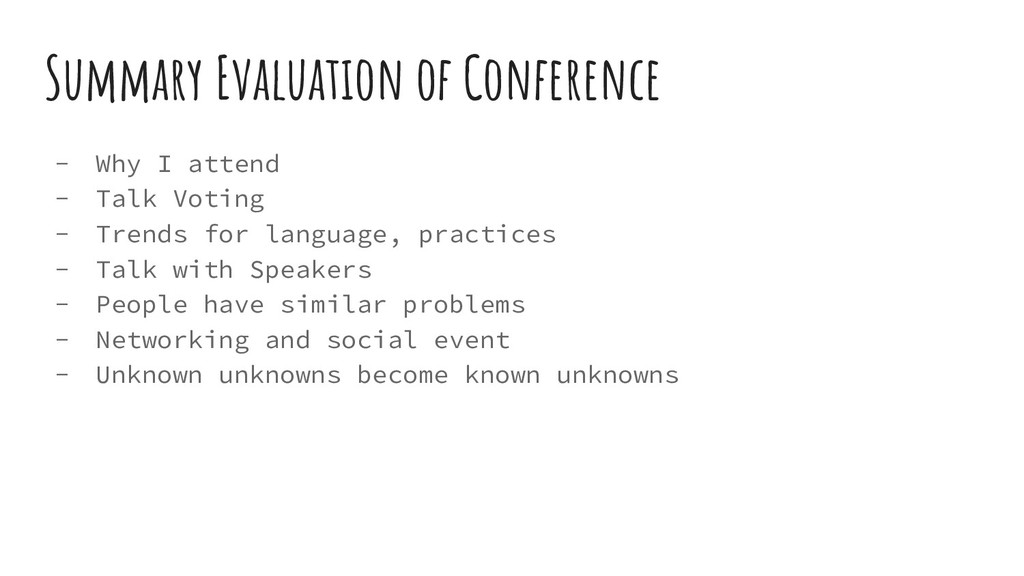
Voting - Trends for language, practices - Talk with Speakers - People have similar problems - Networking and social event - Unknown unknowns become known unknowns
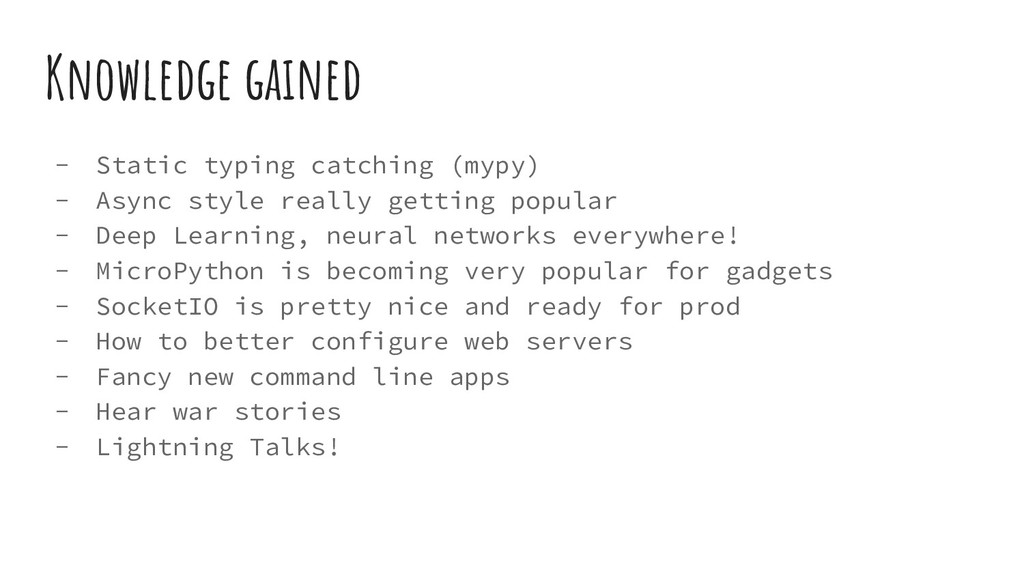
really getting popular - Deep Learning, neural networks everywhere! - MicroPython is becoming very popular for gadgets - SocketIO is pretty nice and ready for prod - How to better configure web servers - Fancy new command line apps - Hear war stories - Lightning Talks!
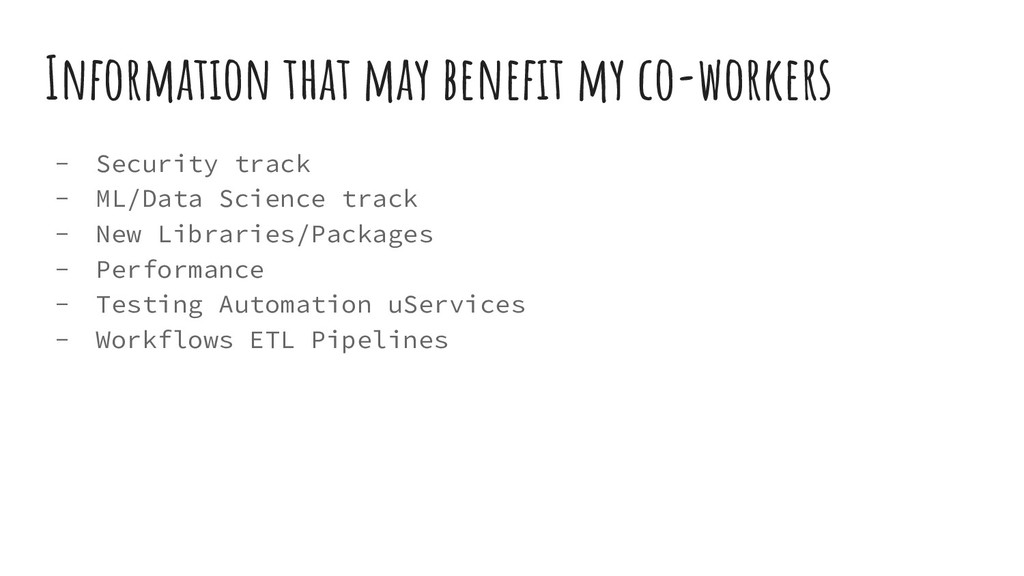
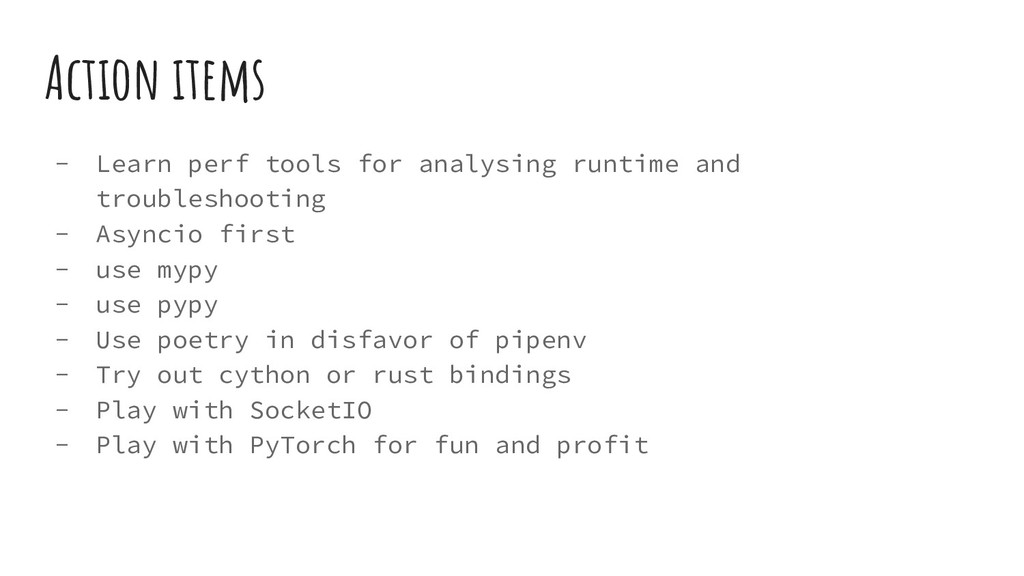
troubleshooting - Asyncio first - use mypy - use pypy - Use poetry in disfavor of pipenv - Try out cython or rust bindings - Play with SocketIO - Play with PyTorch for fun and profit
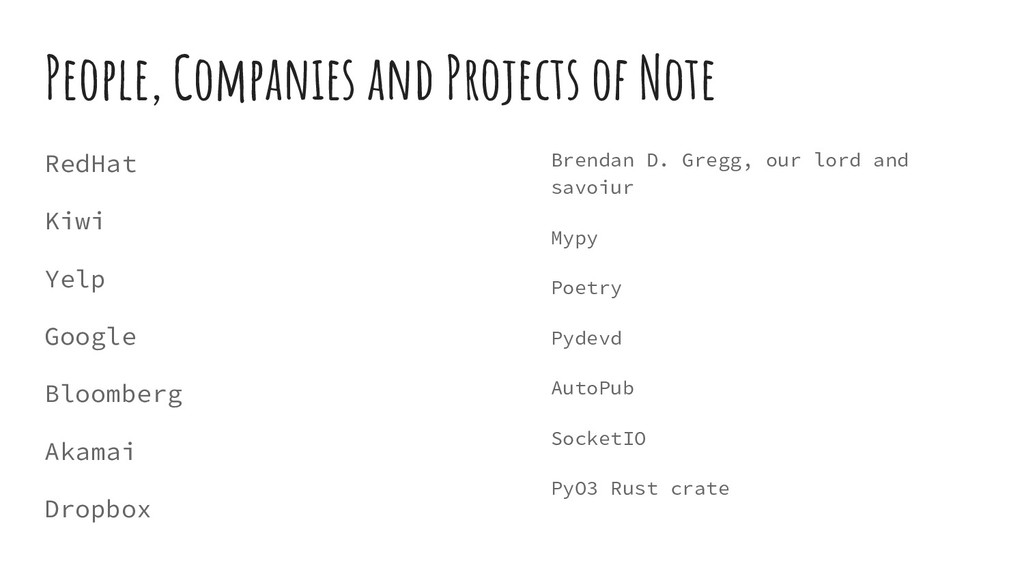
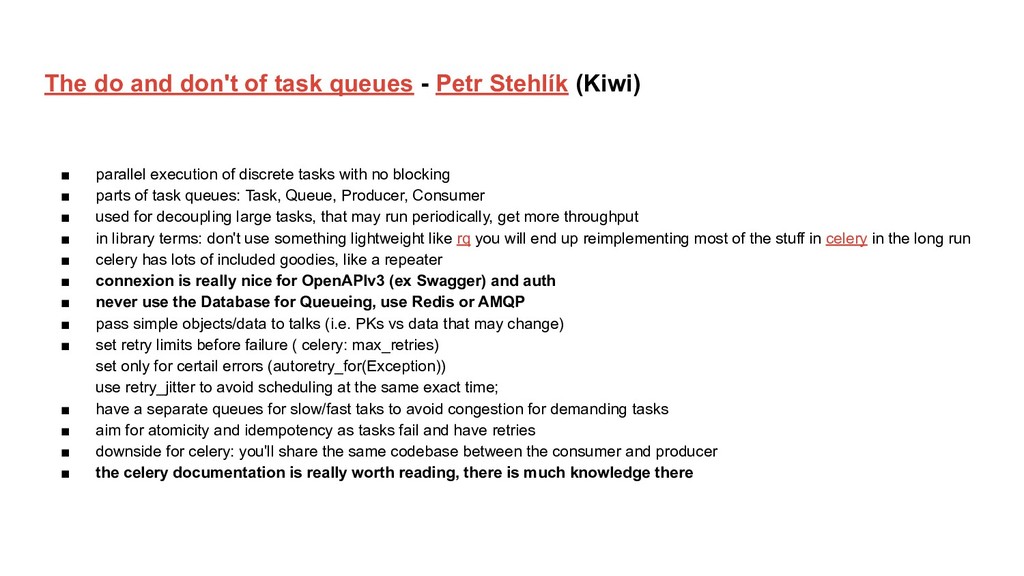
(Kiwi) ▪ parallel execution of discrete tasks with no blocking ▪ parts of task queues: Task, Queue, Producer, Consumer ▪ used for decoupling large tasks, that may run periodically, get more throughput ▪ in library terms: don't use something lightweight like rq you will end up reimplementing most of the stuff in celery in the long run ▪ celery has lots of included goodies, like a repeater ▪ connexion is really nice for OpenAPIv3 (ex Swagger) and auth ▪ never use the Database for Queueing, use Redis or AMQP ▪ pass simple objects/data to talks (i.e. PKs vs data that may change) ▪ set retry limits before failure ( celery: max_retries) set only for certail errors (autoretry_for(Exception)) use retry_jitter to avoid scheduling at the same exact time; ▪ have a separate queues for slow/fast taks to avoid congestion for demanding tasks ▪ aim for atomicity and idempotency as tasks fail and have retries ▪ downside for celery: you'll share the same codebase between the consumer and producer ▪ the celery documentation is really worth reading, there is much knowledge there
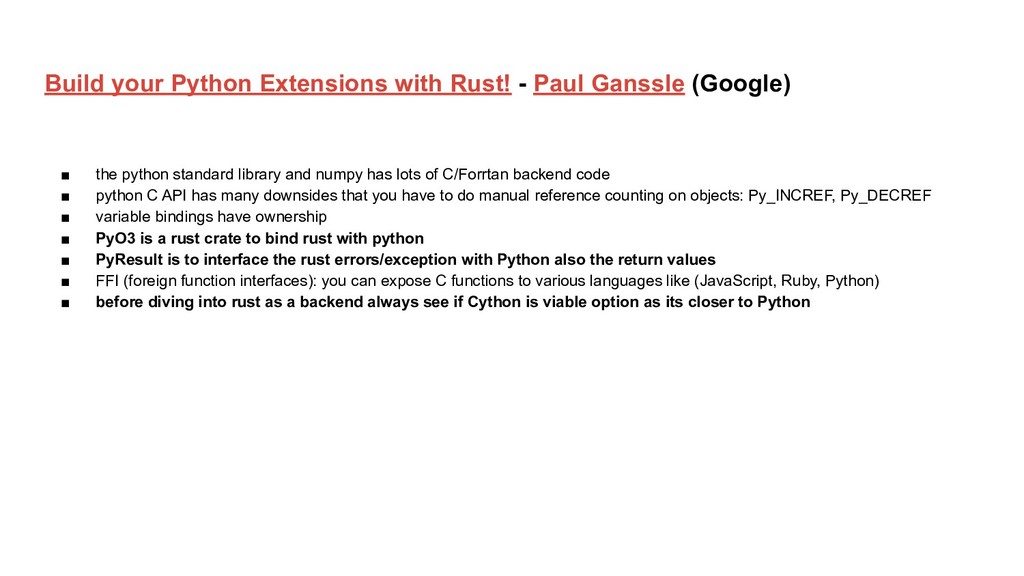
▪ the python standard library and numpy has lots of C/Forrtan backend code ▪ python C API has many downsides that you have to do manual reference counting on objects: Py_INCREF, Py_DECREF ▪ variable bindings have ownership ▪ PyO3 is a rust crate to bind rust with python ▪ PyResult is to interface the rust errors/exception with Python also the return values ▪ FFI (foreign function interfaces): you can expose C functions to various languages like (JavaScript, Ruby, Python) ▪ before diving into rust as a backend always see if Cython is viable option as its closer to Python
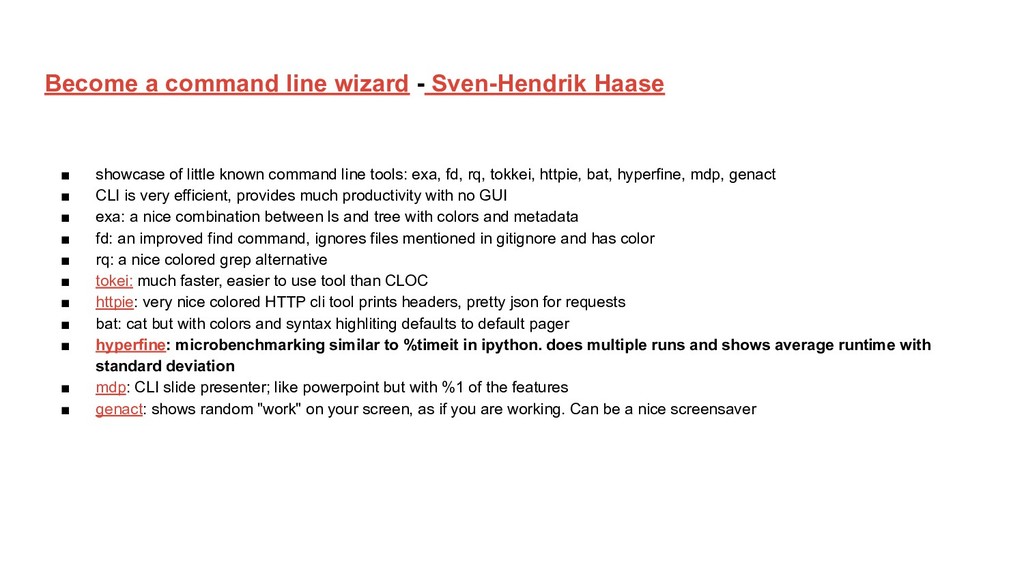
of little known command line tools: exa, fd, rq, tokkei, httpie, bat, hyperfine, mdp, genact ▪ CLI is very efficient, provides much productivity with no GUI ▪ exa: a nice combination between ls and tree with colors and metadata ▪ fd: an improved find command, ignores files mentioned in gitignore and has color ▪ rq: a nice colored grep alternative ▪ tokei: much faster, easier to use tool than CLOC ▪ httpie: very nice colored HTTP cli tool prints headers, pretty json for requests ▪ bat: cat but with colors and syntax highliting defaults to default pager ▪ hyperfine: microbenchmarking similar to %timeit in ipython. does multiple runs and shows average runtime with standard deviation ▪ mdp: CLI slide presenter; like powerpoint but with %1 of the features ▪ genact: shows random "work" on your screen, as if you are working. Can be a nice screensaver
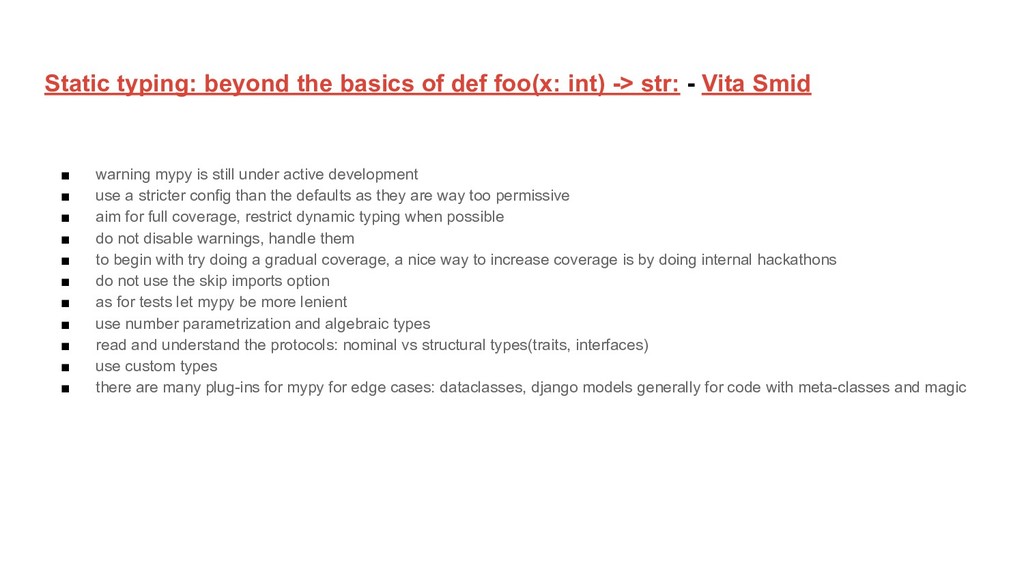
str: - Vita Smid ▪ warning mypy is still under active development ▪ use a stricter config than the defaults as they are way too permissive ▪ aim for full coverage, restrict dynamic typing when possible ▪ do not disable warnings, handle them ▪ to begin with try doing a gradual coverage, a nice way to increase coverage is by doing internal hackathons ▪ do not use the skip imports option ▪ as for tests let mypy be more lenient ▪ use number parametrization and algebraic types ▪ read and understand the protocols: nominal vs structural types(traits, interfaces) ▪ use custom types ▪ there are many plug-ins for mypy for edge cases: dataclasses, django models generally for code with meta-classes and magic
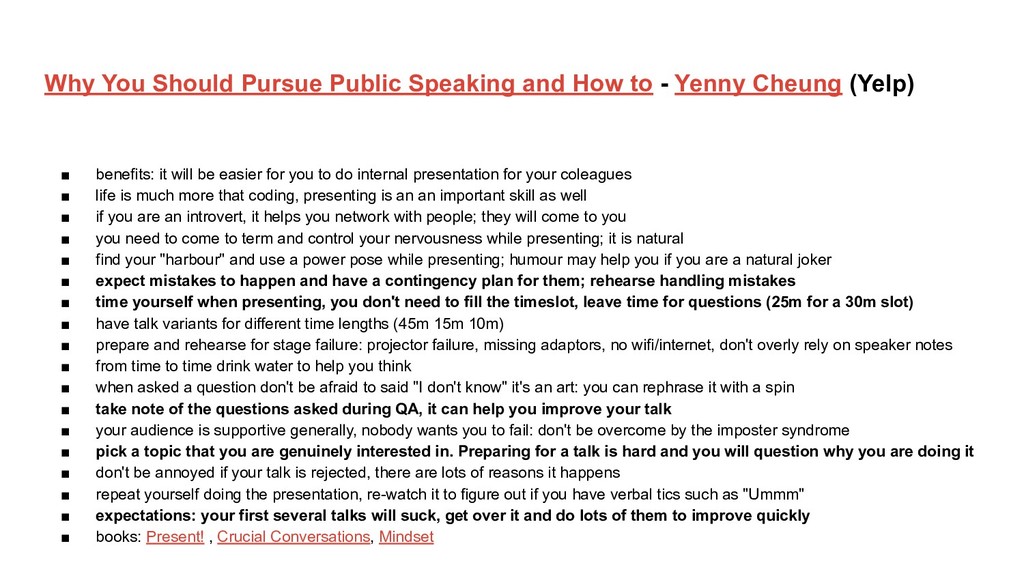
Yenny Cheung (Yelp) ▪ benefits: it will be easier for you to do internal presentation for your coleagues ▪ life is much more that coding, presenting is an an important skill as well ▪ if you are an introvert, it helps you network with people; they will come to you ▪ you need to come to term and control your nervousness while presenting; it is natural ▪ find your "harbour" and use a power pose while presenting; humour may help you if you are a natural joker ▪ expect mistakes to happen and have a contingency plan for them; rehearse handling mistakes ▪ time yourself when presenting, you don't need to fill the timeslot, leave time for questions (25m for a 30m slot) ▪ have talk variants for different time lengths (45m 15m 10m) ▪ prepare and rehearse for stage failure: projector failure, missing adaptors, no wifi/internet, don't overly rely on speaker notes ▪ from time to time drink water to help you think ▪ when asked a question don't be afraid to said "I don't know" it's an art: you can rephrase it with a spin ▪ take note of the questions asked during QA, it can help you improve your talk ▪ your audience is supportive generally, nobody wants you to fail: don't be overcome by the imposter syndrome ▪ pick a topic that you are genuinely interested in. Preparing for a talk is hard and you will question why you are doing it ▪ don't be annoyed if your talk is rejected, there are lots of reasons it happens ▪ repeat yourself doing the presentation, re-watch it to figure out if you have verbal tics such as "Ummm" ▪ expectations: your first several talks will suck, get over it and do lots of them to improve quickly ▪ books: Present! , Crucial Conversations, Mindset
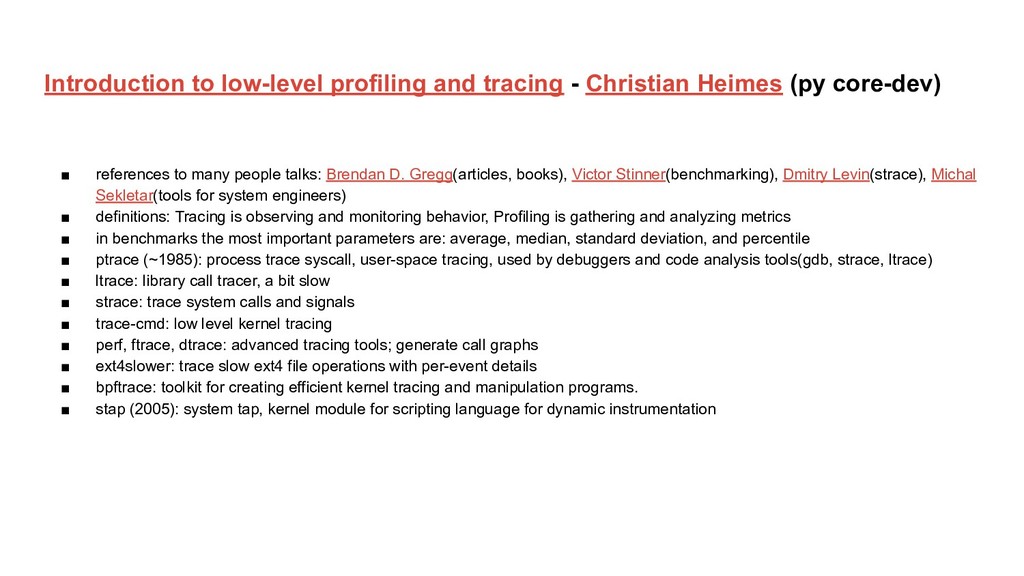
core-dev) ▪ references to many people talks: Brendan D. Gregg(articles, books), Victor Stinner(benchmarking), Dmitry Levin(strace), Michal Sekletar(tools for system engineers) ▪ definitions: Tracing is observing and monitoring behavior, Profiling is gathering and analyzing metrics ▪ in benchmarks the most important parameters are: average, median, standard deviation, and percentile ▪ ptrace (~1985): process trace syscall, user-space tracing, used by debuggers and code analysis tools(gdb, strace, ltrace) ▪ ltrace: library call tracer, a bit slow ▪ strace: trace system calls and signals ▪ trace-cmd: low level kernel tracing ▪ perf, ftrace, dtrace: advanced tracing tools; generate call graphs ▪ ext4slower: trace slow ext4 file operations with per-event details ▪ bpftrace: toolkit for creating efficient kernel tracing and manipulation programs. ▪ stap (2005): system tap, kernel module for scripting language for dynamic instrumentation
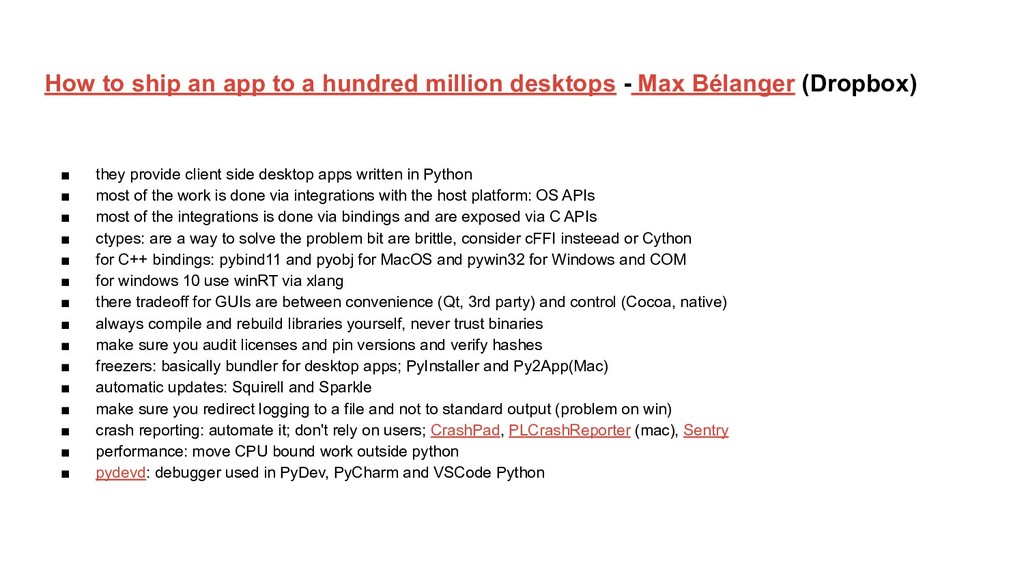
- Max Bélanger (Dropbox) ▪ they provide client side desktop apps written in Python ▪ most of the work is done via integrations with the host platform: OS APIs ▪ most of the integrations is done via bindings and are exposed via C APIs ▪ ctypes: are a way to solve the problem bit are brittle, consider cFFI insteead or Cython ▪ for C++ bindings: pybind11 and pyobj for MacOS and pywin32 for Windows and COM ▪ for windows 10 use winRT via xlang ▪ there tradeoff for GUIs are between convenience (Qt, 3rd party) and control (Cocoa, native) ▪ always compile and rebuild libraries yourself, never trust binaries ▪ make sure you audit licenses and pin versions and verify hashes ▪ freezers: basically bundler for desktop apps; PyInstaller and Py2App(Mac) ▪ automatic updates: Squirell and Sparkle ▪ make sure you redirect logging to a file and not to standard output (problem on win) ▪ crash reporting: automate it; don't rely on users; CrashPad, PLCrashReporter (mac), Sentry ▪ performance: move CPU bound work outside python ▪ pydevd: debugger used in PyDev, PyCharm and VSCode Python
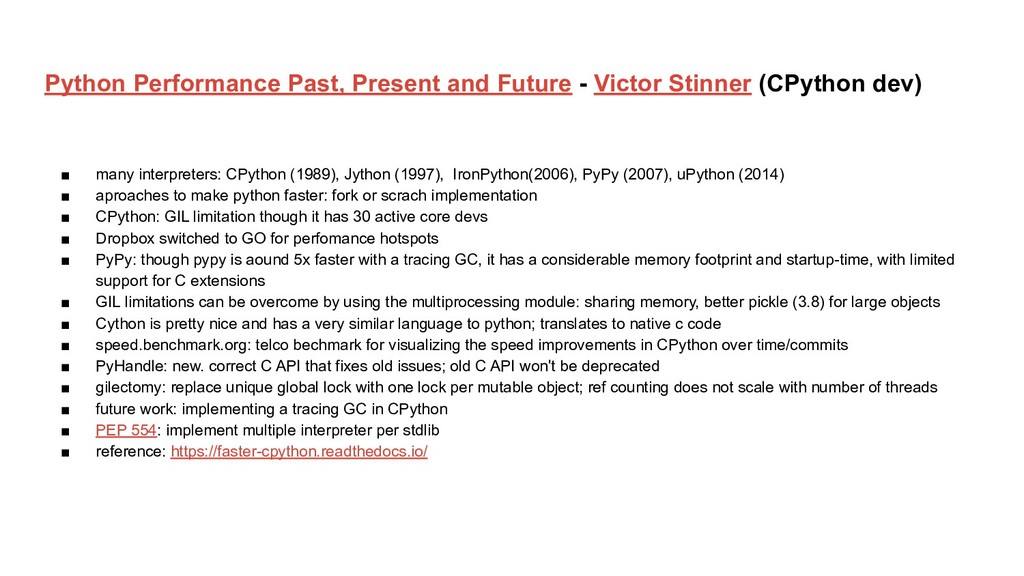
dev) ▪ many interpreters: CPython (1989), Jython (1997), IronPython(2006), PyPy (2007), uPython (2014) ▪ aproaches to make python faster: fork or scrach implementation ▪ CPython: GIL limitation though it has 30 active core devs ▪ Dropbox switched to GO for perfomance hotspots ▪ PyPy: though pypy is aound 5x faster with a tracing GC, it has a considerable memory footprint and startup-time, with limited support for C extensions ▪ GIL limitations can be overcome by using the multiprocessing module: sharing memory, better pickle (3.8) for large objects ▪ Cython is pretty nice and has a very similar language to python; translates to native c code ▪ speed.benchmark.org: telco bechmark for visualizing the speed improvements in CPython over time/commits ▪ PyHandle: new. correct C API that fixes old issues; old C API won't be deprecated ▪ gilectomy: replace unique global lock with one lock per mutable object; ref counting does not scale with number of threads ▪ future work: implementing a tracing GC in CPython ▪ PEP 554: implement multiple interpreter per stdlib ▪ reference: https://faster-cpython.readthedocs.io/
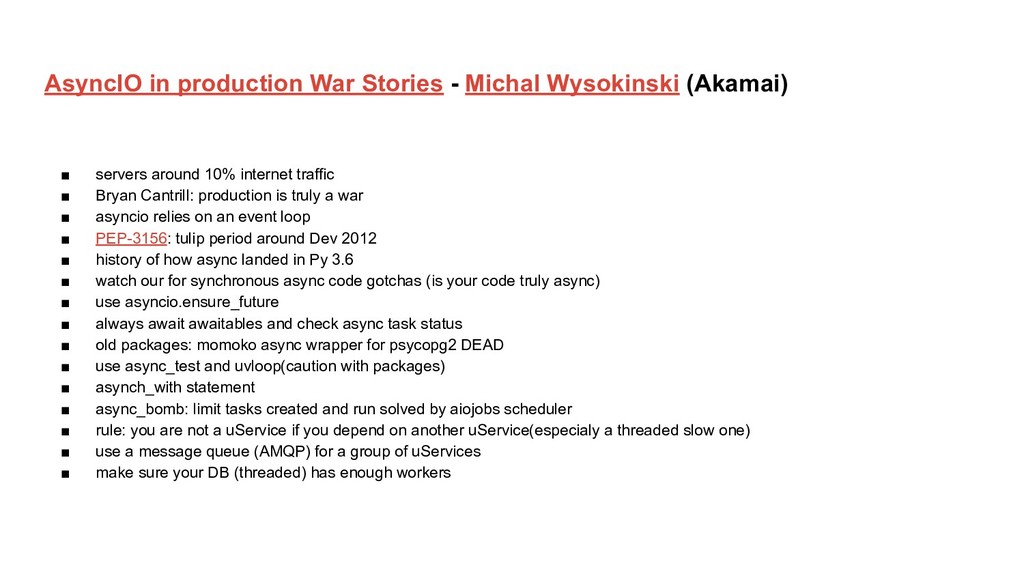
servers around 10% internet traffic ▪ Bryan Cantrill: production is truly a war ▪ asyncio relies on an event loop ▪ PEP-3156: tulip period around Dev 2012 ▪ history of how async landed in Py 3.6 ▪ watch our for synchronous async code gotchas (is your code truly async) ▪ use asyncio.ensure_future ▪ always await awaitables and check async task status ▪ old packages: momoko async wrapper for psycopg2 DEAD ▪ use async_test and uvloop(caution with packages) ▪ asynch_with statement ▪ async_bomb: limit tasks created and run solved by aiojobs scheduler ▪ rule: you are not a uService if you depend on another uService(especialy a threaded slow one) ▪ use a message queue (AMQP) for a group of uServices ▪ make sure your DB (threaded) has enough workers
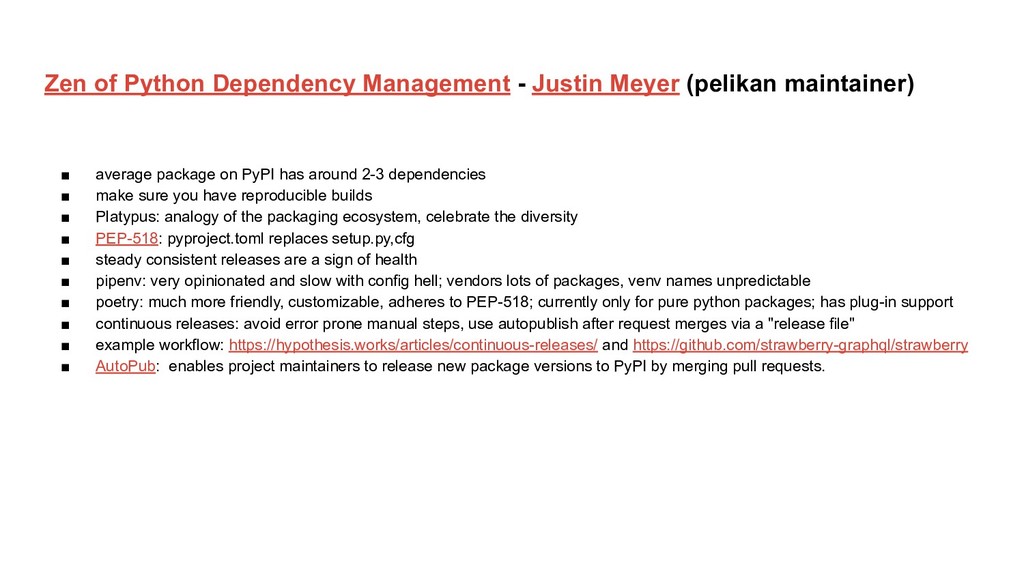
▪ average package on PyPI has around 2-3 dependencies ▪ make sure you have reproducible builds ▪ Platypus: analogy of the packaging ecosystem, celebrate the diversity ▪ PEP-518: pyproject.toml replaces setup.py,cfg ▪ steady consistent releases are a sign of health ▪ pipenv: very opinionated and slow with config hell; vendors lots of packages, venv names unpredictable ▪ poetry: much more friendly, customizable, adheres to PEP-518; currently only for pure python packages; has plug-in support ▪ continuous releases: avoid error prone manual steps, use autopublish after request merges via a "release file" ▪ example workflow: https://hypothesis.works/articles/continuous-releases/ and https://github.com/strawberry-graphql/strawberry ▪ AutoPub: enables project maintainers to release new package versions to PyPI by merging pull requests.
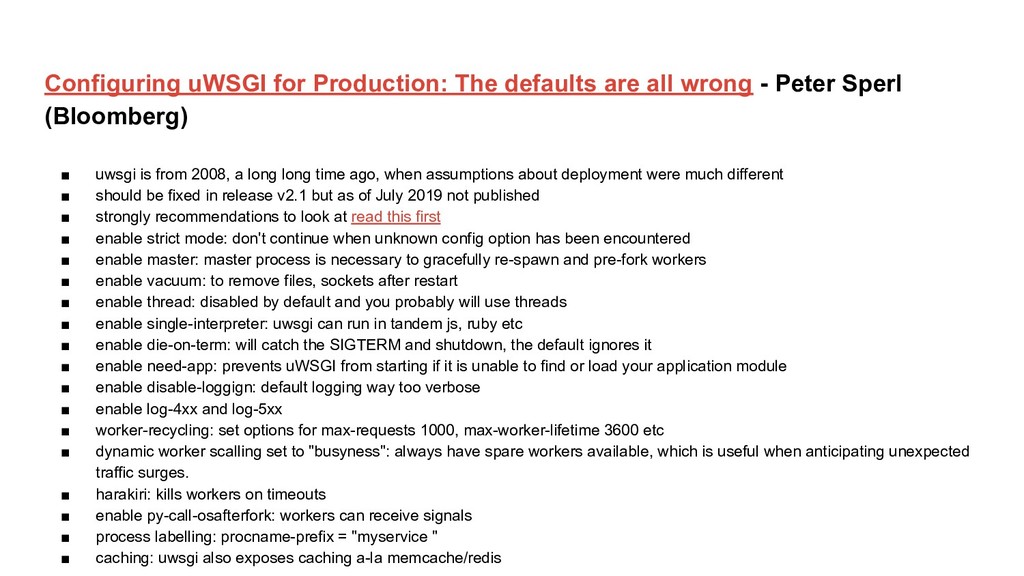
Peter Sperl (Bloomberg) ▪ uwsgi is from 2008, a long long time ago, when assumptions about deployment were much different ▪ should be fixed in release v2.1 but as of July 2019 not published ▪ strongly recommendations to look at read this first ▪ enable strict mode: don't continue when unknown config option has been encountered ▪ enable master: master process is necessary to gracefully re-spawn and pre-fork workers ▪ enable vacuum: to remove files, sockets after restart ▪ enable thread: disabled by default and you probably will use threads ▪ enable single-interpreter: uwsgi can run in tandem js, ruby etc ▪ enable die-on-term: will catch the SIGTERM and shutdown, the default ignores it ▪ enable need-app: prevents uWSGI from starting if it is unable to find or load your application module ▪ enable disable-loggign: default logging way too verbose ▪ enable log-4xx and log-5xx ▪ worker-recycling: set options for max-requests 1000, max-worker-lifetime 3600 etc ▪ dynamic worker scalling set to "busyness": always have spare workers available, which is useful when anticipating unexpected traffic surges. ▪ harakiri: kills workers on timeouts ▪ enable py-call-osafterfork: workers can receive signals ▪ process labelling: procname-prefix = "myservice " ▪ caching: uwsgi also exposes caching a-la memcache/redis
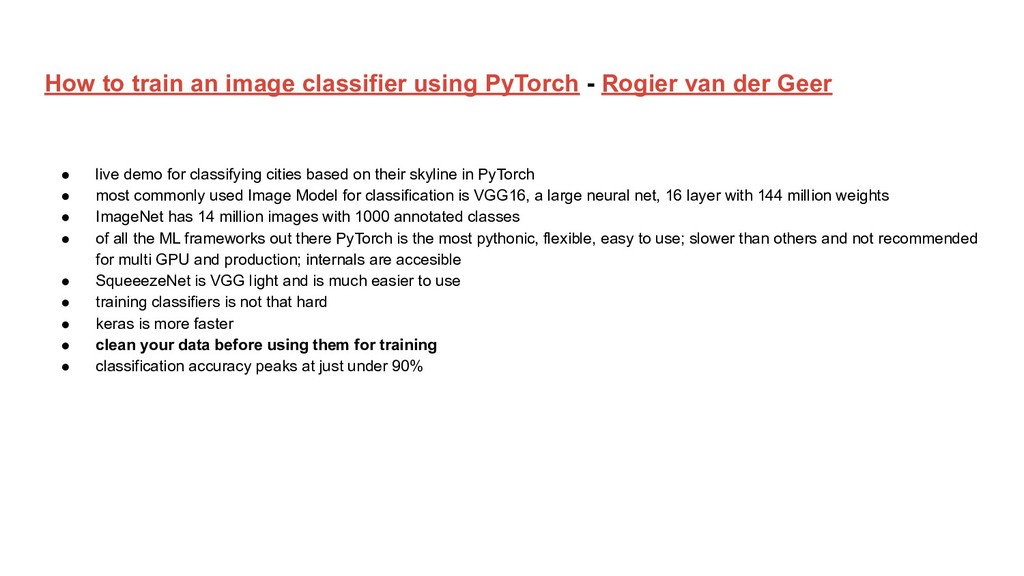
van der Geer • live demo for classifying cities based on their skyline in PyTorch • most commonly used Image Model for classification is VGG16, a large neural net, 16 layer with 144 million weights • ImageNet has 14 million images with 1000 annotated classes • of all the ML frameworks out there PyTorch is the most pythonic, flexible, easy to use; slower than others and not recommended for multi GPU and production; internals are accesible • SqueeezeNet is VGG light and is much easier to use • training classifiers is not that hard • keras is more faster • clean your data before using them for training • classification accuracy peaks at just under 90%
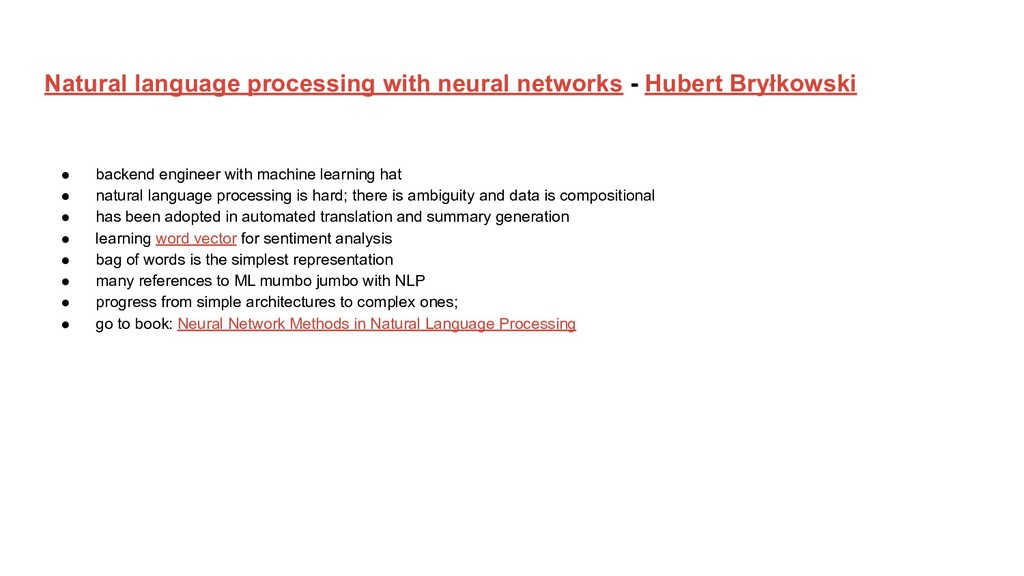
backend engineer with machine learning hat • natural language processing is hard; there is ambiguity and data is compositional • has been adopted in automated translation and summary generation • learning word vector for sentiment analysis • bag of words is the simplest representation • many references to ML mumbo jumbo with NLP • progress from simple architectures to complex ones; • go to book: Neural Network Methods in Natural Language Processing
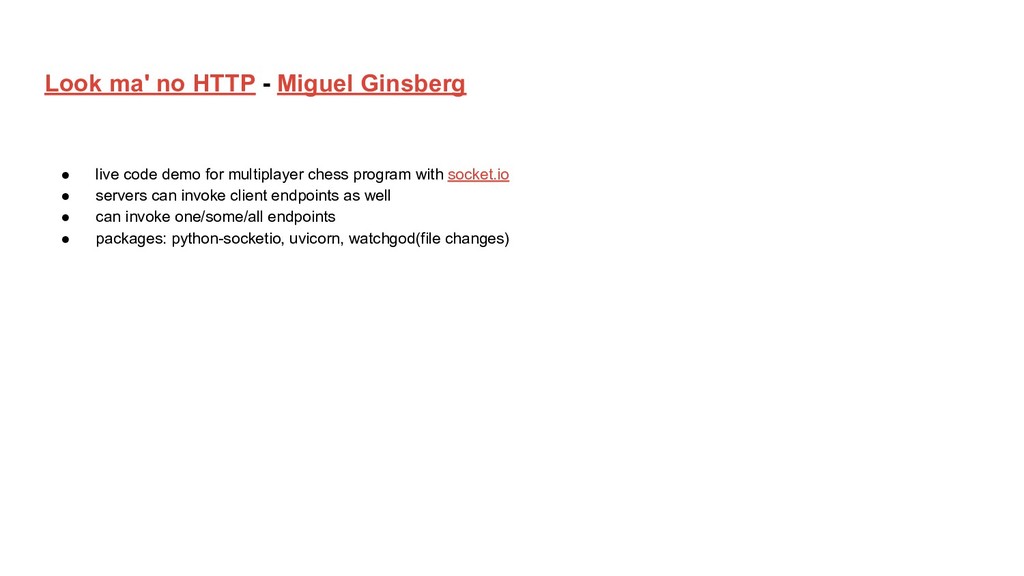
demo for multiplayer chess program with socket.io • servers can invoke client endpoints as well • can invoke one/some/all endpoints • packages: python-socketio, uvicorn, watchgod(file changes)
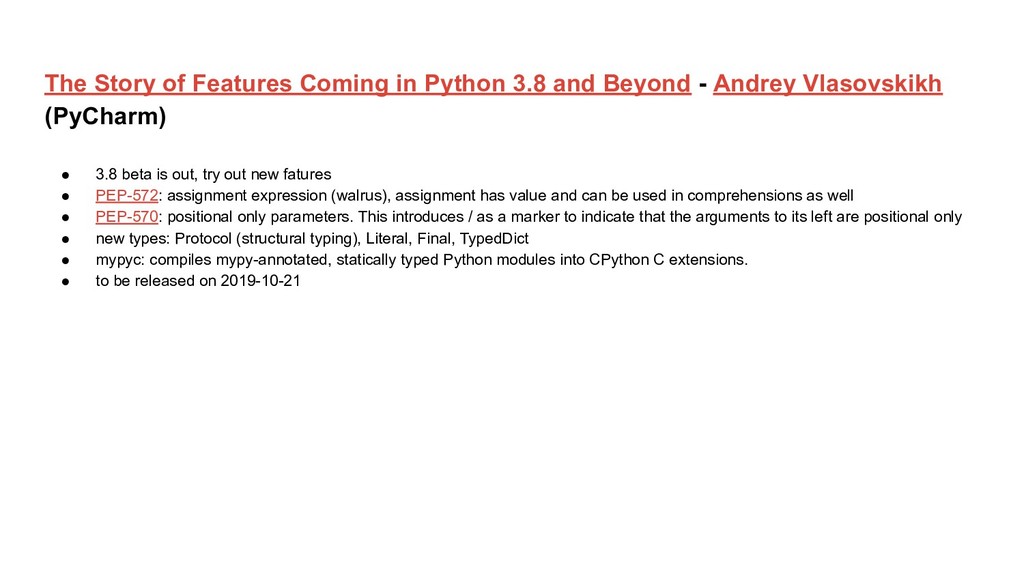
- Andrey Vlasovskikh (PyCharm) • 3.8 beta is out, try out new fatures • PEP-572: assignment expression (walrus), assignment has value and can be used in comprehensions as well • PEP-570: positional only parameters. This introduces / as a marker to indicate that the arguments to its left are positional only • new types: Protocol (structural typing), Literal, Final, TypedDict • mypyc: compiles mypy-annotated, statically typed Python modules into CPython C extensions. • to be released on 2019-10-21
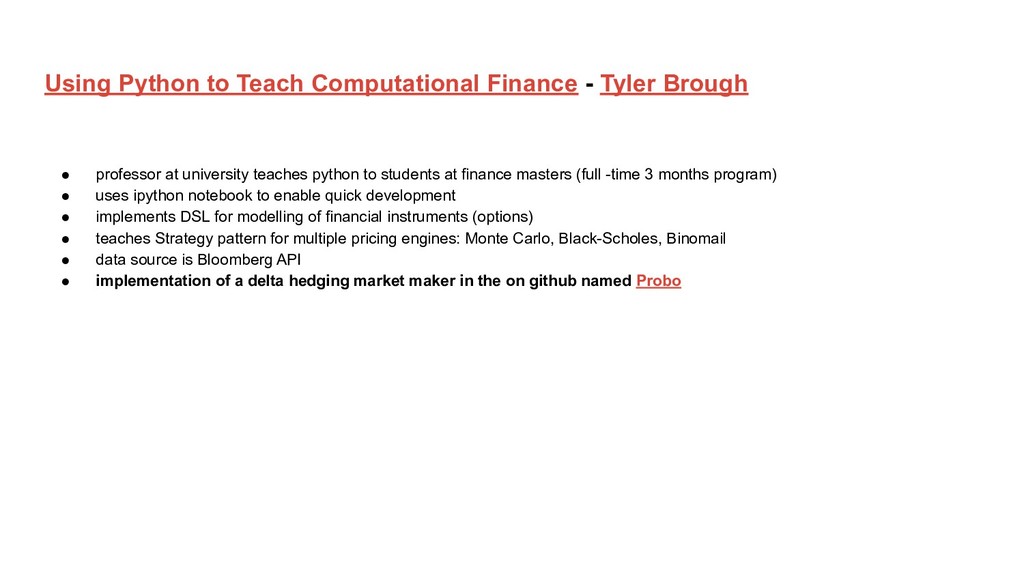
professor at university teaches python to students at finance masters (full -time 3 months program) • uses ipython notebook to enable quick development • implements DSL for modelling of financial instruments (options) • teaches Strategy pattern for multiple pricing engines: Monte Carlo, Black-Scholes, Binomail • data source is Bloomberg API • implementation of a delta hedging market maker in the on github named Probo


 zoliszeredi
 mhrtech
 tetsuya28
 takahashim
 gionn
 yazm
 jozono
 glaforge
 rfdnxbro
 prog893
 yamad
 occhi
 sansantech
 jnunemaker
 codingconduct
 afnizarnur
 morganepeng
 aleyda
 soudai
 bryan
 letsgokoyo
 thirion
 tamaranovitovic