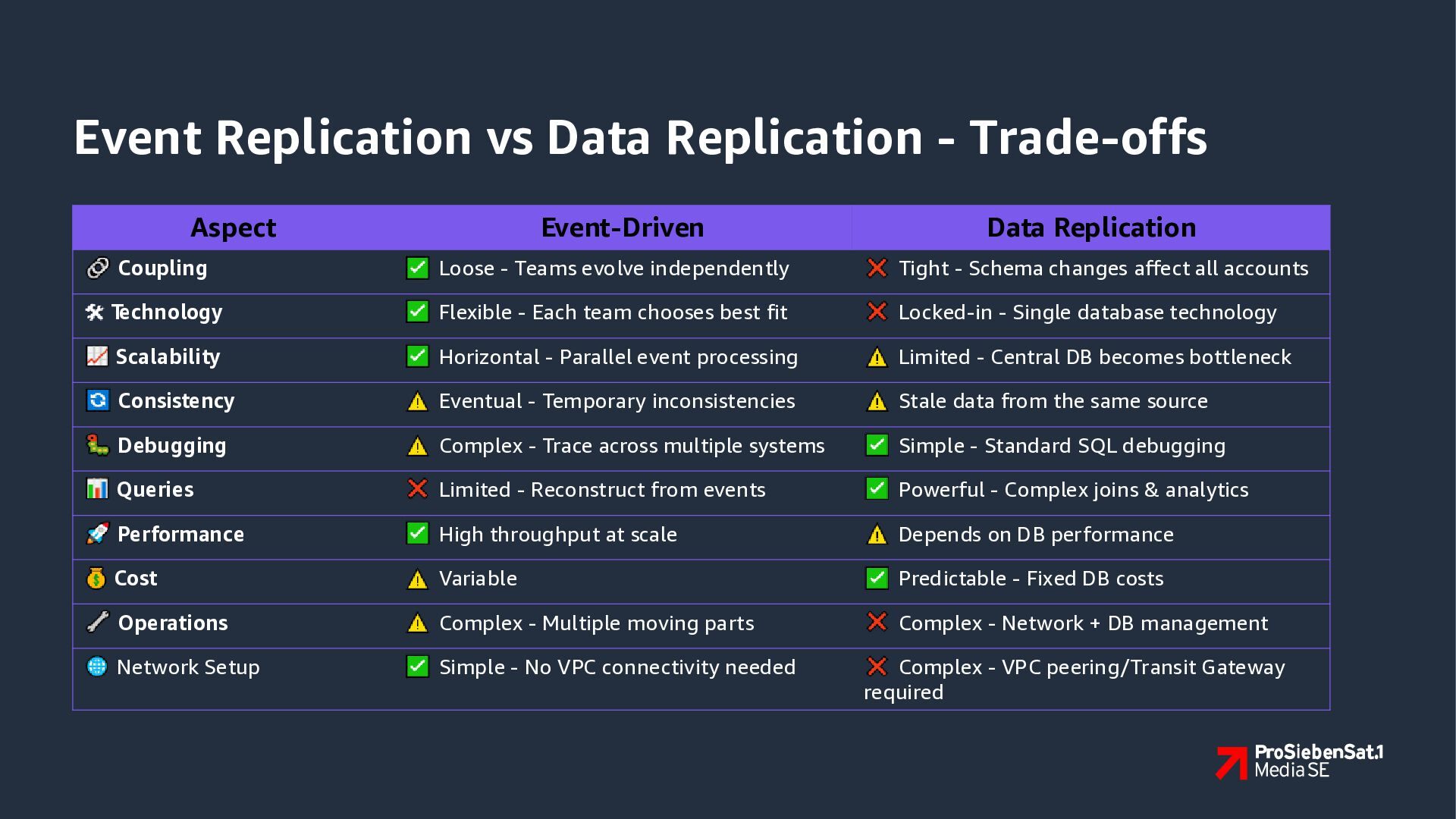
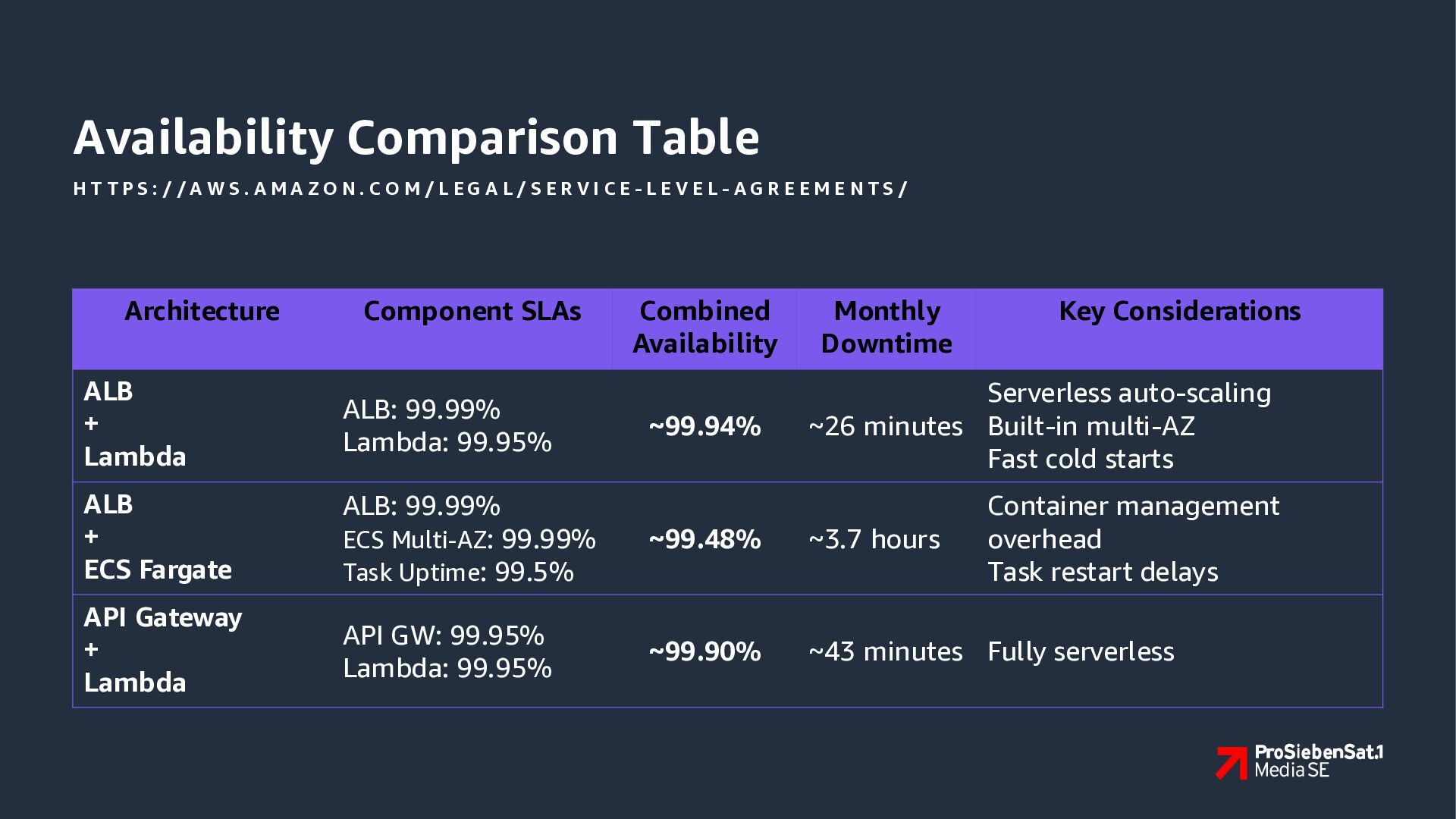
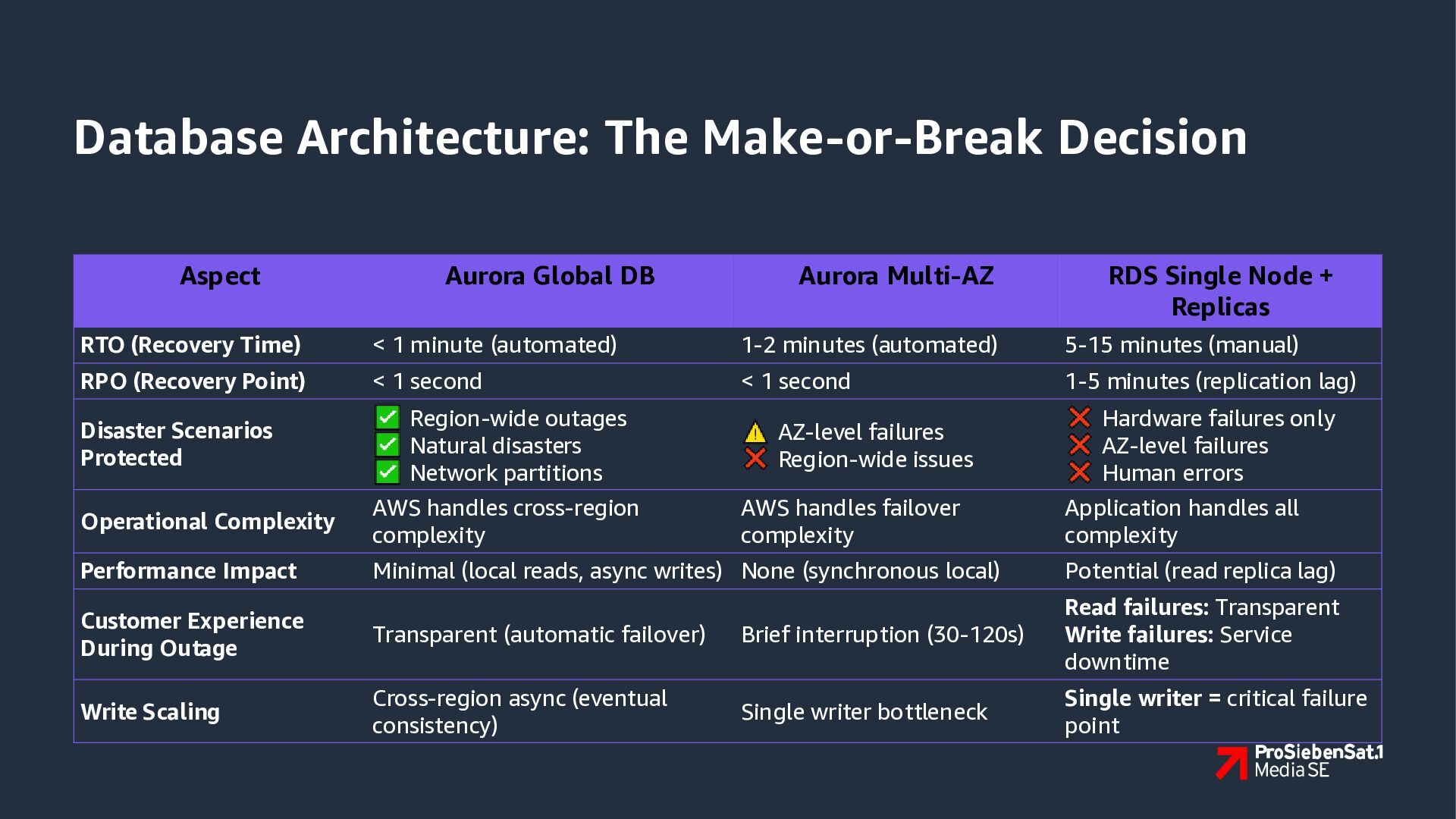
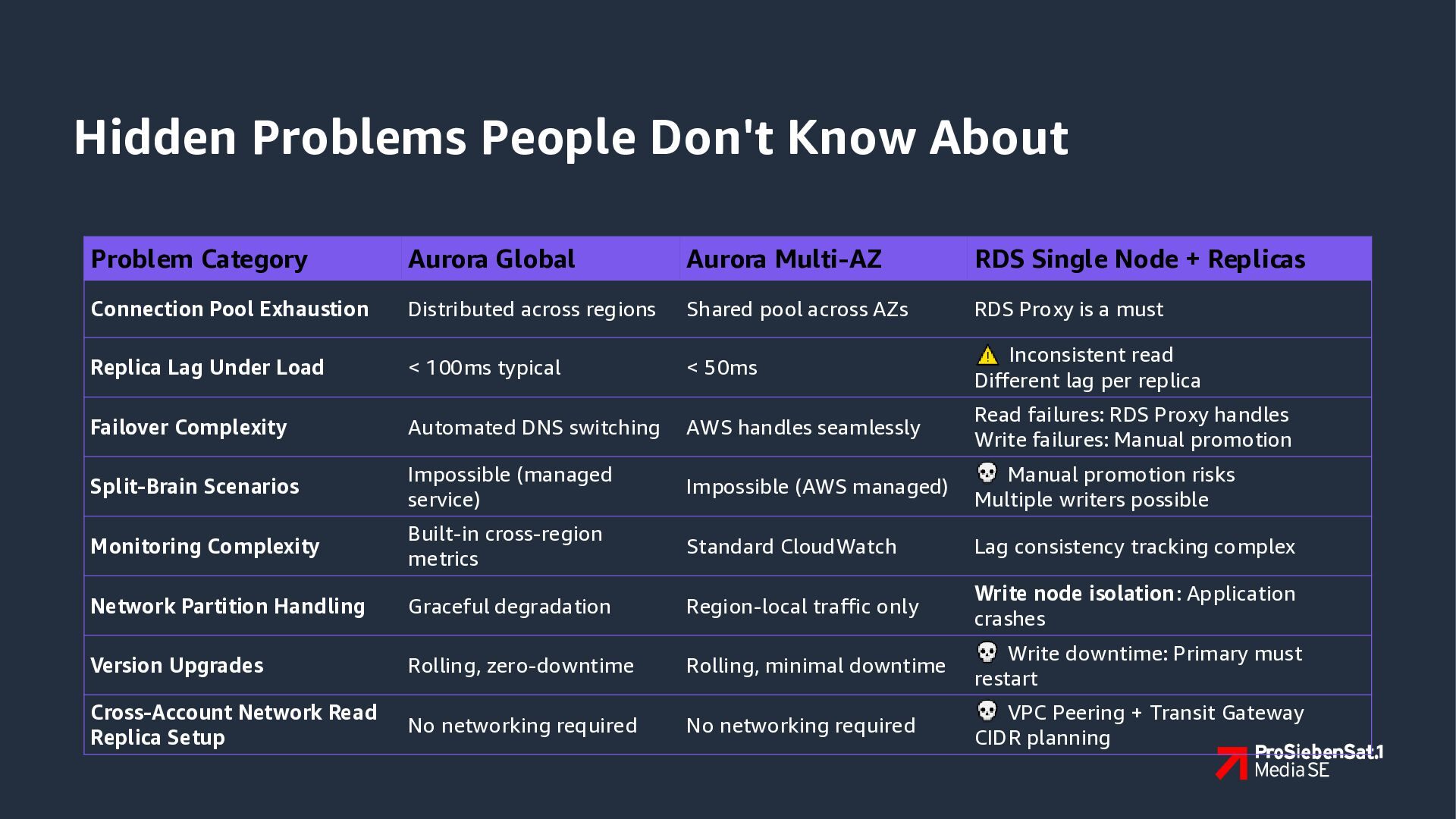
Replication Coupling Loose - Teams evolve independently Tight - Schema changes affect all accounts Technology Flexible - Each team chooses best fit Locked-in - Single database technology Scalability Horizontal - Parallel event processing Limited - Central DB becomes bottleneck Consistency Eventual - Temporary inconsistencies Stale data from the same source Debugging Complex - Trace across multiple systems Simple - Standard SQL debugging Queries Limited - Reconstruct from events Powerful - Complex joins & analytics Performance High throughput at scale Depends on DB performance Cost Variable Predictable - Fixed DB costs Operations Complex - Multiple moving parts Complex - Network + DB management Network Setup Simple - No VPC connectivity needed Complex - VPC peering/Transit Gateway required
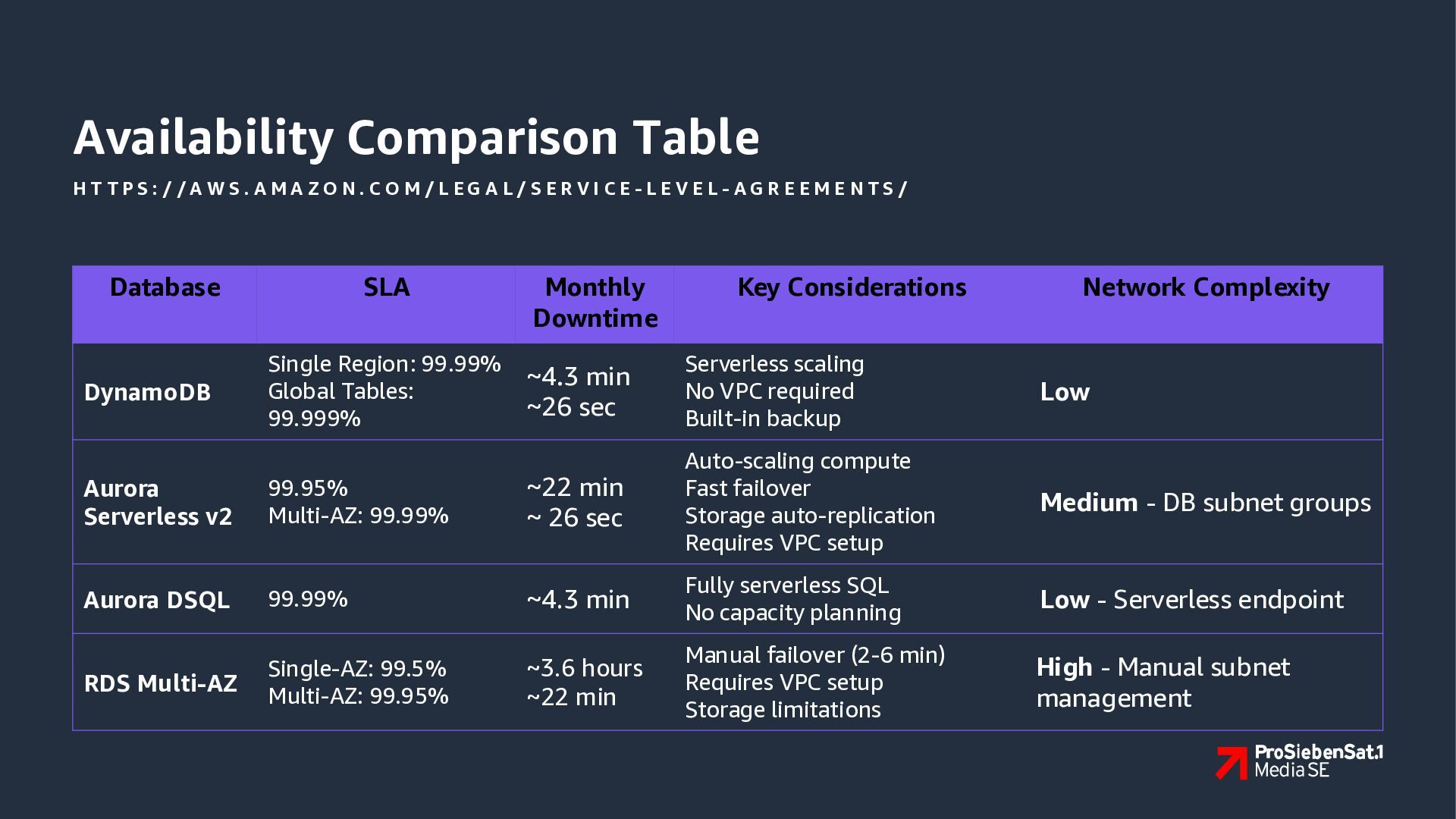
C OM /L EGA L/ SER VI CE-LE VE L-AGR E EM E NTS/ Database DynamoDB SLA Single Region: 99.99% Global Tables: 99.999% Monthly Downtime Key Considerations Network Complexity ~4.3 min ~26 sec Serverless scaling No VPC required Built-in backup Low Medium - DB subnet groups Aurora Serverless v2 99.95% Multi-AZ: 99.99% ~22 min ~ 26 sec Auto-scaling compute Fast failover Storage auto-replication Requires VPC setup Aurora DSQL 99.99% ~4.3 min Fully serverless SQL No capacity planning Low - Serverless endpoint RDS Multi-AZ Single-AZ: 99.5% Multi-AZ: 99.95% ~3.6 hours ~22 min Manual failover (2-6 min) Requires VPC setup Storage limitations High - Manual subnet management
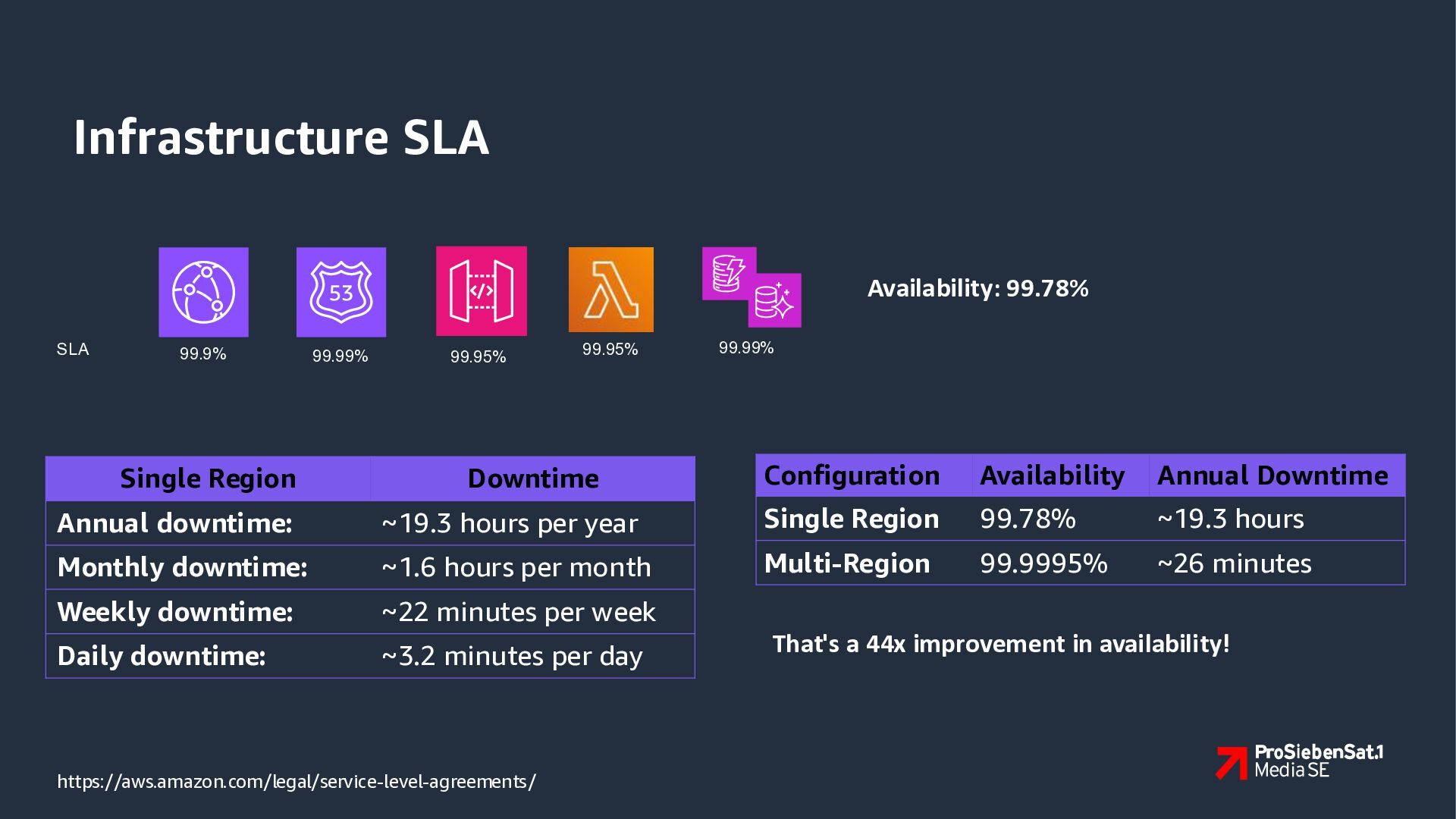
99.95% Downtime 99.99% Configuration Availability Annual Downtime Annual downtime: ~19.3 hours per year Single Region 99.78% ~19.3 hours Monthly downtime: ~1.6 hours per month Multi-Region 99.9995% ~26 minutes Weekly downtime: ~22 minutes per week Daily downtime: ~3.2 minutes per day https://aws.amazon.com/legal/service-level-agreements/ That's a 44x improvement in availability!
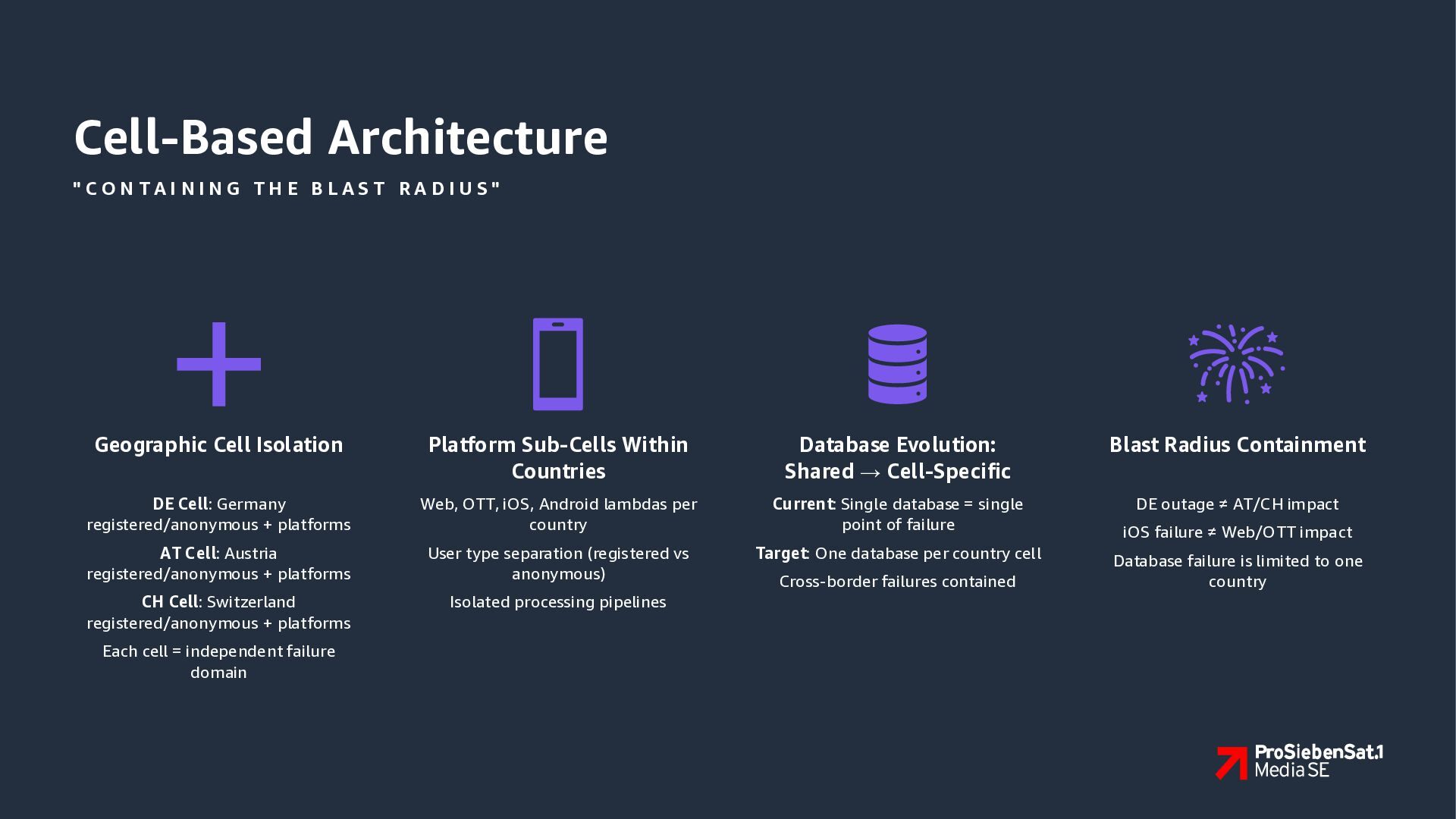
LAS T RA DIU S" Geographic Cell Isolation Platform Sub-Cells Within Countries Database Evolution: Shared → Cell-Specific Blast Radius Containment DE Cell: Germany registered/anonymous + platforms Web, OTT, iOS, Android lambdas per country Current: Single database = single point of failure DE outage ≠ AT/CH impact AT Cell: Austria registered/anonymous + platforms User type separation (registered vs anonymous) Target: One database per country cell CH Cell: Switzerland registered/anonymous + platforms Isolated processing pipelines Each cell = independent failure domain Cross-border failures contained iOS failure ≠ Web/OTT impact Database failure is limited to one country
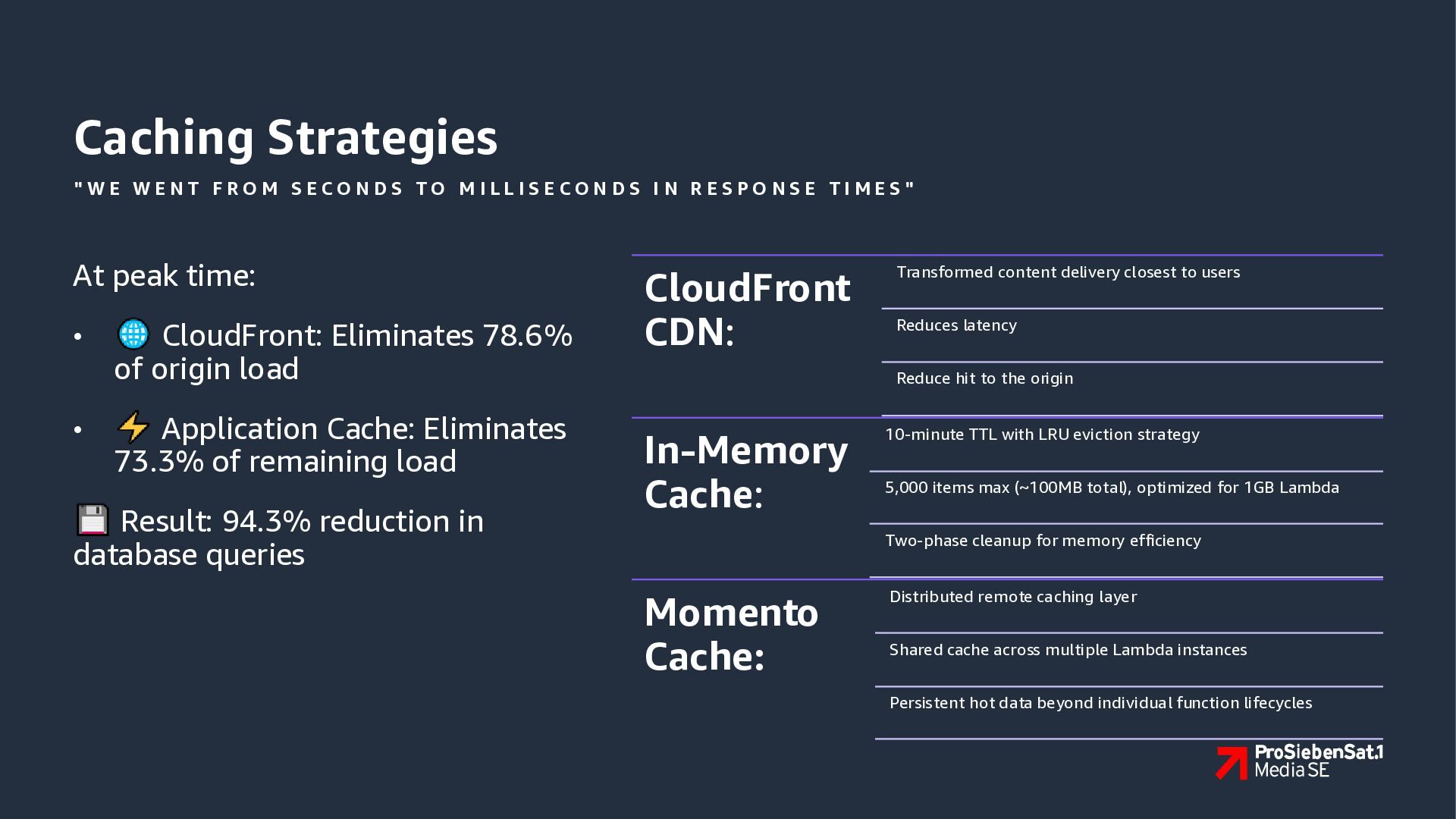
ILL ISECON DS I N RESPO NSE TI MES" At peak time: • • CloudFront: Eliminates 78.6% of origin load Application Cache: Eliminates 73.3% of remaining load Result: 94.3% reduction in database queries CloudFront CDN: Transformed content delivery closest to users Reduces latency Reduce hit to the origin In-Memory Cache: 10-minute TTL with LRU eviction strategy 5,000 items max (~100MB total), optimized for 1GB Lambda Two-phase cleanup for memory efficiency Momento Cache: Distributed remote caching layer Shared cache across multiple Lambda instances Persistent hot data beyond individual function lifecycles
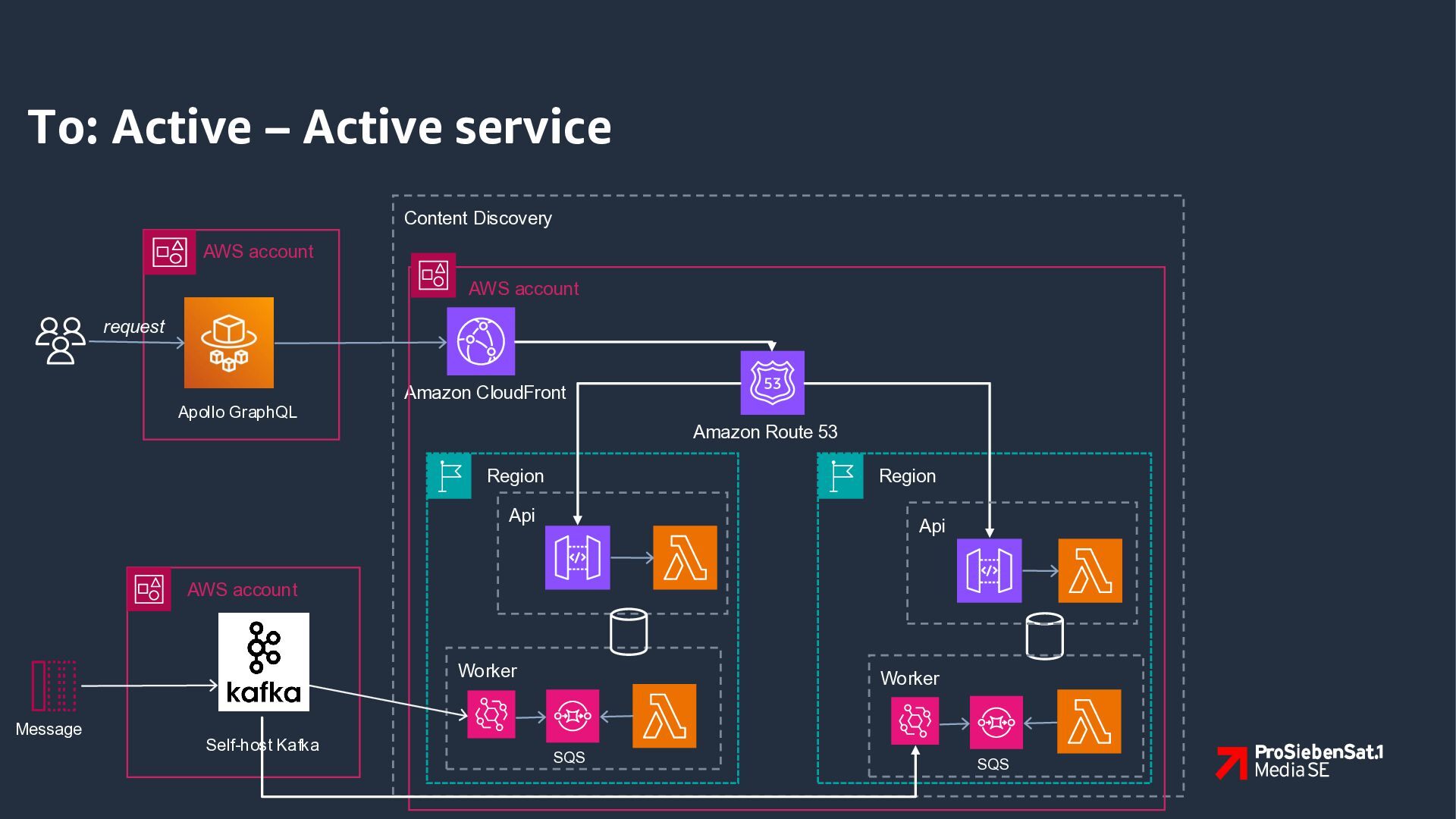
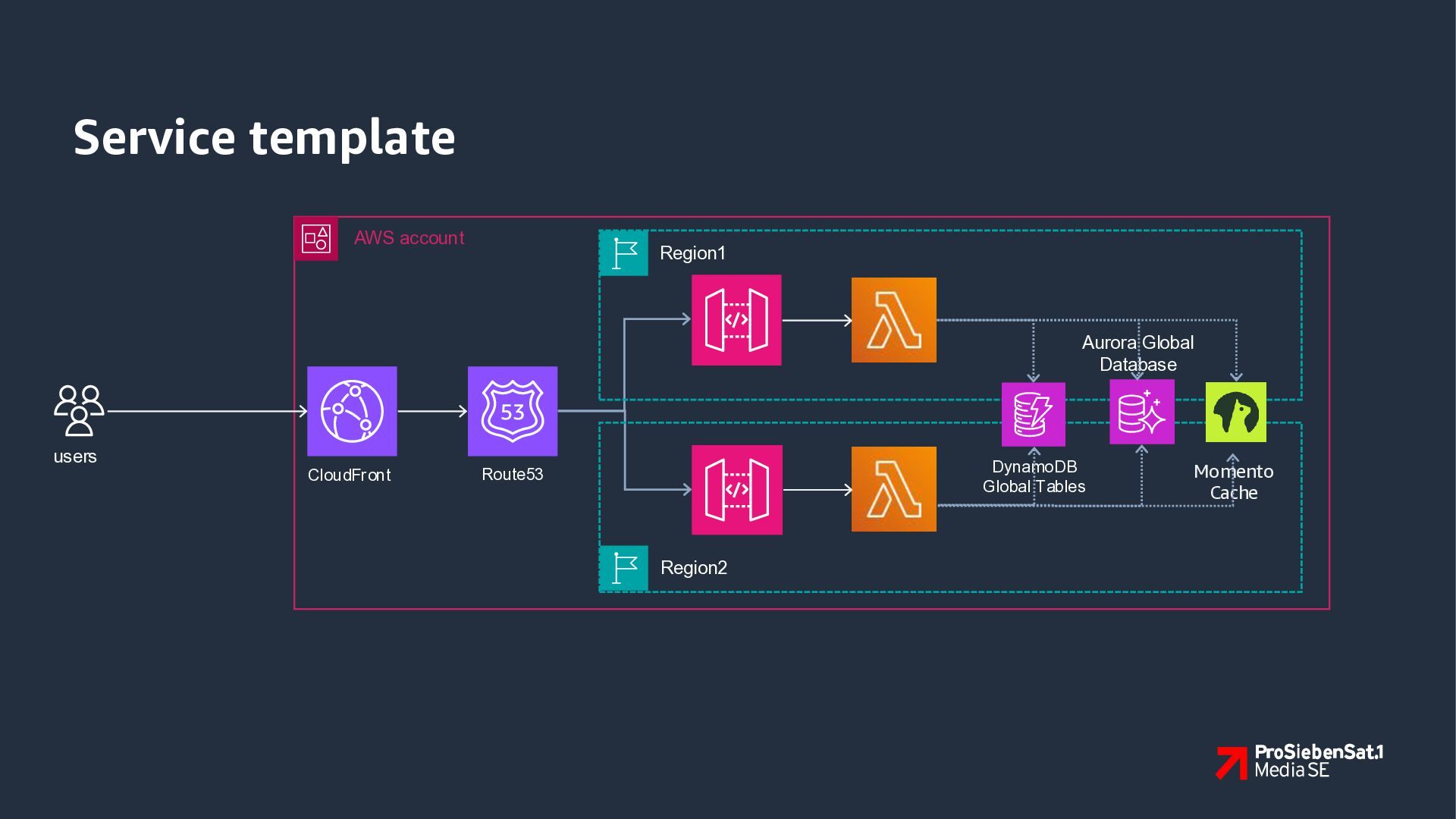
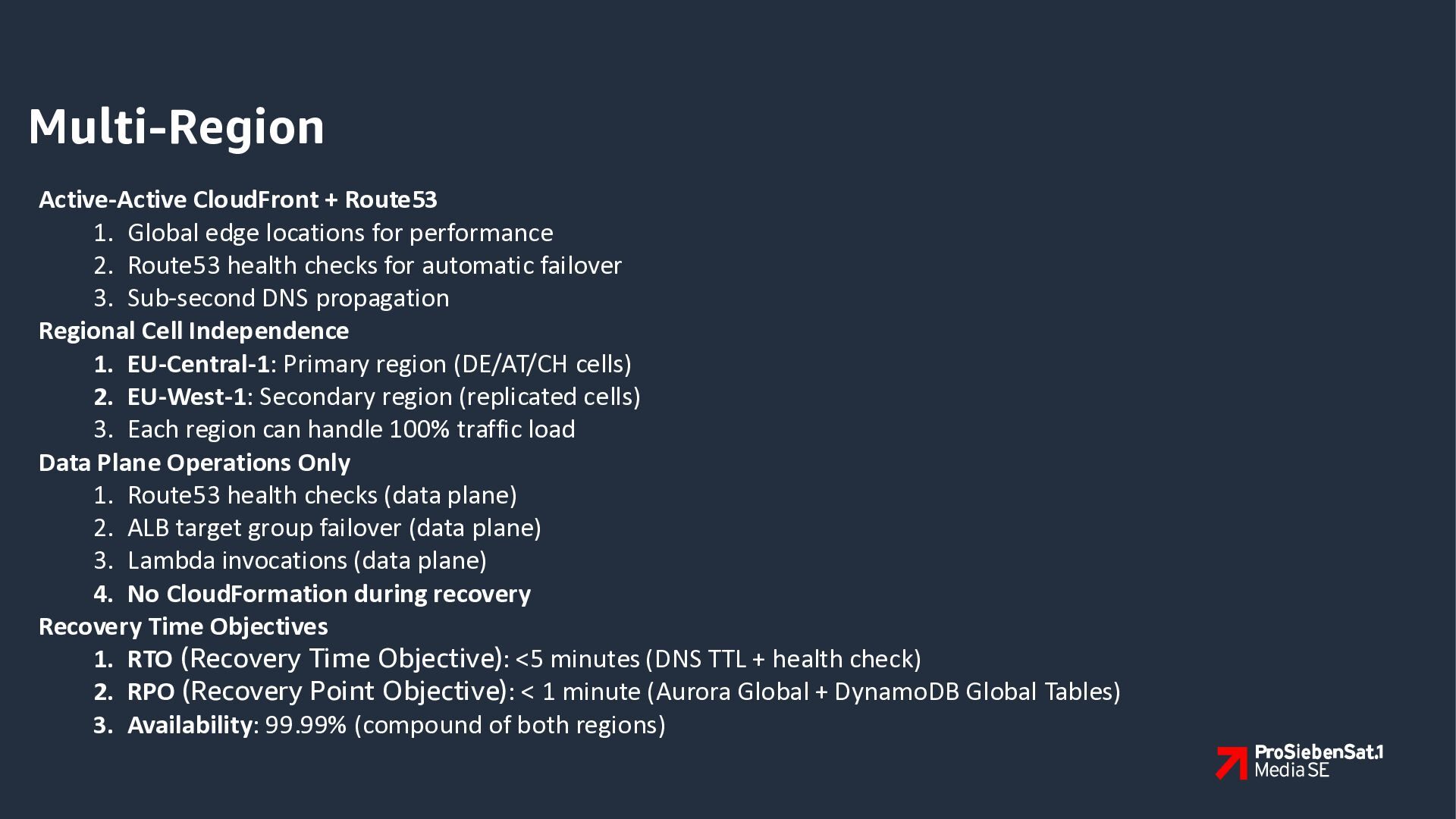
performance 2. Route53 health checks for automatic failover 3. Sub-second DNS propagation Regional Cell Independence 1. EU-Central-1: Primary region (DE/AT/CH cells) 2. EU-West-1: Secondary region (replicated cells) 3. Each region can handle 100% traffic load Data Plane Operations Only 1. Route53 health checks (data plane) 2. ALB target group failover (data plane) 3. Lambda invocations (data plane) 4. No CloudFormation during recovery Recovery Time Objectives 1. RTO (Recovery Time Objective): <5 minutes (DNS TTL + health check) 2. RPO (Recovery Point Objective): < 1 minute (Aurora Global + DynamoDB Global Tables) 3. Availability: 99.99% (compound of both regions)
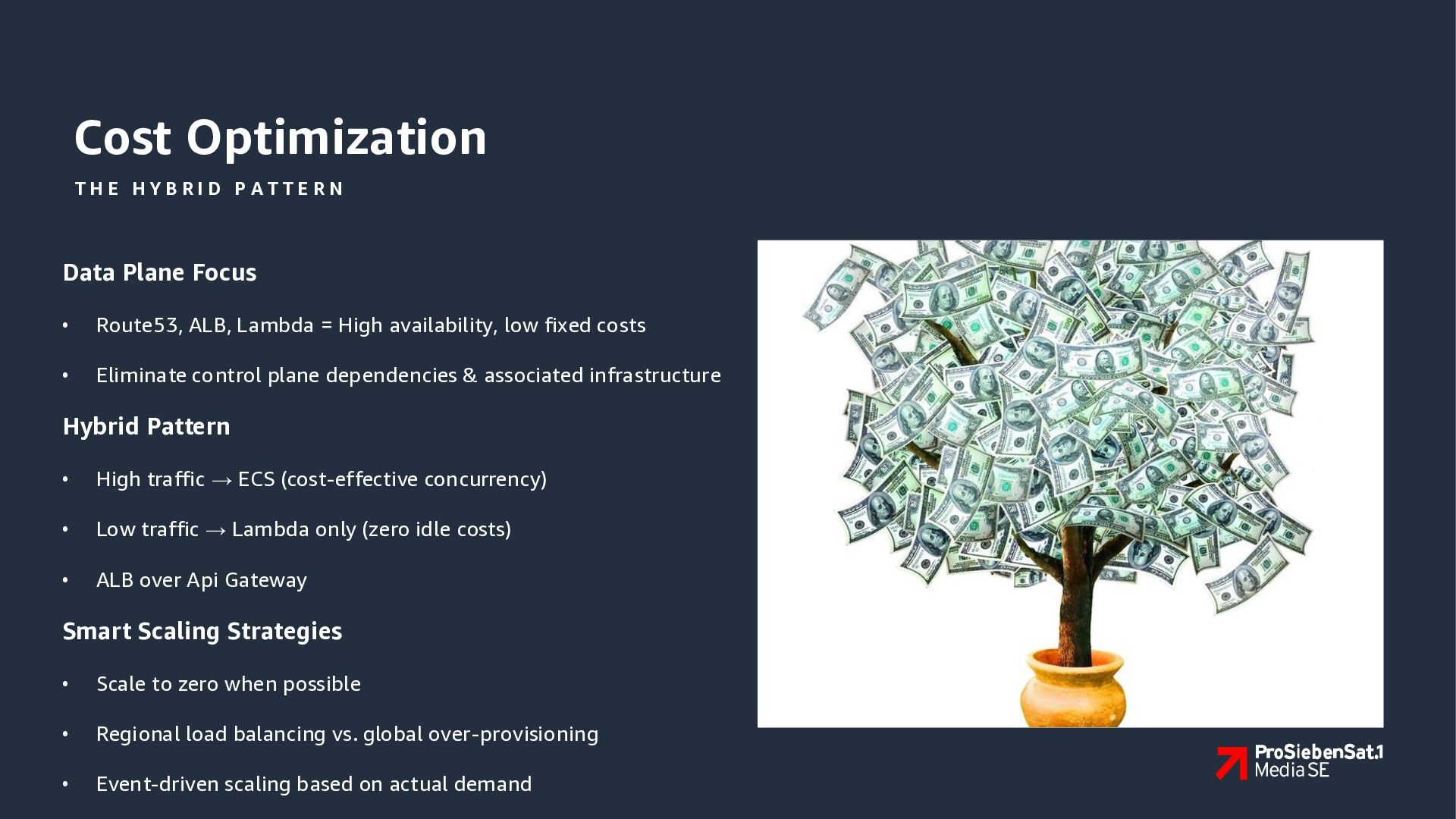
R N Data Plane Focus • Route53, ALB, Lambda = High availability, low fixed costs • Eliminate control plane dependencies & associated infrastructure Hybrid Pattern • High traffic → ECS (cost-effective concurrency) • Low traffic → Lambda only (zero idle costs) • ALB over Api Gateway Smart Scaling Strategies • Scale to zero when possible • Regional load balancing vs. global over-provisioning • Event-driven scaling based on actual demand


 01m2k3g69svbq9qqkr9chsqv2k
 satoshi7
 bgpat
 occhi
 kentarofujii
 ymotongpoo
 yu23ki14
 ishikawa_satoru
 takuroabe
 glaforge
 hiracky16
 pfn
 katiecoart
 palkan
 reverentgeek
 cassininazir
 lfama
 tammyeverts
 greggifford
 eileencodes
 bluesmoon
 cromwellryan
 aleyda
 oripsolob