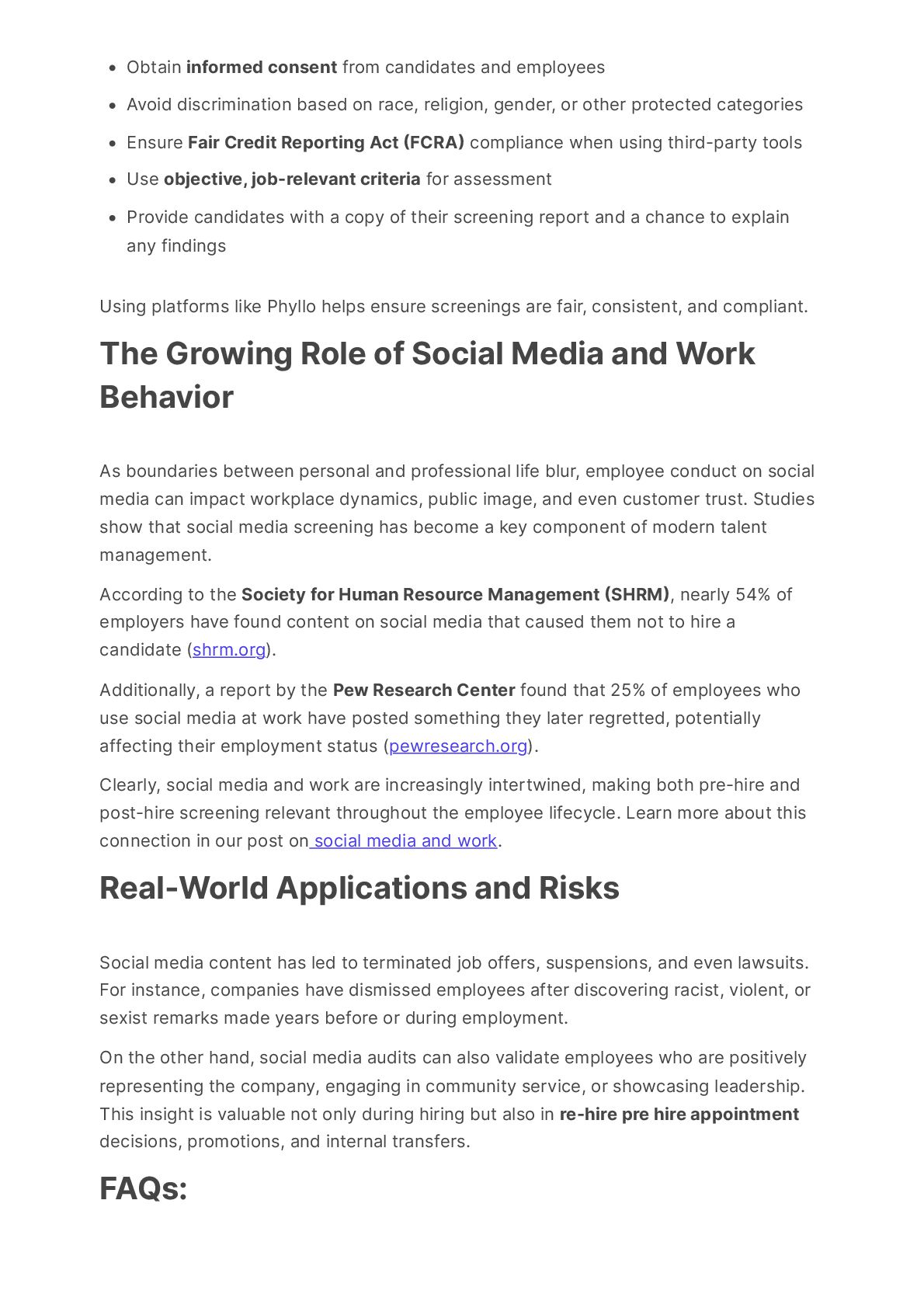
on race, religion, gender, or other protected categories Ensure Fair Credit Reporting Act (FCRA) compliance when using third-party tools Use objective, job-relevant criteria for assessment Provide candidates with a copy of their screening report and a chance to explain any findings Using platforms like Phyllo helps ensure screenings are fair, consistent, and compliant. The Growing Role of Social Media and Work Behavior As boundaries between personal and professional life blur, employee conduct on social media can impact workplace dynamics, public image, and even customer trust. Studies show that social media screening has become a key component of modern talent management. According to the Society for Human Resource Management (SHRM), nearly 54% of employers have found content on social media that caused them not to hire a candidate (shrm.org). Additionally, a report by the Pew Research Center found that 25% of employees who use social media at work have posted something they later regretted, potentially affecting their employment status (pewresearch.org). Clearly, social media and work are increasingly intertwined, making both pre-hire and post-hire screening relevant throughout the employee lifecycle. Learn more about this connection in our post on social media and work. Real-World Applications and Risks Social media content has led to terminated job offers, suspensions, and even lawsuits. For instance, companies have dismissed employees after discovering racist, violent, or sexist remarks made years before or during employment. On the other hand, social media audits can also validate employees who are positively representing the company, engaging in community service, or showcasing leadership. This insight is valuable not only during hiring but also in re-hire pre hire appointment decisions, promotions, and internal transfers. FAQs:


 speakerdeck
 uxyall
 yeseniaperezcruz
 iamctodd
 bluesmoon
 stuffmc
 ipullrank
 moore
 minecr
 axbom
 tmiket