Share
Embed
The TESS FFIs: Expectations vs. Reality
Extreme Solar Systems IV: Transit Session
Adina
August 19, 2019
Transcript
43 slides
-
The TESS Full-Frame Images: Expectations vs. Reality Adina Feinstein, Benjamin
Montet, Elisa Quintana, Vesselin Kostov, Thomas Barclay, Knicole Colon, Brianna Galgano, Ethan Kruse, Susan Mullally, Joshua Schlieder Extreme Solar Systems IV August 19, 2019 @afeinstein20 !1 -
1 observing sector contains ~106 stars, but light curves are
only released for 20,000 short-cadence targets. !2 -
1 observing sector contains ~106 stars, but light curves are
only released for 20,000 short-cadence targets. Continuous Viewing Zone !2 -
The eleanor pipeline takes the FFIs and completes background subtraction,
aperture photometry, and detrending to extract light curves. Feinstein et al. 2019 !3 -
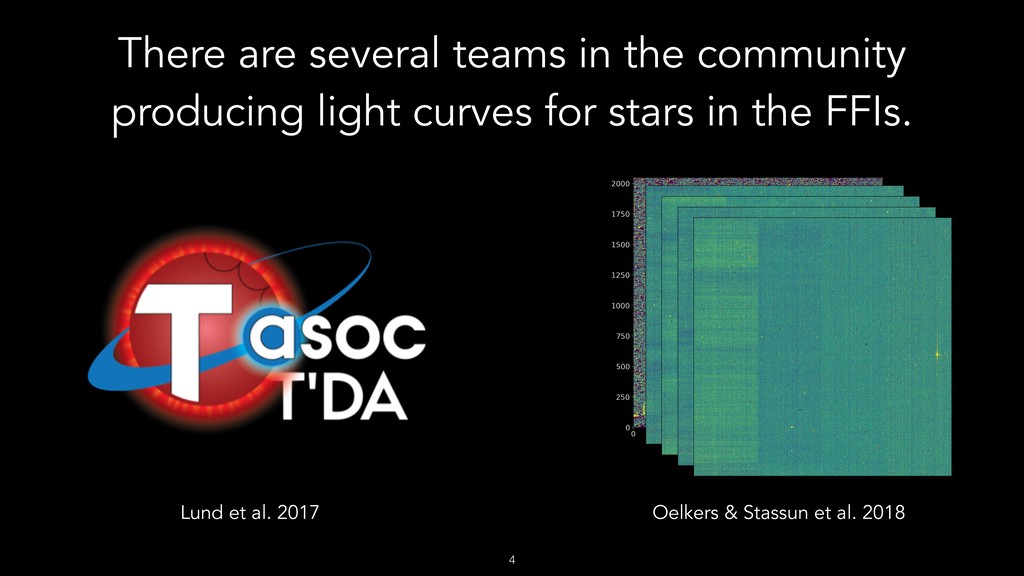
There are several teams in the community producing light curves
for stars in the FFIs. Lund et al. 2017 Oelkers & Stassun et al. 2018 !4 -
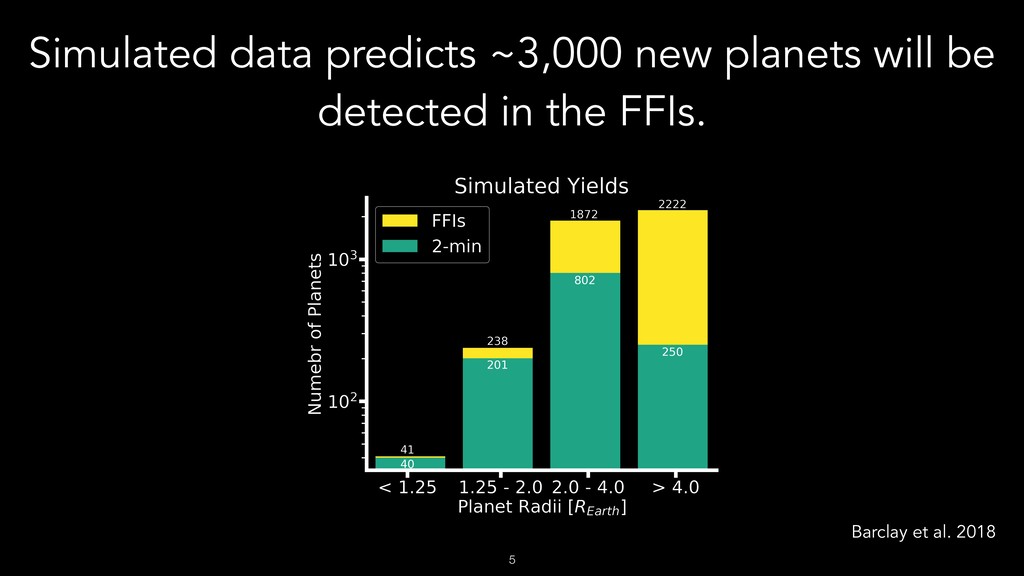
Barclay et al. 2018 Simulated data predicts ~3,000 new planets
will be detected in the FFIs. !5 -
New candidates found within the FFIs generally agree with the
simulated predictions. Exoplanet Archive as of August 12, 2019 !6 -
New candidates found within the FFIs generally agree with the
simulated predictions. Exoplanet Archive as of August 12, 2019 !6 -
New candidates found within the FFIs generally agree with the
simulated predictions. Exoplanet Archive as of August 12, 2019 !6 -
New candidates found within the FFIs generally agree with the
simulated predictions. Exoplanet Archive as of August 12, 2019 !6 -
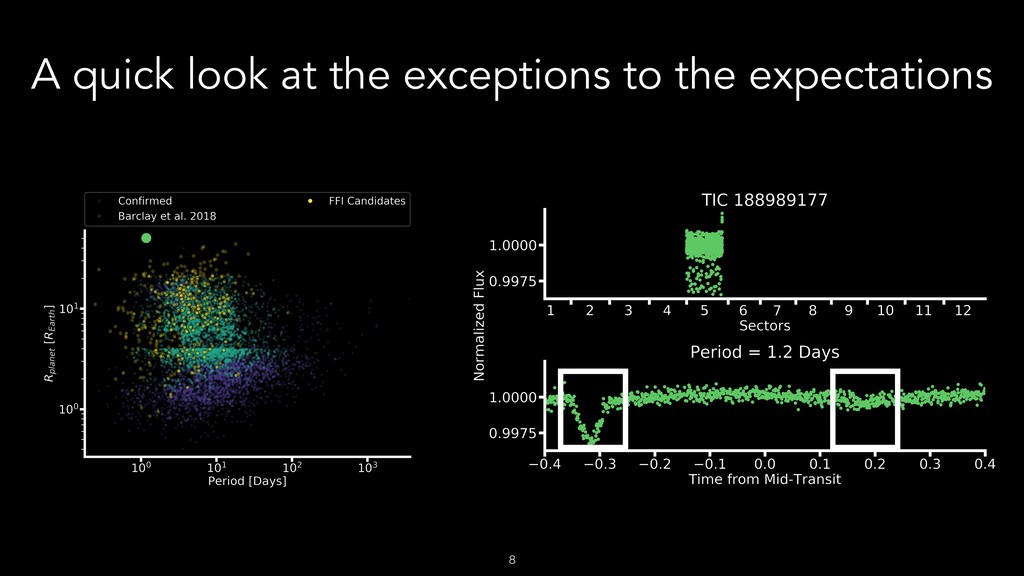
We are not finding as many planets around high- mass
and low-mass stars as expected. Exoplanet Archive as of August 12, 2019 !7 -
We are not finding as many planets around high- mass
and low-mass stars as expected. Exoplanet Archive as of August 12, 2019 !7 -
We are not finding as many planets around high- mass
and low-mass stars as expected. Exoplanet Archive as of August 12, 2019 !7 -
Sullivan et al. 2015 Simulated data predicts ~3,000 new planets
will be detected in the FFIs … along with ~800,000 false positives. ¯\_(ツ)_/¯ !9 -
Due to the pixel size of TESS, we have encountered
all sorts of false positives. !10 Binned Not binned -
Due to the pixel size of TESS, we have encountered
all sorts of false positives. !10 Binned Not binned -
Due to the pixel size of TESS, we have encountered
all sorts of false positives. !10 Binned Not binned -
Due to the pixel size of TESS, we have encountered
all sorts of false positives. !10 Binned Not binned -
Checking the light curves from all available pipelines should be
one of the first steps in confirming new candidates. !11 Binned Not binned -
Checking the light curves from all available pipelines should be
one of the first steps in confirming new candidates. !11 Binned Not binned -
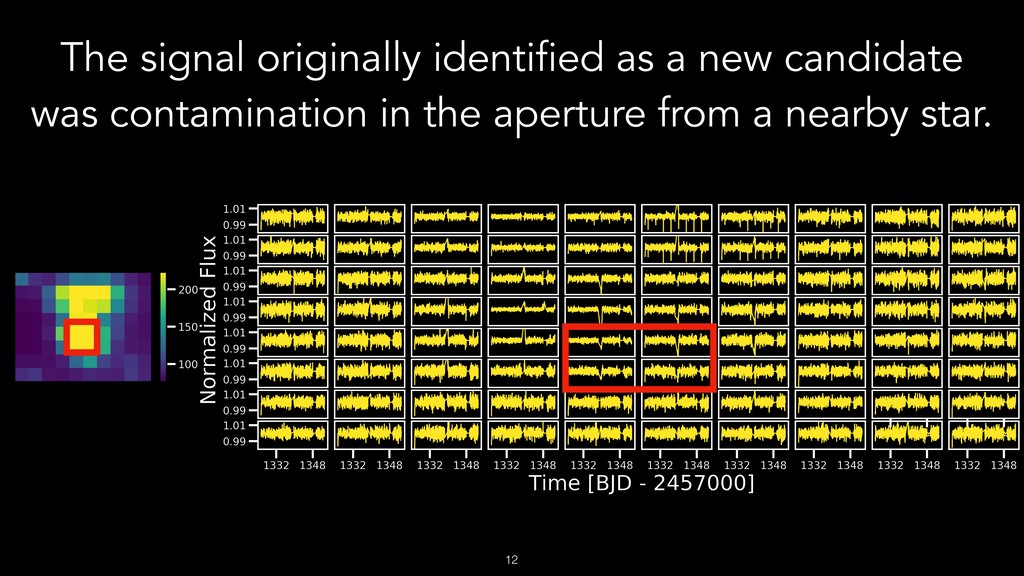
The signal originally identified as a new candidate was contamination
in the aperture from a nearby star. !12 -
The signal originally identified as a new candidate was contamination
in the aperture from a nearby star. !12 -
The signal originally identified as a new candidate was contamination
in the aperture from a nearby star. !12 -
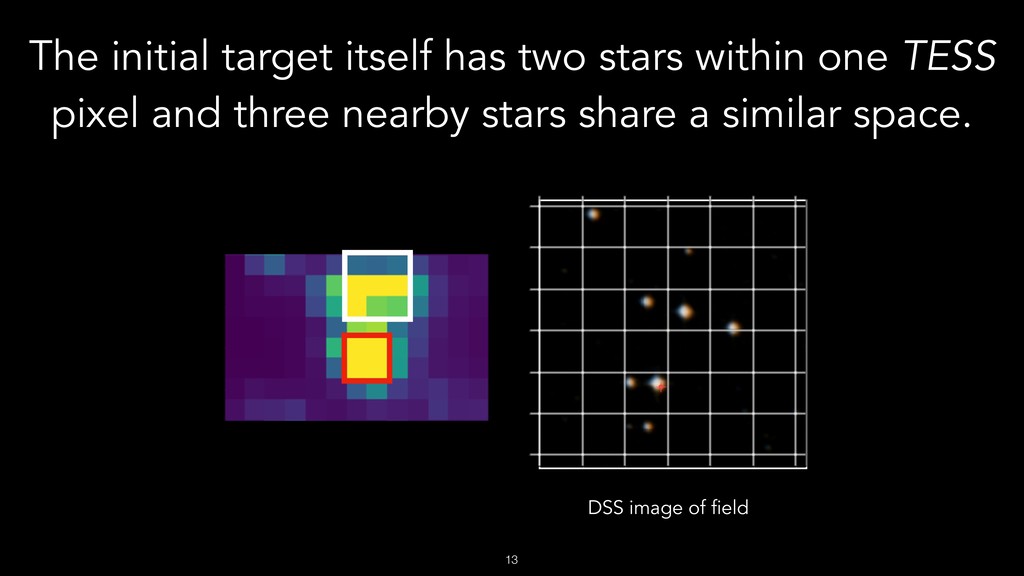
The initial target itself has two stars within one TESS
pixel and three nearby stars share a similar space. summary DSS image of field !13 -
The initial target itself has two stars within one TESS
pixel and three nearby stars share a similar space. summary DSS image of field !13 -
The initial target itself has two stars within one TESS
pixel and three nearby stars share a similar space. summary DSS image of field !13 -
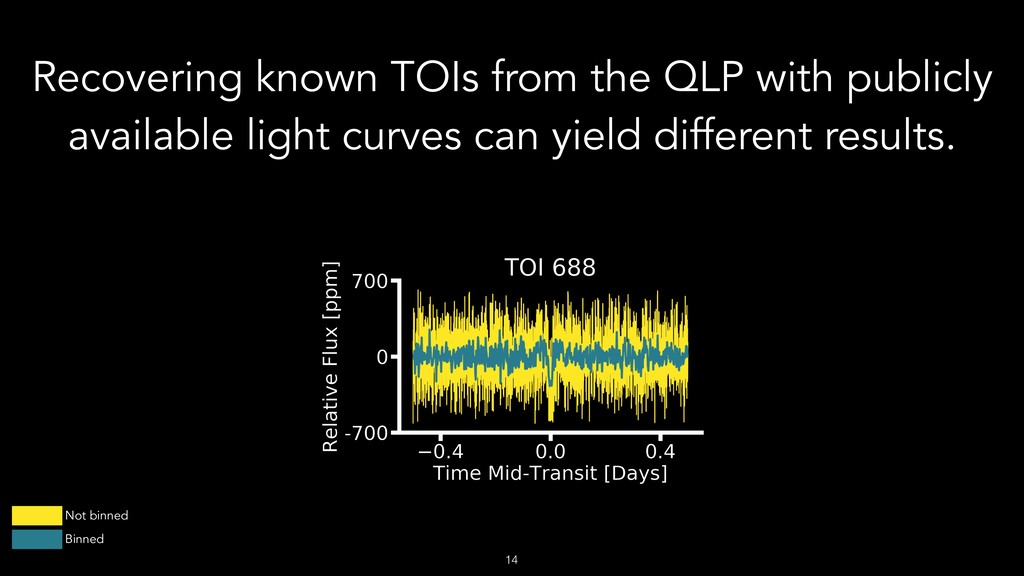
Binned Not binned Recovering known TOIs from the QLP with
publicly available light curves can yield different results. !14 -
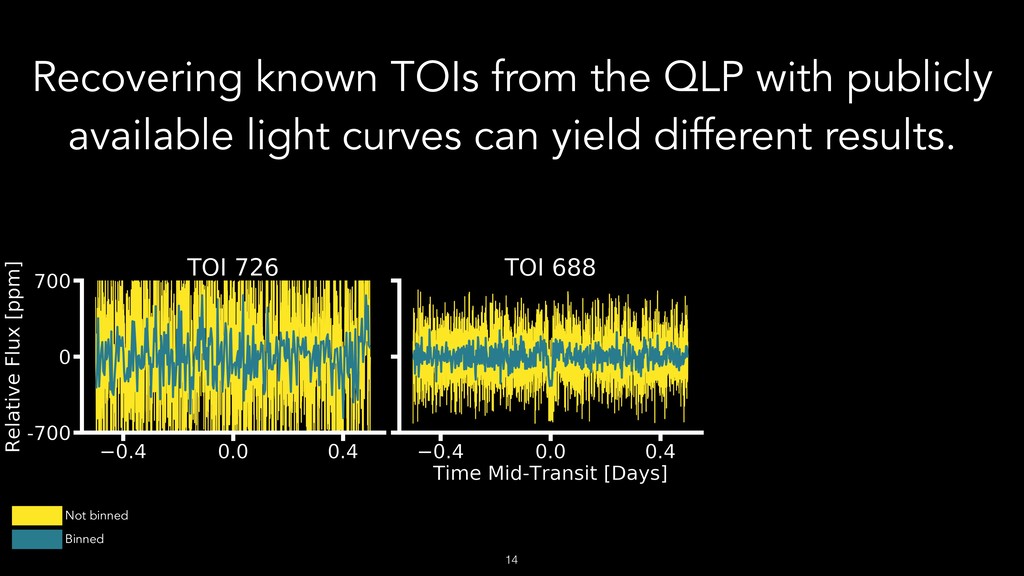
Binned Not binned Recovering known TOIs from the QLP with
publicly available light curves can yield different results. !14 -
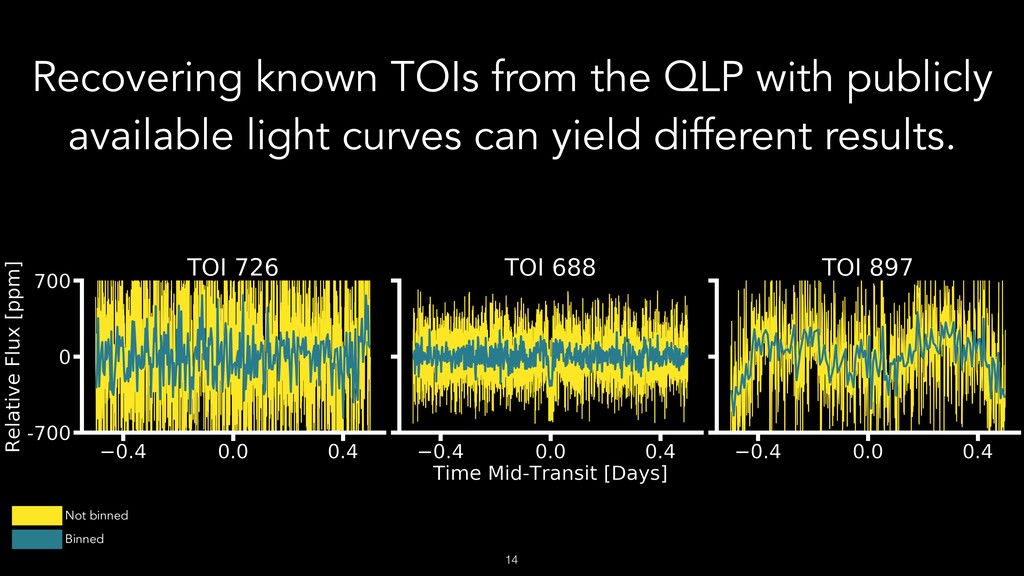
Binned Not binned Recovering known TOIs from the QLP with
publicly available light curves can yield different results. !14 -
Binned Not binned Recovering known TOIs from the QLP with
publicly available light curves can yield different results. !14 CHECK ALL AVAILABLE FFI LIGHT CURVES! -
!15 See Bill Welsh’s talk on Thursday for more details!
Data from the FFIs helped fill in the details of a new circumbinary candidate. Transit Eclipse -
!15 See Bill Welsh’s talk on Thursday for more details!
Data from the FFIs helped fill in the details of a new circumbinary candidate. Transit Eclipse -
!15 See Bill Welsh’s talk on Thursday for more details!
Data from the FFIs helped fill in the details of a new circumbinary candidate. Transit Eclipse -
!15 See Bill Welsh’s talk on Thursday for more details!
Data from the FFIs helped fill in the details of a new circumbinary candidate. Transit Eclipse -
!15 See Bill Welsh’s talk on Thursday for more details!
Data from the FFIs helped fill in the details of a new circumbinary candidate. Transit Eclipse -
Summary •The planet candidates found thus far are generally in
good agreement with what we expected. •There seems to be trend towards lack of planets around high-mass stars. •Due to the number of false positives, anybody interested in using the FFIs should be prepared for a lot of human vetting and should use all available light curves to confirm their signals are real. •For more information on the new circumbinary planet see Bill Welsh’s talk on Thursday! @afeinstein20 !16 Image: Ethan Kruse @ethan_kruse -
Summary •The planet candidates found thus far are generally in
good agreement with what we expected. •There seems to be trend towards lack of planets around high-mass stars. •Due to the number of false positives, anybody interested in using the FFIs should be prepared for a lot of human vetting and should use all available light curves to confirm their signals are real. •For more information on the new circumbinary planet see Bill Welsh’s talk on Thursday! @afeinstein20 !16 Image: Ethan Kruse @ethan_kruse