Upgrade to Pro — share decks privately, control downloads, hide ads and more …

Dynamic Programming

Sponsored · SiteGround - Reliable hosting with speed, security, and support you can count on. →

Dynamic Programming

Avatar for Ajith Jose

Ajith Jose

July 23, 2014

Other Decks in Programming

Transcript

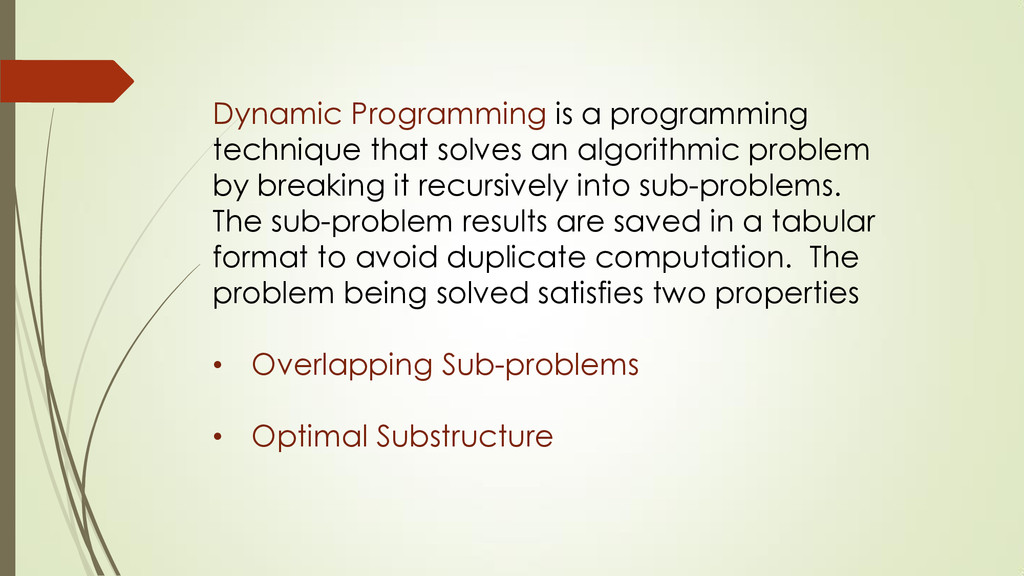
  1. Dynamic Programming is a programming technique that solves an algorithmic

    problem by breaking it recursively into sub-problems. The sub-problem results are saved in a tabular format to avoid duplicate computation. The problem being solved satisfies two properties • Overlapping Sub-problems • Optimal Substructure
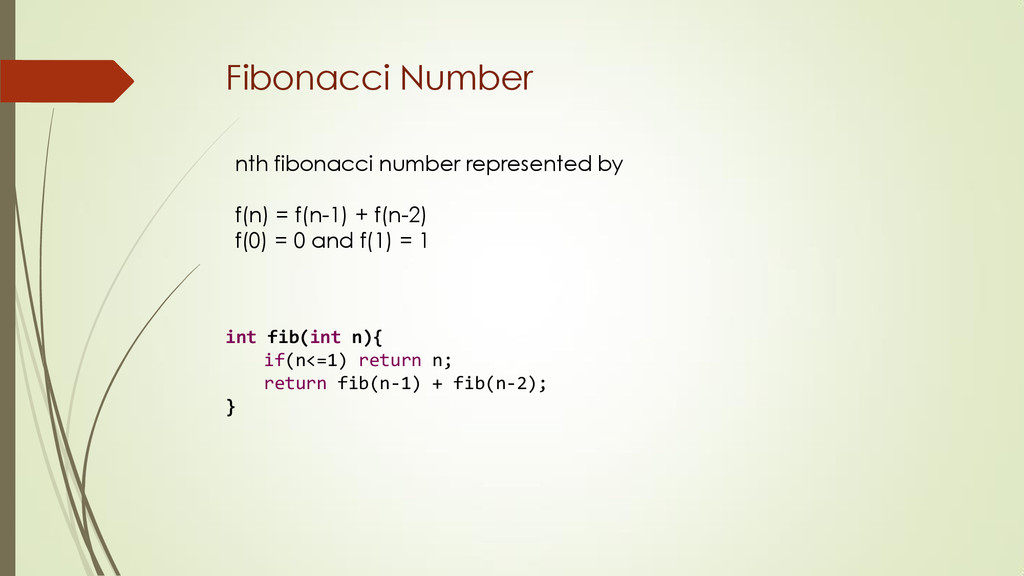
  2. Fibonacci Number int fib(int n){ if(n<=1) return n; return fib(n-1)

    + fib(n-2); } nth fibonacci number represented by f(n) = f(n-1) + f(n-2) f(0) = 0 and f(1) = 1
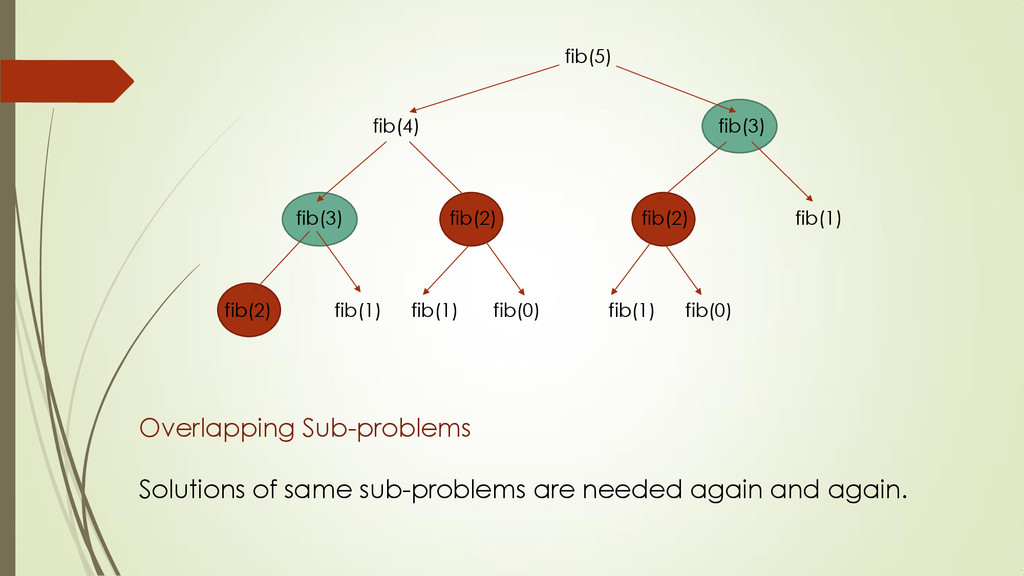
  3. fib(5) fib(4) fib(3) fib(3) fib(2) fib(2) fib(1) fib(2) fib(1) fib(1)

    fib(0) fib(1) fib(0) Overlapping Sub-problems Solutions of same sub-problems are needed again and again.
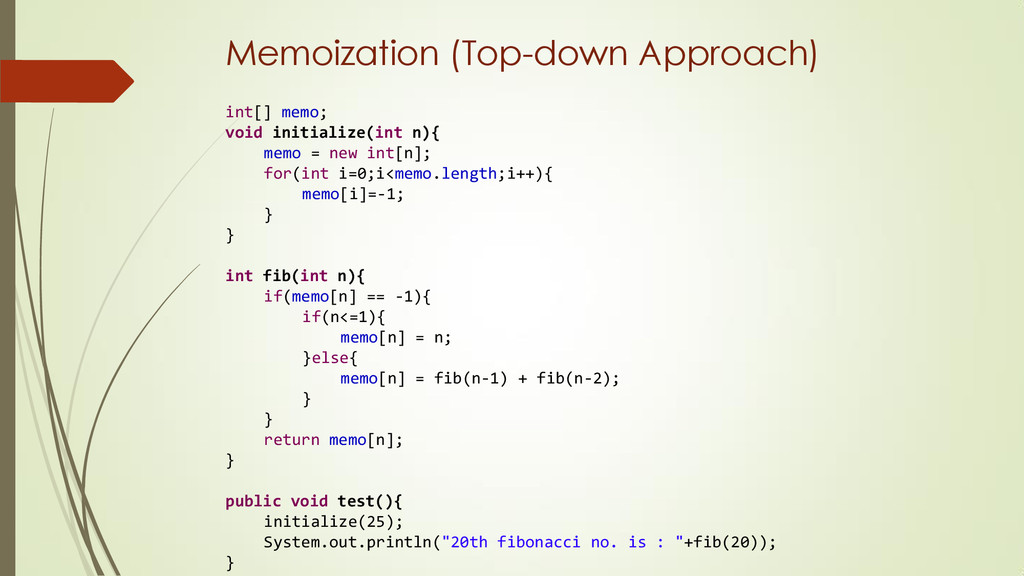
  4. Memoization (Top-down Approach) int[] memo; void initialize(int n){ memo =

    new int[n]; for(int i=0;i<memo.length;i++){ memo[i]=-1; } } int fib(int n){ if(memo[n] == -1){ if(n<=1){ memo[n] = n; }else{ memo[n] = fib(n-1) + fib(n-2); } } return memo[n]; } public void test(){ initialize(25); System.out.println("20th fibonacci no. is : "+fib(20)); }
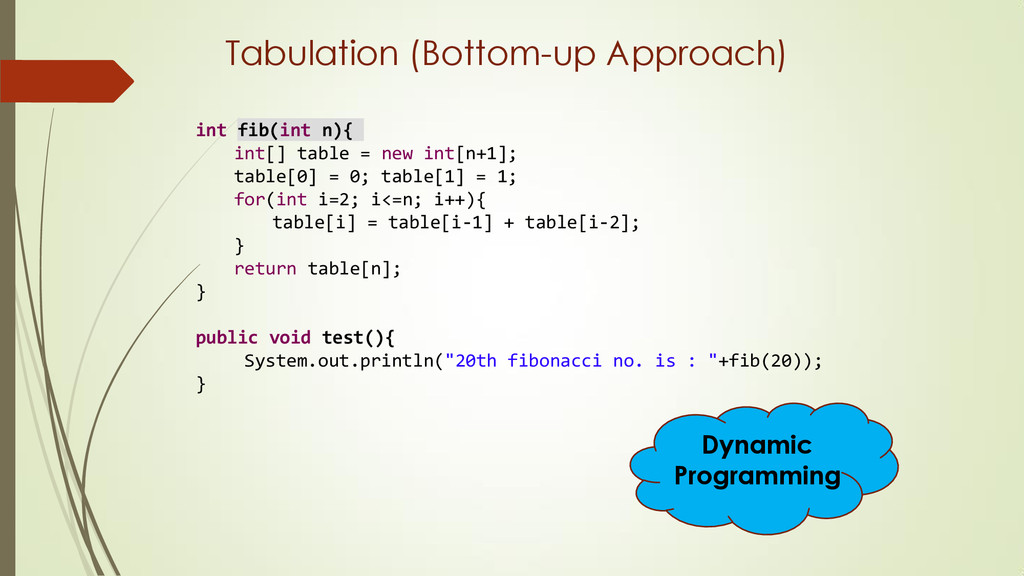
  5. Tabulation (Bottom-up Approach) int fib(int n){ int[] table = new

    int[n+1]; table[0] = 0; table[1] = 1; for(int i=2; i<=n; i++){ table[i] = table[i-1] + table[i-2]; } return table[n]; } public void test(){ System.out.println("20th fibonacci no. is : "+fib(20)); } Dynamic Programming
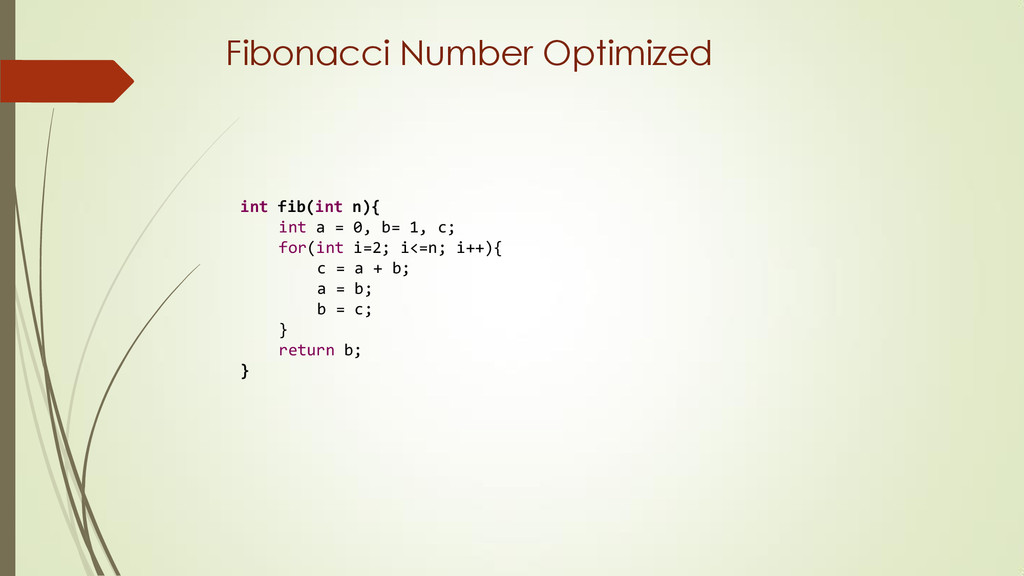
  6. Fibonacci Number Optimized int fib(int n){ int a = 0,

    b= 1, c; for(int i=2; i<=n; i++){ c = a + b; a = b; b = c; } return b; }
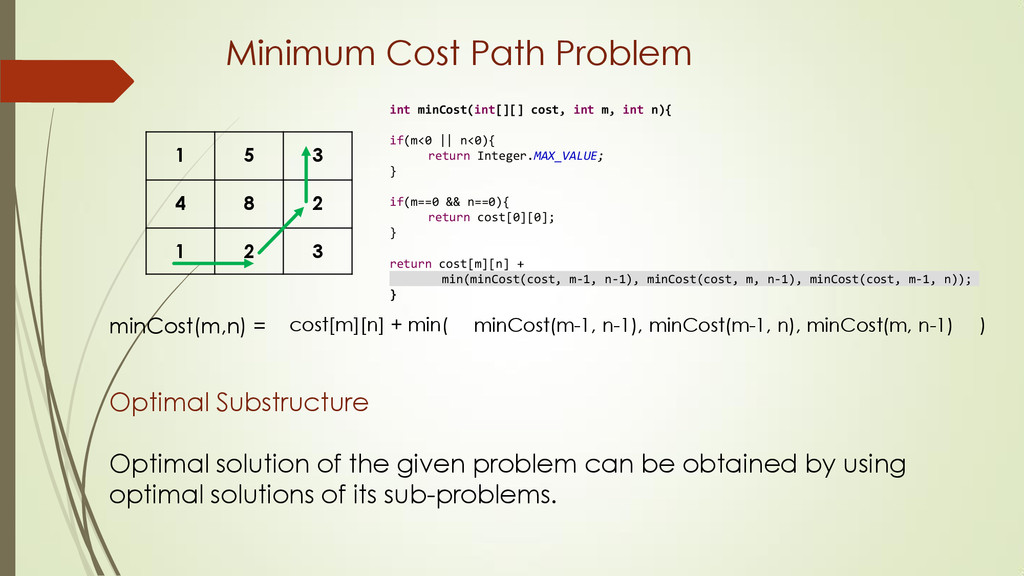
  7. Minimum Cost Path Problem 1 5 3 4 8 2

    1 2 3 minCost(m,n) = cost[m][n] + min( ) minCost(m-1, n-1), minCost(m-1, n), minCost(m, n-1) Optimal Substructure Optimal solution of the given problem can be obtained by using optimal solutions of its sub-problems. int minCost(int[][] cost, int m, int n){ if(m<0 || n<0){ return Integer.MAX_VALUE; } if(m==0 && n==0){ return cost[0][0]; } return cost[m][n] + min(minCost(cost, m-1, n-1), minCost(cost, m, n-1), minCost(cost, m-1, n)); }
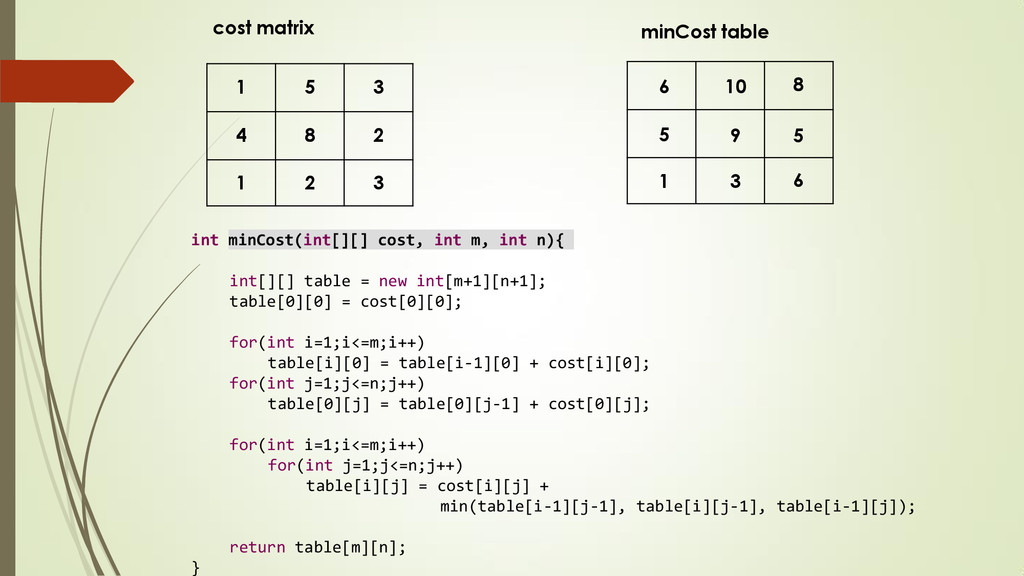
  8. 1 5 3 4 8 2 1 2 3 cost

    matrix int minCost(int[][] cost, int m, int n){ int[][] table = new int[m+1][n+1]; table[0][0] = cost[0][0]; for(int i=1;i<=m;i++) table[i][0] = table[i-1][0] + cost[i][0]; for(int j=1;j<=n;j++) table[0][j] = table[0][j-1] + cost[0][j]; for(int i=1;i<=m;i++) for(int j=1;j<=n;j++) table[i][j] = cost[i][j] + min(table[i-1][j-1], table[i][j-1], table[i-1][j]); return table[m][n]; } 1 5 6 3 6 9 5 10 8 minCost table
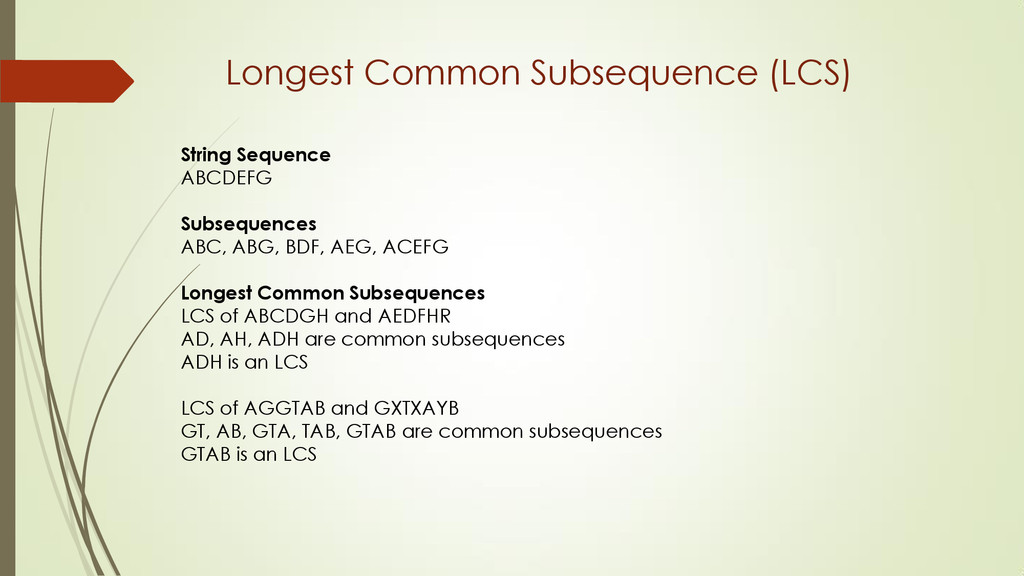
  9. Longest Common Subsequence (LCS) String Sequence ABCDEFG Subsequences ABC, ABG,

    BDF, AEG, ACEFG Longest Common Subsequences LCS of ABCDGH and AEDFHR AD, AH, ADH are common subsequences ADH is an LCS LCS of AGGTAB and GXTXAYB GT, AB, GTA, TAB, GTAB are common subsequences GTAB is an LCS
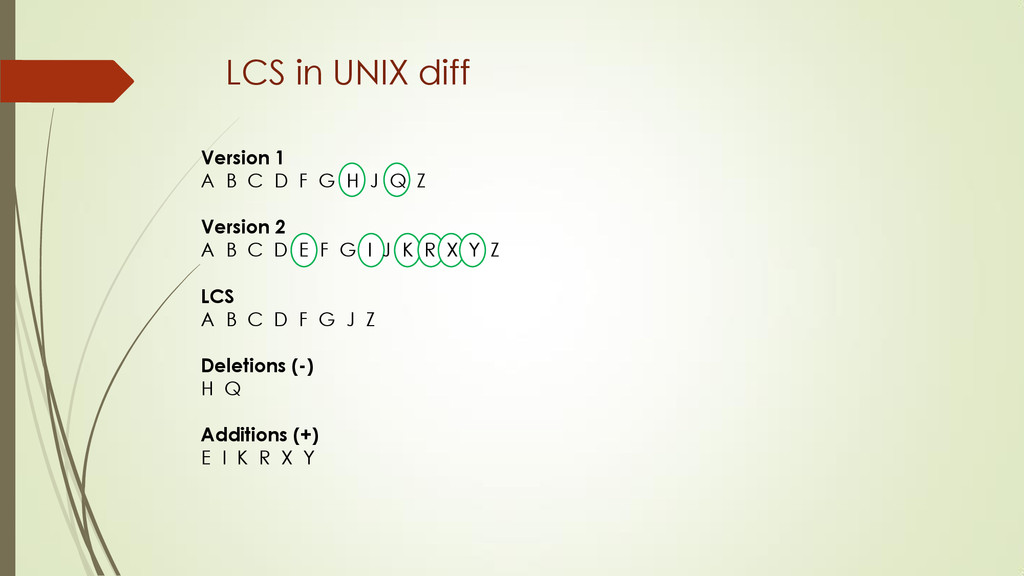
  10. LCS in UNIX diff Version 1 A B C D

    F G H J Q Z Version 2 A B C D E F G I J K R X Y Z LCS A B C D F G J Z Deletions (-) H Q Additions (+) E I K R X Y
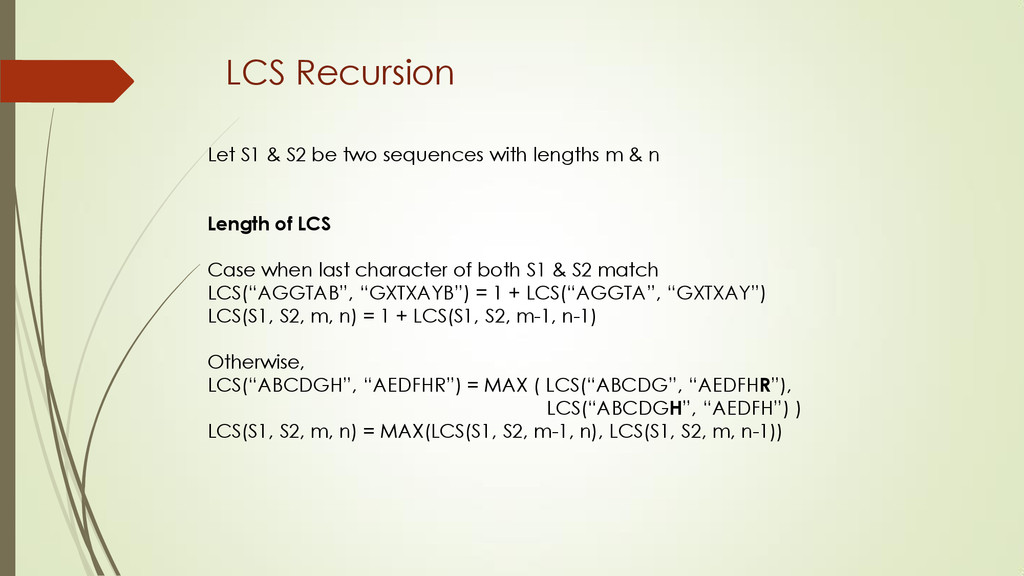
  11. LCS Recursion Let S1 & S2 be two sequences with

    lengths m & n Length of LCS Case when last character of both S1 & S2 match LCS(“AGGTAB”, “GXTXAYB”) = 1 + LCS(“AGGTA”, “GXTXAY”) LCS(S1, S2, m, n) = 1 + LCS(S1, S2, m-1, n-1) Otherwise, LCS(“ABCDGH”, “AEDFHR”) = MAX ( LCS(“ABCDG”, “AEDFHR”), LCS(“ABCDGH”, “AEDFH”) ) LCS(S1, S2, m, n) = MAX(LCS(S1, S2, m-1, n), LCS(S1, S2, m, n-1))
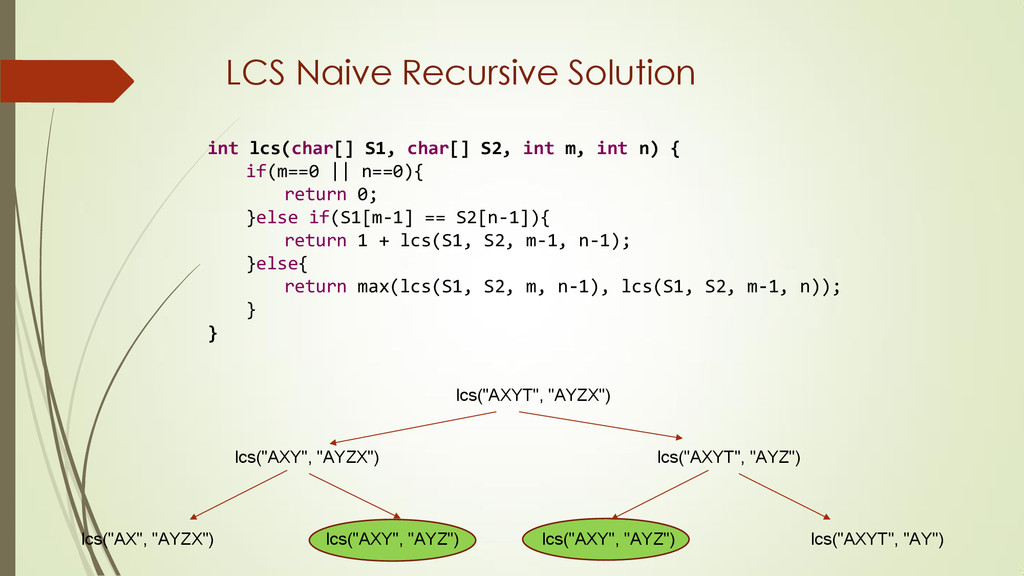
  12. LCS Naive Recursive Solution int lcs(char[] S1, char[] S2, int

    m, int n) { if(m==0 || n==0){ return 0; }else if(S1[m-1] == S2[n-1]){ return 1 + lcs(S1, S2, m-1, n-1); }else{ return max(lcs(S1, S2, m, n-1), lcs(S1, S2, m-1, n)); } } lcs("AXYT", "AYZX") lcs("AXY", "AYZX") lcs("AXYT", "AYZ") lcs("AX", "AYZX") lcs("AXY", "AYZ") lcs("AXY", "AYZ") lcs("AXYT", "AY")
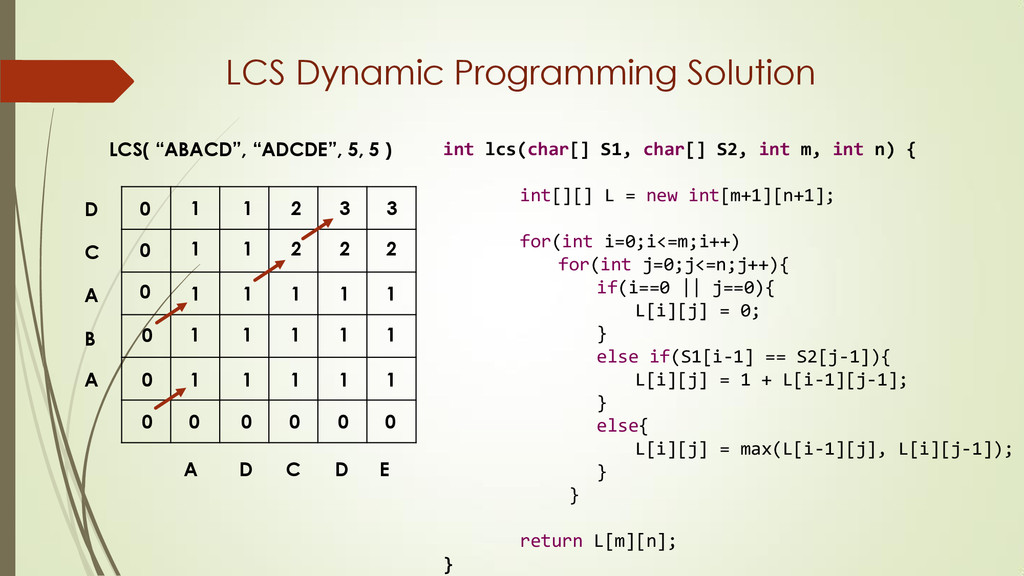
  13. LCS Dynamic Programming Solution int lcs(char[] S1, char[] S2, int

    m, int n) { int[][] L = new int[m+1][n+1]; for(int i=0;i<=m;i++) for(int j=0;j<=n;j++){ if(i==0 || j==0){ L[i][j] = 0; } else if(S1[i-1] == S2[j-1]){ L[i][j] = 1 + L[i-1][j-1]; } else{ L[i][j] = max(L[i-1][j], L[i][j-1]); } } return L[m][n]; } A B A C D A D C D E LCS( “ABACD”, “ADCDE”, 5, 5 ) 0 0 0 0 0 0 0 0 0 0 0 1 1 1 1 1 1 1 1 1 1 1 1 1 1 1 1 1 2 2 2 1 1 2 3 3
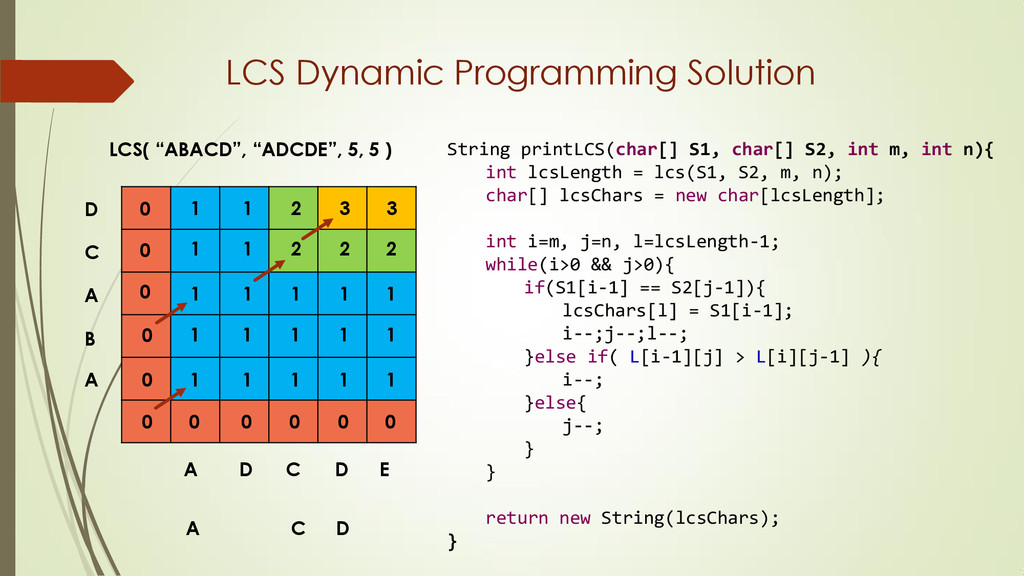
  14. LCS Dynamic Programming Solution A B A C D A

    D C D E LCS( “ABACD”, “ADCDE”, 5, 5 ) 0 0 0 0 0 0 0 0 0 0 0 1 1 1 1 1 1 1 1 1 1 1 1 1 1 1 1 1 2 2 2 1 1 2 3 3 D C A String printLCS(char[] S1, char[] S2, int m, int n){ int lcsLength = lcs(S1, S2, m, n); char[] lcsChars = new char[lcsLength]; int i=m, j=n, l=lcsLength-1; while(i>0 && j>0){ if(S1[i-1] == S2[j-1]){ lcsChars[l] = S1[i-1]; i--;j--;l--; }else if( L[i-1][j] > L[i][j-1] ){ i--; }else{ j--; } } return new String(lcsChars); }
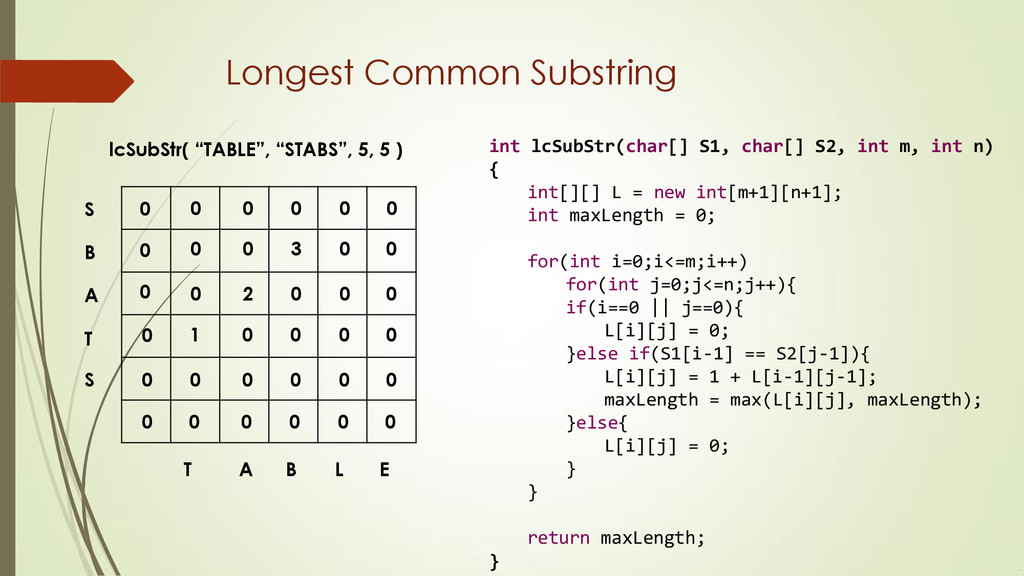
  15. Longest Common Substring S T A B S T A

    B L E lcSubStr( “TABLE”, “STABS”, 5, 5 ) 0 0 0 0 0 0 0 0 0 0 0 0 0 0 0 0 1 0 0 0 0 0 2 0 0 0 0 0 3 0 0 0 0 0 0 0 int lcSubStr(char[] S1, char[] S2, int m, int n) { int[][] L = new int[m+1][n+1]; int maxLength = 0; for(int i=0;i<=m;i++) for(int j=0;j<=n;j++){ if(i==0 || j==0){ L[i][j] = 0; }else if(S1[i-1] == S2[j-1]){ L[i][j] = 1 + L[i-1][j-1]; maxLength = max(L[i][j], maxLength); }else{ L[i][j] = 0; } } return maxLength; }
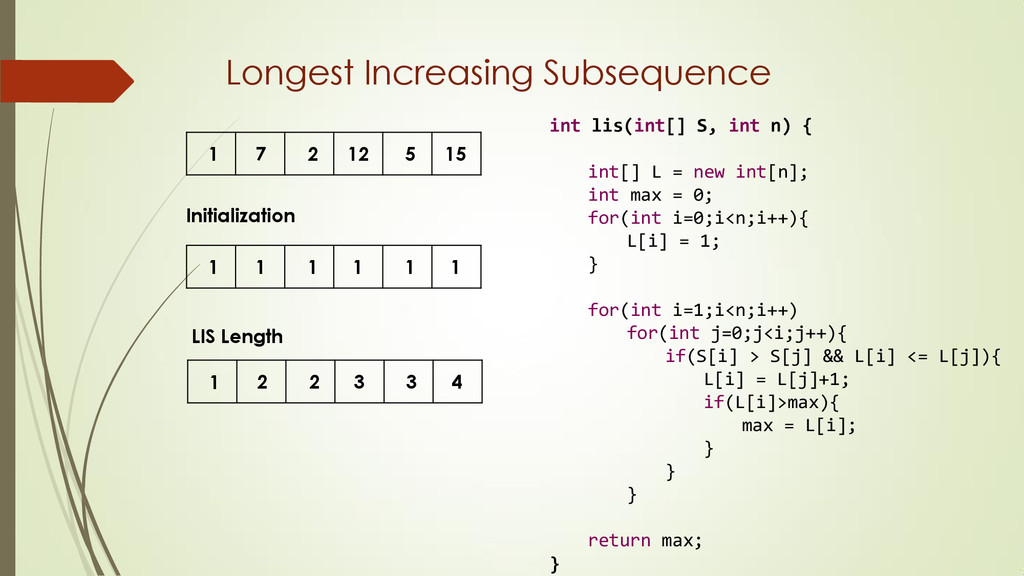
  16. Longest Increasing Subsequence 1 7 2 12 5 15 1

    1 1 1 1 1 Initialization LIS Length 1 2 2 3 3 4 int lis(int[] S, int n) { int[] L = new int[n]; int max = 0; for(int i=0;i<n;i++){ L[i] = 1; } for(int i=1;i<n;i++) for(int j=0;j<i;j++){ if(S[i] > S[j] && L[i] <= L[j]){ L[i] = L[j]+1; if(L[i]>max){ max = L[i]; } } } return max; }
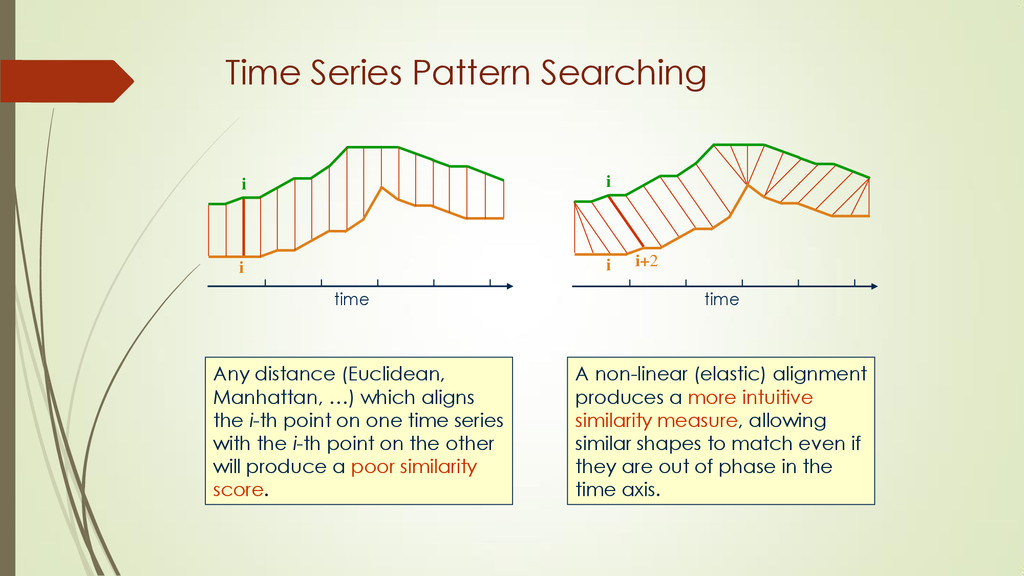
  17. Time Series Pattern Searching i i+2 i i i time

    time Any distance (Euclidean, Manhattan, …) which aligns the i-th point on one time series with the i-th point on the other will produce a poor similarity score. A non-linear (elastic) alignment produces a more intuitive similarity measure, allowing similar shapes to match even if they are out of phase in the time axis.
  18. js is m 1 n 1 Time Series B Time

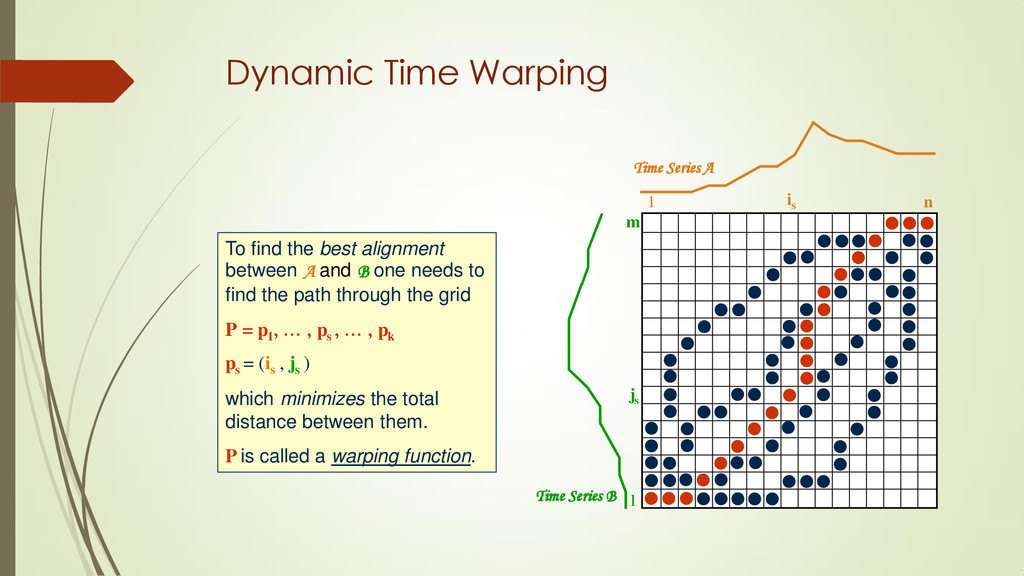
    Series A Dynamic Time Warping To find the best alignment between A and B one needs to find the path through the grid P = p1 , … , ps , … , pk ps = (is , js ) which minimizes the total distance between them. P is called a warping function.
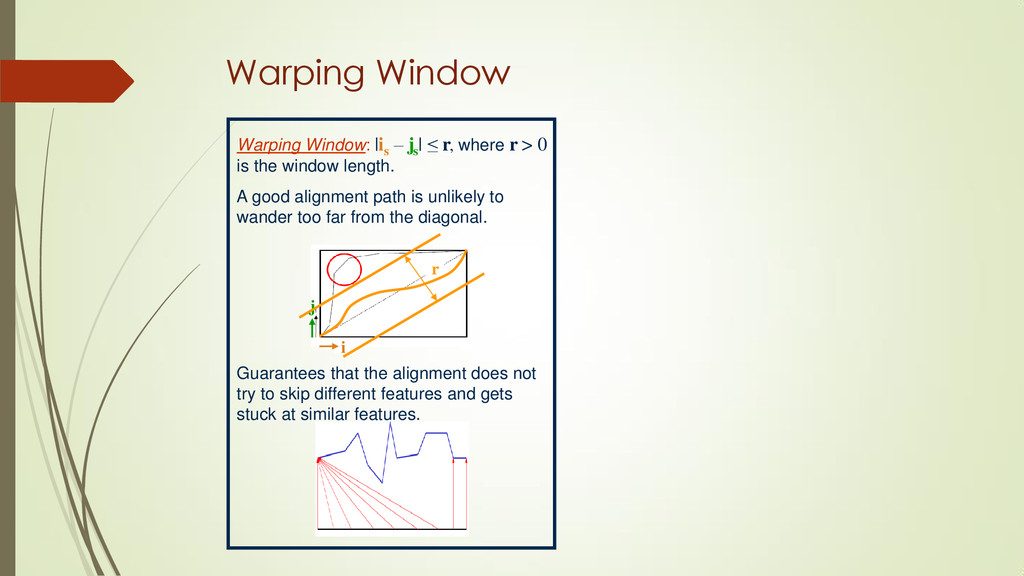
  19. Warping Window: |is – js | ≤ r, where r

    > 0 is the window length. A good alignment path is unlikely to wander too far from the diagonal. Guarantees that the alignment does not try to skip different features and gets stuck at similar features. i j r Warping Window
  20. Dynamic Programming is a programming technique that solves an algorithmic

    problem by breaking it recursively into sub-problems. The sub-problem results are saved in a tabular format to avoid duplicate computation. The problem being solved satisfies two properties • Overlapping Sub-problems • Optimal Substructure Conclusion & Definition Revisited