Share
Embed

Transcript
195 slides
-
History “I’m an egotistical bastard, and I name all my
projects after myself. First Linux, now git.” Linus Torvalds Born in 2005 Projects Linux Kernel Android Fedora JQuery Eclipse Drupal millions more.. -
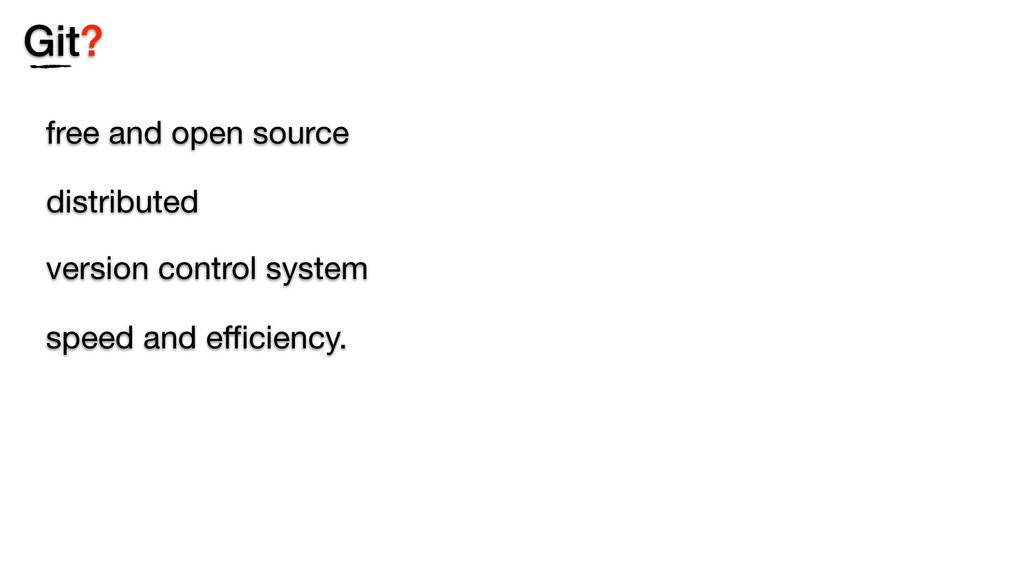
Git? “Git is free and open source distributed version control
system designed to handle everything from small to very large projects with speed and efficiency.” -
Git? “Git is free and open source distributed version control
system designed to handle everything from small to very large projects with speed and efficiency.” “Directory Content Management System” -
Git? “Git is free and open source distributed version control
system designed to handle everything from small to very large projects with speed and efficiency.” “Directory Content Management System” “A Stupid Content Tracker” -
Git? “Git is free and open source distributed version control
system designed to handle everything from small to very large projects with speed and efficiency.” “Directory Content Management System” “A Stupid Content Tracker” “A Toolkit” -
Git is free and open source distributed version control system
designed to handle everything from small to very large projects speed and efficiency. with Git? -
Free & Open Source Downloads - It’s free http://git-scm.com/downloads Mac
OS X, Windows, Linux & Solaris Source Code + Freedom https://github.com/git/git GNU General Public License Current Version : v2.3.0 (6/2/2015) GUI Clients Github, Gitbox, SourceTree GitX, GitEye, Tower Documentation http://git-scm.com/doc Book : Pro Git - Free PDF -
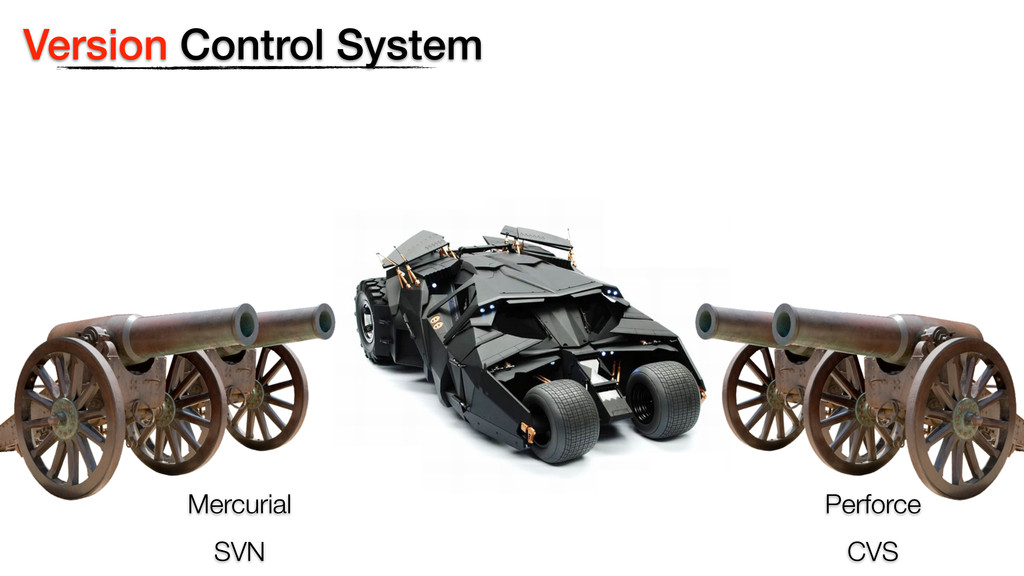
“A system that records changes to a file or set
of files over time so that you can recall specific revisions later.” What is it? Version Control System -
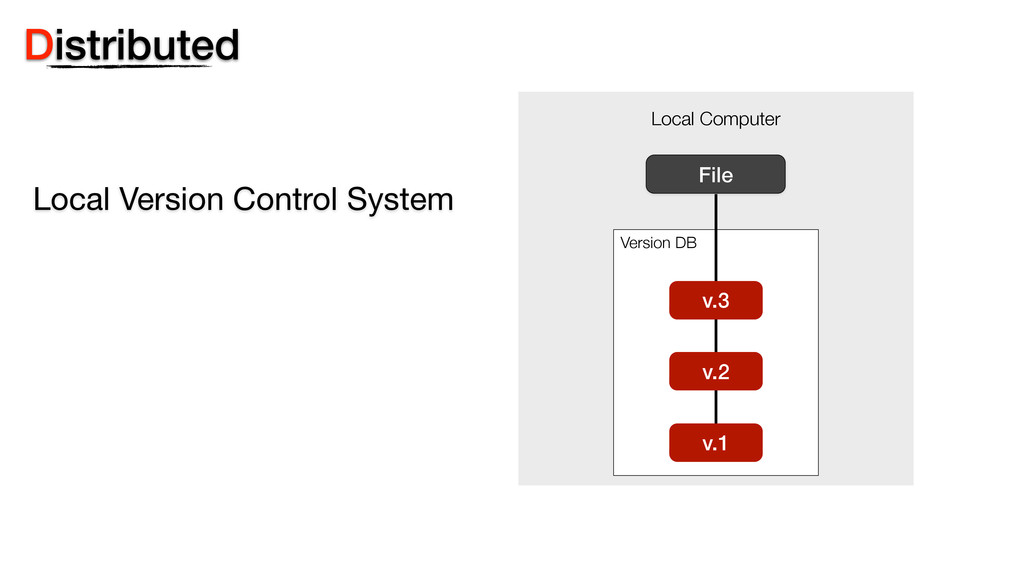
Distributed v.3 v.2 File Local Computer Version DB v.1 Local
Version Control System -
Distributed v.3 v.2 File Local Computer Version DB v.1 Local
Version Control System Everything is LOCAL -
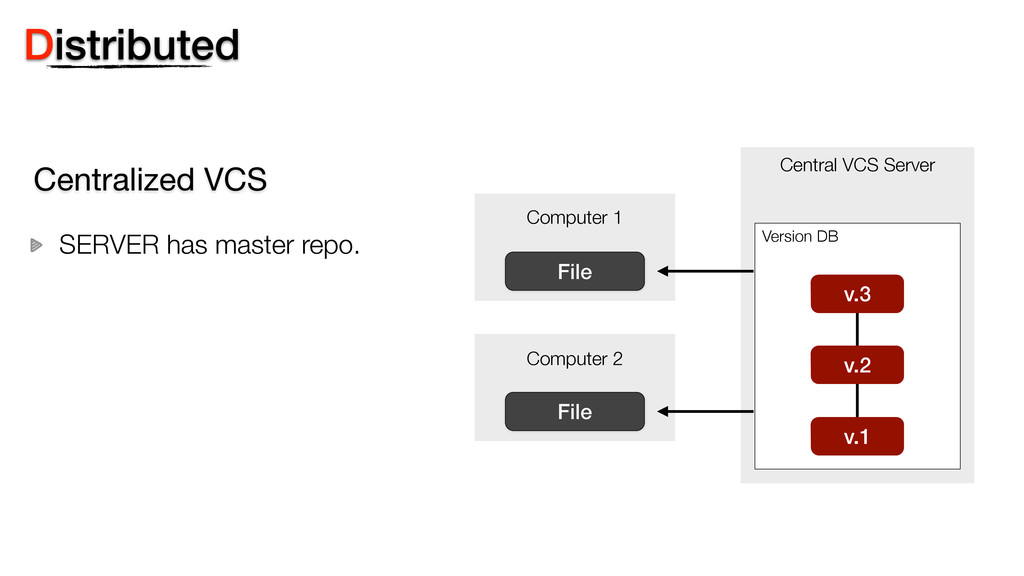
v.3 v.2 Version DB v.1 Centralized VCS File File Computer
1 Computer 2 Central VCS Server Distributed -
v.3 v.2 Version DB v.1 Centralized VCS SERVER has master
repo. File File Computer 1 Computer 2 Central VCS Server Distributed -
v.3 v.2 Version DB v.1 Centralized VCS SERVER has master
repo. Collaborate with others on a different system File File Computer 1 Computer 2 Central VCS Server Distributed -
v.3 v.2 Version DB v.1 Centralized VCS SERVER has master
repo. Collaborate with others on a different system We push everything to server. File File Computer 1 Computer 2 Central VCS Server Distributed -
Central VCS Server v.3 v.2 File Computer 1 Version DB
v.1 v.3 v.2 Version DB v.1 v.3 v.2 File Computer 2 Version DB v.1 Distributed VCS Distributed -
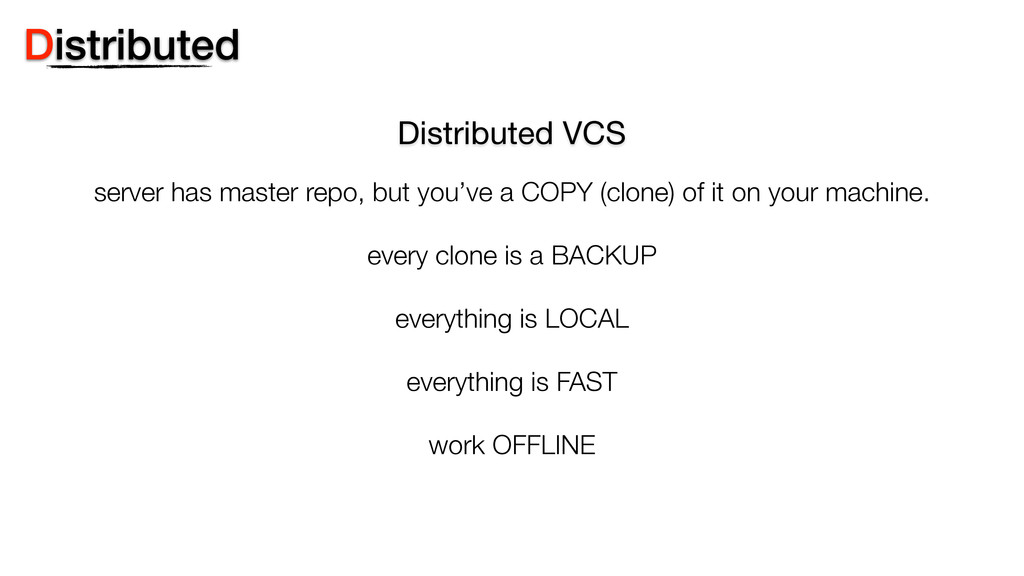
Distributed VCS server has master repo, but you’ve a COPY
(clone) of it on your machine. every clone is a BACKUP everything is LOCAL everything is FAST work OFFLINE Distributed -
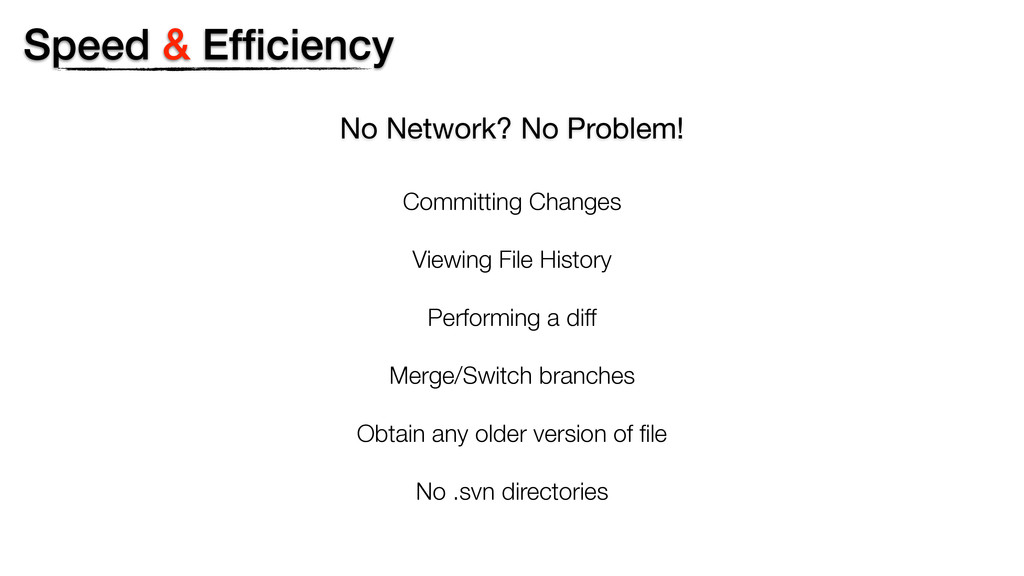
No Network? No Problem! Committing Changes Viewing File History Performing
a diff Merge/Switch branches Obtain any older version of file No .svn directories Speed & Efficiency -
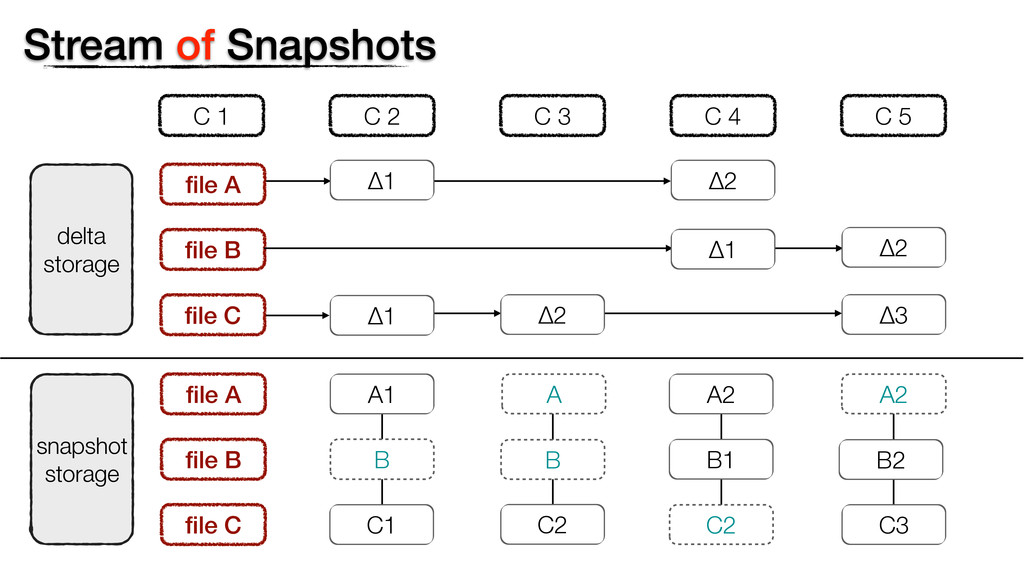
Stream of Snapshots delta storage file B file C C
1 C 2 C 3 C 4 C 5 snapshot storage file A file B file C file A ∆1 ∆2 ∆1 ∆2 ∆1 ∆2 ∆3 A1 B B A C2 A2 C1 C2 A2 B1 B2 C3 -
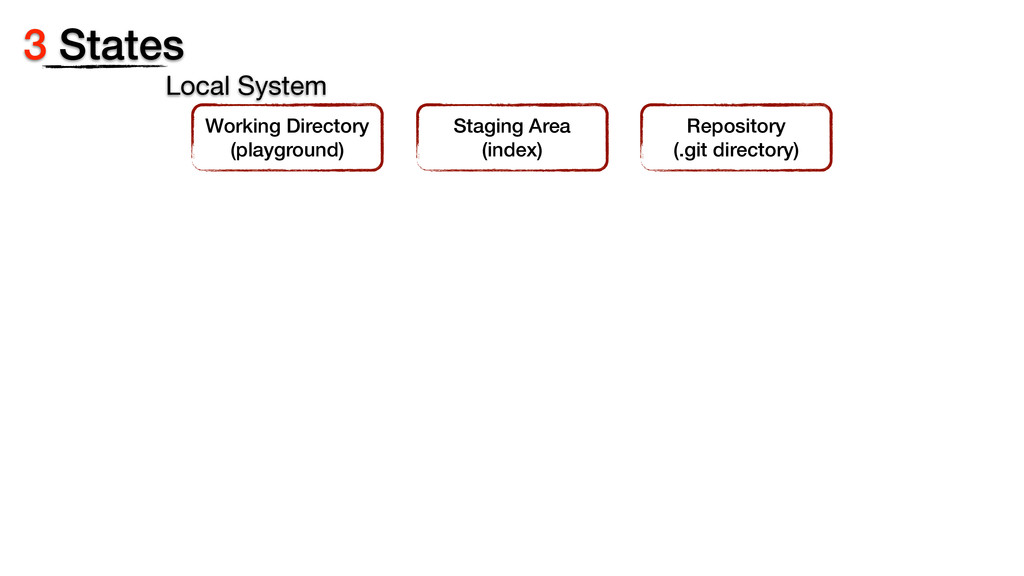
3 States Repository (.git directory) Staging Area (index) Working Directory
(playground) Checkout the project Stage changes Commit Changes -
3 States Repository (.git directory) Staging Area (index) Working Directory
(playground) Local System -
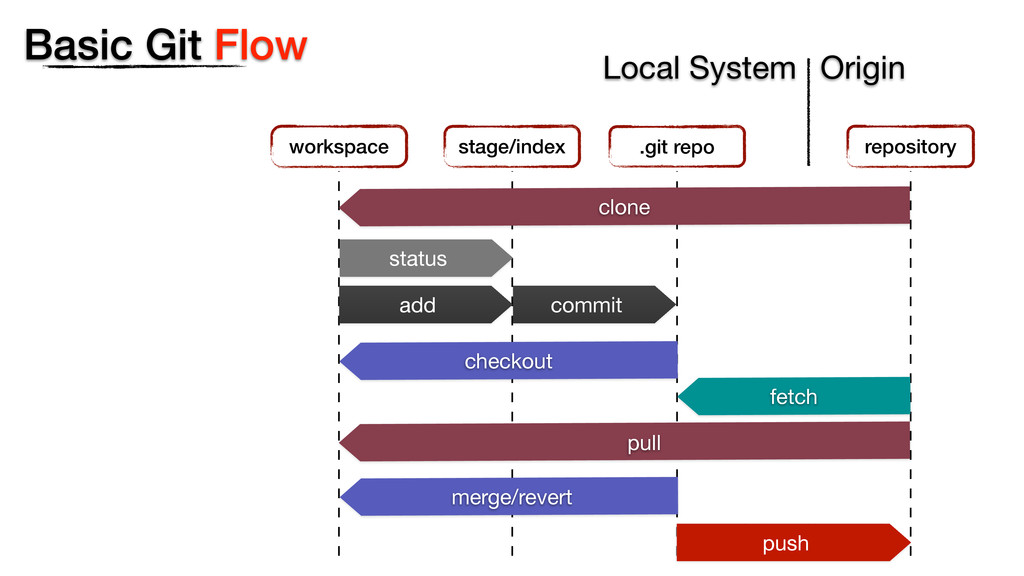
Basic Git Flow Local System workspace .git repo stage/index Origin
repository add commit status clone pull fetch checkout push merge/revert -
Basic Git Flow Local System workspace .git repo stage/index stash
Origin repository add commit status clone pull fetch checkout push merge/revert -
Basic Git Flow Local System workspace .git repo stage/index stash
Origin repository add commit status clone pull fetch checkout save push apply/discard merge/revert -
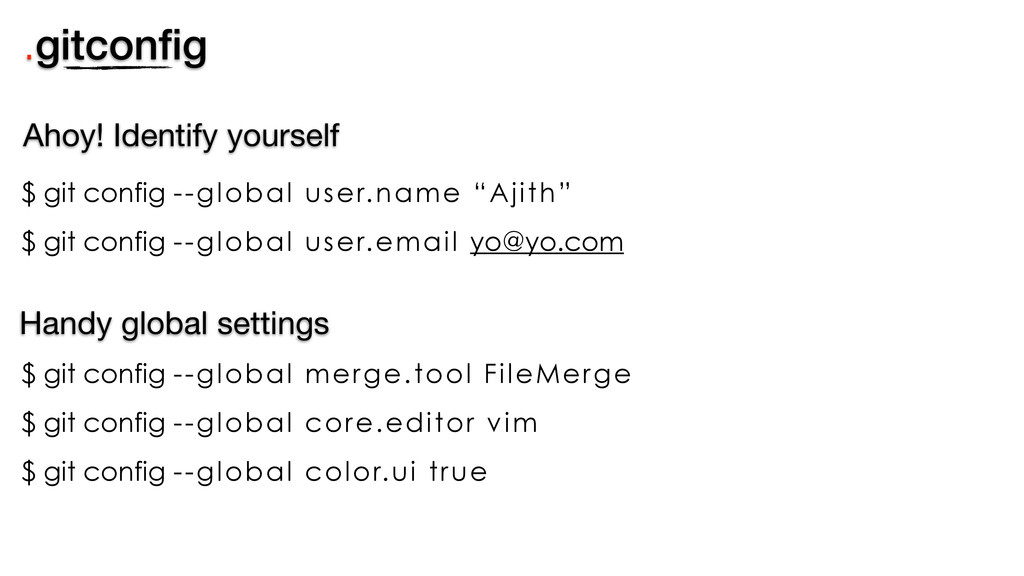
.gitconfig $ git config --global user.name “Ajith” $ git config
--global user.email [email protected] $ git config --global merge.tool FileMerge $ git config --global core.editor vim $ git config --global color.ui true Ahoy! Identify yourself Handy global settings -
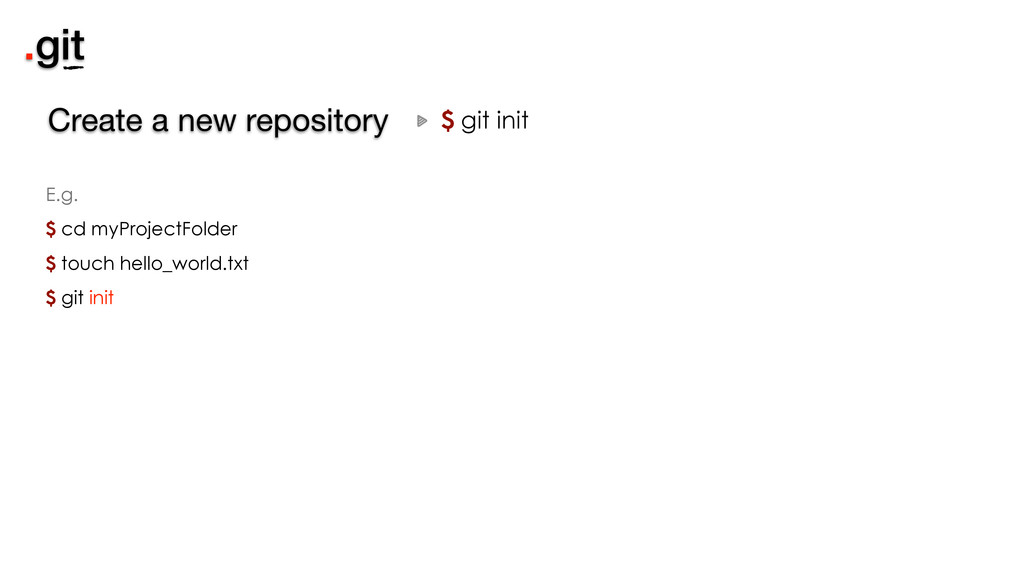
.git $ git init Create a new repository E.g. $
cd myProjectFolder $ touch hello_world.txt $ git init -
.git $ git init Create a new repository $ git
clone <URL> Clone an existing repository E.g. $ cd myProjectFolder $ touch hello_world.txt $ git init E.g. $ git clone [email protected]:ajithrnayak/AJUtilities.git Cloning into 'AJUtilities'... -
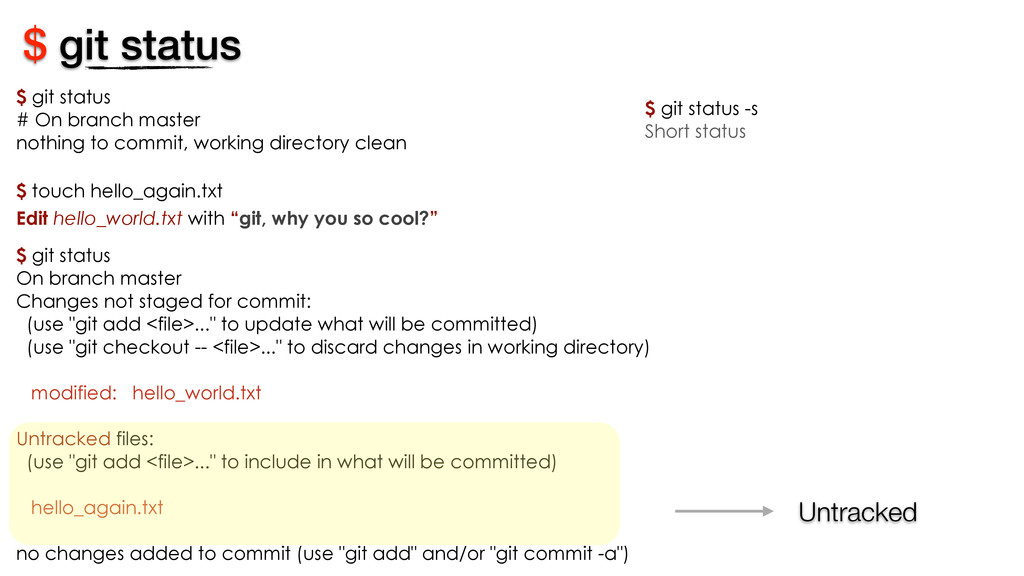
$ git status $ git status # On branch master
nothing to commit, working directory clean $ touch hello_again.txt Edit hello_world.txt with “git, why you so cool?” $ git status -s Short status -
$ git status On branch master Changes not staged for
commit: (use "git add <file>..." to update what will be committed) (use "git checkout -- <file>..." to discard changes in working directory) m odified: hello_world.txt Untracked files: (use "git add <file>..." to include in what will be committed) h ello_again.txt no changes added to commit (use "git add" and/or "git commit -a") $ git status $ git status # On branch master nothing to commit, working directory clean $ touch hello_again.txt Edit hello_world.txt with “git, why you so cool?” $ git status -s Short status -
$ git status On branch master Changes not staged for
commit: (use "git add <file>..." to update what will be committed) (use "git checkout -- <file>..." to discard changes in working directory) m odified: hello_world.txt Untracked files: (use "git add <file>..." to include in what will be committed) h ello_again.txt no changes added to commit (use "git add" and/or "git commit -a") $ git status $ git status # On branch master nothing to commit, working directory clean $ touch hello_again.txt Edit hello_world.txt with “git, why you so cool?” $ git checkout - -hello_world.txt $ git status -s Short status -
$ git status On branch master Changes not staged for
commit: (use "git add <file>..." to update what will be committed) (use "git checkout -- <file>..." to discard changes in working directory) m odified: hello_world.txt Untracked files: (use "git add <file>..." to include in what will be committed) h ello_again.txt no changes added to commit (use "git add" and/or "git commit -a") $ git status $ git status # On branch master nothing to commit, working directory clean $ touch hello_again.txt Edit hello_world.txt with “git, why you so cool?” Unstaged $ git status -s Short status -
$ git status On branch master Changes not staged for
commit: (use "git add <file>..." to update what will be committed) (use "git checkout -- <file>..." to discard changes in working directory) m odified: hello_world.txt Untracked files: (use "git add <file>..." to include in what will be committed) h ello_again.txt no changes added to commit (use "git add" and/or "git commit -a") $ git status $ git status # On branch master nothing to commit, working directory clean $ touch hello_again.txt Edit hello_world.txt with “git, why you so cool?” Untracked $ git status -s Short status -
$ git add Lets add file(s) to stage - Ready
for commit $ git add hello_world.txt -
$ git add Lets add file(s) to stage - Ready
for commit $ git status On branch master Changes to be committed: (use "git reset HEAD <file>..." to unstage) modified: hello_world.txt Untracked files: (use "git add <file>..." to include in what will be committed) hello_again.txt $ git add hello_world.txt -
$ git add Lets add file(s) to stage - Ready
for commit $ git status On branch master Changes to be committed: (use "git reset HEAD <file>..." to unstage) modified: hello_world.txt Untracked files: (use "git add <file>..." to include in what will be committed) hello_again.txt $ git add hello_world.txt $ git reset HEAD hello_world.txt Unstaged changes after reset: M hello_world.txt -
$ git add Lets add file(s) to stage - Ready
for commit $ git add - -all $ git status On branch master On branch master Changes to be committed: (use "git reset HEAD <file>..." to unstage) n ew file: hello_again.txt m odified: hello_world.txt -
$ git add Lets add file(s) to stage - Ready
for commit Remember, tracking a new file starts after you add it Modified staged file? stage it again $ git add - -all $ git status On branch master On branch master Changes to be committed: (use "git reset HEAD <file>..." to unstage) n ew file: hello_again.txt m odified: hello_world.txt -
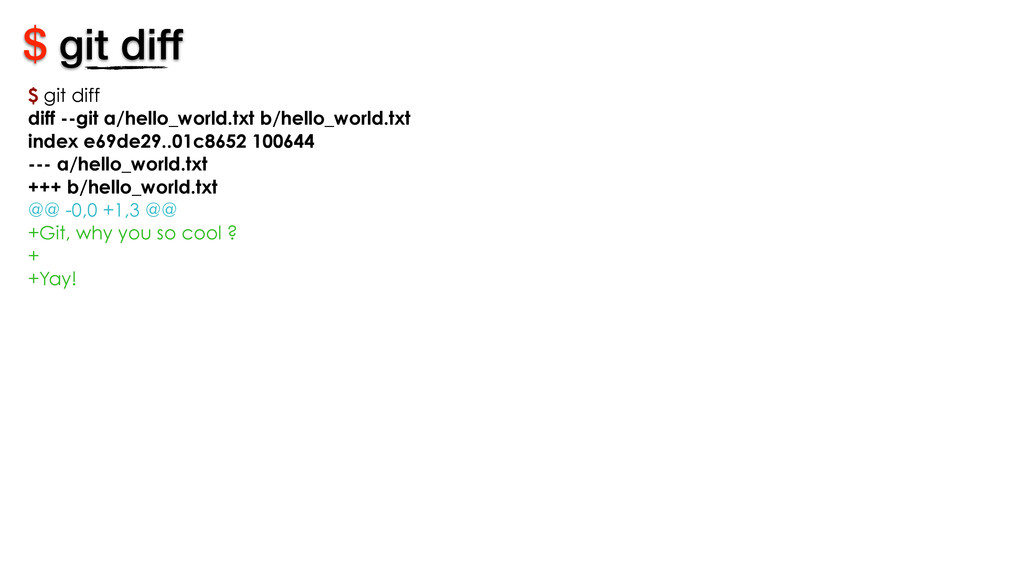
$ git diff diff --git a/hello_world.txt b/hello_world.txt index e69de29..01c8652 100644
--- a/hello_world.txt +++ b/hello_world.txt @@ -0,0 +1,3 @@ +Git, why you so cool ? + +Yay! $ git diff -
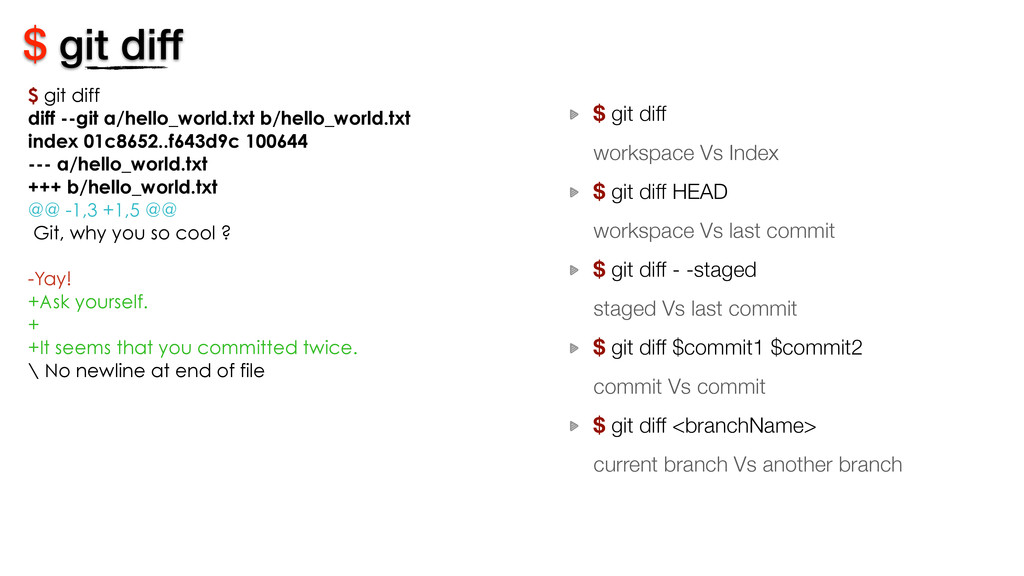
$ git diff diff --git a/hello_world.txt b/hello_world.txt index 01c8652..f643d9c 100644
--- a/hello_world.txt +++ b/hello_world.txt @@ -1,3 +1,5 @@ Git, why you so cool ? -Yay! +Ask yourself. + +It seems that you committed twice. \ No newline at end of file $ git diff -
$ git diff diff --git a/hello_world.txt b/hello_world.txt index 01c8652..f643d9c 100644
--- a/hello_world.txt +++ b/hello_world.txt @@ -1,3 +1,5 @@ Git, why you so cool ? -Yay! +Ask yourself. + +It seems that you committed twice. \ No newline at end of file $ git diff workspace Vs Index $ git diff HEAD workspace Vs last commit $ git diff - -staged staged Vs last commit $ git diff $commit1 $commit2 commit Vs commit $ git diff <branchName> current branch Vs another branch $ git diff -
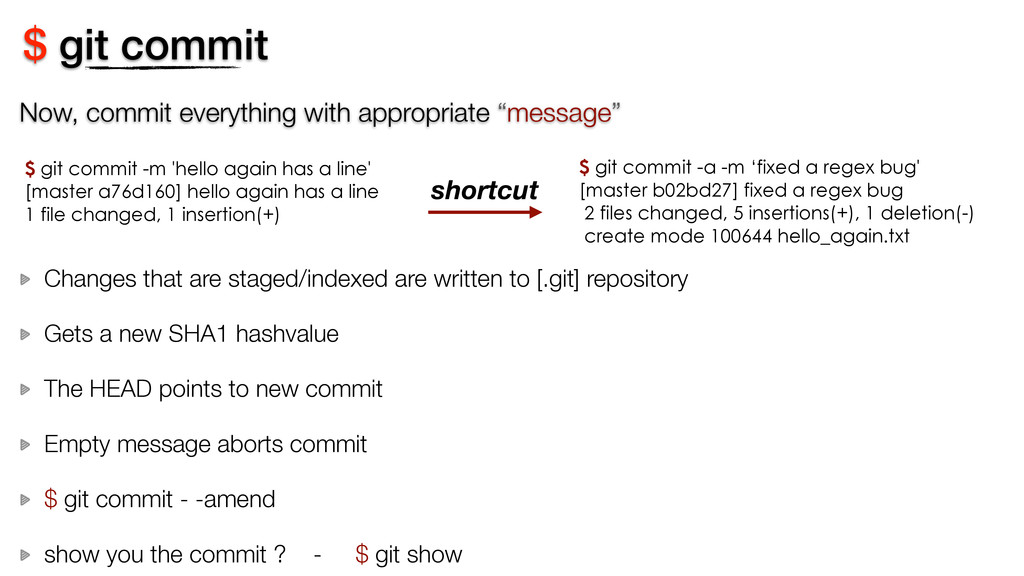
Now, commit everything with appropriate “message” $ git commit $
git commit -m 'hello again has a line' [master a76d160] hello again has a line 1 file changed, 1 insertion(+) -
Now, commit everything with appropriate “message” shortcut $ git commit
$ git commit -m 'hello again has a line' [master a76d160] hello again has a line 1 file changed, 1 insertion(+) $ git commit -a -m ‘fixed a regex bug' [master b02bd27] fixed a regex bug 2 files changed, 5 insertions(+), 1 deletion(-) create mode 100644 hello_again.txt -
Now, commit everything with appropriate “message” shortcut Changes that are
staged/indexed are written to [.git] repository Gets a new SHA1 hashvalue The HEAD points to new commit Empty message aborts commit $ git commit - -amend show you the commit ? - $ git show $ git commit $ git commit -m 'hello again has a line' [master a76d160] hello again has a line 1 file changed, 1 insertion(+) $ git commit -a -m ‘fixed a regex bug' [master b02bd27] fixed a regex bug 2 files changed, 5 insertions(+), 1 deletion(-) create mode 100644 hello_again.txt -
$ git commit -m “Said hello to people" [master 91e5129]
Said hello to people 2 files changed, 1 deletion(-) create mode 100644 hello_people.txt What’s happening under the hood? $ git commit -
$ git commit -m “Said hello to people" [master 91e5129]
Said hello to people 2 files changed, 1 deletion(-) create mode 100644 hello_people.txt What’s happening under the hood? $ git commit -
Object model commit blob tree Pointer to a snapshot
Directory list File contents -
$ git log $ git log commit a76d160f2964a7ed488c96550a474cb8e31d05d0 Author: Ajith
<[email protected]> Date: Tue Feb 17 09:49:45 2015 +0530 hello again commit b02bd2733c90e72914e9ae7b861662a77bc50b22 Author: Ajith <[email protected]> Date: Tue Feb 17 09:36:27 2015 +0530 another exp commit commit 7c971151c8543ee99fcf60a7f839c74f8a91b055 Author: Ajith <[email protected]> Date: Tue Feb 17 09:34:17 2015 +0530 exp commit $ git log -3 shows last 3 commits $ git log - -since=2.days logs since last 2 days $ git log - -p patch with each commit $ git log - -pretty=oneline each commit on single line $ git log - -graph a cool graph A look back at all the commit logs -
$ git tag $ git tag List out all the
existing tags $ git tag v.1.0.3 New tag is created- ‘v.1.0.3’ Lightweight tag $ git tag -a <name> -m “first official release” New tag with more info Annotated tag Tag is a named reference to a commit -
OMGit!! The Rescue weapons $ git revert <commit> Reverse Commit
- Adds another commit by reverting the commit $ git commit - -ammend Alter Commit - Make changes to last commit $ git reset HEAD <file> Unstage file - Removes it from stage/index $ git checkout <file> Revert changes - commit Vs commit $ git rm Remove files - delete the file. -
OMGit!! Panic time!! $ git reflog a76d160 HEAD@{0}: commit: hello
again b02bd27 HEAD@{1}: commit: another exp commit 7c97115 HEAD@{2}: commit: exp commit 2fa198e HEAD@{3}: commit: another commit 1d9b1ad HEAD@{4}: commit (initial): Initial commit -
OMGit!! Panic time!! $ git reset - -hard HEAD@{2} Be
gone! - head, staged & workspace is erased reset flags: - -hard - -soft - -mixed $ git reflog a76d160 HEAD@{0}: commit: hello again b02bd27 HEAD@{1}: commit: another exp commit 7c97115 HEAD@{2}: commit: exp commit 2fa198e HEAD@{3}: commit: another commit 1d9b1ad HEAD@{4}: commit (initial): Initial commit -
.gitignore Ignore files that never needs tracking iOS e.g. .DS_Store
.Trashes *.swp DerivedData build/ *.pbxuser !default.pbxuser *.mode1v3 !default.mode1v3 xcuserdata *.xccheckout E.g breakpoints, log files, project bundle state etc Check this out : http://github.com/github/gitignore -
Remote Adding a remote to your local repository $ git
remote add https://github.com/ajithrnayak/epicStuff.git OR $ git remote add [email protected]/ajithrnayak/epicStuff.git -
Remote Adding a remote to your local repository Cloned a
repo? It already has remote - origin $ git remote add https://github.com/ajithrnayak/epicStuff.git OR $ git remote add [email protected]/ajithrnayak/epicStuff.git $ git remote -v origin [email protected]/ajithrnayak/epicStuff.git(fetch) origin [email protected]/ajithrnayak/epicStuff.git(push) -
Remote Adding a remote to your local repository Cloned a
repo? It already has remote - origin $ git remote add https://github.com/ajithrnayak/epicStuff.git OR $ git remote add [email protected]/ajithrnayak/epicStuff.git $ git remote -v origin [email protected]/ajithrnayak/epicStuff.git(fetch) origin [email protected]/ajithrnayak/epicStuff.git(push) Information about remote $ git remote show origin -
Push $ git push <remote_name> <remote_branch> E.g. $ git push
origin master Push a branch to remote Push only the branches that you want to share Rejected if branch is behind $ git push origin - -tags Tags must be pushed seperately Push changes to remote -
Fetch Vs Pull Get data from others (remote repo) $
git fetch <remote_name> Not available to workspace yet. $ git pull $ git fetch + $ git merge workspace .git repo stage/index stash repository pull fetch Local System Origin -
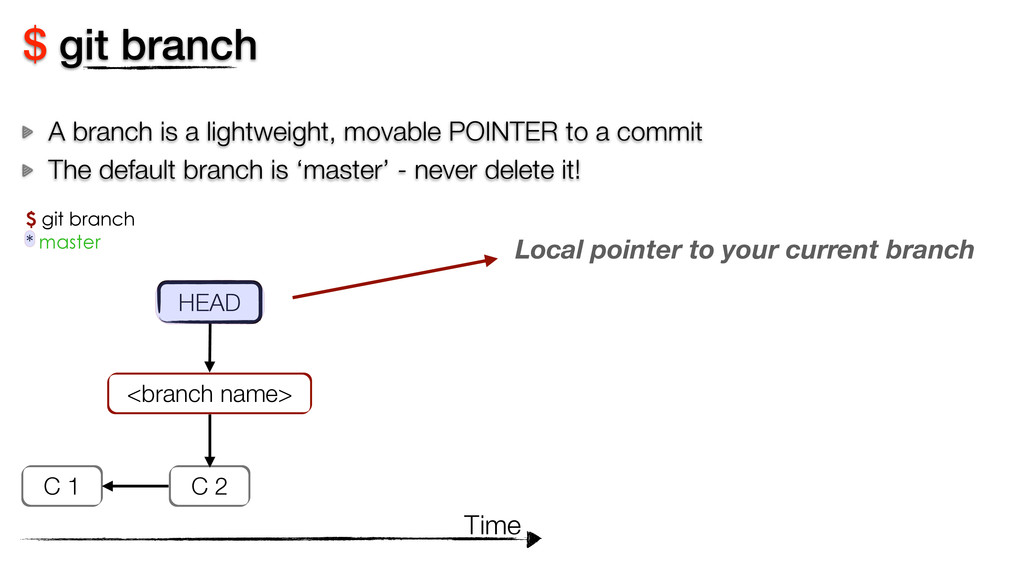
$ git branch A branch is a lightweight, movable POINTER
to a commit The default branch is ‘master’ - never delete it! $ git branch * master -
$ git branch A branch is a lightweight, movable POINTER
to a commit The default branch is ‘master’ - never delete it! $ git branch * master C 1 C 2 <branch name> HEAD Time -
$ git branch A branch is a lightweight, movable POINTER
to a commit The default branch is ‘master’ - never delete it! $ git branch * master C 1 C 2 <branch name> HEAD Time Local pointer to your current branch -
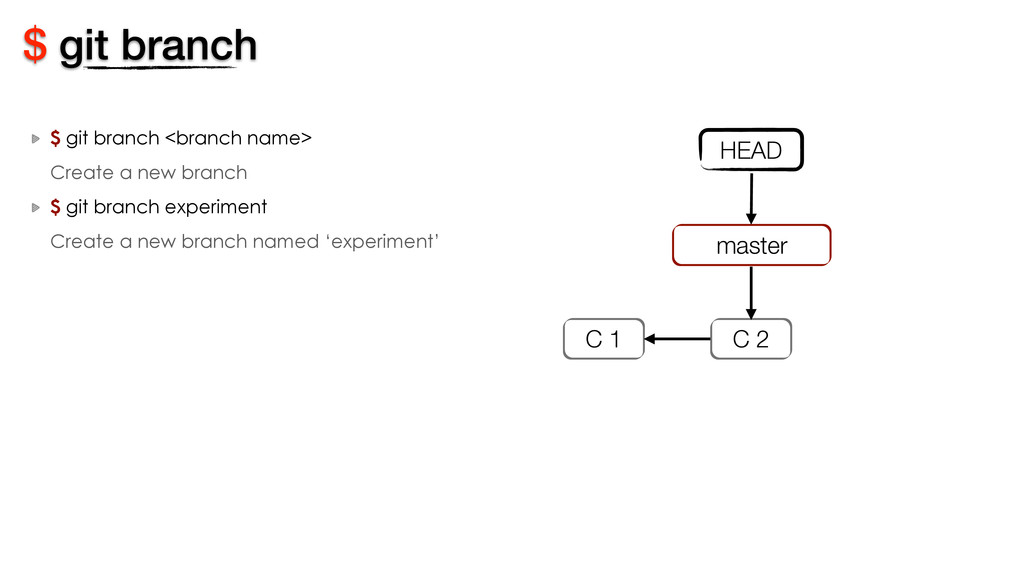
$ git branch <branch name> Create a new branch C
1 C 2 master HEAD $ git branch -
$ git branch <branch name> Create a new branch $
git branch experiment Create a new branch named ‘experiment’ C 1 C 2 master HEAD $ git branch -
$ git branch <branch name> Create a new branch $
git branch experiment Create a new branch named ‘experiment’ C 1 C 2 master HEAD experiment $ git branch experiment * master $ git branch -
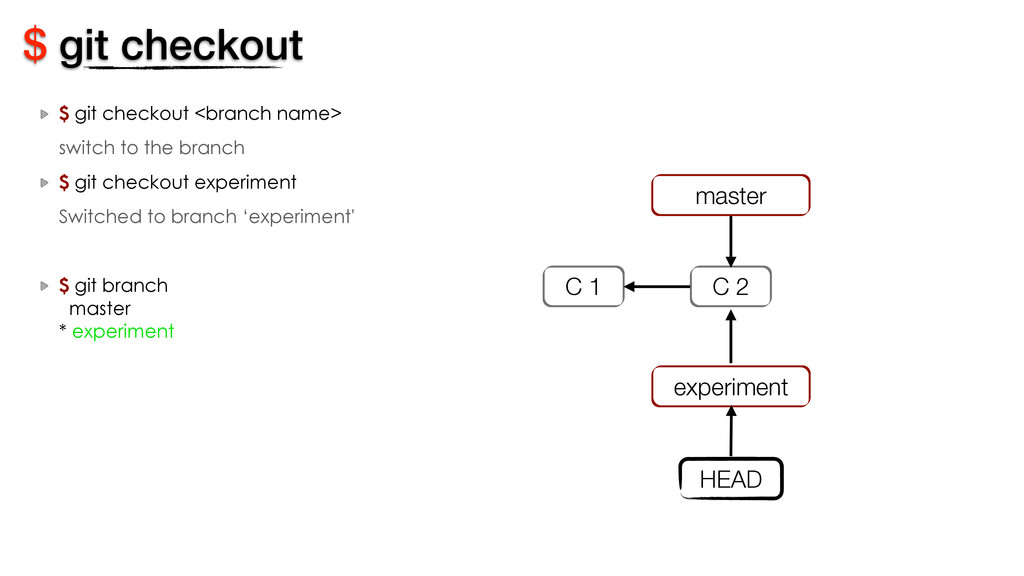
$ git checkout C 1 C 2 master experiment $
git checkout <branch name> switch to the branch $ git checkout experiment Switched to branch ‘experiment' $ git branch master * experiment HEAD -
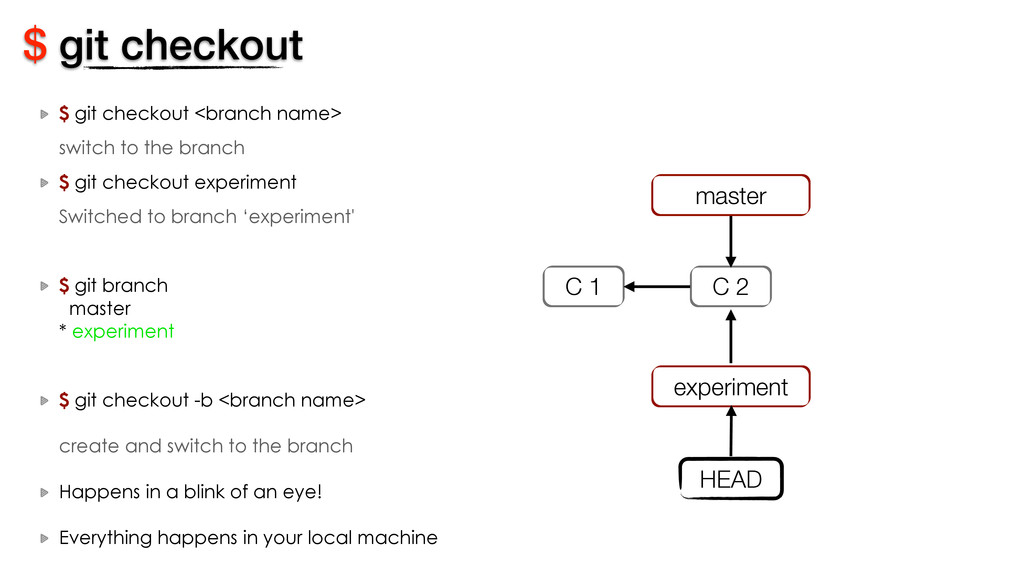
$ git checkout C 1 C 2 master experiment $
git checkout <branch name> switch to the branch $ git checkout experiment Switched to branch ‘experiment' $ git branch master * experiment $ git checkout -b <branch name> create and switch to the branch Happens in a blink of an eye! Everything happens in your local machine HEAD -
How it works $ git commit C 1 C 2
master experiment HEAD -
C 3 How it works $ git commit C 1
C 2 master experiment HEAD -
C 3 How it works $ git commit C 1
C 2 master experiment HEAD -
C 3 How it works $ git commit $ git
commit C 1 C 2 master experiment HEAD -
C 3 C 4 How it works $ git commit
$ git commit C 1 C 2 master experiment HEAD -
C 3 C 4 How it works $ git commit
$ git commit C 1 C 2 master experiment HEAD -
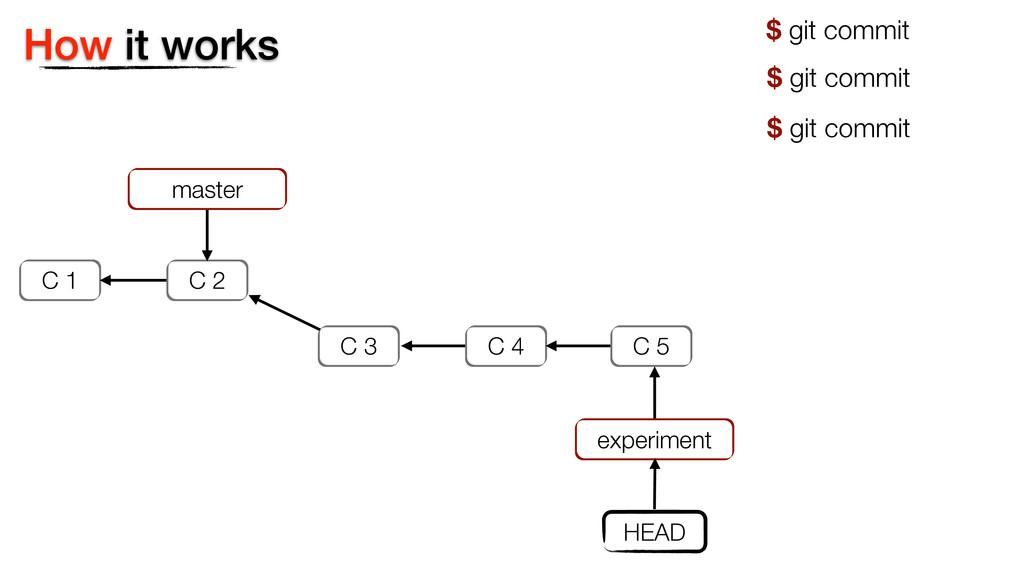
C 3 C 4 C 5 How it works $
git commit $ git commit $ git commit C 1 C 2 master experiment HEAD -
C 3 C 4 C 5 How it works $
git commit $ git commit $ git commit C 1 C 2 master experiment HEAD -
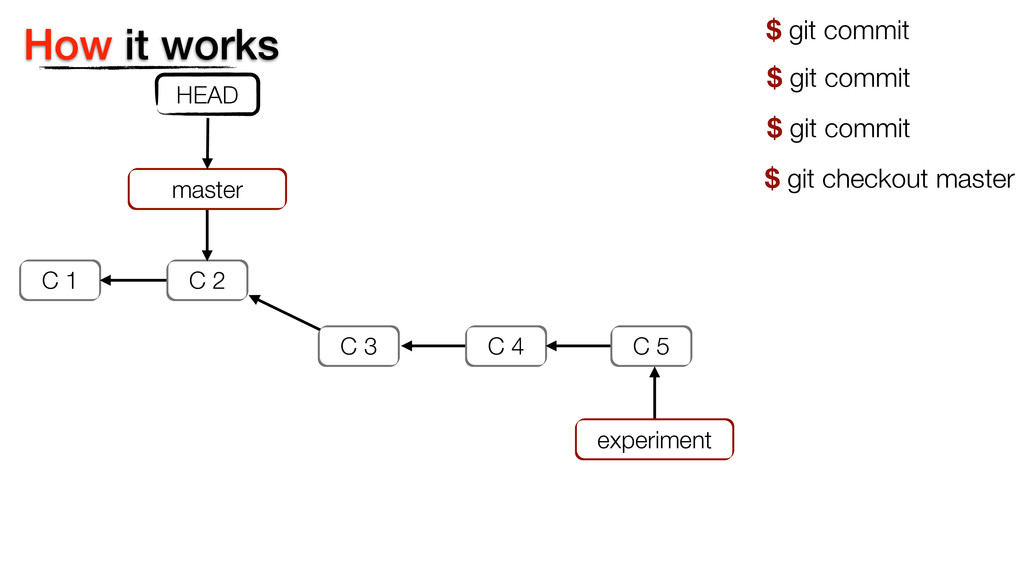
C 3 C 4 C 5 How it works $
git commit $ git commit $ git checkout master $ git commit C 1 C 2 master experiment HEAD -
C 3 C 4 C 5 How it works $
git commit $ git commit $ git checkout master $ git commit C 1 C 2 master experiment HEAD -
How it works C 1 C 2 master experiment $
git checkout master HEAD C 3 C 4 C 5 -
How it works C 1 C 2 master experiment $
git checkout master HEAD $ git commit C 3 C 4 C 5 -
How it works C 1 C 2 master experiment $
git checkout master HEAD $ git commit C 6 C 3 C 4 C 5 -
How it works C 1 C 2 master experiment $
git checkout master HEAD $ git commit C 6 C 3 C 4 C 5 -
How it works C 1 C 2 master experiment $
git checkout master HEAD $ git commit C 6 C 3 C 4 C 5 -
$ git merge C 1 C 2 master experiment C
3 C 4 HEAD C 6 C 5 -
$ git merge C 1 C 2 master experiment C
3 C 4 HEAD C 6 C 5 $ git merge experiment -
$ git merge C 1 C 2 master experiment C
3 C 4 HEAD C 6 C 5 $ git merge experiment C 7 -
$ git merge C 1 C 2 master experiment C
3 C 4 HEAD C 6 C 5 $ git merge experiment C 7 -
$ git merge C 1 C 2 master experiment C
3 C 4 HEAD C 6 C 5 $ git merge experiment C 7 MAGIC! Delete ‘experiment’ branch -
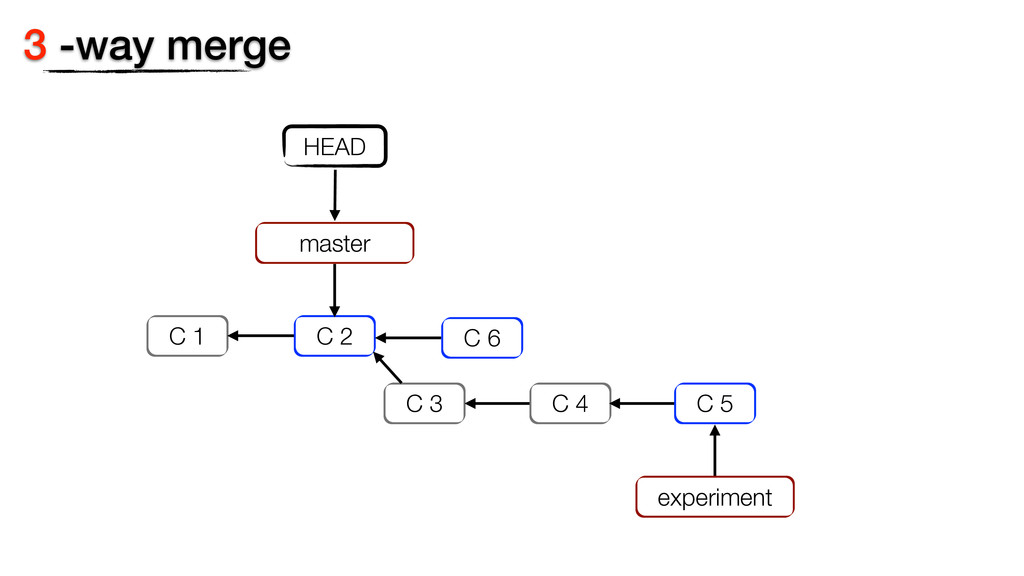
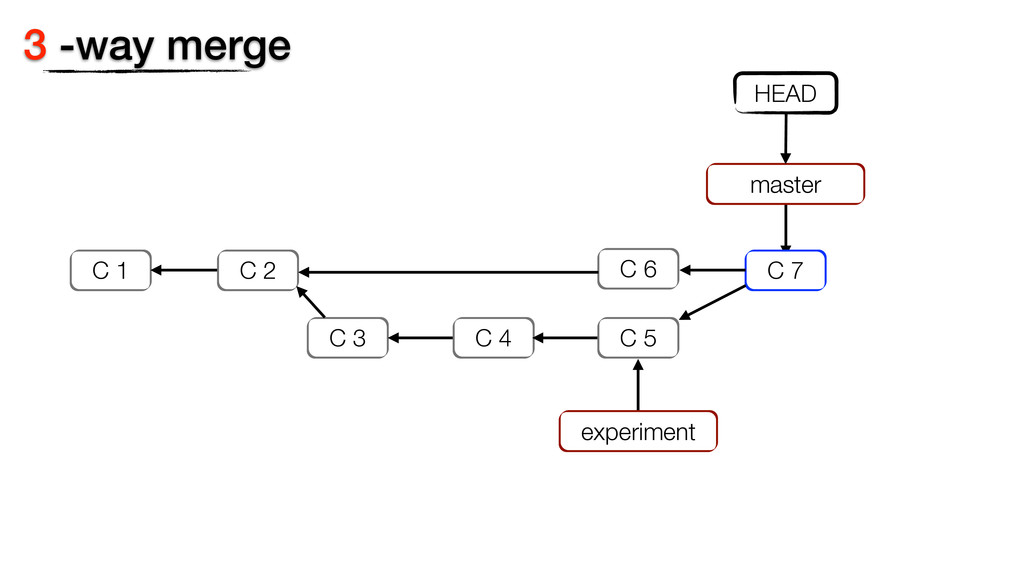
C 1 C 2 master experiment C 3 C 4
HEAD C 6 C 5 3 -way merge -
3 -way merge C 1 C 2 master experiment C
3 C 4 HEAD C 6 C 5 C 7 -
Fast Forward C 1 C 2 master experiment C 3
C 4 HEAD C 5 -
C 1 C 2 master experiment C 3 C 4
HEAD C 5 Fast Forward -
C 1 C 2 master experiment C 3 C 4
HEAD C 5 Fast Forward Use ‘- -no-ff’ for a non-fastforward merge Simply adds a commit that summarises merge -
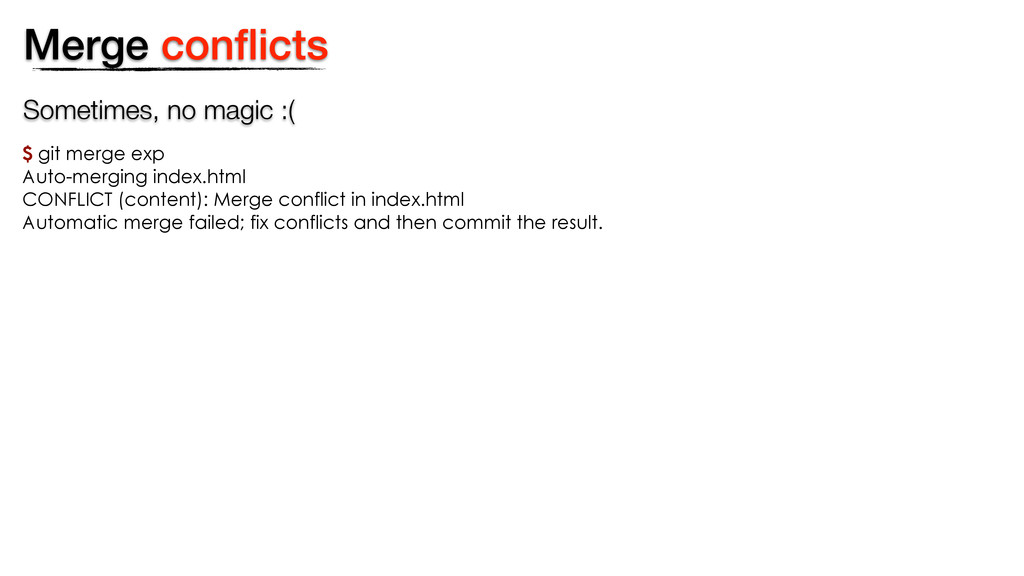
Merge conflicts Sometimes, no magic :( $ git merge exp
Auto-merging index.html CONFLICT (content): Merge conflict in index.html Automatic merge failed; fix conflicts and then commit the result. -
Merge conflicts Sometimes, no magic :( $ git merge exp
Auto-merging index.html CONFLICT (content): Merge conflict in index.html Automatic merge failed; fix conflicts and then commit the result. $ git status On branch master You have unmerged paths. (fix conflicts and run "git commit”) Unmerged paths: (use "git add <file>..." to mark resolution) both modified: index.html no changes added to commit (use "git add" and/or "git commit -a") -
def hello <<<<<<< HEAD puts ‘hola Amigos' ======= puts 'hello
world' >>>>>>> said hello to world end Resolve conflicts -
def hello <<<<<<< HEAD puts ‘hola Amigos' ======= puts 'hello
world' >>>>>>> said hello to world end Resolve conflicts -
def hello <<<<<<< HEAD puts ‘hola Amigos' ======= puts 'hello
world' >>>>>>> said hello to world end Resolve conflicts -
def hello <<<<<<< HEAD puts ‘hola Amigos' ======= puts 'hello
world' >>>>>>> said hello to world end Resolve conflicts $ git config --global merge.conflictstyle diff3 -
def hello <<<<<<< HEAD puts ‘hola Amigos' ======= puts 'hello
world' >>>>>>> said hello to world end Resolve conflicts $ git config --global merge.conflictstyle diff3 def hello <<<<<<< HEAD puts 'hola Amigos' ||||||| original puts 'hello Amigos' ======= puts 'hello world' >>>>>>> said hello to world end -
def hello <<<<<<< HEAD puts ‘hola Amigos' ======= puts 'hello
world' >>>>>>> said hello to world end Resolve conflicts $ git config --global merge.conflictstyle diff3 Use git mergetool Resolve conflicts Do a commit def hello <<<<<<< HEAD puts 'hola Amigos' ||||||| original puts 'hello Amigos' ======= puts 'hello world' >>>>>>> said hello to world end -
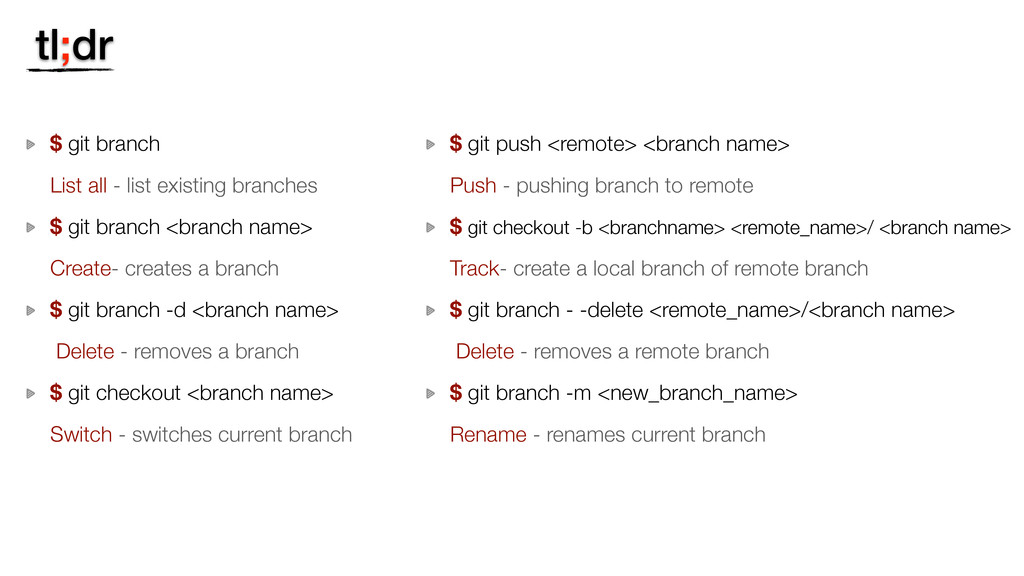
tl;dr $ git branch List all - list existing branches
$ git branch <branch name> Create- creates a branch $ git branch -d <branch name> Delete - removes a branch $ git checkout <branch name> Switch - switches current branch $ git push <remote> <branch name> Push - pushing branch to remote $ git checkout -b <branchname> <remote_name>/ <branch name> Track- create a local branch of remote branch $ git branch - -delete <remote_name>/<branch name> Delete - removes a remote branch $ git branch -m <new_branch_name> Rename - renames current branch -
Git is cool Here’s why : Cheap branching Everything is
local It’s fast It’s small No blocked files Distributed No network Github & Bitbucket Huge community -
Capabilities? Release Can we fix a bug for next release?
Can we get the codes of last release? Build Can we build the current code? Can we ship a build to client? Feature Is that feature complete? Can we try implementing this feature? Hot fix Can we do a hot fix to current version? Review How everybody can review your code? Thank you, @svenpet -
Git workflows What can/should you do with branches Workflows in
your development cycle Forking workflow github’s favourite Centralized workflow subversion like Feature Branch workflow new branch for every task/feature/story Git Flow workflow organise your source code -
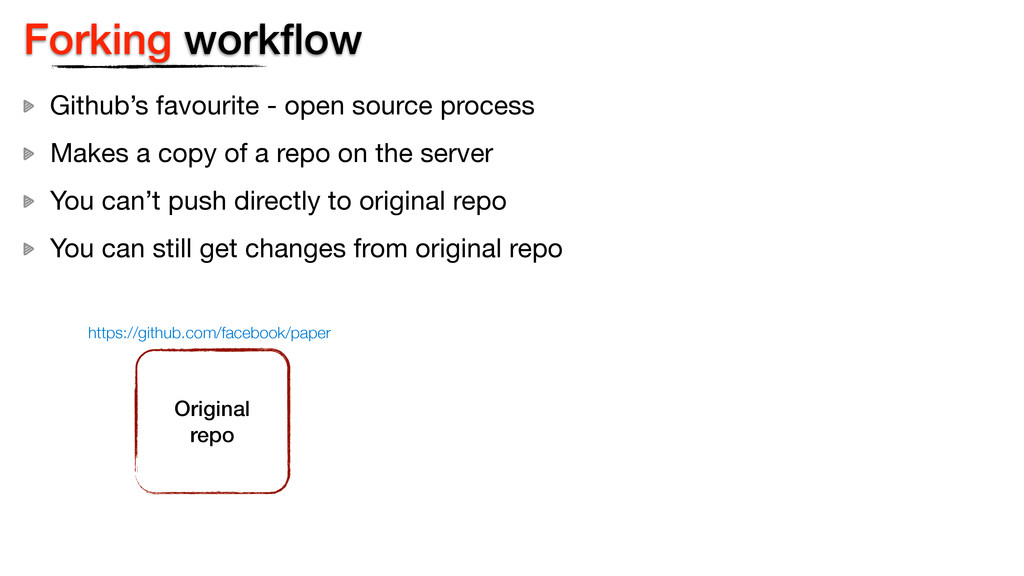
Forking workflow Github’s favourite - open source process Makes a
copy of a repo on the server You can’t push directly to original repo You can still get changes from original repo -
Forking workflow Github’s favourite - open source process Makes a
copy of a repo on the server You can’t push directly to original repo You can still get changes from original repo Original repo https://github.com/facebook/paper -
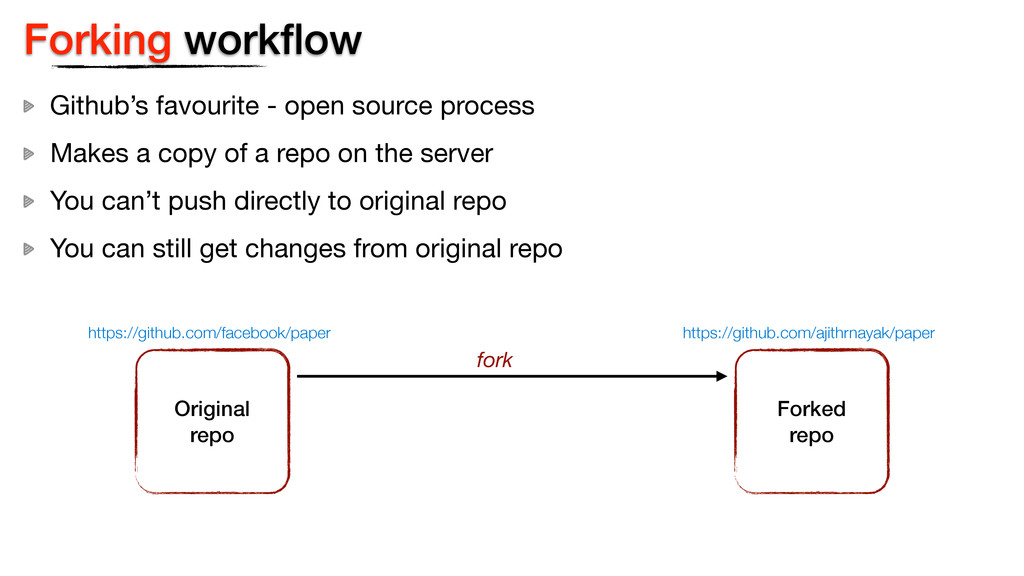
Forking workflow Github’s favourite - open source process Makes a
copy of a repo on the server You can’t push directly to original repo You can still get changes from original repo Original repo Forked repo fork https://github.com/facebook/paper https://github.com/ajithrnayak/paper -
Forking workflow Github’s favourite - open source process Makes a
copy of a repo on the server You can’t push directly to original repo You can still get changes from original repo Original repo Forked repo fork No push https://github.com/facebook/paper https://github.com/ajithrnayak/paper -
Forking workflow Github’s favourite - open source process Makes a
copy of a repo on the server You can’t push directly to original repo You can still get changes from original repo Original repo Forked repo fork No push https://github.com/facebook/paper https://github.com/ajithrnayak/paper -
Forking workflow Github’s favourite - open source process Makes a
copy of a repo on the server You can’t push directly to original repo You can still get changes from original repo Original repo Forked repo fork No push pull request https://github.com/facebook/paper https://github.com/ajithrnayak/paper -
Centralized workflow Central repo develop repo develop
repo develop repo develop repo SVN users, this one is for you Decentralized but centralized You get a complete local copy Pull/Push changes very often +ve : Conflicts are dealt very soon -ve : unfinished stories -
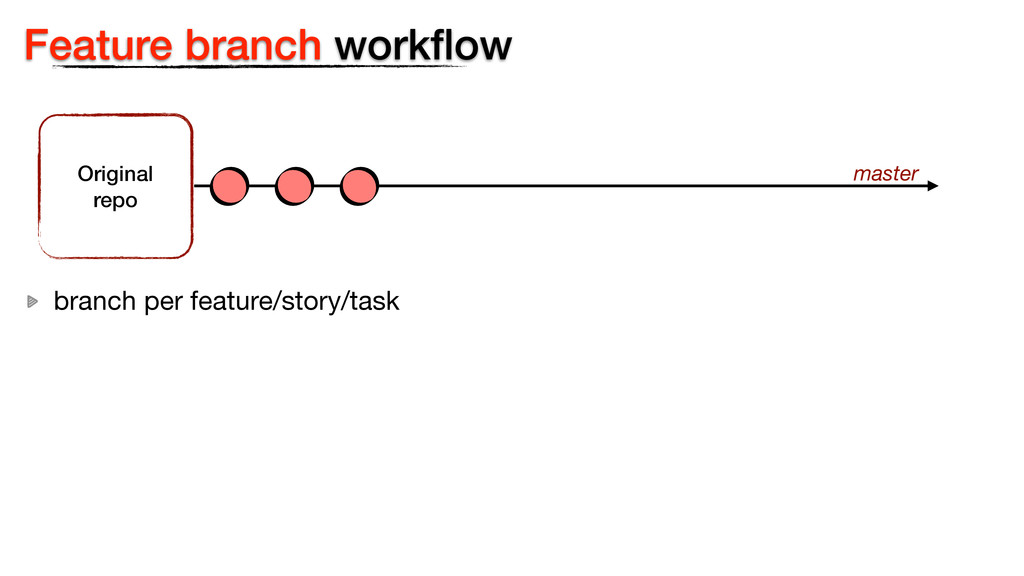
Feature branch workflow Original repo master feature 1 branch
per feature/story/task -
Feature branch workflow Original repo master feature 1 branch
per feature/story/task ’n’ developers can work on one branch -
Feature branch workflow Original repo master feature 1 feature
2 branch per feature/story/task ’n’ developers can work on one branch merge when its done & delete feaure branch -
Feature branch workflow Original repo master feature 1 feature
2 branch per feature/story/task ’n’ developers can work on one branch merge when its done & delete feaure branch -
Feature branch workflow Original repo master branch per feature/story/task
’n’ developers can work on one branch merge when its done & delete feaure branch +ve : master is clean with complete features you work independently merge frequently; short stories. -
Git flow The Feast! Vincent Driessen Branching strategy & release
management A development model to manage software development process -
Git flow Decentralized but Centralized Each developer pulls/pushes to origin
‘Origin’ is central repo (for all git users) Origin Shiv AJ Pabi Arch -
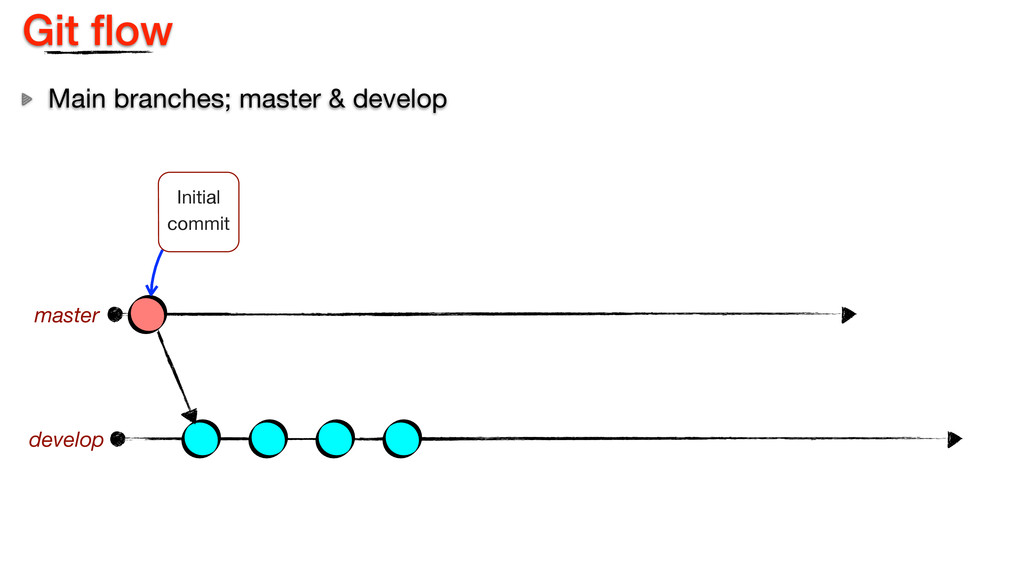
develop Git flow Main branches; master & develop master Initial
commit version 1.O -
develop Git flow Main branches; master & develop master Initial
commit version 1.O version 2.O -
develop Git flow Main branches; master & develop master Initial
commit version 1.O version 2.O in-progress work for next release -
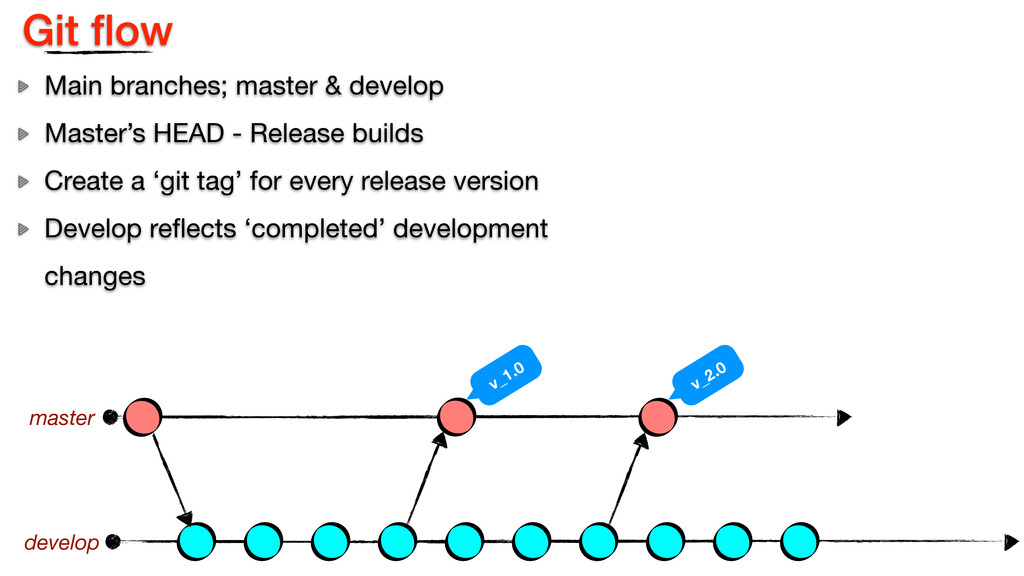
develop Git flow Main branches; master & develop Master’s HEAD
- Release builds Create a ‘git tag’ for every release version Develop reflects ‘completed’ development changes master v_1.0 v_2.0 -
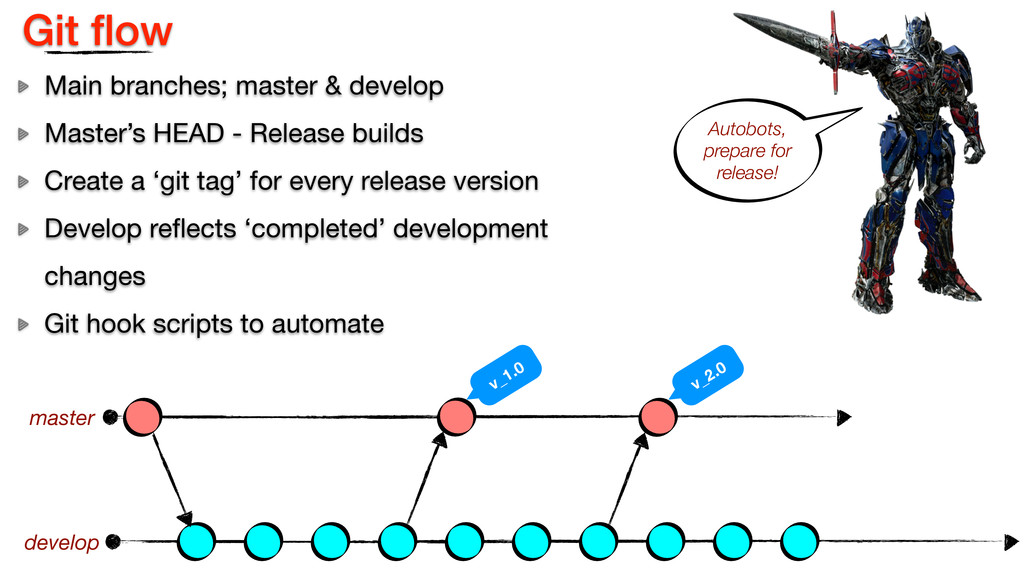
develop Git flow Main branches; master & develop Master’s HEAD
- Release builds Create a ‘git tag’ for every release version Develop reflects ‘completed’ development changes Git hook scripts to automate master v_1.0 v_2.0 Autobots, prepare for release! -
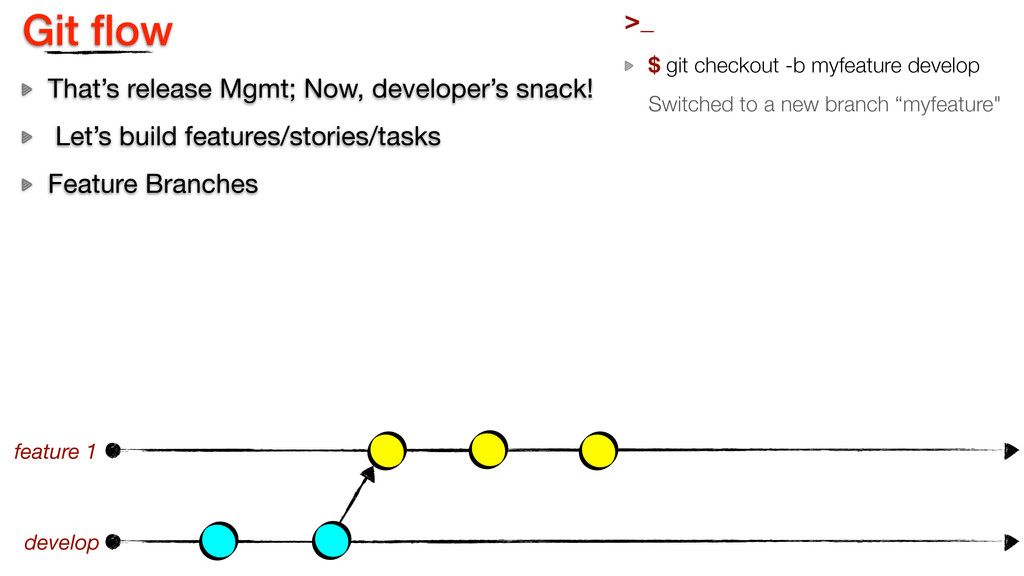
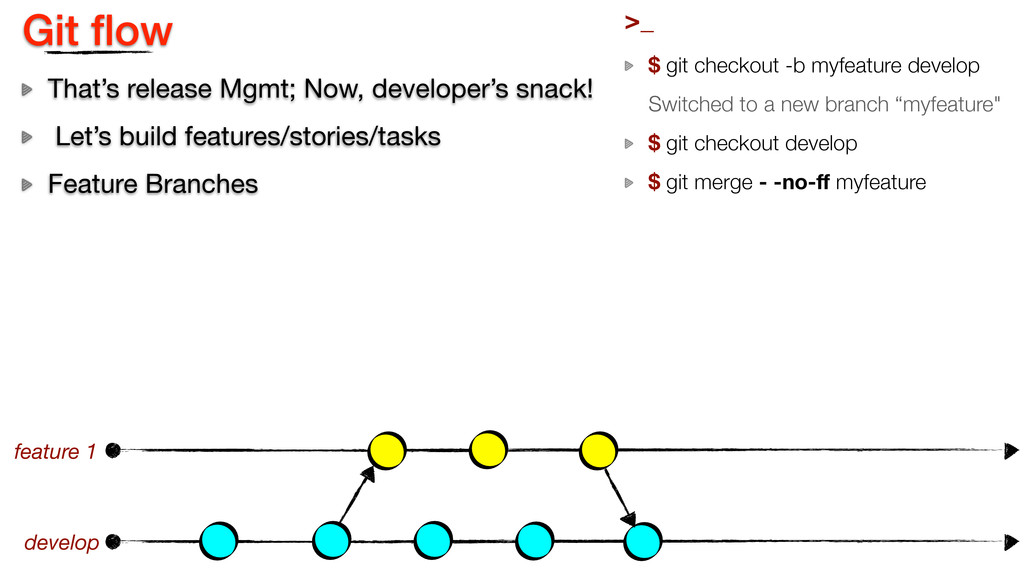
Git flow That’s release Mgmt; Now, developer’s snack! Let’s build
features/stories/tasks Feature Branches develop -
Git flow That’s release Mgmt; Now, developer’s snack! Let’s build
features/stories/tasks Feature Branches develop feature 1 >_ $ git checkout -b myfeature develop Switched to a new branch “myfeature" -
Git flow That’s release Mgmt; Now, developer’s snack! Let’s build
features/stories/tasks Feature Branches develop feature 1 >_ $ git checkout -b myfeature develop Switched to a new branch “myfeature" -
Git flow That’s release Mgmt; Now, developer’s snack! Let’s build
features/stories/tasks Feature Branches develop feature 1 >_ $ git checkout -b myfeature develop Switched to a new branch “myfeature" -
Git flow That’s release Mgmt; Now, developer’s snack! Let’s build
features/stories/tasks Feature Branches develop feature 1 >_ $ git checkout -b myfeature develop Switched to a new branch “myfeature" -
Git flow That’s release Mgmt; Now, developer’s snack! Let’s build
features/stories/tasks Feature Branches develop feature 1 >_ $ git checkout -b myfeature develop Switched to a new branch “myfeature" $ git checkout develop -
Git flow That’s release Mgmt; Now, developer’s snack! Let’s build
features/stories/tasks Feature Branches develop feature 1 >_ $ git checkout -b myfeature develop Switched to a new branch “myfeature" $ git checkout develop $ git merge - -no-ff myfeature -
Git flow That’s release Mgmt; Now, developer’s snack! Let’s build
features/stories/tasks Feature Branches develop feature 1 >_ $ git checkout -b myfeature develop Switched to a new branch “myfeature" $ git checkout develop $ git merge - -no-ff myfeature -
Git flow That’s release Mgmt; Now, developer’s snack! Let’s build
features/stories/tasks Feature Branches develop >_ $ git checkout -b myfeature develop Switched to a new branch “myfeature" $ git checkout develop $ git merge - -no-ff myfeature $ git branch -d myfeature -
Git flow That’s release Mgmt; Now, developer’s snack! Let’s build
features/stories/tasks Feature Branches develop >_ $ git checkout -b myfeature develop Switched to a new branch “myfeature" $ git checkout develop $ git merge - -no-ff myfeature $ git branch -d myfeature $ git push origin develop -
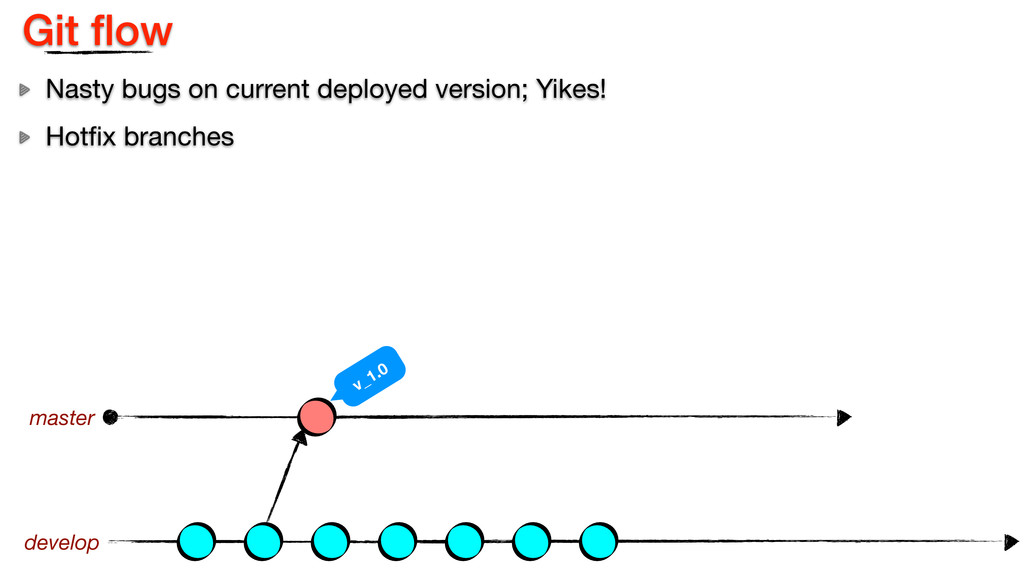
Git flow Nasty bugs on current deployed version; Yikes! Hotfix
branches develop master v_1.0 -
develop master v_1.0 Git flow Nasty bugs on current deployed
version; Yikes! Hotfix branches hotfix -
develop master v_1.0 Git flow Nasty bugs on current deployed
version; Yikes! Hotfix branches hotfix -
develop master v_1.0 Git flow Nasty bugs on current deployed
version; Yikes! Hotfix branches hotfix -
develop master v_1.0 Git flow Nasty bugs on current deployed
version; Yikes! Hotfix branches hotfix v_1.1 -
develop master v_1.0 Git flow Nasty bugs on current deployed
version; Yikes! Hotfix branches hotfix v_1.1 -
develop master v_1.0 Git flow Nasty bugs on current deployed
version; Yikes! Hotfix branches hotfix v_1.1 -
$ git rebase Alternative to merging Reapply introduced changes on
top of another commit Avoid merge commits for pulling Keeps history clean Be Carefull !! origin feature 1 feature 1 -
$ git rebase Alternative to merging Reapply introduced changes on
top of another commit Avoid merge commits for pulling Keeps history clean Be Carefull !! Commits to be pushed and pulled? fetch + rebase & push origin feature 1 feature 1 -
Stash Local System workspace stash save apply/discard “On hold” stuff
Reset staging area & workspace Changes are cached $ git stash save “description” reset index and workspace $ git stash list all your stashes $ git stash apply get them back - apply $ git stash pop apply and drop -
Cherrypick pick changes from another commit A new commit is
added on top of HEAD origin feature 1 feature 1 develop -
Cherrypick pick changes from another commit A new commit is
added on top of HEAD origin feature 1 feature 1 develop -
Code review Why do you want code reviews? - Let’s
ask the birdies! -
Code review Why do you want code reviews? Learn Code
Quality Blame Feels Good - Let’s ask the birdies! -
Code review How does it work? Send ‘pull request’ ’n’
members can review your code at the same time Commit messages should explain changes introduced in each commit Others can improve your code Happy birds!! -
Help? $ git help <command> Google is your best buddy!
Refer documentation - Be a Pro! -
Help? $ git help <command> Google is your best buddy!
Refer documentation - Be a Pro! Or, pay for my beer ;-)
 ajithrnayak
 yegor256
 quramy
 mtsmfm
 akihisaikeda
 nakamizu
 kinakomoti321
 j5ik2o
 rkaga
 kitano_yuichi
 bicstone
 ikura_hamu
 minodriven
 madoxten
 soudai
 ammeep
 mkilby
 raygrieselhuber
 lauravandoore
 davetheseo
 katarinadahlin
 jonoalderson
 uxyall
 akademiya2063