Upgrade to Pro — share decks privately, control downloads, hide ads and more …

Chess betting odds

Chess betting odds

Presented at the 3rd Milano R meeting, Italy.

chess-bet is a web app, implementing a model to calculate the odds for the players and the teams in chess events with R and Shiny.

Avatar for Alberto Santini

Alberto Santini

April 18, 2013

More Decks by Alberto Santini

Other Decks in Programming

Transcript

  1. Outline • What is chess-bet? • Chess rating, expected score,

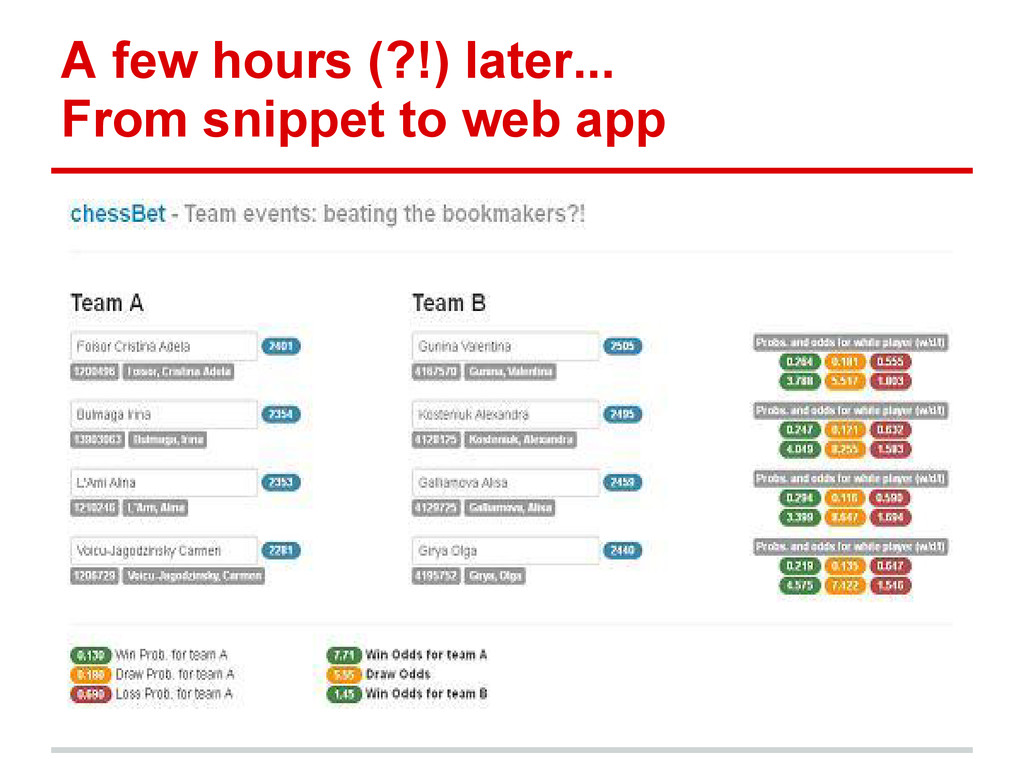
    team events, odds. • Anatomy of chess-bet app. • How to build a Shiny app. • A few hours (!?) later...
  2. What is chess-bet? chess-bet is a web app, implementing a

    model to calculate the odds for the players and the teams in chess events. With R and Shiny. Credits to Peter Zhdanov Team events: beating the bookmakers?!
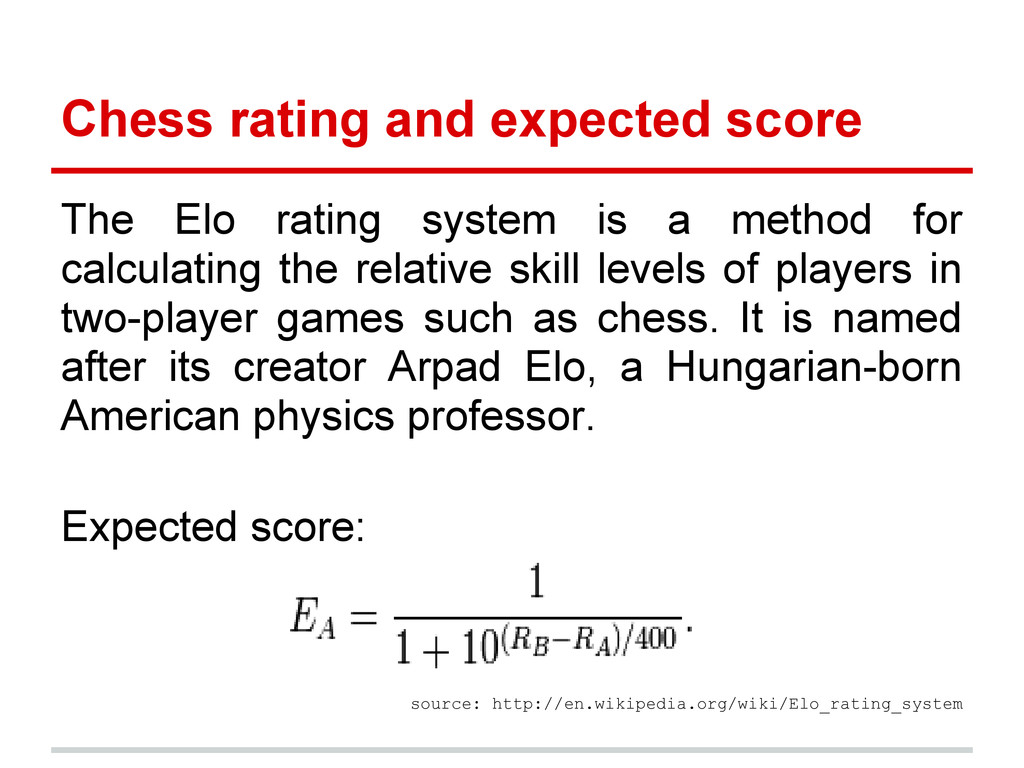
  3. Chess rating and expected score The Elo rating system is

    a method for calculating the relative skill levels of players in two-player games such as chess. It is named after its creator Arpad Elo, a Hungarian-born American physics professor. Expected score: source: http://en.wikipedia.org/wiki/Elo_rating_system
  4. Team events and odds Usually there are two teams composed

    of four chess players each. This is typical for the Chess Olympiad, World Team Chess Championship and other important events. How high is the probability that team A will win? How probable is a draw? Team B’s victory?
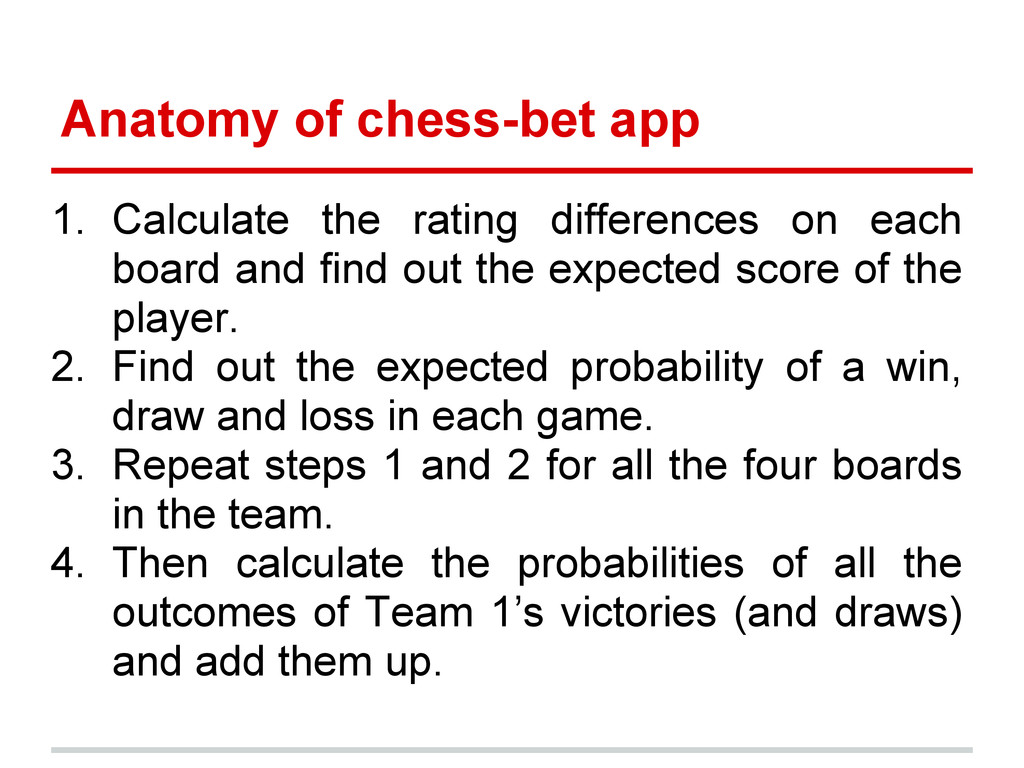
  5. Anatomy of chess-bet app 1. Calculate the rating differences on

    each board and find out the expected score of the player. 2. Find out the expected probability of a win, draw and loss in each game. 3. Repeat steps 1 and 2 for all the four boards in the team. 4. Then calculate the probabilities of all the outcomes of Team 1’s victories (and draws) and add them up.
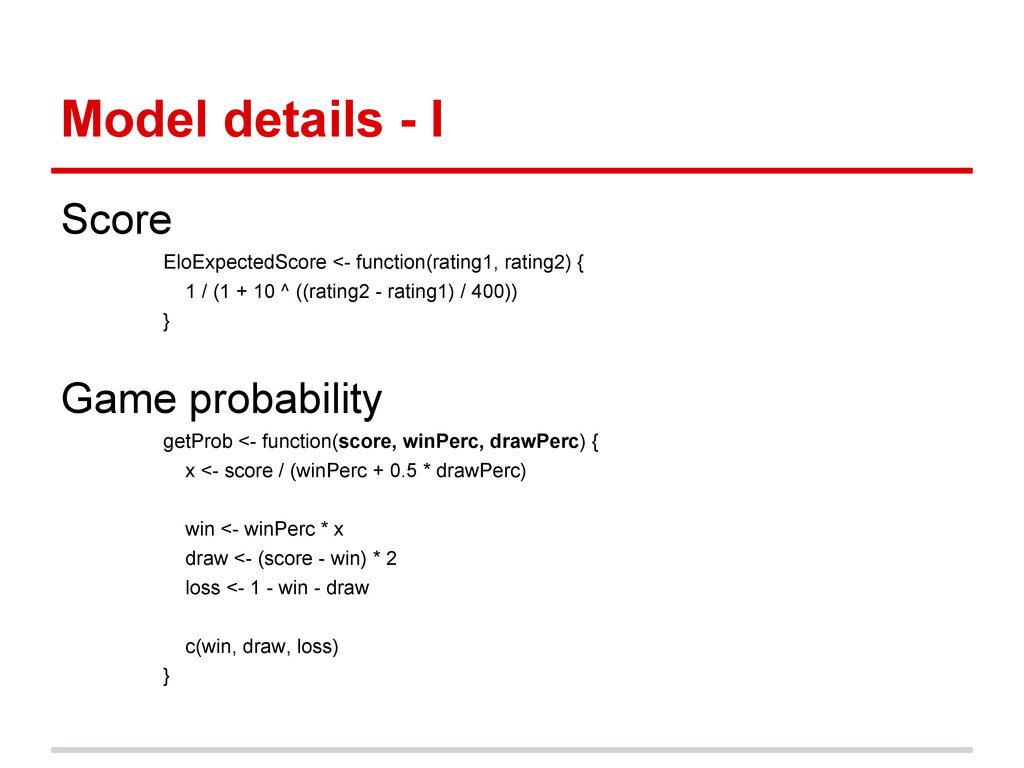
  6. Model details - I Score EloExpectedScore <- function(rating1, rating2) {

    1 / (1 + 10 ^ ((rating2 - rating1) / 400)) } Game probability getProb <- function(score, winPerc, drawPerc) { x <- score / (winPerc + 0.5 * drawPerc) win <- winPerc * x draw <- (score - win) * 2 loss <- 1 - win - draw c(win, draw, loss) }
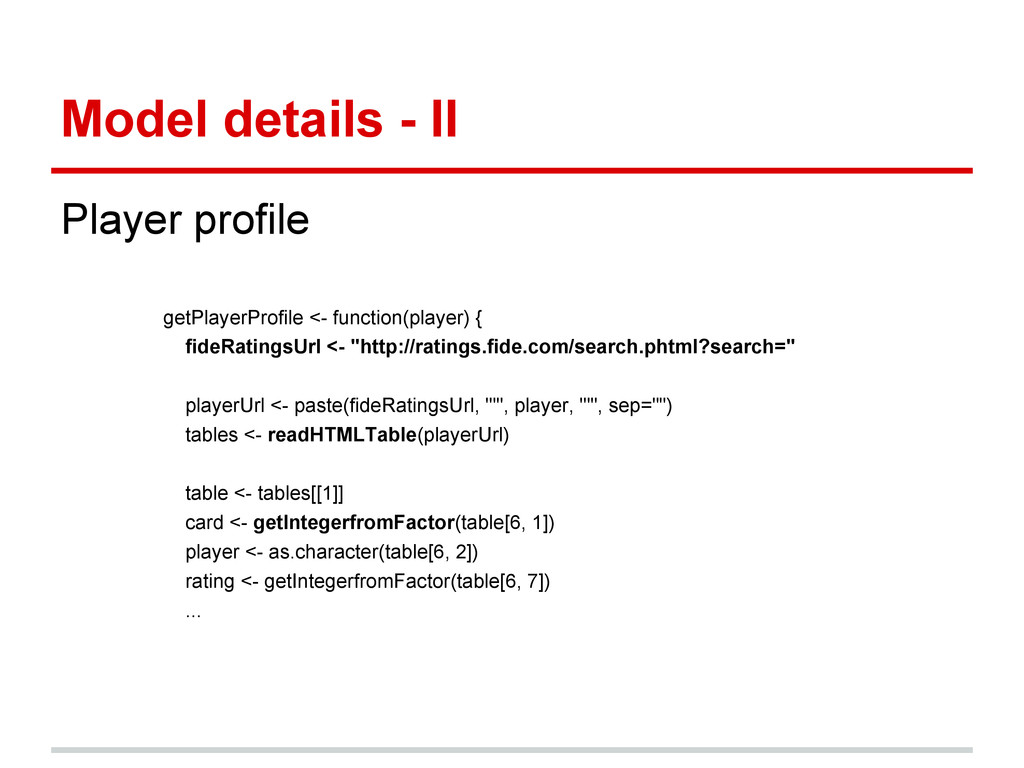
  7. Model details - II Player profile getPlayerProfile <- function(player) {

    fideRatingsUrl <- "http://ratings.fide.com/search.phtml?search=" playerUrl <- paste(fideRatingsUrl, "'", player, "'", sep="") tables <- readHTMLTable(playerUrl) table <- tables[[1]] card <- getIntegerfromFactor(table[6, 1]) player <- as.character(table[6, 2]) rating <- getIntegerfromFactor(table[6, 7]) ...
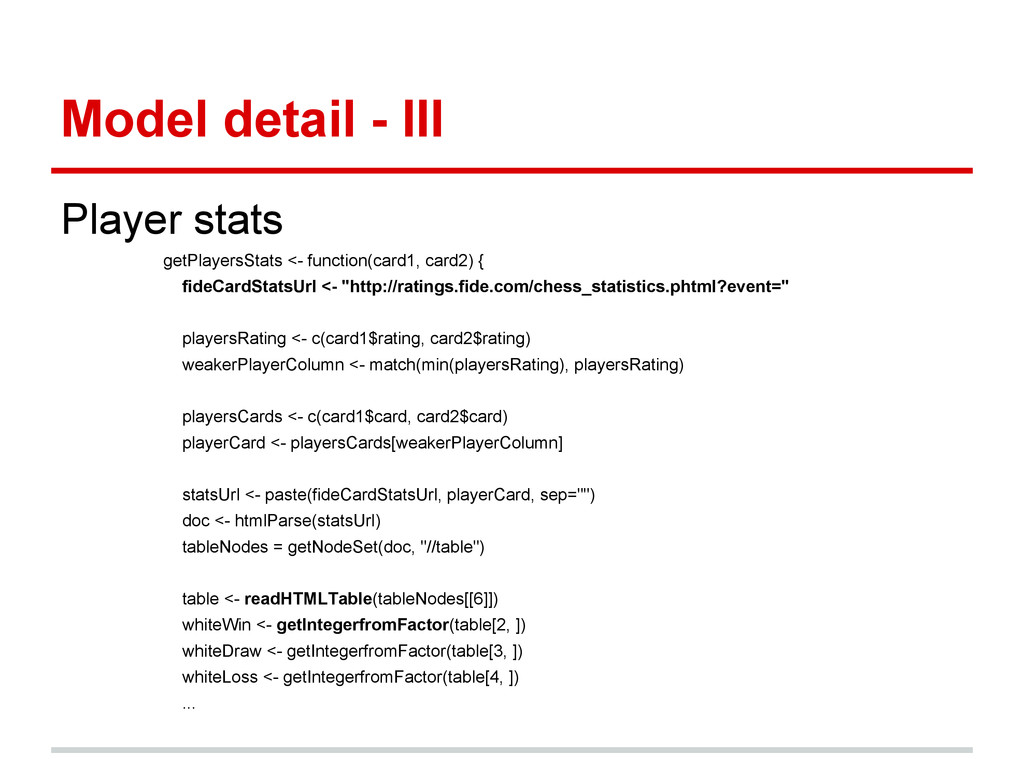
  8. Model detail - III Player stats getPlayersStats <- function(card1, card2)

    { fideCardStatsUrl <- "http://ratings.fide.com/chess_statistics.phtml?event=" playersRating <- c(card1$rating, card2$rating) weakerPlayerColumn <- match(min(playersRating), playersRating) playersCards <- c(card1$card, card2$card) playerCard <- playersCards[weakerPlayerColumn] statsUrl <- paste(fideCardStatsUrl, playerCard, sep="") doc <- htmlParse(statsUrl) tableNodes = getNodeSet(doc, "//table") table <- readHTMLTable(tableNodes[[6]]) whiteWin <- getIntegerfromFactor(table[2, ]) whiteDraw <- getIntegerfromFactor(table[3, ]) whiteLoss <- getIntegerfromFactor(table[4, ]) ...
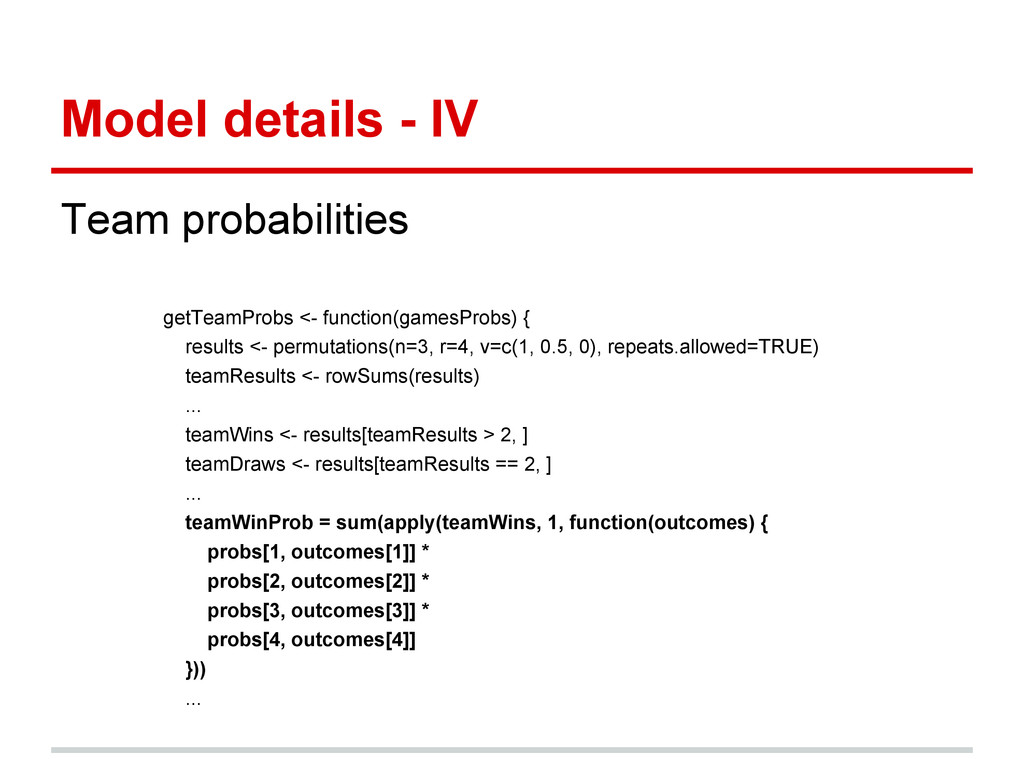
  9. Model details - IV Team probabilities getTeamProbs <- function(gamesProbs) {

    results <- permutations(n=3, r=4, v=c(1, 0.5, 0), repeats.allowed=TRUE) teamResults <- rowSums(results) ... teamWins <- results[teamResults > 2, ] teamDraws <- results[teamResults == 2, ] ... teamWinProb = sum(apply(teamWins, 1, function(outcomes) { probs[1, outcomes[1]] * probs[2, outcomes[2]] * probs[3, outcomes[3]] * probs[4, outcomes[4]] })) ...
  10. How to build a Shiny app A Shiny app combines

    the statistical power of R with the simplicity of a web page. Shiny provides a fast and convenient way to build user-interfaces without HTML or JavaScript knowledge, but some applications will inevitably require more flexibility. For this type of application, you can define your user interface directly in HTML.
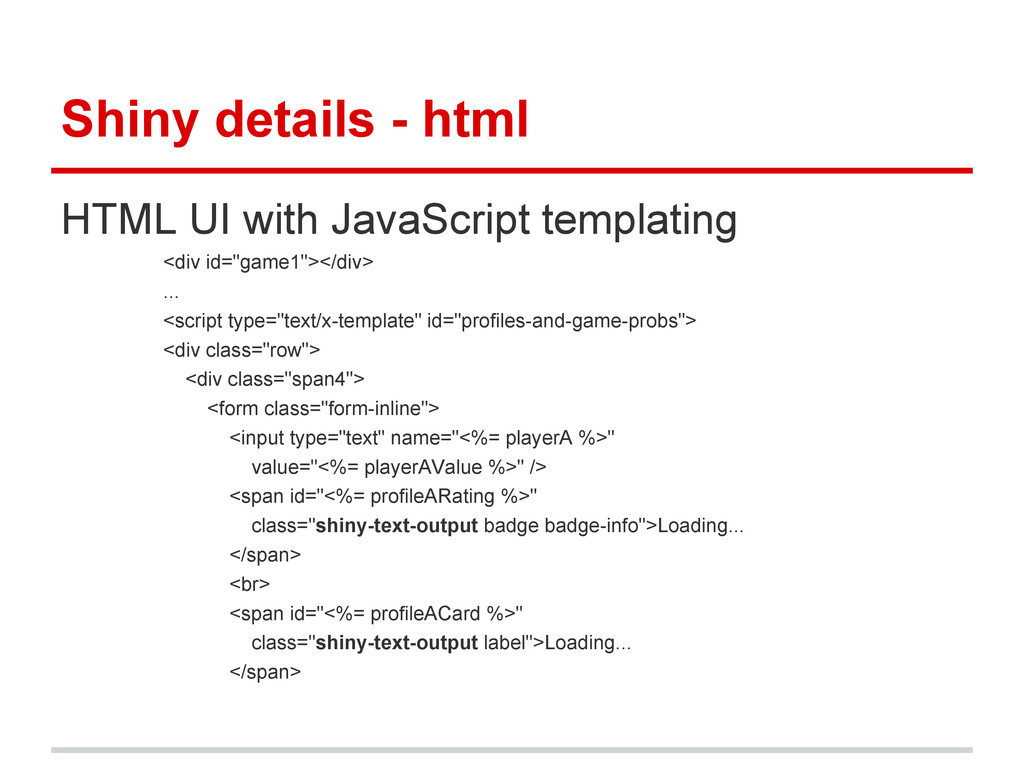
  11. Shiny details - html HTML UI with JavaScript templating <div

    id="game1"></div> ... <script type="text/x-template" id="profiles-and-game-probs"> <div class="row"> <div class="span4"> <form class="form-inline"> <input type="text" name="<%= playerA %>" value="<%= playerAValue %>" /> <span id="<%= profileARating %>" class="shiny-text-output badge badge-info">Loading... </span> <br> <span id="<%= profileACard %>" class="shiny-text-output label">Loading... </span>
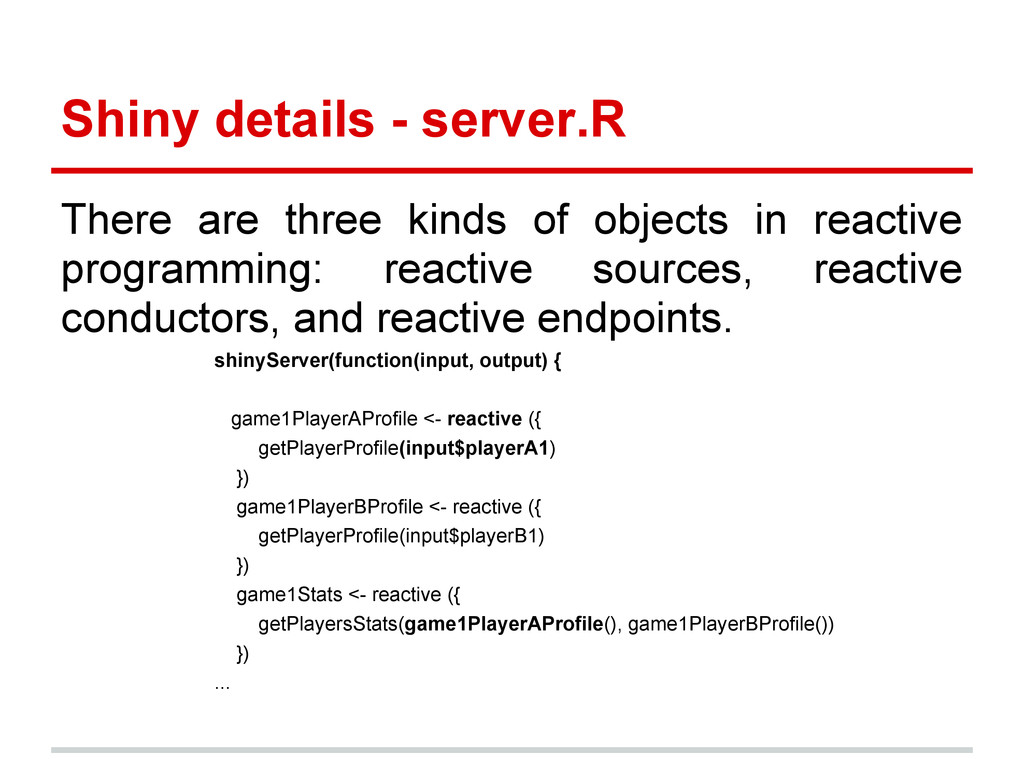
  12. Shiny details - server.R There are three kinds of objects

    in reactive programming: reactive sources, reactive conductors, and reactive endpoints. shinyServer(function(input, output) { game1PlayerAProfile <- reactive ({ getPlayerProfile(input$playerA1) }) game1PlayerBProfile <- reactive ({ getPlayerProfile(input$playerB1) }) game1Stats <- reactive ({ getPlayersStats(game1PlayerAProfile(), game1PlayerBProfile()) }) ...
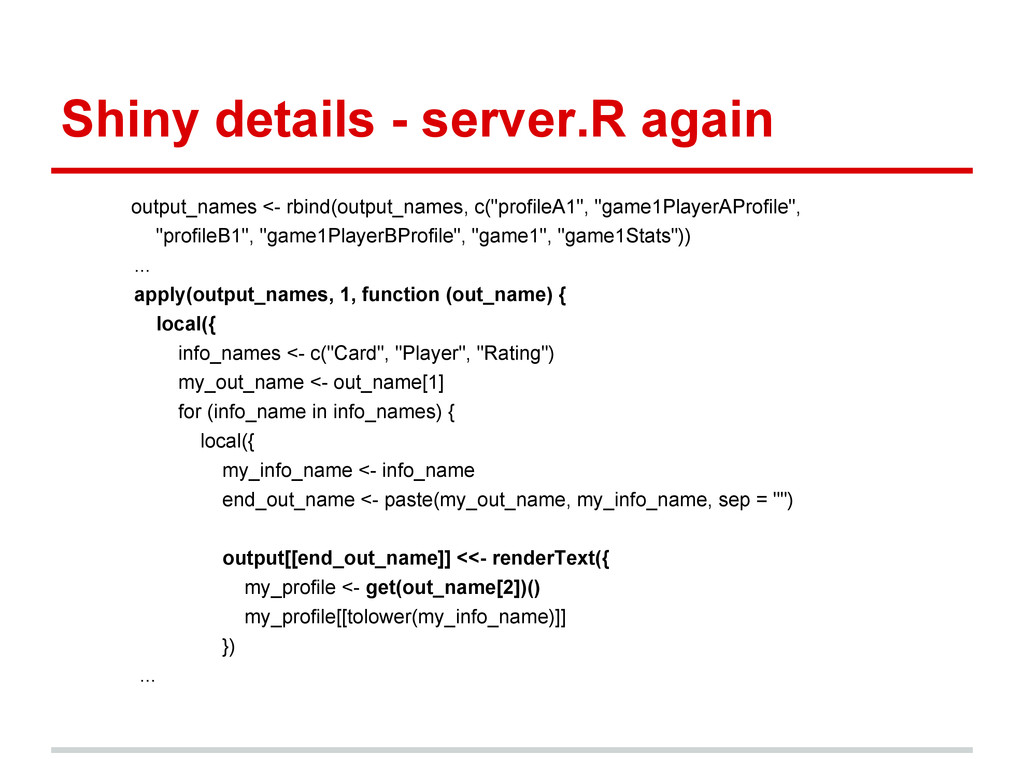
  13. Shiny details - server.R again output_names <- rbind(output_names, c("profileA1", "game1PlayerAProfile",

    "profileB1", "game1PlayerBProfile", "game1", "game1Stats")) ... apply(output_names, 1, function (out_name) { local({ info_names <- c("Card", "Player", "Rating") my_out_name <- out_name[1] for (info_name in info_names) { local({ my_info_name <- info_name end_out_name <- paste(my_out_name, my_info_name, sep = "") output[[end_out_name]] <<- renderText({ my_profile <- get(out_name[2])() my_profile[[tolower(my_info_name)]] }) ...