Upgrade to Pro — share decks privately, control downloads, hide ads and more …

The Death Of Traffic: Building Revenue-Focused ...

Sponsored · Your Podcast. Everywhere. Effortlessly. Share. Educate. Inspire. Entertain. You do you. We'll handle the rest.

The Death Of Traffic: Building Revenue-Focused SEO In A Zero-Click World

This presentation explores how SEO is evolving in a zero-click world, where traditional traffic metrics are becoming less meaningful. It argues that SEO should be measured and prioritised like any other commercial channel—through revenue, profit, margins and ROI. The session presents a practical framework for shifting from traffic-focused SEO to revenue-focused acquisition, including six proven plays around commercial prioritisation, content updates, internal linking, PPC data, digital PR and branded search protection.

Avatar for Alex Galinos

Alex Galinos

September 03, 2026

More Decks by Alex Galinos

Other Decks in Marketing & SEO

Transcript

  1. SEARCH EVOLUTION SUMMIT · ROMANIA · 2026 The Death of

    Traffic Building revenue-focused SEO in a zero-click world hoppa.com · Elife Transfer Alex Galinos Director of Marketing Acquisition · Elife Group
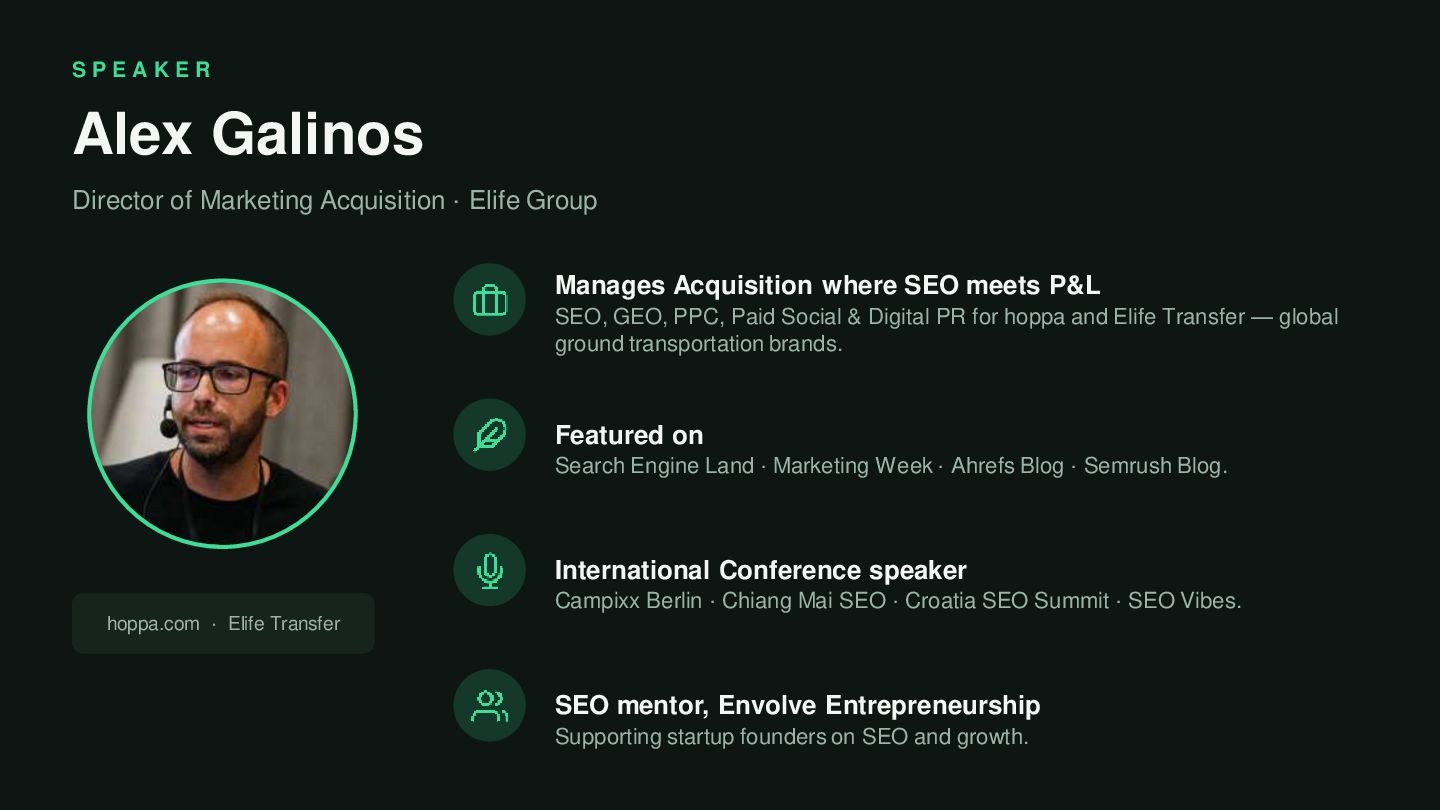
  2. SPEAKER Alex Galinos Director of Marketing Acquisition · Elife Group

    Manages Acquisition where SEO meets P&L SEO, GEO, PPC, Paid Social & Digital PR for hoppa and Elife Transfer — global ground transportation brands. Featured on Search Engine Land · Marketing Week · Ahrefs Blog · Semrush Blog. International Conference speaker Campixx Berlin · Chiang Mai SEO · Croatia SEO Summit · SEO Vibes. hoppa.com · Elife Transfer SEO mentor, Envolve Entrepreneurship Supporting startup founders on SEO and growth.
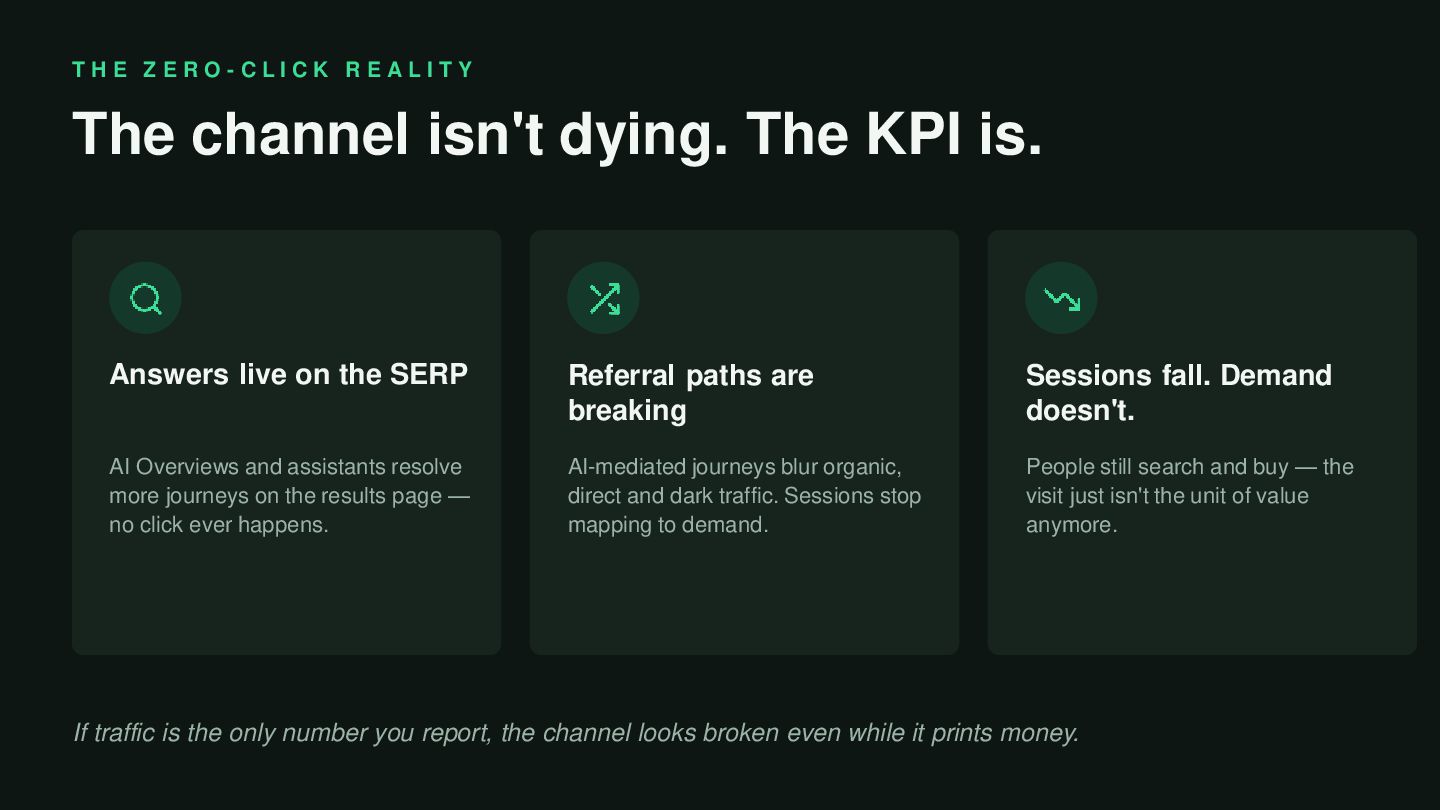
  3. THE ZERO-CLICK REALITY The channel isn't dying. The KPI is.

    Answers live on the SERP Referral paths are breaking Sessions fall. Demand doesn't. AI Overviews and assistants resolve more journeys on the results page — no click ever happens. AI-mediated journeys blur organic, direct and dark traffic. Sessions stop mapping to demand. People still search and buy — the visit just isn't the unit of value anymore. If traffic is the only number you report, the channel looks broken even while it prints money.
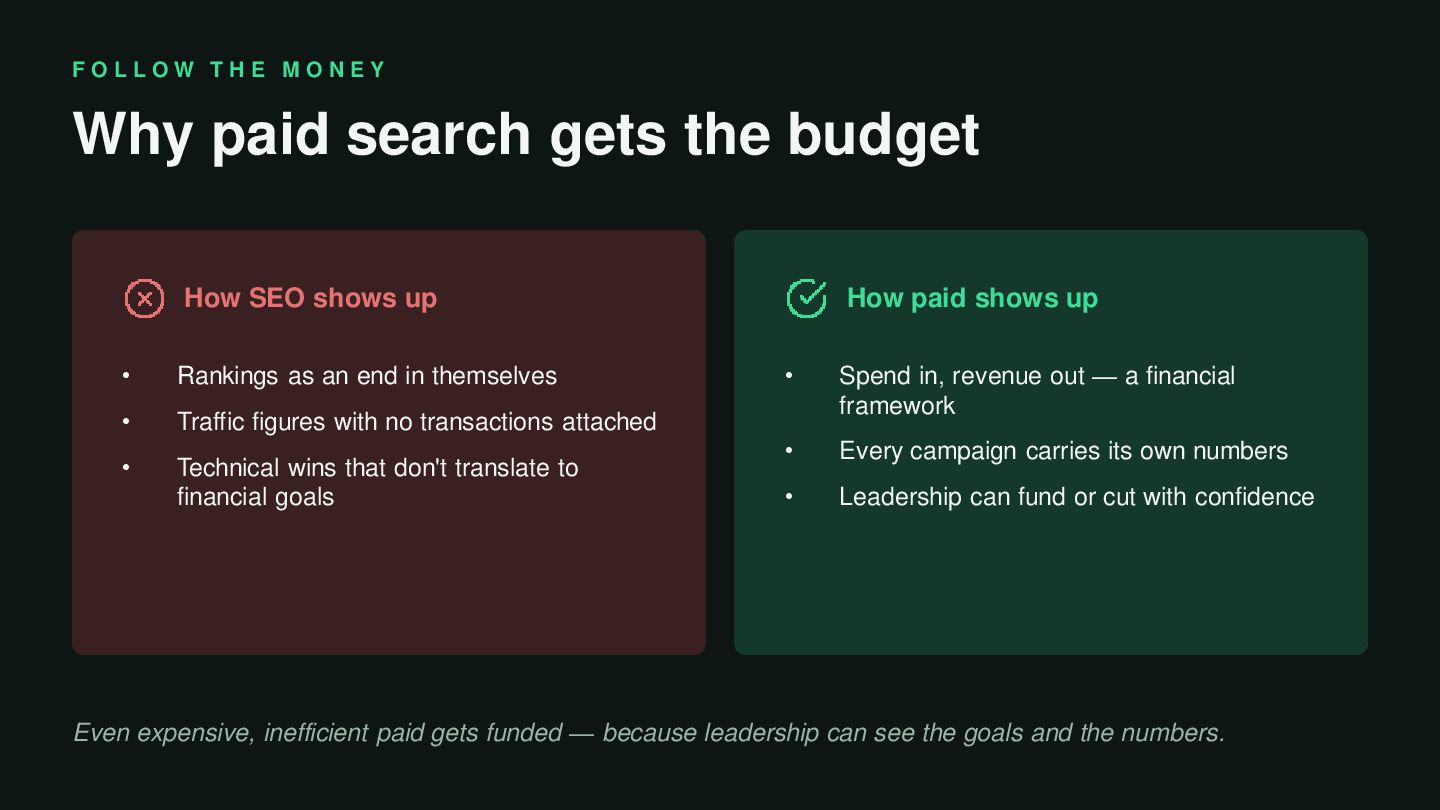
  4. FOLLOW THE MONEY Why paid search gets the budget How

    SEO shows up • Rankings as an end in themselves • Traffic figures with no transactions attached • Technical wins that don't translate to financial goals How paid shows up • Spend in, revenue out — a financial framework • Every campaign carries its own numbers • Leadership can fund or cut with confidence Even expensive, inefficient paid gets funded — because leadership can see the goals and the numbers.
  5. THE UNCOMFORTABLE BIT “Leadership doesn’t understand SEO” “We’d invest more

    in organic, but the board just doesn’t get SEO.” — every under-funded SEO team, probably A MORE HONEST EXPLANAT ION SEO hasn’t made its commercial case. Leadership needs organic measured in sales, margins and channel ROI — the way every other line on the budget already is. Budgets follow business cases — not crawl stats.
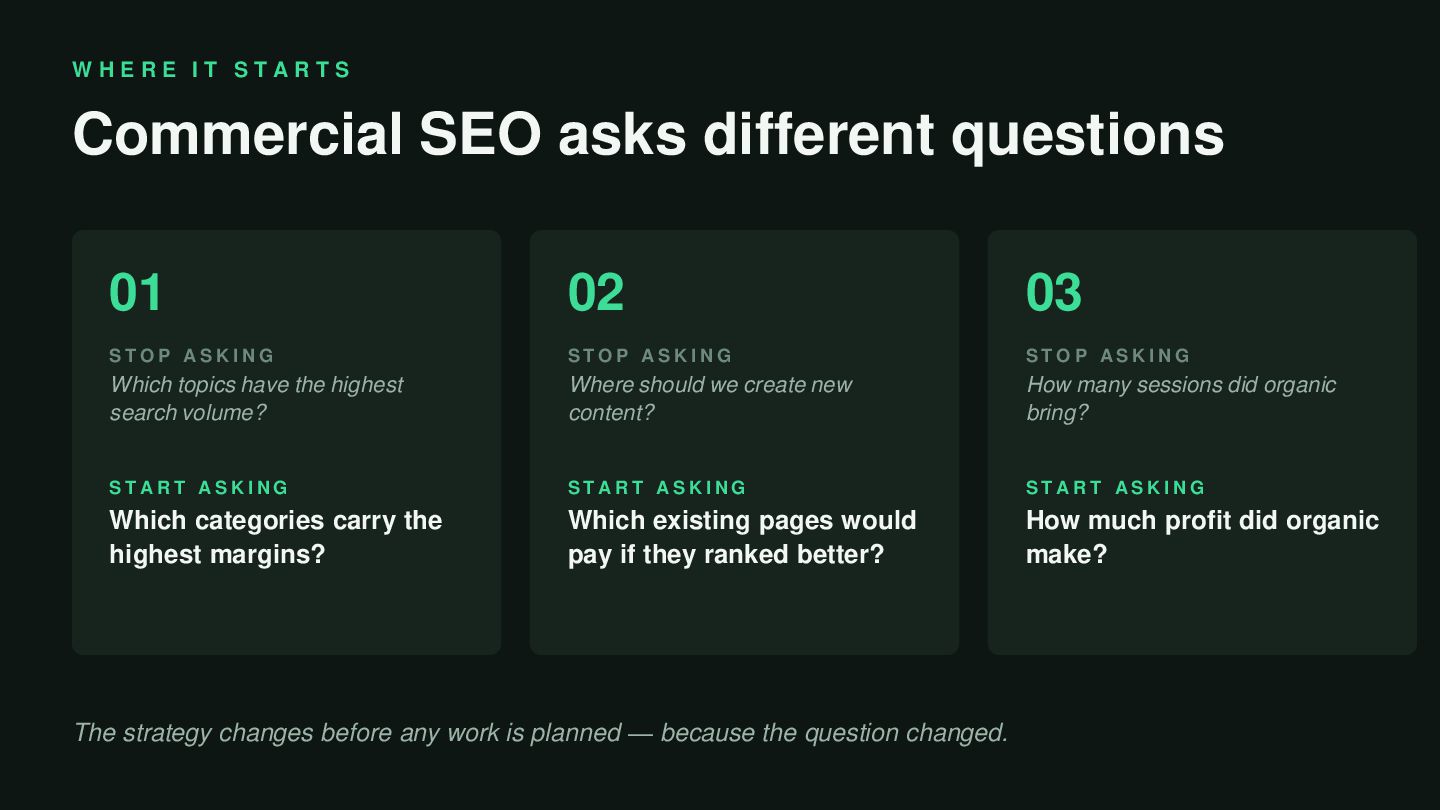
  6. WHERE IT STARTS Commercial SEO asks different questions 01 02

    03 STOP ASKING STOP ASKING STOP ASKING Which topics have the highest search volume? Where should we create new content? How many sessions did organic bring? START ASKING START ASKING START ASKING Which categories carry the highest margins? Which existing pages would pay if they ranked better? How much profit did organic make? The strategy changes before any work is planned — because the question changed.
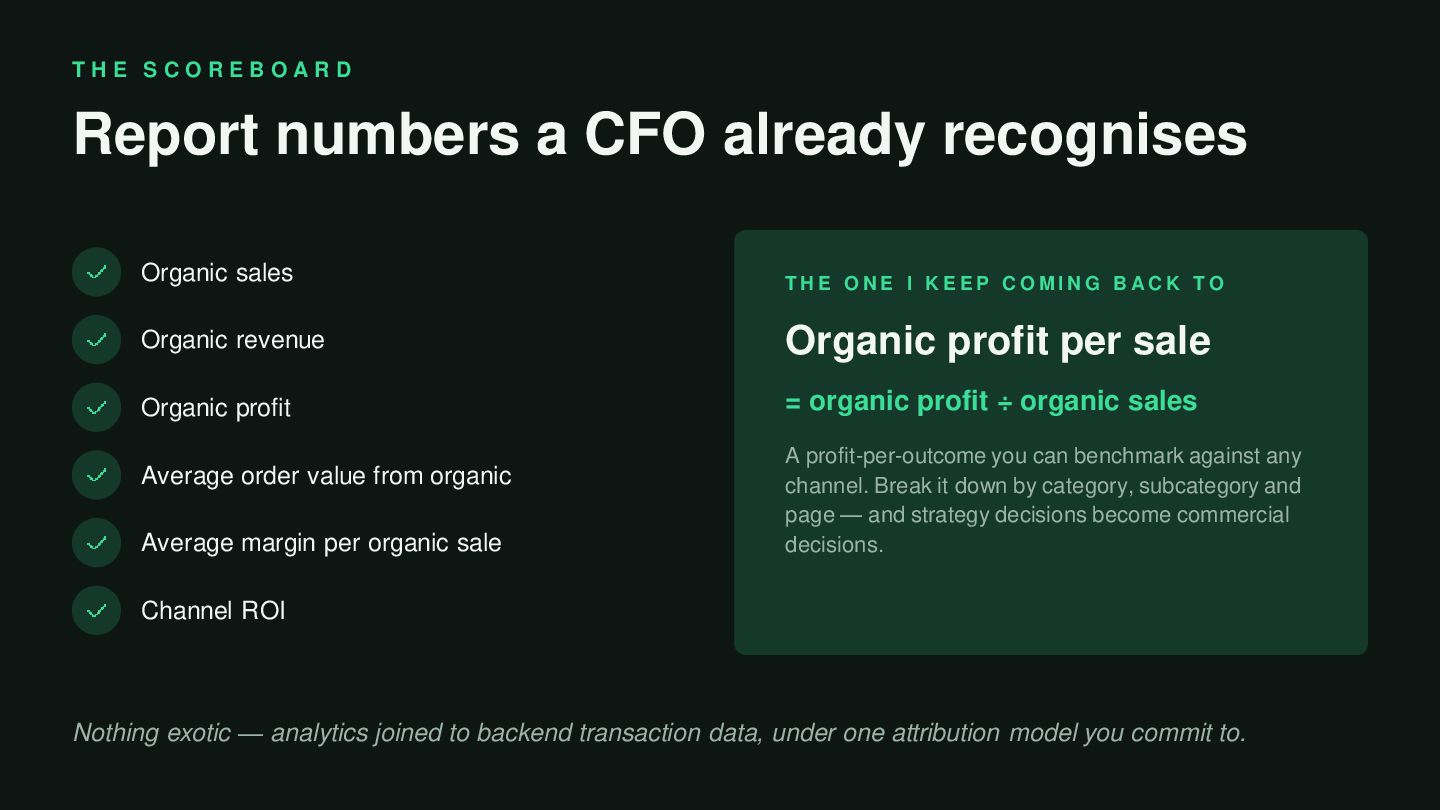
  7. THE SCOREBOARD Report numbers a CFO already recognises Organic sales

    TH E ON E I K E E P C OMIN G B AC K TO Organic revenue Organic profit per sale Organic profit = organic profit ÷ organic sales Average order value from organic Average margin per organic sale A profit-per-outcome you can benchmark against any channel. Break it down by category, subcategory and page — and strategy decisions become commercial decisions. Channel ROI Nothing exotic — analytics joined to backend transaction data, under one attribution model you commit to.
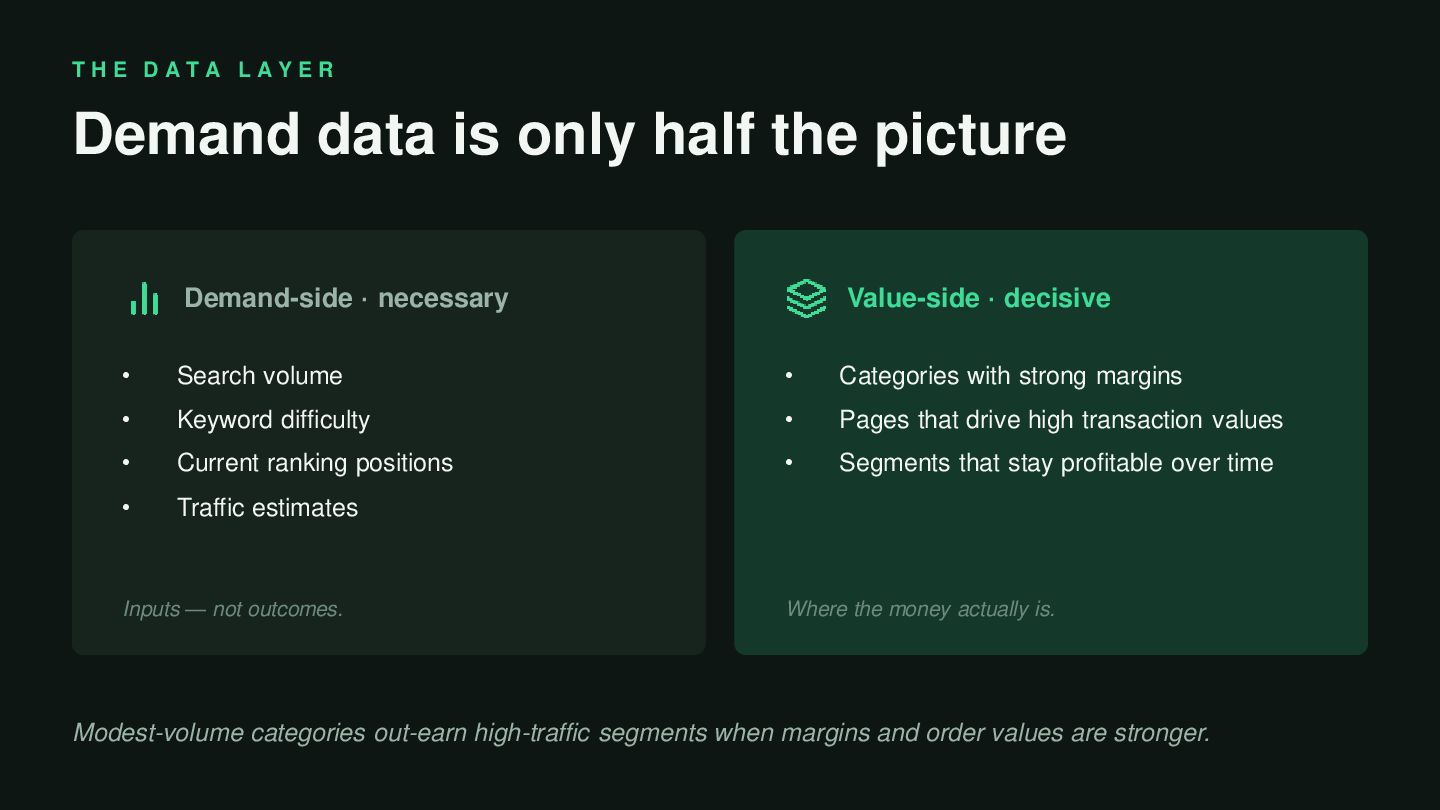
  8. THE DATA LAYER Demand data is only half the picture

    Demand-side · necessary Value-side · decisive • Search volume • Categories with strong margins • Keyword difficulty • Pages that drive high transaction values • Current ranking positions • Segments that stay profitable over time • Traffic estimates Inputs — not outcomes. Where the money actually is. Modest-volume categories out-earn high-traffic segments when margins and order values are stronger.
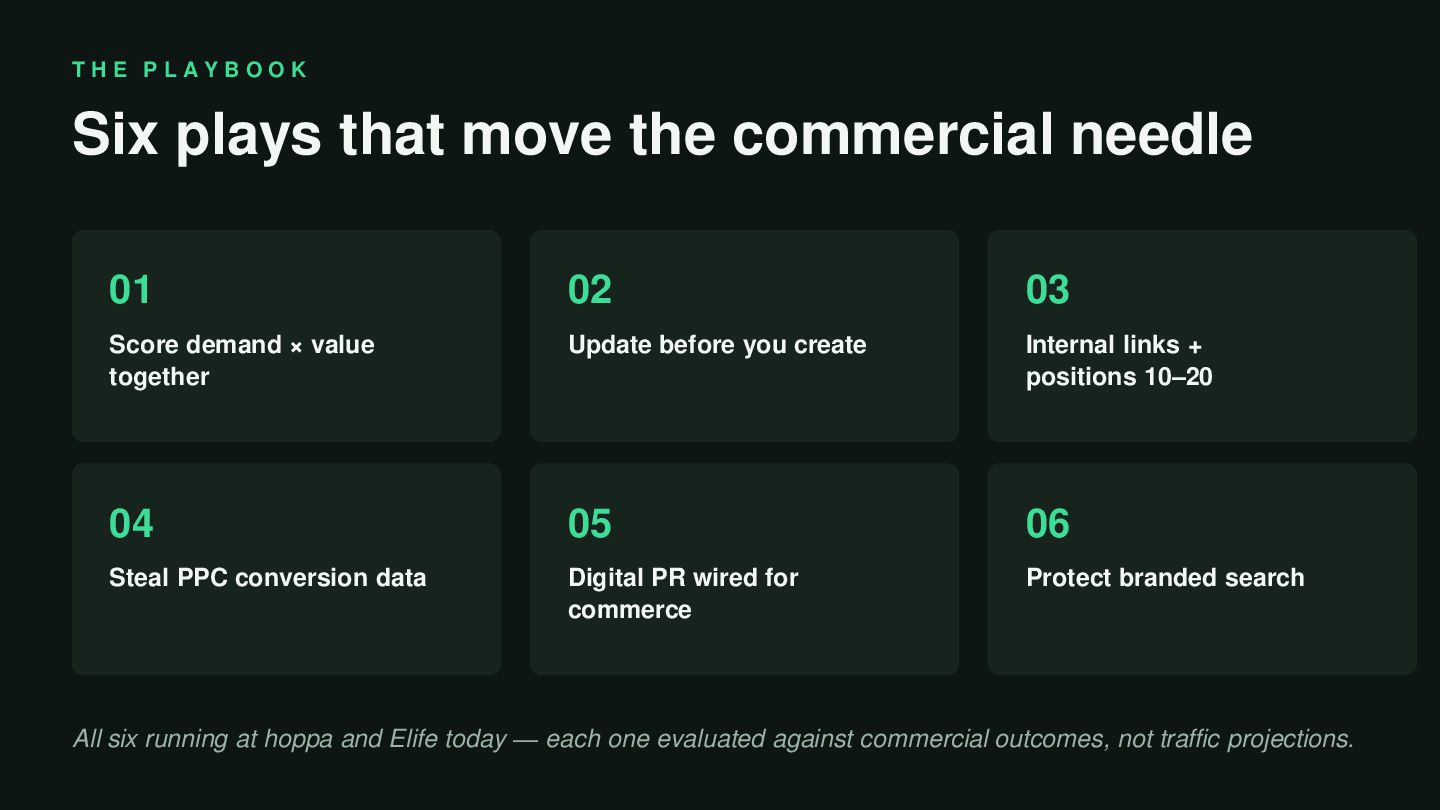
  9. THE PLAYBOOK Six plays that move the commercial needle 01

    02 03 Score demand × value together Update before you create Internal links + positions 10–20 04 05 06 Steal PPC conversion data Digital PR wired for commerce Protect branded search All six running at hoppa and Elife today — each one evaluated against commercial outcomes, not traffic projections.
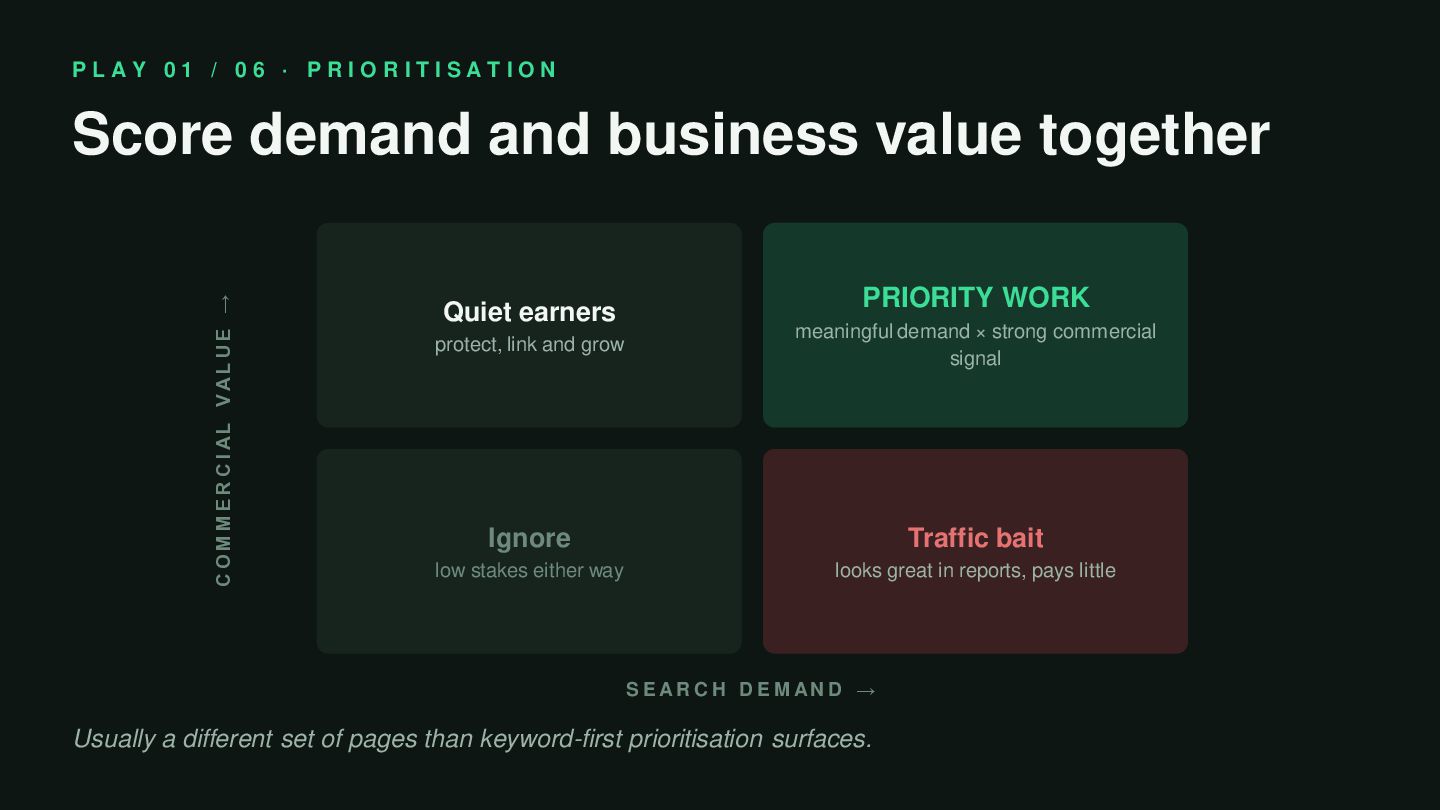
  10. PLAY 01 / 06 · PRIORITISATION C OMME R C

    IAL V ALU E → Score demand and business value together Quiet earners PRIORITY WORK protect, link and grow meaningful demand × strong commercial signal Ignore Traffic bait low stakes either way looks great in reports, pays little S E AR C H D E MAN D → Usually a different set of pages than keyword-first prioritisation surfaces.
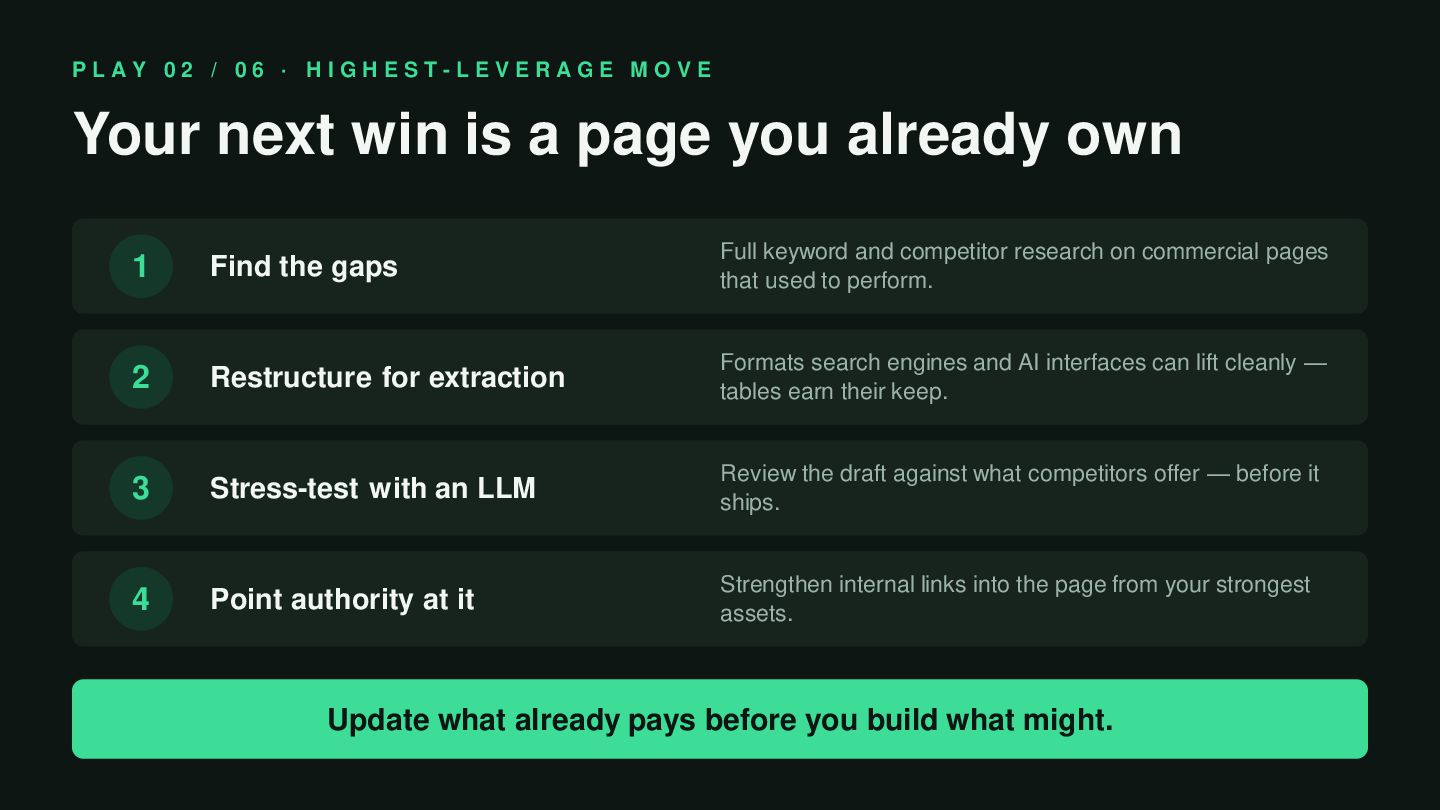
  11. PLAY 02 / 06 · HIGHEST-LEVERAGE MOVE Your next win

    is a page you already own 1 Find the gaps Full keyword and competitor research on commercial pages that used to perform. 2 Restructure for extraction Formats search engines and AI interfaces can lift cleanly — tables earn their keep. 3 Stress-test with an LLM Review the draft against what competitors offer — before it ships. 4 Point authority at it Strengthen internal links into the page from your strongest assets. Update what already pays before you build what might.
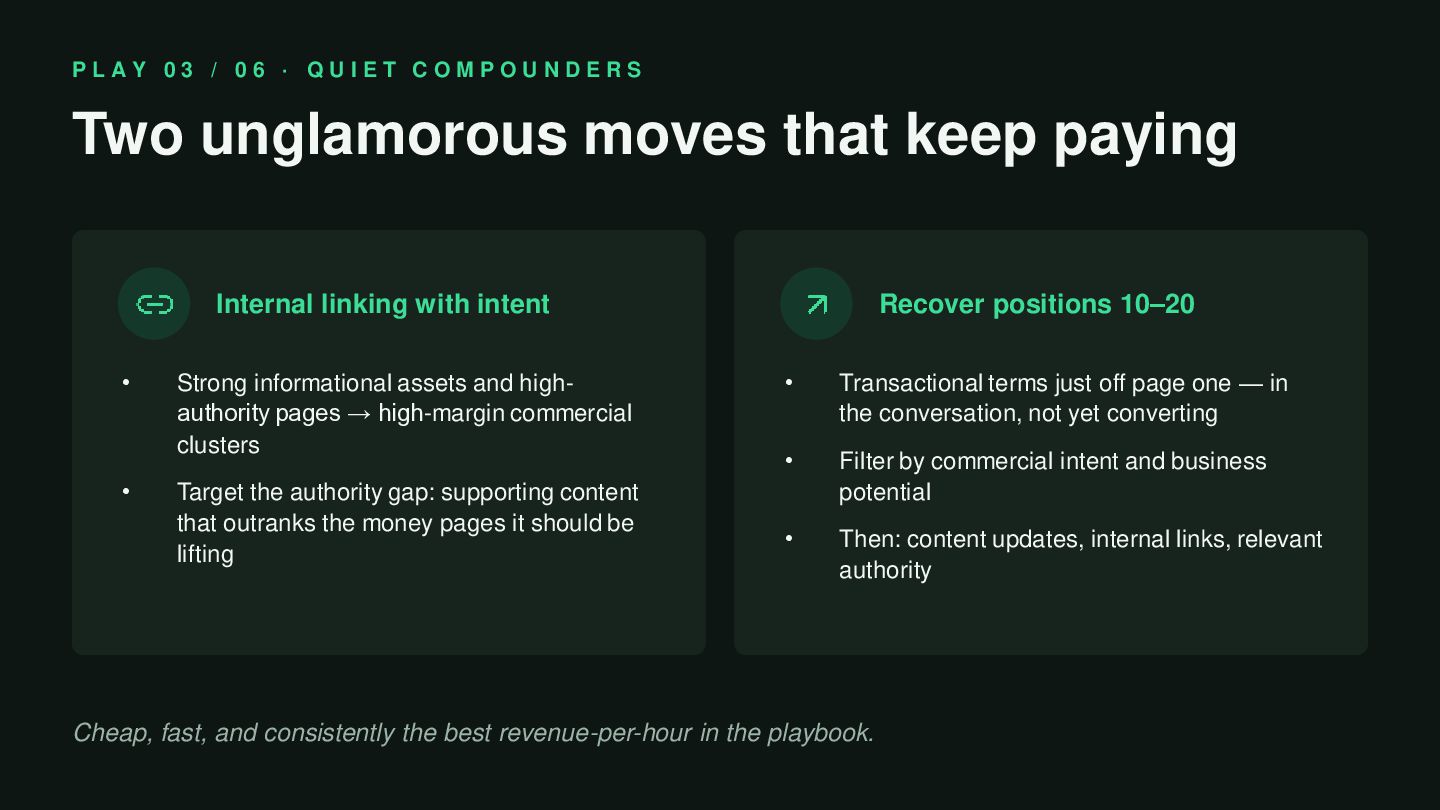
  12. PLAY 03 / 06 · QUIET COMPOUNDERS Two unglamorous moves

    that keep paying Internal linking with intent • • Strong informational assets and highauthority pages → high-margin commercial clusters Target the authority gap: supporting content that outranks the money pages it should be lifting Recover positions 10–20 • Transactional terms just off page one — in the conversation, not yet converting • Filter by commercial intent and business potential • Then: content updates, internal links, relevant authority Cheap, fast, and consistently the best revenue-per-hour in the playbook.
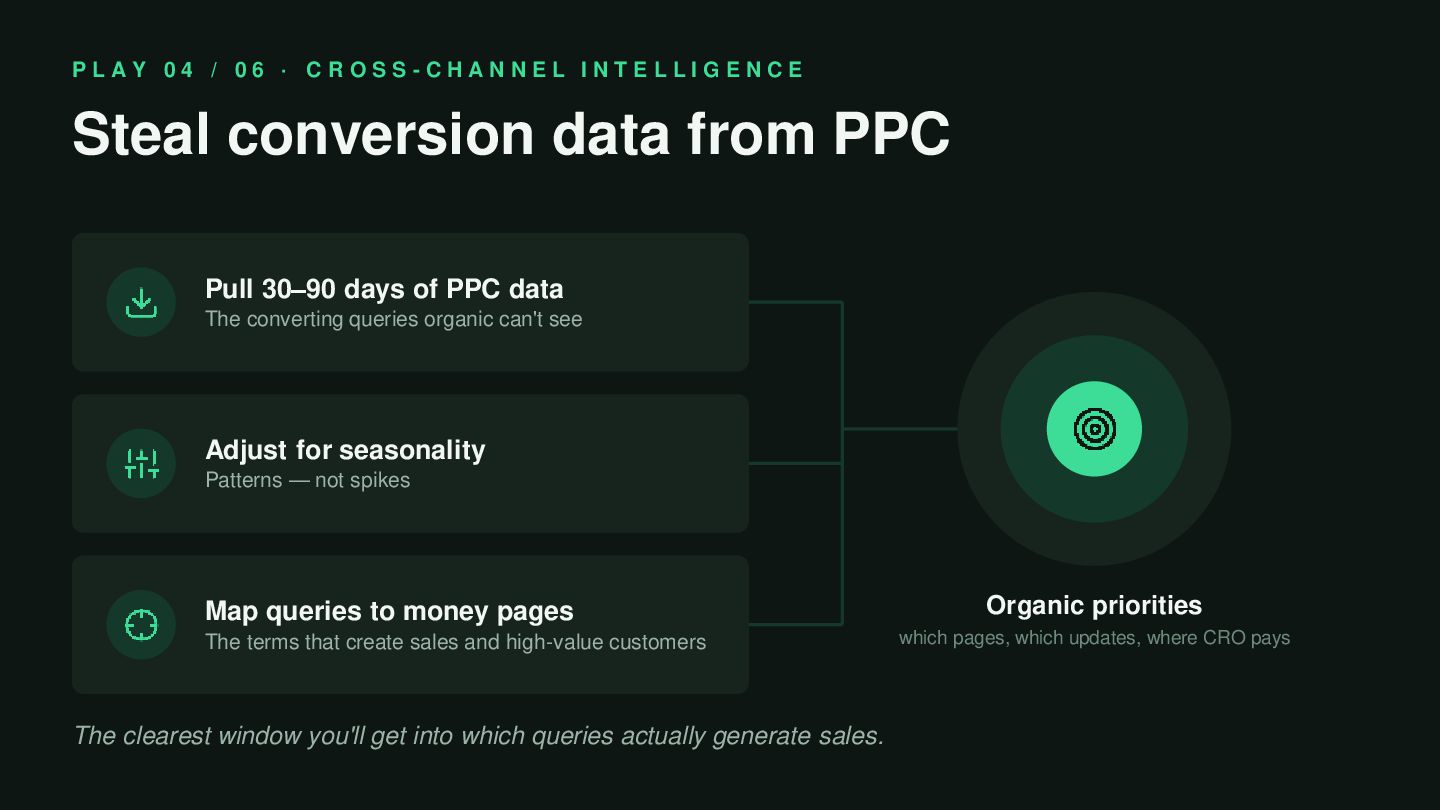
  13. PLAY 04 / 06 · CROSS-CHANNEL INTELLIGENCE Steal conversion data

    from PPC Pull 30–90 days of PPC data The converting queries organic can't see Adjust for seasonality Patterns — not spikes Map queries to money pages The terms that create sales and high-value customers The clearest window you'll get into which queries actually generate sales. Organic priorities which pages, which updates, where CRO pays
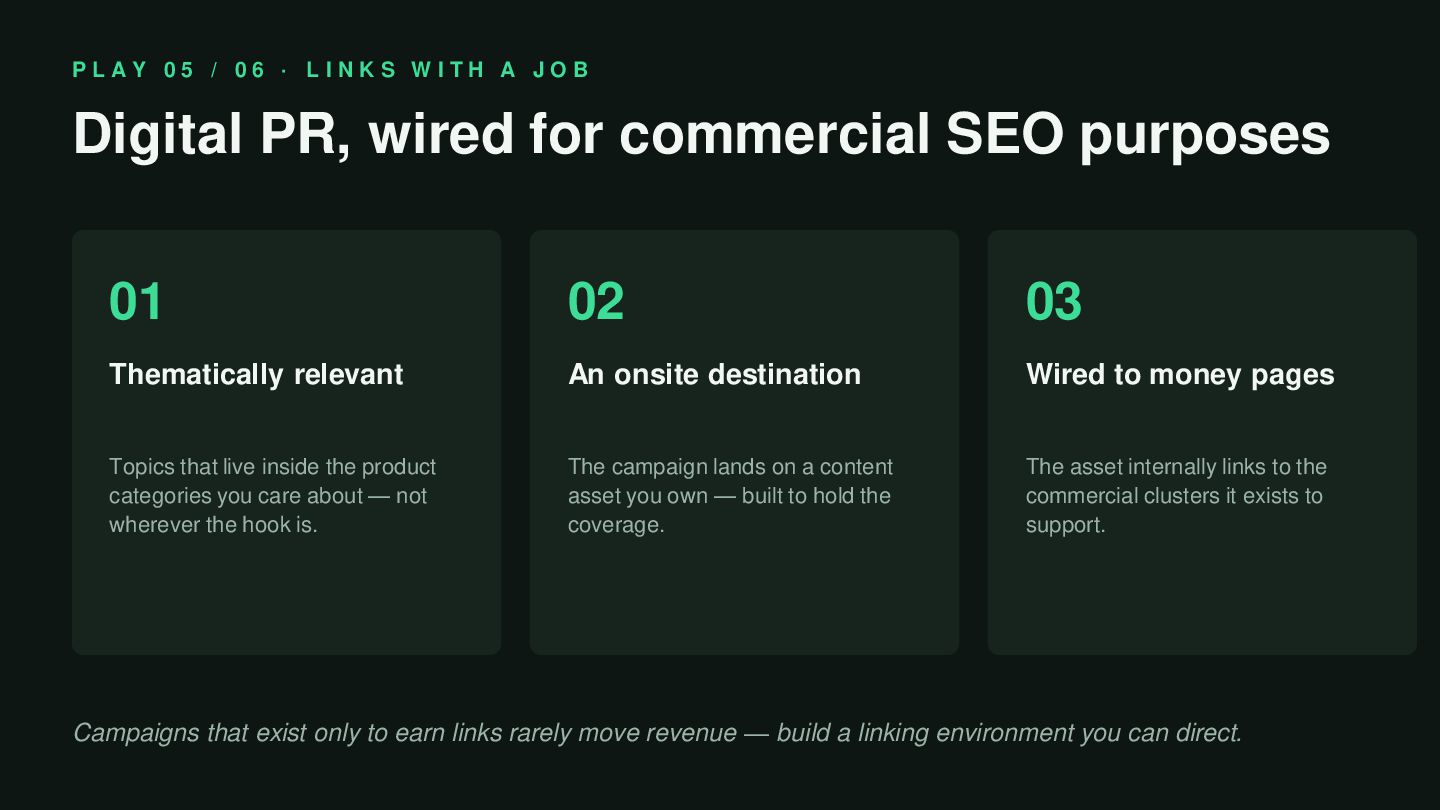
  14. PLAY 05 / 06 · LINKS WITH A JOB Digital

    PR, wired for commercial SEO purposes 01 02 03 Thematically relevant An onsite destination Wired to money pages Topics that live inside the product categories you care about — not wherever the hook is. The campaign lands on a content asset you own — built to hold the coverage. The asset internally links to the commercial clusters it exists to support. Campaigns that exist only to earn links rarely move revenue — build a linking environment you can direct.
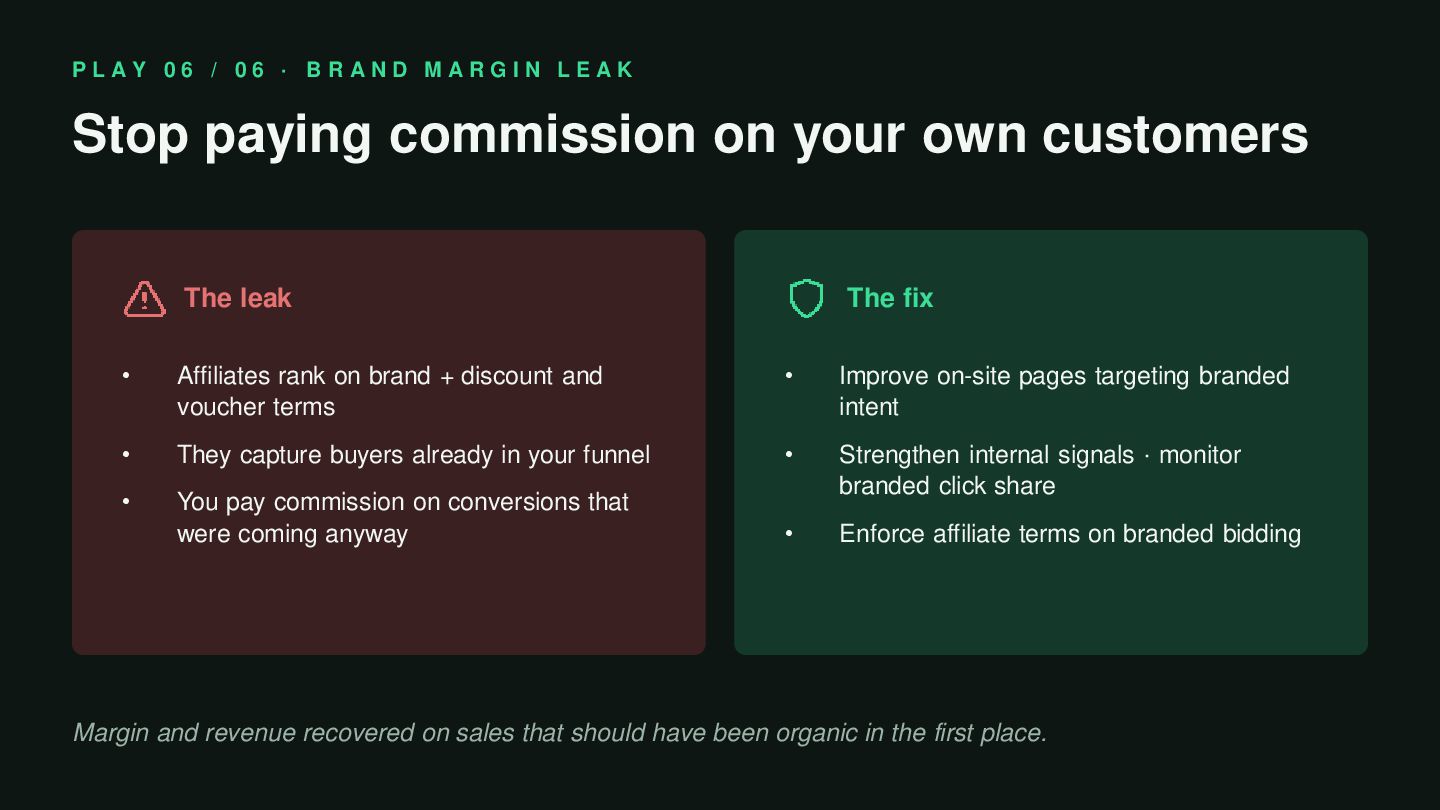
  15. PLAY 06 / 06 · BRAND MARGIN LEAK Stop paying

    commission on your own customers The leak The fix • Affiliates rank on brand + discount and voucher terms • Improve on-site pages targeting branded intent • They capture buyers already in your funnel • • You pay commission on conversions that were coming anyway Strengthen internal signals · monitor branded click share • Enforce affiliate terms on branded bidding Margin and revenue recovered on sales that should have been organic in the first place.
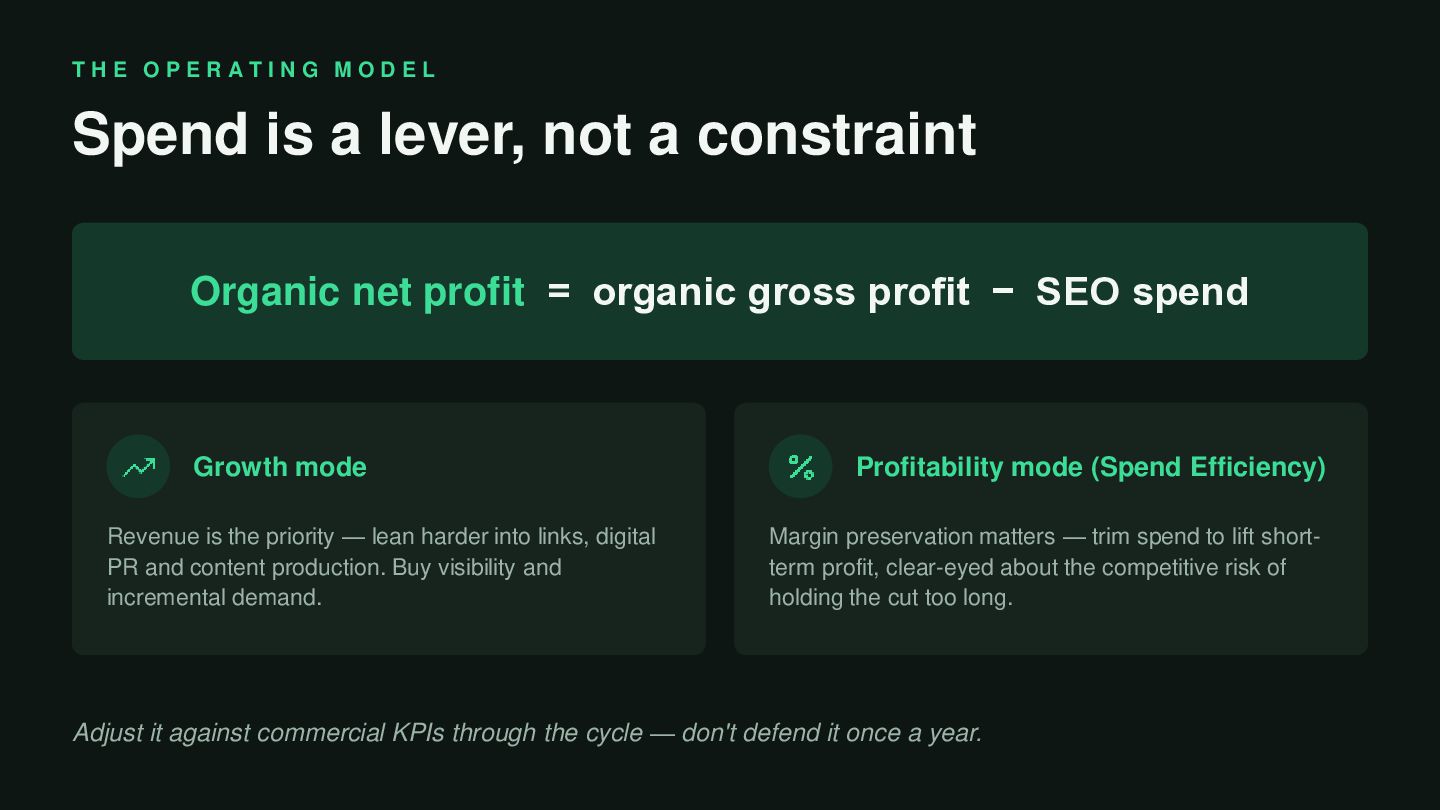
  16. THE OPERATING MODEL Spend is a lever, not a constraint

    Organic net profit = organic gross profit − SEO spend Growth mode Revenue is the priority — lean harder into links, digital PR and content production. Buy visibility and incremental demand. Profitability mode (Spend Efficiency) Margin preservation matters — trim spend to lift shortterm profit, clear-eyed about the competitive risk of holding the cut too long. Adjust it against commercial KPIs through the cycle — don't defend it once a year.
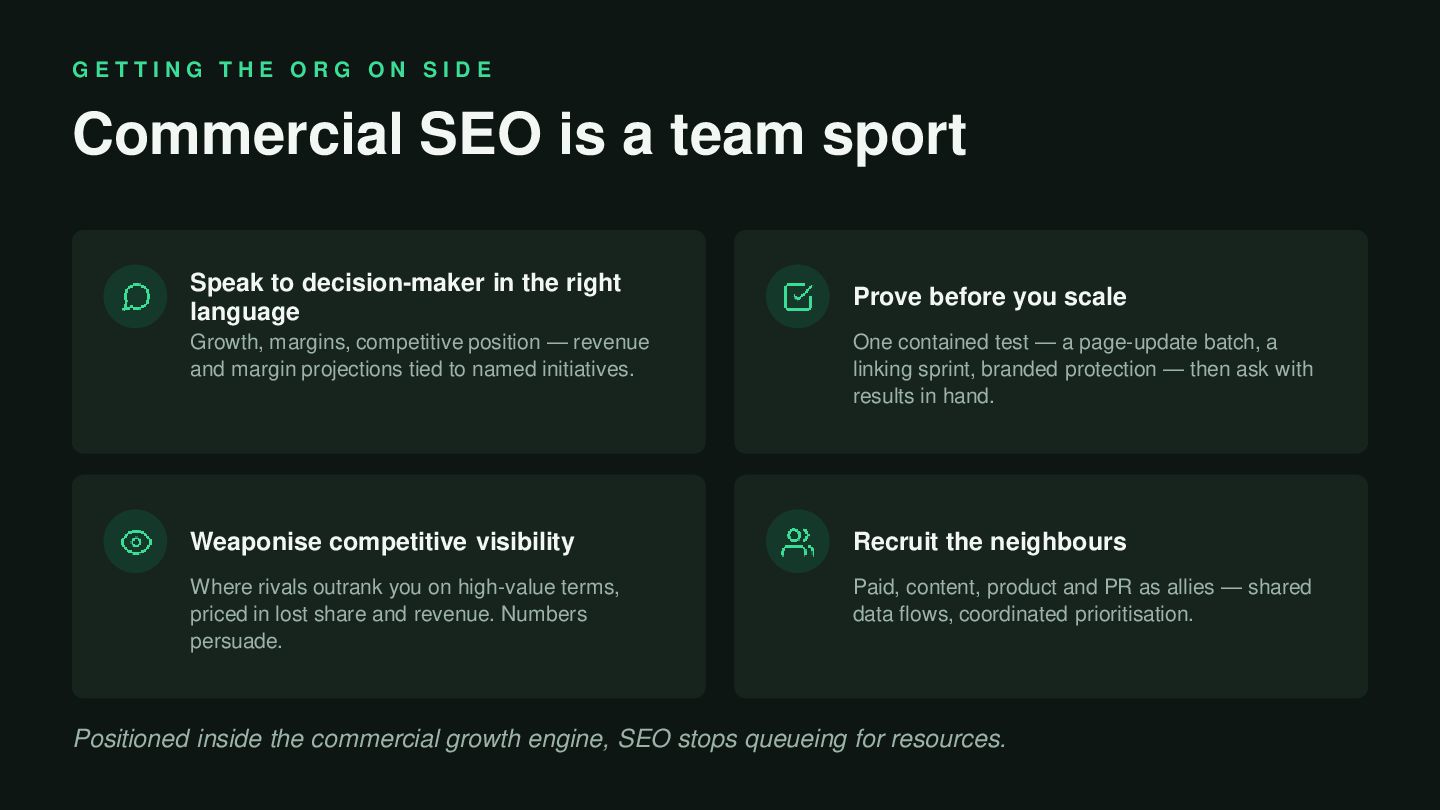
  17. GETTING THE ORG ON SIDE Commercial SEO is a team

    sport Speak to decision-maker in the right language Prove before you scale Growth, margins, competitive position — revenue and margin projections tied to named initiatives. One contained test — a page-update batch, a linking sprint, branded protection — then ask with results in hand. Weaponise competitive visibility Recruit the neighbours Where rivals outrank you on high-value terms, priced in lost share and revenue. Numbers persuade. Paid, content, product and PR as allies — shared data flows, coordinated prioritisation. Positioned inside the commercial growth engine, SEO stops queueing for resources.
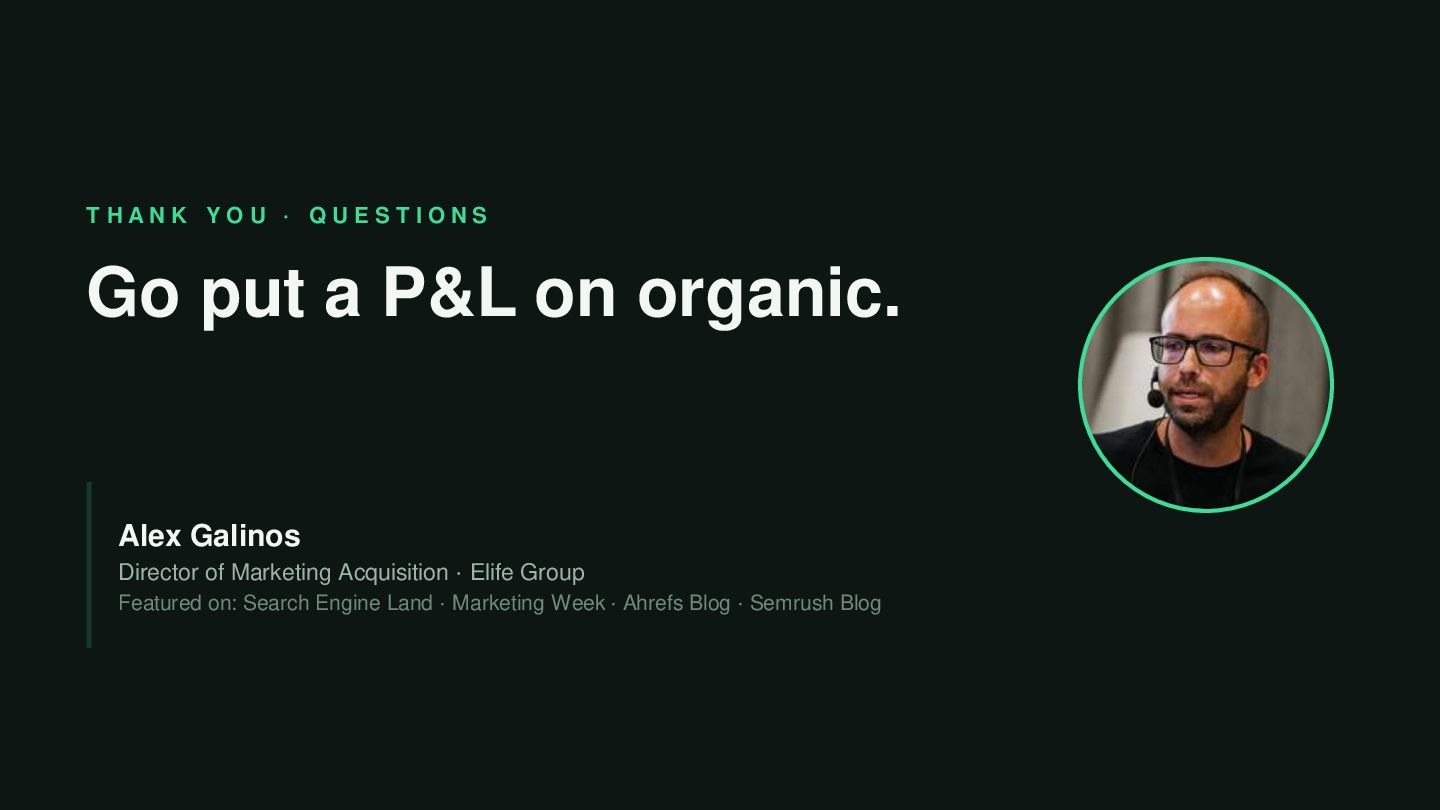
  18. THANK YOU · QUESTIONS Go put a P&L on organic.

    Alex Galinos Director of Marketing Acquisition · Elife Group Featured on: Search Engine Land · Marketing Week · Ahrefs Blog · Semrush Blog