when a farmer discovered that his goats became lively at night after eating a certain fruit, which turned out to be coffee. • Coffee reputation: Gradually, the consumption of coffee expanded with a reputation for providing alertness and a soothing effect. • Place of consumption: Coffee was widely consumed in London, particularly along the banks of the River Thames, making it a hub where news about economics and current affairs first reached. • However, coffee was expensive due to its monopoly as it could only be grown in Yemen. The price of coffee rapidly declined when the Dutch successfully cultivated it in Java, breaking the monopoly and making coffee accessible to everyone. 1. Coffee transplantation
valued in Europe for their quality and craftsmanship • Competitive advantage of Indian textiles: intricate designs, vibrant colors, and fine craftsmanship • Lower production costs: large population and years of experience • Access to raw materials • Economic exploitation: solidified the EIC's economic dominance and reinforced colonial power structures. 2. The rise of cotton and textile trade
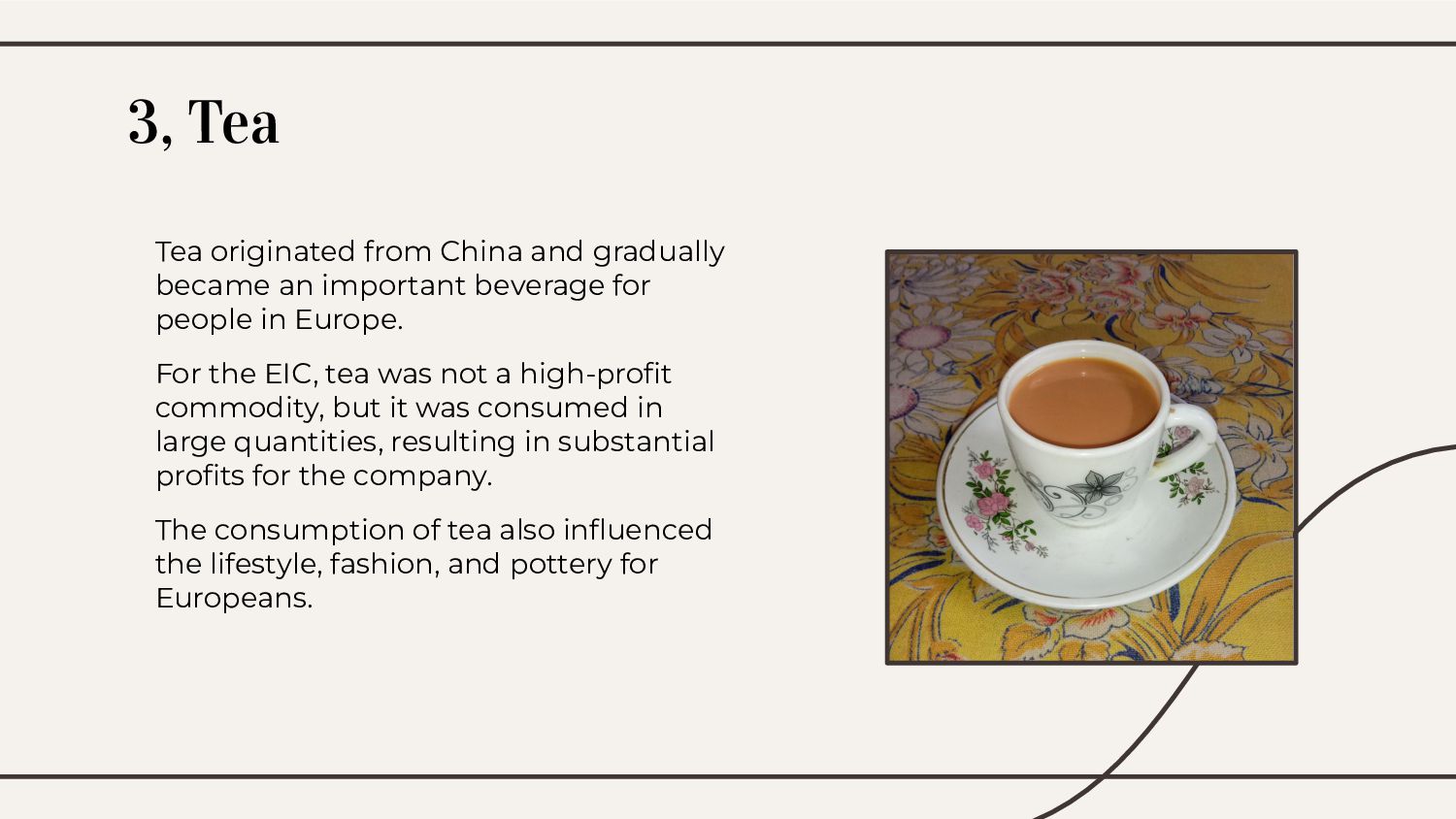
for people in Europe. For the EIC, tea was not a high-profit commodity, but it was consumed in large quantities, resulting in substantial profits for the company. The consumption of tea also influenced the lifestyle, fashion, and pottery for Europeans. 3, Tea
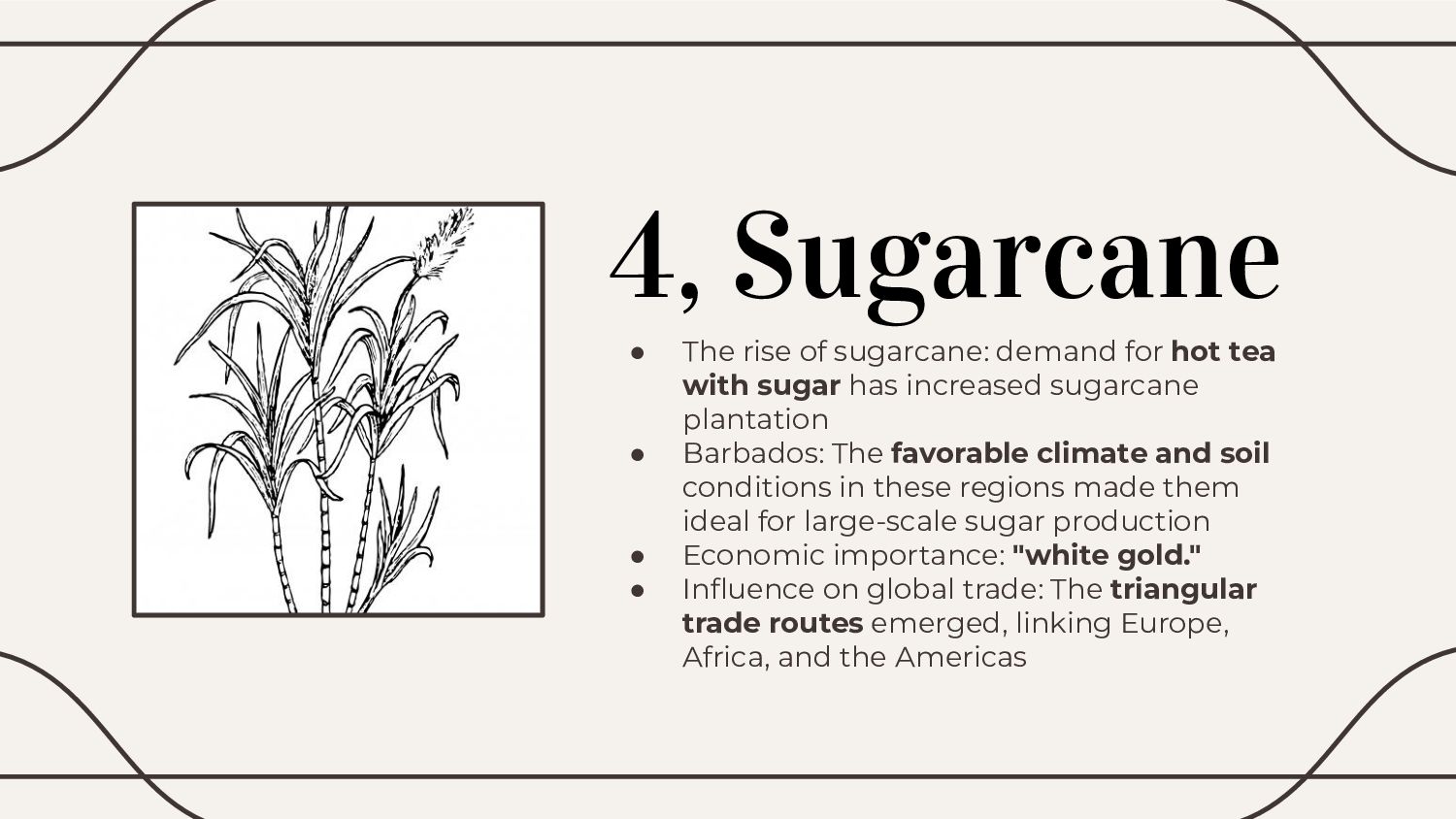
tea with sugar has increased sugarcane plantation • Barbados: The favorable climate and soil conditions in these regions made them ideal for large-scale sugar production • Economic importance: "white gold." • Influence on global trade: The triangular trade routes emerged, linking Europe, Africa, and the Americas
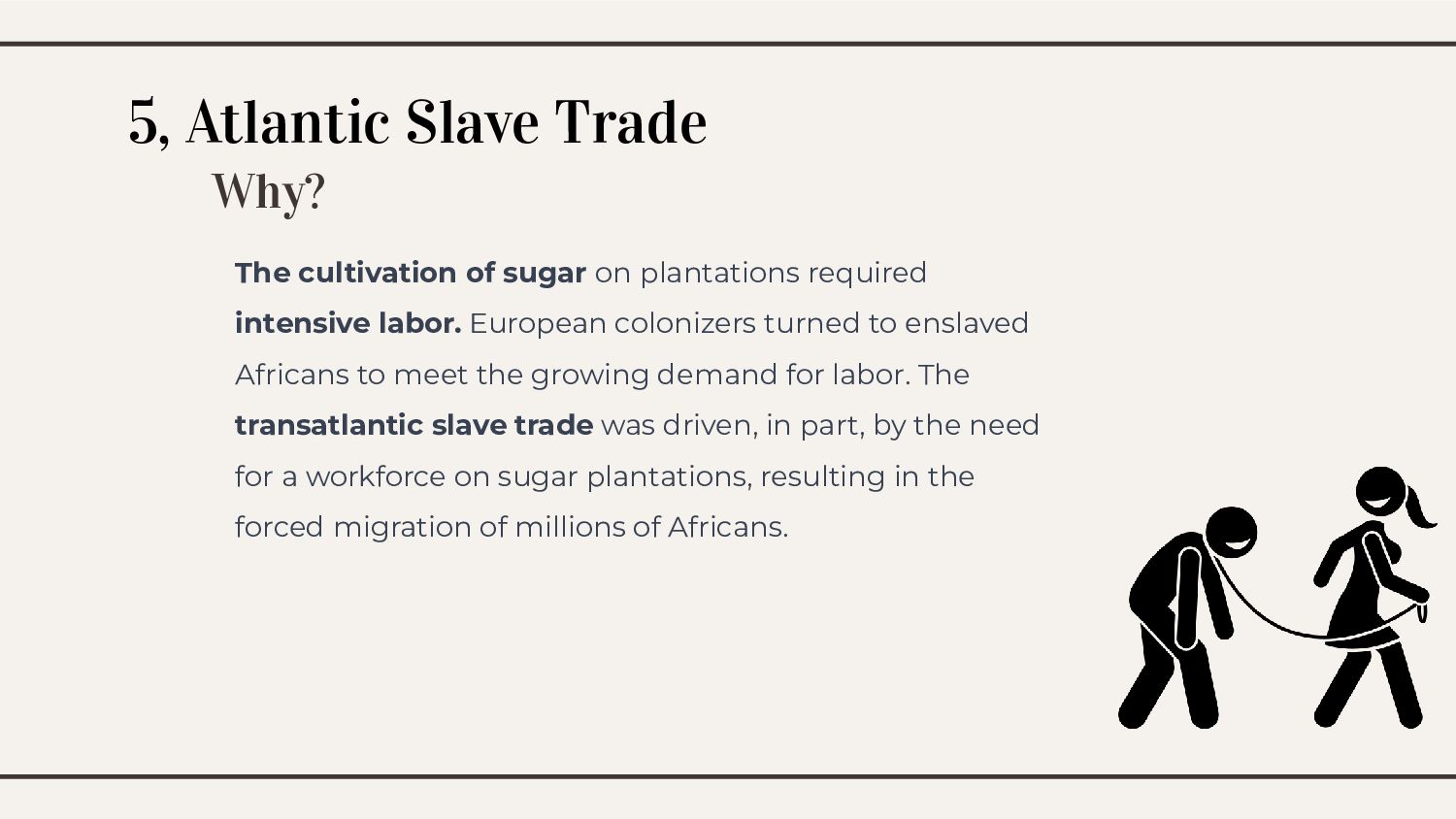
European colonizers turned to enslaved Africans to meet the growing demand for labor. The transatlantic slave trade was driven, in part, by the need for a workforce on sugar plantations, resulting in the forced migration of millions of Africans. 5, Atlantic Slave Trade
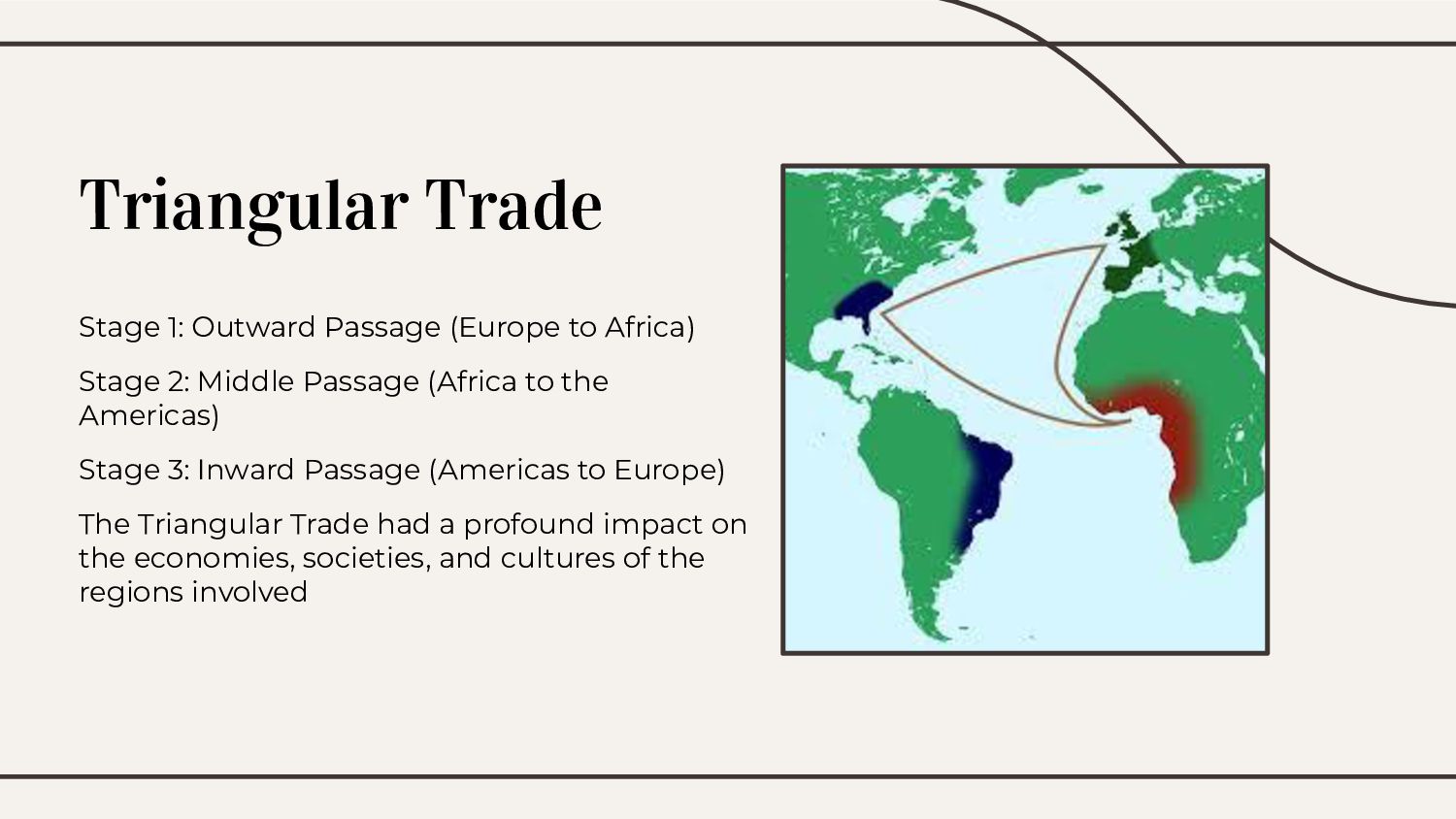
2: Middle Passage (Africa to the Americas) Stage 3: Inward Passage (Americas to Europe) The Triangular Trade had a profound impact on the economies, societies, and cultures of the regions involved
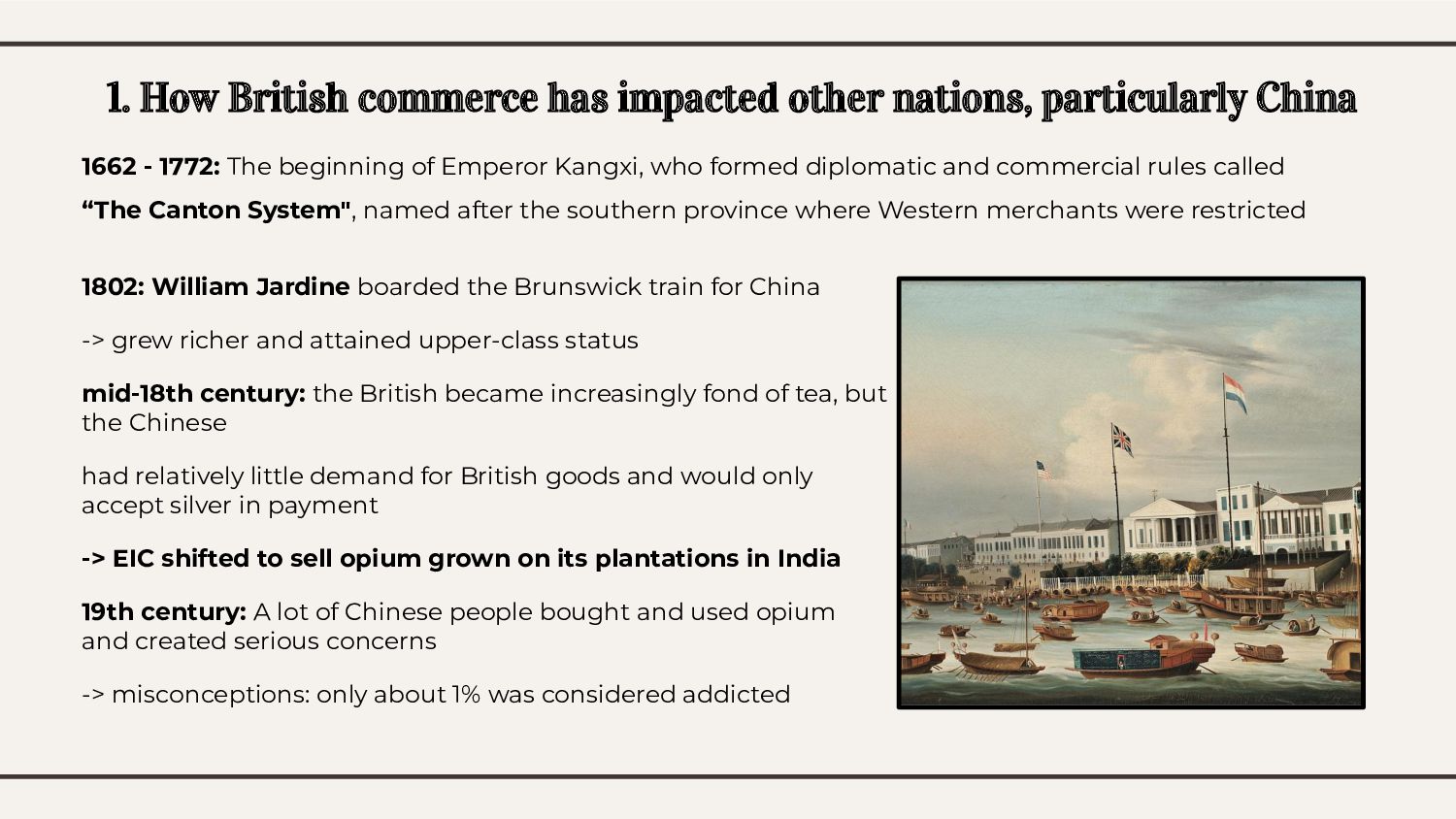
diplomatic and commercial rules called “The Canton System", named after the southern province where Western merchants were restricted 1. How British commerce has impacted other nations, particularly China 1802: William Jardine boarded the Brunswick train for China -> grew richer and attained upper-class status mid-18th century: the British became increasingly fond of tea, but the Chinese had relatively little demand for British goods and would only accept silver in payment -> EIC shifted to sell opium grown on its plantations in India 19th century: A lot of Chinese people bought and used opium and created serious concerns -> misconceptions: only about 1% was considered addicted
and started to work with some ex workers who had access to the EIC trading system. Around 1820: Jardine, Matheson & Co., appeared and dominated the market. After 1832, the EIC began to collect transit taxes from local merchants at a low rate, and allow some certified private traders to trade The EIC released: the Clipper (a boat with improved hull and sail design) → Although EIC brought the Clipper into the Chinese commercial market, it was ultimately private companies that fully exploited the potential of this new type of vessel. In the early 19th century, loopholes appeared in the monopoly of EIC → trade under diplomatic cover 1830: Parliament passed the proposal of New Commercial Law Finally, EIC's monopoly on Eastern trade was permanently invalidated from April 1834. After 1834, private traders expanded their scope of activities
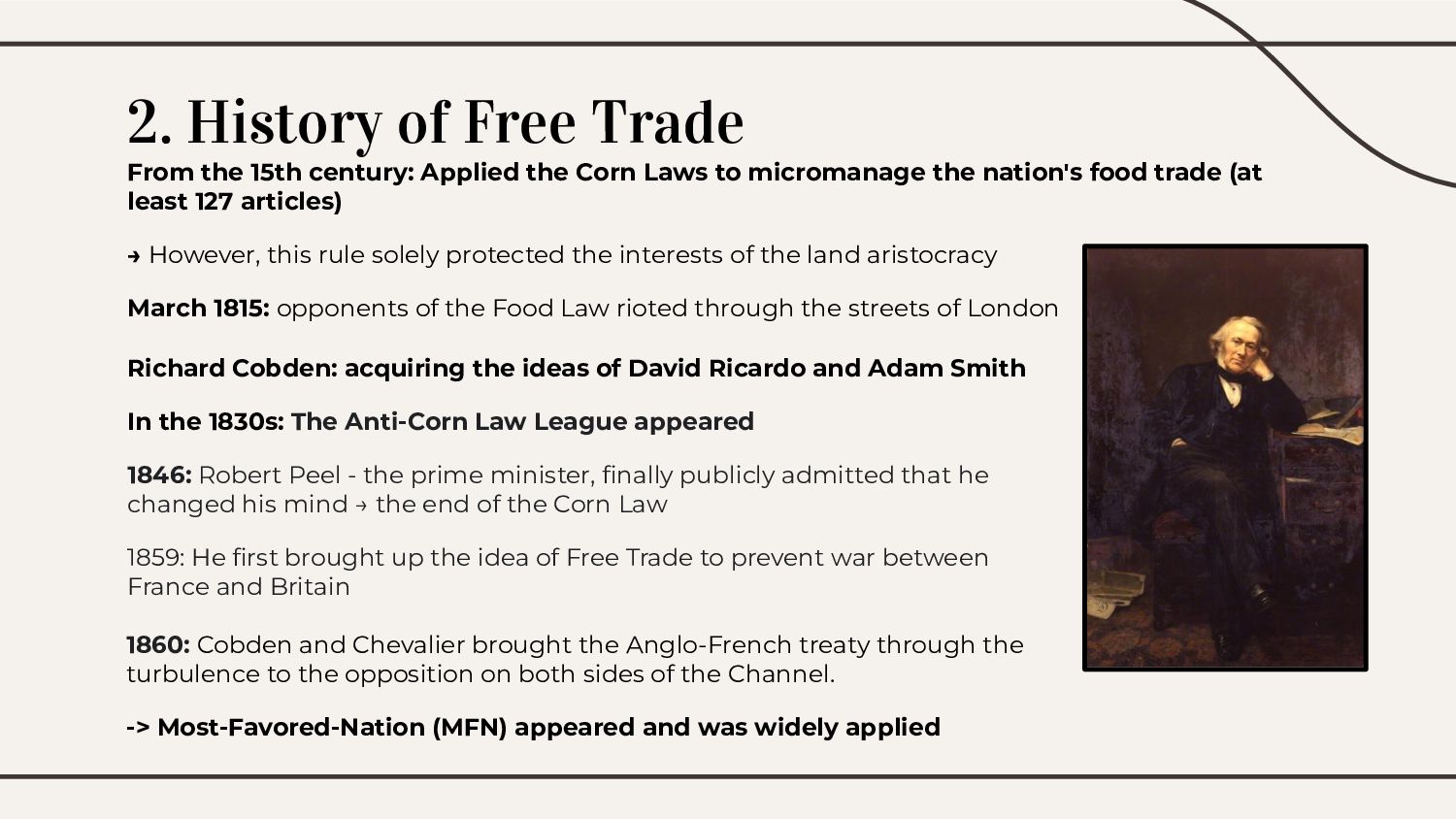
the Corn Laws to micromanage the nation's food trade (at least 127 articles) → However, this rule solely protected the interests of the land aristocracy March 1815: opponents of the Food Law rioted through the streets of London Richard Cobden: acquiring the ideas of David Ricardo and Adam Smith In the 1830s: The Anti-Corn Law League appeared 1846: Robert Peel - the prime minister, finally publicly admitted that he changed his mind → the end of the Corn Law 1859: He first brought up the idea of Free Trade to prevent war between France and Britain 1860: Cobden and Chevalier brought the Anglo-French treaty through the turbulence to the opposition on both sides of the Channel. -> Most-Favored-Nation (MFN) appeared and was widely applied
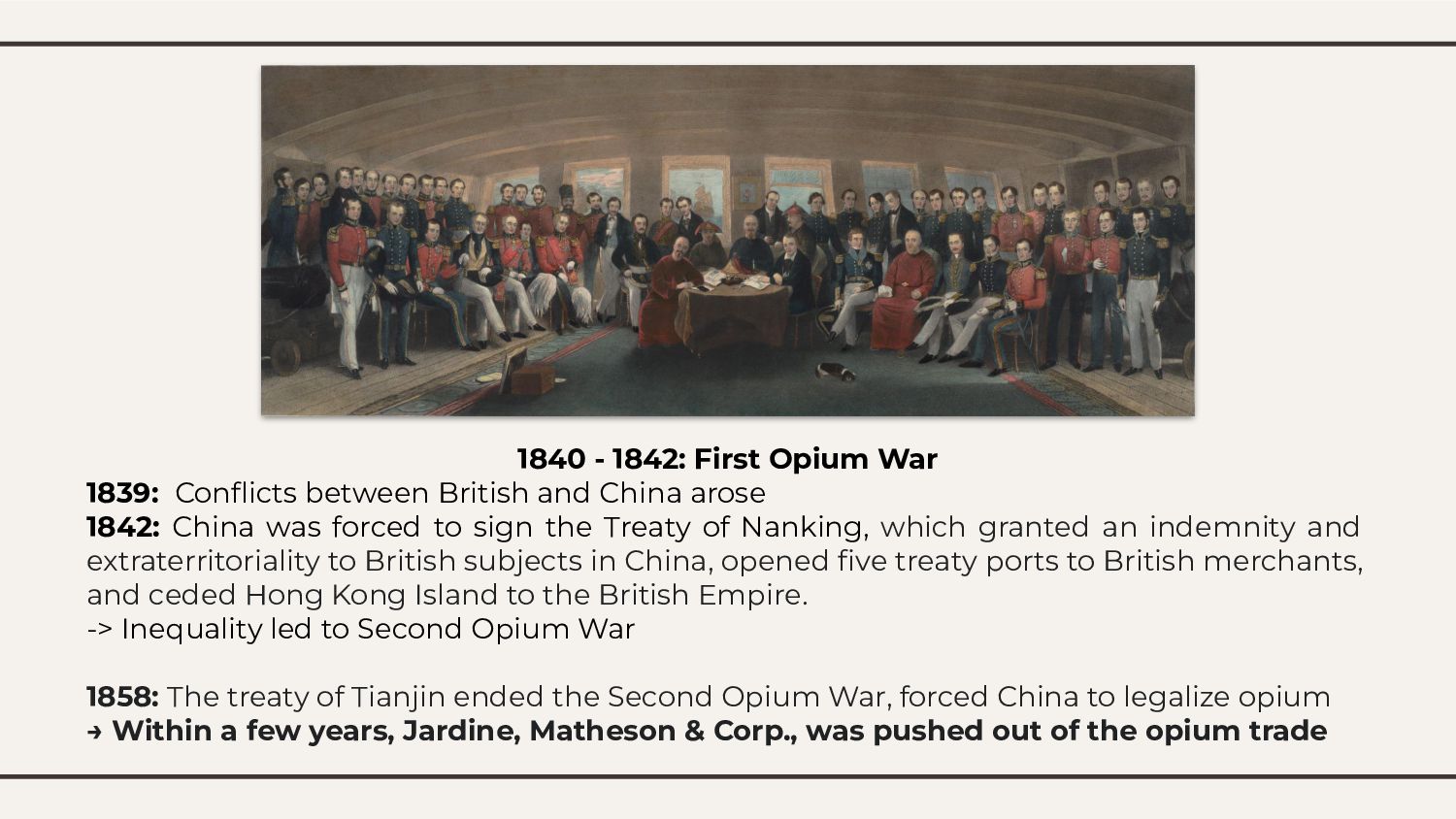
and China arose 1842: China was forced to sign the Treaty of Nanking, which granted an indemnity and extraterritoriality to British subjects in China, opened five treaty ports to British merchants, and ceded Hong Kong Island to the British Empire. -> Inequality led to Second Opium War 1858: The treaty of Tianjin ended the Second Opium War, forced China to legalize opium → Within a few years, Jardine, Matheson & Corp., was pushed out of the opium trade
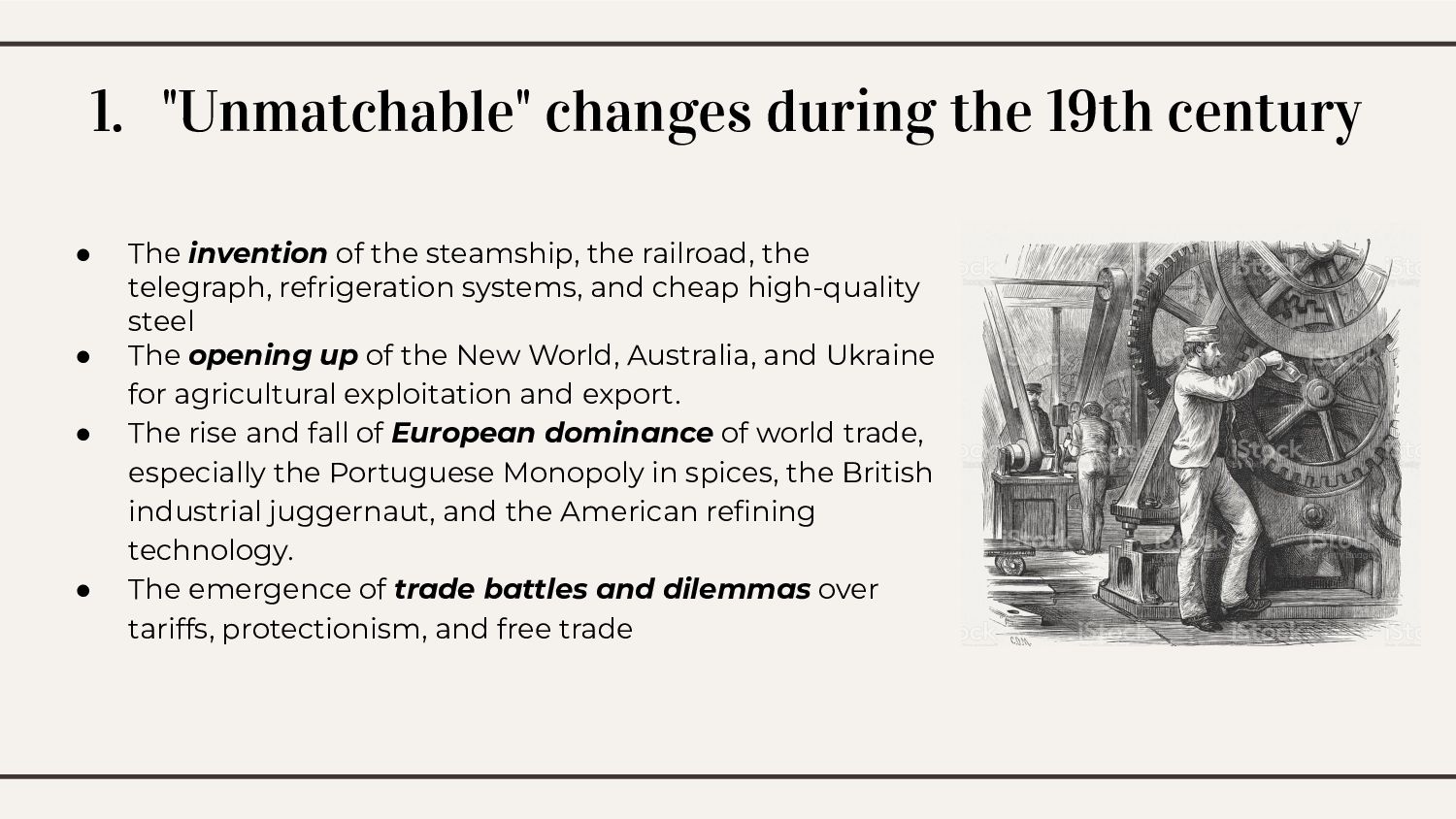
of the steamship, the railroad, the telegraph, refrigeration systems, and cheap high-quality steel • The opening up of the New World, Australia, and Ukraine for agricultural exploitation and export. • The rise and fall of European dominance of world trade, especially the Portuguese Monopoly in spices, the British industrial juggernaut, and the American refining technology. • The emergence of trade battles and dilemmas over tariffs, protectionism, and free trade
for coal, iron, and steel Reduce the cost and time of transporting + stimulate trade and economic development Pave the way for further expansion and innovation in transportation and communication Transform the United States from a collection of isolated regions into a unified nation 01 02 03 04
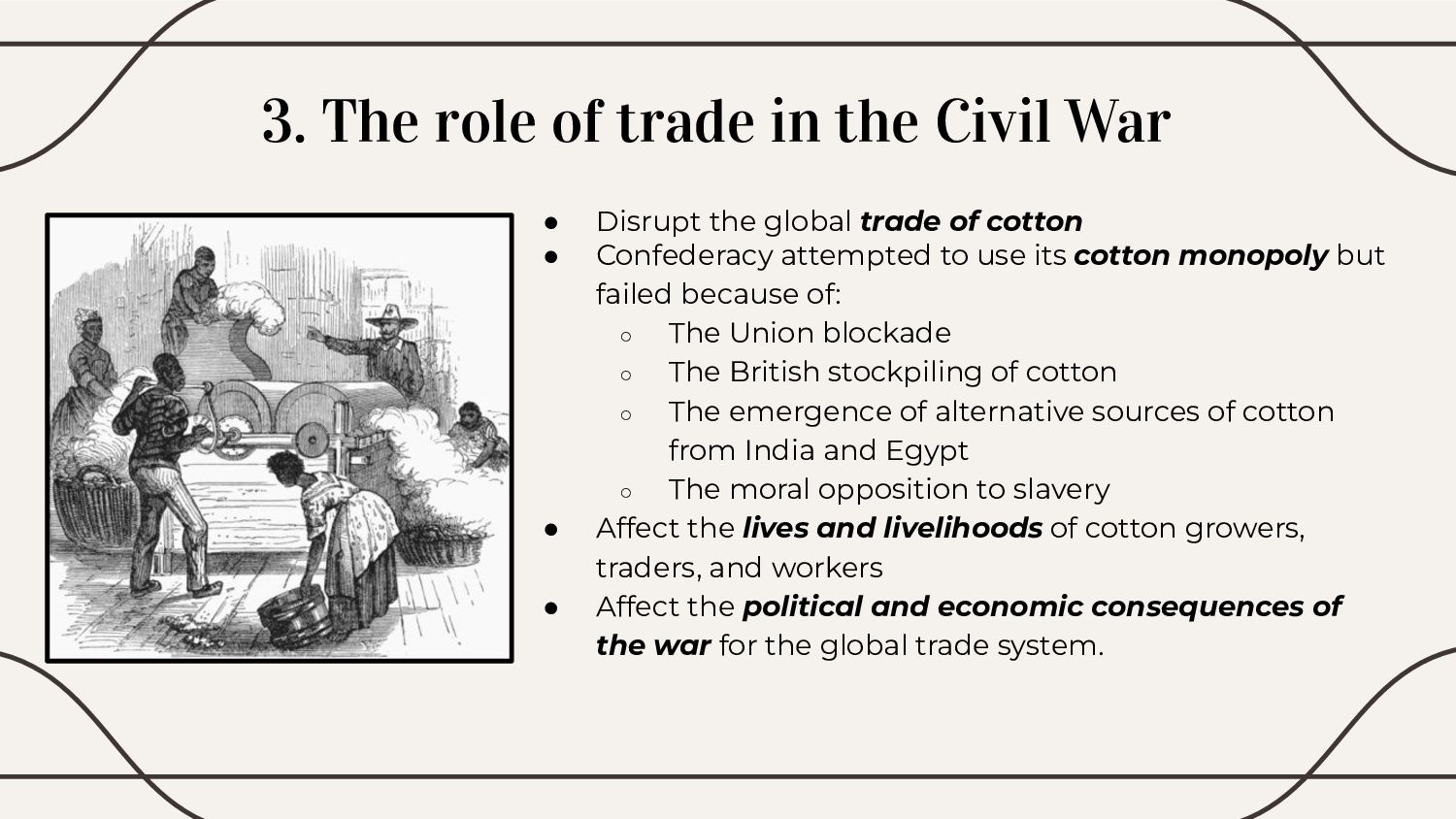
to use its cotton monopoly but failed because of: ◦ The Union blockade ◦ The British stockpiling of cotton ◦ The emergence of alternative sources of cotton from India and Egypt ◦ The moral opposition to slavery • Affect the lives and livelihoods of cotton growers, traders, and workers • Affect the political and economic consequences of the war for the global trade system. 3. The role of trade in the Civil War
and people across land and sea Facilitate the expansion of trade and imperialism 02 04 01 Reduce the cost and time of travel, increase the volume of trade, and connected markets 03 Stimulate the growth of industrialization and urbanization 05 Affect the environment and culture of different regions 4. Steam and steel changed the global economy
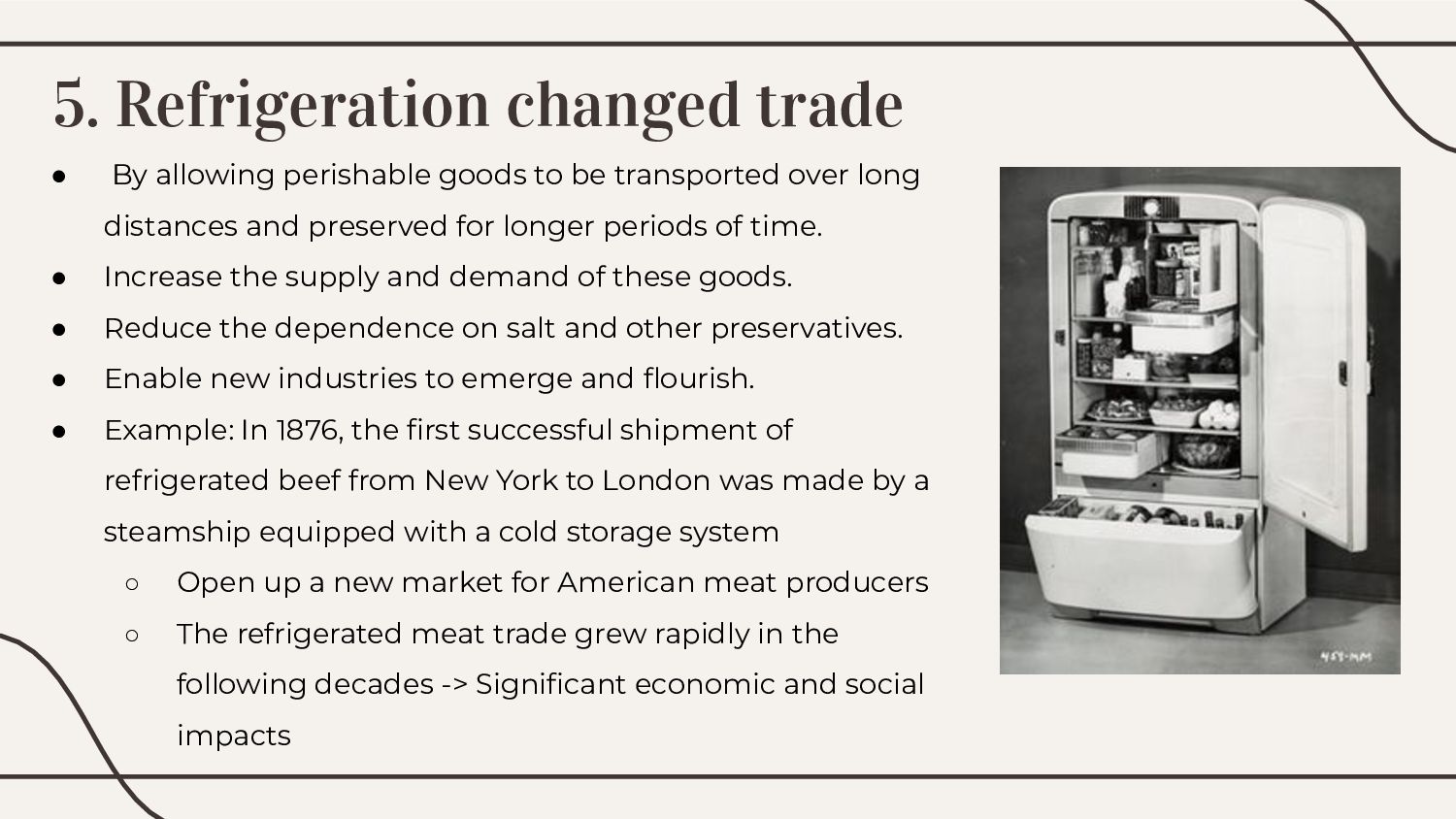
be transported over long distances and preserved for longer periods of time. • Increase the supply and demand of these goods. • Reduce the dependence on salt and other preservatives. • Enable new industries to emerge and flourish. • Example: In 1876, the first successful shipment of refrigerated beef from New York to London was made by a steamship equipped with a cold storage system ◦ Open up a new market for American meat producers ◦ The refrigerated meat trade grew rapidly in the following decades -> Significant economic and social impacts
Trade has always been a double-edged sword They faced increased competition, exploitation, displacement, and violence Technological innovations -> new challenges and conflicts The cotton farmers and workers in the American South, the British textile industry, and the indigenous peoples of Africa and Asia 01 02 03 04
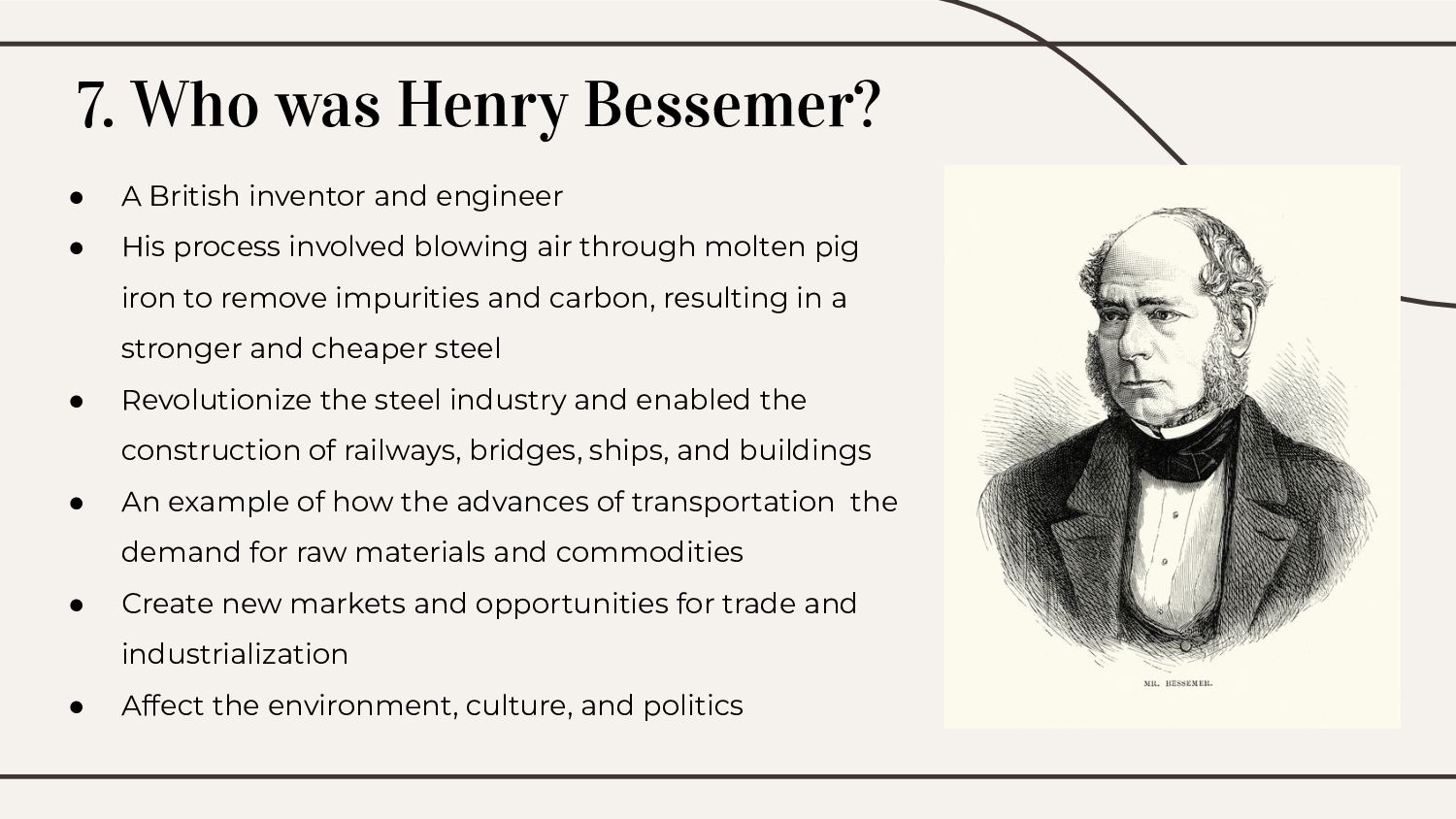
blowing air through molten pig iron to remove impurities and carbon, resulting in a stronger and cheaper steel • Revolutionize the steel industry and enabled the construction of railways, bridges, ships, and buildings • An example of how the advances of transportation the demand for raw materials and commodities • Create new markets and opportunities for trade and industrialization • Affect the environment, culture, and politics 7. Who was Henry Bessemer?
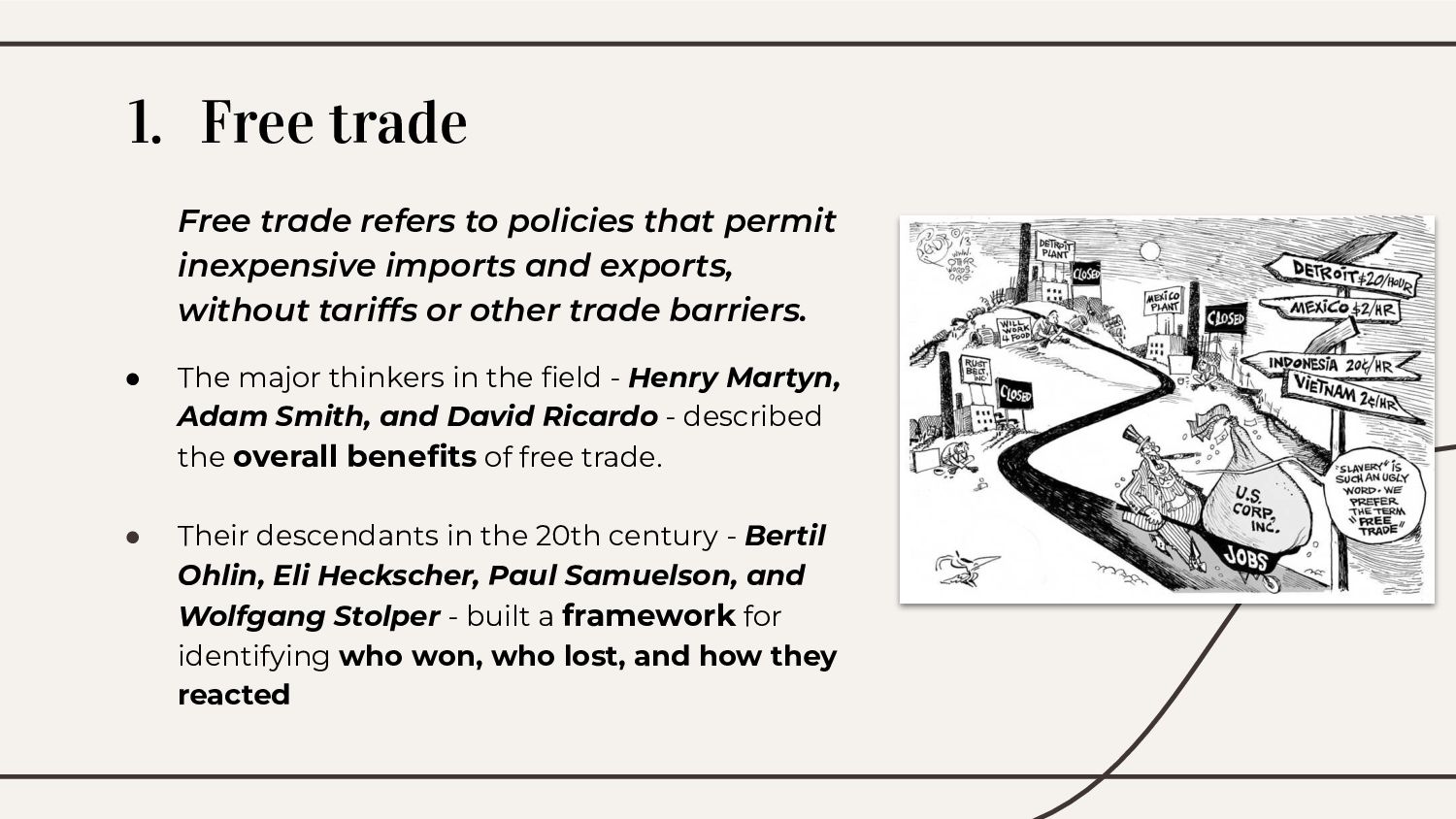
Adam Smith, and David Ricardo - described the overall benefits of free trade. • Their descendants in the 20th century - Bertil Ohlin, Eli Heckscher, Paul Samuelson, and Wolfgang Stolper - built a framework for identifying who won, who lost, and how they reacted 1. Free trade Free trade refers to policies that permit inexpensive imports and exports, without tariffs or other trade barriers.
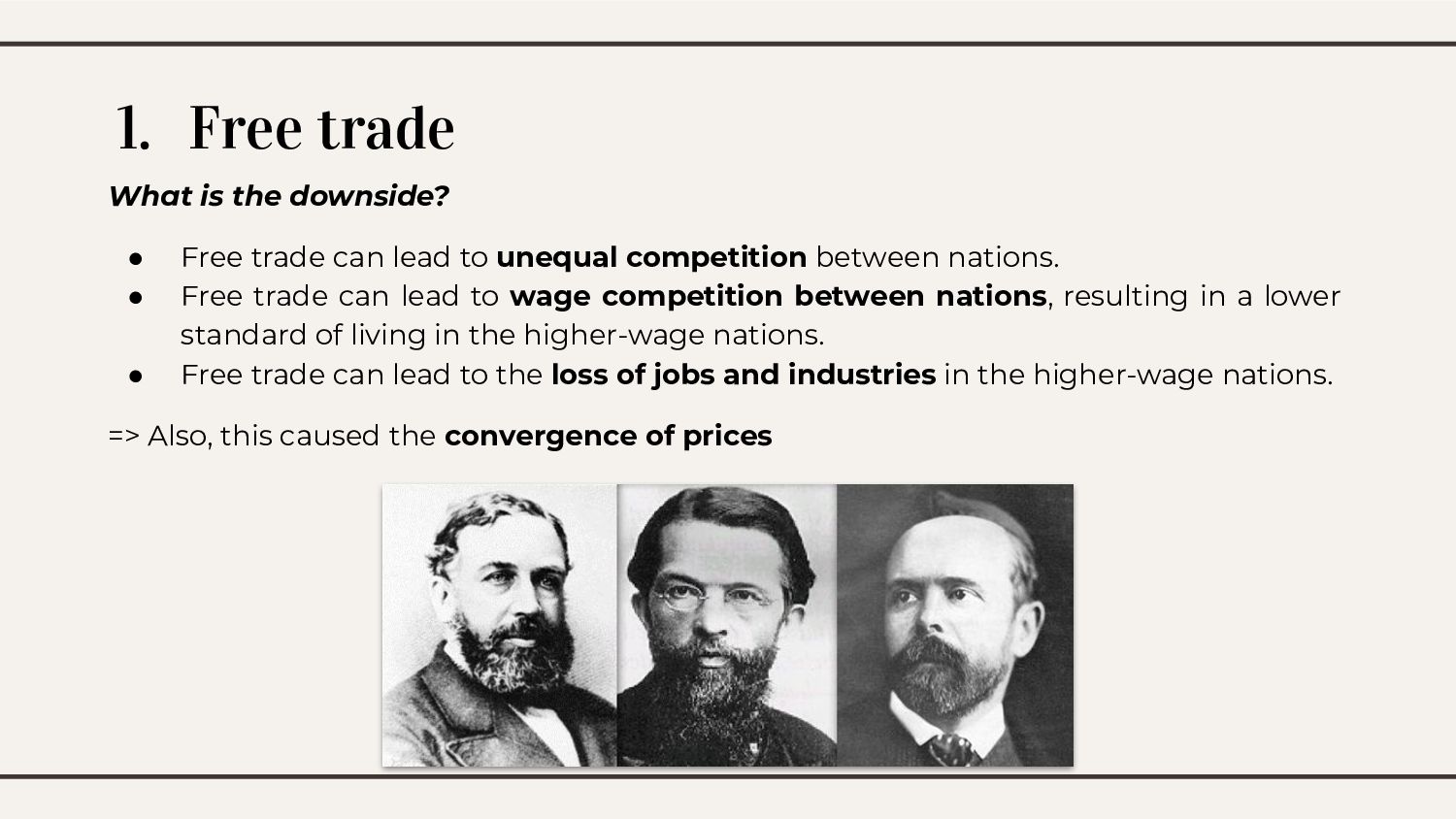
unequal competition between nations. • Free trade can lead to wage competition between nations, resulting in a lower standard of living in the higher-wage nations. • Free trade can lead to the loss of jobs and industries in the higher-wage nations. => Also, this caused the convergence of prices 1. Free trade
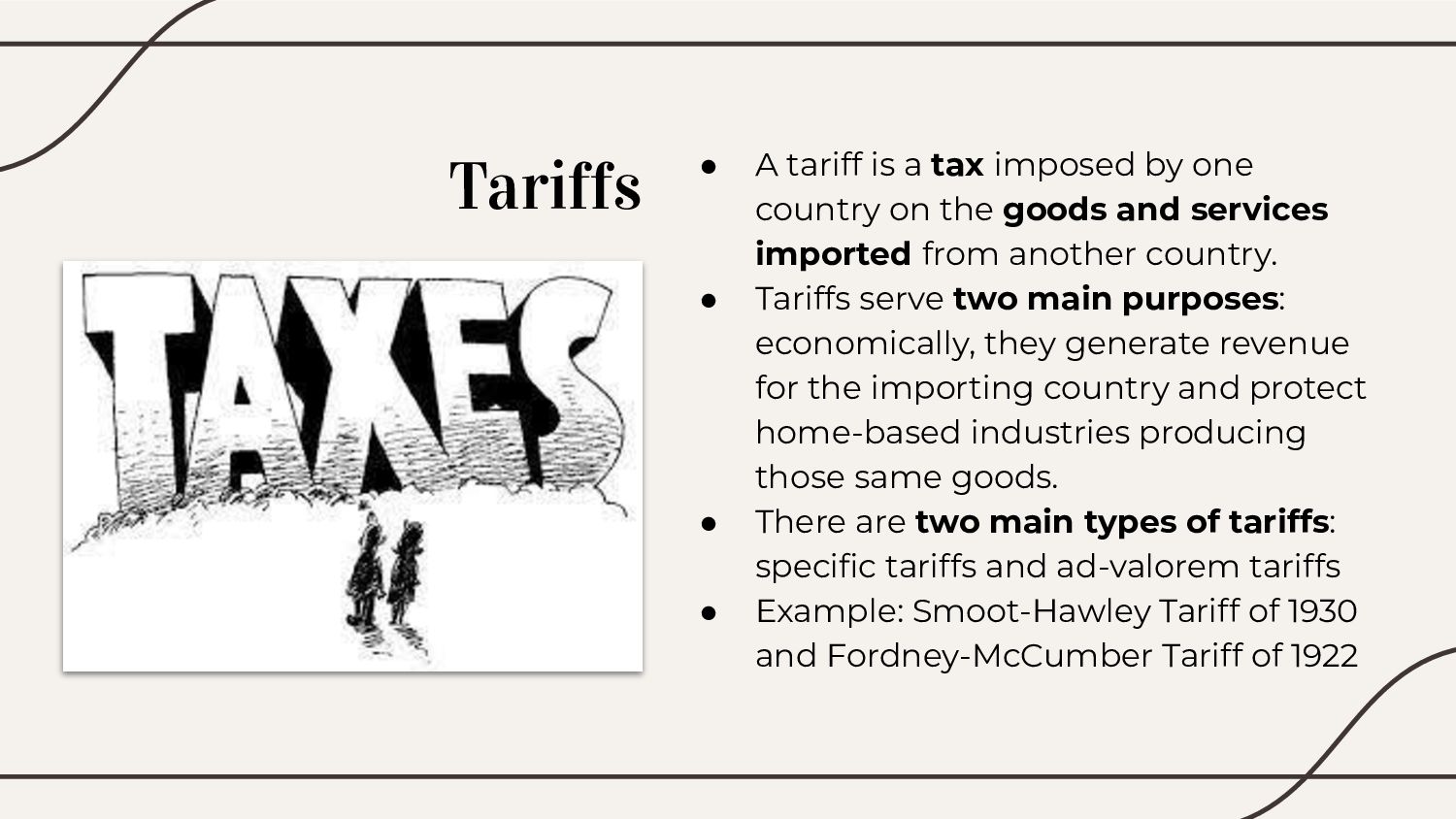
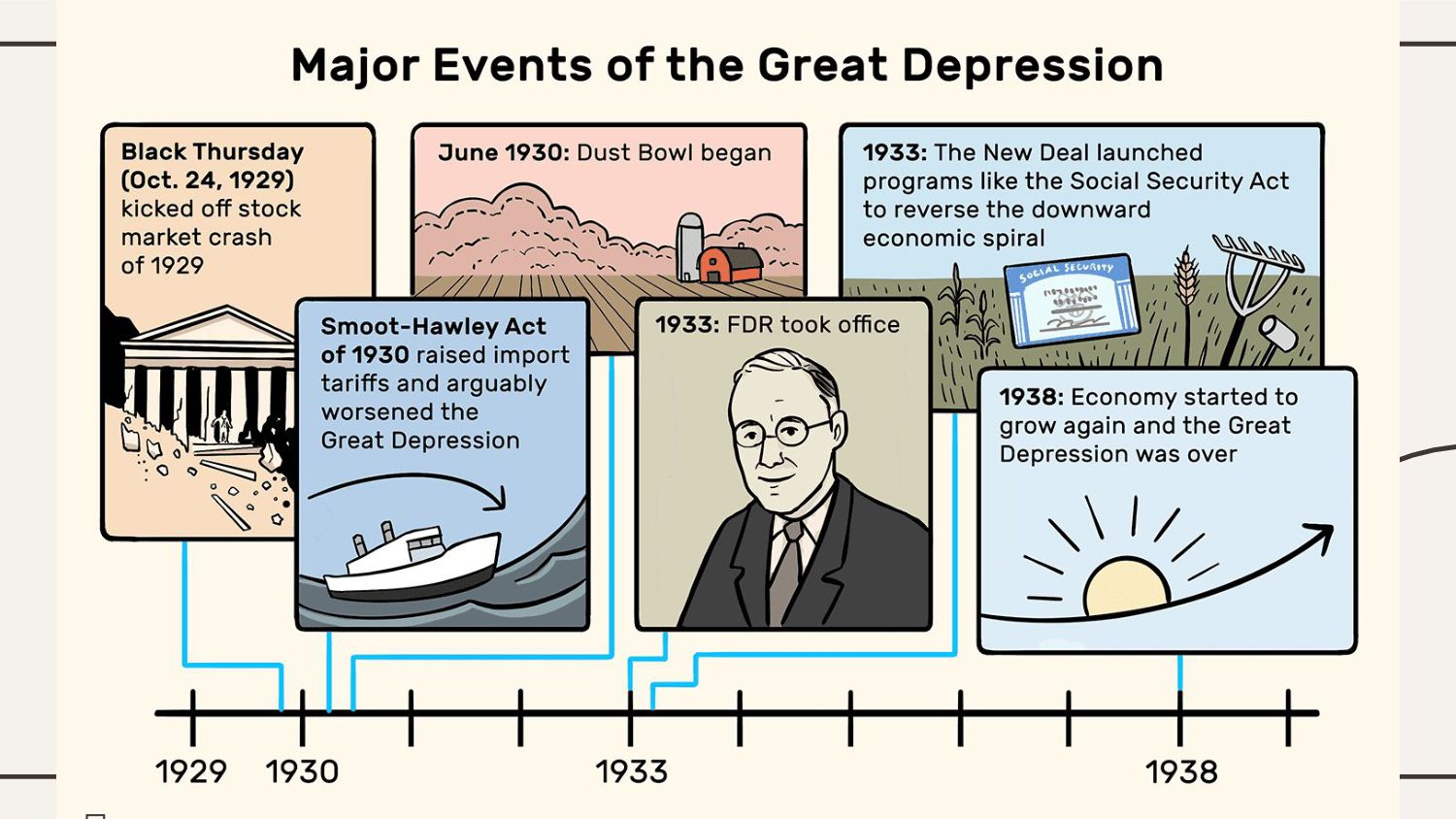
on the goods and services imported from another country. • Tariffs serve two main purposes: economically, they generate revenue for the importing country and protect home-based industries producing those same goods. • There are two main types of tariffs: specific tariffs and ad-valorem tariffs • Example: Smoot-Hawley Tariff of 1930 and Fordney-McCumber Tariff of 1922 Tariffs
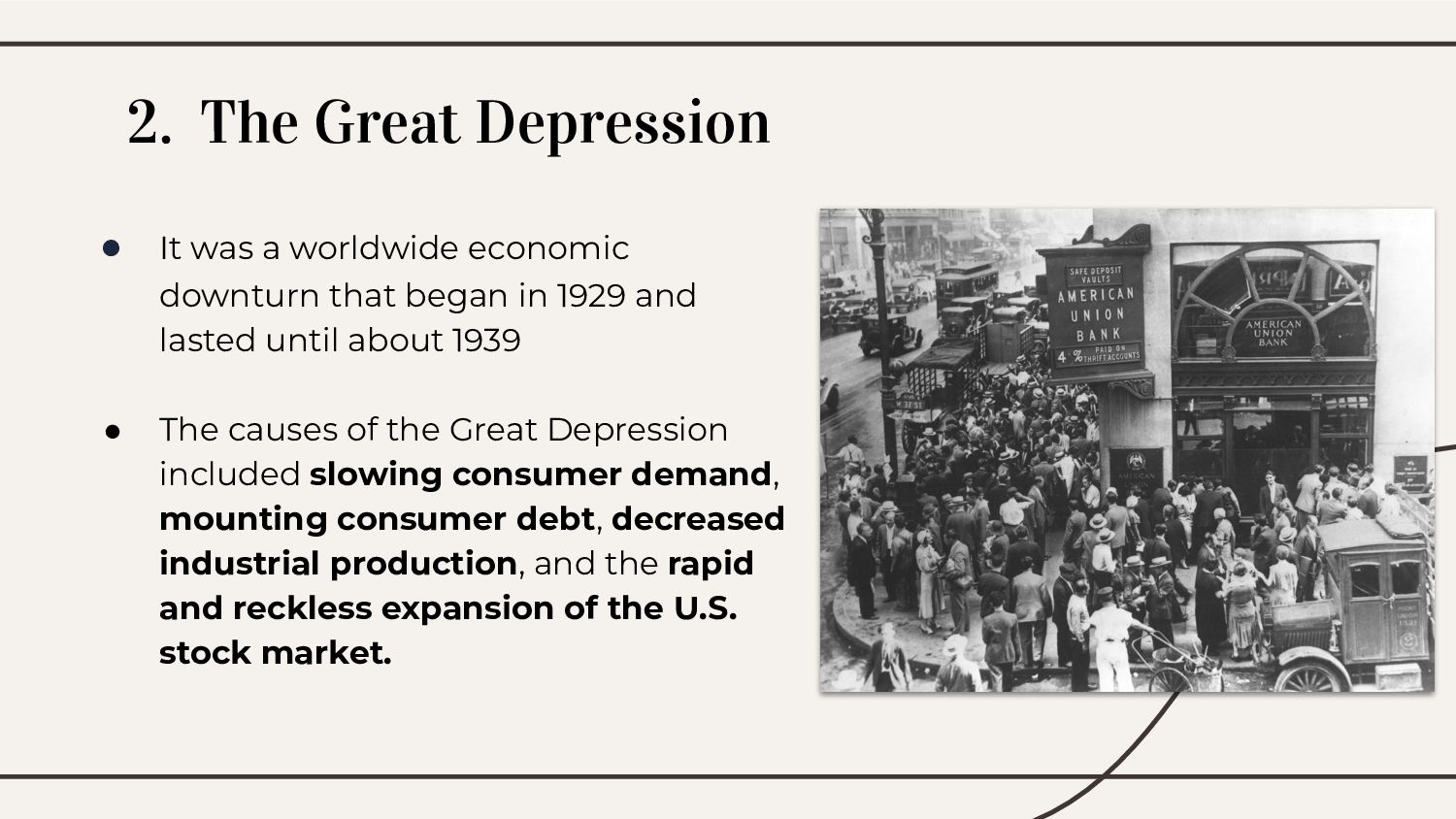
downturn that began in 1929 and lasted until about 1939 • The causes of the Great Depression included slowing consumer demand, mounting consumer debt, decreased industrial production, and the rapid and reckless expansion of the U.S. stock market.
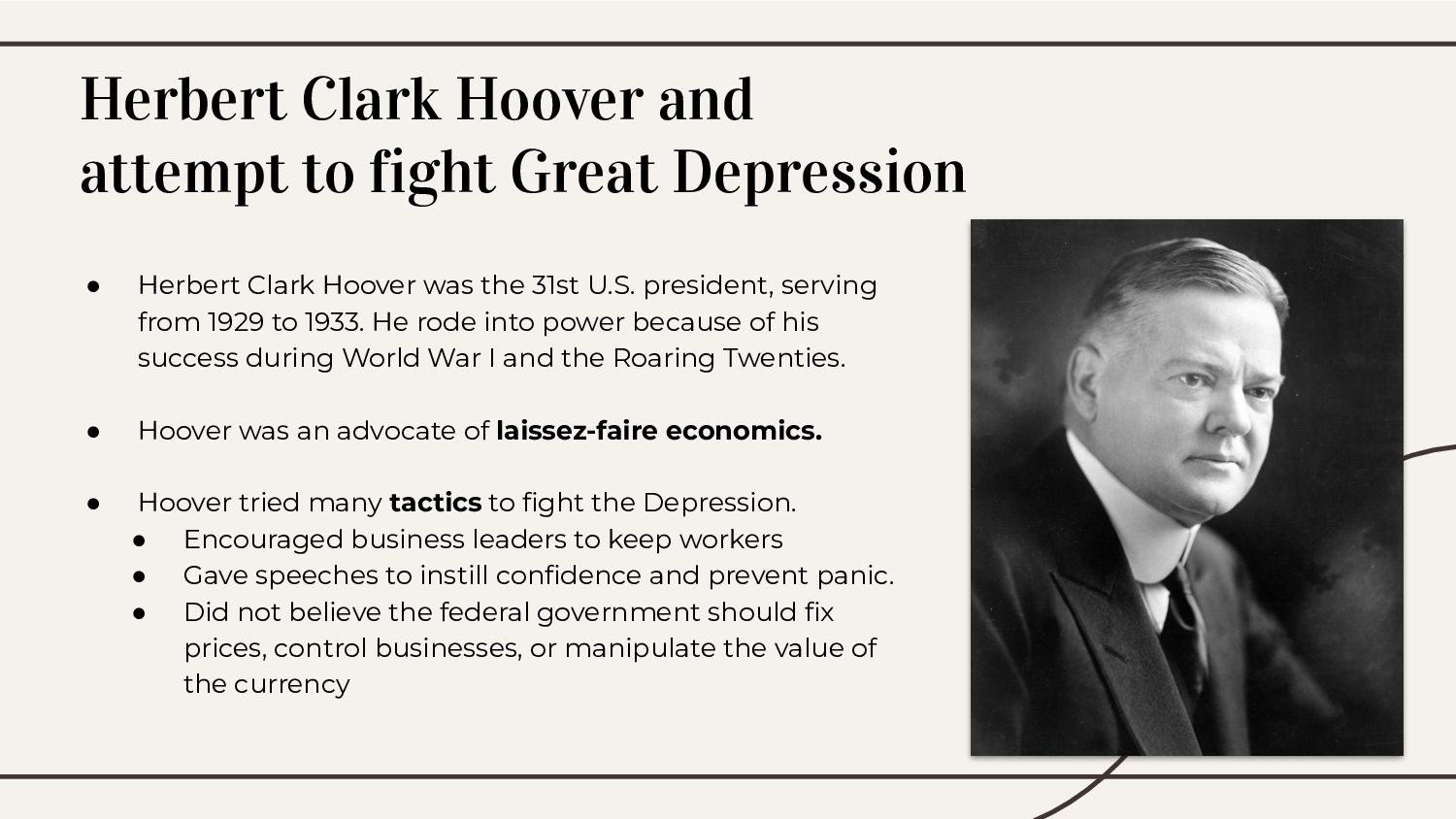
from 1929 to 1933. He rode into power because of his success during World War I and the Roaring Twenties. • Hoover was an advocate of laissez-faire economics. • Hoover tried many tactics to fight the Depression. • Encouraged business leaders to keep workers • Gave speeches to instill confidence and prevent panic. • Did not believe the federal government should fix prices, control businesses, or manipulate the value of the currency Herbert Clark Hoover and attempt to fight Great Depression
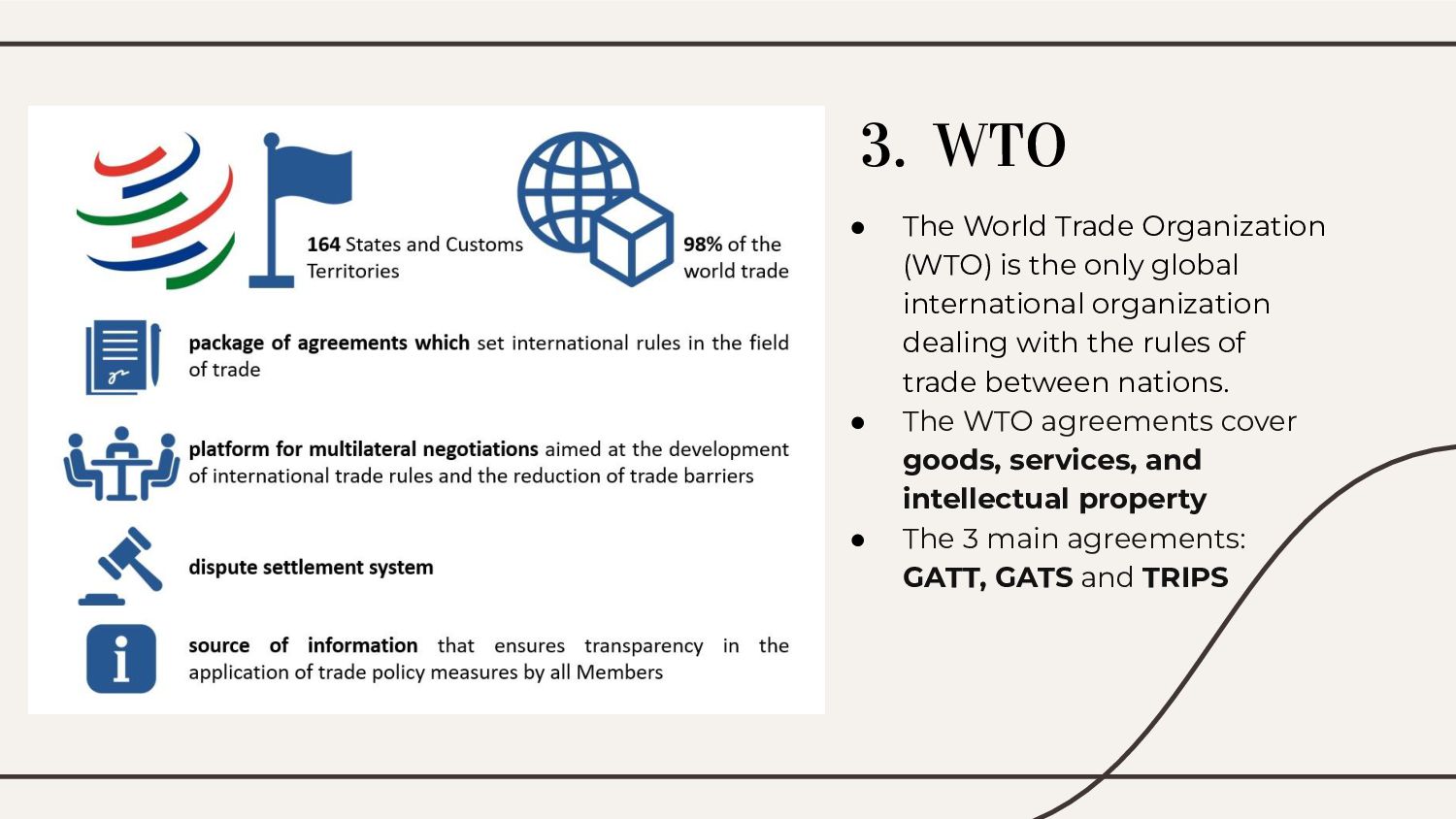
only global international organization dealing with the rules of trade between nations. • The WTO agreements cover goods, services, and intellectual property • The 3 main agreements: GATT, GATS and TRIPS
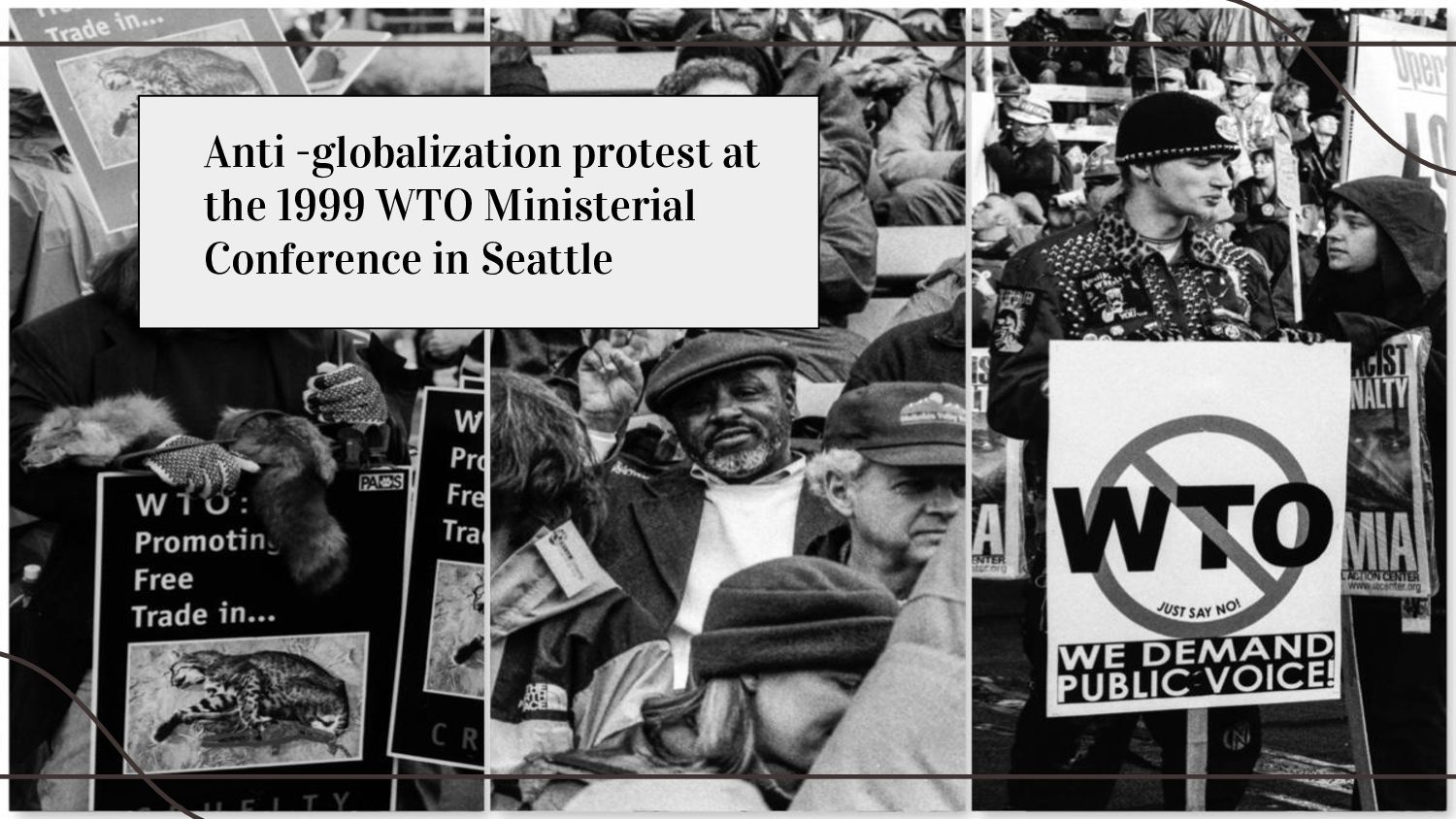
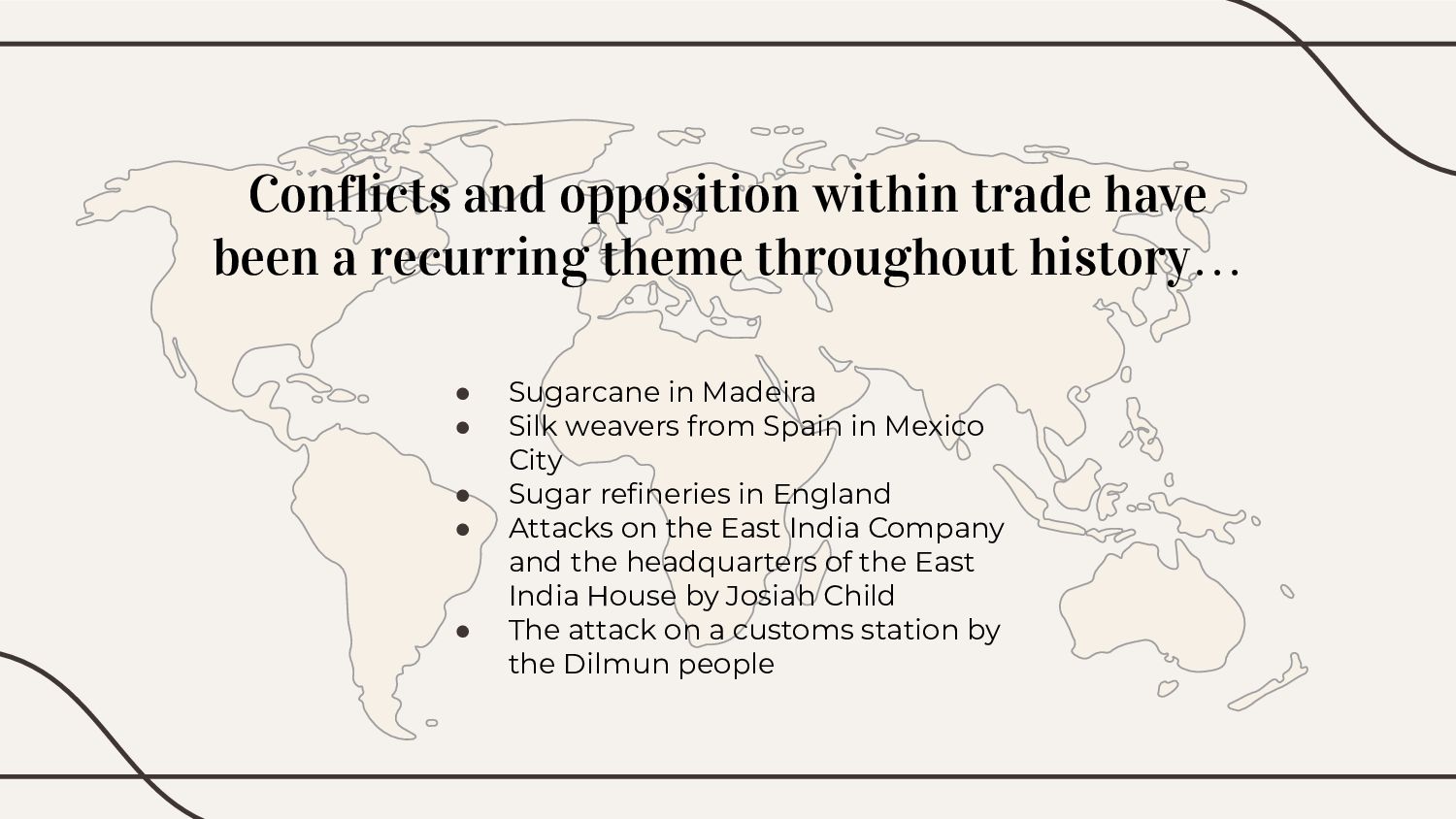
Mexico City • Sugar refineries in England • Attacks on the East India Company and the headquarters of the East India House by Josiah Child • The attack on a customs station by the Dilmun people Conflicts and opposition within trade have been a recurring theme throughout history…
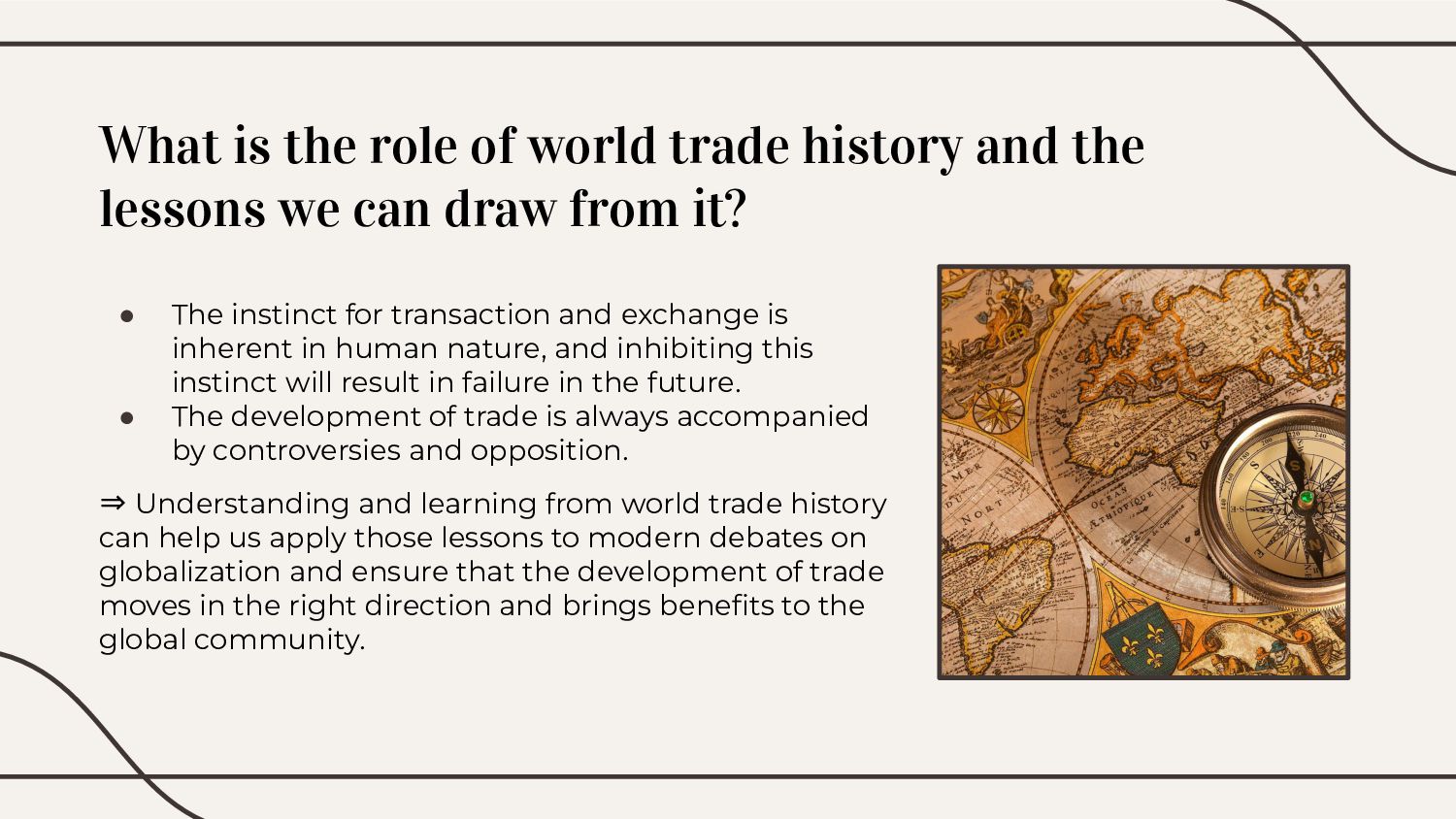
human nature, and inhibiting this instinct will result in failure in the future. • The development of trade is always accompanied by controversies and opposition. ⇒ Understanding and learning from world trade history can help us apply those lessons to modern debates on globalization and ensure that the development of trade moves in the right direction and brings benefits to the global community. What is the role of world trade history and the lessons we can draw from it?
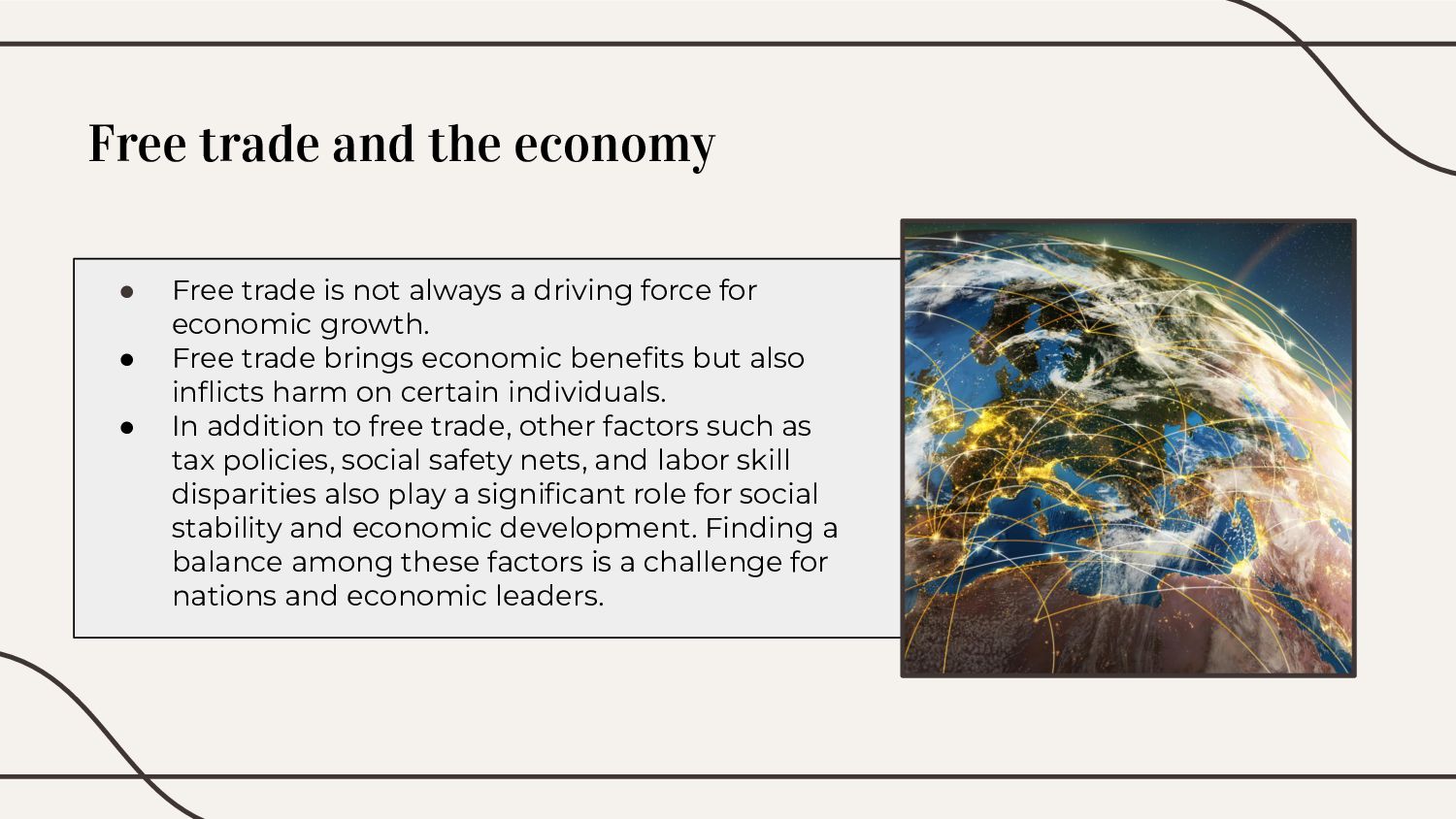
economic growth. • Free trade brings economic benefits but also inflicts harm on certain individuals. • In addition to free trade, other factors such as tax policies, social safety nets, and labor skill disparities also play a significant role for social stability and economic development. Finding a balance among these factors is a challenge for nations and economic leaders. Free trade and the economy
create injustice due to competition from foreign labor. • Paul Samuelson: all countries can suffer from free trade. Competition from foreign labor leads to job displacement rather than job loss. While international trade brings many benefits in terms of goods, intellectual capital, culture, and understanding of other nations, it also causes disadvantages and harm to some individuals. Opinions and viewpoints of economists on free trade Some proponents of free trade argue that expanding social safety nets is necessary to address the negative impacts of free trade, but this proposal is often seen as empty rhetoric. • Bhagwati: when workers lose their jobs due to competition from foreign companies, they become resentful and demand actions against dumping or special compensation and retraining programs. • Dani Rodrik also suggests that free trade and a country's generous social safety net need to be mutually reinforced.
the trend of free trade, but history has proven that there is no perfect choice. Ultimately, remembering history and the challenges overcome in the past can help us avoid the potential dangers on the path of free trade.


 anhtnt12
 goetter
 moco1013
 rezaline
 sekiguchiy
 mukai_takeru
 kgsi
 a2k
 takanorip
 edmontonriver
 apolaine
 yuri9911
 kimpetersen
 elsirapls
 katarinadahlin
 watany
 chriscoyier
 axbom
 mfonobong
 3n
 tessaabrams
 davidcarrasco
 sachag