Upgrade to Pro — share decks privately, control downloads, hide ads and more …

AI Detection Accuracy in 2026: False Positives,...

Sponsored · Your Podcast. Everywhere. Effortlessly. Share. Educate. Inspire. Entertain. You do you. We'll handle the rest. →
Avatar for AI Detector AI Detector
September 11, 2026

AI Detection Accuracy in 2026: False Positives, AI Scores and the Human–AI Classification Problem

AI detection is increasingly used in education, publishing, research, and professional writing, but an AI score is not direct proof of authorship.

This research presentation examines AI detection accuracy in 2026, including false positives, false negatives, AI-score interpretation, classification thresholds, multilingual detection, human–AI hybrid writing, and the reasons different AI detectors can produce different results from identical text.

The presentation also explains why headline accuracy alone can be misleading, how precision and recall affect detector performance, and why high-stakes decisions should combine automated detection with contextual evidence and human review.

Avatar for AI Detector

AI Detector

September 11, 2026

Other Decks in Research

Transcript

  1. AI Detection Accuracy in 2026 False Positives, AI Scores and

    the Human–AI Classification Problem A research-focused briefing for educators, writers and AI product teams AIDetector.cx AIDetector.cx Research • 2026 1
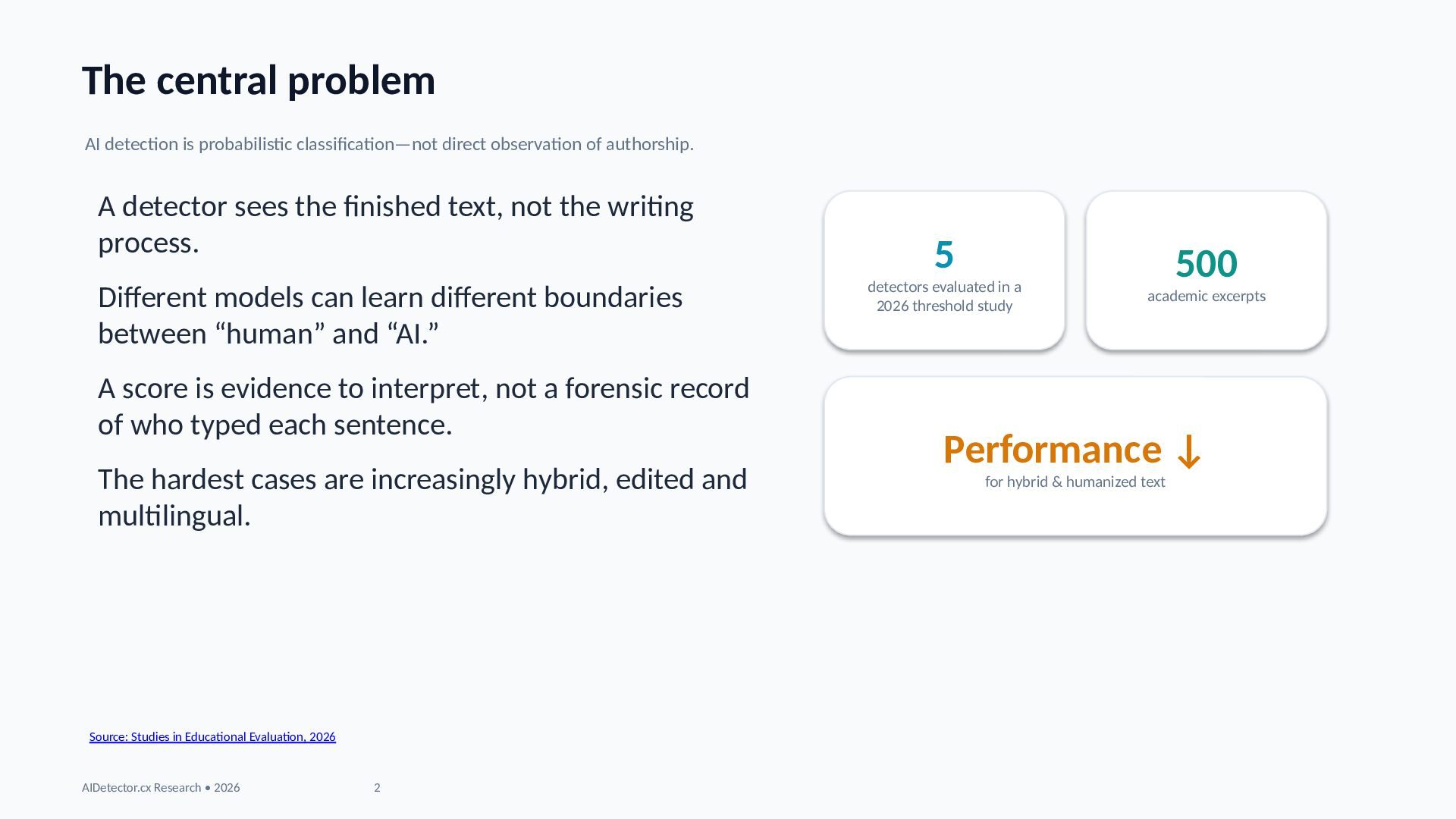
  2. The central problem AI detection is probabilistic classification—not direct observation

    of authorship. A detector sees the finished text, not the writing process. Different models can learn different boundaries between “human” and “AI.” A score is evidence to interpret, not a forensic record of who typed each sentence. The hardest cases are increasingly hybrid, edited and multilingual. Source: Studies in Educational Evaluation, 2026 AIDetector.cx Research • 2026 2 5 detectors evaluated in a 2026 threshold study 500 academic excerpts Performance ↓ for hybrid & humanized text
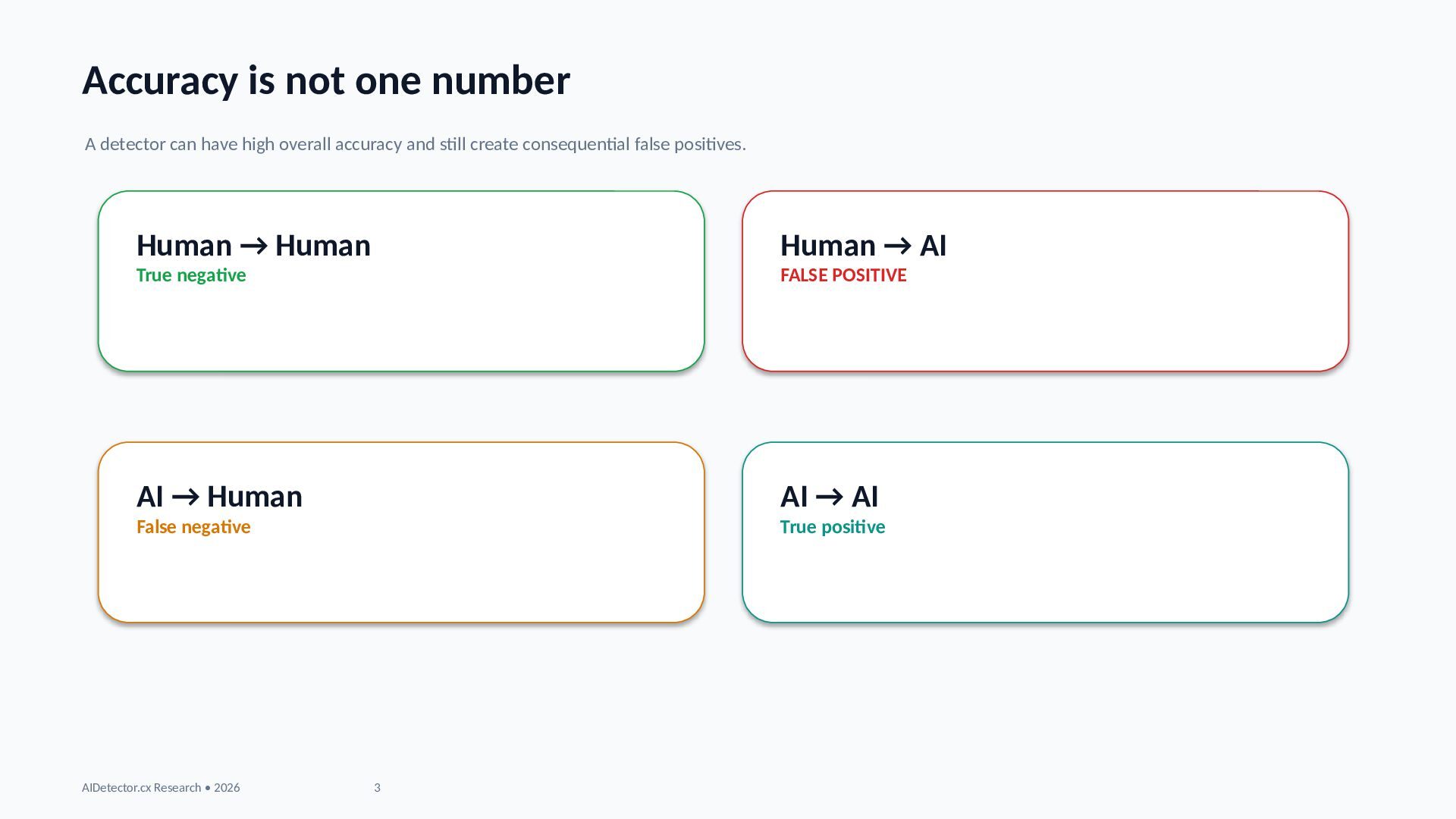
  3. Accuracy is not one number A detector can have high

    overall accuracy and still create consequential false positives. Human → Human Human → AI AI → Human AI → AI True negative FALSE POSITIVE False negative AIDetector.cx Research • 2026 True positive 3
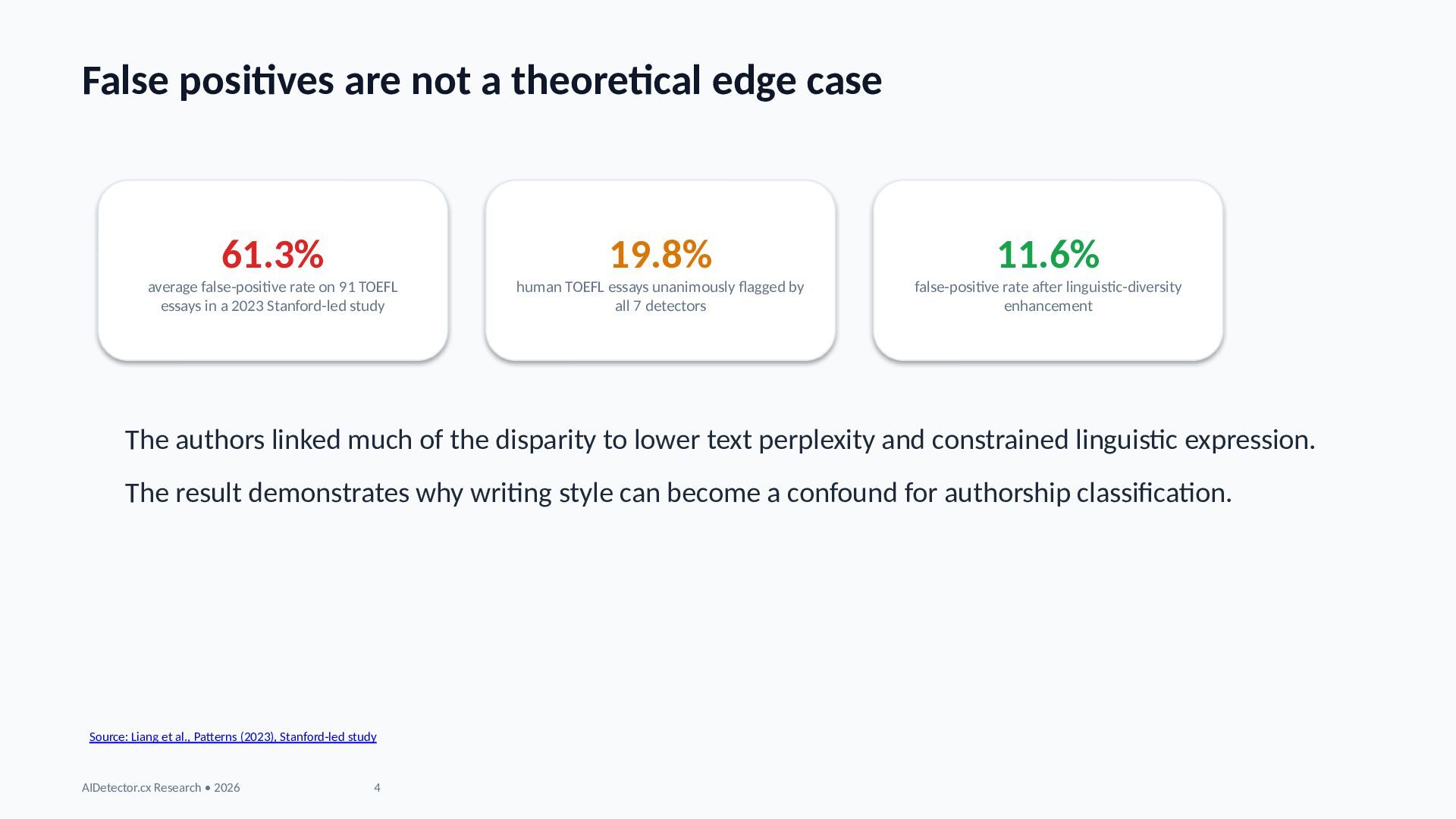
  4. False positives are not a theoretical edge case 61.3% average

    false-positive rate on 91 TOEFL essays in a 2023 Stanford-led study 19.8% human TOEFL essays unanimously flagged by all 7 detectors 11.6% false-positive rate after linguistic-diversity enhancement The authors linked much of the disparity to lower text perplexity and constrained linguistic expression. The result demonstrates why writing style can become a confound for authorship classification. Source: Liang et al., Patterns (2023), Stanford-led study AIDetector.cx Research • 2026 4
  5. What does an “AI score” actually mean? It does not

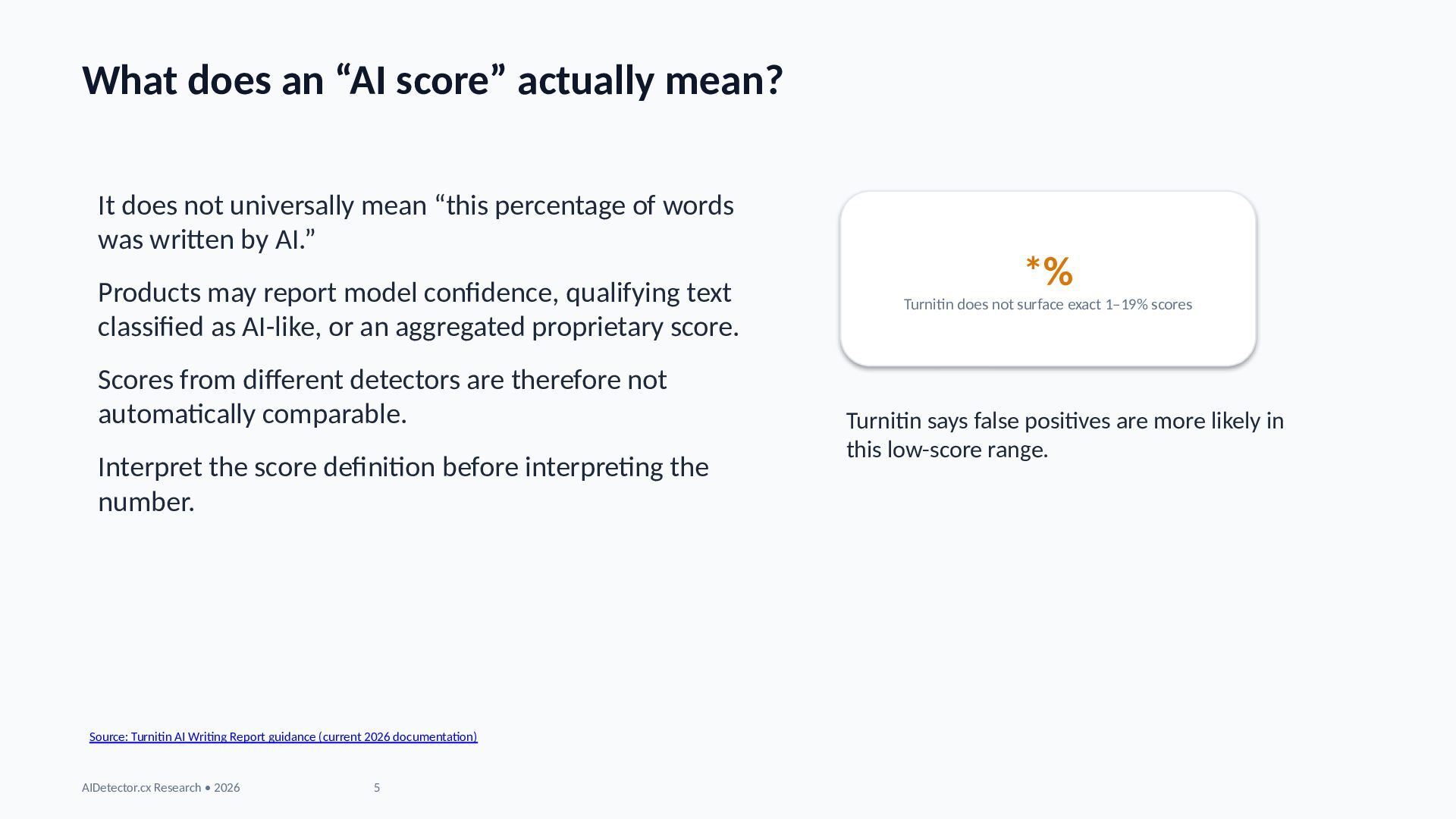
    universally mean “this percentage of words was written by AI.” Products may report model confidence, qualifying text classified as AI-like, or an aggregated proprietary score. Scores from different detectors are therefore not automatically comparable. Interpret the score definition before interpreting the number. Source: Turnitin AI Writing Report guidance (current 2026 documentation) AIDetector.cx Research • 2026 5 *% Turnitin does not surface exact 1–19% scores Turnitin says false positives are more likely in this low-score range.
  6. Why two detectors can disagree on the same text Training

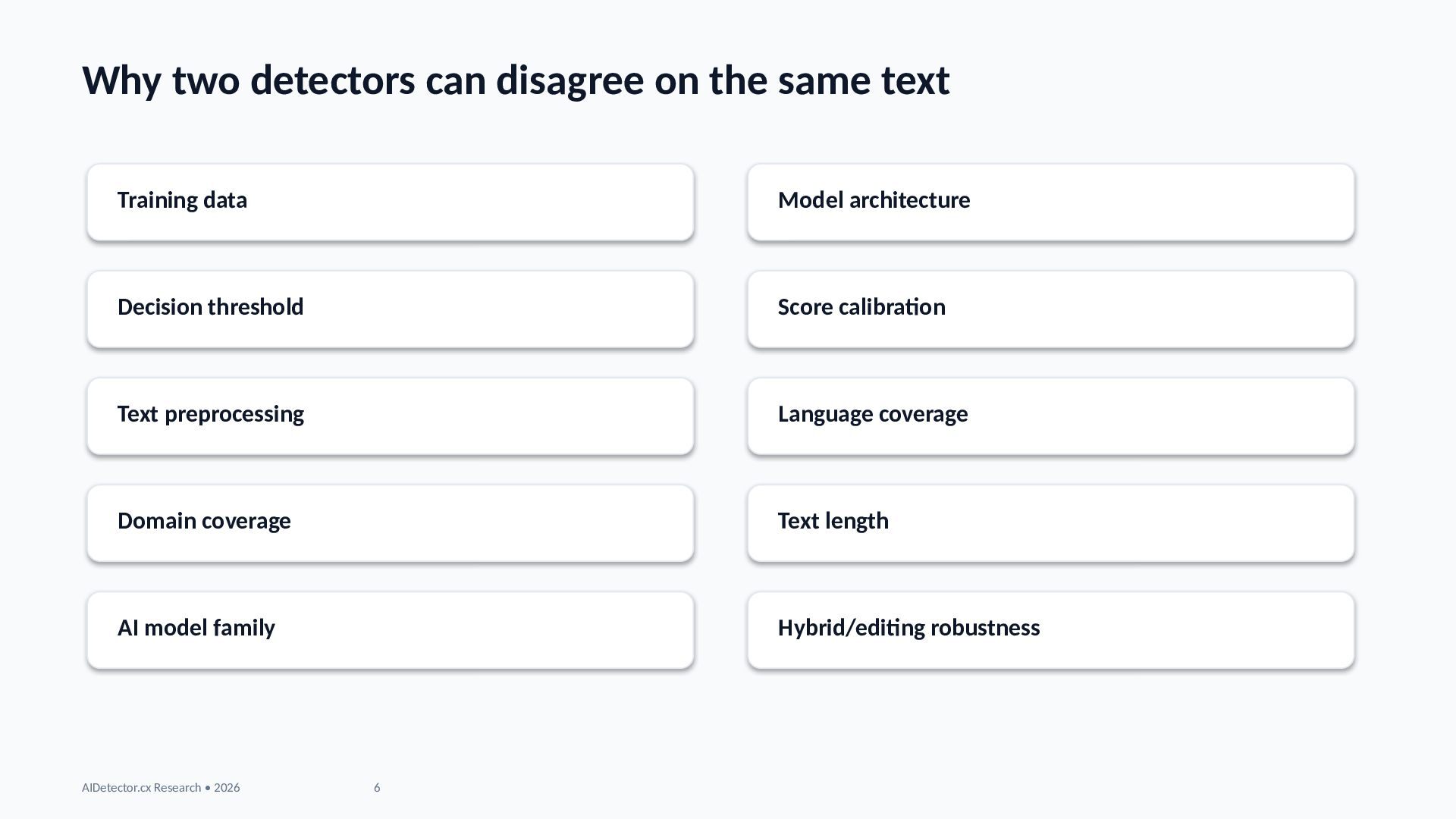
    data Model architecture Decision threshold Score calibration Text preprocessing Language coverage Domain coverage Text length AI model family Hybrid/editing robustness AIDetector.cx Research • 2026 6
  7. The binary label is breaking down Real writing workflows increasingly

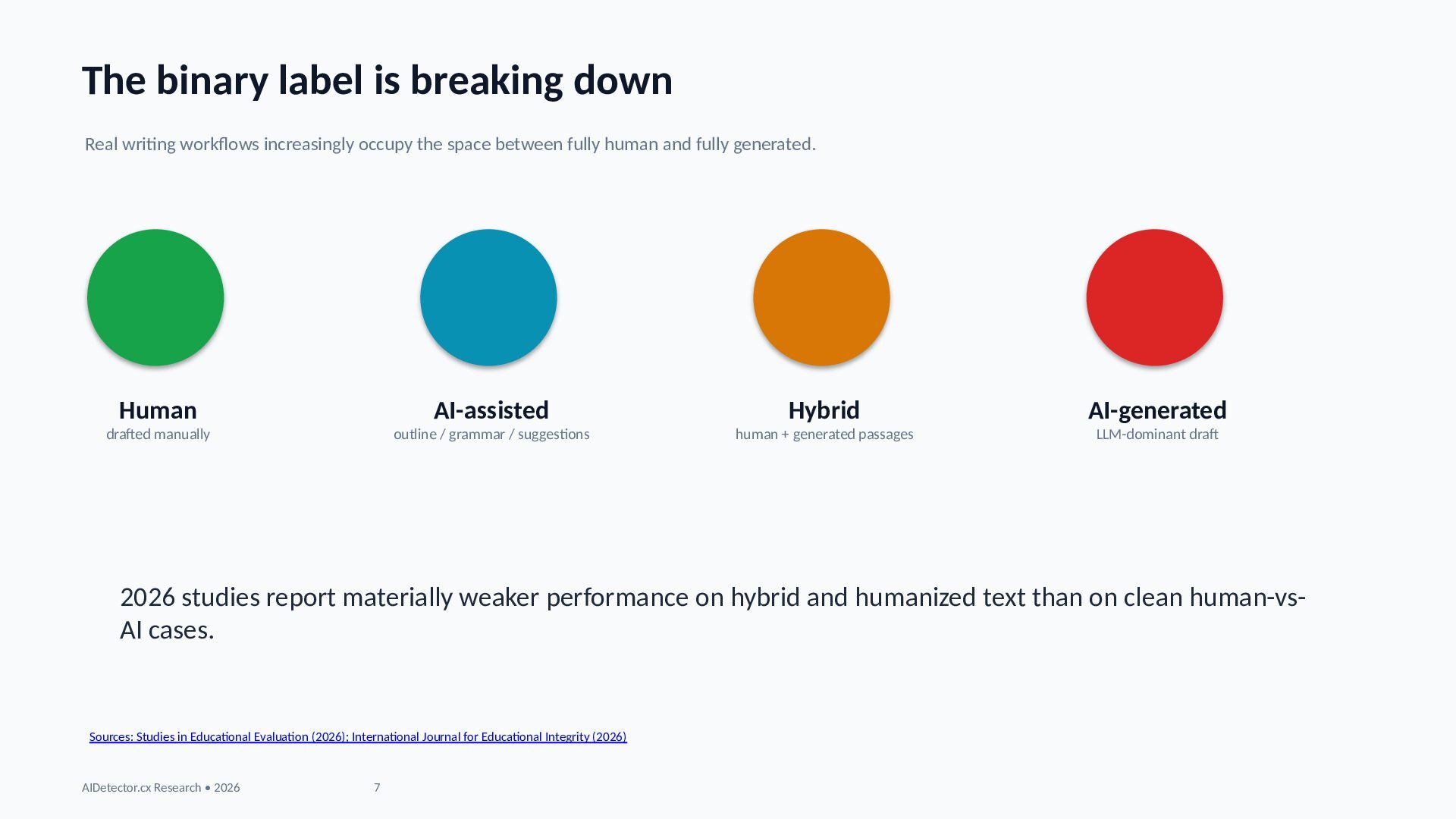
    occupy the space between fully human and fully generated. Human AI-assisted drafted manually outline / grammar / suggestions Hybrid human + generated passages AI-generated LLM-dominant draft 2026 studies report materially weaker performance on hybrid and humanized text than on clean human-vsAI cases. Sources: Studies in Educational Evaluation (2026); International Journal for Educational Integrity (2026) AIDetector.cx Research • 2026 7
  8. What 2026 research is telling us 13 88% detectors evaluated

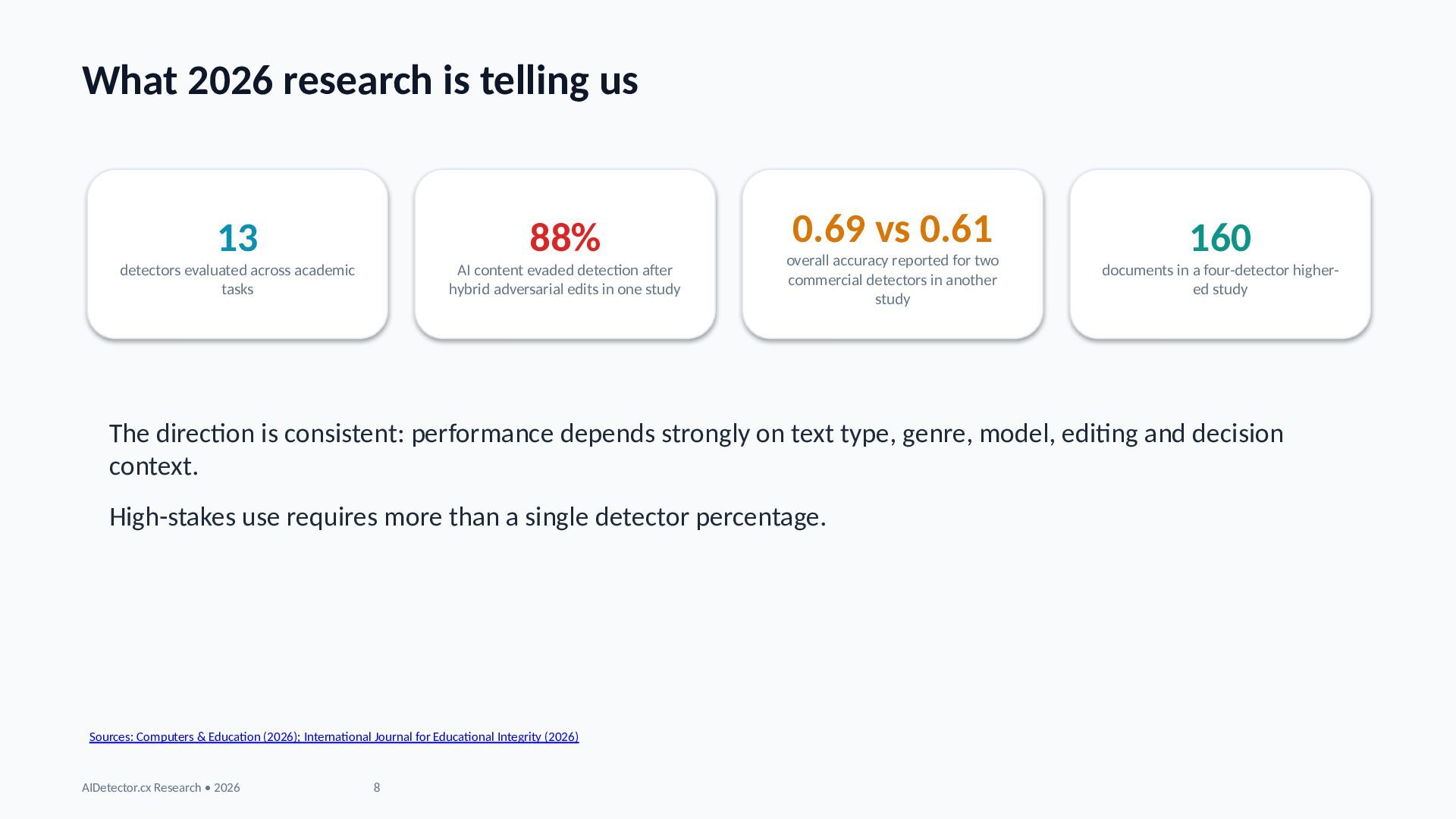
    across academic tasks AI content evaded detection after hybrid adversarial edits in one study 0.69 vs 0.61 overall accuracy reported for two commercial detectors in another study 160 documents in a four-detector highered study The direction is consistent: performance depends strongly on text type, genre, model, editing and decision context. High-stakes use requires more than a single detector percentage. Sources: Computers & Education (2026); International Journal for Educational Integrity (2026) AIDetector.cx Research • 2026 8
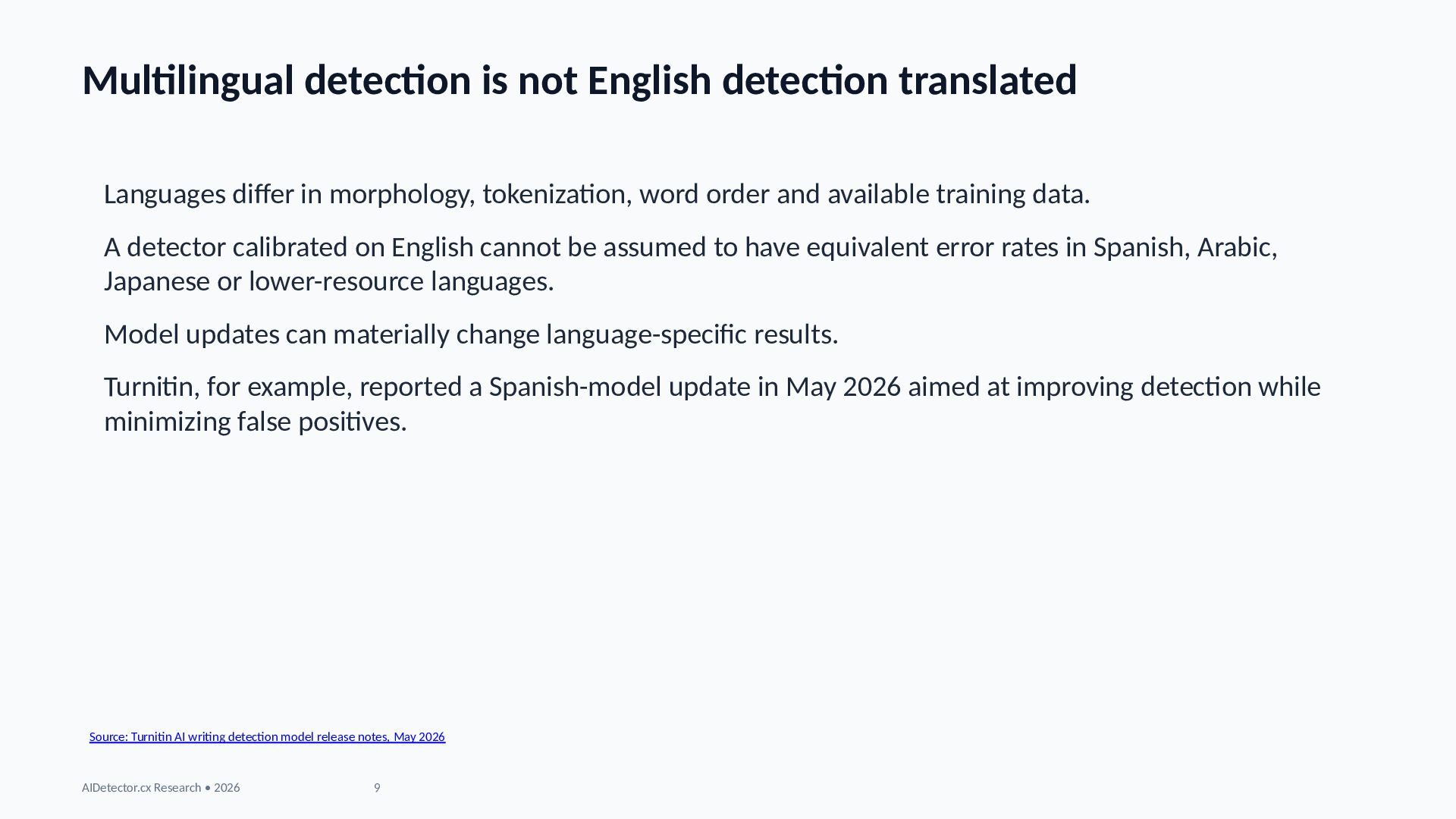
  9. Multilingual detection is not English detection translated Languages differ in

    morphology, tokenization, word order and available training data. A detector calibrated on English cannot be assumed to have equivalent error rates in Spanish, Arabic, Japanese or lower-resource languages. Model updates can materially change language-specific results. Turnitin, for example, reported a Spanish-model update in May 2026 aimed at improving detection while minimizing false positives. Source: Turnitin AI writing detection model release notes, May 2026 AIDetector.cx Research • 2026 9
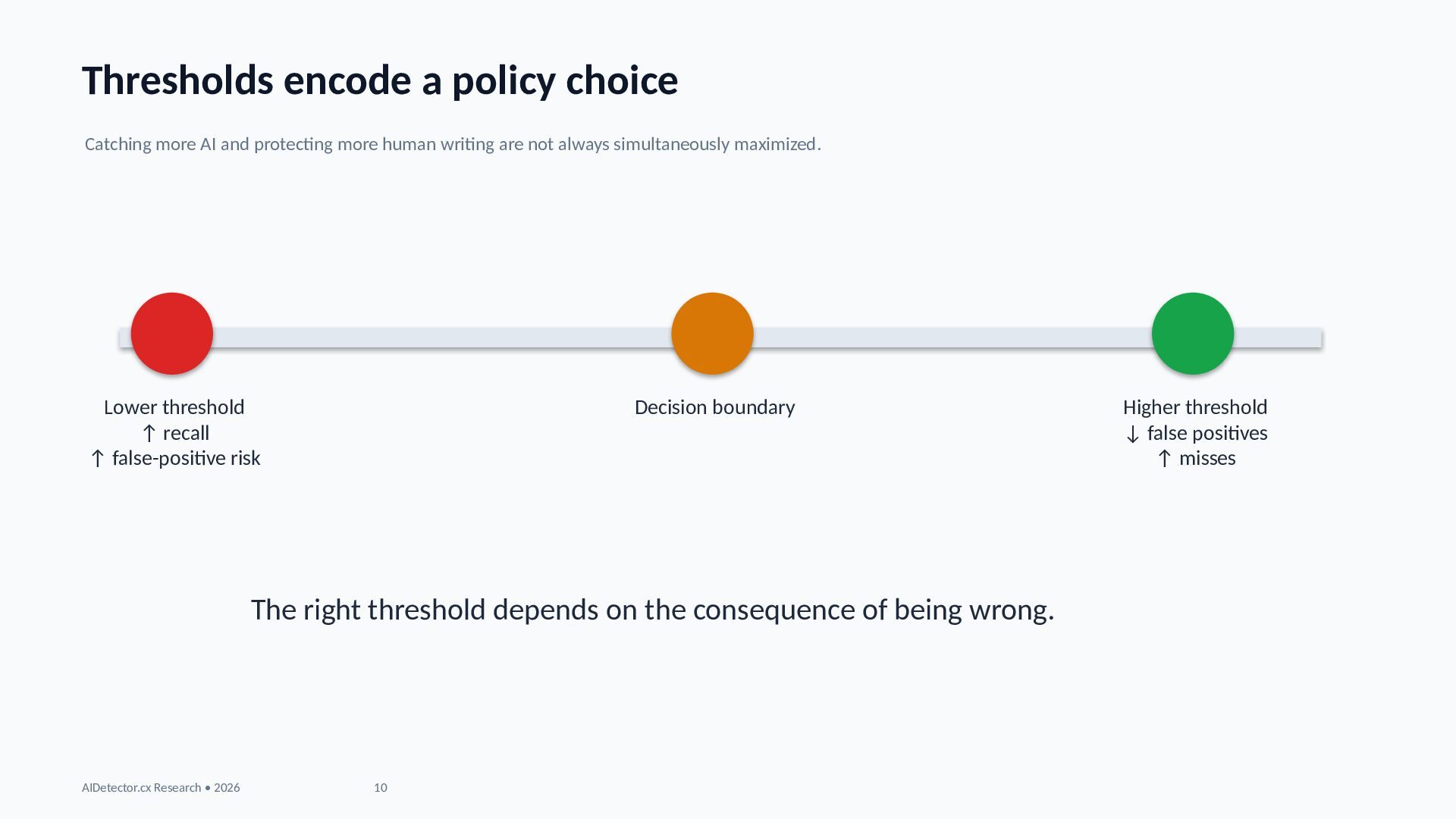
  10. Thresholds encode a policy choice Catching more AI and protecting

    more human writing are not always simultaneously maximized. Lower threshold ↑ recall ↑ false-positive risk Decision boundary The right threshold depends on the consequence of being wrong. AIDetector.cx Research • 2026 10 Higher threshold ↓ false positives ↑ misses
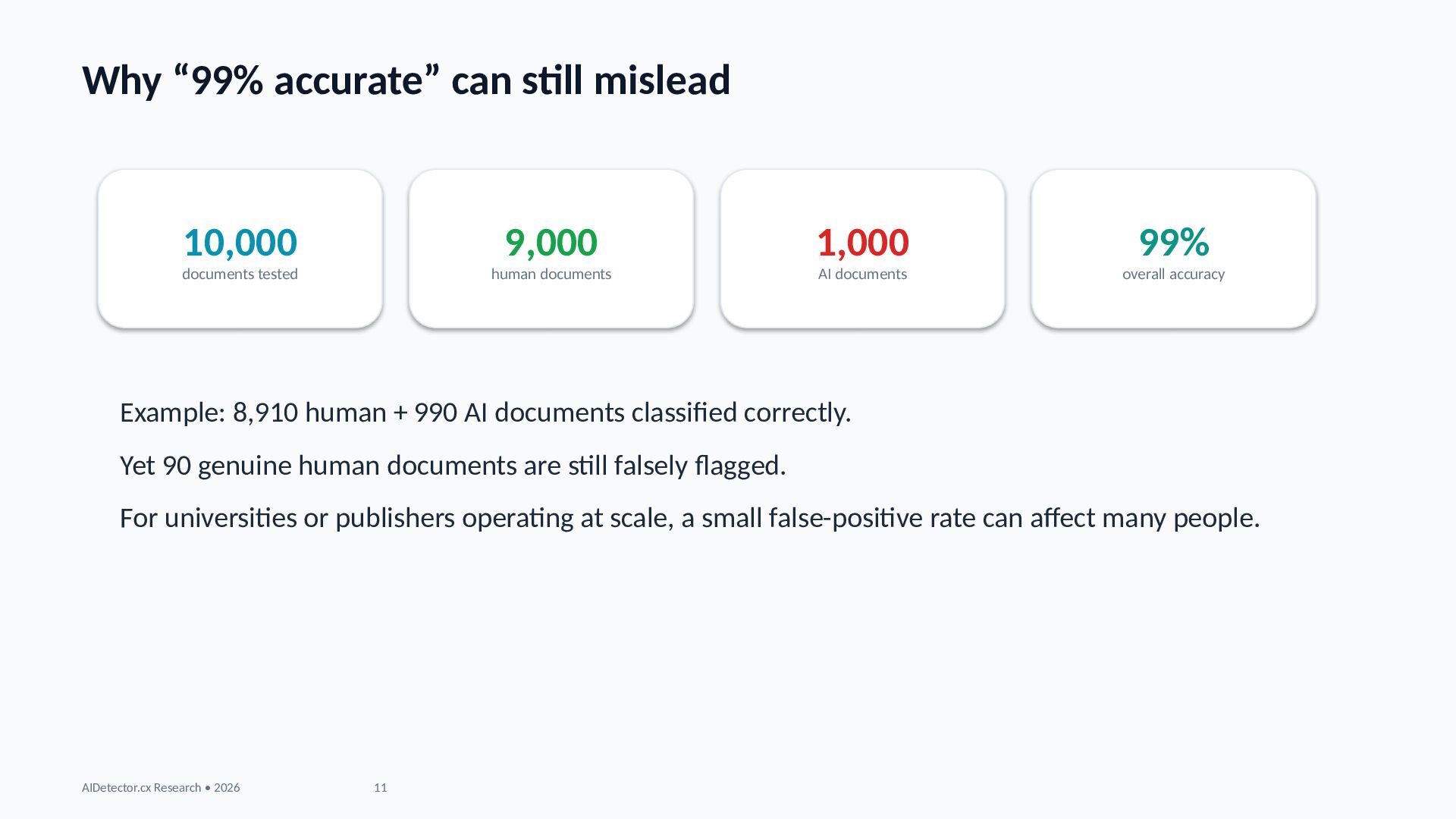
  11. Why “99% accurate” can still mislead 10,000 9,000 documents tested

    human documents 1,000 AI documents 99% overall accuracy Example: 8,910 human + 990 AI documents classified correctly. Yet 90 genuine human documents are still falsely flagged. For universities or publishers operating at scale, a small false-positive rate can affect many people. AIDetector.cx Research • 2026 11
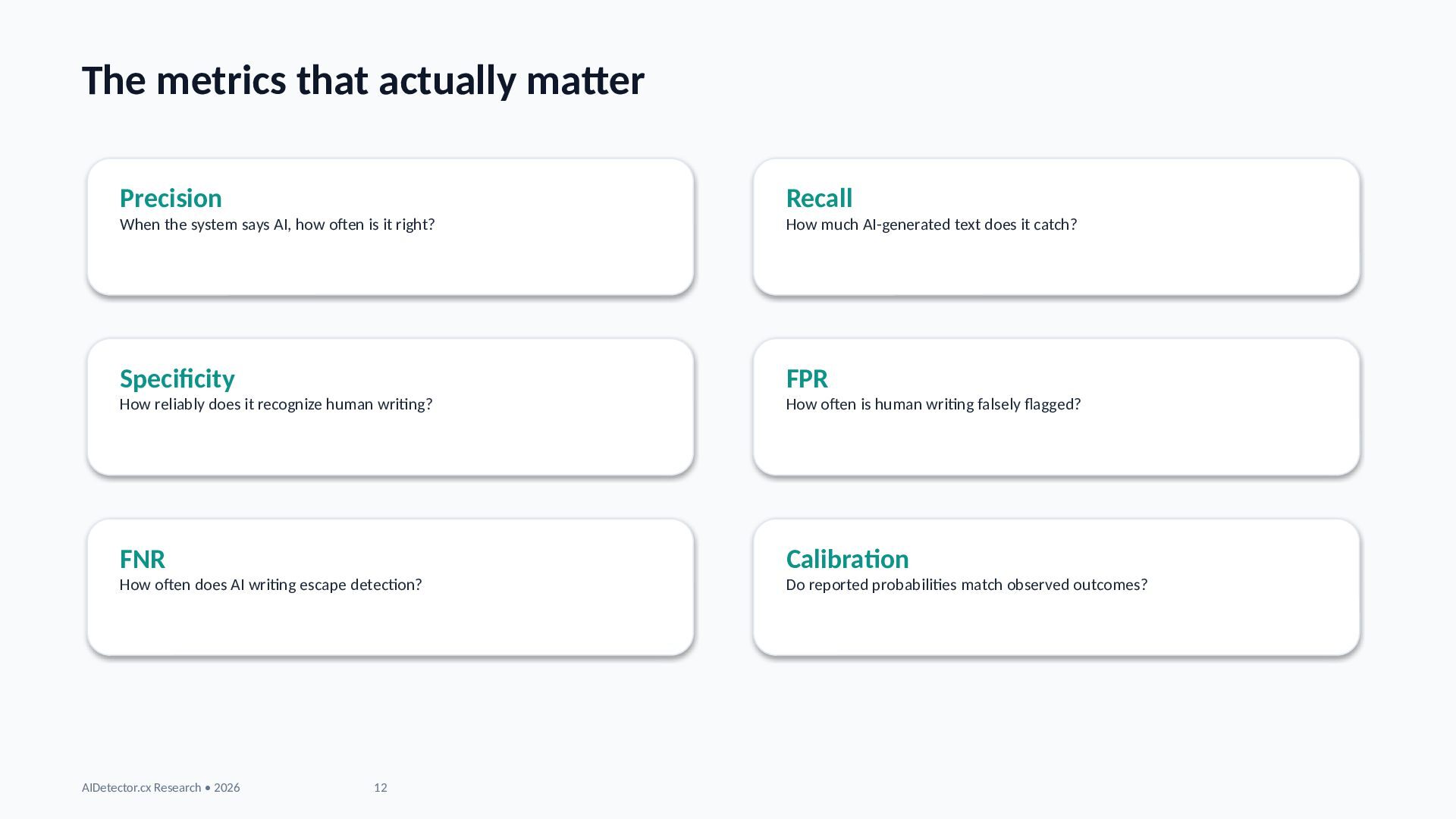
  12. The metrics that actually matter Precision Recall Specificity FPR FNR

    Calibration When the system says AI, how often is it right? How reliably does it recognize human writing? How often does AI writing escape detection? AIDetector.cx Research • 2026 12 How much AI-generated text does it catch? How often is human writing falsely flagged? Do reported probabilities match observed outcomes?
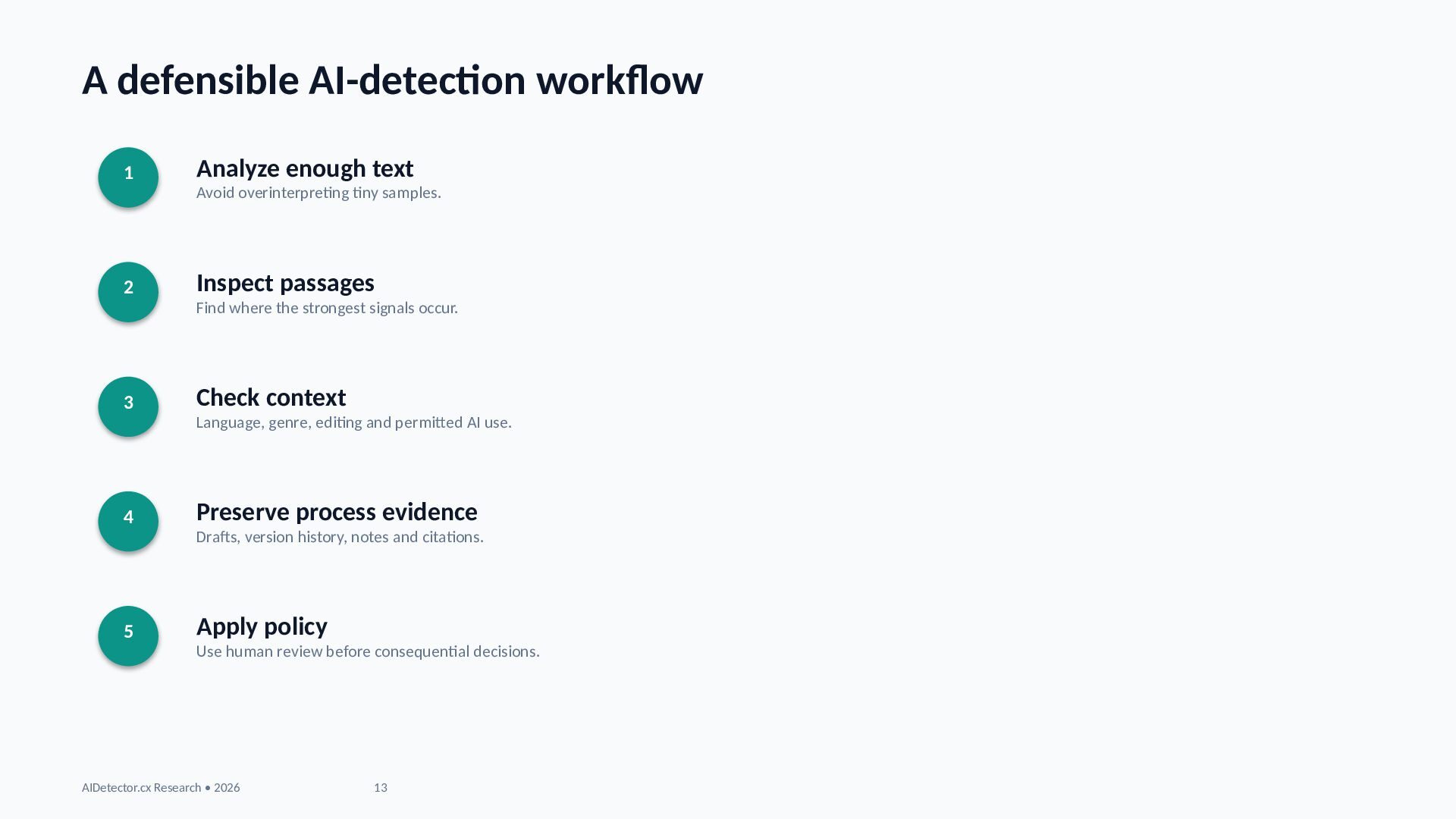
  13. A defensible AI-detection workflow 1 Analyze enough text 2 Inspect

    passages 3 Check context 4 Preserve process evidence 5 Apply policy Avoid overinterpreting tiny samples. Find where the strongest signals occur. Language, genre, editing and permitted AI use. Drafts, version history, notes and citations. Use human review before consequential decisions. AIDetector.cx Research • 2026 13
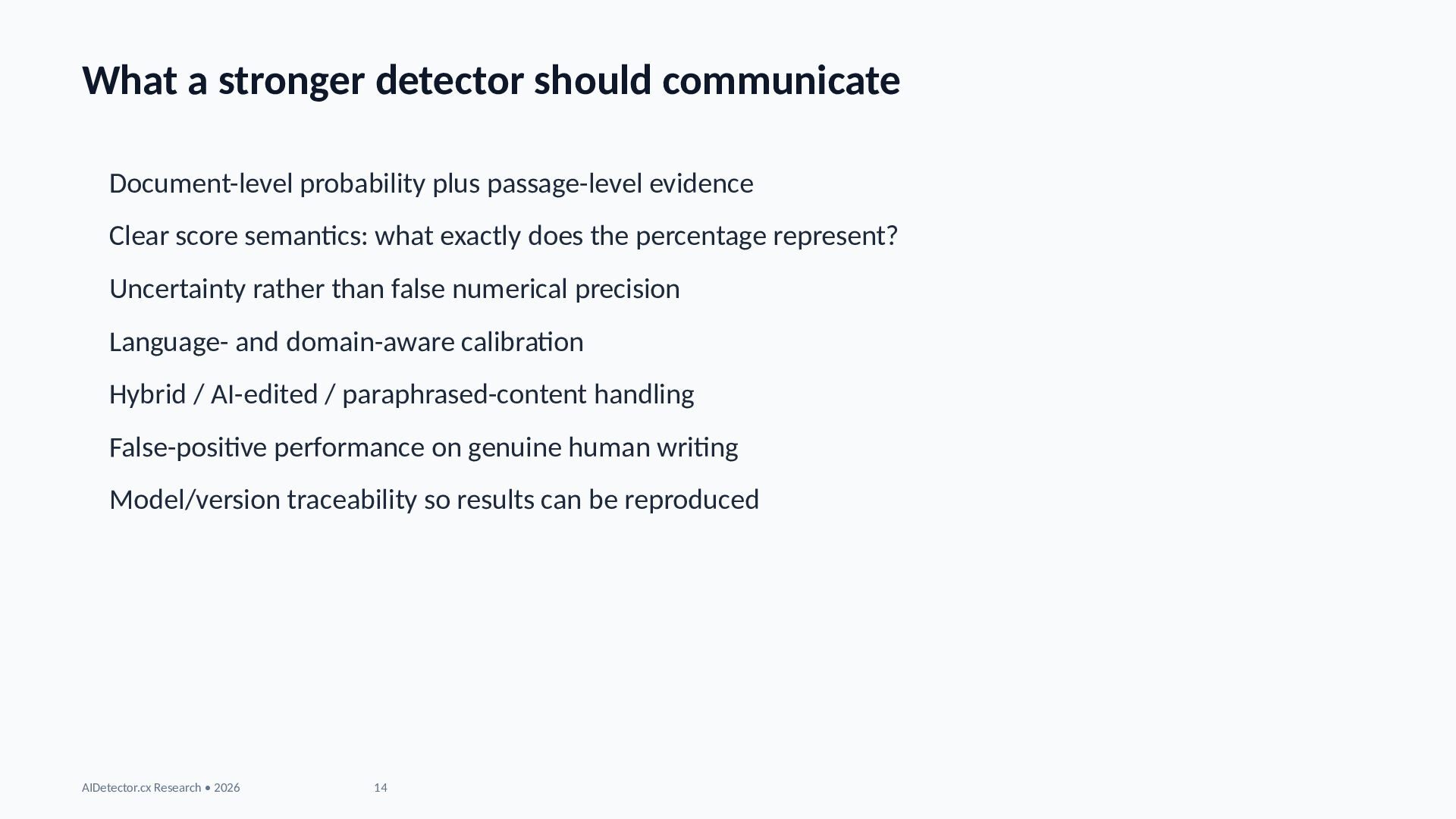
  14. What a stronger detector should communicate Document-level probability plus passage-level

    evidence Clear score semantics: what exactly does the percentage represent? Uncertainty rather than false numerical precision Language- and domain-aware calibration Hybrid / AI-edited / paraphrased-content handling False-positive performance on genuine human writing Model/version traceability so results can be reproduced AIDetector.cx Research • 2026 14
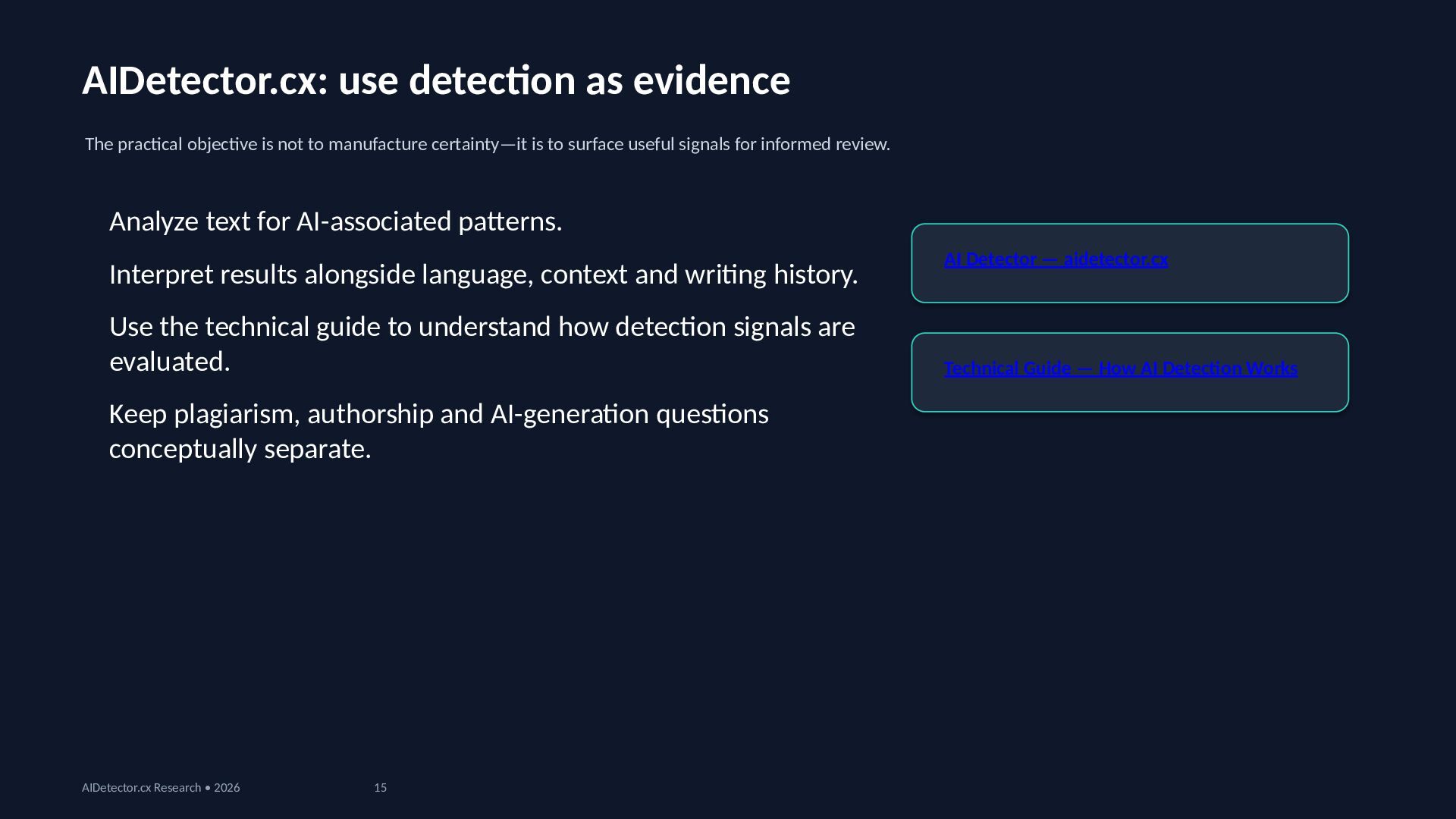
  15. AIDetector.cx: use detection as evidence The practical objective is not

    to manufacture certainty—it is to surface useful signals for informed review. Analyze text for AI-associated patterns. Interpret results alongside language, context and writing history. Use the technical guide to understand how detection signals are evaluated. Keep plagiarism, authorship and AI-generation questions conceptually separate. AIDetector.cx Research • 2026 15 AI Detector — aidetector.cx Technical Guide — How AI Detection Works
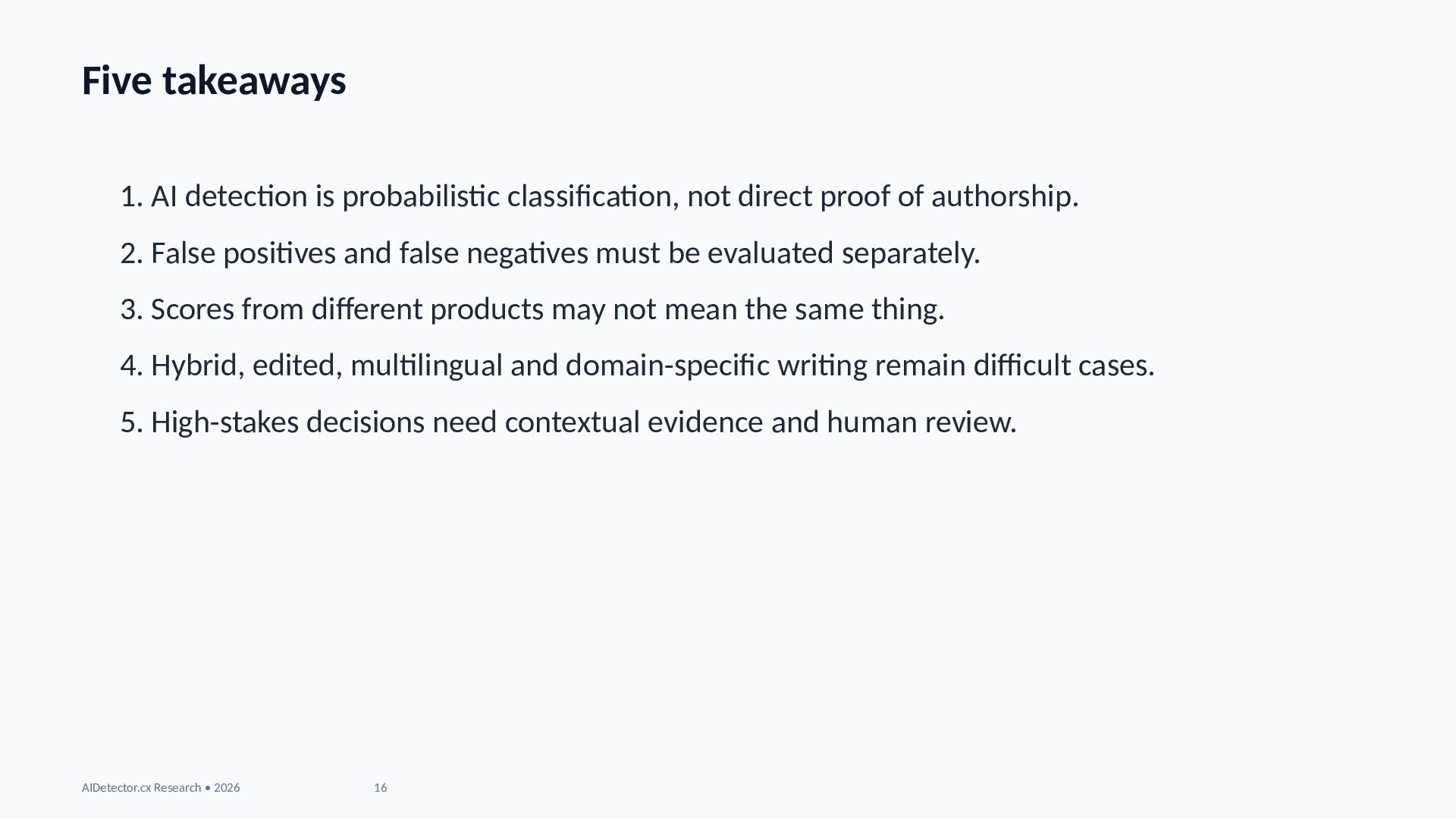
  16. Five takeaways 1. AI detection is probabilistic classification, not direct

    proof of authorship. 2. False positives and false negatives must be evaluated separately. 3. Scores from different products may not mean the same thing. 4. Hybrid, edited, multilingual and domain-specific writing remain difficult cases. 5. High-stakes decisions need contextual evidence and human review. AIDetector.cx Research • 2026 16
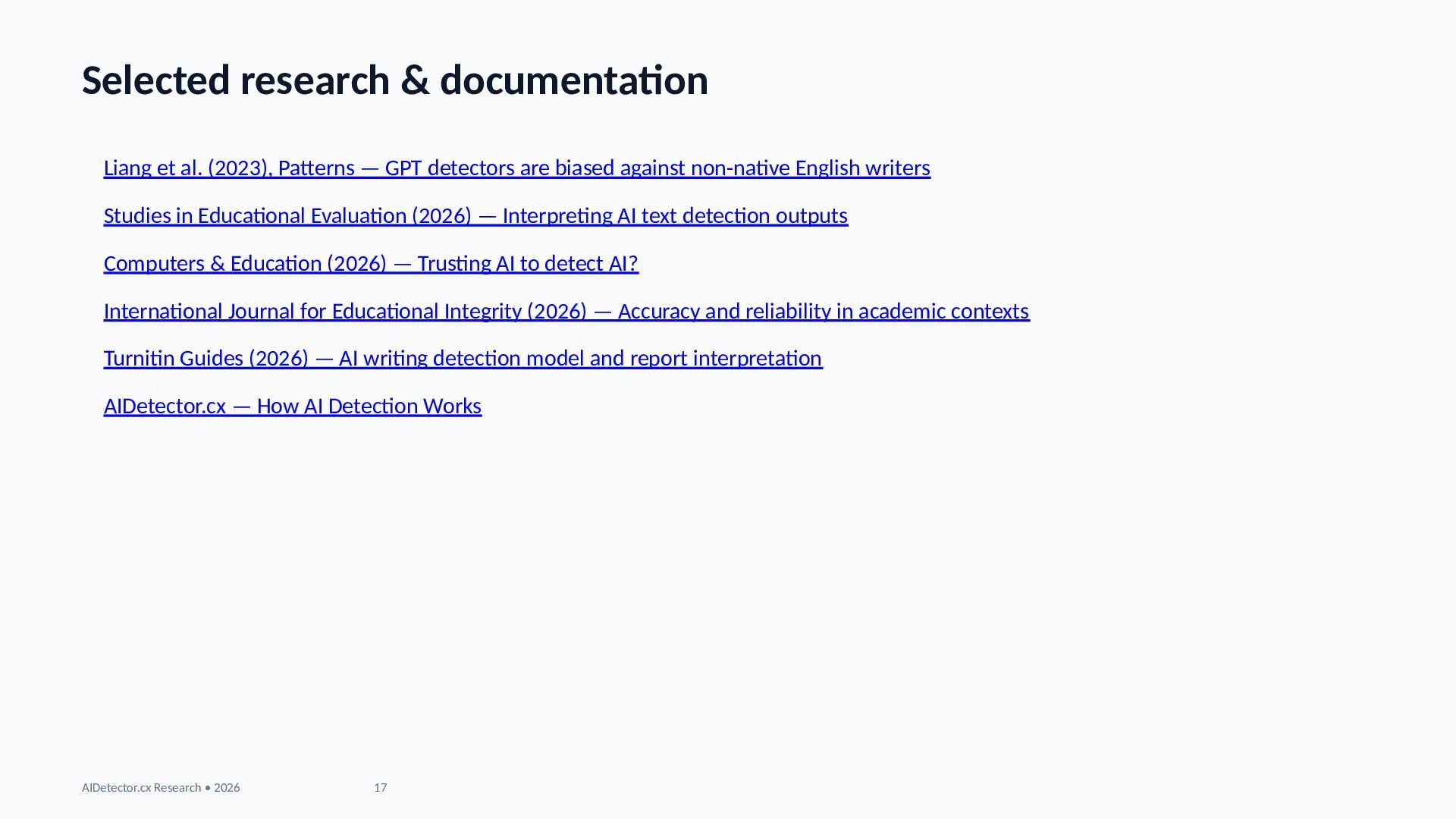
  17. Selected research & documentation Liang et al. (2023), Patterns —

    GPT detectors are biased against non-native English writers Studies in Educational Evaluation (2026) — Interpreting AI text detection outputs Computers & Education (2026) — Trusting AI to detect AI? International Journal for Educational Integrity (2026) — Accuracy and reliability in academic contexts Turnitin Guides (2026) — AI writing detection model and report interpretation AIDetector.cx — How AI Detection Works AIDetector.cx Research • 2026 17
  18. The question is not “Which detector gave the highest score?”

    It is: Which result is supported by the strongest evidence—and what does that evidence actually tell us? Explore: AIDetector.cx AIDetector.cx Research • 2026 18