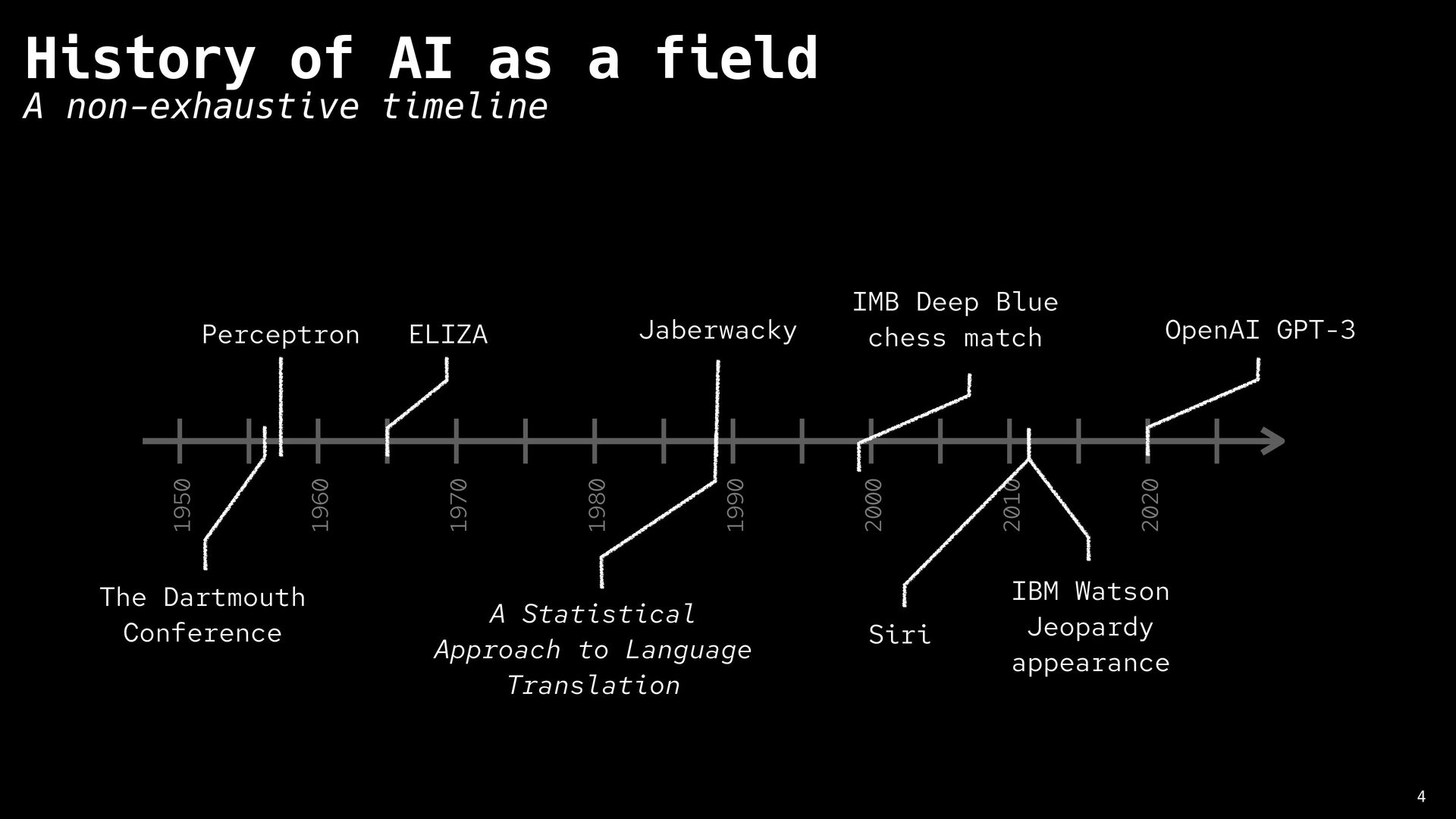
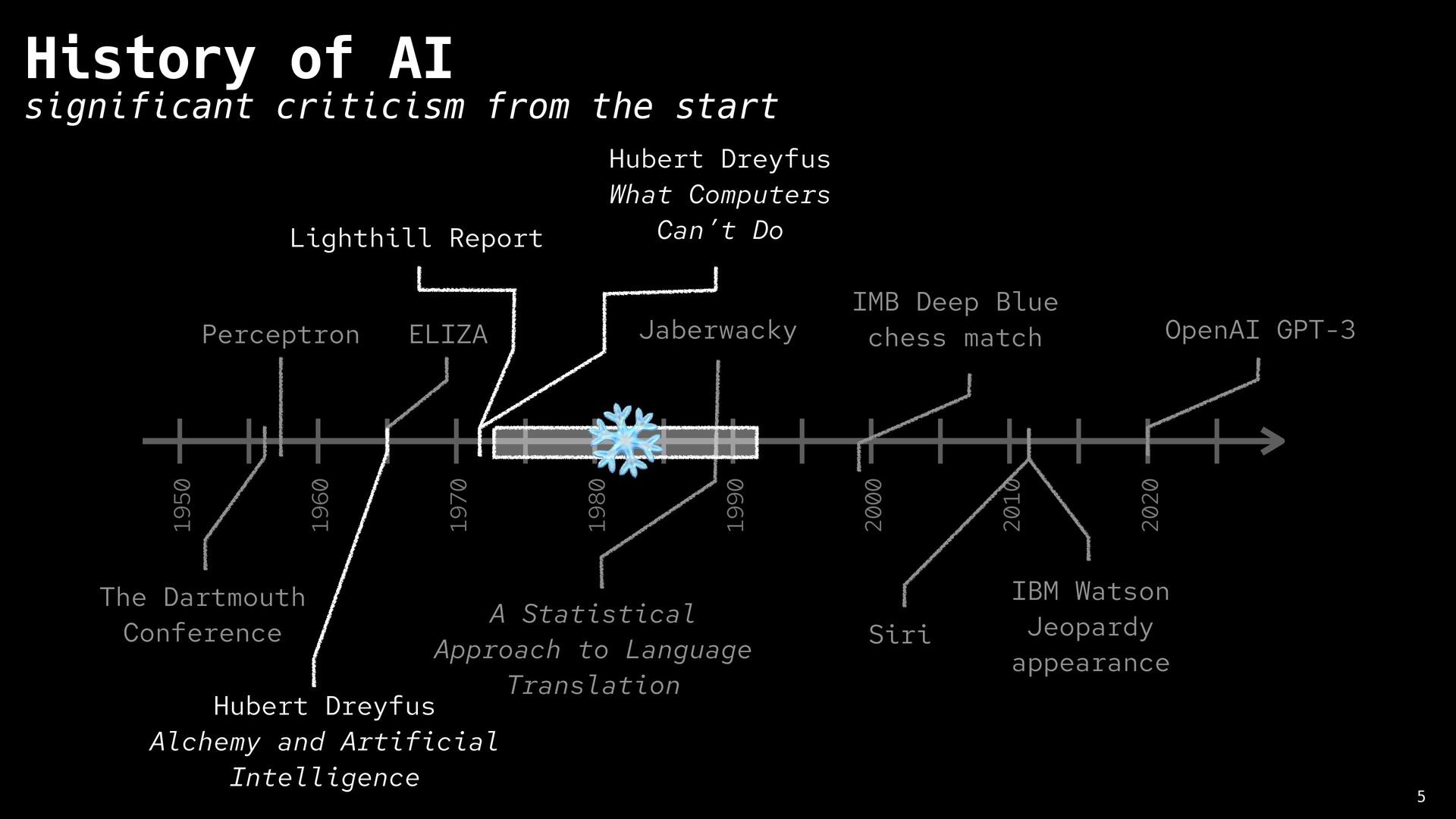
1950 1960 1970 1980 1990 2000 2010 2020 The Dartmouth Conference Perceptron ELIZA Jaberwacky A Statistical Approach to Language Translation IMB Deep Blue chess match IBM Watson Jeopardy appearance Siri OpenAI GPT-3
1960 1970 1980 1990 2000 2010 2020 The Dartmouth Conference Perceptron ELIZA Jaberwacky A Statistical Approach to Language Translation IMB Deep Blue chess match IBM Watson Jeopardy appearance Siri OpenAI GPT-3 Lighthill Report Hubert Dreyfus Alchemy and Artificial Intelligence Hubert Dreyfus What Computers Can’t Do ❄
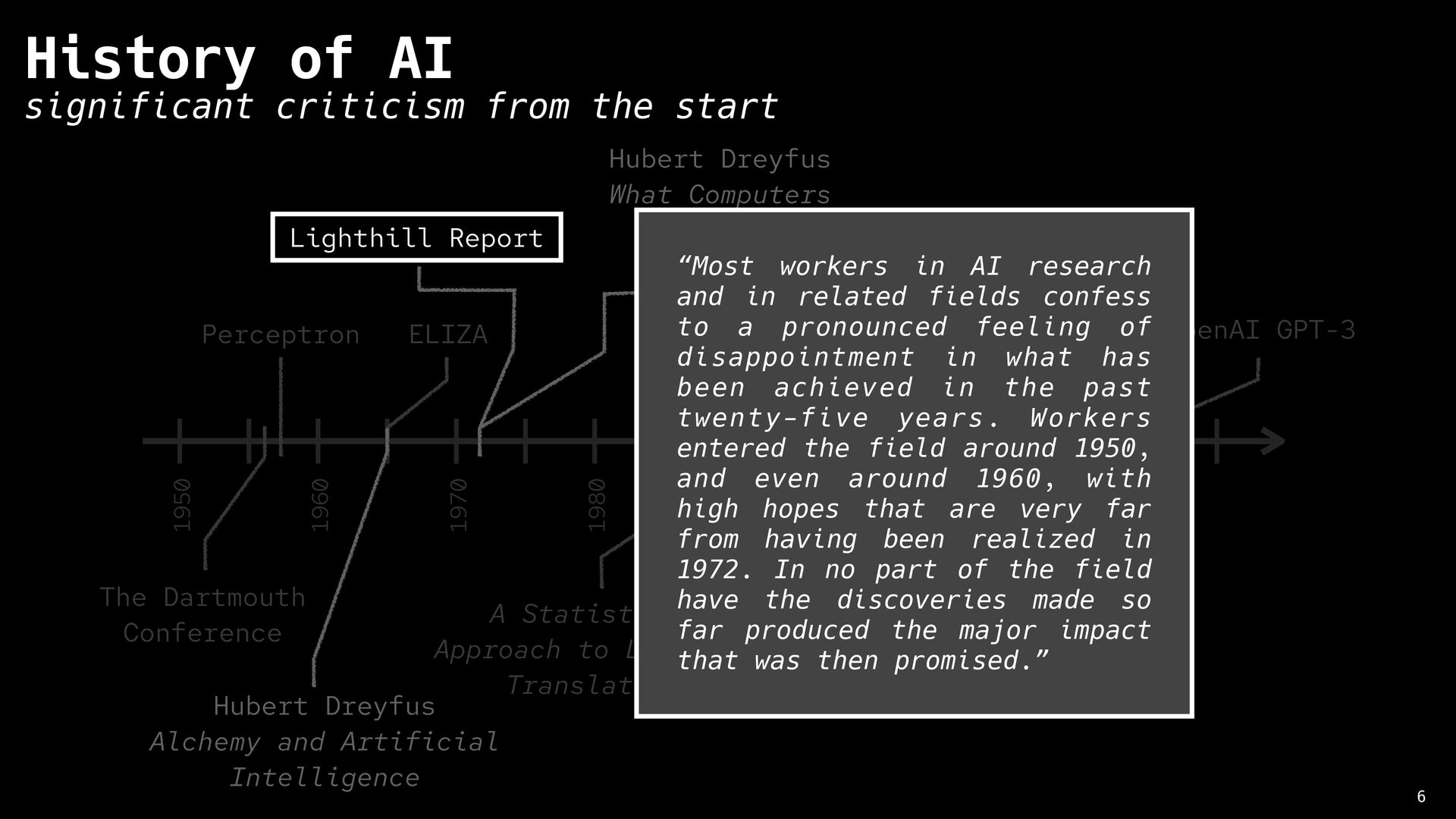
1960 1970 1980 1990 2000 2010 2020 The Dartmouth Conference Perceptron ELIZA Jaberwacky A Statistical Approach to Language Translation IMB Deep Blue chess match IBM Watson Jeopardy appearance Siri OpenAI GPT-3 Hubert Dreyfus Alchemy and Artificial Intelligence Hubert Dreyfus What Computers Can’t Do “Most workers in AI research and in related fields confess to a pronounced feeling of disappointment in what has been achieved in the past twenty-five years. Workers entered the field around 1950, and even around 1960, with high hopes that are very far from having been realized in 1972. In no part of the field have the discoveries made so far produced the major impact that was then promised.” Lighthill Report
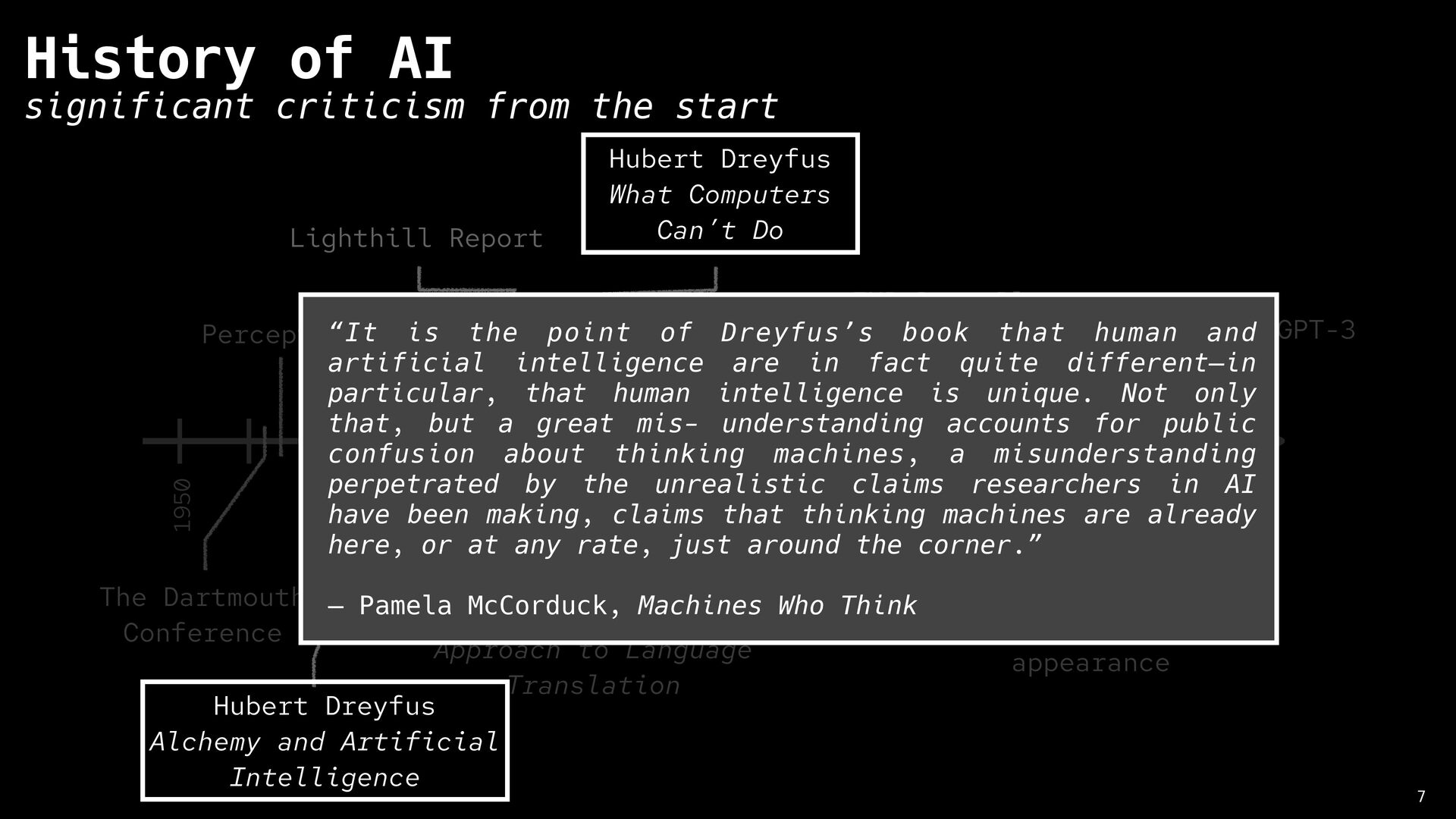
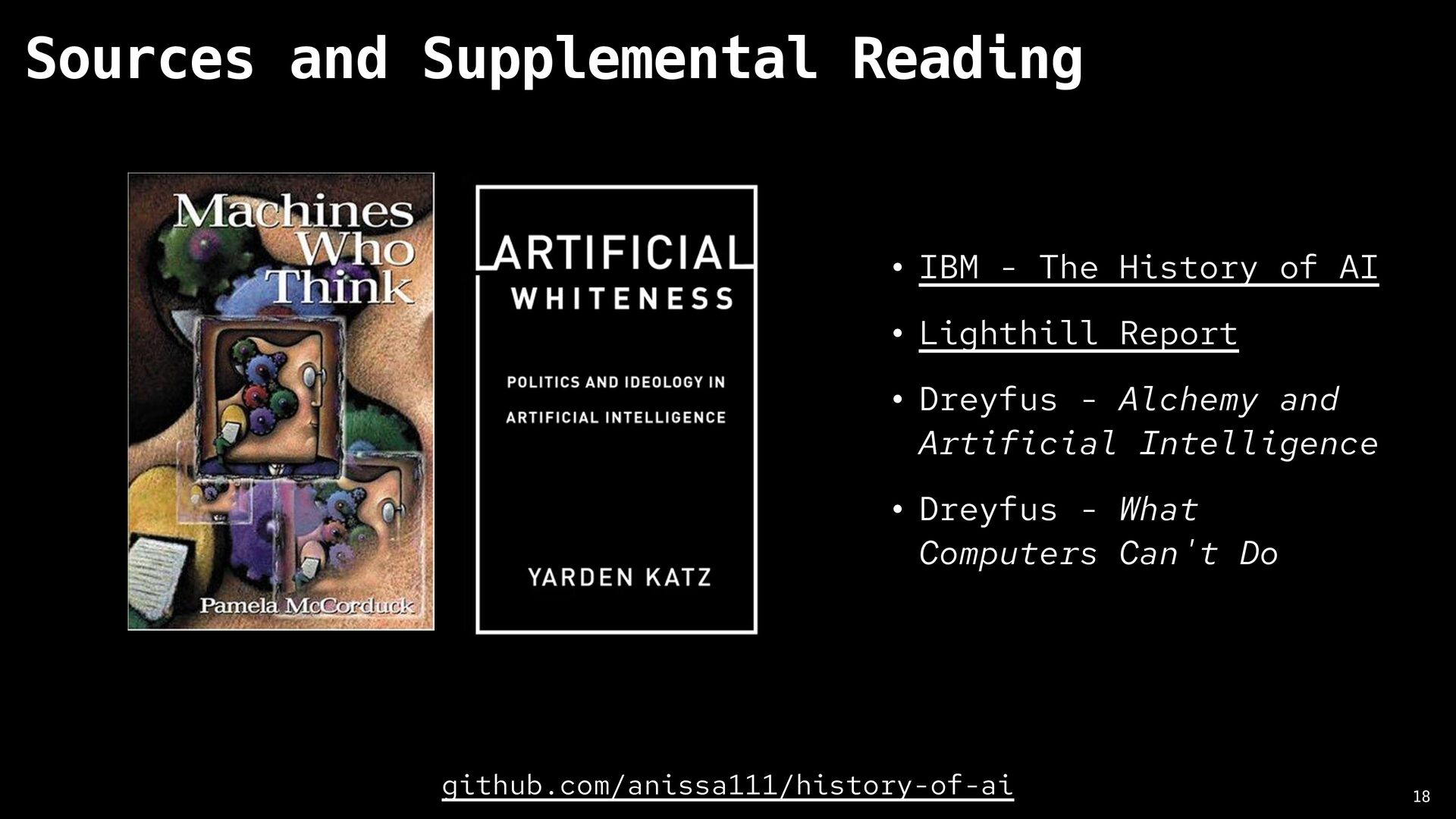
1960 1970 1980 1990 2000 2010 2020 The Dartmouth Conference Perceptron ELIZA Jaberwacky A Statistical Approach to Language Translation IMB Deep Blue chess match IBM Watson Jeopardy appearance Siri OpenAI GPT-3 Lighthill Report Hubert Dreyfus What Computers Can’t Do Hubert Dreyfus Alchemy and Artificial Intelligence “It is the point of Dreyfus’s book that human and artificial intelligence are in fact quite different—in particular, that human intelligence is unique. Not only that, but a great mis- understanding accounts for public confusion about thinking machines, a misunderstanding perpetrated by the unrealistic claims researchers in AI have been making, claims that thinking machines are already here, or at any rate, just around the corner.” — Pamela McCorduck, Machines Who Think
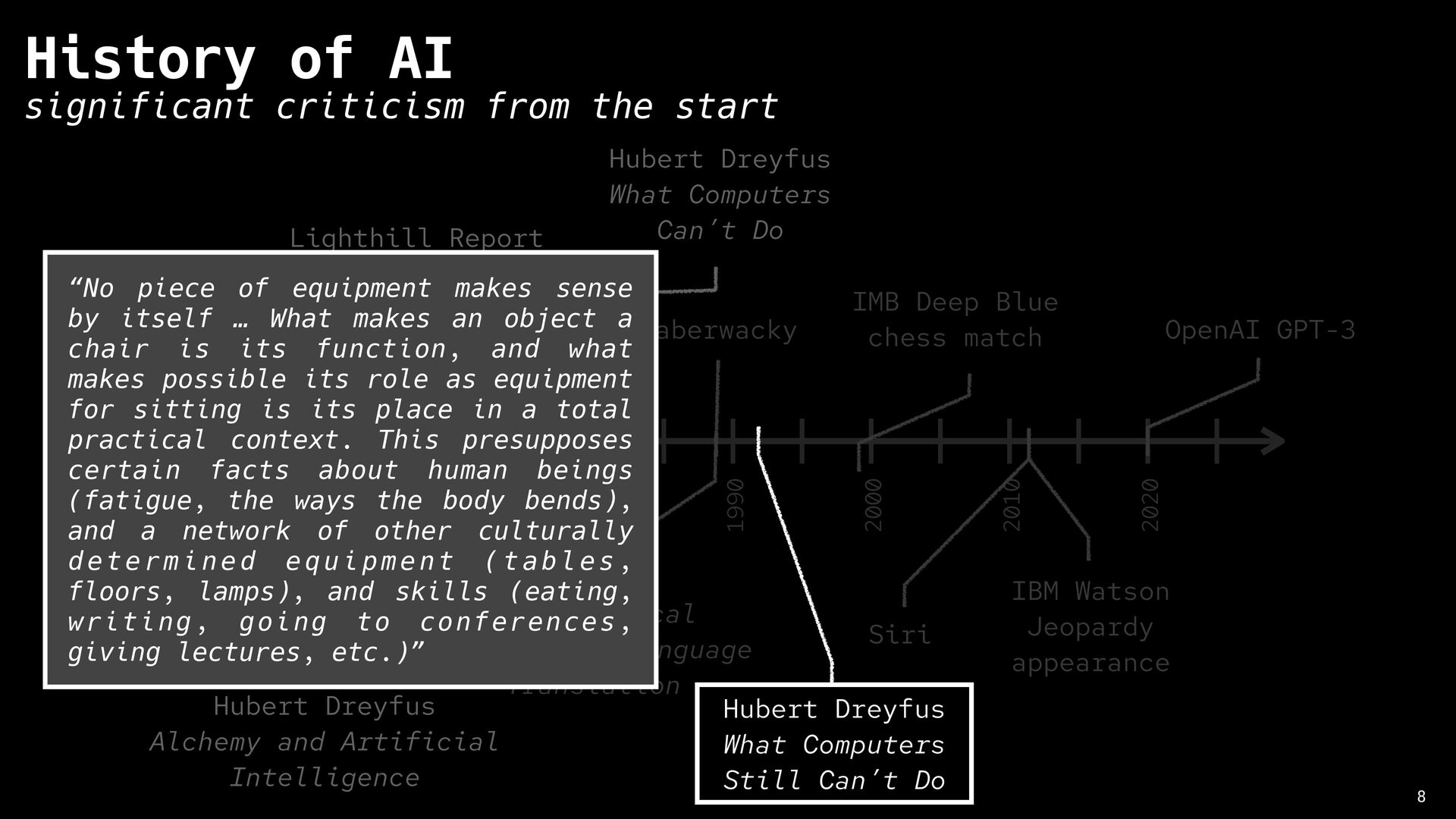
Artificial Intelligence 8 History of AI significant criticism from the start 1950 1960 1970 1980 1990 2000 2010 2020 The Dartmouth Conference Perceptron ELIZA Jaberwacky A Statistical Approach to Language Translation IMB Deep Blue chess match IBM Watson Jeopardy appearance Siri OpenAI GPT-3 Lighthill Report Hubert Dreyfus What Computers Still Can’t Do “No piece of equipment makes sense by itself … What makes an object a chair is its function, and what makes possible its role as equipment for sitting is its place in a total practical context. This presupposes certain facts about human beings (fatigue, the ways the body bends), and a network of other culturally determined equipment (tables, floors, lamps), and skills (eating, writing, going to conferences, giving lectures, etc.)”
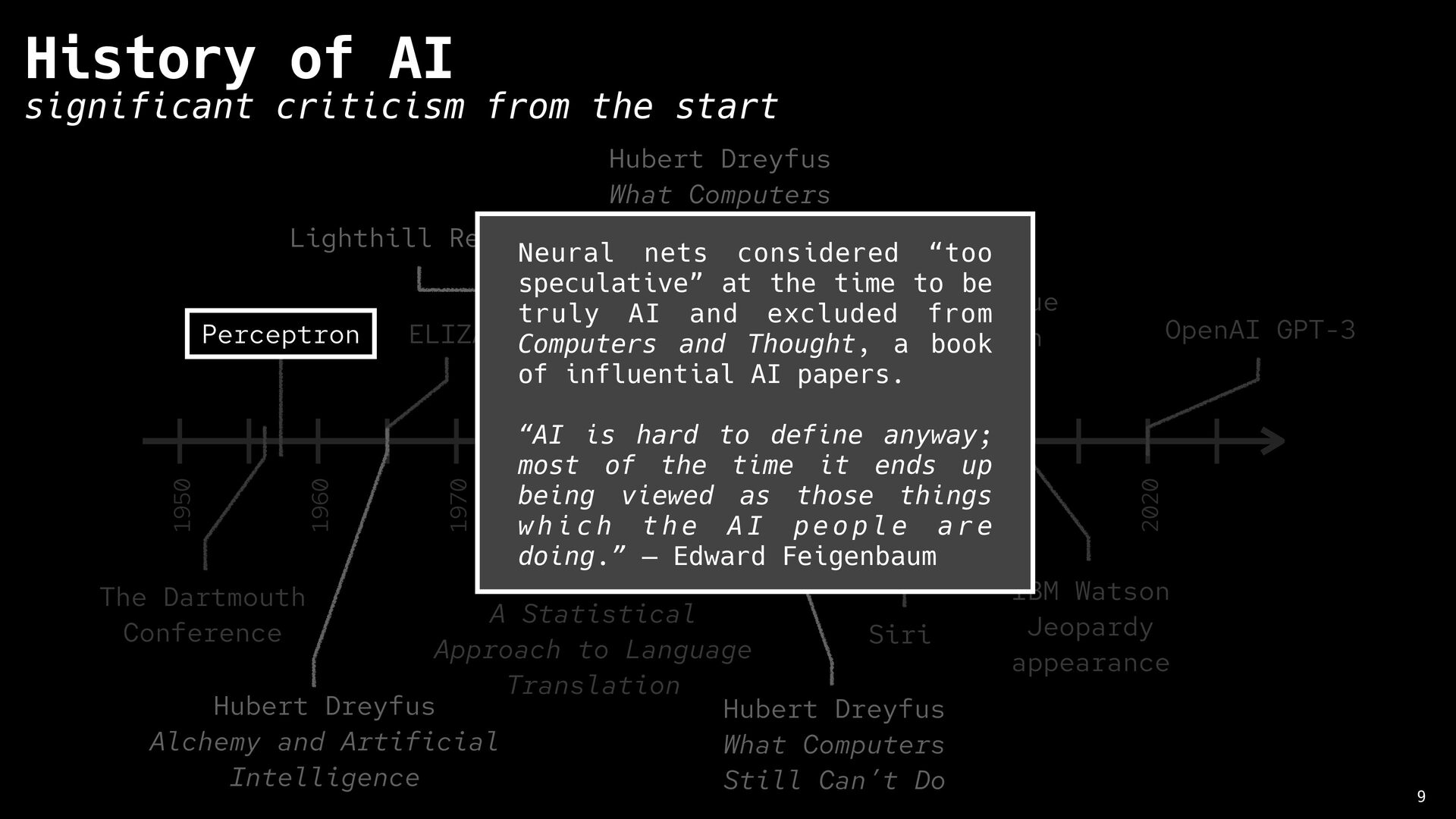
History of AI significant criticism from the start 1950 1960 1970 1980 1990 2000 2010 2020 The Dartmouth Conference ELIZA Jaberwacky A Statistical Approach to Language Translation IMB Deep Blue chess match IBM Watson Jeopardy appearance Siri OpenAI GPT-3 Hubert Dreyfus Alchemy and Artificial Intelligence Hubert Dreyfus What Computers Can’t Do Neural nets considered “too speculative” at the time to be truly AI and excluded from Computers and Thought, a book of influential AI papers. “AI is hard to define anyway; most of the time it ends up being viewed as those things w h i c h t h e A I p e o p l e a r e doing.” — Edward Feigenbaum Perceptron


 anissa111
 yama3133
 tsukuboshi
 bcantrill
 kameitomohiro
 munakata
 baseballyama
 470715
 jozono
 masahirokawahara
 kawametho
 masakiokuda
 sansantech
 keavy
keavy
 destraynor
 mfonobong
 lara
lara
 marktimemedia
 schroneko
 smashingmag
 eileencodes
 mayatellez
 mlcsv
mlcsv
 addyosmani