Upgrade to Pro — share decks privately, control downloads, hide ads and more …

9 Career Success Strategies

9 Career Success Strategies

Are you struggling to grow in your career?
Whether you’re a student, job seeker, or working professional, knowing the right career success strategies can help you stay ahead of the competition, make smart career moves, and achieve long-term success.

That’s why we’ve put together this powerful, expert-backed guide – “9 Career Success Strategies” – a free resource to help you achieve your professional goals with confidence.

🔹 Learn how to set clear career goals
🔹 Master essential skills that top employers look for
🔹 Boost your confidence & stand out in job applications
🔹 Make smarter career decisions & accelerate your growth

This eBook is designed to help you take charge of your career and implement strategies that work across industries.

Avatar for Anthony Cooper

Anthony Cooper

March 26, 2025

Other Decks in Education

Transcript

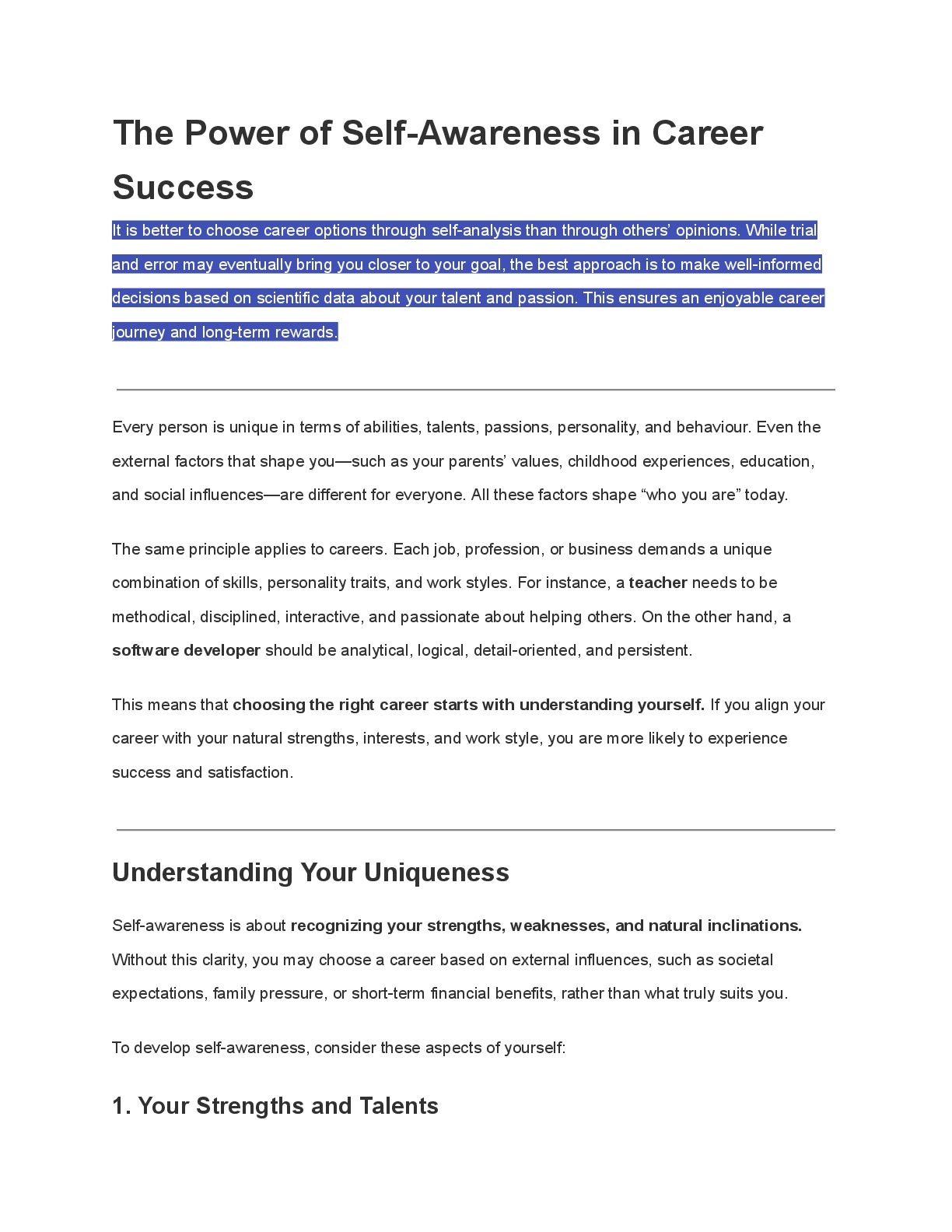
  1. The Power of Self-Awareness in Career Success It is better

    to choose career options through self-analysis than through others’ opinions. While trial and error may eventually bring you closer to your goal, the best approach is to make well-informed decisions based on scientific data about your talent and passion. This ensures an enjoyable career journey and long-term rewards. Every person is unique in terms of abilities, talents, passions, personality, and behaviour. Even the external factors that shape you—such as your parents’ values, childhood experiences, education, and social influences—are different for everyone. All these factors shape “who you are” today. The same principle applies to careers. Each job, profession, or business demands a unique combination of skills, personality traits, and work styles. For instance, a teacher needs to be methodical, disciplined, interactive, and passionate about helping others. On the other hand, a software developer should be analytical, logical, detail-oriented, and persistent. This means that choosing the right career starts with understanding yourself. If you align your career with your natural strengths, interests, and work style, you are more likely to experience success and satisfaction. Understanding Your Uniqueness Self-awareness is about recognizing your strengths, weaknesses, and natural inclinations. Without this clarity, you may choose a career based on external influences, such as societal expectations, family pressure, or short-term financial benefits, rather than what truly suits you. To develop self-awareness, consider these aspects of yourself: 1. Your Strengths and Talents
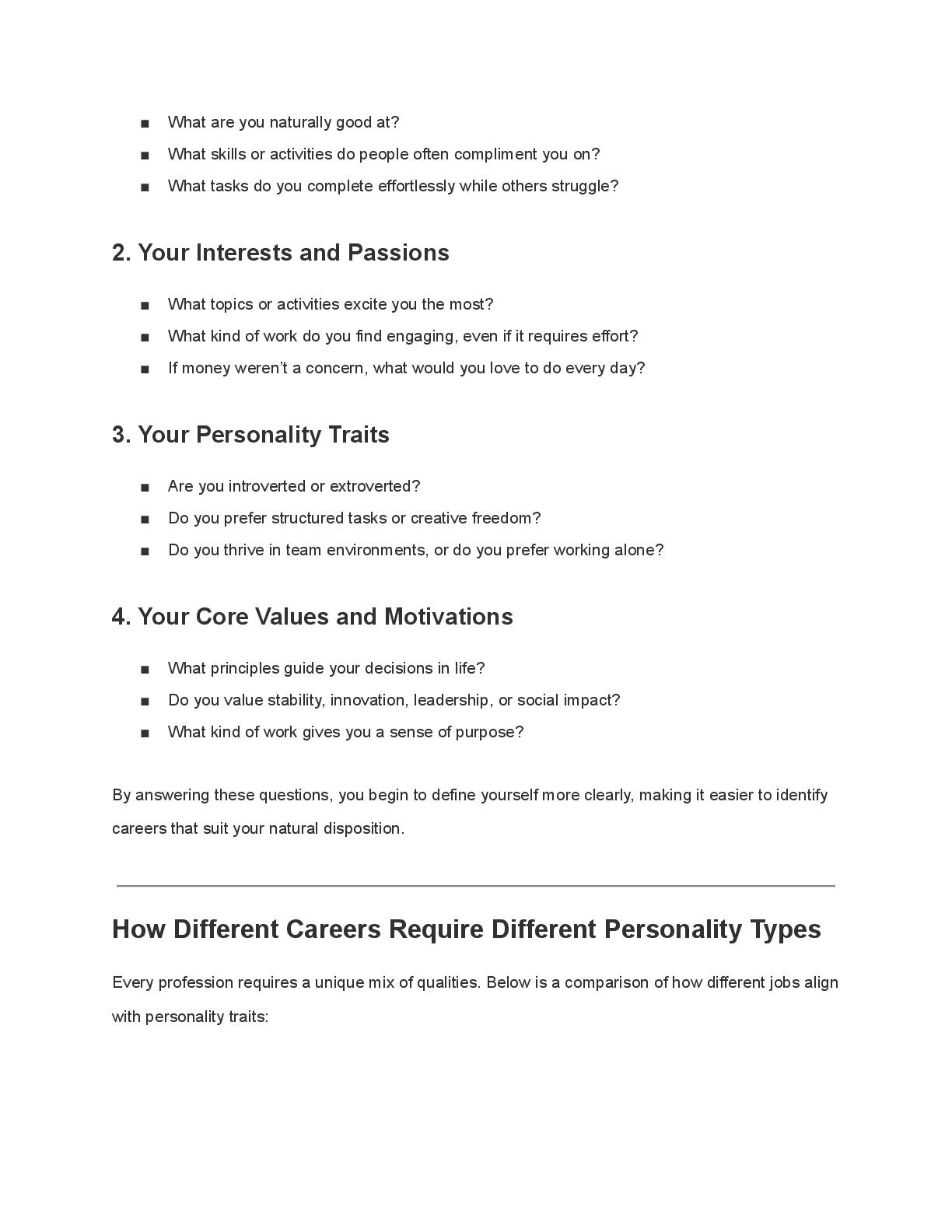
  2. ▪​ What are you naturally good at? ▪​ What skills

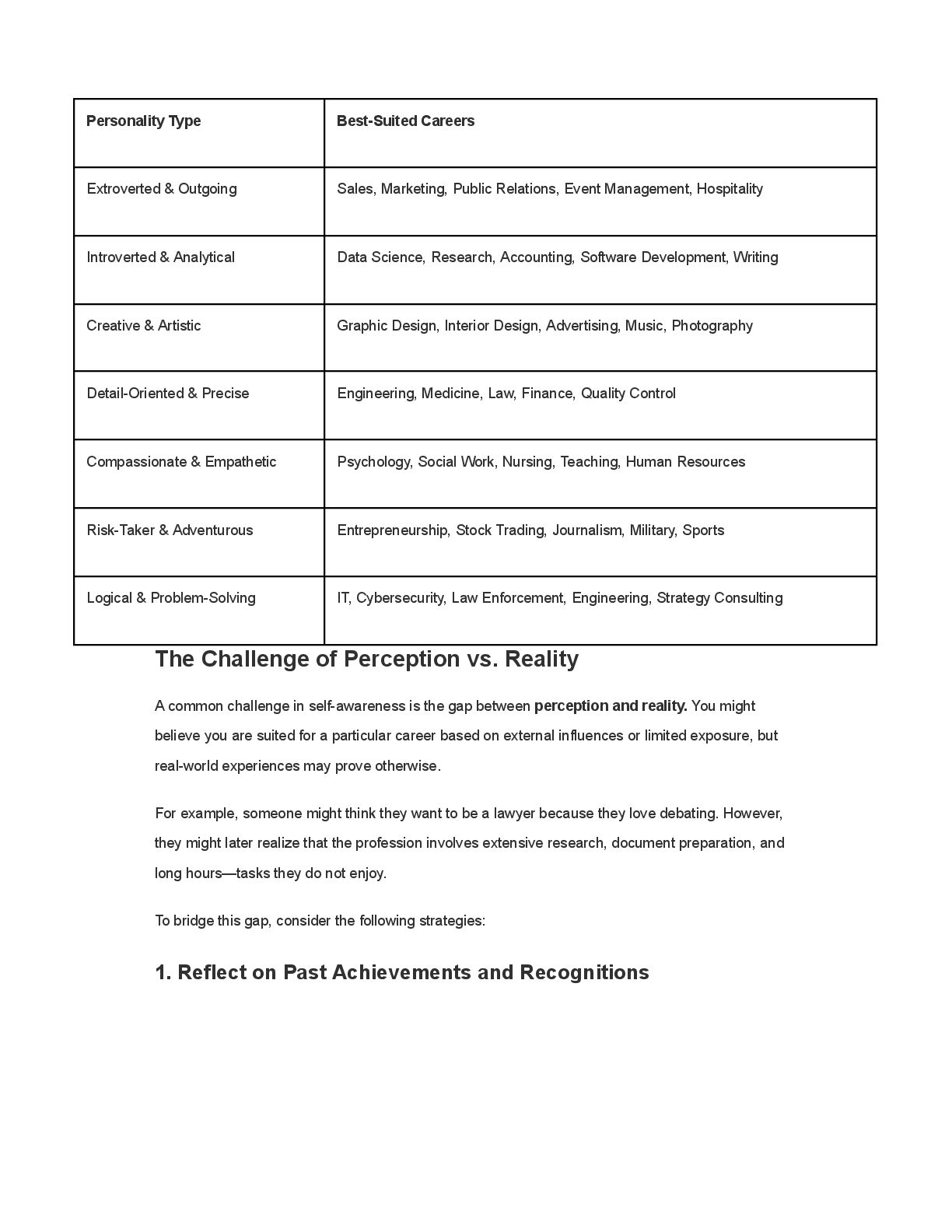
    or activities do people often compliment you on? ▪​ What tasks do you complete effortlessly while others struggle? 2. Your Interests and Passions ▪​ What topics or activities excite you the most? ▪​ What kind of work do you find engaging, even if it requires effort? ▪​ If money weren’t a concern, what would you love to do every day? 3. Your Personality Traits ▪​ Are you introverted or extroverted? ▪​ Do you prefer structured tasks or creative freedom? ▪​ Do you thrive in team environments, or do you prefer working alone? 4. Your Core Values and Motivations ▪​ What principles guide your decisions in life? ▪​ Do you value stability, innovation, leadership, or social impact? ▪​ What kind of work gives you a sense of purpose? By answering these questions, you begin to define yourself more clearly, making it easier to identify careers that suit your natural disposition. How Different Careers Require Different Personality Types Every profession requires a unique mix of qualities. Below is a comparison of how different jobs align with personality traits:
  3. Personality Type Best-Suited Careers Extroverted & Outgoing Sales, Marketing, Public

    Relations, Event Management, Hospitality Introverted & Analytical Data Science, Research, Accounting, Software Development, Writing Creative & Artistic Graphic Design, Interior Design, Advertising, Music, Photography Detail-Oriented & Precise Engineering, Medicine, Law, Finance, Quality Control Compassionate & Empathetic Psychology, Social Work, Nursing, Teaching, Human Resources Risk-Taker & Adventurous Entrepreneurship, Stock Trading, Journalism, Military, Sports Logical & Problem-Solving IT, Cybersecurity, Law Enforcement, Engineering, Strategy Consulting The Challenge of Perception vs. Reality A common challenge in self-awareness is the gap between perception and reality. You might believe you are suited for a particular career based on external influences or limited exposure, but real-world experiences may prove otherwise. For example, someone might think they want to be a lawyer because they love debating. However, they might later realize that the profession involves extensive research, document preparation, and long hours—tasks they do not enjoy. To bridge this gap, consider the following strategies: 1. Reflect on Past Achievements and Recognitions
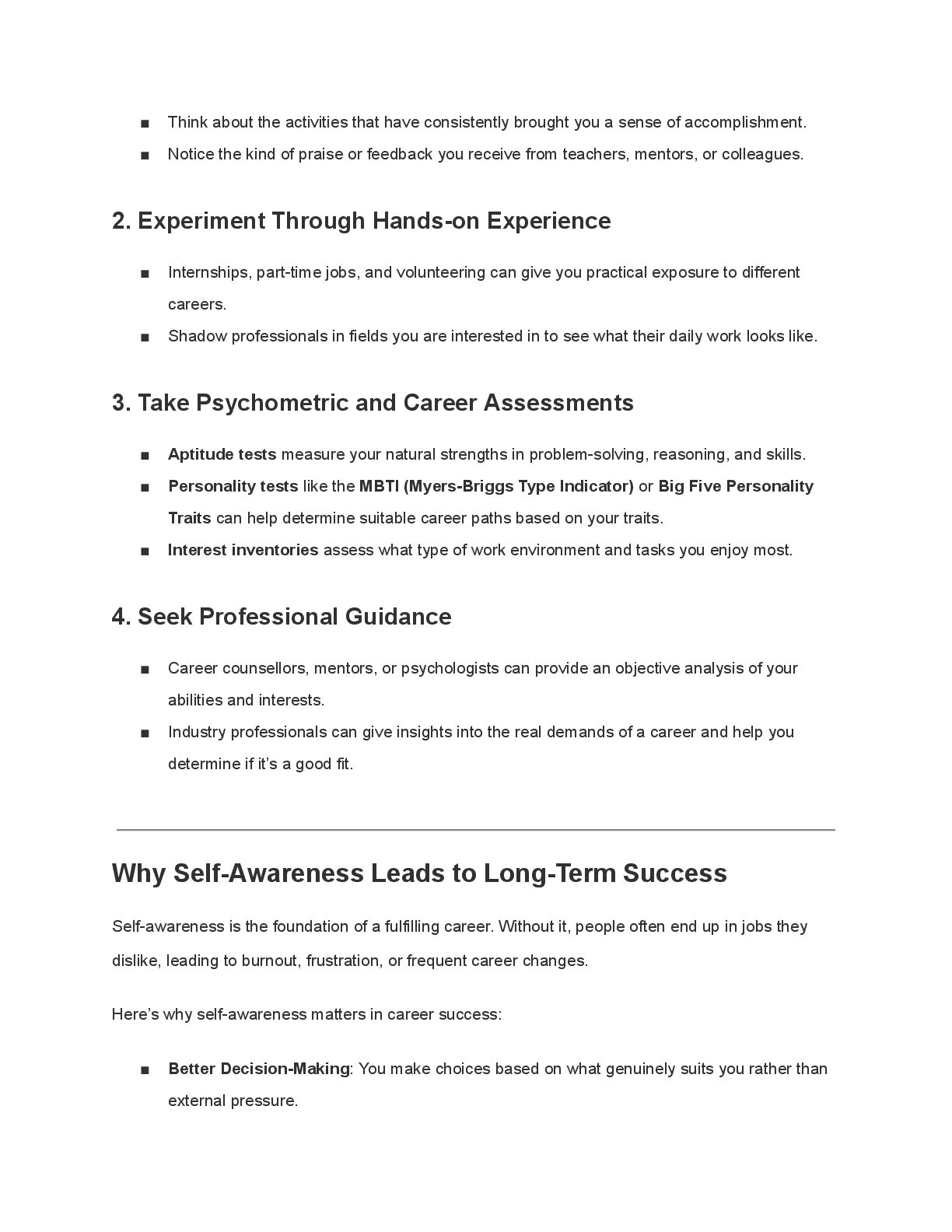
  4. ▪​ Think about the activities that have consistently brought you

    a sense of accomplishment. ▪​ Notice the kind of praise or feedback you receive from teachers, mentors, or colleagues. 2. Experiment Through Hands-on Experience ▪​ Internships, part-time jobs, and volunteering can give you practical exposure to different careers. ▪​ Shadow professionals in fields you are interested in to see what their daily work looks like. 3. Take Psychometric and Career Assessments ▪​ Aptitude tests measure your natural strengths in problem-solving, reasoning, and skills. ▪​ Personality tests like the MBTI (Myers-Briggs Type Indicator) or Big Five Personality Traits can help determine suitable career paths based on your traits. ▪​ Interest inventories assess what type of work environment and tasks you enjoy most. 4. Seek Professional Guidance ▪​ Career counsellors, mentors, or psychologists can provide an objective analysis of your abilities and interests. ▪​ Industry professionals can give insights into the real demands of a career and help you determine if it’s a good fit. Why Self-Awareness Leads to Long-Term Success Self-awareness is the foundation of a fulfilling career. Without it, people often end up in jobs they dislike, leading to burnout, frustration, or frequent career changes. Here’s why self-awareness matters in career success: ▪​ Better Decision-Making: You make choices based on what genuinely suits you rather than external pressure.
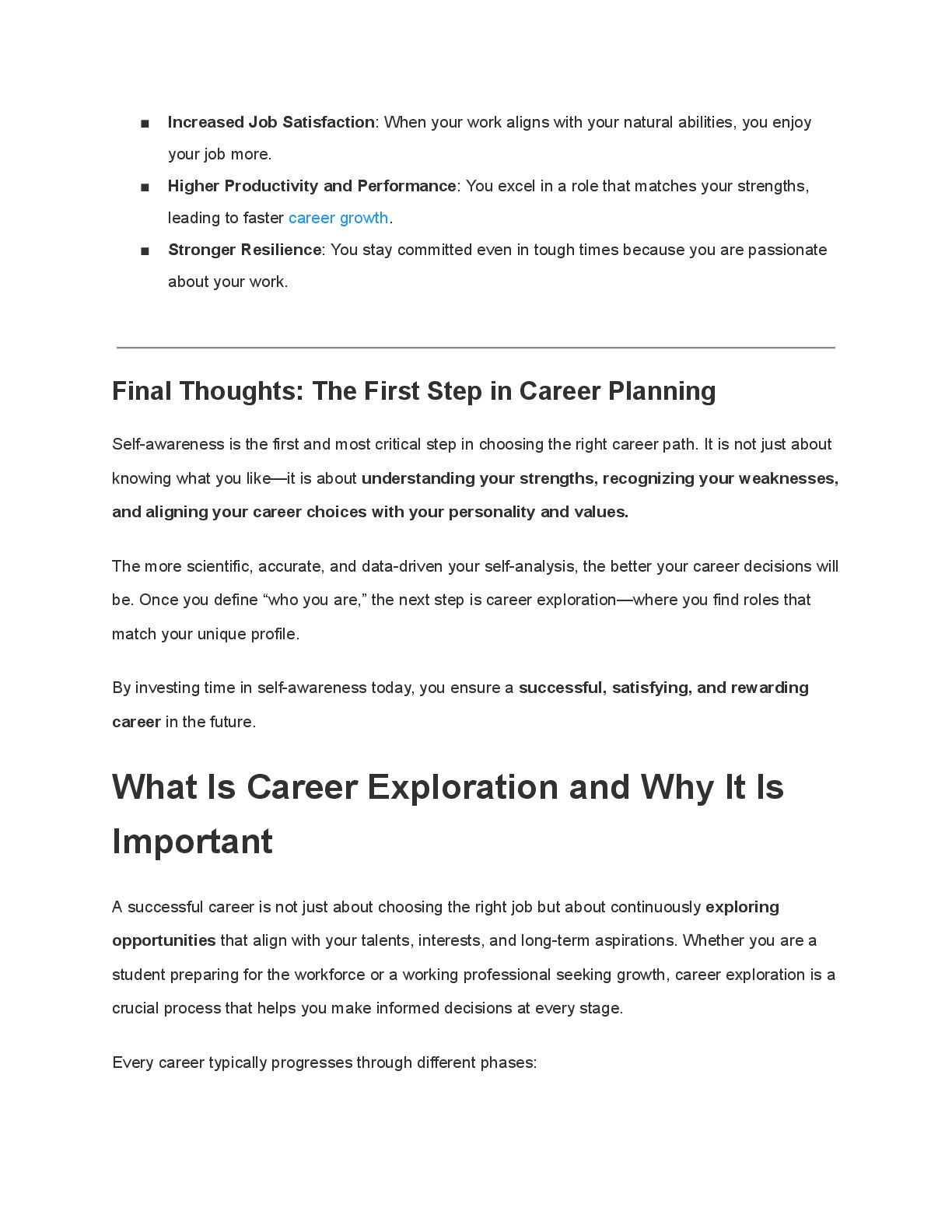
  5. ▪​ Increased Job Satisfaction: When your work aligns with your

    natural abilities, you enjoy your job more. ▪​ Higher Productivity and Performance: You excel in a role that matches your strengths, leading to faster career growth. ▪​ Stronger Resilience: You stay committed even in tough times because you are passionate about your work. Final Thoughts: The First Step in Career Planning Self-awareness is the first and most critical step in choosing the right career path. It is not just about knowing what you like—it is about understanding your strengths, recognizing your weaknesses, and aligning your career choices with your personality and values. The more scientific, accurate, and data-driven your self-analysis, the better your career decisions will be. Once you define “who you are,” the next step is career exploration—where you find roles that match your unique profile. By investing time in self-awareness today, you ensure a successful, satisfying, and rewarding career in the future. What Is Career Exploration and Why It Is Important A successful career is not just about choosing the right job but about continuously exploring opportunities that align with your talents, interests, and long-term aspirations. Whether you are a student preparing for the workforce or a working professional seeking growth, career exploration is a crucial process that helps you make informed decisions at every stage. Every career typically progresses through different phases:
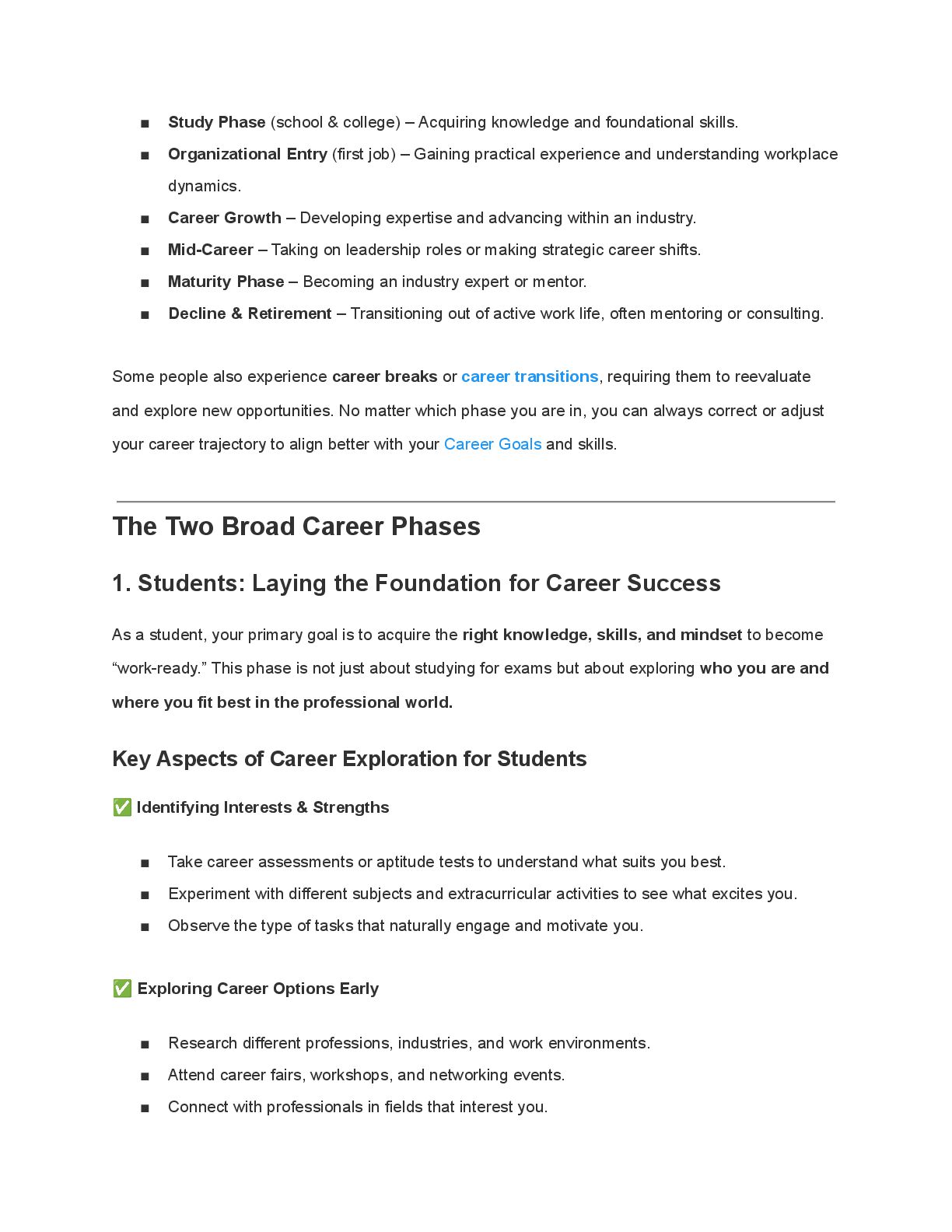
  6. ▪​ Study Phase (school & college) – Acquiring knowledge and

    foundational skills. ▪​ Organizational Entry (first job) – Gaining practical experience and understanding workplace dynamics. ▪​ Career Growth – Developing expertise and advancing within an industry. ▪​ Mid-Career – Taking on leadership roles or making strategic career shifts. ▪​ Maturity Phase – Becoming an industry expert or mentor. ▪​ Decline & Retirement – Transitioning out of active work life, often mentoring or consulting. Some people also experience career breaks or career transitions, requiring them to reevaluate and explore new opportunities. No matter which phase you are in, you can always correct or adjust your career trajectory to align better with your Career Goals and skills. The Two Broad Career Phases 1. Students: Laying the Foundation for Career Success As a student, your primary goal is to acquire the right knowledge, skills, and mindset to become “work-ready.” This phase is not just about studying for exams but about exploring who you are and where you fit best in the professional world. Key Aspects of Career Exploration for Students ✅ Identifying Interests & Strengths ▪​ Take career assessments or aptitude tests to understand what suits you best. ▪​ Experiment with different subjects and extracurricular activities to see what excites you. ▪​ Observe the type of tasks that naturally engage and motivate you. ✅ Exploring Career Options Early ▪​ Research different professions, industries, and work environments. ▪​ Attend career fairs, workshops, and networking events. ▪​ Connect with professionals in fields that interest you.
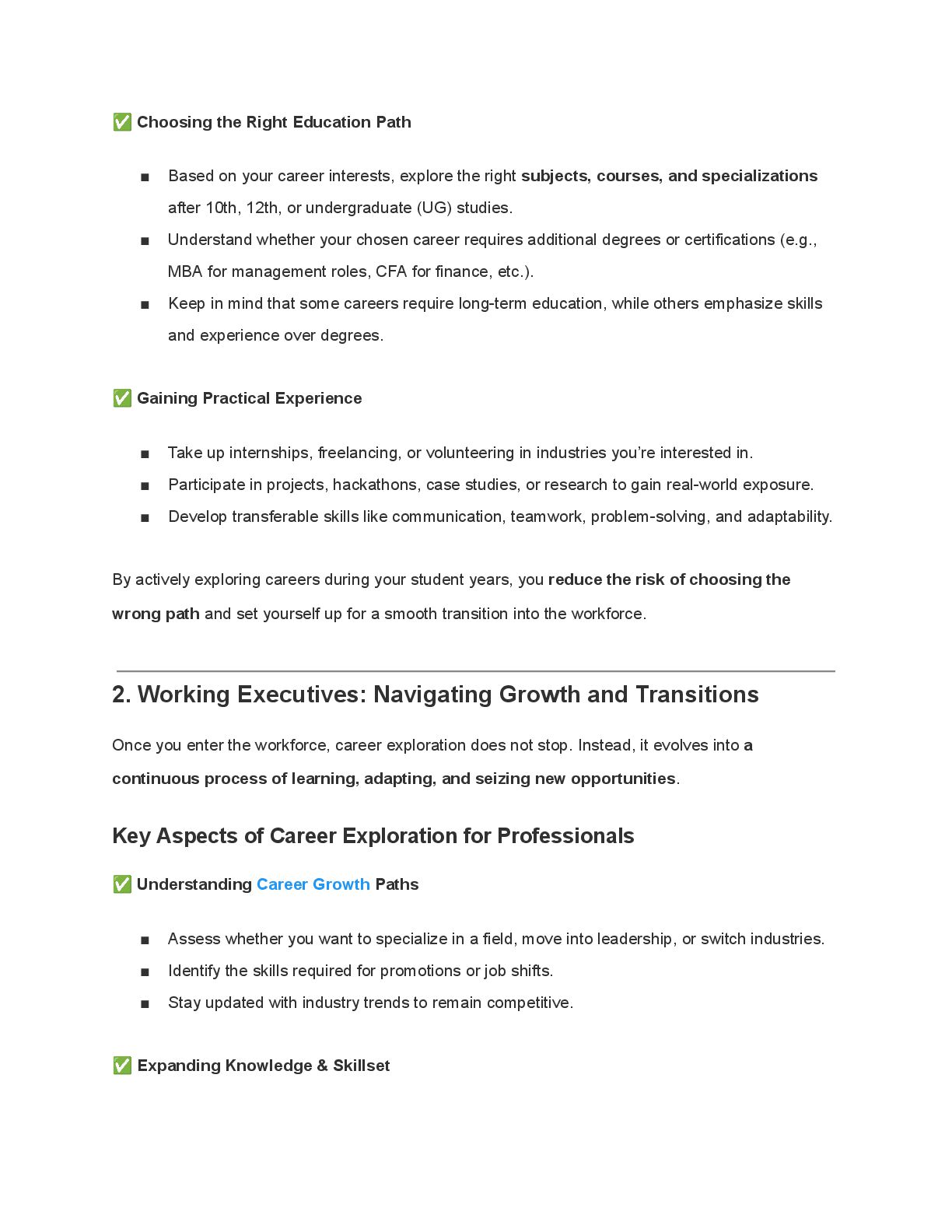
  7. ✅ Choosing the Right Education Path ▪​ Based on your

    career interests, explore the right subjects, courses, and specializations after 10th, 12th, or undergraduate (UG) studies. ▪​ Understand whether your chosen career requires additional degrees or certifications (e.g., MBA for management roles, CFA for finance, etc.). ▪​ Keep in mind that some careers require long-term education, while others emphasize skills and experience over degrees. ✅ Gaining Practical Experience ▪​ Take up internships, freelancing, or volunteering in industries you’re interested in. ▪​ Participate in projects, hackathons, case studies, or research to gain real-world exposure. ▪​ Develop transferable skills like communication, teamwork, problem-solving, and adaptability. By actively exploring careers during your student years, you reduce the risk of choosing the wrong path and set yourself up for a smooth transition into the workforce. 2. Working Executives: Navigating Growth and Transitions Once you enter the workforce, career exploration does not stop. Instead, it evolves into a continuous process of learning, adapting, and seizing new opportunities. Key Aspects of Career Exploration for Professionals ✅ Understanding Career Growth Paths ▪​ Assess whether you want to specialize in a field, move into leadership, or switch industries. ▪​ Identify the skills required for promotions or job shifts. ▪​ Stay updated with industry trends to remain competitive. ✅ Expanding Knowledge & Skillset
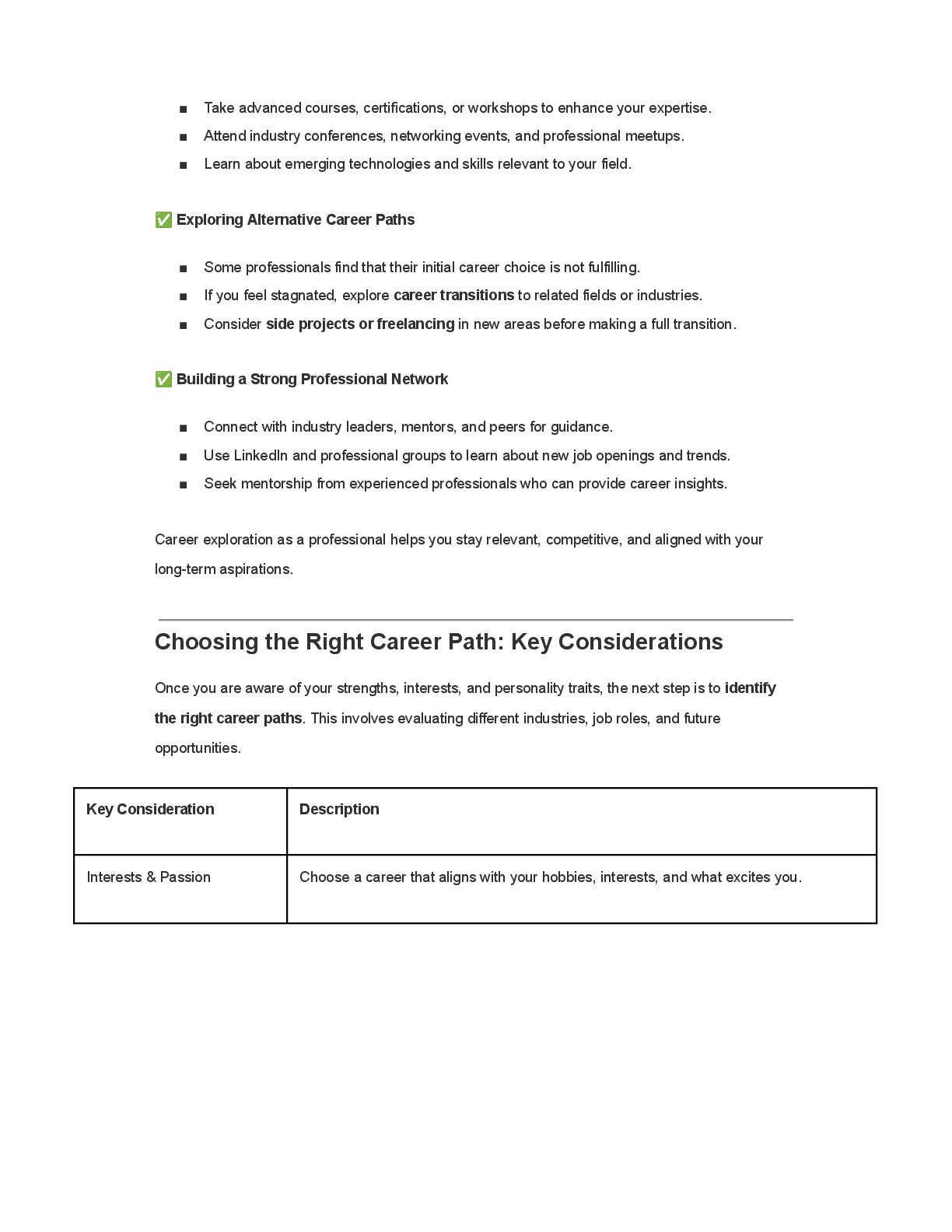
  8. ▪​ Take advanced courses, certifications, or workshops to enhance your

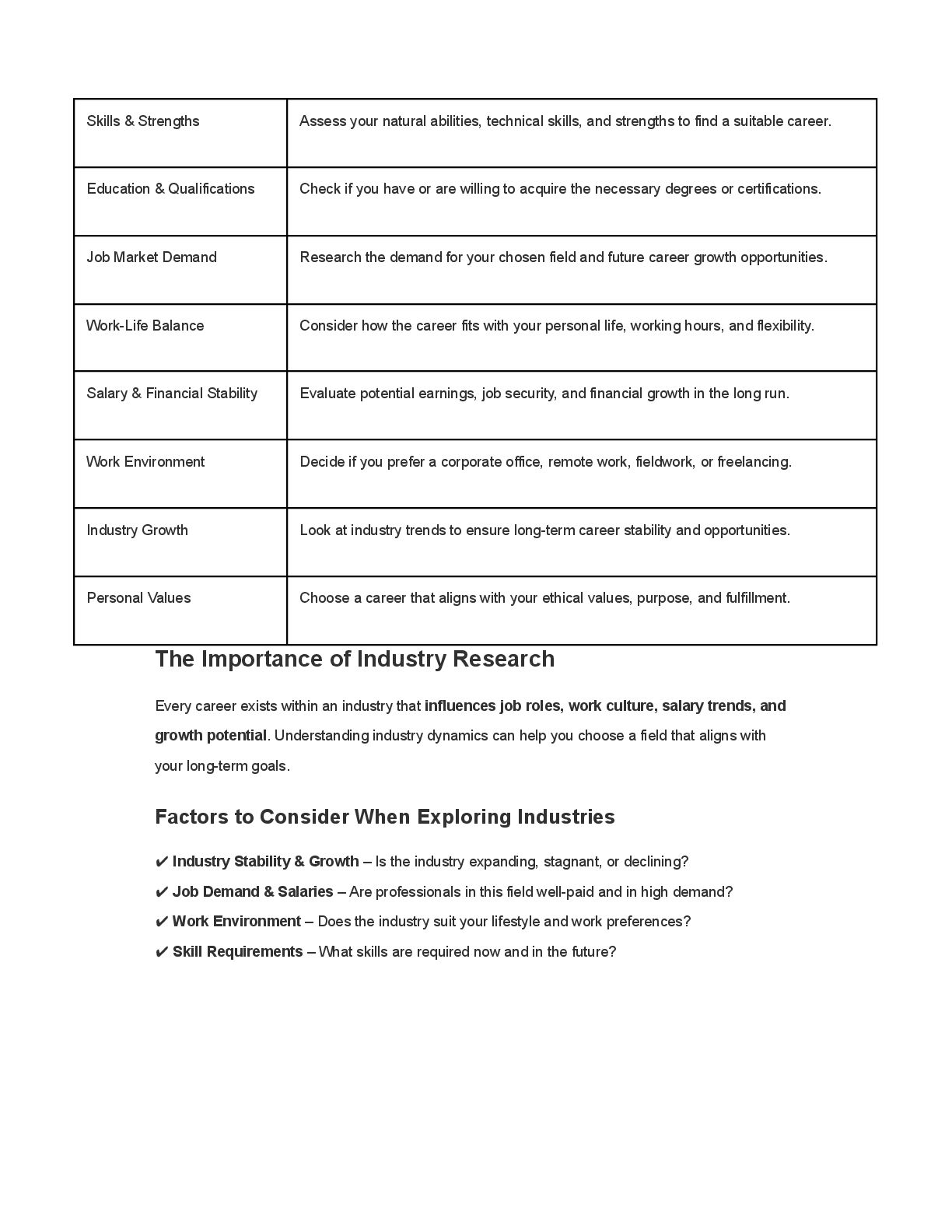
    expertise. ▪​ Attend industry conferences, networking events, and professional meetups. ▪​ Learn about emerging technologies and skills relevant to your field. ✅ Exploring Alternative Career Paths ▪​ Some professionals find that their initial career choice is not fulfilling. ▪​ If you feel stagnated, explore career transitions to related fields or industries. ▪​ Consider side projects or freelancing in new areas before making a full transition. ✅ Building a Strong Professional Network ▪​ Connect with industry leaders, mentors, and peers for guidance. ▪​ Use LinkedIn and professional groups to learn about new job openings and trends. ▪​ Seek mentorship from experienced professionals who can provide career insights. Career exploration as a professional helps you stay relevant, competitive, and aligned with your long-term aspirations. Choosing the Right Career Path: Key Considerations Once you are aware of your strengths, interests, and personality traits, the next step is to identify the right career paths. This involves evaluating different industries, job roles, and future opportunities. Key Consideration Description Interests & Passion Choose a career that aligns with your hobbies, interests, and what excites you.
  9. Skills & Strengths Assess your natural abilities, technical skills, and

    strengths to find a suitable career. Education & Qualifications Check if you have or are willing to acquire the necessary degrees or certifications. Job Market Demand Research the demand for your chosen field and future career growth opportunities. Work-Life Balance Consider how the career fits with your personal life, working hours, and flexibility. Salary & Financial Stability Evaluate potential earnings, job security, and financial growth in the long run. Work Environment Decide if you prefer a corporate office, remote work, fieldwork, or freelancing. Industry Growth Look at industry trends to ensure long-term career stability and opportunities. Personal Values Choose a career that aligns with your ethical values, purpose, and fulfillment. The Importance of Industry Research Every career exists within an industry that influences job roles, work culture, salary trends, and growth potential. Understanding industry dynamics can help you choose a field that aligns with your long-term goals. Factors to Consider When Exploring Industries ✔ Industry Stability & Growth – Is the industry expanding, stagnant, or declining?​ ✔ Job Demand & Salaries – Are professionals in this field well-paid and in high demand?​ ✔ Work Environment – Does the industry suit your lifestyle and work preferences?​ ✔ Skill Requirements – What skills are required now and in the future?
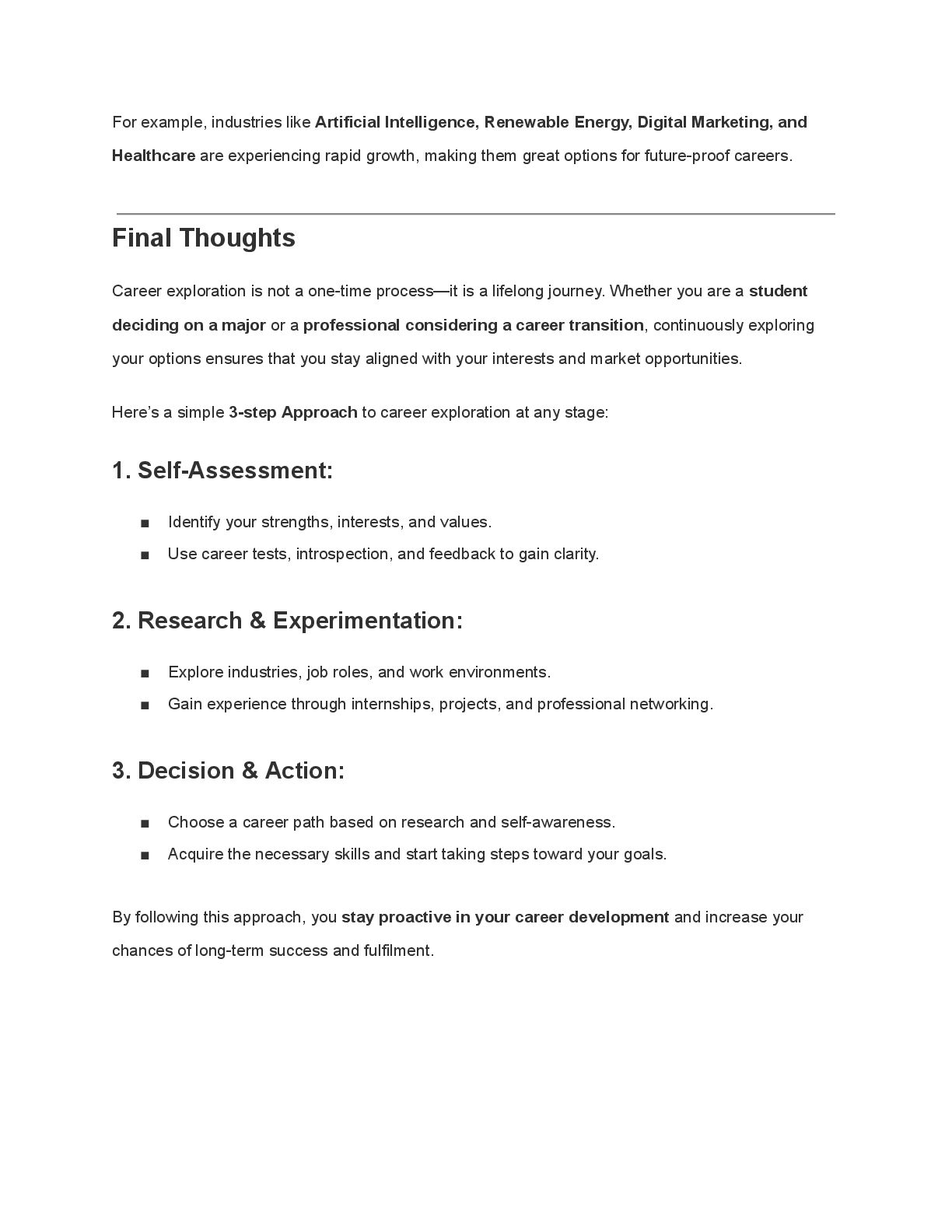
  10. For example, industries like Artificial Intelligence, Renewable Energy, Digital Marketing,

    and Healthcare are experiencing rapid growth, making them great options for future-proof careers. Final Thoughts Career exploration is not a one-time process—it is a lifelong journey. Whether you are a student deciding on a major or a professional considering a career transition, continuously exploring your options ensures that you stay aligned with your interests and market opportunities. Here’s a simple 3-step Approach to career exploration at any stage: 1. Self-Assessment: ▪​ Identify your strengths, interests, and values. ▪​ Use career tests, introspection, and feedback to gain clarity. 2. Research & Experimentation: ▪​ Explore industries, job roles, and work environments. ▪​ Gain experience through internships, projects, and professional networking. 3. Decision & Action: ▪​ Choose a career path based on research and self-awareness. ▪​ Acquire the necessary skills and start taking steps toward your goals. By following this approach, you stay proactive in your career development and increase your chances of long-term success and fulfilment.
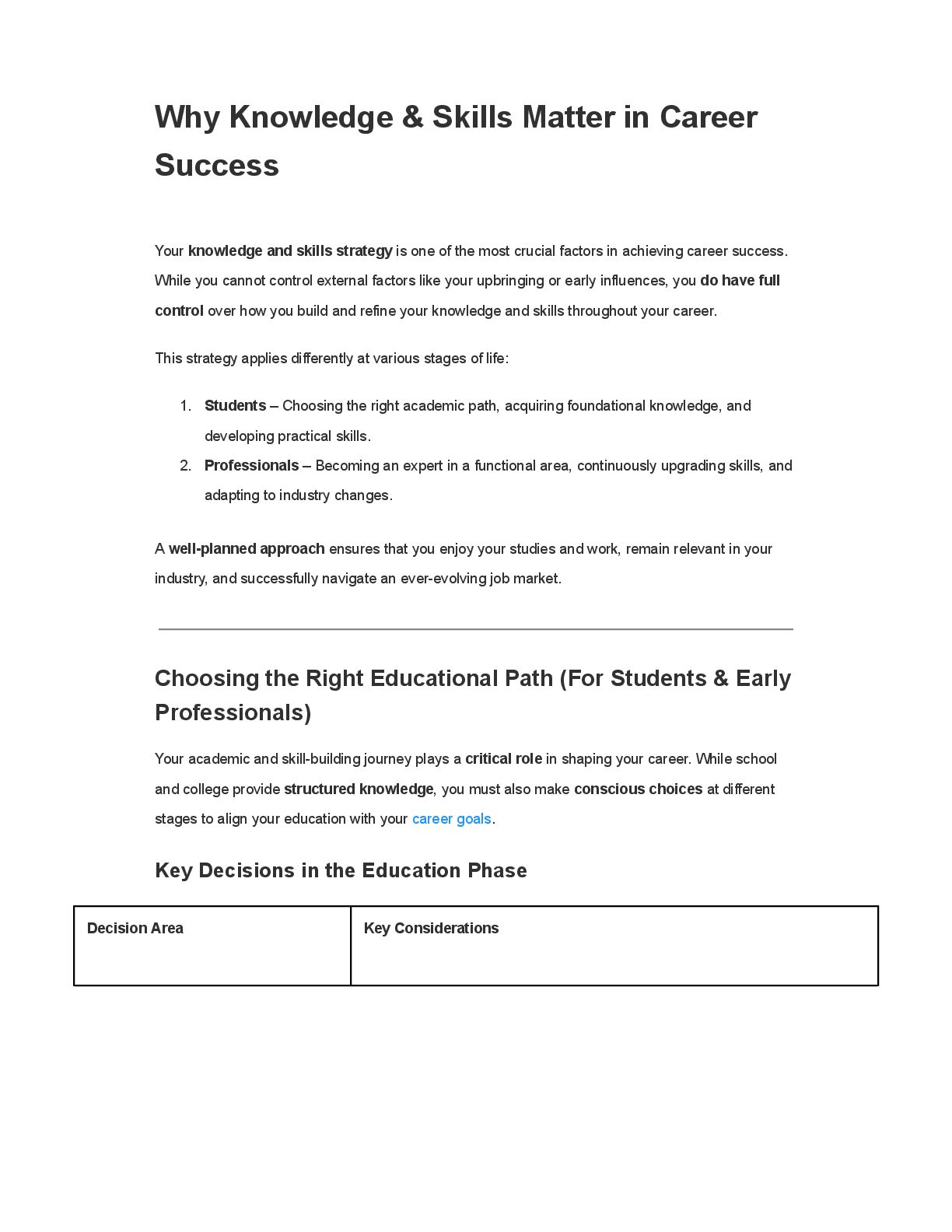
  11. Why Knowledge & Skills Matter in Career Success Your knowledge

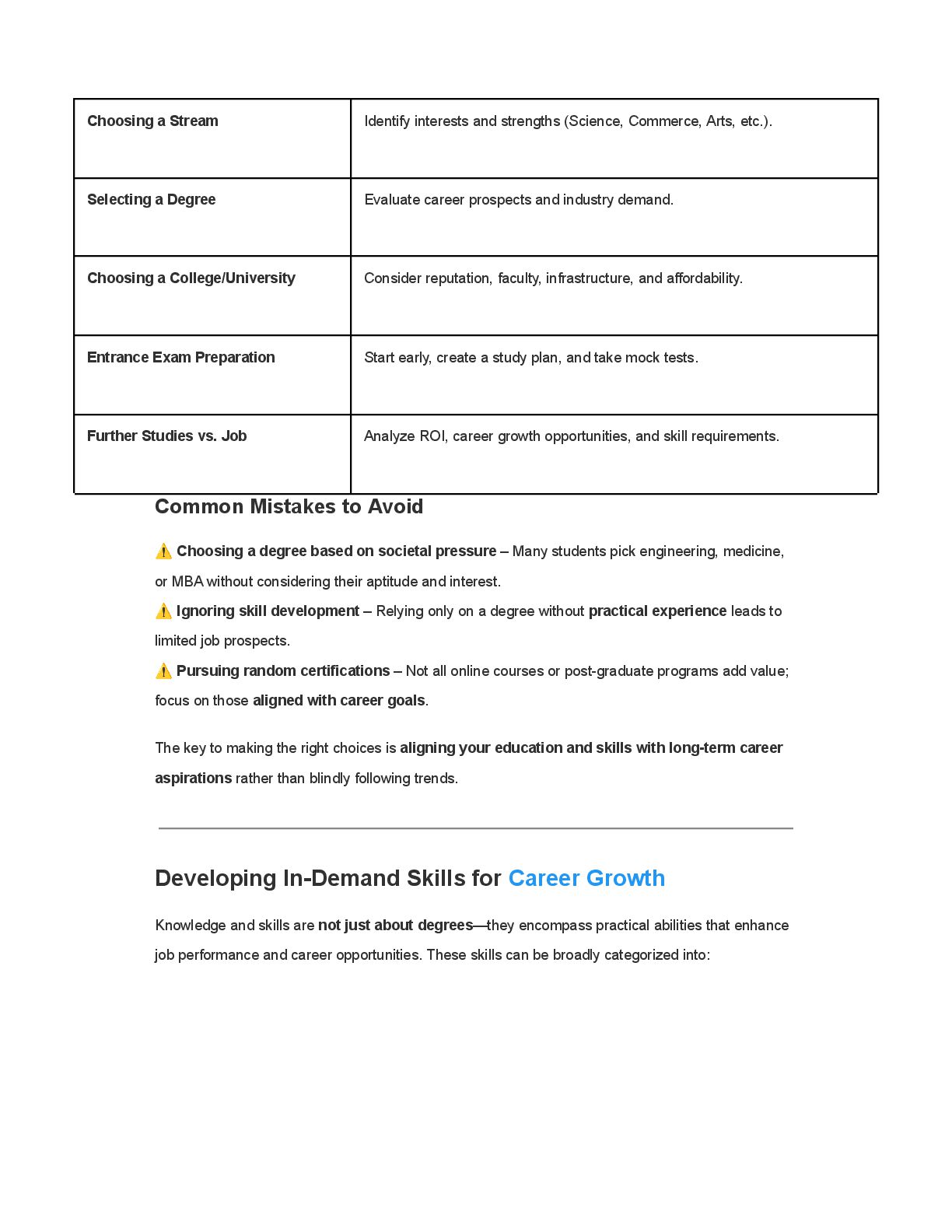
    and skills strategy is one of the most crucial factors in achieving career success. While you cannot control external factors like your upbringing or early influences, you do have full control over how you build and refine your knowledge and skills throughout your career. This strategy applies differently at various stages of life: 1.​ Students – Choosing the right academic path, acquiring foundational knowledge, and developing practical skills. 2.​ Professionals – Becoming an expert in a functional area, continuously upgrading skills, and adapting to industry changes. A well-planned approach ensures that you enjoy your studies and work, remain relevant in your industry, and successfully navigate an ever-evolving job market. Choosing the Right Educational Path (For Students & Early Professionals) Your academic and skill-building journey plays a critical role in shaping your career. While school and college provide structured knowledge, you must also make conscious choices at different stages to align your education with your career goals. Key Decisions in the Education Phase Decision Area Key Considerations
  12. Choosing a Stream Identify interests and strengths (Science, Commerce, Arts,

    etc.). Selecting a Degree Evaluate career prospects and industry demand. Choosing a College/University Consider reputation, faculty, infrastructure, and affordability. Entrance Exam Preparation Start early, create a study plan, and take mock tests. Further Studies vs. Job Analyze ROI, career growth opportunities, and skill requirements. Common Mistakes to Avoid ⚠️ Choosing a degree based on societal pressure – Many students pick engineering, medicine, or MBA without considering their aptitude and interest.​ ⚠️ Ignoring skill development – Relying only on a degree without practical experience leads to limited job prospects.​ ⚠️ Pursuing random certifications – Not all online courses or post-graduate programs add value; focus on those aligned with career goals. The key to making the right choices is aligning your education and skills with long-term career aspirations rather than blindly following trends. Developing In-Demand Skills for Career Growth Knowledge and skills are not just about degrees—they encompass practical abilities that enhance job performance and career opportunities. These skills can be broadly categorized into:
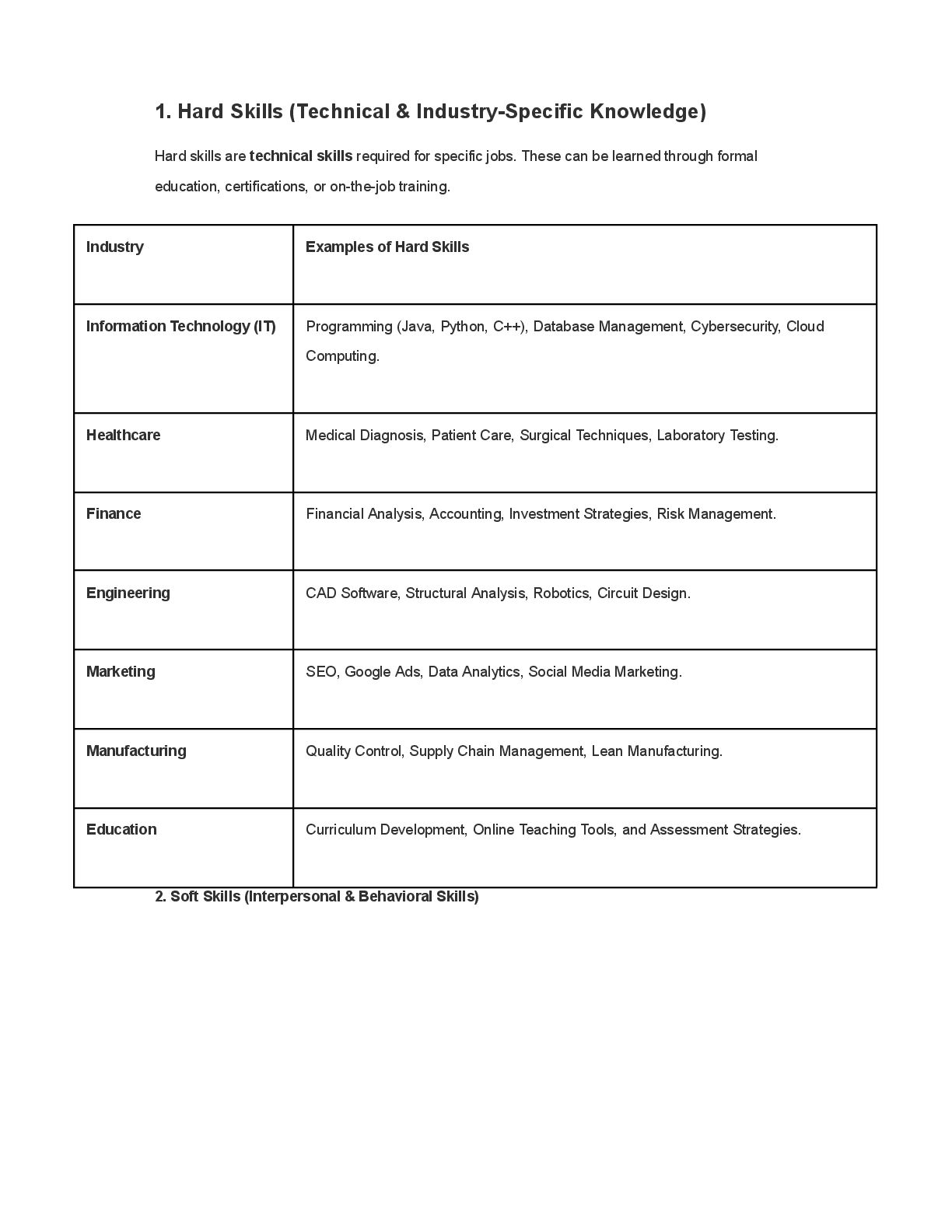
  13. 1. Hard Skills (Technical & Industry-Specific Knowledge) Hard skills are

    technical skills required for specific jobs. These can be learned through formal education, certifications, or on-the-job training. Industry Examples of Hard Skills Information Technology (IT) Programming (Java, Python, C++), Database Management, Cybersecurity, Cloud Computing. Healthcare Medical Diagnosis, Patient Care, Surgical Techniques, Laboratory Testing. Finance Financial Analysis, Accounting, Investment Strategies, Risk Management. Engineering CAD Software, Structural Analysis, Robotics, Circuit Design. Marketing SEO, Google Ads, Data Analytics, Social Media Marketing. Manufacturing Quality Control, Supply Chain Management, Lean Manufacturing. Education Curriculum Development, Online Teaching Tools, and Assessment Strategies. 2. Soft Skills (Interpersonal & Behavioral Skills)
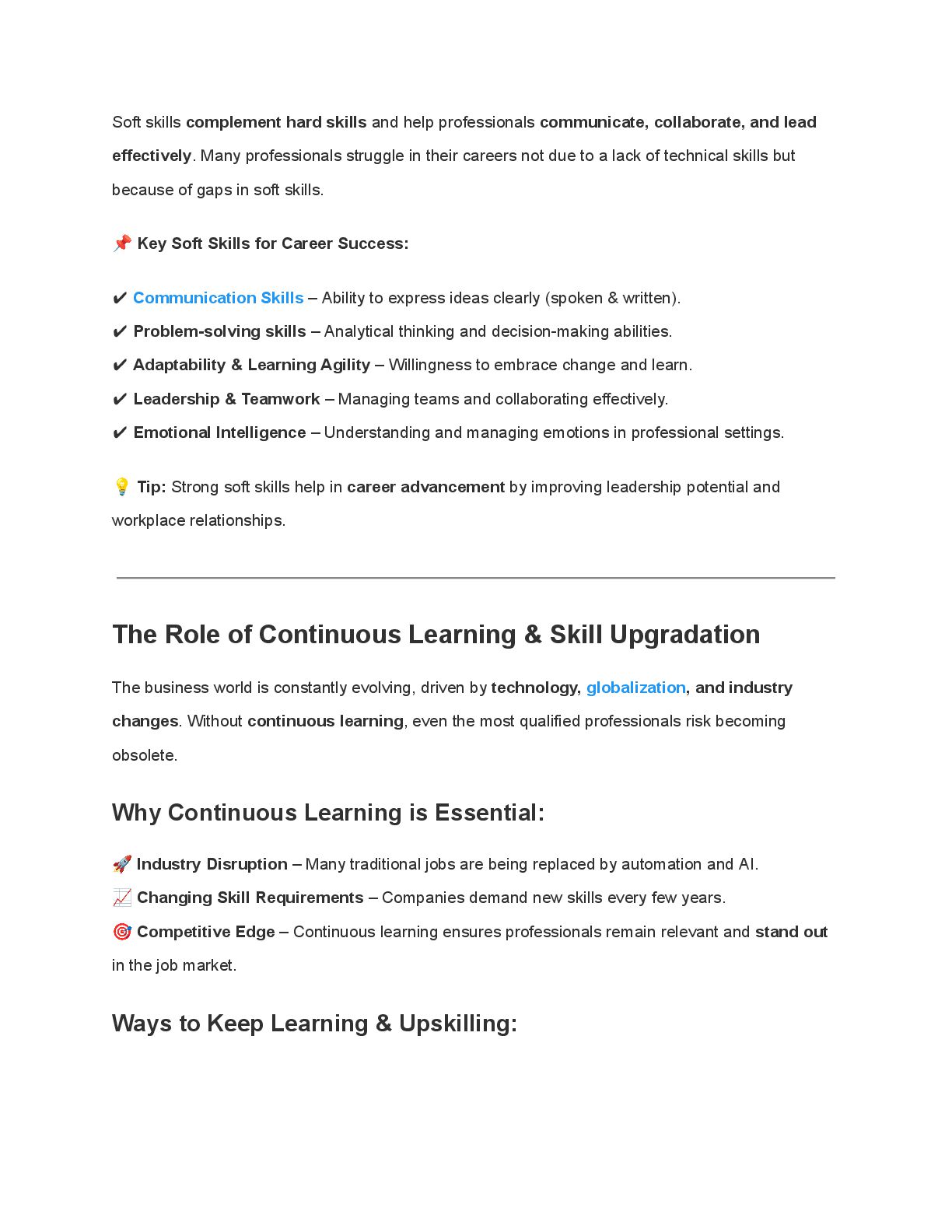
  14. Soft skills complement hard skills and help professionals communicate, collaborate,

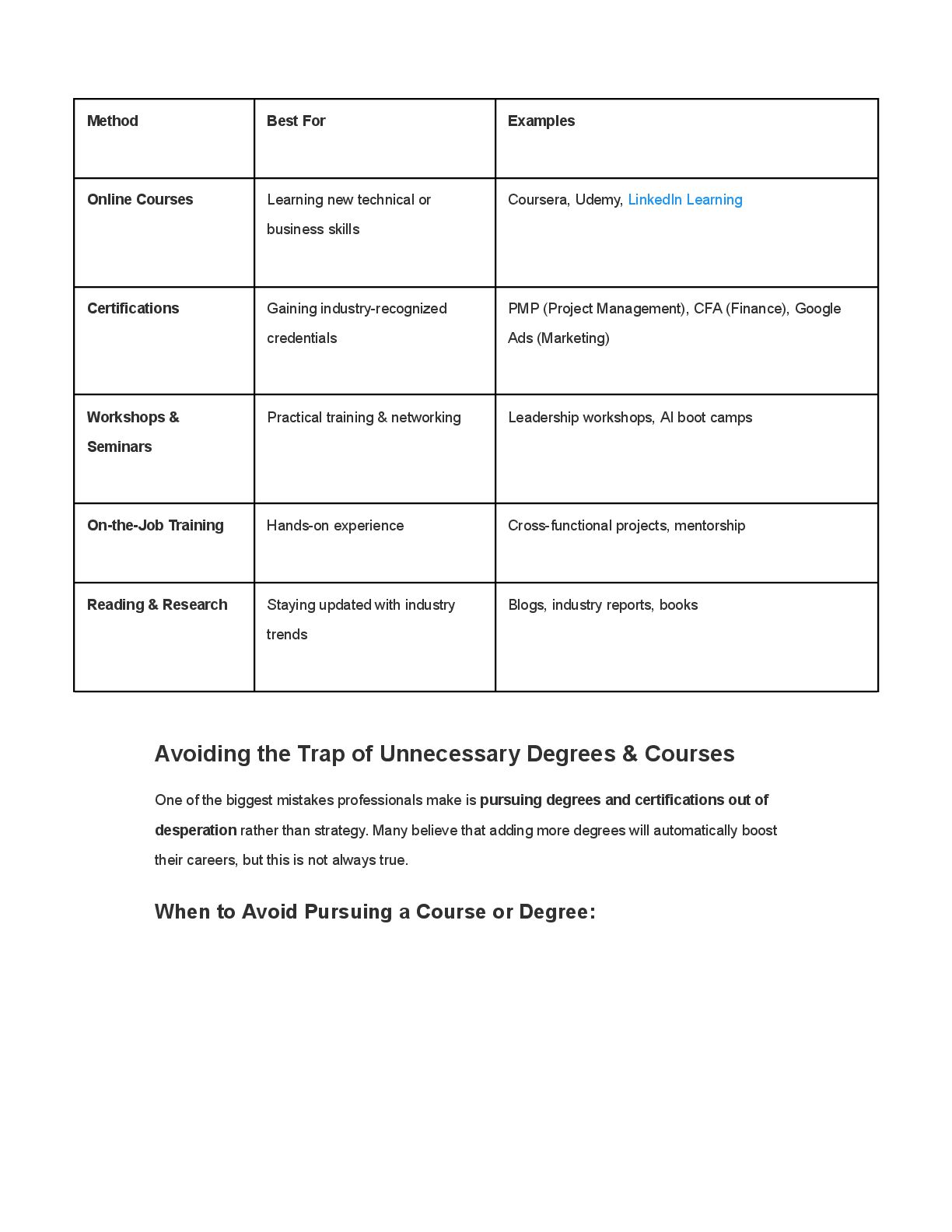
    and lead effectively. Many professionals struggle in their careers not due to a lack of technical skills but because of gaps in soft skills. 📌 Key Soft Skills for Career Success: ✔ Communication Skills – Ability to express ideas clearly (spoken & written).​ ✔ Problem-solving skills – Analytical thinking and decision-making abilities.​ ✔ Adaptability & Learning Agility – Willingness to embrace change and learn.​ ✔ Leadership & Teamwork – Managing teams and collaborating effectively.​ ✔ Emotional Intelligence – Understanding and managing emotions in professional settings. 💡 Tip: Strong soft skills help in career advancement by improving leadership potential and workplace relationships. The Role of Continuous Learning & Skill Upgradation The business world is constantly evolving, driven by technology, globalization, and industry changes. Without continuous learning, even the most qualified professionals risk becoming obsolete. Why Continuous Learning is Essential: 🚀 Industry Disruption – Many traditional jobs are being replaced by automation and AI.​ 📈 Changing Skill Requirements – Companies demand new skills every few years.​ 🎯 Competitive Edge – Continuous learning ensures professionals remain relevant and stand out in the job market. Ways to Keep Learning & Upskilling:
  15. Method Best For Examples Online Courses Learning new technical or

    business skills Coursera, Udemy, LinkedIn Learning Certifications Gaining industry-recognized credentials PMP (Project Management), CFA (Finance), Google Ads (Marketing) Workshops & Seminars Practical training & networking Leadership workshops, AI boot camps On-the-Job Training Hands-on experience Cross-functional projects, mentorship Reading & Research Staying updated with industry trends Blogs, industry reports, books Avoiding the Trap of Unnecessary Degrees & Courses One of the biggest mistakes professionals make is pursuing degrees and certifications out of desperation rather than strategy. Many believe that adding more degrees will automatically boost their careers, but this is not always true. When to Avoid Pursuing a Course or Degree:
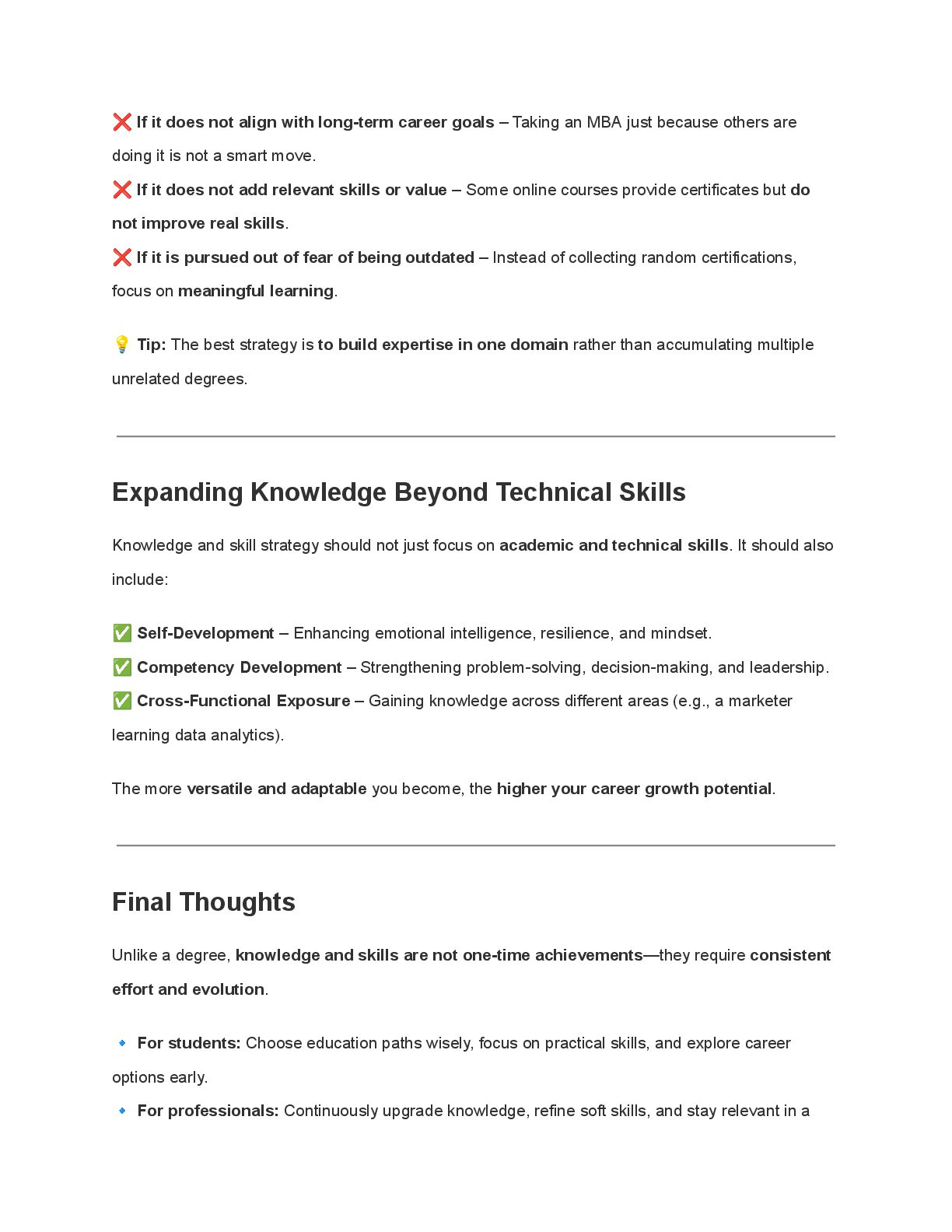
  16. ❌ If it does not align with long-term career goals

    – Taking an MBA just because others are doing it is not a smart move.​ ❌ If it does not add relevant skills or value – Some online courses provide certificates but do not improve real skills.​ ❌ If it is pursued out of fear of being outdated – Instead of collecting random certifications, focus on meaningful learning. 💡 Tip: The best strategy is to build expertise in one domain rather than accumulating multiple unrelated degrees. Expanding Knowledge Beyond Technical Skills Knowledge and skill strategy should not just focus on academic and technical skills. It should also include: ✅ Self-Development – Enhancing emotional intelligence, resilience, and mindset.​ ✅ Competency Development – Strengthening problem-solving, decision-making, and leadership.​ ✅ Cross-Functional Exposure – Gaining knowledge across different areas (e.g., a marketer learning data analytics). The more versatile and adaptable you become, the higher your career growth potential. Final Thoughts Unlike a degree, knowledge and skills are not one-time achievements—they require consistent effort and evolution. 🔹 For students: Choose education paths wisely, focus on practical skills, and explore career options early.​ 🔹 For professionals: Continuously upgrade knowledge, refine soft skills, and stay relevant in a
  17. changing job market.​ 🔹 For all career stages: Avoid unnecessary

    degrees, invest in meaningful learning, and adapt to industry trends. By implementing a strategic approach to learning and development, you set yourself up for long-term success, job satisfaction, and career resilience in an unpredictable world. Mastering the Right Admission Strategy Why Admission Strategy Matters The admission strategy plays a crucial role in shaping your career. It is not just about getting into a prestigious institution but about making the right educational choices based on your long-term career goals. This strategy is important for two main groups: 1.​ Students (10th/12th or Bachelor’s level) – Choosing the right college, course, and specialization to build a strong career foundation. 2.​ Working Professionals (Career Transition or Upskilling) – Selecting further education options (MBA, certifications, online courses) to gain expertise in a new domain. A strategic approach helps you avoid confusion, unnecessary expenses, and wasted time while ensuring that your education aligns with your aspirations and industry demands. Key Factors in Admission Strategy Admission strategy is mainly about where to study and which entrance exams to prepare for. However, many students and professionals make mistakes by focusing too much on college rankings instead of considering other important factors. 1. Choosing the Right College & University
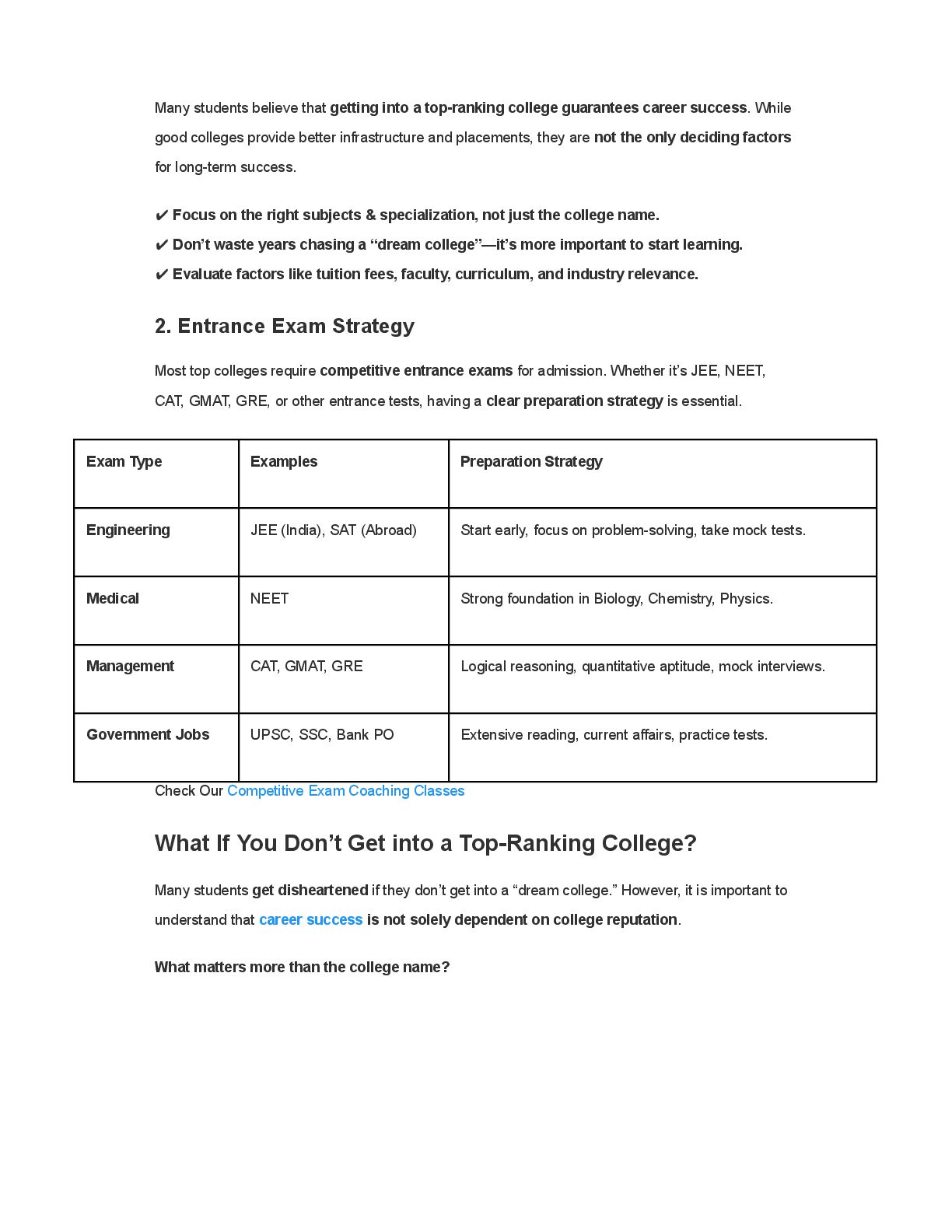
  18. Many students believe that getting into a top-ranking college guarantees

    career success. While good colleges provide better infrastructure and placements, they are not the only deciding factors for long-term success. ✔ Focus on the right subjects & specialization, not just the college name.​ ✔ Don’t waste years chasing a “dream college”—it’s more important to start learning.​ ✔ Evaluate factors like tuition fees, faculty, curriculum, and industry relevance. 2. Entrance Exam Strategy Most top colleges require competitive entrance exams for admission. Whether it’s JEE, NEET, CAT, GMAT, GRE, or other entrance tests, having a clear preparation strategy is essential. Exam Type Examples Preparation Strategy Engineering JEE (India), SAT (Abroad) Start early, focus on problem-solving, take mock tests. Medical NEET Strong foundation in Biology, Chemistry, Physics. Management CAT, GMAT, GRE Logical reasoning, quantitative aptitude, mock interviews. Government Jobs UPSC, SSC, Bank PO Extensive reading, current affairs, practice tests. Check Our Competitive Exam Coaching Classes What If You Don’t Get into a Top-Ranking College? Many students get disheartened if they don’t get into a “dream college.” However, it is important to understand that career success is not solely dependent on college reputation. What matters more than the college name?
  19. 1.​ The subjects and skills you learn. 2.​ How well

    you utilize resources and opportunities. 3.​ Networking and internships during your course. 💡 Example: Many top professionals, entrepreneurs, and CEOs have come from ordinary colleges but achieved success due to self-learning, skill-building, and persistence. Avoiding Common Admission Mistakes Many students and parents make costly mistakes while choosing colleges and courses. Let’s address some of the most common errors: 1. Overemphasis on College Rankings 🚫 Mistake: Thinking that only top-ranking institutions provide good education.​ ✔ Solution: A lesser-known college with the right course and practical exposure can be more beneficial. 2. Opting for Management Quota Without Long-Term Benefits 🚫 Mistake: Paying lakhs for a management quota seat without career benefits.​ ✔ Solution: Instead, invest in certifications, internships, or skill development that provide real advantages. 3. Studying Abroad Without Proper Analysis 🚫 Mistake: Choosing a foreign degree just because it sounds prestigious.​ ✔ Solution: Before studying abroad, analyze: ▪​ Job opportunities and work permit rules. ▪​ Return on Investment (ROI) – Will the degree provide long-term benefits? ▪​ What if you return to India? – Will the qualification be valuable in your home country?
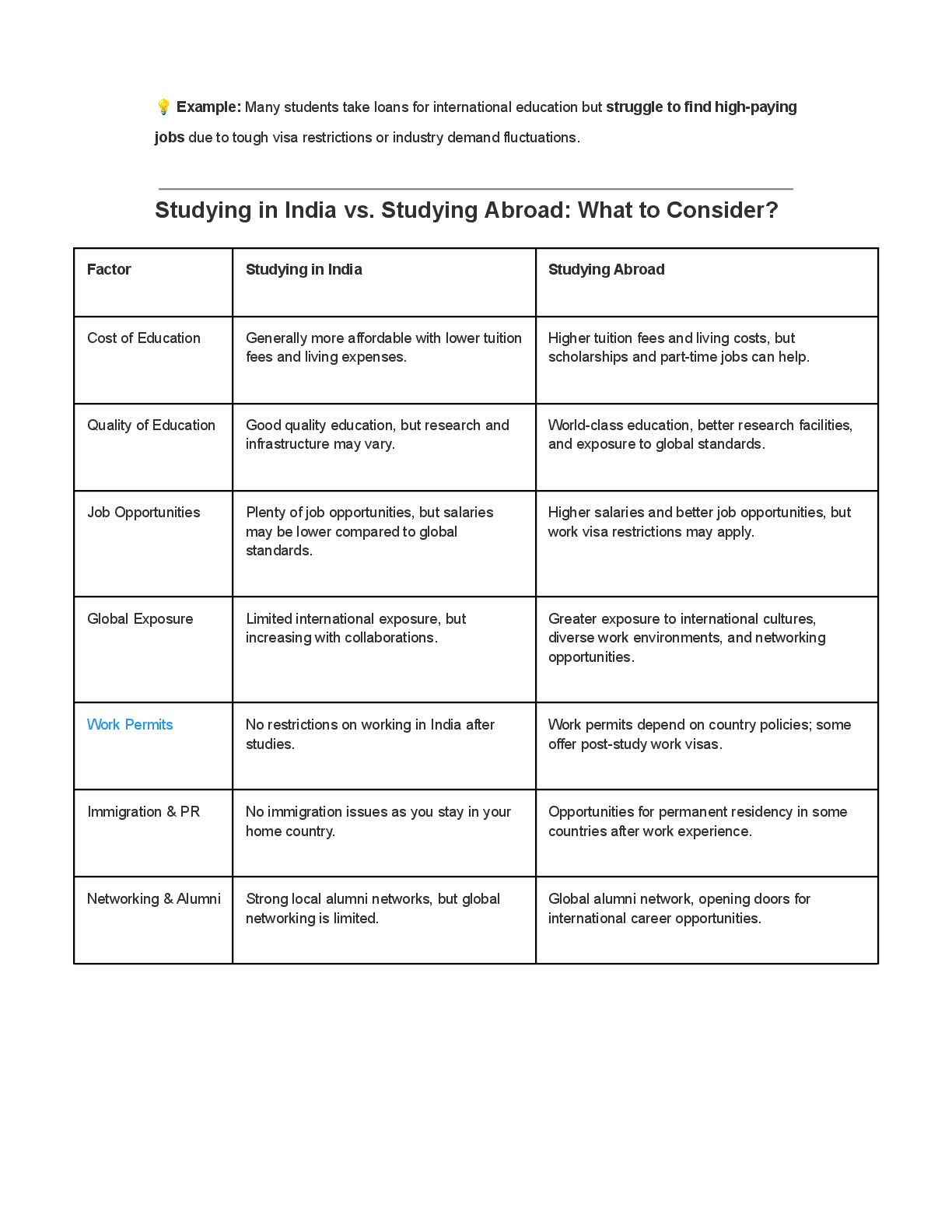
  20. 💡 Example: Many students take loans for international education but

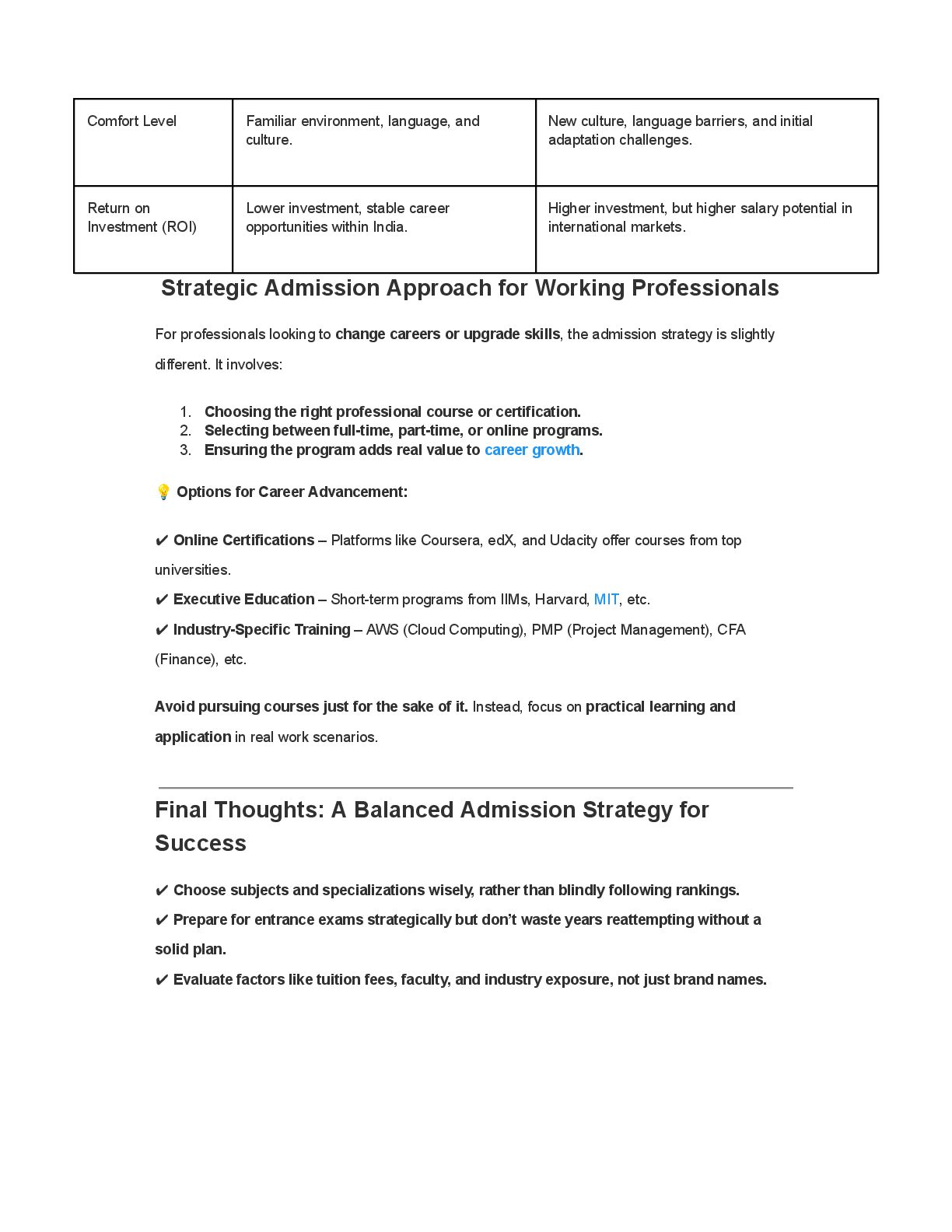
    struggle to find high-paying jobs due to tough visa restrictions or industry demand fluctuations. Studying in India vs. Studying Abroad: What to Consider? Factor Studying in India Studying Abroad Cost of Education Generally more affordable with lower tuition fees and living expenses. Higher tuition fees and living costs, but scholarships and part-time jobs can help. Quality of Education Good quality education, but research and infrastructure may vary. World-class education, better research facilities, and exposure to global standards. Job Opportunities Plenty of job opportunities, but salaries may be lower compared to global standards. Higher salaries and better job opportunities, but work visa restrictions may apply. Global Exposure Limited international exposure, but increasing with collaborations. Greater exposure to international cultures, diverse work environments, and networking opportunities. Work Permits No restrictions on working in India after studies. Work permits depend on country policies; some offer post-study work visas. Immigration & PR No immigration issues as you stay in your home country. Opportunities for permanent residency in some countries after work experience. Networking & Alumni Strong local alumni networks, but global networking is limited. Global alumni network, opening doors for international career opportunities.
  21. Comfort Level Familiar environment, language, and culture. New culture, language

    barriers, and initial adaptation challenges. Return on Investment (ROI) Lower investment, stable career opportunities within India. Higher investment, but higher salary potential in international markets. Strategic Admission Approach for Working Professionals For professionals looking to change careers or upgrade skills, the admission strategy is slightly different. It involves: 1.​ Choosing the right professional course or certification. 2.​ Selecting between full-time, part-time, or online programs. 3.​ Ensuring the program adds real value to career growth. 💡 Options for Career Advancement: ✔ Online Certifications – Platforms like Coursera, edX, and Udacity offer courses from top universities.​ ✔ Executive Education – Short-term programs from IIMs, Harvard, MIT, etc.​ ✔ Industry-Specific Training – AWS (Cloud Computing), PMP (Project Management), CFA (Finance), etc. Avoid pursuing courses just for the sake of it. Instead, focus on practical learning and application in real work scenarios. Final Thoughts: A Balanced Admission Strategy for Success ✔ Choose subjects and specializations wisely, rather than blindly following rankings.​ ✔ Prepare for entrance exams strategically but don’t waste years reattempting without a solid plan.​ ✔ Evaluate factors like tuition fees, faculty, and industry exposure, not just brand names.​
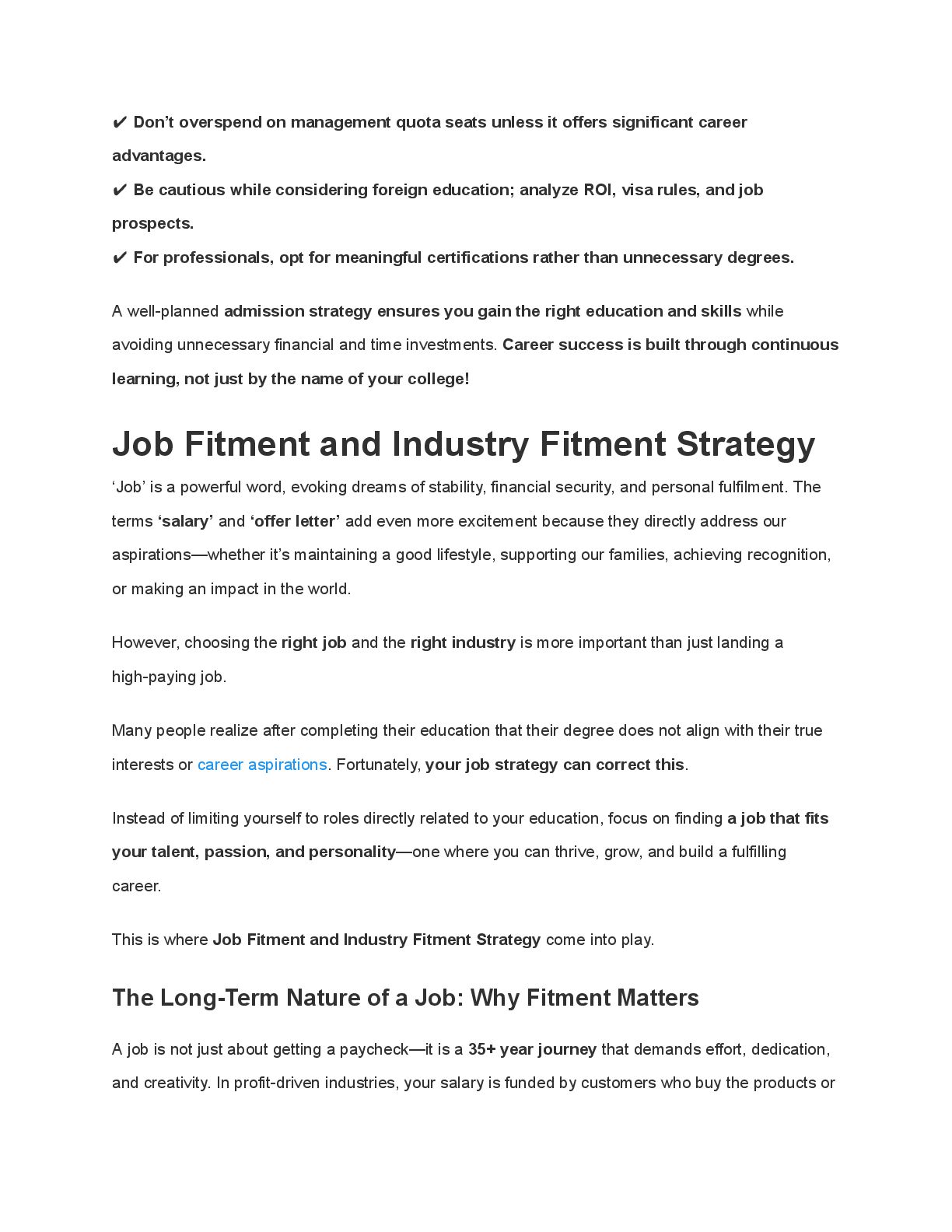
  22. ✔ Don’t overspend on management quota seats unless it offers

    significant career advantages.​ ✔ Be cautious while considering foreign education; analyze ROI, visa rules, and job prospects.​ ✔ For professionals, opt for meaningful certifications rather than unnecessary degrees. A well-planned admission strategy ensures you gain the right education and skills while avoiding unnecessary financial and time investments. Career success is built through continuous learning, not just by the name of your college! Job Fitment and Industry Fitment Strategy ‘Job’ is a powerful word, evoking dreams of stability, financial security, and personal fulfilment. The terms ‘salary’ and ‘offer letter’ add even more excitement because they directly address our aspirations—whether it’s maintaining a good lifestyle, supporting our families, achieving recognition, or making an impact in the world. However, choosing the right job and the right industry is more important than just landing a high-paying job. Many people realize after completing their education that their degree does not align with their true interests or career aspirations. Fortunately, your job strategy can correct this. Instead of limiting yourself to roles directly related to your education, focus on finding a job that fits your talent, passion, and personality—one where you can thrive, grow, and build a fulfilling career. This is where Job Fitment and Industry Fitment Strategy come into play. The Long-Term Nature of a Job: Why Fitment Matters A job is not just about getting a paycheck—it is a 35+ year journey that demands effort, dedication, and creativity. In profit-driven industries, your salary is funded by customers who buy the products or
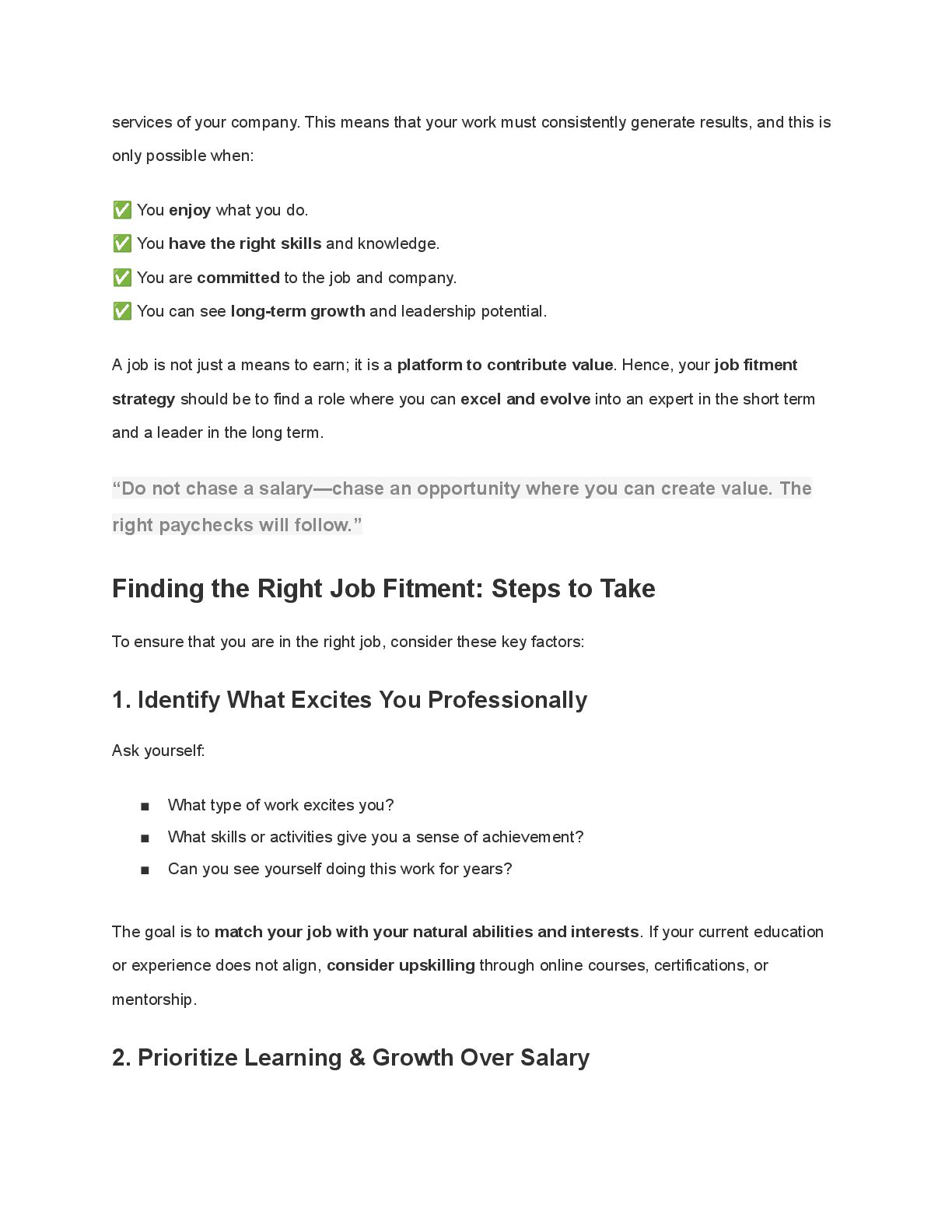
  23. services of your company. This means that your work must

    consistently generate results, and this is only possible when: ✅ You enjoy what you do.​ ✅ You have the right skills and knowledge.​ ✅ You are committed to the job and company.​ ✅ You can see long-term growth and leadership potential. A job is not just a means to earn; it is a platform to contribute value. Hence, your job fitment strategy should be to find a role where you can excel and evolve into an expert in the short term and a leader in the long term. “Do not chase a salary—chase an opportunity where you can create value. The right paychecks will follow.” Finding the Right Job Fitment: Steps to Take To ensure that you are in the right job, consider these key factors: 1. Identify What Excites You Professionally Ask yourself: ▪​ What type of work excites you? ▪​ What skills or activities give you a sense of achievement? ▪​ Can you see yourself doing this work for years? The goal is to match your job with your natural abilities and interests. If your current education or experience does not align, consider upskilling through online courses, certifications, or mentorship. 2. Prioritize Learning & Growth Over Salary
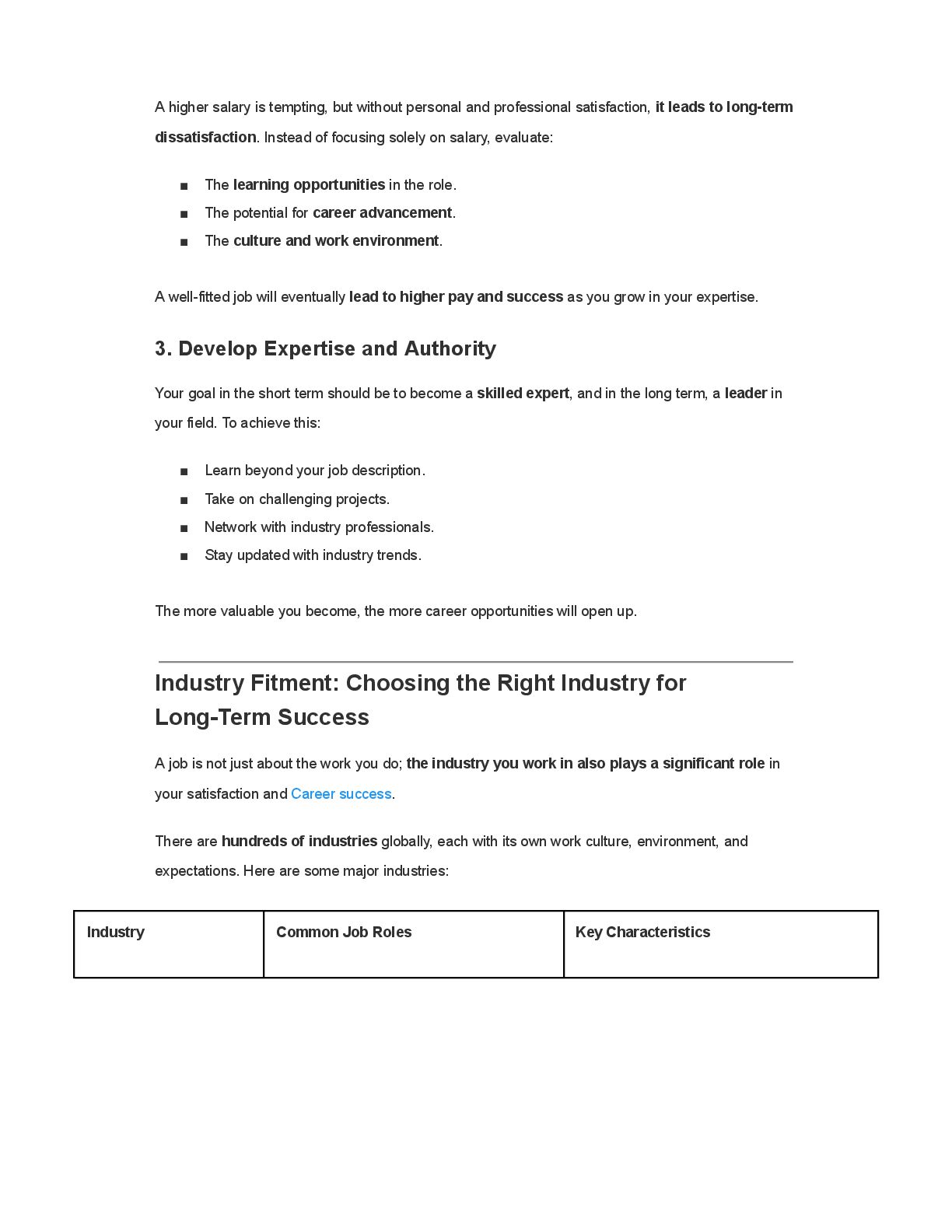
  24. A higher salary is tempting, but without personal and professional

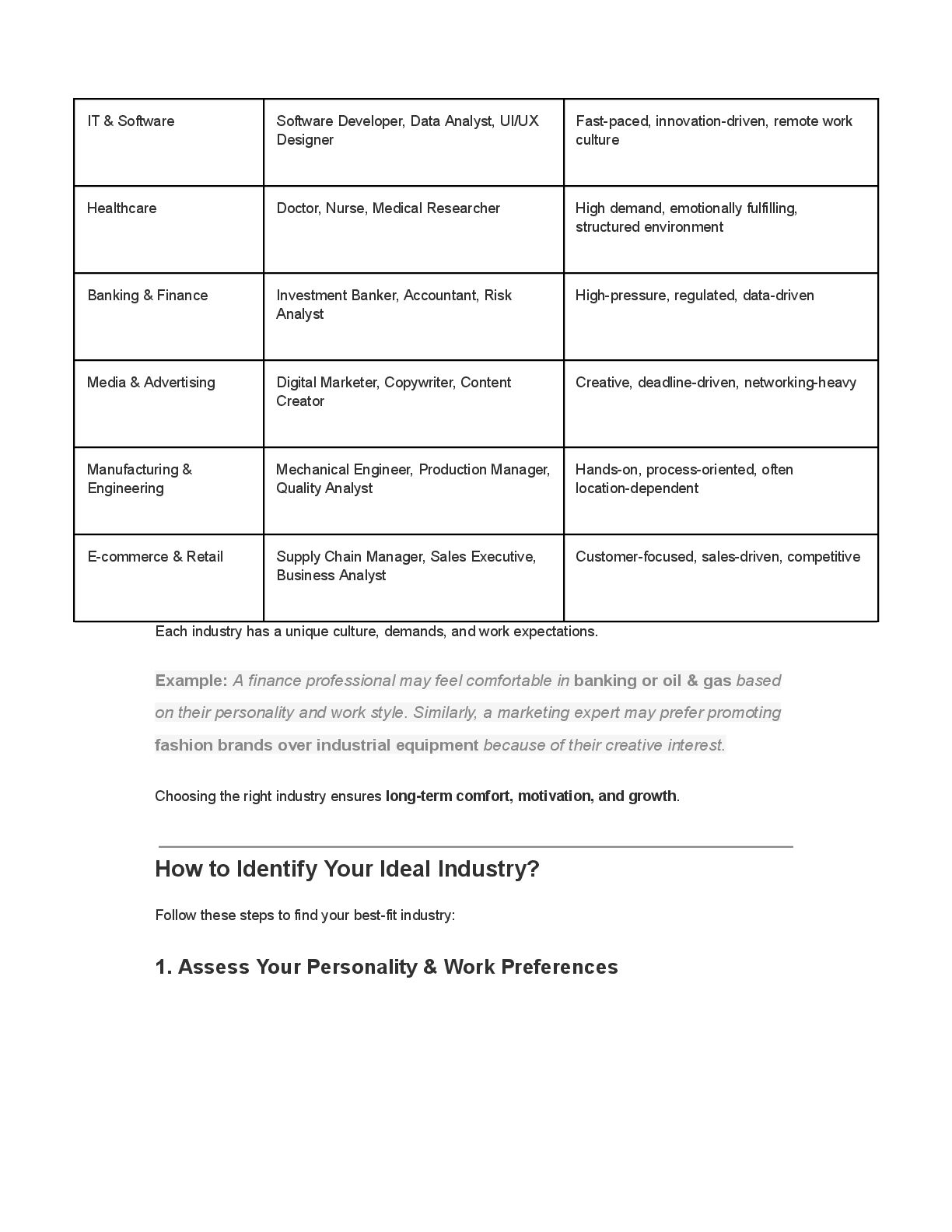
    satisfaction, it leads to long-term dissatisfaction. Instead of focusing solely on salary, evaluate: ▪​ The learning opportunities in the role. ▪​ The potential for career advancement. ▪​ The culture and work environment. A well-fitted job will eventually lead to higher pay and success as you grow in your expertise. 3. Develop Expertise and Authority Your goal in the short term should be to become a skilled expert, and in the long term, a leader in your field. To achieve this: ▪​ Learn beyond your job description. ▪​ Take on challenging projects. ▪​ Network with industry professionals. ▪​ Stay updated with industry trends. The more valuable you become, the more career opportunities will open up. Industry Fitment: Choosing the Right Industry for Long-Term Success A job is not just about the work you do; the industry you work in also plays a significant role in your satisfaction and Career success. There are hundreds of industries globally, each with its own work culture, environment, and expectations. Here are some major industries: Industry Common Job Roles Key Characteristics
  25. IT & Software Software Developer, Data Analyst, UI/UX Designer Fast-paced,

    innovation-driven, remote work culture Healthcare Doctor, Nurse, Medical Researcher High demand, emotionally fulfilling, structured environment Banking & Finance Investment Banker, Accountant, Risk Analyst High-pressure, regulated, data-driven Media & Advertising Digital Marketer, Copywriter, Content Creator Creative, deadline-driven, networking-heavy Manufacturing & Engineering Mechanical Engineer, Production Manager, Quality Analyst Hands-on, process-oriented, often location-dependent E-commerce & Retail Supply Chain Manager, Sales Executive, Business Analyst Customer-focused, sales-driven, competitive Each industry has a unique culture, demands, and work expectations. Example: A finance professional may feel comfortable in banking or oil & gas based on their personality and work style. Similarly, a marketing expert may prefer promoting fashion brands over industrial equipment because of their creative interest. Choosing the right industry ensures long-term comfort, motivation, and growth. How to Identify Your Ideal Industry? Follow these steps to find your best-fit industry: 1. Assess Your Personality & Work Preferences
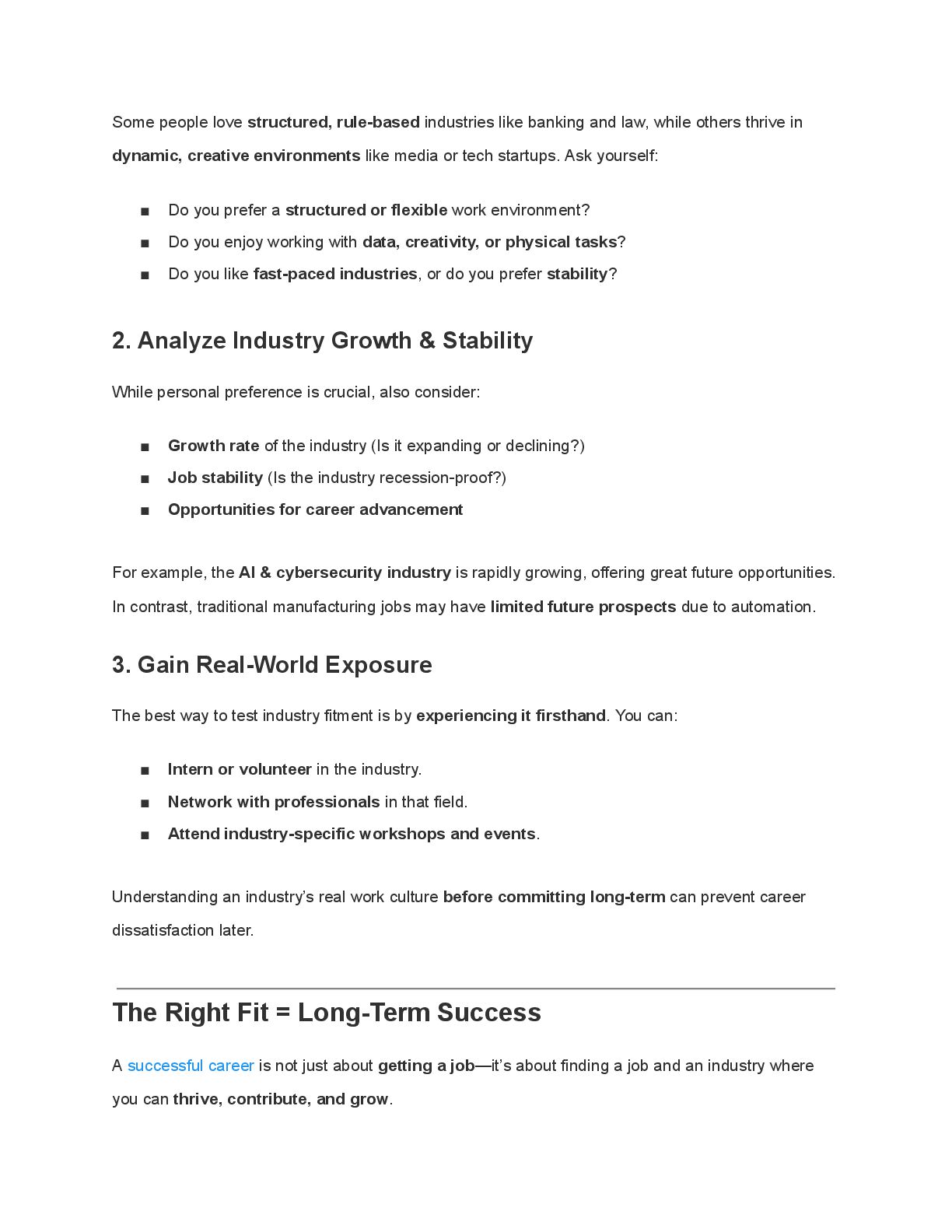
  26. Some people love structured, rule-based industries like banking and law,

    while others thrive in dynamic, creative environments like media or tech startups. Ask yourself: ▪​ Do you prefer a structured or flexible work environment? ▪​ Do you enjoy working with data, creativity, or physical tasks? ▪​ Do you like fast-paced industries, or do you prefer stability? 2. Analyze Industry Growth & Stability While personal preference is crucial, also consider: ▪​ Growth rate of the industry (Is it expanding or declining?) ▪​ Job stability (Is the industry recession-proof?) ▪​ Opportunities for career advancement For example, the AI & cybersecurity industry is rapidly growing, offering great future opportunities. In contrast, traditional manufacturing jobs may have limited future prospects due to automation. 3. Gain Real-World Exposure The best way to test industry fitment is by experiencing it firsthand. You can: ▪​ Intern or volunteer in the industry. ▪​ Network with professionals in that field. ▪​ Attend industry-specific workshops and events. Understanding an industry’s real work culture before committing long-term can prevent career dissatisfaction later. The Right Fit = Long-Term Success A successful career is not just about getting a job—it’s about finding a job and an industry where you can thrive, contribute, and grow.
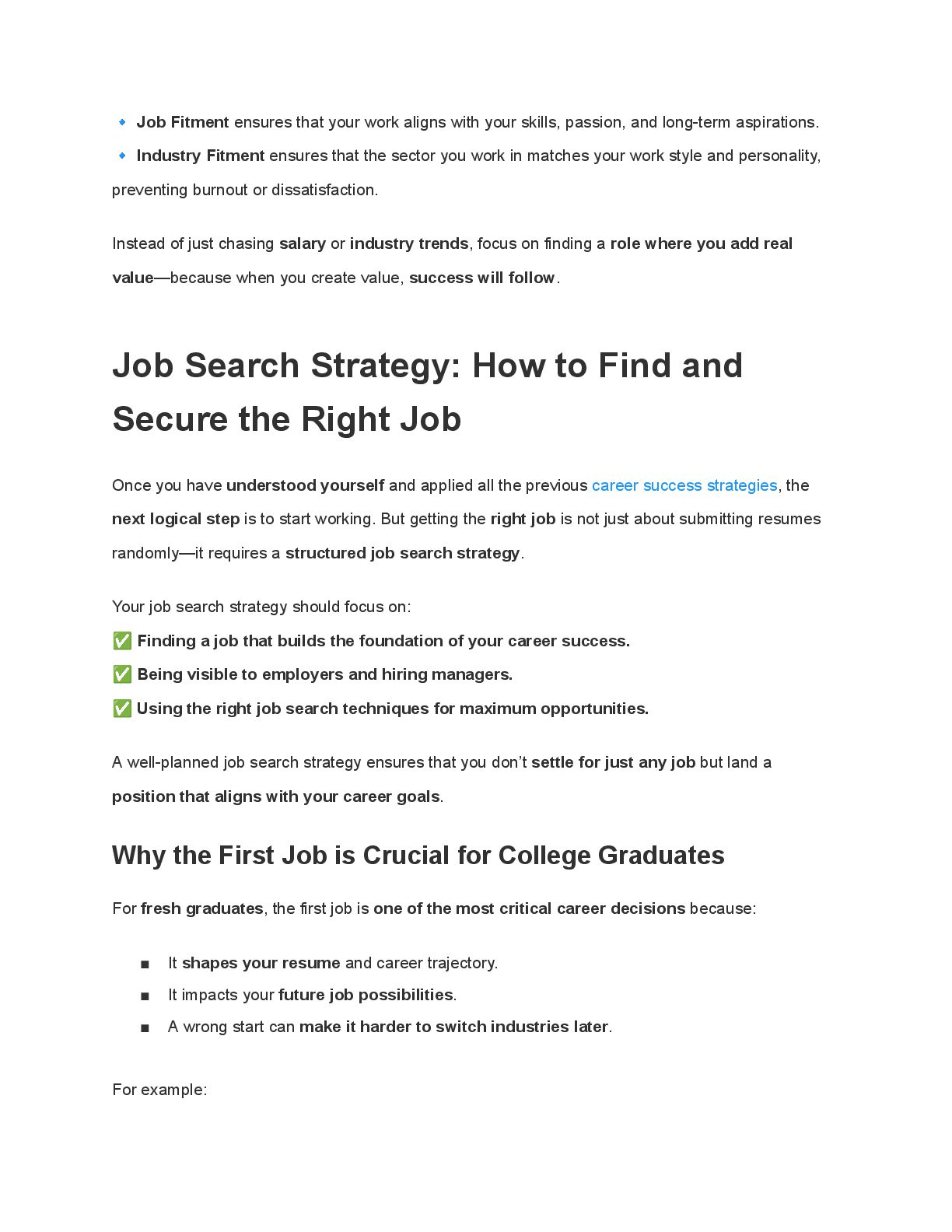
  27. 🔹 Job Fitment ensures that your work aligns with your

    skills, passion, and long-term aspirations.​ 🔹 Industry Fitment ensures that the sector you work in matches your work style and personality, preventing burnout or dissatisfaction. Instead of just chasing salary or industry trends, focus on finding a role where you add real value—because when you create value, success will follow. Job Search Strategy: How to Find and Secure the Right Job Once you have understood yourself and applied all the previous career success strategies, the next logical step is to start working. But getting the right job is not just about submitting resumes randomly—it requires a structured job search strategy. Your job search strategy should focus on:​ ✅ Finding a job that builds the foundation of your career success.​ ✅ Being visible to employers and hiring managers.​ ✅ Using the right job search techniques for maximum opportunities. A well-planned job search strategy ensures that you don’t settle for just any job but land a position that aligns with your career goals. Why the First Job is Crucial for College Graduates For fresh graduates, the first job is one of the most critical career decisions because: ▪​ It shapes your resume and career trajectory. ▪​ It impacts your future job possibilities. ▪​ A wrong start can make it harder to switch industries later. For example:
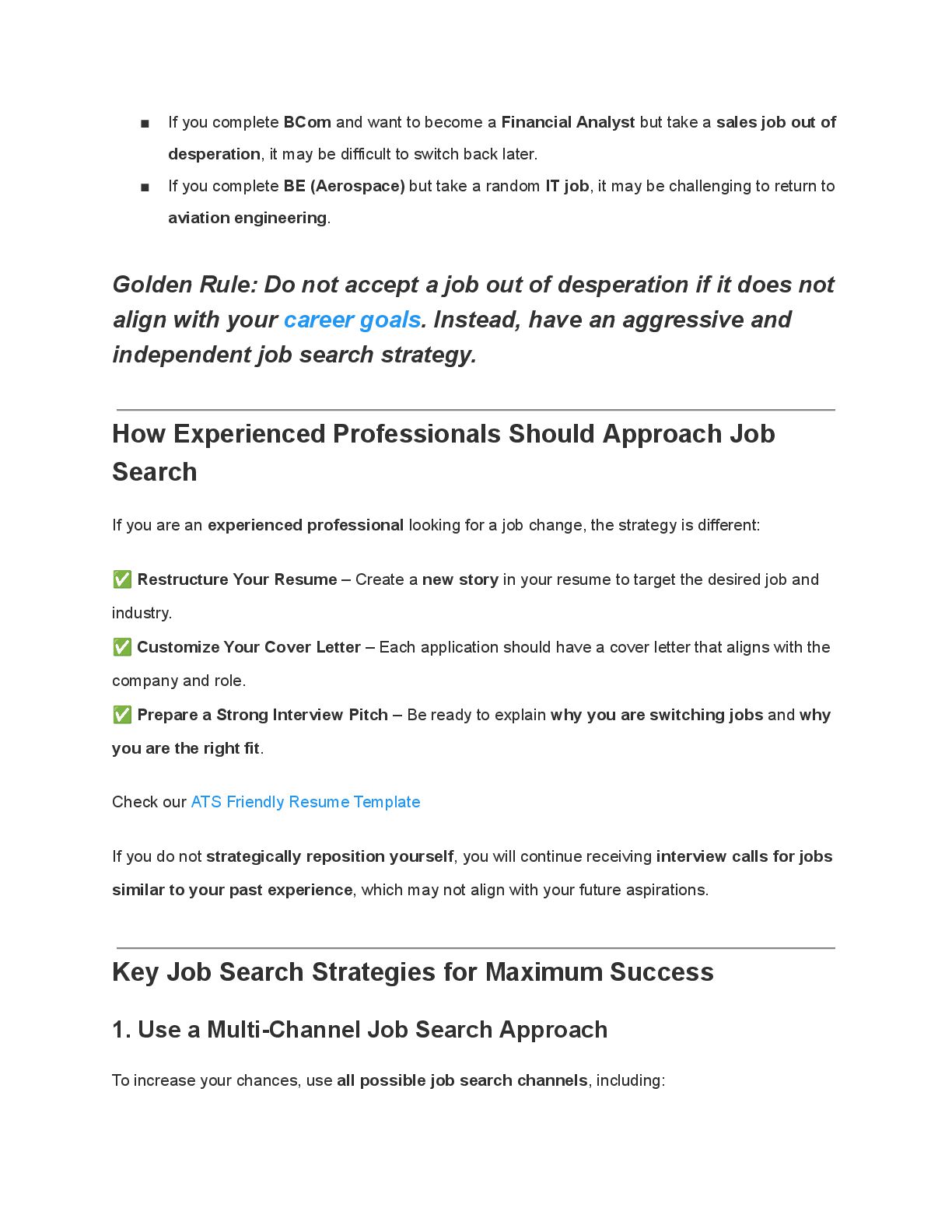
  28. ▪​ If you complete BCom and want to become a

    Financial Analyst but take a sales job out of desperation, it may be difficult to switch back later. ▪​ If you complete BE (Aerospace) but take a random IT job, it may be challenging to return to aviation engineering. Golden Rule: Do not accept a job out of desperation if it does not align with your career goals. Instead, have an aggressive and independent job search strategy. How Experienced Professionals Should Approach Job Search If you are an experienced professional looking for a job change, the strategy is different: ✅ Restructure Your Resume – Create a new story in your resume to target the desired job and industry. ​ ✅ Customize Your Cover Letter – Each application should have a cover letter that aligns with the company and role.​ ✅ Prepare a Strong Interview Pitch – Be ready to explain why you are switching jobs and why you are the right fit. Check our ATS Friendly Resume Template If you do not strategically reposition yourself, you will continue receiving interview calls for jobs similar to your past experience, which may not align with your future aspirations. Key Job Search Strategies for Maximum Success 1. Use a Multi-Channel Job Search Approach To increase your chances, use all possible job search channels, including:
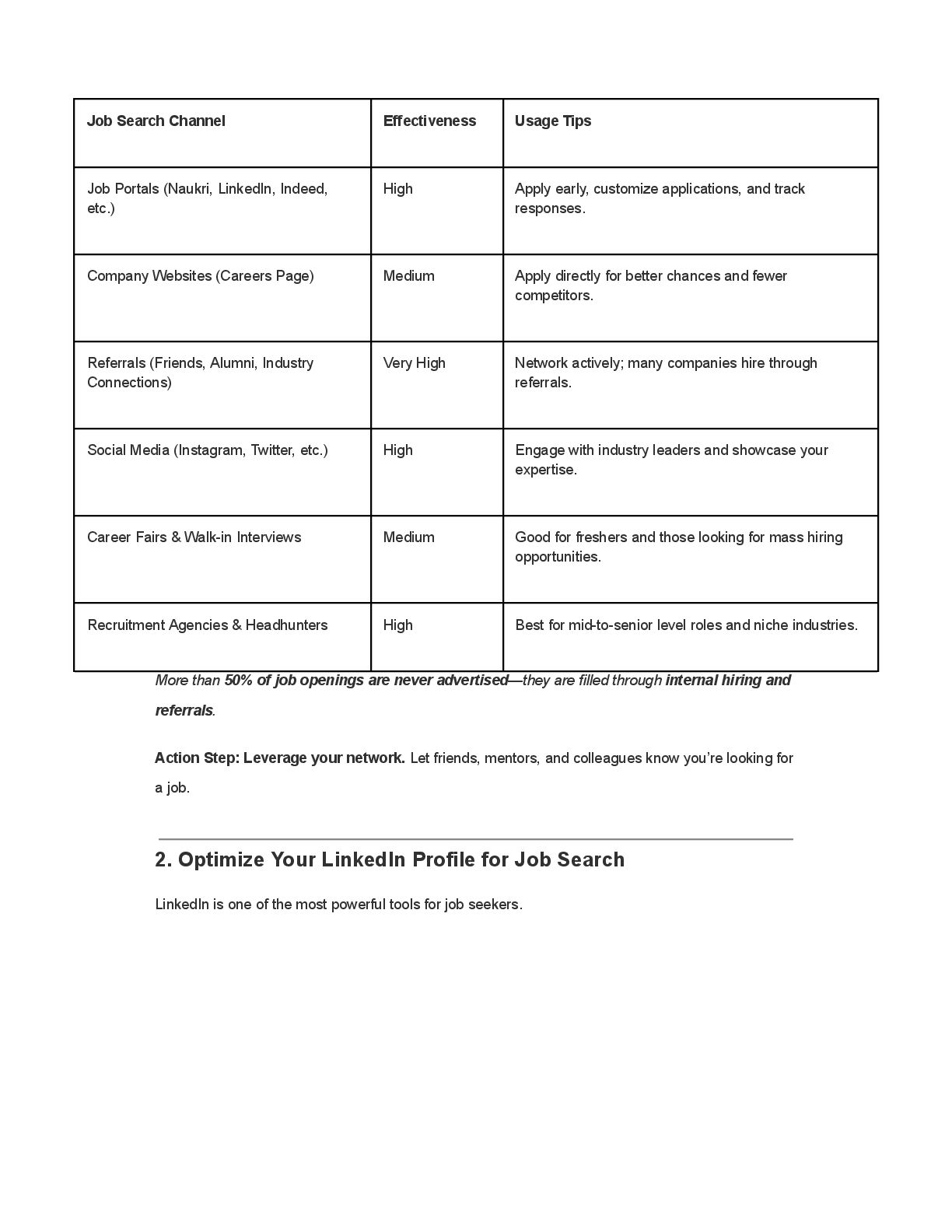
  29. Job Search Channel Effectiveness Usage Tips Job Portals (Naukri, LinkedIn,

    Indeed, etc.) High Apply early, customize applications, and track responses. Company Websites (Careers Page) Medium Apply directly for better chances and fewer competitors. Referrals (Friends, Alumni, Industry Connections) Very High Network actively; many companies hire through referrals. Social Media (Instagram, Twitter, etc.) High Engage with industry leaders and showcase your expertise. Career Fairs & Walk-in Interviews Medium Good for freshers and those looking for mass hiring opportunities. Recruitment Agencies & Headhunters High Best for mid-to-senior level roles and niche industries. More than 50% of job openings are never advertised—they are filled through internal hiring and referrals. Action Step: Leverage your network. Let friends, mentors, and colleagues know you’re looking for a job. 2. Optimize Your LinkedIn Profile for Job Search LinkedIn is one of the most powerful tools for job seekers.
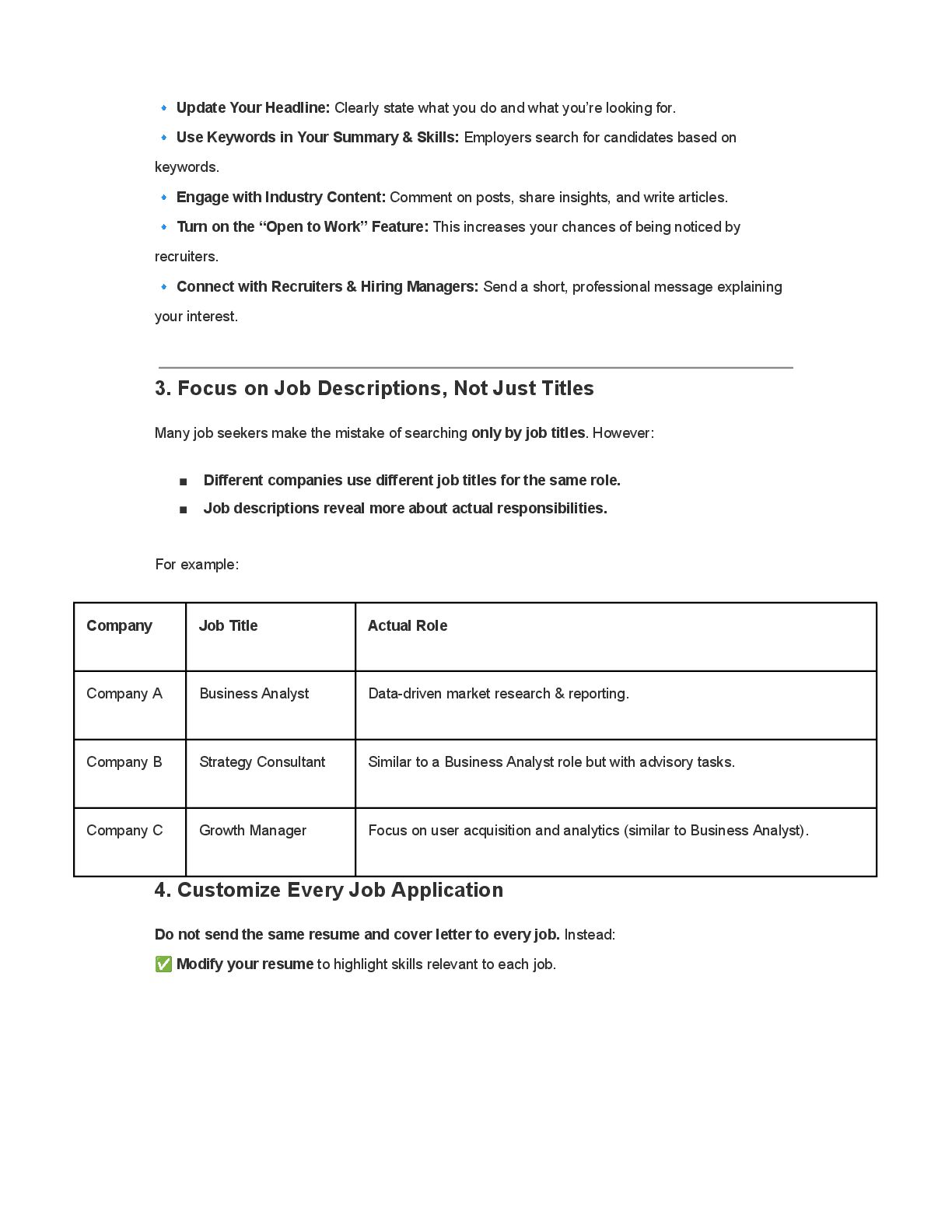
  30. 🔹 Update Your Headline: Clearly state what you do and

    what you’re looking for.​ 🔹 Use Keywords in Your Summary & Skills: Employers search for candidates based on keywords.​ 🔹 Engage with Industry Content: Comment on posts, share insights, and write articles.​ 🔹 Turn on the “Open to Work” Feature: This increases your chances of being noticed by recruiters.​ 🔹 Connect with Recruiters & Hiring Managers: Send a short, professional message explaining your interest. 3. Focus on Job Descriptions, Not Just Titles Many job seekers make the mistake of searching only by job titles. However: ▪​ Different companies use different job titles for the same role. ▪​ Job descriptions reveal more about actual responsibilities. For example: Company Job Title Actual Role Company A Business Analyst Data-driven market research & reporting. Company B Strategy Consultant Similar to a Business Analyst role but with advisory tasks. Company C Growth Manager Focus on user acquisition and analytics (similar to Business Analyst). 4. Customize Every Job Application Do not send the same resume and cover letter to every job. Instead:​ ✅ Modify your resume to highlight skills relevant to each job.​
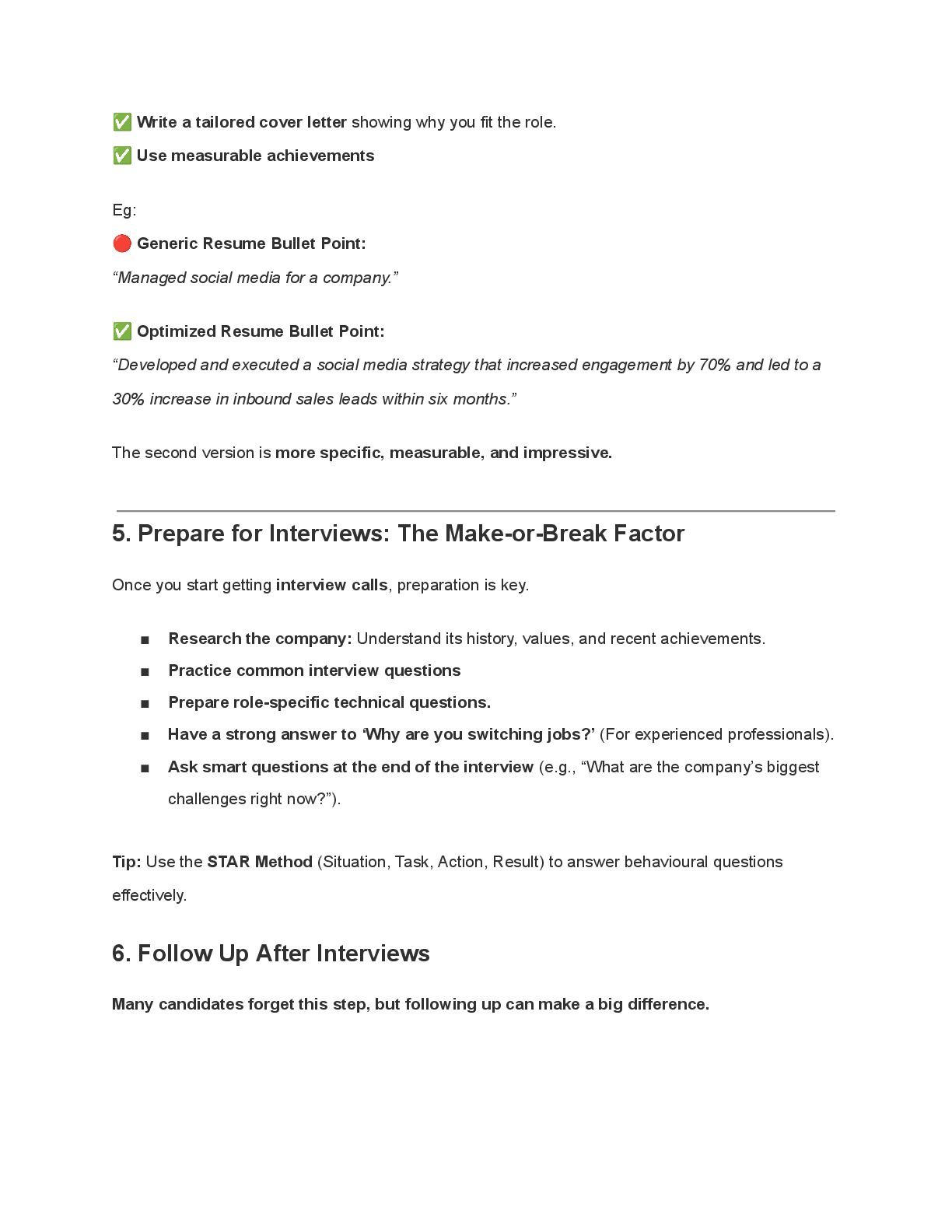
  31. ✅ Write a tailored cover letter showing why you fit

    the role.​ ✅ Use measurable achievements Eg:​ 🔴 Generic Resume Bullet Point:​ “Managed social media for a company.” ✅ Optimized Resume Bullet Point:​ “Developed and executed a social media strategy that increased engagement by 70% and led to a 30% increase in inbound sales leads within six months.” The second version is more specific, measurable, and impressive. 5. Prepare for Interviews: The Make-or-Break Factor Once you start getting interview calls, preparation is key. ▪​ Research the company: Understand its history, values, and recent achievements. ▪​ Practice common interview questions ▪​ Prepare role-specific technical questions. ▪​ Have a strong answer to ‘Why are you switching jobs?’ (For experienced professionals). ▪​ Ask smart questions at the end of the interview (e.g., “What are the company’s biggest challenges right now?”). Tip: Use the STAR Method (Situation, Task, Action, Result) to answer behavioural questions effectively. 6. Follow Up After Interviews Many candidates forget this step, but following up can make a big difference.
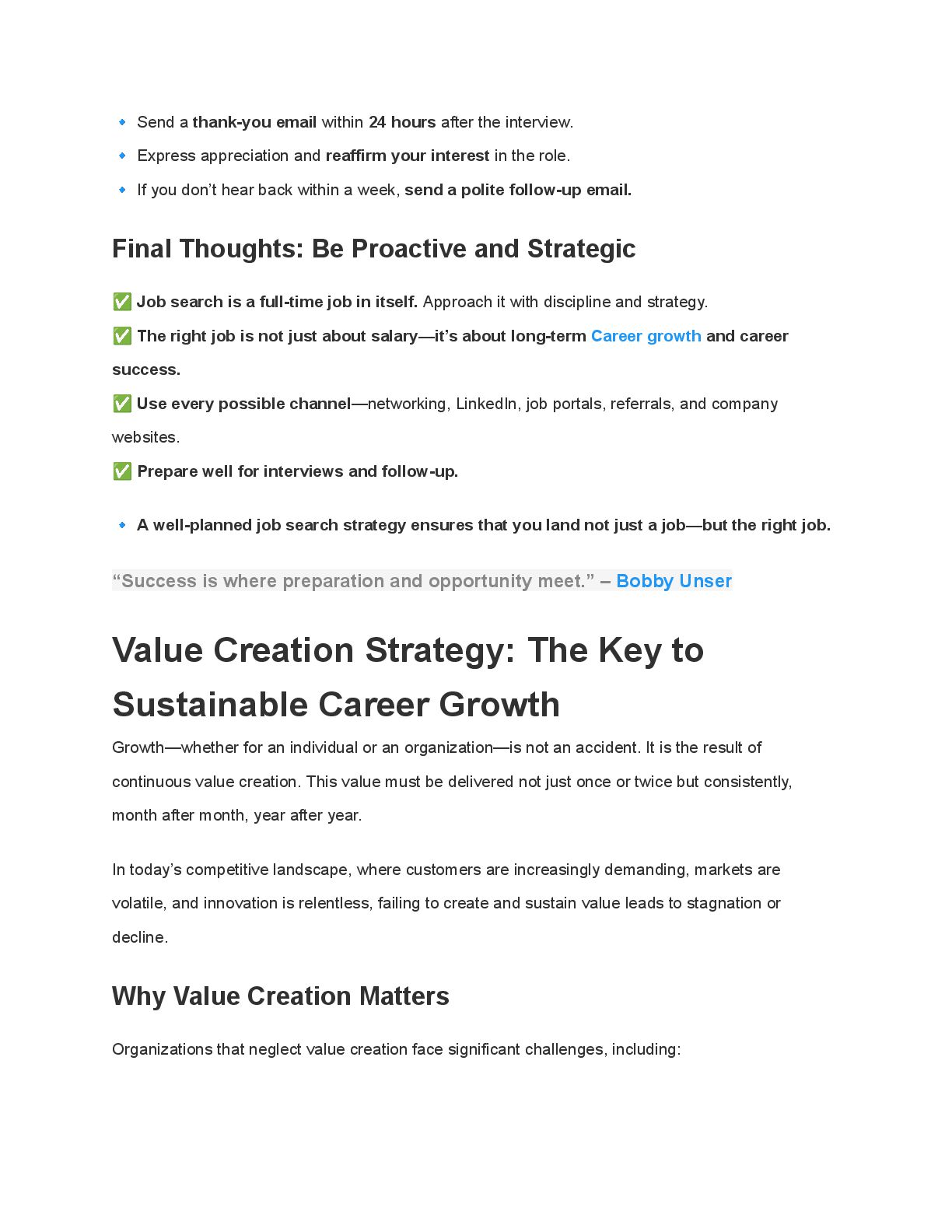
  32. 🔹 Send a thank-you email within 24 hours after the

    interview.​ 🔹 Express appreciation and reaffirm your interest in the role.​ 🔹 If you don’t hear back within a week, send a polite follow-up email. Final Thoughts: Be Proactive and Strategic ✅ Job search is a full-time job in itself. Approach it with discipline and strategy.​ ✅ The right job is not just about salary—it’s about long-term Career growth and career success.​ ✅ Use every possible channel—networking, LinkedIn, job portals, referrals, and company websites.​ ✅ Prepare well for interviews and follow-up. 🔹 A well-planned job search strategy ensures that you land not just a job—but the right job. “Success is where preparation and opportunity meet.” – Bobby Unser Value Creation Strategy: The Key to Sustainable Career Growth Growth—whether for an individual or an organization—is not an accident. It is the result of continuous value creation. This value must be delivered not just once or twice but consistently, month after month, year after year. In today’s competitive landscape, where customers are increasingly demanding, markets are volatile, and innovation is relentless, failing to create and sustain value leads to stagnation or decline. Why Value Creation Matters Organizations that neglect value creation face significant challenges, including:
  33. ▪​ Stagnation in Products & Services: A company that stops

    adding new features or improving its offerings loses relevance. ▪​ Inefficient Systems & Processes: Without refinement and optimization, inefficiencies creep in, impacting productivity and profitability. ▪​ Declining Shareholder Value: If an organization fails to generate returns for stakeholders, it risks losing investor confidence. ▪​ Loss of Market Share: Competitors with better strategies, innovations, or customer engagement will capture the market. ▪​ Inability to Manage Competition: Failure to differentiate or respond effectively to competitors results in diminishing industry presence. Similarly, individuals who do not add value in their professional roles face career stagnation. The moment an employee: ▪​ Stops innovating or improving their job-related contributions, ▪​ Fails to exceed expectations set by managers or employers, ▪​ Avoids tasks beyond their usual responsibilities, ▪​ Struggles to navigate uncertain situations through creative problem-solving, their career graph begins to flatten, and they risk being perceived as replaceable rather than indispensable. Value Addition: Beyond Fulfilling Duties Performing your core responsibilities is not enough. True career growth comes from value addition. This involves: ▪​ Enhancing Systems & Processes: Identifying bottlenecks and inefficiencies and introducing improvements. ▪​ Generating New Ideas: Suggesting innovations that drive productivity, reduce costs, or enhance service quality.
  34. ▪​ Reducing Costs & Increasing Efficiency: Optimizing workflows to ensure

    better utilization of resources. ▪​ Delivering Ahead of Schedules: Meeting deadlines is good, but consistently outperforming timelines adds credibility. ▪​ Increasing Productivity: Helping teams work smarter through collaboration, training, or automation. Employees who fail to engage in such activities are often seen as skilled labourers rather than strategic contributors or experts. As a result, their career growth becomes uncertain. How Employers Measure Value Creation Your manager and employer are constantly evaluating you—consciously or unconsciously—on your ability to create value. Directly or indirectly, they observe: ▪​ Your willingness to take initiative, ▪​ Your problem-solving abilities, ▪​ How efficiently you handle tasks beyond your job description, ▪​ Your contribution to team and organizational success, ▪​ The level of influence you have on others. Additionally, your colleagues and peers talk about you. Over time, this informal feedback shapes your professional reputation. Depending on how you engage with your work, you can be recognized as: ▪​ A Go-Getter: Someone who takes initiative and delivers results. ▪​ An Innovator: A professional who brings fresh ideas and solutions. ▪​ A Problem-Solver: Someone capable of handling challenges creatively. ▪​ An Influencer: A person whose thoughts and ideas inspire others. On the other hand, a lack of value creation can result in labels like: ▪​ Non-Performer: Someone who does the bare minimum.
  35. ▪​ Procrastinator: An employee who struggles with meeting deadlines. ▪​

    Non-Serious: Someone whose lack of enthusiasm affects team morale. Actionable Steps for Continuous Value Creation To ensure you remain an asset to your organization and industry, focus on the following strategies: 1.​ Develop a Growth Mindset: Always seek learning opportunities. Be open to feedback and use it constructively. 2.​ Think Beyond Your Role: Look for ways to contribute outside your job description. Offer solutions, help colleagues, and support broader company goals. 3.​ Stay Updated with Industry Trends: Read industry reports, attend conferences, and upskill yourself to stay ahead of the curve. 4.​ Innovate & Optimize: If you see an area for improvement, take the initiative to propose or implement changes. 5.​ Become a Problem-Solver: Rather than just pointing out issues, bring solutions. Employers value those who can troubleshoot effectively. 6.​ Build Your Personal Brand: Engage in thought leadership by sharing knowledge, writing articles, or speaking at events. 7.​ Foster Collaboration: Work with different teams, encourage knowledge-sharing, and help build a positive work culture. Conclusion Career success is directly tied to value creation. The more you contribute beyond expectations, the more indispensable you become. Whether through innovation, efficiency, leadership, or collaboration, consistent value addition ensures steady growth, recognition, and long-term professional success. By identifying your strengths and leveraging them effectively, you can ensure that your career continues to thrive in an ever-changing professional landscape. Life Fulfillment Strategy: A Holistic Approach to Career Success Career success is often measured in terms of power, position, authority, and financial growth. While these elements play a crucial role in professional achievement, true fulfilment in life goes beyond
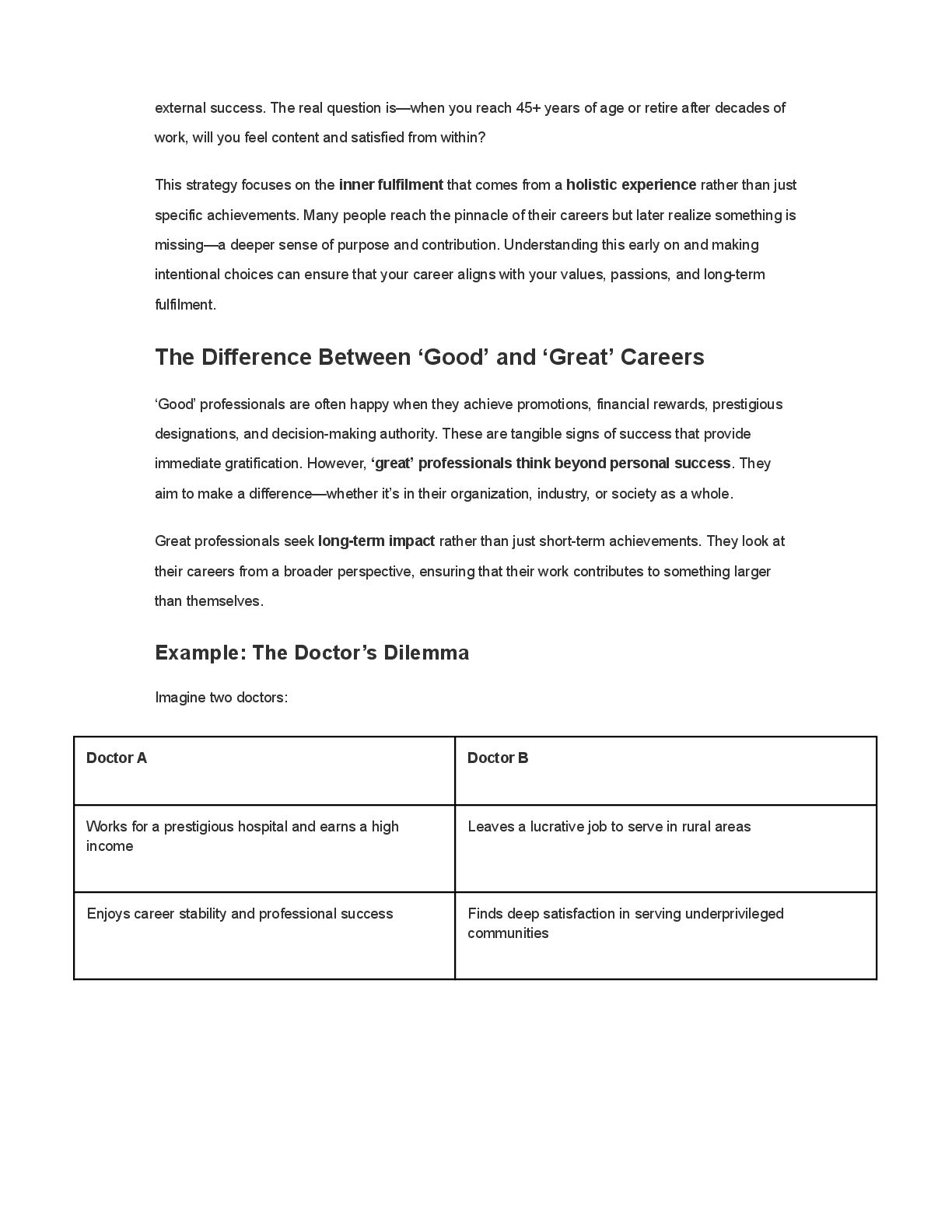
  36. external success. The real question is—when you reach 45+ years

    of age or retire after decades of work, will you feel content and satisfied from within? This strategy focuses on the inner fulfilment that comes from a holistic experience rather than just specific achievements. Many people reach the pinnacle of their careers but later realize something is missing—a deeper sense of purpose and contribution. Understanding this early on and making intentional choices can ensure that your career aligns with your values, passions, and long-term fulfilment. The Difference Between ‘Good’ and ‘Great’ Careers ‘Good’ professionals are often happy when they achieve promotions, financial rewards, prestigious designations, and decision-making authority. These are tangible signs of success that provide immediate gratification. However, ‘great’ professionals think beyond personal success. They aim to make a difference—whether it’s in their organization, industry, or society as a whole. Great professionals seek long-term impact rather than just short-term achievements. They look at their careers from a broader perspective, ensuring that their work contributes to something larger than themselves. Example: The Doctor’s Dilemma Imagine two doctors: Doctor A Doctor B Works for a prestigious hospital and earns a high income Leaves a lucrative job to serve in rural areas Enjoys career stability and professional success Finds deep satisfaction in serving underprivileged communities
  37. Measures success through income and recognition Measures success through the

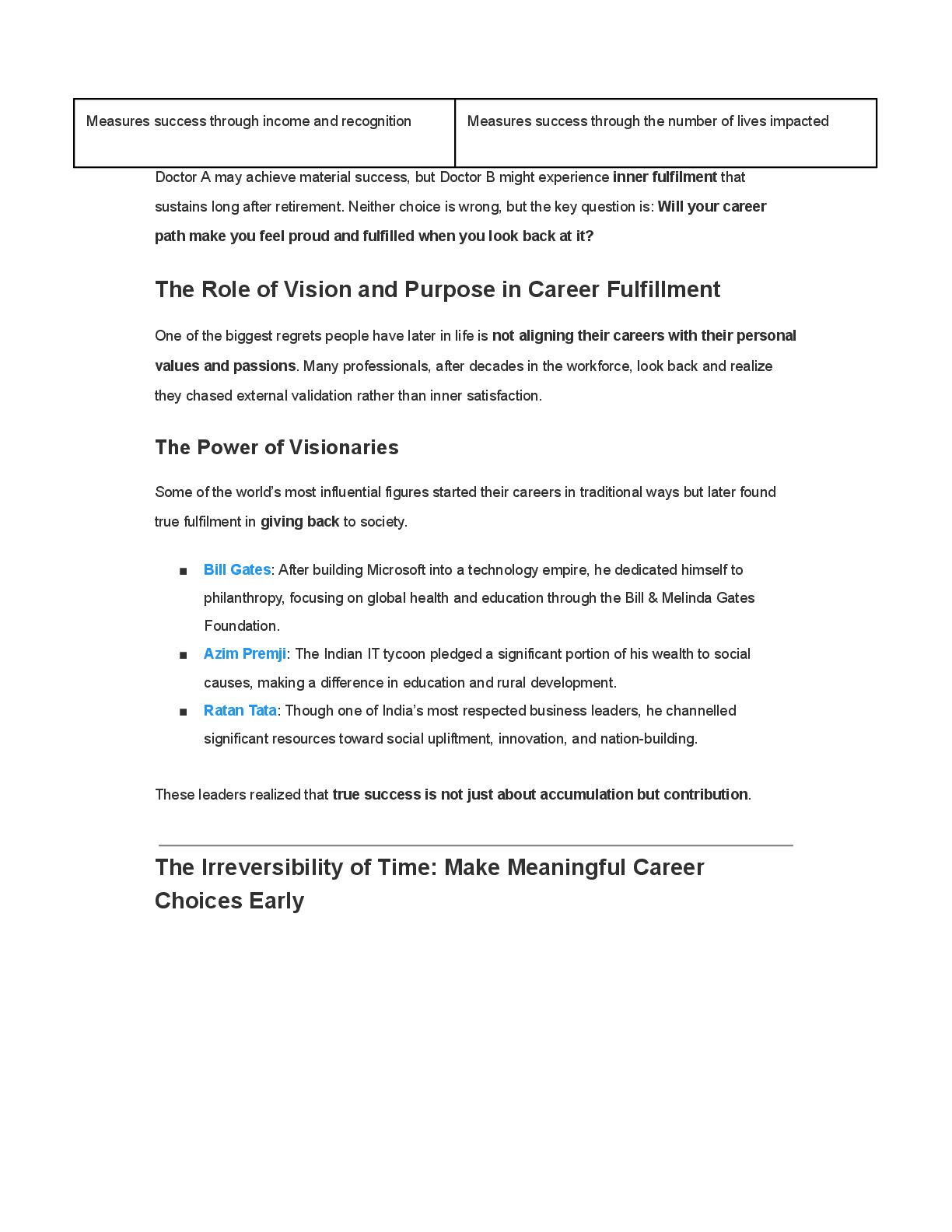
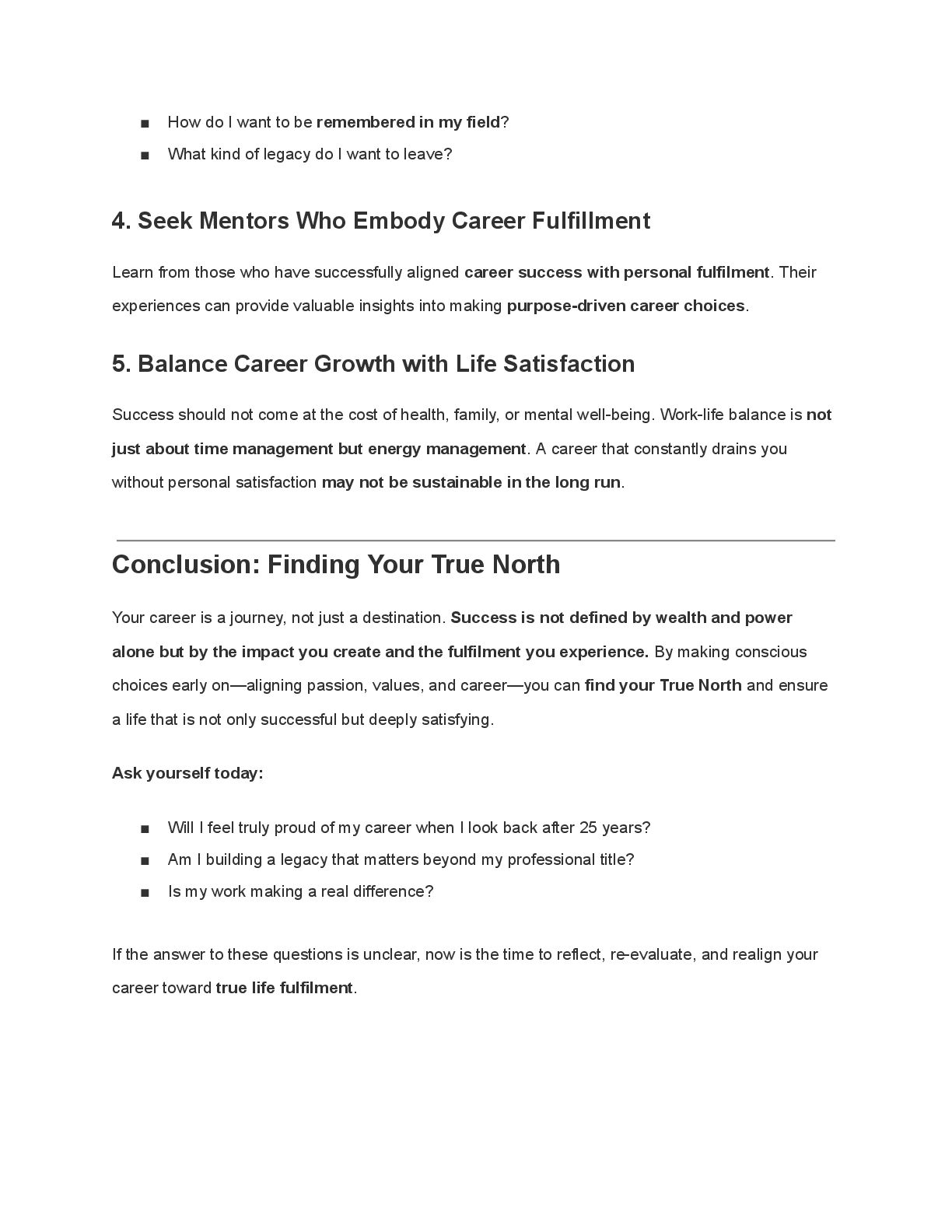
    number of lives impacted Doctor A may achieve material success, but Doctor B might experience inner fulfilment that sustains long after retirement. Neither choice is wrong, but the key question is: Will your career path make you feel proud and fulfilled when you look back at it? The Role of Vision and Purpose in Career Fulfillment One of the biggest regrets people have later in life is not aligning their careers with their personal values and passions. Many professionals, after decades in the workforce, look back and realize they chased external validation rather than inner satisfaction. The Power of Visionaries Some of the world’s most influential figures started their careers in traditional ways but later found true fulfilment in giving back to society. ▪​ Bill Gates: After building Microsoft into a technology empire, he dedicated himself to philanthropy, focusing on global health and education through the Bill & Melinda Gates Foundation. ▪​ Azim Premji: The Indian IT tycoon pledged a significant portion of his wealth to social causes, making a difference in education and rural development. ▪​ Ratan Tata: Though one of India’s most respected business leaders, he channelled significant resources toward social upliftment, innovation, and nation-building. These leaders realized that true success is not just about accumulation but contribution. The Irreversibility of Time: Make Meaningful Career Choices Early
  38. Time is a non-renewable resource. Once a career decision is

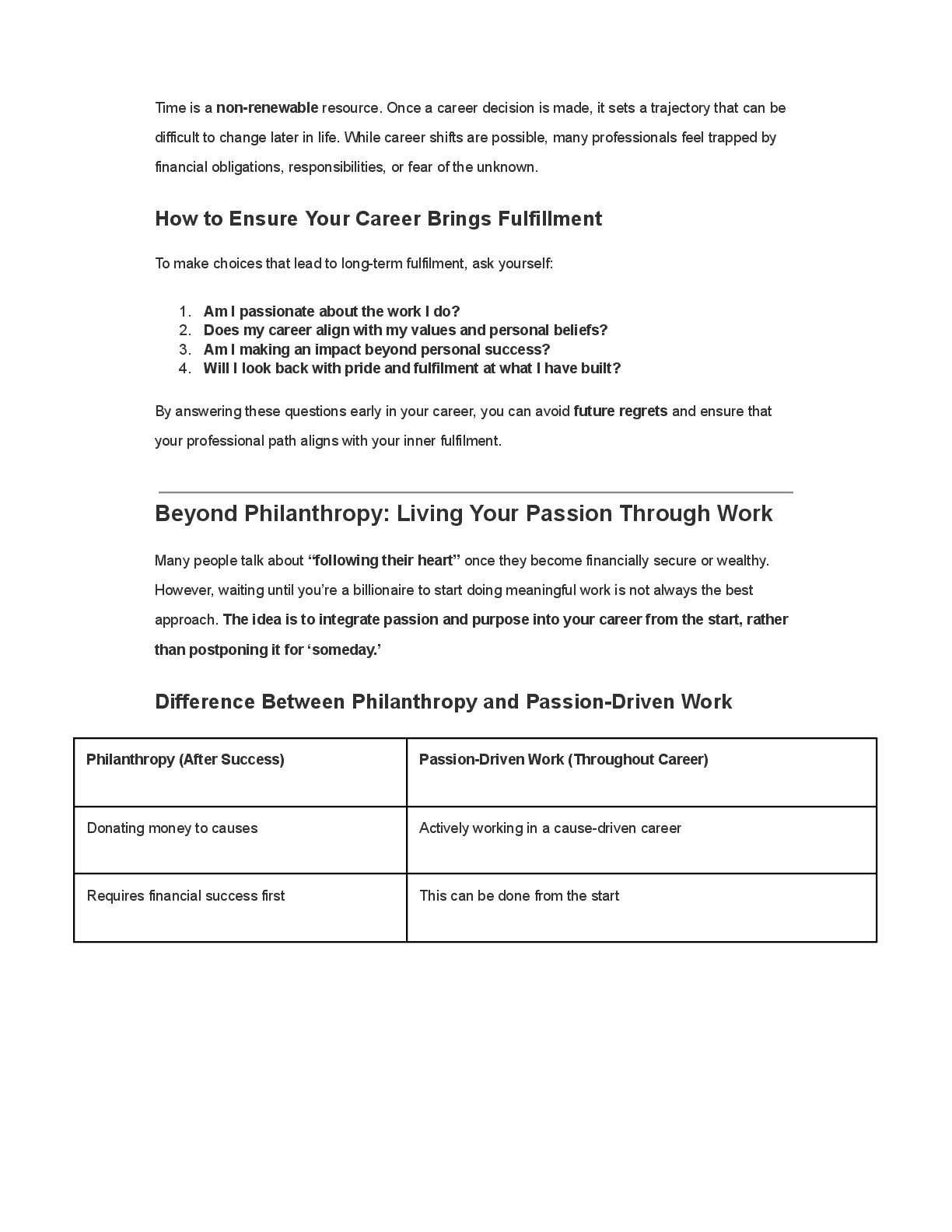
    made, it sets a trajectory that can be difficult to change later in life. While career shifts are possible, many professionals feel trapped by financial obligations, responsibilities, or fear of the unknown. How to Ensure Your Career Brings Fulfillment To make choices that lead to long-term fulfilment, ask yourself: 1.​ Am I passionate about the work I do? 2.​ Does my career align with my values and personal beliefs? 3.​ Am I making an impact beyond personal success? 4.​ Will I look back with pride and fulfilment at what I have built? By answering these questions early in your career, you can avoid future regrets and ensure that your professional path aligns with your inner fulfilment. Beyond Philanthropy: Living Your Passion Through Work Many people talk about “following their heart” once they become financially secure or wealthy. However, waiting until you’re a billionaire to start doing meaningful work is not always the best approach. The idea is to integrate passion and purpose into your career from the start, rather than postponing it for ‘someday.’ Difference Between Philanthropy and Passion-Driven Work Philanthropy (After Success) Passion-Driven Work (Throughout Career) Donating money to causes Actively working in a cause-driven career Requires financial success first This can be done from the start
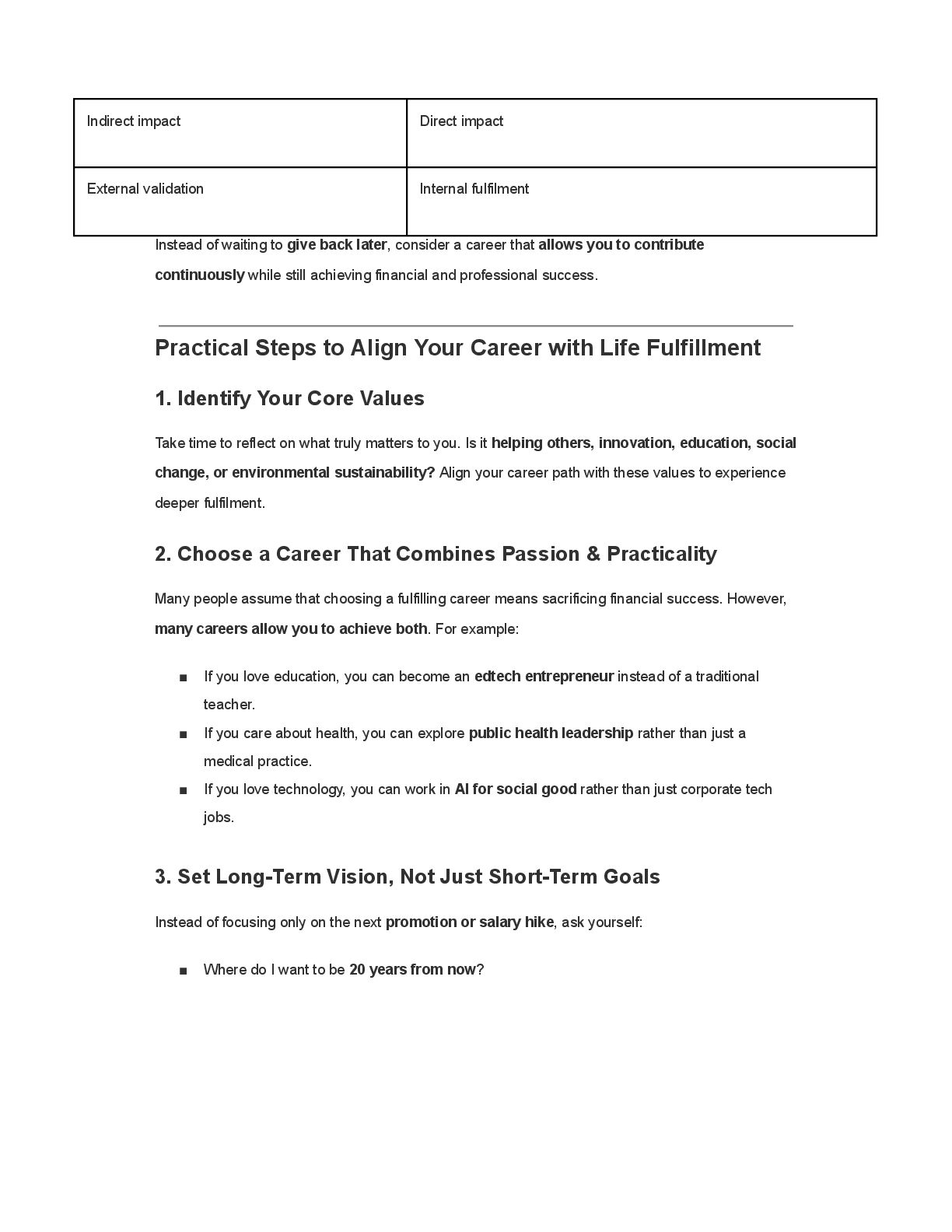
  39. Indirect impact Direct impact External validation Internal fulfilment Instead of

    waiting to give back later, consider a career that allows you to contribute continuously while still achieving financial and professional success. Practical Steps to Align Your Career with Life Fulfillment 1. Identify Your Core Values Take time to reflect on what truly matters to you. Is it helping others, innovation, education, social change, or environmental sustainability? Align your career path with these values to experience deeper fulfilment. 2. Choose a Career That Combines Passion & Practicality Many people assume that choosing a fulfilling career means sacrificing financial success. However, many careers allow you to achieve both. For example: ▪​ If you love education, you can become an edtech entrepreneur instead of a traditional teacher. ▪​ If you care about health, you can explore public health leadership rather than just a medical practice. ▪​ If you love technology, you can work in AI for social good rather than just corporate tech jobs. 3. Set Long-Term Vision, Not Just Short-Term Goals Instead of focusing only on the next promotion or salary hike, ask yourself: ▪​ Where do I want to be 20 years from now?
  40. ▪​ How do I want to be remembered in my

    field? ▪​ What kind of legacy do I want to leave? 4. Seek Mentors Who Embody Career Fulfillment Learn from those who have successfully aligned career success with personal fulfilment. Their experiences can provide valuable insights into making purpose-driven career choices. 5. Balance Career Growth with Life Satisfaction Success should not come at the cost of health, family, or mental well-being. Work-life balance is not just about time management but energy management. A career that constantly drains you without personal satisfaction may not be sustainable in the long run. Conclusion: Finding Your True North Your career is a journey, not just a destination. Success is not defined by wealth and power alone but by the impact you create and the fulfilment you experience. By making conscious choices early on—aligning passion, values, and career—you can find your True North and ensure a life that is not only successful but deeply satisfying. Ask yourself today: ▪​ Will I feel truly proud of my career when I look back after 25 years? ▪​ Am I building a legacy that matters beyond my professional title? ▪​ Is my work making a real difference? If the answer to these questions is unclear, now is the time to reflect, re-evaluate, and realign your career toward true life fulfilment.