or a robot controlled by a computer to do tasks that are usually done by humans because they require human intelligence and discernment. In computer terms, it is the programming and development of machines and systems capable of using and interpreting information in a manner similar to the activities of a human. AI technologies are able to understand, analyse, and learn from data through specially designed algorithms, which are complex mathematical formulas and operations. Artificial intelligence is widely used to provide personalised recommendations to people, based for example on their previous searches and purchases or other online behaviour. AI is hugely important in commerce: optimising products, planning inventory, logistics etc. AI will lead to increased levels of productivity, specialization in job roles, and an increased importance of “human skills'' like creativity, problem solving, and quantitative skills. Although AI will increase economic growth, these gains will not be evenly distributed. Rural communities that already face high levels of job insecurity will come under additional strain. AI will benefit labour in some industries but threaten it in others. As AI is becoming an integral part of various institutions, organizations are starting to develop AI codes of ethics. AI ethics is a system of moral principles and techniques intended to inform the development and responsible use of artificial intelligence technology. The ethical concepts have been discussed in detail.
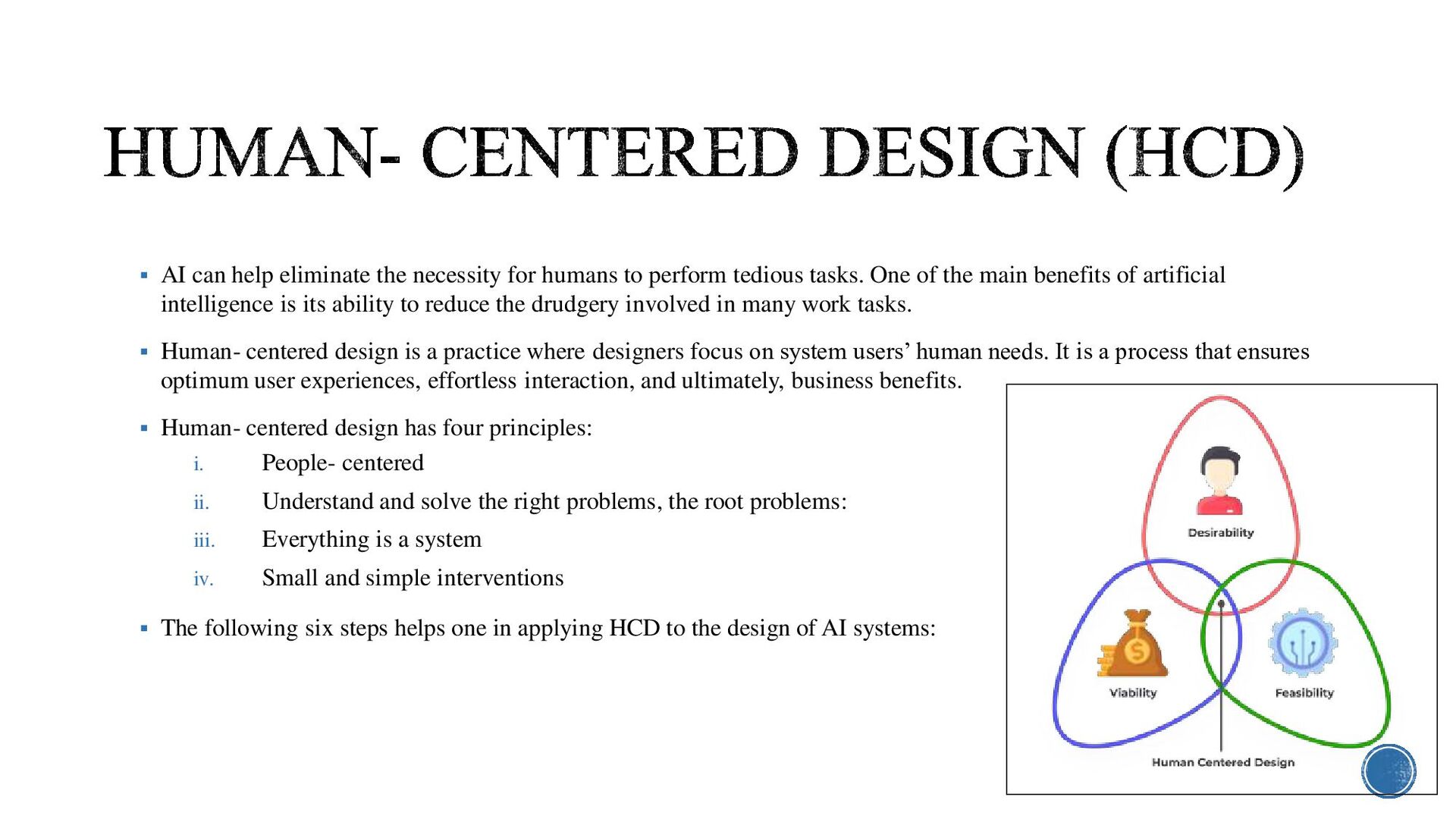
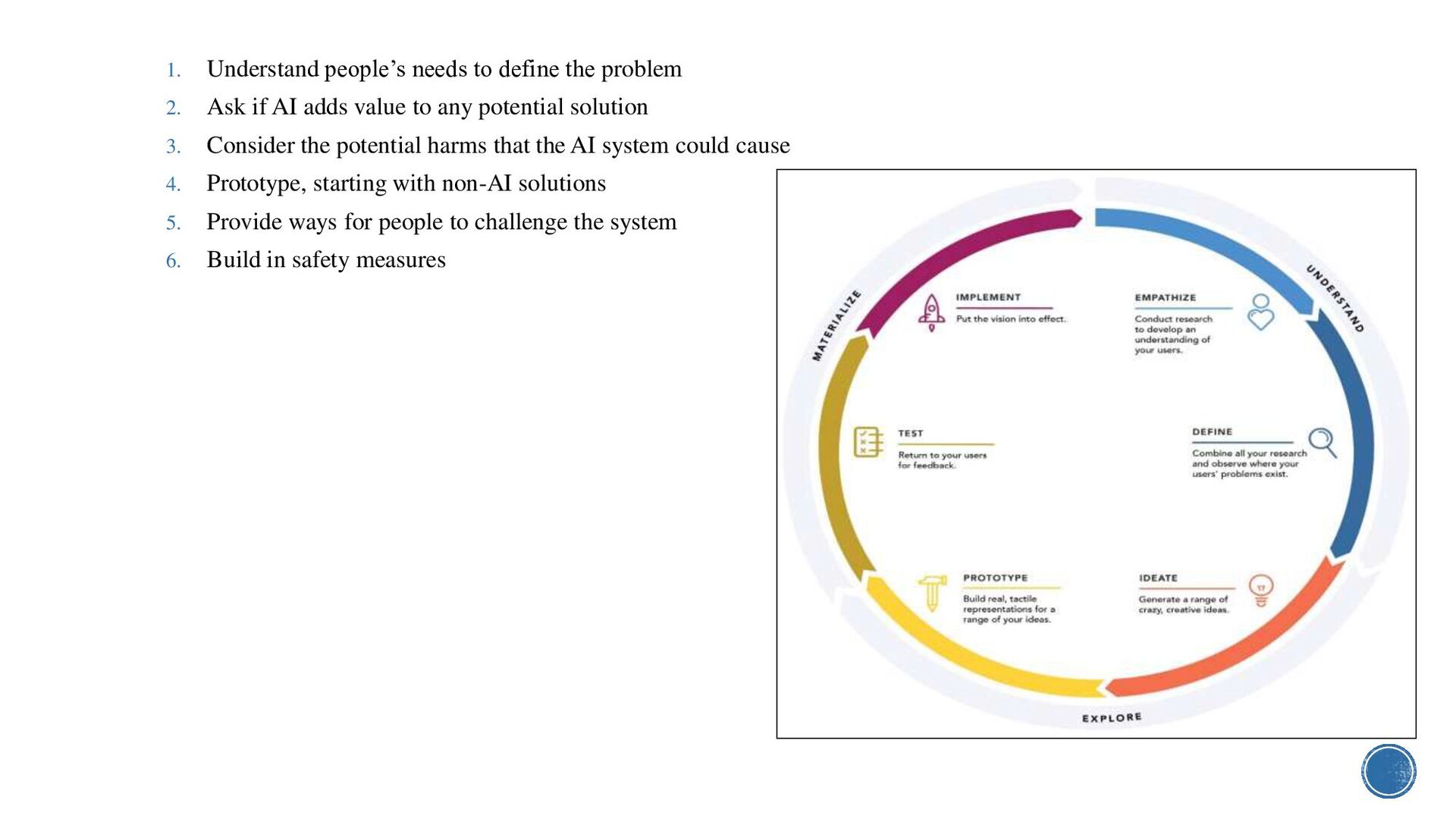
perform tedious tasks. One of the main benefits of artificial intelligence is its ability to reduce the drudgery involved in many work tasks. Human- centered design is a practice where designers focus on system users’ human needs. It is a process that ensures optimum user experiences, effortless interaction, and ultimately, business benefits. Human- centered design has four principles: i. People- centered ii. Understand and solve the right problems, the root problems: iii. Everything is a system iv. Small and simple interventions The following six steps helps one in applying HCD to the design of AI systems:
if AI adds value to any potential solution 3. Consider the potential harms that the AI system could cause 4. Prototype, starting with non-AI solutions 5. Provide ways for people to challenge the system 6. Build in safety measures
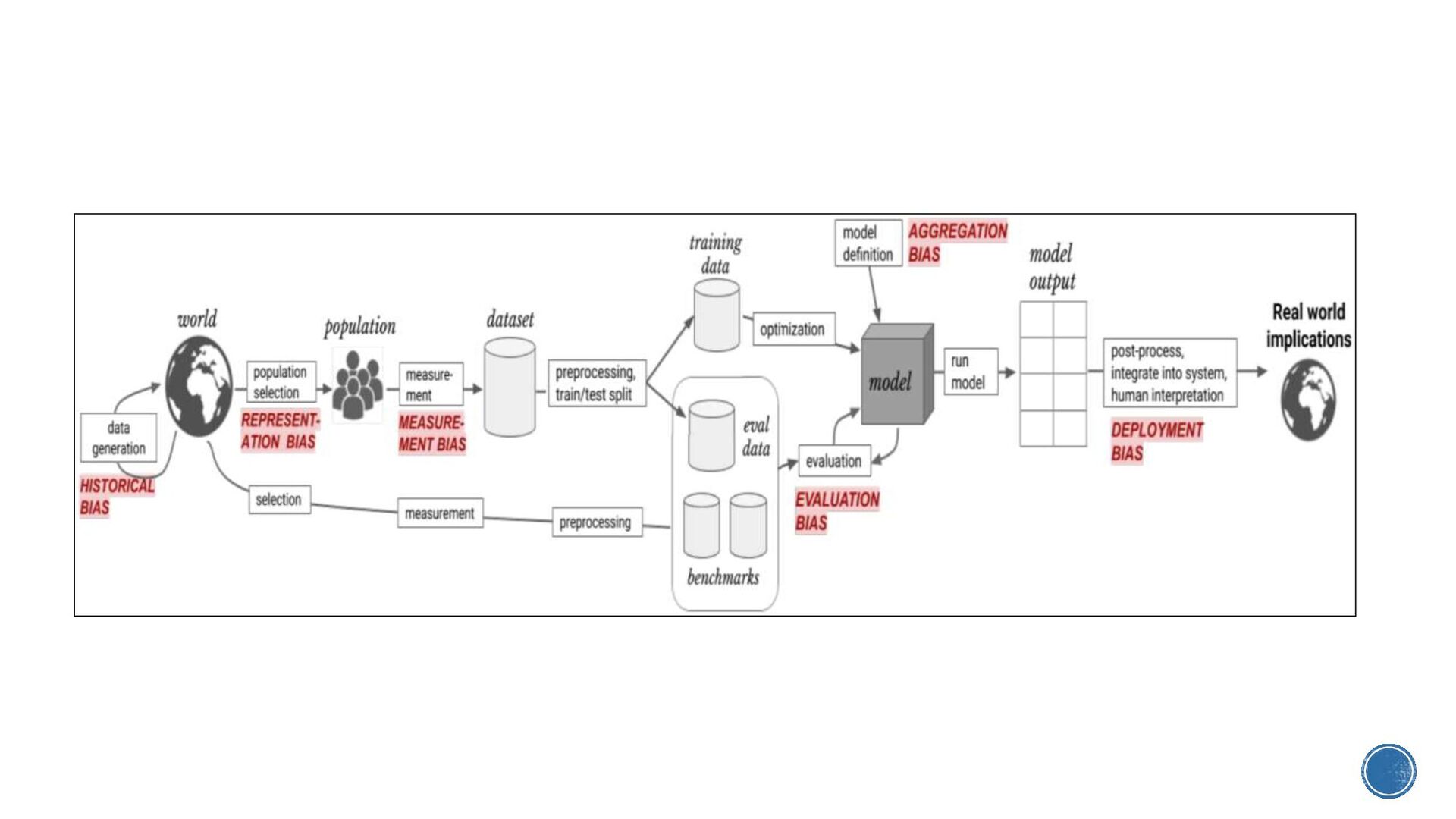
machine learning algorithms, due to the prejudiced assumptions made during the algorithm development process or prejudices in the training data. There are six types of bias, that can occur in an AI project: i. Historical bias: occurs when the state of the world in which the data was generated is flawed. ii. Representation bias: occurs when building datasets for training a model, if those datasets poorly represent the people that the model will serve. iii. Measurement bias: occurs when the accuracy of the data varies across groups. This can happen when working with proxy variables (variables that take the place of a variable that cannot be directly measured), if the quality of the proxy varies in different groups. iv. Aggregation bias: occurs when groups are inappropriately combined, resulting in a model that does not perform well for any group or only performs well for the majority group. (This is often not an issue, but most commonly arises in medical applications.) v. Evaluation bias: occurs when evaluating a model, if the benchmark data (used to compare the model to other models that perform similar tasks) does not represent the population that the model will serve. vi. Deployment bias: occurs when the problem the model is intended to solve is different from the way it is actually used. If the end users don’t use the model in the way it is intended, there is no guarantee that the model will perform well.
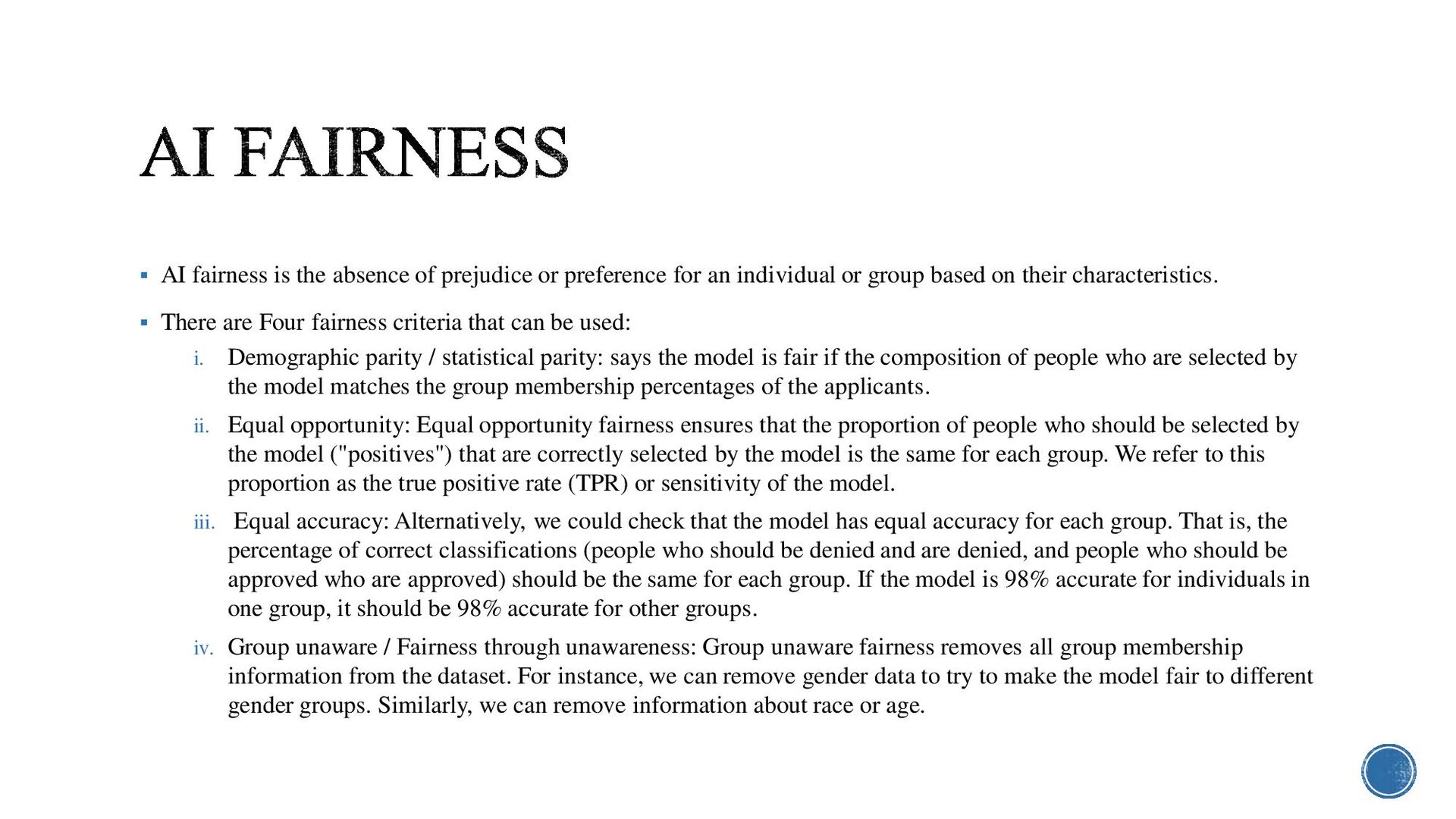
for an individual or group based on their characteristics. There are Four fairness criteria that can be used: i. Demographic parity / statistical parity: says the model is fair if the composition of people who are selected by the model matches the group membership percentages of the applicants. ii. Equal opportunity: Equal opportunity fairness ensures that the proportion of people who should be selected by the model ("positives") that are correctly selected by the model is the same for each group. We refer to this proportion as the true positive rate (TPR) or sensitivity of the model. iii. Equal accuracy: Alternatively, we could check that the model has equal accuracy for each group. That is, the percentage of correct classifications (people who should be denied and are denied, and people who should be approved who are approved) should be the same for each group. If the model is 98% accurate for individuals in one group, it should be 98% accurate for other groups. iv. Group unaware / Fairness through unawareness: Group unaware fairness removes all group membership information from the dataset. For instance, we can remove gender data to try to make the model fair to different gender groups. Similarly, we can remove information about race or age.
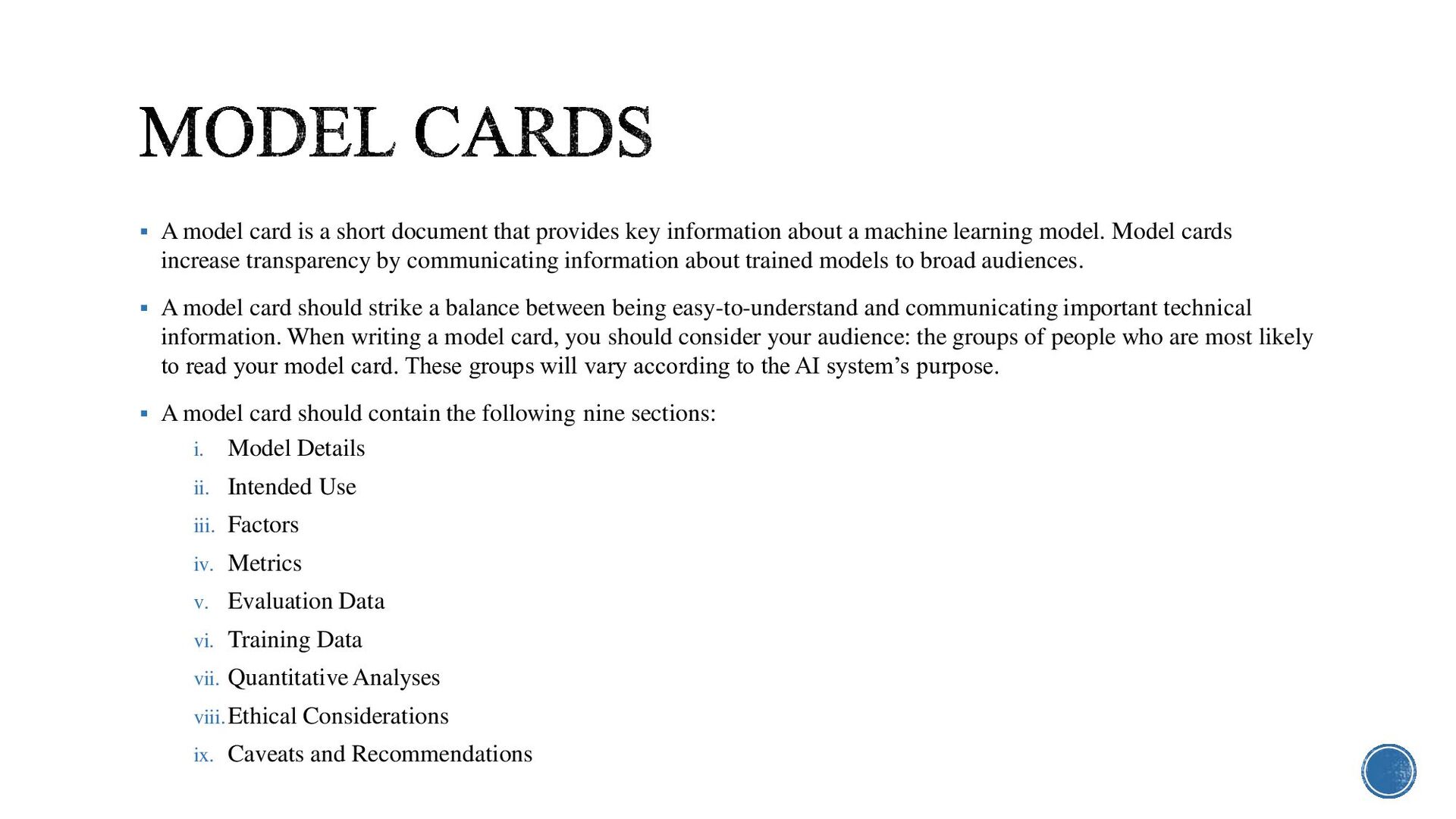
key information about a machine learning model. Model cards increase transparency by communicating information about trained models to broad audiences. A model card should strike a balance between being easy-to-understand and communicating important technical information. When writing a model card, you should consider your audience: the groups of people who are most likely to read your model card. These groups will vary according to the AI system’s purpose. A model card should contain the following nine sections: i. Model Details ii. Intended Use iii. Factors iv. Metrics v. Evaluation Data vi. Training Data vii. Quantitative Analyses viii.Ethical Considerations ix. Caveats and Recommendations


 ashwini_s
 terasawat
 bvr7352
 coderdojojapan
 mutomasa
 pawan_pharm
 ssmedikasda
 drpoonamkc
 ishii_mit
 spring_aki
 suisan
 rashwhitman
 masakiokuda
 ipullrank
 reverentgeek
 eitanlees
 leimatthew05
 geoffreycrofte
 addyosmani
 speakerdeck
 hatefulcrawdad
 aleyda
 pedronauck
 eileencodes
 caitiem20