Upgrade to Pro — share decks privately, control downloads, hide ads and more …

Data Science in Military

Data Science in Military

Avatar for Ashwini Srinivasan

Ashwini Srinivasan

March 29, 2022

More Decks by Ashwini Srinivasan

Other Decks in Education

Transcript

  1.  Military Domain o What is Military? o What is

    a domain? o Meaning of Military Domain  A Brief Overview of Military Domain.  Data science in Military. o Role of Data Scientists in this domain o The Indian Scenario o Recent developments in India  Use of Data science by other Country’s Military  References
  2.  A military, also known as armed forces, is a

    heavily armed, highly organized force primarily intended for warfare. It is typically authorized and maintained by the government of the country, with its members identifiable by their distinct military uniform. It may consist of one or more military branches such as an army, navy, air force, space force, marines, or coast guard. The main task of the military is usually defined as defence of the state and its interests against external armed threats.  A domain is an area of interest or an area over which a person has control. Whereas, a domain name is an identification string that defines a realm of administrative autonomy, authority or control within the Internet. Domain names are used in various networking contexts and for application-specific naming and addressing purposes.  A military domain (.mil) is used by the military entities of a country.
  3.  Military domain was first created by the United States

    Department of Defence and its subsidiary or affiliated organizations in January 1985, which was a sponsored top-level domain (sTLD) in the Domain Name System.  The United States is the only country that has a top-level domain for its military, a legacy of the United States' military's role in the creation of the Internet. Other countries often use second-level domains for this purpose, e.g., mod.uk for the United Kingdom's Ministry of Defence. Canada uses norad.mil with the United States as they jointly operate the North American Aerospace Defence Command.  In the recent years, a Multi- Domain Operations has been adopted by many nation states.  The concept of Multi-Domain Operations (MDO) was first published by the United States in 2018 when it first applied the concept of the Multi-Domain Operations as a crisis response, and conflict to support Joint All Domain Operations. The multi-domain operations enhances the credibility of military deterrence, enabling policy makers to employ the right mix of diplomatic, economic, and information levers to prevent a conflict before it starts.
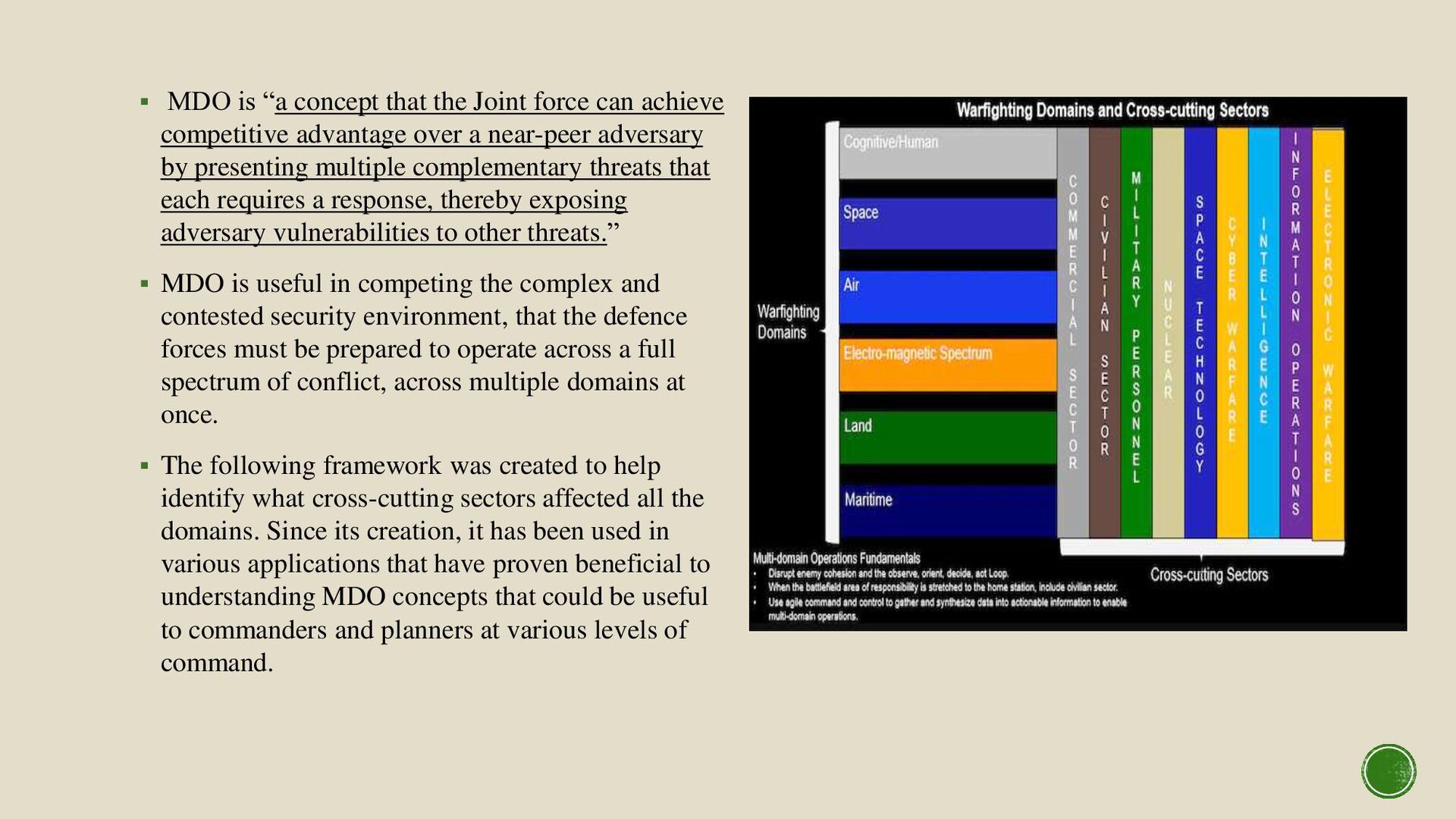
  4.  MDO is “a concept that the Joint force can

    achieve competitive advantage over a near-peer adversary by presenting multiple complementary threats that each requires a response, thereby exposing adversary vulnerabilities to other threats.”  MDO is useful in competing the complex and contested security environment, that the defence forces must be prepared to operate across a full spectrum of conflict, across multiple domains at once.  The following framework was created to help identify what cross-cutting sectors affected all the domains. Since its creation, it has been used in various applications that have proven beneficial to understanding MDO concepts that could be useful to commanders and planners at various levels of command.
  5.  Defence and security have often been at the forefront

    of new technologies. Some of the most important applications we use every day, such as the internet, were first developed for military use.  Data Science is being used extensively by the armed forces in the recent years. Data Science focuses on planning for acquisition, management, analysis of, and inference from data. Government and industry alike are experiencing a massive growth in the volume, velocity, and variety of available data.  The reason for this change is that apart from physical strength, the modern day military, intelligence and law enforcement operations require a lot of interpretation of information which they receive through varied channels like phones, internet, satellite etc. In all the domestic and overseas bases, such data is generated every day, every minute or rather every second.  This information or data can be utilized to bring out useful insights to protect the homeland.  The use of data analytics in the military not only lies in intelligence, surveillance, border management, maritime management, space management, operational planning but also in logistics, financial management, disaster management, future technologies, cognitive analysis and analysis of historical data.
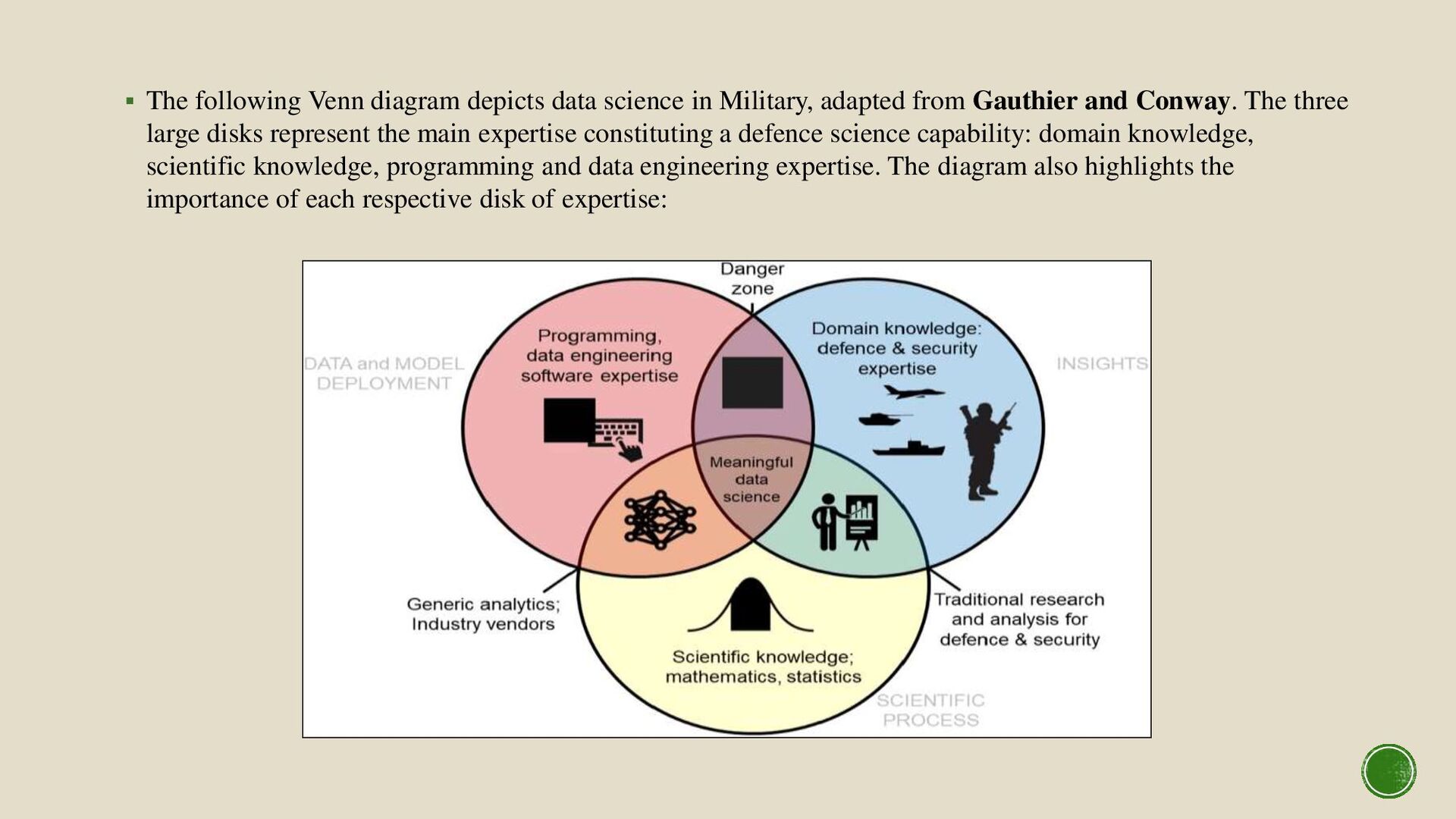
  6.  The following Venn diagram depicts data science in Military,

    adapted from Gauthier and Conway. The three large disks represent the main expertise constituting a defence science capability: domain knowledge, scientific knowledge, programming and data engineering expertise. The diagram also highlights the importance of each respective disk of expertise:
  7. a) Without programming and data engineering expertise, the capability is

    limited to traditional research and analysis. This intersection is where most military operations research resides, and analogously, military human performance research. While still highly valued, this research is often presented in the form of reports or presentation, but not operationalized with live data streams, dashboards, or other facilitators that may enable real-time decision making. b) Without domain knowledge, skilful programmers and expert scientists are left creating generic products that may miss the mark with respect to answering the right questions. These are often represented by solutions proposed by industry. While often sleek and user-friendly, they may lack the flexibility to be used off-the-shelf. c) Without scientific expertise, defence and security experts are left to their own devices, relying on contractors to provide programming and data engineering expertise. This represents the danger zone on the diagram, appropriately represented by a ‘black box’. Excluding the scientific process limits the decision makers ability to truly trust (let alone understand) what the analytical tool is presenting. Worse, the risk of making the wrong decision based on an incorrect interpretation or manipulation of data is heightened.  With the data analytics spectrum and data science capability Venn diagram in hand, military human performance researchers will not only identify where their strengths lie, but also understand areas of weakness and how they need to partner to truly operationalize their research via data analytics.  Military intelligence (MILINT) AI is a growing phenomenon that generates conceptual transformation in future battlefield concepts of operations (ConOps), gathered by demand for AI-analytics-based sensors paradigm. It increases intelligence resources in defence budgets, and becomes a strategic national asset that reflects deeply international superpower relations.  With its strategic implications on armed forces around the globe, intelligence warfare will take place across a multi- domain battlespace with further integration of air, maritime, land, and cyber-based intelligence analytics domains.
  8.  Role of data Scientists in Military: • The Data

    Scientists not only work with the advanced hardware and software but also with the techniques to develop computational algorithms and statistical methods that find patterns and relations in the vast sea of data. • Data scientists in the military, intelligence and law enforcement benefit the organization by mitigating the risk of failure, gaining a better understanding of the anti-national elements, receiving unique insights, aiding in efficient expansion and improving event predictions. These benefits will further reduce operational casualties, collateral damage, fall in crime rate, fall in the rate of terror attacks, and fall in the rate of cross- border intrusions.  The Indian Scenario: • In India, the analysis is outsourced to private organisations due to the lack of data analysts or dedicated data analysis department in the military, paramilitary and law enforcement organizations. • A Gurugram based company which goes by the name Chron, has developed border security systems for the BSF. It has found out with the help of past data that whenever there are cattle moving around the border fence, there is a high chance of cross-border intrusion. The movement of the cattle ensured that there are no landmines near the fence and it would be safe for the intruders to cross over. • However, there is a potential threat to the national security to outsource the border’s important data to be given in the hands of private players for analysis. Therefore, there is an utmost need for the military and law enforcement organizations to have a dedicated department for data analytics.
  9.  Recent Developments in India: • The Union Government is

    now focused upon developing an Artificial intelligence-based platform, that are the future of any battlefield. As they can be easily deployed without being detected easily and cause havoc through enemy fire. They are stealthy and very effective. • The Defence Research and Development Organisation (DRDO) has a specialized laboratory, Centre for Artificial Intelligence and Robotics (CAIR) with about 150 scientists who focus on AI Robotics, Control Systems, Command Control Communications, and Intelligence (C3I), Networking and Communications Secrecy. • DRDO have also produced a miniaturized man-portable UGV for low-intensity conflicts, a wall climbing flapping- wing robot, and a walking robot with four and six legs for logistics support. • Intelligent wheelchairs have been developed for physically challenged persons. • CAIR has also developed a NetWork Traffic Analysis (NETRA) which can monitor internet traffic. This device can intercept keywords such as bomb blast, kill, and other designated words in real-time. • As per the reports submitted by N Chandrasekaran, Chairman Tata Sons, in 2018 to the Ministry of Defence, the Defence AI Council (DAIC) was constituted with Defence Minister as Chairman and the three Service Chiefs, the Secretary of Defence, Defence Production, DRDO, Financial Adviser Defence Services, National Cyber Security Coordinator, and eminent representatives from industry and academia. • According to some news reports, A Defence AI Project Agency (DAIPA) will also be established with the secretary of defence production as the Chairman. The other members will be from the service headquarters, headquarters integrated defence staff, defence public sector units, DRDO, industry, and academia. Each service headquarters has been directed to earmark Rs 100 crores for AI-specific application development for the next five years.
  10. Although many countries have started to use data science in

    their defence force, but the usage varies from country to country depending upon the Government’s decision. The case of USA, have been already discussed earlier. Let’s try to understand the case of Russia and China. Russia: Russia has mastered the art of what it calls non-linear warfare. Be it shaping the environment by bringing up the issue of Russian identity (psychological operations), leveraging Gazprom as a tool for coercion, economic carrot and stick approach, use of irregular forces, cyber aggression, etc. China: China’s unrestricted warfare is based on exploitation of economy, law, networks, etc. rather than a direct military confrontation. The same is evident in China’s impressive space and cyber capabilities, exploitation of audio and visual means of mass communication for narrative building, debt diplomacy, use of deceptive, irregular forces (maritime militia), etc.
  11.  https://www.airuniversity.af.edu/Wild-Blue-Yonder/Article-Display/Article/2109784/multi-domain- operations-bridging-the-gaps-for-dominance/  https://analyticsindiamag.com/scope-data-science-military-intelligence-law-enforcement/  https://indianarmy.nic.in/writereaddata/CLAWS/The%20Expanding%20Domains%20of%20War.htm  https://www.sciencedirect.com/science/article/pii/S1440244021000992 

    https://www.analyticsinsight.net/use-of-artificial-intelligence-by-indian-army-in-the-borders-in-2021/  https://www.prnewswire.com/news-releases/global-military-intelligence-analytics-growth-opportunities- 2021-lint-nlp-to-automatically-classify-and-match-incoming-data-301445205.html