Upgrade to Pro — share decks privately, control downloads, hide ads and more …

MySQL Cookbook Recipes for Developers

MySQL Cookbook Recipes for Developers

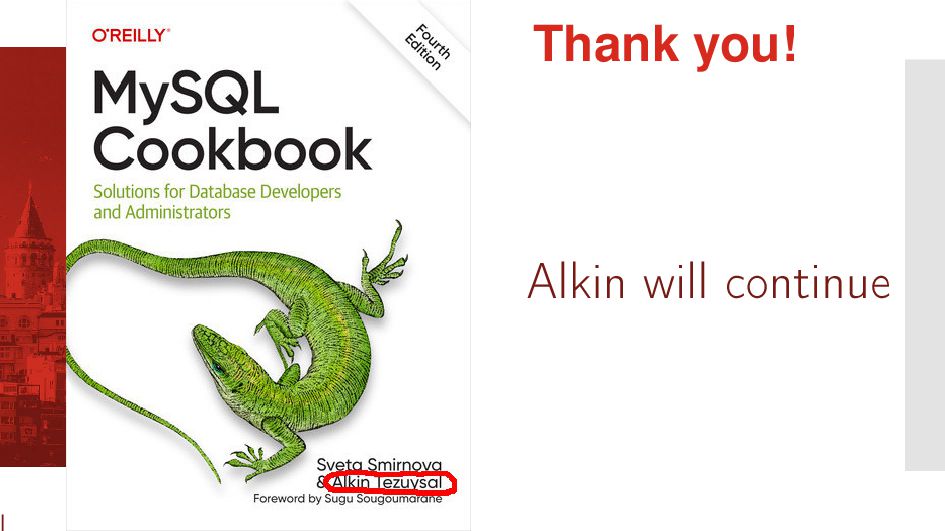
MySQL Cookbook 4th edition was released this summer. We are the book's authors and will show you how to "cook" MySQL. We will show you a few tasks with different priorities, such as JSON in MySQL for those who need flexibility, modern SQL for analytics, and Group Replication for high availability. We will also show how to write programs using JavaScript and Python languages, X DevAPI, and MySQL Shell. We will touch on some of the exciting features of MySQL Spatial Indexes and Geographical Data, Using a Full-Text Search, and more. We're hoping this talk will interest developers and administrators of MySQL.

Presenting the newly released MySQL Cookbook 4th edition to help developers and administrators to understand simple to complex recipes.

Avatar for Alkin Tezuysal

Alkin Tezuysal

November 14, 2022
Tweet

More Decks by Alkin Tezuysal

Other Decks in Technology

Transcript

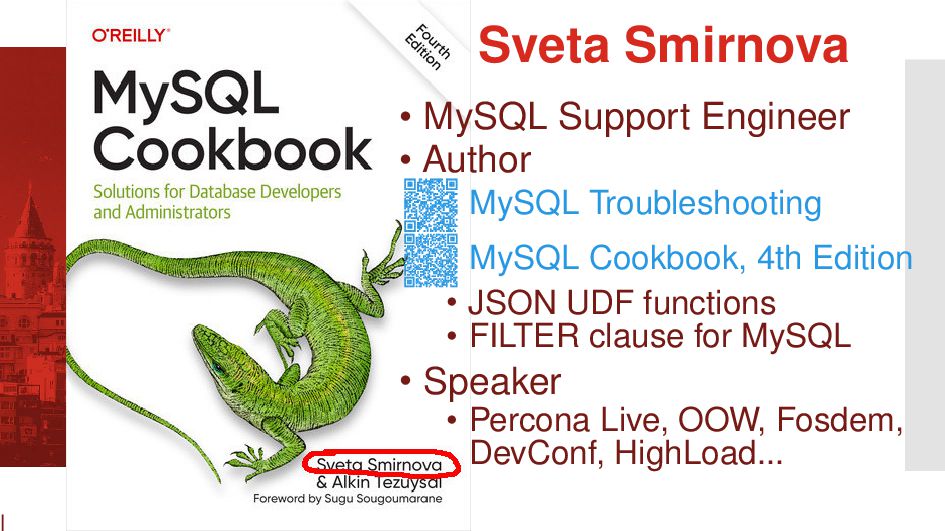
  1. l • MySQL Support Engineer • Author MySQL Troubleshooting MySQL

    Cookbook, 4th Edition • JSON UDF functions • FILTER clause for MySQL • Speaker • Percona Live, OOW, Fosdem, DevConf, HighLoad... Sveta Smirnova
  2. • Audience: DBAs • They do not write queries •

    They tune • Server options • Indexes • Table structure Sveta the Speaker 4 ©2022 | Percona
  3. • For developers • New topic for me → challenging

    • In past I worked as a developer MySQL Cookbook by O’Reilly 5 ©2022 | Percona
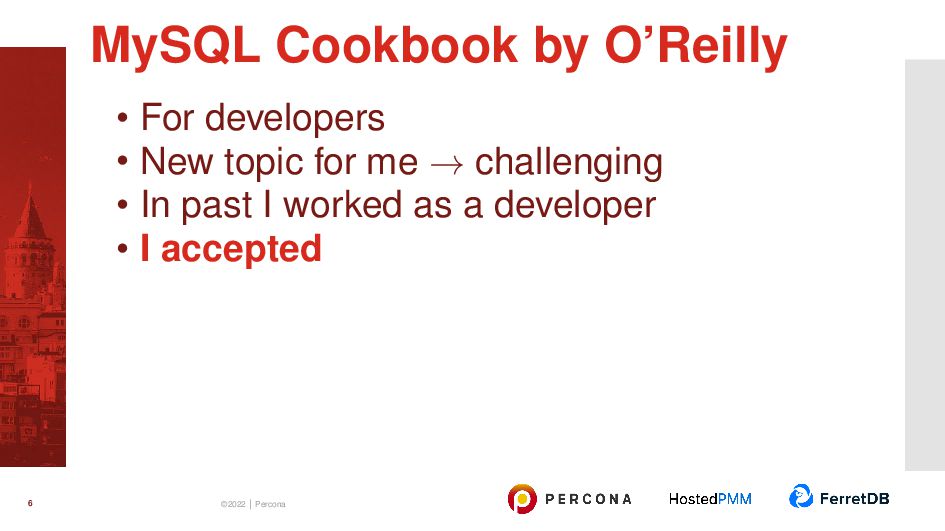
  4. • For developers • New topic for me → challenging

    • In past I worked as a developer • I accepted MySQL Cookbook by O’Reilly 6 ©2022 | Percona
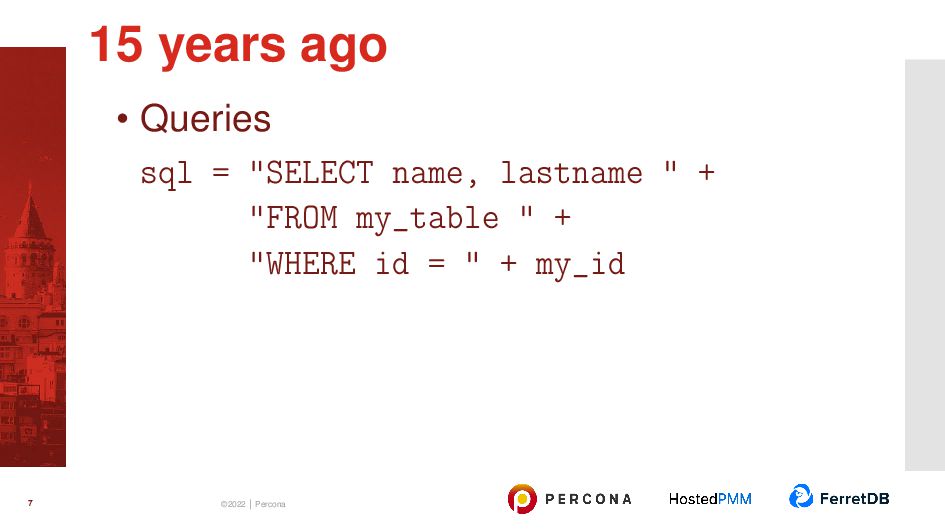
  5. • Queries sql = "SELECT name, lastname " + "FROM

    my_table " + "WHERE id = " + my_id 15 years ago 7 ©2022 | Percona
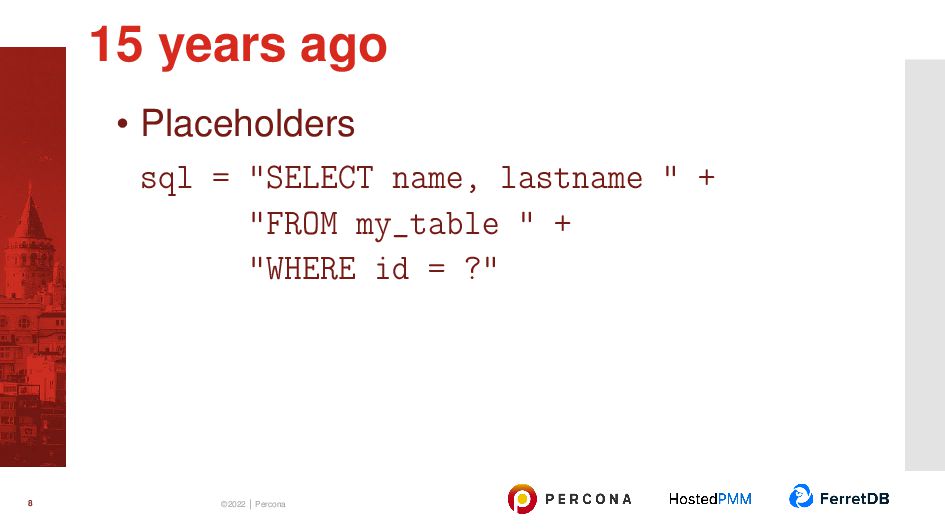
  6. • Placeholders sql = "SELECT name, lastname " + "FROM

    my_table " + "WHERE id = ?" 15 years ago 8 ©2022 | Percona
  7. • Nothing • New MySQL APIs • Document Store support

    in MySQL • Object-oriented query language in MySQL X DevAPI Was anything changed? 11 ©2022 | Percona
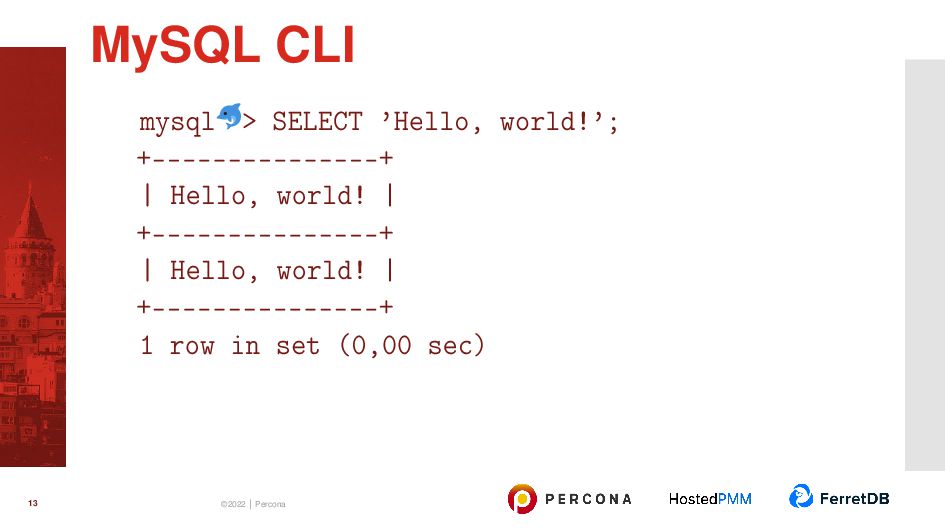
  8. mysql > SELECT ’Hello, world!’; +---------------+ | Hello, world! |

    +---------------+ | Hello, world! | +---------------+ 1 row in set (0,00 sec) MySQL CLI 13 ©2022 | Percona
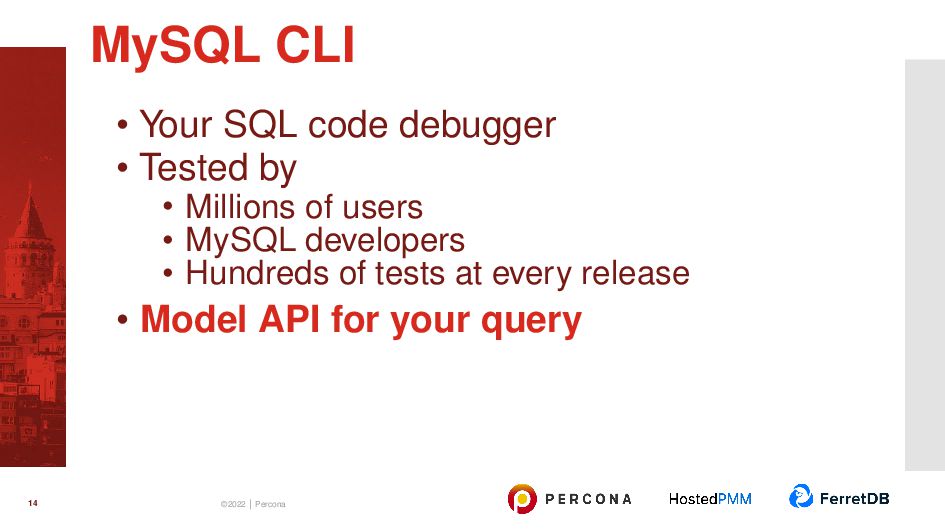
  9. • Your SQL code debugger • Tested by • Millions

    of users • MySQL developers • Hundreds of tests at every release • Model API for your query MySQL CLI 14 ©2022 | Percona
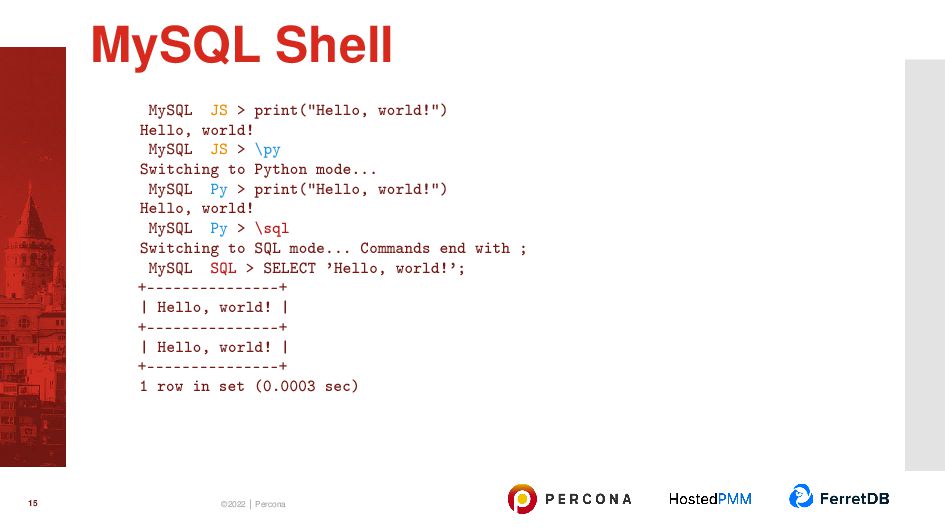
  10. MySQL JS > print("Hello, world!") Hello, world! MySQL JS >

    \py Switching to Python mode... MySQL Py > print("Hello, world!") Hello, world! MySQL Py > \sql Switching to SQL mode... Commands end with ; MySQL SQL > SELECT ’Hello, world!’; +---------------+ | Hello, world! | +---------------+ | Hello, world! | +---------------+ 1 row in set (0.0003 sec) MySQL Shell 15 ©2022 | Percona
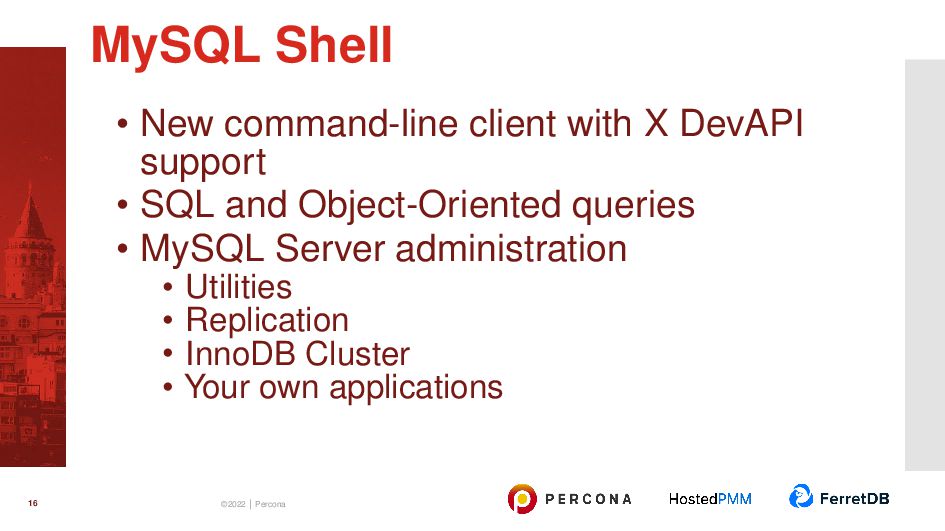
  11. • New command-line client with X DevAPI support • SQL

    and Object-Oriented queries • MySQL Server administration • Utilities • Replication • InnoDB Cluster • Your own applications MySQL Shell 16 ©2022 | Percona
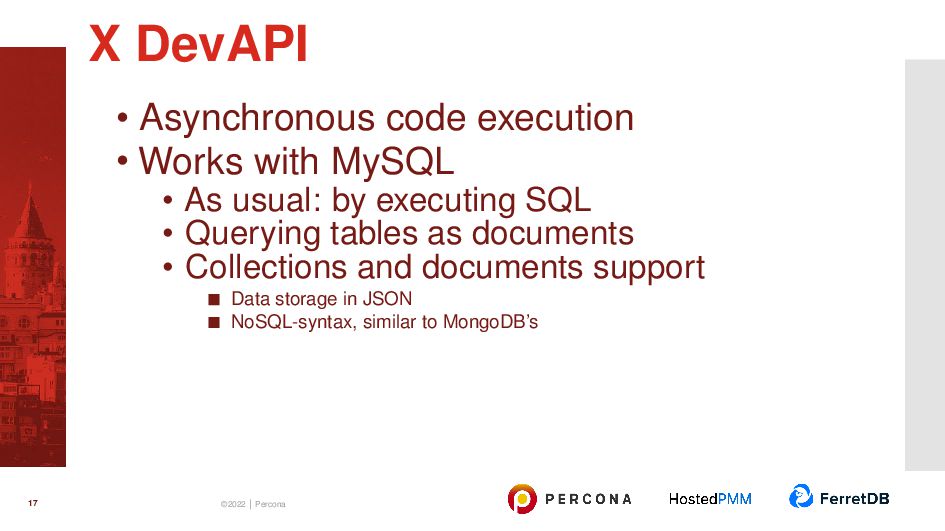
  12. • Asynchronous code execution • Works with MySQL • As

    usual: by executing SQL • Querying tables as documents • Collections and documents support Data storage in JSON NoSQL-syntax, similar to MongoDB’s X DevAPI 17 ©2022 | Percona
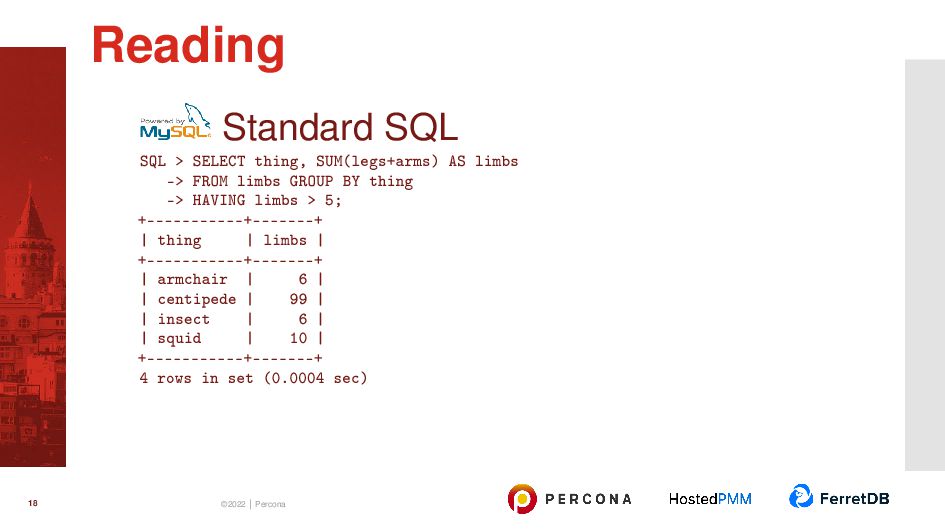
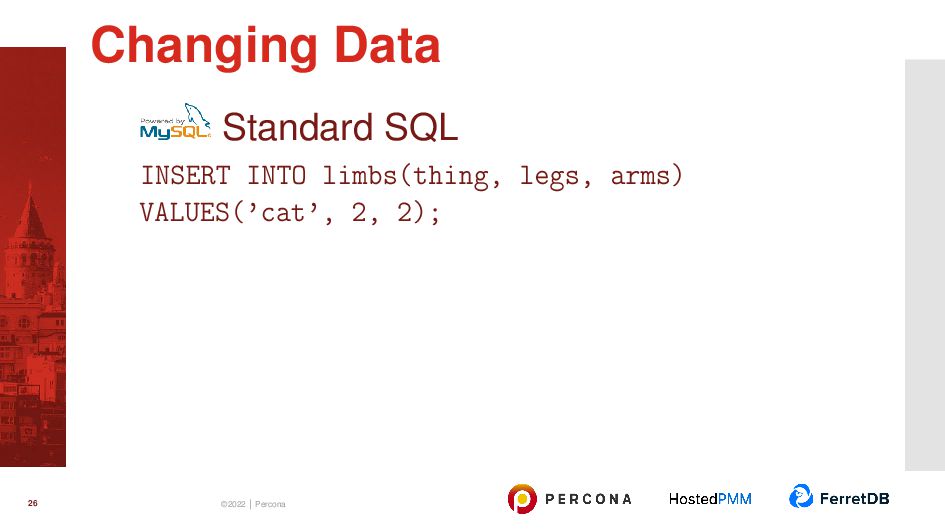
  13. Standard SQL SQL > SELECT thing, SUM(legs+arms) AS limbs ->

    FROM limbs GROUP BY thing -> HAVING limbs > 5; +-----------+-------+ | thing | limbs | +-----------+-------+ | armchair | 6 | | centipede | 99 | | insect | 6 | | squid | 10 | +-----------+-------+ 4 rows in set (0.0004 sec) Reading 18 ©2022 | Percona
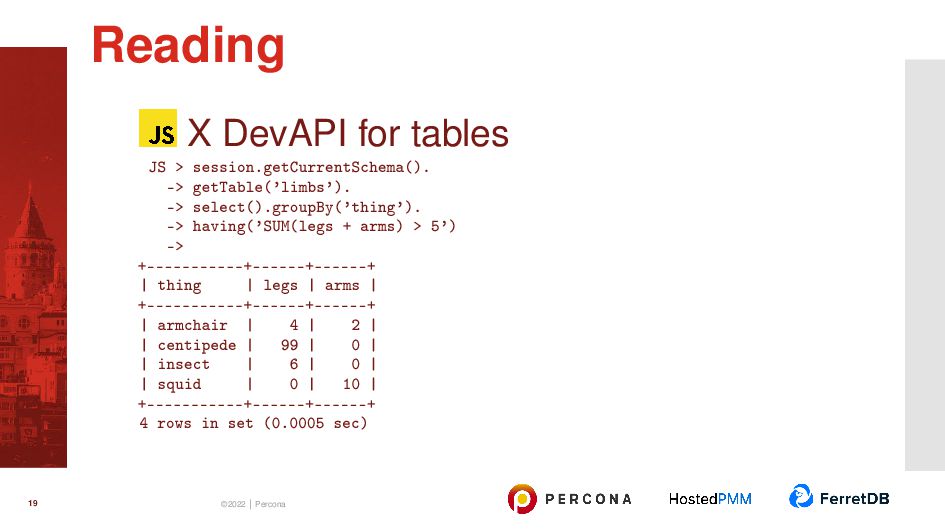
  14. X DevAPI for tables JS > session.getCurrentSchema(). -> getTable(’limbs’). ->
    select().groupBy(’thing’). -> having(’SUM(legs + arms) > 5’) -> +-----------+------+------+ | thing | legs | arms | +-----------+------+------+ | armchair | 4 | 2 | | centipede | 99 | 0 | | insect | 6 | 0 | | squid | 0 | 10 | +-----------+------+------+ 4 rows in set (0.0005 sec) Reading 19 ©2022 | Percona

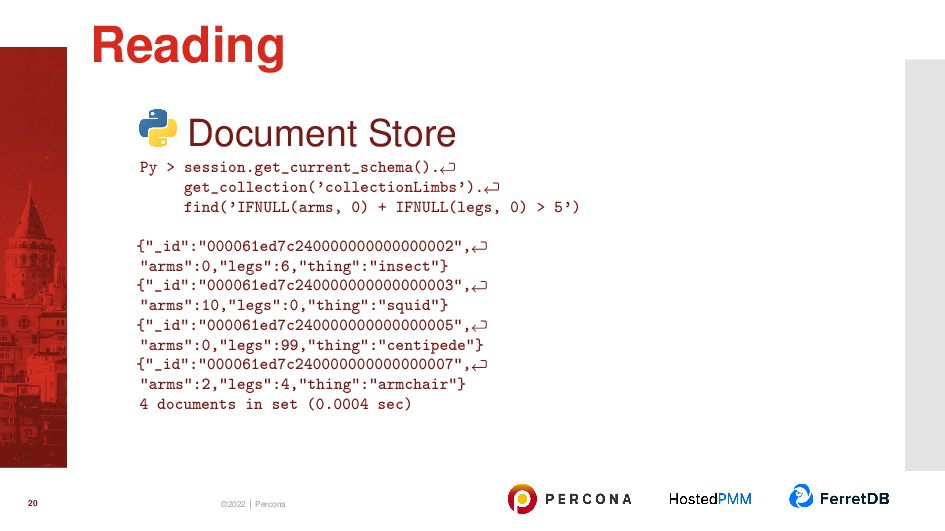
  15. Document Store Py > session.get_current_schema(). get_collection(’collectionLimbs’). find(’IFNULL(arms, 0) + IFNULL(legs,

    0) > 5’) {"_id":"000061ed7c240000000000000002", "arms":0,"legs":6,"thing":"insect"} {"_id":"000061ed7c240000000000000003", "arms":10,"legs":0,"thing":"squid"} {"_id":"000061ed7c240000000000000005", "arms":0,"legs":99,"thing":"centipede"} {"_id":"000061ed7c240000000000000007", "arms":2,"legs":4,"thing":"armchair"} 4 documents in set (0.0004 sec) Reading 20 ©2022 | Percona
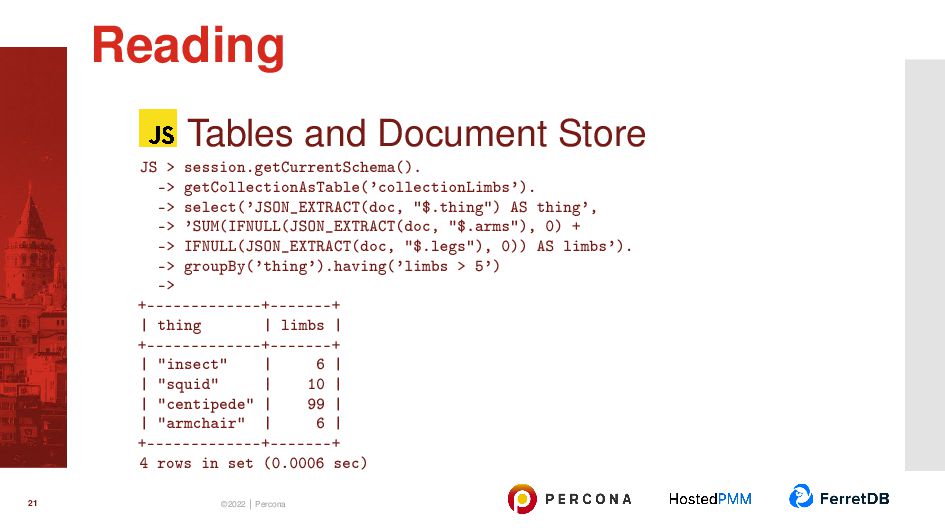
  16. Tables and Document Store JS > session.getCurrentSchema(). -> getCollectionAsTable(’collectionLimbs’). ->

    select(’JSON_EXTRACT(doc, "$.thing") AS thing’, -> ’SUM(IFNULL(JSON_EXTRACT(doc, "$.arms"), 0) + -> IFNULL(JSON_EXTRACT(doc, "$.legs"), 0)) AS limbs’). -> groupBy(’thing’).having(’limbs > 5’) -> +-------------+-------+ | thing | limbs | +-------------+-------+ | "insect" | 6 | | "squid" | 10 | | "centipede" | 99 | | "armchair" | 6 | +-------------+-------+ 4 rows in set (0.0006 sec) Reading 21 ©2022 | Percona
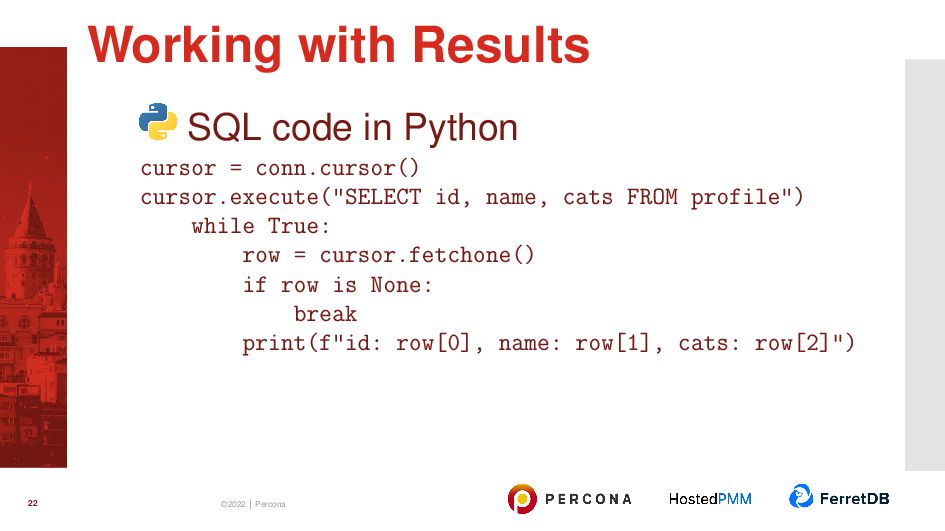
  17. SQL code in Python cursor = conn.cursor() cursor.execute("SELECT id, name,

    cats FROM profile") while True: row = cursor.fetchone() if row is None: break print(f"id: row[0], name: row[1], cats: row[2]") Working with Results 22 ©2022 | Percona
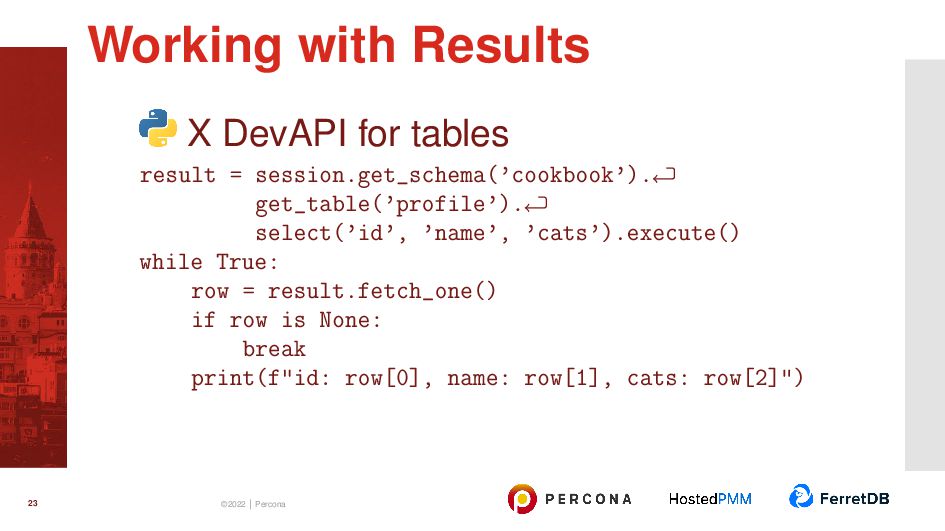
  18. X DevAPI for tables result = session.get_schema(’cookbook’). get_table(’profile’). select(’id’, ’name’,

    ’cats’).execute() while True: row = result.fetch_one() if row is None: break print(f"id: row[0], name: row[1], cats: row[2]") Working with Results 23 ©2022 | Percona
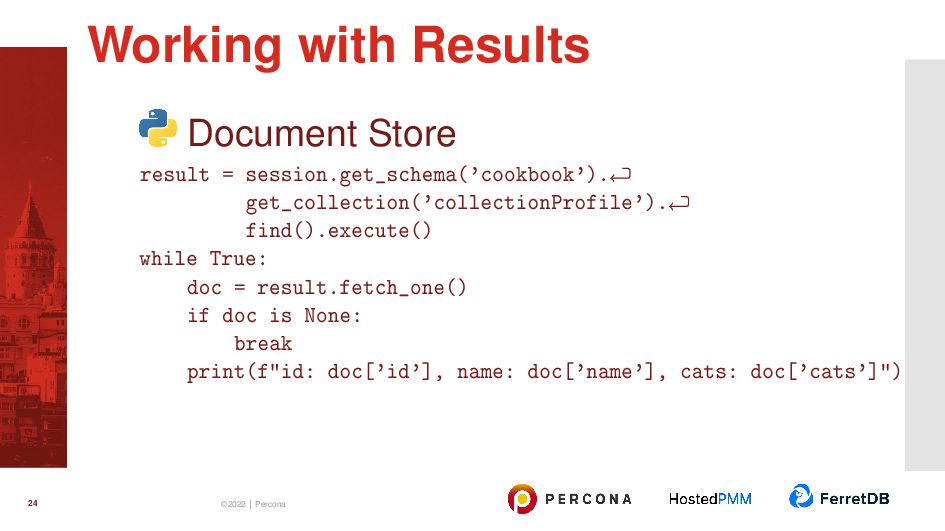
  19. Document Store result = session.get_schema(’cookbook’). get_collection(’collectionProfile’). find().execute() while True: doc

    = result.fetch_one() if doc is None: break print(f"id: doc[’id’], name: doc[’name’], cats: doc[’cats’]") Working with Results 24 ©2022 | Percona
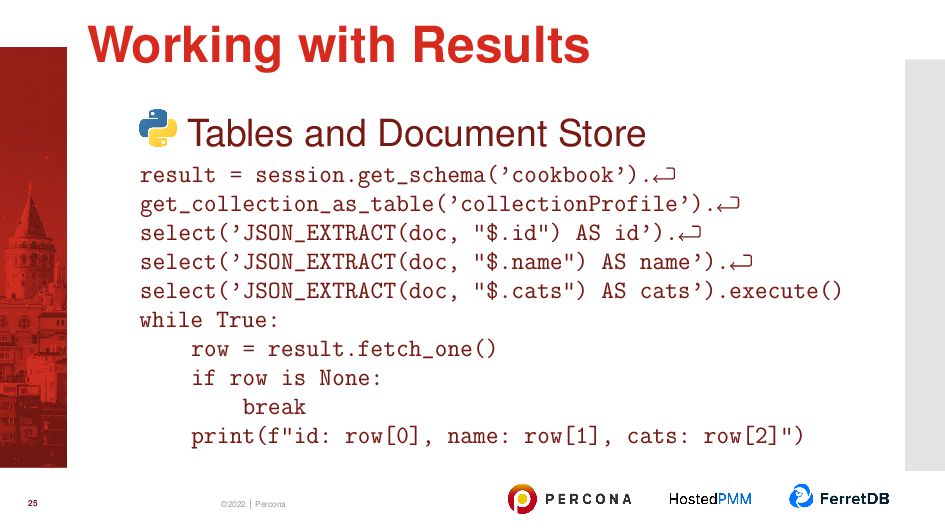
  20. Tables and Document Store result = session.get_schema(’cookbook’). get_collection_as_table(’collectionProfile’). select(’JSON_EXTRACT(doc, "$.id")

    AS id’). select(’JSON_EXTRACT(doc, "$.name") AS name’). select(’JSON_EXTRACT(doc, "$.cats") AS cats’).execute() while True: row = result.fetch_one() if row is None: break print(f"id: row[0], name: row[1], cats: row[2]") Working with Results 25 ©2022 | Percona
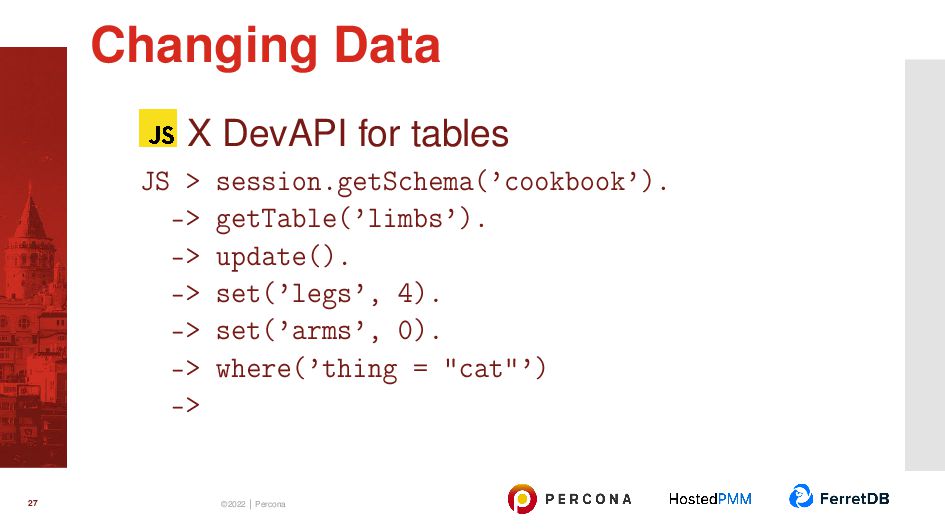
  21. X DevAPI for tables JS > session.getSchema(’cookbook’). -> getTable(’limbs’). ->

    update(). -> set(’legs’, 4). -> set(’arms’, 0). -> where(’thing = "cat"’) -> Changing Data 27 ©2022 | Percona
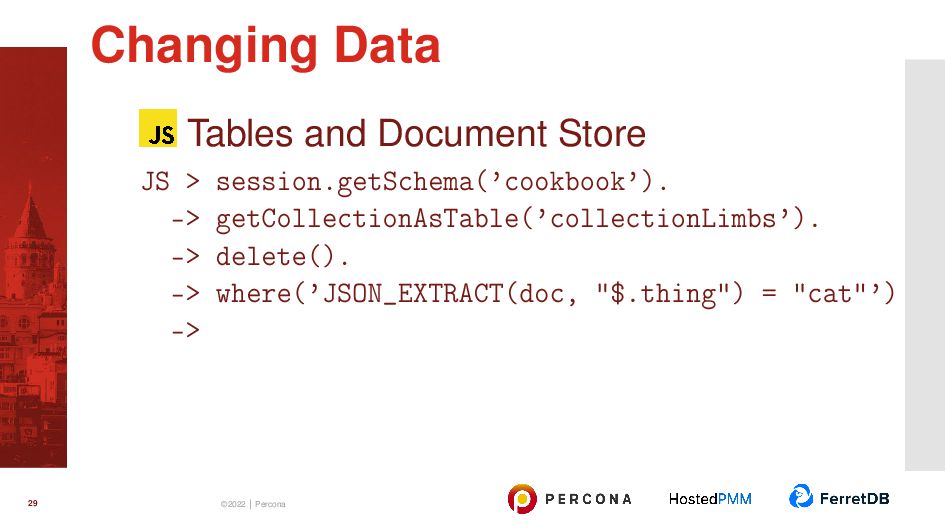
  22. Tables and Document Store JS > session.getSchema(’cookbook’). -> getCollectionAsTable(’collectionLimbs’). ->

    delete(). -> where(’JSON_EXTRACT(doc, "$.thing") = "cat"’) -> Changing Data 29 ©2022 | Percona
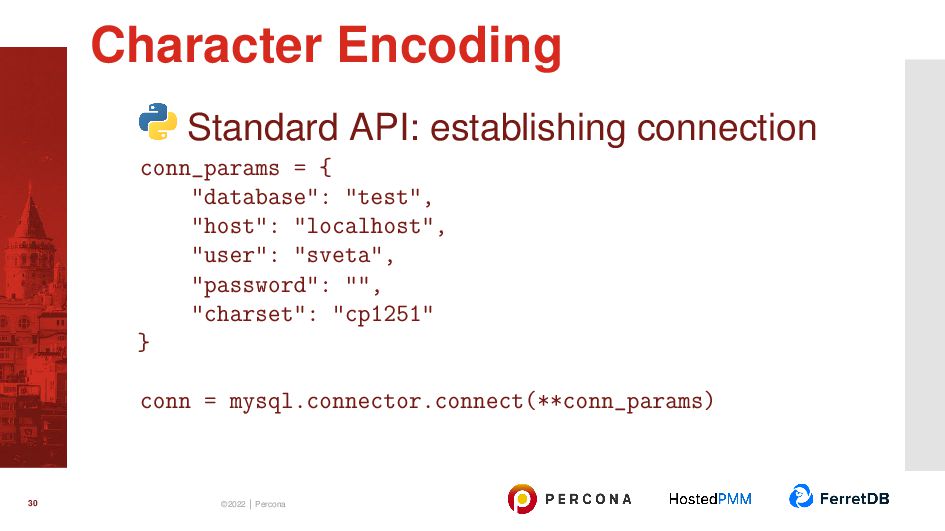
  23. Standard API: establishing connection conn_params = { "database": "test", "host":

    "localhost", "user": "sveta", "password": "", "charset": "cp1251" } conn = mysql.connector.connect(**conn_params) Character Encoding 30 ©2022 | Percona
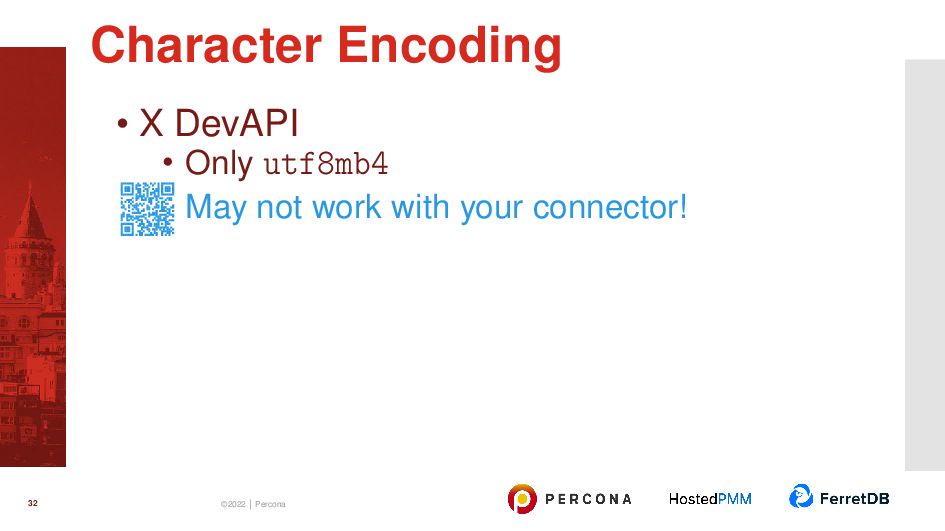
  24. • X DevAPI • Only utf8mb4 May not work with

    your connector! Character Encoding 32 ©2022 | Percona
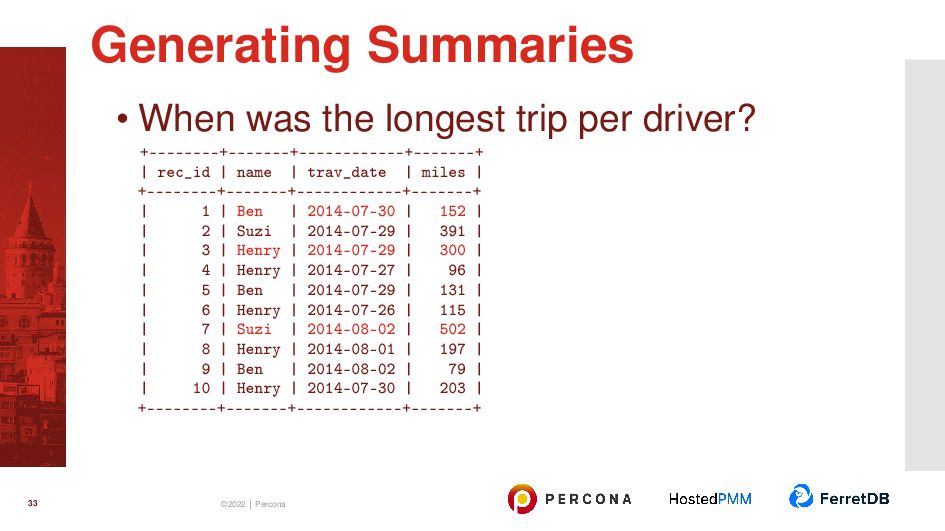
  25. • When was the longest trip per driver? +--------+-------+------------+-------+ |

    rec_id | name | trav_date | miles | +--------+-------+------------+-------+ | 1 | Ben | 2014-07-30 | 152 | | 2 | Suzi | 2014-07-29 | 391 | | 3 | Henry | 2014-07-29 | 300 | | 4 | Henry | 2014-07-27 | 96 | | 5 | Ben | 2014-07-29 | 131 | | 6 | Henry | 2014-07-26 | 115 | | 7 | Suzi | 2014-08-02 | 502 | | 8 | Henry | 2014-08-01 | 197 | | 9 | Ben | 2014-08-02 | 79 | | 10 | Henry | 2014-07-30 | 203 | +--------+-------+------------+-------+ Generating Summaries 33 ©2022 | Percona
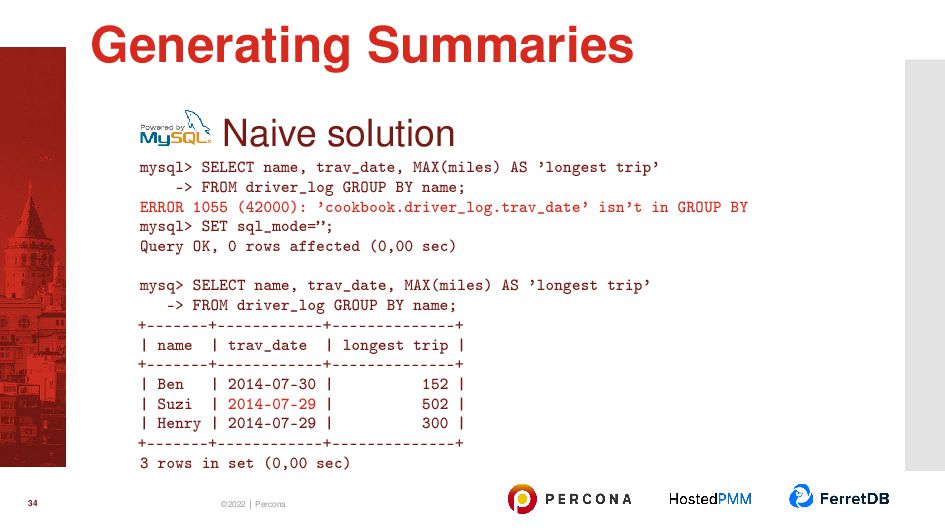
  26. Naive solution mysql> SELECT name, trav_date, MAX(miles) AS ’longest trip’

    -> FROM driver_log GROUP BY name; ERROR 1055 (42000): ’cookbook.driver_log.trav_date’ isn’t in GROUP BY mysql> SET sql_mode=”; Query OK, 0 rows affected (0,00 sec) mysq> SELECT name, trav_date, MAX(miles) AS ’longest trip’ -> FROM driver_log GROUP BY name; +-------+------------+--------------+ | name | trav_date | longest trip | +-------+------------+--------------+ | Ben | 2014-07-30 | 152 | | Suzi | 2014-07-29 | 502 | | Henry | 2014-07-29 | 300 | +-------+------------+--------------+ 3 rows in set (0,00 sec) Generating Summaries 34 ©2022 | Percona
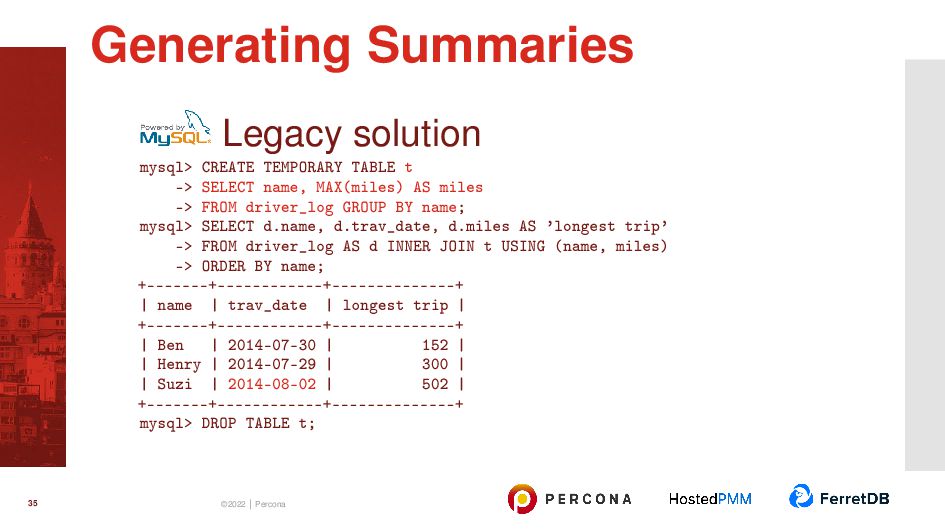
  27. Legacy solution mysql> CREATE TEMPORARY TABLE t -> SELECT name,

    MAX(miles) AS miles -> FROM driver_log GROUP BY name; mysql> SELECT d.name, d.trav_date, d.miles AS ’longest trip’ -> FROM driver_log AS d INNER JOIN t USING (name, miles) -> ORDER BY name; +-------+------------+--------------+ | name | trav_date | longest trip | +-------+------------+--------------+ | Ben | 2014-07-30 | 152 | | Henry | 2014-07-29 | 300 | | Suzi | 2014-08-02 | 502 | +-------+------------+--------------+ mysql> DROP TABLE t; Generating Summaries 35 ©2022 | Percona
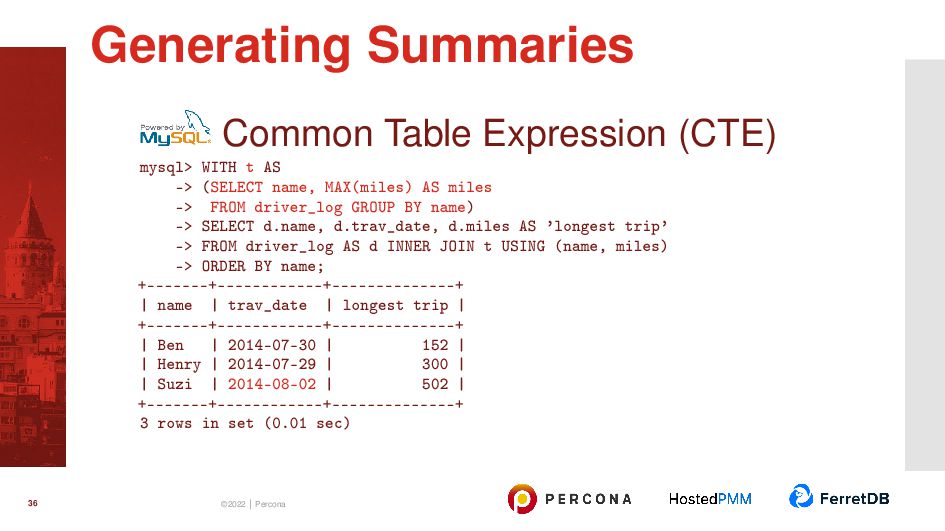
  28. Common Table Expression (CTE) mysql> WITH t AS -> (SELECT

    name, MAX(miles) AS miles -> FROM driver_log GROUP BY name) -> SELECT d.name, d.trav_date, d.miles AS ’longest trip’ -> FROM driver_log AS d INNER JOIN t USING (name, miles) -> ORDER BY name; +-------+------------+--------------+ | name | trav_date | longest trip | +-------+------------+--------------+ | Ben | 2014-07-30 | 152 | | Henry | 2014-07-29 | 300 | | Suzi | 2014-08-02 | 502 | +-------+------------+--------------+ 3 rows in set (0.01 sec) Generating Summaries 36 ©2022 | Percona
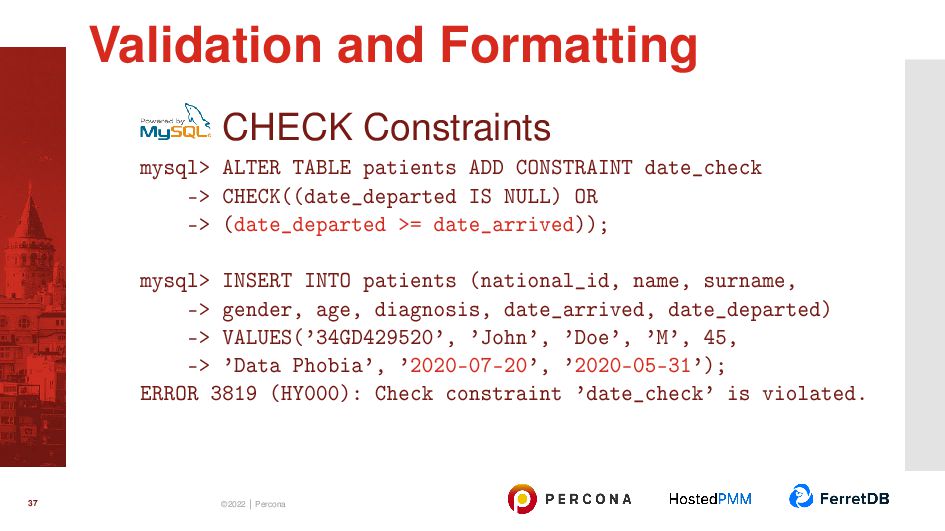
  29. CHECK Constraints mysql> ALTER TABLE patients ADD CONSTRAINT date_check ->

    CHECK((date_departed IS NULL) OR -> (date_departed >= date_arrived)); mysql> INSERT INTO patients (national_id, name, surname, -> gender, age, diagnosis, date_arrived, date_departed) -> VALUES(’34GD429520’, ’John’, ’Doe’, ’M’, 45, -> ’Data Phobia’, ’2020-07-20’, ’2020-05-31’); ERROR 3819 (HY000): Check constraint ’date_check’ is violated. Validation and Formatting 37 ©2022 | Percona
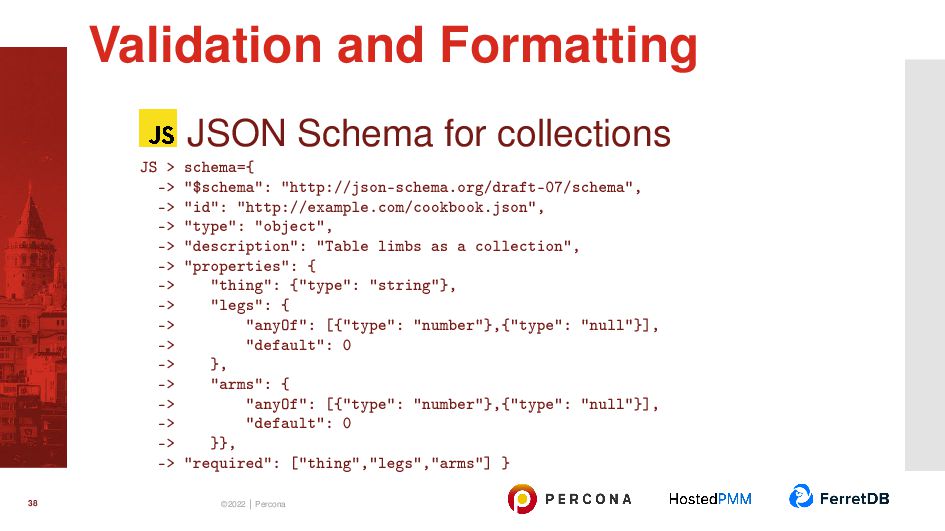
  30. JSON Schema for collections JS > schema={ -> "$schema": "http://json-schema.org/draft-07/schema",

    -> "id": "http://example.com/cookbook.json", -> "type": "object", -> "description": "Table limbs as a collection", -> "properties": { -> "thing": {"type": "string"}, -> "legs": { -> "anyOf": [{"type": "number"},{"type": "null"}], -> "default": 0 -> }, -> "arms": { -> "anyOf": [{"type": "number"},{"type": "null"}], -> "default": 0 -> }}, -> "required": ["thing","legs","arms"] } Validation and Formatting 38 ©2022 | Percona
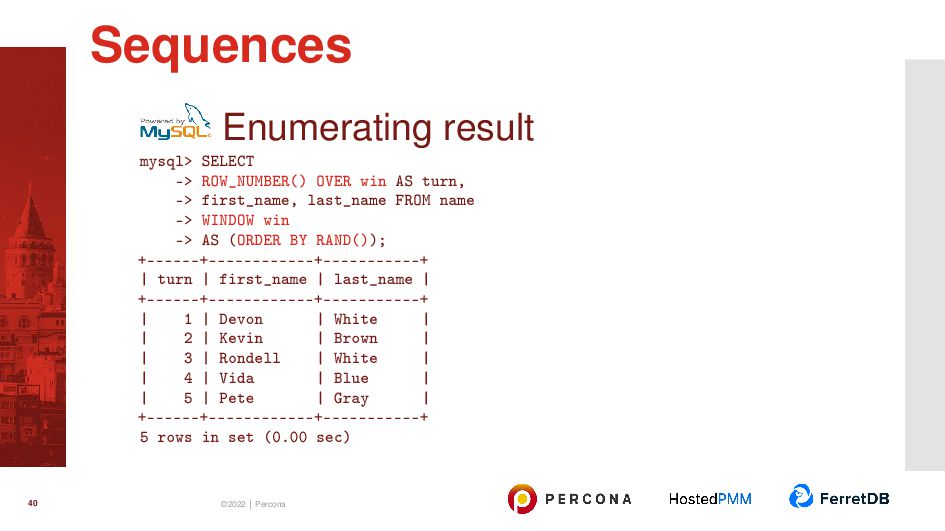
  31. Enumerating result mysql> SELECT -> ROW_NUMBER() OVER win AS turn,

    -> first_name, last_name FROM name -> WINDOW win -> AS (ORDER BY RAND()); +------+------------+-----------+ | turn | first_name | last_name | +------+------------+-----------+ | 1 | Devon | White | | 2 | Kevin | Brown | | 3 | Rondell | White | | 4 | Vida | Blue | | 5 | Pete | Gray | +------+------------+-----------+ 5 rows in set (0.00 sec) Sequences 40 ©2022 | Percona
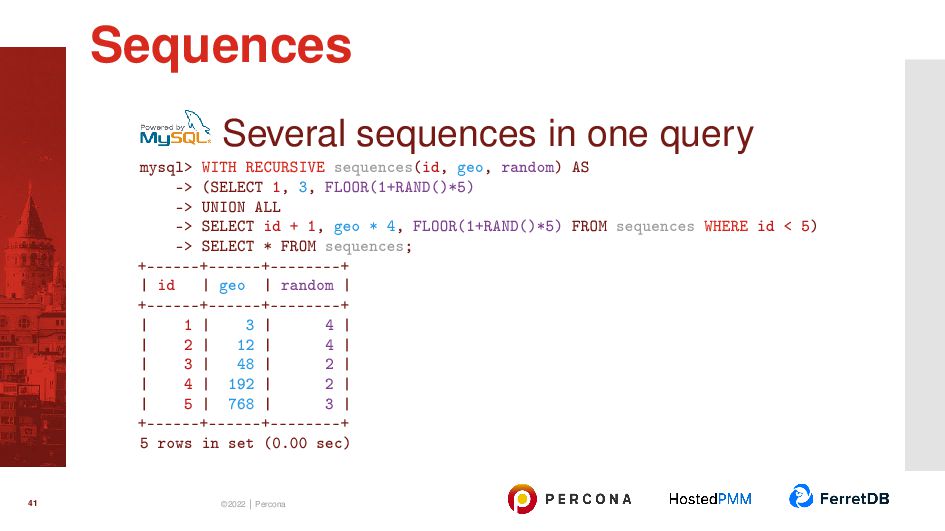
  32. Several sequences in one query mysql> WITH RECURSIVE sequences(id, geo,

    random) AS -> (SELECT 1, 3, FLOOR(1+RAND()*5) -> UNION ALL -> SELECT id + 1, geo * 4, FLOOR(1+RAND()*5) FROM sequences WHERE id < 5) -> SELECT * FROM sequences; +------+------+--------+ | id | geo | random | +------+------+--------+ | 1 | 3 | 4 | | 2 | 12 | 4 | | 3 | 48 | 2 | | 4 | 192 | 2 | | 5 | 768 | 3 | +------+------+--------+ 5 rows in set (0.00 sec) Sequences 41 ©2022 | Percona
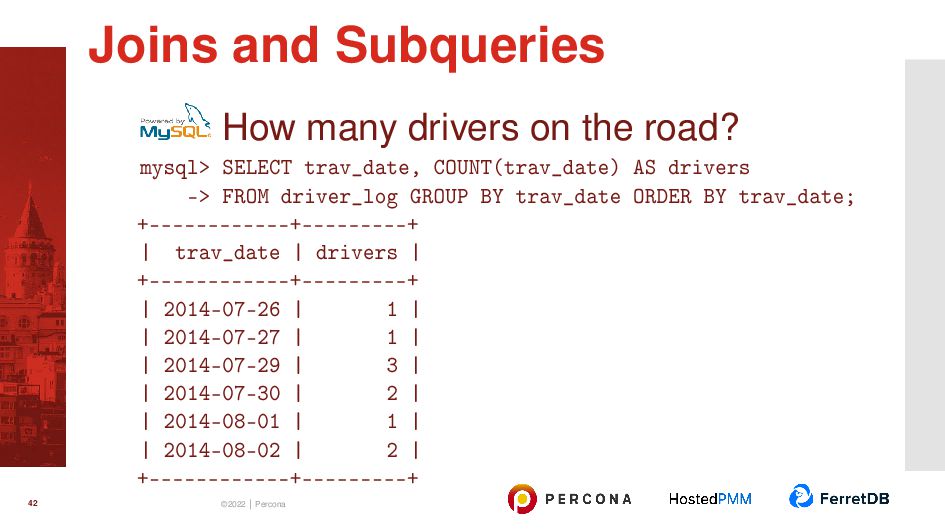
  33. How many drivers on the road? mysql> SELECT trav_date, COUNT(trav_date)

    AS drivers -> FROM driver_log GROUP BY trav_date ORDER BY trav_date; +------------+---------+ | trav_date | drivers | +------------+---------+ | 2014-07-26 | 1 | | 2014-07-27 | 1 | | 2014-07-29 | 3 | | 2014-07-30 | 2 | | 2014-08-01 | 1 | | 2014-08-02 | 2 | +------------+---------+ Joins and Subqueries 42 ©2022 | Percona
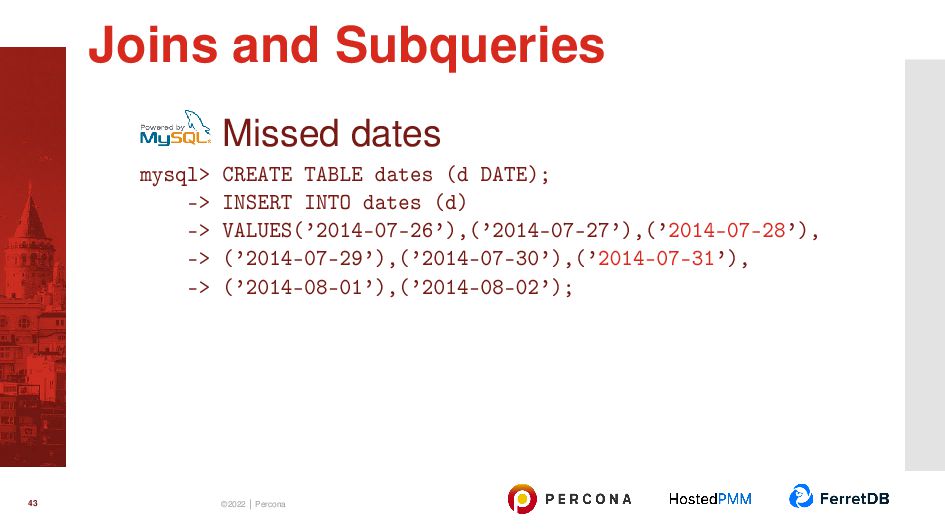
  34. Missed dates mysql> CREATE TABLE dates (d DATE); -> INSERT

    INTO dates (d) -> VALUES(’2014-07-26’),(’2014-07-27’),(’2014-07-28’), -> (’2014-07-29’),(’2014-07-30’),(’2014-07-31’), -> (’2014-08-01’),(’2014-08-02’); Joins and Subqueries 43 ©2022 | Percona
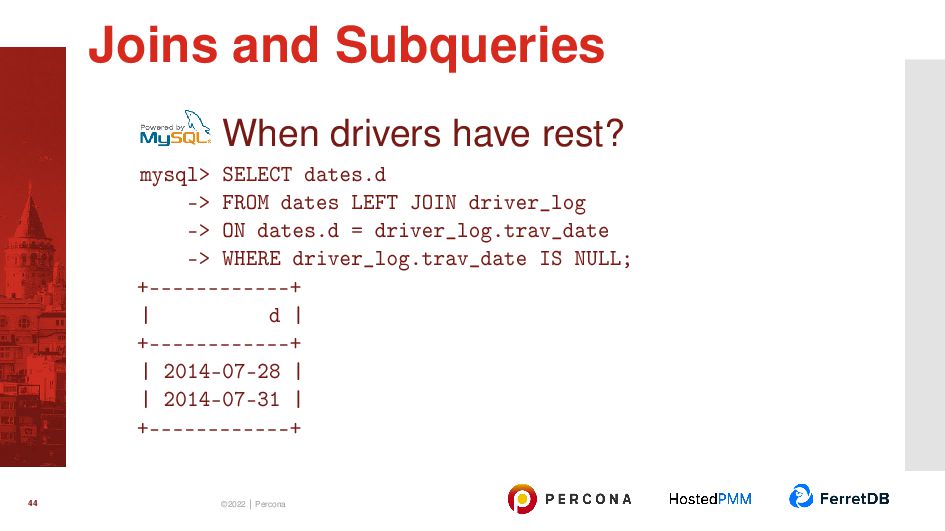
  35. When drivers have rest? mysql> SELECT dates.d -> FROM dates

    LEFT JOIN driver_log -> ON dates.d = driver_log.trav_date -> WHERE driver_log.trav_date IS NULL; +------------+ | d | +------------+ | 2014-07-28 | | 2014-07-31 | +------------+ Joins and Subqueries 44 ©2022 | Percona
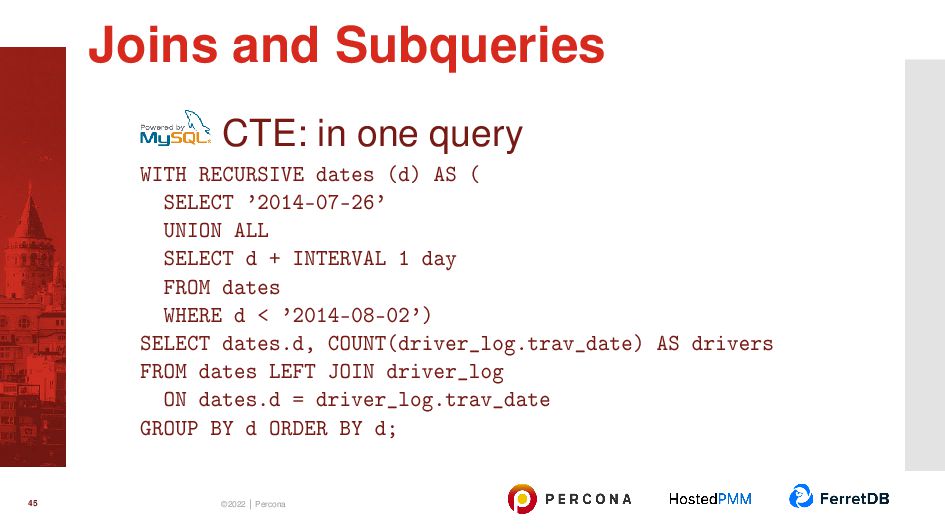
  36. CTE: in one query WITH RECURSIVE dates (d) AS (

    SELECT ’2014-07-26’ UNION ALL SELECT d + INTERVAL 1 day FROM dates WHERE d < ’2014-08-02’) SELECT dates.d, COUNT(driver_log.trav_date) AS drivers FROM dates LEFT JOIN driver_log ON dates.d = driver_log.trav_date GROUP BY d ORDER BY d; Joins and Subqueries 45 ©2022 | Percona
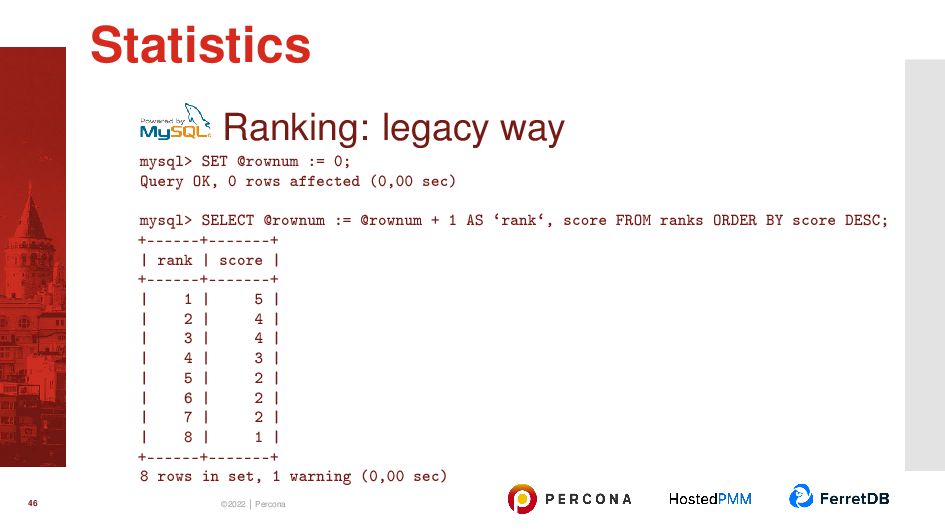
  37. Ranking: legacy way mysql> SET @rownum := 0; Query OK,

    0 rows affected (0,00 sec) mysql> SELECT @rownum := @rownum + 1 AS ‘rank‘, score FROM ranks ORDER BY score DESC; +------+-------+ | rank | score | +------+-------+ | 1 | 5 | | 2 | 4 | | 3 | 4 | | 4 | 3 | | 5 | 2 | | 6 | 2 | | 7 | 2 | | 8 | 1 | +------+-------+ 8 rows in set, 1 warning (0,00 sec) Statistics 46 ©2022 | Percona
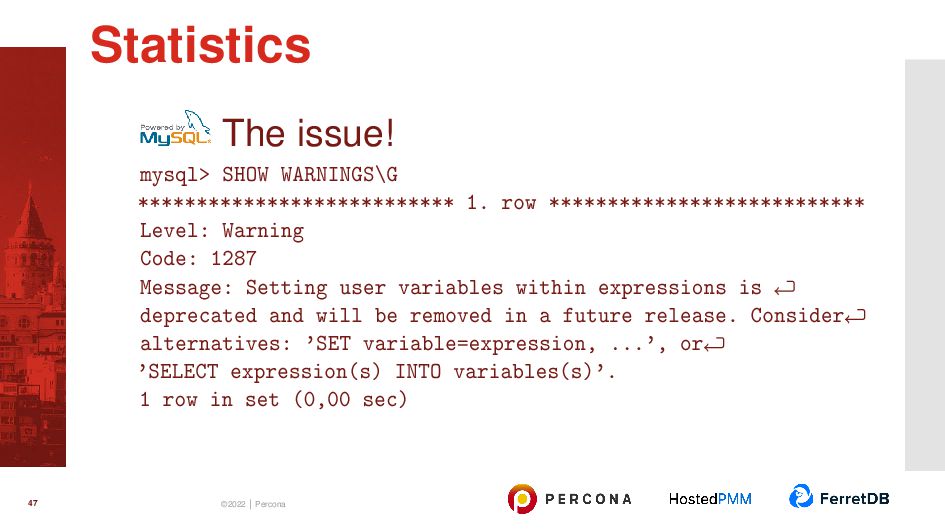
  38. The issue! mysql> SHOW WARNINGS\G *************************** 1. row *************************** Level:

    Warning Code: 1287 Message: Setting user variables within expressions is deprecated and will be removed in a future release. Consider alternatives: ’SET variable=expression, ...’, or ’SELECT expression(s) INTO variables(s)’. 1 row in set (0,00 sec) Statistics 47 ©2022 | Percona
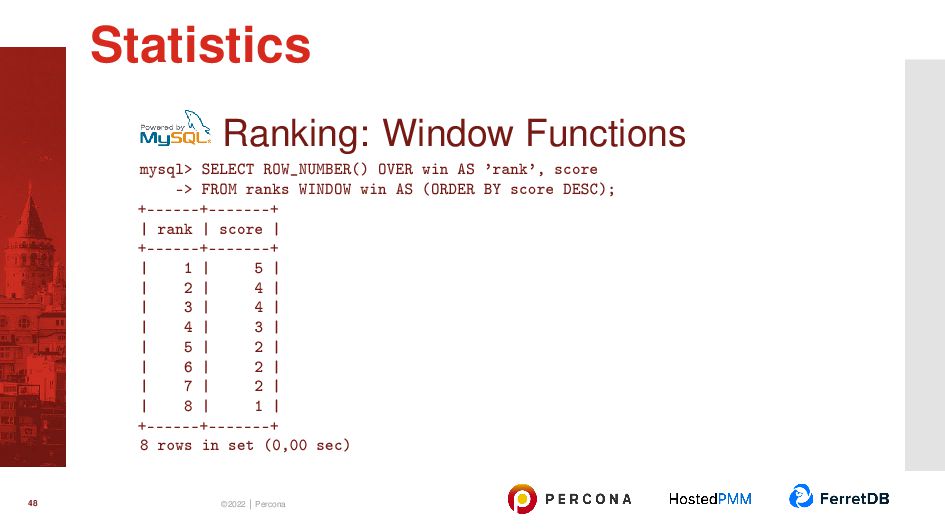
  39. Ranking: Window Functions mysql> SELECT ROW_NUMBER() OVER win AS ’rank’,

    score -> FROM ranks WINDOW win AS (ORDER BY score DESC); +------+-------+ | rank | score | +------+-------+ | 1 | 5 | | 2 | 4 | | 3 | 4 | | 4 | 3 | | 5 | 2 | | 6 | 2 | | 7 | 2 | | 8 | 1 | +------+-------+ 8 rows in set (0,00 sec) Statistics 48 ©2022 | Percona
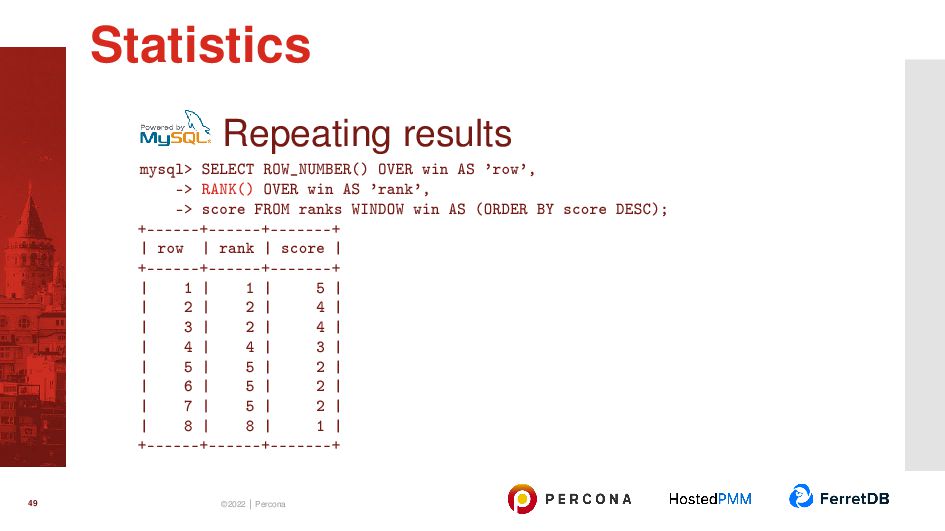
  40. Repeating results mysql> SELECT ROW_NUMBER() OVER win AS ’row’, ->

    RANK() OVER win AS ’rank’, -> score FROM ranks WINDOW win AS (ORDER BY score DESC); +------+------+-------+ | row | rank | score | +------+------+-------+ | 1 | 1 | 5 | | 2 | 2 | 4 | | 3 | 2 | 4 | | 4 | 4 | 3 | | 5 | 5 | 2 | | 6 | 5 | 2 | | 7 | 5 | 2 | | 8 | 8 | 1 | +------+------+-------+ Statistics 49 ©2022 | Percona
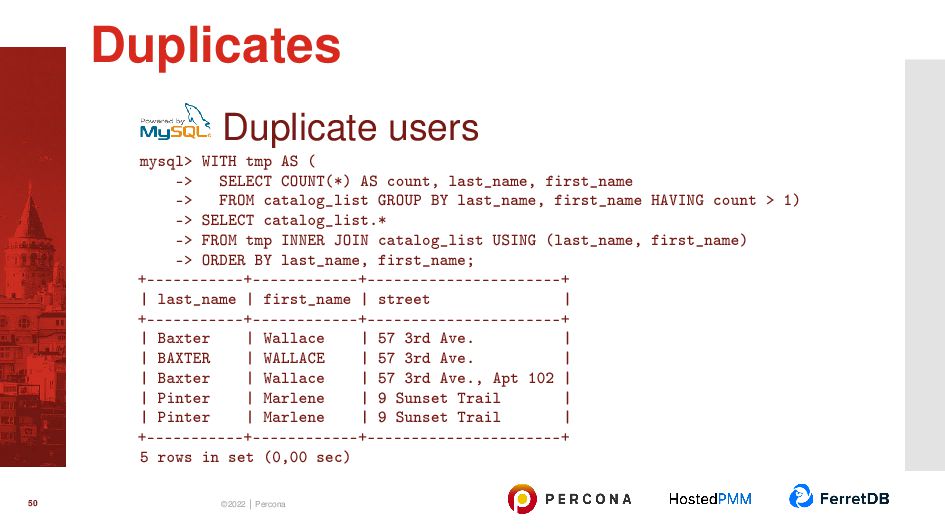
  41. Duplicate users mysql> WITH tmp AS ( -> SELECT COUNT(*)

    AS count, last_name, first_name -> FROM catalog_list GROUP BY last_name, first_name HAVING count > 1) -> SELECT catalog_list.* -> FROM tmp INNER JOIN catalog_list USING (last_name, first_name) -> ORDER BY last_name, first_name; +-----------+------------+----------------------+ | last_name | first_name | street | +-----------+------------+----------------------+ | Baxter | Wallace | 57 3rd Ave. | | BAXTER | WALLACE | 57 3rd Ave. | | Baxter | Wallace | 57 3rd Ave., Apt 102 | | Pinter | Marlene | 9 Sunset Trail | | Pinter | Marlene | 9 Sunset Trail | +-----------+------------+----------------------+ 5 rows in set (0,00 sec) Duplicates 50 ©2022 | Percona
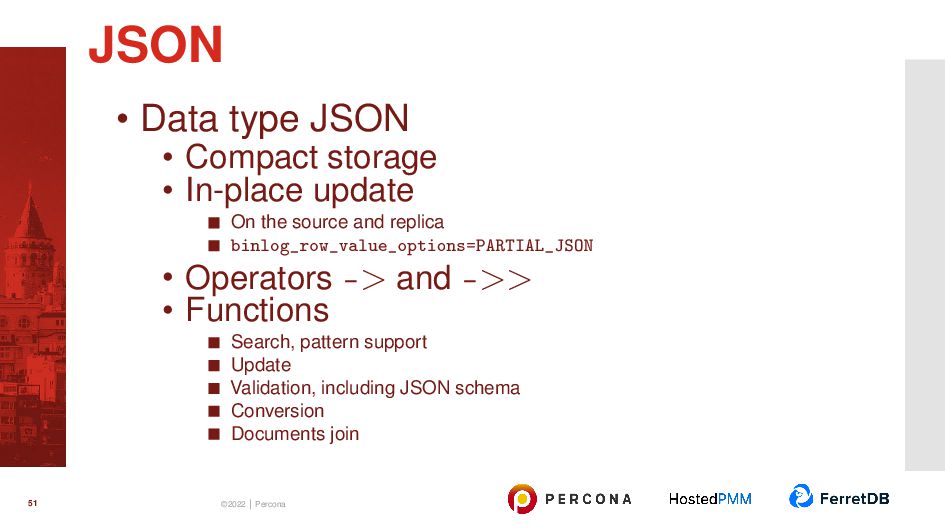
  42. • Data type JSON • Compact storage • In-place update

    On the source and replica binlog_row_value_options=PARTIAL_JSON • Operators -> and ->> • Functions Search, pattern support Update Validation, including JSON schema Conversion Documents join JSON 51 ©2022 | Percona
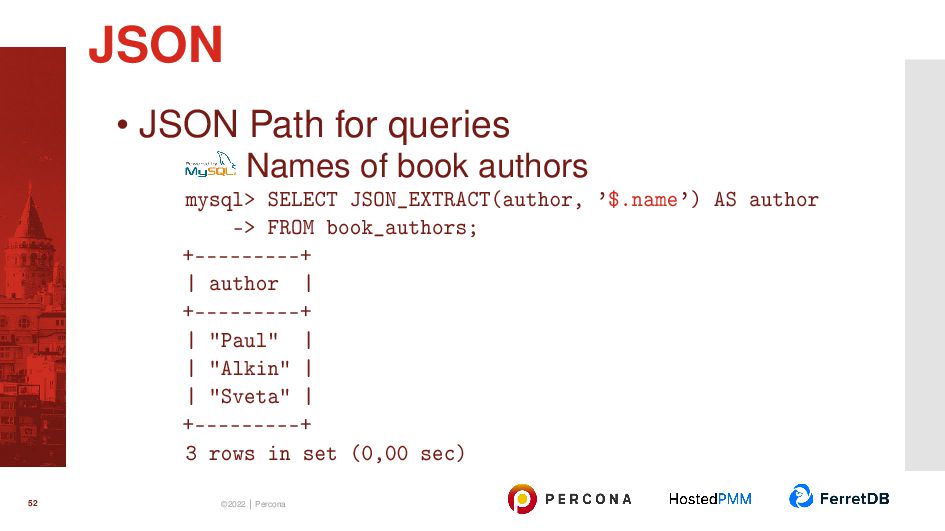
  43. • JSON Path for queries Names of book authors mysql>

    SELECT JSON_EXTRACT(author, ’$.name’) AS author -> FROM book_authors; +---------+ | author | +---------+ | "Paul" | | "Alkin" | | "Sveta" | +---------+ 3 rows in set (0,00 sec) JSON 52 ©2022 | Percona
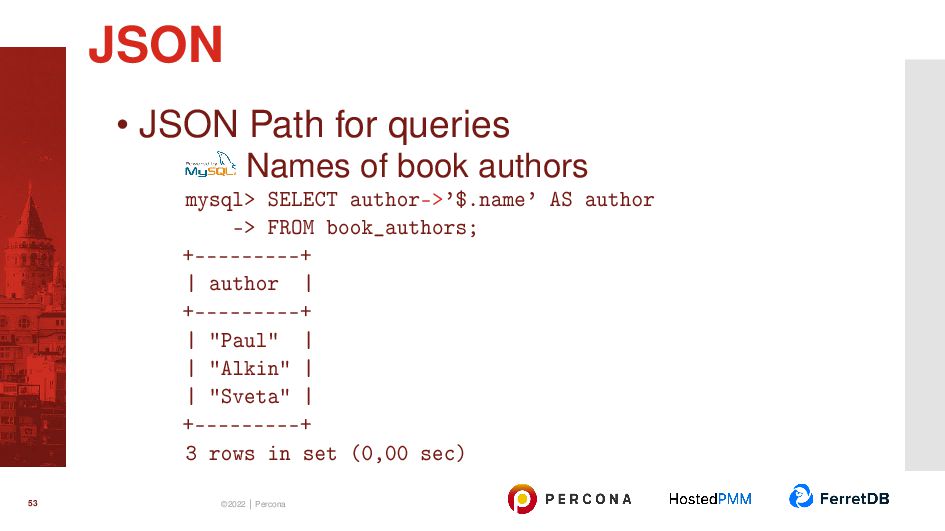
  44. • JSON Path for queries Names of book authors mysql>

    SELECT author->’$.name’ AS author -> FROM book_authors; +---------+ | author | +---------+ | "Paul" | | "Alkin" | | "Sveta" | +---------+ 3 rows in set (0,00 sec) JSON 53 ©2022 | Percona
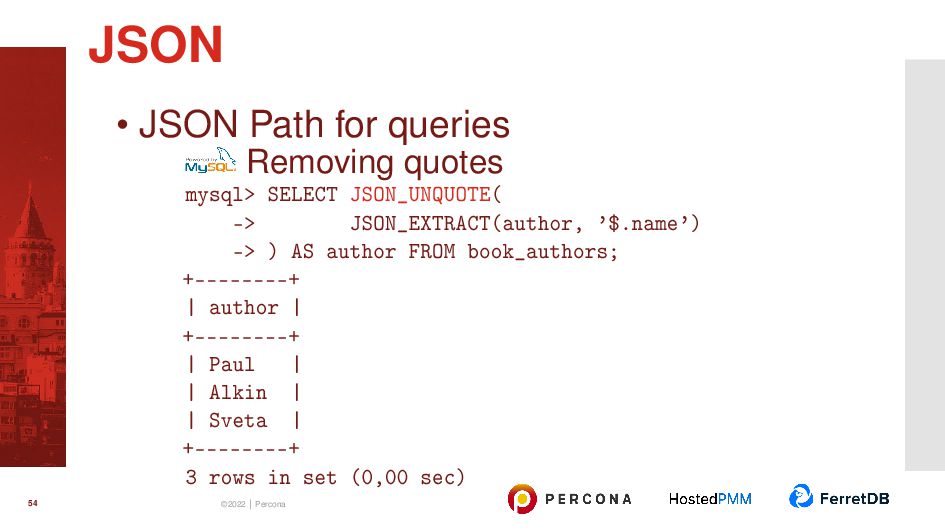
  45. • JSON Path for queries Removing quotes mysql> SELECT JSON_UNQUOTE(

    -> JSON_EXTRACT(author, ’$.name’) -> ) AS author FROM book_authors; +--------+ | author | +--------+ | Paul | | Alkin | | Sveta | +--------+ 3 rows in set (0,00 sec) JSON 54 ©2022 | Percona
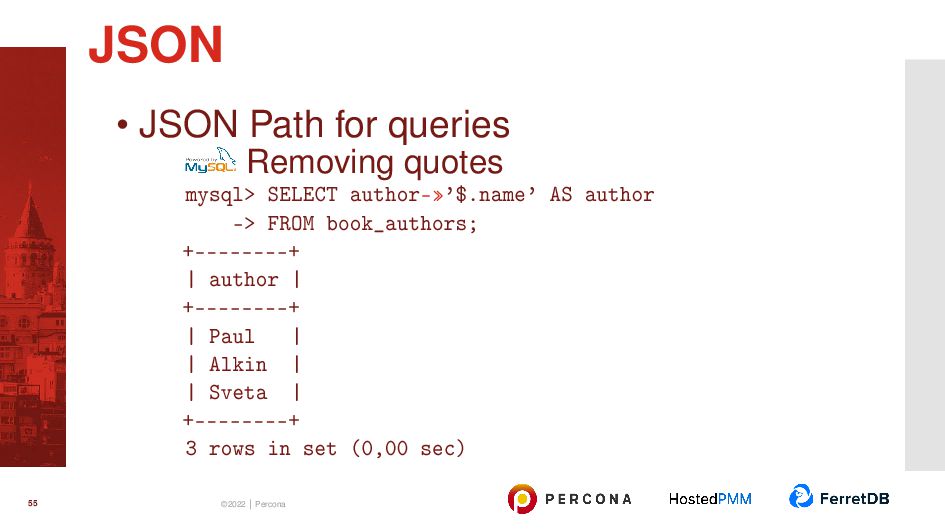
  46. • JSON Path for queries Removing quotes mysql> SELECT author-»’$.name’

    AS author -> FROM book_authors; +--------+ | author | +--------+ | Paul | | Alkin | | Sveta | +--------+ 3 rows in set (0,00 sec) JSON 55 ©2022 | Percona
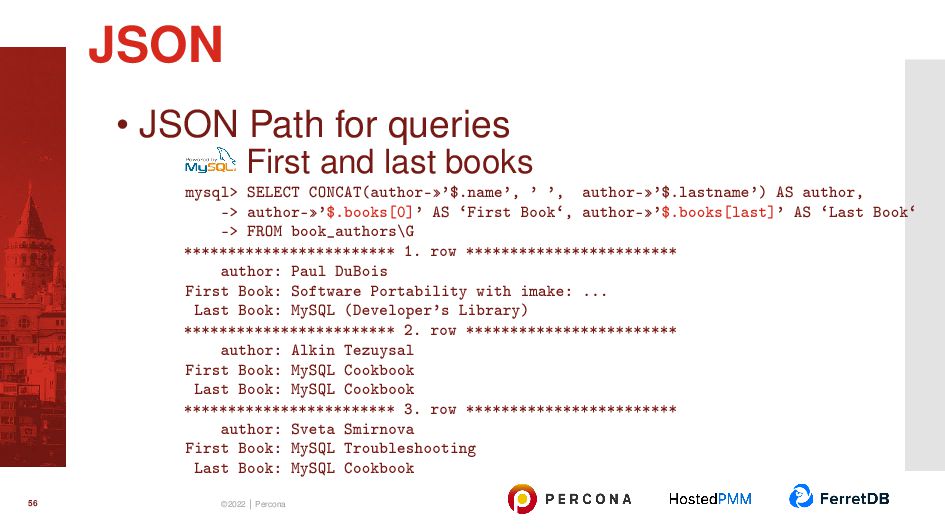
  47. • JSON Path for queries First and last books mysql>

    SELECT CONCAT(author-»’$.name’, ’ ’, author-»’$.lastname’) AS author, -> author-»’$.books[0]’ AS ‘First Book‘, author-»’$.books[last]’ AS ‘Last Book‘ -> FROM book_authors\G ************************ 1. row ************************ author: Paul DuBois First Book: Software Portability with imake: ... Last Book: MySQL (Developer’s Library) ************************ 2. row ************************ author: Alkin Tezuysal First Book: MySQL Cookbook Last Book: MySQL Cookbook ************************ 3. row ************************ author: Sveta Smirnova First Book: MySQL Troubleshooting Last Book: MySQL Cookbook JSON 56 ©2022 | Percona
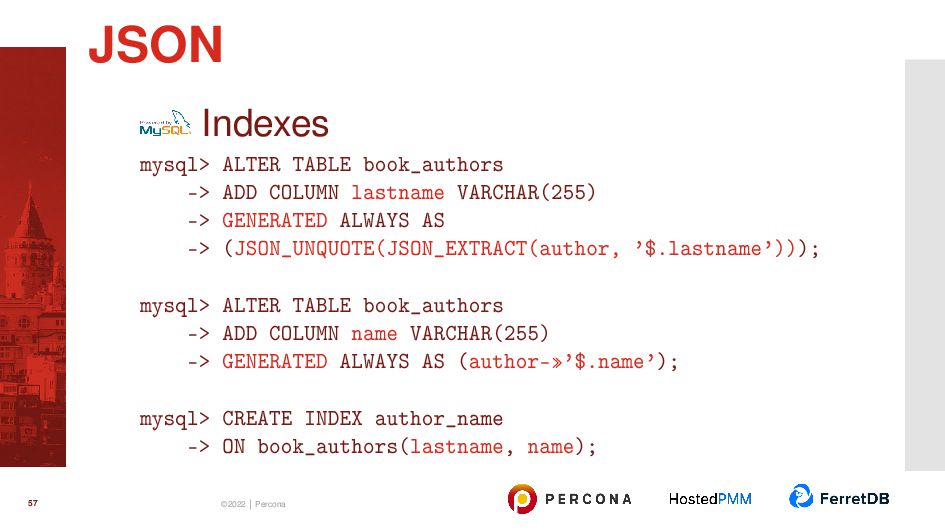
  48. Indexes mysql> ALTER TABLE book_authors -> ADD COLUMN lastname VARCHAR(255)

    -> GENERATED ALWAYS AS -> (JSON_UNQUOTE(JSON_EXTRACT(author, ’$.lastname’))); mysql> ALTER TABLE book_authors -> ADD COLUMN name VARCHAR(255) -> GENERATED ALWAYS AS (author-»’$.name’); mysql> CREATE INDEX author_name -> ON book_authors(lastname, name); JSON 57 ©2022 | Percona
  49. © 2022 | Percona Let’s get connected with Alkin first

    Alkin Tezuysal - EVP - Global Services @chistadata • Linkedin : https://www.linkedin.com/in/askdba/ • Twitter: https://twitter.com/ask_dba Open Source Database Evangelist • Previously PlanetScale, Percona and Pythian as Technical Manager, SRE, DBA • Previously Enterprise DBA , Informix, Oracle, DB2 , SQL Server Author, Speaker, Mentor, and Coach @ChistaDATA Inc. 2022 @ask_dba
  50. © 2022 | Percona Also… Born to Sail, Forced to

    Work @ChistaDATA Inc. 2022 @ask_dba
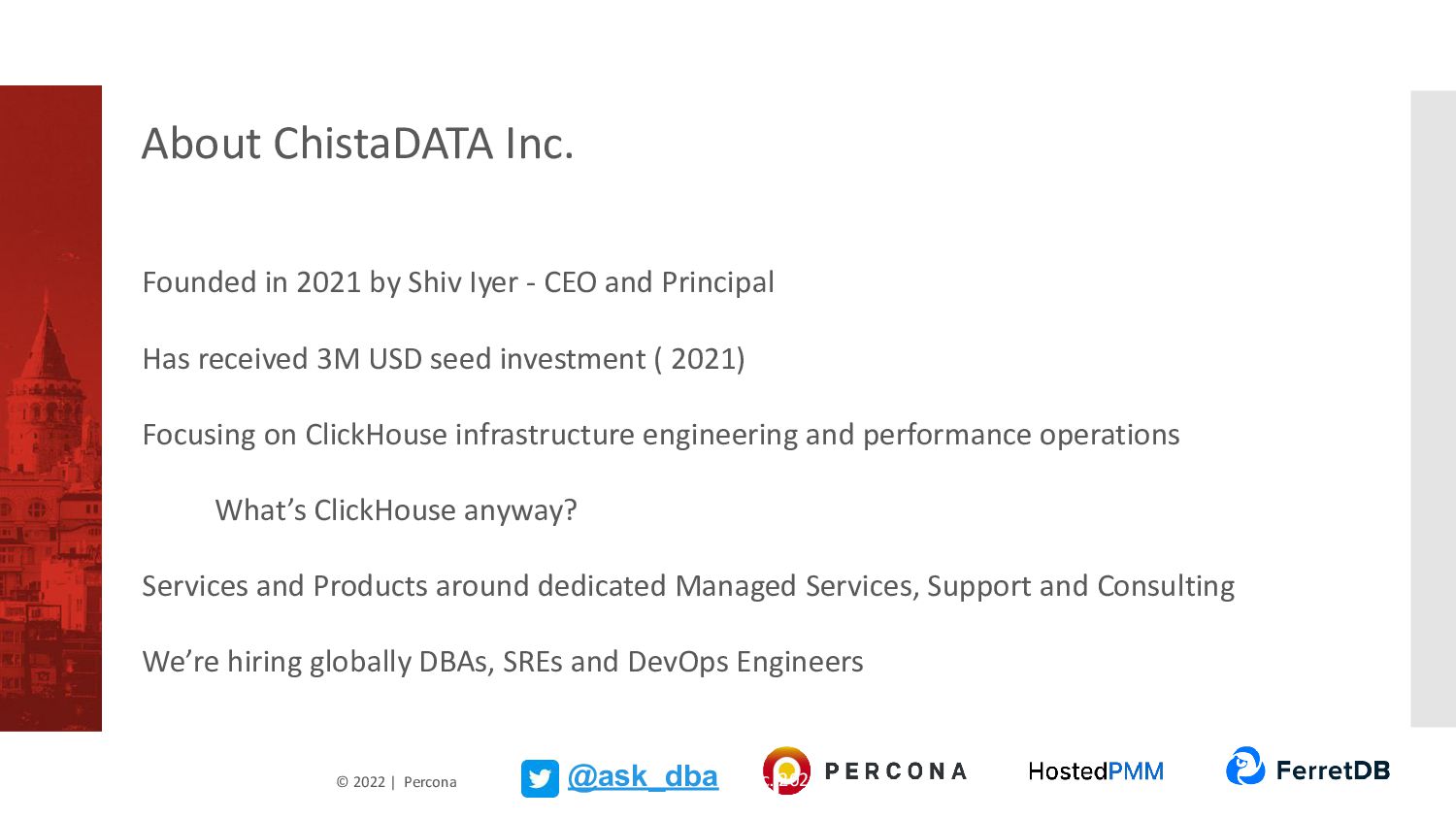
  51. © 2022 | Percona About ChistaDATA Inc. Founded in 2021

    by Shiv Iyer - CEO and Principal Has received 3M USD seed investment ( 2021) Focusing on ClickHouse infrastructure engineering and performance operations What’s ClickHouse anyway? Services and Products around dedicated Managed Services, Support and Consulting We’re hiring globally DBAs, SREs and DevOps Engineers @ChistaDATA Inc. 2022 @ask_dba
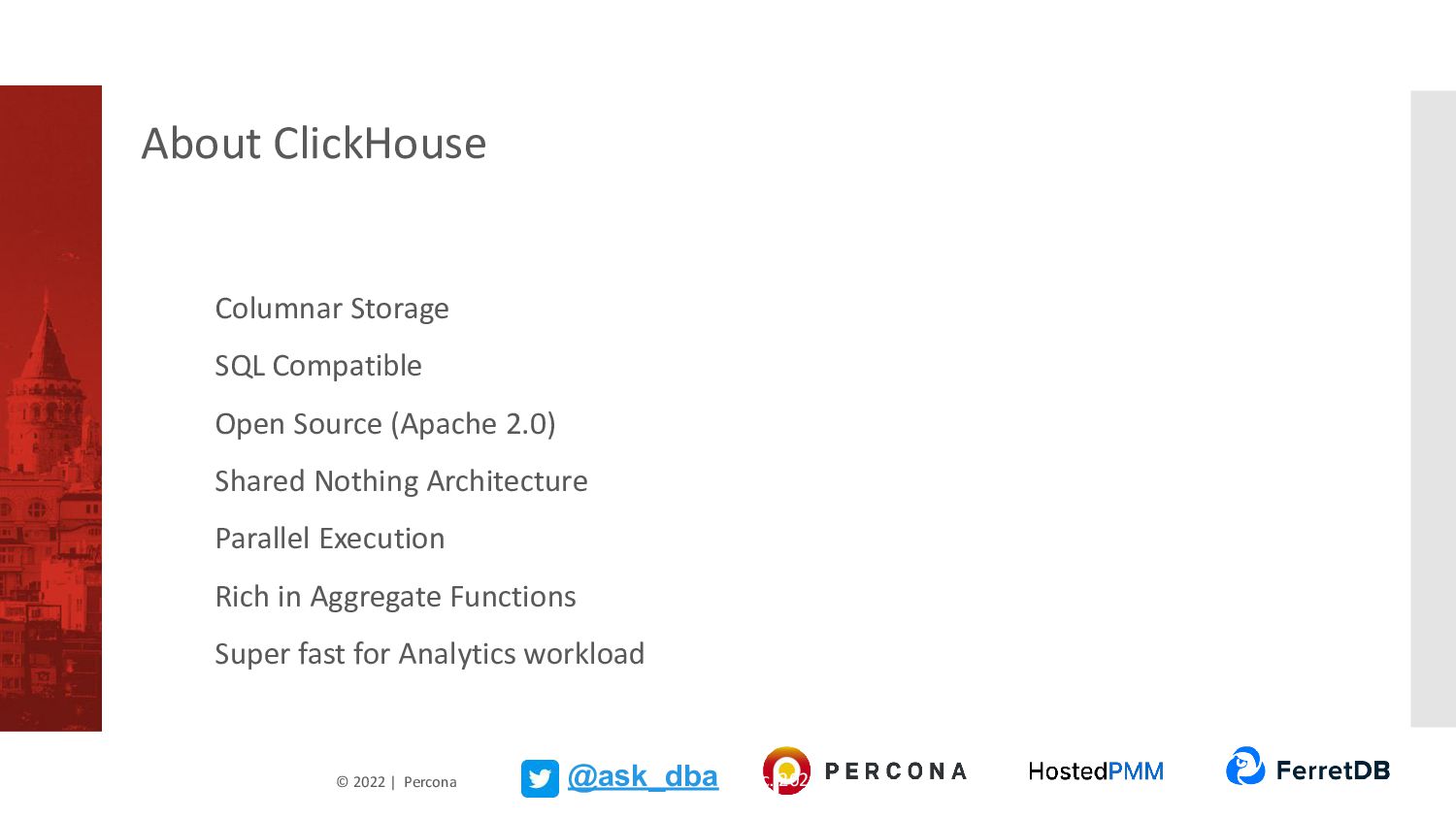
  52. © 2022 | Percona About ClickHouse Columnar Storage SQL Compatible

    Open Source (Apache 2.0) Shared Nothing Architecture Parallel Execution Rich in Aggregate Functions Super fast for Analytics workload @ChistaDATA Inc. 2022 @ask_dba
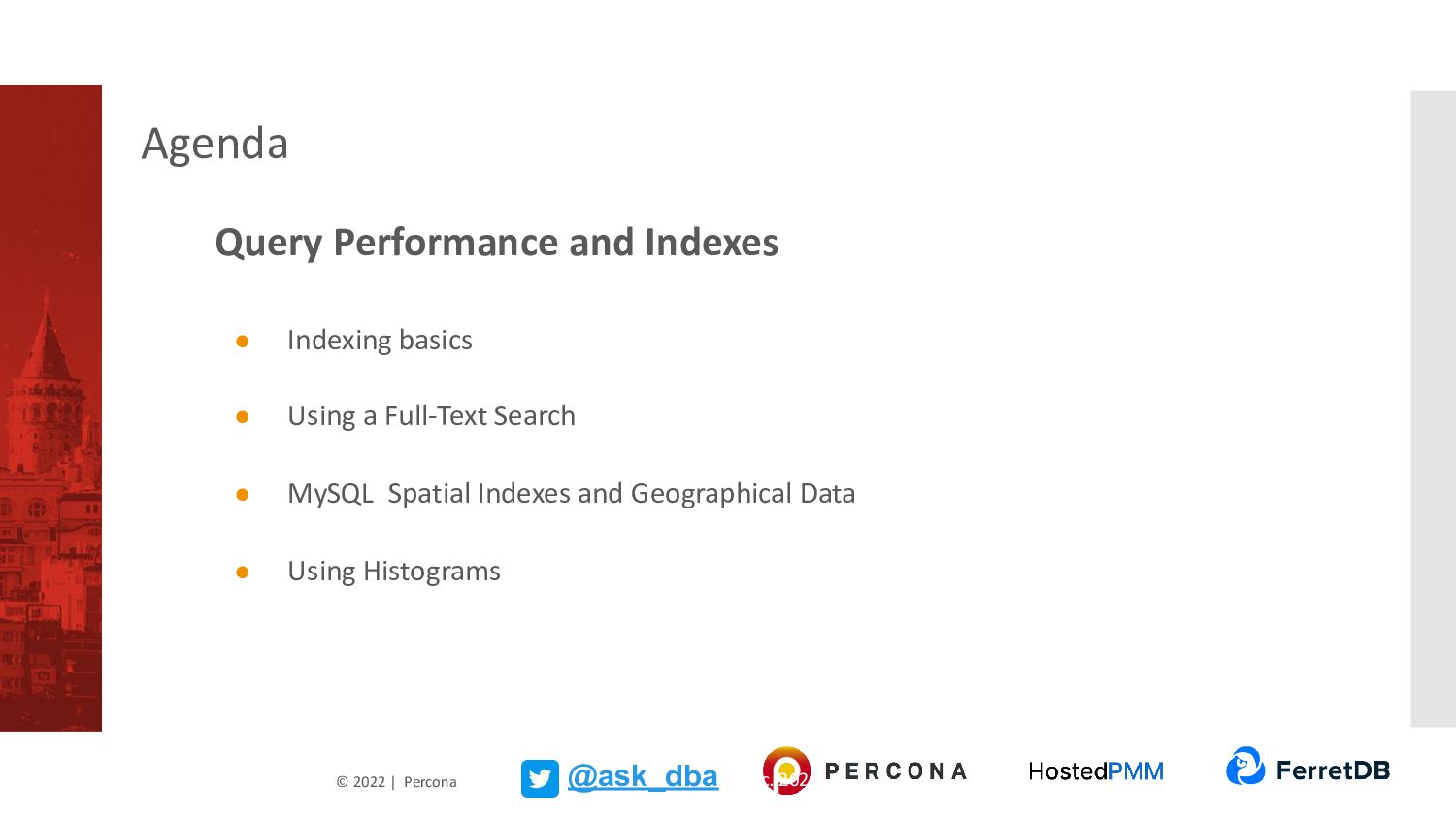
  53. © 2022 | Percona Agenda Query Performance and Indexes •

    Indexing basics • Using a Full-Text Search • MySQL Spatial Indexes and Geographical Data • Using Histograms @ChistaDATA Inc. 2022 @ask_dba
  54. © 2022 | Percona Indexes in MySQL • Table Scan

    • Tree Traversal • Leaf Nodes • B-tree Structure • Hash Indexing • Spatial • Full-text • Histograms @ask_dba @ask_dba
  55. © 2022 | Percona Creating a Surrogate Primary Key Problem

    A table without a primary key is not performant enough Solution Add a primary key to all InnoDB tables. @ask_dba
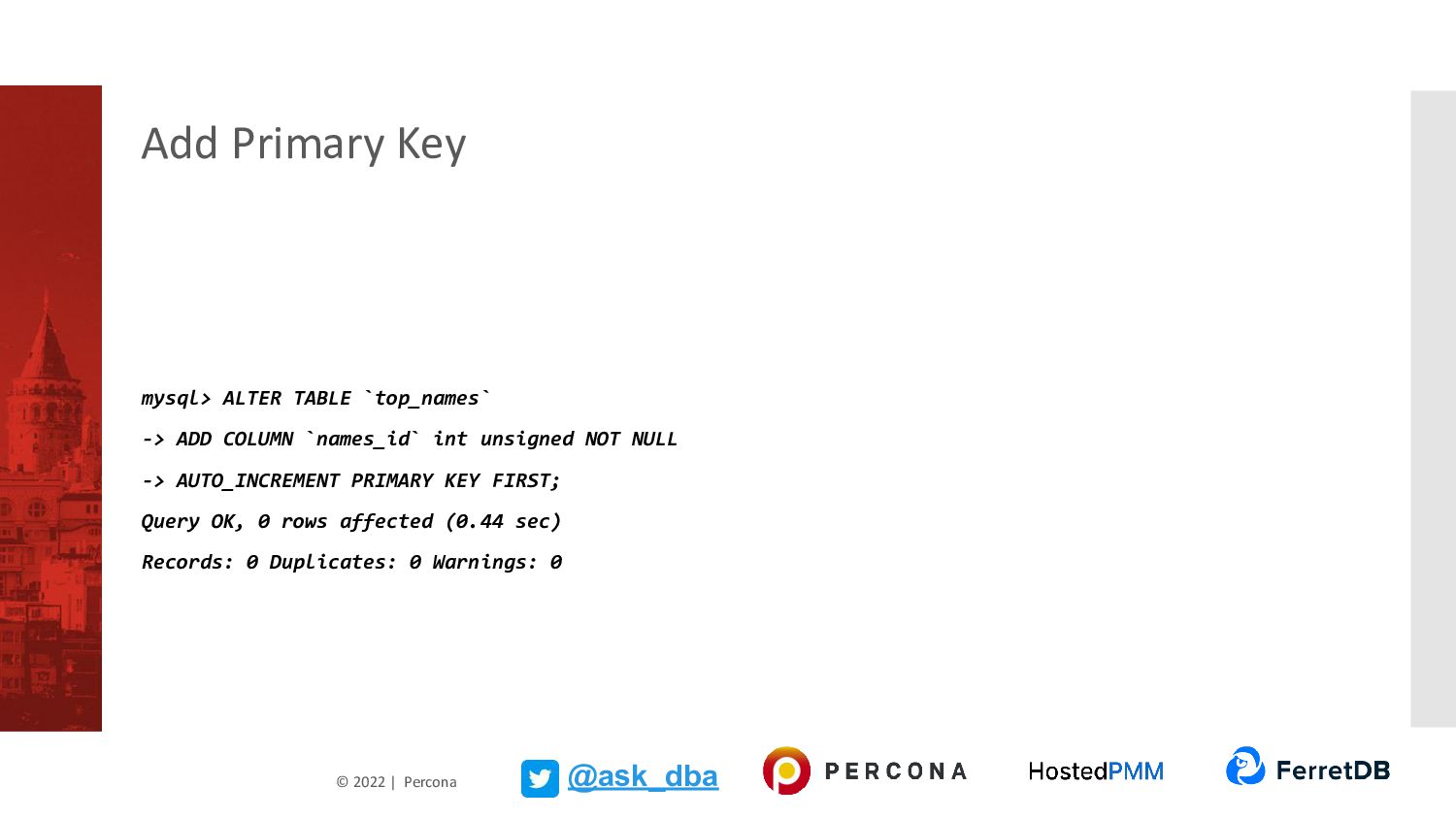
  56. © 2022 | Percona mysql> ALTER TABLE `top_names` -> ADD

    COLUMN `names_id` int unsigned NOT NULL -> AUTO_INCREMENT PRIMARY KEY FIRST; Query OK, 0 rows affected (0.44 sec) Records: 0 Duplicates: 0 Warnings: 0 Add Primary Key @ask_dba
  57. © 2022 | Percona Deciding When a Query Can Use

    an Index Problem Your table has an index, but queries are still slow. Solution Check the query plan using EXPLAIN to make sure the right index has been used. @ask_dba
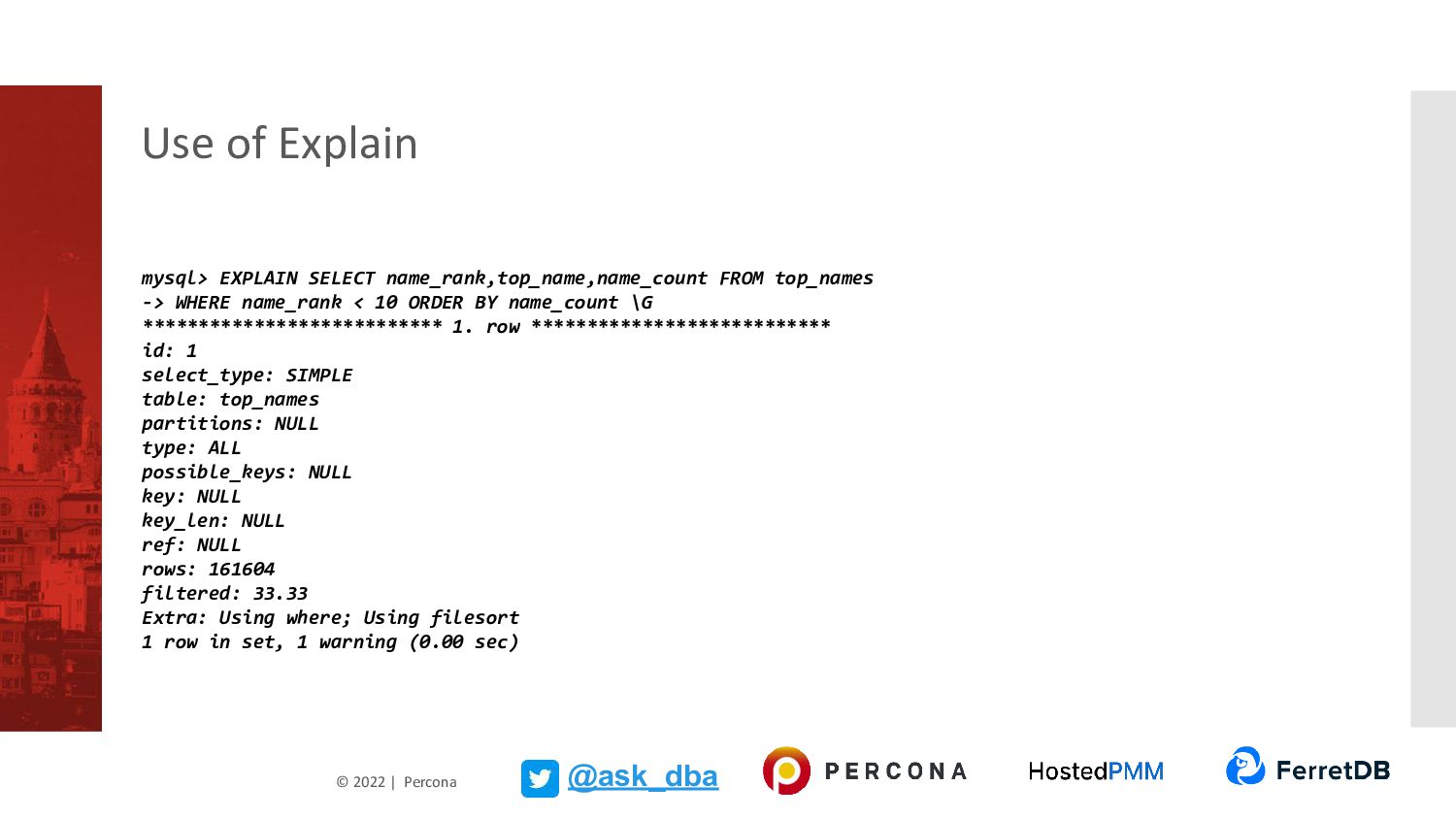
  58. © 2022 | Percona Use of Explain mysql> EXPLAIN SELECT

    name_rank,top_name,name_count FROM top_names -> WHERE name_rank < 10 ORDER BY name_count \G *************************** 1. row *************************** id: 1 select_type: SIMPLE table: top_names partitions: NULL type: ALL possible_keys: NULL key: NULL key_len: NULL ref: NULL rows: 161604 filtered: 33.33 Extra: Using where; Using filesort 1 row in set, 1 warning (0.00 sec) @ask_dba
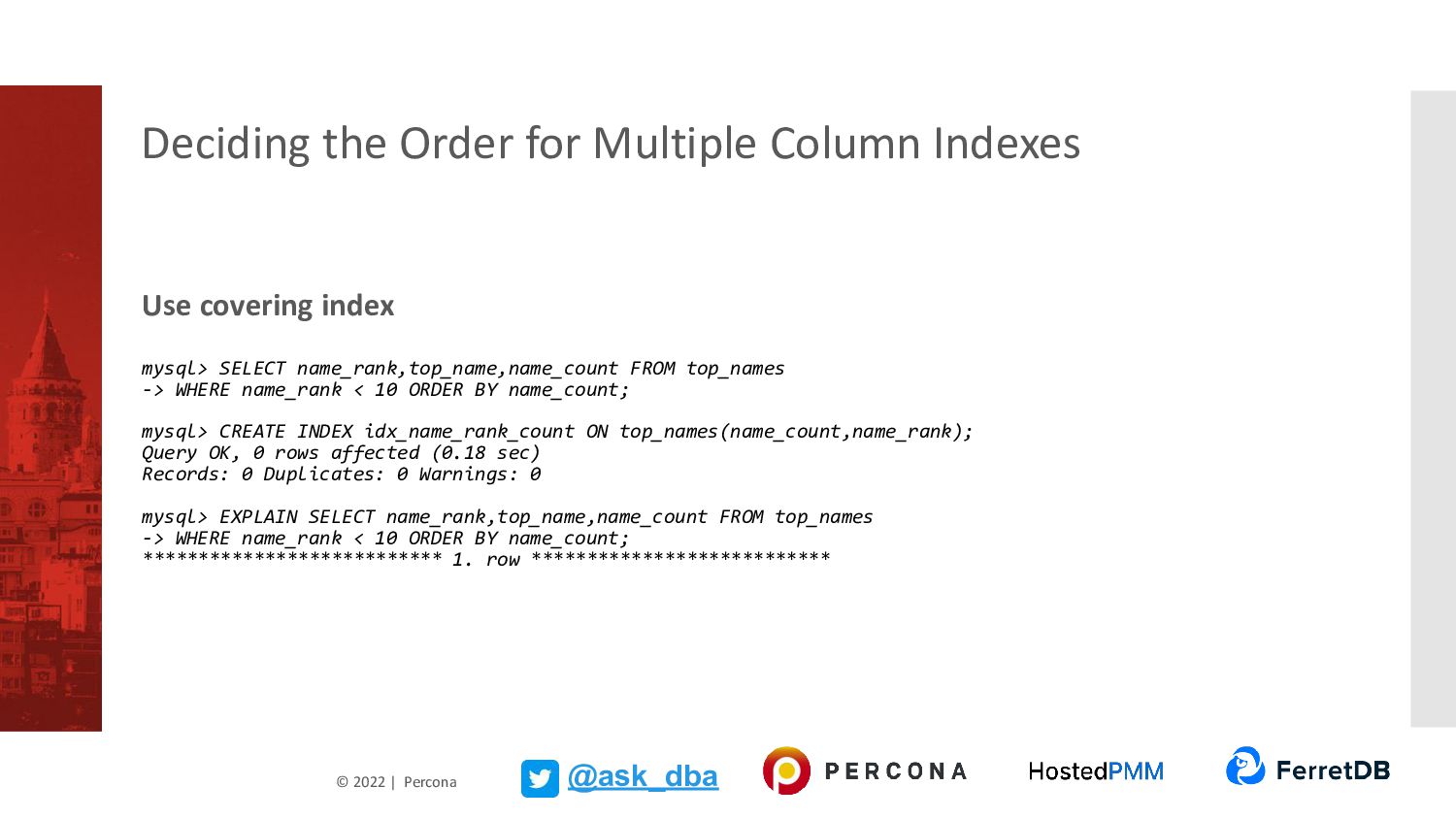
  59. © 2022 | Percona Deciding the Order for Multiple Column

    Indexes Use covering index mysql> SELECT name_rank,top_name,name_count FROM top_names -> WHERE name_rank < 10 ORDER BY name_count; mysql> CREATE INDEX idx_name_rank_count ON top_names(name_count,name_rank); Query OK, 0 rows affected (0.18 sec) Records: 0 Duplicates: 0 Warnings: 0 mysql> EXPLAIN SELECT name_rank,top_name,name_count FROM top_names -> WHERE name_rank < 10 ORDER BY name_count; *************************** 1. row *************************** @ask_dba
  60. © 2022 | Percona Using Full Text Indexes Problem You

    want to take advantage of a keyword search, but queries on text fields are slow. Solution Use FULLTEXT indexes for full-text searches. @ask_dba
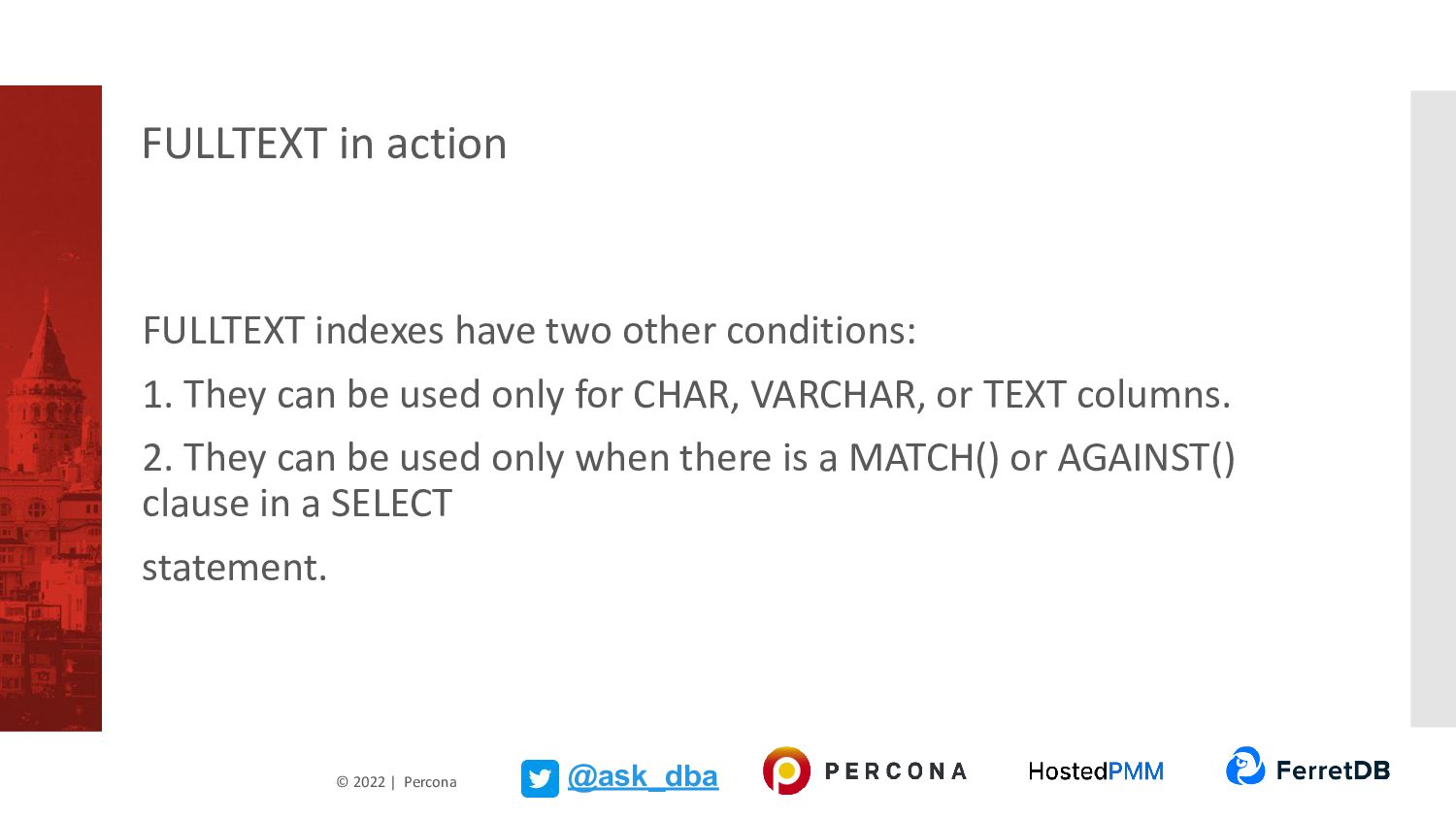
  61. © 2022 | Percona FULLTEXT in action FULLTEXT indexes have

    two other conditions: 1. They can be used only for CHAR, VARCHAR, or TEXT columns. 2. They can be used only when there is a MATCH() or AGAINST() clause in a SELECT statement. @ask_dba
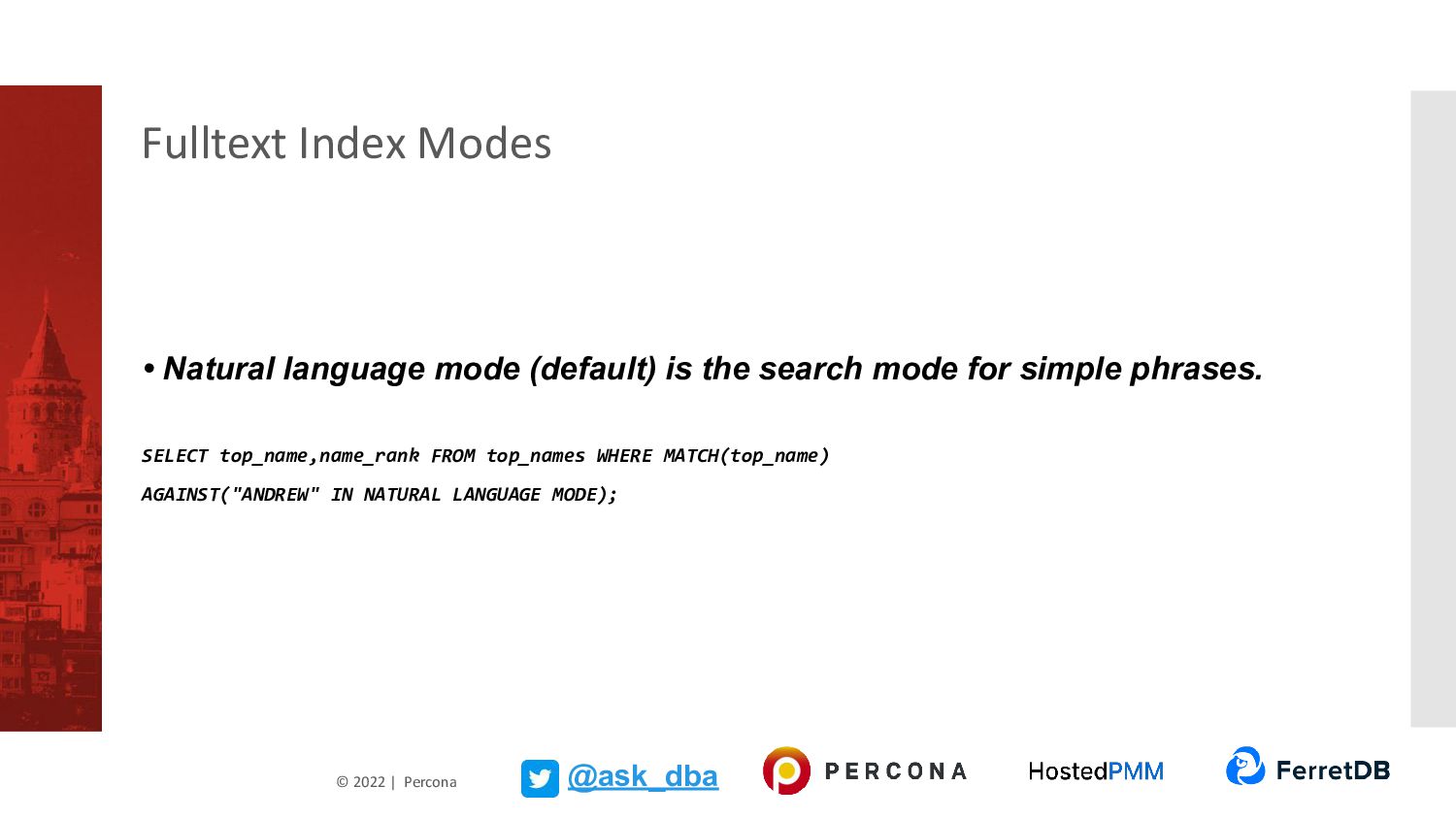
  62. © 2022 | Percona Fulltext Index Modes • Natural language

    mode (default) is the search mode for simple phrases. SELECT top_name,name_rank FROM top_names WHERE MATCH(top_name) AGAINST("ANDREW" IN NATURAL LANGUAGE MODE); @ask_dba
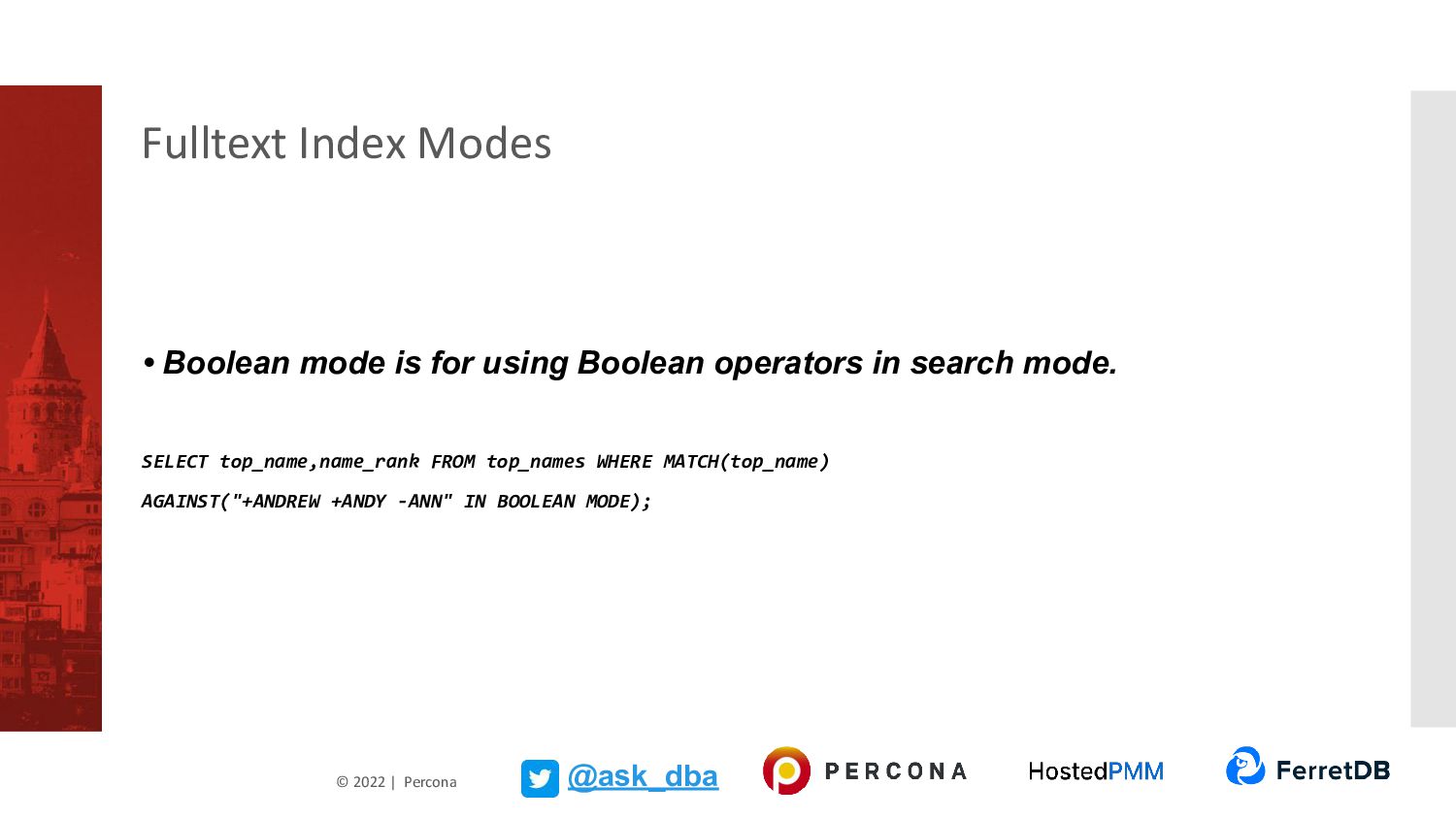
  63. © 2022 | Percona Fulltext Index Modes • Boolean mode

    is for using Boolean operators in search mode. SELECT top_name,name_rank FROM top_names WHERE MATCH(top_name) AGAINST("+ANDREW +ANDY -ANN" IN BOOLEAN MODE); @ask_dba
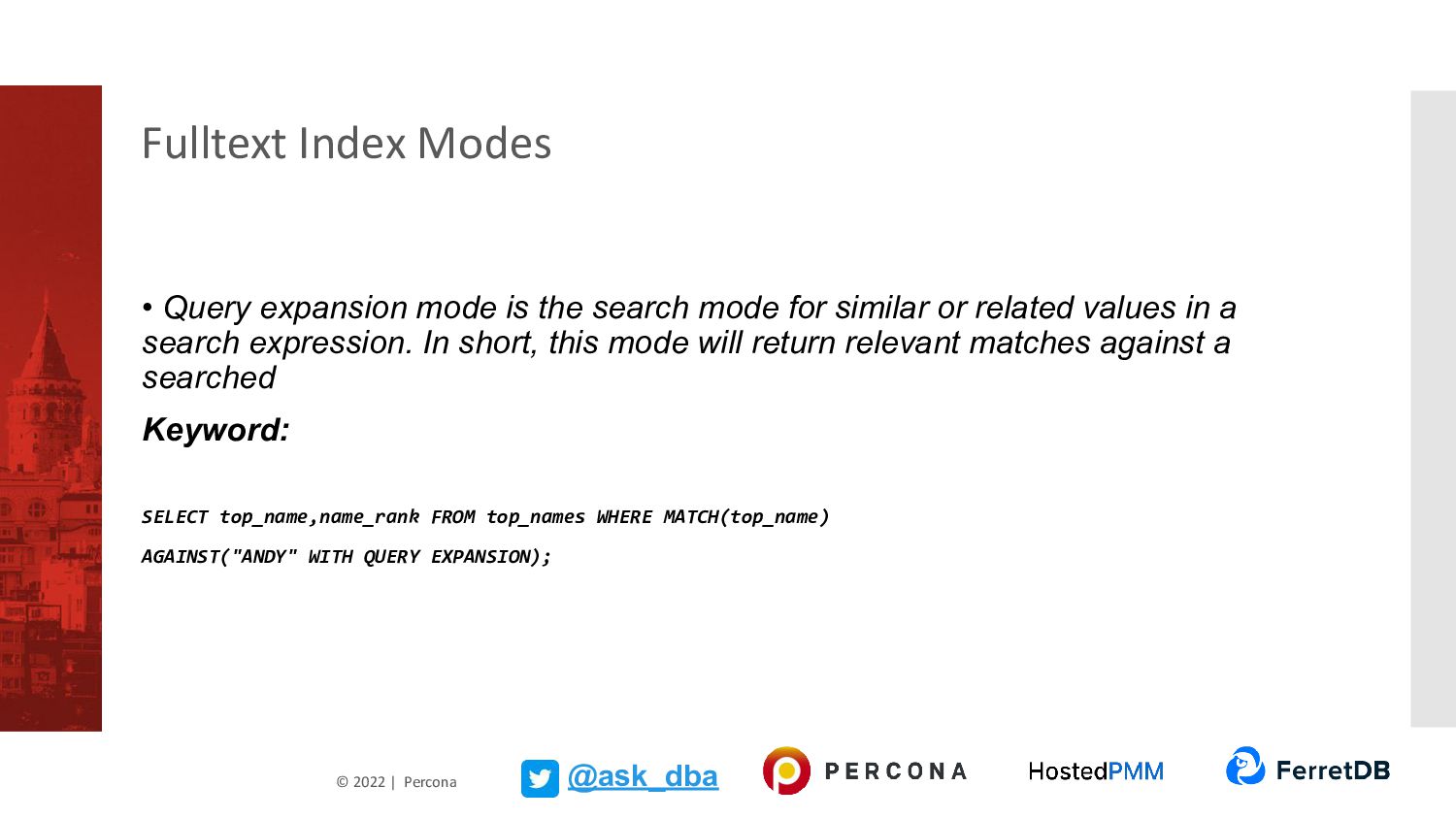
  64. © 2022 | Percona Fulltext Index Modes • Query expansion

    mode is the search mode for similar or related values in a search expression. In short, this mode will return relevant matches against a searched Keyword: SELECT top_name,name_rank FROM top_names WHERE MATCH(top_name) AGAINST("ANDY" WITH QUERY EXPANSION); @ask_dba
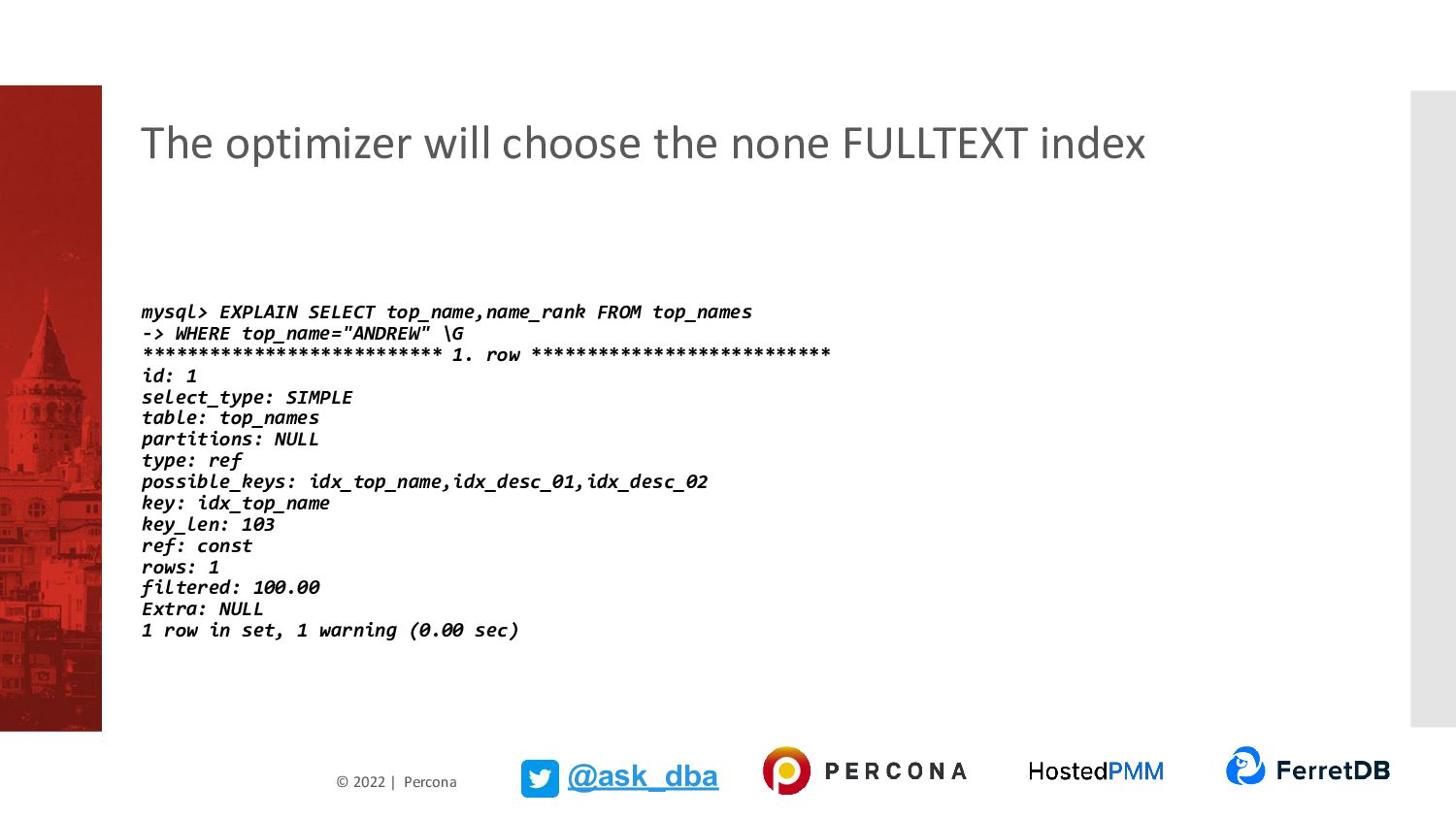
  65. © 2022 | Percona The optimizer will choose the none

    FULLTEXT index mysql> EXPLAIN SELECT top_name,name_rank FROM top_names -> WHERE top_name="ANDREW" \G *************************** 1. row *************************** id: 1 select_type: SIMPLE table: top_names partitions: NULL type: ref possible_keys: idx_top_name,idx_desc_01,idx_desc_02 key: idx_top_name key_len: 103 ref: const rows: 1 filtered: 100.00 Extra: NULL 1 row in set, 1 warning (0.00 sec) @ask_dba
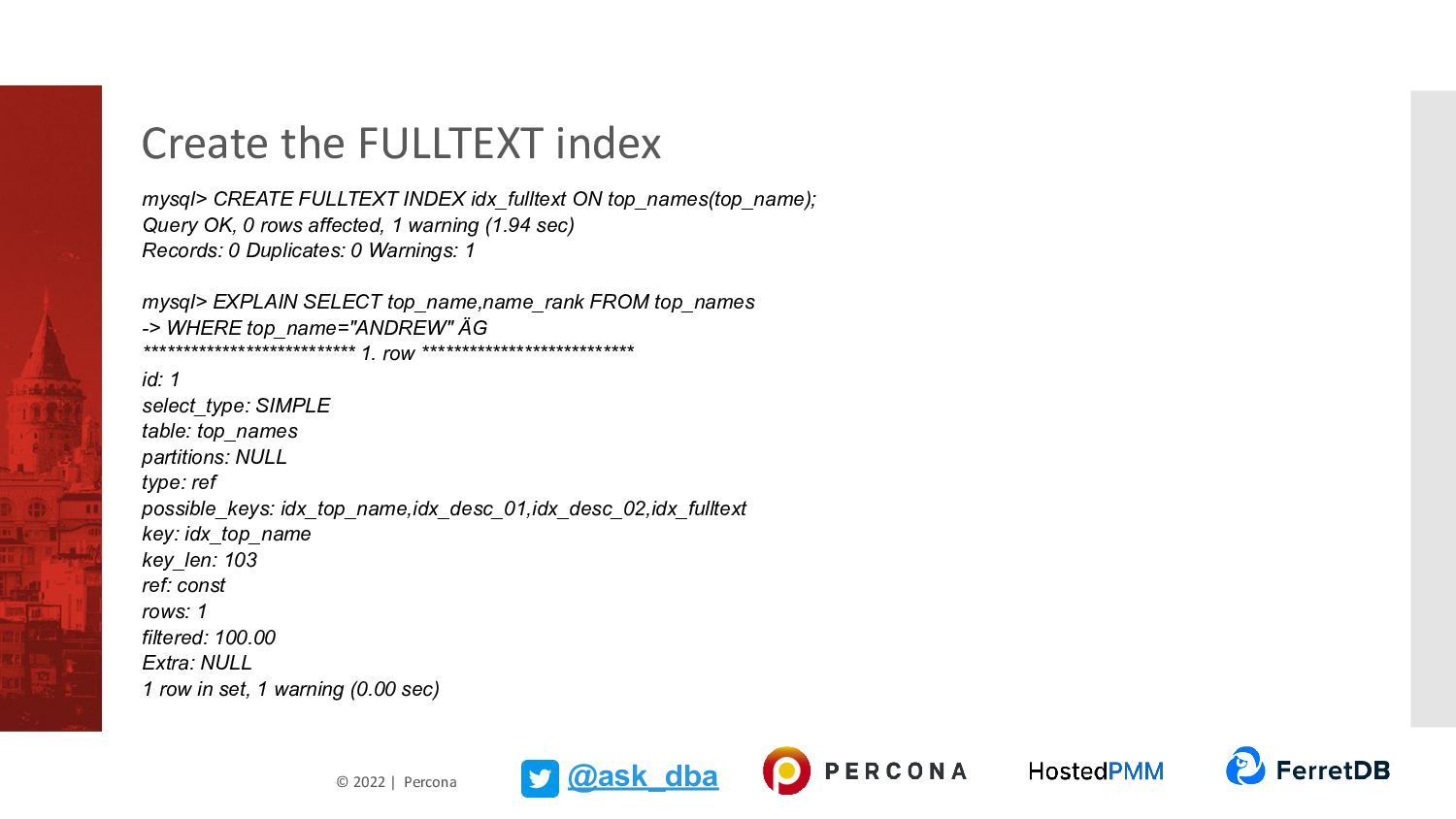
  66. © 2022 | Percona Create the FULLTEXT index mysql> CREATE

    FULLTEXT INDEX idx_fulltext ON top_names(top_name); Query OK, 0 rows affected, 1 warning (1.94 sec) Records: 0 Duplicates: 0 Warnings: 1 mysql> EXPLAIN SELECT top_name,name_rank FROM top_names -> WHERE top_name="ANDREW" ÄG *************************** 1. row *************************** id: 1 select_type: SIMPLE table: top_names partitions: NULL type: ref possible_keys: idx_top_name,idx_desc_01,idx_desc_02,idx_fulltext key: idx_top_name key_len: 103 ref: const rows: 1 filtered: 100.00 Extra: NULL 1 row in set, 1 warning (0.00 sec) @ask_dba
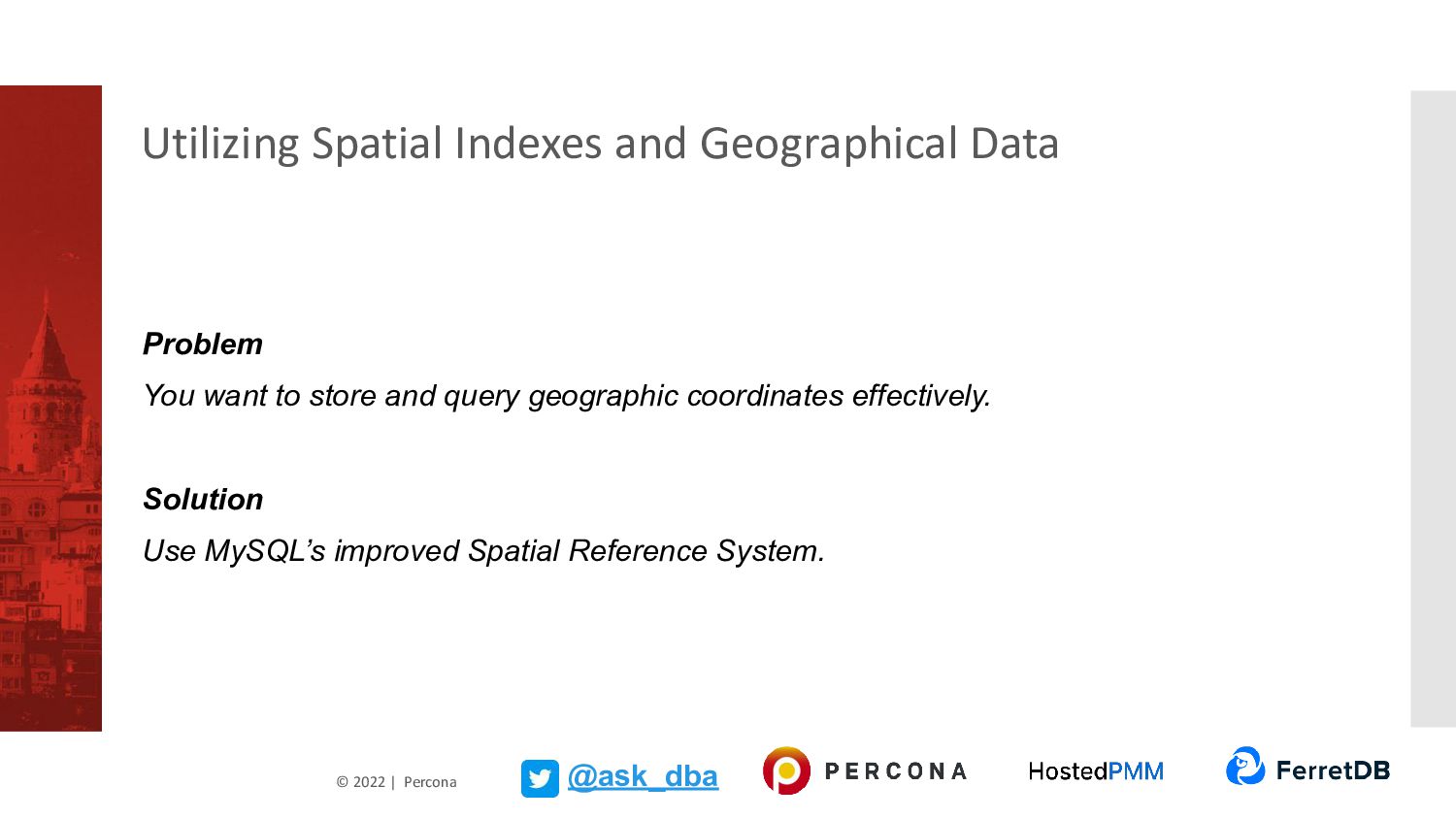
  67. © 2022 | Percona Utilizing Spatial Indexes and Geographical Data

    Problem You want to store and query geographic coordinates effectively. Solution Use MySQL’s improved Spatial Reference System. @ask_dba
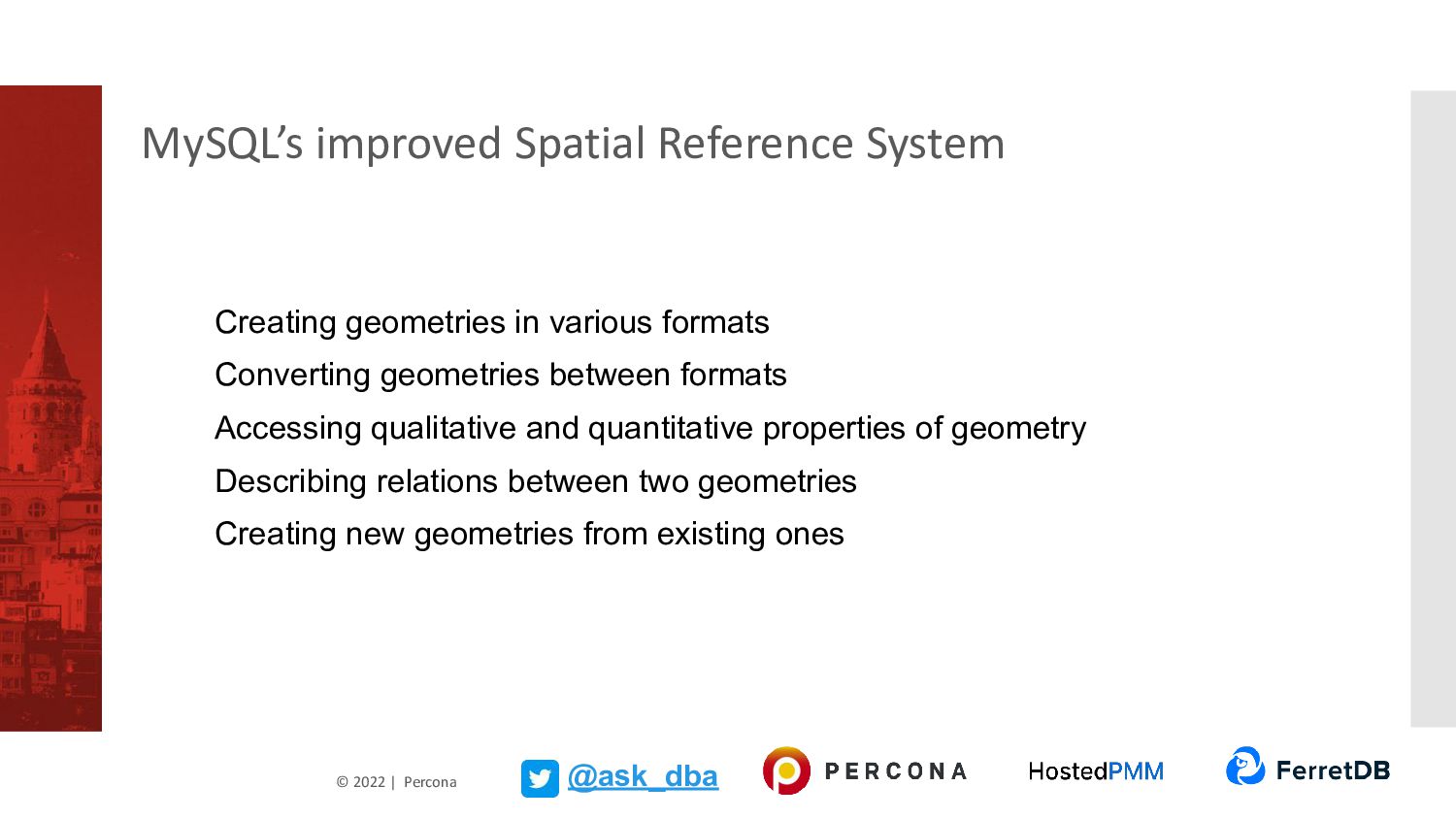
  68. © 2022 | Percona MySQL’s improved Spatial Reference System Creating

    geometries in various formats Converting geometries between formats Accessing qualitative and quantitative properties of geometry Describing relations between two geometries Creating new geometries from existing ones @ask_dba
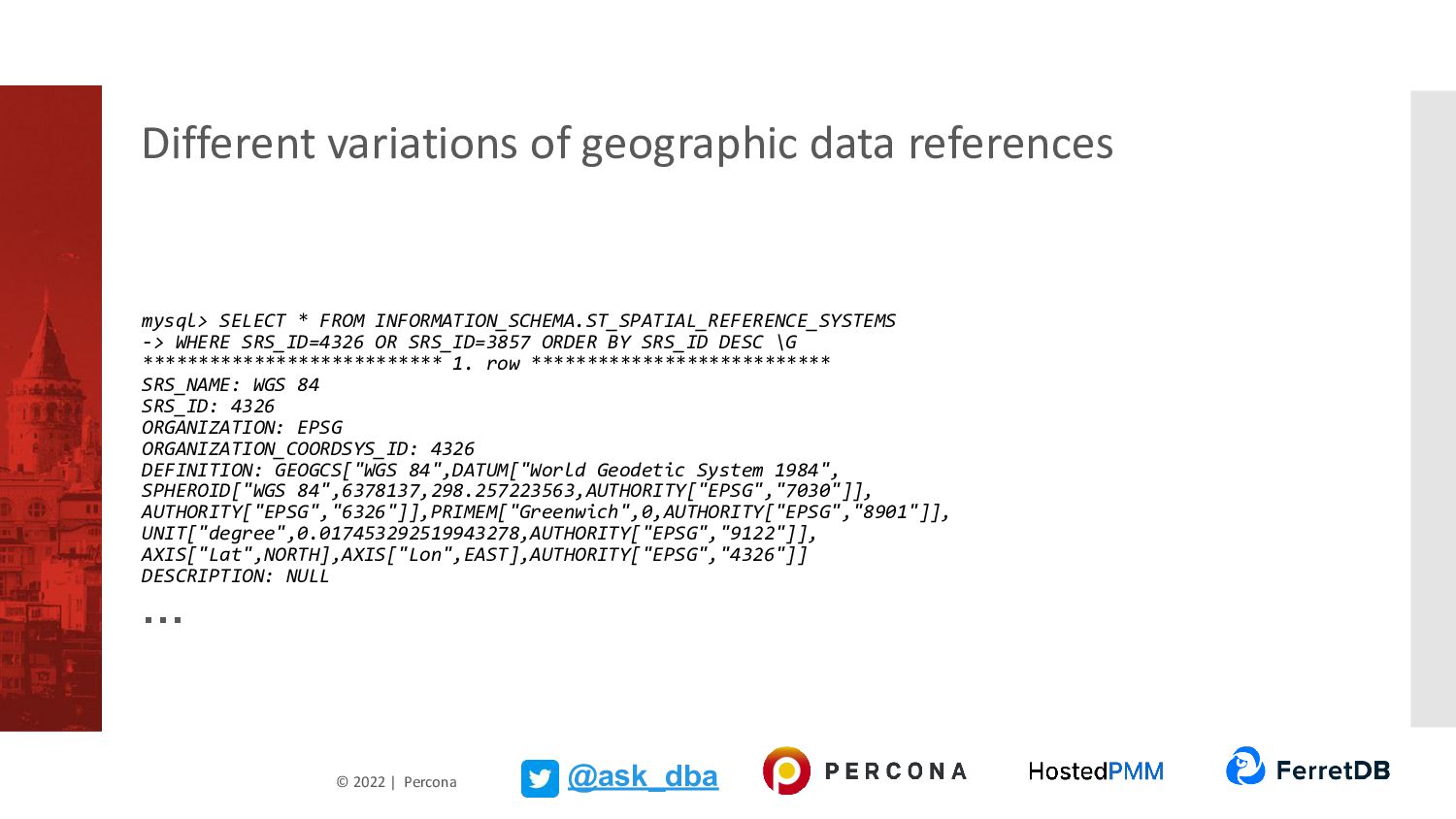
  69. © 2022 | Percona Different variations of geographic data references

    mysql> SELECT * FROM INFORMATION_SCHEMA.ST_SPATIAL_REFERENCE_SYSTEMS -> WHERE SRS_ID=4326 OR SRS_ID=3857 ORDER BY SRS_ID DESC \G *************************** 1. row *************************** SRS_NAME: WGS 84 SRS_ID: 4326 ORGANIZATION: EPSG ORGANIZATION_COORDSYS_ID: 4326 DEFINITION: GEOGCS["WGS 84",DATUM["World Geodetic System 1984", SPHEROID["WGS 84",6378137,298.257223563,AUTHORITY["EPSG","7030"]], AUTHORITY["EPSG","6326"]],PRIMEM["Greenwich",0,AUTHORITY["EPSG","8901"]], UNIT["degree",0.017453292519943278,AUTHORITY["EPSG","9122"]], AXIS["Lat",NORTH],AXIS["Lon",EAST],AUTHORITY["EPSG","4326"]] DESCRIPTION: NULL … @ask_dba
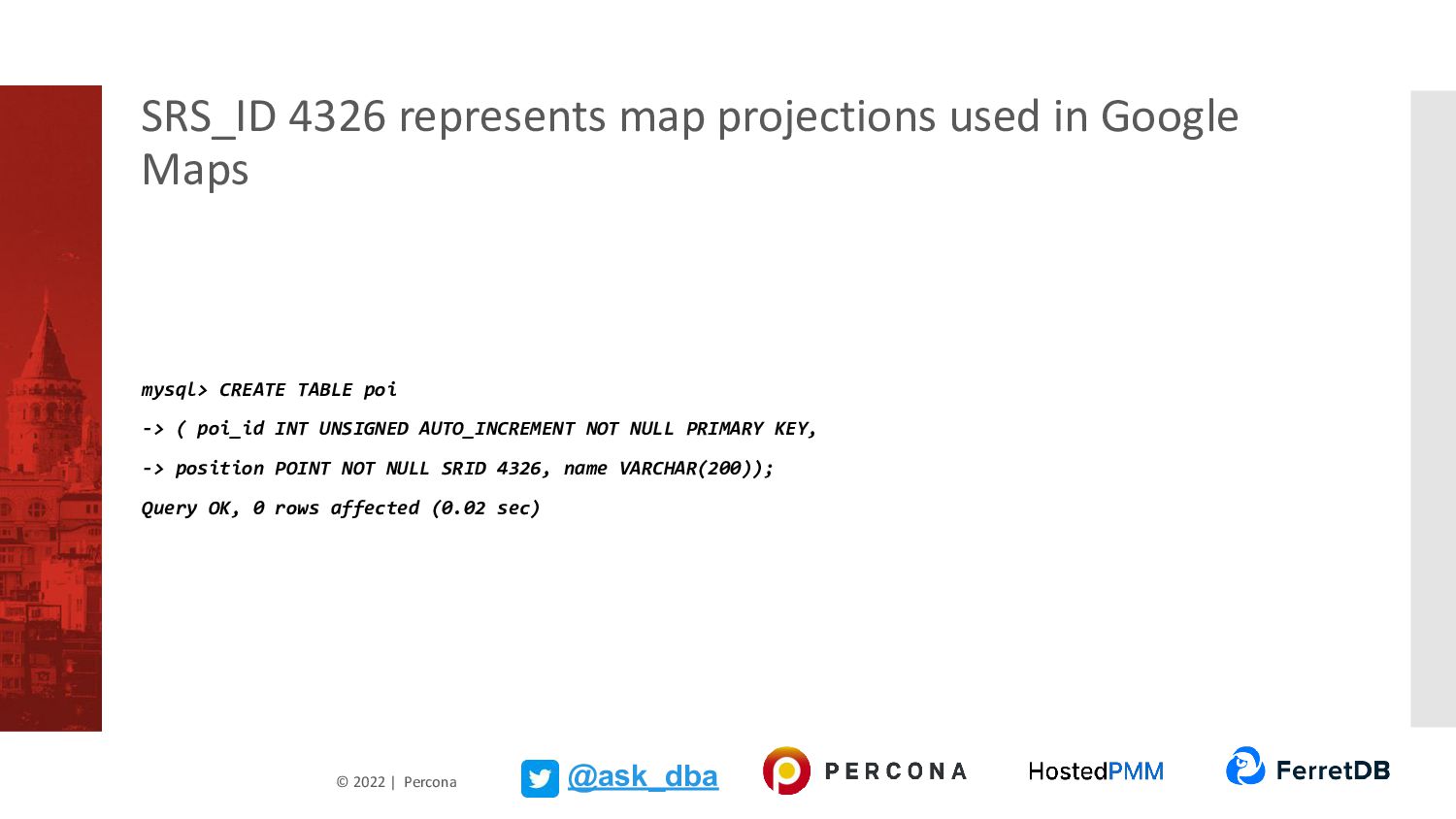
  70. © 2022 | Percona SRS_ID 4326 represents map projections used

    in Google Maps mysql> CREATE TABLE poi -> ( poi_id INT UNSIGNED AUTO_INCREMENT NOT NULL PRIMARY KEY, -> position POINT NOT NULL SRID 4326, name VARCHAR(200)); Query OK, 0 rows affected (0.02 sec) @ask_dba
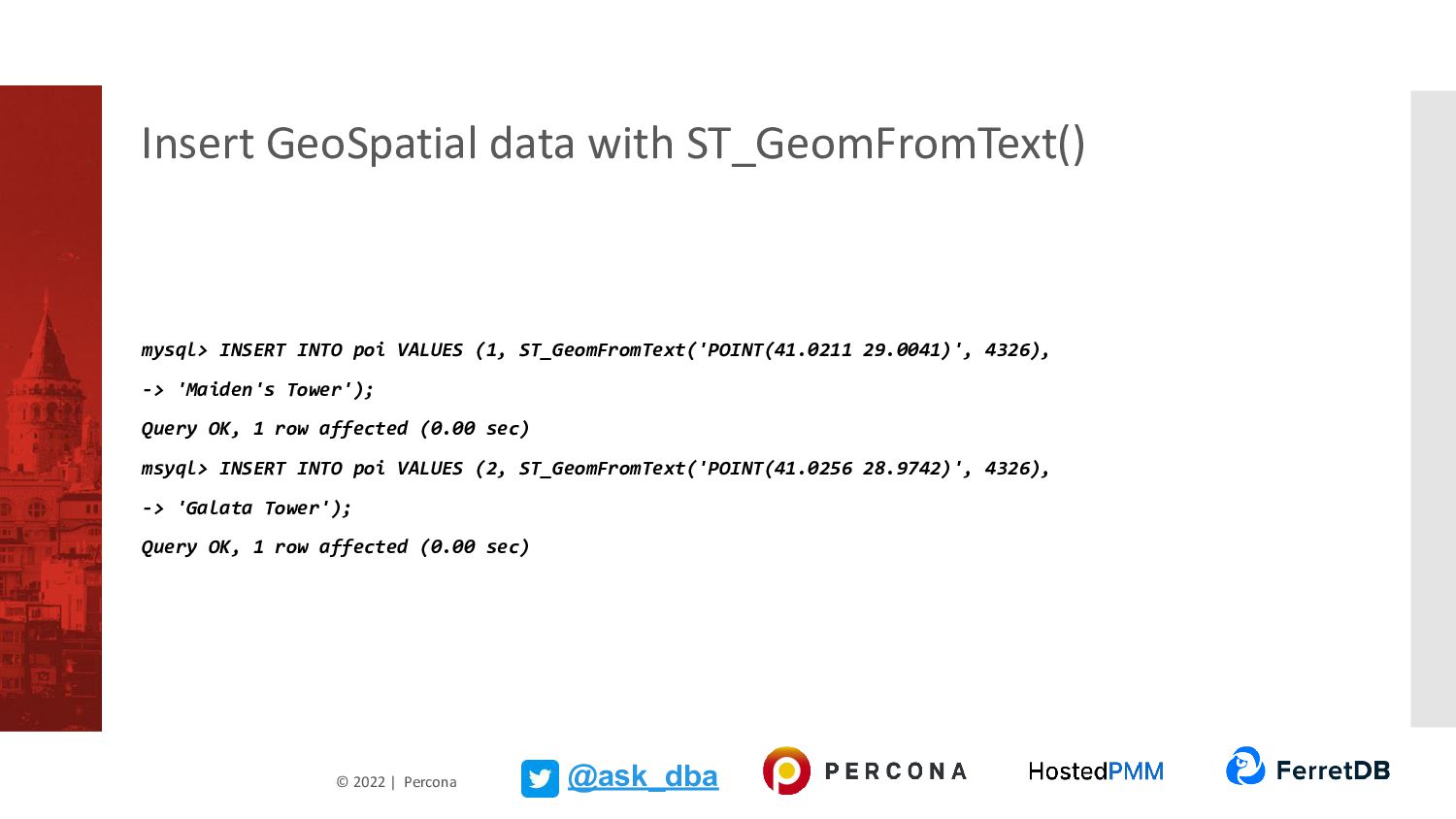
  71. © 2022 | Percona Insert GeoSpatial data with ST_GeomFromText() mysql>

    INSERT INTO poi VALUES (1, ST_GeomFromText('POINT(41.0211 29.0041)', 4326), -> 'Maiden's Tower'); Query OK, 1 row affected (0.00 sec) msyql> INSERT INTO poi VALUES (2, ST_GeomFromText('POINT(41.0256 28.9742)', 4326), -> 'Galata Tower'); Query OK, 1 row affected (0.00 sec) @ask_dba
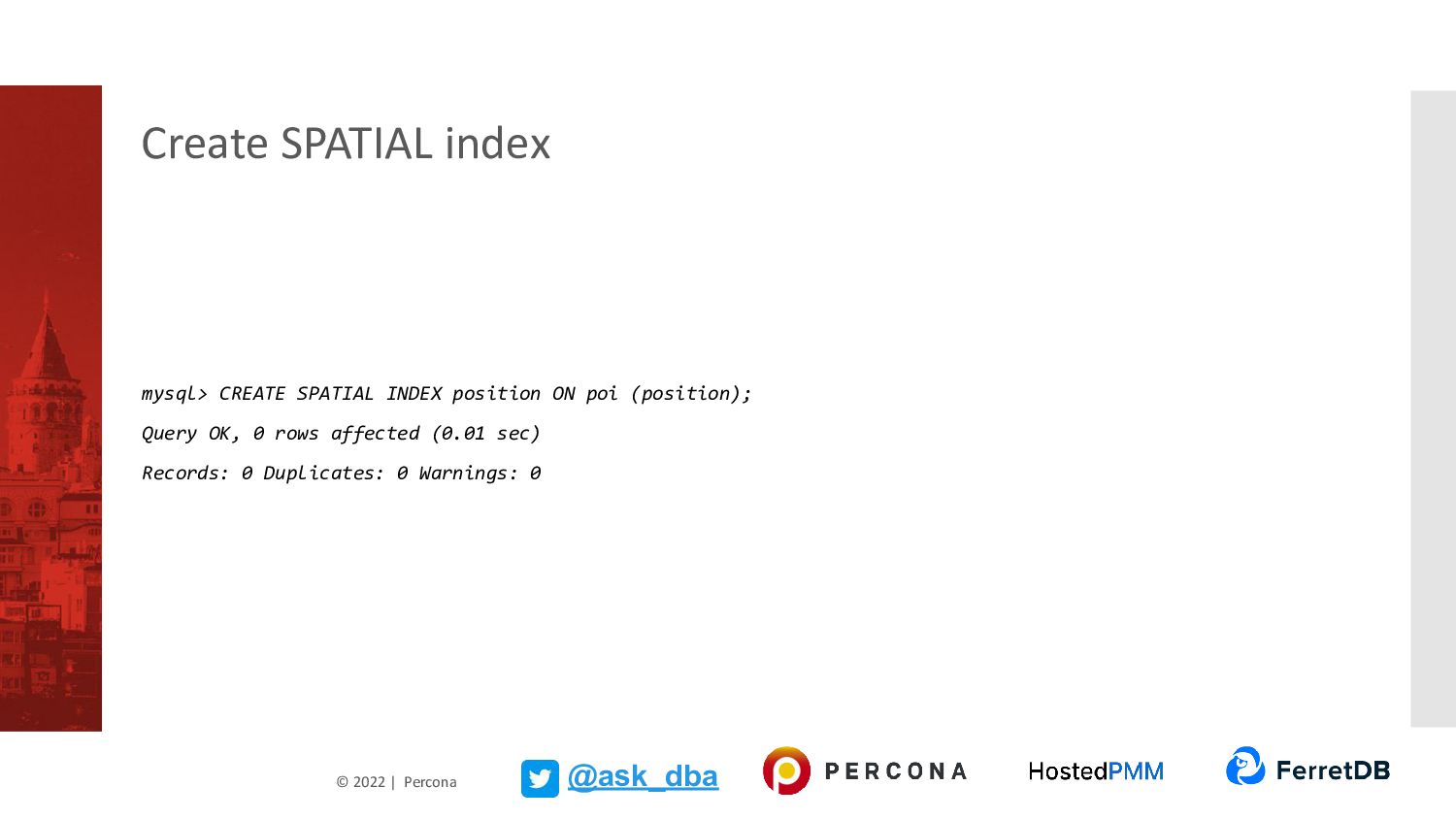
  72. © 2022 | Percona Create SPATIAL index mysql> CREATE SPATIAL

    INDEX position ON poi (position); Query OK, 0 rows affected (0.01 sec) Records: 0 Duplicates: 0 Warnings: 0 @ask_dba
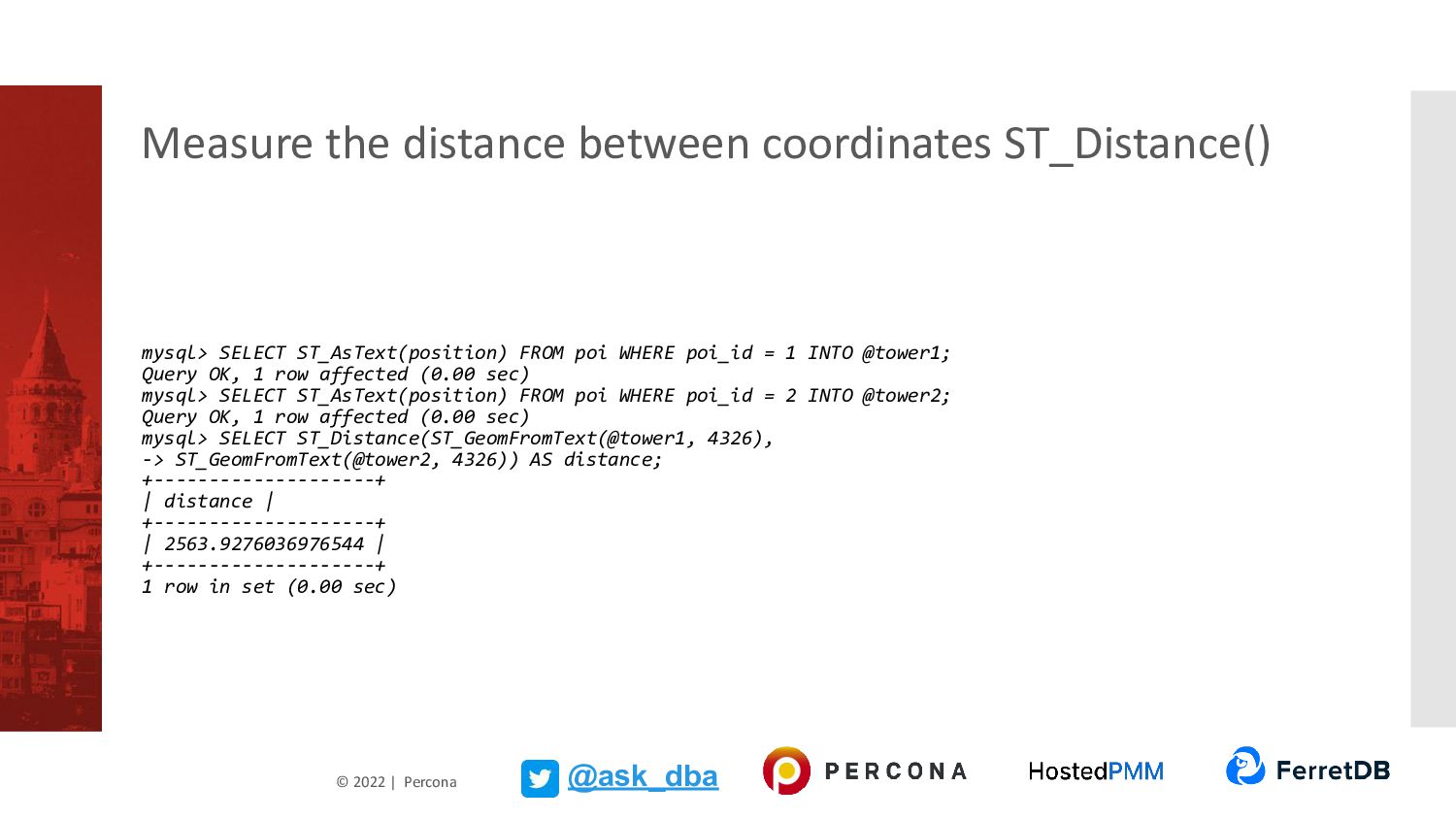
  73. © 2022 | Percona Measure the distance between coordinates ST_Distance()

    mysql> SELECT ST_AsText(position) FROM poi WHERE poi_id = 1 INTO @tower1; Query OK, 1 row affected (0.00 sec) mysql> SELECT ST_AsText(position) FROM poi WHERE poi_id = 2 INTO @tower2; Query OK, 1 row affected (0.00 sec) mysql> SELECT ST_Distance(ST_GeomFromText(@tower1, 4326), -> ST_GeomFromText(@tower2, 4326)) AS distance; +--------------------+ | distance | +--------------------+ | 2563.9276036976544 | +--------------------+ 1 row in set (0.00 sec) @ask_dba
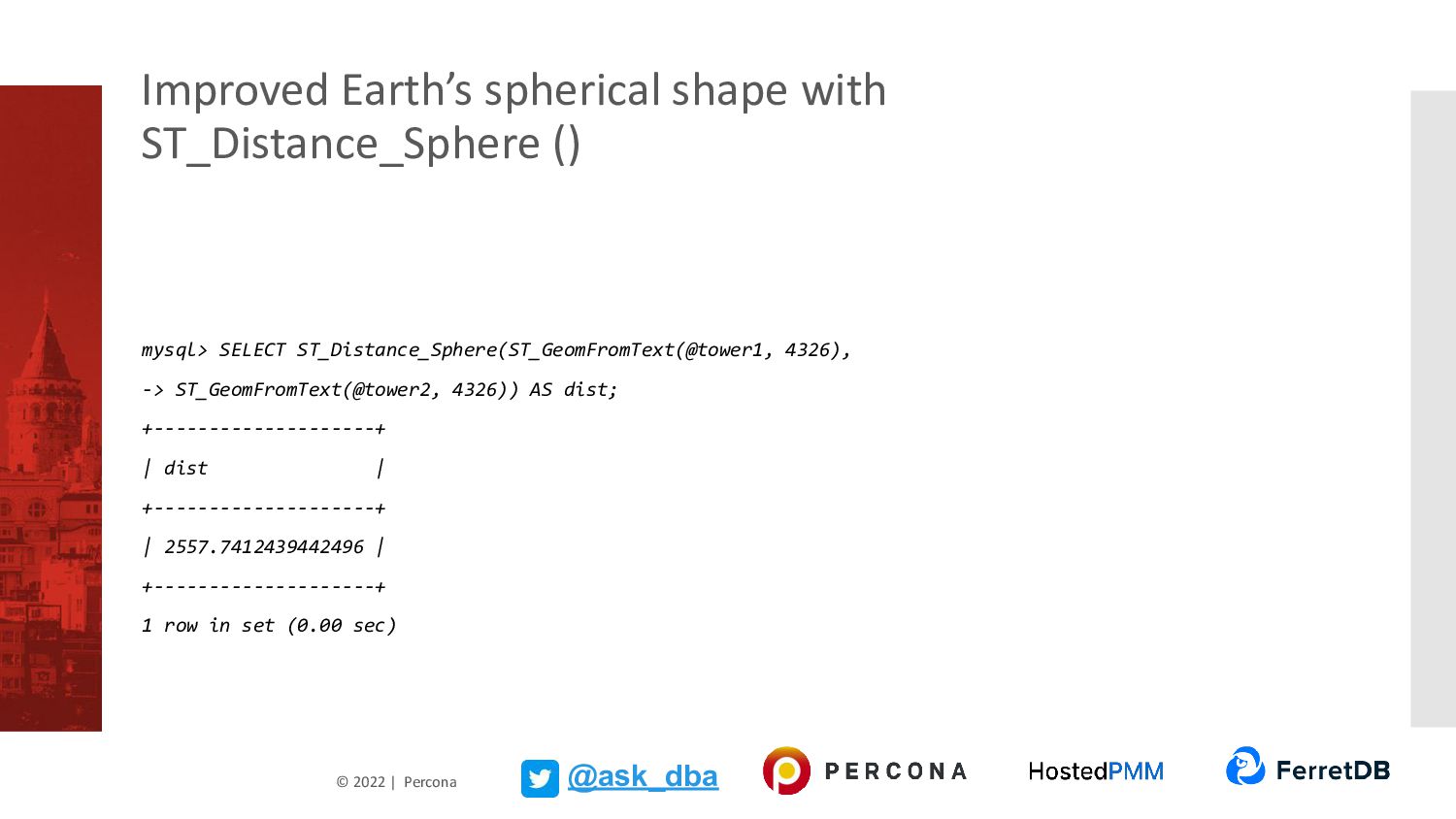
  74. © 2022 | Percona Improved Earth’s spherical shape with ST_Distance_Sphere

    () mysql> SELECT ST_Distance_Sphere(ST_GeomFromText(@tower1, 4326), -> ST_GeomFromText(@tower2, 4326)) AS dist; +--------------------+ | dist | +--------------------+ | 2557.7412439442496 | +--------------------+ 1 row in set (0.00 sec) @ask_dba
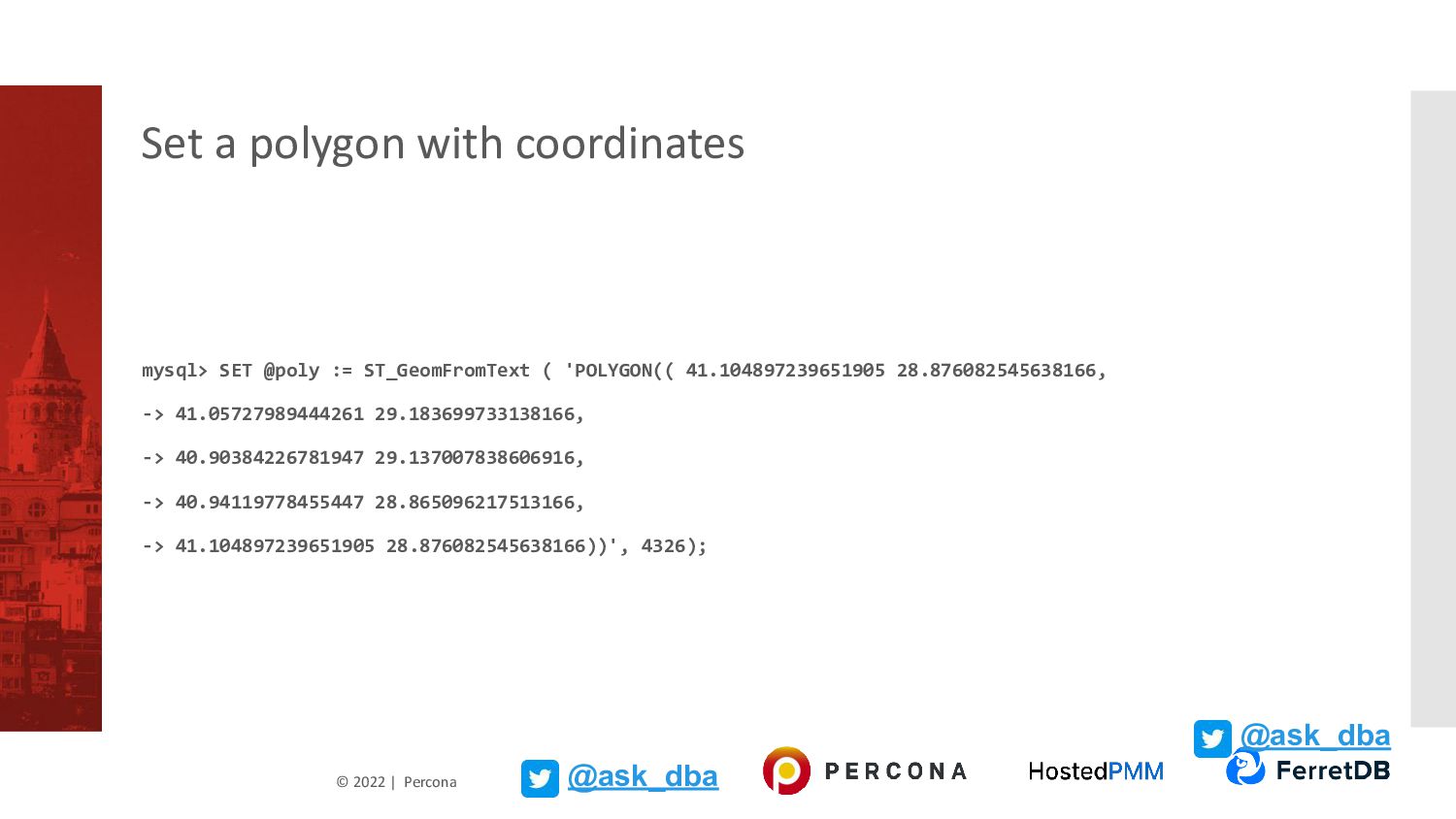
  75. © 2022 | Percona Set a polygon with coordinates mysql>

    SET @poly := ST_GeomFromText ( 'POLYGON(( 41.104897239651905 28.876082545638166, -> 41.05727989444261 29.183699733138166, -> 40.90384226781947 29.137007838606916, -> 40.94119778455447 28.865096217513166, -> 41.104897239651905 28.876082545638166))', 4326); @ask_dba @ask_dba
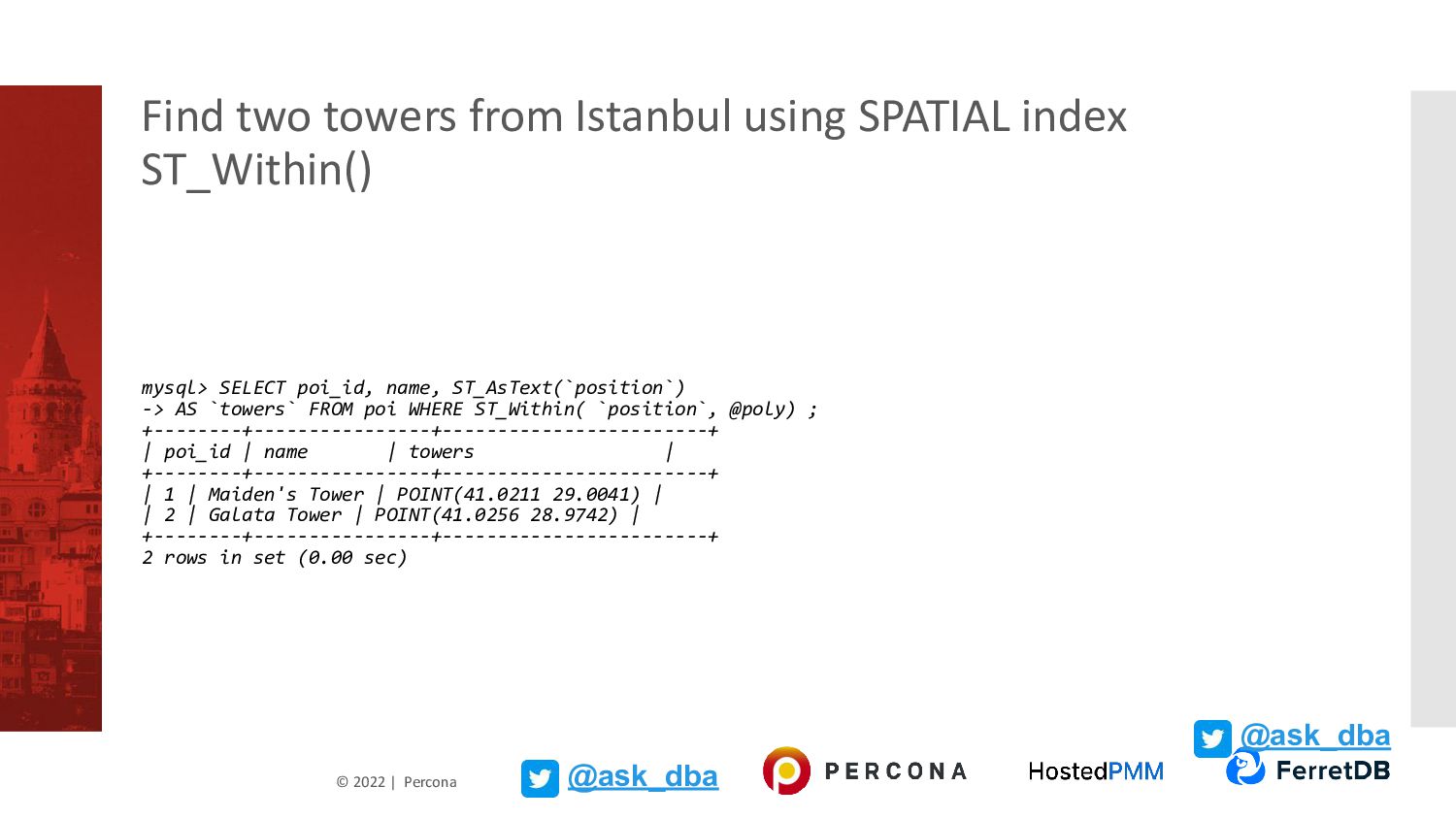
  76. © 2022 | Percona Find two towers from Istanbul using

    SPATIAL index ST_Within() mysql> SELECT poi_id, name, ST_AsText(`position`) -> AS `towers` FROM poi WHERE ST_Within( `position`, @poly) ; +--------+----------------+------------------------+ | poi_id | name | towers | +--------+----------------+------------------------+ | 1 | Maiden's Tower | POINT(41.0211 29.0041) | | 2 | Galata Tower | POINT(41.0256 28.9742) | +--------+----------------+------------------------+ 2 rows in set (0.00 sec) @ask_dba @ask_dba
  77. © 2022 | Percona Creating and Using Histograms Problem You

    want to join two or more tables, but MySQL’s optimizer does not choose the right query plan. Solution Use optimizer histograms to aid decision making. @ask_dba @ask_dba
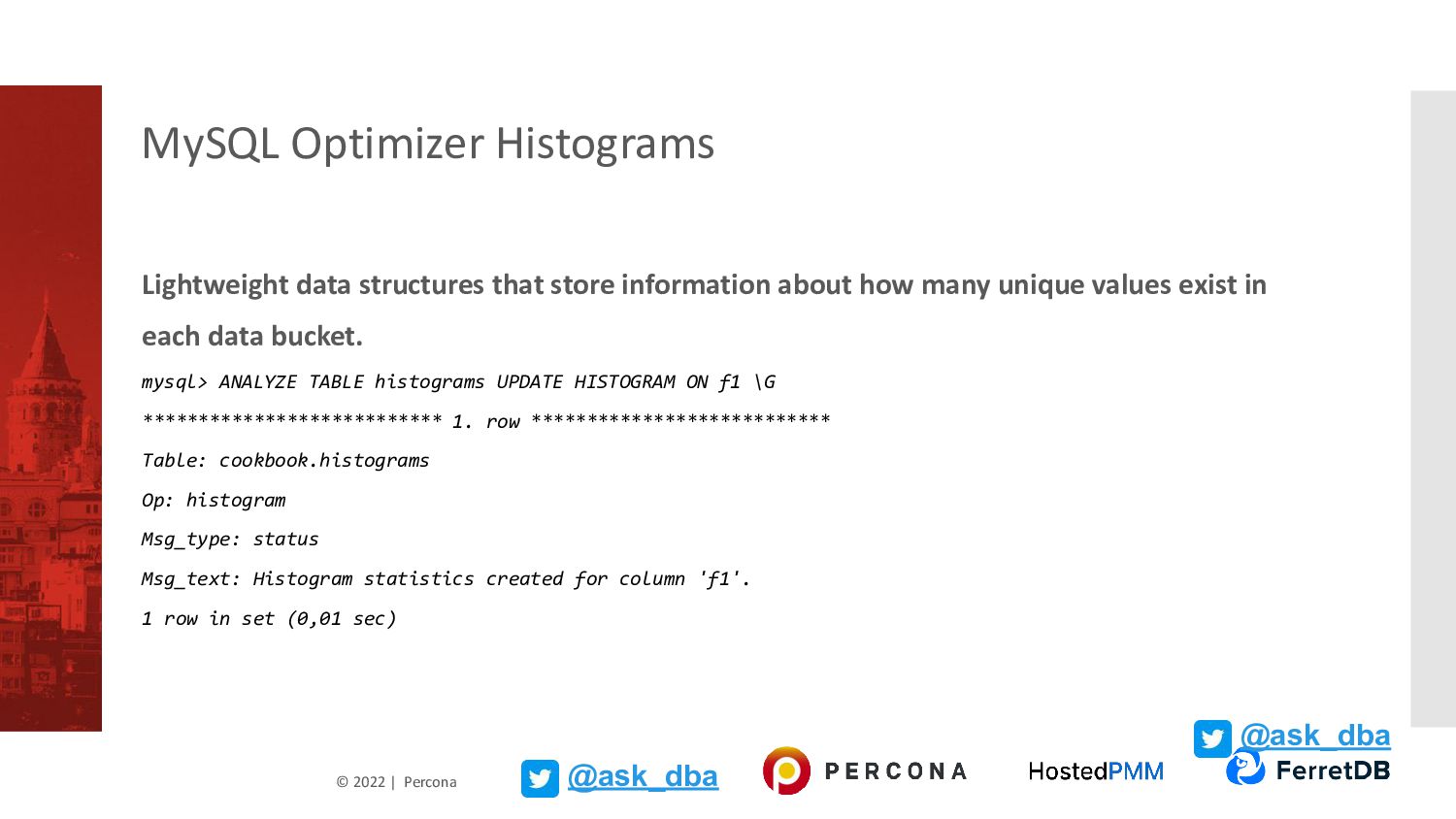
  78. © 2022 | Percona MySQL Optimizer Histograms Lightweight data structures

    that store information about how many unique values exist in each data bucket. mysql> ANALYZE TABLE histograms UPDATE HISTOGRAM ON f1 \G *************************** 1. row *************************** Table: cookbook.histograms Op: histogram Msg_type: status Msg_text: Histogram statistics created for column 'f1'. 1 row in set (0,01 sec) @ask_dba @ask_dba
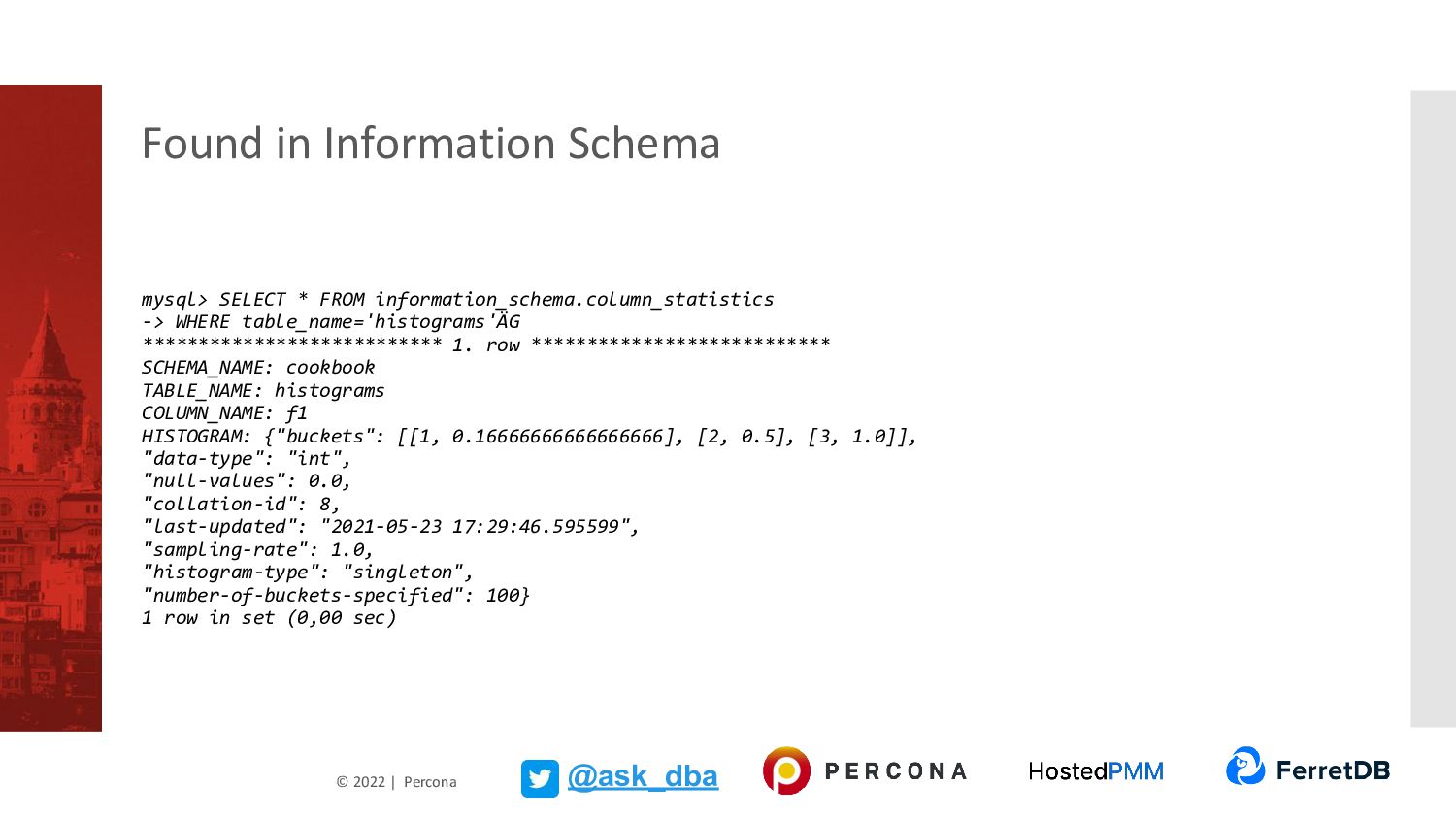
  79. © 2022 | Percona Found in Information Schema mysql> SELECT

    * FROM information_schema.column_statistics -> WHERE table_name='histograms'ÄG *************************** 1. row *************************** SCHEMA_NAME: cookbook TABLE_NAME: histograms COLUMN_NAME: f1 HISTOGRAM: {"buckets": [[1, 0.16666666666666666], [2, 0.5], [3, 1.0]], "data-type": "int", "null-values": 0.0, "collation-id": 8, "last-updated": "2021-05-23 17:29:46.595599", "sampling-rate": 1.0, "histogram-type": "singleton", "number-of-buckets-specified": 100} 1 row in set (0,00 sec) @ask_dba
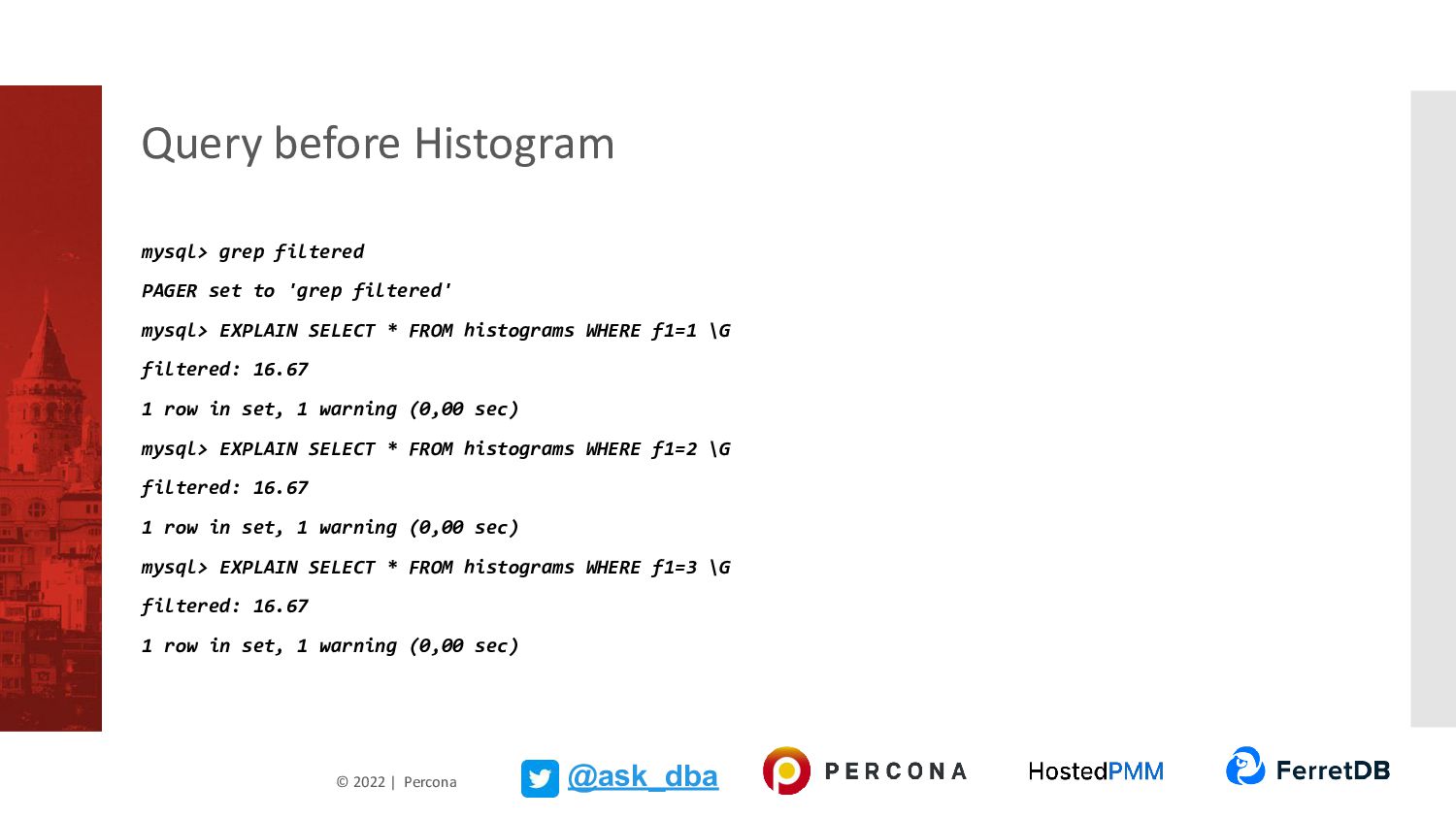
  80. © 2022 | Percona Query before Histogram mysql> grep filtered

    PAGER set to 'grep filtered' mysql> EXPLAIN SELECT * FROM histograms WHERE f1=1 \G filtered: 16.67 1 row in set, 1 warning (0,00 sec) mysql> EXPLAIN SELECT * FROM histograms WHERE f1=2 \G filtered: 16.67 1 row in set, 1 warning (0,00 sec) mysql> EXPLAIN SELECT * FROM histograms WHERE f1=3 \G filtered: 16.67 1 row in set, 1 warning (0,00 sec) @ask_dba
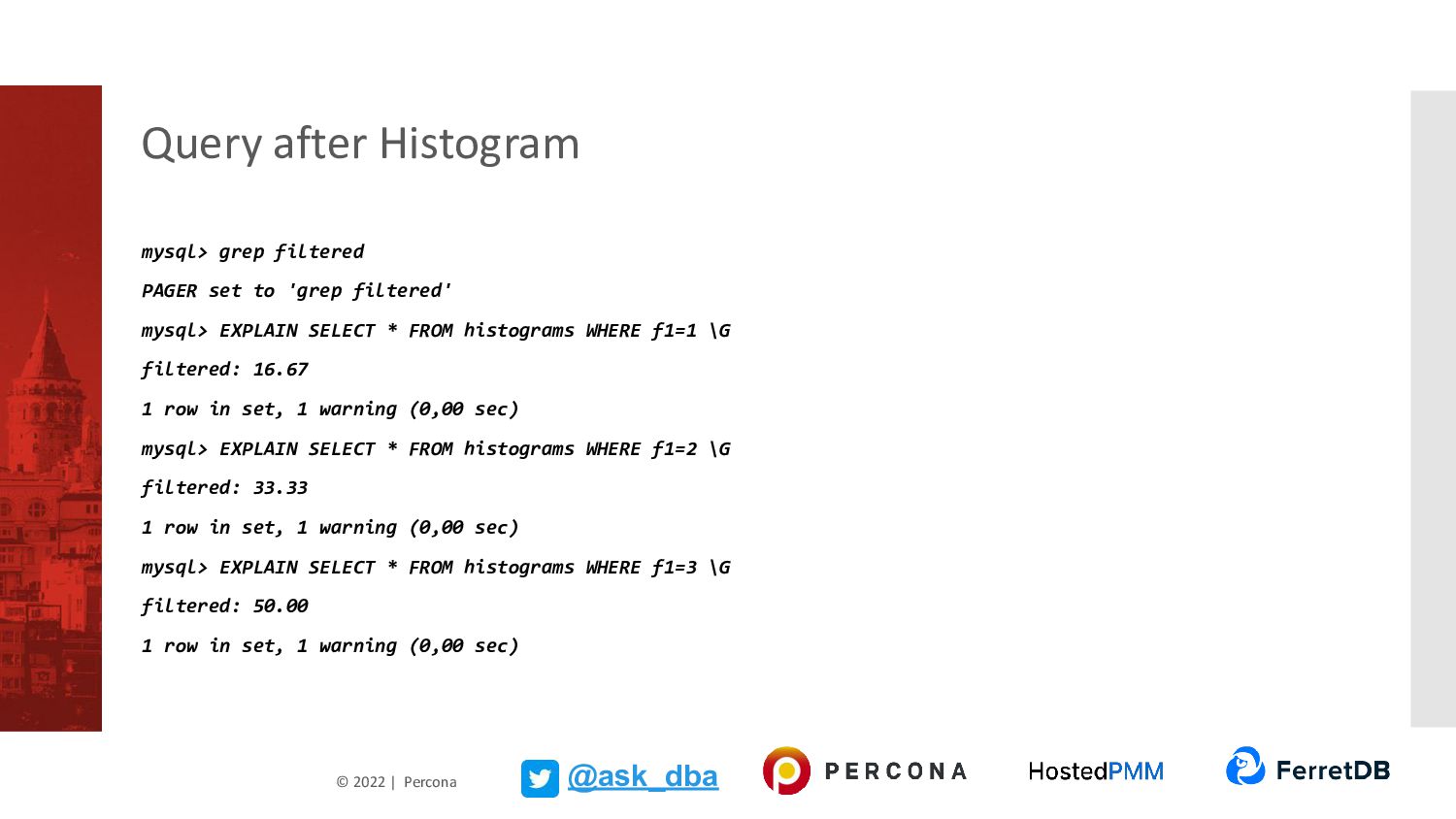
  81. © 2022 | Percona Query after Histogram mysql> grep filtered

    PAGER set to 'grep filtered' mysql> EXPLAIN SELECT * FROM histograms WHERE f1=1 \G filtered: 16.67 1 row in set, 1 warning (0,00 sec) mysql> EXPLAIN SELECT * FROM histograms WHERE f1=2 \G filtered: 33.33 1 row in set, 1 warning (0,00 sec) mysql> EXPLAIN SELECT * FROM histograms WHERE f1=3 \G filtered: 50.00 1 row in set, 1 warning (0,00 sec) @ask_dba
  82. © 2022 | Percona Writing Performant Queries Problem You want

    to write efficient queries. Solution Study how MySQL accesses data, and adjust your queries to help MySQL perform its job faster. @ask_dba
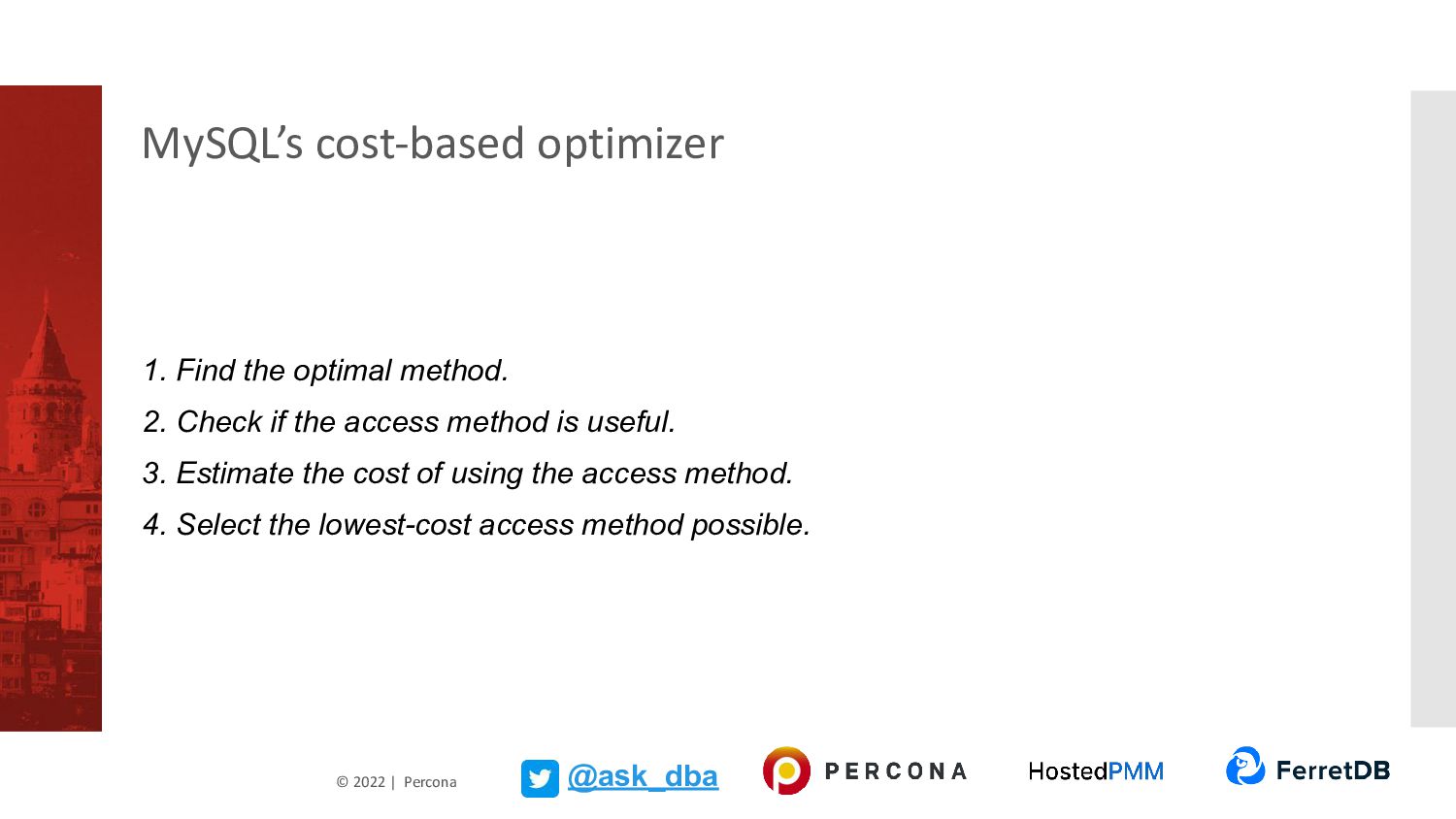
  83. © 2022 | Percona MySQL’s cost-based optimizer 1. Find the

    optimal method. 2. Check if the access method is useful. 3. Estimate the cost of using the access method. 4. Select the lowest-cost access method possible. @ask_dba
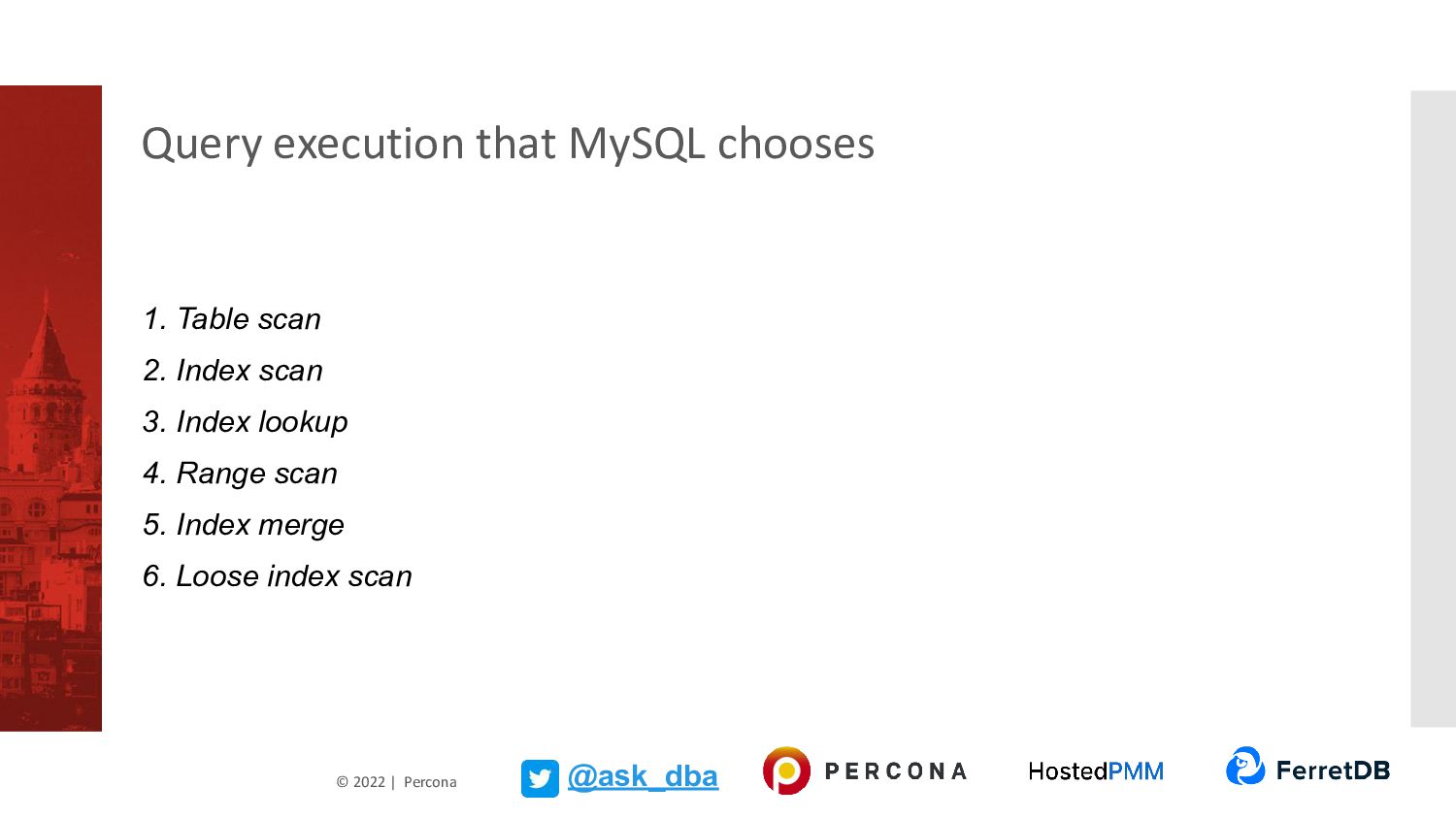
  84. © 2022 | Percona Query execution that MySQL chooses 1.

    Table scan 2. Index scan 3. Index lookup 4. Range scan 5. Index merge 6. Loose index scan @ask_dba
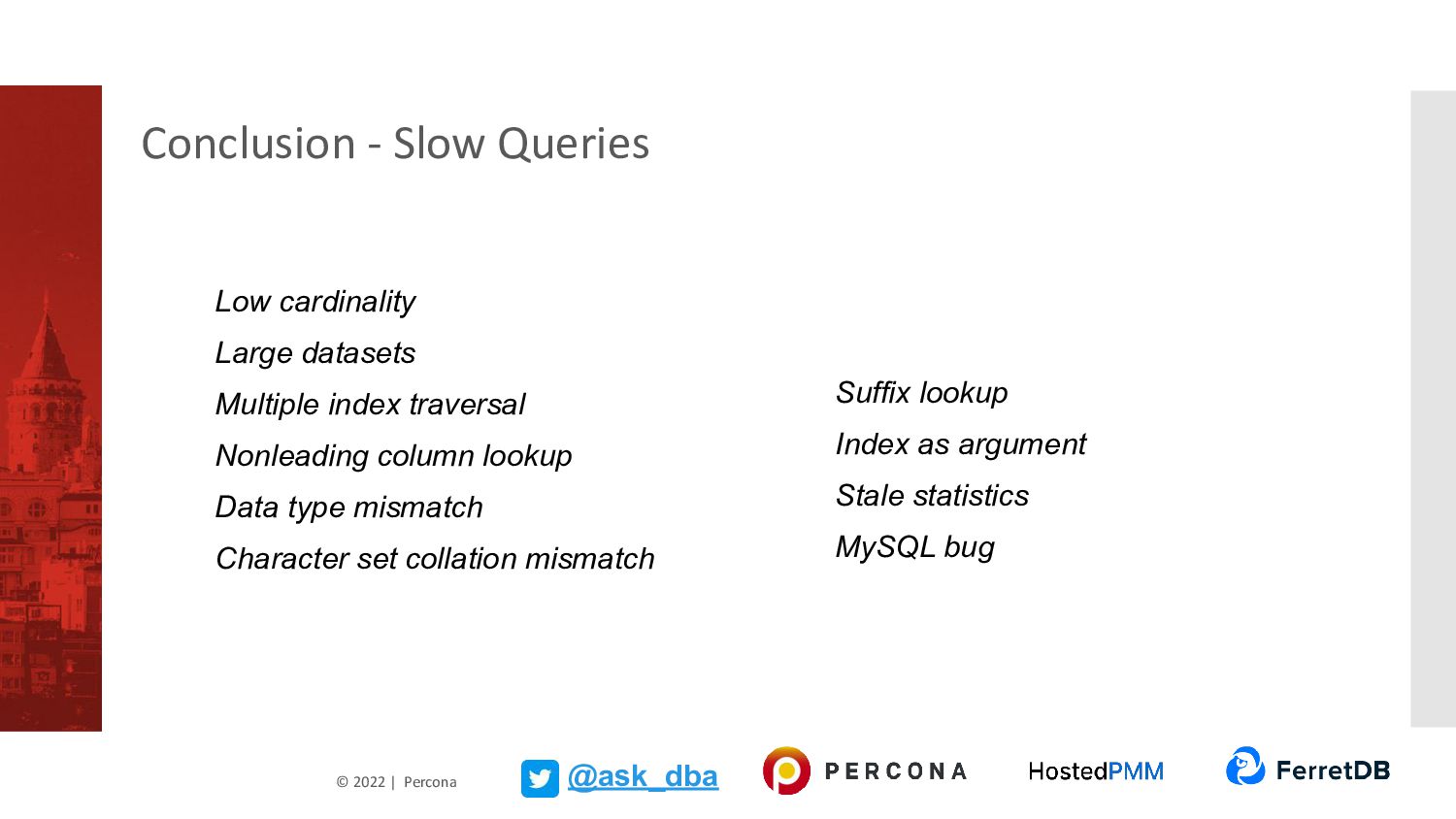
  85. © 2022 | Percona Conclusion - Slow Queries Low cardinality

    Large datasets Multiple index traversal Nonleading column lookup Data type mismatch Character set collation mismatch Suffix lookup Index as argument Stale statistics MySQL bug @ask_dba