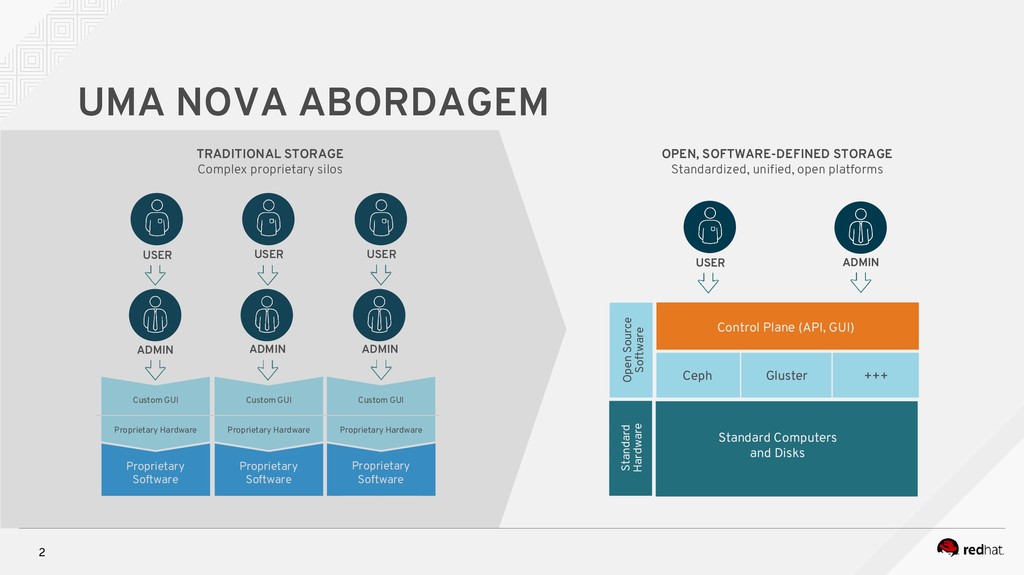
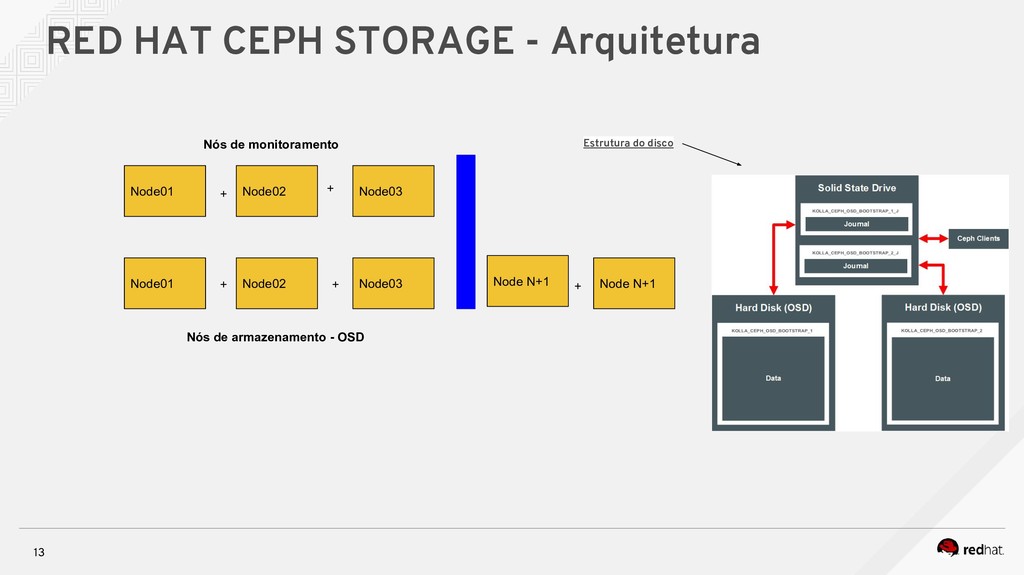
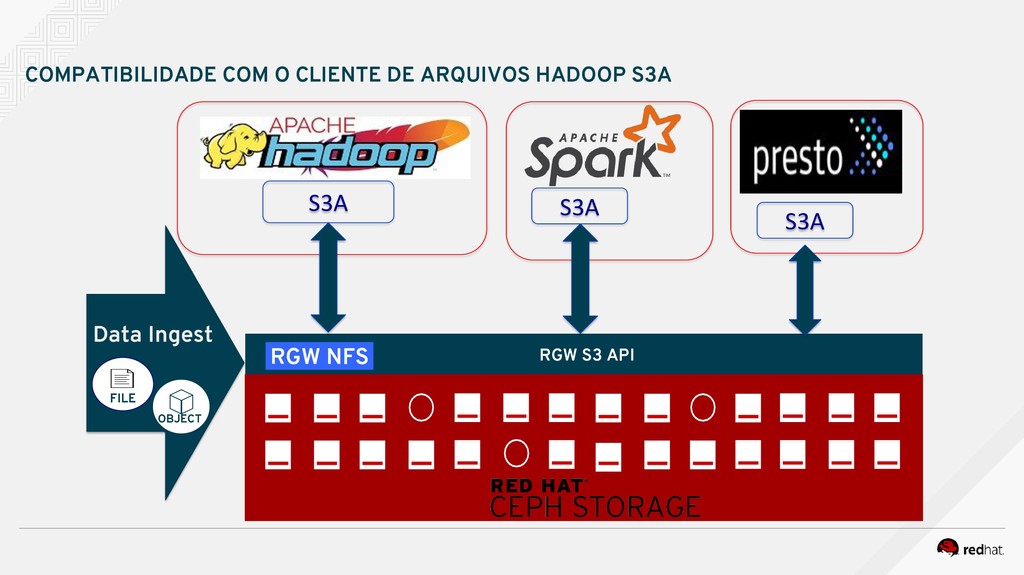
platforms Standard Computers and Disks Ceph Gluster +++ Control Plane (API, GUI) Custom GUI Proprietary Hardware Proprietary Software Custom GUI Proprietary Hardware Proprietary Software USER USER USER ADMIN ADMIN ADMIN Custom GUI Proprietary Hardware Proprietary Software USER ADMIN Standard Hardware Open Source Software TRADITIONAL STORAGE Complex proprietary silos
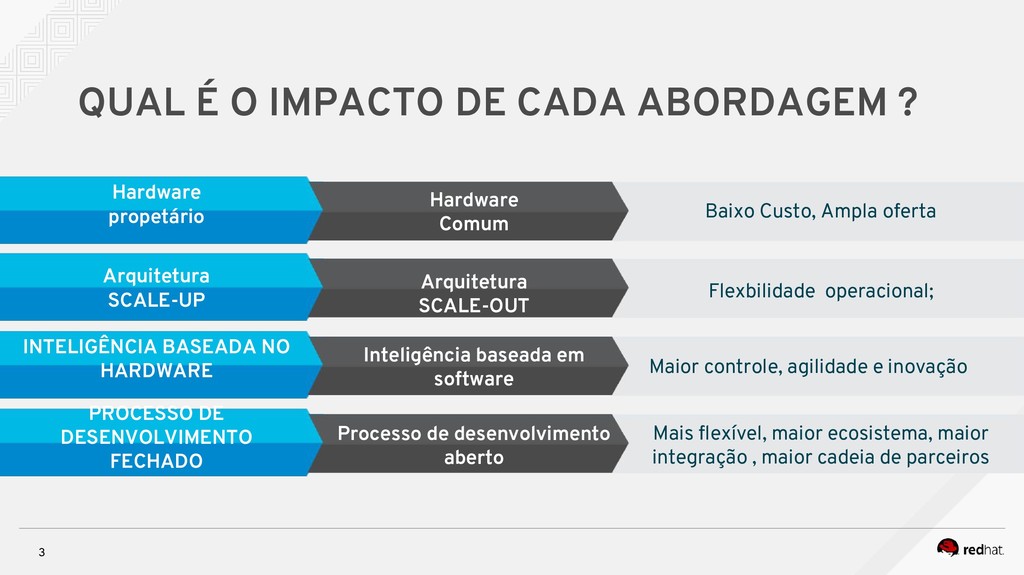
propetário Arquitetura SCALE-UP INTELIGÊNCIA BASEADA NO HARDWARE PROCESSO DE DESENVOLVIMENTO FECHADO Hardware Comum Arquitetura SCALE-OUT Inteligência baseada em software Processo de desenvolvimento aberto Baixo Custo, Ampla oferta Flexbilidade operacional; Maior controle, agilidade e inovação Mais flexível, maior ecosistema, maior integração , maior cadeia de parceiros
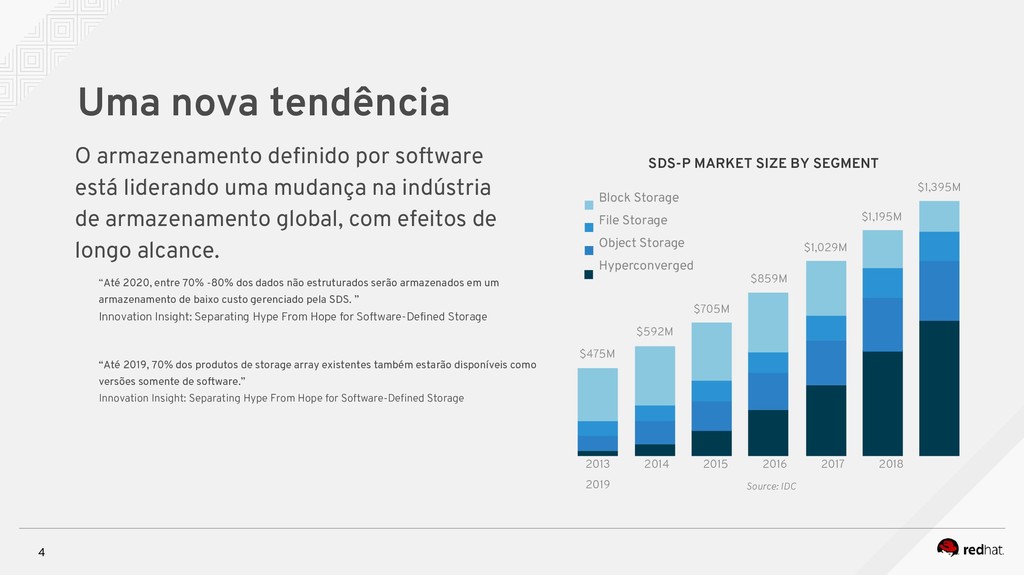
dados não estruturados serão armazenados em um armazenamento de baixo custo gerenciado pela SDS. ” Innovation Insight: Separating Hype From Hope for Software-Defined Storage “Até 2019, 70% dos produtos de storage array existentes também estarão disponíveis como versões somente de software.” Innovation Insight: Separating Hype From Hope for Software-Defined Storage O armazenamento definido por software está liderando uma mudança na indústria de armazenamento global, com efeitos de longo alcance. SDS-P MARKET SIZE BY SEGMENT Block Storage File Storage Object Storage Hyperconverged 2013 2014 2015 2016 2017 2018 2019 Source: IDC $475M $1,395M $1,195M $1,029M $859M $705M $592M
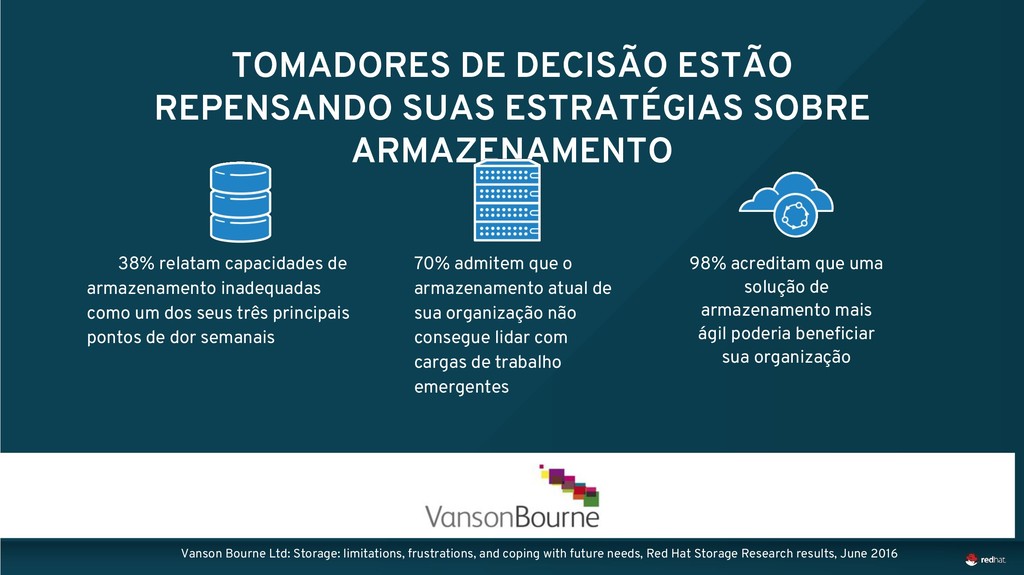
relatam capacidades de armazenamento inadequadas como um dos seus três principais pontos de dor semanais 70% admitem que o armazenamento atual de sua organização não consegue lidar com cargas de trabalho emergentes 98% acreditam que uma solução de armazenamento mais ágil poderia beneficiar sua organização Vanson Bourne Ltd: Storage: limitations, frustrations, and coping with future needs, Red Hat Storage Research results, June 2016
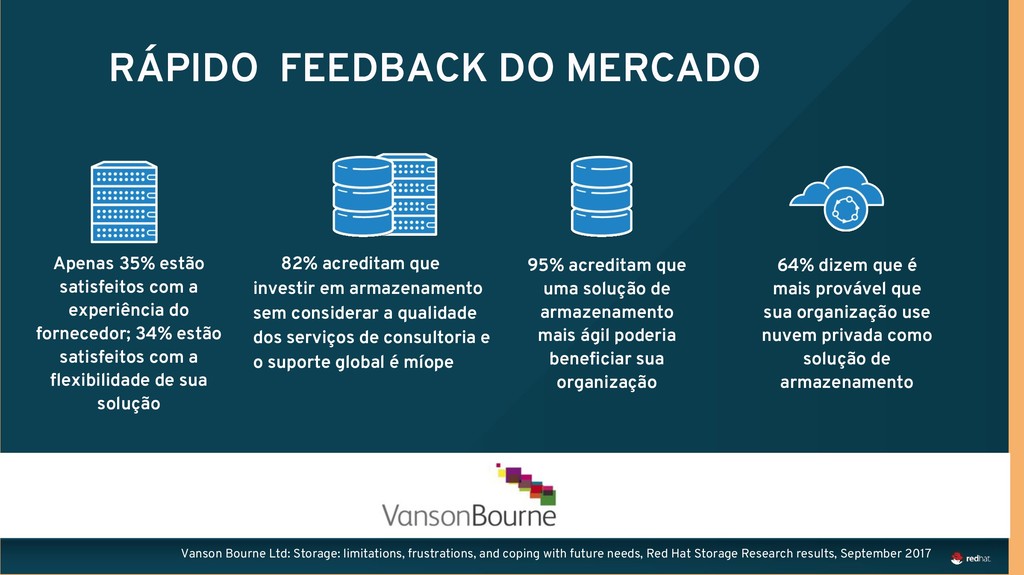
a experiência do fornecedor; 34% estão satisfeitos com a flexibilidade de sua solução 82% acreditam que investir em armazenamento sem considerar a qualidade dos serviços de consultoria e o suporte global é míope 95% acreditam que uma solução de armazenamento mais ágil poderia beneficiar sua organização Vanson Bourne Ltd: Storage: limitations, frustrations, and coping with future needs, Red Hat Storage Research results, September 2017 64% dizem que é mais provável que sua organização use nuvem privada como solução de armazenamento
armazenamento unificado e definido por software que ofereça uma gama de serviços de dados para cargas de trabalho da próxima geração, acelerando assim a transição para infraestruturas de TI modernas.
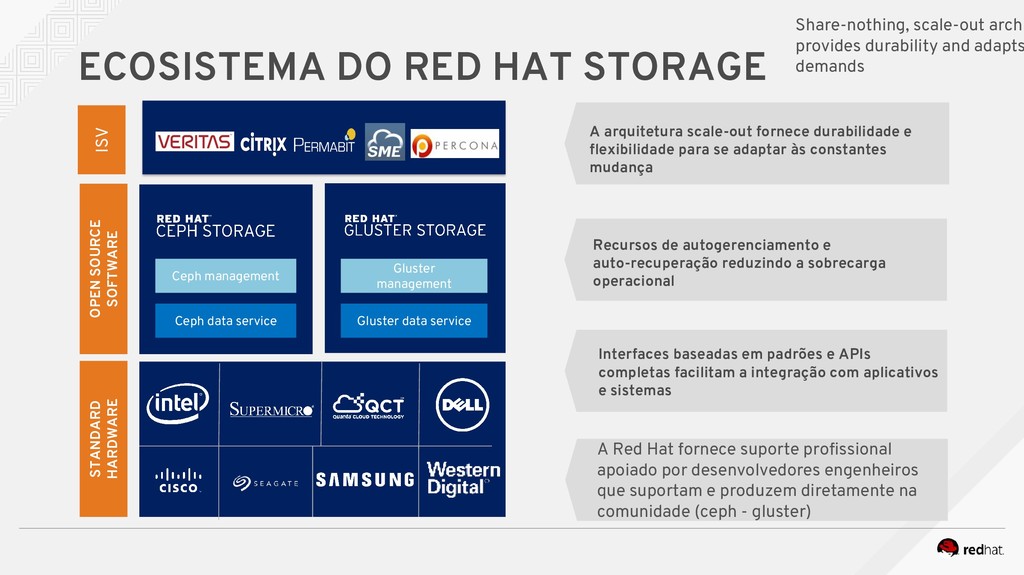
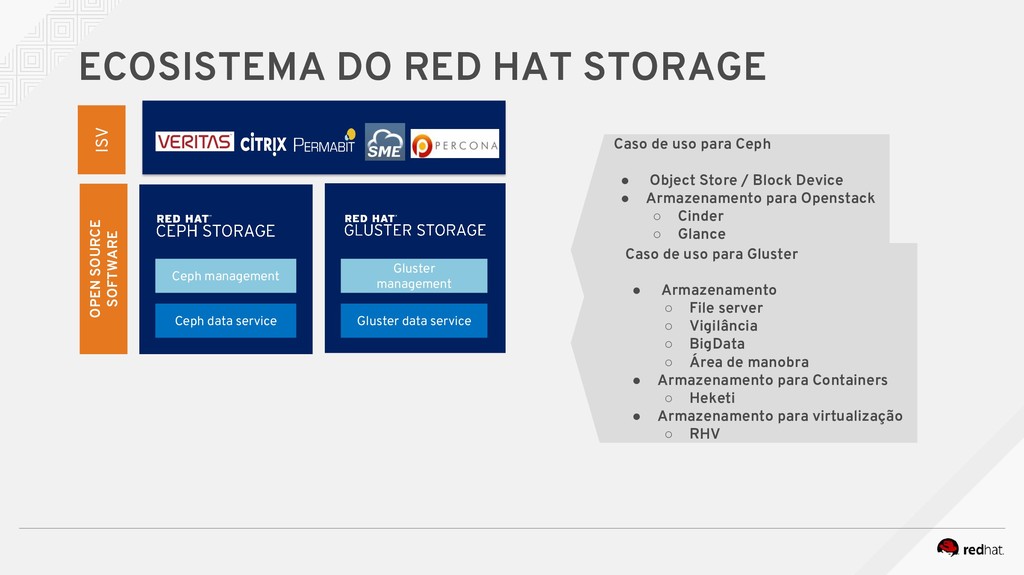
autogerenciamento e auto-recuperação reduzindo a sobrecarga operacional Interfaces baseadas em padrões e APIs completas facilitam a integração com aplicativos e sistemas A Red Hat fornece suporte profissional apoiado por desenvolvedores engenheiros que suportam e produzem diretamente na comunidade (ceph - gluster) ISV STANDARD HARDWARE OPEN SOURCE SOFTWARE Gluster management Ceph data service Gluster data service Ceph management ECOSISTEMA DO RED HAT STORAGE A arquitetura scale-out fornece durabilidade e flexibilidade para se adaptar às constantes mudança
data service Ceph management ECOSISTEMA DO RED HAT STORAGE Caso de uso para Ceph • Object Store / Block Device • Armazenamento para Openstack ◦ Cinder ◦ Glance ◦ Swift ◦ Manila • Armazenamento storage ◦ VMware ◦ RHV ◦ Openstack Caso de uso para Gluster • Armazenamento ◦ File server ◦ Vigilância ◦ BigData ◦ Área de manobra • Armazenamento para Containers ◦ Heketi • Armazenamento para virtualização ◦ RHV
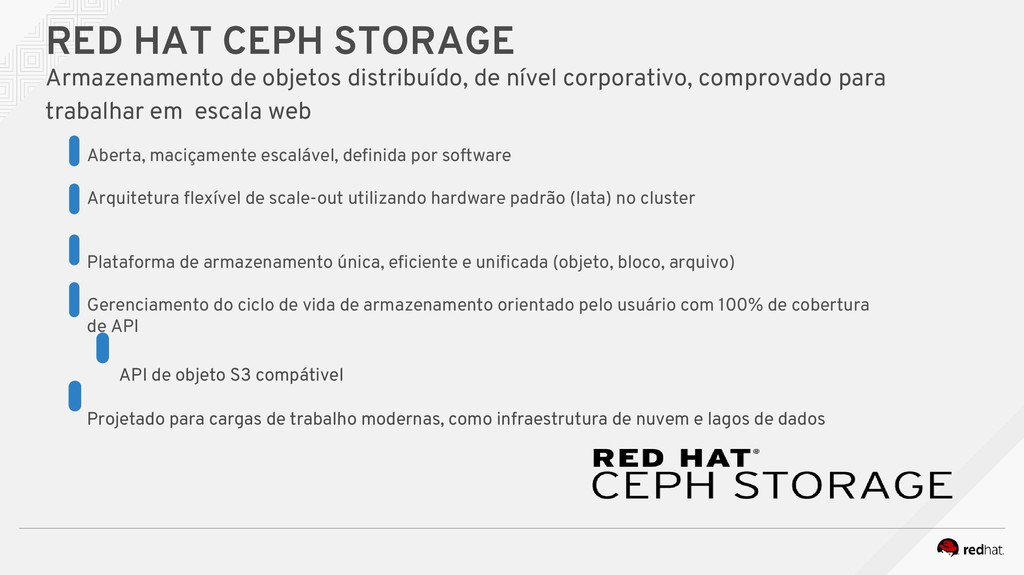
corporativo, comprovado para trabalhar em escala web Aberta, maciçamente escalável, definida por software Arquitetura flexível de scale-out utilizando hardware padrão (lata) no cluster Plataforma de armazenamento única, eficiente e unificada (objeto, bloco, arquivo) Gerenciamento do ciclo de vida de armazenamento orientado pelo usuário com 100% de cobertura de API API de objeto S3 compátivel Projetado para cargas de trabalho modernas, como infraestrutura de nuvem e lagos de dados
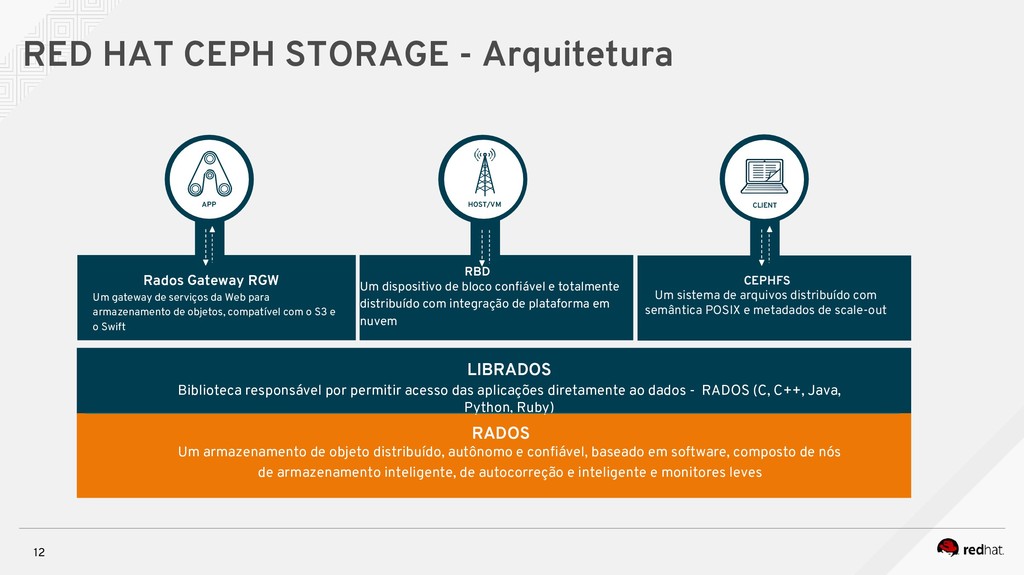
de bloco confiável e totalmente distribuído com integração de plataforma em nuvem APP HOST/VM LIBRADOS Biblioteca responsável por permitir acesso das aplicações diretamente ao dados - RADOS (C, C++, Java, Python, Ruby) RADOS Um armazenamento de objeto distribuído, autônomo e confiável, baseado em software, composto de nós de armazenamento inteligente, de autocorreção e inteligente e monitores leves CEPHFS Um sistema de arquivos distribuído com semântica POSIX e metadados de scale-out CLIENT Rados Gateway RGW Um gateway de serviços da Web para armazenamento de objetos, compatível com o S3 e o Swift
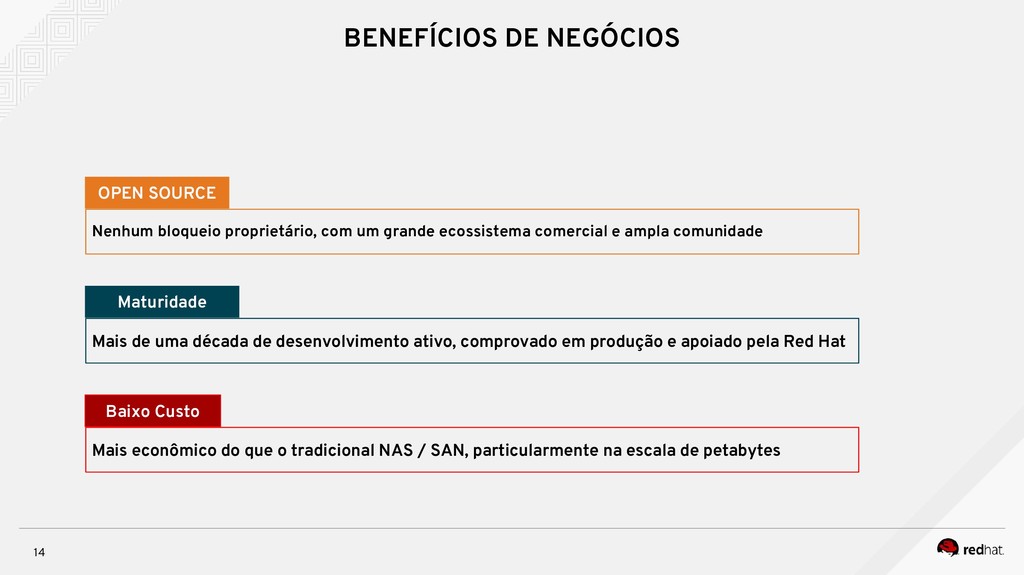
um grande ecossistema comercial e ampla comunidade Maturidade Mais de uma década de desenvolvimento ativo, comprovado em produção e apoiado pela Red Hat Baixo Custo Mais econômico do que o tradicional NAS / SAN, particularmente na escala de petabytes
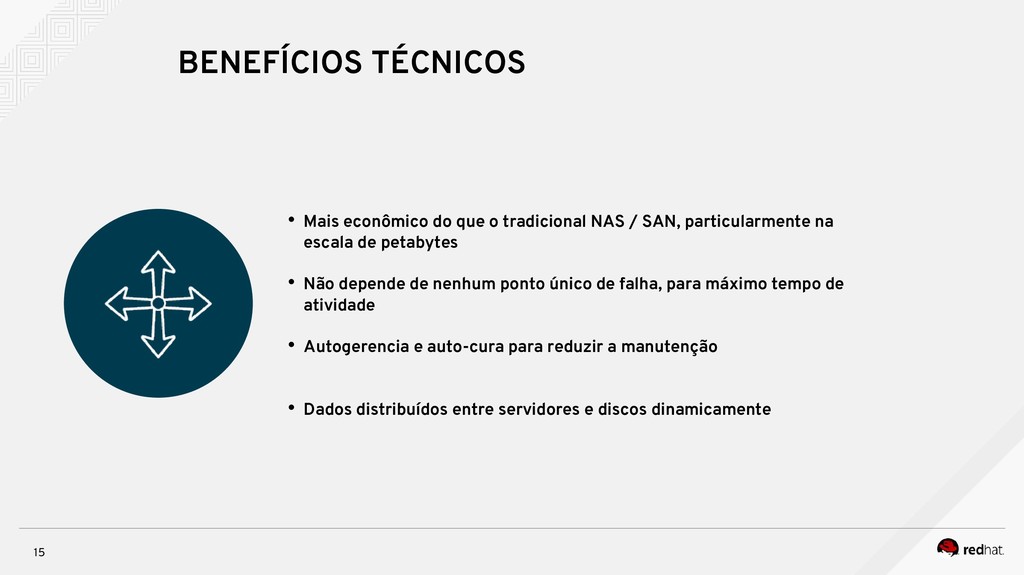
NAS / SAN, particularmente na escala de petabytes • Não depende de nenhum ponto único de falha, para máximo tempo de atividade • Autogerencia e auto-cura para reduzir a manutenção • Dados distribuídos entre servidores e discos dinamicamente
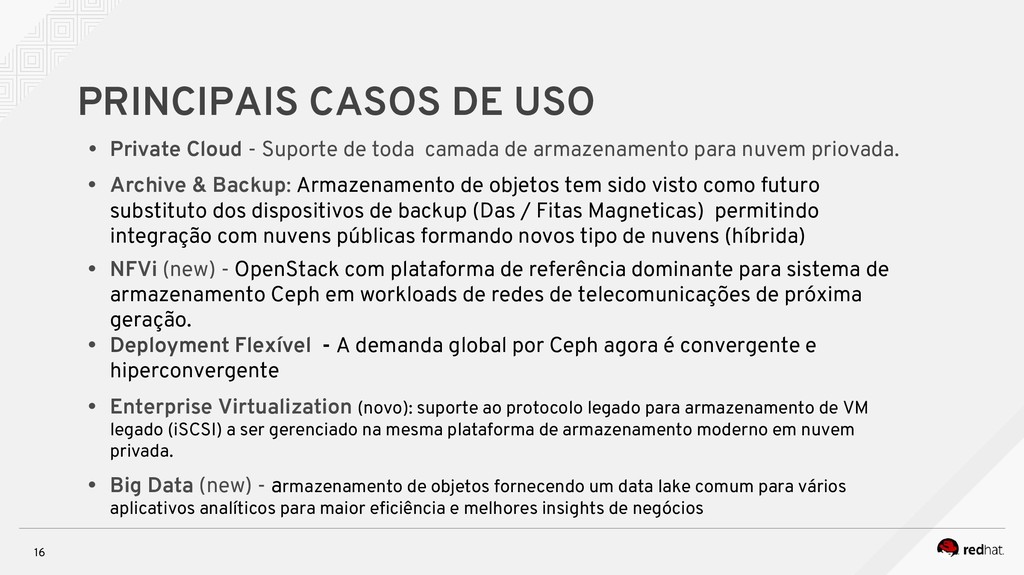
de toda camada de armazenamento para nuvem priovada. • Archive & Backup: Armazenamento de objetos tem sido visto como futuro substituto dos dispositivos de backup (Das / Fitas Magneticas) permitindo integração com nuvens públicas formando novos tipo de nuvens (híbrida) • NFVi (new) - OpenStack com plataforma de referência dominante para sistema de armazenamento Ceph em workloads de redes de telecomunicações de próxima geração. • Deployment Flexível - A demanda global por Ceph agora é convergente e hiperconvergente • Enterprise Virtualization (novo): suporte ao protocolo legado para armazenamento de VM legado (iSCSI) a ser gerenciado na mesma plataforma de armazenamento moderno em nuvem privada. • Big Data (new) - armazenamento de objetos fornecendo um data lake comum para vários aplicativos analíticos para maior eficiência e melhores insights de negócios
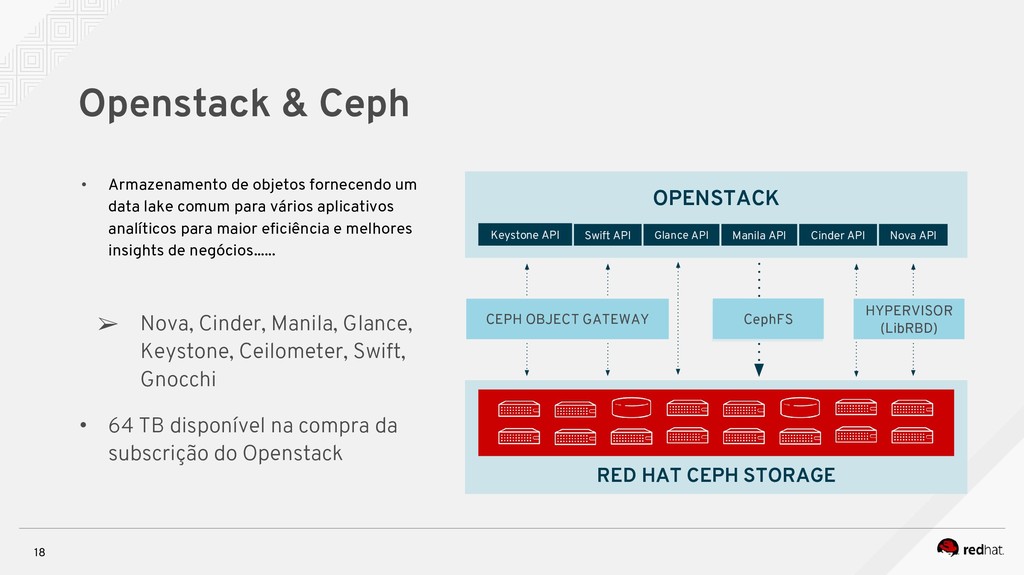
data lake comum para vários aplicativos analíticos para maior eficiência e melhores insights de negócios...... ➢ Nova, Cinder, Manila, Glance, Keystone, Ceilometer, Swift, Gnocchi • 64 TB disponível na compra da subscrição do Openstack RED HAT CEPH STORAGE OPENSTACK Keystone API Swift API Glance API Cinder API Nova API HYPERVISOR (LibRBD) CEPH OBJECT GATEWAY Manila API CephFS CephFS
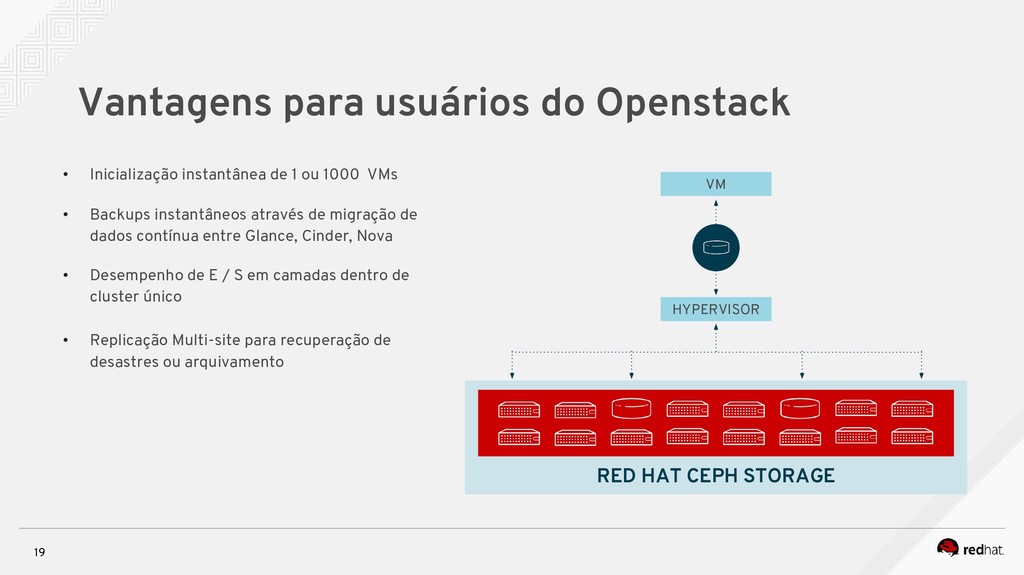
1 ou 1000 VMs • Backups instantâneos através de migração de dados contínua entre Glance, Cinder, Nova • Desempenho de E / S em camadas dentro de cluster único • Replicação Multi-site para recuperação de desastres ou arquivamento RED HAT CEPH STORAGE HYPERVISOR VM
e bloco device • Upgrades automatizados da versão Red Hat Ceph Storage 1.3 • Suporte as versões existente do Ceph • OpenStack Manila suporta o uso CephFS Driver disponibilizando File Server As Server • Coloção da Red Hat OpenStack Platform and Red Hat Ceph Storage
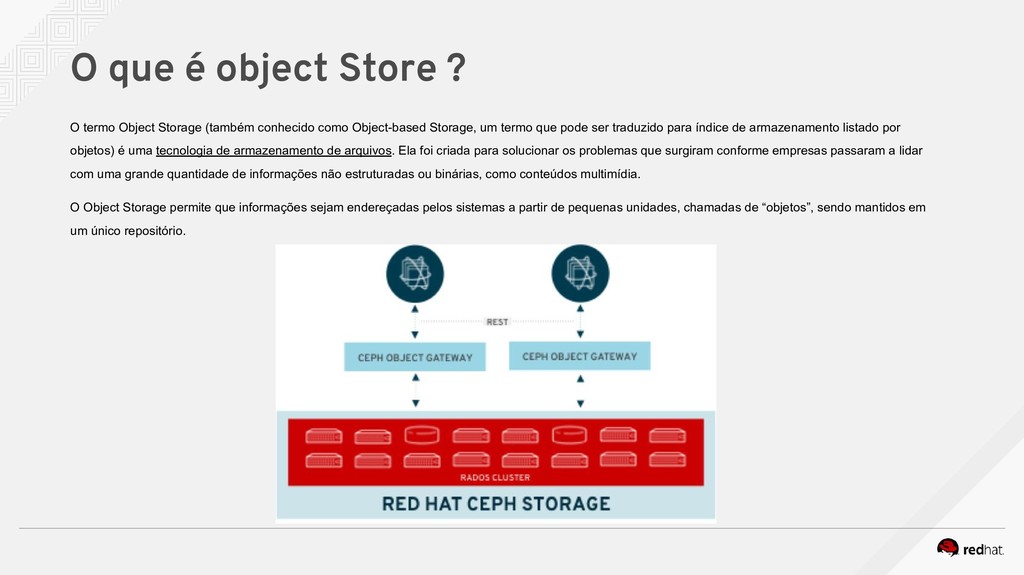
termo que pode ser traduzido para índice de armazenamento listado por objetos) é uma tecnologia de armazenamento de arquivos. Ela foi criada para solucionar os problemas que surgiram conforme empresas passaram a lidar com uma grande quantidade de informações não estruturadas ou binárias, como conteúdos multimídia. O Object Storage permite que informações sejam endereçadas pelos sistemas a partir de pequenas unidades, chamadas de “objetos”, sendo mantidos em um único repositório. O que é object Store ?
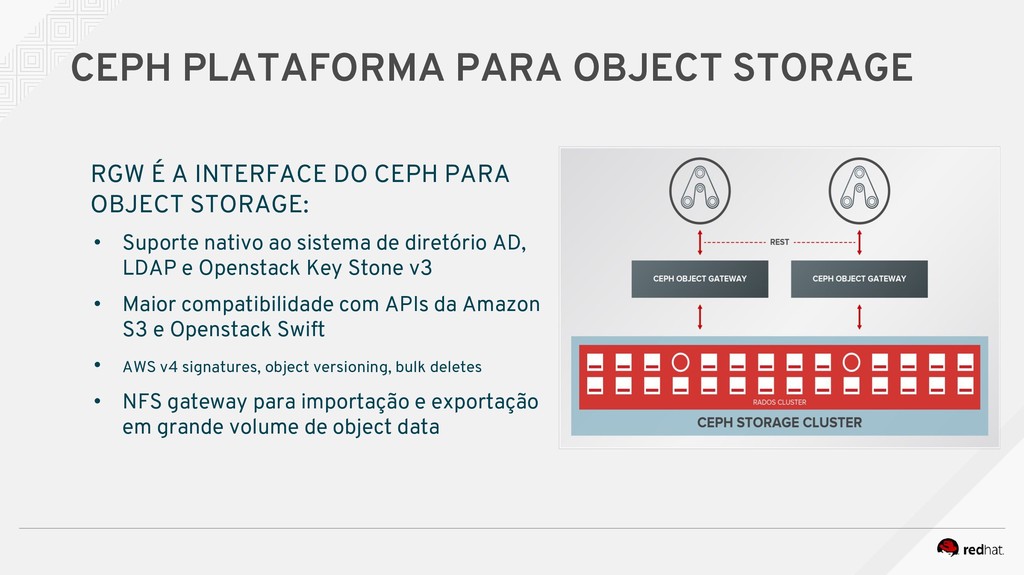
Suporte nativo ao sistema de diretório AD, LDAP e Openstack Key Stone v3 • Maior compatibilidade com APIs da Amazon S3 e Openstack Swift • AWS v4 signatures, object versioning, bulk deletes • NFS gateway para importação e exportação em grande volume de object data CEPH PLATAFORMA PARA OBJECT STORAGE
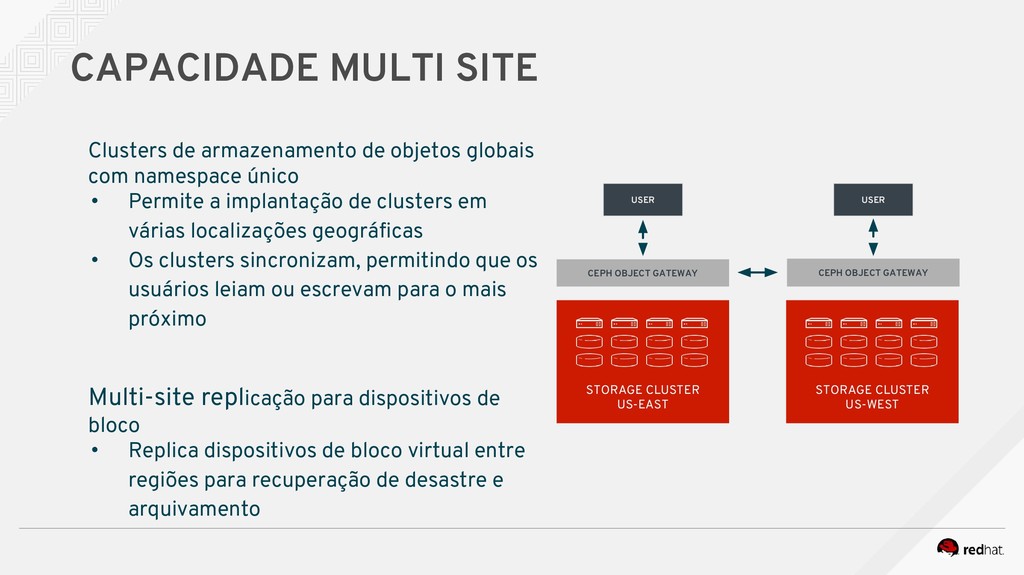
Permite a implantação de clusters em várias localizações geográficas • Os clusters sincronizam, permitindo que os usuários leiam ou escrevam para o mais próximo Multi-site replicação para dispositivos de bloco • Replica dispositivos de bloco virtual entre regiões para recuperação de desastre e arquivamento CAPACIDADE MULTI SITE USER CEPH OBJECT GATEWAY USER CEPH OBJECT GATEWAY STORAGE CLUSTER US-EAST STORAGE CLUSTER US-WEST
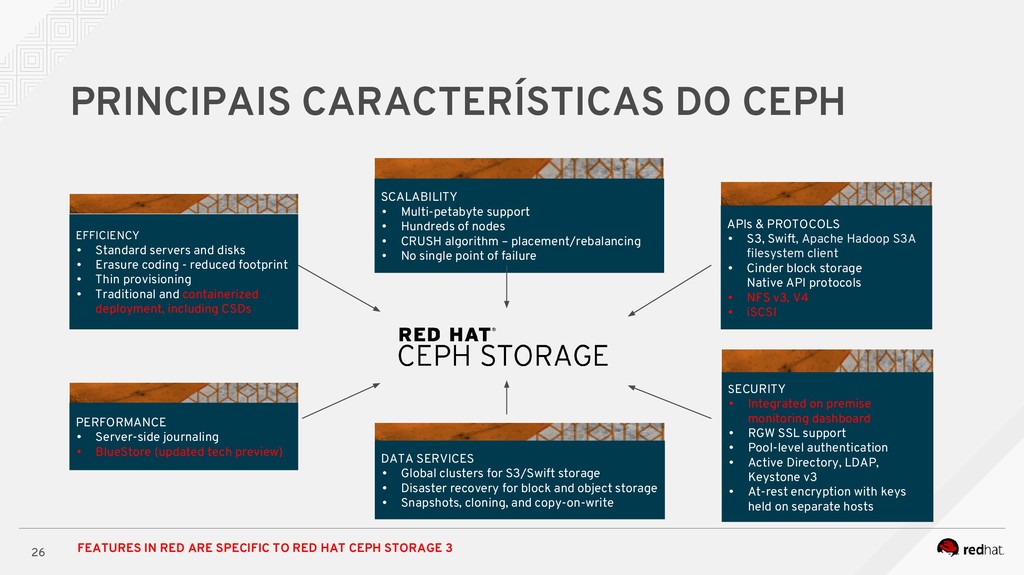
- reduced footprint • Thin provisioning • Traditional and containerized deployment, including CSDs SCALABILITY • Multi-petabyte support • Hundreds of nodes • CRUSH algorithm – placement/rebalancing • No single point of failure PERFORMANCE • Server-side journaling • BlueStore (updated tech preview) APIs & PROTOCOLS • S3, Swift, Apache Hadoop S3A filesystem client • Cinder block storage Native API protocols • NFS v3, V4 • iSCSI SECURITY • Integrated on premise monitoring dashboard • RGW SSL support • Pool-level authentication • Active Directory, LDAP, Keystone v3 • At-rest encryption with keys held on separate hosts DATA SERVICES • Global clusters for S3/Swift storage • Disaster recovery for block and object storage • Snapshots, cloning, and copy-on-write PRINCIPAIS CARACTERÍSTICAS DO CEPH FEATURES IN RED ARE SPECIFIC TO RED HAT CEPH STORAGE 3
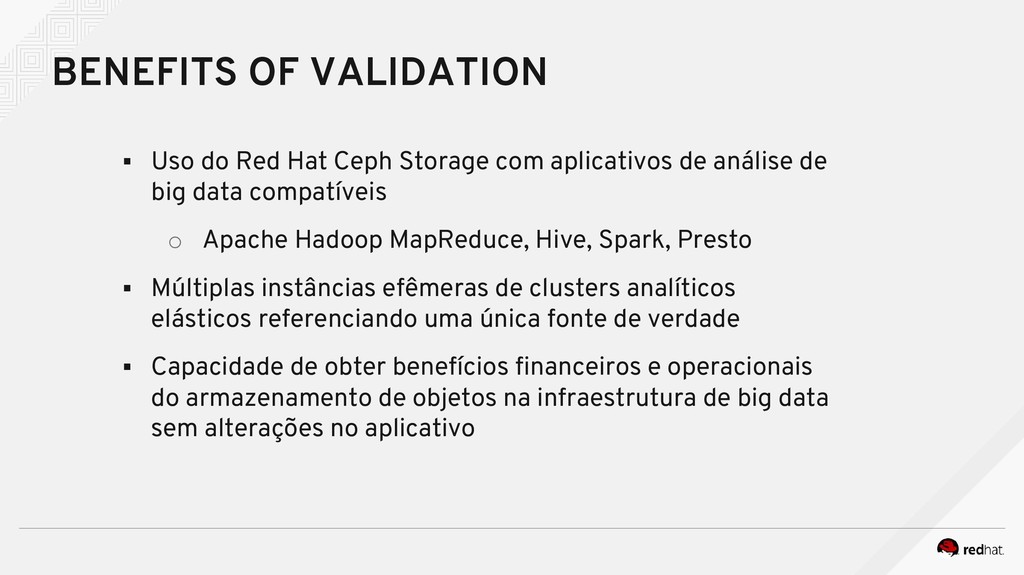
com aplicativos de análise de big data compatíveis o Apache Hadoop MapReduce, Hive, Spark, Presto ▪ Múltiplas instâncias efêmeras de clusters analíticos elásticos referenciando uma única fonte de verdade ▪ Capacidade de obter benefícios financeiros e operacionais do armazenamento de objetos na infraestrutura de big data sem alterações no aplicativo
para incorporar tecnologia de conteinerização para economias de configuração e de espaço e desempenho previsível e confiável ▪ Suporte OpenStack mais amplo com o CephFS e links para ambientes de armazenamento herdados por meio do iSCSI ▪ Interface de monitoramento e camadas de automação para tornar as implantações mais auto-mantenedoras Custos reduzidos com contêineres e um alcance de armazenamento unificado mais amplo
consideram soluções modernas de armazenamento para transformação digital, para quem 1) a economia de CSDs e o fascínio de contêineres suportam uma mudança disruptiva em sua infraestrutura de TI envolvendo armazenamento E 2) iSCSI para VMware e Windows para mais armazenamento unificado ressoam em termos de eficiência. • Arquitetos Cloud - aqueles que executam nuvens privadas com demandas de cargas de trabalho heterogêneas, para quem o CephFS oferece mais opções para executar cargas de trabalho tradicionais no OpenStack • Arquitetos NFVi - aqueles que estão construindo as soluções de próxima geração da Telco, para quem os CSDs aumentam a variedade de opções de implantação de plataforma para atender aos requisitos de custo e o CephFS expande as opções de VNF. • Para usuários/parceiros de Ceph - aqueles que já investiram no Ceph e esperaram recursos como o iSCSI, para quem avanços como o Ceph Metrics sinalizam uma experiência operacional mais fácil A Red Hat Ceph Storage 3 atinge aqueles que conhecemos e aqueles que sabem que os conhecemos
opção de implantação para o sistema de armazenamento Ceph em contêineres ▪ Capacidade de configurar qualquer um ou todos os oito daemons Ceph (OSD, MON, MGR, MDS, gateway RGW, NFS, iSCSI e RDB Mirror) dentro de contêineres com CPU e RAM distribuídos ▪ Os daemons com co-localização segura na mesma máquina aumentam a utilização do hardware e reduzem os custos sem comprometer a disponibilidade de dados em situações de failover ▪ Alternativa para isolar serviços em hardware dedicado
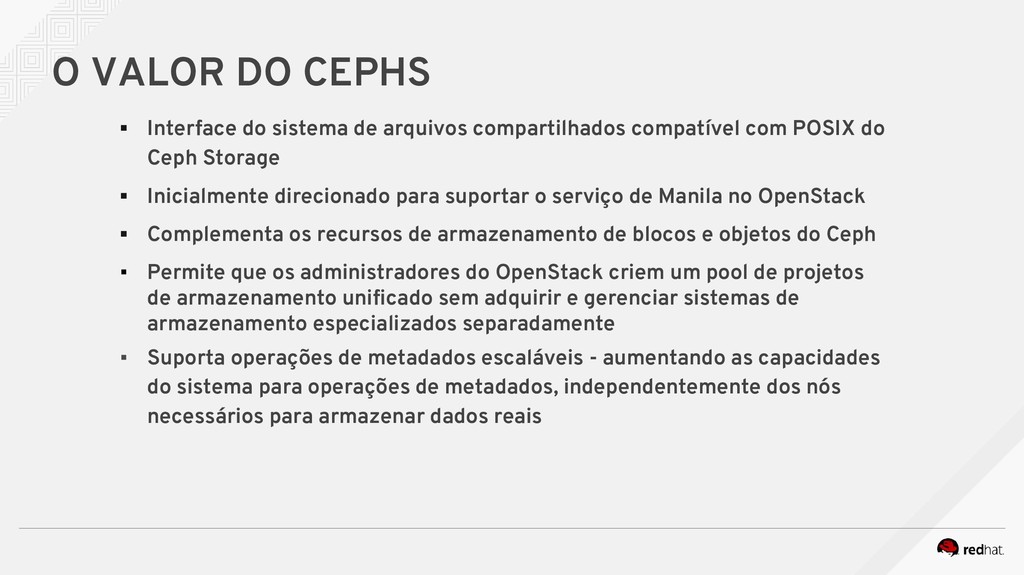
compartilhados compatível com POSIX do Ceph Storage ▪ Inicialmente direcionado para suportar o serviço de Manila no OpenStack ▪ Complementa os recursos de armazenamento de blocos e objetos do Ceph ▪ Permite que os administradores do OpenStack criem um pool de projetos de armazenamento unificado sem adquirir e gerenciar sistemas de armazenamento especializados separadamente ▪ Suporta operações de metadados escaláveis - aumentando as capacidades do sistema para operações de metadados, independentemente dos nós necessários para armazenar dados reais
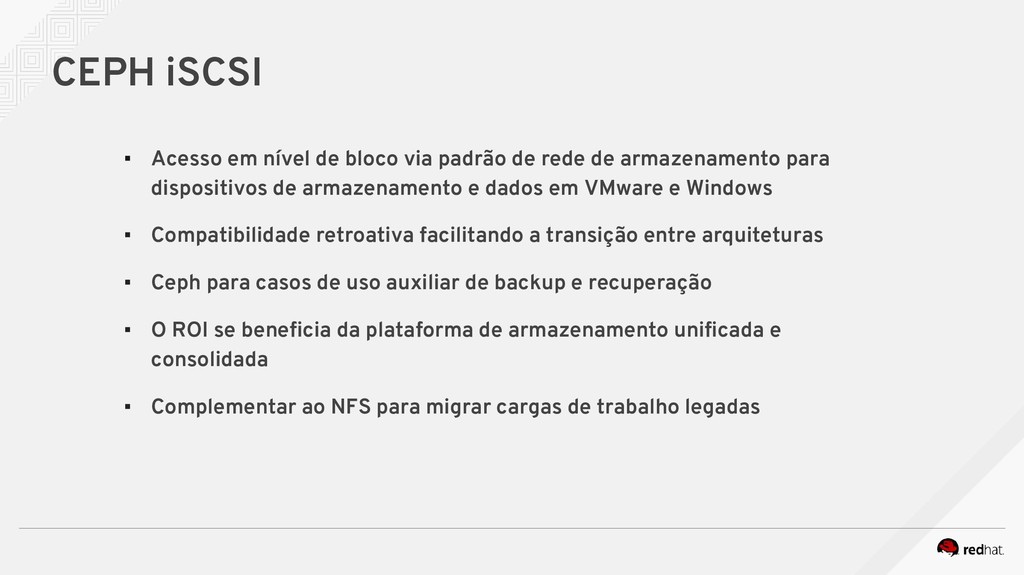
de rede de armazenamento para dispositivos de armazenamento e dados em VMware e Windows ▪ Compatibilidade retroativa facilitando a transição entre arquiteturas ▪ Ceph para casos de uso auxiliar de backup e recuperação ▪ O ROI se beneficia da plataforma de armazenamento unificada e consolidada ▪ Complementar ao NFS para migrar cargas de trabalho legadas
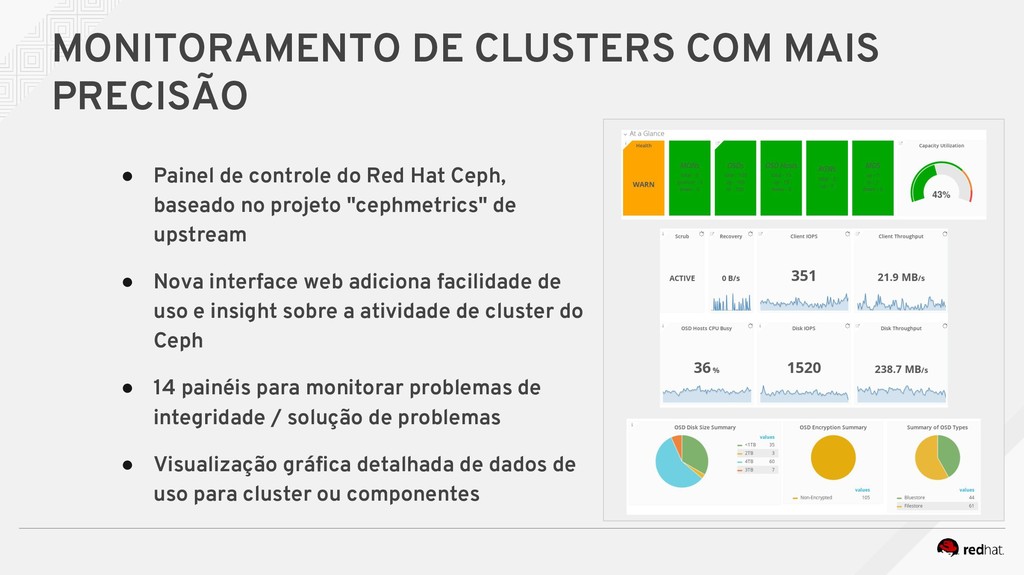
do Red Hat Ceph, baseado no projeto "cephmetrics" de upstream • Nova interface web adiciona facilidade de uso e insight sobre a atividade de cluster do Ceph • 14 painéis para monitorar problemas de integridade / solução de problemas • Visualização gráfica detalhada de dados de uso para cluster ou componentes
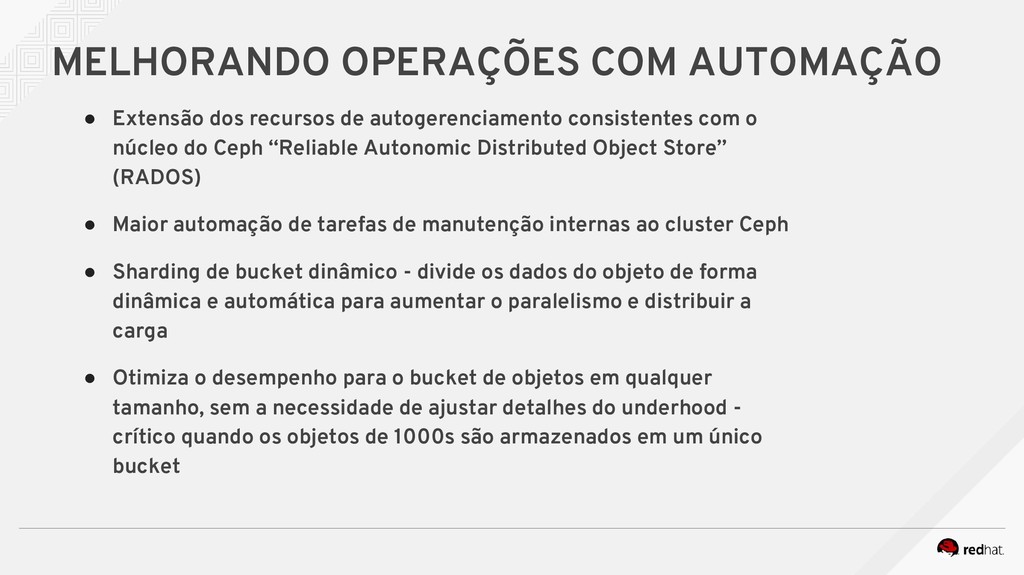
consistentes com o núcleo do Ceph “Reliable Autonomic Distributed Object Store” (RADOS) • Maior automação de tarefas de manutenção internas ao cluster Ceph • Sharding de bucket dinâmico - divide os dados do objeto de forma dinâmica e automática para aumentar o paralelismo e distribuir a carga • Otimiza o desempenho para o bucket de objetos em qualquer tamanho, sem a necessidade de ajustar detalhes do underhood - crítico quando os objetos de 1000s são armazenados em um único bucket
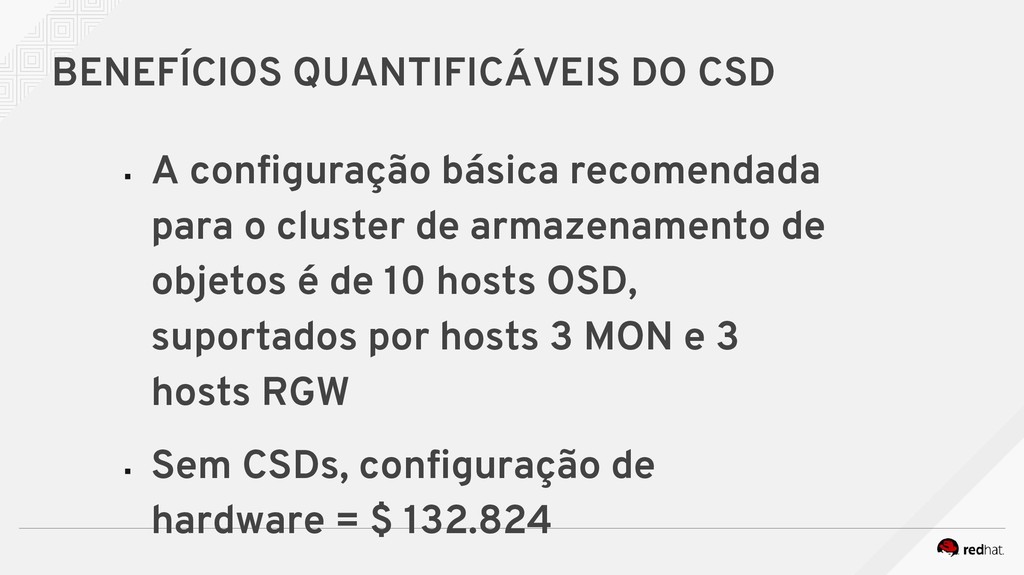
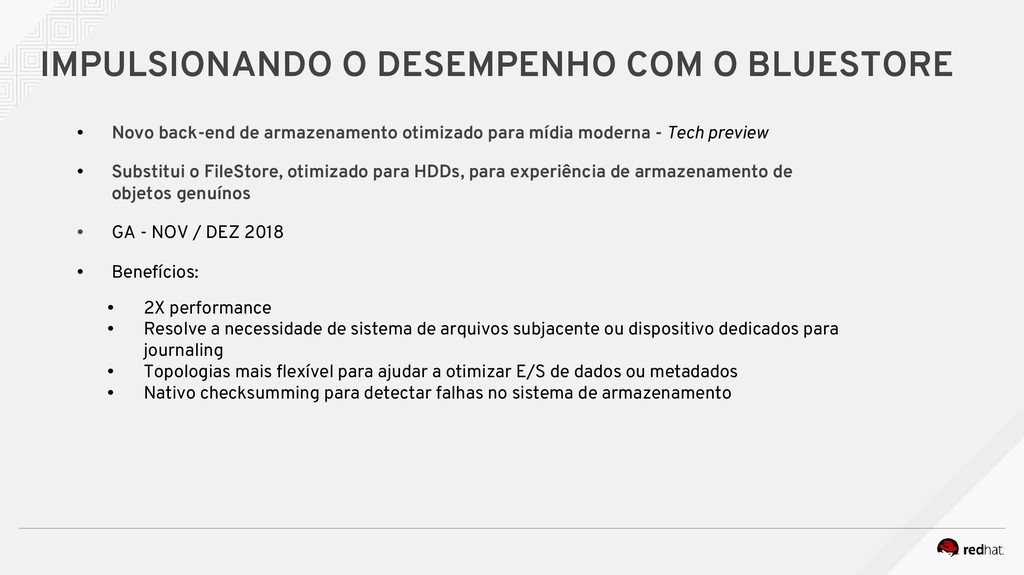
armazenamento otimizado para mídia moderna - Tech preview • Substitui o FileStore, otimizado para HDDs, para experiência de armazenamento de objetos genuínos • GA - NOV / DEZ 2018 • Benefícios: • 2X performance • Resolve a necessidade de sistema de arquivos subjacente ou dispositivo dedicados para journaling • Topologias mais flexível para ajudar a otimizar E/S de dados ou metadados • Nativo checksumming para detectar falhas no sistema de armazenamento
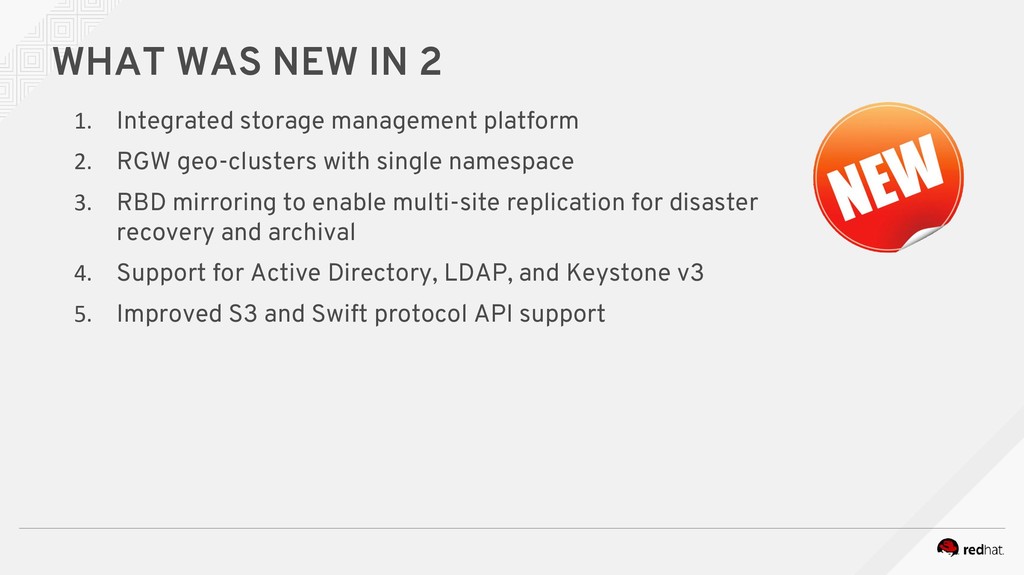
2. RGW geo-clusters with single namespace 3. RBD mirroring to enable multi-site replication for disaster recovery and archival 4. Support for Active Directory, LDAP, and Keystone v3 5. Improved S3 and Swift protocol API support
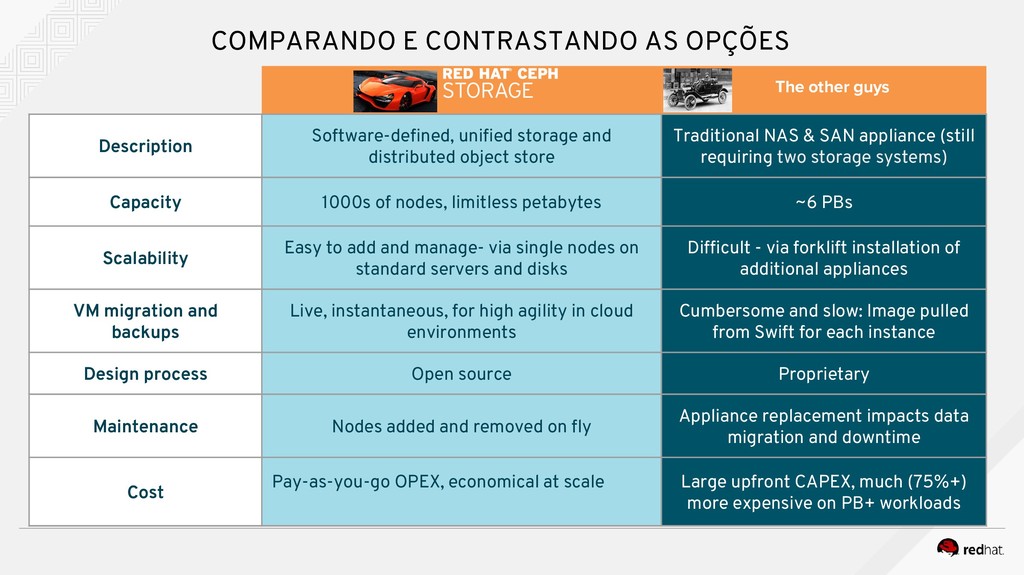
store Traditional NAS & SAN appliance (still requiring two storage systems) Capacity 1000s of nodes, limitless petabytes ~6 PBs Scalability Easy to add and manage- via single nodes on standard servers and disks Difficult - via forklift installation of additional appliances VM migration and backups Live, instantaneous, for high agility in cloud environments Cumbersome and slow: Image pulled from Swift for each instance Design process Open source Proprietary Maintenance Nodes added and removed on fly Appliance replacement impacts data migration and downtime Cost Pay-as-you-go OPEX, economical at scale Large upfront CAPEX, much (75%+) more expensive on PB+ workloads COMPARANDO E CONTRASTANDO AS OPÇÕES
& RED HAT OPENSTACK PLATFORM • Subscription Benefits – Streamlined product and resource access, lifecycle management, Knowledgebase and deployment resources, security and accountability • Jumpstart - 3 day consulting for pre-production cluster implementation at customer site • Smart Start – 3-week consulting for object storage, cloud infrastructure, and virtualization • Health Check - 3-5 day evaluation of total solution best practice engagement • Red Hat Storage Consulting Services - recommended for initial storage design and set-up • Global Services and Support - production subscriptions for smooth lifecycle deployments • Red Hat Storage training – 2 and 5-day for storage or cloud admins, including OpenStack
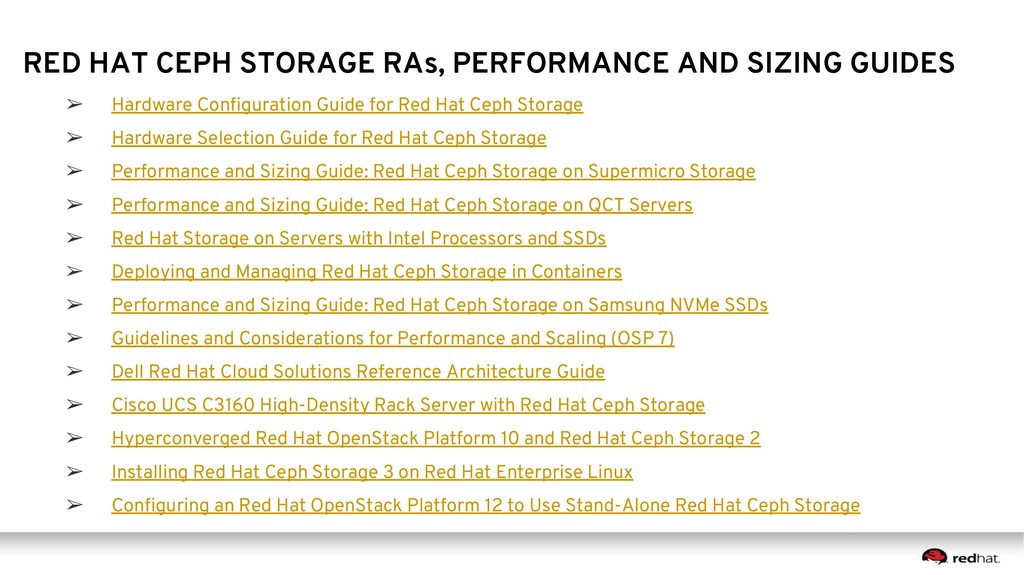
Hardware Configuration Guide for Red Hat Ceph Storage ➢ Hardware Selection Guide for Red Hat Ceph Storage ➢ Performance and Sizing Guide: Red Hat Ceph Storage on Supermicro Storage ➢ Performance and Sizing Guide: Red Hat Ceph Storage on QCT Servers ➢ Red Hat Storage on Servers with Intel Processors and SSDs ➢ Deploying and Managing Red Hat Ceph Storage in Containers ➢ Performance and Sizing Guide: Red Hat Ceph Storage on Samsung NVMe SSDs ➢ Guidelines and Considerations for Performance and Scaling (OSP 7) ➢ Dell Red Hat Cloud Solutions Reference Architecture Guide ➢ Cisco UCS C3160 High-Density Rack Server with Red Hat Ceph Storage ➢ Hyperconverged Red Hat OpenStack Platform 10 and Red Hat Ceph Storage 2 ➢ Installing Red Hat Ceph Storage 3 on Red Hat Enterprise Linux ➢ Configuring an Red Hat OpenStack Platform 12 to Use Stand-Alone Red Hat Ceph Storage
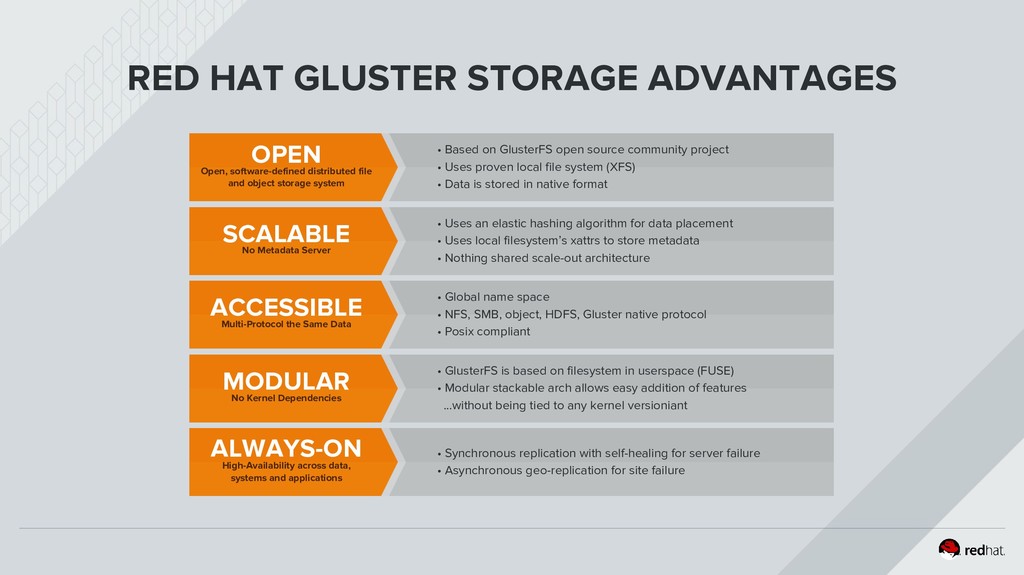
Open, software-defined distributed file and object storage system No Metadata Server Multi-Protocol the Same Data No Kernel Dependencies High-Availability across data, systems and applications • Based on GlusterFS open source community project • Uses proven local file system (XFS) • Data is stored in native format • Uses an elastic hashing algorithm for data placement • Uses local filesystem’s xattrs to store metadata • Nothing shared scale-out architecture • Global name space • NFS, SMB, object, HDFS, Gluster native protocol • Posix compliant • GlusterFS is based on filesystem in userspace (FUSE) • Modular stackable arch allows easy addition of features ...without being tied to any kernel versioniant • Synchronous replication with self-healing for server failure • Asynchronous geo-replication for site failure
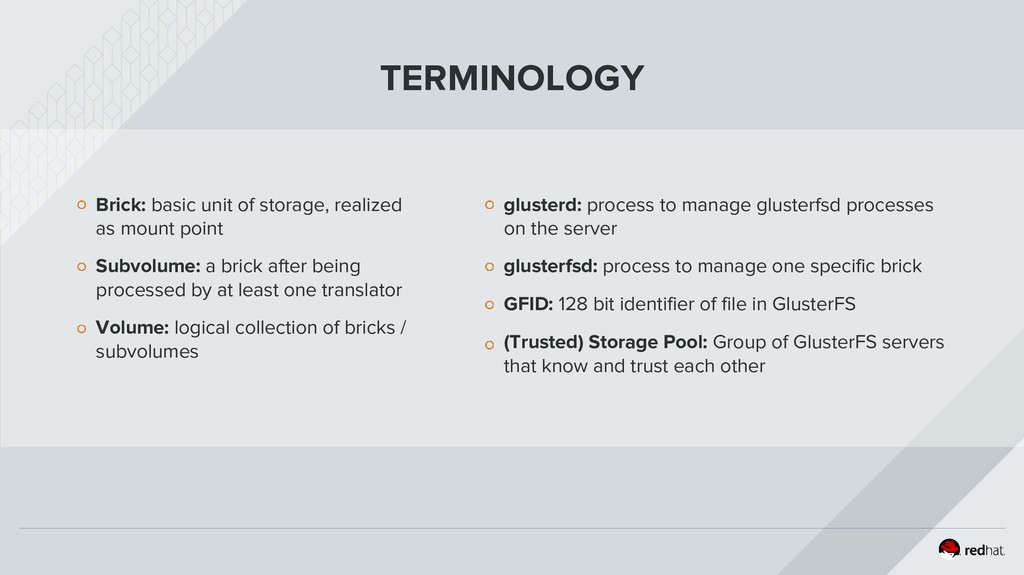
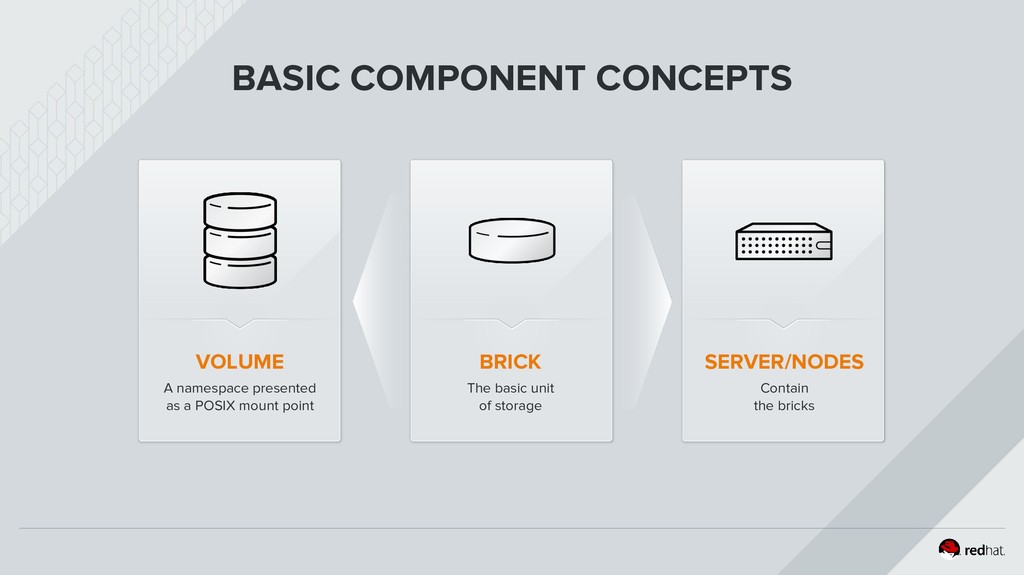
Subvolume: a brick after being processed by at least one translator Volume: logical collection of bricks / subvolumes glusterd: process to manage glusterfsd processes on the server glusterfsd: process to manage one specific brick GFID: 128 bit identifier of file in GlusterFS (Trusted) Storage Pool: Group of GlusterFS servers that know and trust each other
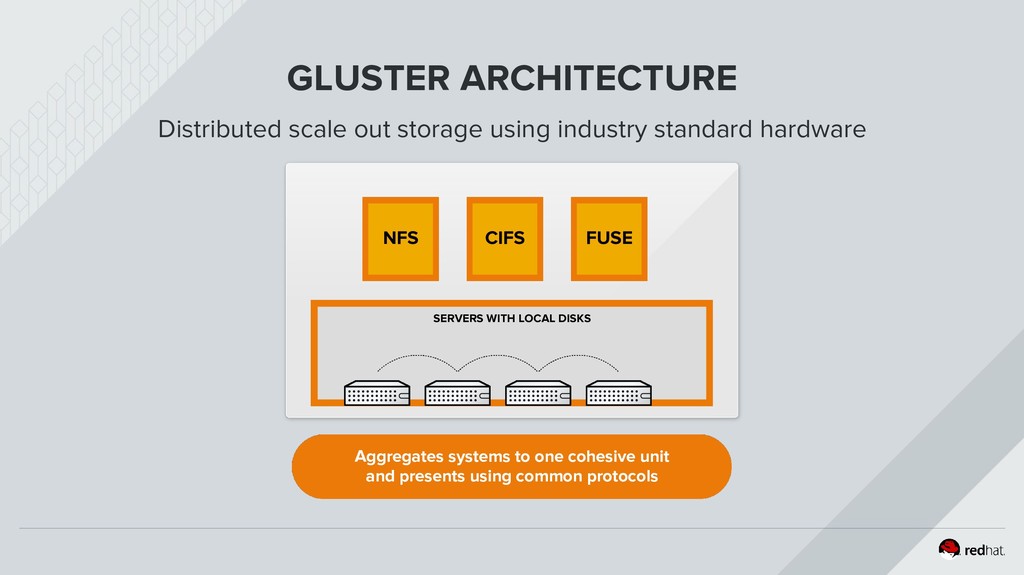
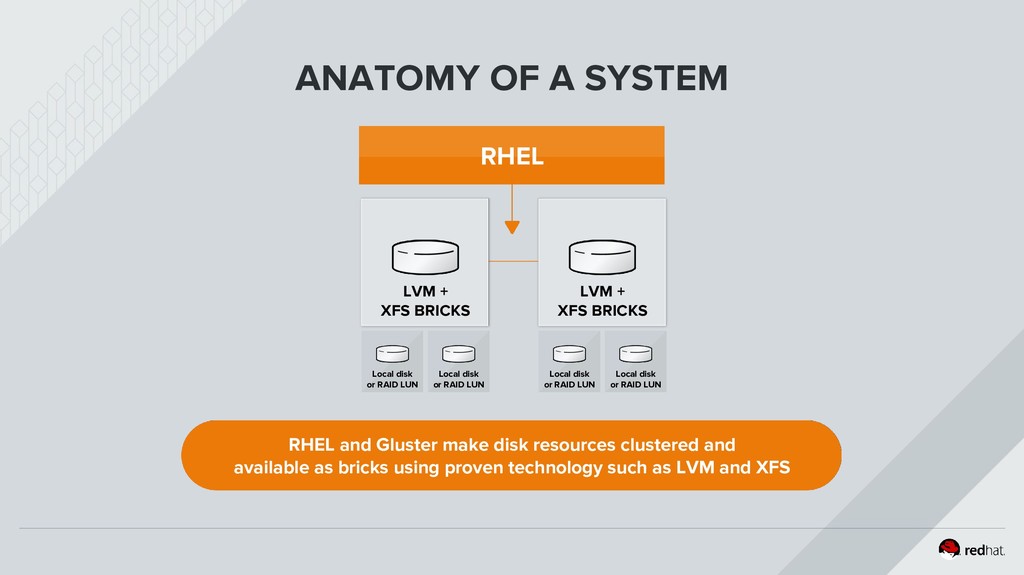
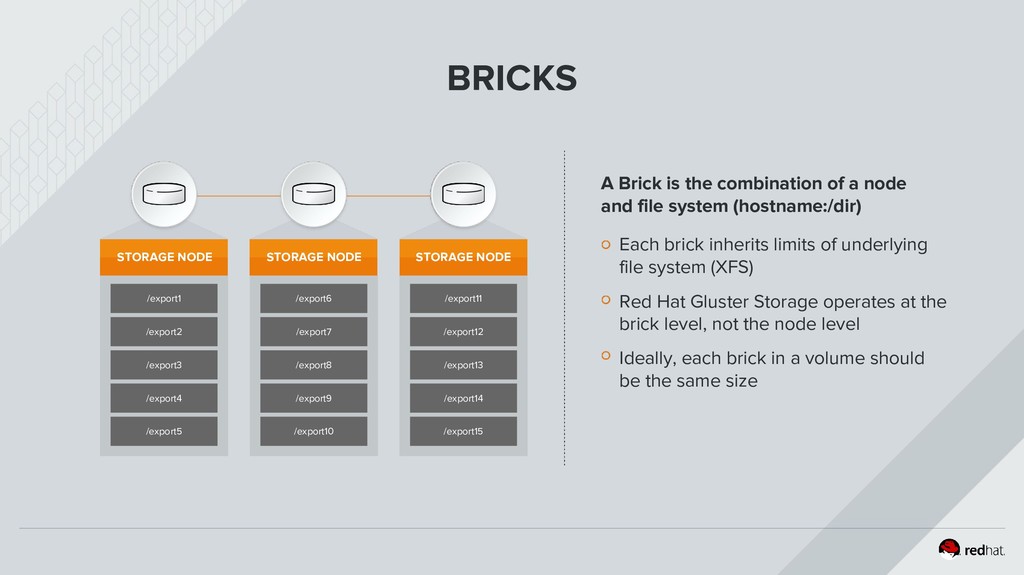
+ XFS BRICKS Local disk or RAID LUN Local disk or RAID LUN Local disk or RAID LUN Local disk or RAID LUN RHEL and Gluster make disk resources clustered and available as bricks using proven technology such as LVM and XFS
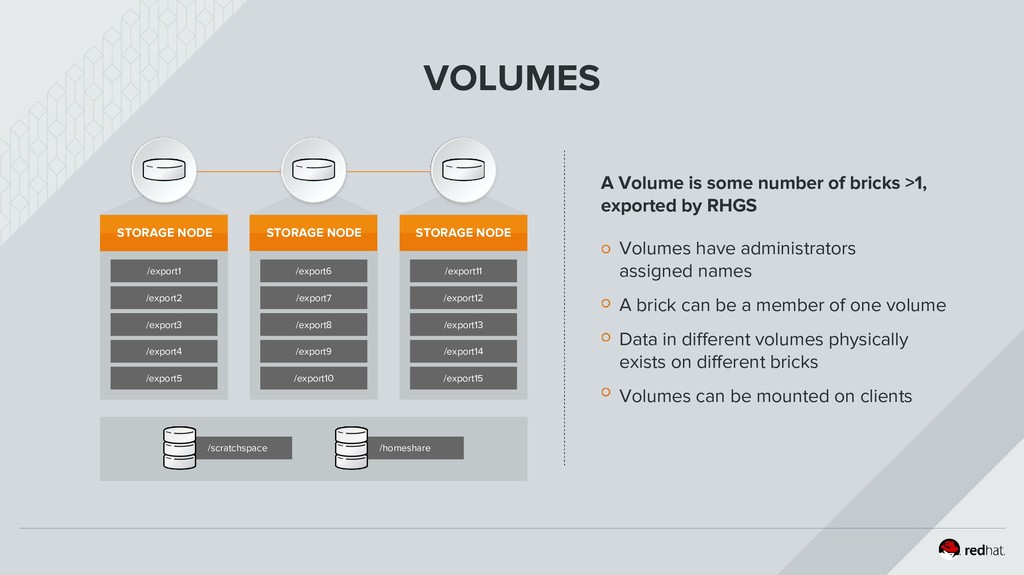
/export10 /export11 /export12 /export13 /export14 /export15 STORAGE NODE STORAGE NODE STORAGE NODE A Brick is the combination of a node and file system (hostname:/dir) Each brick inherits limits of underlying file system (XFS) Red Hat Gluster Storage operates at the brick level, not the node level Ideally, each brick in a volume should be the same size
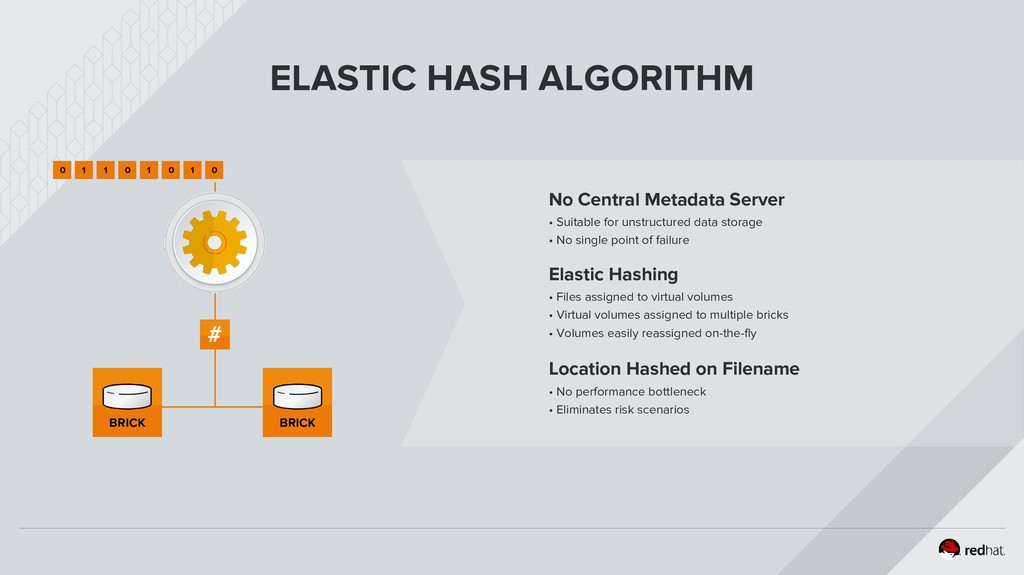
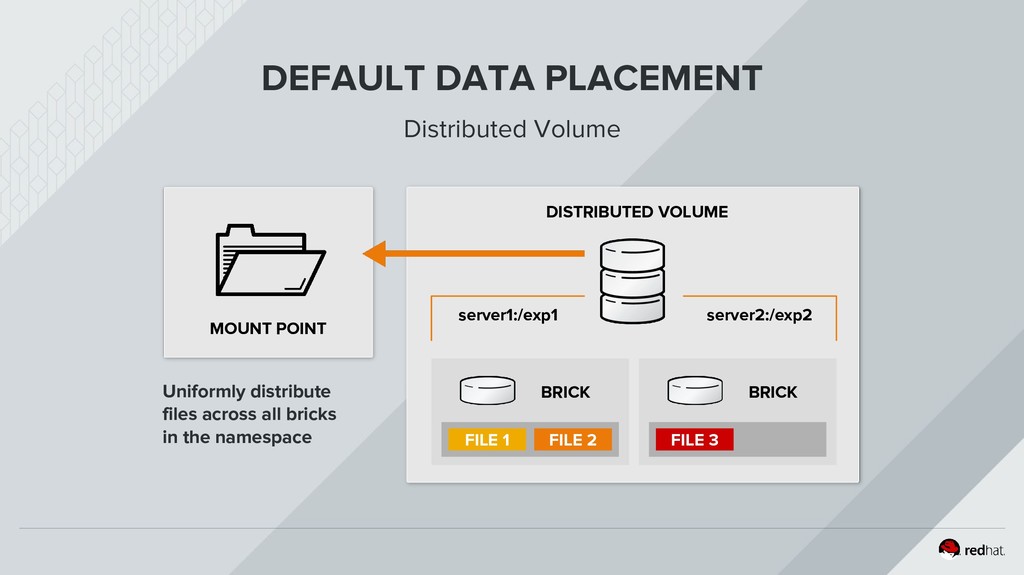
1 0 1 0 No Central Metadata Server • Suitable for unstructured data storage • No single point of failure Elastic Hashing • Files assigned to virtual volumes • Virtual volumes assigned to multiple bricks • Volumes easily reassigned on-the-fly Location Hashed on Filename • No performance bottleneck • Eliminates risk scenarios
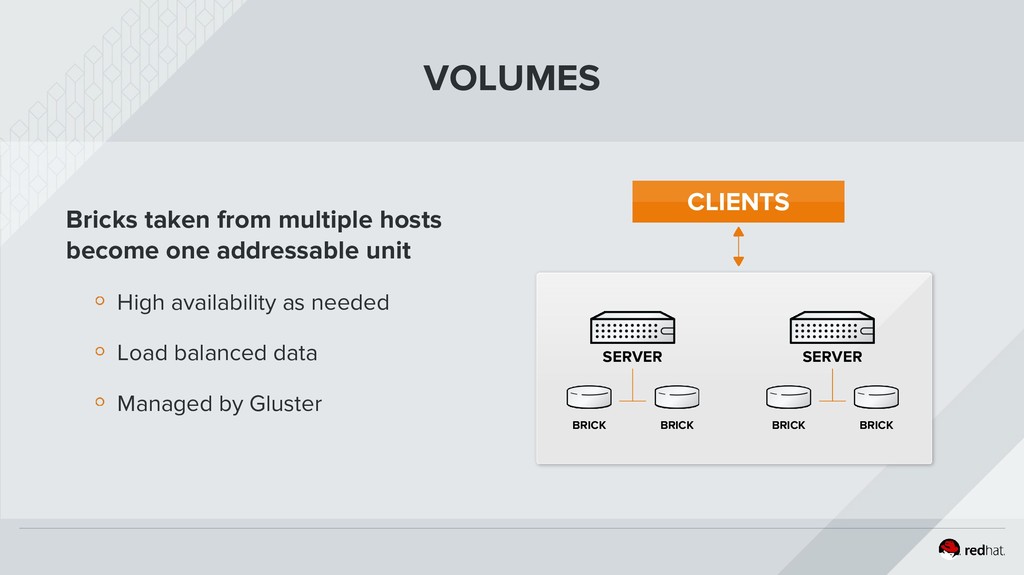
is some number of bricks >1, exported by RHGS Volumes have administrators assigned names A brick can be a member of one volume Data in different volumes physically exists on different bricks Volumes can be mounted on clients /export2 /export3 /export4 /export5 /export6 /export7 /export8 /export9 /export10 /export11 /export12 /export13 /export14 /export15 /scratchspace /homeshare
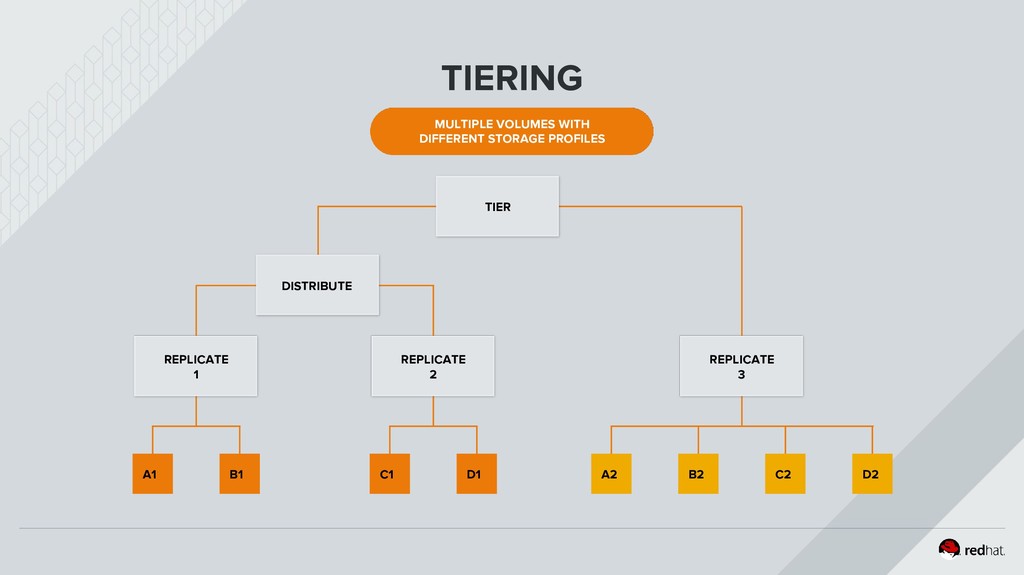
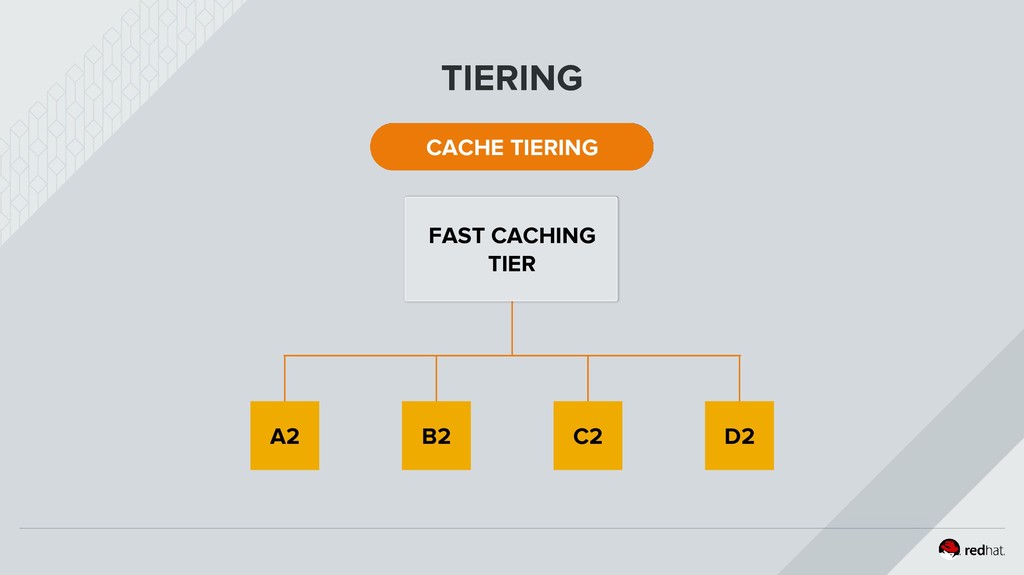
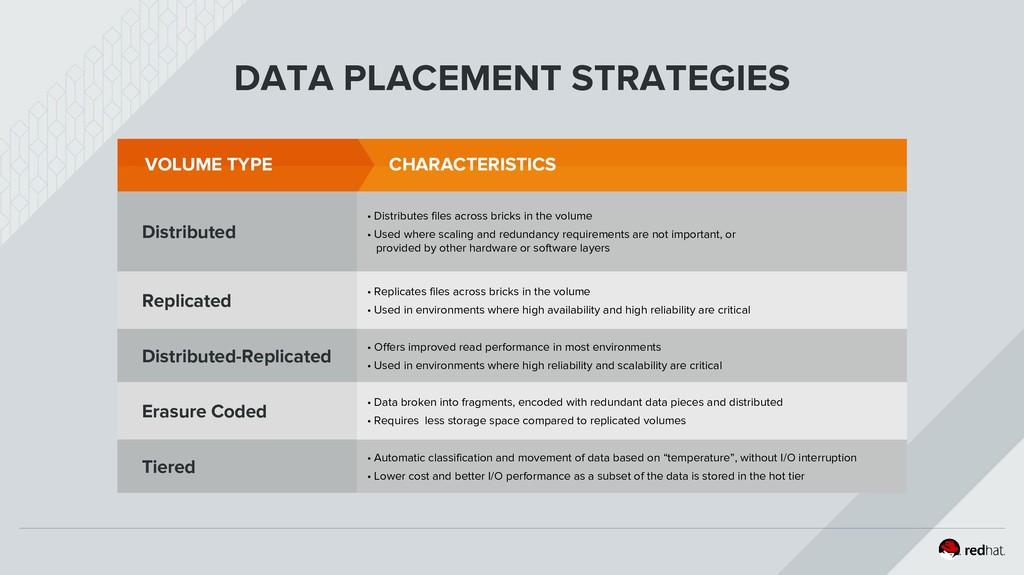
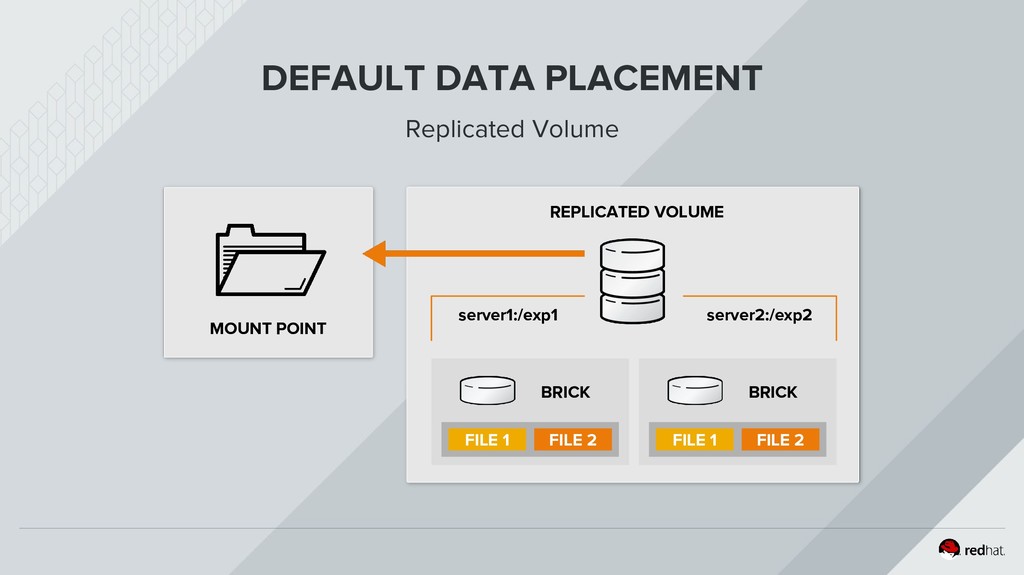
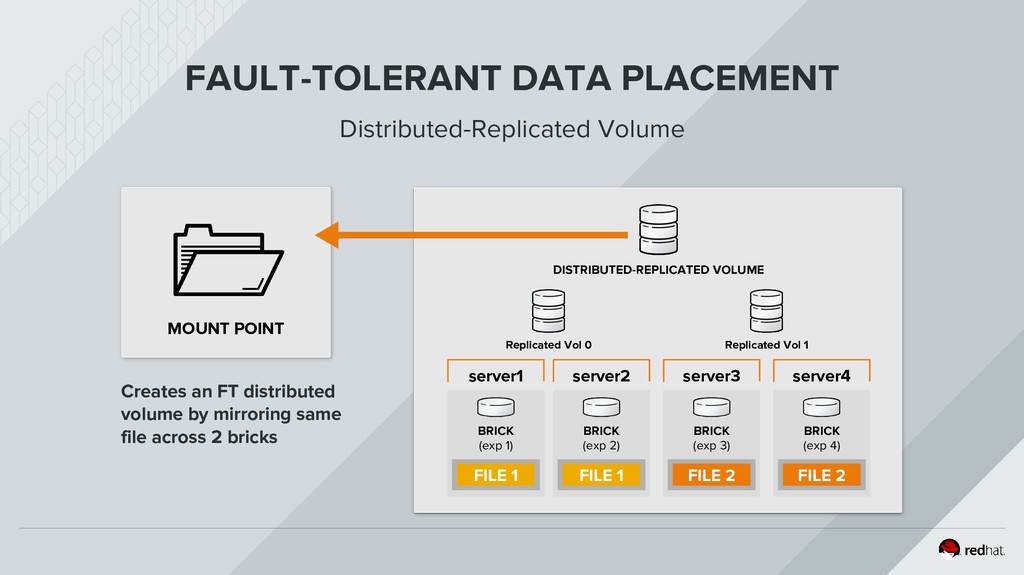
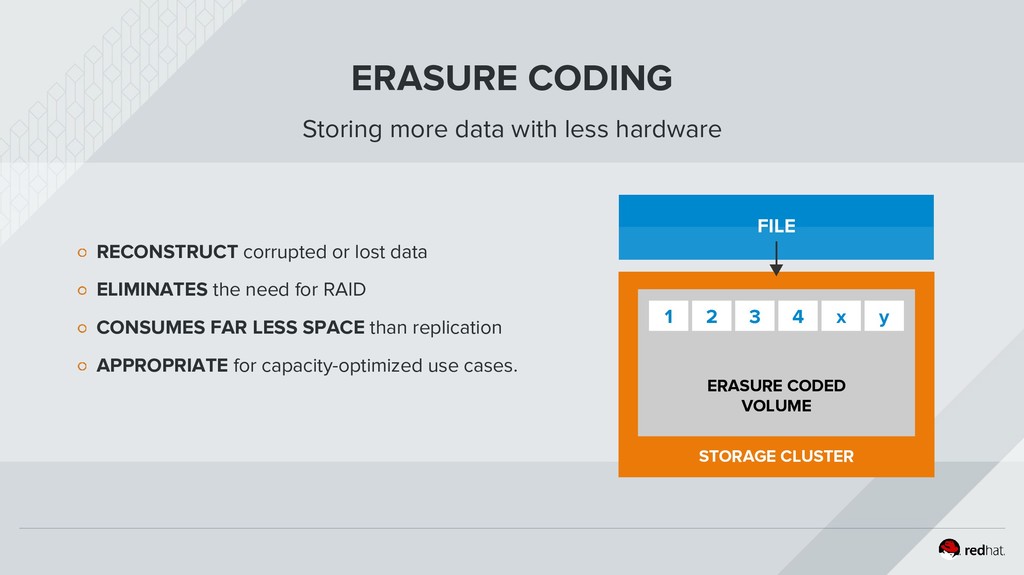
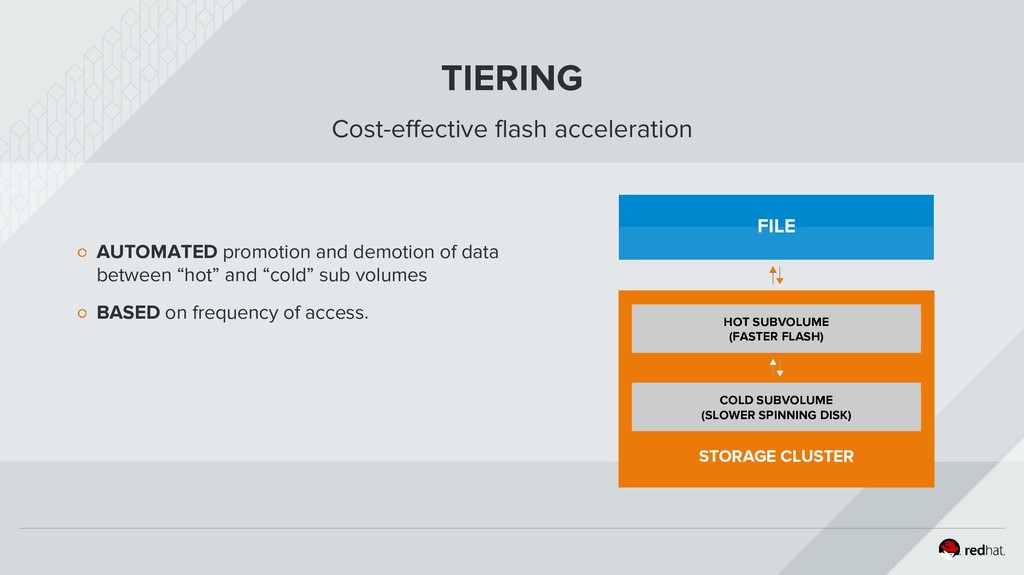
across bricks in the volume • Used where scaling and redundancy requirements are not important, or provided by other hardware or software layers Replicated • Replicates files across bricks in the volume • Used in environments where high availability and high reliability are critical Distributed-Replicated • Offers improved read performance in most environments • Used in environments where high reliability and scalability are critical Erasure Coded Tiered • Automatic classification and movement of data based on “temperature”, without I/O interruption • Lower cost and better I/O performance as a subset of the data is stored in the hot tier • Data broken into fragments, encoded with redundant data pieces and distributed • Requires less storage space compared to replicated volumes
4 x 1 y FILE ERASURE CODED VOLUME STORAGE CLUSTER RECONSTRUCT corrupted or lost data ELIMINATES the need for RAID CONSUMES FAR LESS SPACE than replication APPROPRIATE for capacity-optimized use cases.
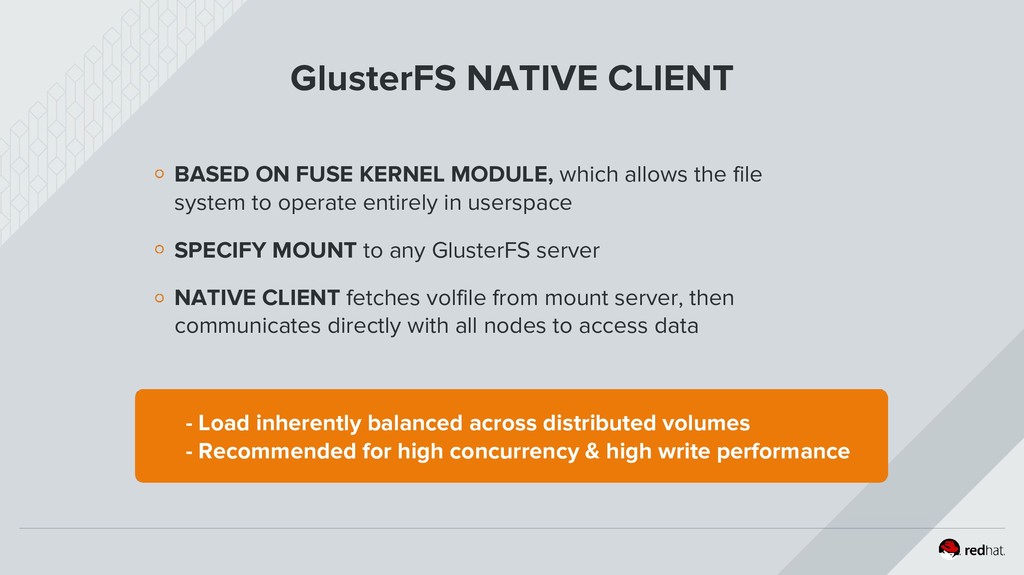
the file system to operate entirely in userspace SPECIFY MOUNT to any GlusterFS server NATIVE CLIENT fetches volfile from mount server, then communicates directly with all nodes to access data - Load inherently balanced across distributed volumes - Recommended for high concurrency & high write performance
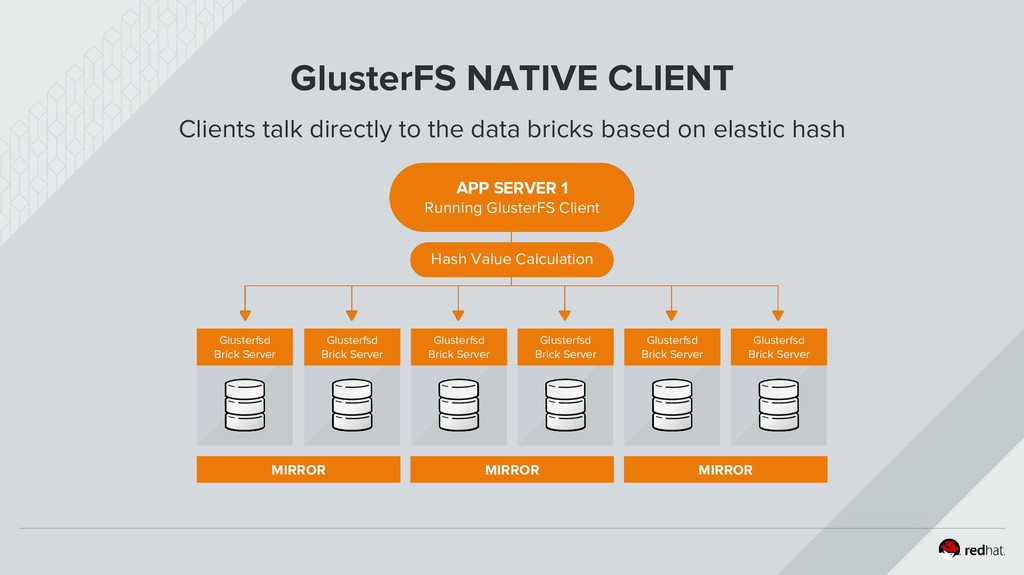
based on elastic hash Glusterfsd Brick Server Glusterfsd Brick Server Glusterfsd Brick Server Glusterfsd Brick Server Glusterfsd Brick Server Glusterfsd Brick Server MIRROR MIRROR MIRROR APP SERVER 1 Running GlusterFS Client Hash Value Calculation
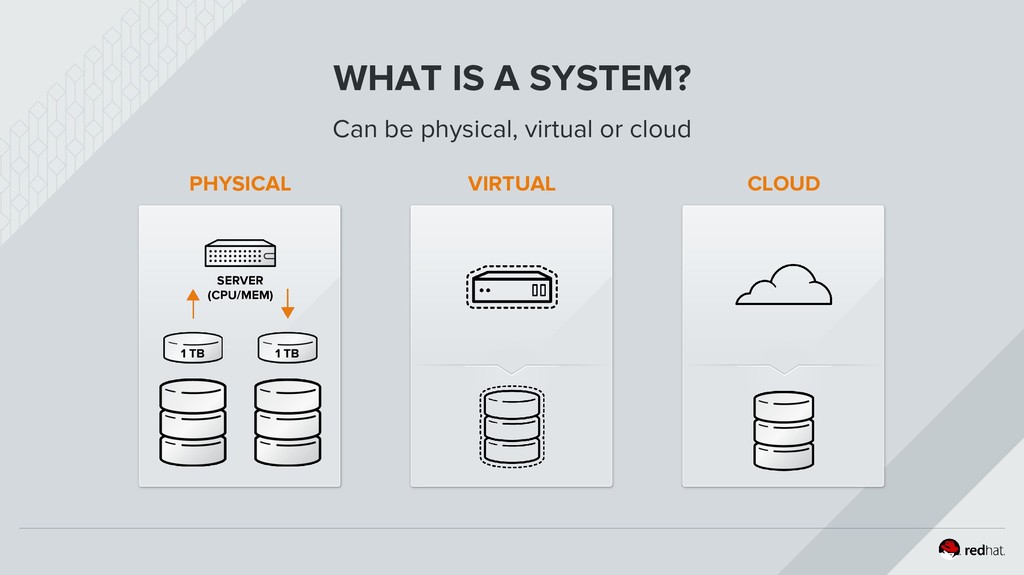
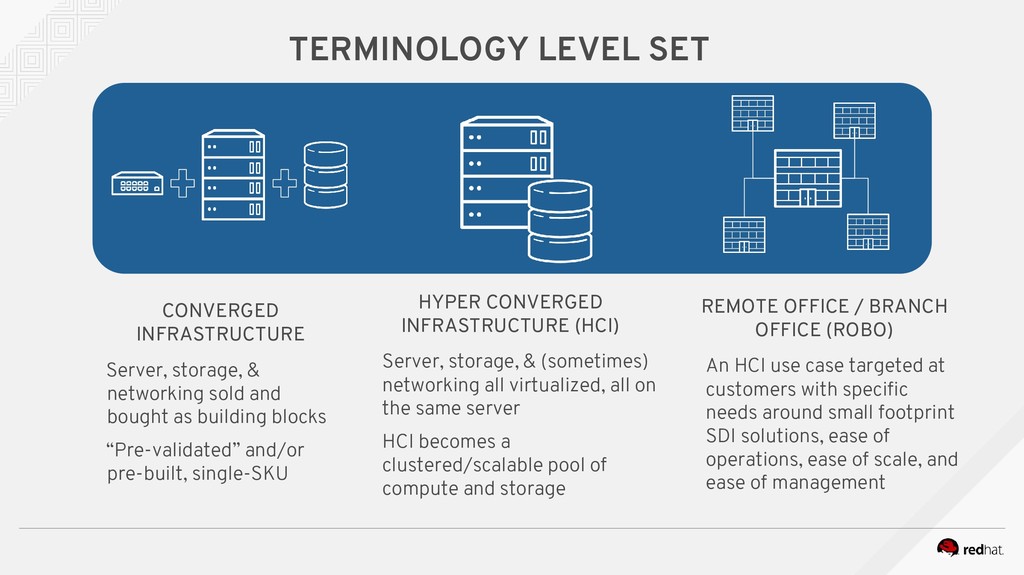
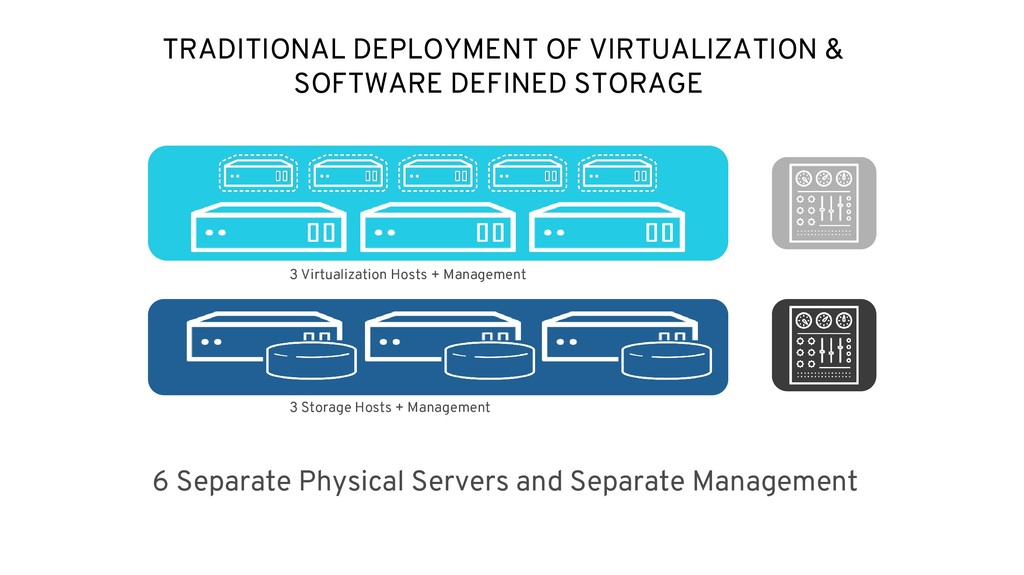
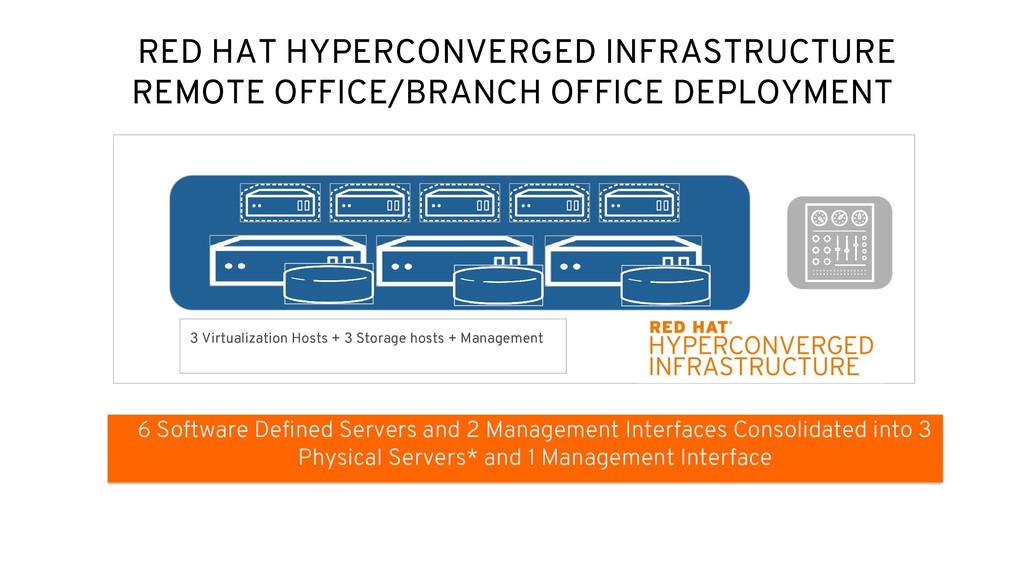
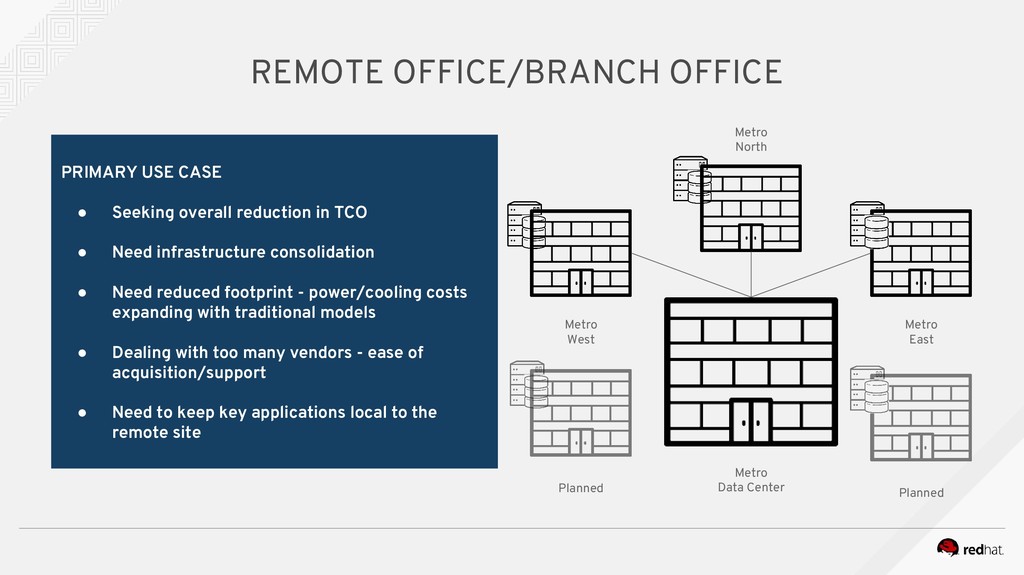
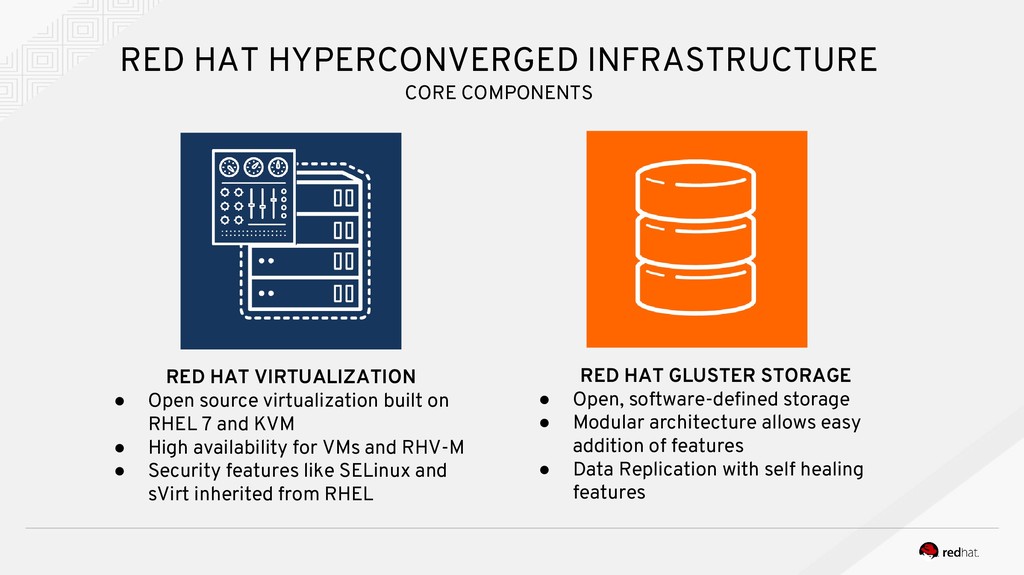
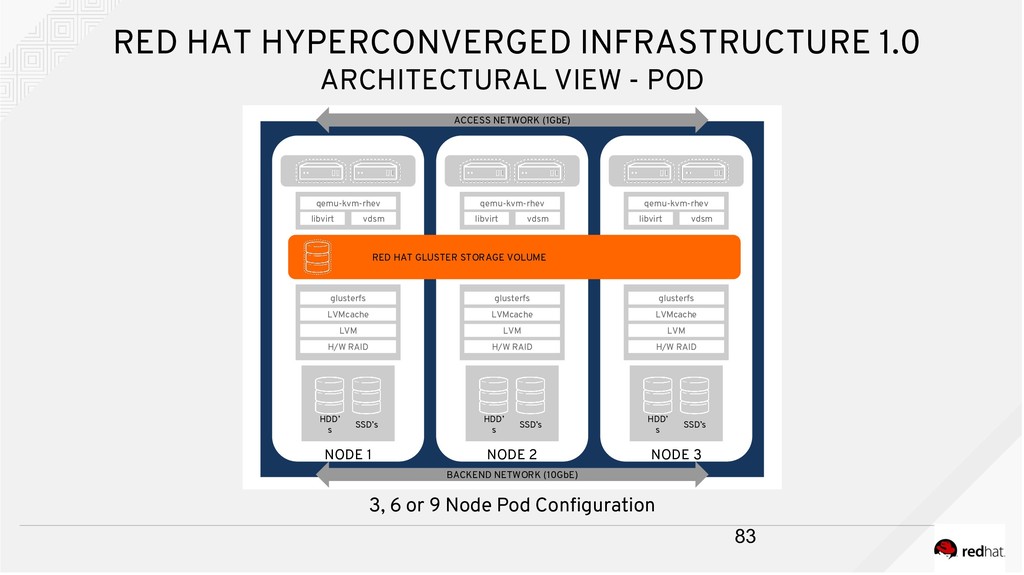
building blocks “Pre-validated” and/or pre-built, single-SKU HYPER CONVERGED INFRASTRUCTURE (HCI) Server, storage, & (sometimes) networking all virtualized, all on the same server HCI becomes a clustered/scalable pool of compute and storage REMOTE OFFICE / BRANCH OFFICE (ROBO) An HCI use case targeted at customers with specific needs around small footprint SDI solutions, ease of operations, ease of scale, and ease of management TERMINOLOGY LEVEL SET
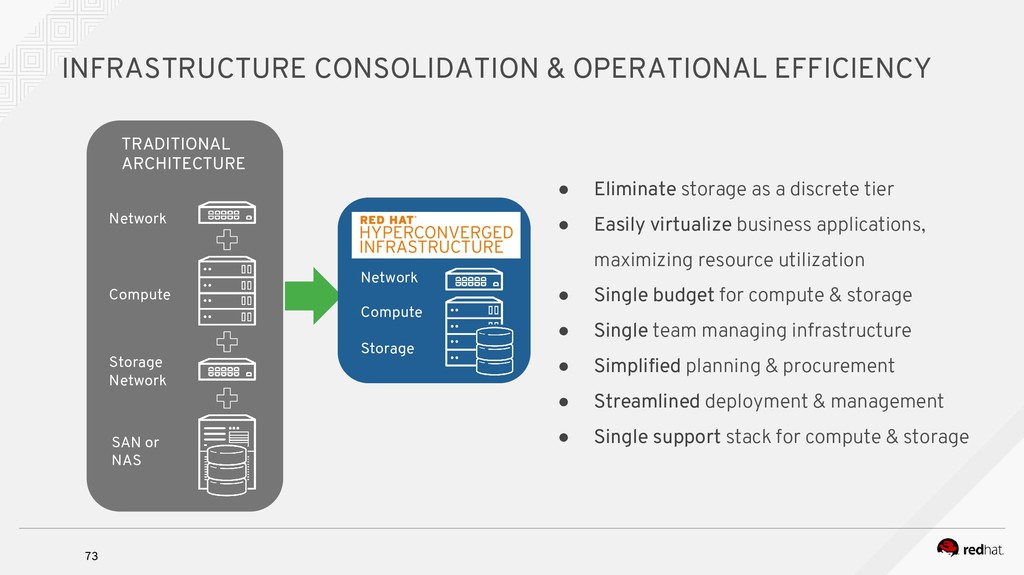
virtualize business applications, maximizing resource utilization • Single budget for compute & storage • Single team managing infrastructure • Simplified planning & procurement • Streamlined deployment & management • Single support stack for compute & storage INFRASTRUCTURE CONSOLIDATION & OPERATIONAL EFFICIENCY TRADITIONAL ARCHITECTURE Network Compute Storage Network SAN or NAS Network Compute Storage
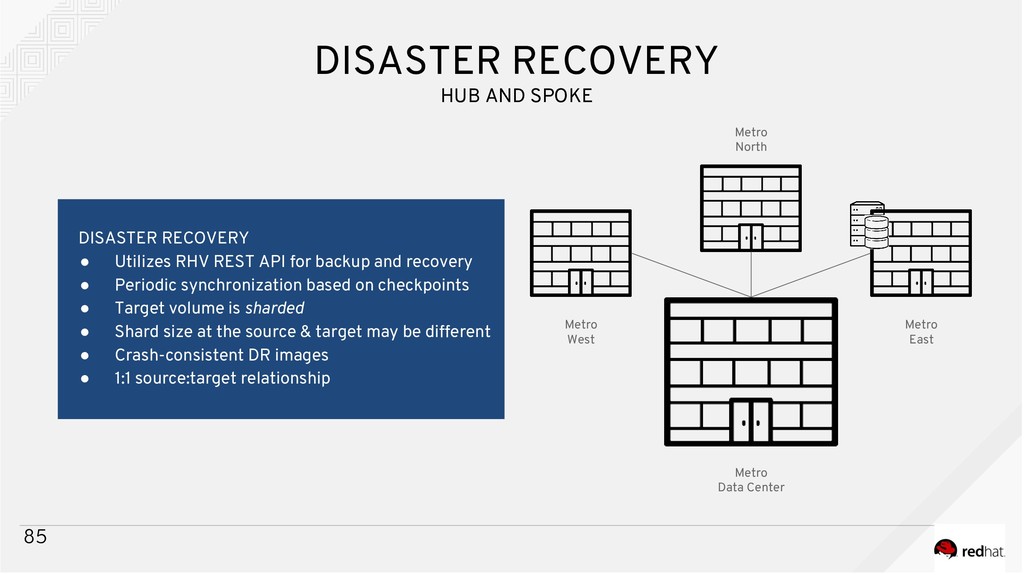
in TCO • Need infrastructure consolidation • Need reduced footprint - power/cooling costs expanding with traditional models • Dealing with too many vendors - ease of acquisition/support • Need to keep key applications local to the remote site Metro West Metro East Metro North Metro Data Center Planned Planned
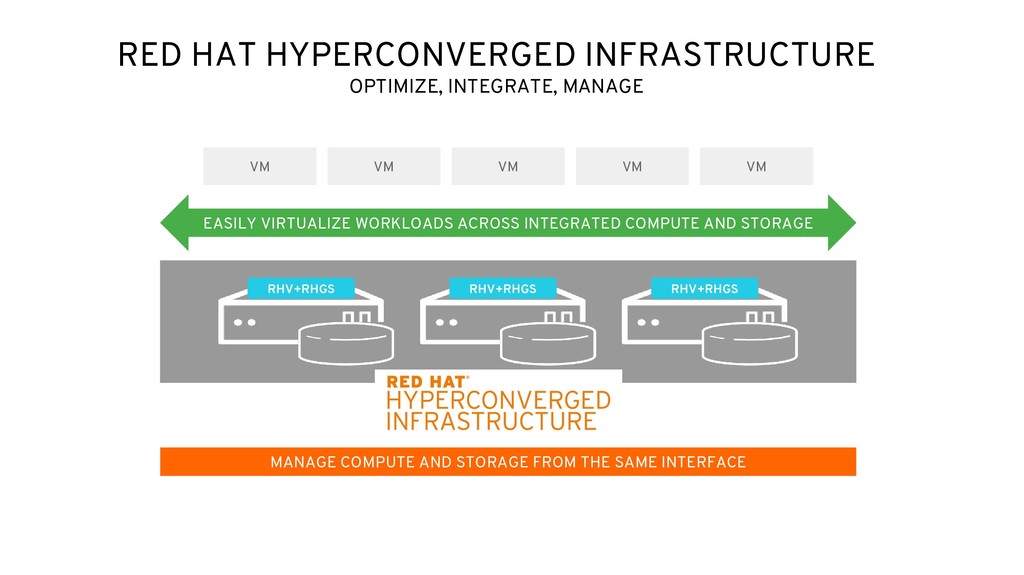
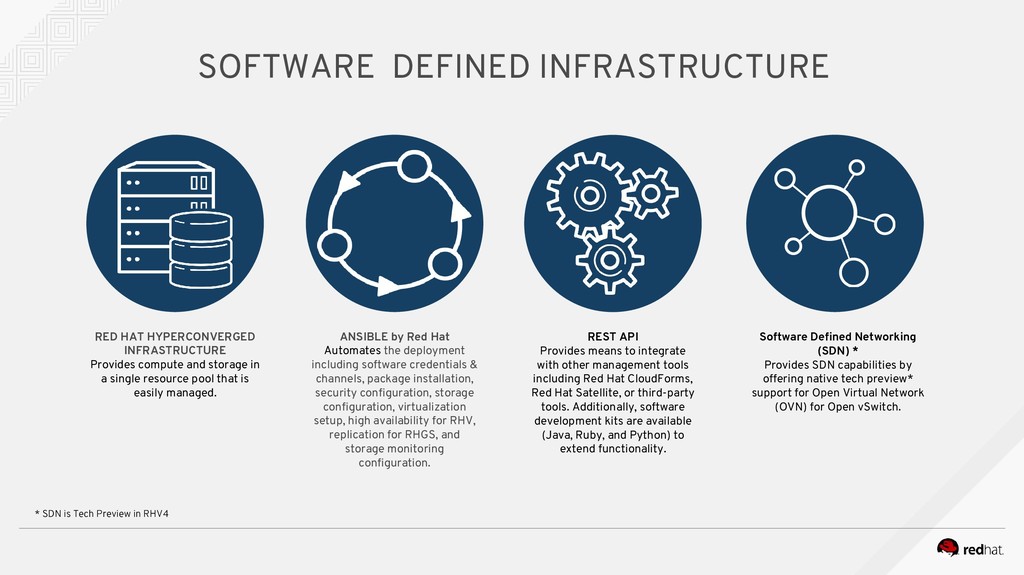
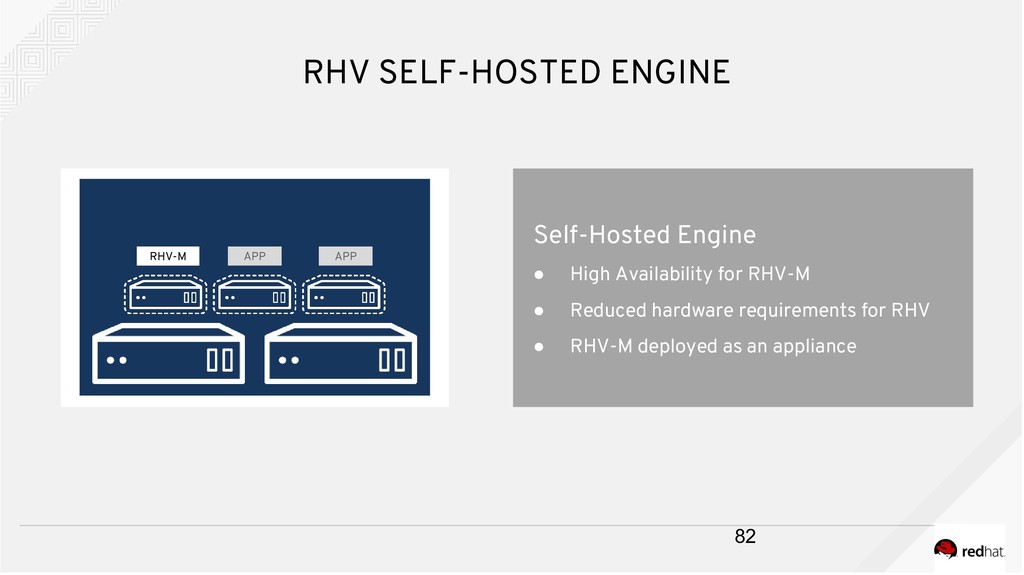
other management tools including Red Hat CloudForms, Red Hat Satellite, or third-party tools. Additionally, software development kits are available (Java, Ruby, and Python) to extend functionality. ANSIBLE by Red Hat Automates the deployment including software credentials & channels, package installation, security configuration, storage configuration, virtualization setup, high availability for RHV, replication for RHGS, and storage monitoring configuration. Software Defined Networking (SDN) * Provides SDN capabilities by offering native tech preview* support for Open Virtual Network (OVN) for Open vSwitch. RED HAT HYPERCONVERGED INFRASTRUCTURE Provides compute and storage in a single resource pool that is easily managed. * SDN is Tech Preview in RHV4
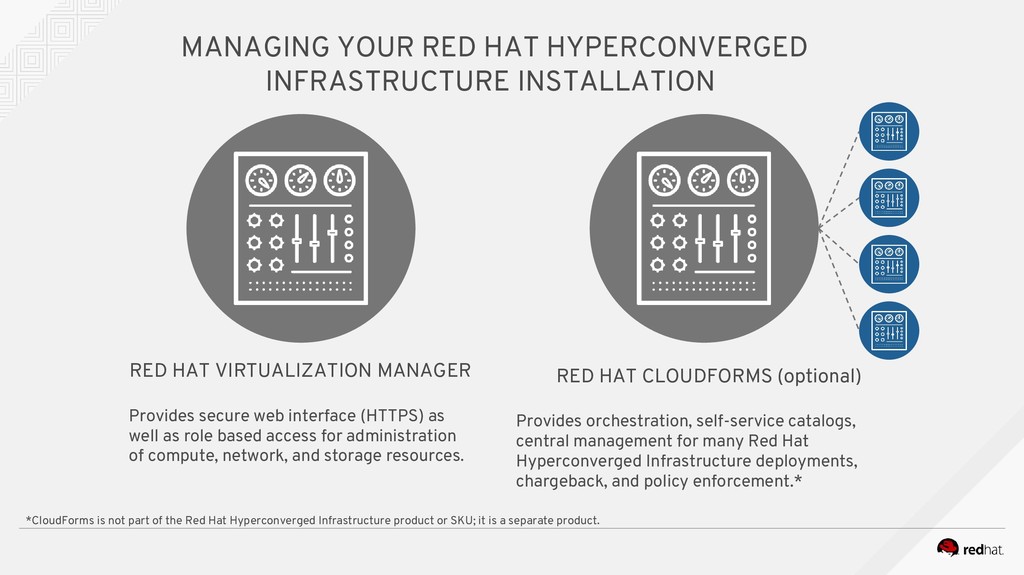
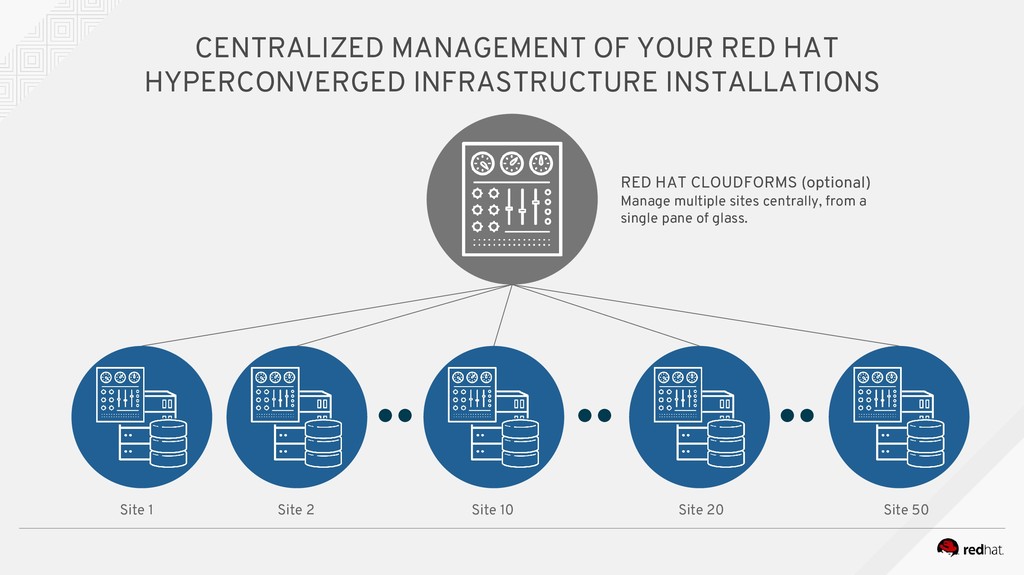
MANAGER Provides secure web interface (HTTPS) as well as role based access for administration of compute, network, and storage resources. RED HAT CLOUDFORMS (optional) Provides orchestration, self-service catalogs, central management for many Red Hat Hyperconverged Infrastructure deployments, chargeback, and policy enforcement.* *CloudForms is not part of the Red Hat Hyperconverged Infrastructure product or SKU; it is a separate product.
Open source virtualization built on RHEL 7 and KVM • High availability for VMs and RHV-M • Security features like SELinux and sVirt inherited from RHEL RED HAT GLUSTER STORAGE • Open, software-defined storage • Modular architecture allows easy addition of features • Data Replication with self healing features
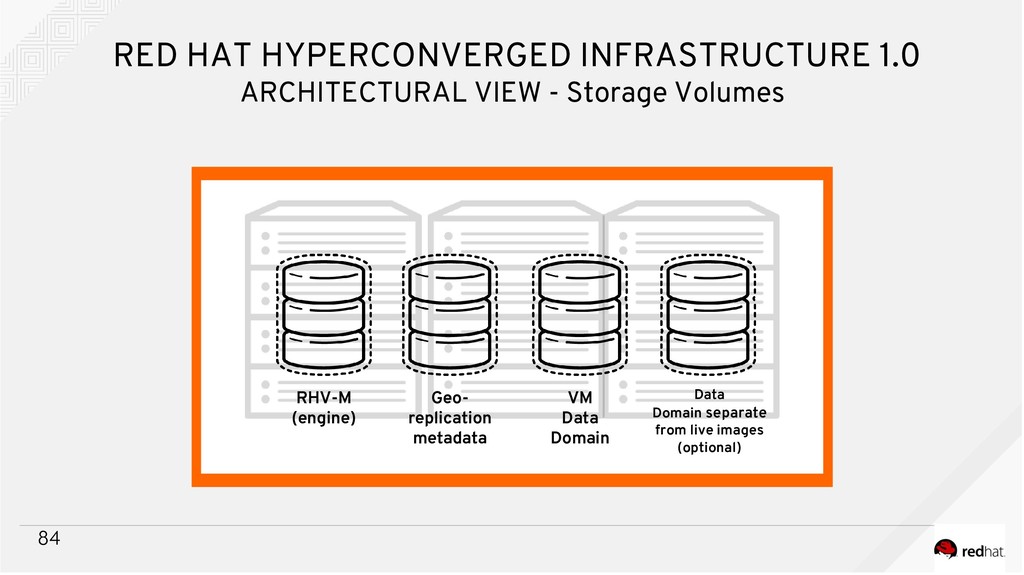
REST API for backup and recovery • Periodic synchronization based on checkpoints • Target volume is sharded • Shard size at the source & target may be different • Crash-consistent DR images • 1:1 source:target relationship 85 Metro West Metro East Metro North Metro Data Center
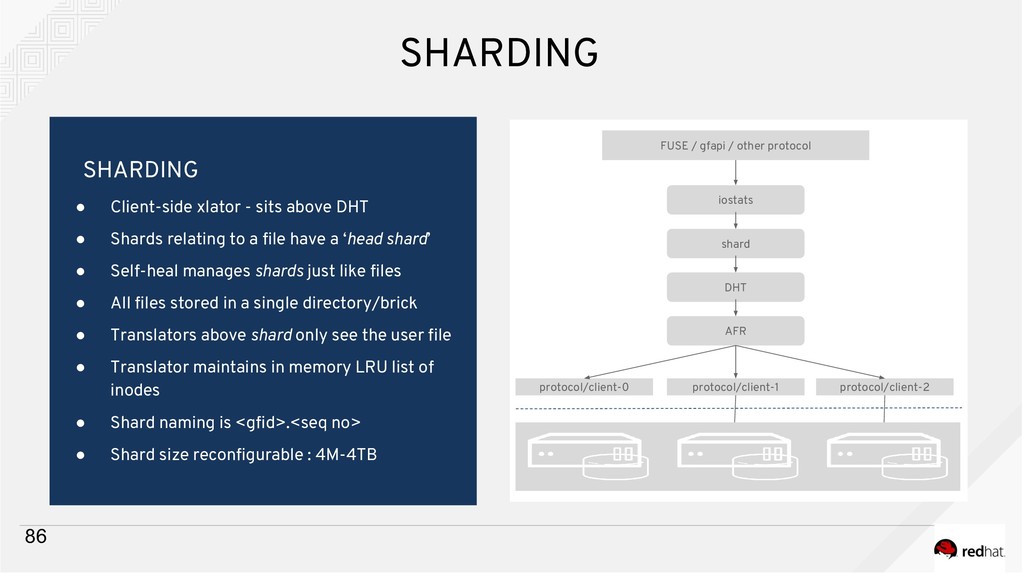
• Shards relating to a file have a ‘head shard’ • Self-heal manages shards just like files • All files stored in a single directory/brick • Translators above shard only see the user file • Translator maintains in memory LRU list of inodes • Shard naming is <gfid>.<seq no> • Shard size reconfigurable : 4M-4TB iostats shard DHT AFR protocol/client-0 protocol/client-1 protocol/client-2 FUSE / gfapi / other protocol
Facebook: www.facebook.com/RedHatStorage/ • YouTube: www.youtube.com/user/redhatstorage • Slideshare: www.slideshare.net/Red_Hat_Storage WHERE TO GO ON SOCIAL MEDIA
➢ Evaluation, Pre-production, and Production contracts available through Red Hat sales ➢ Red Hat Consulting: http://www.redhat.com/en/services/consulting/storage ➢ Red Hat Storage training: https://www.redhat.com/en/services/training ➢ Red Hat Storage test-drive: http://red.ht/cephtestdrive ➢ To engage a Territory Service Manager in your area, ask for a local Red Hat Storage sales professional at: NORTH AMERICA: 1 (888) REDHAT-1; LATIN AMERICA: 54 (11) 4329-7300; EMEA: 00800 7334 2835 APJ: 65 6490 4200; Brazil: 55 (11) 3529-6000,; Australia: 1800 733 428; New Zealand: 0800 733 428
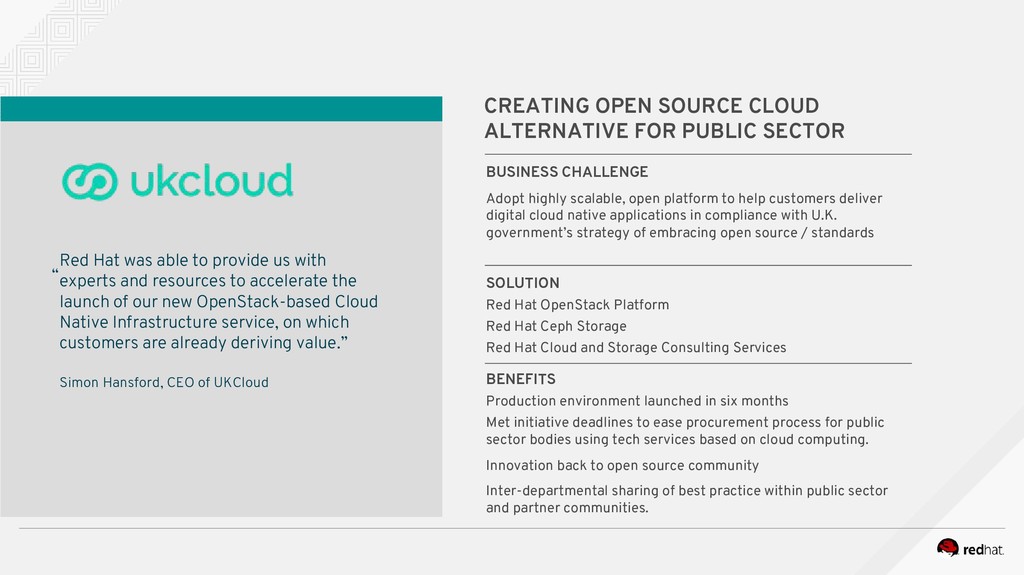
resources to accelerate the launch of our new OpenStack-based Cloud Native Infrastructure service, on which customers are already deriving value.” Simon Hansford, CEO of UKCloud “ CREATING OPEN SOURCE CLOUD ALTERNATIVE FOR PUBLIC SECTOR BUSINESS CHALLENGE Adopt highly scalable, open platform to help customers deliver digital cloud native applications in compliance with U.K. government’s strategy of embracing open source / standards SOLUTION Red Hat OpenStack Platform Red Hat Ceph Storage Red Hat Cloud and Storage Consulting Services BENEFITS Production environment launched in six months Met initiative deadlines to ease procurement process for public sector bodies using tech services based on cloud computing. Innovation back to open source community Inter-departmental sharing of best practice within public sector and partner communities.
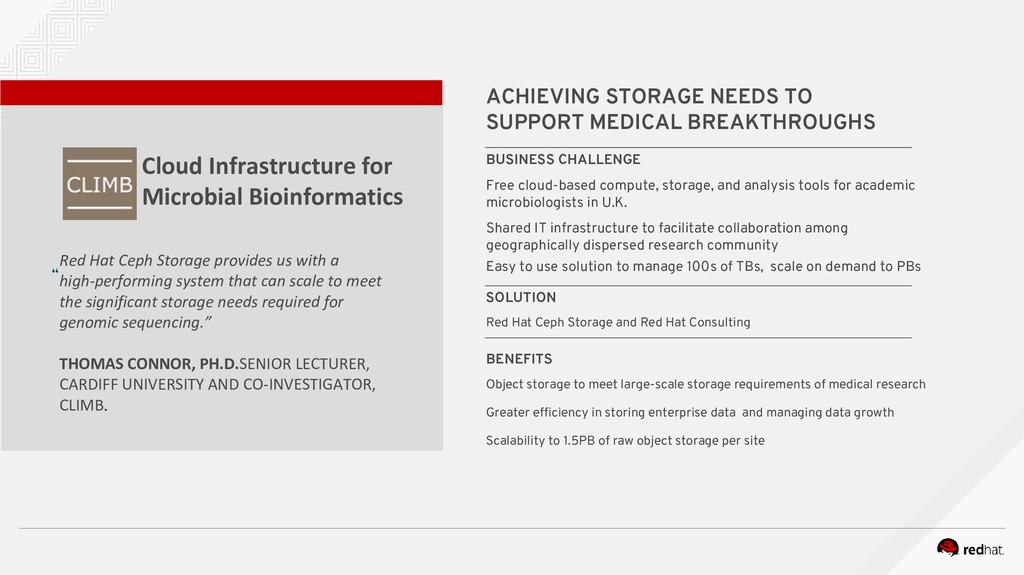
that can scale to meet the significant storage needs required for genomic sequencing.” THOMAS CONNOR, PH.D.SENIOR LECTURER, CARDIFF UNIVERSITY AND CO-INVESTIGATOR, CLIMB. “ ACHIEVING STORAGE NEEDS TO SUPPORT MEDICAL BREAKTHROUGHS BUSINESS CHALLENGE Free cloud-based compute, storage, and analysis tools for academic microbiologists in U.K. Shared IT infrastructure to facilitate collaboration among geographically dispersed research community Easy to use solution to manage 100s of TBs, scale on demand to PBs SOLUTION Red Hat Ceph Storage and Red Hat Consulting BENEFITS Object storage to meet large-scale storage requirements of medical research Greater efficiency in storing enterprise data and managing data growth Scalability to 1.5PB of raw object storage per site Cloud Infrastructure for Microbial Bioinformatics
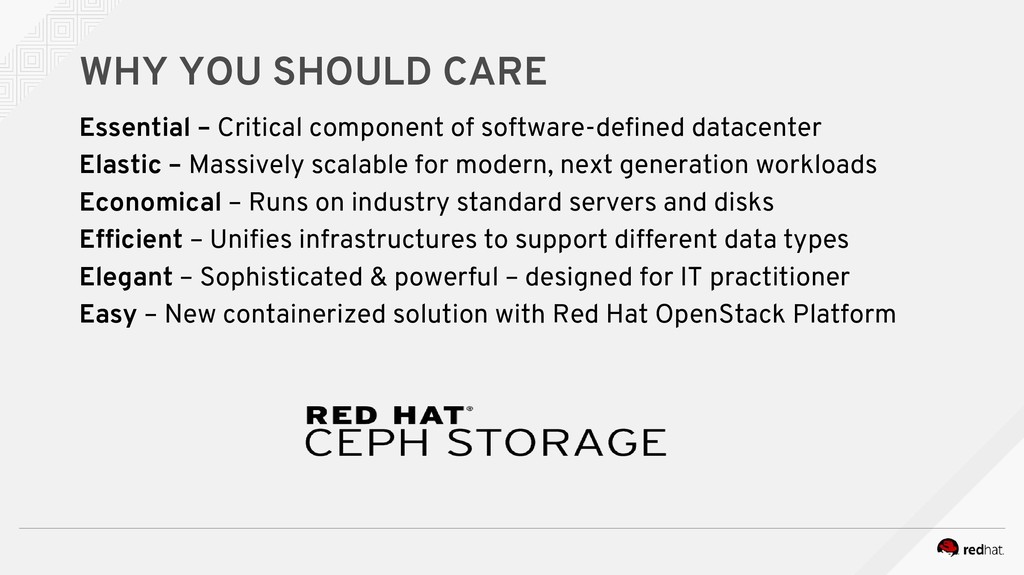
datacenter Elastic – Massively scalable for modern, next generation workloads Economical – Runs on industry standard servers and disks Efficient – Unifies infrastructures to support different data types Elegant – Sophisticated & powerful – designed for IT practitioner Easy – New containerized solution with Red Hat OpenStack Platform
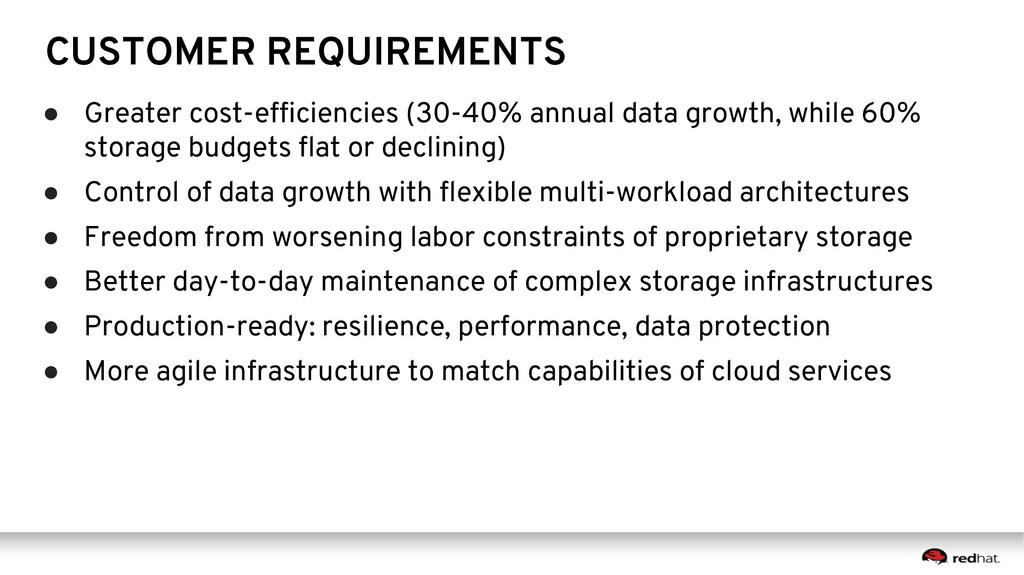
60% storage budgets flat or declining) • Control of data growth with flexible multi-workload architectures • Freedom from worsening labor constraints of proprietary storage • Better day-to-day maintenance of complex storage infrastructures • Production-ready: resilience, performance, data protection • More agile infrastructure to match capabilities of cloud services
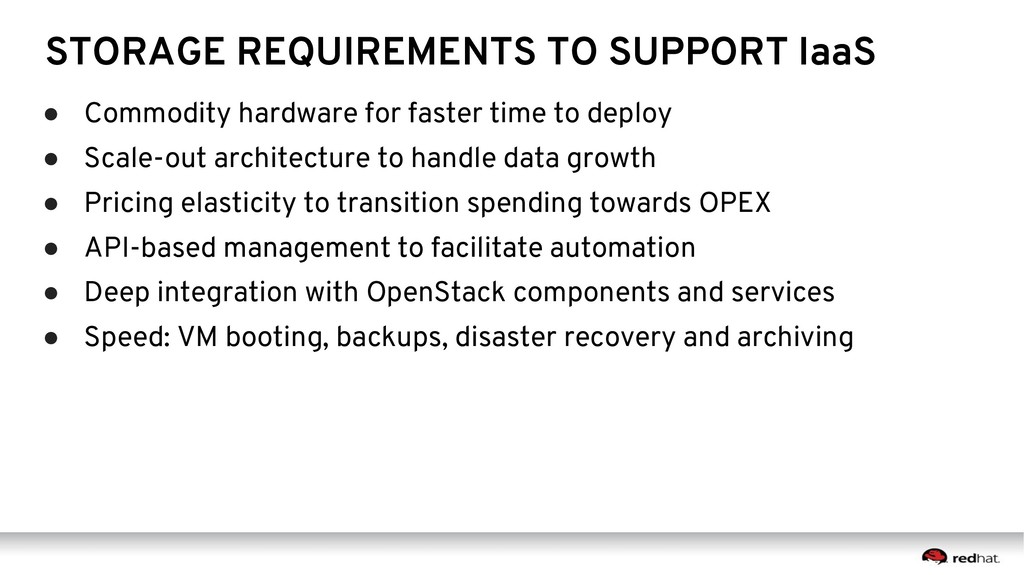
time to deploy • Scale-out architecture to handle data growth • Pricing elasticity to transition spending towards OPEX • API-based management to facilitate automation • Deep integration with OpenStack components and services • Speed: VM booting, backups, disaster recovery and archiving


 koukihosaka
 glaforge
 greenmidori
 kzkhykw1991
 yamanoku
 y0hgi
 takonda
 techtekt
 shumei_ito
 stomk
 carta_engineering
 colopl
 badams
 irinanazarova
 mfonobong
 jonoalderson
 iamctodd
 marketingsoph
 uxyall
 lara
 ks91
 aleyda
 yeseniaperezcruz
 codingconduct