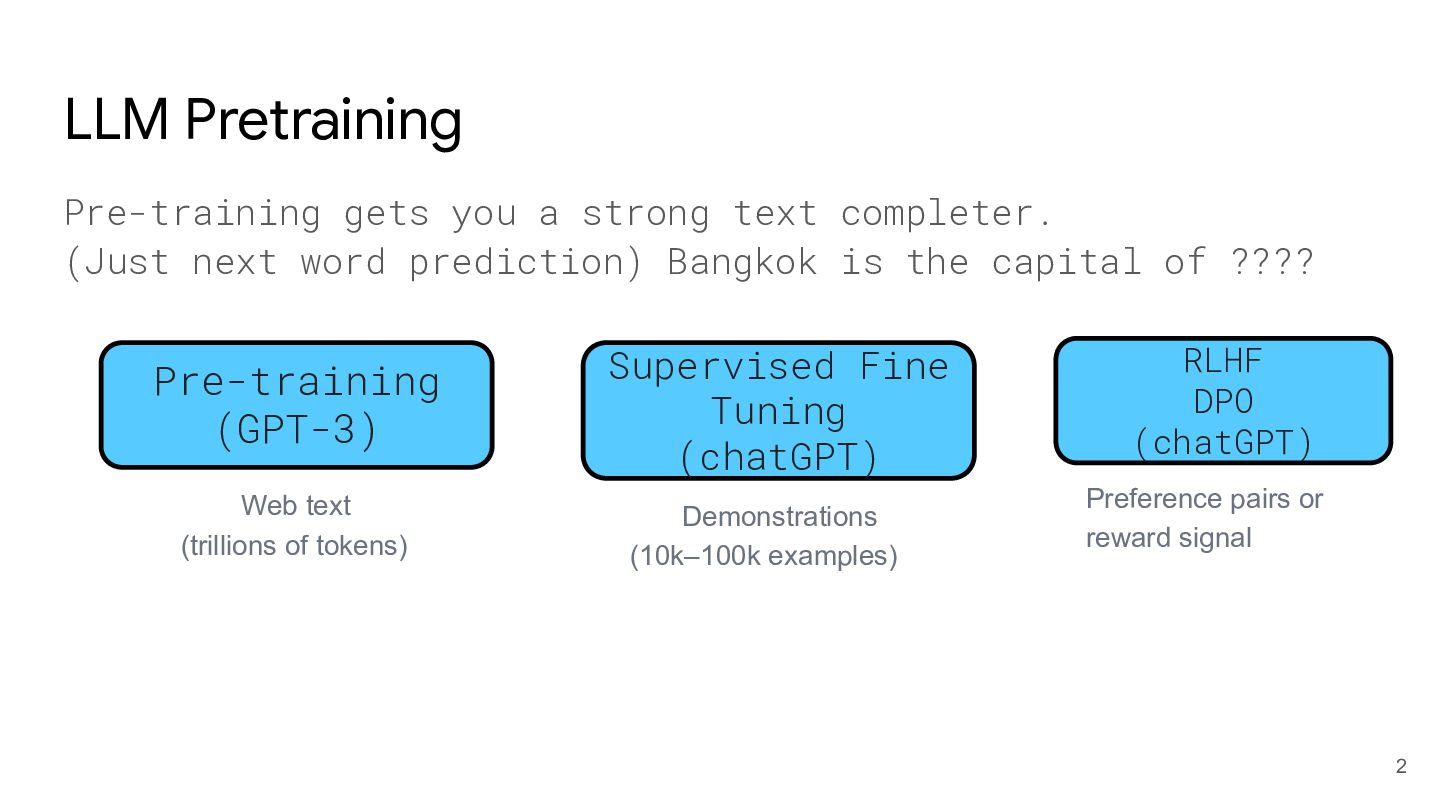
next word prediction) Bangkok is the capital of ???? Pre-training (GPT-3) Supervised Fine Tuning (chatGPT) Web text (trillions of tokens) Demonstrations (10k–100k examples) RLHF DPO (chatGPT) Preference pairs or reward signal 2
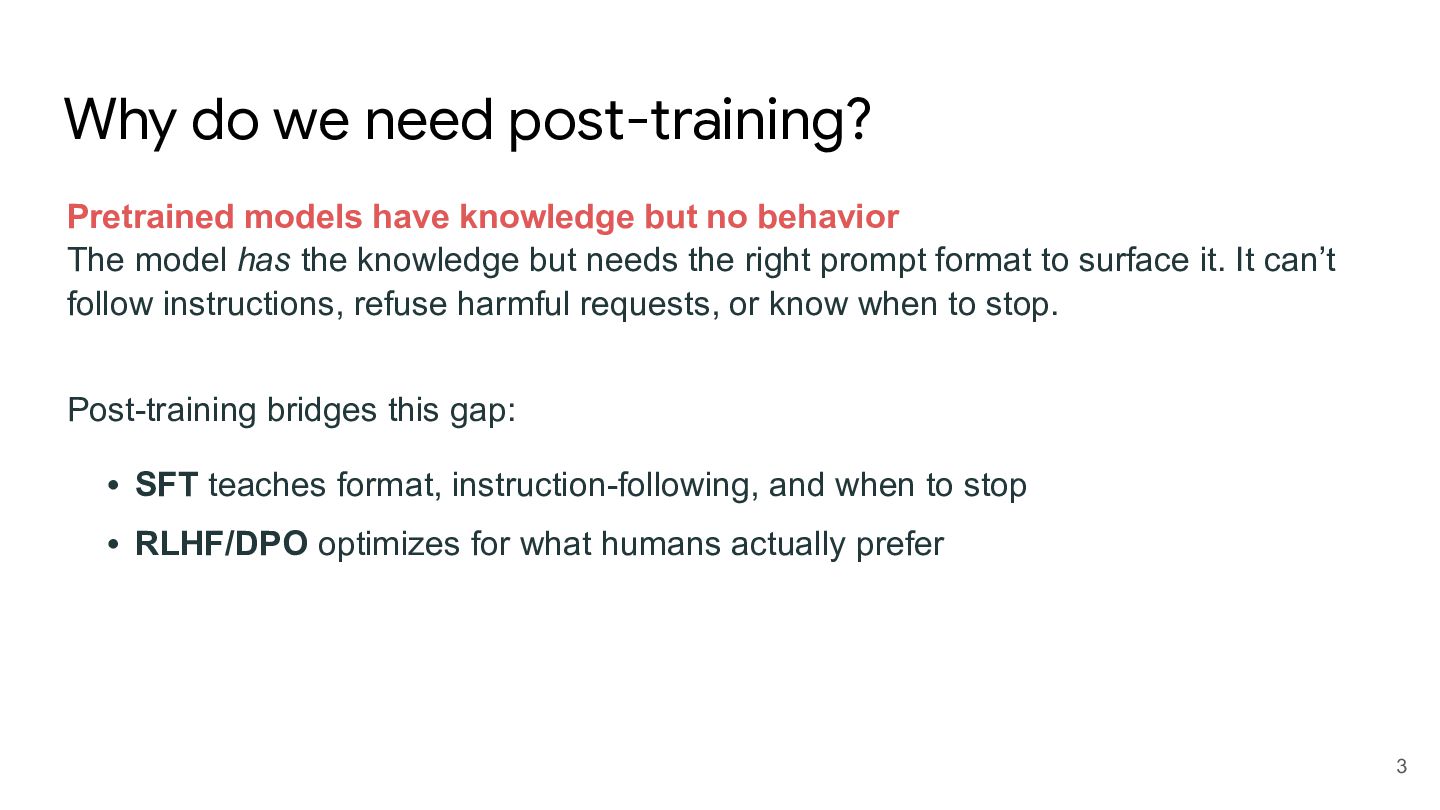
no behavior The model has the knowledge but needs the right prompt format to surface it. It can’t follow instructions, refuse harmful requests, or know when to stop. Post-training bridges this gap: • SFT teaches format, instruction-following, and when to stop • RLHF/DPO optimizes for what humans actually prefer 3
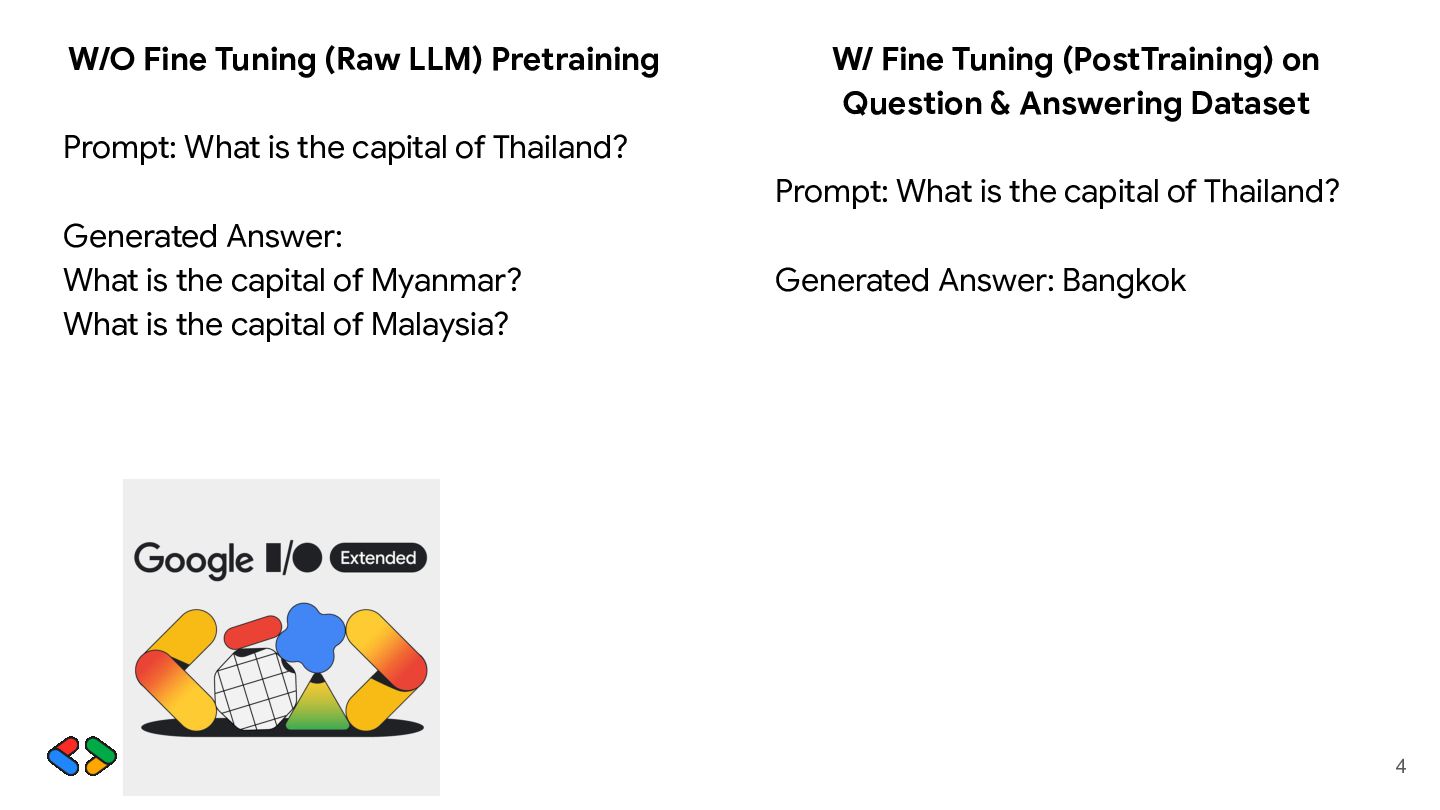
on Question & Answering Dataset Prompt: What is the capital of Thailand? Prompt: What is the capital of Thailand? Generated Answer: What is the capital of Myanmar? What is the capital of Malaysia? Editable Location Generated Answer: Bangkok 4
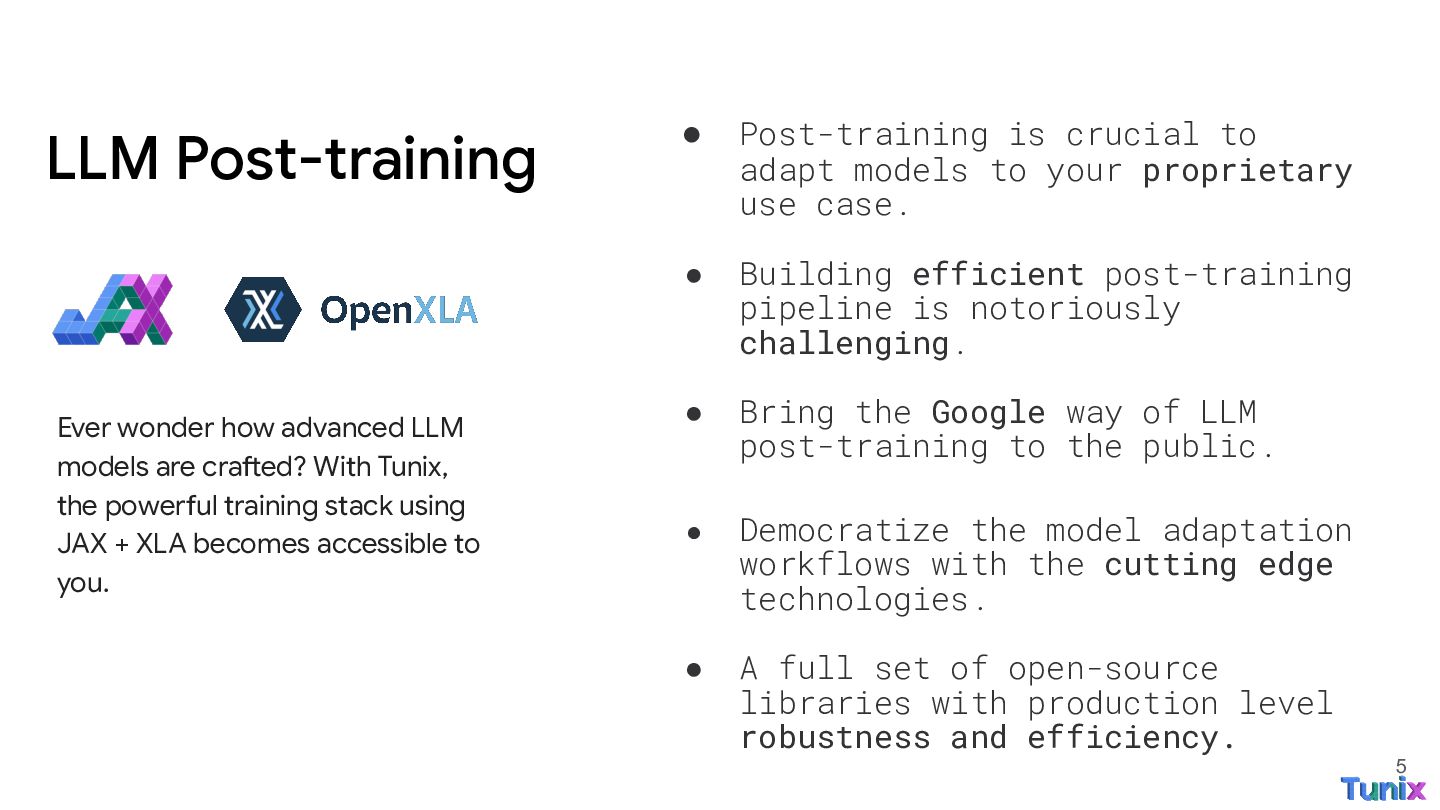
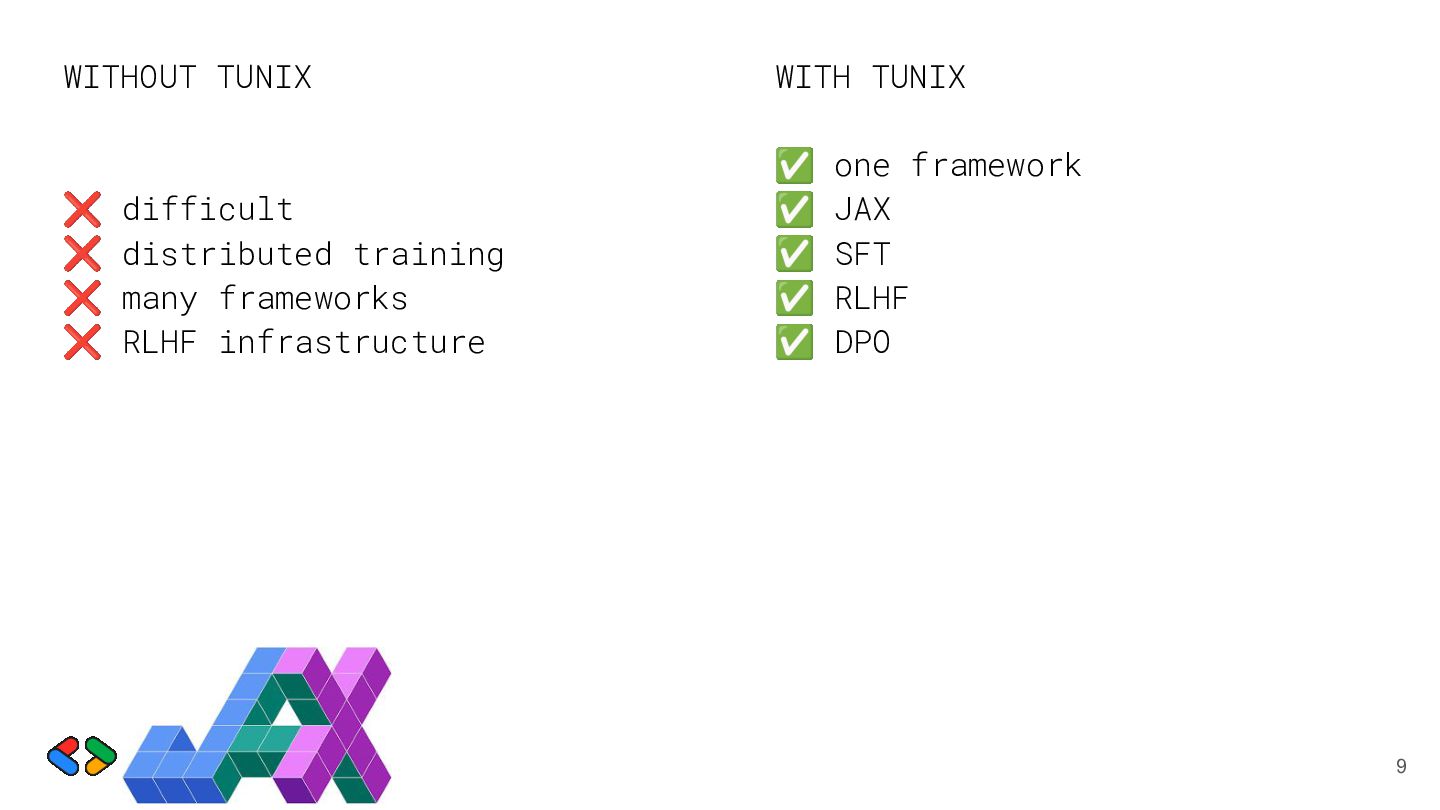
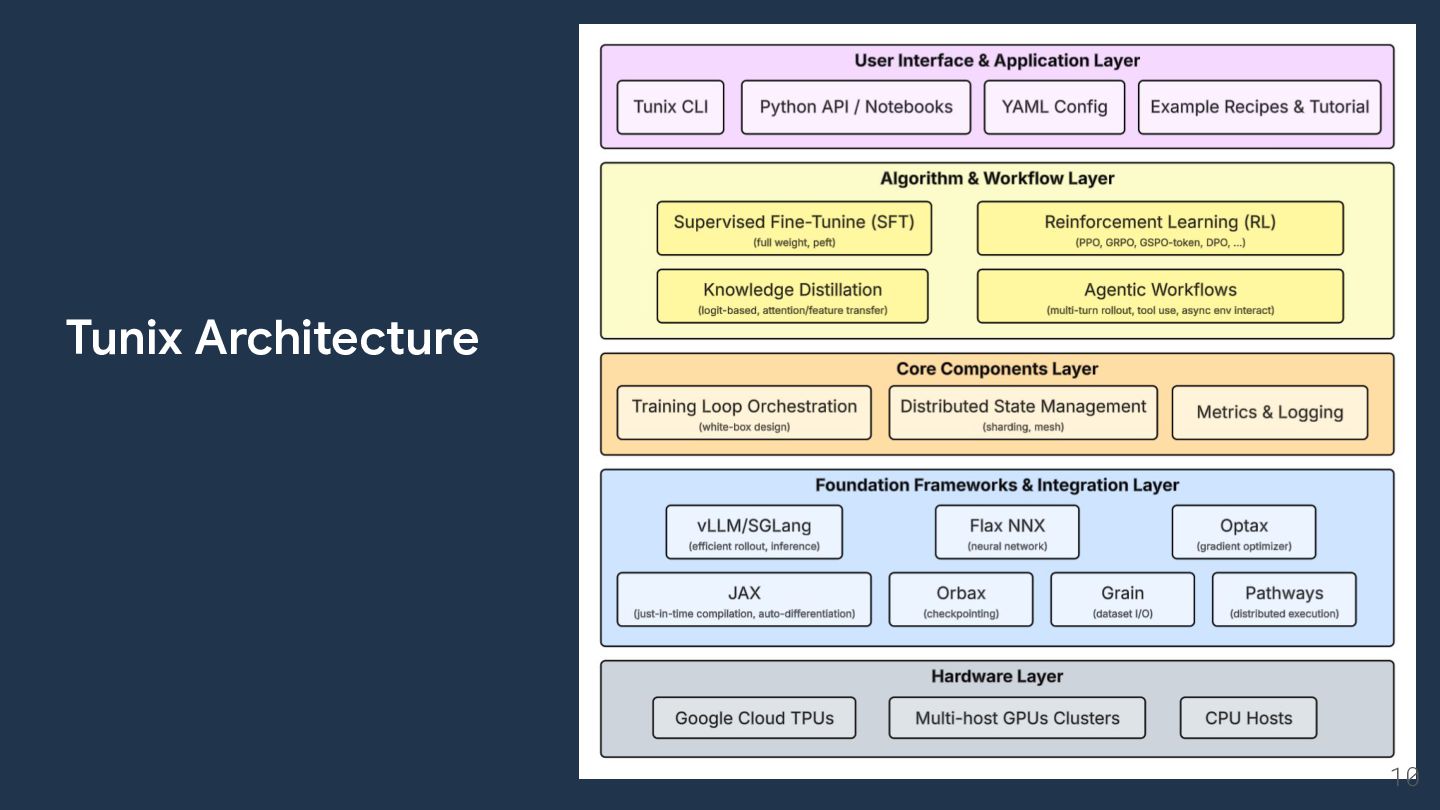
With Tunix, the powerful training stack using JAX + XLA becomes accessible to you. • Post-training is crucial to adapt models to your proprietary use case. • Building efficient post-training pipeline is notoriously challenging. • Bring the Google way of LLM post-training to the public. • Democratize the model adaptation workflows with the cutting edge technologies. • A full set of open-source libraries with production level robustness and efficiency. 5
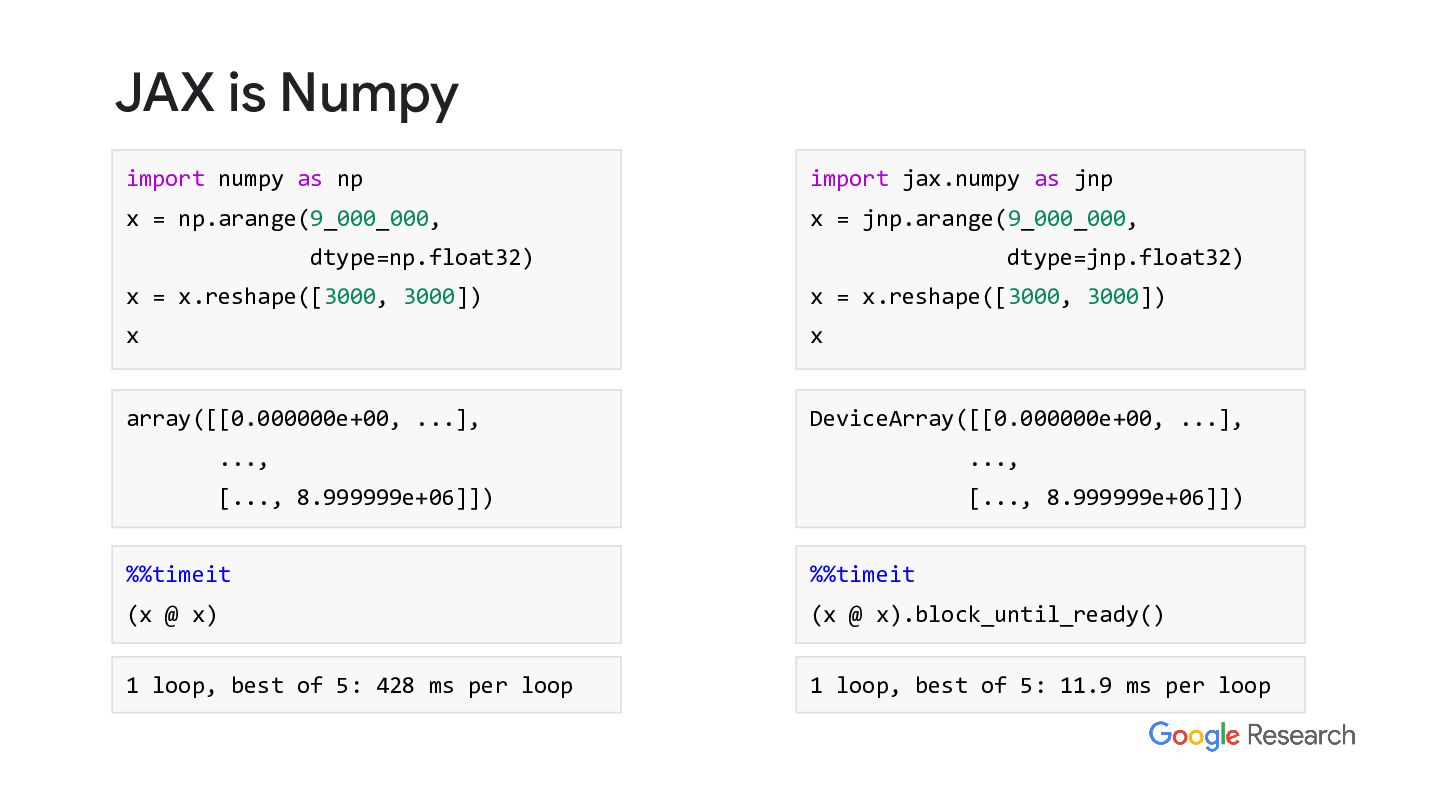
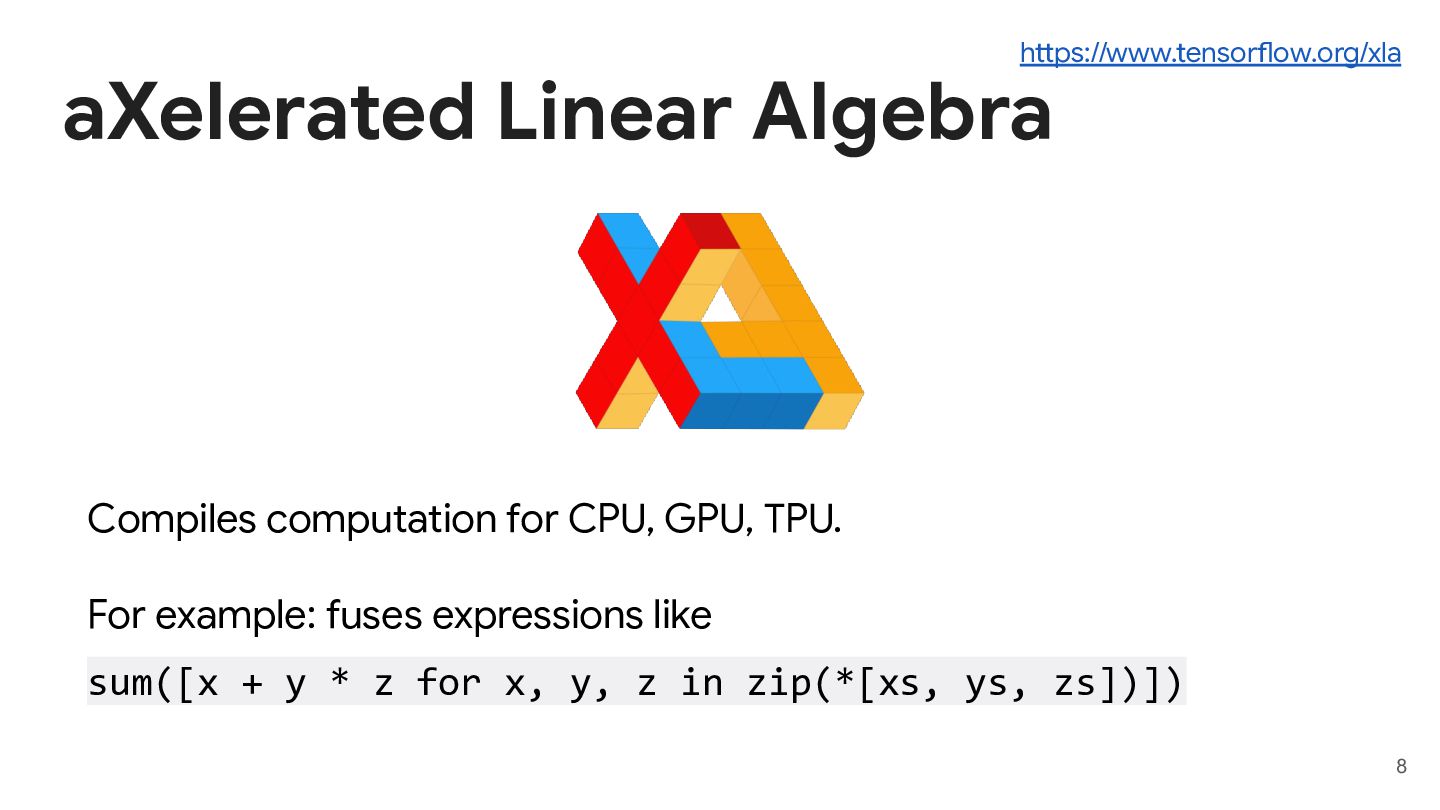
together for high-performance machine learning research. Dig a little deeper, and you'll see that JAX is really an extensible system for composable function transformations. 6
jnp x = np.arange(9_000_000, x = jnp.arange(9_000_000, dtype=np.float32) x = x.reshape([3000, 3000]) x dtype=jnp.float32) x = x.reshape([3000, 3000]) �� x array([[0.000000e+00, ...], ..., DeviceArray([[0.000000e+00, ...], ..., [..., 8.999999e+06]]) [..., 8.999999e+06]]) %%timeit %%timeit (x @ x) (x @ x).block_until_ready() 1 loop, best of 5: 428 ms per loop 1 loop, best of 5: 11.9 ms per loop 7
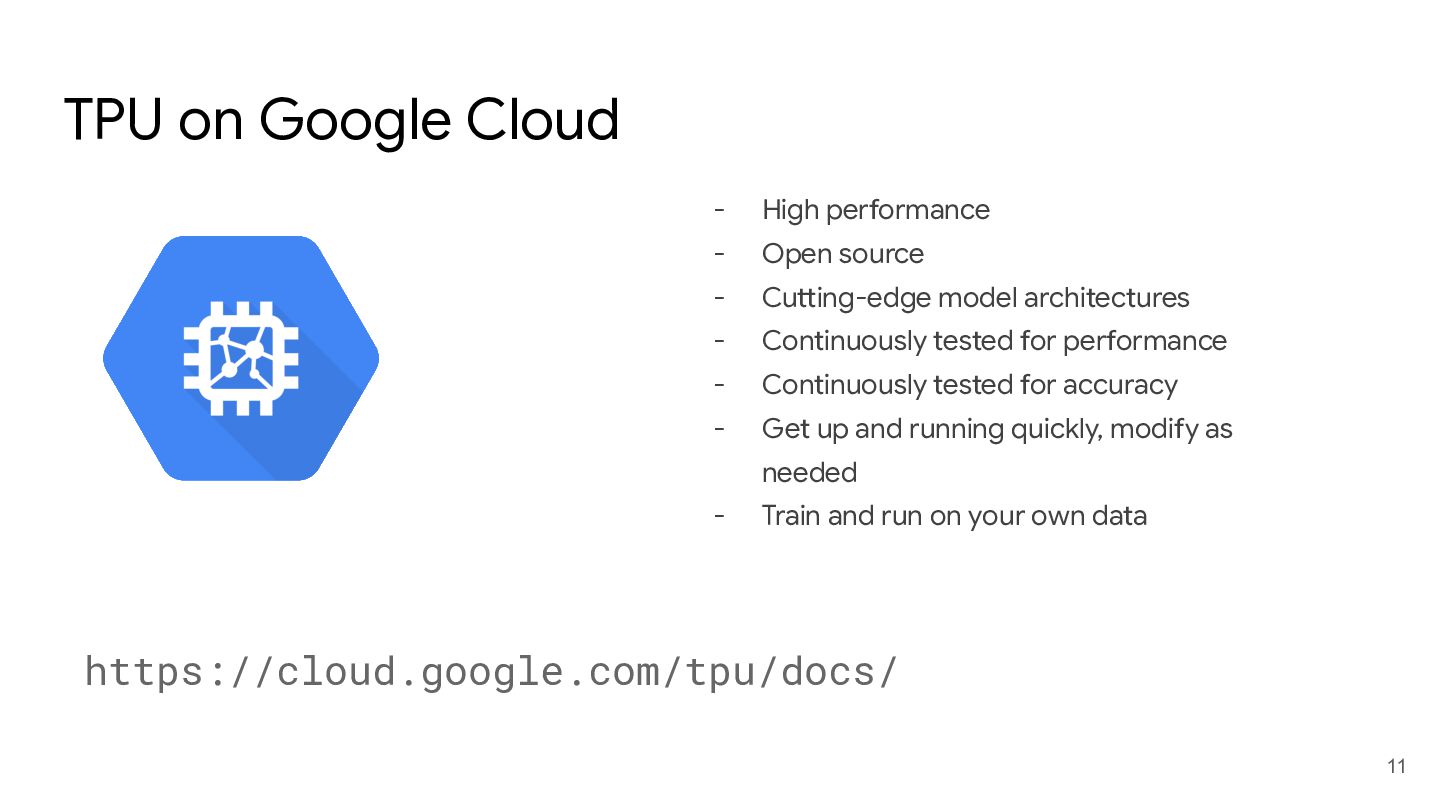
- Cutting-edge model architectures - Continuously tested for performance - Continuously tested for accuracy - Get up and running quickly, modify as needed - Train and run on your own data https://cloud.google.com/tpu/docs/ 11
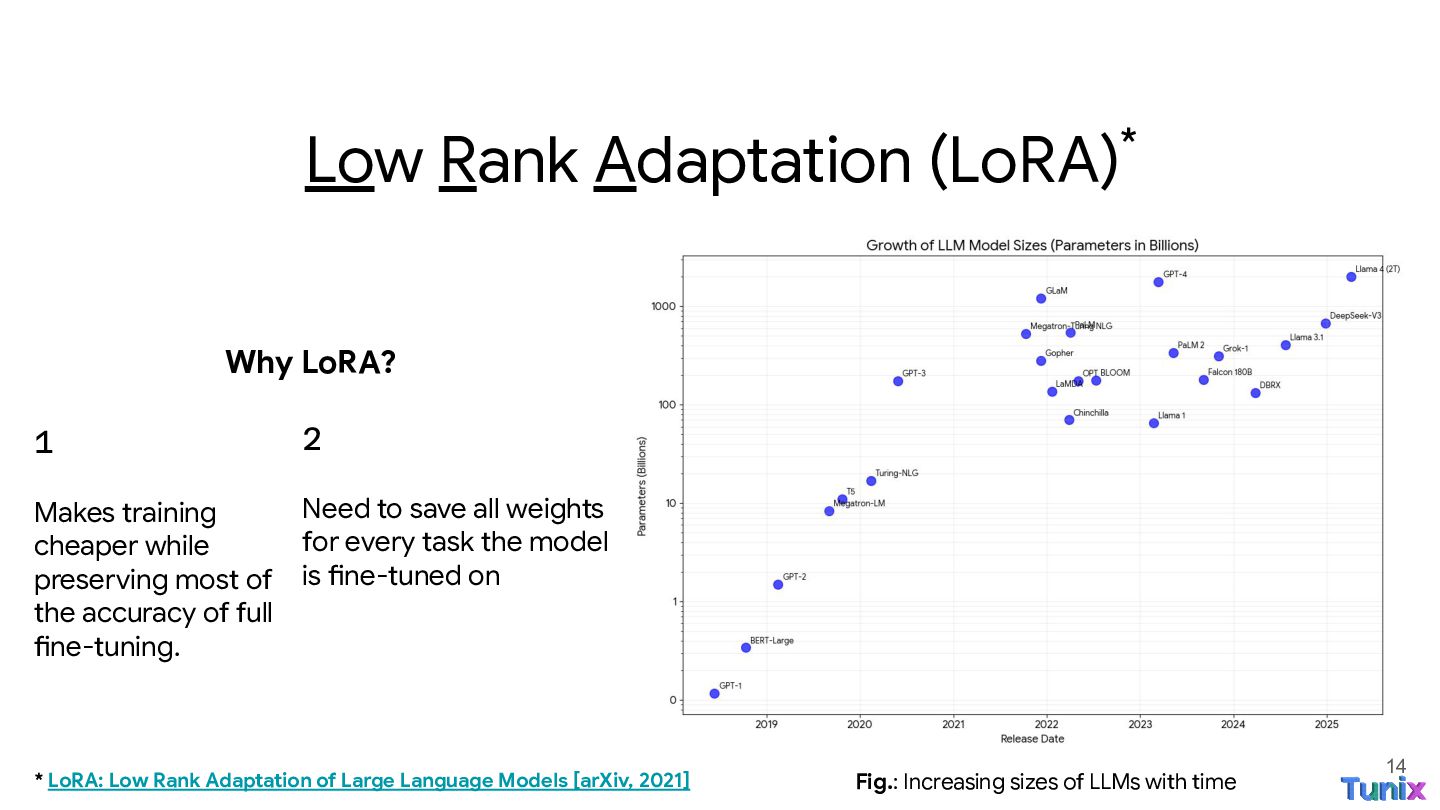
cheaper while preserving most of the accuracy of full fine-tuning. Need to save all weights for every task the model is fine-tuned on * LoRA: Low Rank Adaptation of Large Language Models [arXiv, 2021] Fig.: Increasing sizes of LLMs with time 14
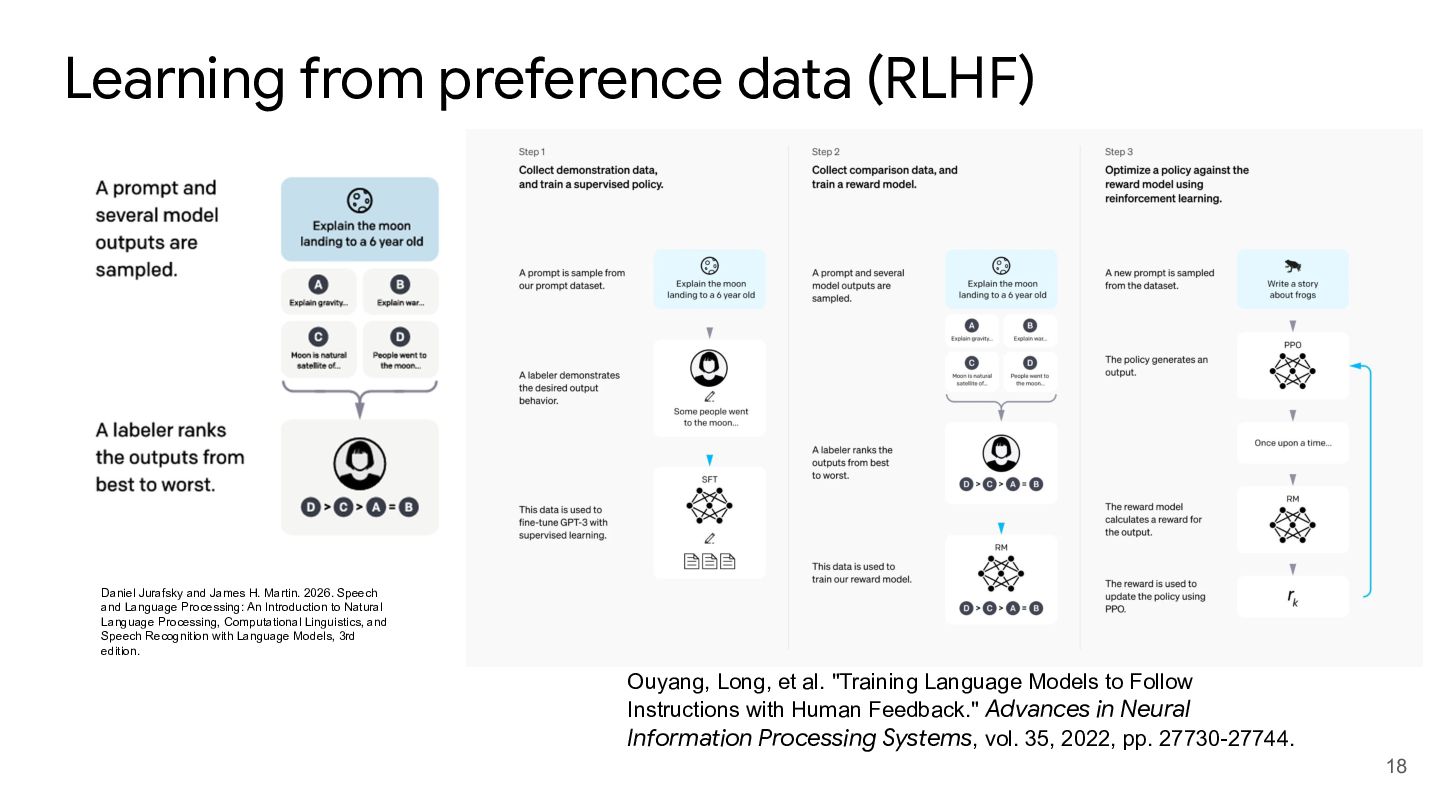
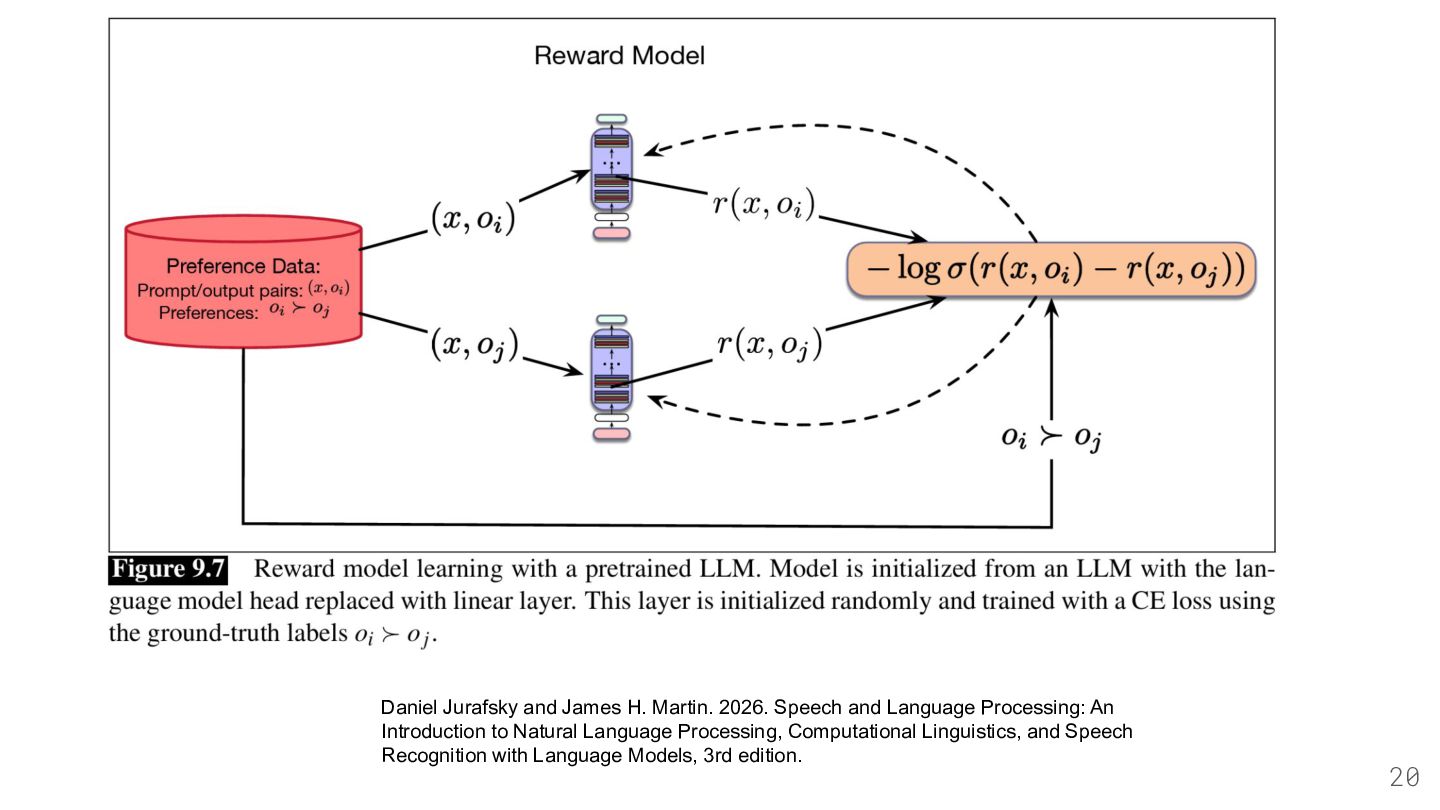
Martin. 2026. Speech and Language Processing: An Introduction to Natural Language Processing, Computational Linguistics, and Speech Recognition with Language Models, 3rd edition. Ouyang, Long, et al. "Training Language Models to Follow Instructions with Human Feedback." Advances in Neural Information Processing Systems, vol. 35, 2022, pp. 27730-27744. 18
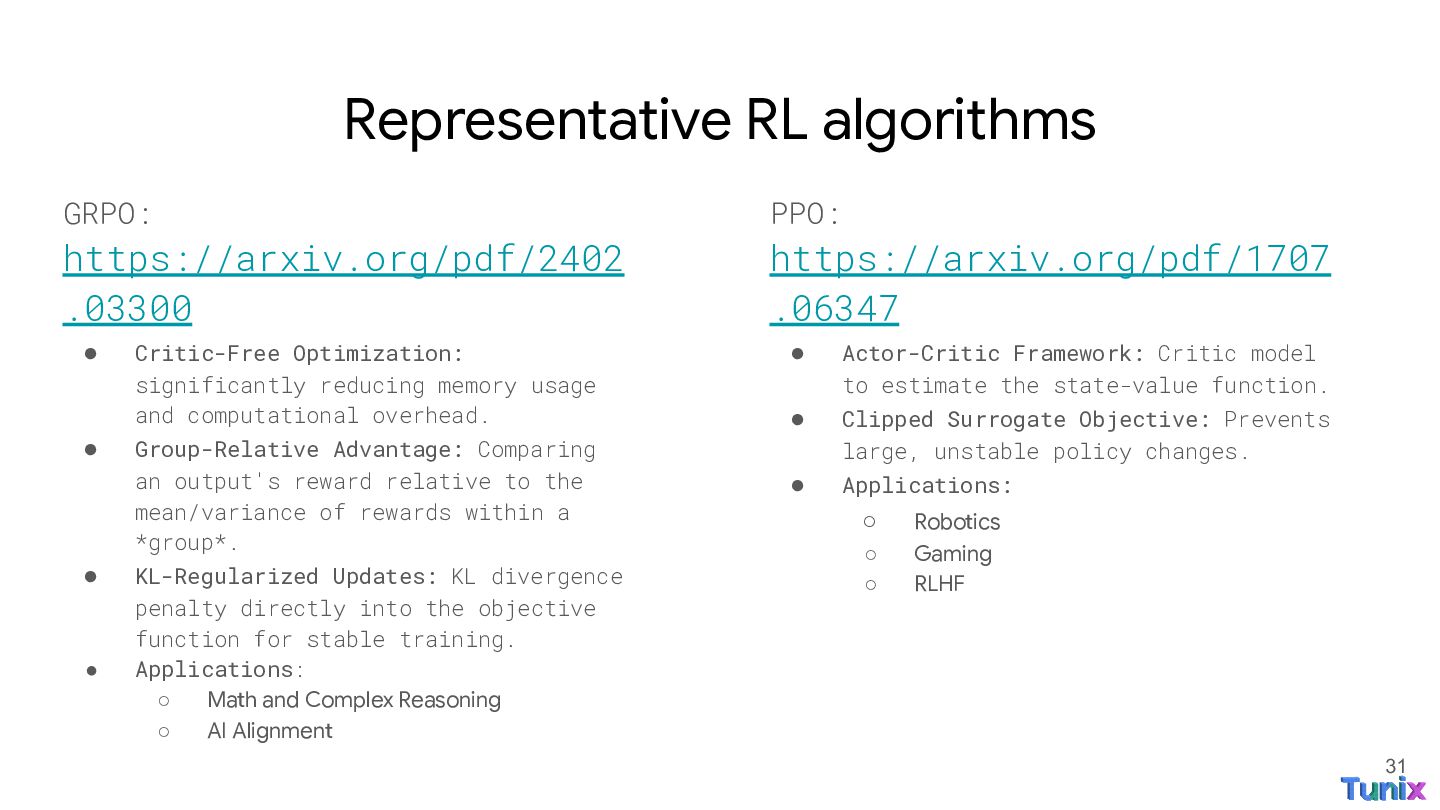
• • • Critic-Free Optimization: significantly reducing memory usage and computational overhead. Group-Relative Advantage: Comparing an output's reward relative to the mean/variance of rewards within a *group*. KL-Regularized Updates: KL divergence penalty directly into the objective function for stable training. Applications: ◦ Math and Complex Reasoning ◦ AI Alignment • Actor-Critic Framework: Critic model to estimate the state-value function. • Clipped Surrogate Objective: Prevents large, unstable policy changes. • Applications: ◦ ◦ ◦ Robotics Gaming RLHF 31


 ayehninnkhine
 recruitengineers
 tomzoh
 mtpooh
 fespinoza
 philipz
 oracle4engineer
 yama3133
 carta_engineering
 yakumo
 dugsong
 techseoconnect
 sferik
 scottboms
 akosma
 cassininazir
 baasie
 tammyeverts
 chrisshort
 axbom
axbom
 addyosmani
 jeffersonlam