Share
Embed
A2A プロトコルを試してみる
Google が開発しLinux Foundationに寄贈されたAgent2Agent(A2A)プロトコルについて、TypeScriptで
の実装を通じて学ぶプレゼンテーションです、。AIエージェント間の標準的な連携を可能にするA2Aプロト コルの基本概念から、エージェントカードの定義、タスク管理、JSON-RPC 2.0通信、そして公式JavaScript SDKやMastraフレームワークを使った実装例まで、包括的に解説します。
azukiazusa
June 25, 2025
Transcript
42 slides
-
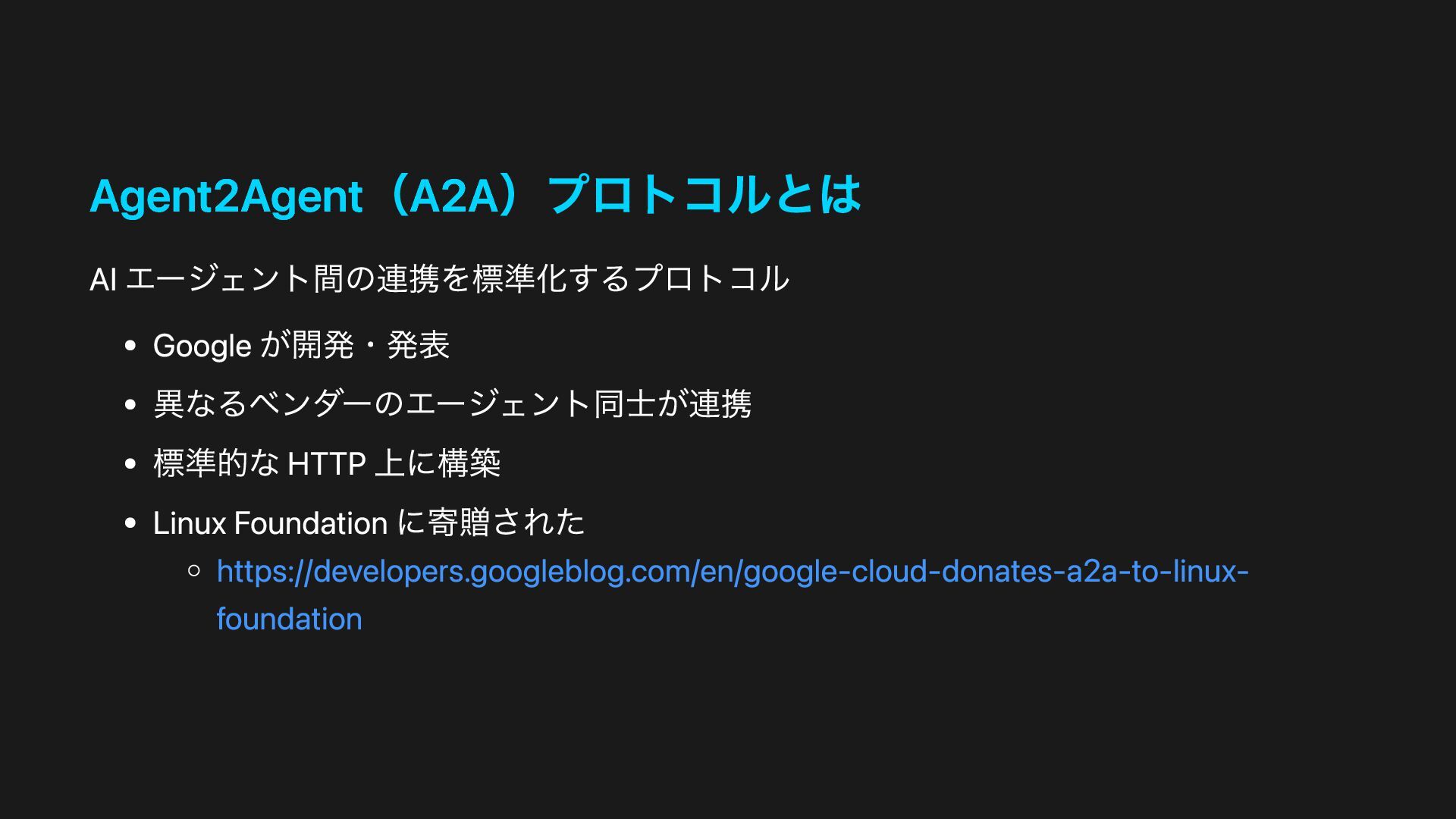
Agent2Agent(A2A)プロトコルとは AI エージェント間の連携を標準化するプロトコル Google が開発・発表 異なるベンダーのエージェント同士が連携 標準的な HTTP 上に構築 Linux
Foundation に寄贈された https://developers.googleblog.com/en/google-cloud-donates-a2a-to-linux- foundation -
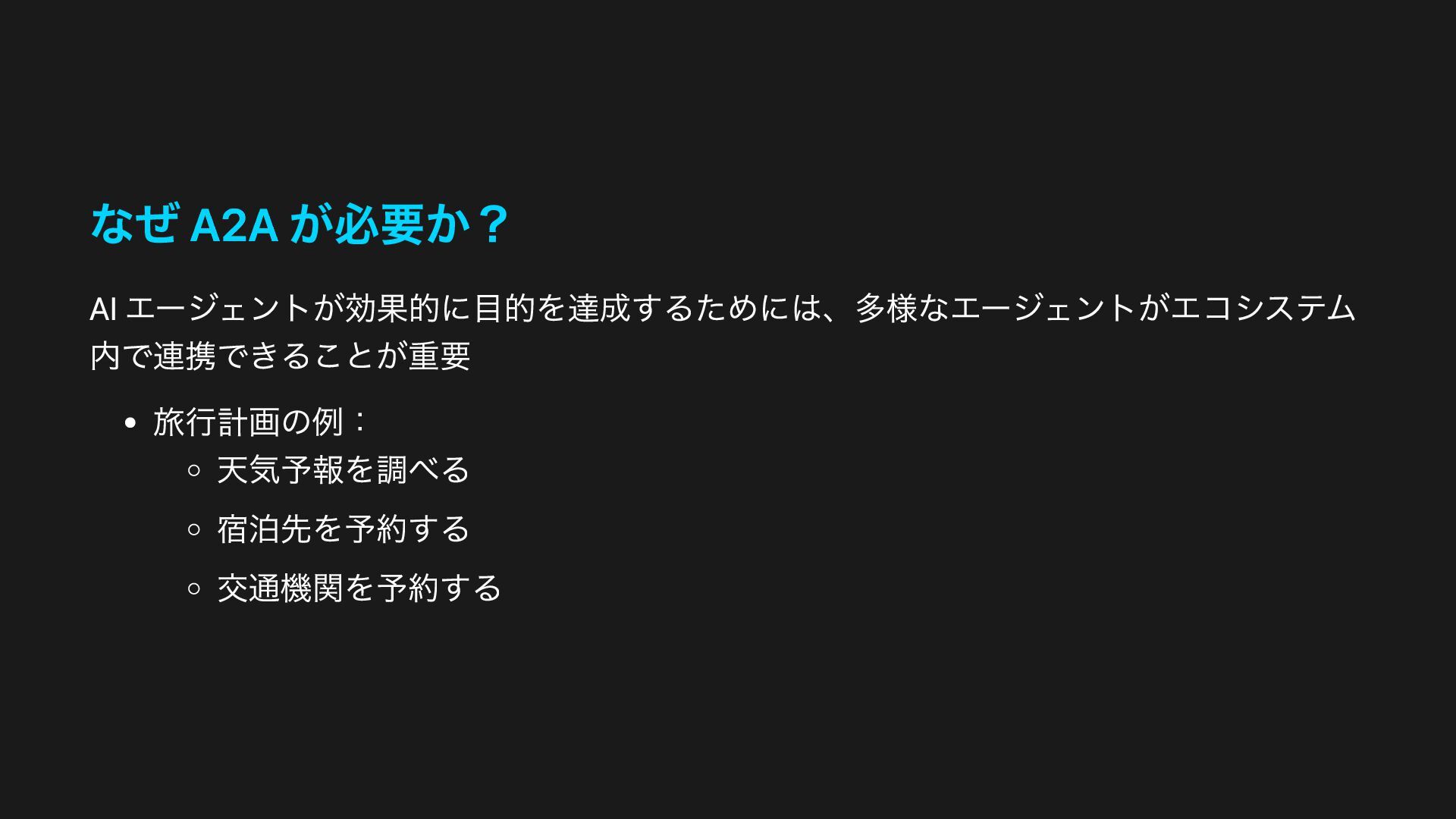
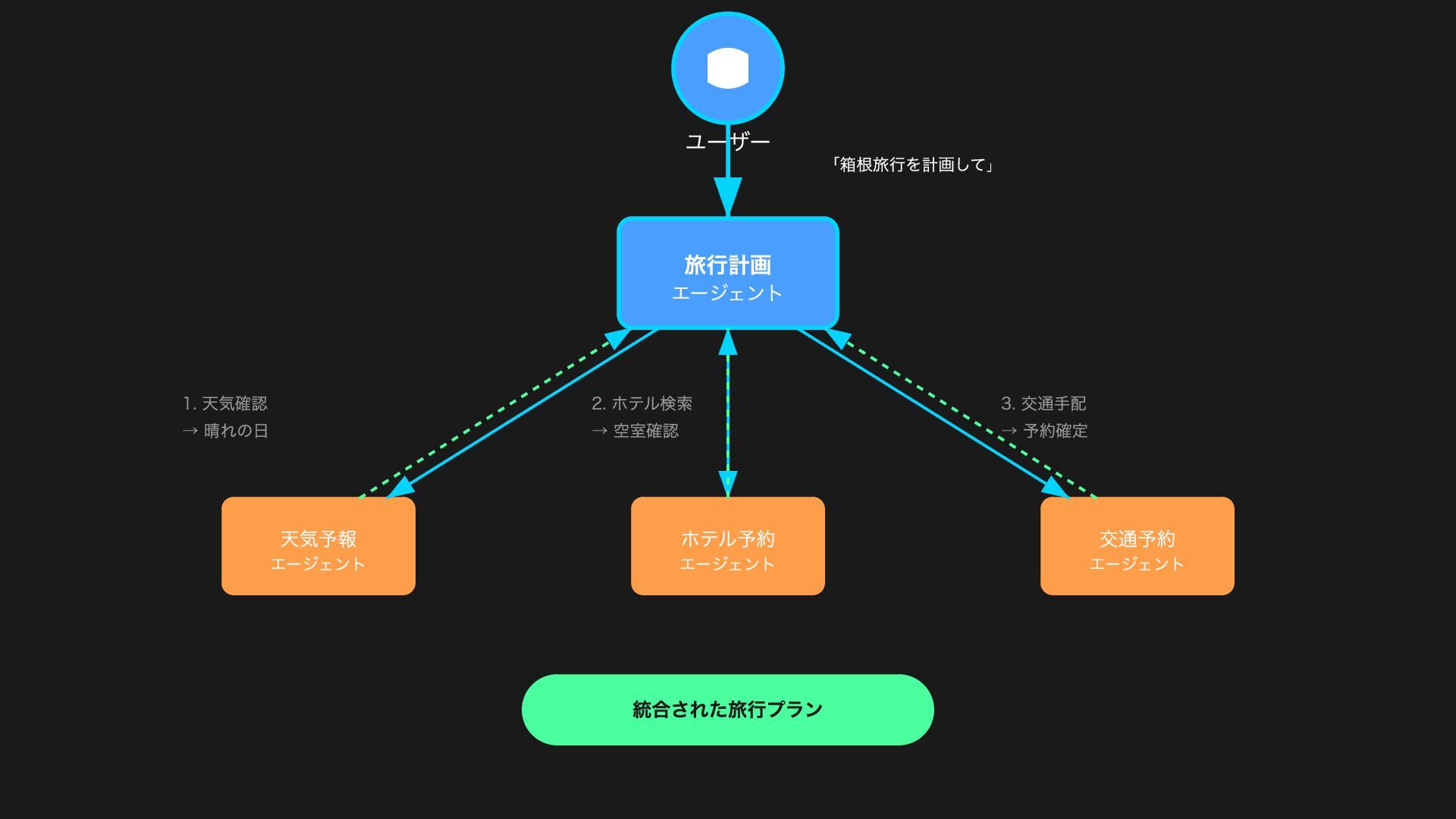
ユーザー 旅⾏計画 エージェント 天気予報 エージェント ホテル予約 エージェント 交通予約 エージェント 「箱根旅⾏を計画して」
統合された旅⾏プラン 1. 天気確認 → 晴れの⽇ 2. ホテル検索 → 空室確認 3. 交通⼿配 → 予約確定 -
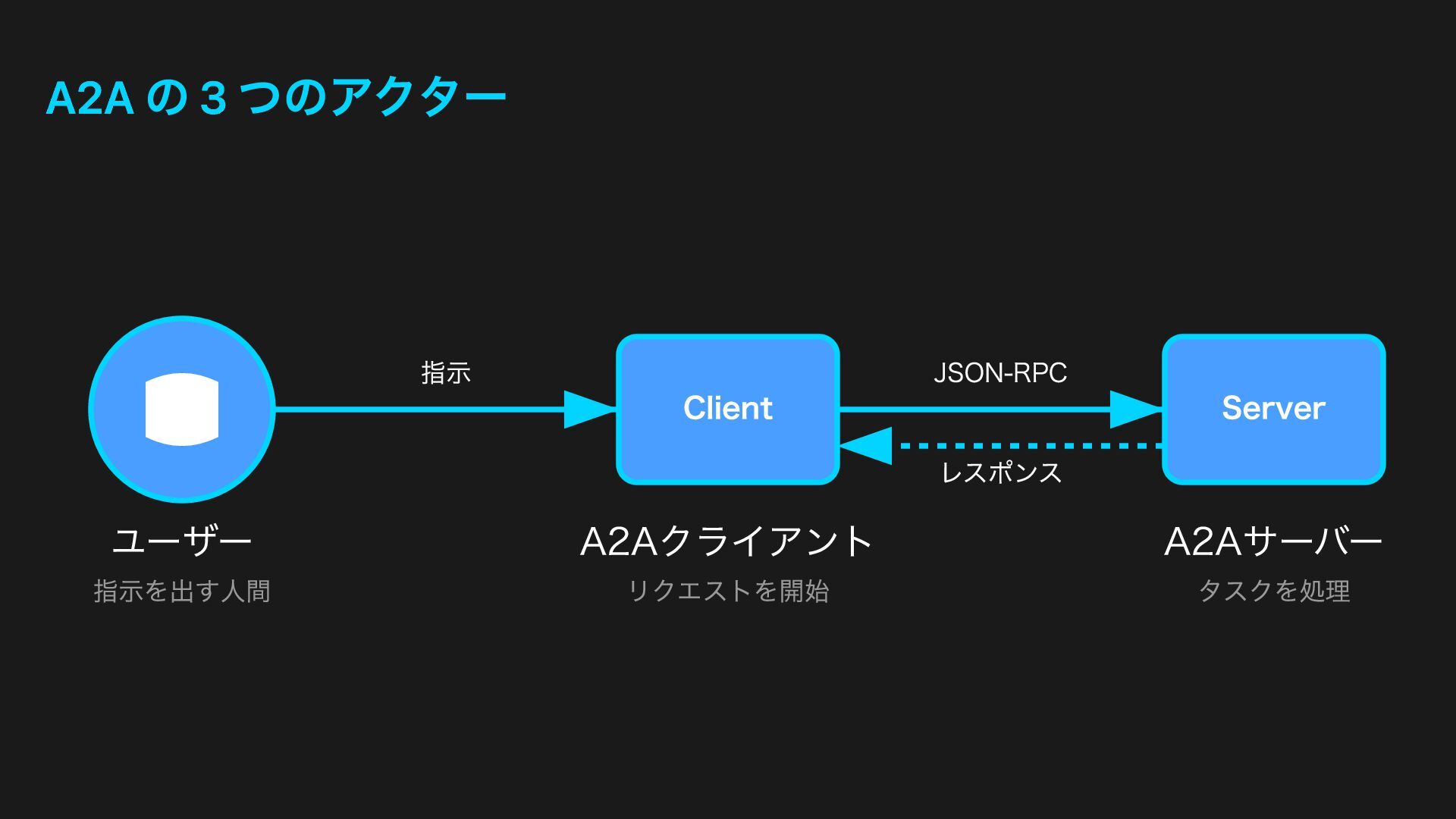
ユーザー 指⽰を出す⼈間 Client A2Aクライアント リクエストを開始 Server A2Aサーバー タスクを処理 指⽰ JSON-RPC
レスポンス A2A の 3 つのアクター -
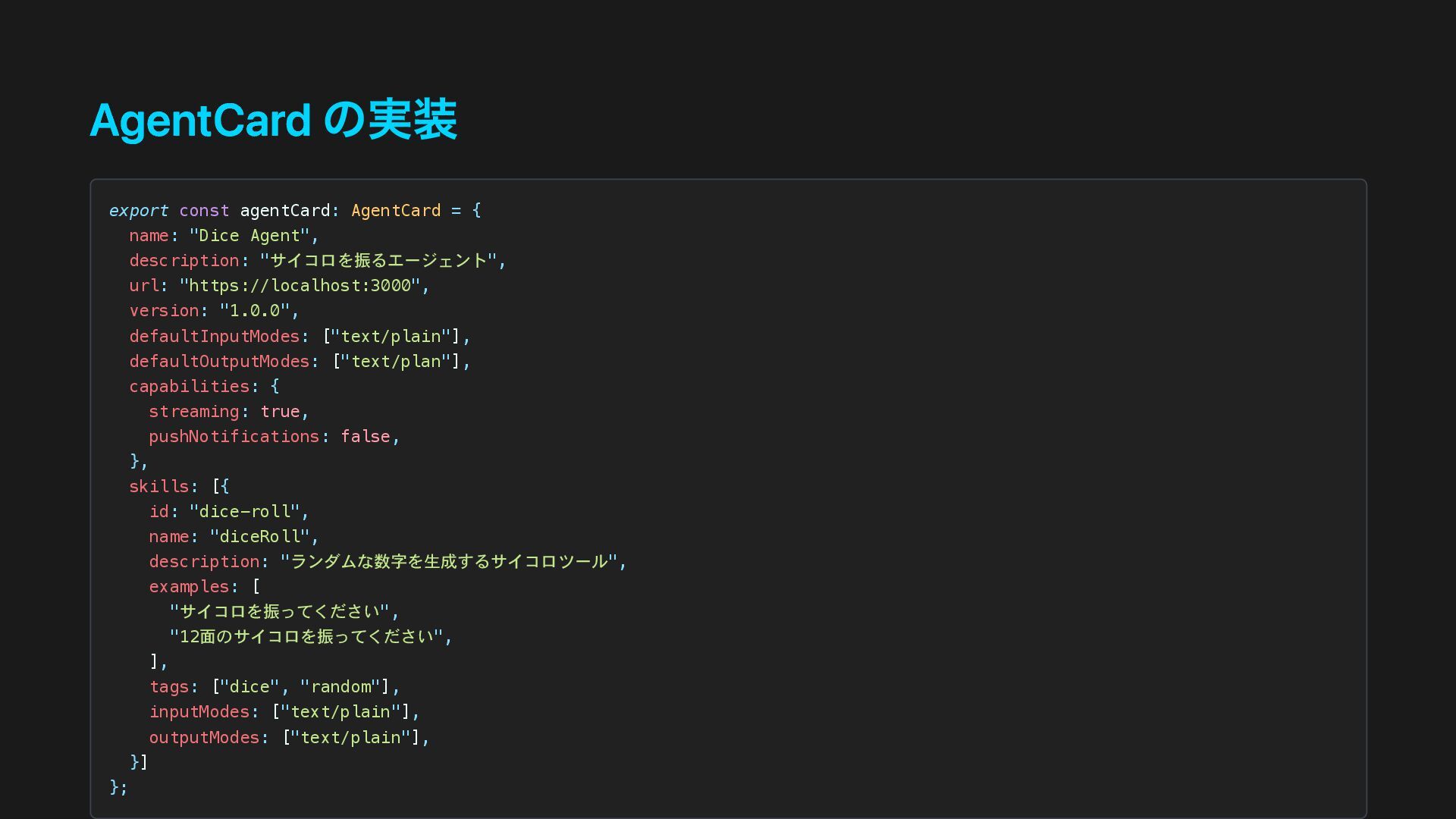
AgentCard の実装 export const agentCard: AgentCard = { name: "Dice
Agent", description: "サイコロを振るエージェント", url: "https://localhost:3000", version: "1.0.0", defaultInputModes: ["text/plain"], defaultOutputModes: ["text/plan"], capabilities: { streaming: true, pushNotifications: false, }, skills: [{ id: "dice-roll", name: "diceRoll", description: "ランダムな数字を生成するサイコロツール", examples: [ "サイコロを振ってください", "12面のサイコロを振ってください", ], tags: ["dice", "random"], inputModes: ["text/plain"], outputModes: ["text/plain"], }] }; -
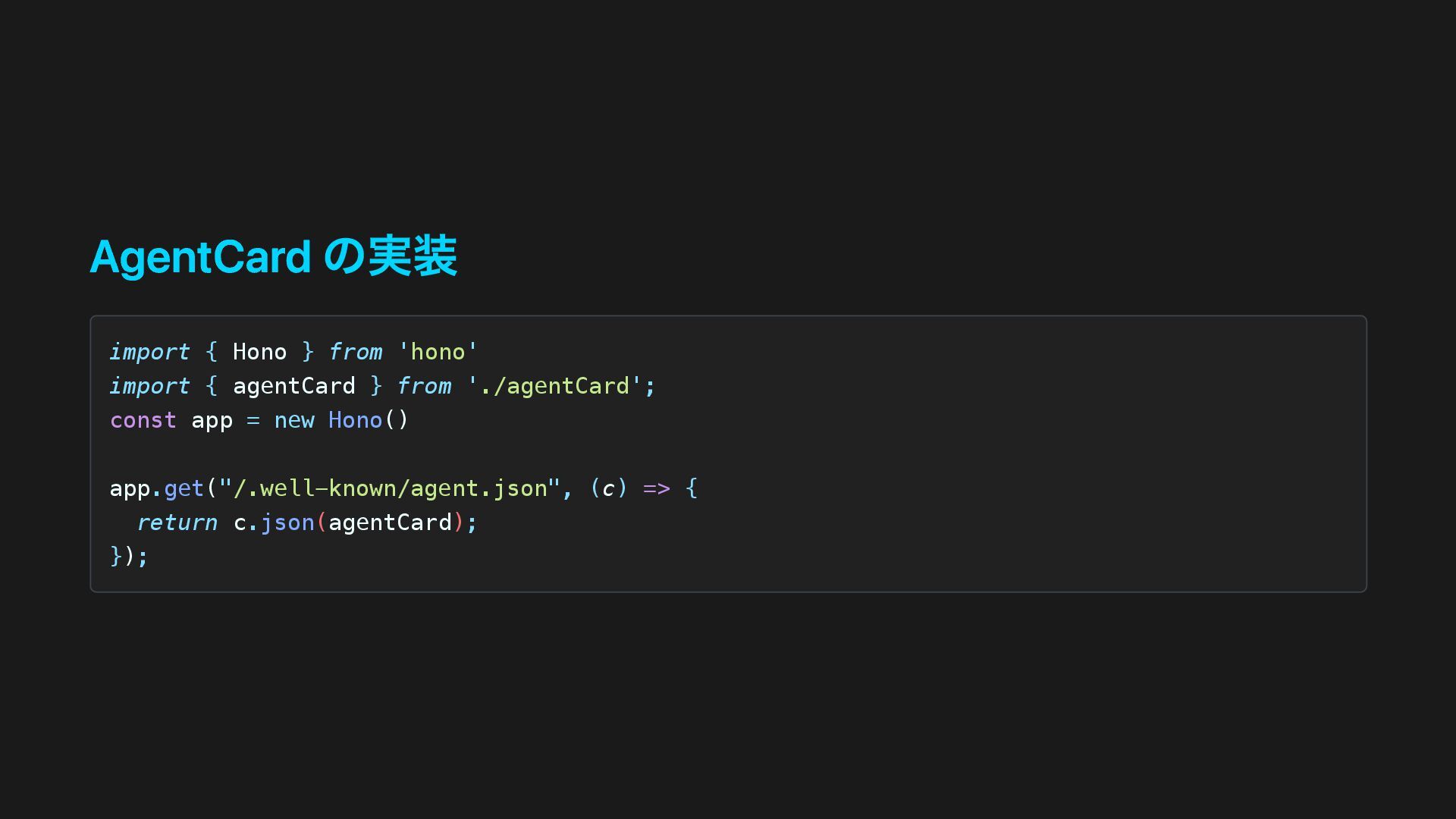
AgentCard の実装 import { Hono } from 'hono' import {
agentCard } from './agentCard'; const app = new Hono() app.get("/.well-known/agent.json", (c) => { return c.json(agentCard); }); -
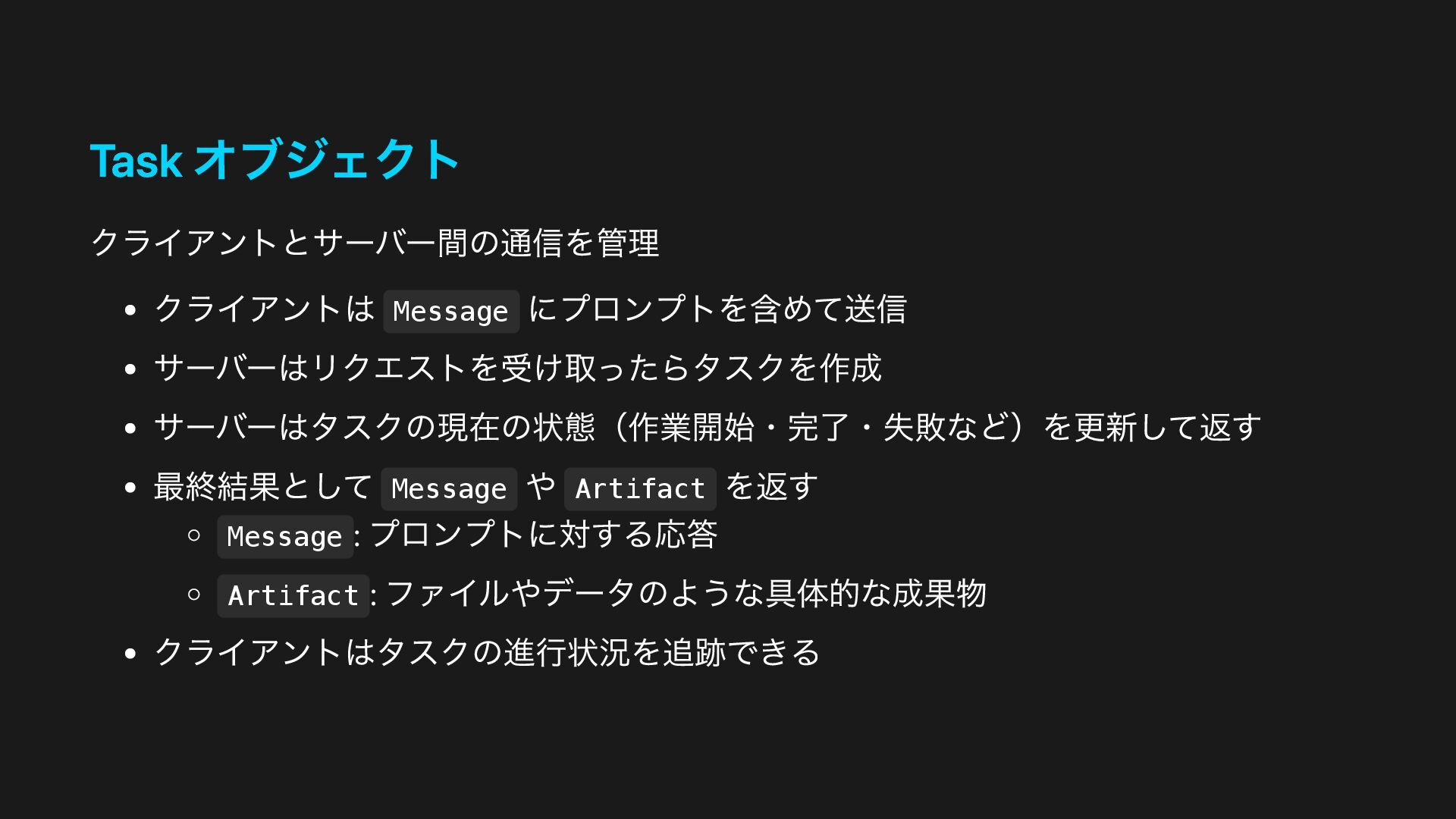
Task オブジェクト クライアントとサーバー間の通信を管理 クライアントは Message にプロンプトを含めて送信 サーバーはリクエストを受け取ったらタスクを作成 サーバーはタスクの現在の状態(作業開始・完了・失敗など)を更新して返す 最終結果として Message
や Artifact を返す Message : プロンプトに対する応答 Artifact : ファイルやデータのような具体的な成果物 クライアントはタスクの進行状況を追跡できる -
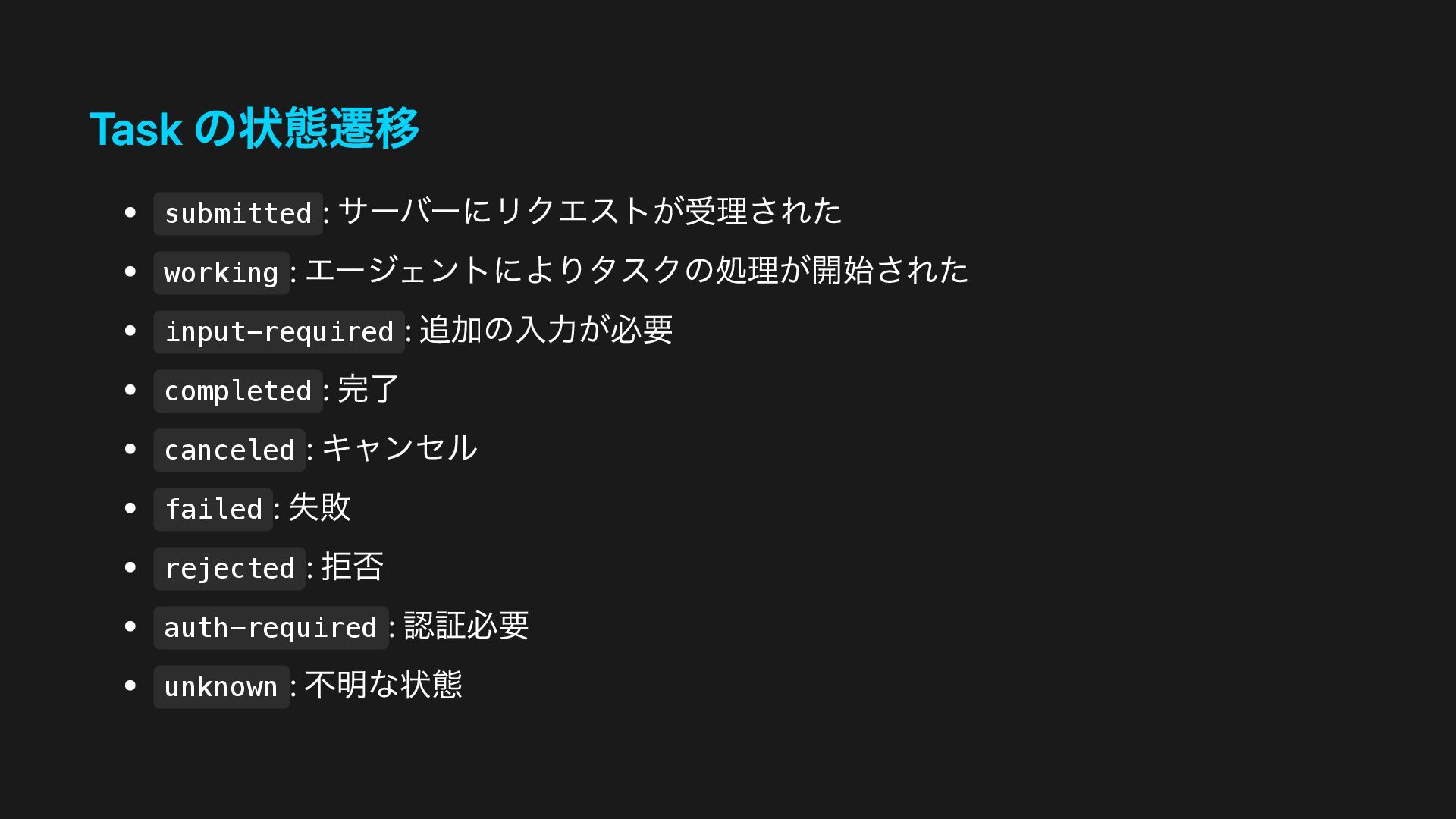
Task の状態遷移 submitted : サーバーにリクエストが受理された working : エージェントによりタスクの処理が開始された input-required :
追加の入力が必要 completed : 完了 canceled : キャンセル failed : 失敗 rejected : 拒否 auth-required : 認証必要 unknown : 不明な状態 -
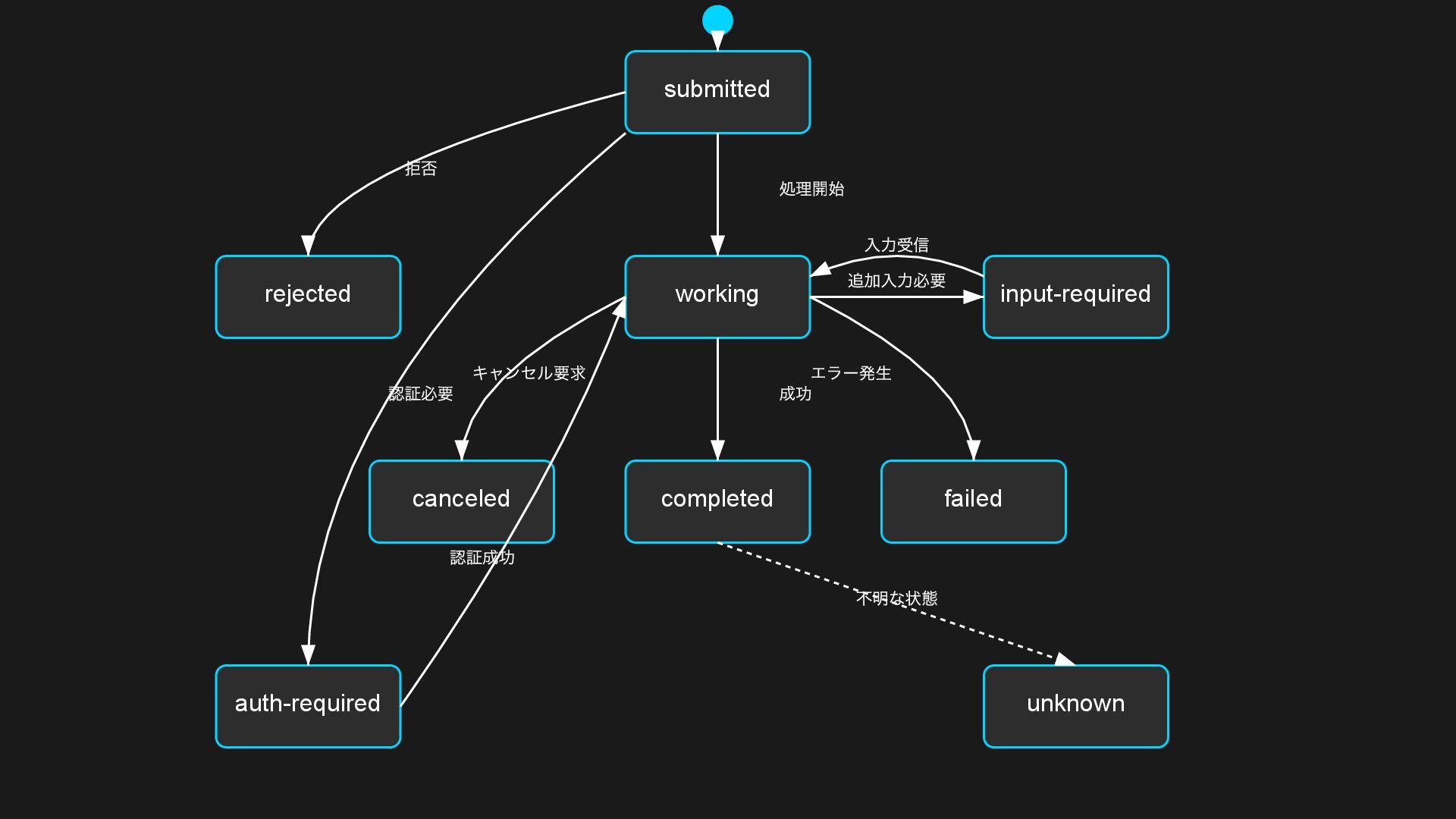
submitted working input-required completed canceled failed rejected auth-required unknown 処理開始
追加⼊⼒必要 ⼊⼒受信 成功 キャンセル要求 エラー発⽣ 拒否 認証必要 認証成功 不明な状態 -
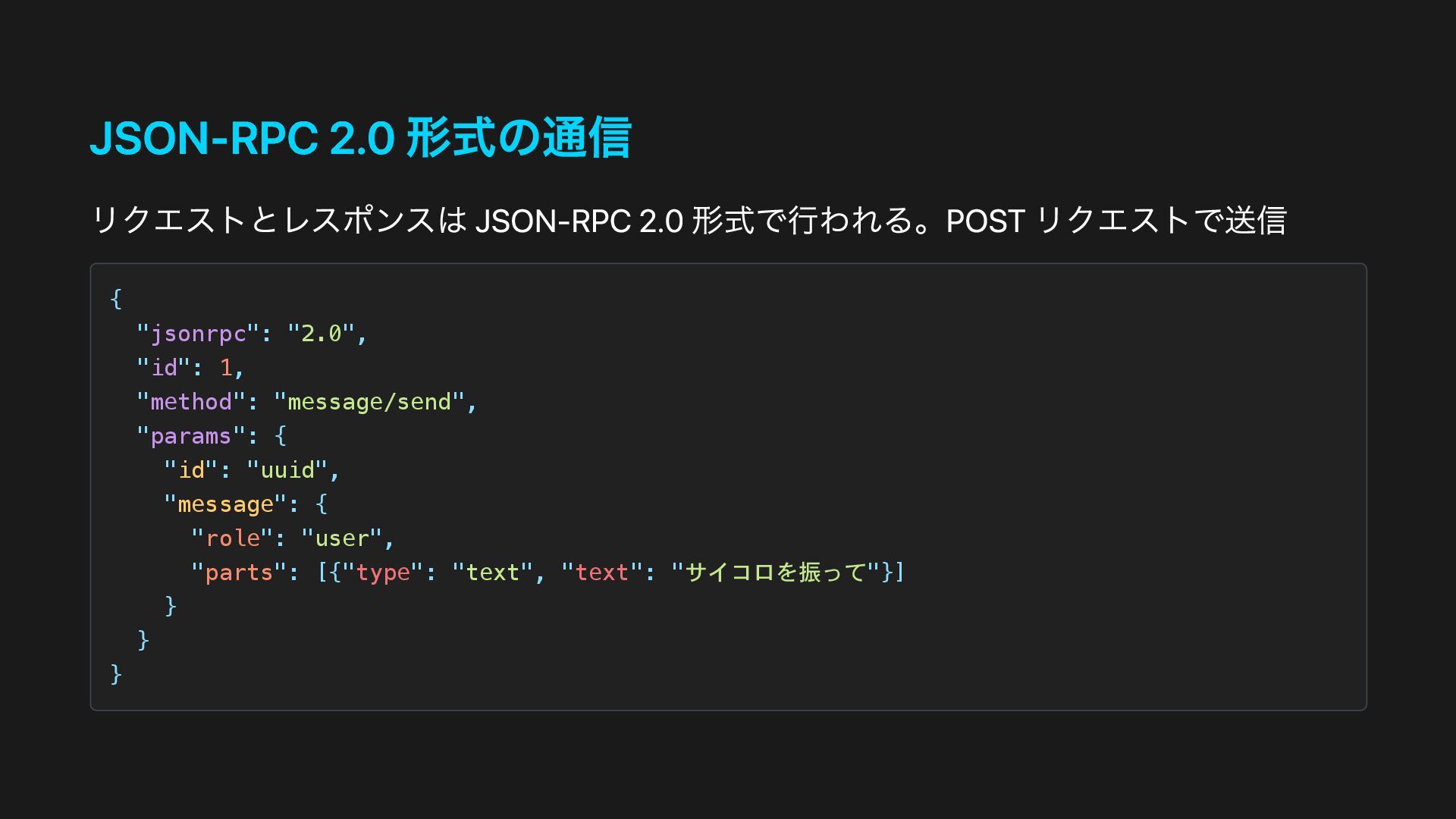
JSON-RPC 2.0 形式の通信 リクエストとレスポンスは JSON-RPC 2.0 形式で行われる。POST リクエストで送信 { "jsonrpc":
"2.0", "id": 1, "method": "message/send", "params": { "id": "uuid", "message": { "role": "user", "parts": [{"type": "text", "text": "サイコロを振って"}] } } } -
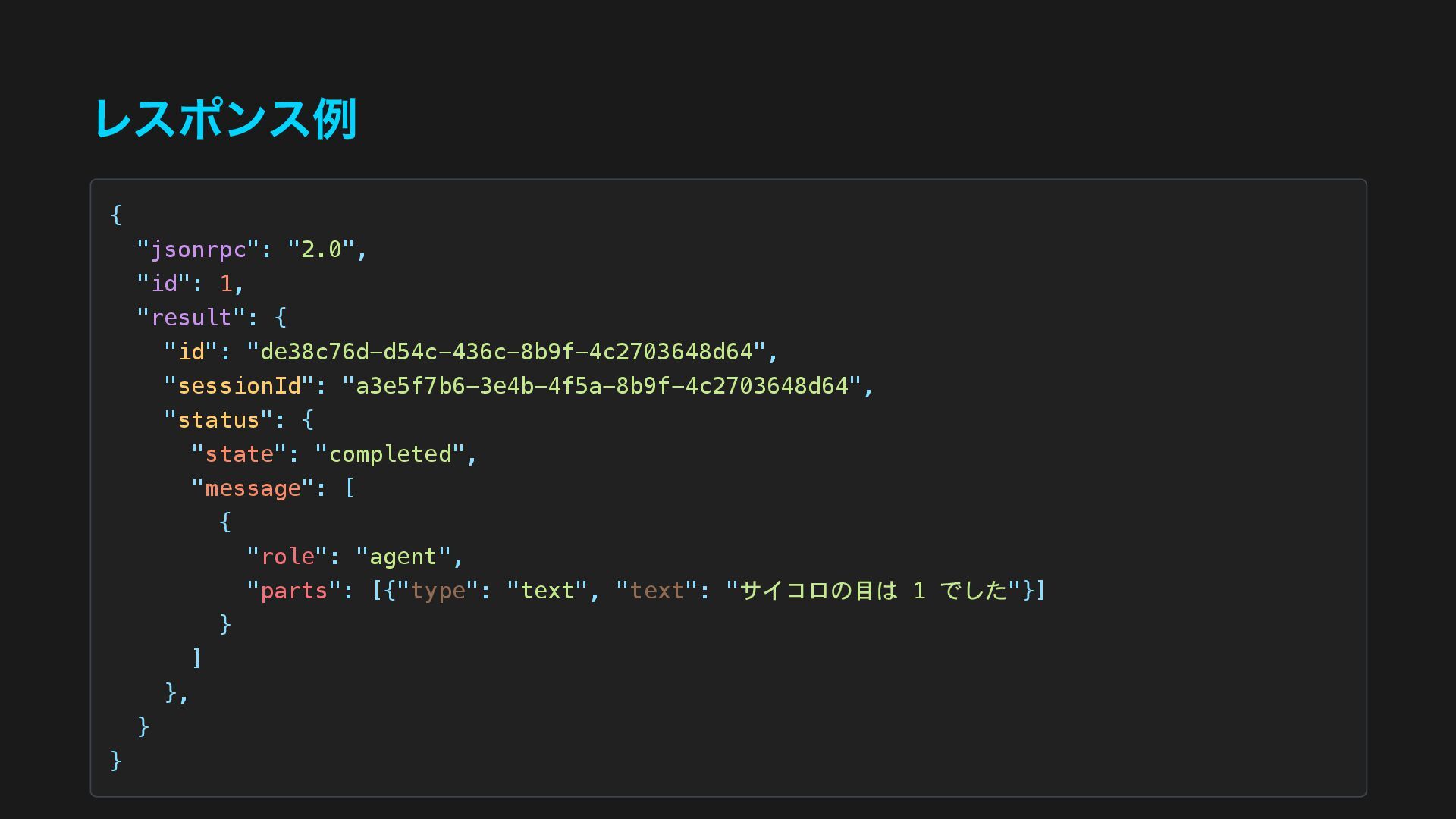
レスポンス例 { "jsonrpc": "2.0", "id": 1, "result": { "id": "de38c76d-d54c-436c-8b9f-4c2703648d64",
"sessionId": "a3e5f7b6-3e4b-4f5a-8b9f-4c2703648d64", "status": { "state": "completed", "message": [ { "role": "agent", "parts": [{"type": "text", "text": "サイコロの目は 1 でした"}] } ] }, } } -
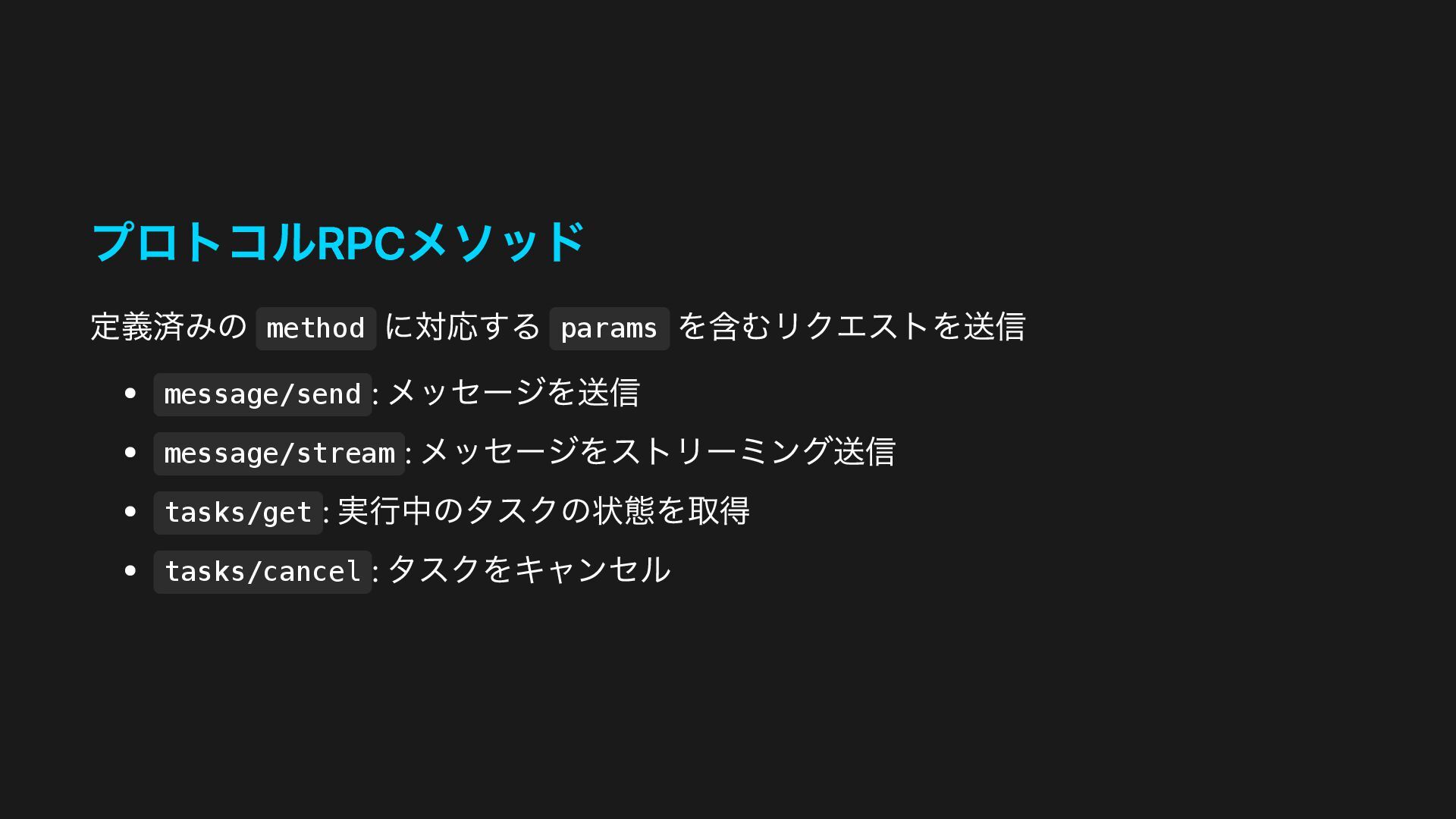
プロトコルRPCメソッド 定義済みの method に対応する params を含むリクエストを送信 message/send : メッセージを送信 message/stream
: メッセージをストリーミング送信 tasks/get : 実行中のタスクの状態を取得 tasks/cancel : タスクをキャンセル -
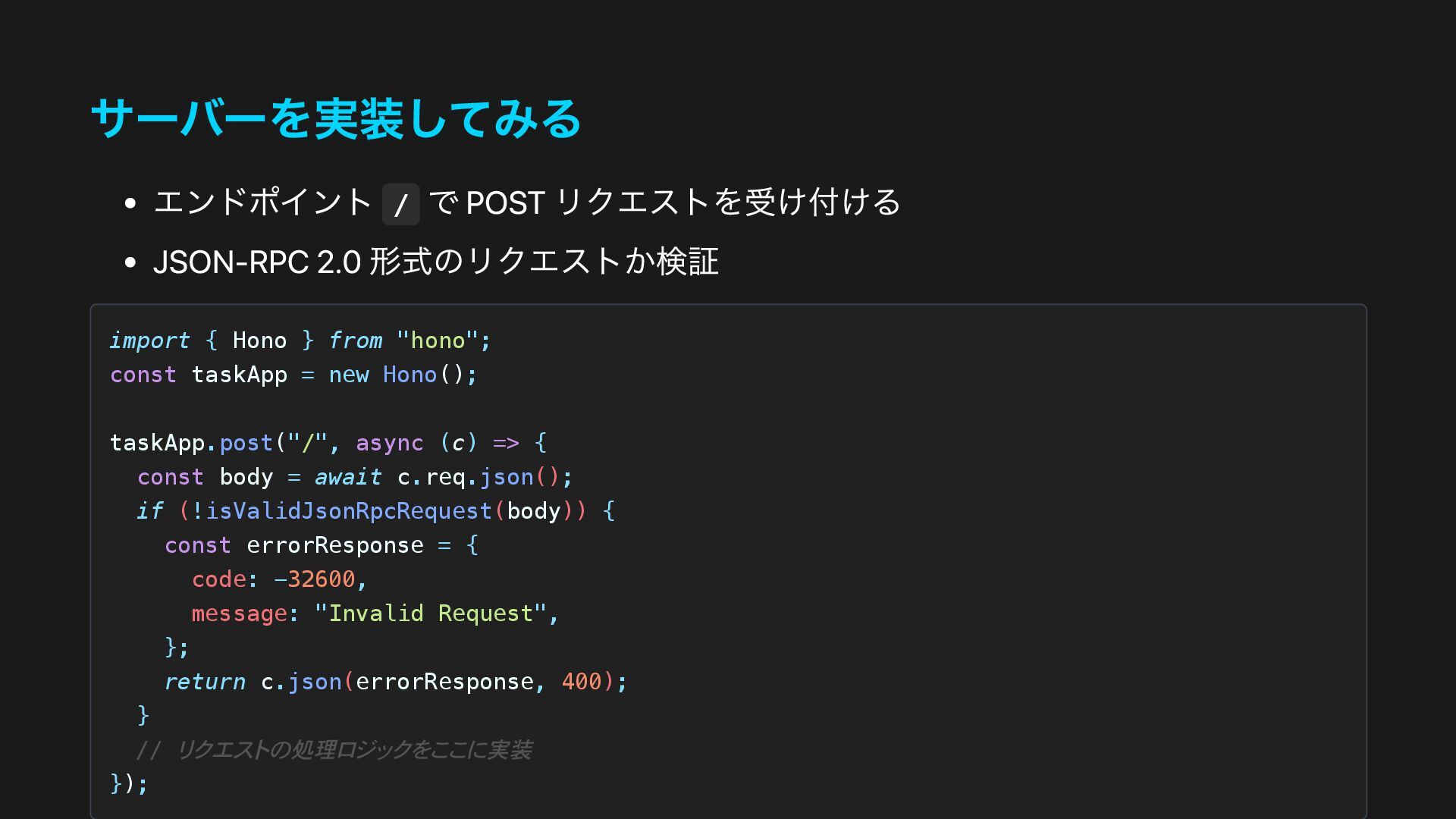
サーバーを実装してみる エンドポイント / で POST リクエストを受け付ける JSON-RPC 2.0 形式のリクエストか検証 import
{ Hono } from "hono"; const taskApp = new Hono(); taskApp.post("/", async (c) => { const body = await c.req.json(); if (!isValidJsonRpcRequest(body)) { const errorResponse = { code: -32600, message: "Invalid Request", }; return c.json(errorResponse, 400); } // リクエストの処理ロジックをここに実装 }); -
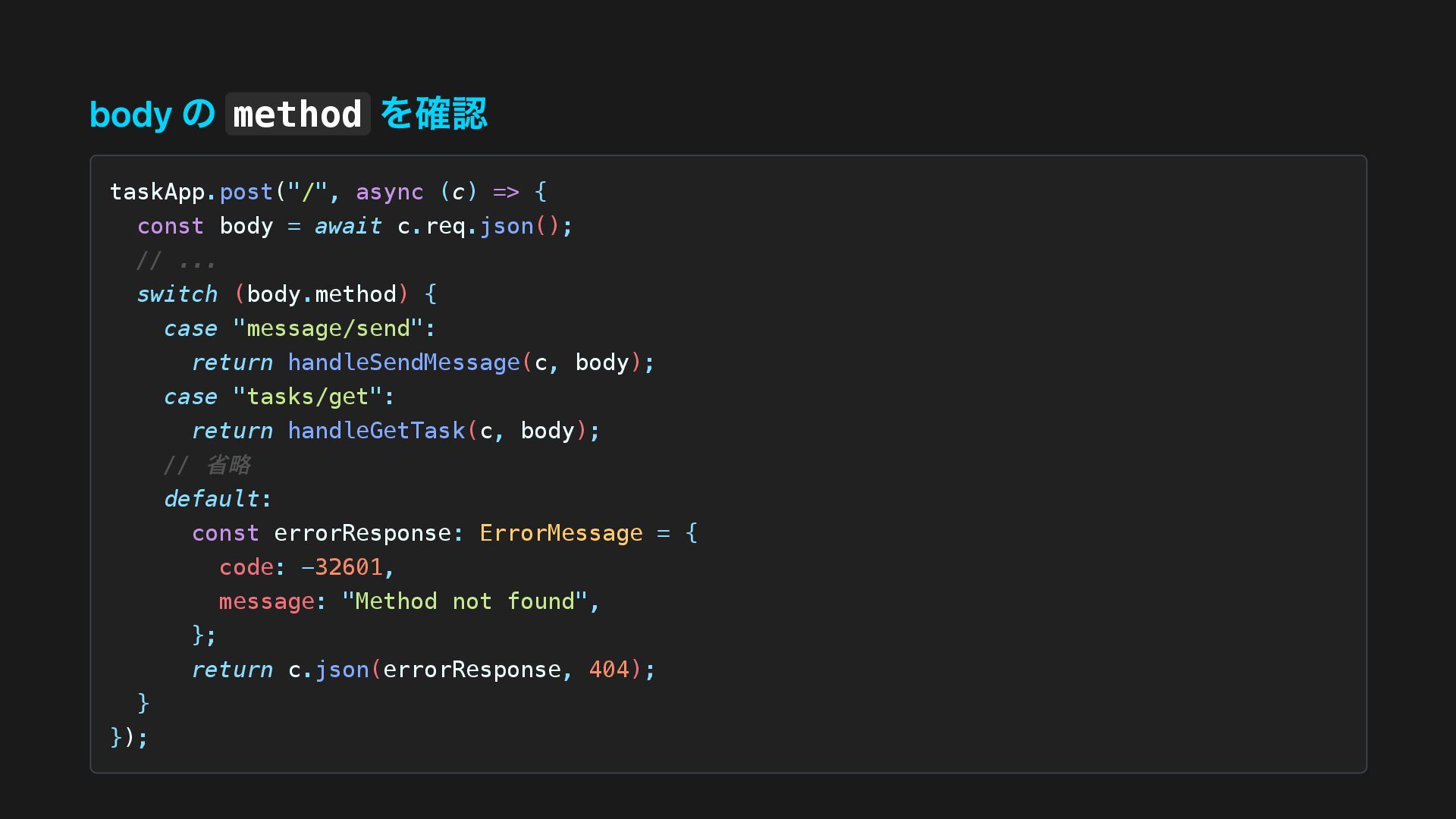
body の method を確認 taskApp.post("/", async (c) => { const
body = await c.req.json(); // ... switch (body.method) { case "message/send": return handleSendMessage(c, body); case "tasks/get": return handleGetTask(c, body); // 省略 default: const errorResponse: ErrorMessage = { code: -32601, message: "Method not found", }; return c.json(errorResponse, 404); } }); -
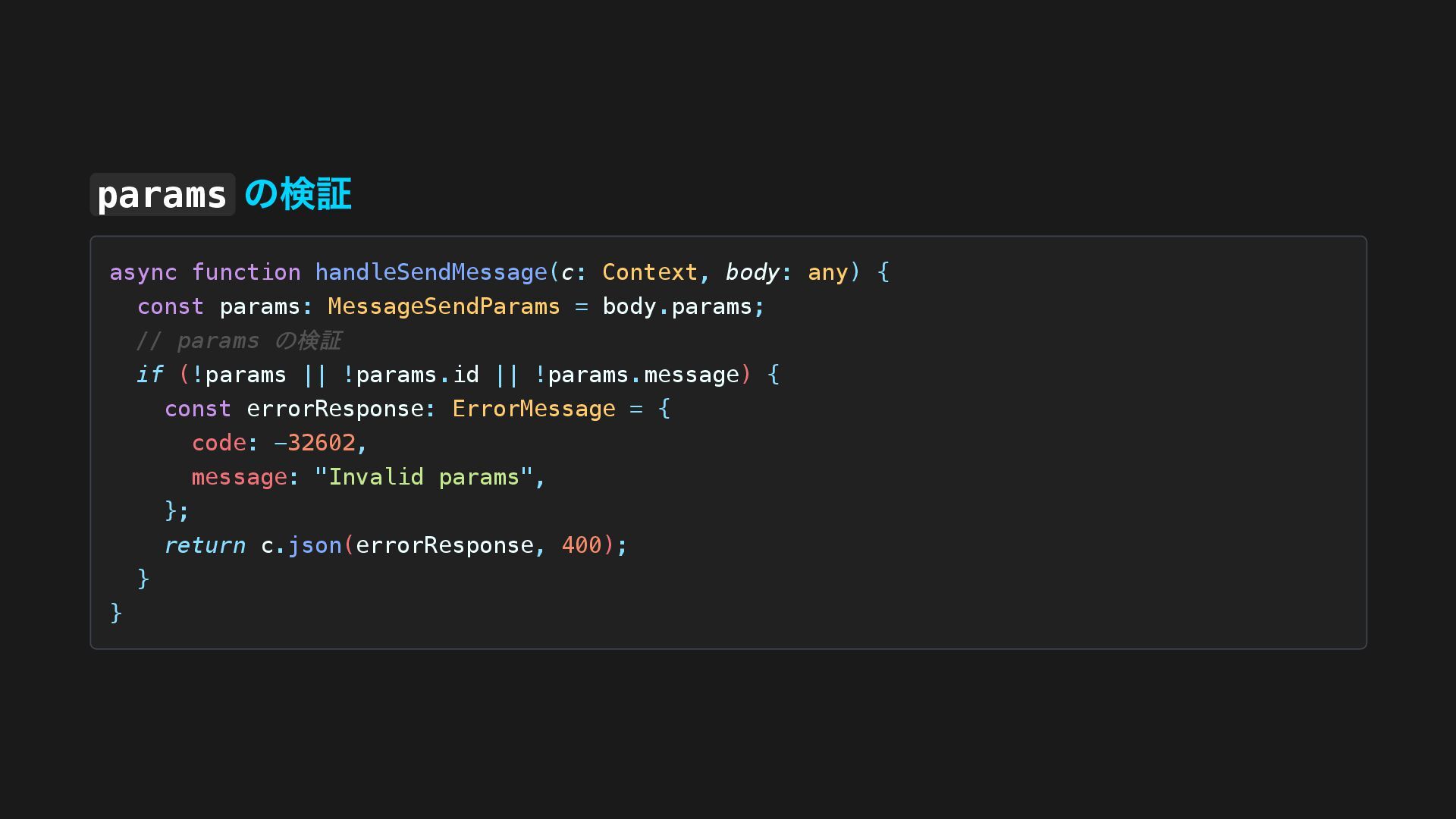
params の検証 async function handleSendMessage(c: Context, body: any) { const
params: MessageSendParams = body.params; // params の検証 if (!params || !params.id || !params.message) { const errorResponse: ErrorMessage = { code: -32602, message: "Invalid params", }; return c.json(errorResponse, 400); } } -
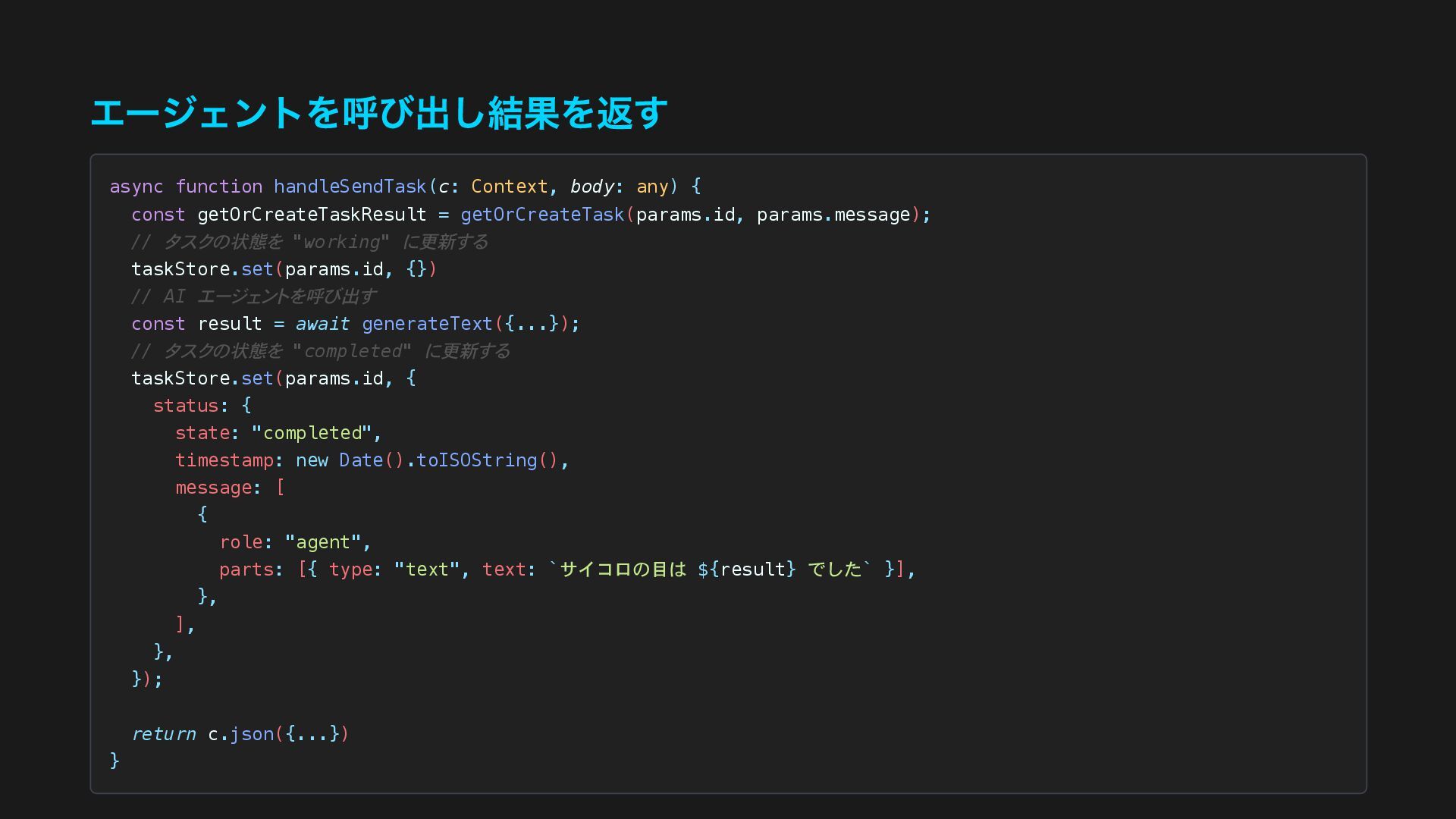
エージェントを呼び出し結果を返す async function handleSendTask(c: Context, body: any) { const getOrCreateTaskResult
= getOrCreateTask(params.id, params.message); // タスクの状態を "working" に更新する taskStore.set(params.id, {}) // AI エージェントを呼び出す const result = await generateText({...}); // タスクの状態を "completed" に更新する taskStore.set(params.id, { status: { state: "completed", timestamp: new Date().toISOString(), message: [ { role: "agent", parts: [{ type: "text", text: `サイコロの目は ${result} でした` }], }, ], }, }); return c.json({...}) } -
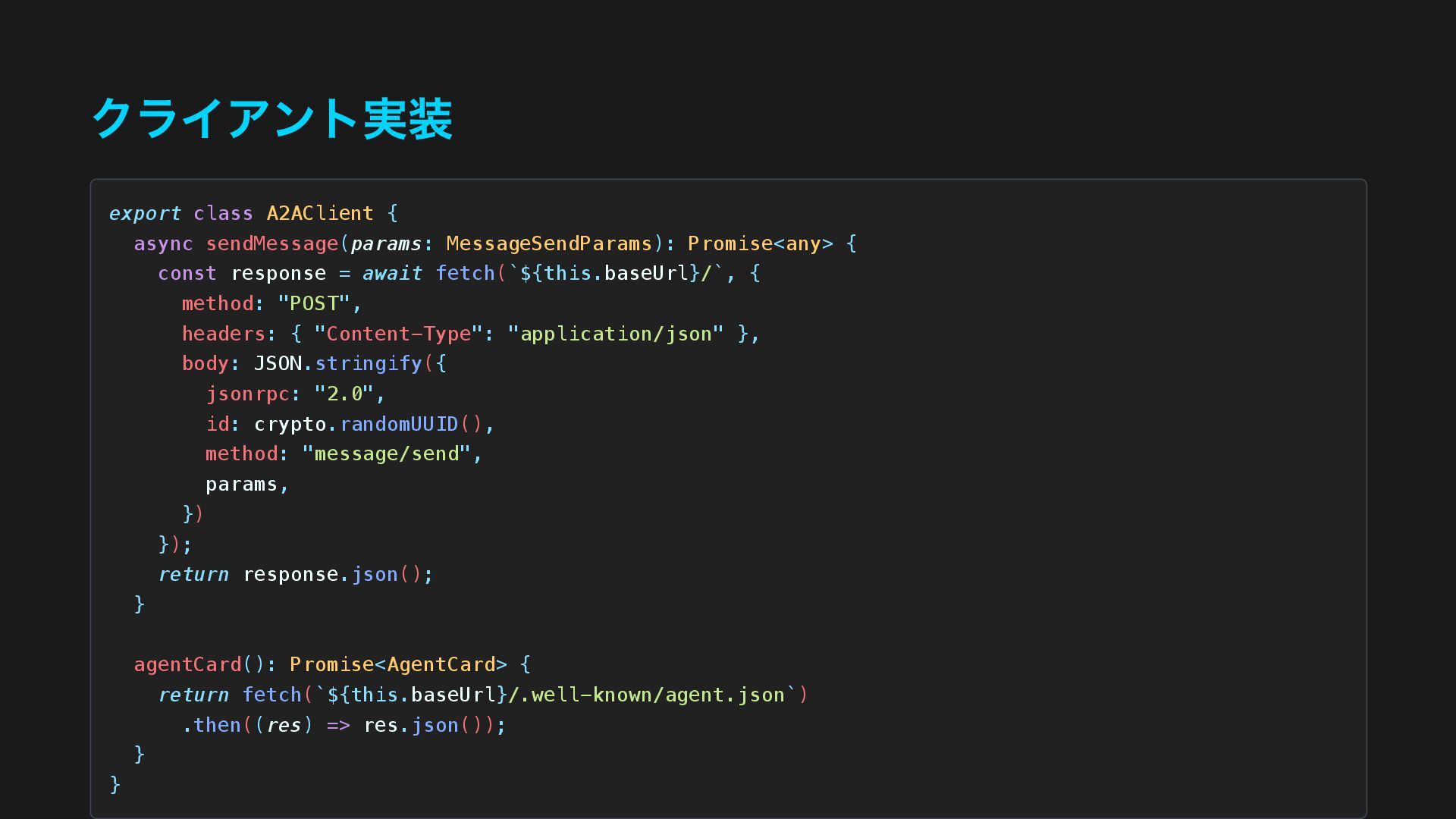
クライアント実装 export class A2AClient { async sendMessage(params: MessageSendParams): Promise<any> {
const response = await fetch(`${this.baseUrl}/`, { method: "POST", headers: { "Content-Type": "application/json" }, body: JSON.stringify({ jsonrpc: "2.0", id: crypto.randomUUID(), method: "message/send", params, }) }); return response.json(); } agentCard(): Promise<AgentCard> { return fetch(`${this.baseUrl}/.well-known/agent.json`) .then((res) => res.json()); } } -
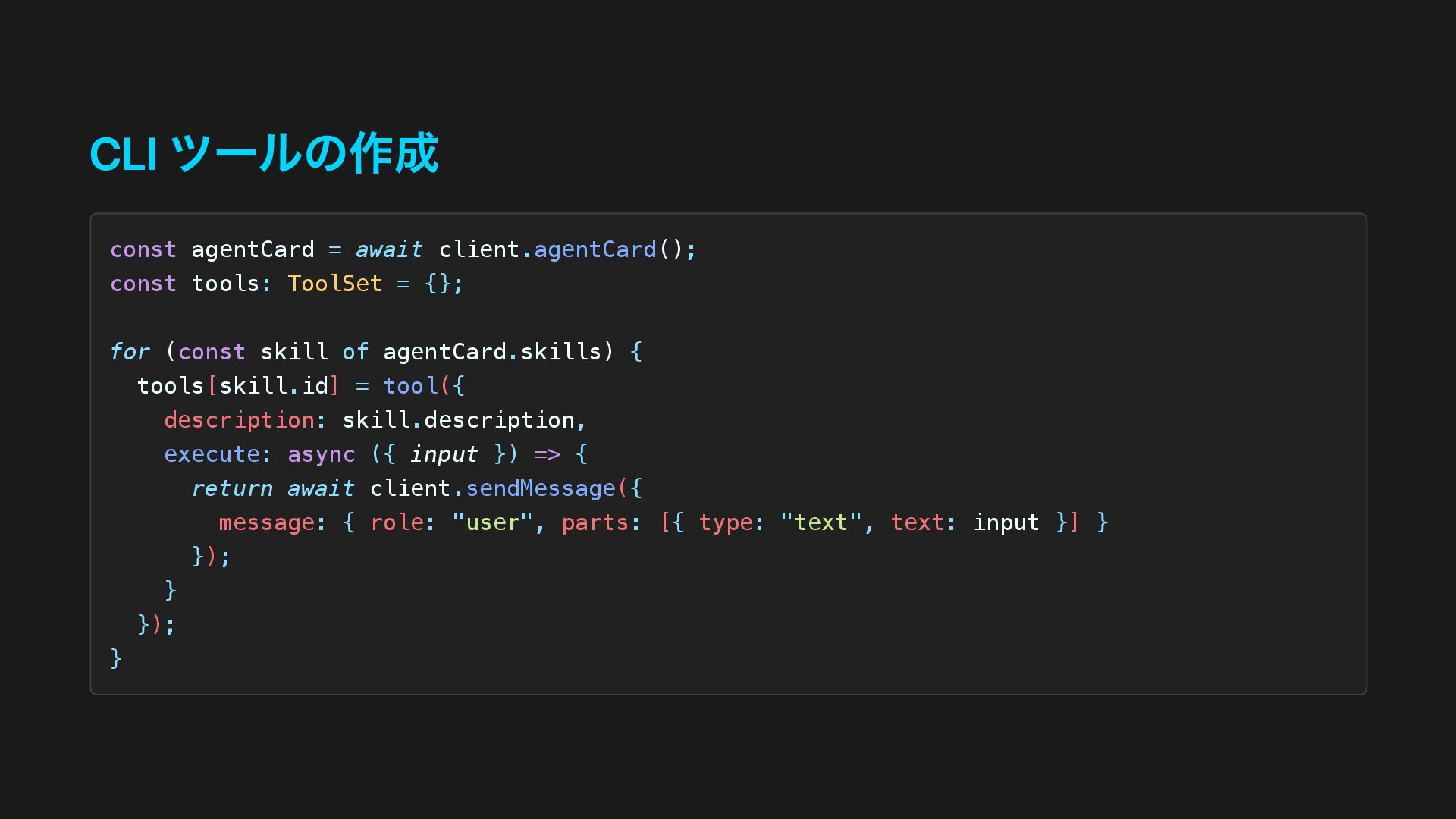
CLI ツールの作成 const agentCard = await client.agentCard(); const tools: ToolSet
= {}; for (const skill of agentCard.skills) { tools[skill.id] = tool({ description: skill.description, execute: async ({ input }) => { return await client.sendMessage({ message: { role: "user", parts: [{ type: "text", text: input }] } }); } }); } -
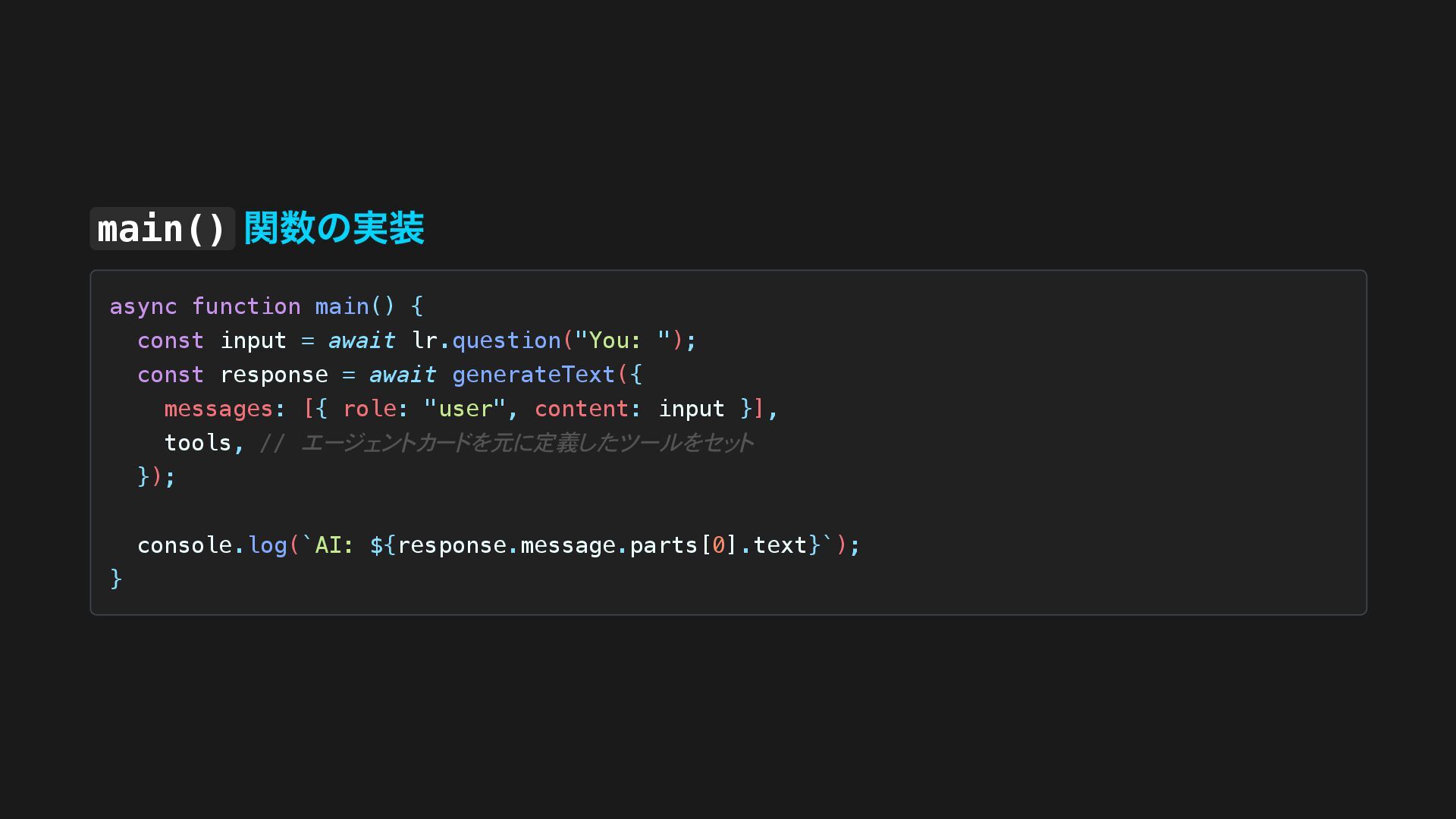
main() 関数の実装 async function main() { const input = await
lr.question("You: "); const response = await generateText({ messages: [{ role: "user", content: input }], tools, // エージェントカードを元に定義したツールをセット }); console.log(`AI: ${response.message.parts[0].text}`); } -
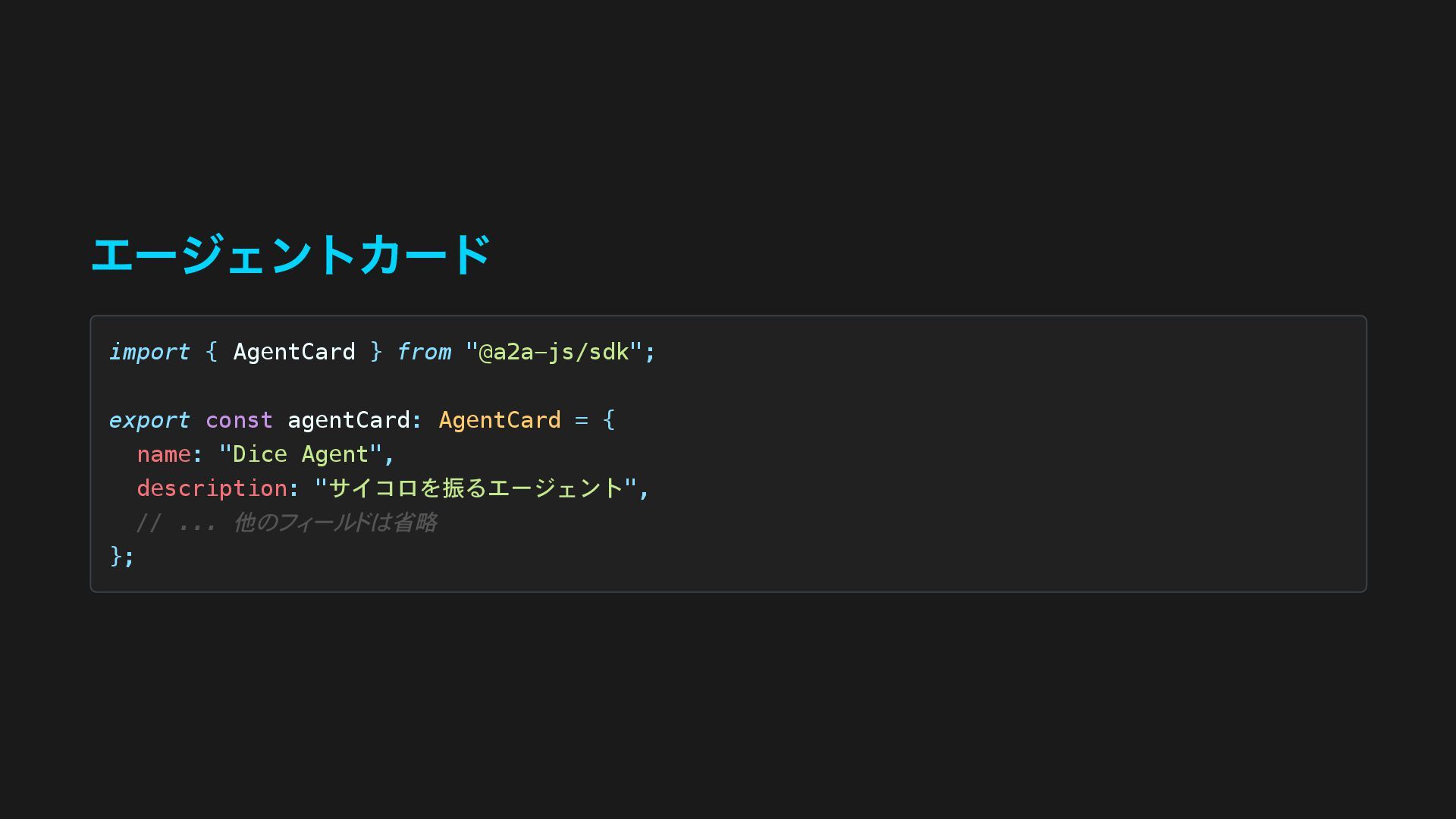
エージェントカード import { AgentCard } from "@a2a-js/sdk"; export const agentCard:
AgentCard = { name: "Dice Agent", description: "サイコロを振るエージェント", // ... 他のフィールドは省略 }; -
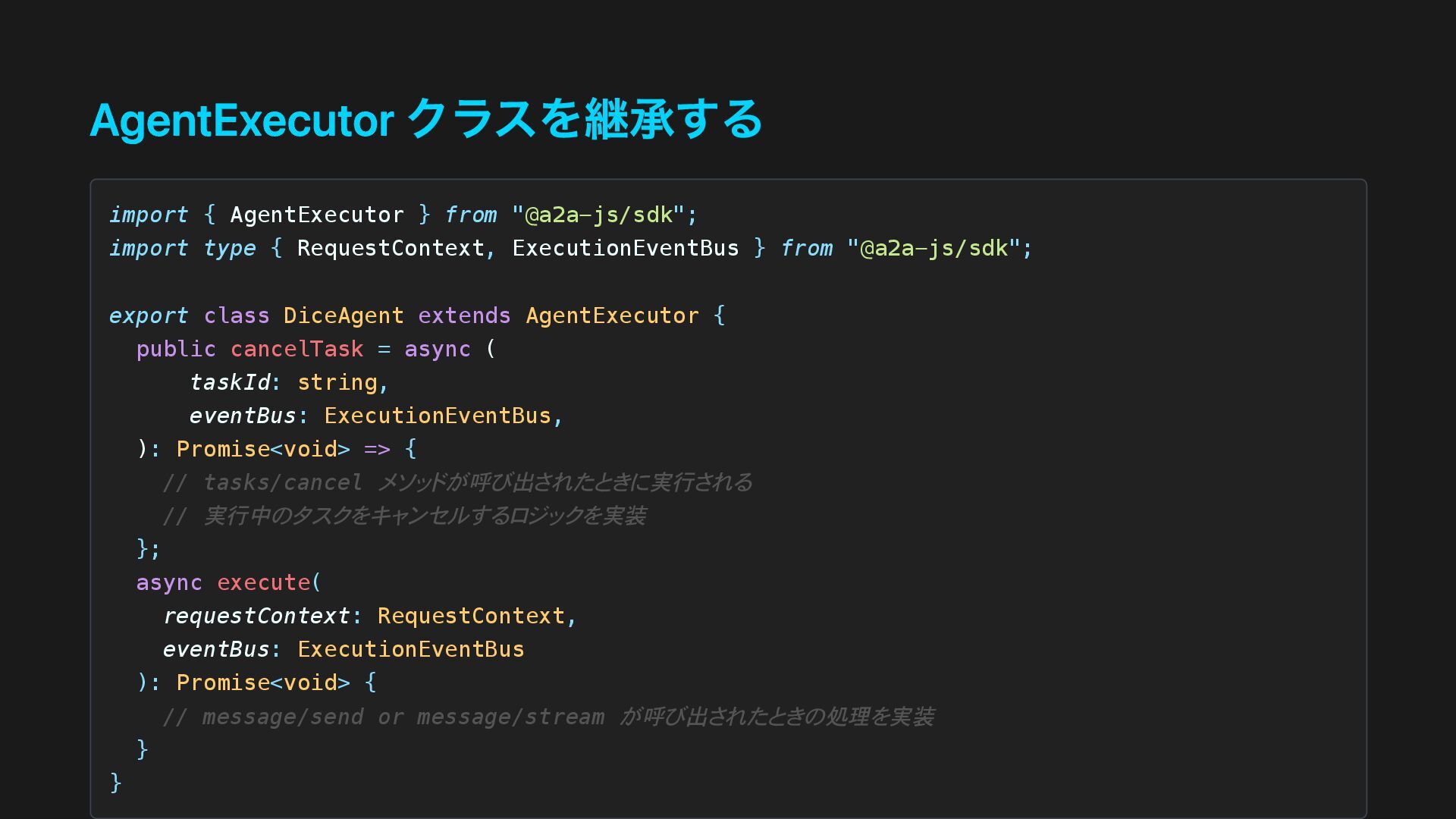
AgentExecutor クラスを継承する import { AgentExecutor } from "@a2a-js/sdk"; import type
{ RequestContext, ExecutionEventBus } from "@a2a-js/sdk"; export class DiceAgent extends AgentExecutor { public cancelTask = async ( taskId: string, eventBus: ExecutionEventBus, ): Promise<void> => { // tasks/cancel メソッドが呼び出されたときに実行される // 実行中のタスクをキャンセルするロジックを実装 }; async execute( requestContext: RequestContext, eventBus: ExecutionEventBus ): Promise<void> { // message/send or message/stream が呼び出されたときの処理を実装 } } -
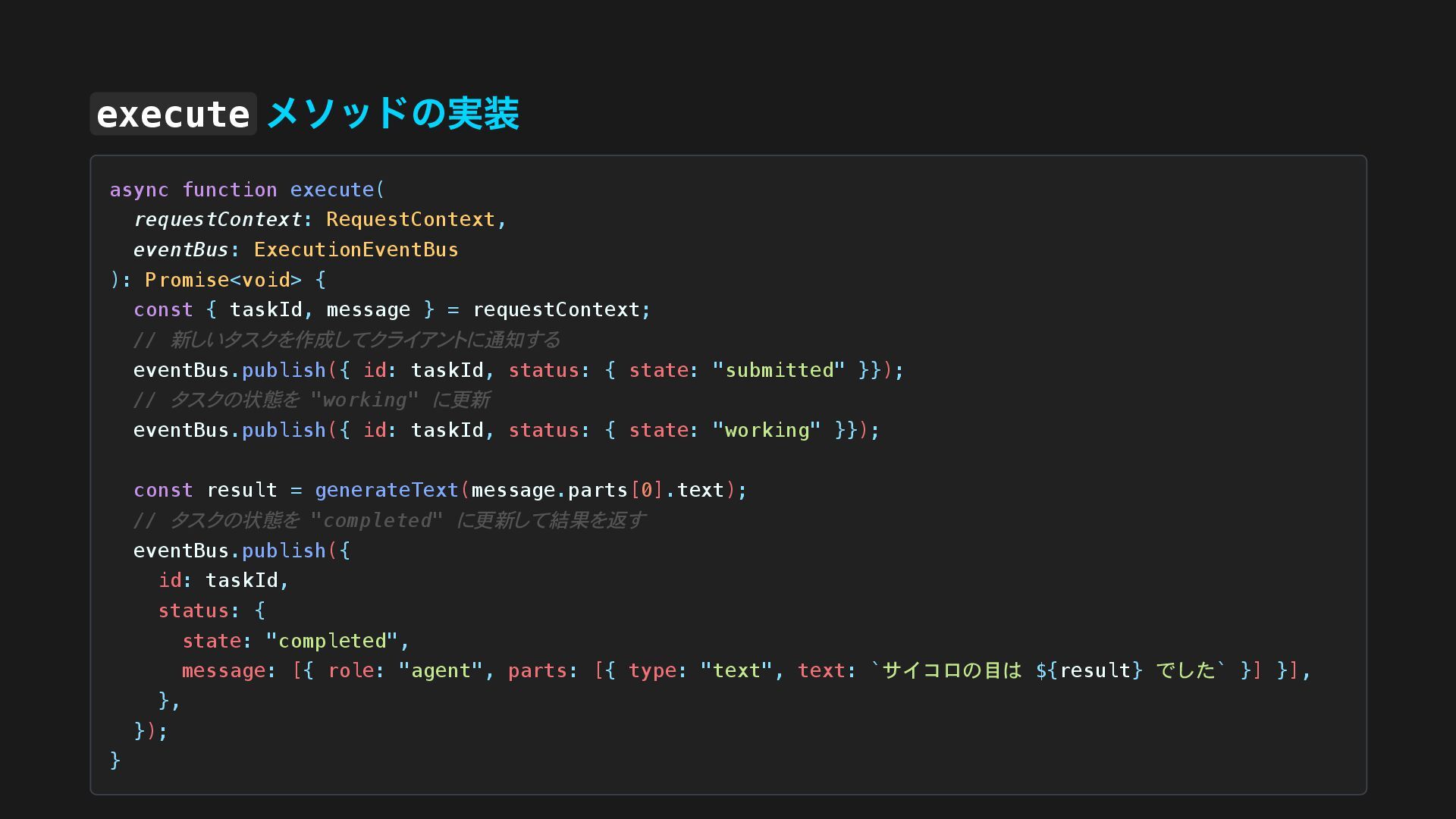
execute メソッドの実装 async function execute( requestContext: RequestContext, eventBus: ExecutionEventBus ):
Promise<void> { const { taskId, message } = requestContext; // 新しいタスクを作成してクライアントに通知する eventBus.publish({ id: taskId, status: { state: "submitted" }}); // タスクの状態を "working" に更新 eventBus.publish({ id: taskId, status: { state: "working" }}); const result = generateText(message.parts[0].text); // タスクの状態を "completed" に更新して結果を返す eventBus.publish({ id: taskId, status: { state: "completed", message: [{ role: "agent", parts: [{ type: "text", text: `サイコロの目は ${result} でした` }] }], }, }); } -
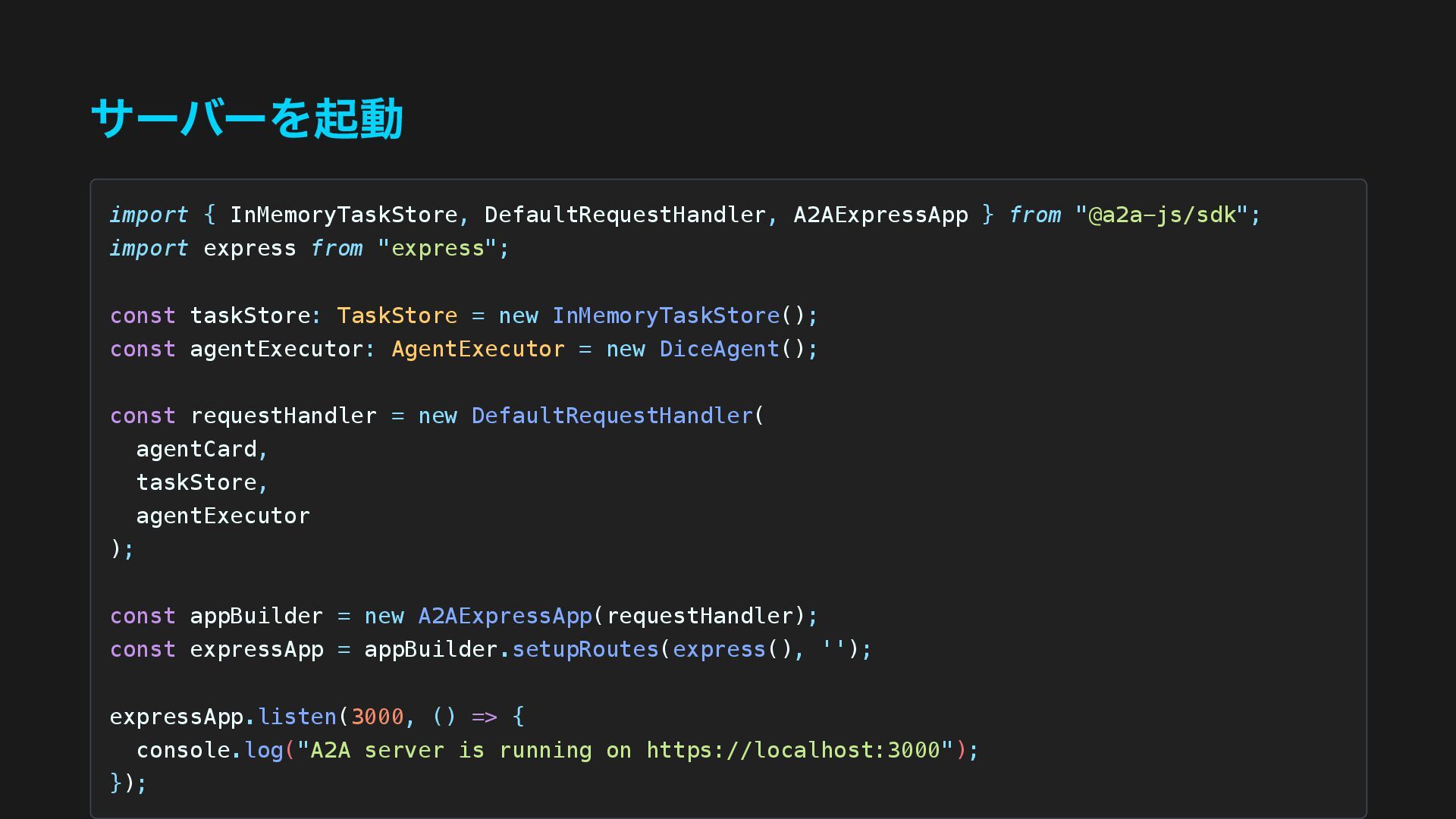
サーバーを起動 import { InMemoryTaskStore, DefaultRequestHandler, A2AExpressApp } from "@a2a-js/sdk"; import
express from "express"; const taskStore: TaskStore = new InMemoryTaskStore(); const agentExecutor: AgentExecutor = new DiceAgent(); const requestHandler = new DefaultRequestHandler( agentCard, taskStore, agentExecutor ); const appBuilder = new A2AExpressApp(requestHandler); const expressApp = appBuilder.setupRoutes(express(), ''); expressApp.listen(3000, () => { console.log("A2A server is running on https://localhost:3000"); }); -
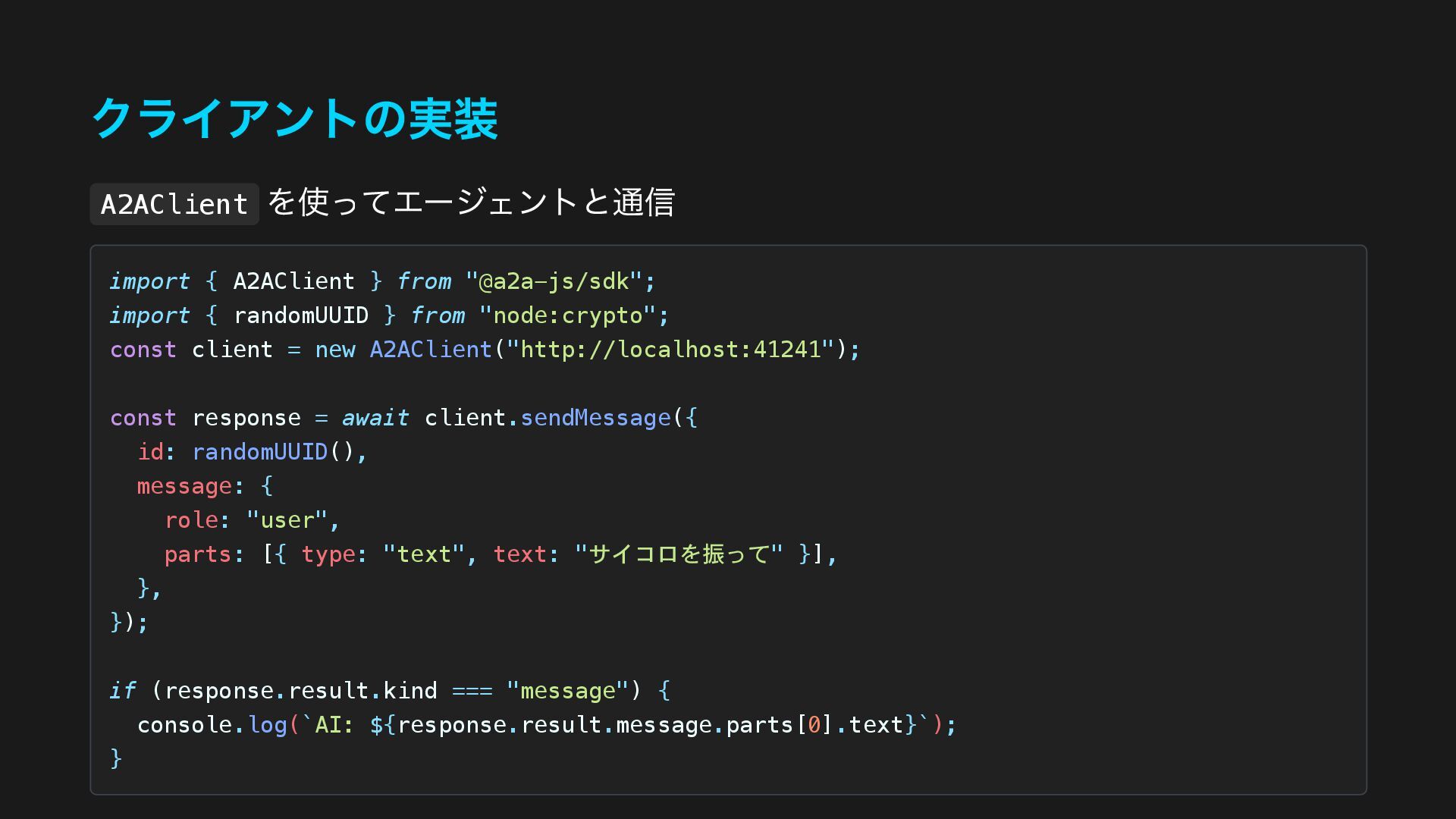
クライアントの実装 A2AClient を使ってエージェントと通信 import { A2AClient } from "@a2a-js/sdk"; import
{ randomUUID } from "node:crypto"; const client = new A2AClient("http://localhost:41241"); const response = await client.sendMessage({ id: randomUUID(), message: { role: "user", parts: [{ type: "text", text: "サイコロを振って" }], }, }); if (response.result.kind === "message") { console.log(`AI: ${response.result.message.parts[0].text}`); } -
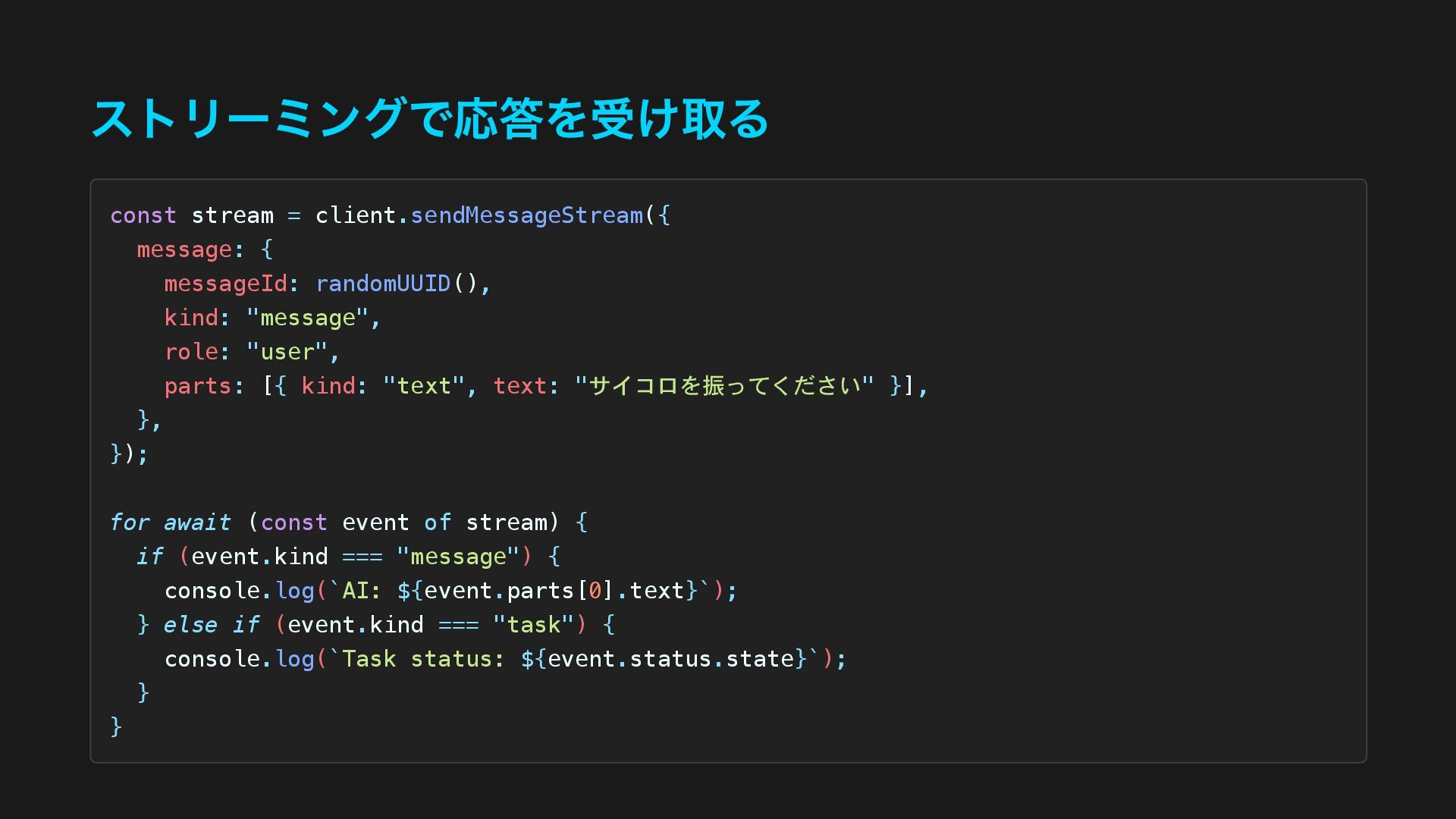
ストリーミングで応答を受け取る const stream = client.sendMessageStream({ message: { messageId: randomUUID(), kind:
"message", role: "user", parts: [{ kind: "text", text: "サイコロを振ってください" }], }, }); for await (const event of stream) { if (event.kind === "message") { console.log(`AI: ${event.parts[0].text}`); } else if (event.kind === "task") { console.log(`Task status: ${event.status.state}`); } } -
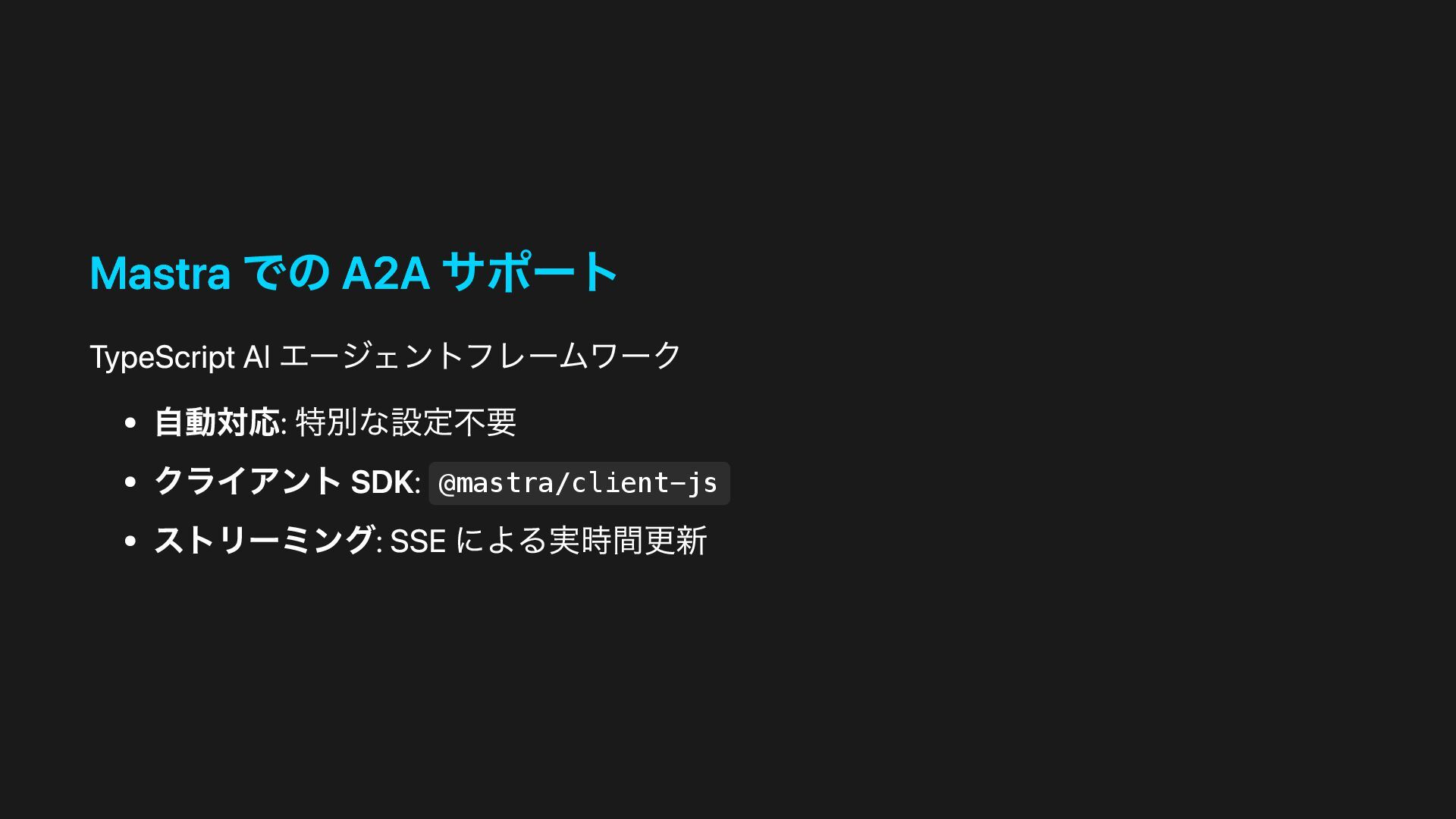
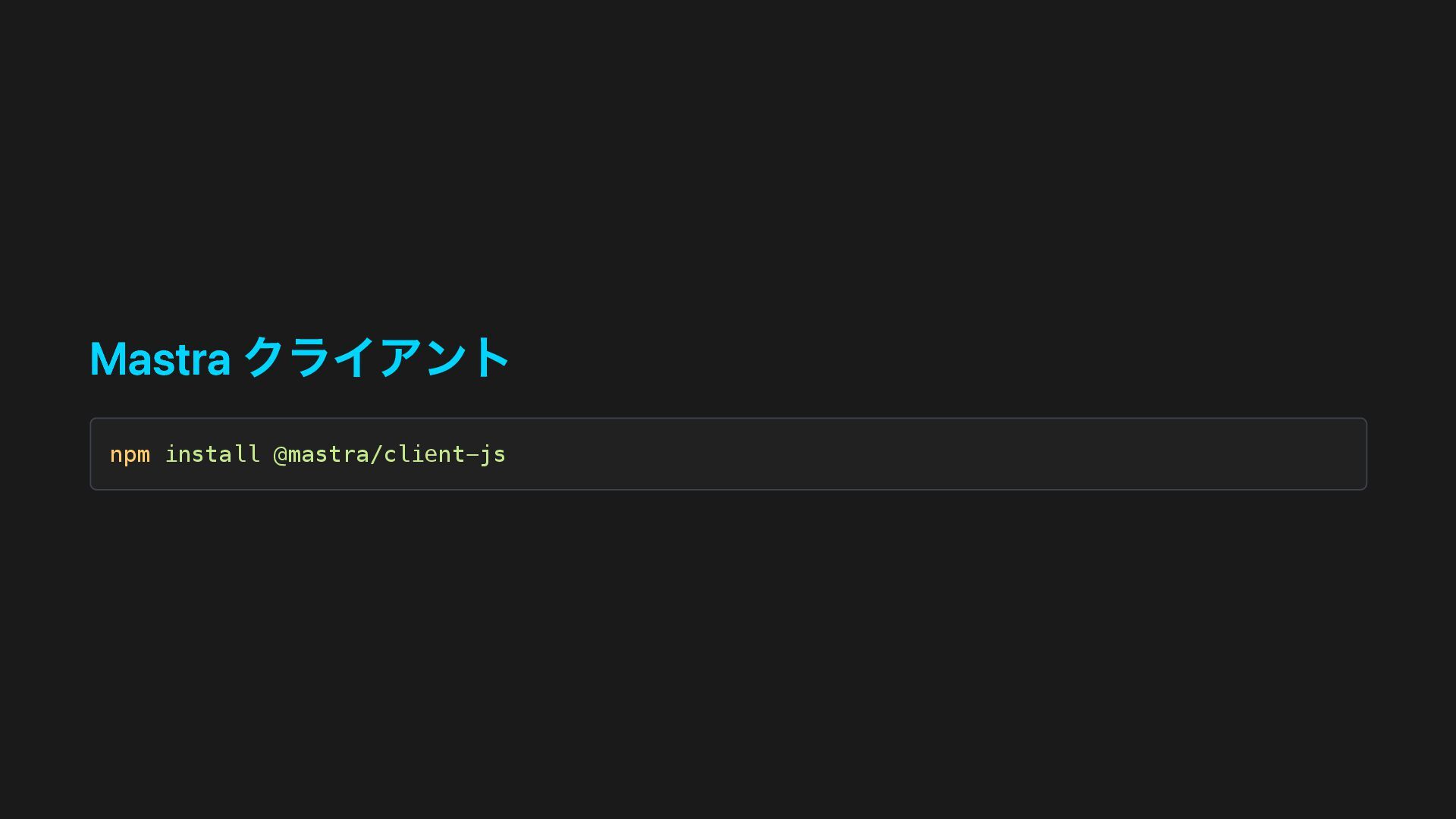
Mastra での A2A サポート TypeScript AI エージェントフレームワーク 自動対応: 特別な設定不要 クライアント
SDK: @mastra/client-js ストリーミング: SSE による実時間更新 -
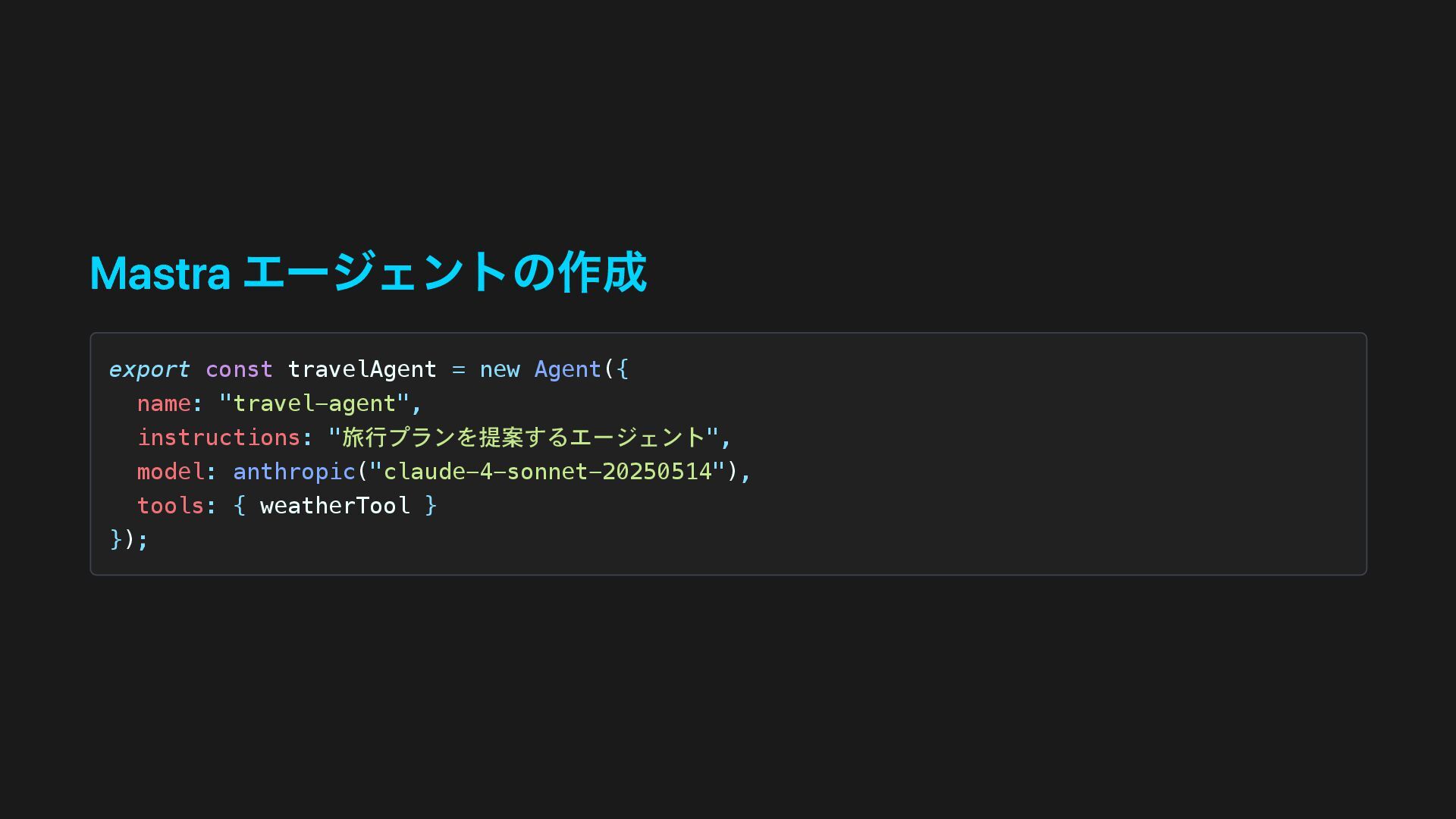
Mastra エージェントの作成 export const travelAgent = new Agent({ name: "travel-agent",
instructions: "旅行プランを提案するエージェント", model: anthropic("claude-4-sonnet-20250514"), tools: { weatherTool } }); -
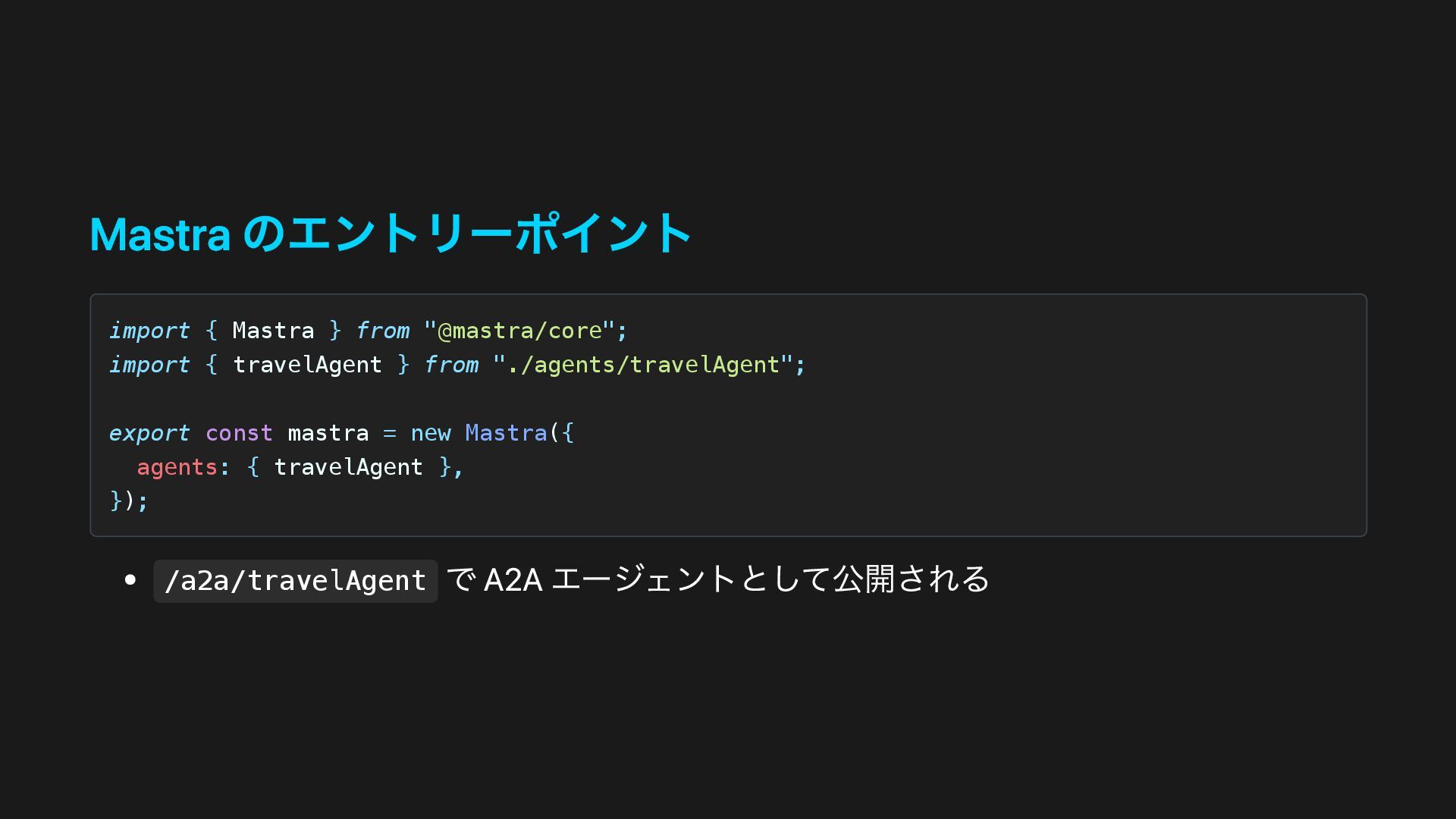
Mastra のエントリーポイント import { Mastra } from "@mastra/core"; import {
travelAgent } from "./agents/travelAgent"; export const mastra = new Mastra({ agents: { travelAgent }, }); /a2a/travelAgent で A2A エージェントとして公開される -
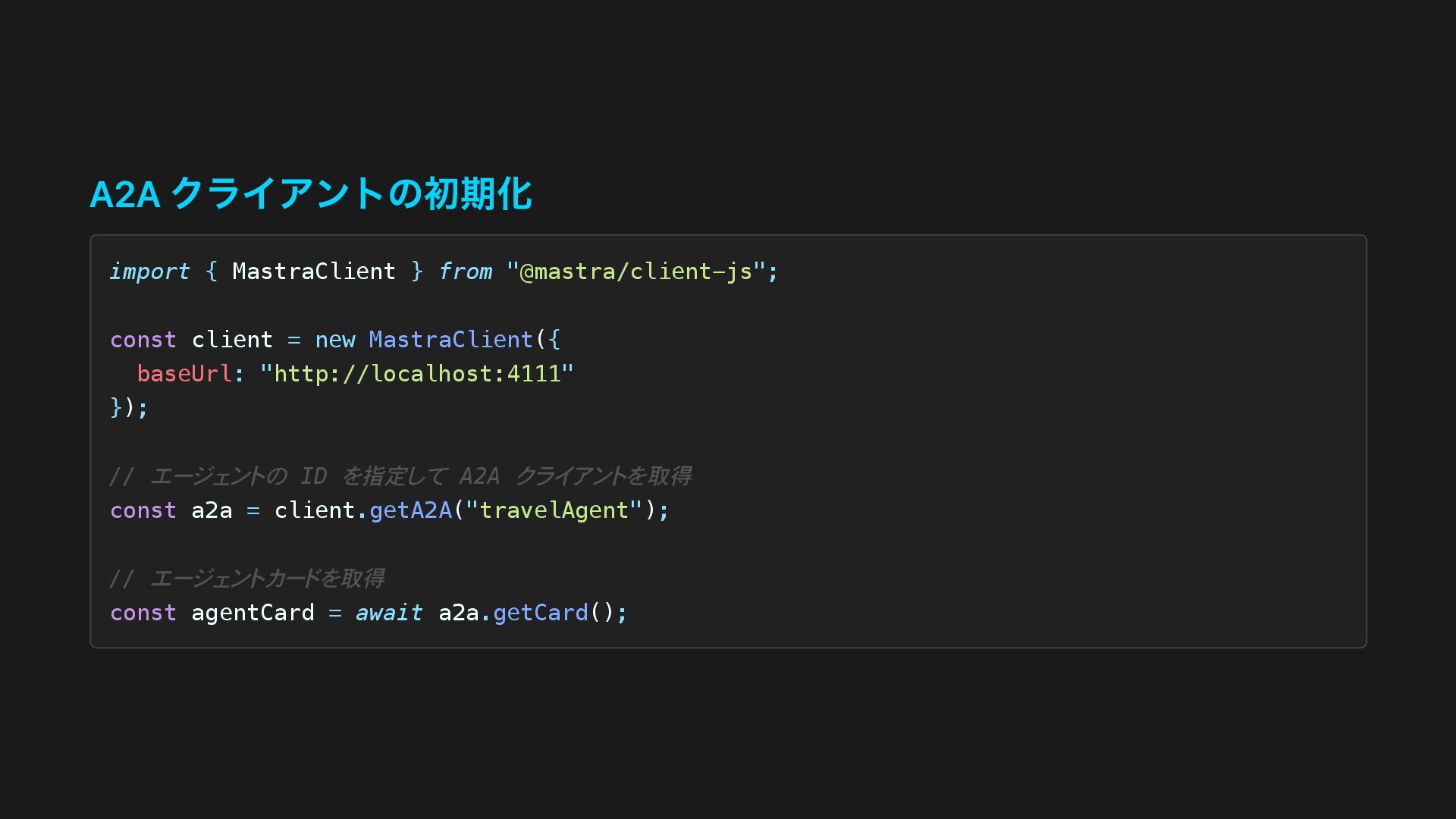
A2A クライアントの初期化 import { MastraClient } from "@mastra/client-js"; const client
= new MastraClient({ baseUrl: "http://localhost:4111" }); // エージェントの ID を指定して A2A クライアントを取得 const a2a = client.getA2A("travelAgent"); // エージェントカードを取得 const agentCard = await a2a.getCard(); -
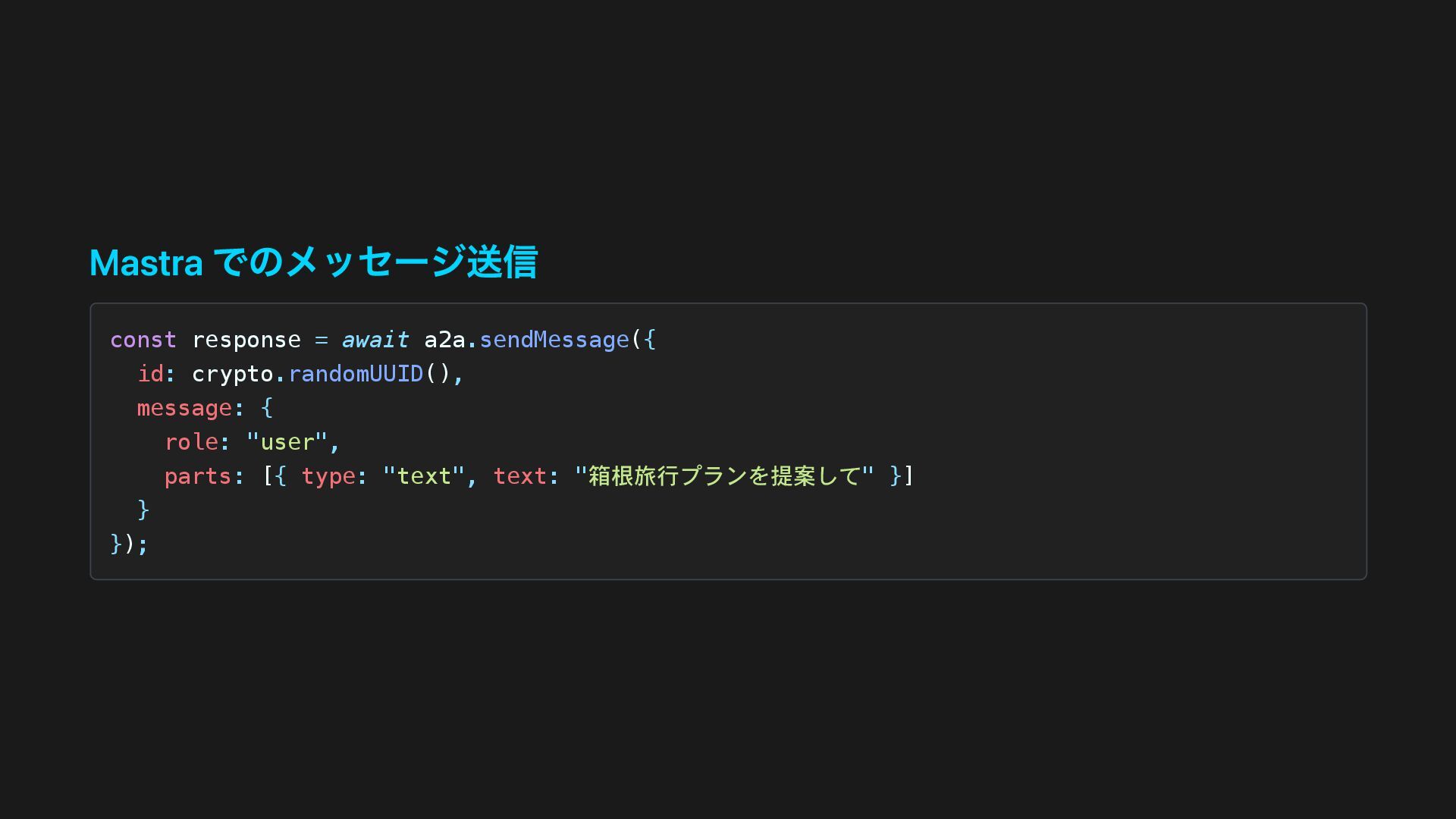
Mastra でのメッセージ送信 const response = await a2a.sendMessage({ id: crypto.randomUUID(), message:
{ role: "user", parts: [{ type: "text", text: "箱根旅行プランを提案して" }] } }); -
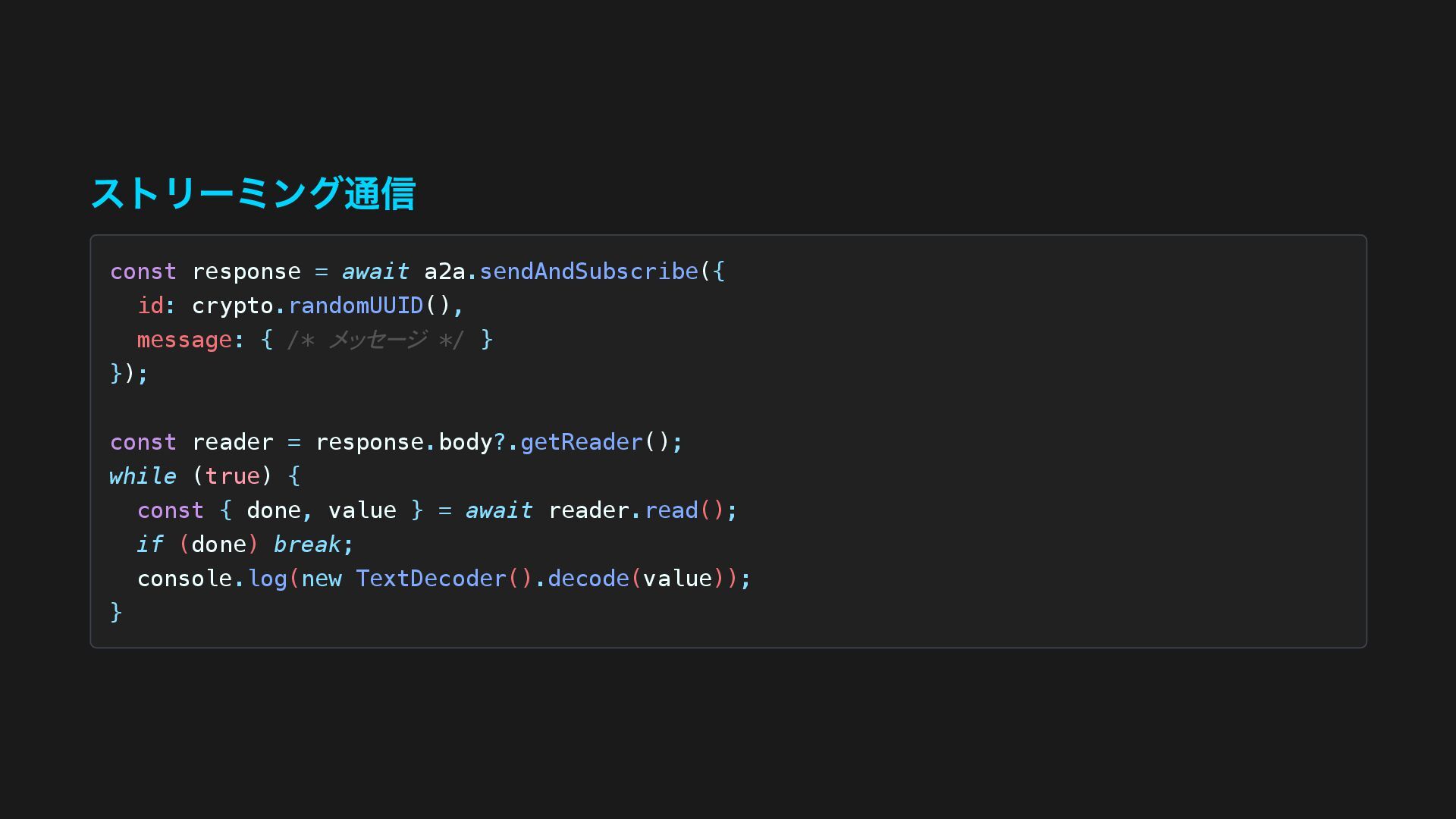
ストリーミング通信 const response = await a2a.sendAndSubscribe({ id: crypto.randomUUID(), message: {
/* メッセージ */ } }); const reader = response.body?.getReader(); while (true) { const { done, value } = await reader.read(); if (done) break; console.log(new TextDecoder().decode(value)); } -
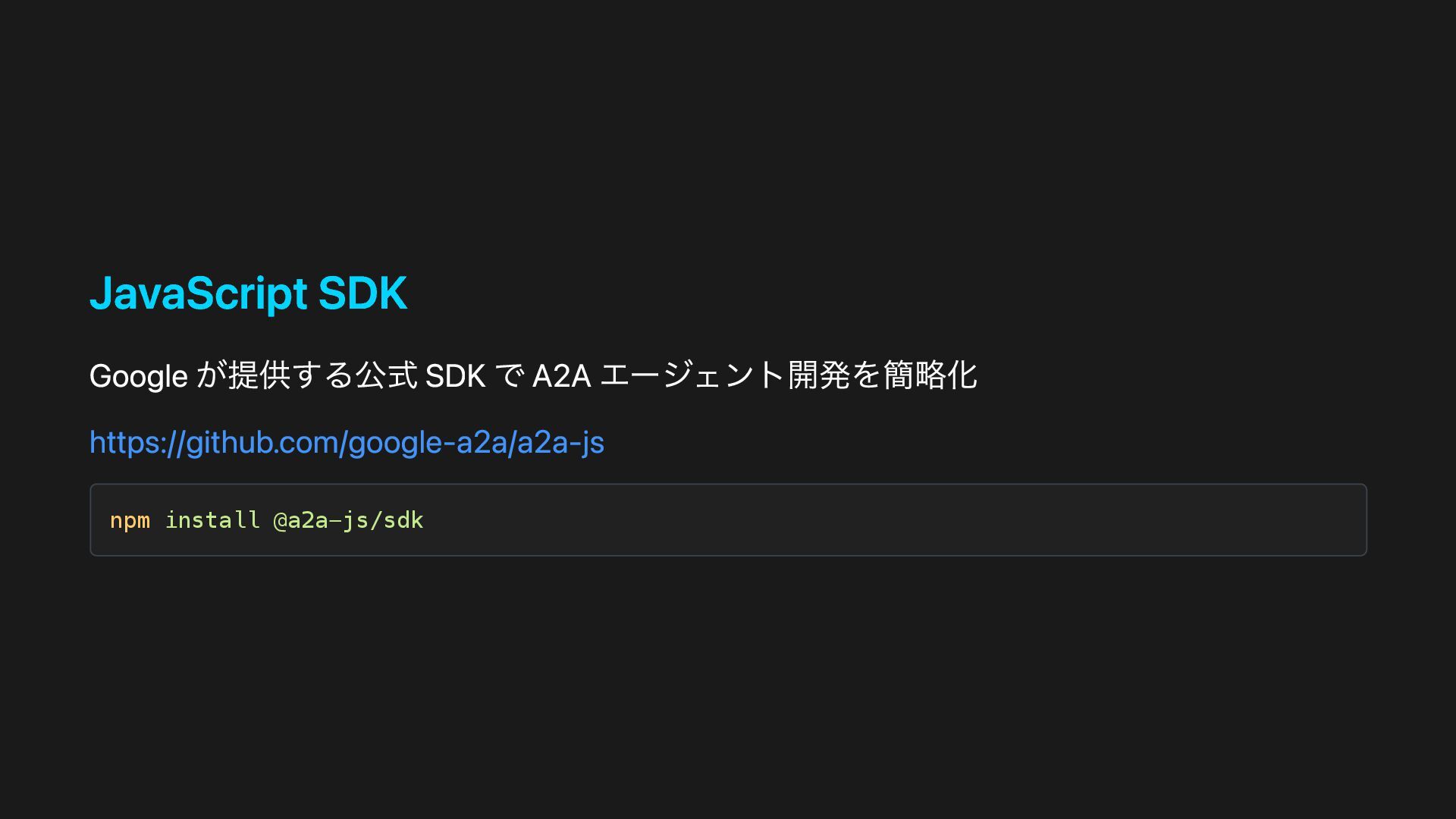
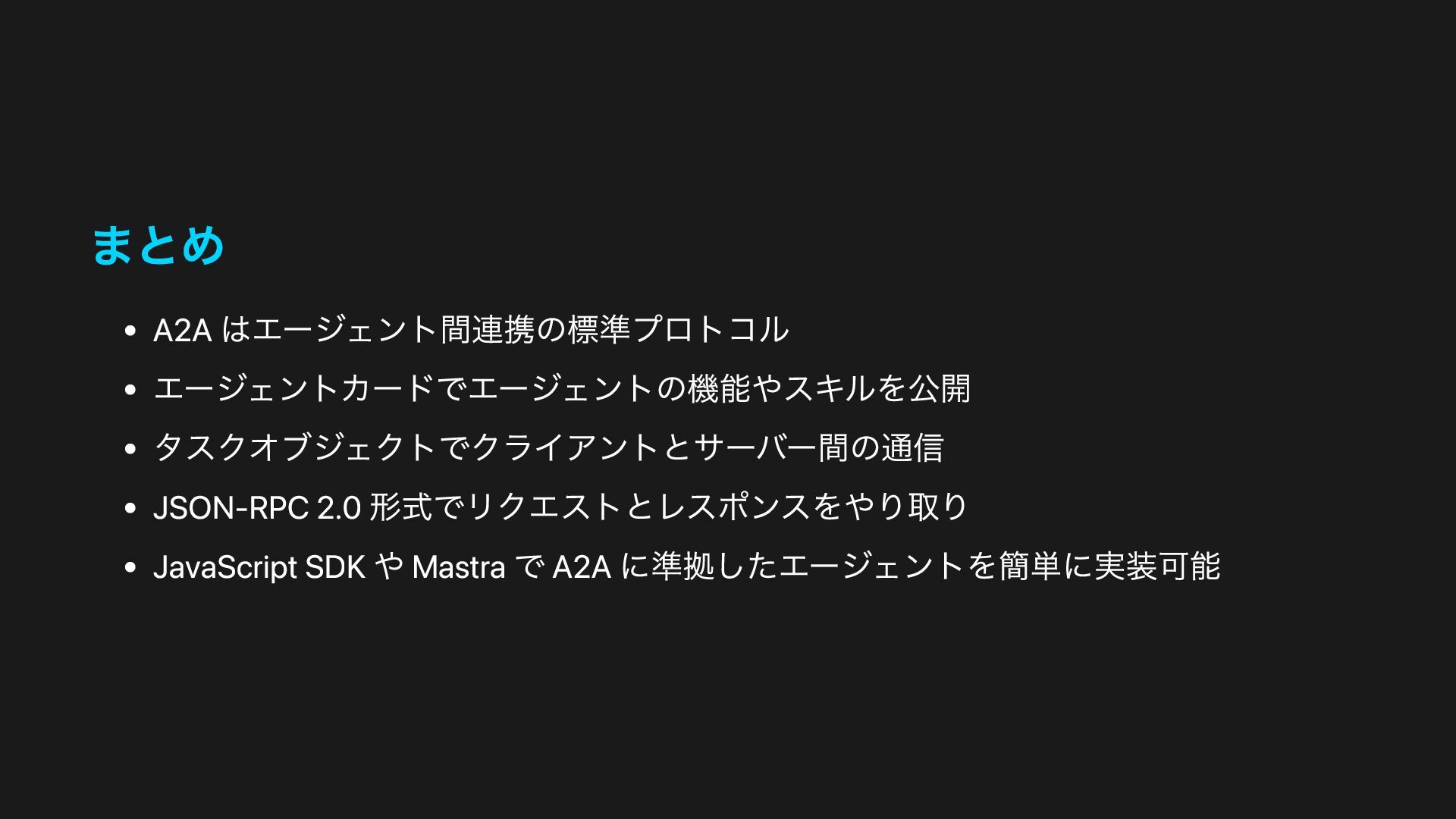
まとめ A2A はエージェント間連携の標準プロトコル エージェントカードでエージェントの機能やスキルを公開 タスクオブジェクトでクライアントとサーバー間の通信 JSON-RPC 2.0 形式でリクエストとレスポンスをやり取り JavaScript SDK
や Mastra で A2A に準拠したエージェントを簡単に実装可能