the communication process with the steps in developing a communication campaign strategy; To identify the various variables and characteristics of a communication situation through research; To determine the goal of a communication campaign strategy; To establish the key performance index (KPI) of a communication campaign strategy; To generate insights on the sender, receiver, and context of the communication situation; To define a message and channel strategy; To define creatives and channels; and To value the importance of a pre-test, implementation, and post-test steps of the campaign strategy development process. Week 2 Objectives:
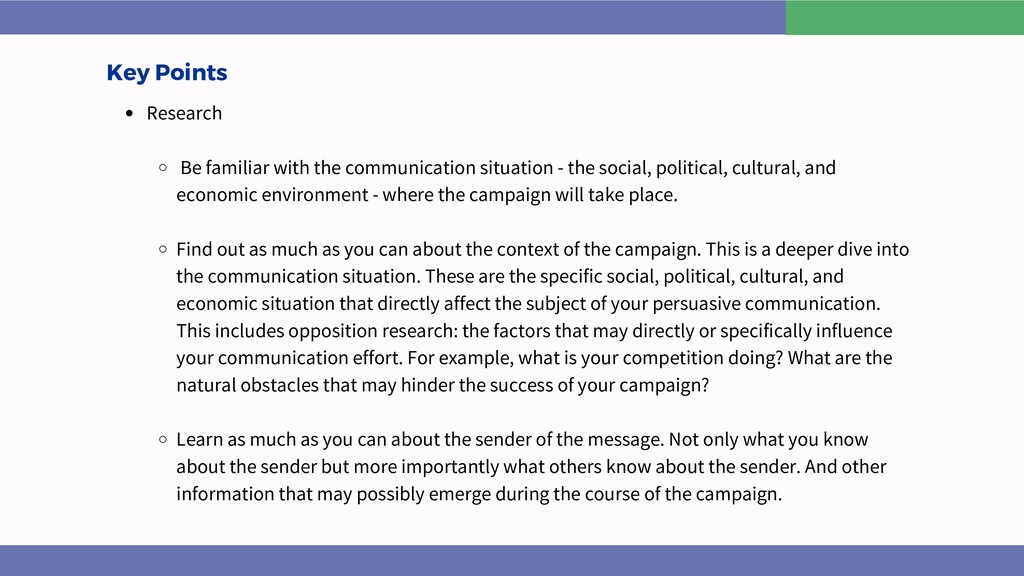
political, cultural, and economic environment - where the campaign will take place. Find out as much as you can about the context of the campaign. This is a deeper dive into the communication situation. These are the specific social, political, cultural, and economic situation that directly affect the subject of your persuasive communication. This includes opposition research: the factors that may directly or specifically influence your communication effort. For example, what is your competition doing? What are the natural obstacles that may hinder the success of your campaign? Learn as much as you can about the sender of the message. Not only what you know about the sender but more importantly what others know about the sender. And other information that may possibly emerge during the course of the campaign. Key Points
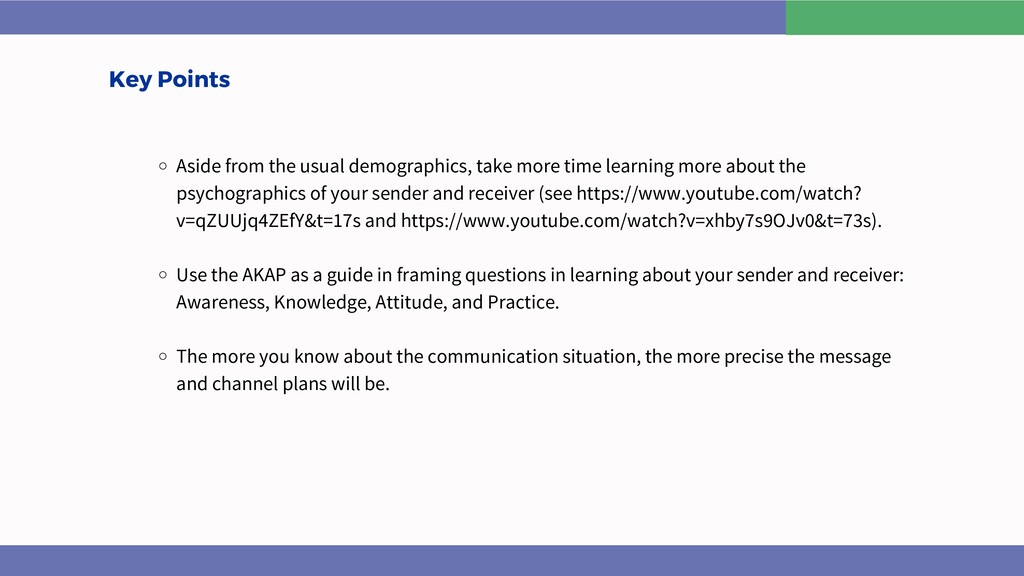
about the psychographics of your sender and receiver (see https://www.youtube.com/watch? v=qZUUjq4ZEfY&t=17s and https://www.youtube.com/watch?v=xhby7s9OJv0&t=73s). Use the AKAP as a guide in framing questions in learning about your sender and receiver: Awareness, Knowledge, Attitude, and Practice. The more you know about the communication situation, the more precise the message and channel plans will be. Key Points
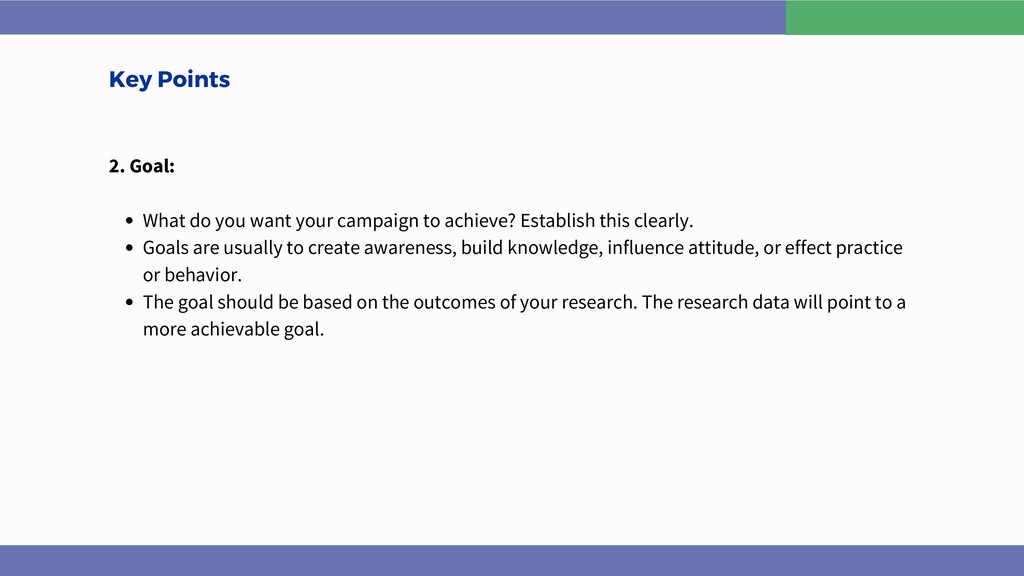
clearly. Goals are usually to create awareness, build knowledge, influence attitude, or effect practice or behavior. The goal should be based on the outcomes of your research. The research data will point to a more achievable goal. 2. Goal: Key Points
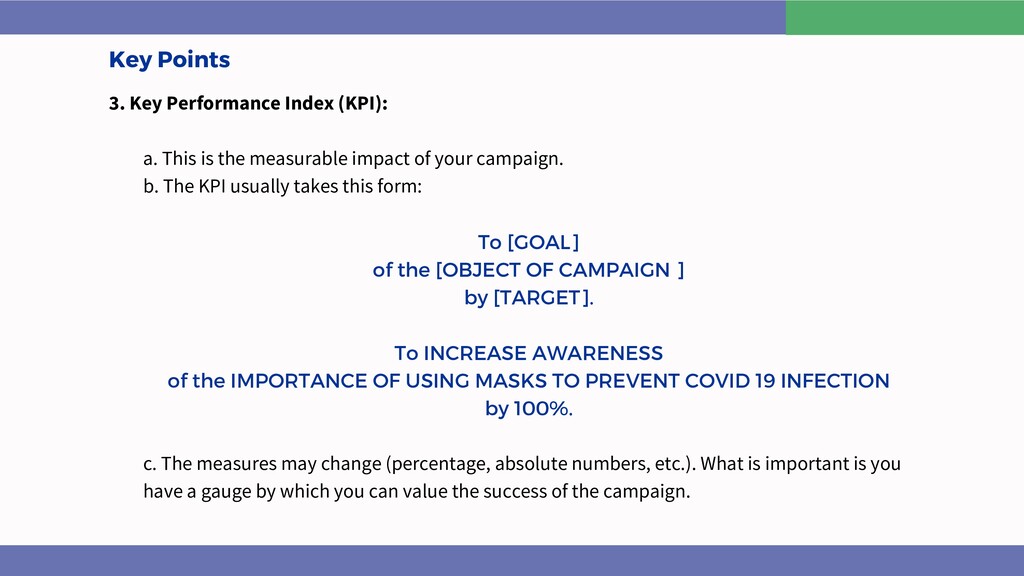
impact of your campaign. b. The KPI usually takes this form: To [GOAL] of the [OBJECT OF CAMPAIGN ] by [TARGET]. To INCREASE AWARENESS of the IMPORTANCE OF USING MASKS TO PREVENT COVID 19 INFECTION by 100%. c. The measures may change (percentage, absolute numbers, etc.). What is important is you have a gauge by which you can value the success of the campaign. Key Points
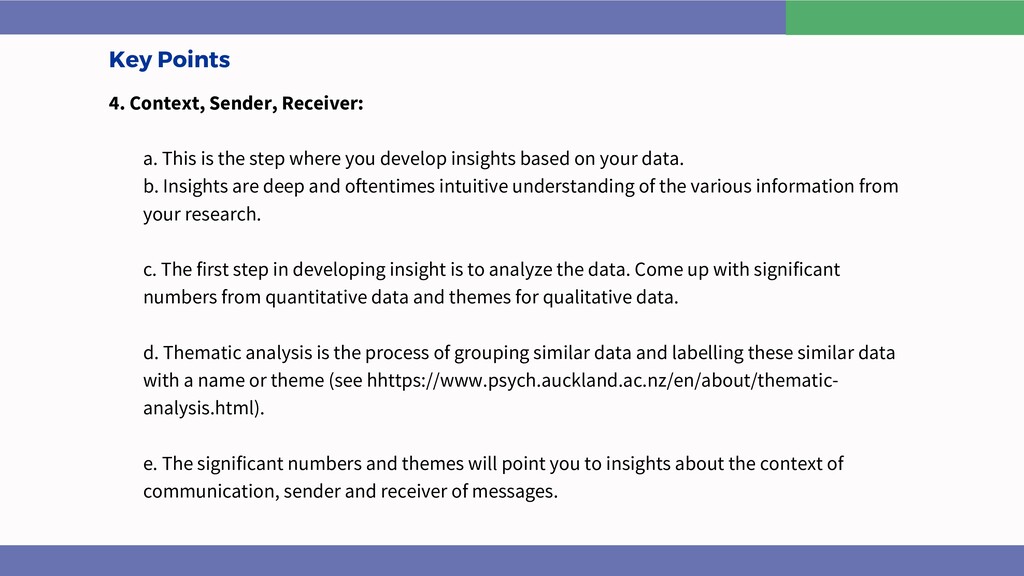
you develop insights based on your data. b. Insights are deep and oftentimes intuitive understanding of the various information from your research. c. The first step in developing insight is to analyze the data. Come up with significant numbers from quantitative data and themes for qualitative data. d. Thematic analysis is the process of grouping similar data and labelling these similar data with a name or theme (see hhttps://www.psych.auckland.ac.nz/en/about/thematic- analysis.html). e. The significant numbers and themes will point you to insights about the context of communication, sender and receiver of messages. Key Points
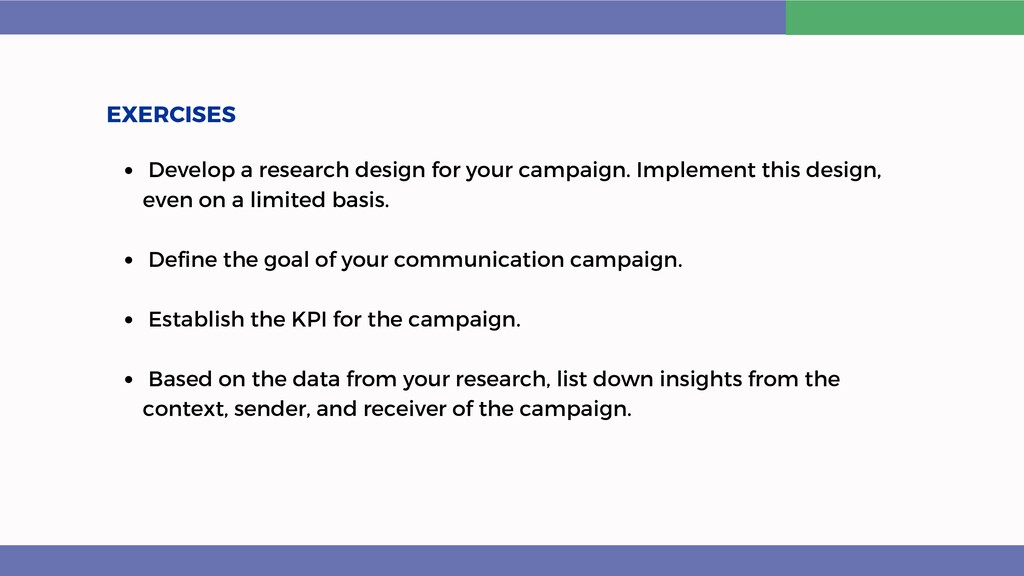
even on a limited basis. Define the goal of your communication campaign. Establish the KPI for the campaign. Based on the data from your research, list down insights from the context, sender, and receiver of the campaign. EXERCISES


 bgrey
 szymonslowik
 konakalab
 moore
 varn
 badams
 62gerente
 morganepeng
 sergeychernyshev
 danielanewman
 tammyeverts
 mlcsv
 mongodb