How SEO Is Changing in 2026: What Businesses Ne...

Share
Embed
How SEO Is Changing in 2026: What Businesses Need to Know
Discover how SEO is evolving in 2026 with AI powered search, Generative Engine Optimization (GEO), zero click searches and changing Google algorithms. Explore 10 important SEO trends, practical optimization strategies and what businesses should do to improve online visibility, attract quality traffic and generate more leads.

Mukesh Brand360
November 03, 2026
Transcript
6 slides
-
How SEO Is Changing in 2026: What Businesses Need to
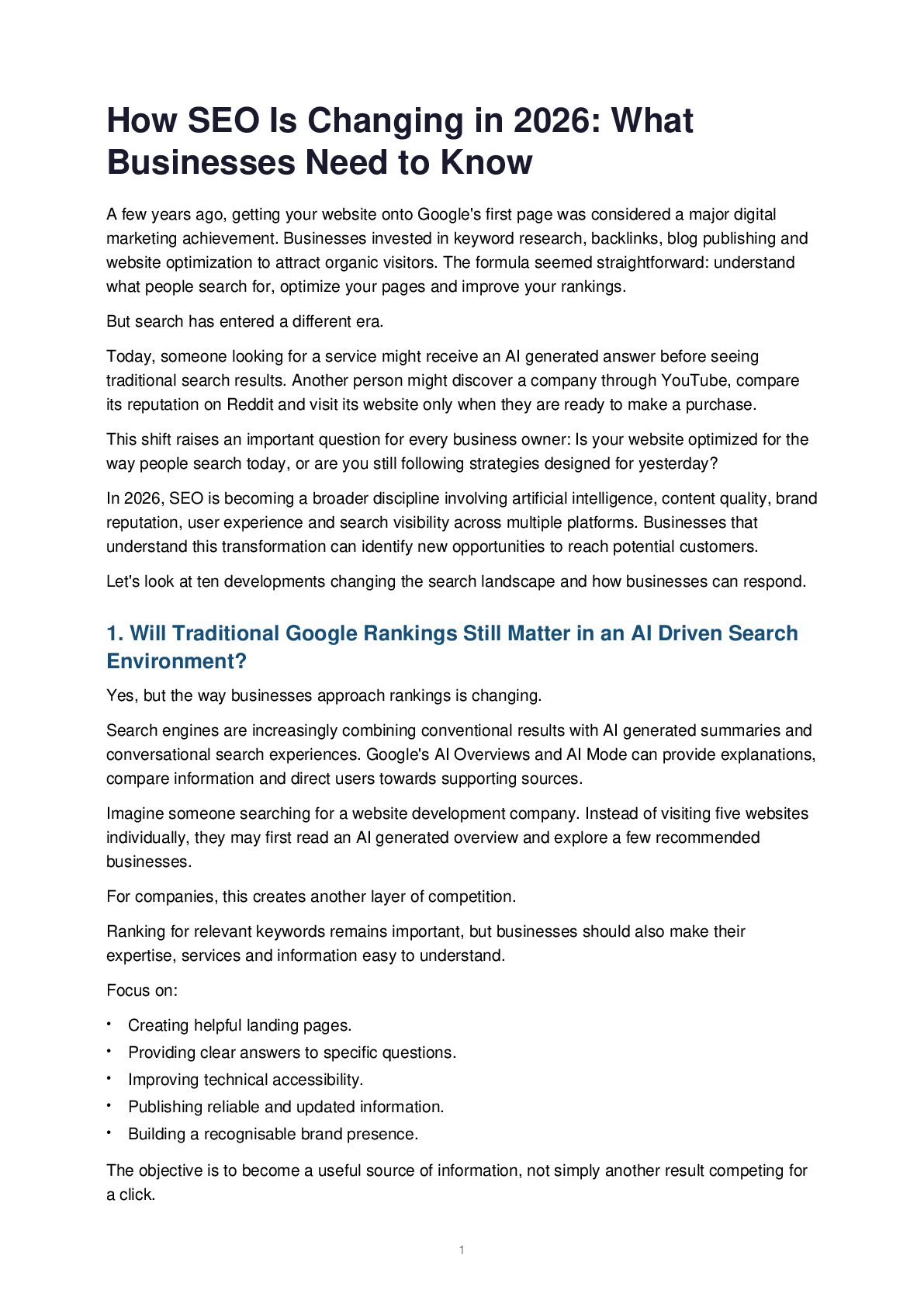
Know A few years ago, getting your website onto Google's first page was considered a major digital marketing achievement. Businesses invested in keyword research, backlinks, blog publishing and website optimization to attract organic visitors. The formula seemed straightforward: understand what people search for, optimize your pages and improve your rankings. But search has entered a different era. Today, someone looking for a service might receive an AI generated answer before seeing traditional search results. Another person might discover a company through YouTube, compare its reputation on Reddit and visit its website only when they are ready to make a purchase. This shift raises an important question for every business owner: Is your website optimized for the way people search today, or are you still following strategies designed for yesterday? In 2026, SEO is becoming a broader discipline involving artificial intelligence, content quality, brand reputation, user experience and search visibility across multiple platforms. Businesses that understand this transformation can identify new opportunities to reach potential customers. Let's look at ten developments changing the search landscape and how businesses can respond. 1. Will Traditional Google Rankings Still Matter in an AI Driven Search Environment? Yes, but the way businesses approach rankings is changing. Search engines are increasingly combining conventional results with AI generated summaries and conversational search experiences. Google's AI Overviews and AI Mode can provide explanations, compare information and direct users towards supporting sources. Imagine someone searching for a website development company. Instead of visiting five websites individually, they may first read an AI generated overview and explore a few recommended businesses. For companies, this creates another layer of competition. Ranking for relevant keywords remains important, but businesses should also make their expertise, services and information easy to understand. Focus on: • Creating helpful landing pages. • Providing clear answers to specific questions. • Improving technical accessibility. • Publishing reliable and updated information. • Building a recognisable brand presence. The objective is to become a useful source of information, not simply another result competing for a click. 1 -
2. Can GEO Help Businesses Become Visible in AI Generated
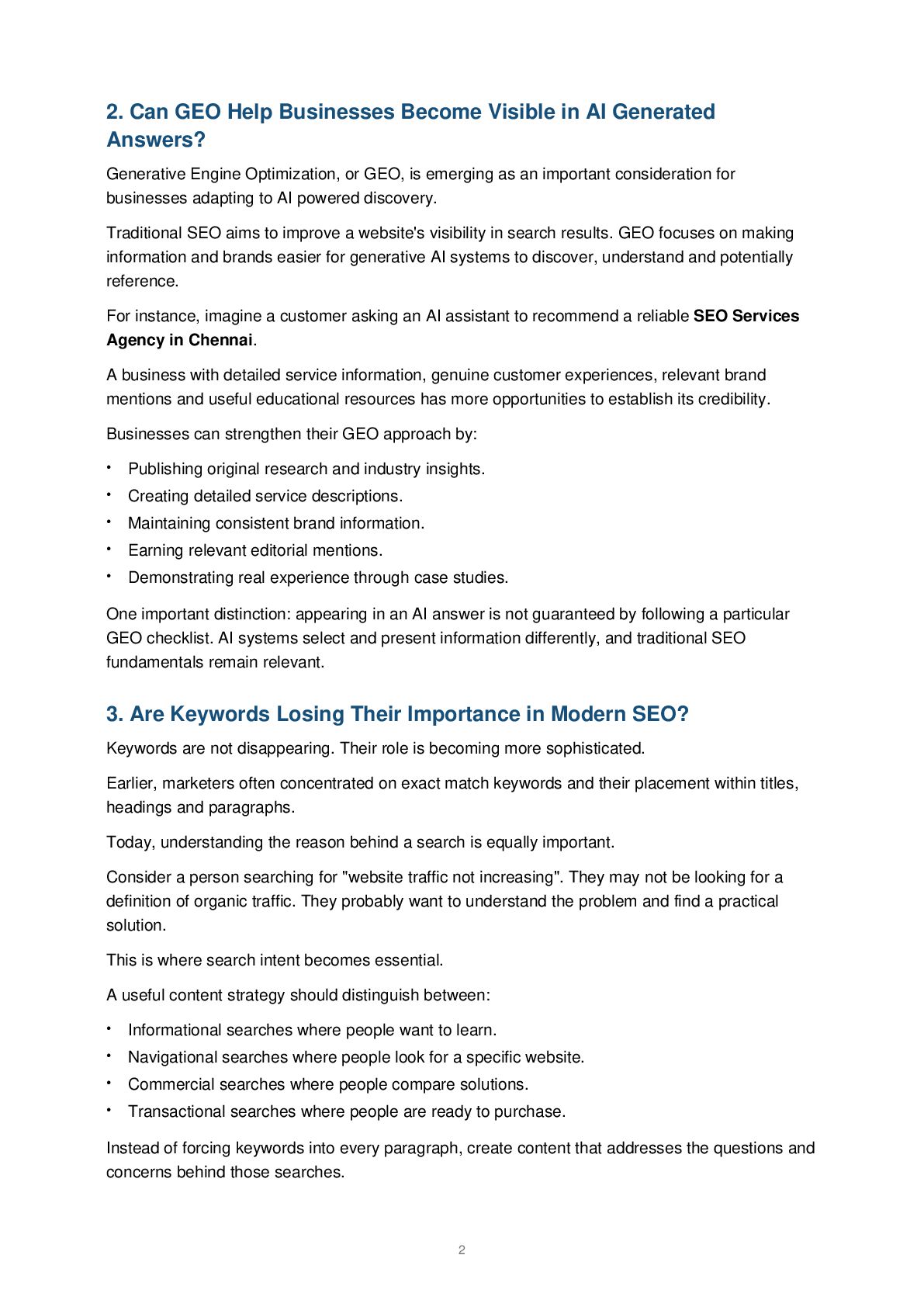
Answers? Generative Engine Optimization, or GEO, is emerging as an important consideration for businesses adapting to AI powered discovery. Traditional SEO aims to improve a website's visibility in search results. GEO focuses on making information and brands easier for generative AI systems to discover, understand and potentially reference. For instance, imagine a customer asking an AI assistant to recommend a reliable SEO Services Agency in Chennai. A business with detailed service information, genuine customer experiences, relevant brand mentions and useful educational resources has more opportunities to establish its credibility. Businesses can strengthen their GEO approach by: • Publishing original research and industry insights. • Creating detailed service descriptions. • Maintaining consistent brand information. • Earning relevant editorial mentions. • Demonstrating real experience through case studies. One important distinction: appearing in an AI answer is not guaranteed by following a particular GEO checklist. AI systems select and present information differently, and traditional SEO fundamentals remain relevant. 3. Are Keywords Losing Their Importance in Modern SEO? Keywords are not disappearing. Their role is becoming more sophisticated. Earlier, marketers often concentrated on exact match keywords and their placement within titles, headings and paragraphs. Today, understanding the reason behind a search is equally important. Consider a person searching for "website traffic not increasing". They may not be looking for a definition of organic traffic. They probably want to understand the problem and find a practical solution. This is where search intent becomes essential. A useful content strategy should distinguish between: • Informational searches where people want to learn. • Navigational searches where people look for a specific website. • Commercial searches where people compare solutions. • Transactional searches where people are ready to purchase. Instead of forcing keywords into every paragraph, create content that addresses the questions and concerns behind those searches. 2 -
4. Why Is Building Subject Expertise Becoming a Stronger SEO
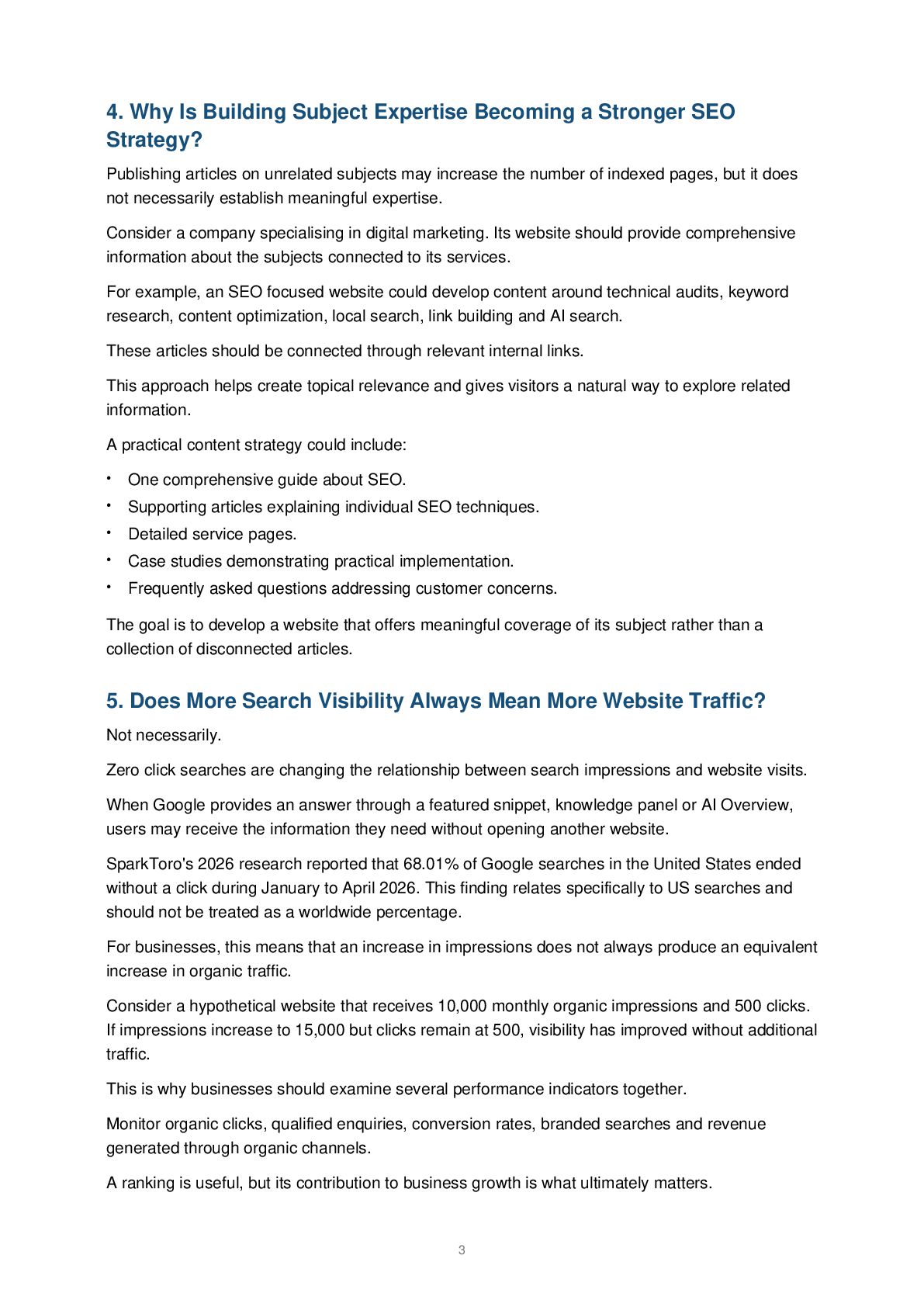
Strategy? Publishing articles on unrelated subjects may increase the number of indexed pages, but it does not necessarily establish meaningful expertise. Consider a company specialising in digital marketing. Its website should provide comprehensive information about the subjects connected to its services. For example, an SEO focused website could develop content around technical audits, keyword research, content optimization, local search, link building and AI search. These articles should be connected through relevant internal links. This approach helps create topical relevance and gives visitors a natural way to explore related information. A practical content strategy could include: • One comprehensive guide about SEO. • Supporting articles explaining individual SEO techniques. • Detailed service pages. • Case studies demonstrating practical implementation. • Frequently asked questions addressing customer concerns. The goal is to develop a website that offers meaningful coverage of its subject rather than a collection of disconnected articles. 5. Does More Search Visibility Always Mean More Website Traffic? Not necessarily. Zero click searches are changing the relationship between search impressions and website visits. When Google provides an answer through a featured snippet, knowledge panel or AI Overview, users may receive the information they need without opening another website. SparkToro's 2026 research reported that 68.01% of Google searches in the United States ended without a click during January to April 2026. This finding relates specifically to US searches and should not be treated as a worldwide percentage. For businesses, this means that an increase in impressions does not always produce an equivalent increase in organic traffic. Consider a hypothetical website that receives 10,000 monthly organic impressions and 500 clicks. If impressions increase to 15,000 but clicks remain at 500, visibility has improved without additional traffic. This is why businesses should examine several performance indicators together. Monitor organic clicks, qualified enquiries, conversion rates, branded searches and revenue generated through organic channels. A ranking is useful, but its contribution to business growth is what ultimately matters. 3 -
6. Is Google Still the Only Platform Businesses Should Optimize
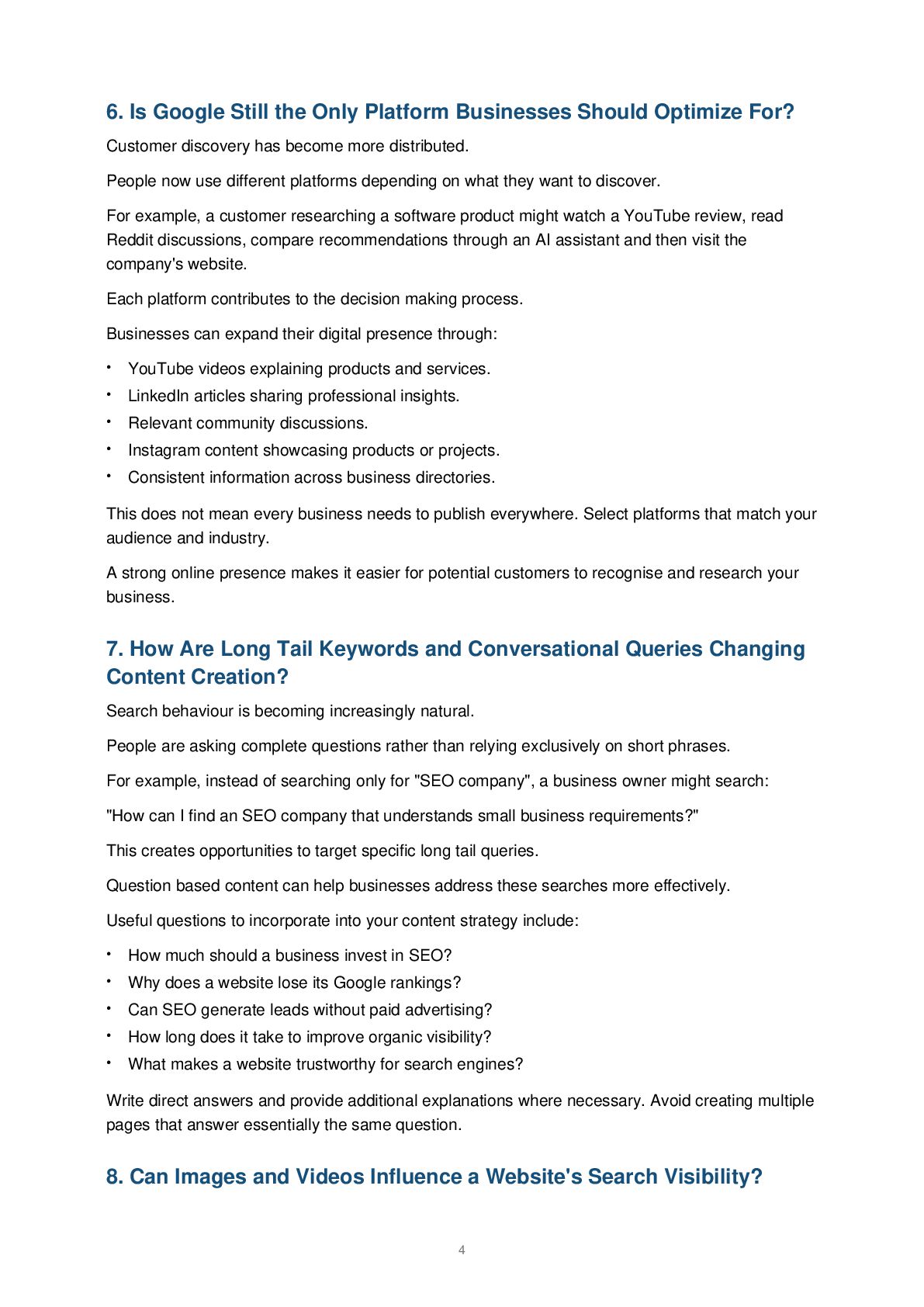
For? Customer discovery has become more distributed. People now use different platforms depending on what they want to discover. For example, a customer researching a software product might watch a YouTube review, read Reddit discussions, compare recommendations through an AI assistant and then visit the company's website. Each platform contributes to the decision making process. Businesses can expand their digital presence through: • YouTube videos explaining products and services. • LinkedIn articles sharing professional insights. • Relevant community discussions. • Instagram content showcasing products or projects. • Consistent information across business directories. This does not mean every business needs to publish everywhere. Select platforms that match your audience and industry. A strong online presence makes it easier for potential customers to recognise and research your business. 7. How Are Long Tail Keywords and Conversational Queries Changing Content Creation? Search behaviour is becoming increasingly natural. People are asking complete questions rather than relying exclusively on short phrases. For example, instead of searching only for "SEO company", a business owner might search: "How can I find an SEO company that understands small business requirements?" This creates opportunities to target specific long tail queries. Question based content can help businesses address these searches more effectively. Useful questions to incorporate into your content strategy include: • How much should a business invest in SEO? • Why does a website lose its Google rankings? • Can SEO generate leads without paid advertising? • How long does it take to improve organic visibility? • What makes a website trustworthy for search engines? Write direct answers and provide additional explanations where necessary. Avoid creating multiple pages that answer essentially the same question. 8. Can Images and Videos Influence a Website's Search Visibility? 4 -
Absolutely. Search is becoming increasingly visual and multimodal. Tools such
as Google Lens and Circle to Search allow users to discover information using images and visual inputs. This creates opportunities for businesses that depend on visual presentation. A furniture company, for example, can make its products easier to discover through descriptive product images. A website development agency can use portfolio screenshots to demonstrate its previous projects. However, simply uploading images is not enough. Businesses should pay attention to: • Descriptive image filenames. • Relevant alternative text. • Image compression and loading performance. • Original photography. • Video descriptions and captions. • Contextual information surrounding visual content. Visual optimization should complement the overall page experience and provide additional information to visitors. 9. Why Are Real Experience and Original Information Becoming Competitive Advantages? AI has made it easier to generate articles, descriptions and marketing content at scale. As a result, businesses are competing in an environment where generic information is widely available. The real opportunity is to publish something readers cannot easily find everywhere else. Imagine two businesses publishing an article about improving website performance. One explains general speed optimization techniques. The other shares an actual website audit, identifies specific performance problems, explains the corrections and documents the before and after results. The second article provides a more practical learning experience. Businesses should consider publishing: • Original project case studies. • Customer success stories. • Industry surveys. • Expert interviews. • Practical implementation guides. • Genuine performance observations. For example, a website that improves its Largest Contentful Paint from 4.2 seconds to 2.1 seconds after optimization can explain the changes responsible for that improvement, provided those 5 -
measurements come from a genuine test. Specific evidence makes content
more informative and gives readers a reason to trust the publisher. 10. What Should Businesses Measure to Understand SEO Performance in 2026? SEO reporting needs to move beyond a simple ranking report. A website ranking in the top three positions for an important keyword is encouraging. However, businesses also need to understand whether that visibility attracts relevant visitors and generates enquiries. A more complete measurement strategy includes: • Search impressions: Understand how frequently your pages appear. • Organic clicks: Measure visits from unpaid search results. • Click through rate: Evaluate how effectively search appearances attract visitors. • Conversion rate: Identify the percentage of visitors completing desired actions. • Lead quality: Understand whether organic enquiries match your target customers. • Branded search demand: Monitor interest in your business name. • Engagement: Evaluate how visitors interact with your website. Google Search Console and Google Analytics 4 can provide valuable insights into these areas. For example, if organic traffic increases by 30% but enquiries remain unchanged, the next step should be to investigate visitor intent, landing page relevance and conversion experience rather than simply publishing more articles. Final Thoughts The future of SEO is not about abandoning everything that worked before. It is about understanding how search behaviour is evolving and adjusting your strategy accordingly. AI powered discovery, GEO, conversational queries, original content and brand credibility are creating new opportunities for businesses to connect with their audiences. Whether you manage optimization internally or partner with an SEO Services Agency in Chennai, the priority should be building a website that offers genuine value and supports your business objectives. Start by understanding your customers, strengthening your website foundation and creating information that answers real questions. Pay attention to technical performance, content quality and brand reputation. Avoid common SEO mistakes such as keyword stuffing, irrelevant link building, duplicate content and neglecting mobile optimization. Ultimately, successful SEO is not about manipulating search engines. It is about making your business the most useful and credible choice when potential customers are searching for a solution. 6
 rosshudgens
 aleyda
 zjchahalis
 speedyindexteam
 graydotco
 alexgalinos
 alexmossuk
 amandafloq
 lynnandtonic
 lauravandoore
 geoffreycrofte
 baasie
 cassininazir
 palkan
 3n
 chrislema
 madoxten
 inesmontani
 bermonpainter
 letsgokoyo