? ? ? ? A Field Guide to Asking Better Questions Cassini Nazir Assistant Professor Director, Curiosity Lab University of North Texas Mavericks Insight Conference UT Arlington, Masters in Market Research (MMR) 22 Sept 2026 · Hurst, TX The Curious Researcher · Cassini Nazir · 22 Sept. 2026 2
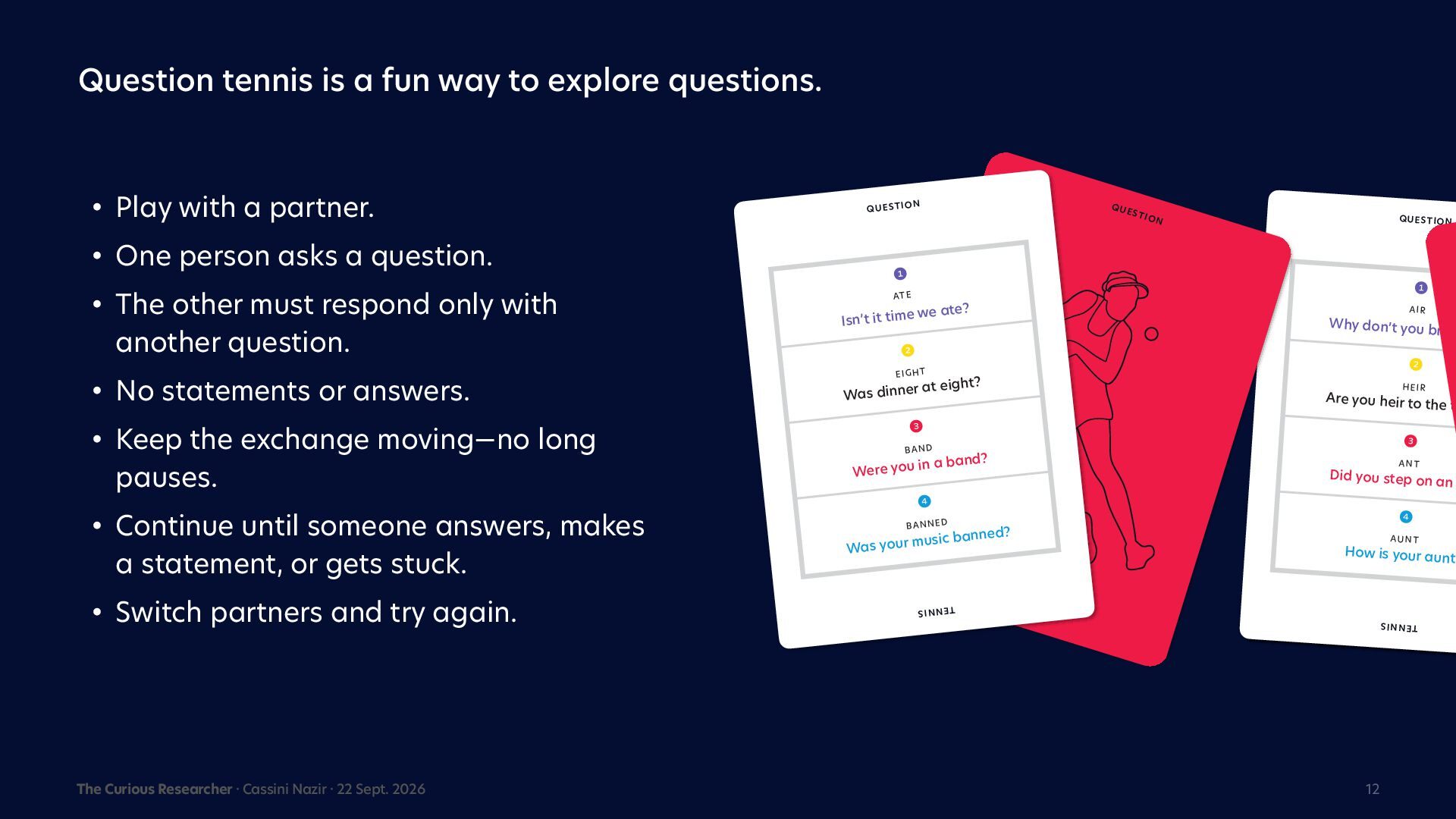
N NIS STIO TEN QUE TE N N IS Question tennis is a fun way to explore questions. island? Q U ES TI O N • One person asks a question. AD (VE RT ISI NG ) E d you se ATDi e th Björn Borg e we ate? Isn’t it tim 2 2 AD DIT IO N GH Tyou know how to EIDo add? r at eight? Was dinne 3 3 AIS LE Why ar D u standi BAeN yo ng in the aisle? in a band? Were you 4 4 ISL E Didn ED u visit BA N’tNyo an ned? island? si u m c ban r u o y s a W sW • Switch partners and try again. illiam TE N N IS N I S TE NN IS NIS • Continue until someone answers, makes a statement, or gets stuck. ? agic berry am Was that s Did you 1 2 AIR WRYhy don’t you br BU re? ea the treasu ry u b 2 3 HE IR ArRE e you heir to the CE AL th t cereal? a e u o y o D 3 4 AN T Di AL u step on an SEdRIyo st a serial? ca d o p Is that 4 AU NT How is your aunt ? TE N N IS TEN • Keep the exchange moving—no long pauses. QU ES TIO N 1 at online ad? Ven u • No statements or answers. N TEN • The other must respond only with another question. STIO BE RR Y 1 1 QUE TE NN IS • Play with a partner. QU ES TIO N Q U ES TI O N QU ES TIO N QU ES TIO N 1 The Curious Researcher · Cassini Nazir · 22 Sept. 2026 Isn’t it AT E 12 1
canquality do different of questions kinds ofmatter. work. Graesser, A. C., & Person, N. K. (1994). Question asking during tutoring. American Educational Research Journal, 31, 104-137. Lehnert, W. G. (1978). The process of question-answering. Hillsdale, NJ: Erlbaum.
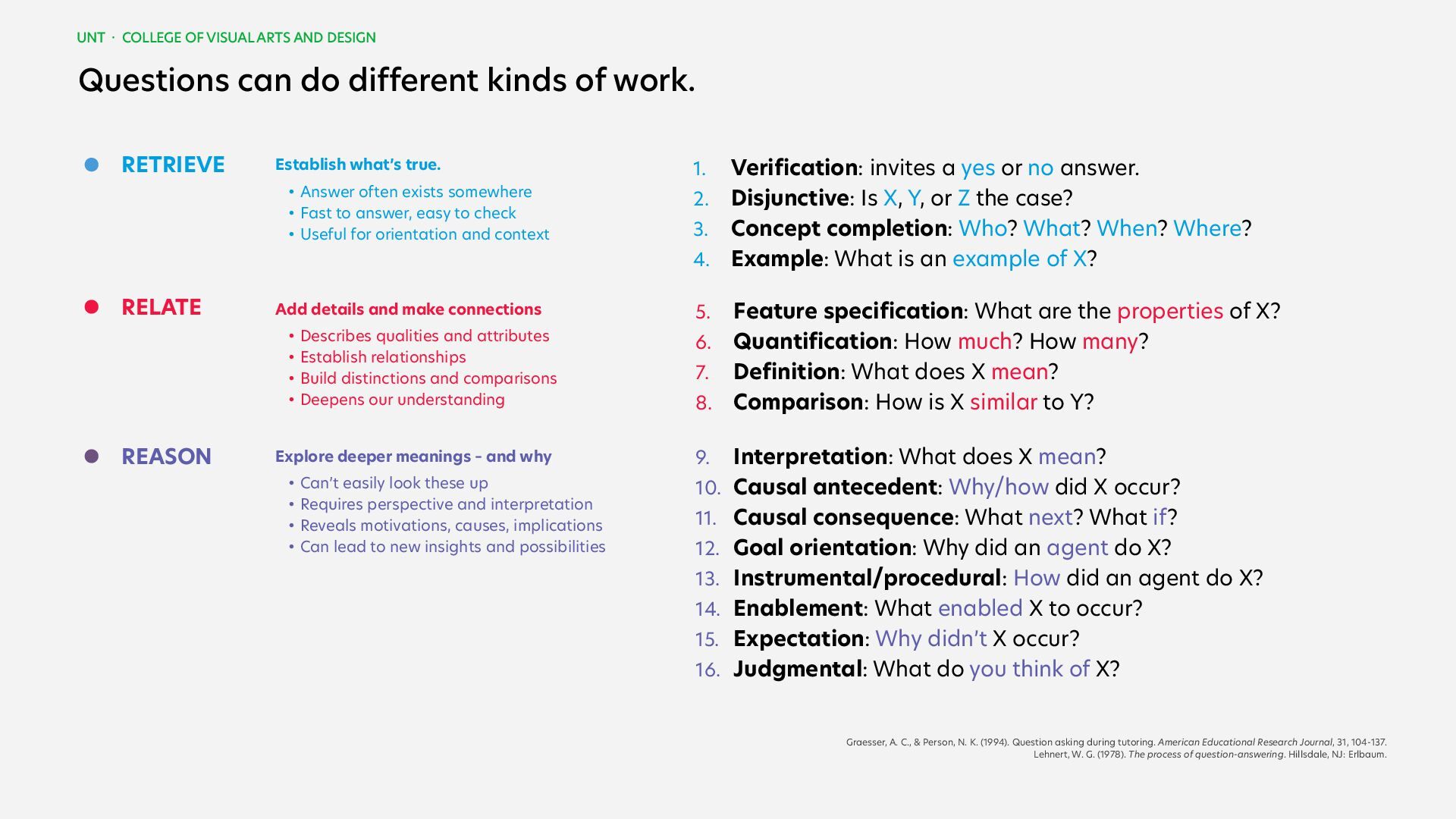
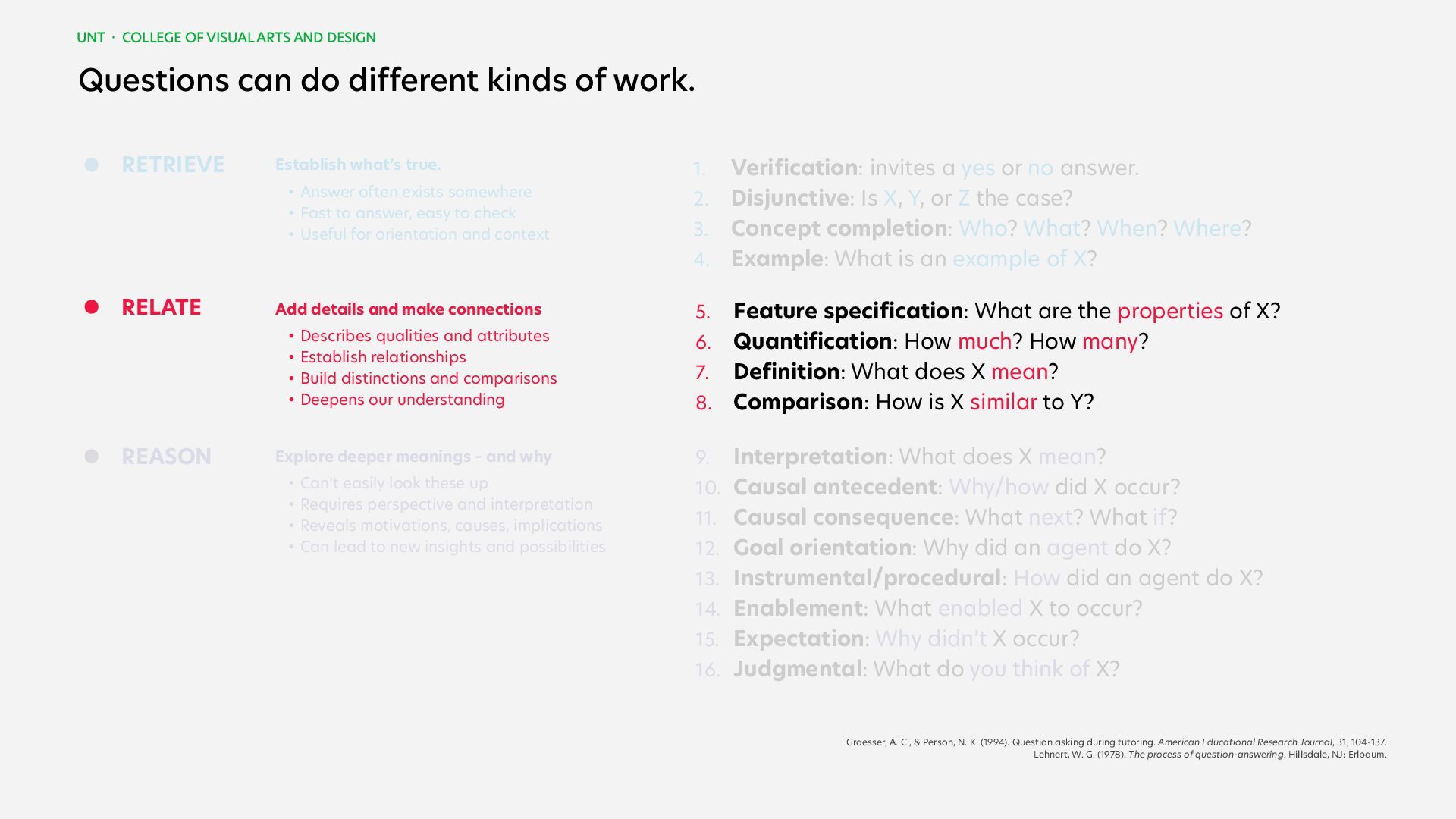
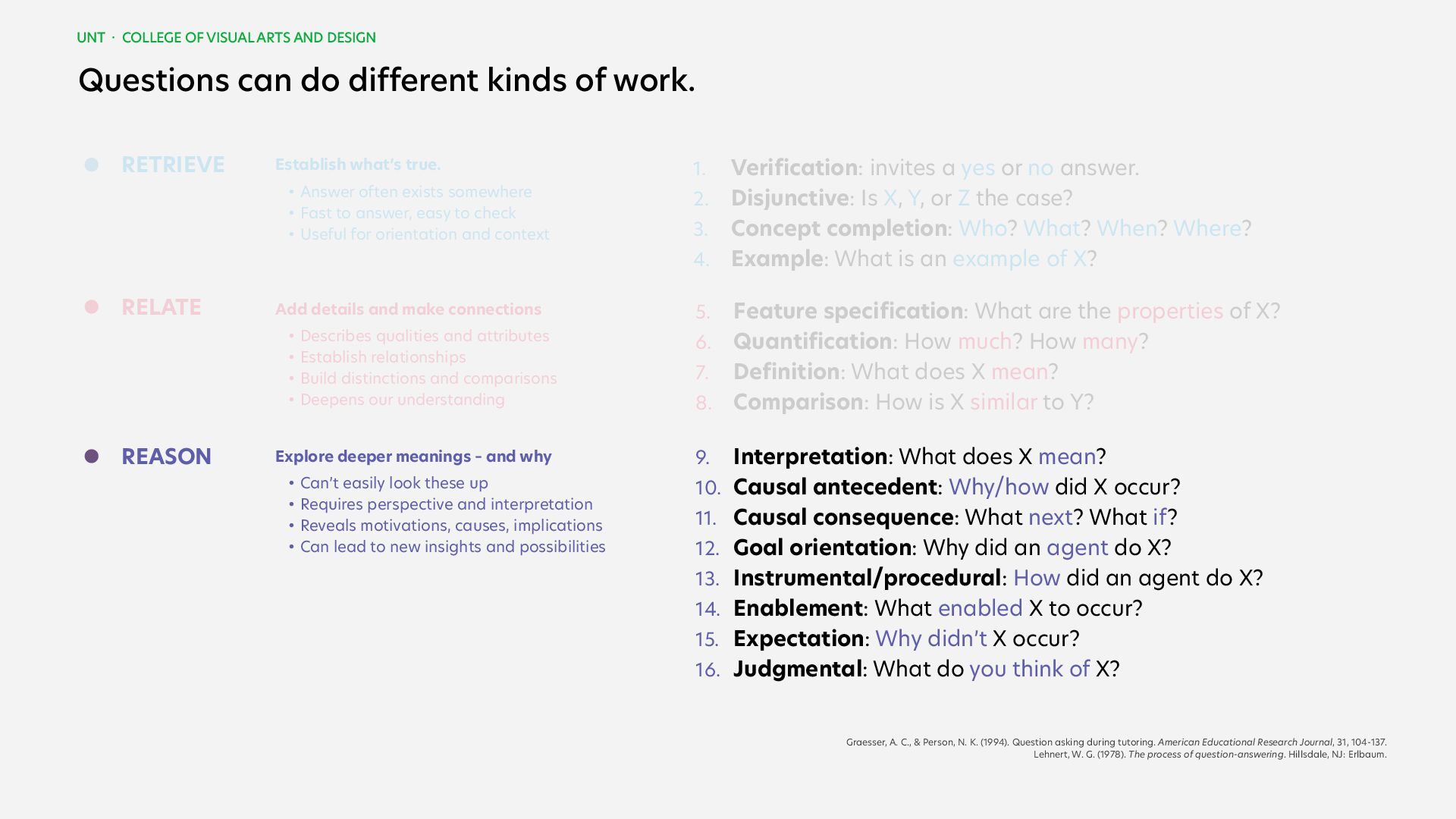
do different kinds of work. RETRIEVE Establish what’s true. • Answer often exists somewhere • Fast to answer, easy to check • Useful for orientation and context 1. 2. 3. 4. RELATE REASON Add details and make connections 5. • Describes qualities and attributes • Establish relationships • Build distinctions and comparisons • Deepens our understanding 6. Explore deeper meanings – and why 9. • Can’t easily look these up • Requires perspective and interpretation • Reveals motivations, causes, implications • Can lead to new insights and possibilities 7. 8. Verification: invites a yes or no answer. Disjunctive: Is X, Y, or Z the case? Concept completion: Who? What? When? Where? Example: What is an example of X? Feature specification: What are the properties of X? Quantification: How much? How many? Definition: What does X mean? Comparison: How is X similar to Y? Interpretation: What does X mean? 10. Causal antecedent: Why/how did X occur? 11. Causal consequence: What next? What if? 12. Goal orientation: Why did an agent do X? 13. Instrumental/procedural: How did an agent do X? 14. Enablement: What enabled X to occur? 15. Expectation: Why didn’t X occur? 16. Judgmental: What do you think of X? Graesser, A. C., & Person, N. K. (1994). Question asking during tutoring. American Educational Research Journal, 31, 104-137. Lehnert, W. G. (1978). The process of question-answering. Hillsdale, NJ: Erlbaum.
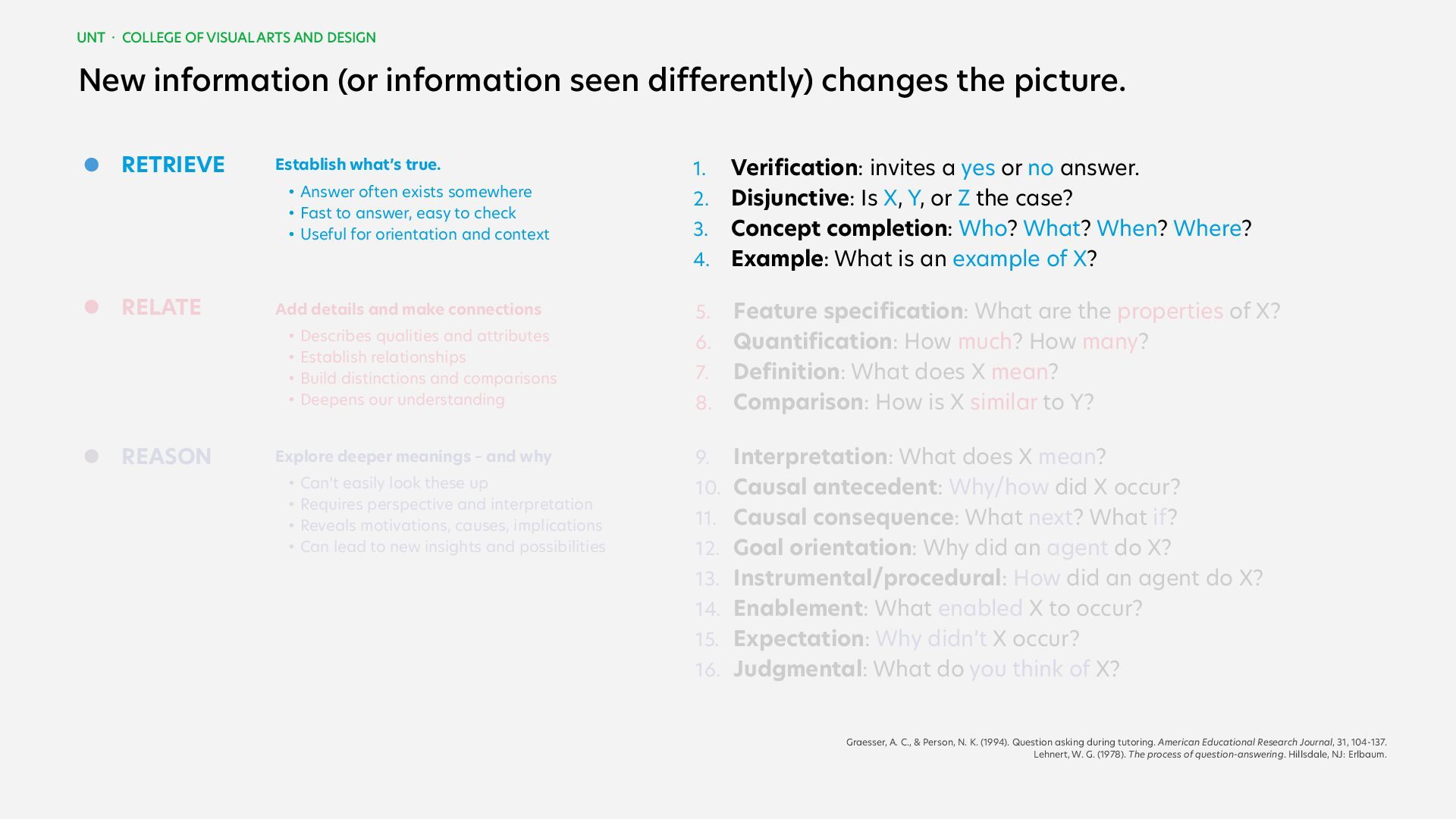
(or information seen differently) changes the picture. RETRIEVE Establish what’s true. • Answer often exists somewhere • Fast to answer, easy to check • Useful for orientation and context 1. 2. 3. 4. RELATE REASON Add details and make connections 5. • Describes qualities and attributes • Establish relationships • Build distinctions and comparisons • Deepens our understanding 6. Explore deeper meanings – and why 9. • Can’t easily look these up • Requires perspective and interpretation • Reveals motivations, causes, implications • Can lead to new insights and possibilities 7. 8. Verification: invites a yes or no answer. Disjunctive: Is X, Y, or Z the case? Concept completion: Who? What? When? Where? Example: What is an example of X? Feature specification: What are the properties of X? Quantification: How much? How many? Definition: What does X mean? Comparison: How is X similar to Y? Interpretation: What does X mean? 10. Causal antecedent: Why/how did X occur? 11. Causal consequence: What next? What if? 12. Goal orientation: Why did an agent do X? 13. Instrumental/procedural: How did an agent do X? 14. Enablement: What enabled X to occur? 15. Expectation: Why didn’t X occur? 16. Judgmental: What do you think of X? Graesser, A. C., & Person, N. K. (1994). Question asking during tutoring. American Educational Research Journal, 31, 104-137. Lehnert, W. G. (1978). The process of question-answering. Hillsdale, NJ: Erlbaum.
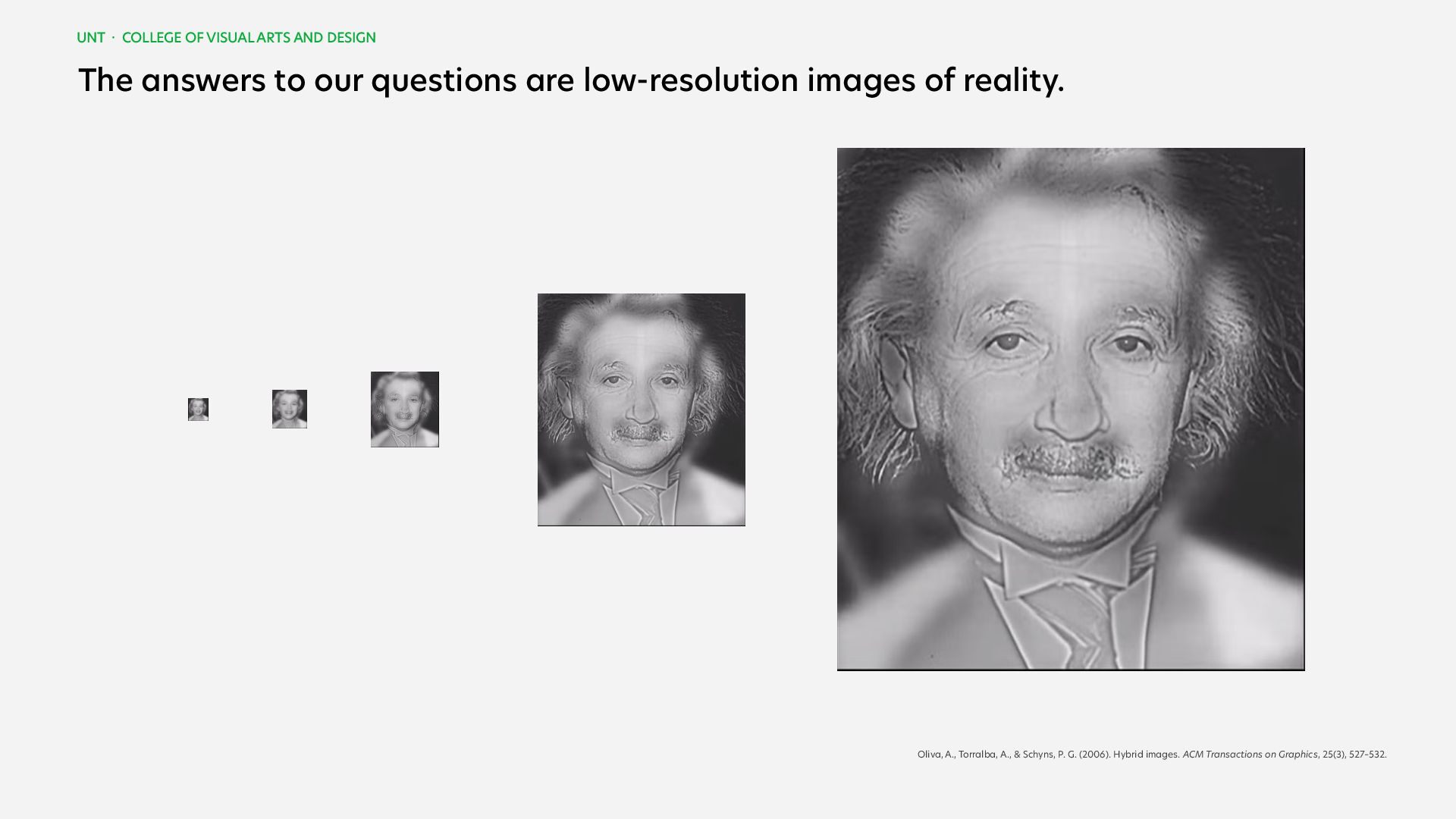
to our questions are low-resolution images of reality. Oliva, A., Torralba, A., & Schyns, P. G. (2006). Hybrid images. ACM Transactions on Graphics, 25(3), 527–532.
to our questions are low-resolution images of reality. Oliva, A., Torralba, A., & Schyns, P. G. (2006). Hybrid images. ACM Transactions on Graphics, 25(3), 527–532.
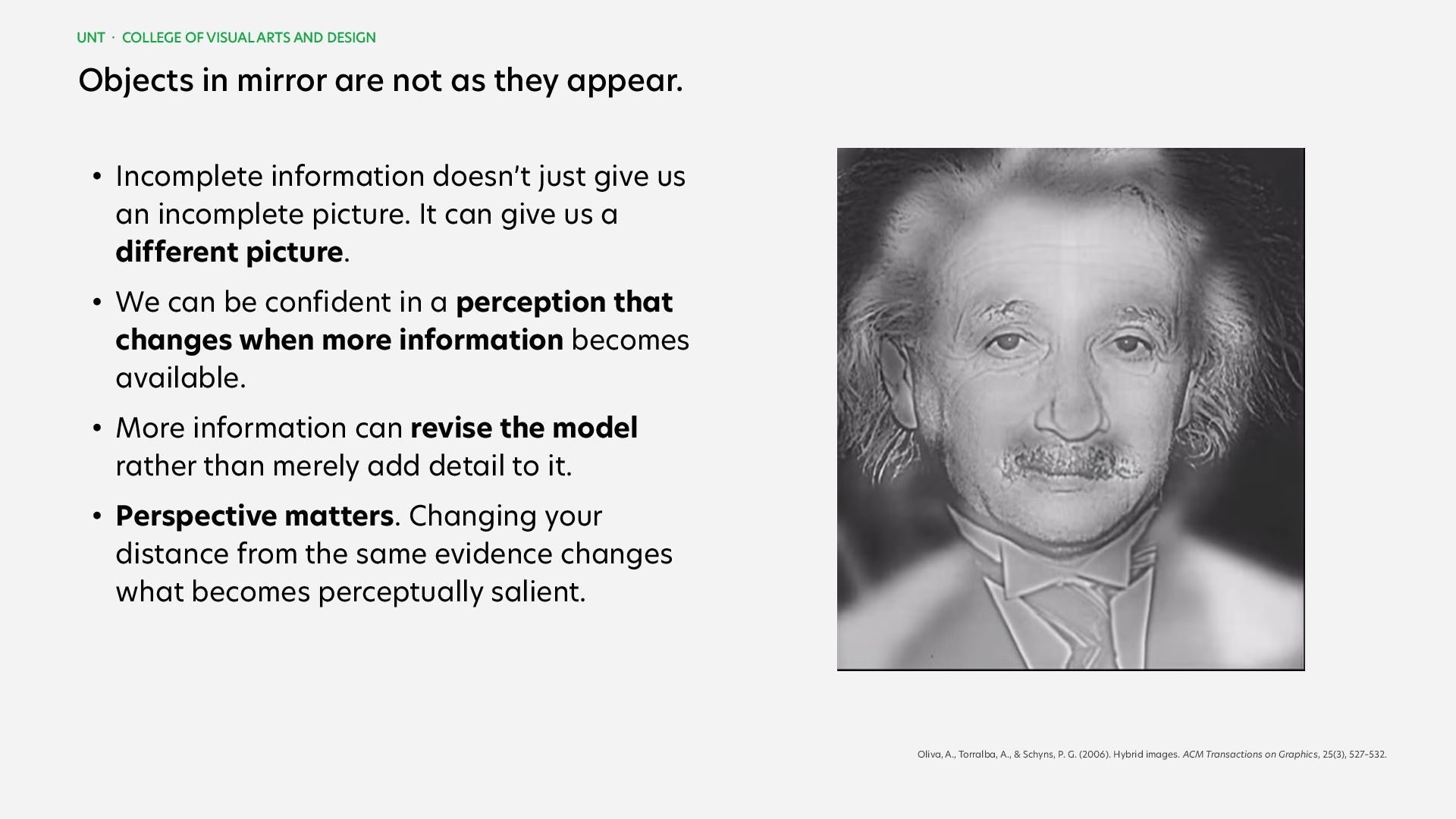
mirror are not as they appear. • Incomplete information doesn’t just give us an incomplete picture. It can give us a different picture. • We can be confident in a perception that changes when more information becomes available. • More information can revise the model rather than merely add detail to it. • Perspective matters. Changing your distance from the same evidence changes what becomes perceptually salient. Oliva, A., Torralba, A., & Schyns, P. G. (2006). Hybrid images. ACM Transactions on Graphics, 25(3), 527–532.
do different kinds of work. RETRIEVE Establish what’s true. • Answer often exists somewhere • Fast to answer, easy to check • Useful for orientation and context 1. 2. 3. 4. RELATE REASON Add details and make connections 5. • Describes qualities and attributes • Establish relationships • Build distinctions and comparisons • Deepens our understanding 6. Explore deeper meanings – and why 9. • Can’t easily look these up • Requires perspective and interpretation • Reveals motivations, causes, implications • Can lead to new insights and possibilities 7. 8. Verification: invites a yes or no answer. Disjunctive: Is X, Y, or Z the case? Concept completion: Who? What? When? Where? Example: What is an example of X? Feature specification: What are the properties of X? Quantification: How much? How many? Definition: What does X mean? Comparison: How is X similar to Y? Interpretation: What does X mean? 10. Causal antecedent: Why/how did X occur? 11. Causal consequence: What next? What if? 12. Goal orientation: Why did an agent do X? 13. Instrumental/procedural: How did an agent do X? 14. Enablement: What enabled X to occur? 15. Expectation: Why didn’t X occur? 16. Judgmental: What do you think of X? Graesser, A. C., & Person, N. K. (1994). Question asking during tutoring. American Educational Research Journal, 31, 104-137. Lehnert, W. G. (1978). The process of question-answering. Hillsdale, NJ: Erlbaum.
do different kinds of work. RETRIEVE Establish what’s true. • Answer often exists somewhere • Fast to answer, easy to check • Useful for orientation and context 1. 2. 3. 4. RELATE REASON Add details and make connections 5. • Describes qualities and attributes • Establish relationships • Build distinctions and comparisons • Deepens our understanding 6. Explore deeper meanings – and why 9. • Can’t easily look these up • Requires perspective and interpretation • Reveals motivations, causes, implications • Can lead to new insights and possibilities 7. 8. Verification: invites a yes or no answer. Disjunctive: Is X, Y, or Z the case? Concept completion: Who? What? When? Where? Example: What is an example of X? Feature specification: What are the properties of X? Quantification: How much? How many? Definition: What does X mean? Comparison: How is X similar to Y? Interpretation: What does X mean? 10. Causal antecedent: Why/how did X occur? 11. Causal consequence: What next? What if? 12. Goal orientation: Why did an agent do X? 13. Instrumental/procedural: How did an agent do X? 14. Enablement: What enabled X to occur? 15. Expectation: Why didn’t X occur? 16. Judgmental: What do you think of X? Graesser, A. C., & Person, N. K. (1994). Question asking during tutoring. American Educational Research Journal, 31, 104-137. Lehnert, W. G. (1978). The process of question-answering. Hillsdale, NJ: Erlbaum.
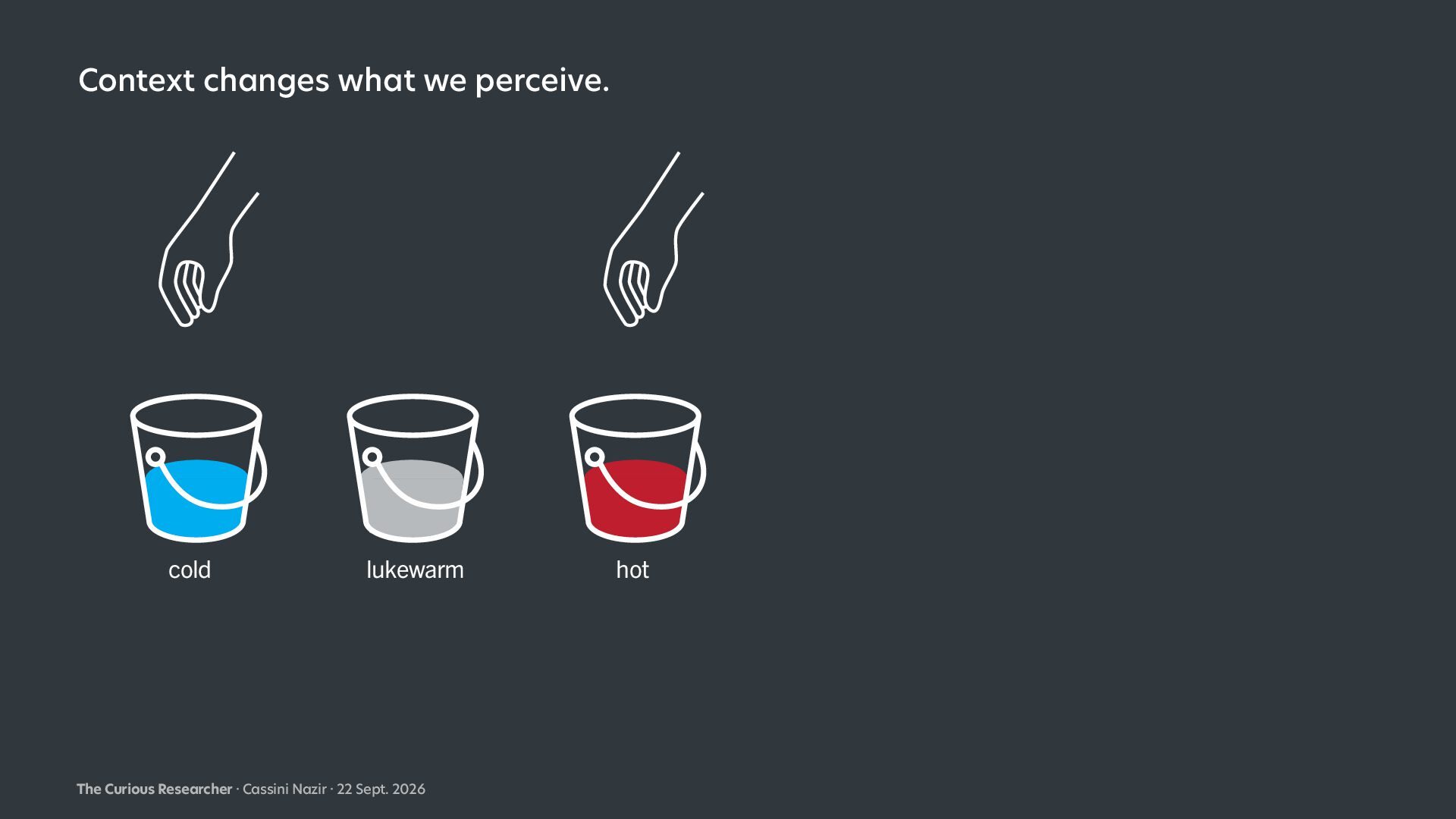
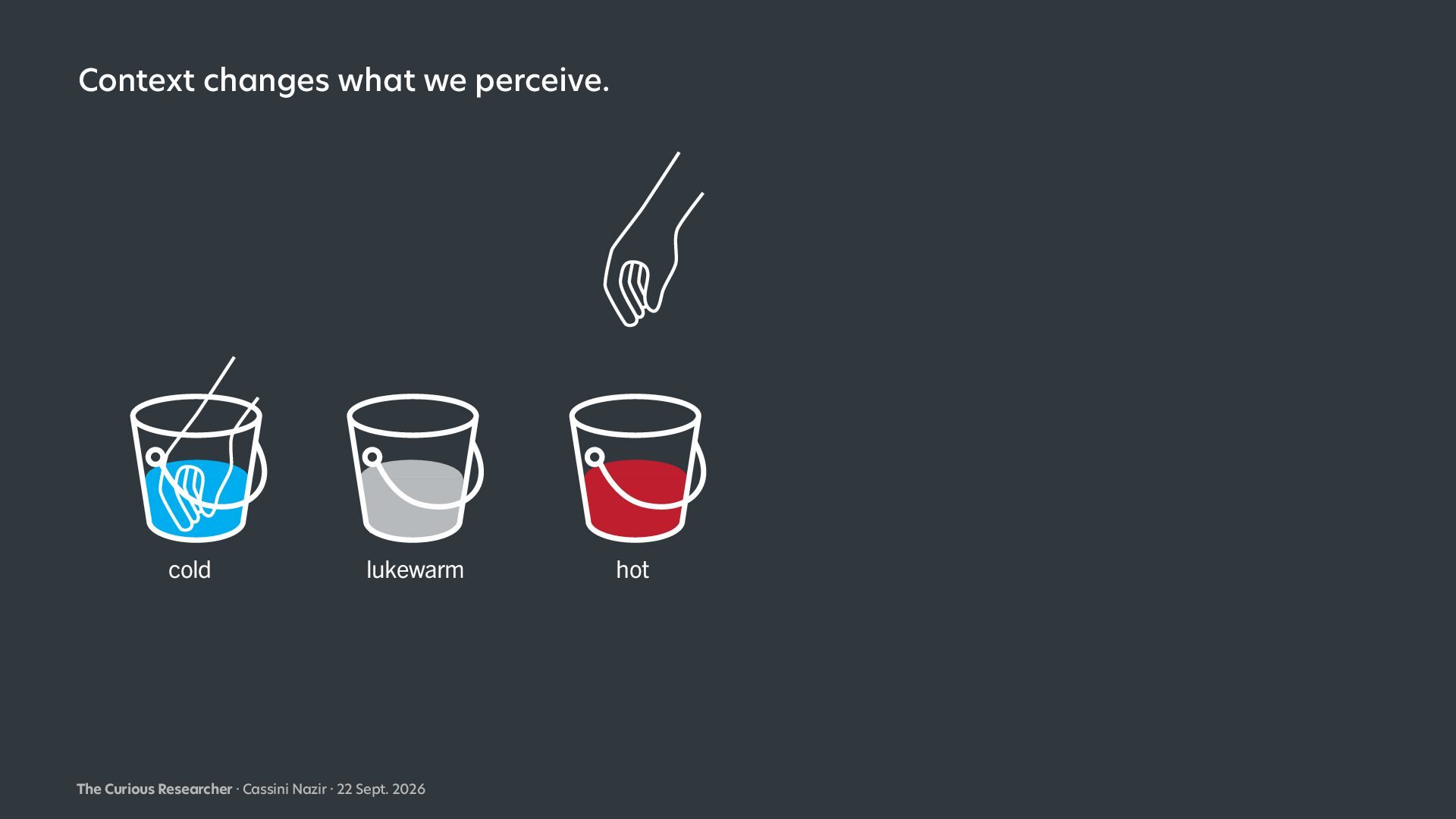
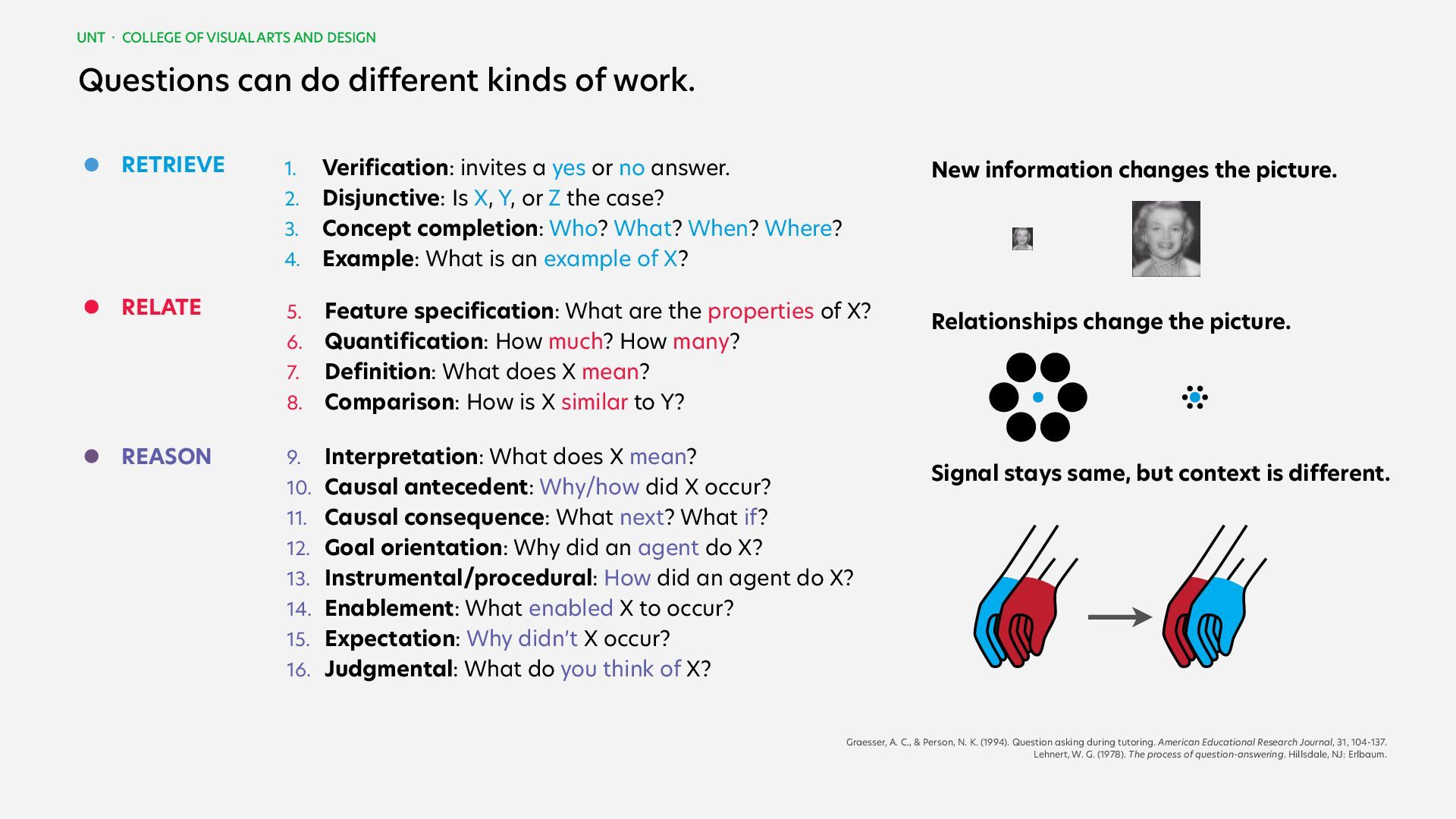
do different kinds of work. RETRIEVE 1. 2. 3. 4. RELATE 5. 6. 7. 8. REASON Verification: invites a yes or no answer. Disjunctive: Is X, Y, or Z the case? Concept completion: Who? What? When? Where? Example: What is an example of X? New information changes the picture. Feature specification: What are the properties of X? Quantification: How much? How many? Definition: What does X mean? Comparison: How is X similar to Y? Relationships change the picture. Interpretation: What does X mean? 10. Causal antecedent: Why/how did X occur? 11. Causal consequence: What next? What if? 12. Goal orientation: Why did an agent do X? 13. Instrumental/procedural: How did an agent do X? 14. Enablement: What enabled X to occur? 15. Expectation: Why didn’t X occur? 16. Judgmental: What do you think of X? 9. Signal stays same, but context is different. Graesser, A. C., & Person, N. K. (1994). Question asking during tutoring. American Educational Research Journal, 31, 104-137. Lehnert, W. G. (1978). The process of question-answering. Hillsdale, NJ: Erlbaum.
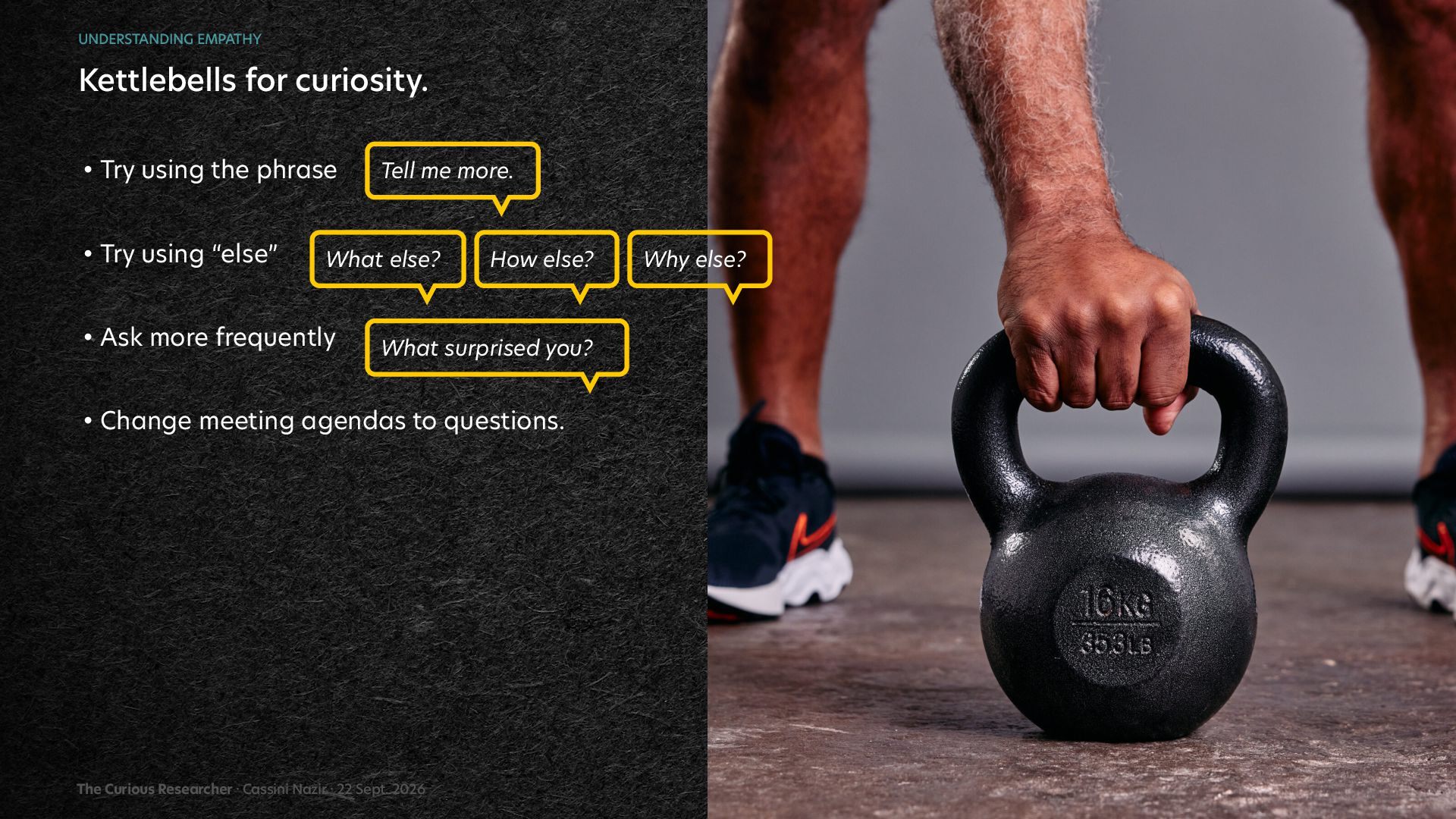
• Try using “else” Tell me more. What else? • Ask more frequently How else? What surprised you? • Change meeting agendas to questions. the dangers The Curious Researcher of empathy · Cassini advancing Nazir research · 22 Sept. 2023 2026 proposal Why else?
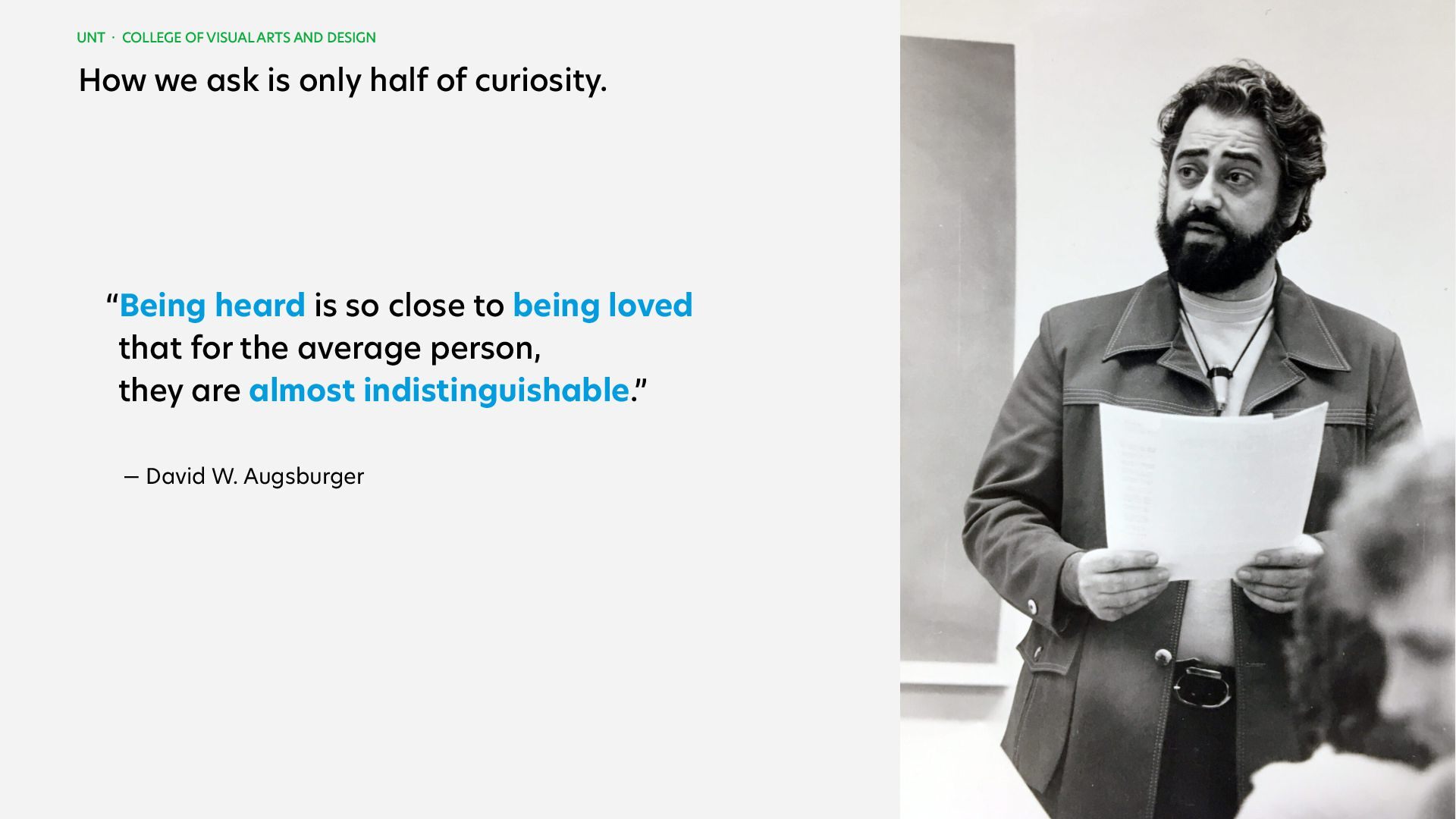
ask is only half of curiosity. “Being heard is so close to being loved that for the average person, they are almost indistinguishable.” — David W. Augsburger
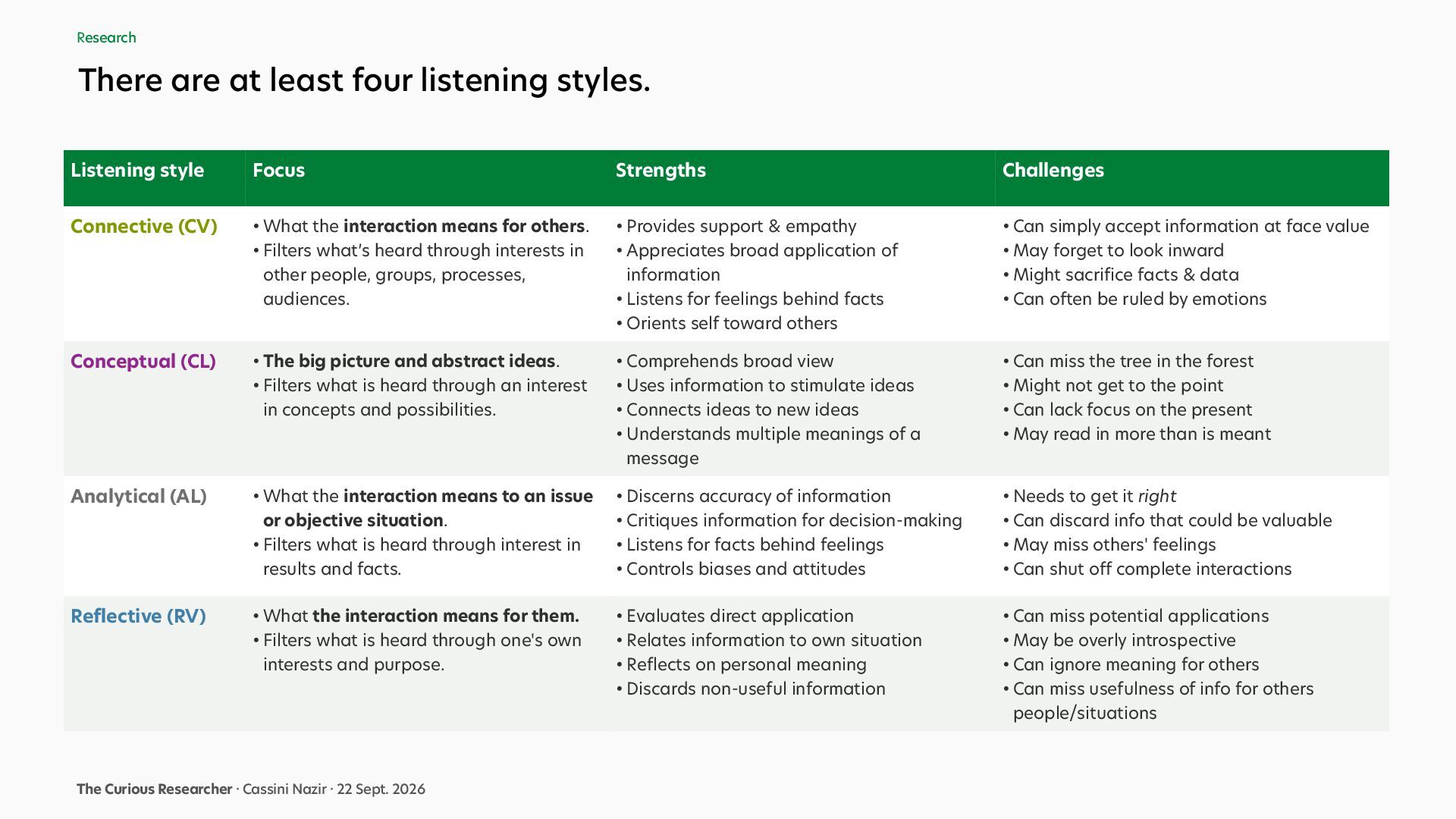
Focus Strengths Challenges Connective (CV) • What the interaction means for others. • Filters what’s heard through interests in other people, groups, processes, audiences. • Provides support & empathy • Appreciates broad application of information • Listens for feelings behind facts • Orients self toward others • Can simply accept information at face value • May forget to look inward • Might sacrifice facts & data • Can often be ruled by emotions Conceptual (CL) • The big picture and abstract ideas. • Filters what is heard through an interest in concepts and possibilities. • Comprehends broad view • Uses information to stimulate ideas • Connects ideas to new ideas • Understands multiple meanings of a message • Can miss the tree in the forest • Might not get to the point • Can lack focus on the present • May read in more than is meant Analytical (AL) • What the interaction means to an issue or objective situation. • Filters what is heard through interest in results and facts. • Discerns accuracy of information • Critiques information for decision-making • Listens for facts behind feelings • Controls biases and attitudes • Needs to get it right • Can discard info that could be valuable • May miss others' feelings • Can shut off complete interactions Reflective (RV) • What the interaction means for them. • Filters what is heard through one's own interests and purpose. • Evaluates direct application • Relates information to own situation • Reflects on personal meaning • Discards non-useful information • Can miss potential applications • May be overly introspective • Can ignore meaning for others • Can miss usefulness of info for others people/situations The Curious Researcher · Cassini Nazir · 22 Sept. 2026
that might change how you see them? • How would you need to listen to truly hear their answer? Cassini Nazir [email protected] http://unknowing.design https://youtu.be/uD4izuDMUQA the curious case for waylosing · secac 2024


 cassininazir
 quoitworks999
 mukai_takeru
 muture
 a2k
a2k
 keita_yoshikawa
 kotasaito_cnt
 0b1tk
0b1tk
 mhand01
 vivion
 yusukeiyoda
 toy1618
 nishame
 retrage
 davidcarrasco
 codingconduct
 rmw
rmw
 bkeepers
 soudai
 baasie
 chriscoyier
 axbom
axbom
 inesmontani
 tmiket
 coloredviolet