Upgrade to Pro — share decks privately, control downloads, hide ads and more …

Is Buying Verified PayPal Account Worth it?

Is Buying Verified PayPal Account Worth it?

Is Buying Verified PayPal Account Worth It?
At first glance, buying a verified PayPal account can look like a practical shortcut.
You find an account that is supposedly verified, already active, and ready to receive payments. You pay the seller, receive the login details, and expect to start working immediately.
But there's a question that matters more than the asking price:
━━━━━━━━━━━━━━━━━━━━━━━━━━━━━━
🗣️ For More Details: https://usamarketit.com
📞 Telegram Channel: @usamarketit
👾 Telegram Link: https://t.me/usamarketit
☎️ WhatsApp: +1(772)563-8300
💬 Email: [email protected]
✅ Trusted Service
⚡ Fast Response
━━━━━━━━━━━━━━━━━━━━━━━━━━━━━━
🚀 ORDER NOW FROM HERE:
https://usamarketit.com
What happens when PayPal needs to know who is actually using the account?
That's where the economics of buying an account change.
A cheap account can become expensive if it creates identity problems, security checks, payment interruptions, loss of access, or difficulties withdrawing funds.
PayPal explains that verification is intended to establish ownership of financial details associated with an account. It can also request additional identity information for regulatory and security purposes.
So is buying a verified PayPal account worth it?
For someone looking for a dependable long-term payment solution, the risks generally outweigh the convenience.
Here's why.
What Are You Actually Paying For?
When someone advertises a “verified PayPal account,” you're not necessarily buying a verified identity.
You're buying access to an account that somebody else may have created and verified.
That distinction changes everything.
A legitimate PayPal account is connected to a real person or business. Verification exists to establish information about that customer.
PayPal's official guidance explains that verification can involve confirming a bank account or card, while identity confirmation can require information such as name, address, date of birth, government-issued identification, and proof of address depending on the circumstances.
A third-party seller cannot simply transfer that history of identity verification to you.
The Convenience Argument
People who consider buying accounts usually have a reasonable argument:
“I need to receive payments now, and creating an account is taking too long.”
That's understandable.
A freelancer might have a new client waiting.
An ecommerce seller might want to accept payments immediately.
A small business might need to invoice an international customer.
Time has value.
But convenience only makes sense if the solution remains functional.
If the account works for three days and then requires identity confirmation that you cannot complete, the original time-saving benefit disappears.
The Risk-Reward Calculation
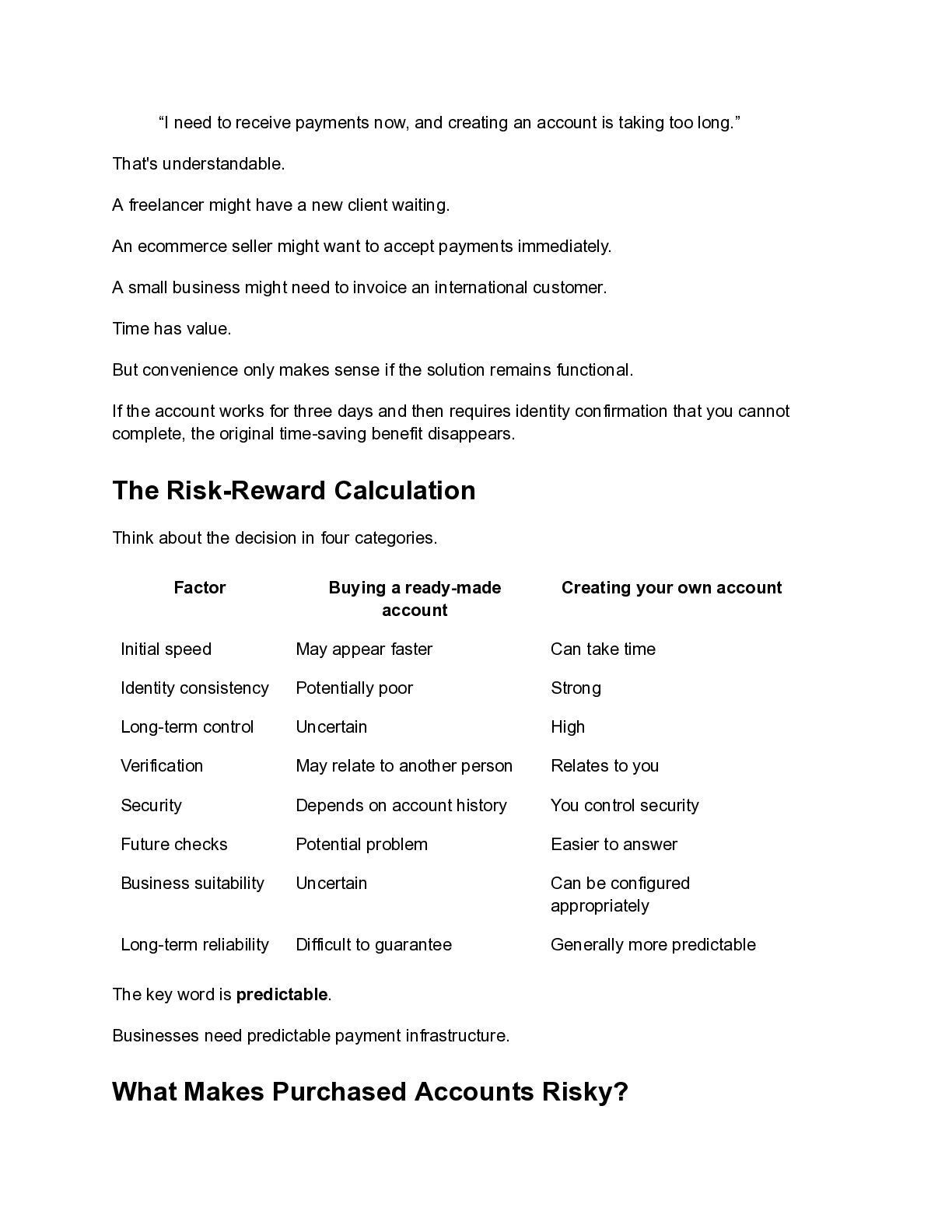
Think about the decision in four categories.
Factor
Buying a ready-made account

Avatar for Buy Verified Coinbase Account

Buy Verified Coinbase Account

September 08, 2026

Other Decks in Research

Transcript

  1. Is Buying Verified PayPal Account Worth It? At first glance,

    buying a verified PayPal account can look like a practical shortcut. You find an account that is supposedly verified, already active, and ready to receive payments. You pay the seller, receive the login details, and expect to start working immediately. But there's a question that matters more than the asking price: ━━━━━━━━━━━━━━━━━━━━━━━━━━━━━━ 🗣️ For More Details: https://usamarketit.com 📞 Telegram Channel: @usamarketit​ 👾 Telegram Link: https://t.me/usamarketit​ ☎️ WhatsApp: +1(772)563-8300​ 💬 Email: [email protected] ✅ Trusted Service​ ⚡ Fast Response ━━━━━━━━━━━━━━━━━━━━━━━━━━━━━━ 🚀 ORDER NOW FROM HERE:​ https://usamarketit.com What happens when PayPal needs to know who is actually using the account? That's where the economics of buying an account change. A cheap account can become expensive if it creates identity problems, security checks, payment interruptions, loss of access, or difficulties withdrawing funds. PayPal explains that verification is intended to establish ownership of financial details associated with an account. It can also request additional identity information for regulatory and security purposes. So is buying a verified PayPal account worth it?
  2. For someone looking for a dependable long-term payment solution, the

    risks generally outweigh the convenience. Here's why. What Are You Actually Paying For? When someone advertises a “verified PayPal account,” you're not necessarily buying a verified identity. You're buying access to an account that somebody else may have created and verified. That distinction changes everything. A legitimate PayPal account is connected to a real person or business. Verification exists to establish information about that customer. PayPal's official guidance explains that verification can involve confirming a bank account or card, while identity confirmation can require information such as name, address, date of birth, government-issued identification, and proof of address depending on the circumstances. A third-party seller cannot simply transfer that history of identity verification to you. The Convenience Argument People who consider buying accounts usually have a reasonable argument:
  3. “I need to receive payments now, and creating an account

    is taking too long.” That's understandable. A freelancer might have a new client waiting. An ecommerce seller might want to accept payments immediately. A small business might need to invoice an international customer. Time has value. But convenience only makes sense if the solution remains functional. If the account works for three days and then requires identity confirmation that you cannot complete, the original time-saving benefit disappears. The Risk-Reward Calculation Think about the decision in four categories. Factor Buying a ready-made account Creating your own account Initial speed May appear faster Can take time Identity consistency Potentially poor Strong Long-term control Uncertain High Verification May relate to another person Relates to you Security Depends on account history You control security Future checks Potential problem Easier to answer Business suitability Uncertain Can be configured appropriately Long-term reliability Difficult to guarantee Generally more predictable The key word is predictable. Businesses need predictable payment infrastructure. What Makes Purchased Accounts Risky?
  4. Identity is the biggest issue Imagine that an account was

    verified using a seller's identity. You now operate it from your own location. At some point, PayPal asks you to confirm your identity. What information are you going to provide? If you provide your own documents, they may not match the account. If you provide the seller's documents, you are attempting to represent another person's identity. Neither is a sound foundation for a business payment system. PayPal says its identity confirmation process exists to confirm customer information for regulatory reasons. Security checks can reveal changes PayPal states that it may request security checks when activity is new or unusual, including logins from a new device or location. That matters because a purchased account naturally changes hands. The account may suddenly be accessed from: •​ •​ •​ •​ •​ •​ A different country A different city A different device A different IP address A different browser A different usage pattern No seller can guarantee that a platform's security systems will ignore these changes. Your business may outgrow the account Suppose an account appears fine for small transactions. Later, your business grows. You begin receiving larger payments, using more currencies, or processing more customer transactions. Now the payment provider may need more information about your business.
  5. If the underlying account doesn't genuinely represent your business, growth

    can expose the problem. What About “Aged” Accounts? Aged accounts are frequently marketed as more valuable. The reasoning is usually simple: older accounts have history. But account age doesn't solve identity. An account created years ago for another person remains an account created for another person. Age can also create additional unknowns. You may not know: •​ •​ •​ •​ •​ •​ Who previously used it What transactions occurred Whether disputes occurred What devices accessed it Which payment methods were connected Whether the account previously had limitations That uncertainty has little value when the account will be used for important business income. What About “Fully Verified” Accounts? This phrase deserves particular caution. Ask: Verified for whom? If the answer is another person, the label doesn't solve your problem. PayPal's own explanation of verification focuses on proving ownership of financial details. So “fully verified” should never be interpreted as: “Any future user can operate this account without additional verification.” That's not what verification means.
  6. Is Buying Ever Worth It? From a purely theoretical perspective,

    someone might value the speed enough to accept the risks. But for a payment account that will hold business revenue, the calculation is different. Ask yourself: 1.​ Can I prove that the account belongs to me? 2.​ Can I complete future identity checks? 3.​ Can I control the recovery information? 4.​ Can I explain the account's history? 5.​ Can I safely withdraw money? 6.​ Can I keep using the account if PayPal asks additional questions? 7.​ Can I build my business around it for years? If the answer to several questions is “no,” the low purchase price is not the real cost. A Better Way to Solve the Problem Instead of buying an existing account, solve the underlying problem. If you need international payments Find a payment provider that officially supports your location. If you need faster setup Prepare your information before creating the account. Have your legitimate personal or business details ready. If you're a freelancer Ask your clients which payment methods they can use. You may have more than one option. If you operate an online store Compare payment gateways supported by your ecommerce platform. If your current provider doesn't support your country Don't purchase an account registered elsewhere.
  7. Find a regulated service that operates in your market. How

    to Set Up a More Reliable Payment System 1. Define your payment flow Write down where money comes from and where it needs to go. For example: Customer → Payment Provider → Your Bank That's more useful than simply saying, “I need PayPal.” 2. Identify the countries involved Are your customers in the USA? UK? Canada? Germany? Spain? France? The answer can affect currencies, payment methods, taxes, verification, and availability. 3. Determine whether you need personal or business functionality If you're operating commercially, examine business-oriented payment options. 4. Check withdrawal compatibility Don't choose a provider only because it accepts payments. Make sure you can withdraw funds using a method available to you. 5. Compare fees Consider: •​ Transaction fees
  8. •​ •​ •​ •​ Currency conversion Withdrawal fees Chargeback or

    dispute costs Monthly fees, if any 6. Evaluate verification Ask whether you can complete verification using your own legitimate information. If not, the service isn't a good fit. Common Mistakes When Evaluating an Account Mistake: Looking only at the price A $50 account isn't cheap if you lose access to $5,000 in business revenue. Mistake: Trusting screenshots A screenshot showing a “verified” status doesn't prove that you will control the account or pass future checks. Mistake: Believing guarantees “Lifetime warranty” isn't the same thing as control over a payment platform. Mistake: Ignoring account history You don't know what happened before you acquired the account. Mistake: Building a business around one payment method Even legitimate businesses should consider payment continuity. If possible, maintain appropriate backup payment options rather than making your entire operation dependent on one account. Expert Perspective: Optimize for Continuity The smartest payment decision isn't necessarily the fastest one. It's the one that remains workable when something unexpected happens. A good payment system should have:
  9. •​ •​ •​ •​ •​ •​ •​ •​ Clear ownership

    Accurate identity information Secure login credentials A compatible bank account Reliable customer support Documented transactions Appropriate business information A backup payment option when practical That's boring compared with an advertisement promising an “instant verified account.” It's also much more useful. Legitimate Alternatives Build your own PayPal account If PayPal is available for your needs, create and verify your own account. Use another payment provider Compare providers based on your actual location and payment requirements. Accept bank transfers For B2B work, direct transfers may be practical depending on your clients and countries. Use an ecommerce payment gateway Online stores can often integrate multiple payment methods. Use invoicing solutions Some businesses can use payment-enabled invoicing tools rather than relying on a purchased payment account. Frequently Asked Questions Is buying a verified PayPal account worth it? For long-term payment use, the risks can outweigh the convenience. A purchased account may be linked to another person's identity and could create problems if PayPal requests additional verification.
  10. Why do people buy verified PayPal accounts? People usually want

    faster access to payment functionality, international receiving capability, or an account in a market where they are having difficulty establishing one themselves. Does a verified PayPal account guarantee higher limits? No. PayPal explains that accounts can have sending and withdrawal limits and that verification requirements vary. Can an old PayPal account be safer? Age alone doesn't guarantee safety. An old account can still be subject to security checks, identity confirmation, and other requirements. What happens if PayPal asks for my identity after I buy an account? You may face a mismatch if the account was verified under another person's identity. The appropriate response is to use official PayPal support rather than submitting false information or attempting to bypass verification. Can I change the name on a purchased account? You should not assume that an account can simply be transferred into your identity. Name and identity changes are subject to the provider's procedures and circumstances. What does PayPal use identity verification for? PayPal says identity confirmation helps verify customer information for regulatory and security purposes. Why does PayPal ask for a government ID? Government-issued identification can be used as part of the Customer Identification Process when PayPal needs to confirm personal identity. Is buying an account better than creating one? Usually, the apparent speed advantage isn't worth creating uncertainty around identity, ownership, security, and future verification. What if I cannot use PayPal in my country?
  11. Look for payment providers officially supported in your location. Don't

    solve a geographic availability problem by purchasing an account associated with another country. What is the safest way to get a verified PayPal account? Create the account yourself using accurate information and complete PayPal's verification process. This gives you a much clearer relationship between your identity, financial information, and payment account. Conclusion The idea of buying a verified PayPal account sounds attractive because it appears to eliminate waiting and verification. But verification is valuable precisely because it connects an account to a real customer. Once you remove that connection, the apparent shortcut becomes a source of uncertainty. If you need PayPal for freelancing, ecommerce, consulting, or international business, build the payment setup around your real identity and actual business needs. If PayPal isn't suitable, choose another legitimate payment method rather than buying an account that may not remain usable. The real question isn't: “How cheaply can I buy a verified account?” It's: “Can I build a payment system that I can still trust when my business grows?” That is the decision worth making. Call to Action Before spending money on any account marketplace, compare the legitimate payment options available in your country. A few minutes spent checking availability, verification requirements, withdrawal methods, and fees can save you from turning a short-term convenience into a long-term payment problem.