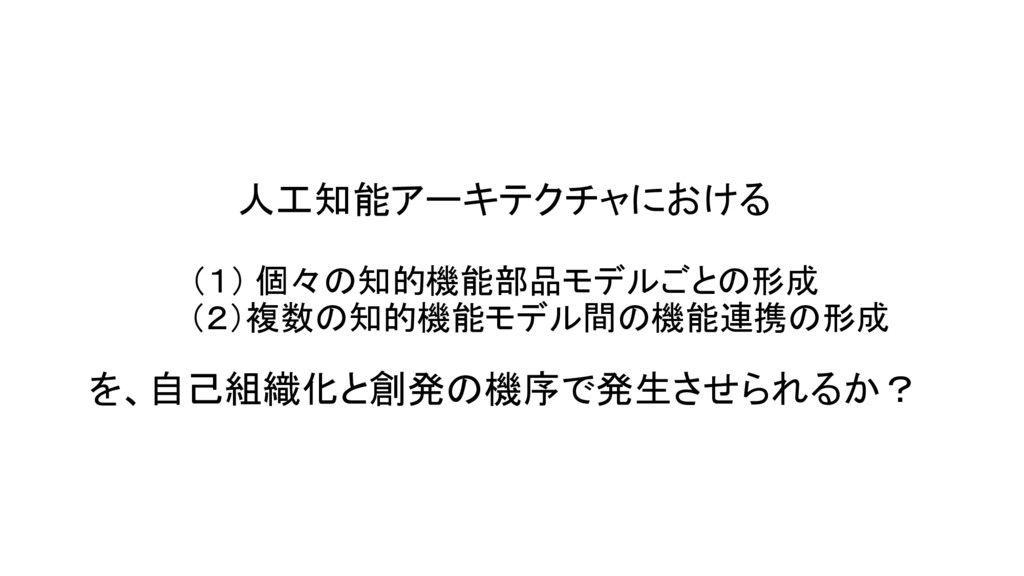
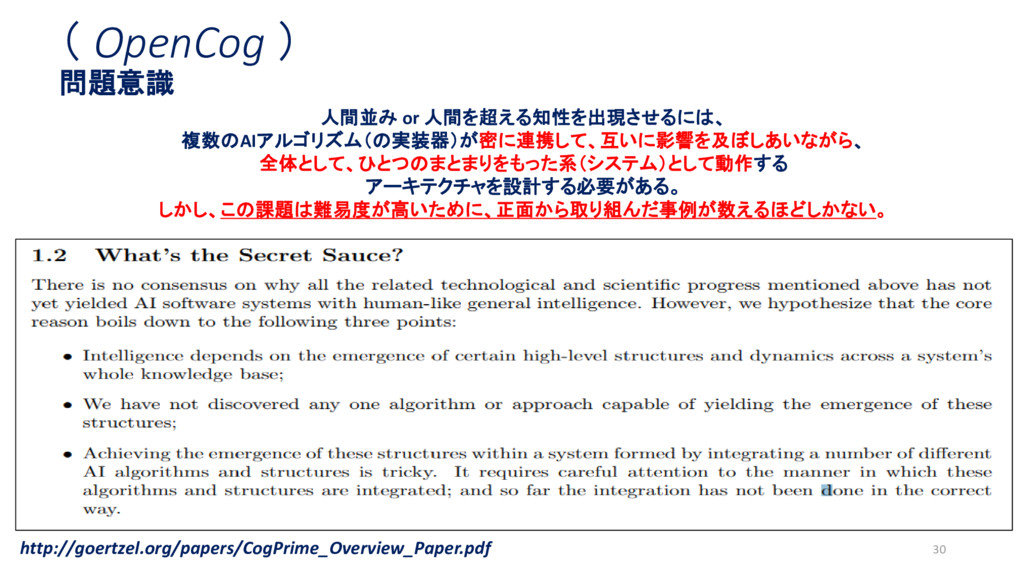
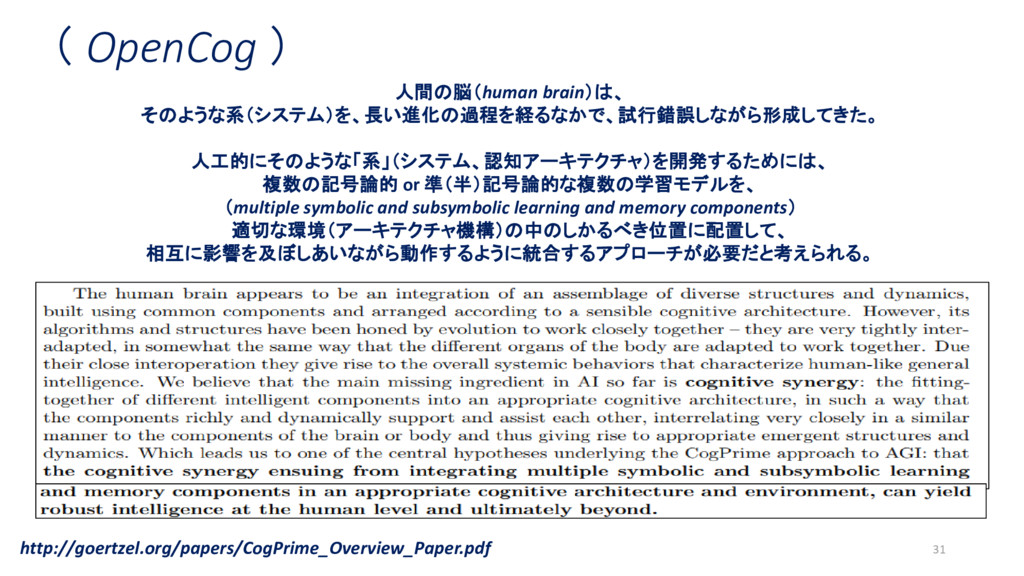
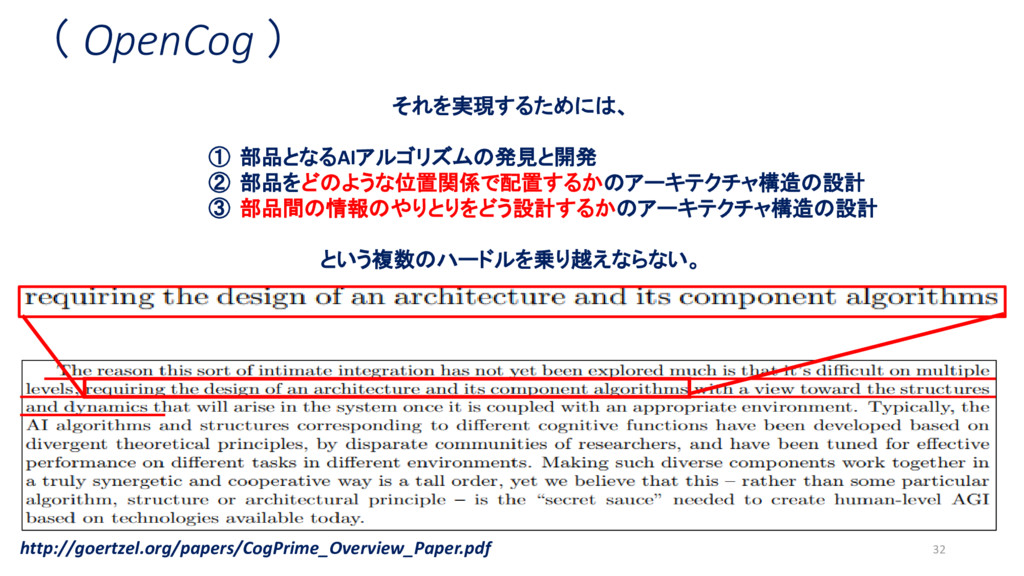
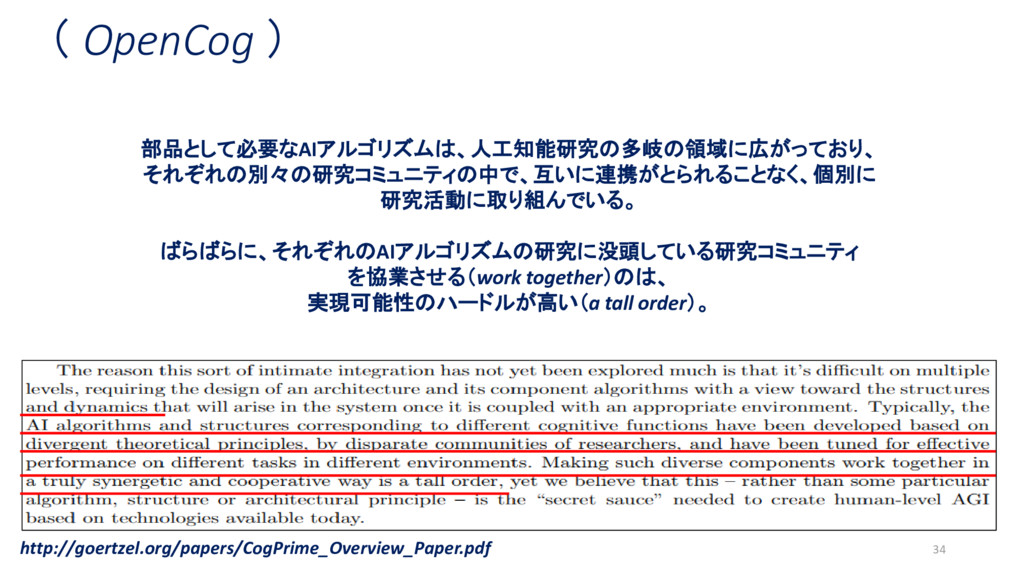
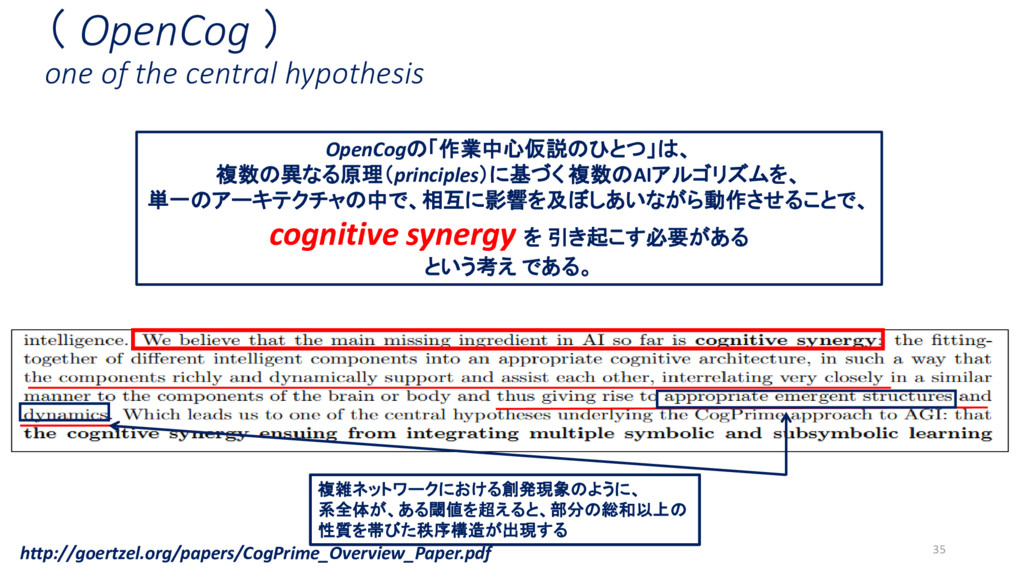
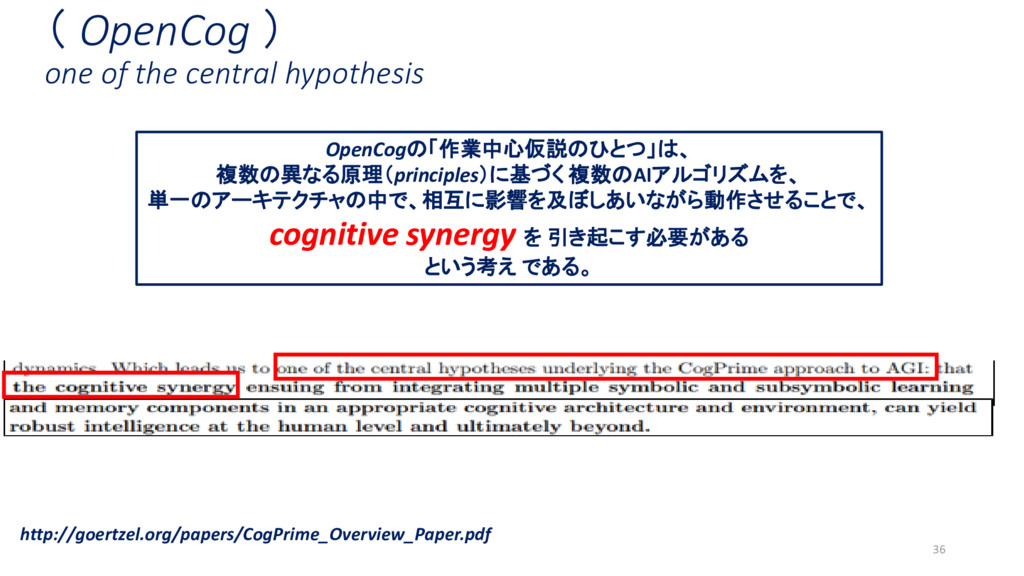
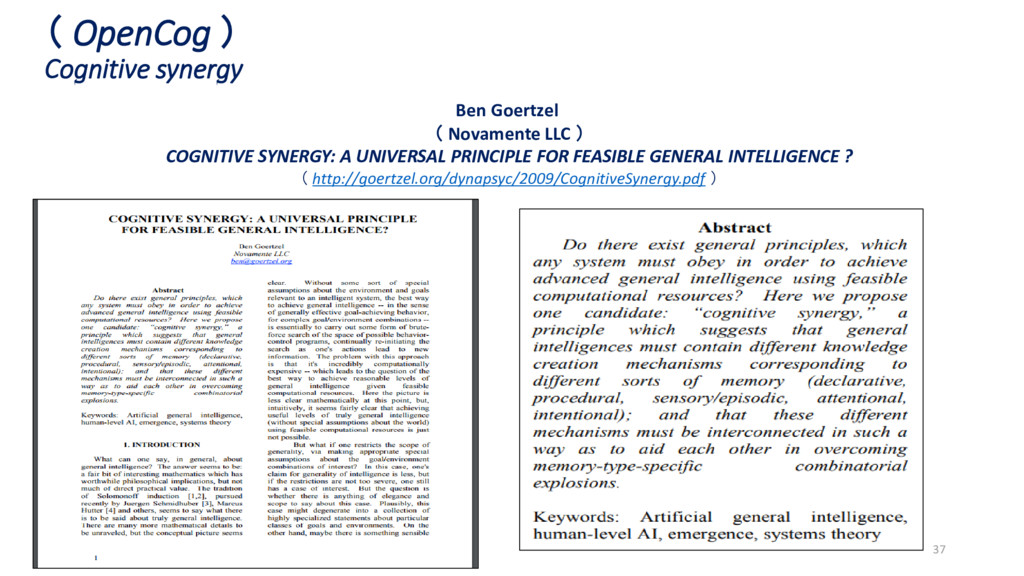
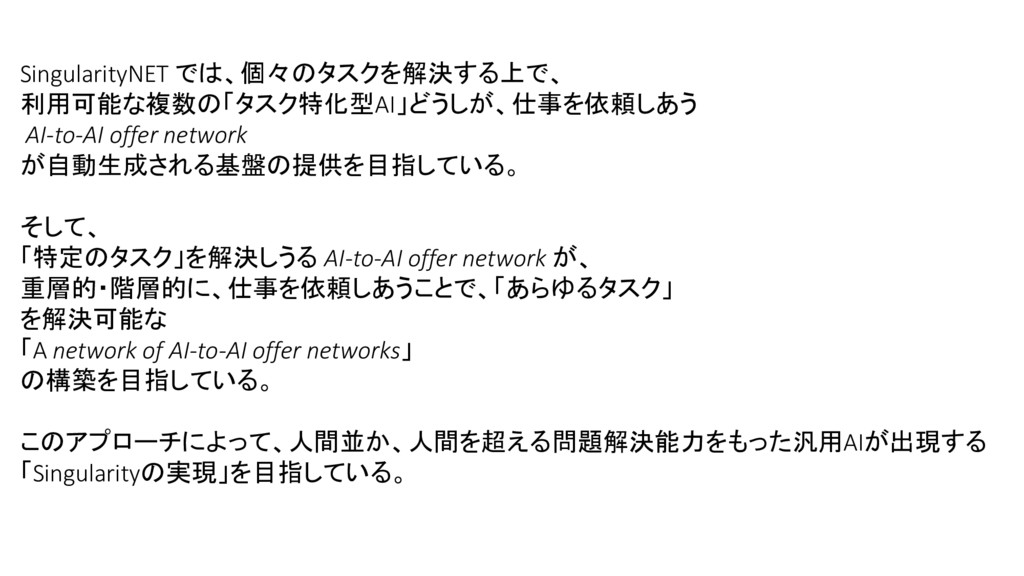
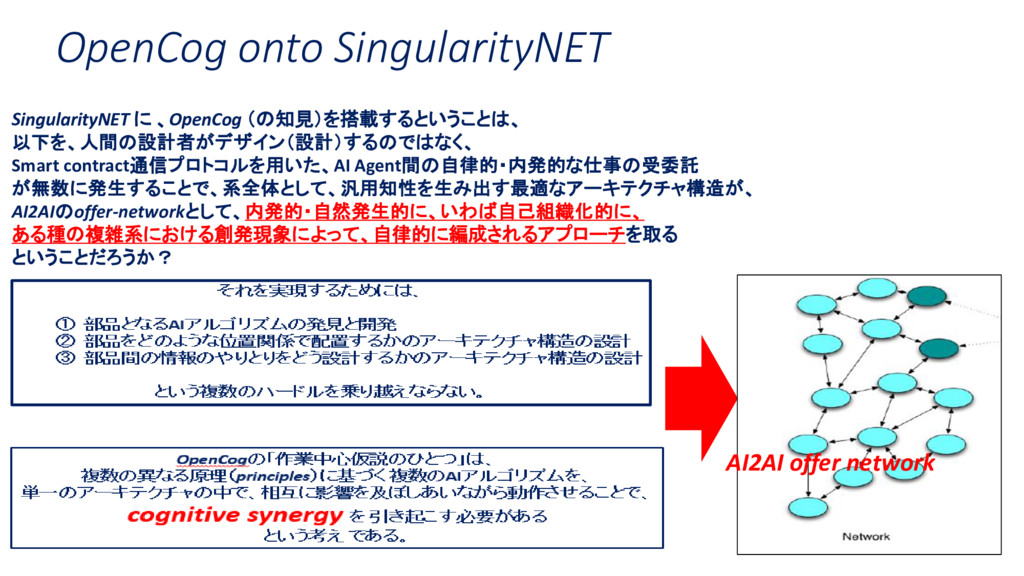
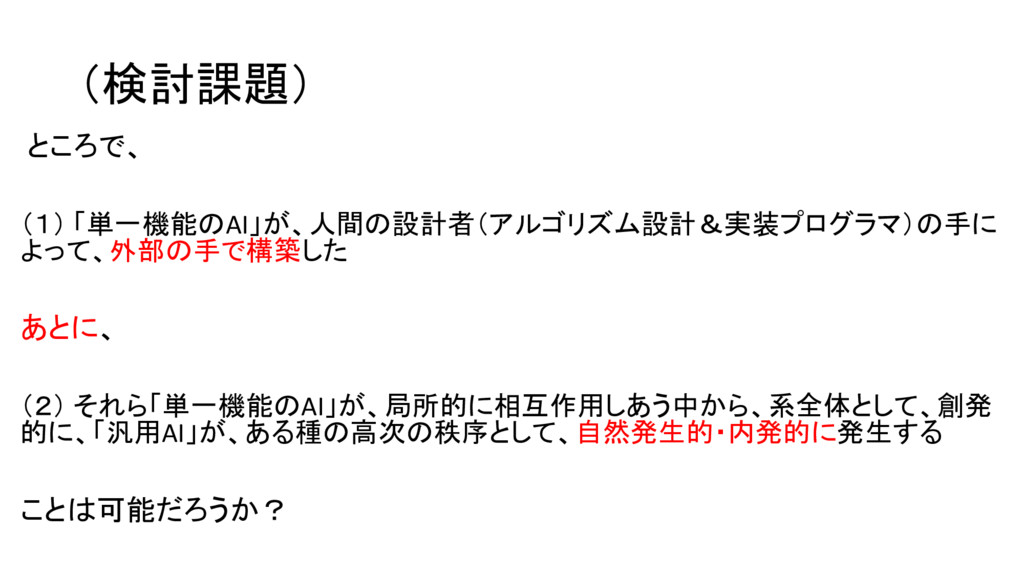
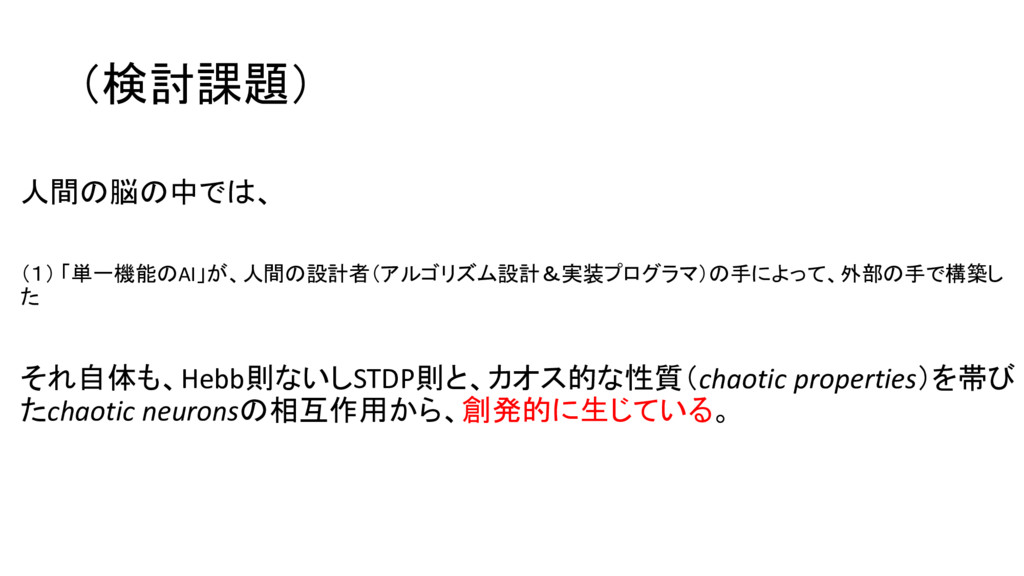
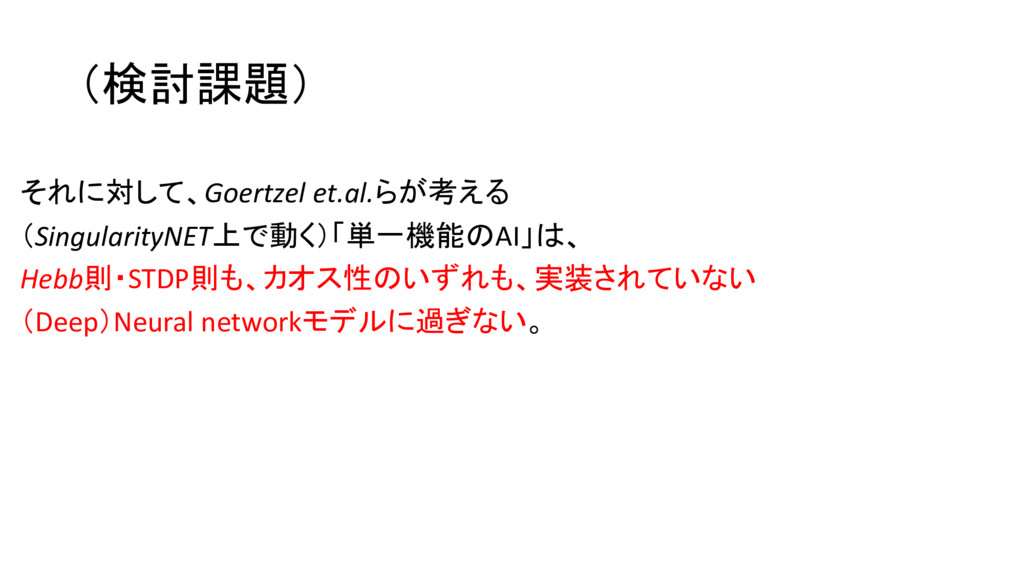
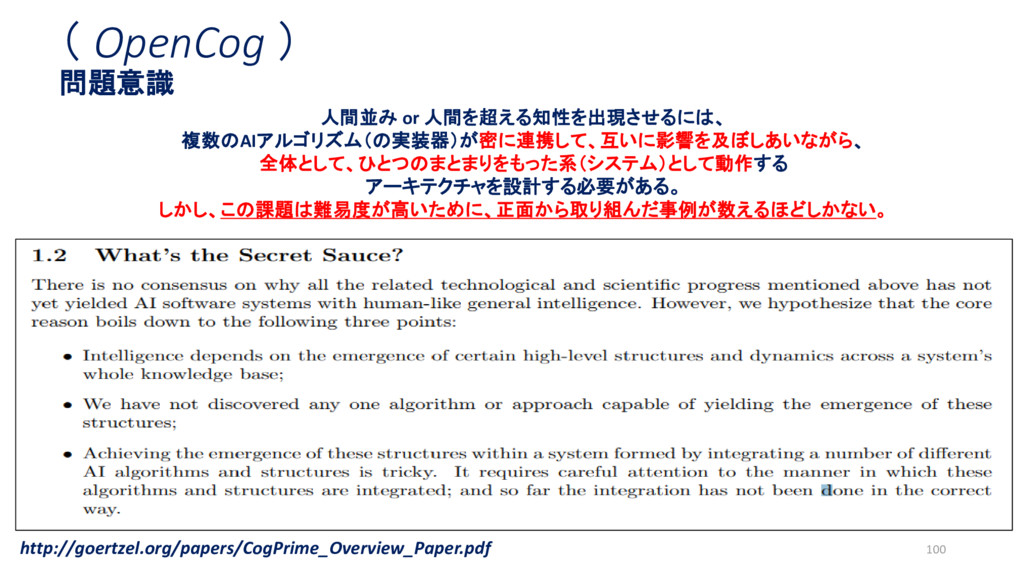
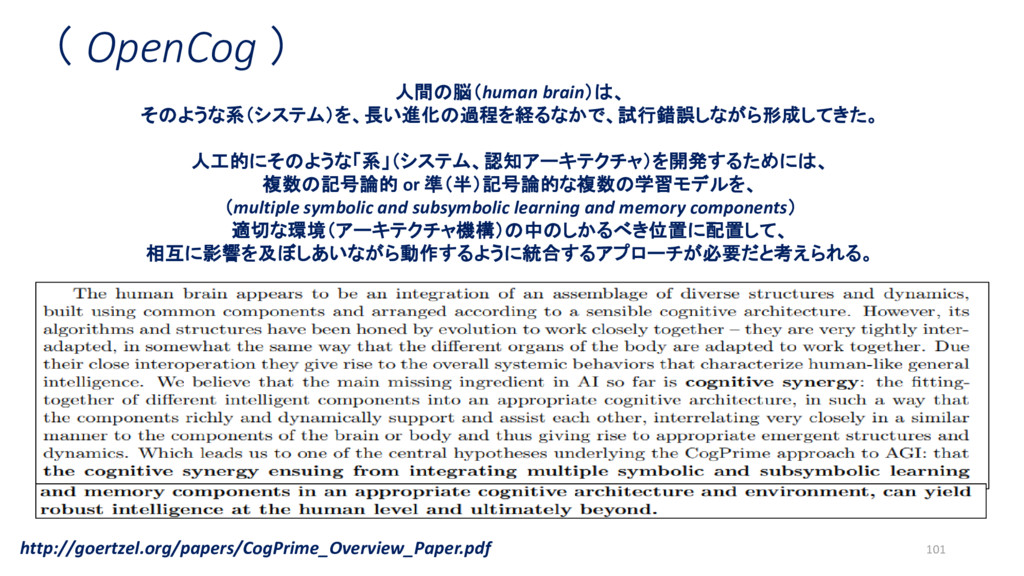
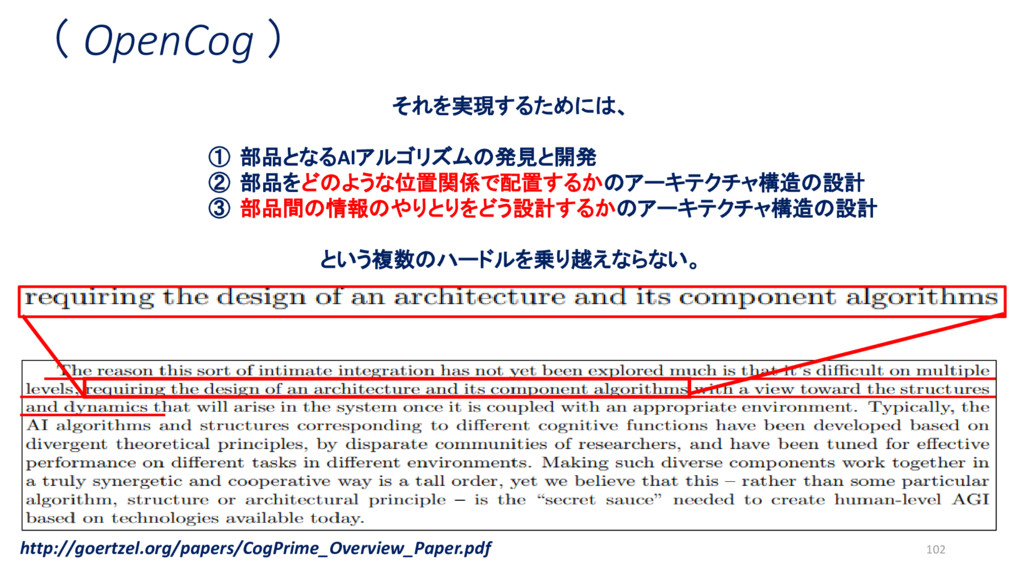
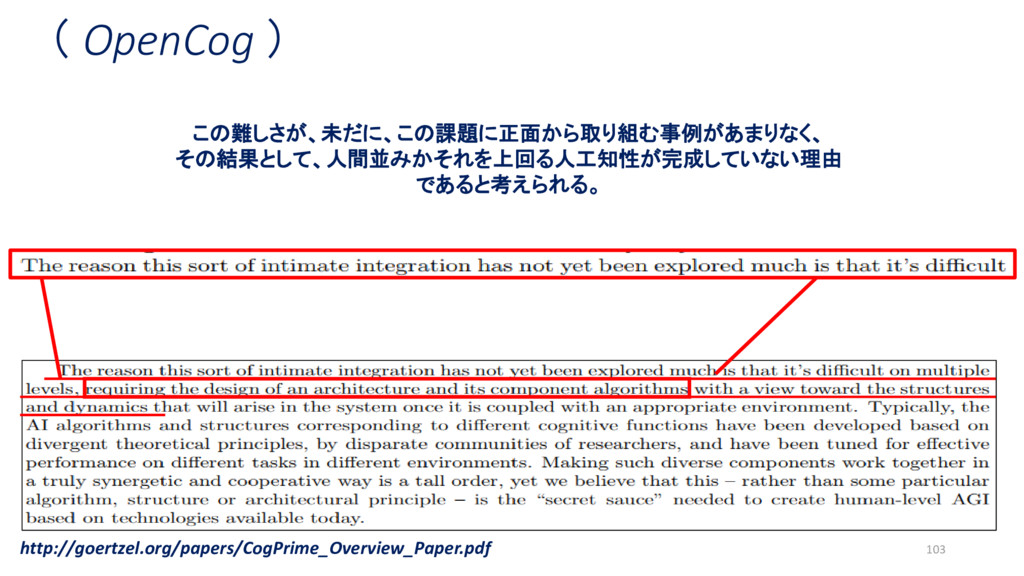
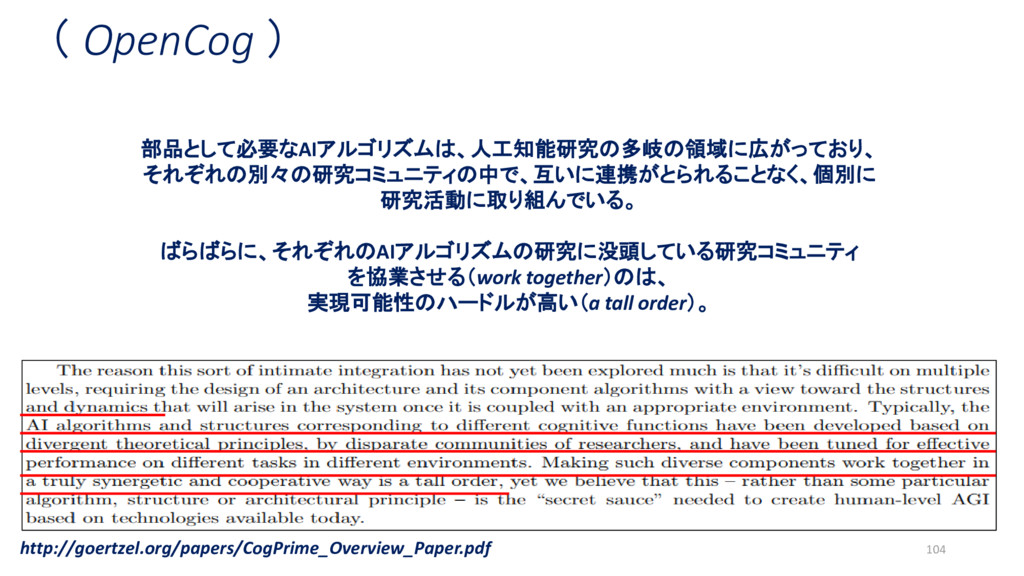
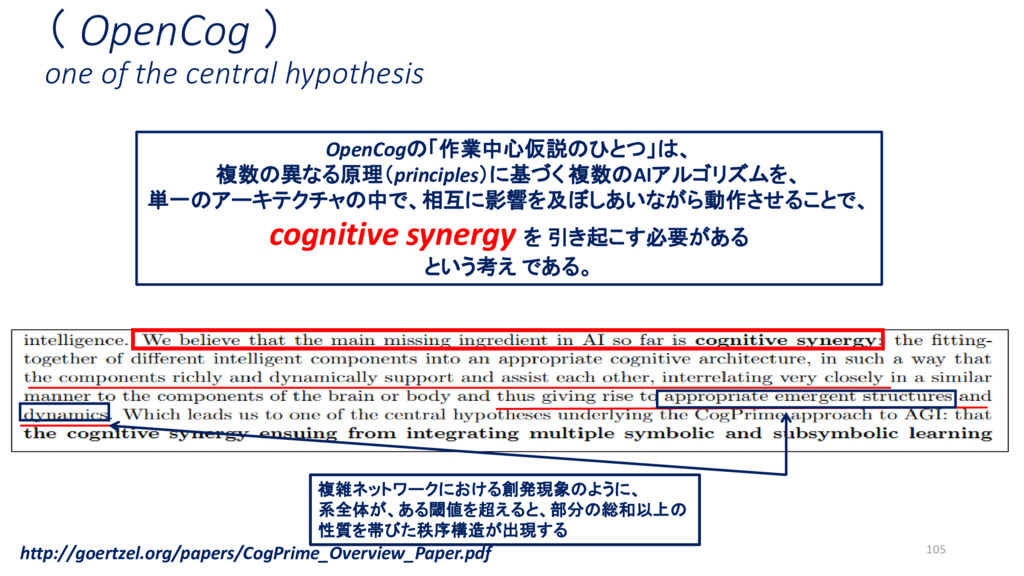
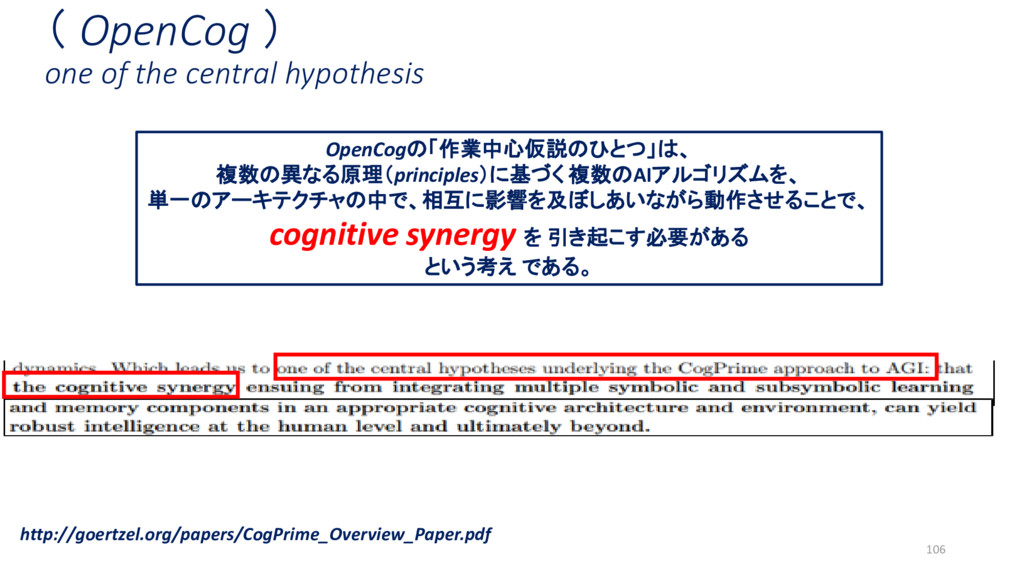
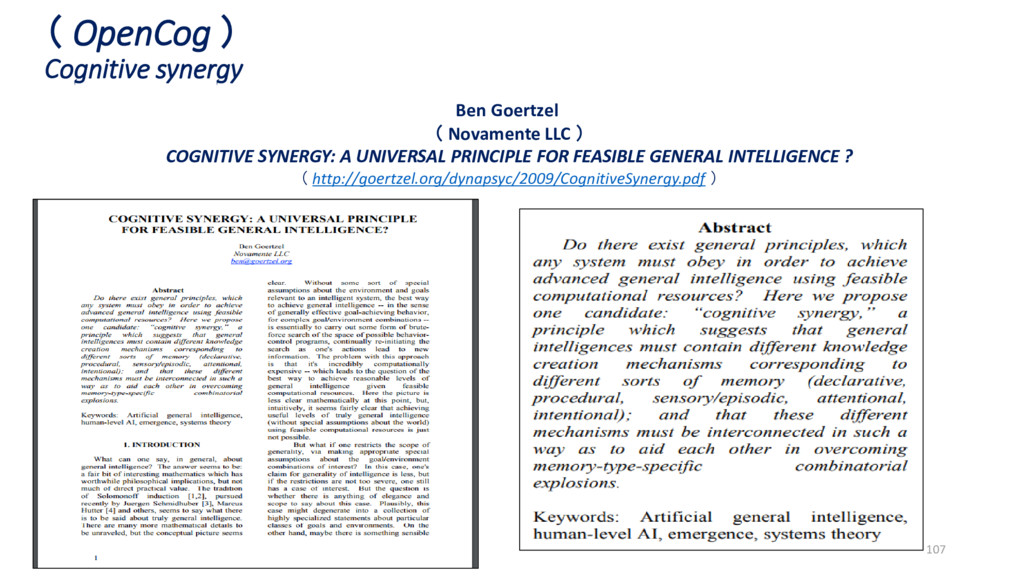
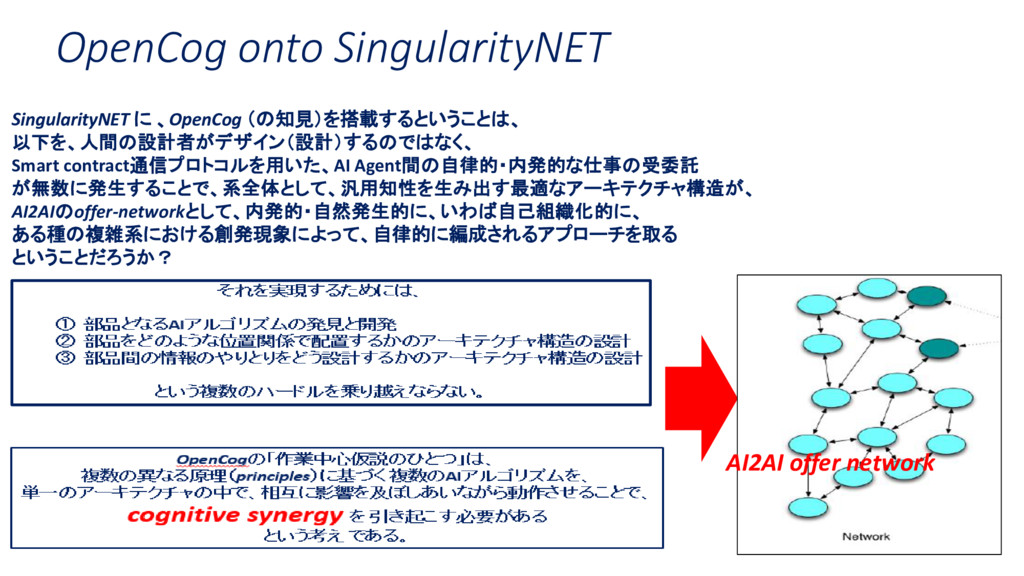
or 準(半)記号論的な複数の学習モデルを、 (multiple symbolic and subsymbolic learning and memory components) 適切な環境(アーキテクチャ機構)の中のしかるべき位置に配置して、 相互に影響を及ぼしあいながら動作するように統合するアプローチが必要だと考えられる。
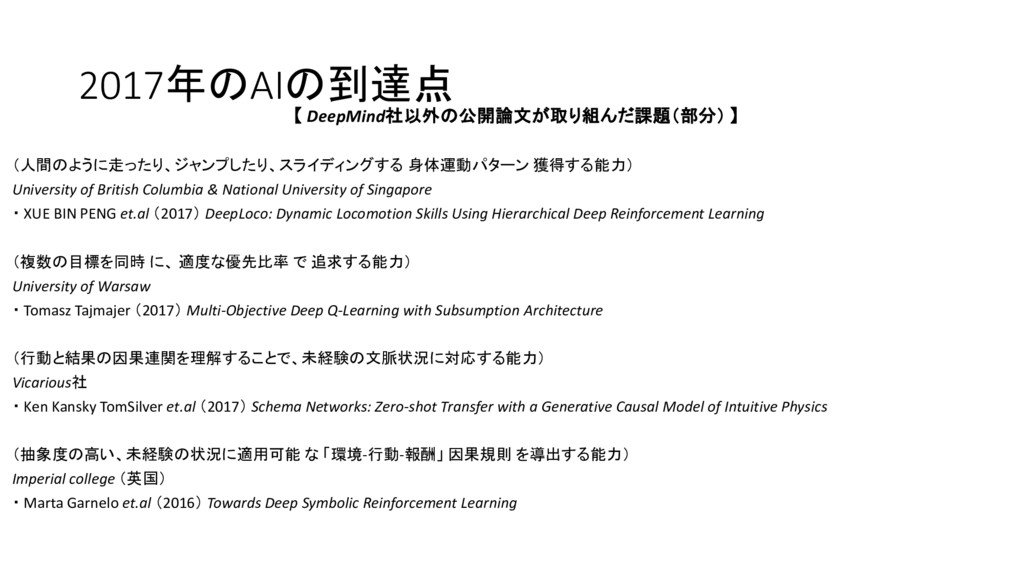
Columbia & National University of Singapore ・ XUE BIN PENG et.al (2017) DeepLoco: Dynamic Locomotion Skills Using Hierarchical Deep Reinforcement Learning (複数の目標を同時 に、 適度な優先比率 で 追求する能力) University of Warsaw ・ Tomasz Tajmajer (2017) Multi-Objective Deep Q-Learning with Subsumption Architecture (行動と結果の因果連関を理解することで、未経験の文脈状況に対応する能力) Vicarious社 ・ Ken Kansky TomSilver et.al (2017) Schema Networks: Zero-shot Transfer with a Generative Causal Model of Intuitive Physics (抽象度の高い、未経験の状況に適用可能 な 「環境-行動-報酬」 因果規則 を導出する能力) Imperial college (英国) ・ Marta Garnelo et.al (2016) Towards Deep Symbolic Reinforcement Learning
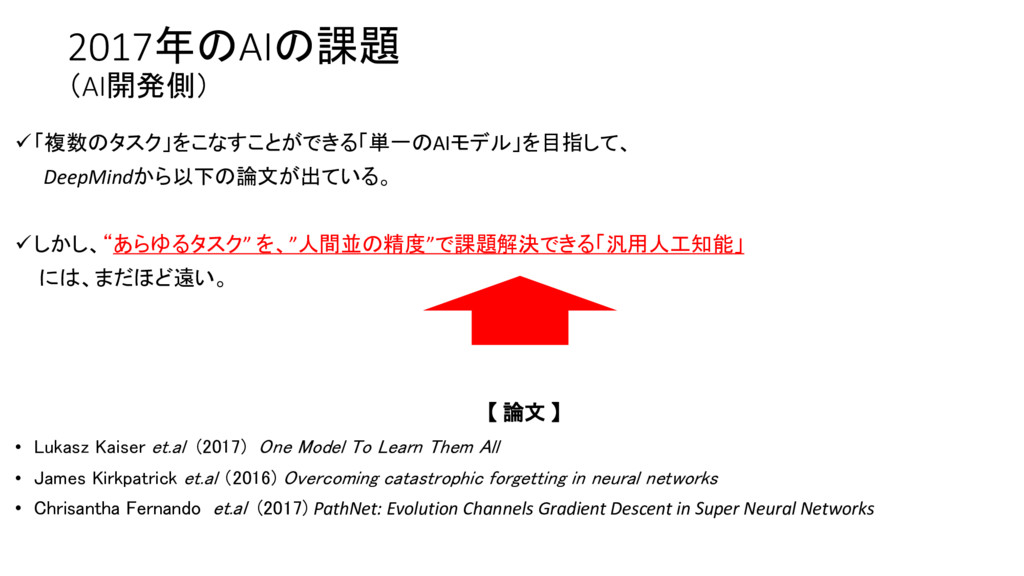
• Lukasz Kaiser et.al (2017) One Model To Learn Them All • James Kirkpatrick et.al (2016) Overcoming catastrophic forgetting in neural networks • Chrisantha Fernando et.al (2017) PathNet: Evolution Channels Gradient Descent in Super Neural Networks
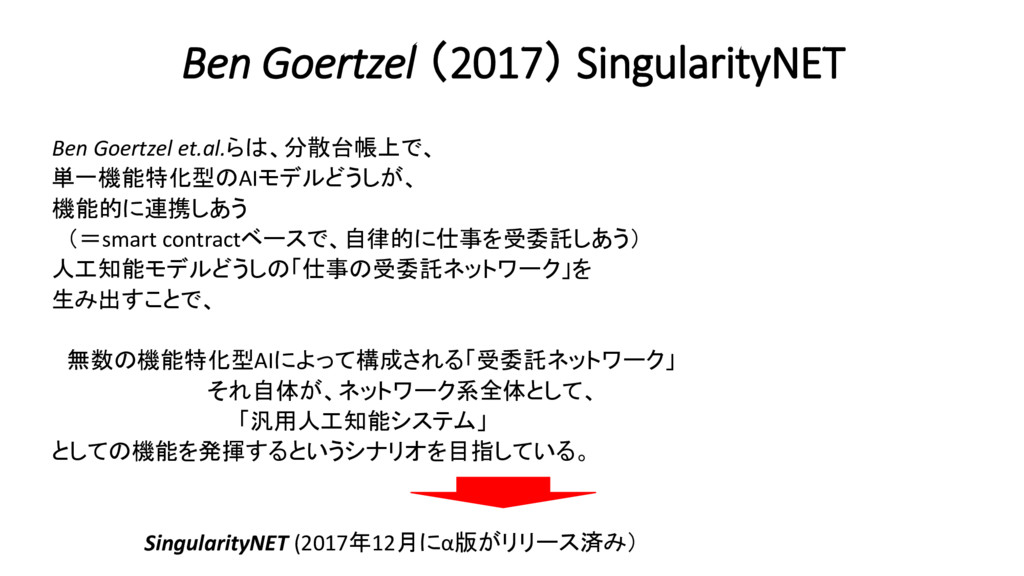
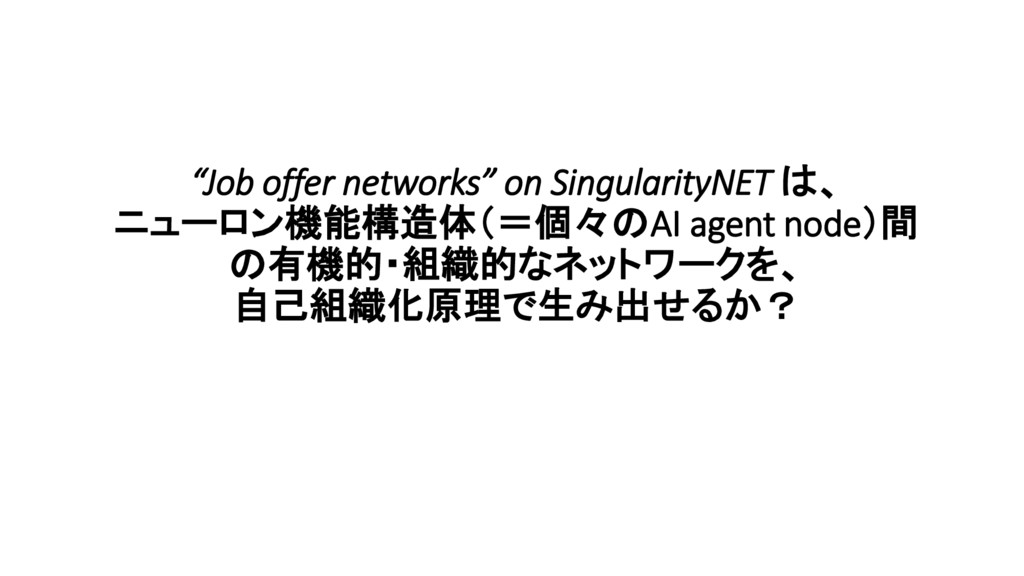
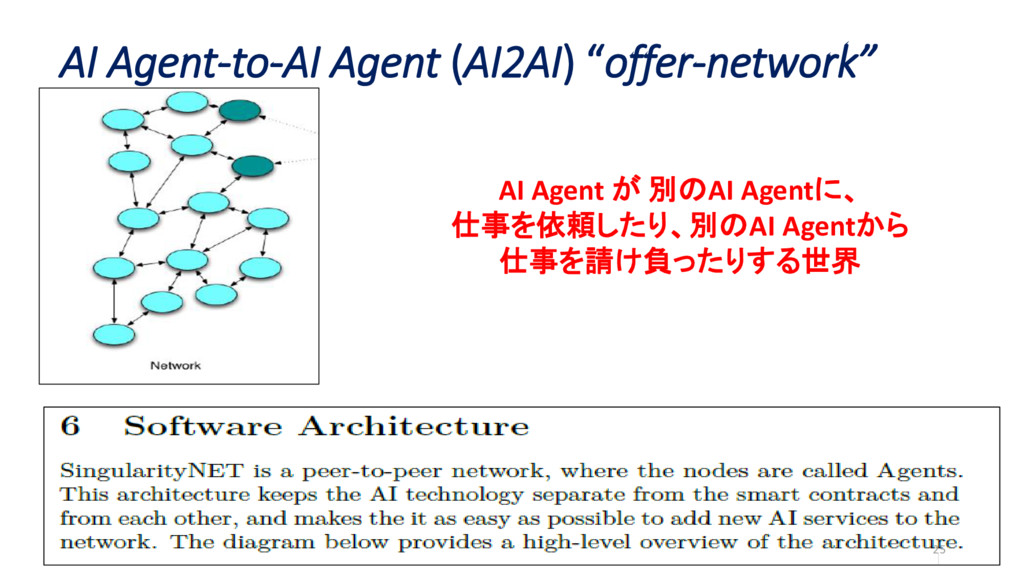
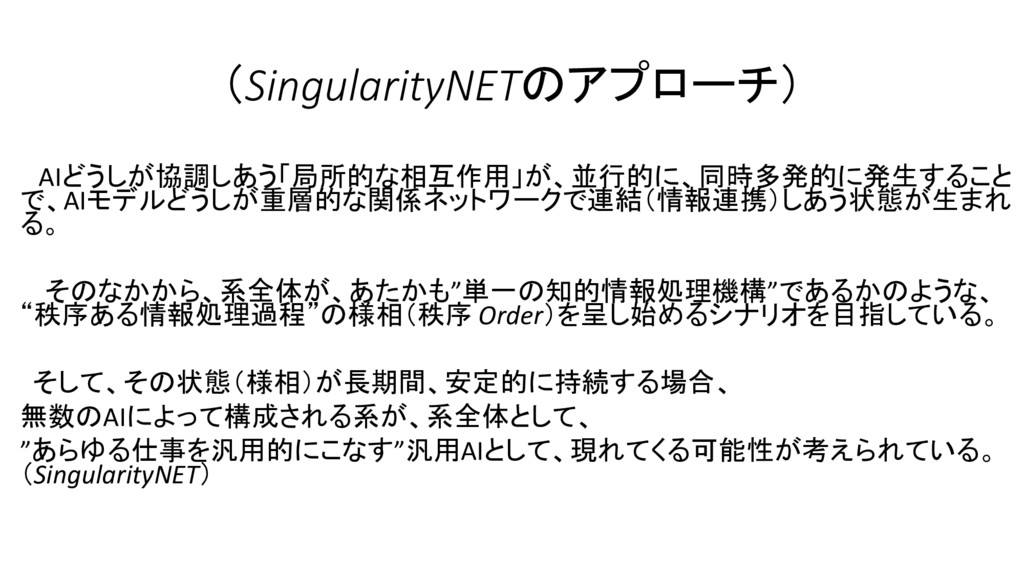
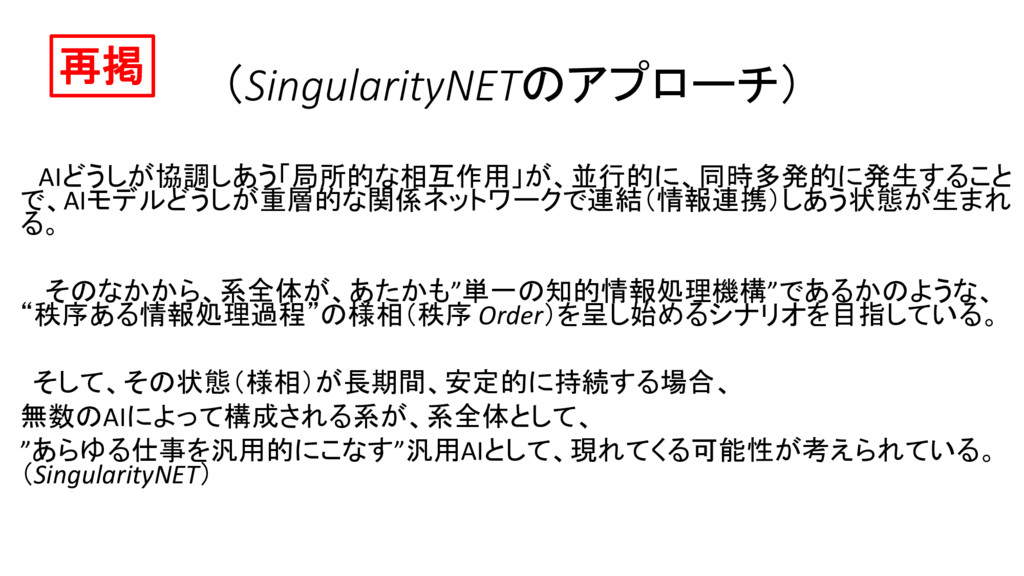
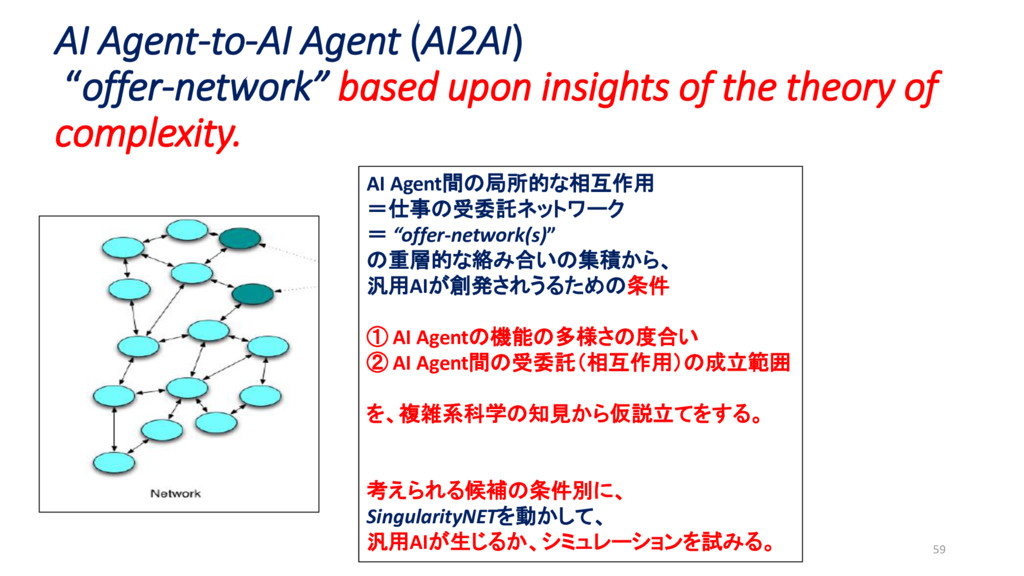
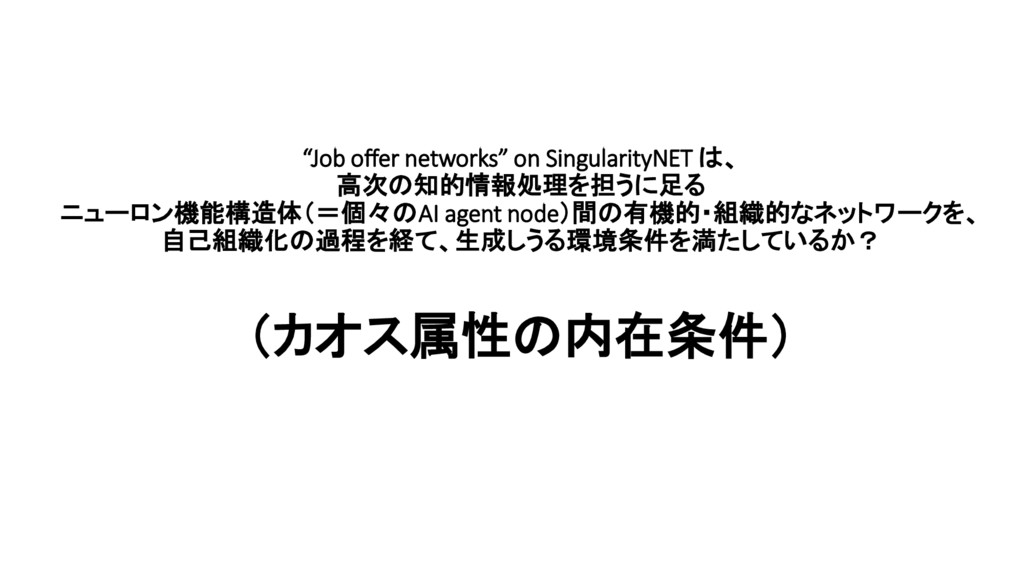
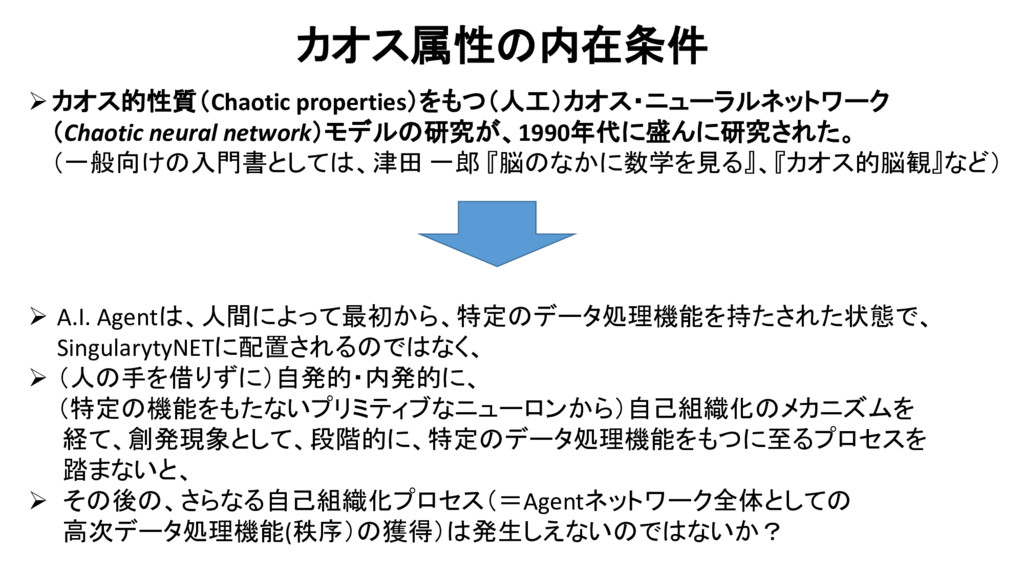
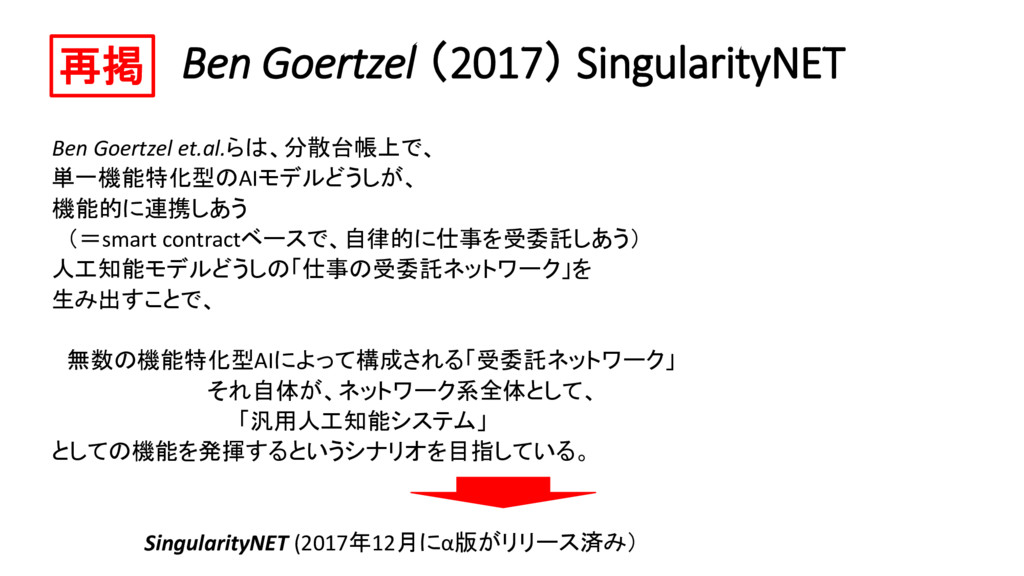
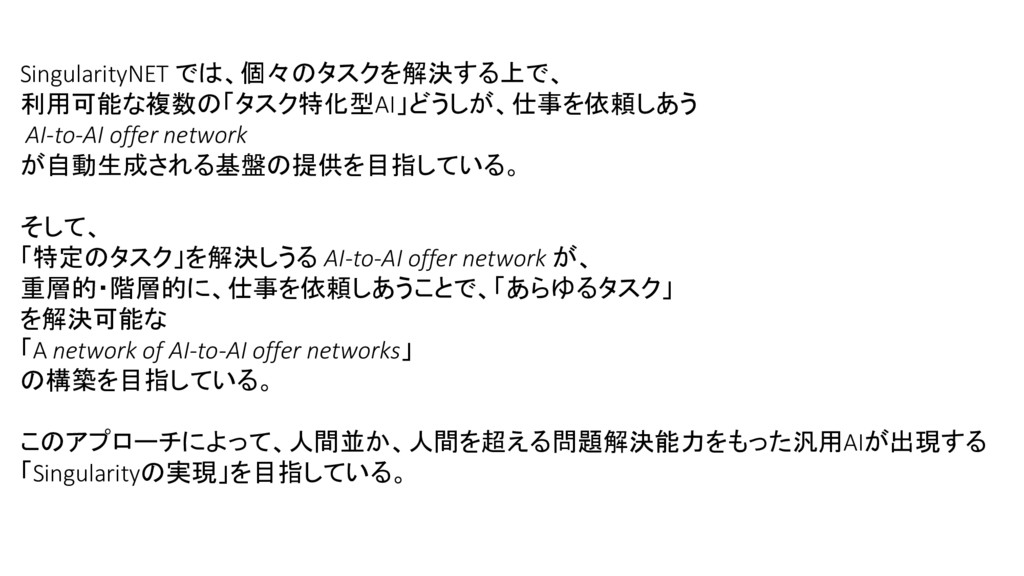
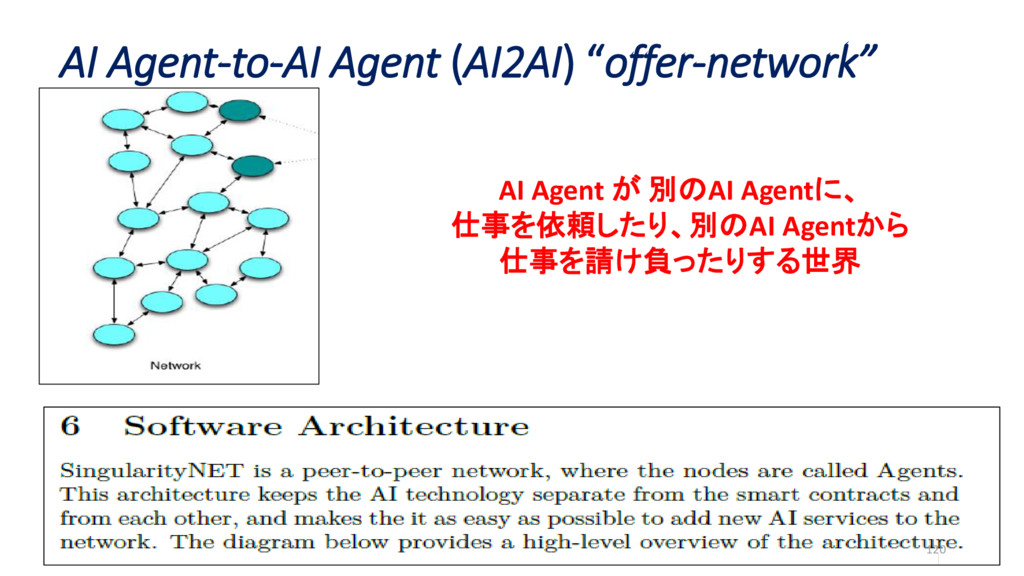
theory of complexity. AI Agent間の局所的な相互作用 =仕事の受委託ネットワーク = “offer-network(s)” の重層的な絡み合いの集積から、 汎用AIが創発されうるための条件 ① AI Agentの機能の多様さの度合い ② AI Agent間の受委託(相互作用)の成立範囲 を、複雑系科学の知見から仮説立てをする。 考えられる候補の条件別に、 SingularityNETを動かして、 汎用AIが生じるか、シミュレーションを試みる。 59
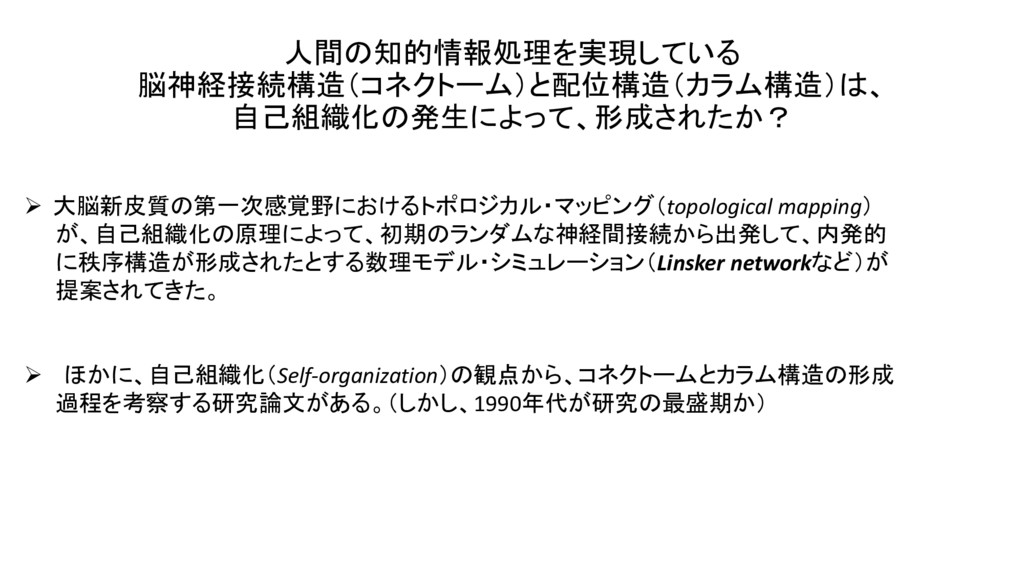
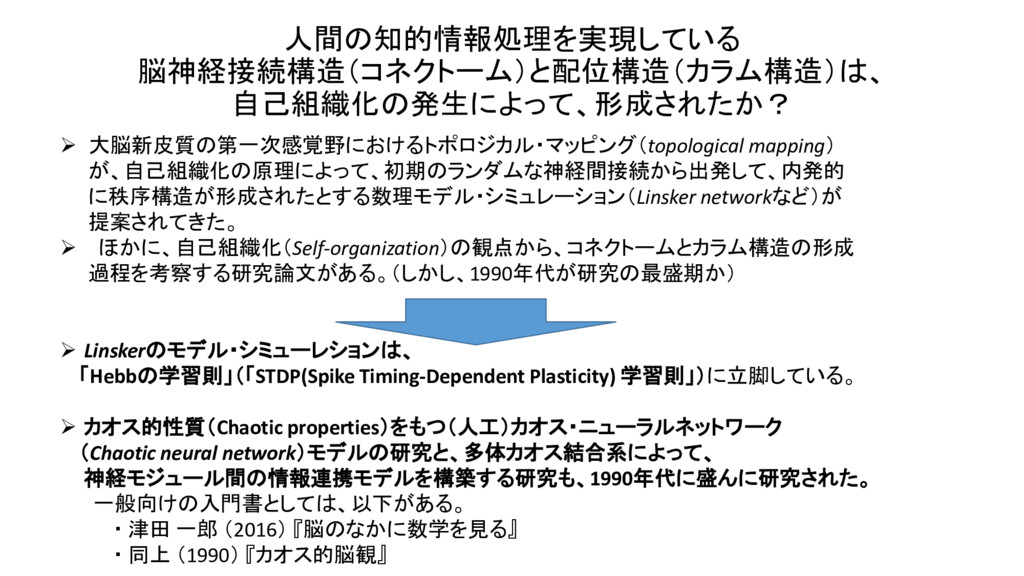
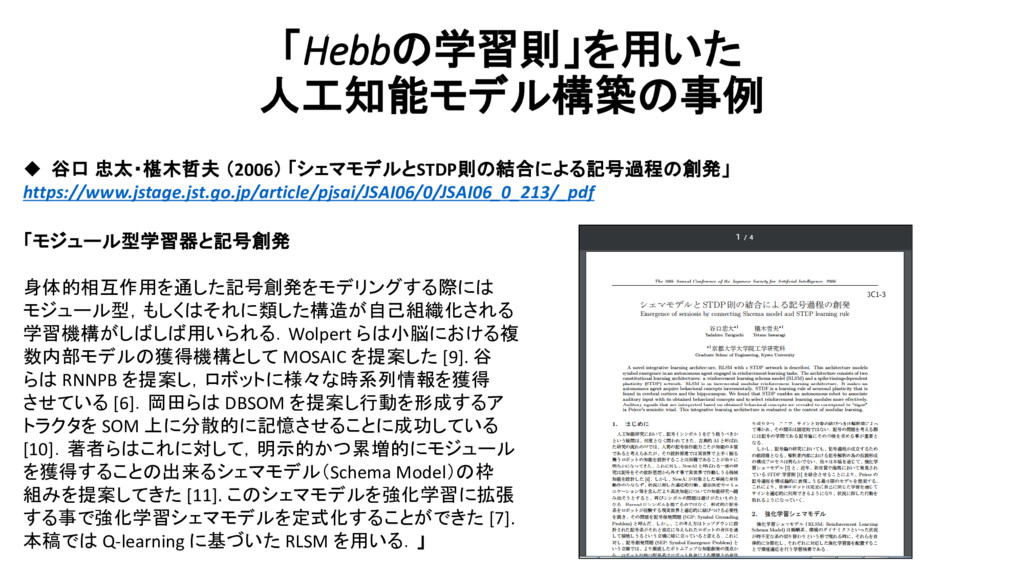
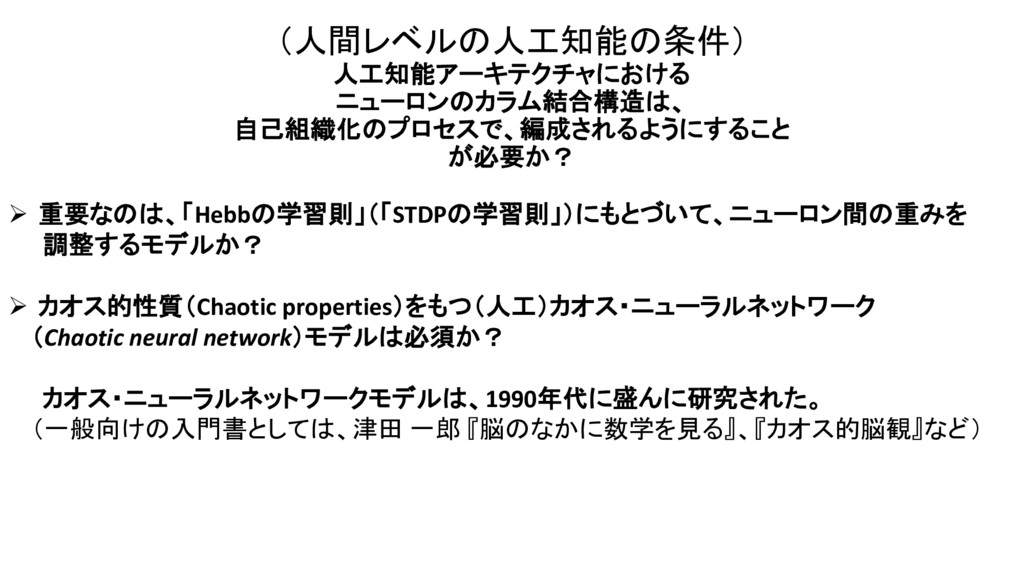
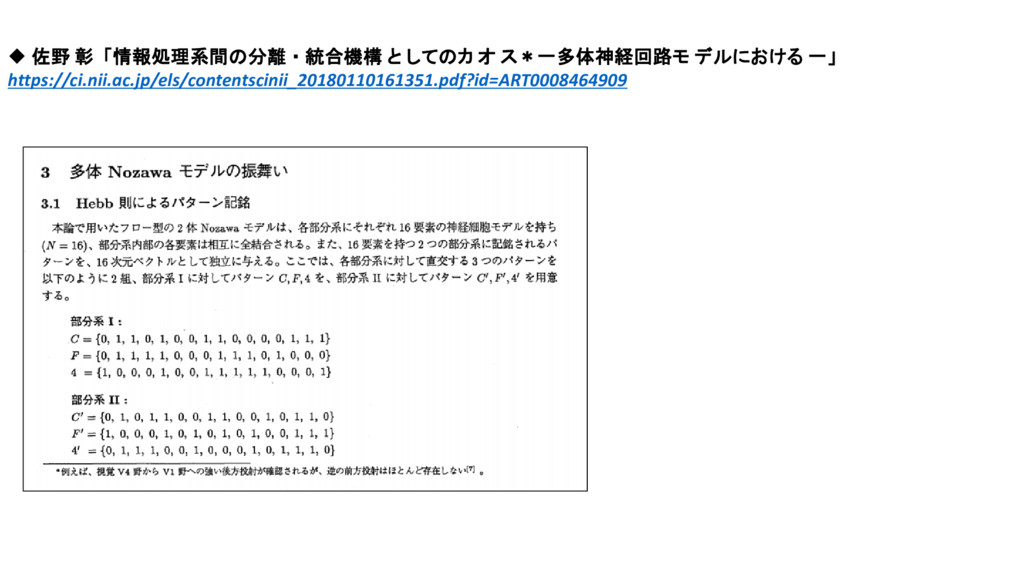
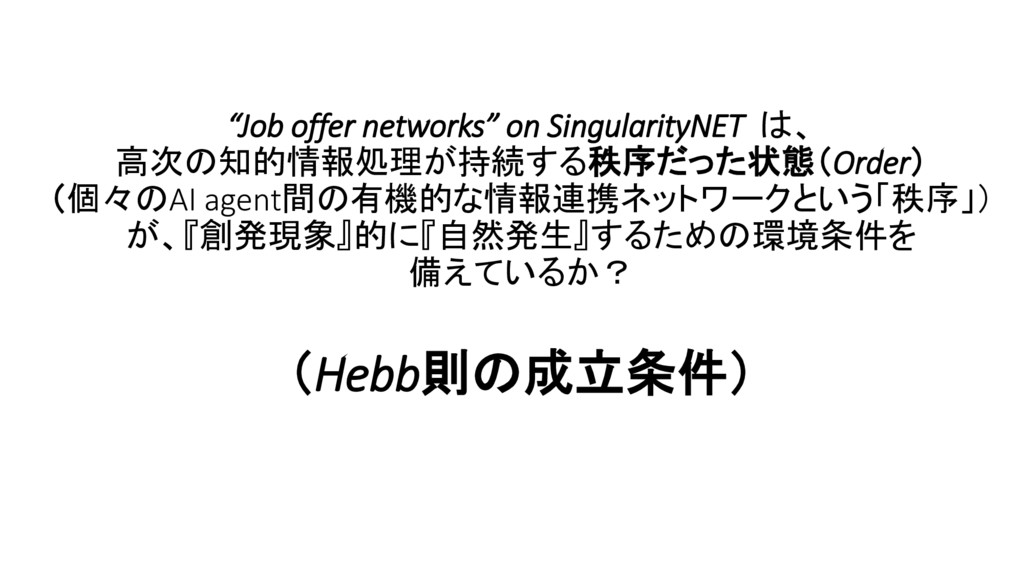
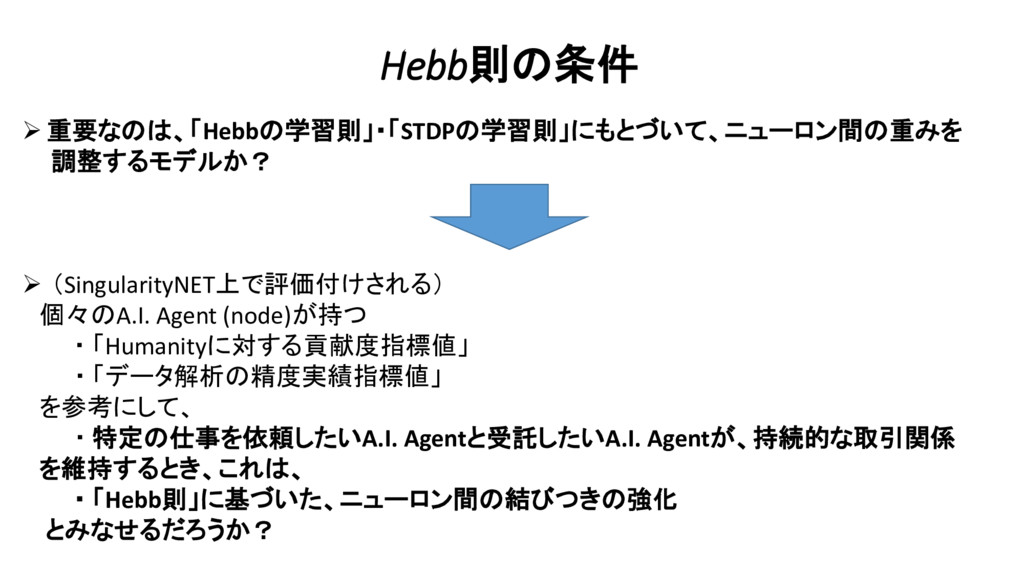
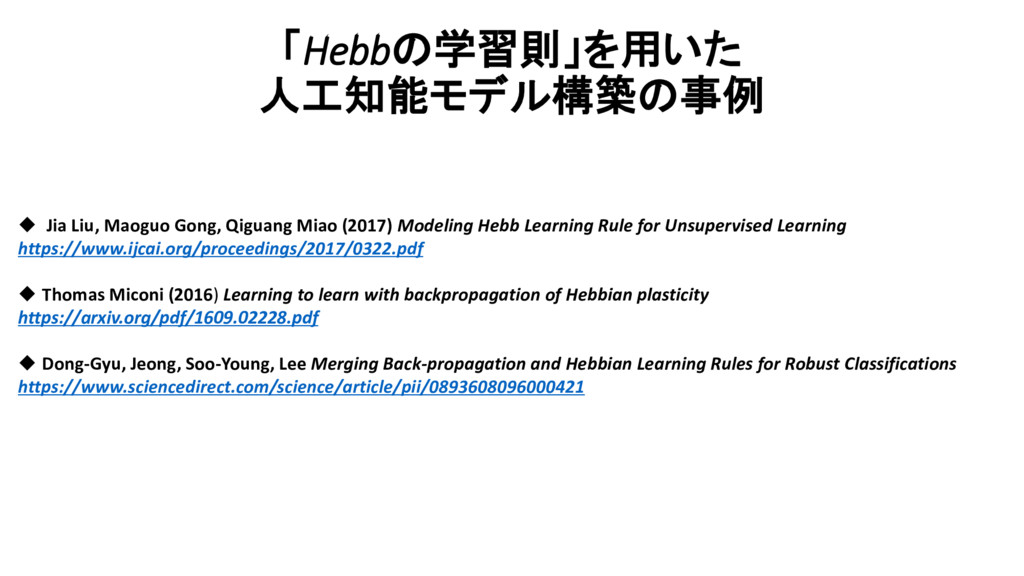
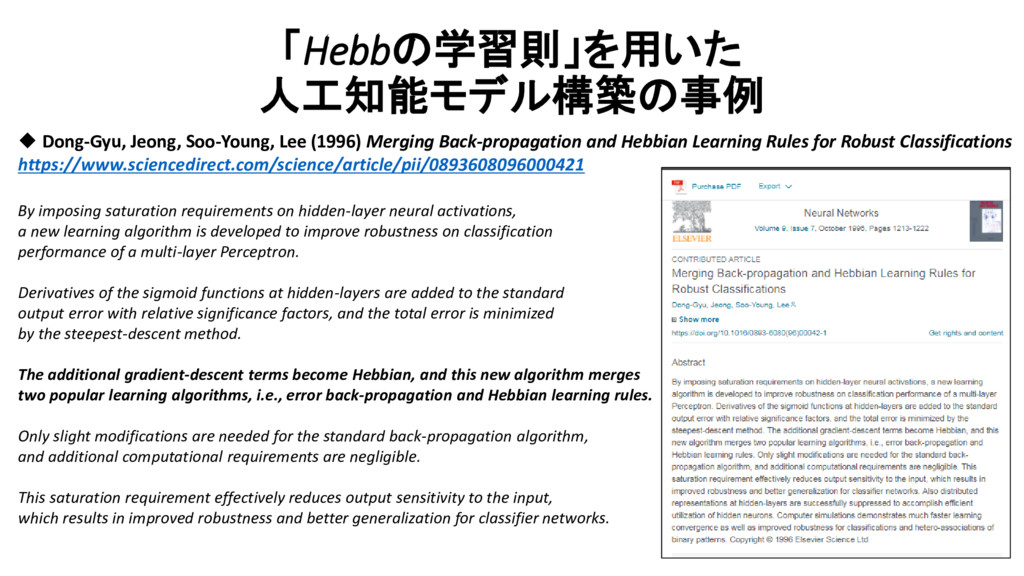
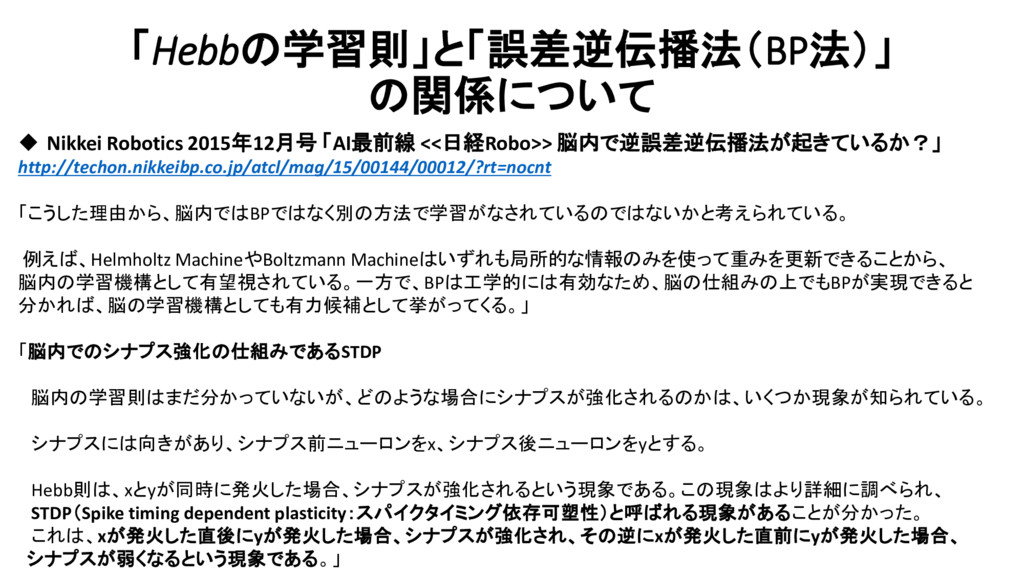
Modeling Hebb Learning Rule for Unsupervised Learning https://www.ijcai.org/proceedings/2017/0322.pdf Thomas Miconi (2016) Learning to learn with backpropagation of Hebbian plasticity https://arxiv.org/pdf/1609.02228.pdf Dong-Gyu, Jeong, Soo-Young, Lee Merging Back-propagation and Hebbian Learning Rules for Robust Classifications https://www.sciencedirect.com/science/article/pii/0893608096000421
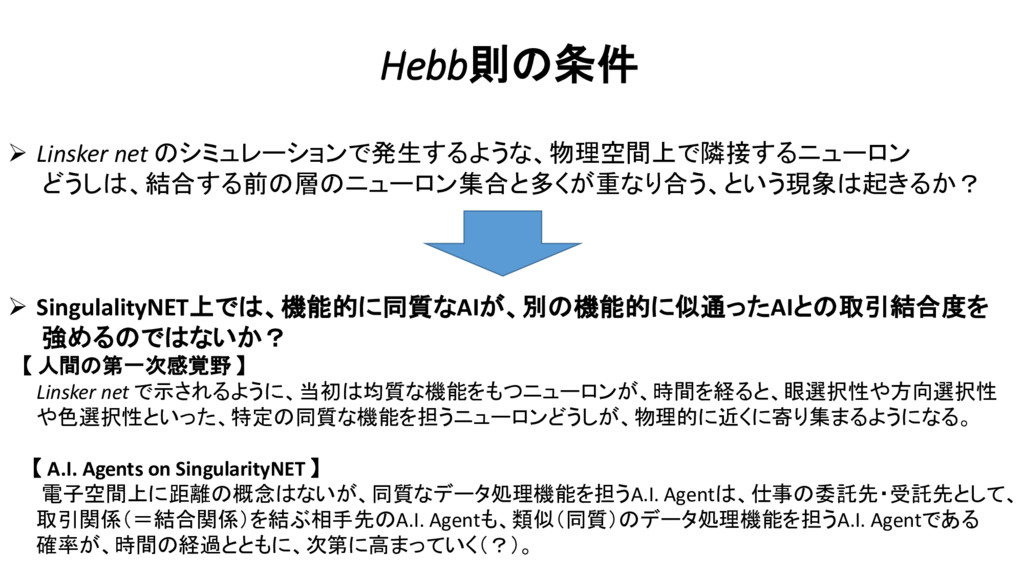
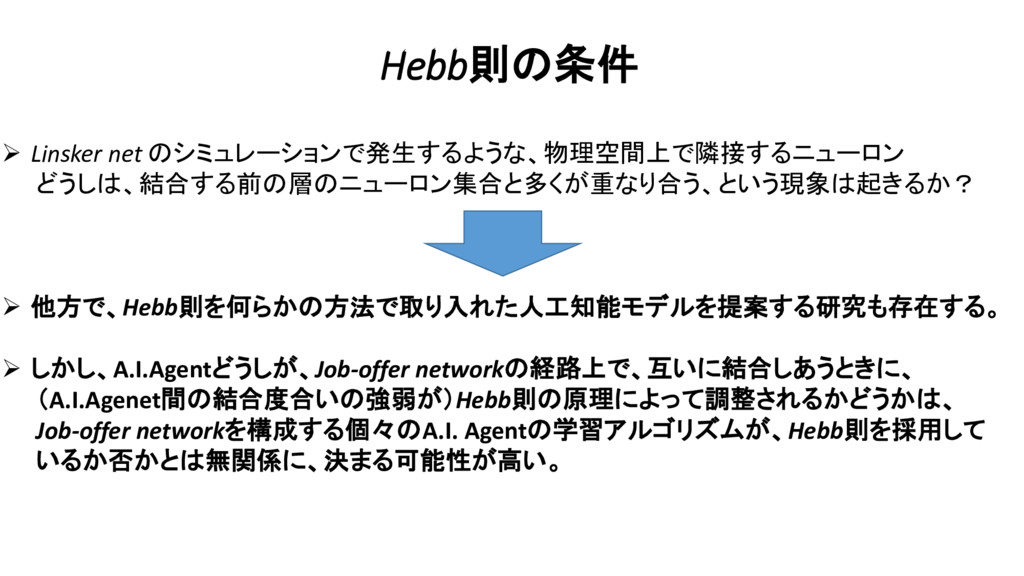
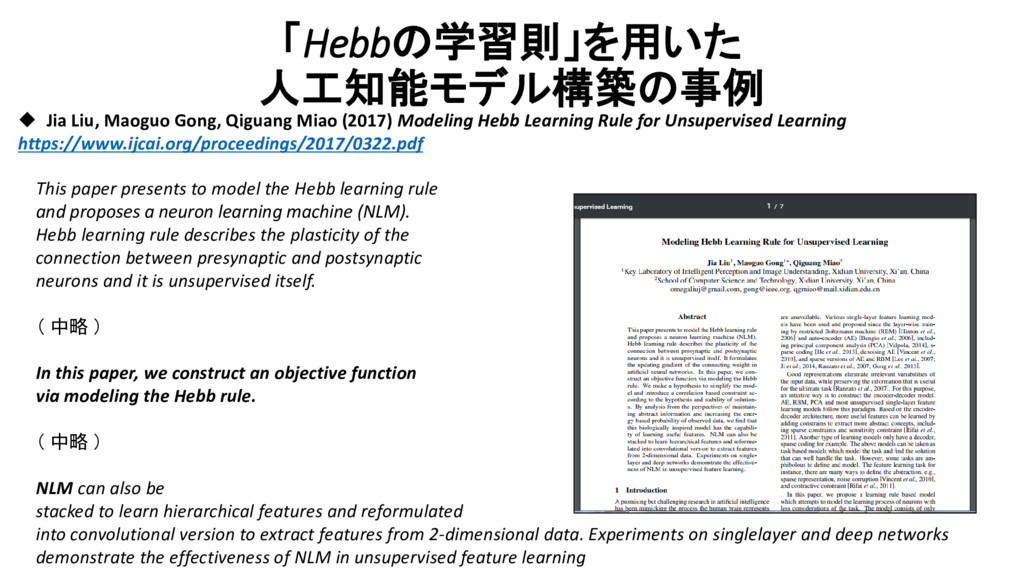
Modeling Hebb Learning Rule for Unsupervised Learning https://www.ijcai.org/proceedings/2017/0322.pdf This paper presents to model the Hebb learning rule and proposes a neuron learning machine (NLM). Hebb learning rule describes the plasticity of the connection between presynaptic and postsynaptic neurons and it is unsupervised itself. ( 中略 ) In this paper, we construct an objective function via modeling the Hebb rule. ( 中略 ) NLM can also be stacked to learn hierarchical features and reformulated into convolutional version to extract features from 2-dimensional data. Experiments on singlelayer and deep networks demonstrate the effectiveness of NLM in unsupervised feature learning
and Hebbian Learning Rules for Robust Classifications https://www.sciencedirect.com/science/article/pii/0893608096000421 By imposing saturation requirements on hidden-layer neural activations, a new learning algorithm is developed to improve robustness on classification performance of a multi-layer Perceptron. Derivatives of the sigmoid functions at hidden-layers are added to the standard output error with relative significance factors, and the total error is minimized by the steepest-descent method. The additional gradient-descent terms become Hebbian, and this new algorithm merges two popular learning algorithms, i.e., error back-propagation and Hebbian learning rules. Only slight modifications are needed for the standard back-propagation algorithm, and additional computational requirements are negligible. This saturation requirement effectively reduces output sensitivity to the input, which results in improved robustness and better generalization for classifier networks.
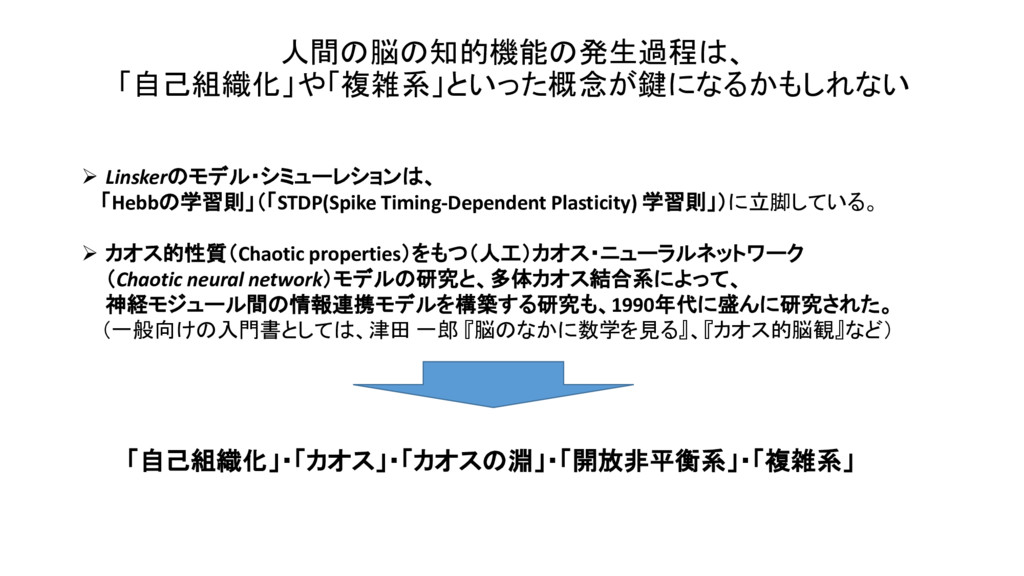
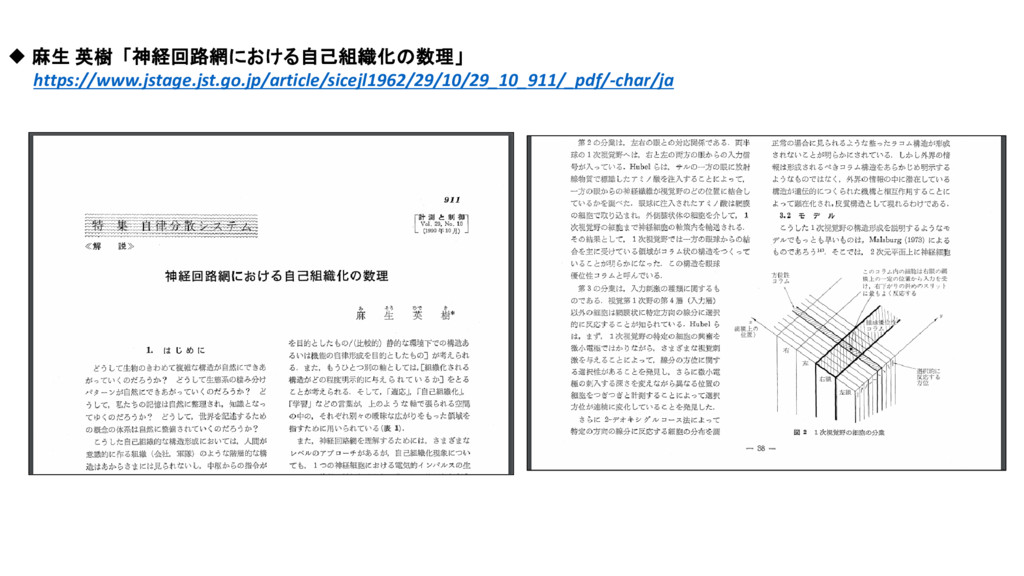
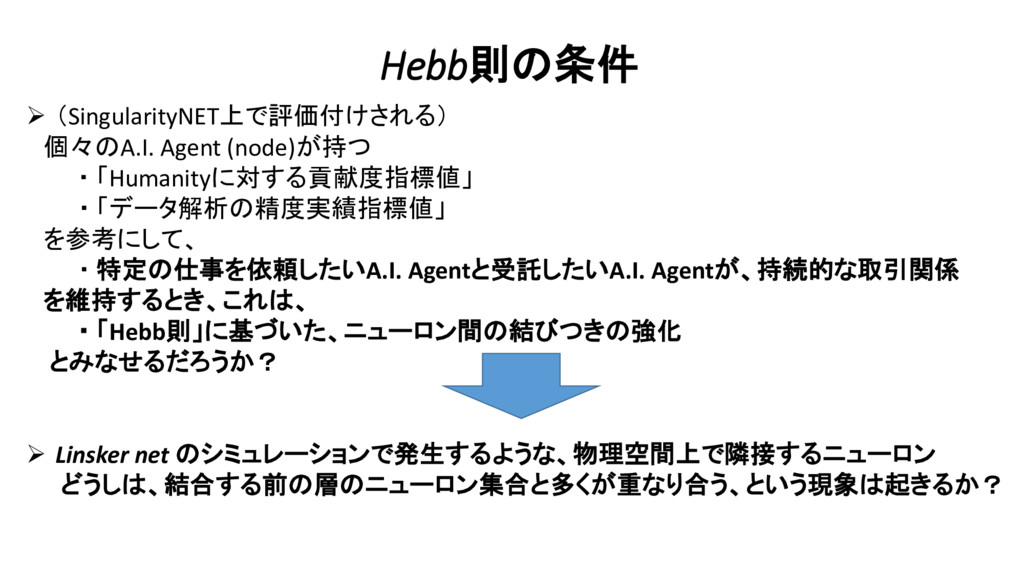
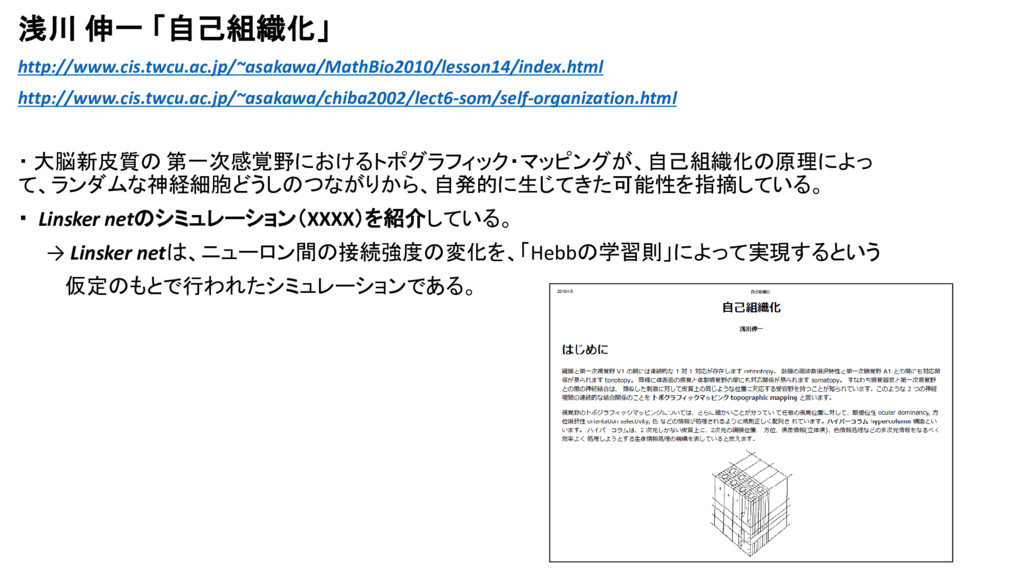
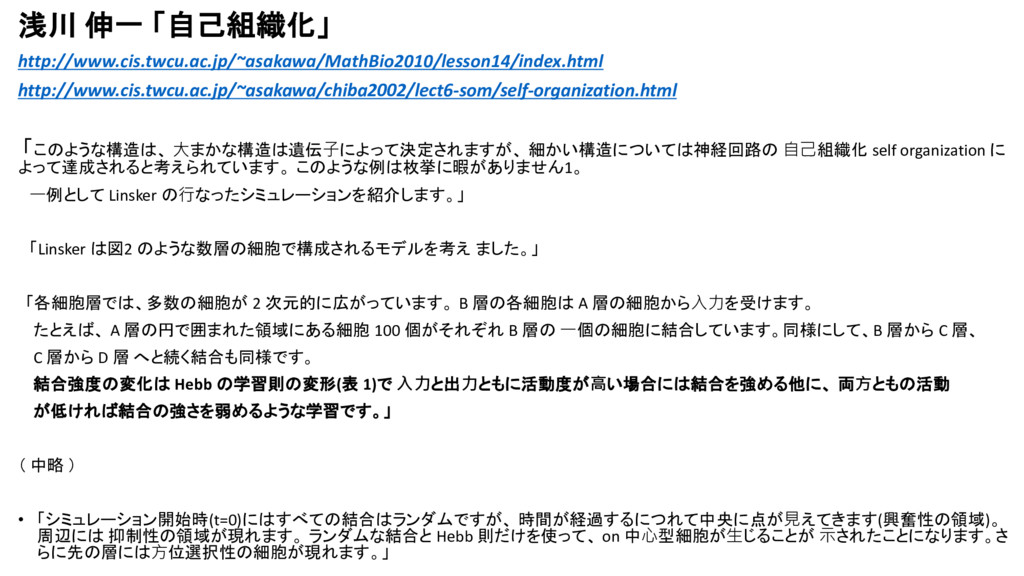
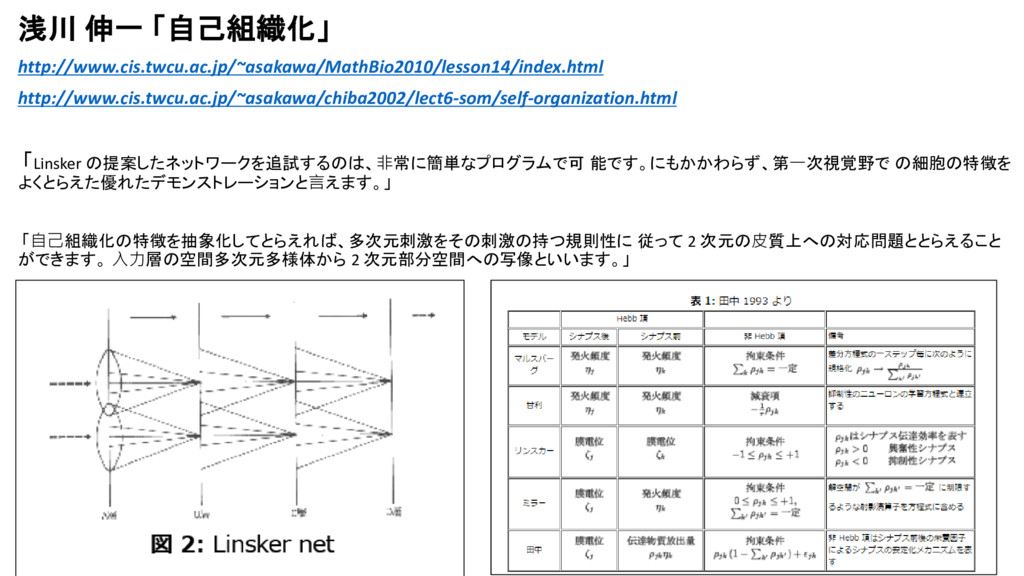
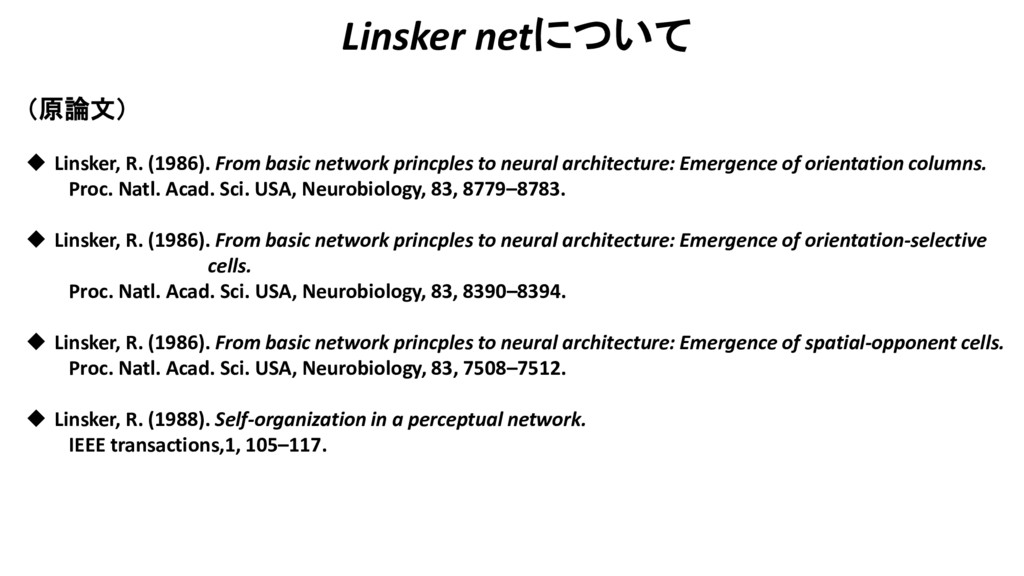
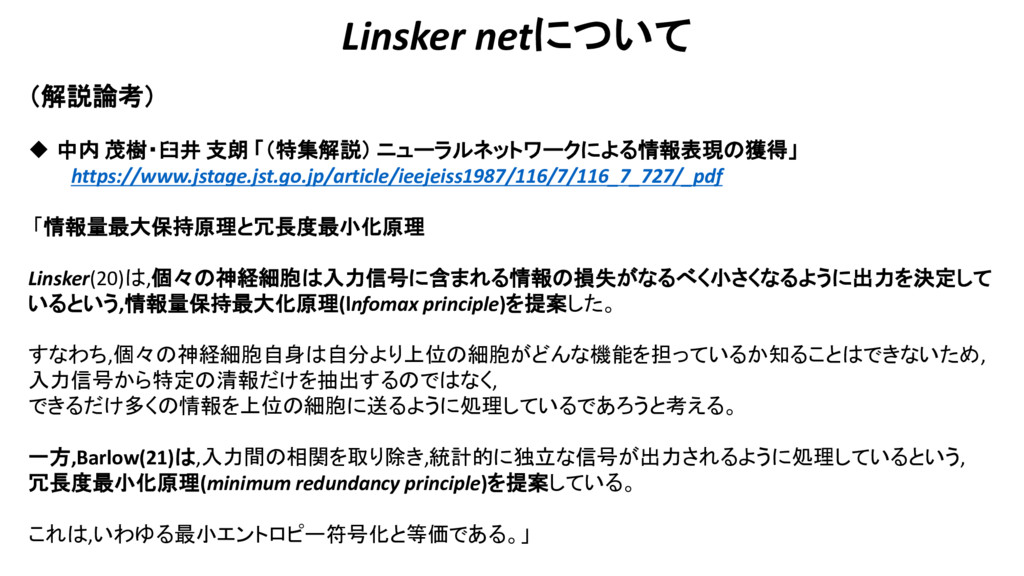
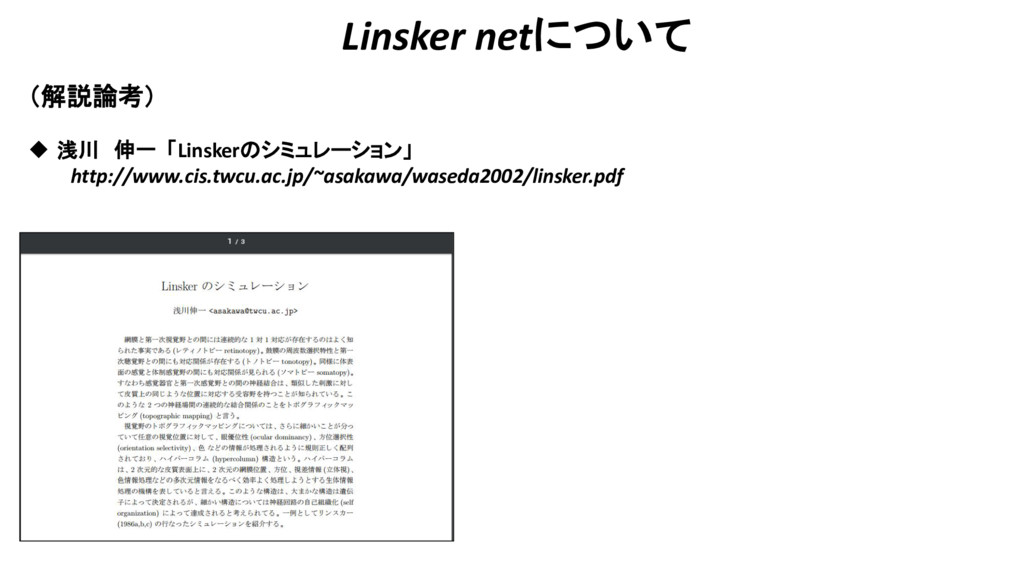
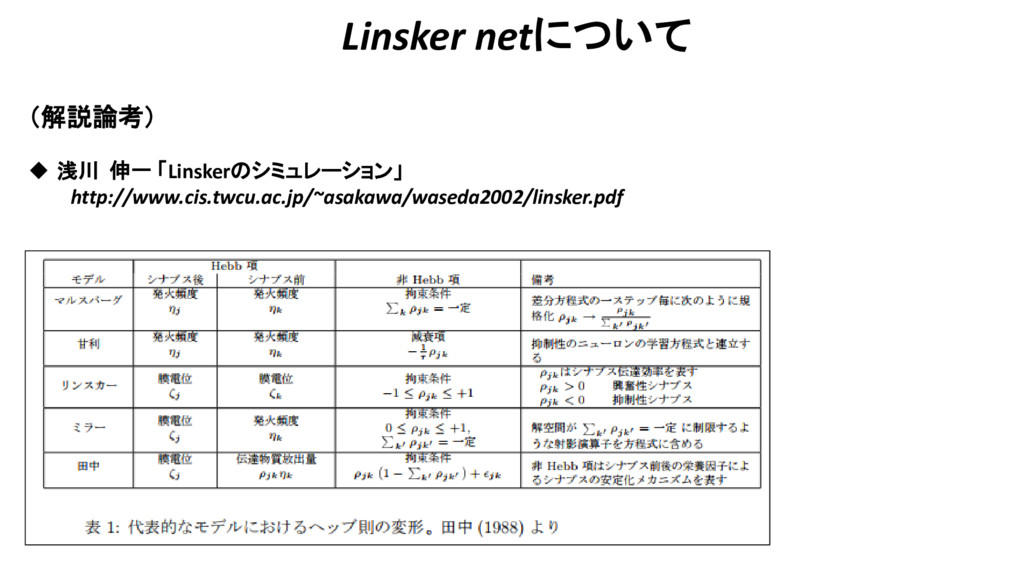
princples to neural architecture: Emergence of orientation columns. Proc. Natl. Acad. Sci. USA, Neurobiology, 83, 8779–8783. Linsker, R. (1986). From basic network princples to neural architecture: Emergence of orientation-selective cells. Proc. Natl. Acad. Sci. USA, Neurobiology, 83, 8390–8394. Linsker, R. (1986). From basic network princples to neural architecture: Emergence of spatial-opponent cells. Proc. Natl. Acad. Sci. USA, Neurobiology, 83, 7508–7512. Linsker, R. (1988). Self-organization in a perceptual network. IEEE transactions,1, 105–117.
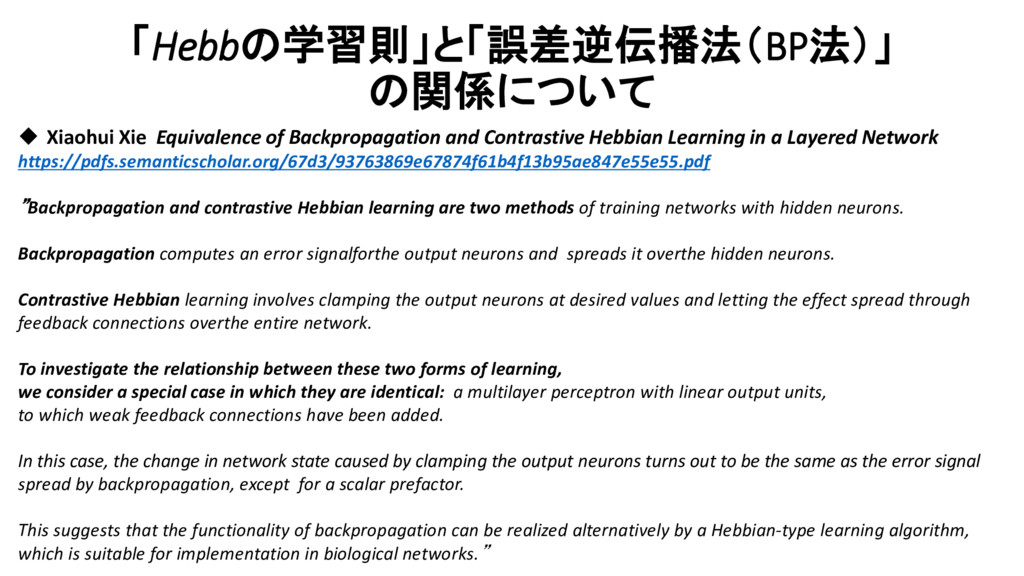
Hebbian Learning in a Layered Network https://pdfs.semanticscholar.org/67d3/93763869e67874f61b4f13b95ae847e55e55.pdf ”Backpropagation and contrastive Hebbian learning are two methods of training networks with hidden neurons. Backpropagation computes an error signalforthe output neurons and spreads it overthe hidden neurons. Contrastive Hebbian learning involves clamping the output neurons at desired values and letting the effect spread through feedback connections overthe entire network. To investigate the relationship between these two forms of learning, we consider a special case in which they are identical: a multilayer perceptron with linear output units, to which weak feedback connections have been added. In this case, the change in network state caused by clamping the output neurons turns out to be the same as the error signal spread by backpropagation, except for a scalar prefactor. This suggests that the functionality of backpropagation can be realized alternatively by a Hebbian-type learning algorithm, which is suitable for implementation in biological networks.”
or 準(半)記号論的な複数の学習モデルを、 (multiple symbolic and subsymbolic learning and memory components) 適切な環境(アーキテクチャ機構)の中のしかるべき位置に配置して、 相互に影響を及ぼしあいながら動作するように統合するアプローチが必要だと考えられる。
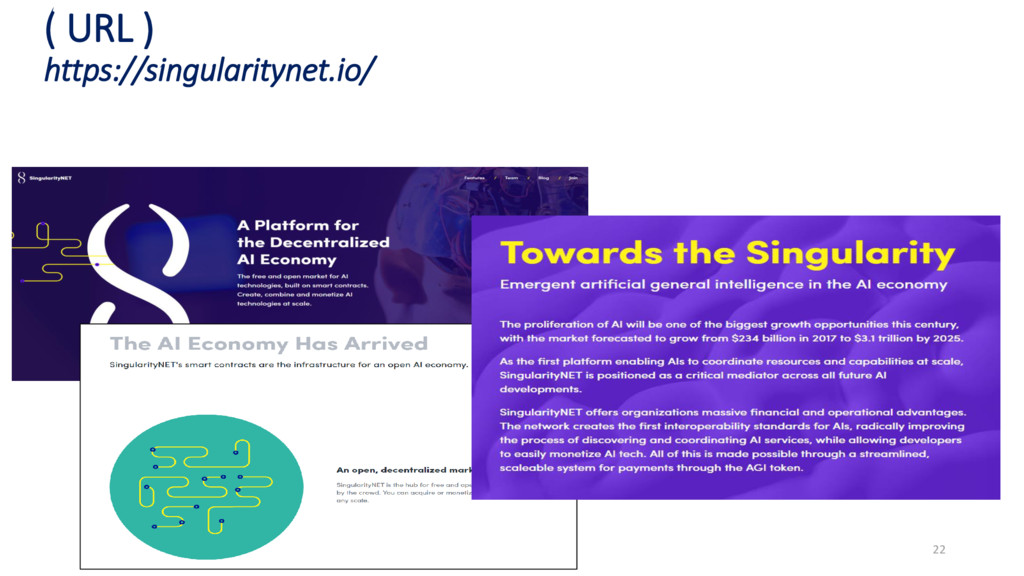
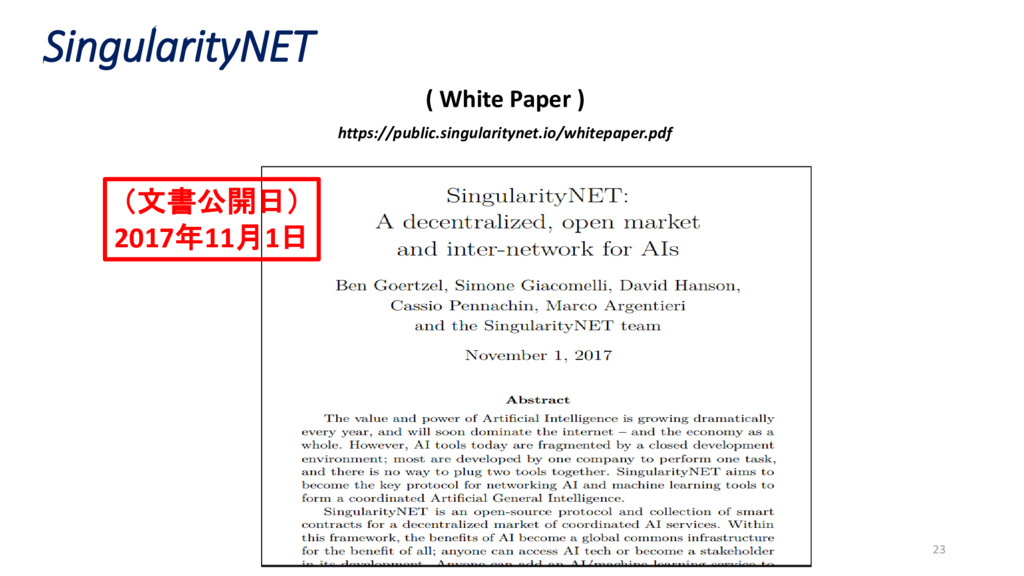
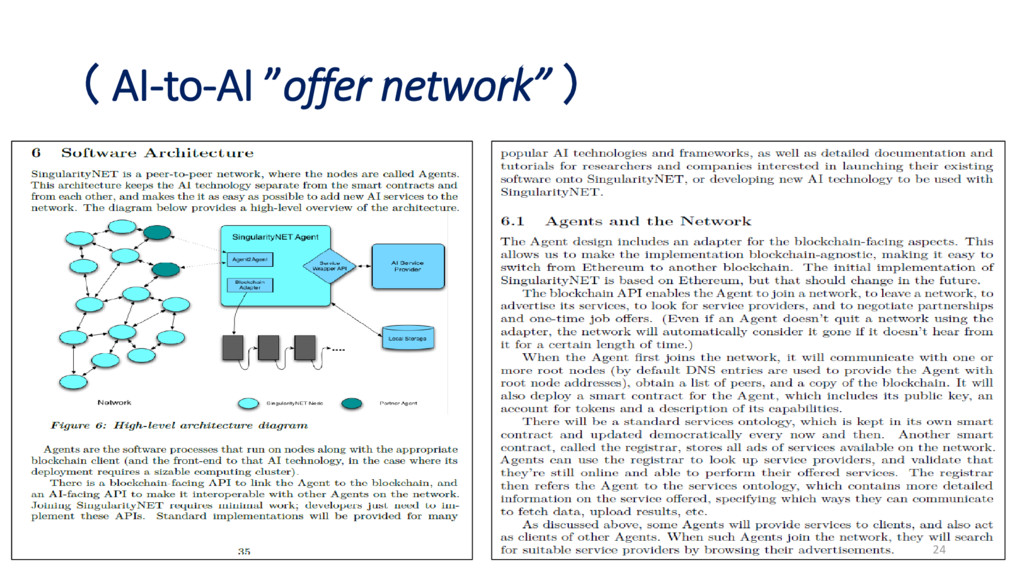
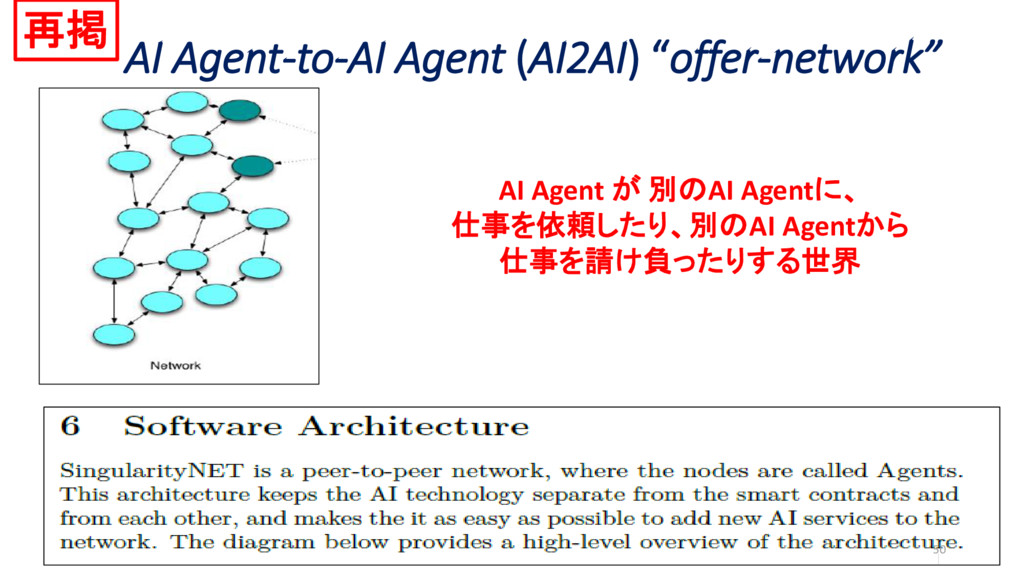
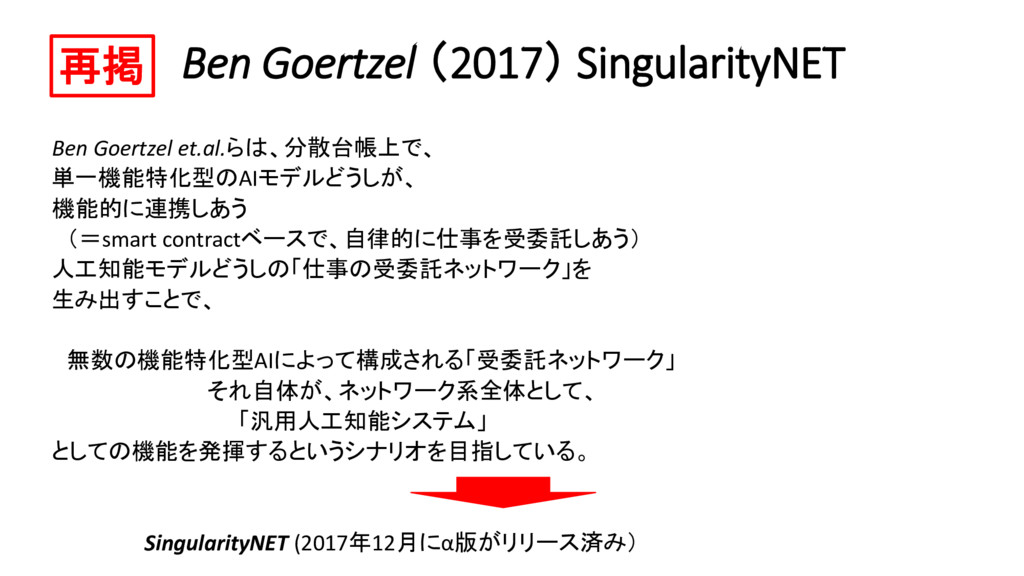
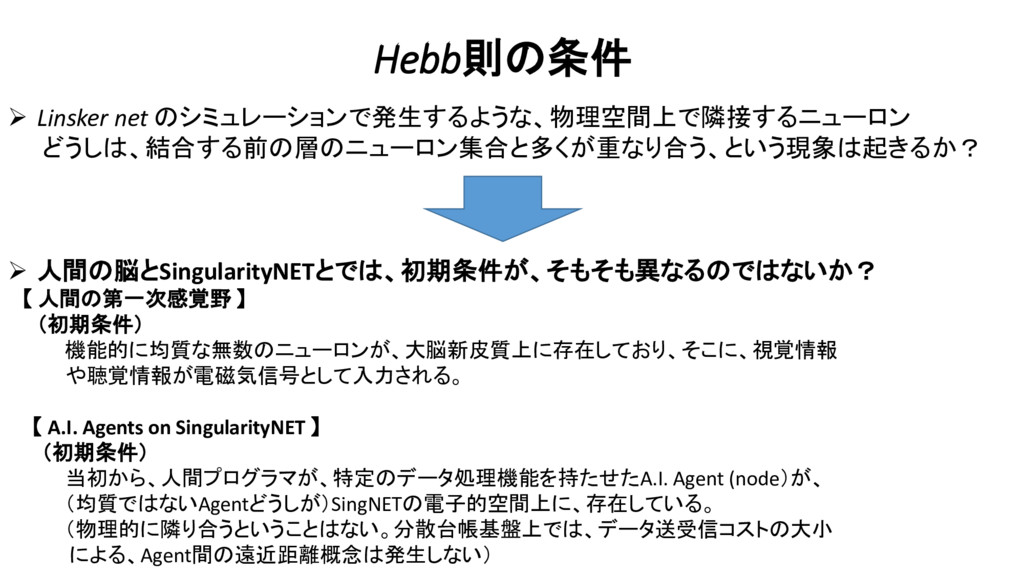
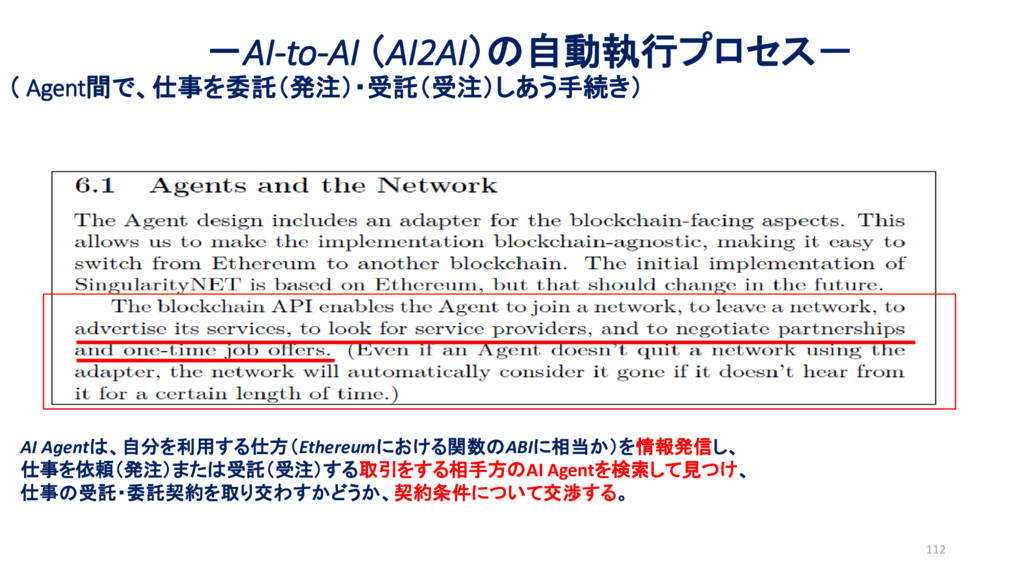
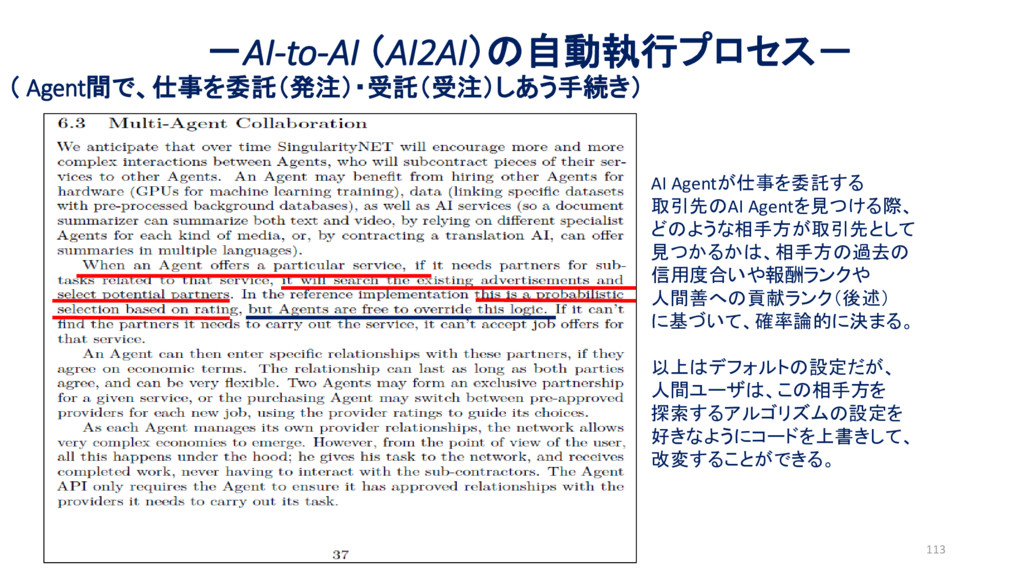
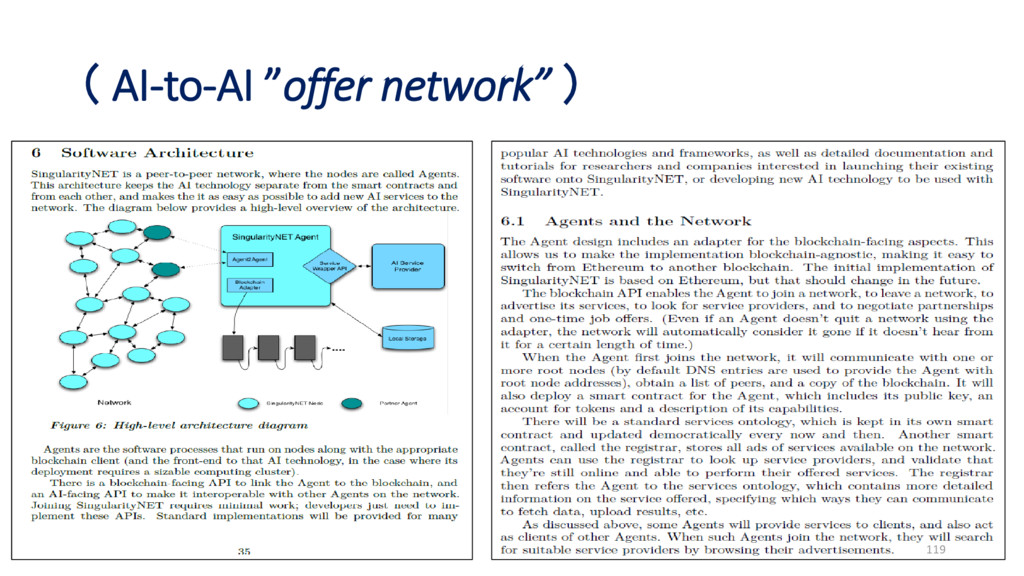
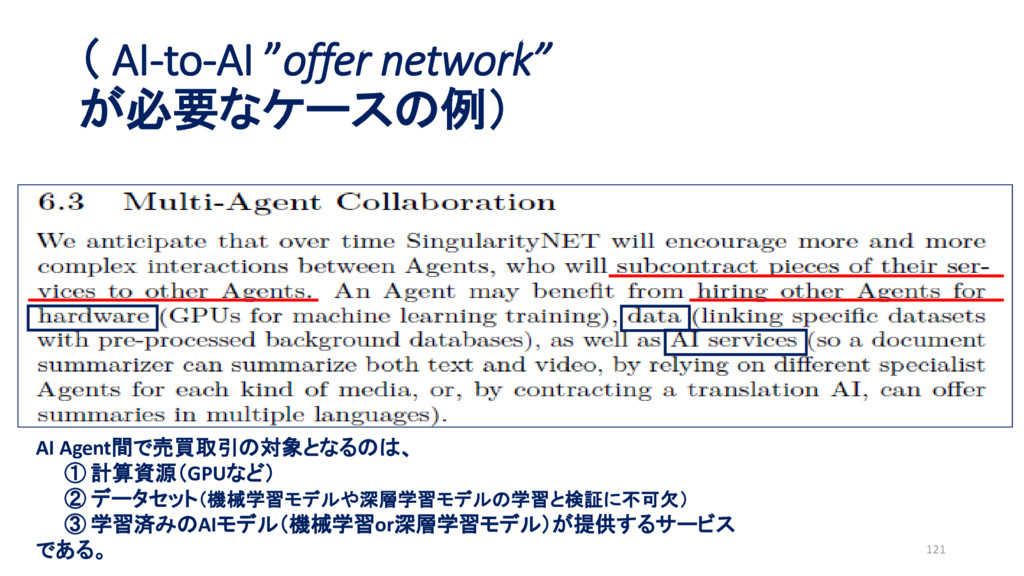
エンジニアによって、新規にSingularityNETにアップロードされた AIプログラム(=AI Agent)は、まず最初に、1つ又は複数の root nodesからメッセージを受信し、以下を受け取る。 ① SingiularityNET上に登録されている(自分以外の)AI Agentsのリスト (a list of peers) ② その時点までのすべてのBlock-chainのcopy ③ smart contract一式(使い方説明書付き) SingularityNET とは何か? 117


 connection_automated_ai
.png) codatum
codatum
 yama3133
 raspython3
 hlum
hlum
 ymrl
ymrl
 kairim0
 aoto
aoto
 tomzoh
 livesense
 vivion
 y0hgi
y0hgi
 oracle4engineer
 marcduiker
 soysaucechin
 cromwellryan
 techseoconnect
 marketingsoph
 eileencodes
 reverentgeek
 aleyda
 varn
varn
 scottboms
 addyosmani
 tmiket