Share
Embed
DFTFIT: Potential Generation for Molecular Dynamics Calculations
Development and quantification of interatomic potentials. Presented at HTCMC 9 in Toronto, Canada June 30th 2016. For further information on DFTFIT see [dftfit](https://github.com/costrouc/dftfit)
Christopher Ostrouchov
June 30, 2016
Transcript
25 slides
-
DFTFIT 1Christopher Ostrouchov University of Tennessee Material Science and Engineering
Potential Generation for Molecular Dynamics Calculations HTCMC Toronto June 30th 2016 2:20-2:40 -
2 About Me I ♥ Python and develop computational tools
for Material Science costrouc I strongly believe in reproducible research and the use of open databases for results pyqe python interface to Quantum Espresso lammps-python high performance interactive parallel LAMMPS sessions dftfit framework for potential development and quantification -
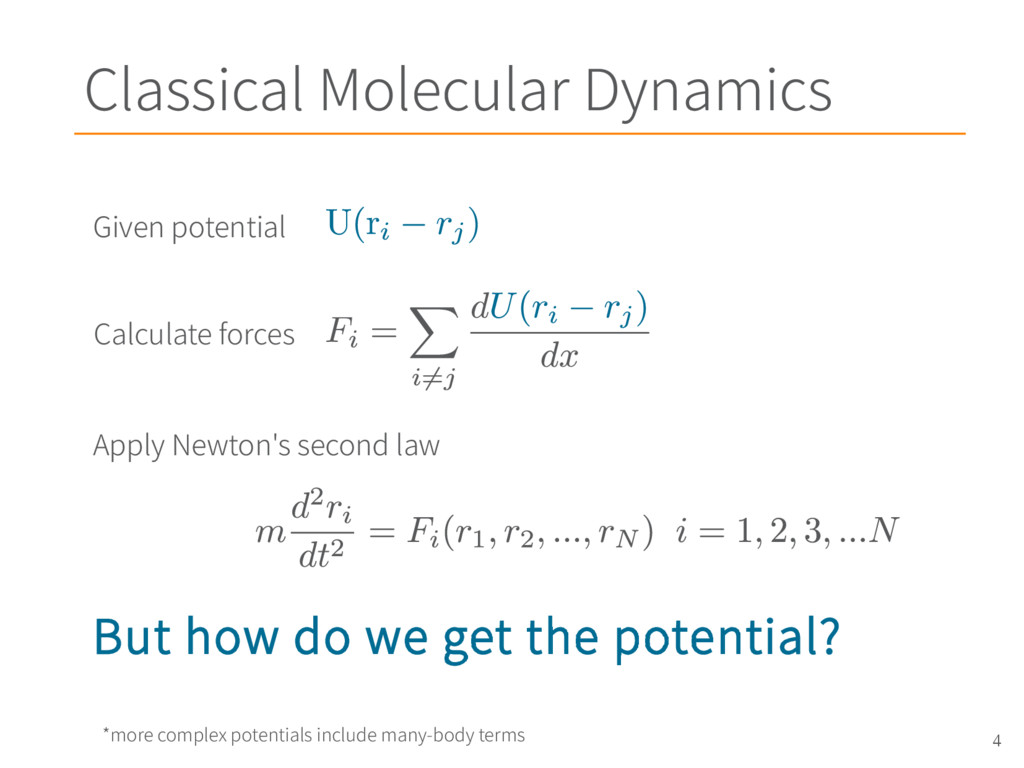
4 Classical Molecular Dynamics But how do we get the
potential? *more complex potentials include many-body terms Given potential Calculate forces Apply Newton's second law -
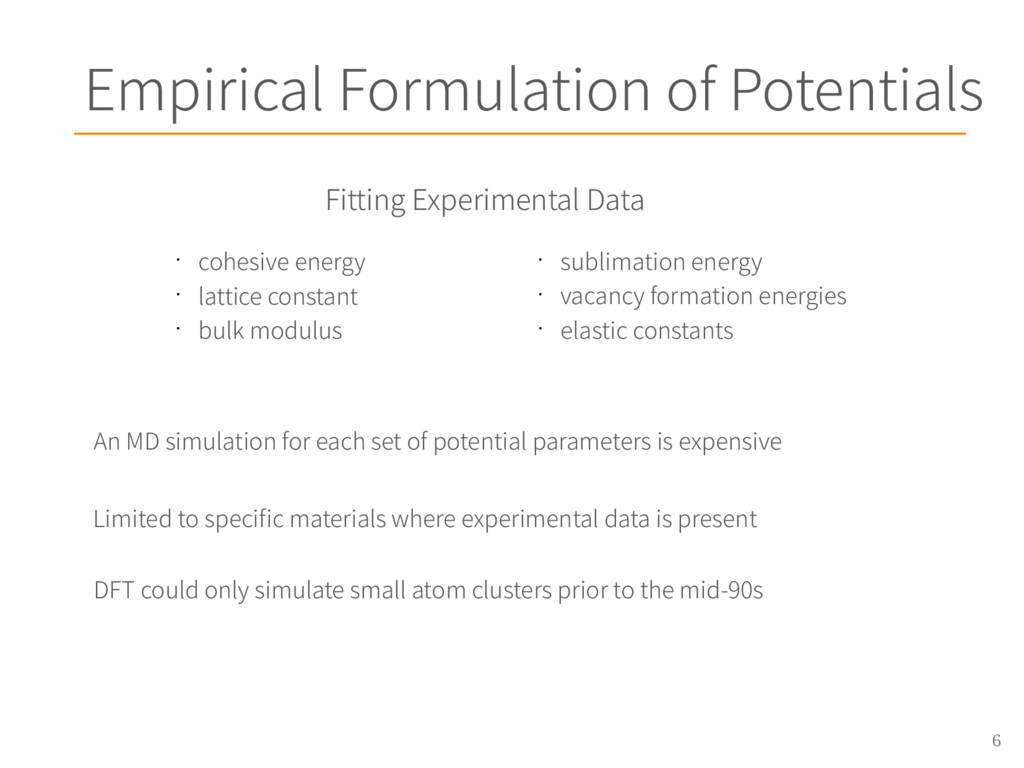
6 Empirical Formulation of Potentials Fitting Experimental Data • cohesive
energy • lattice constant • bulk modulus • sublimation energy • vacancy formation energies • elastic constants DFT could only simulate small atom clusters prior to the mid-90s An MD simulation for each set of potential parameters is expensive Limited to specific materials where experimental data is present -
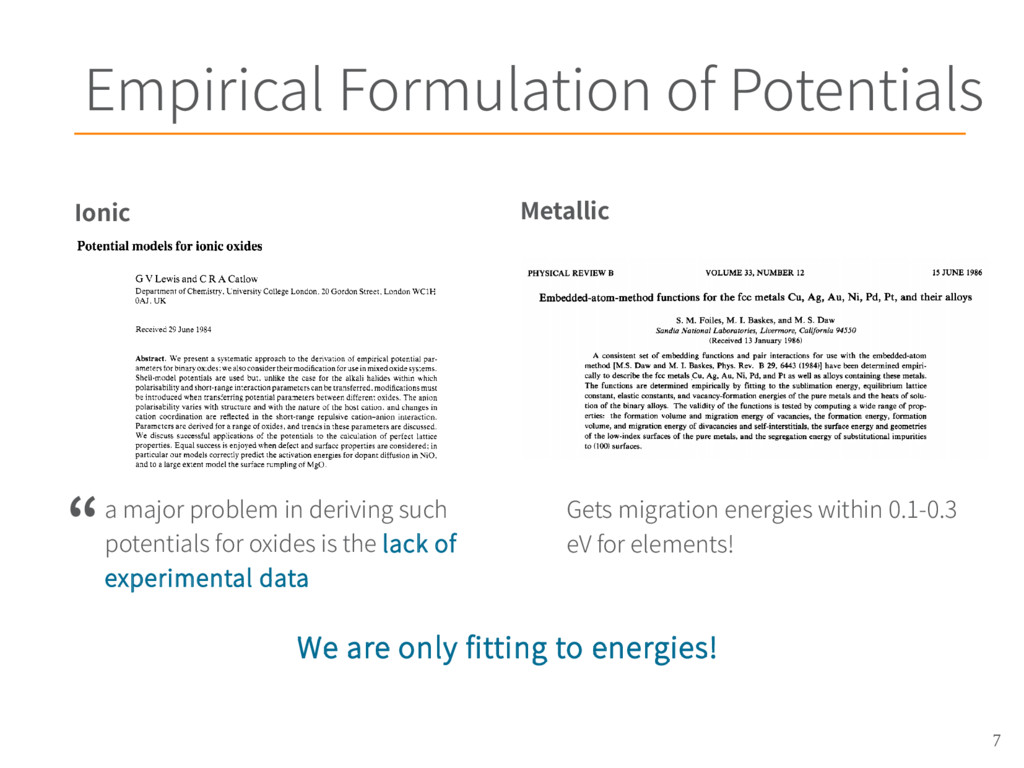
7 Empirical Formulation of Potentials a major problem in deriving
such potentials for oxides is the lack of experimental data “ Gets migration energies within 0.1-0.3 eV for elements! Ionic Metallic We are only fitting to energies! -
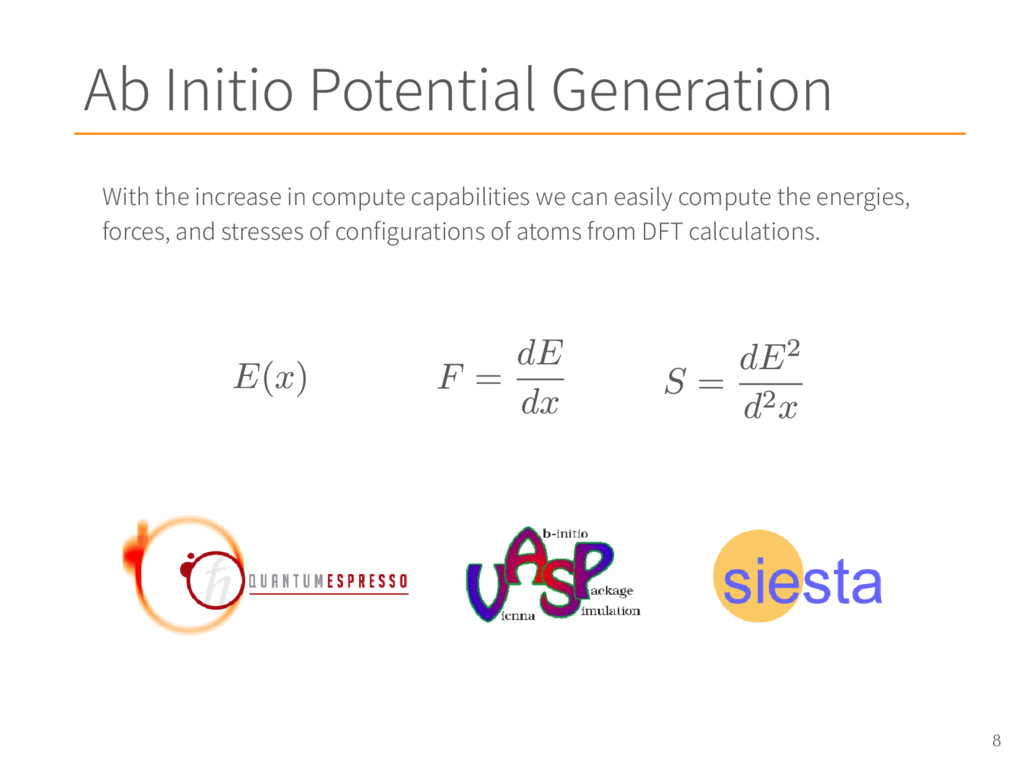
8 Ab Initio Potential Generation With the increase in compute
capabilities we can easily compute the energies, forces, and stresses of configurations of atoms from DFT calculations. -
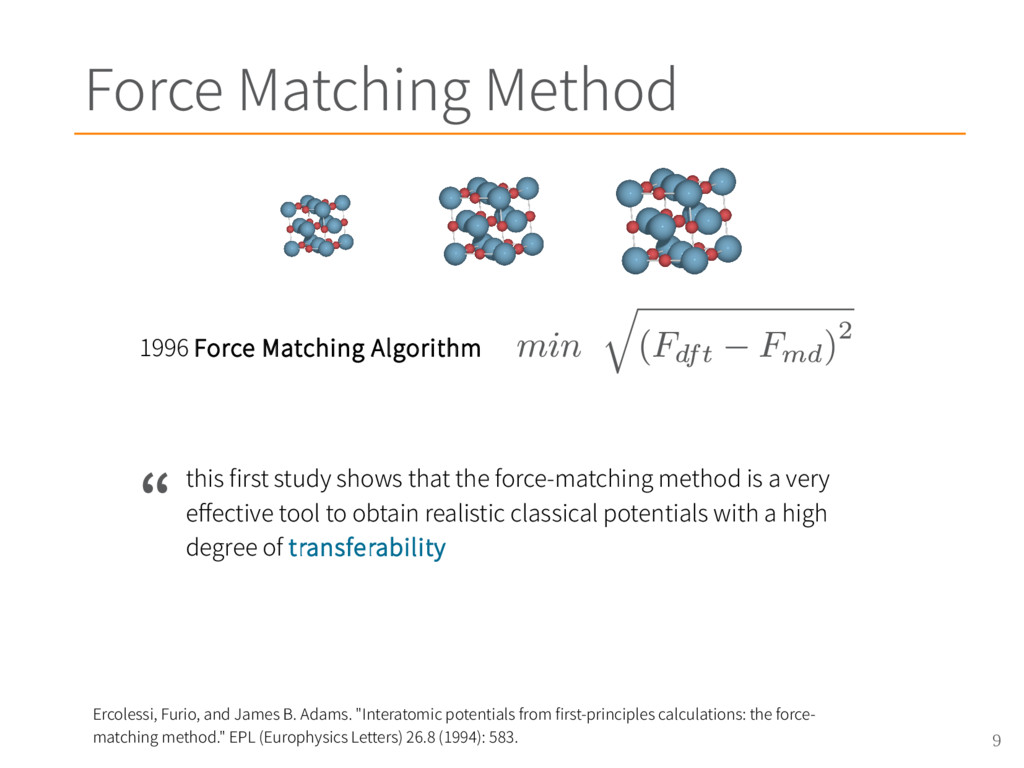
9 Force Matching Method 1996 Force Matching Algorithm “ Ercolessi,
Furio, and James B. Adams. "Interatomic potentials from first-principles calculations: the force- matching method." EPL (Europhysics Letters) 26.8 (1994): 583. this first study shows that the force-matching method is a very effective tool to obtain realistic classical potentials with a high degree of transferability -
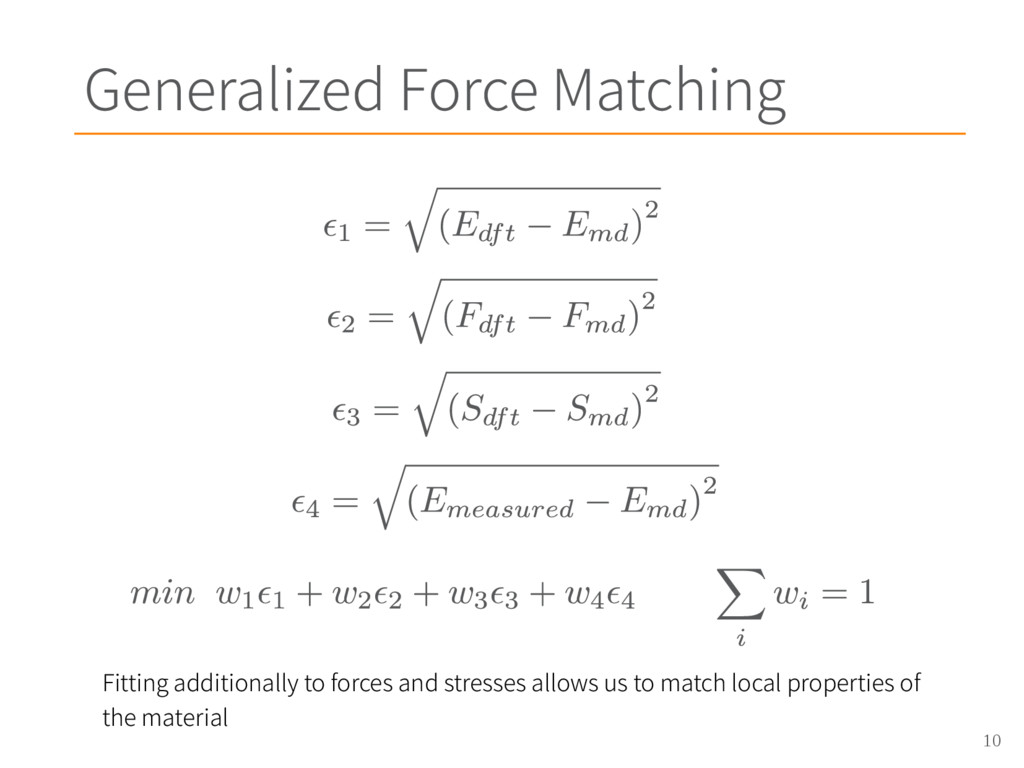
10 Generalized Force Matching Fitting additionally to forces and stresses
allows us to match local properties of the material -
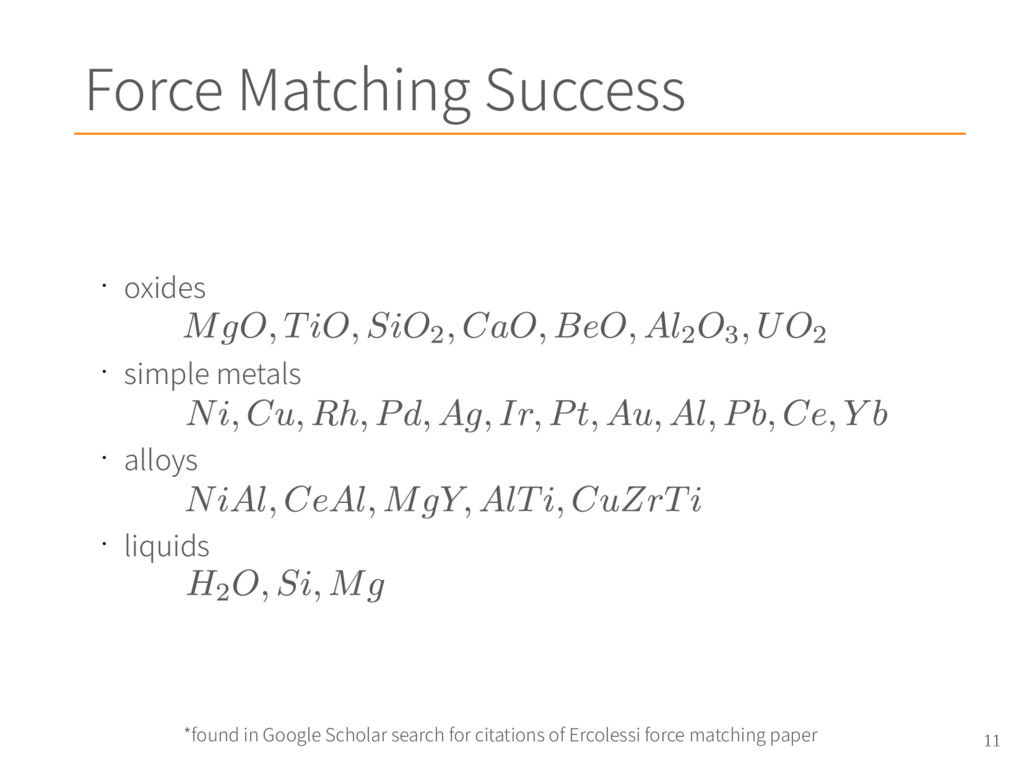
11 Force Matching Success • oxides • simple metals •
alloys • liquids *found in Google Scholar search for citations of Ercolessi force matching paper -
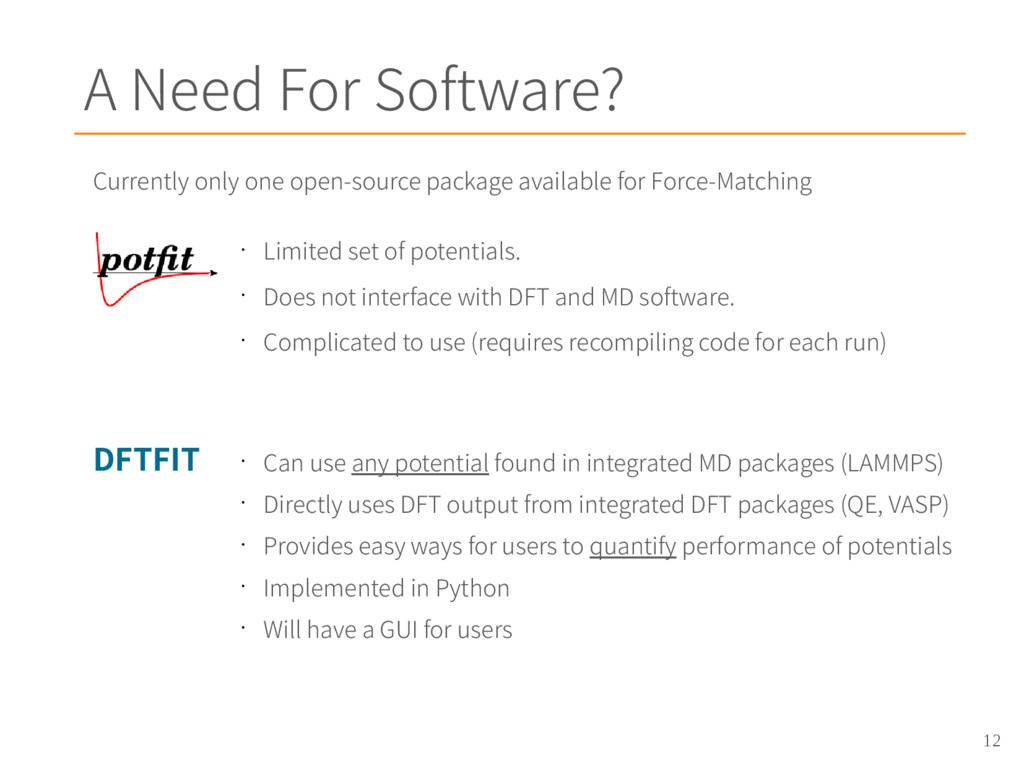
12 A Need For Software? Currently only one open-source package
available for Force-Matching • Limited set of potentials. • Does not interface with DFT and MD software. • Complicated to use (requires recompiling code for each run) DFTFIT • Can use any potential found in integrated MD packages (LAMMPS) • Directly uses DFT output from integrated DFT packages (QE, VASP) • Provides easy ways for users to quantify performance of potentials • Implemented in Python • Will have a GUI for users -
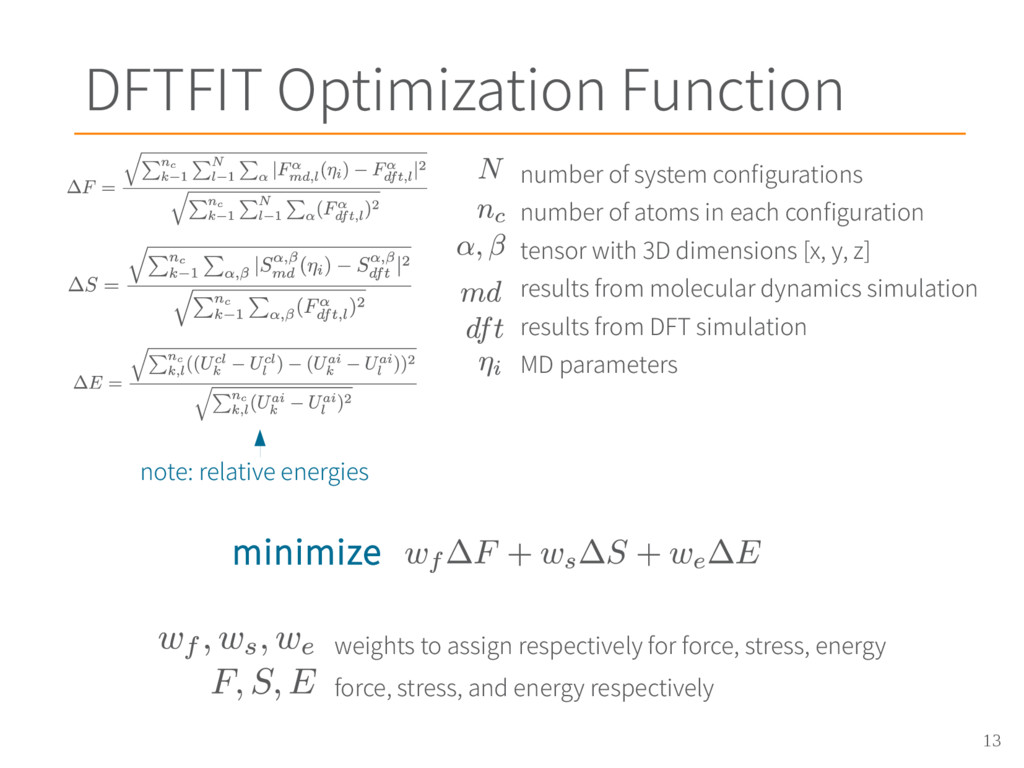
13 DFTFIT Optimization Function number of system configurations number of
atoms in each configuration tensor with 3D dimensions [x, y, z] results from molecular dynamics simulation results from DFT simulation MD parameters weights to assign respectively for force, stress, energy force, stress, and energy respectively note: relative energies minimize -
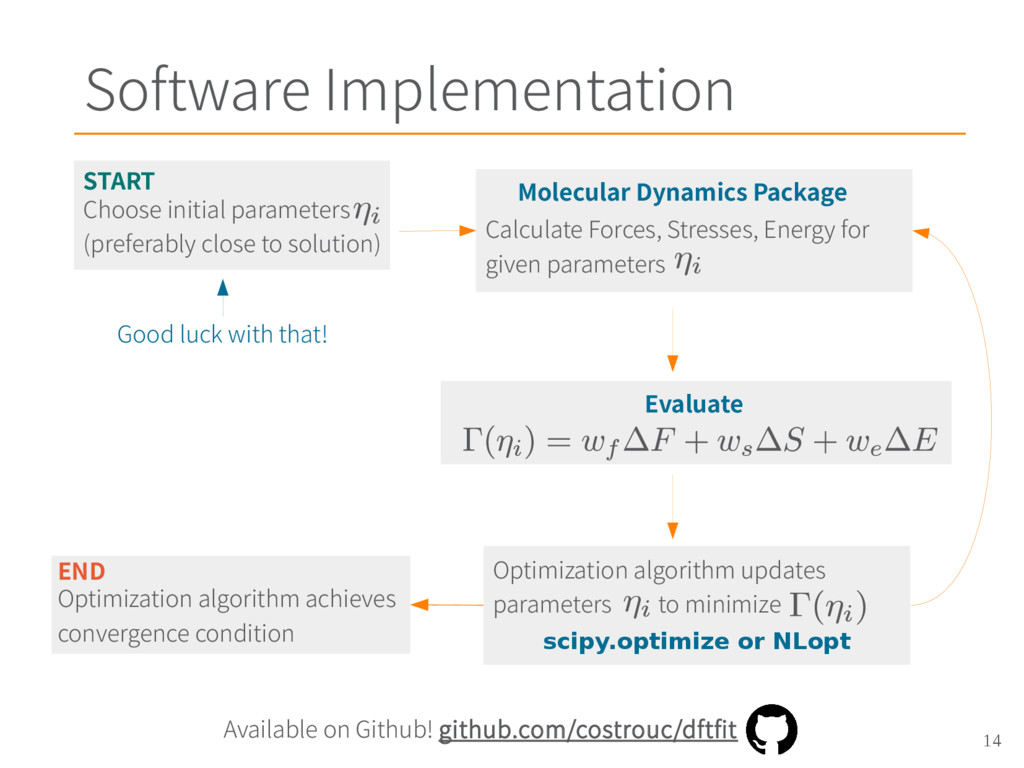
14 Software Implementation Molecular Dynamics Package Calculate Forces, Stresses, Energy
for given parameters Optimization algorithm updates parameters to minimize Available on Github! github.com/costrouc/dftfit Evaluate Choose initial parameters (preferably close to solution) START Optimization algorithm achieves convergence condition END Good luck with that! scipy.optimize or NLopt -
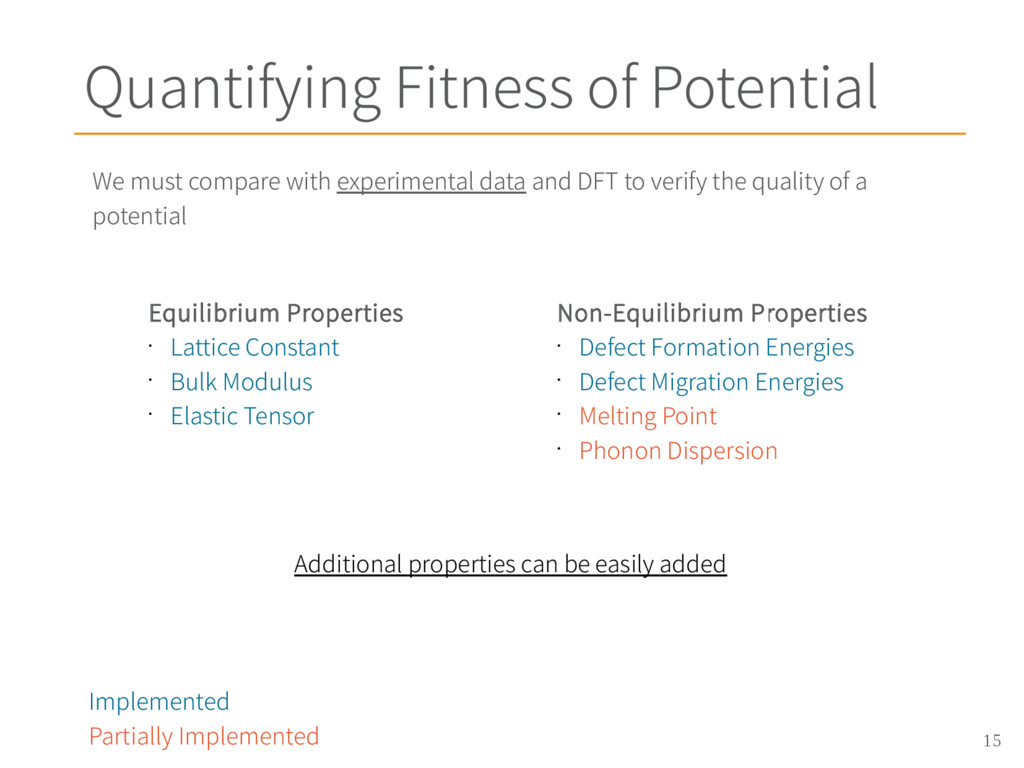
15 Quantifying Fitness of Potential We must compare with experimental
data and DFT to verify the quality of a potential Equilibrium Properties • Lattice Constant • Bulk Modulus • Elastic Tensor Implemented Partially Implemented Additional properties can be easily added Non-Equilibrium Properties • Defect Formation Energies • Defect Migration Energies • Melting Point • Phonon Dispersion -
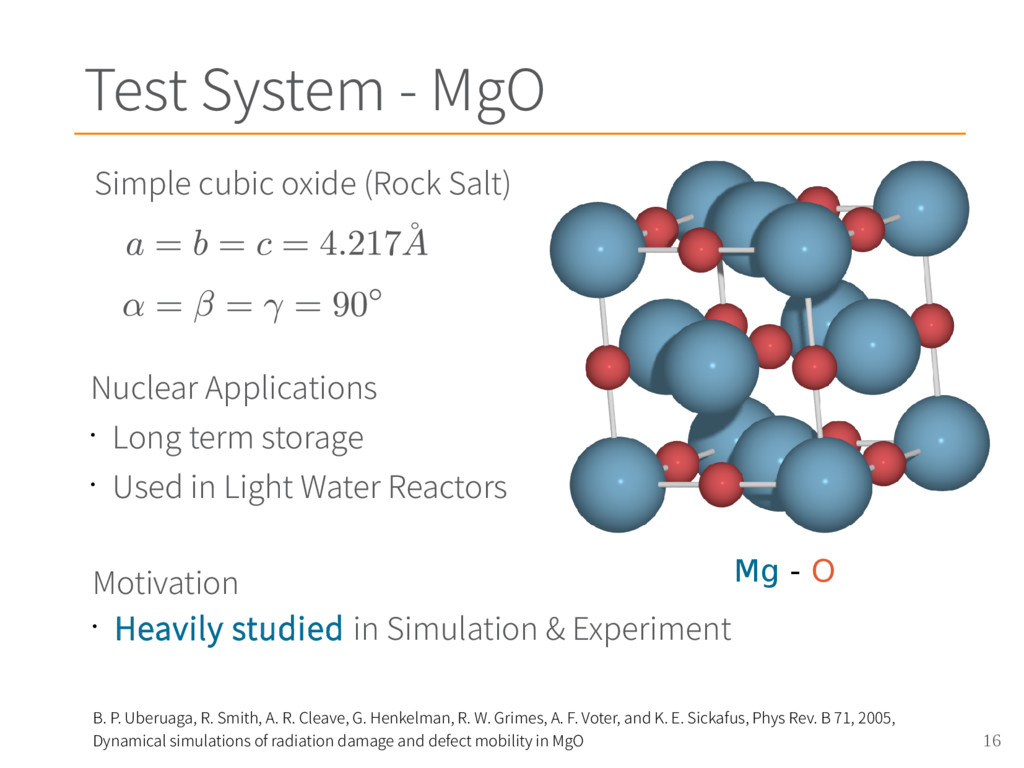
16 Test System - MgO Simple cubic oxide (Rock Salt)
Nuclear Applications • Long term storage • Used in Light Water Reactors B. P. Uberuaga, R. Smith, A. R. Cleave, G. Henkelman, R. W. Grimes, A. F. Voter, and K. E. Sickafus, Phys Rev. B 71, 2005, Dynamical simulations of radiation damage and defect mobility in MgO Mg - O Motivation • Heavily studied in Simulation & Experiment -
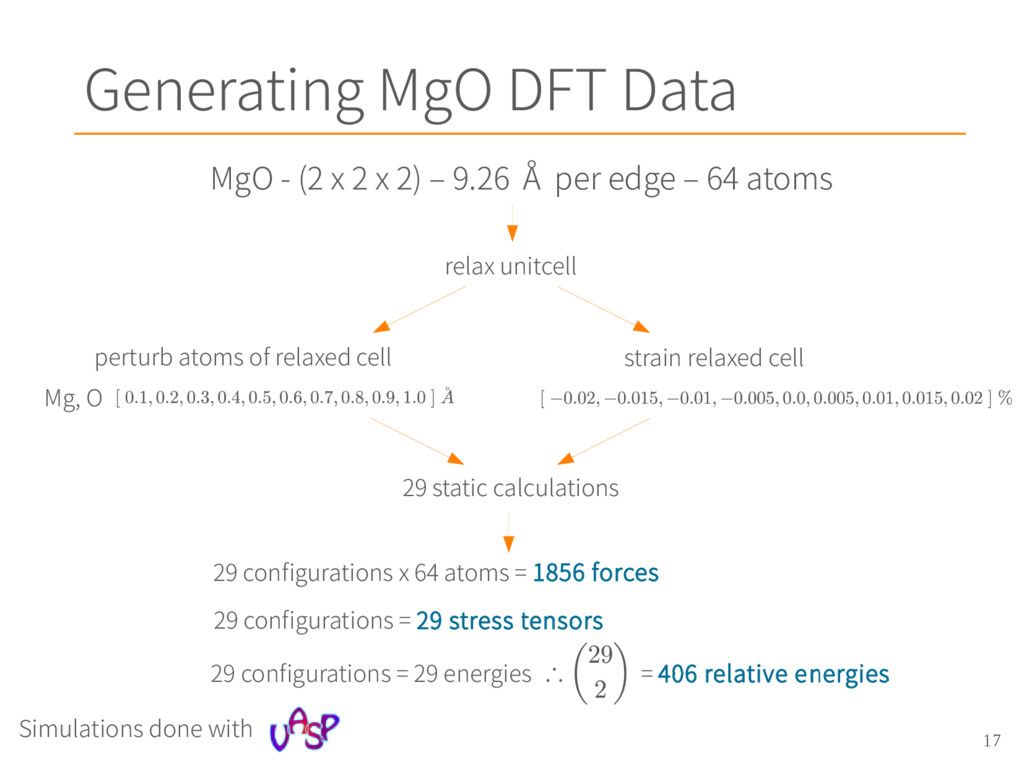
17 Generating MgO DFT Data MgO - (2 x 2
x 2) – 9.26 Å per edge – 64 atoms perturb atoms of relaxed cell 29 configurations x 64 atoms = 1856 forces 29 configurations = 29 stress tensors 29 configurations = 29 energies = 406 relative energies Mg, O 29 static calculations Simulations done with relax unitcell strain relaxed cell -
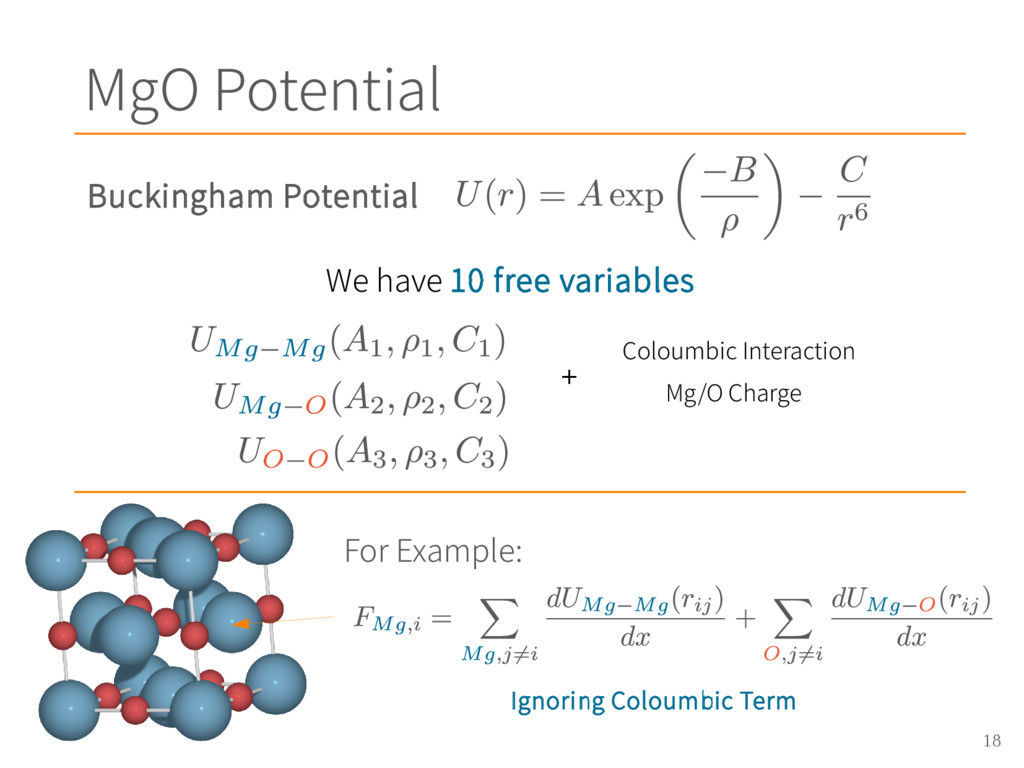
18 MgO Potential Buckingham Potential We have 10 free variables
For Example: + Mg/O Charge Coloumbic Interaction Ignoring Coloumbic Term -
19 MgO Potentials in Literature Matsui (1989) (partial charges) Lewis
and Catlow (1985) Ball and Grimes (2005) Ball and Grimes (2005) (partial charges) Available MgO Buckingham Potentials [1] Masanori Matsui, J. Chem. Phys. 91, 489 (1989), Molecular dynamics study of the structural and thermodynamic properties of MgO crystal with quantum correction [2] G. V. Lewis and C. R. A. Catlow, J. Phys. C: Solid State Phys. 18 1149, (1985), Potential models for ionic oxides [3] Graeme Henkelman, Blas P. Uberuaga, Duncan J. Harris, John H. Harding, and Neil L. Allan, Phys. Rev. B 72, 115437, 2005, MgO addimer diffusion on MgO(100): A comparison of ab initio and empirical models Can we improve upon on these potentials? -
20 Potential Improvement a 0 [A] B 0 [GPa] E
v f [eV] E v m [eV] C 11 [GPa] C 12 [GPa] C 44 [GPa] DFT [VASP] 4.228 156.80 4.57* 2.38 308 100 153 Lewis Catlow 4.199 193.25 2.843* 1.72 333 113 130 Results 4.221 188.17 4.219* 1.81 300 114 120 Experiment 4.211 156-160 N/A 2.0-2.7 291 91 139 *Using conventional MD method for defect formation energy Overall improvement of the potential! -
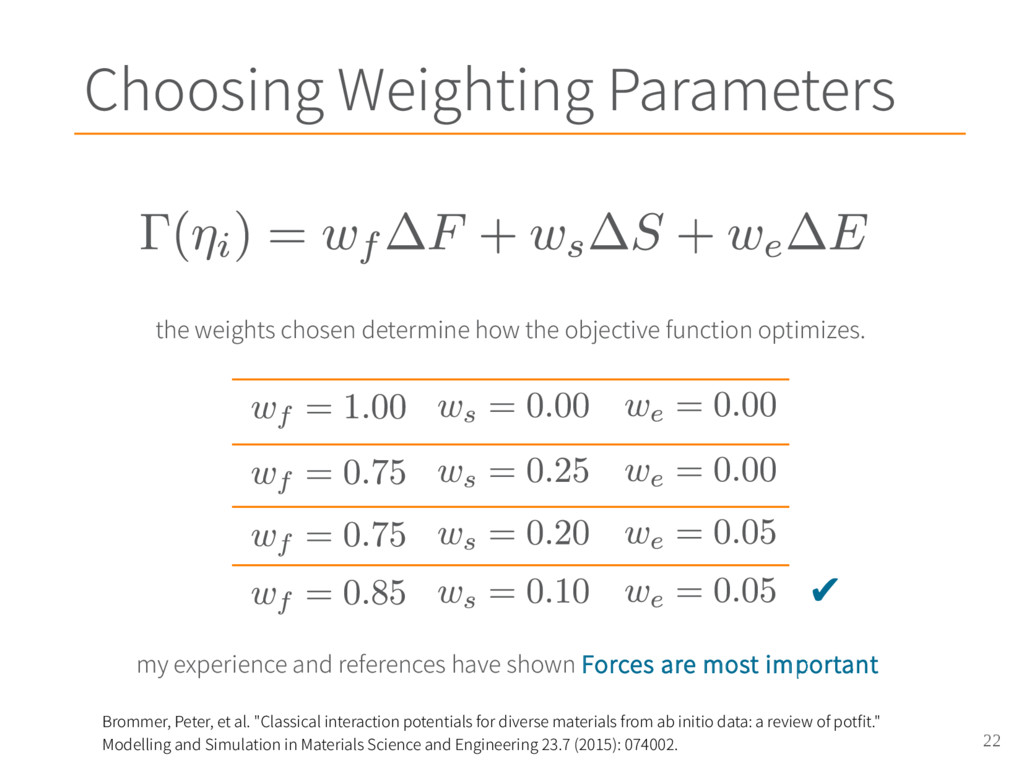
22 Choosing Weighting Parameters the weights chosen determine how the
objective function optimizes. my experience and references have shown Forces are most important ✔ Brommer, Peter, et al. "Classical interaction potentials for diverse materials from ab initio data: a review of potfit." Modelling and Simulation in Materials Science and Engineering 23.7 (2015): 074002. -
23 Optimization Algorithm Global vs. Local Optimization Local • BOBYQA
[nlopt] • Powell [scipy, nlopt] Global • Simulated Annealing • Genetic Algorithms • Stochastic Gradient Decent global optimization will require parallelization -
24 Conclusion • Working code for creating MD potentials •
Interfaces with LAMMPS, Quantum Espresso, and VASP • Tools for quantifying performance of potentials • Shown DFTFIT can improve potentials for MgO Goal is to make potential generation easier -
25 Thank You! References [1] – B. P. Uberuaga, R.
Smith, A. R. Cleave, G. Henkelman, R. W. Grimes, A. F. Voter, and K. E. Sickafus, Phys Rev. B 71, 2005, Dynamical simulations of radiation damage and defect mobility in MgO [2] – Masanori Matsui, J. Chem. Phys. 91, 489 (1989), Molecular dynamics study of the structural and thermodynamic properties of MgO crystal with quantum correction [3] – G. V. Lewis and C. R. A. Catlow, J. Phys. C: Solid State Phys. 18 1149, (1985), Potential models for ionic oxides [4] – Graeme Henkelman, Blas P. Uberuaga, Duncan J. Harris, John H. Harding, and Neil L. Allan, Phys. Rev. B 72, 115437, 2005, MgO addimer diffusion on MgO(100): A comparison of ab initio and empirical models [5] - F. Ercolessi and J. B. Adams Europhys. Lett. 26 583, 1994 Interatomic Potentials from First-Principles Calculations: The Force-Matching Method [6] - Sergei Izvekov, Michele Parrinello, Christian J. Burnham and Gregory A. Voth, J. Chem. Phys. 120, 10896, 2004, Effective force fields for condensed phase systems from ab initio molecular dynamics simulation: A new method for force-matching [7] - Eric Jones, Travis Oliphant, Pearu Peterson and others., SciPy: Open source scientific tools for Python, www.scipy.org, 2001 MgO applications MgO potentials Force matching origin Beautiful force matching paper Least Square Solver Charge Density for LiNbO 3 calculated with Quantum Espresso Acknowledgements • UTK Compute Cluster Newton • NERSC Super Computer Hopper • NICS Super Computer Darter All images and figures created by Chris Ostrouchov