Upgrade to Pro — share decks privately, control downloads, hide ads and more …

Take a break: Intentionally managing your menta...

Take a break: Intentionally managing your mental capital

Creative work is mentally taxing, and software development is no exception. Modern software engineering is a highly collaborative process that requires both social awareness and technical skill. These things combine to make breaks particularly important, but despite our best efforts it's easier said than done. I'll cover some research on break taking; strategies I've used to make breaks more effective, and specific examples around taking breaks in pair and mob programming situations. Be prepared to take a break during the talk.

Avatar for Andrew

Andrew

May 30, 2019

Other Decks in Programming

Transcript

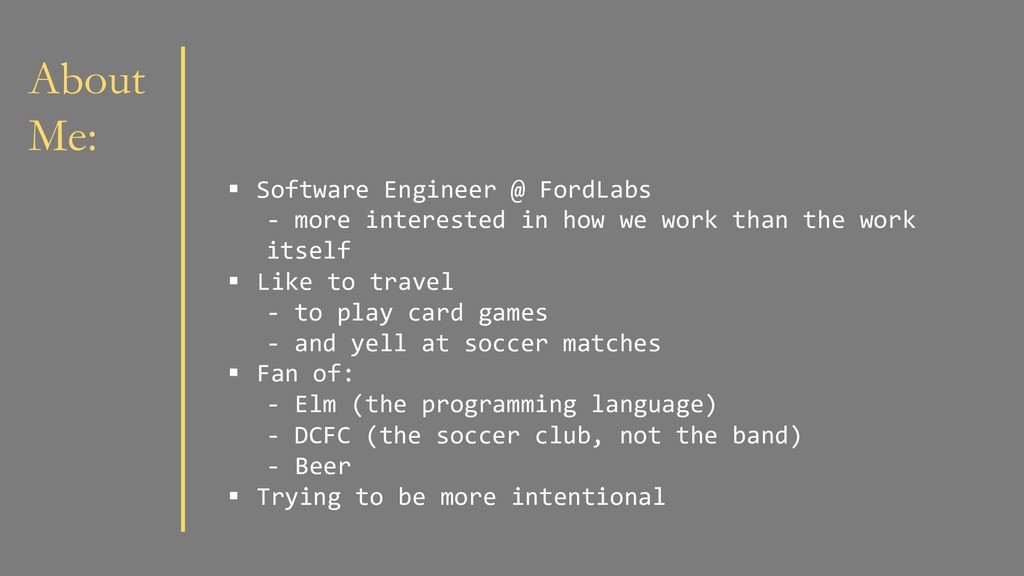
  1. About Me: § Software Engineer @ FordLabs - more interested

    in how we work than the work itself § Like to travel - to play card games - and yell at soccer matches § Fan of: - Elm (the programming language) - DCFC (the soccer club, not the band) - Beer § Trying to be more intentional
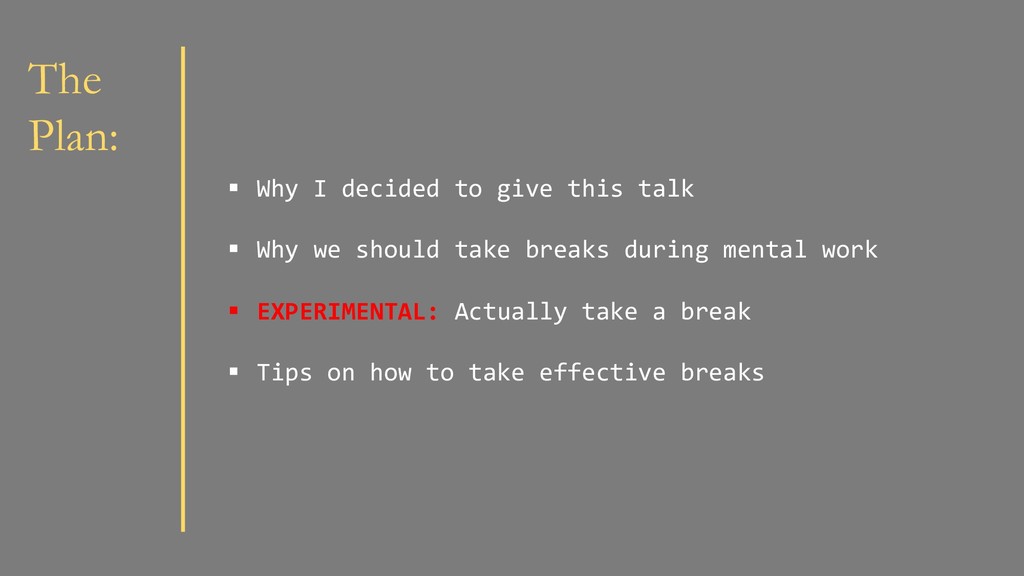
  2. The Plan: § Why I decided to give this talk

    § Why we should take breaks during mental work § EXPERIMENTAL: Actually take a break § Tips on how to take effective breaks
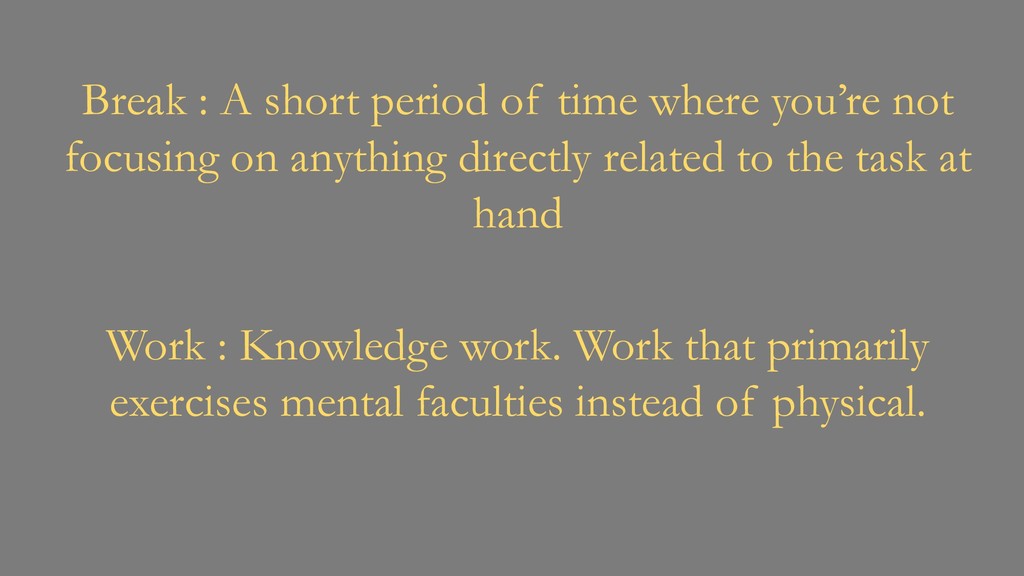
  3. Break : A short period of time where you’re not

    focusing on anything directly related to the task at hand Work : Knowledge work. Work that primarily exercises mental faculties instead of physical.
  4. Why I Care: § Wanted to read research on the

    subject § Was never really taught how § Many of my peers seem bad at it § Frustrated with working hard instead of smart § There’s an open bar at the speaker dinner
  5. “Rather than taking breaks because we are tired, we take

    breaks so that we do not become tired.” – Tim Ottinger
  6. Why Breaks: § We rest frequently during physical labor §

    Very short breaks increase your attention level1 § Higher vitality and lower fatigue2 § Lets your unconscious mind work § Tired people are irritable § Encourages communication outside of your team
  7. Some Caveats: § You need to sleep enough to get

    the benefit3 § Not a lot of research on short breaks § Luckily, it’s pretty easy for us to do our own research
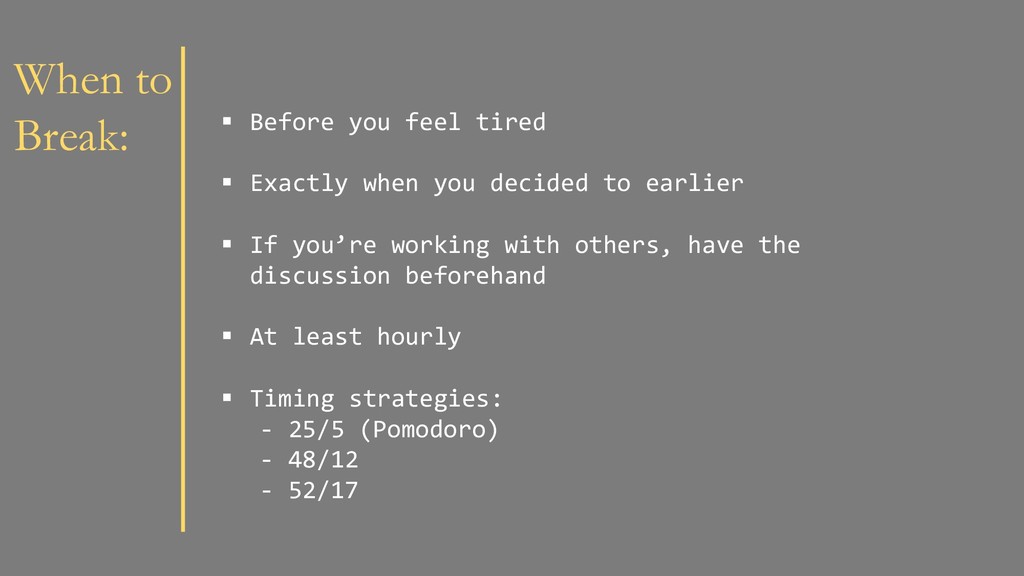
  8. When to Break: § Before you feel tired § Exactly

    when you decided to earlier § If you’re working with others, have the discussion beforehand § At least hourly § Timing strategies: - 25/5 (Pomodoro) - 48/12 - 52/17
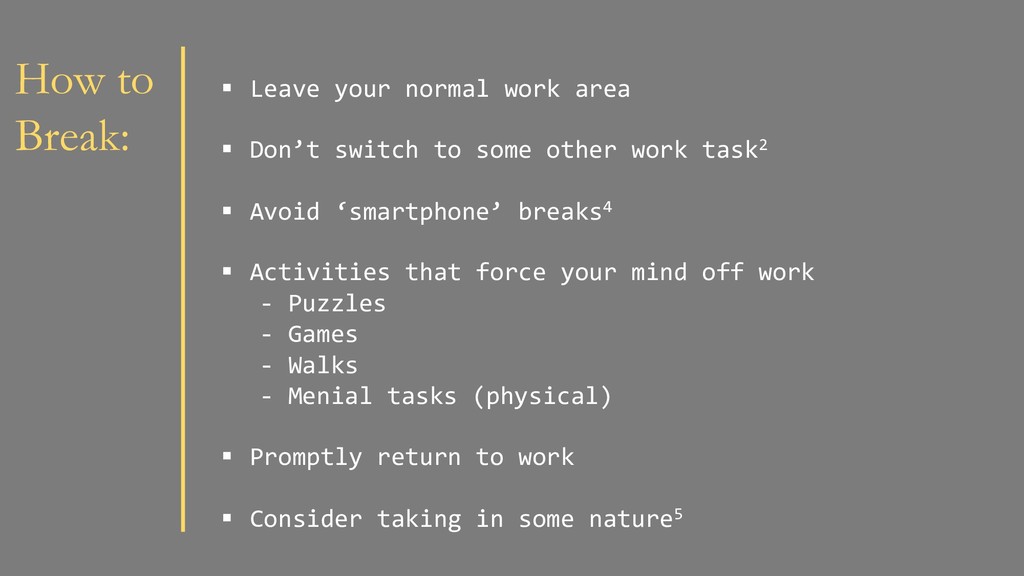
  9. How to Break: § Leave your normal work area §

    Don’t switch to some other work task2 § Avoid ‘smartphone’ breaks4 § Activities that force your mind off work - Puzzles - Games - Walks - Menial tasks (physical) § Promptly return to work § Consider taking in some nature5
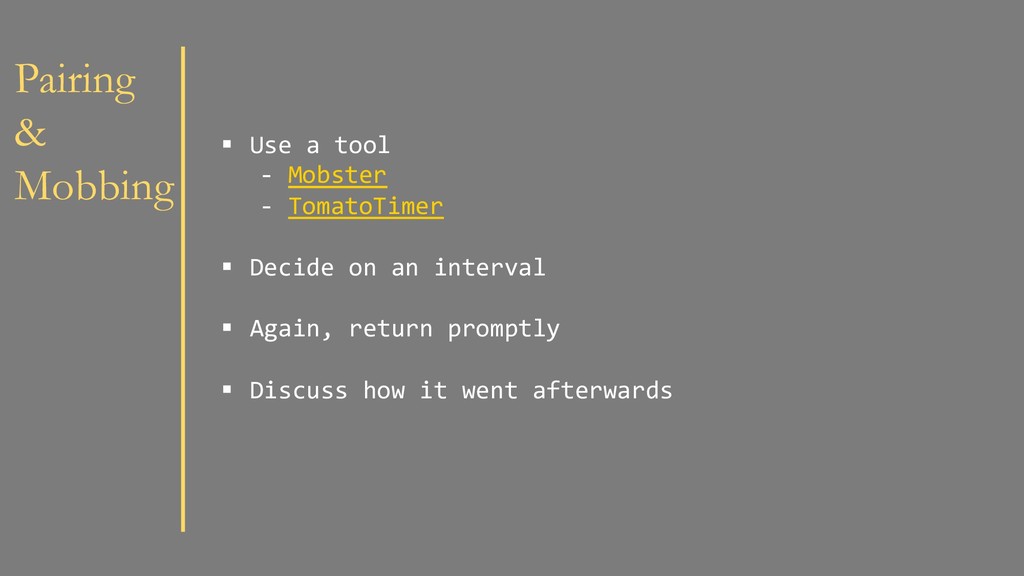
  10. Pairing & Mobbing § Use a tool - Mobster -

    TomatoTimer § Decide on an interval § Again, return promptly § Discuss how it went afterwards
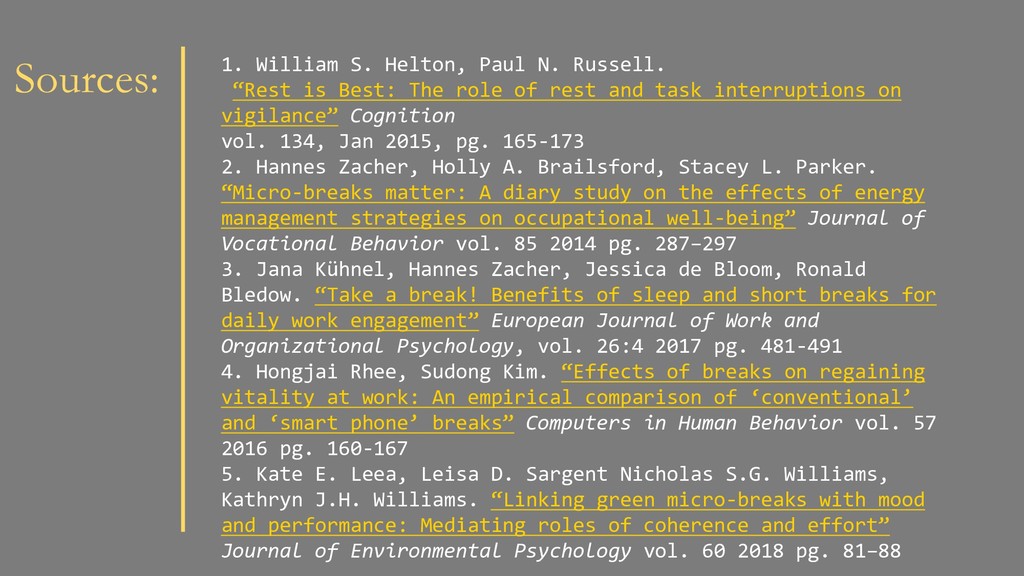
  11. Sources: 1. William S. Helton, Paul N. Russell. “Rest is

    Best: The role of rest and task interruptions on vigilance” Cognition vol. 134, Jan 2015, pg. 165-173 2. Hannes Zacher, Holly A. Brailsford, Stacey L. Parker. “Micro-breaks matter: A diary study on the effects of energy management strategies on occupational well-being” Journal of Vocational Behavior vol. 85 2014 pg. 287–297 3. Jana Kühnel, Hannes Zacher, Jessica de Bloom, Ronald Bledow. “Take a break! Benefits of sleep and short breaks for daily work engagement” European Journal of Work and Organizational Psychology, vol. 26:4 2017 pg. 481-491 4. Hongjai Rhee, Sudong Kim. “Effects of breaks on regaining vitality at work: An empirical comparison of ‘conventional’ and ‘smart phone’ breaks” Computers in Human Behavior vol. 57 2016 pg. 160-167 5. Kate E. Leea, Leisa D. Sargent Nicholas S.G. Williams, Kathryn J.H. Williams. “Linking green micro-breaks with mood and performance: Mediating roles of coherence and effort” Journal of Environmental Psychology vol. 60 2018 pg. 81–88