Share
Embed
JAX 2019: Size does matter! JVM-Microframeworks sinnvoll eingesetzt
Code examples can be found on https://github.com/csh0711/jvm-microframeworks-kotlin-samples
Christian Schwörer
May 08, 2019
Transcript
16 slides
-
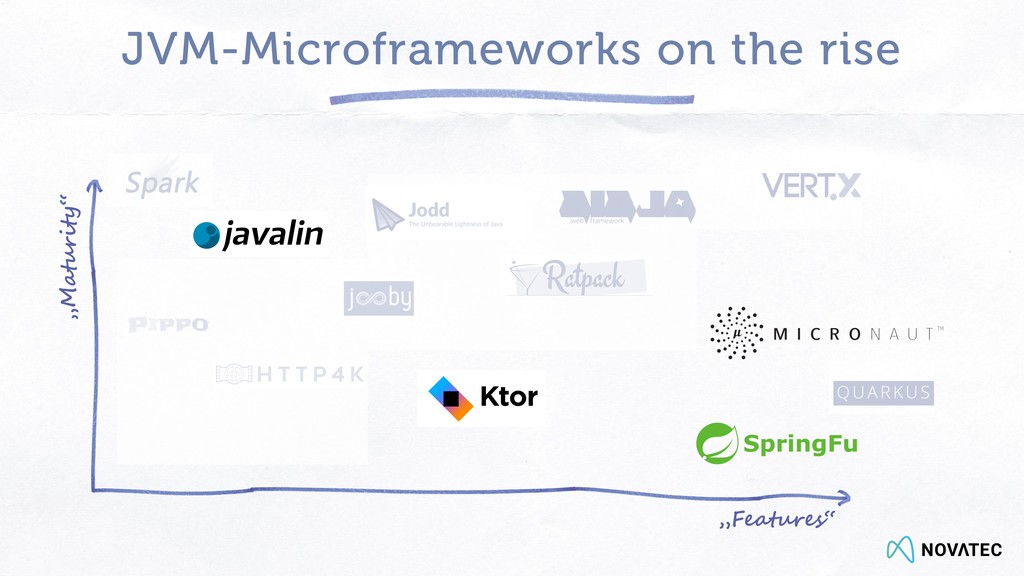
• (Subjective) overview on current JVM-Microframeworks • Practical introduction •
Possible fields of application for microframeworks – and where not to use them (yet) • And what you won’t get: • Deep dive in a single framework • Silver Bullet What is this session about? -
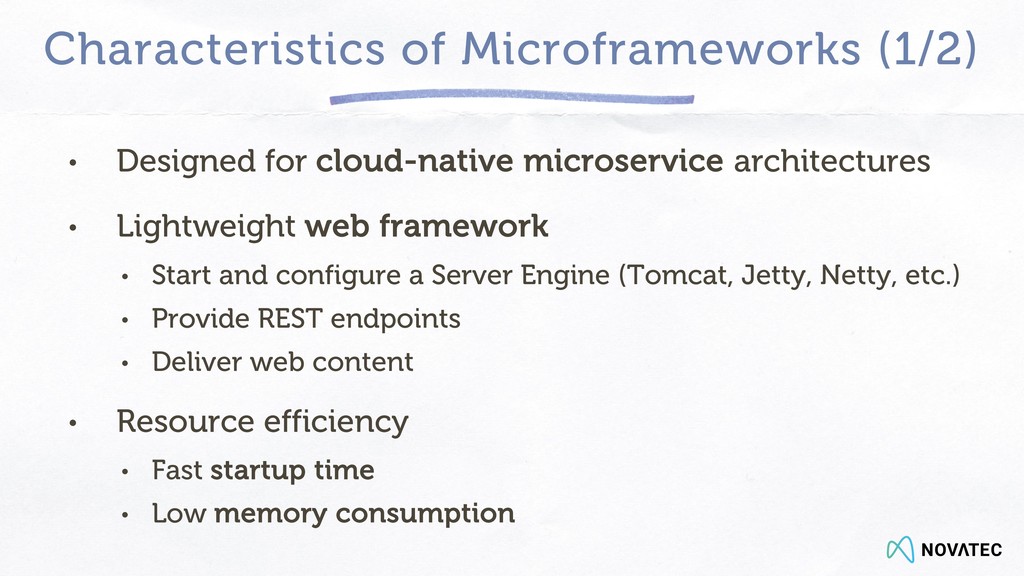
• Designed for cloud-native microservice architectures • Lightweight web framework
• Start and configure a Server Engine (Tomcat, Jetty, Netty, etc.) • Provide REST endpoints • Deliver web content • Resource efficiency • Fast startup time • Low memory consumption Characteristics of Microframeworks (1/2) -
• Focus on simplicity and speed of development • Usually
lack some advanced features (e.g. extended security, monitoring, multiple database abstractions) • GraalVM friendly Characteristics of Microframeworks (2/2) -
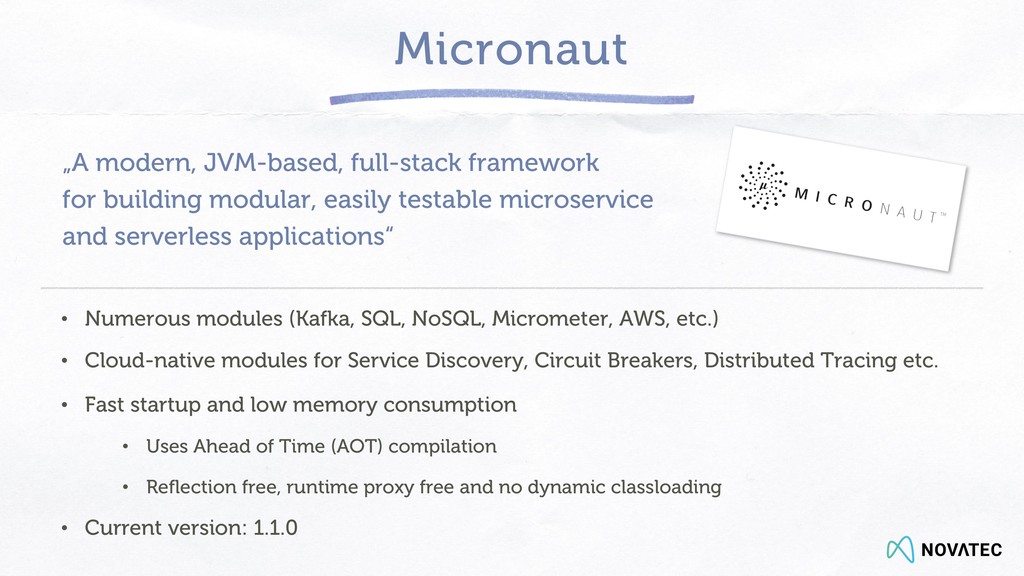
• Numerous modules (Kafka, SQL, NoSQL, Micrometer, AWS, etc.) •
Cloud-native modules for Service Discovery, Circuit Breakers, Distributed Tracing etc. • Fast startup and low memory consumption • Uses Ahead of Time (AOT) compilation • Reflection free, runtime proxy free and no dynamic classloading • Current version: 1.1.0 „A modern, JVM-based, full-stack framework for building modular, easily testable microservice and serverless applications“ Micronaut -
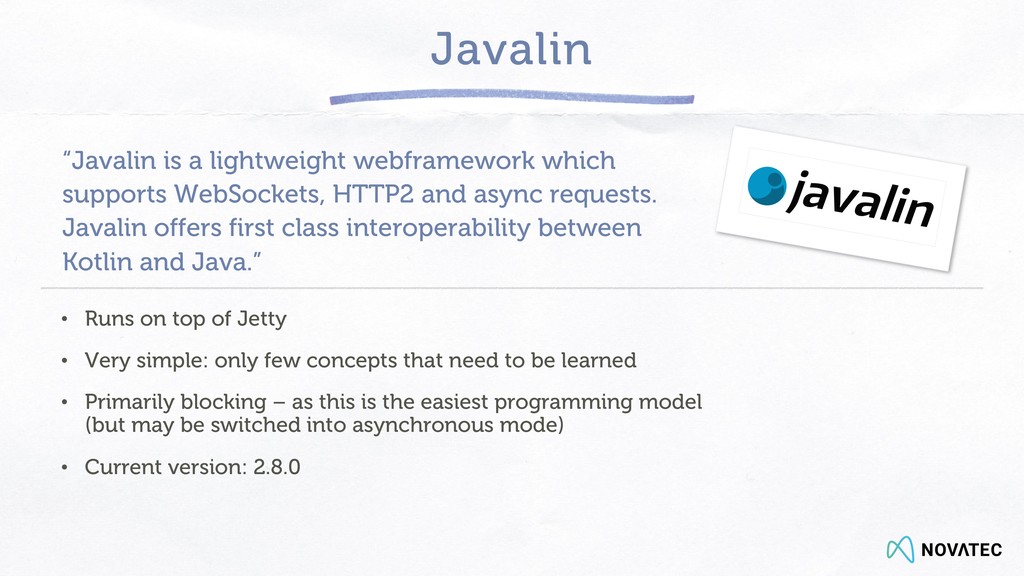
• Runs on top of Jetty • Very simple: only
few concepts that need to be learned • Primarily blocking – as this is the easiest programming model (but may be switched into asynchronous mode) • Current version: 2.8.0 “Javalin is a lightweight webframework which supports WebSockets, HTTP2 and async requests. Javalin offers first class interoperability between Kotlin and Java.” Javalin -
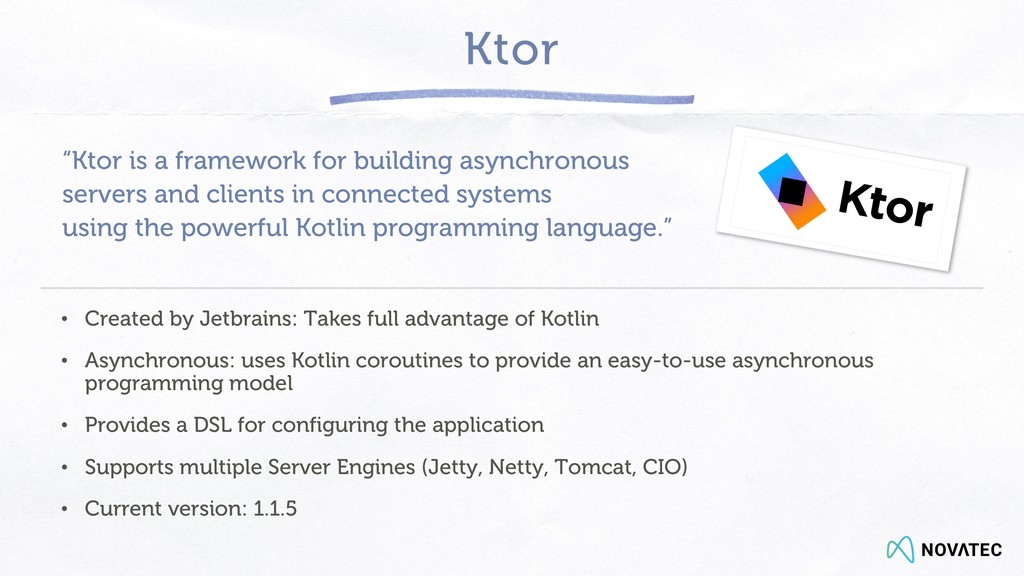
• Created by Jetbrains: Takes full advantage of Kotlin •
Asynchronous: uses Kotlin coroutines to provide an easy-to-use asynchronous programming model • Provides a DSL for configuring the application • Supports multiple Server Engines (Jetty, Netty, Tomcat, CIO) • Current version: 1.1.5 “Ktor is a framework for building asynchronous servers and clients in connected systems using the powerful Kotlin programming language.” Ktor -
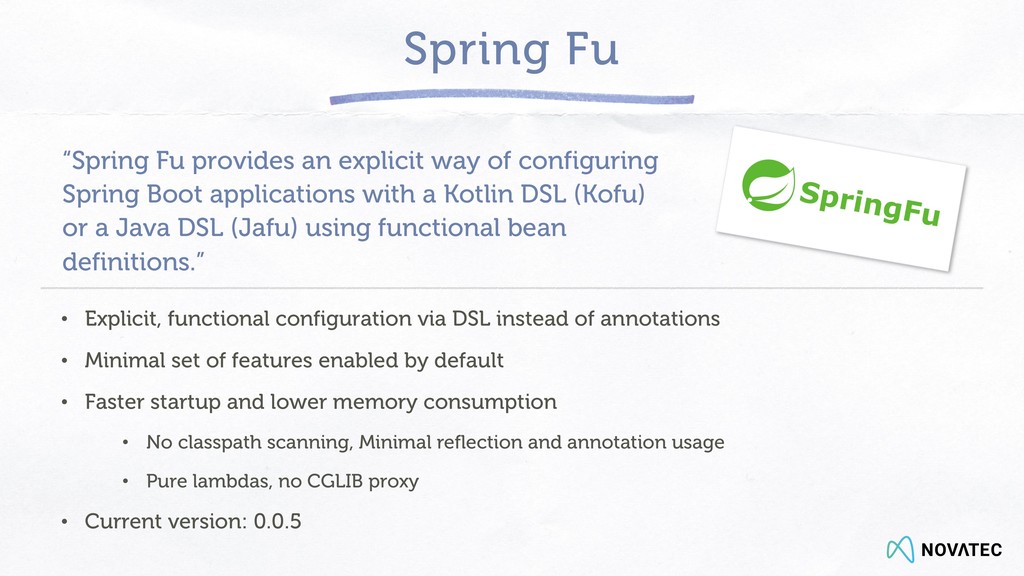
• Explicit, functional configuration via DSL instead of annotations •
Minimal set of features enabled by default • Faster startup and lower memory consumption • No classpath scanning, Minimal reflection and annotation usage • Pure lambdas, no CGLIB proxy • Current version: 0.0.5 “Spring Fu provides an explicit way of configuring Spring Boot applications with a Kotlin DSL (Kofu) or a Java DSL (Jafu) using functional bean definitions.” Spring Fu -
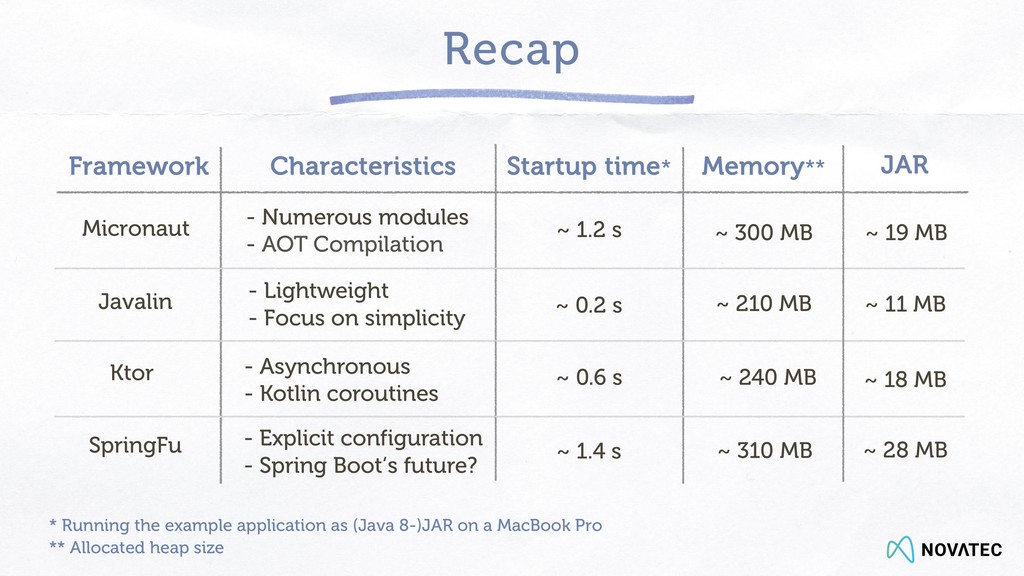
Recap Framework Characteristics Startup time* Memory** * Running the example
application as (Java 8-)JAR on a MacBook Pro ** Allocated heap size Micronaut Javalin Ktor SpringFu - Numerous modules - AOT Compilation - Lightweight - Focus on simplicity - Asynchronous - Kotlin coroutines - Explicit configuration - Spring Boot‘s future? ~ 1.2 s ~ 0.2 s ~ 0.6 s ~ 1.4 s ~ 300 MB ~ 210 MB ~ 240 MB ~ 310 MB JAR ~ 19 MB ~ 18 MB ~ 11 MB ~ 28 MB -
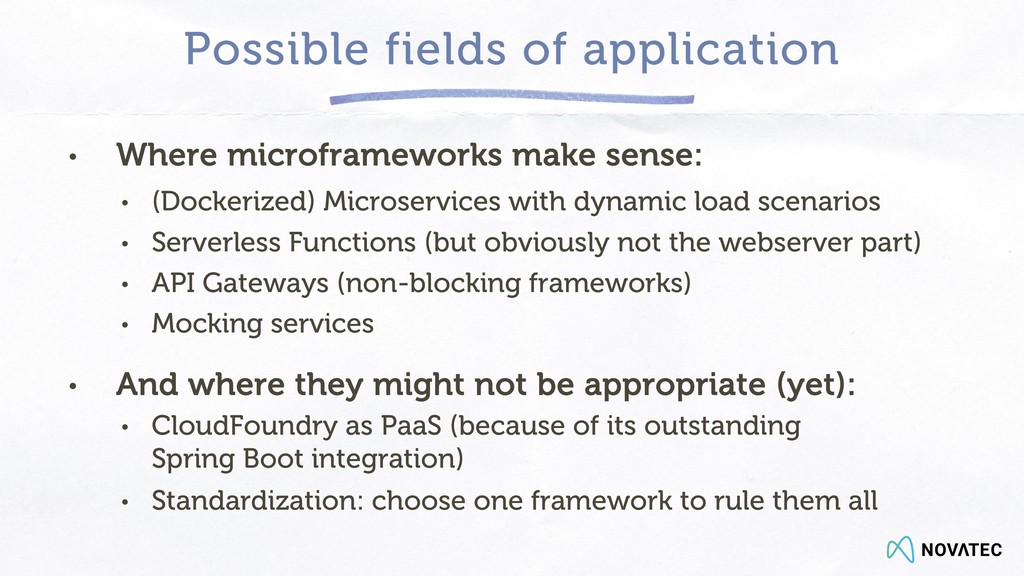
• Where microframeworks make sense: • (Dockerized) Microservices with dynamic
load scenarios • Serverless Functions (but obviously not the webserver part) • API Gateways (non-blocking frameworks) • Mocking services Possible fields of application • And where they might not be appropriate (yet): • CloudFoundry as PaaS (because of its outstanding Spring Boot integration) • Standardization: choose one framework to rule them all -
• @csh_0711 • https://github.com/csh0711/jvm-microframeworks-kotlin-samples • Visit our JAX booth! •
https://www.novatec-gmbh.de/blog/ • Frameworks • https://micronaut.io • https://javalin.io • https://ktor.io • https://github.com/spring-projects/spring-fu Further information