$30 off During Our Annual Pro Sale. View Details »

Towards typesafe deep learning in Scala

Towards typesafe deep learning in Scala

The preferred language of current deep learning frameworks (TensorFlow, PyTorch, MXNet, DyNet, etc.) is Python, a type-unsafe language. To remedy this unfortunate fact, we present Nexus, a prototypical typesafe deep learning engine in Scala. Being extraordinarily expressive in types, Nexus offers unforseen typesafety and succinctness to deep learning developers by extensive use of typelevel computation through the popular library Shapeless. In this talk I'll introduce the design of a deep learning framework, and how Scala's type-level computation abilities could make it safer and more expressive. Ideas include generalized algebraic data types (GADTs), heterogeneous lists (HLists), program verification (compiling-as-proofs with Scala implicits), and introductory machine learning.

Avatar for Tongfei Chen

Tongfei Chen

March 19, 2018
Tweet

Other Decks in Programming

Transcript

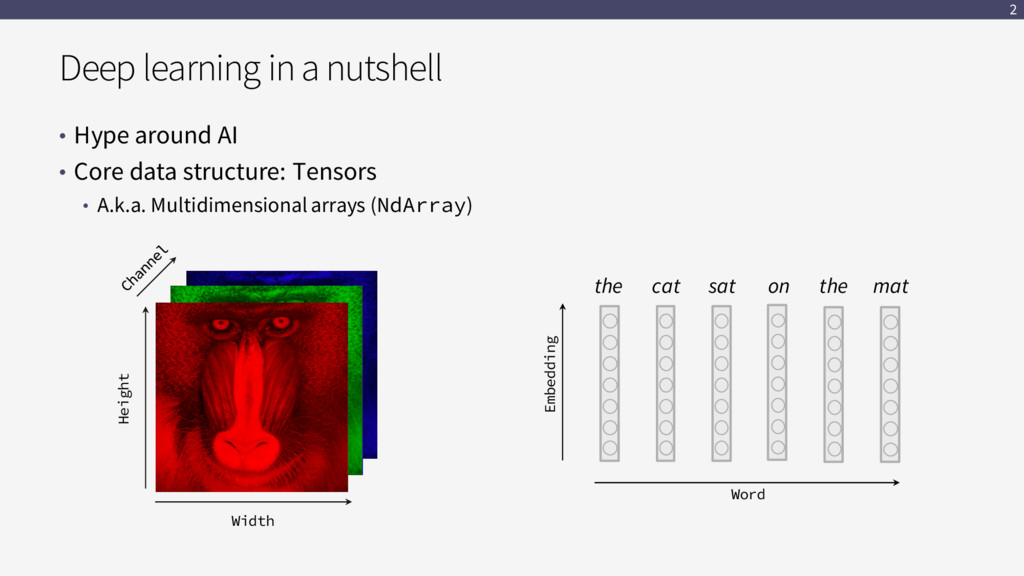
  1. 2 Deep learning inanutshell • Hype around AI • Core

    data structure: Tensors • A.k.a. Multidimensionalarrays (NdArray) Width Height Word Embedding the cat sat on the mat
  2. 4 • Function fitting! • Linear regression: • • Machine

    translation: • • Model (function to fit): • is composed from smaller building blocks with parameters; • trained by gradient descent with respect to a loss function. • Deep Learning estmort. Vive Differentiable Programming! (LeCun, 2018) Deep learning inanutshell f : Fr ! En y L L2 x A b * + f ˆ y L = kˆ y yk2 f : Rm ! Rn; ˆ y = Ax+b
  3. 6

  4. 7 The Pythonicway (TensorFlow) x = tf.placeholder(tf.float32, [m]) y =

    tf.placeholder(tf.float32, [n]) A = tf.Variable(tf.random_normal([n, m])) b = tf.Variable(tf.random_normal([n])) Ax = tf.multiply(x, A) pred = tf.add(Ax, b) cost = tf.reduce_sum(tf.pow(pred - y, 2)) y L L2 x A b * + ˆ y
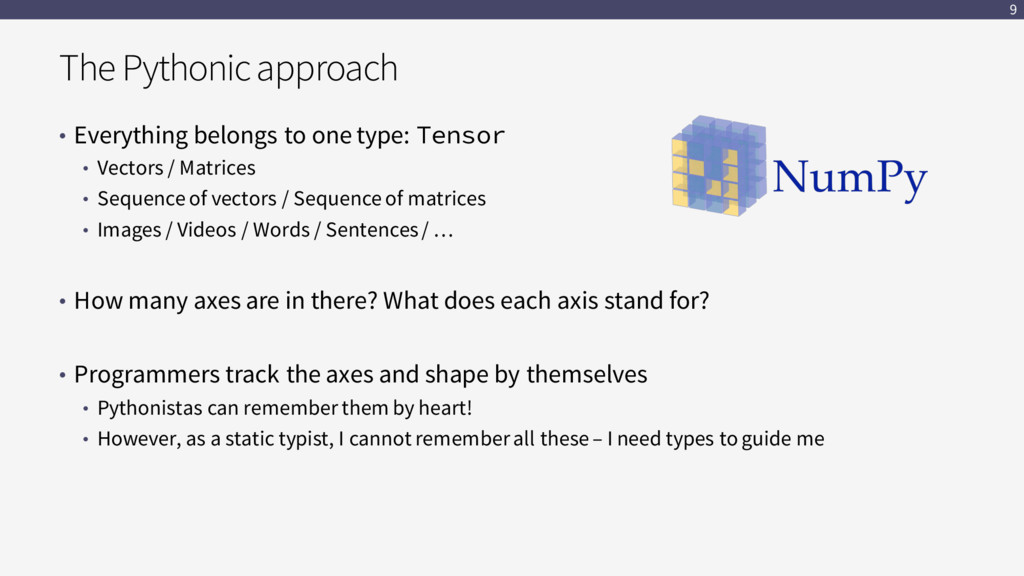
  5. 9 The Pythonicapproach • Everything belongs to one type: Tensor

    • Vectors / Matrices • Sequence of vectors / Sequence of matrices • Images / Videos / Words / Sentences / … • How many axes are in there? What does each axis stand for? • Programmers track the axes and shape by themselves • Pythonistas can remember them by heart! • However, as a static typist, I cannot remember all these – I need types to guide me
  6. 10

  7. 12 Typesafe tensors: goal Tensor[Axes] • “Axes” is the tensor

    axes descriptor – describes the semantics of each axis • A tuple of singleton types (labels to axes) • All operations on tensors are statically typed • Result types known at compile time – IDE can help programmers • Compilation failure when operating incompatible tensors
  8. 14 Typesafetyguarantees • Operations on tensors only allowed if their

    operand’s axes make sense mathematically. • ✅ Tensor[A] + Tensor[A] • ❎ Tensor[A] + Tensor[(A, B)] • ❎ Tensor[A] + Tensor[B]
  9. 15 Typesafetyguarantees • Matrix multiplication • ❎ MatMul(Tensor[A], Tensor[A]) •

    ❎ MatMul(Tensor[(A, B)], Tensor[(A, B)]) • ✅ MatMul(Tensor[(A, B)], Tensor[(B, C)])
  10. 16 Typesafetyguarantees • Axis reduction operations • Python (TensorFlow): tf.reduce_sum(X,

    dim=1) • X: Tensor[(A, B, C)] • ✅ SumAlong(B)(X): Tensor[(A, C)] • ❎ SumAlong(D)(X) Yik = Â j Xijk
  11. 17 Tuples⟺ HLists • HLists are easier to manipulate •

    Underlying typelevel manipulation is done using HLists • Use Generic and Tupler in Shapeless • Generic.Aux[A, B] proves that the the HList form of A is B • Tupler.Aux[B, A] proves that the tuple form of B is A
  12. 18 Typesafe computation graphs: GADTs • sealed trait Expr[X] •

    case class Input[X] extends Expr[X] • case class Param[X](var value: X) (implicit val tag: Grad[X]) extends Expr[X] • case class Const[X](value: X) extends Expr[X] • case class App1[X, Y](op: Op1[X, Y], x: Expr[X]) extends Expr[Y] • case class App2[X1, X2, Y](op: Op2[X1, X2, Y], x1: Expr[X1], x2: Expr[X2]) extends Expr[Y] • …… Expr Input Const Param Apply1 Apply2 Apply3 y L L2 x A b * +
  13. 19 Typesafe differentiable operators trait Op1[X, Y] extends Func1[X, Y]

    { def apply(x: Expr[X]): Expr[Y] = App1(this, x) def forward(x: X): Y def backward(dy: Y, y: Y, x: X): X } y = f (x1,x2) ∂L ∂x = ∂L ∂y ∂y ∂x
  14. 20 Typesafe differentiable operators trait Op2[X1, X2, Y] extends Func2[X1,

    X2, Y] { def apply(x1: Expr[X1], x2: Expr[X2]) = App2(this, x1, x2) def forward(x1: X1, x2: X2): Y def backward1(dy: Y, y: Y, x1: X1, x2: X2): X1 def backward2(dy: Y, y: Y, x1: X1, x2: X2): X2 } y = f (x1,x2) ∂L ∂x1 = ∂L ∂y ∂y ∂x1 ∂L ∂x2 = ∂L ∂y ∂y ∂x2
  15. 21 Forward computation • Type: Expr[A] => A • With

    Cats: Expr ~> Id • Interpreting the computation graph y L L2 x A b * +
  16. 22 Backward(gradient)computation • From last node (loss), traverse the graph

    • Reversed ordering of forward computation • For each node x, compute the gradient of the loss with respect to x y L L2 x A b * +
  17. 23 • Operators: Can be directly computed using the forward

    method • Modules: Must use an interpreter to interpret (contains computation subgraph) Func1[X, Y] Op1[X, Y] Module1[X, Y] = (Expr[X] => Expr[Y]) forward(x: X): Y backward(dy: Y, y: Y, x: X): X parameters: Set[Param[_]] Supertypefor all symbolicfunctions Operators vs modules y L L2 x A b * +
  18. 24 Polymorphicsymbolicfunctions trait PolyFunc1 { type F[X, Y] def ground[X,

    Y](implicit f: F[X, Y]): Func1[X, Y] def apply[X, Y](x: Expr[X])(implicit f: F[X, Y]): Expr[Y] = ground(f)(x) } • Op[X, Y] only applies on one type: X • We need type polymorphism. Similar to Shapeless’s Poly1: Case.Aux[X, Y]
  19. 25 Polymorphic symbolicfunctions def apply[X, Y](x: Expr[X])(implicit f: F[X, Y]):

    Expr[Y] • Only applicable when op.F[X, Y] found. If found, result type is Expr[Y]. • F[_, _] is an arbitrary typelevel predicate! • op.F[X, Y] ⟺ op can be applied to Expr[X], and it results in Expr[Y]. • Compiling as proving (Curry-Howard correspondence!) • Implicit F[X, Y] found ⟺ Proposition F[X, Y] proven • We can encode any type constraint we want on type operators into F.
  20. 26 Polymorphicoperators abstract class PolyOp1 extends PolyFunc1 { @implicitNotFound(“This operator

    cannot be applied to an argument of type ${X}.”) trait F[X, Y] extends Op1[X, Y] def ground[X, Y](implicit f: F[X, Y]) = f override def apply[X, Y](x: Expr[X])(implicit f: F[X, Y]) = f(x) } For polymorphic operators, the proof F is the grounded operator itself
  21. 27 Example: Add • Two variables of the same type,

    and can be differentiated against can be added. 8X,Grad[X] ! Add.F[X,X,X]
  22. 28 Example: MatMul • Two matrices can be multiplied when

    the second axis of the first matrix coincides with the first axis of the second matrix. 8T,R,A,B,C,IsRealTensorK[T,R] ! MatMul.F[T[A,B],T[B,C],T[A,C]]
  23. 29 Parameterized polymorphic operators • Sometimes operators depend on parameters

    not part of the computation graph abstract class ParameterizedPolyOp1 { self => trait F[X, Y] extends Op1[X, Y] class Proxy[P](val parameter: P) extends PolyFunc1 { type F[X, Y] = P => self.F[X, Y] def ground[X, Y](implicit f: F[X, Y]) = f(parameter) } def apply[P](parameter: P): Proxy[P] = new Proxy(parameter) }
  24. 30 Example: Axis renaming • Rename(A -> B)(x) 8T,E,A,U,V,B, ⇢

    IsTensorK[T,E] A\{U}[{V} = B ! Rename.F[T[A],T[B]]
  25. 31 Example: Sum along axis • IndexOf.Aux[A, U, N]: The

    N-th type of A is U • RemoveAt.Aux[A, N, B]: A, with the N-th type removed, is B Yik = Â j Xijk 8T,R,A,U,B, ⇢ IsRealTensorK[T,R] A\{U} = B ! SumAlong.F[T[A],T[B]]
  26. 32 IndexOfin the style of Shapeless IndexOf.Aux[X :: T,X, 0]

    IndexOf.Aux[T,X,I] ! IndexOf.Aux[H :: T,X,I +1]
  27. 33 Native C / CUDA integration • Doing math in

    JVM is not efficient • Integration with native code through JNI • Underlying C/C++ code; JNI code generated by SWIG • Native CPUbackend: BLAS/LAPACKfrom MKL/OpenBLAS/etc. • CUDA GPUbackend: cuBLAS/cuDNN • OpenCL GPU backend?
  28. 34 Example approach (PyTorch) • Bridging Python with native CPU/

    CUDA code Torch (TH) Torch CUDA (THC) BLAS / LAPACK (MKL / OpenBLAS / etc.) CUDA cuBLAS Torch NN (THNN) Torch CUDA NN (THCUNN) cuDNN Generated SWIG bridge PyTorch Bundled dynamic linking library (*.so / *.dylib / *.dll)
  29. 35 Supporting multiplebackends • Bridging JVM with native CPU /

    CUDA code through SWIG-generated JNI code • Reusing C/C++ backends from existing libraries (PyTorch / etc.) Torch (TH) Torch CUDA (THC) BLAS / LAPACK (MKL / OpenBLAS / etc.) CUDA cuBLAS Torch NN (THNN) Torch CUDA NN (THCUNN) cuDNN Backend 1: CPU IsRealTensorK[T[_]] *.so / *.dylib / *.dll Backend 2: CUDA OpenCL? *.so / *.dylib / *.dll
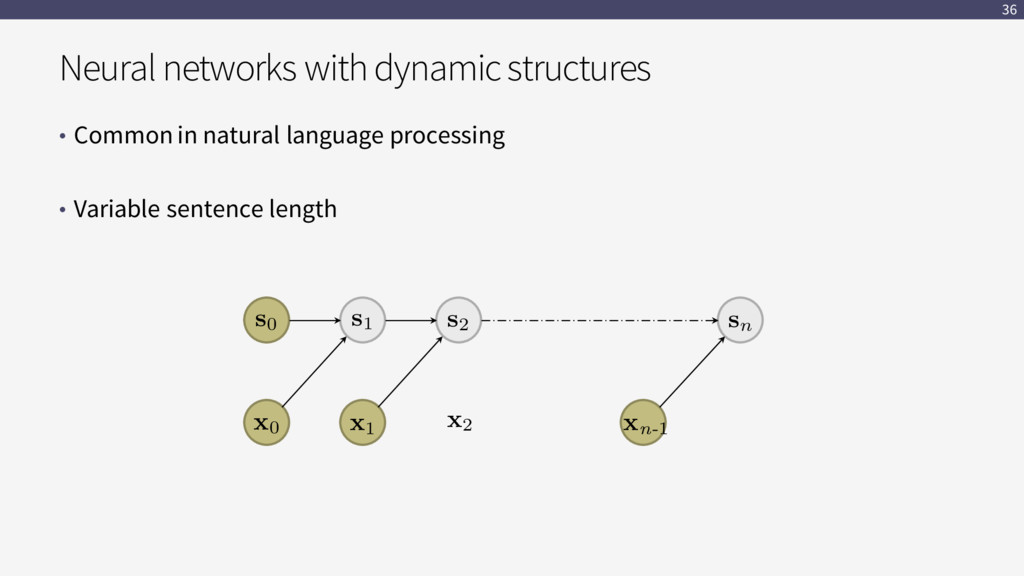
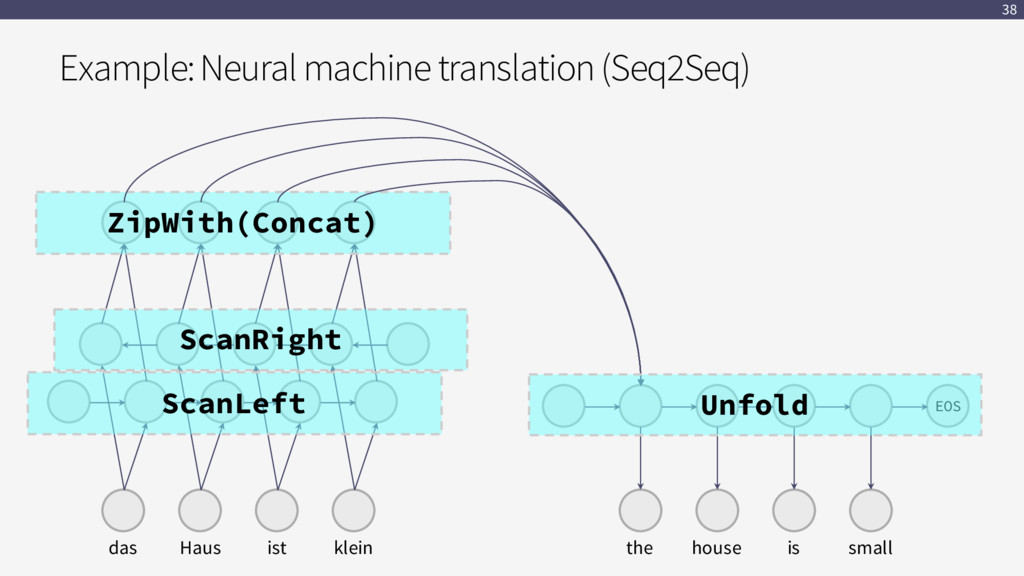
  30. 36 Neural networks withdynamicstructures • Common in natural language processing

    • Variable sentence length s0 s1 s2 x0 x1 x2 xn-1 sn
  31. 39 Static vsdynamiccomputation graphs • Static: Construct graph once, interpret

    later • Difficult to implement dynamic neural networks • Dynamic: Compute as you construct the graph • Lost the ability to do runtime optimization Static Dynamic Lazily create graph for each batch, then do runtime optimization, then run
  32. 40 User control of evaluation sealed trait Expr[X] { •

    /** • * Gets the value of this expression given an implicit computation instance, while forcing this expression to be evaluated strictly in that specific computation instance. • */ def value(implicit comp: Expr ~> Id): X = comp(this) } Normallythe computation graph is constructed lazily. Once value is called,the interpreter is forced to compute to graph to this node.
  33. 41 User control of evaluation val ŷ = x |>

    Layer1 |> Sigmoid |> Layer2 |> Softmax val loss = (y, ŷ) |> CrossEntropy given (x := xValue, y := yValue) { implicit computation => val lossValue = loss.value averageLoss += lossValue …… } Constructs the computation graph (Declaratively, no actually computation executed) Calling value in implicit computation scope forces the interpreter to evaluate
  34. 42 Future work • Towards a fully-fledged Scala deep learning

    engine • Automatic batching (fusion of computation graphs) • Complete GPU support • Garbage collection (off-heap memory & GPU memory) • Distributed learning (through Spark?) • Help needed!