in Cloud-based FPGA Systems Satoshi Konno 1) 2) and Inoguchi Yasushi 1) ICCE 2024 5-8 JANUARY 2024 | LAS VEGAS, NV, USA 1) Japan Advanced Institute of Science and Technology (JAIST) 2) LY Corporation,
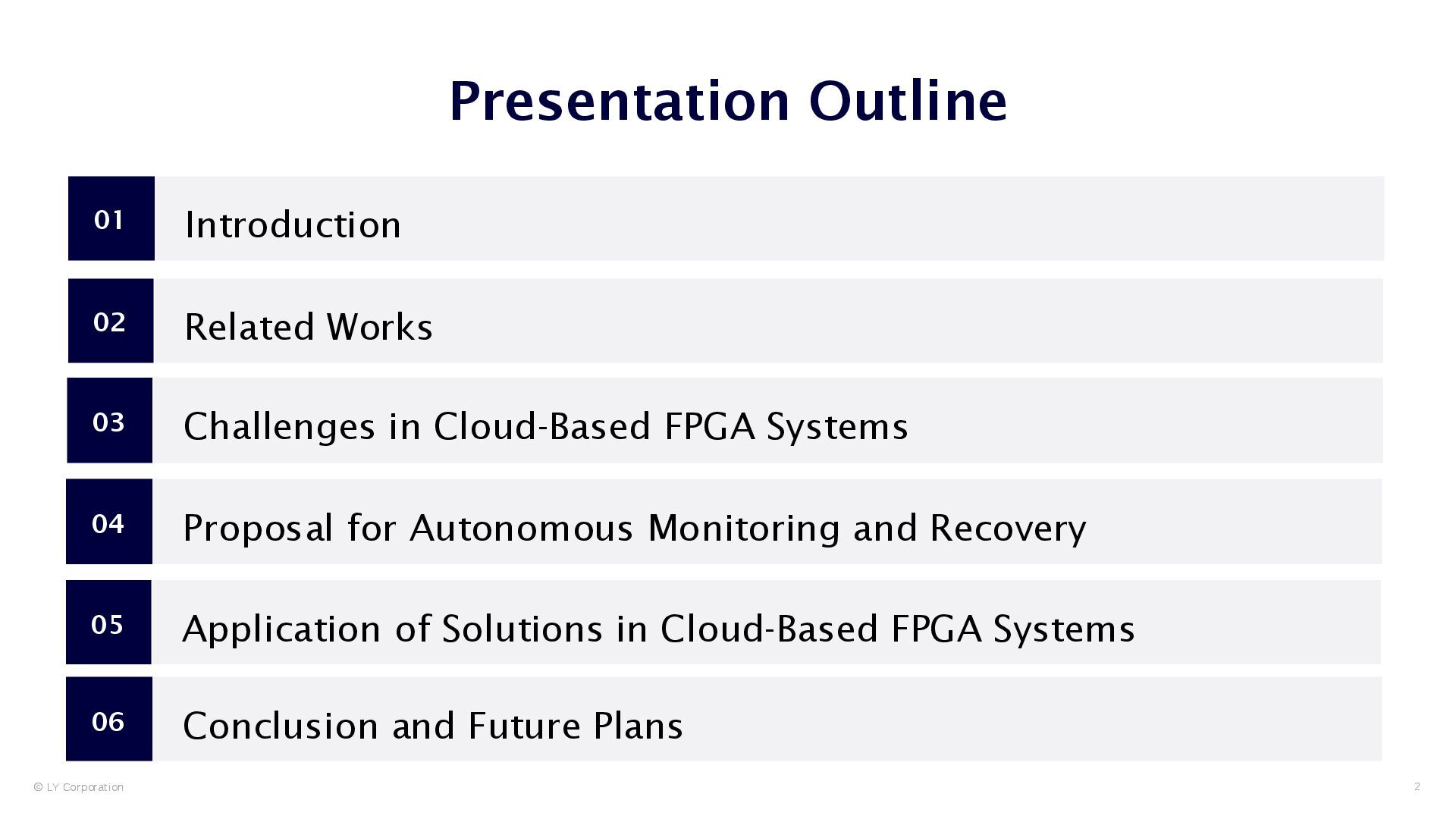
Systems Proposal for Autonomous Monitoring and Recovery Application of Solutions in Cloud-Based FPGA Systems 01 03 02 04 05 2 Presentation Outline Conclusion and Future Plans 06
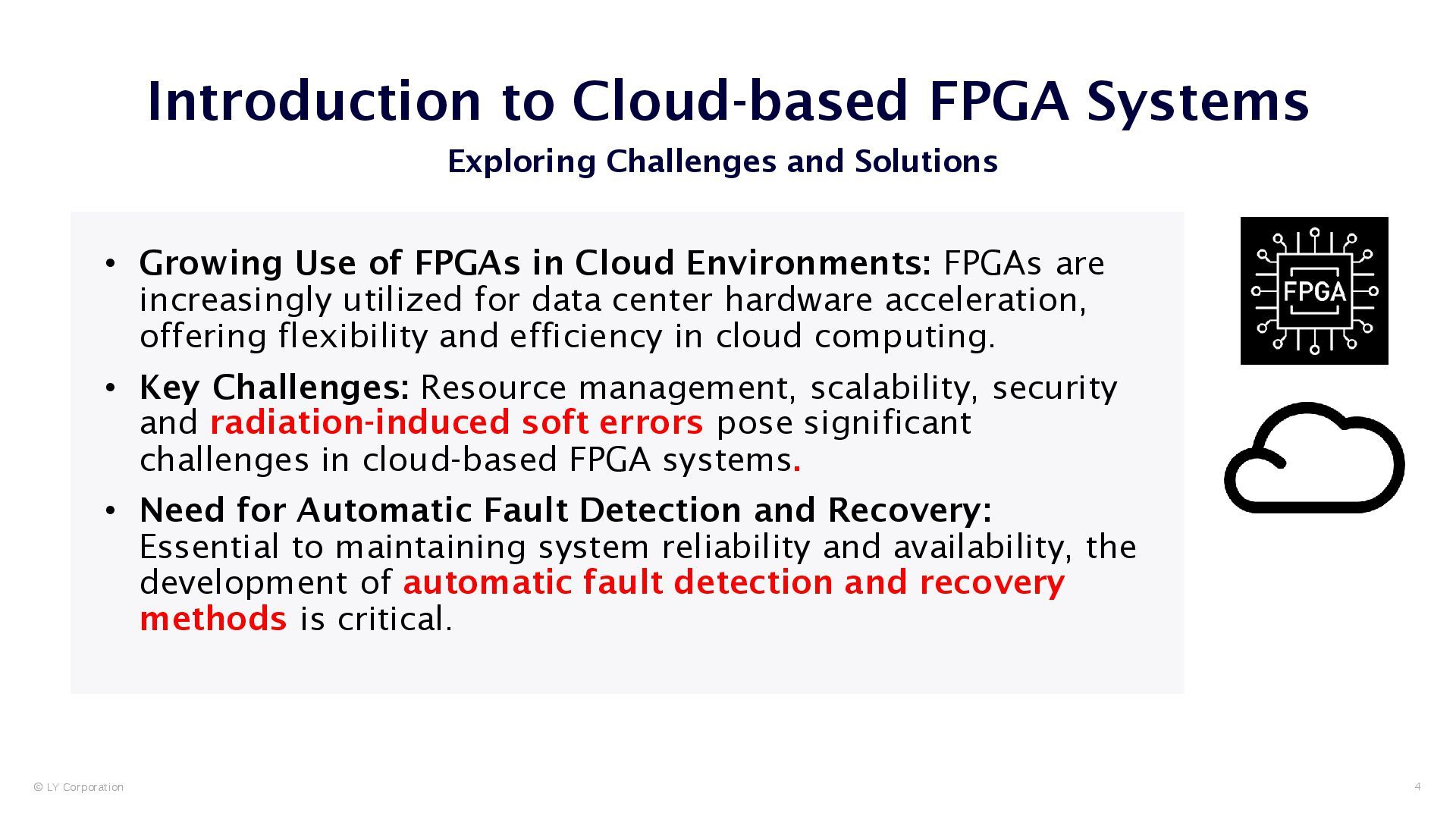
Environments: FPGAs are increasingly utilized for data center hardware acceleration, offering flexibility and efficiency in cloud computing. • Key Challenges: Resource management, scalability, security and radiation-induced soft errors pose significant challenges in cloud-based FPGA systems. • Need for Automatic Fault Detection and Recovery: Essential to maintaining system reliability and availability, the development of automatic fault detection and recovery methods is critical. 4 Introduction to Cloud-based FPGA Systems Exploring Challenges and Solutions
in cloud-based FPGA systems, from simple calculations to intensive computations, complicate management and optimization. • Complexity in Standardization [5][11]: Difficulty in standardizing error information and collection methods across different FPGA vendors, adding to operational complexity. • Radiation Risks in High-Density FPGA Clouds [11][12]: Hundreds of thousands of FPGAs employed in cloud computing are susceptible to radiation-induced errors, posing a significant risk in large-scale deployments. 6 Challenges in Cloud-Based FPGA Systems Identifying Key Issues [5] Bobda, Christophe, et al. "The future of FPGA acceleration in datacenters and the cloud." ACM Transactions on Reconfigurable Technology and Systems (TRETS) 15.3 (2022): 1-42. [11] Keller, Andrew M., and Michael J. Wirthlin. "Impact of soft errors on large-scale FPGA cloud computing." Proceedings of the 2019 ACM/SIGDA International Symposium on Field-Programmable Gate Arrays. 2019. [12] Keller, Andrew M., and Michael J. Wirthlin. "The Impact of Terrestrial Radiation on FPGAs in Data Centers." ACM Transactions on Reconfigurable Technology and Systems (TRETS) 15.2 (2021): 1-21.
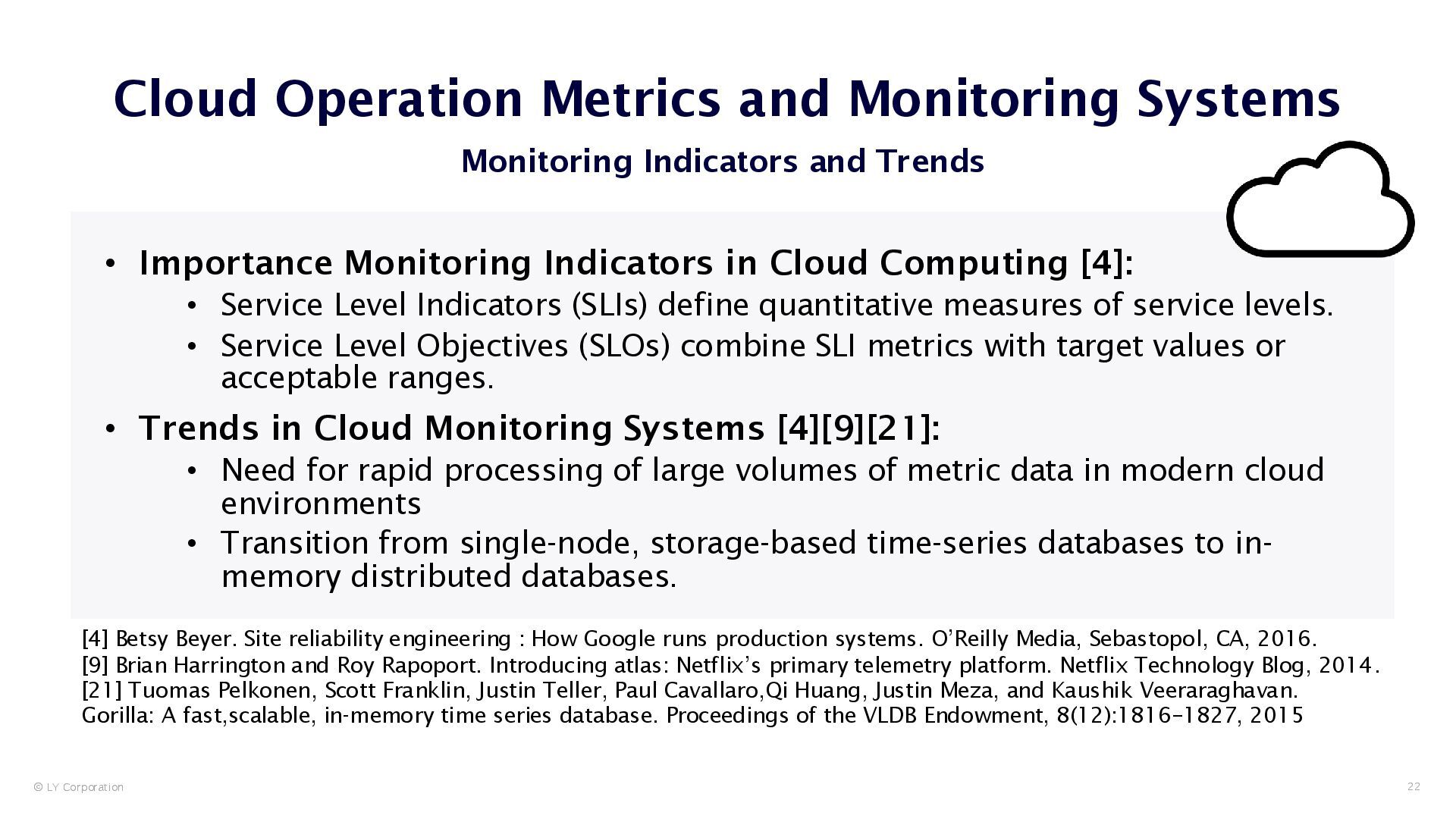
• Need for rapid processing of large volumes of metric data in modern cloud environments • Transition from single-node, storage-based time-series databases to in- memory distributed databases. 7 Cloud Operation Metrics and Monitoring Systems Monitoring Indicators and Trends [4] Betsy Beyer. Site reliability engineering : How Google runs production systems. O’Reilly Media, Sebastopol, CA, 2016. [9] Brian Harrington and Roy Rapoport. Introducing atlas: Netflix’s primary telemetry platform. Netflix Technology Blog, 2014. [21] Tuomas Pelkonen, Scott Franklin, Justin Teller, Paul Cavallaro,Qi Huang, Justin Meza, and Kaushik Veeraraghavan. Gorilla: A fast,scalable, in-memory time series database. Proceedings of the VLDB Endowment, 8(12):1816–1827, 2015
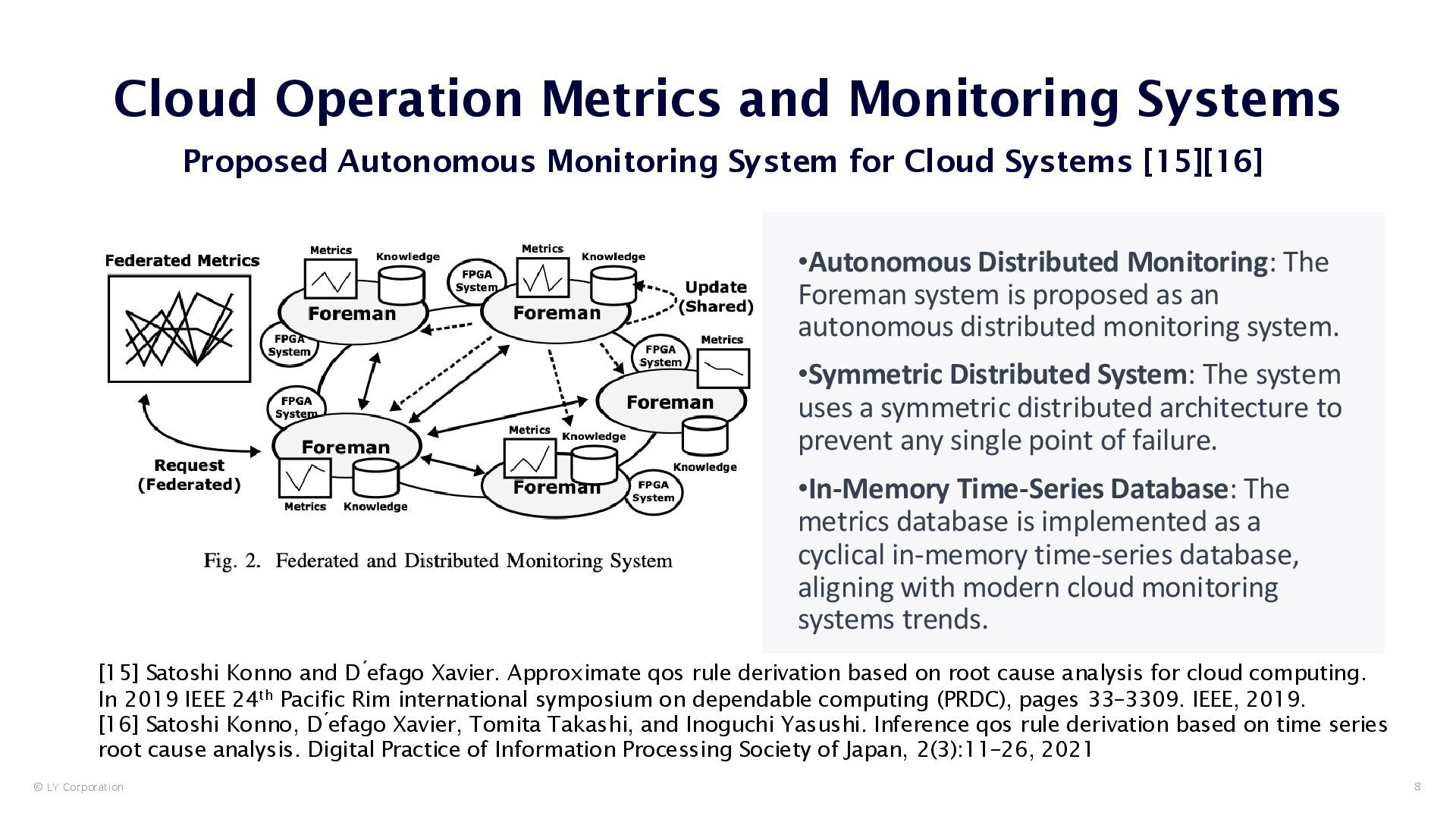
Proposed Autonomous Monitoring System for Cloud Systems [15][16] [15] Satoshi Konno and D ́efago Xavier. Approximate qos rule derivation based on root cause analysis for cloud computing. In 2019 IEEE 24th Pacific Rim international symposium on dependable computing (PRDC), pages 33–3309. IEEE, 2019. [16] Satoshi Konno, D ́efago Xavier, Tomita Takashi, and Inoguchi Yasushi. Inference qos rule derivation based on time series root cause analysis. Digital Practice of Information Processing Society of Japan, 2(3):11–26, 2021 •Autonomous Distributed Monitoring: The Foreman system is proposed as an autonomous distributed monitoring system. •Symmetric Distributed System: The system uses a symmetric distributed architecture to prevent any single point of failure. •In-Memory Time-Series Database: The metrics database is implemented as a cyclical in-memory time-series database, aligning with modern cloud monitoring systems trends.
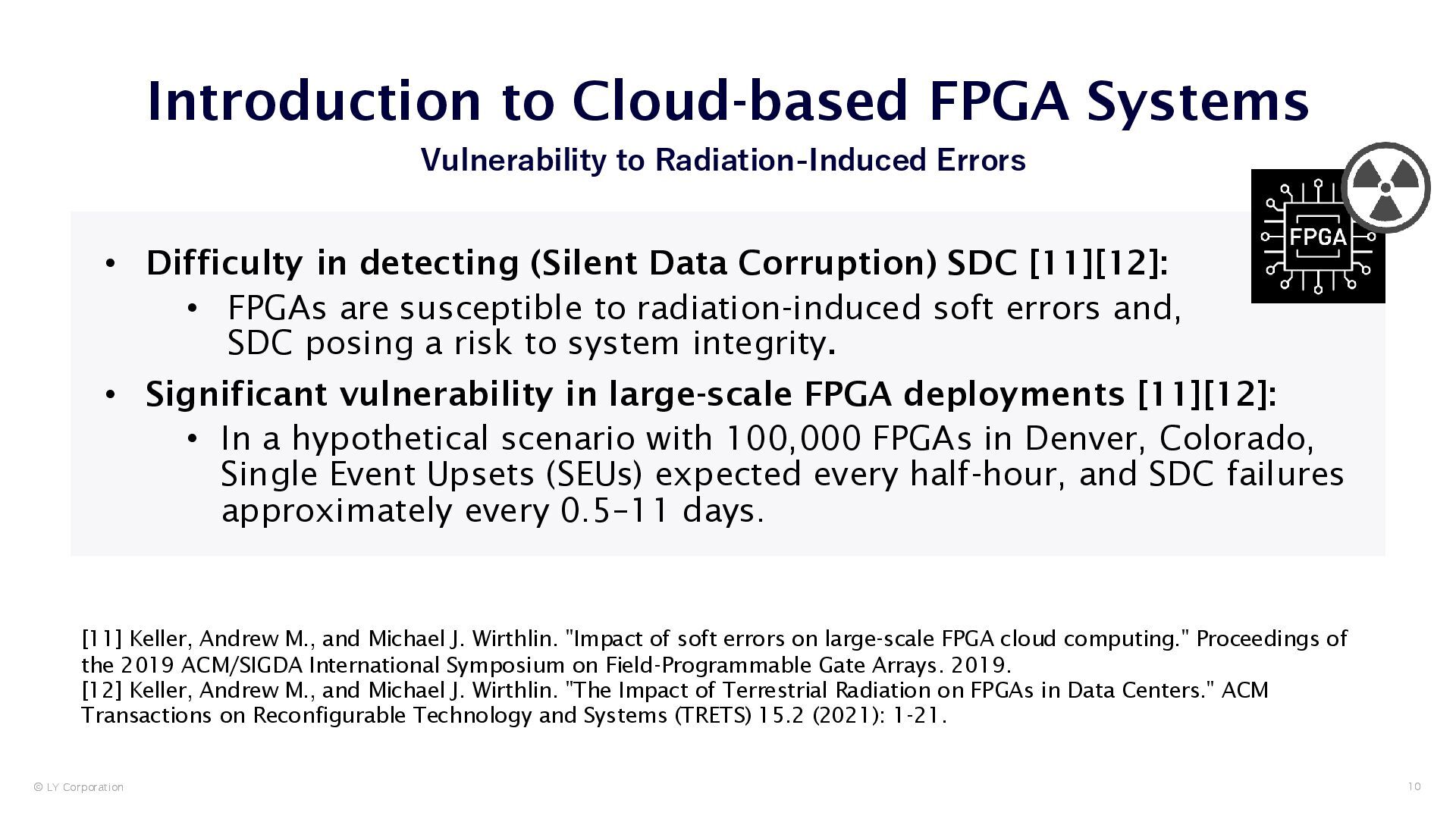
SDC [11][12]: • FPGAs are susceptible to radiation-induced soft errors and, SDC posing a risk to system integrity. • Significant vulnerability in large-scale FPGA deployments [11][12]: • In a hypothetical scenario with 100,000 FPGAs in Denver, Colorado, Single Event Upsets (SEUs) expected every half-hour, and SDC failures approximately every 0.5–11 days. 10 Introduction to Cloud-based FPGA Systems Vulnerability to Radiation-Induced Errors [11] Keller, Andrew M., and Michael J. Wirthlin. "Impact of soft errors on large-scale FPGA cloud computing." Proceedings of the 2019 ACM/SIGDA International Symposium on Field-Programmable Gate Arrays. 2019. [12] Keller, Andrew M., and Michael J. Wirthlin. "The Impact of Terrestrial Radiation on FPGAs in Data Centers." ACM Transactions on Reconfigurable Technology and Systems (TRETS) 15.2 (2021): 1-21.
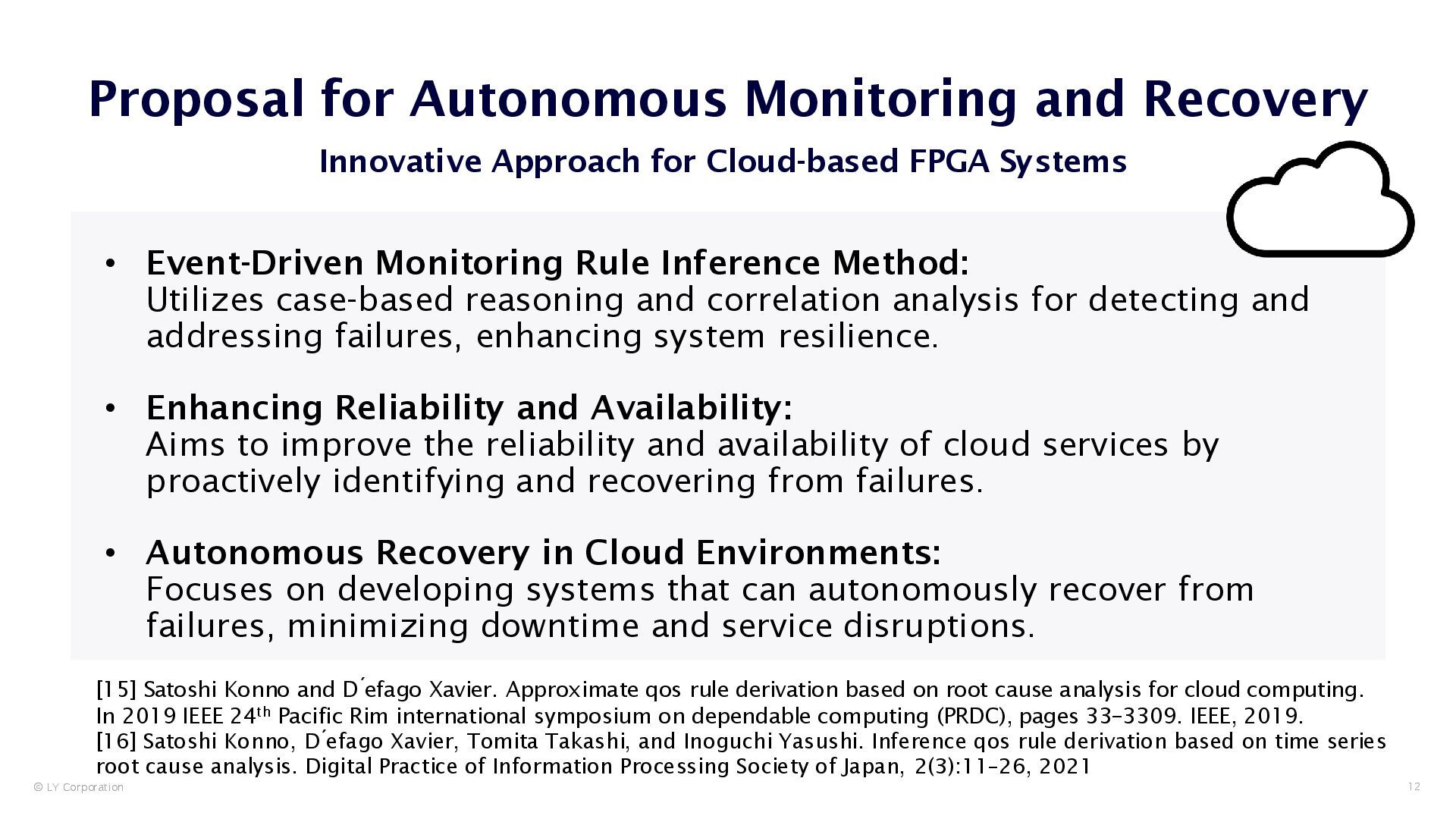
case-based reasoning and correlation analysis for detecting and addressing failures, enhancing system resilience. • Enhancing Reliability and Availability: Aims to improve the reliability and availability of cloud services by proactively identifying and recovering from failures. • Autonomous Recovery in Cloud Environments: Focuses on developing systems that can autonomously recover from failures, minimizing downtime and service disruptions. 12 Proposal for Autonomous Monitoring and Recovery Innovative Approach for Cloud-based FPGA Systems [15] Satoshi Konno and D ́efago Xavier. Approximate qos rule derivation based on root cause analysis for cloud computing. In 2019 IEEE 24th Pacific Rim international symposium on dependable computing (PRDC), pages 33–3309. IEEE, 2019. [16] Satoshi Konno, D ́efago Xavier, Tomita Takashi, and Inoguchi Yasushi. Inference qos rule derivation based on time series root cause analysis. Digital Practice of Information Processing Society of Japan, 2(3):11–26, 2021
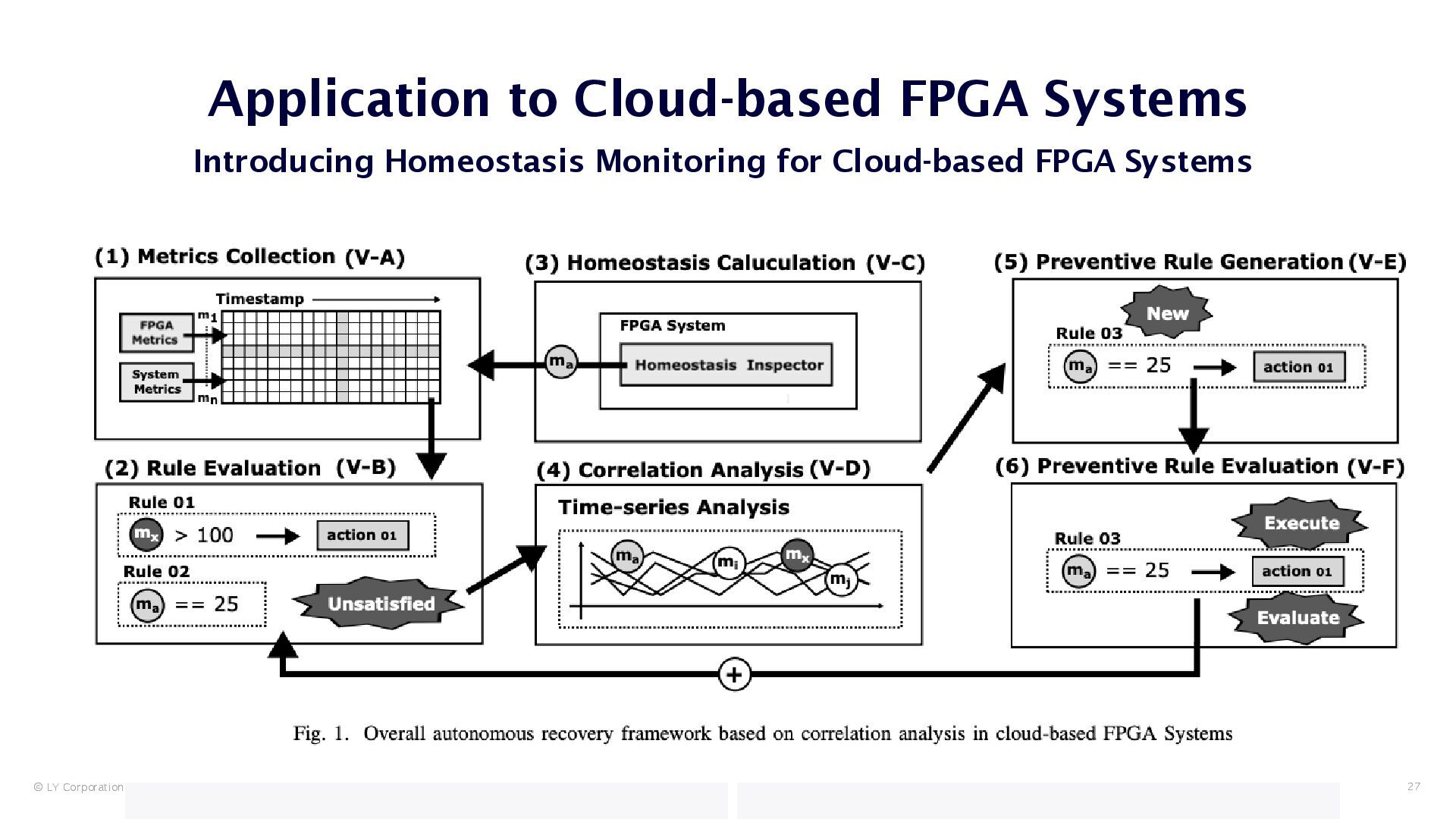
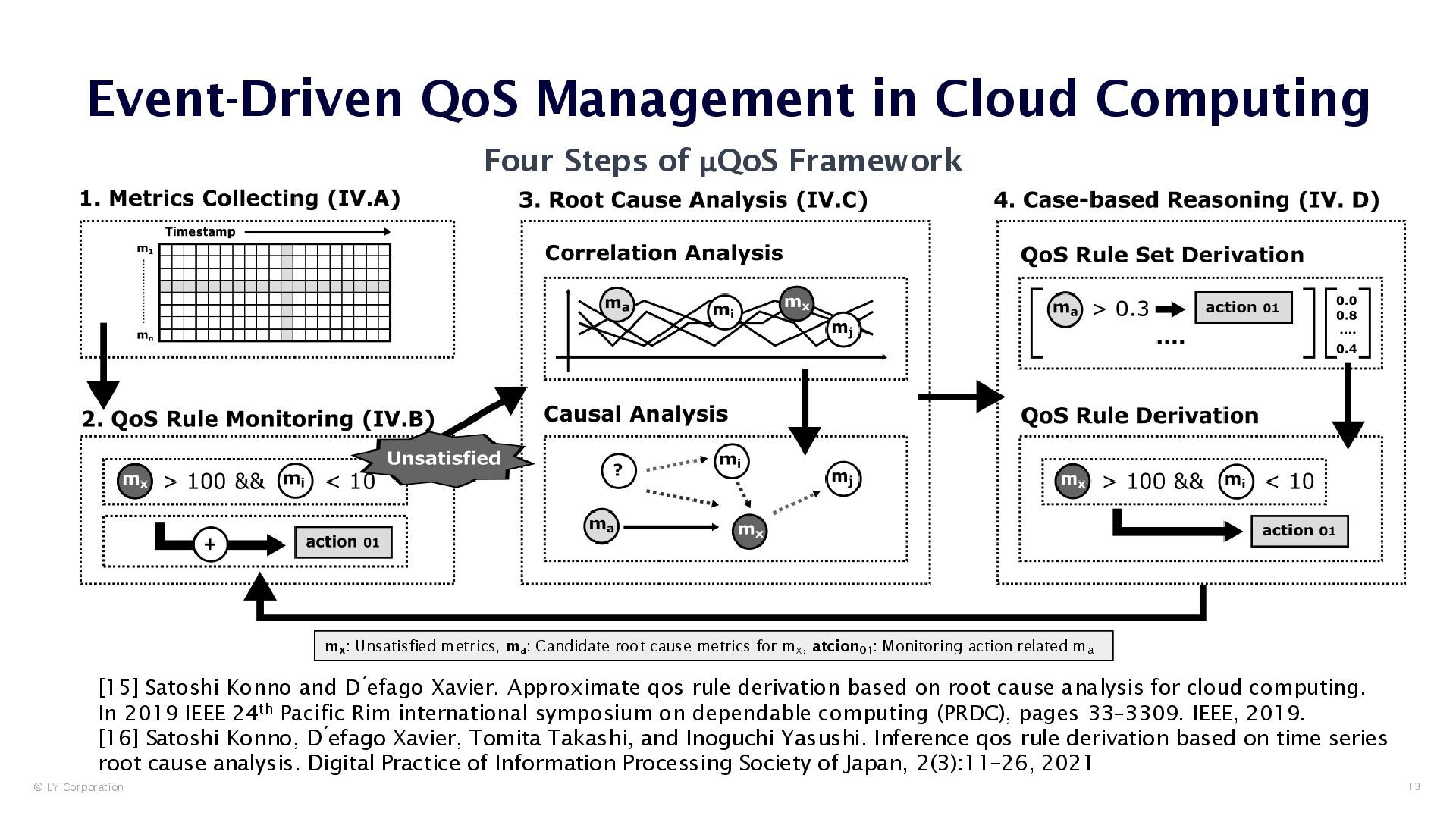
Four Steps of μQoS Framework [15] Satoshi Konno and D ́efago Xavier. Approximate qos rule derivation based on root cause analysis for cloud computing. In 2019 IEEE 24th Pacific Rim international symposium on dependable computing (PRDC), pages 33–3309. IEEE, 2019. [16] Satoshi Konno, D ́efago Xavier, Tomita Takashi, and Inoguchi Yasushi. Inference qos rule derivation based on time series root cause analysis. Digital Practice of Information Processing Society of Japan, 2(3):11–26, 2021 mx : Unsatisfied metrics, ma : Candidate root cause metrics for mx , atcion01 : Monitoring action related ma
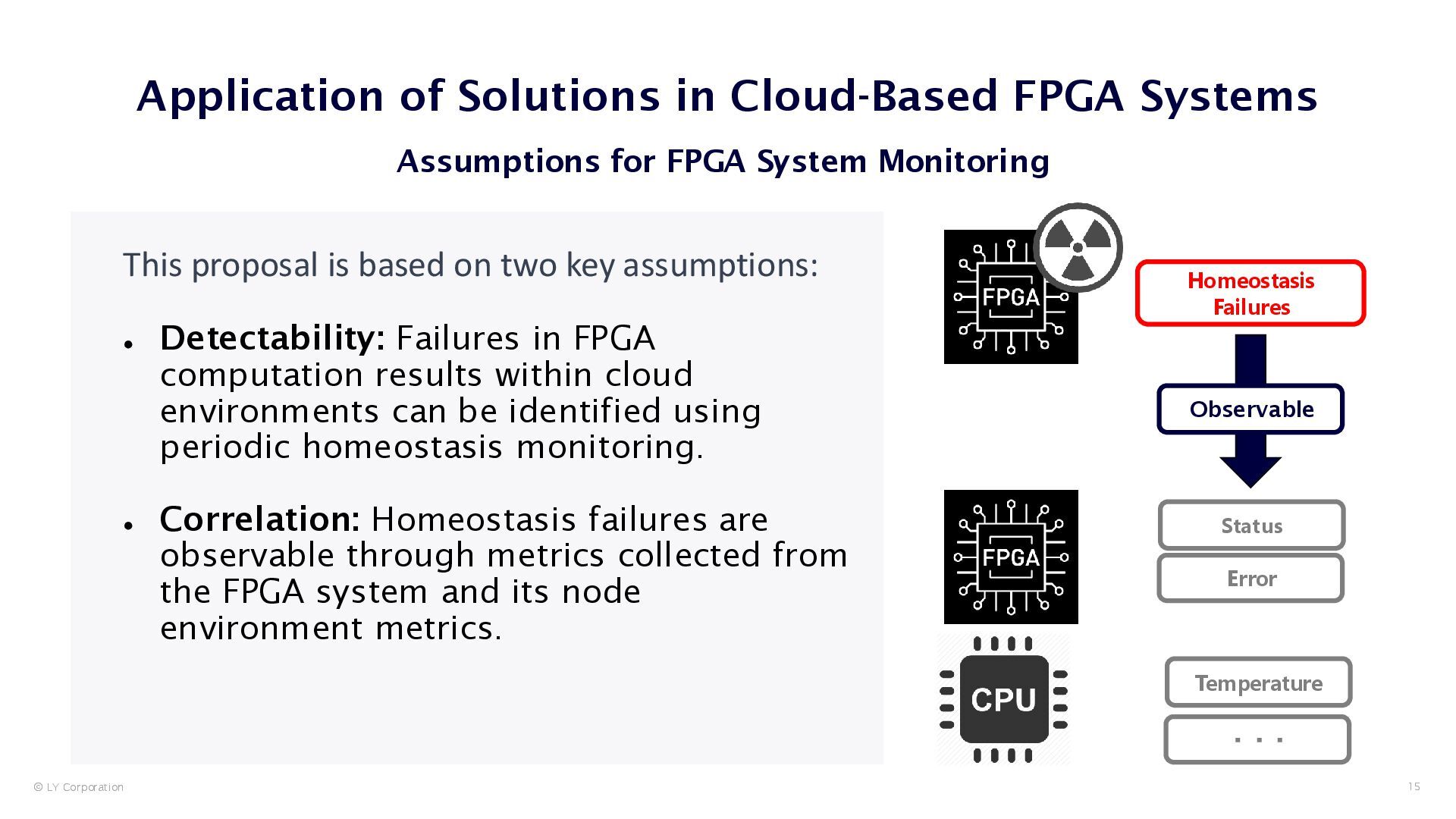
assumptions: • Detectability: Failures in FPGA computation results within cloud environments can be identified using periodic homeostasis monitoring. • Correlation: Homeostasis failures are observable through metrics collected from the FPGA system and its node environment metrics. 15 Application of Solutions in Cloud-Based FPGA Systems Assumptions for FPGA System Monitoring Temperature ・・・ Status Error Homeostasis Failures Observable
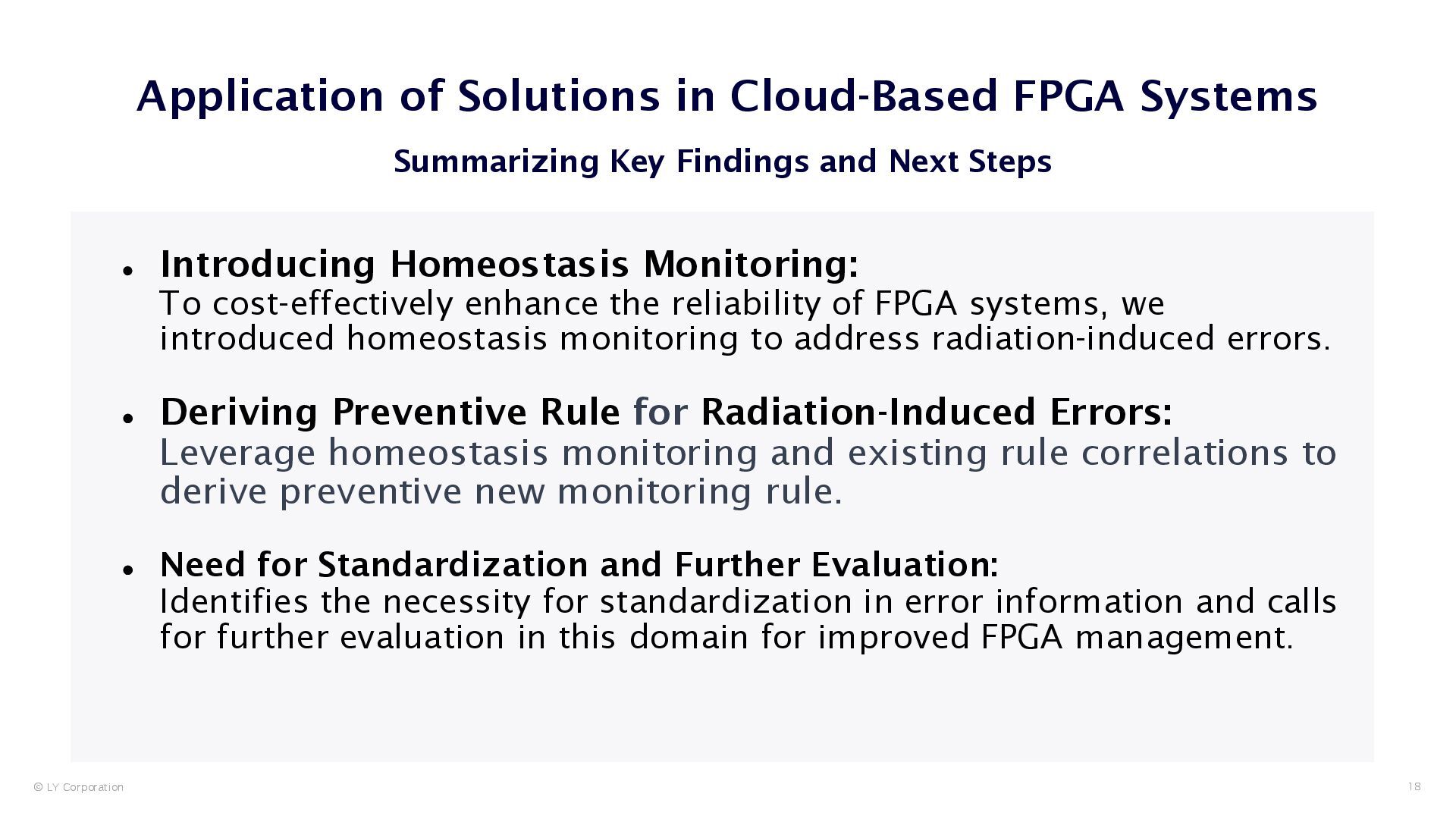
the reliability of FPGA systems, we introduced homeostasis monitoring to address radiation-induced errors. • Deriving Preventive Rule for Radiation-Induced Errors: Leverage homeostasis monitoring and existing rule correlations to derive preventive new monitoring rule. • Need for Standardization and Further Evaluation: Identifies the necessity for standardization in error information and calls for further evaluation in this domain for improved FPGA management. 18 Application of Solutions in Cloud-Based FPGA Systems Summarizing Key Findings and Next Steps
interfaces within FPGAs, complicating effective operation and management in cloud computing. • Inconsistent error logs and hardware error information across different FPGA vendors. 21 Introduction to Cloud-based FPGA Systems Cloud-based FPGA Systems Issues [5] Bobda, Christophe, et al. "The future of FPGA acceleration in datacenters and the cloud." ACM Transactions on Reconfigurable Technology and Systems (TRETS) 15.3 (2022): 1-42. [11] Keller, Andrew M., and Michael J. Wirthlin. "Impact of soft errors on large-scale FPGA cloud computing." Proceedings of the 2019 ACM/SIGDA International Symposium on Field- Programmable Gate Arrays. 2019.
[4]: • Service Level Indicators (SLIs) define quantitative measures of service levels. • Service Level Objectives (SLOs) combine SLI metrics with target values or acceptable ranges. • Trends in Cloud Monitoring Systems [4][9][21]: • Need for rapid processing of large volumes of metric data in modern cloud environments • Transition from single-node, storage-based time-series databases to in- memory distributed databases. 22 Cloud Operation Metrics and Monitoring Systems Monitoring Indicators and Trends [4] Betsy Beyer. Site reliability engineering : How Google runs production systems. O’Reilly Media, Sebastopol, CA, 2016. [9] Brian Harrington and Roy Rapoport. Introducing atlas: Netflix’s primary telemetry platform. Netflix Technology Blog, 2014. [21] Tuomas Pelkonen, Scott Franklin, Justin Teller, Paul Cavallaro,Qi Huang, Justin Meza, and Kaushik Veeraraghavan. Gorilla: A fast,scalable, in-memory time series database. Proceedings of the VLDB Endowment, 8(12):1816–1827, 2015
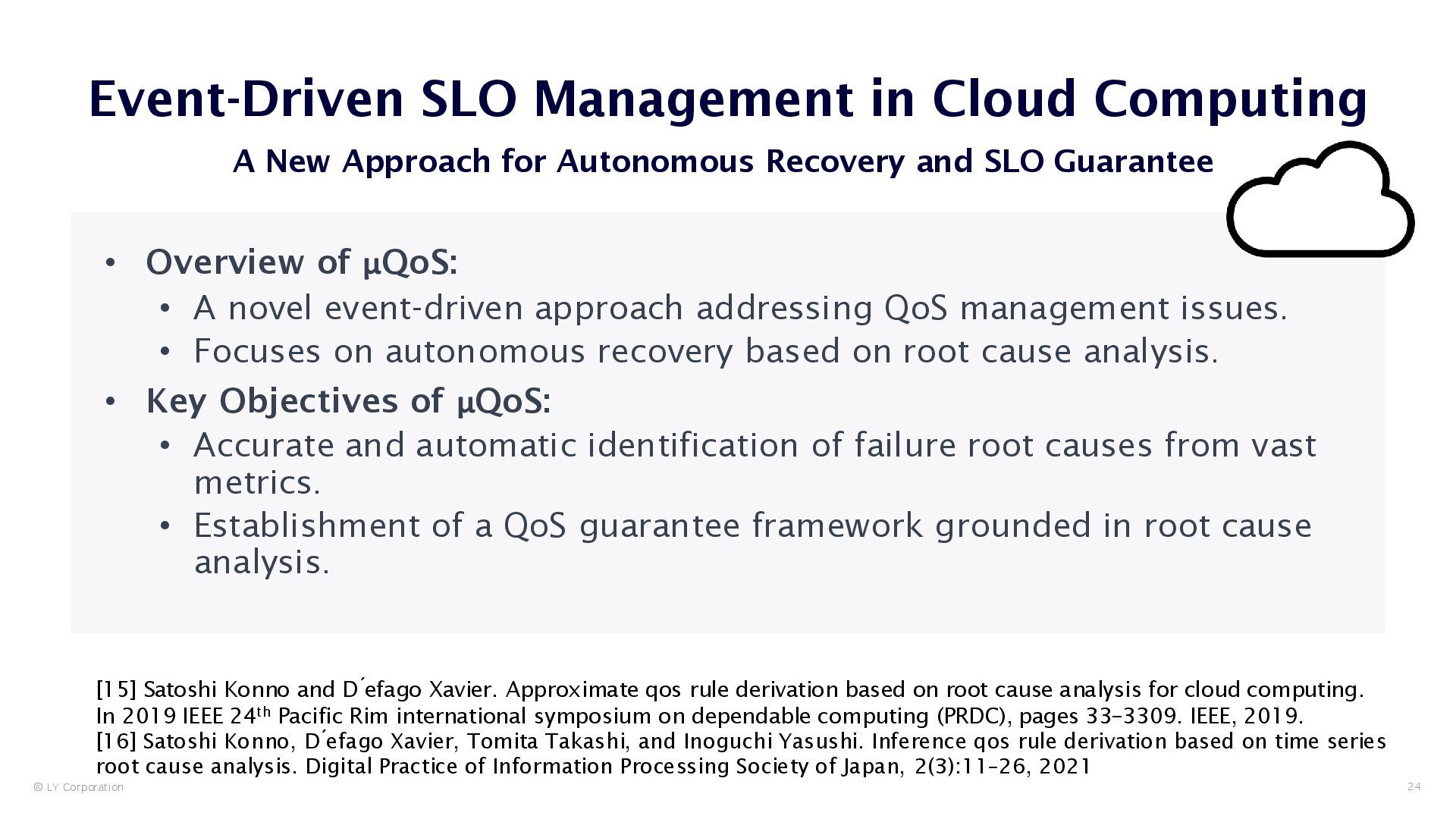
event-driven approach addressing QoS management issues. • Focuses on autonomous recovery based on root cause analysis. • Key Objectives of μQoS: • Accurate and automatic identification of failure root causes from vast metrics. • Establishment of a QoS guarantee framework grounded in root cause analysis. 24 Event-Driven SLO Management in Cloud Computing A New Approach for Autonomous Recovery and SLO Guarantee [15] Satoshi Konno and D ́efago Xavier. Approximate qos rule derivation based on root cause analysis for cloud computing. In 2019 IEEE 24th Pacific Rim international symposium on dependable computing (PRDC), pages 33–3309. IEEE, 2019. [16] Satoshi Konno, D ́efago Xavier, Tomita Takashi, and Inoguchi Yasushi. Inference qos rule derivation based on time series root cause analysis. Digital Practice of Information Processing Society of Japan, 2(3):11–26, 2021
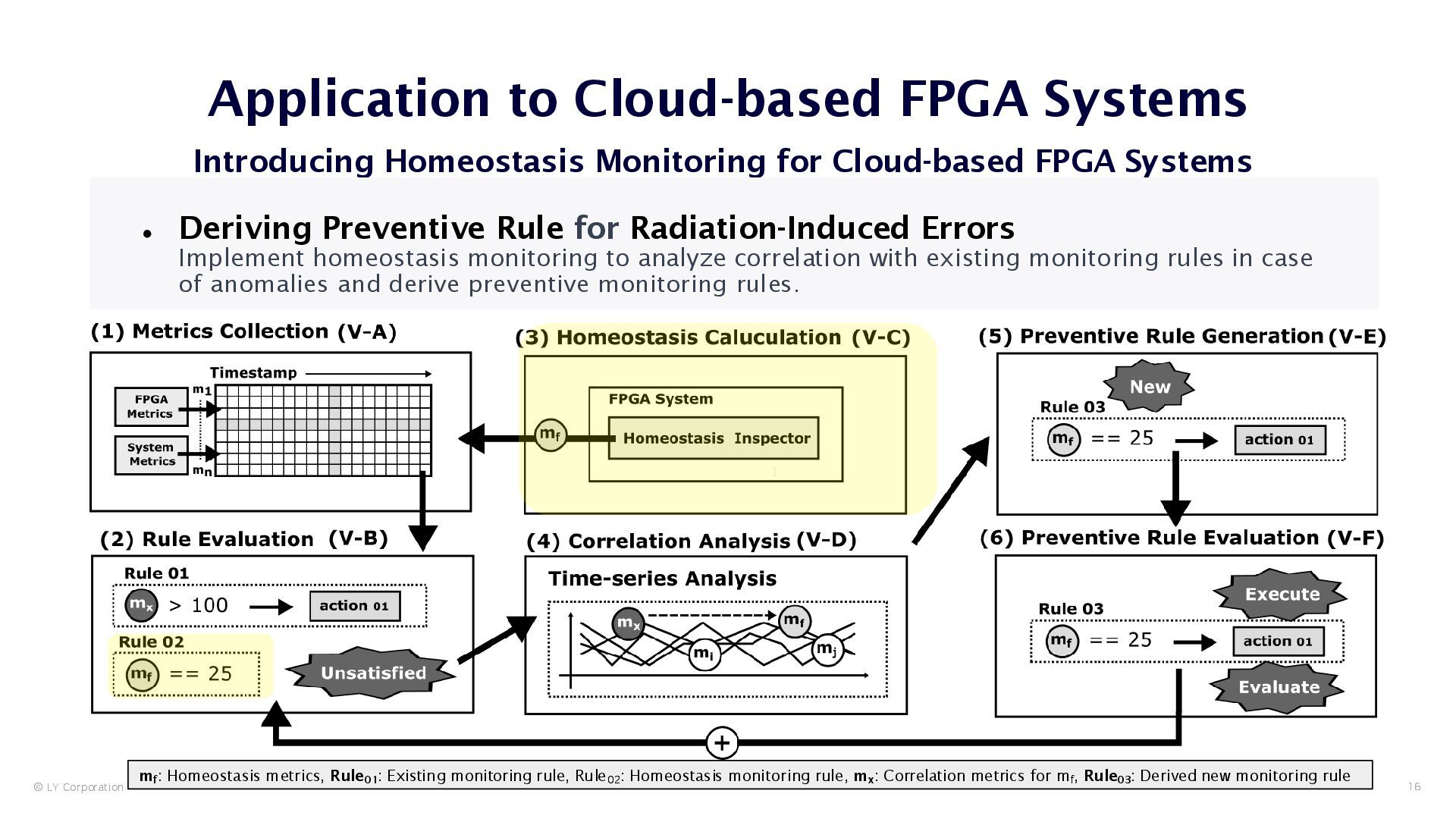
Gathering of relevant metrics for FPGA systems and establishing initial monitoring rules for effective system management. • Homeostasis Monitoring: Detecting infrequent FPGA errors and informs recovery rule updates, enhancing system reliability cost-effectively. • Preventive Monitoring and Rule Generation: Deviating preventive monitoring strategies and dynamic rule generation to anticipate and mitigate potential system failures. 26 Application of Solutions in Cloud-Based FPGA Systems Implementing the Proposed Framework
Cloud: Emphasizes the critical need for reliable and autonomous FPGA systems in cloud environments for enhanced service availability. • QoS Assurance and Automated Recovery: Highlights the significance of QoS assurance and the need for effective automated failure recovery mechanisms. • Need for Standardization and Further Research: Identifies the necessity for standardization in error information and calls for further research in this domain for improved FPGA management. 29 Application of Solutions in Cloud-Based FPGA Systems Summarizing Key Findings and Next Steps


 cybergarage
 konakalab
 voginip
.jpg) lychee1223
lychee1223
 trycycle
.jpeg) arthur1
arthur1
 tagtag
 rmaruy
 x_ttyszk
 mickey_0226
 nwiizo
 tomoyanonymous
 aemeredith
 madoxten
 bethany
 kimpetersen
 addyosmani
 sergeychernyshev
 inesmontani
 helmedeiros
 lara
lara
 marketingsoph


![© LY Corporation • Diverse Application Requirements [5][11]: Varied applications](https://files.speakerdeck.com/presentations/3fad7e3d919b4789af7e3f92ea94fd23/slide_5.jpg)
![© LY Corporation • Trends in Cloud Monitoring Systems [4][9][21]:](https://files.speakerdeck.com/presentations/3fad7e3d919b4789af7e3f92ea94fd23/slide_6.jpg)



![© LY Corporation • Standardization Issues [5][11]: • Non-standardized application](https://files.speakerdeck.com/presentations/3fad7e3d919b4789af7e3f92ea94fd23/slide_20.jpg)