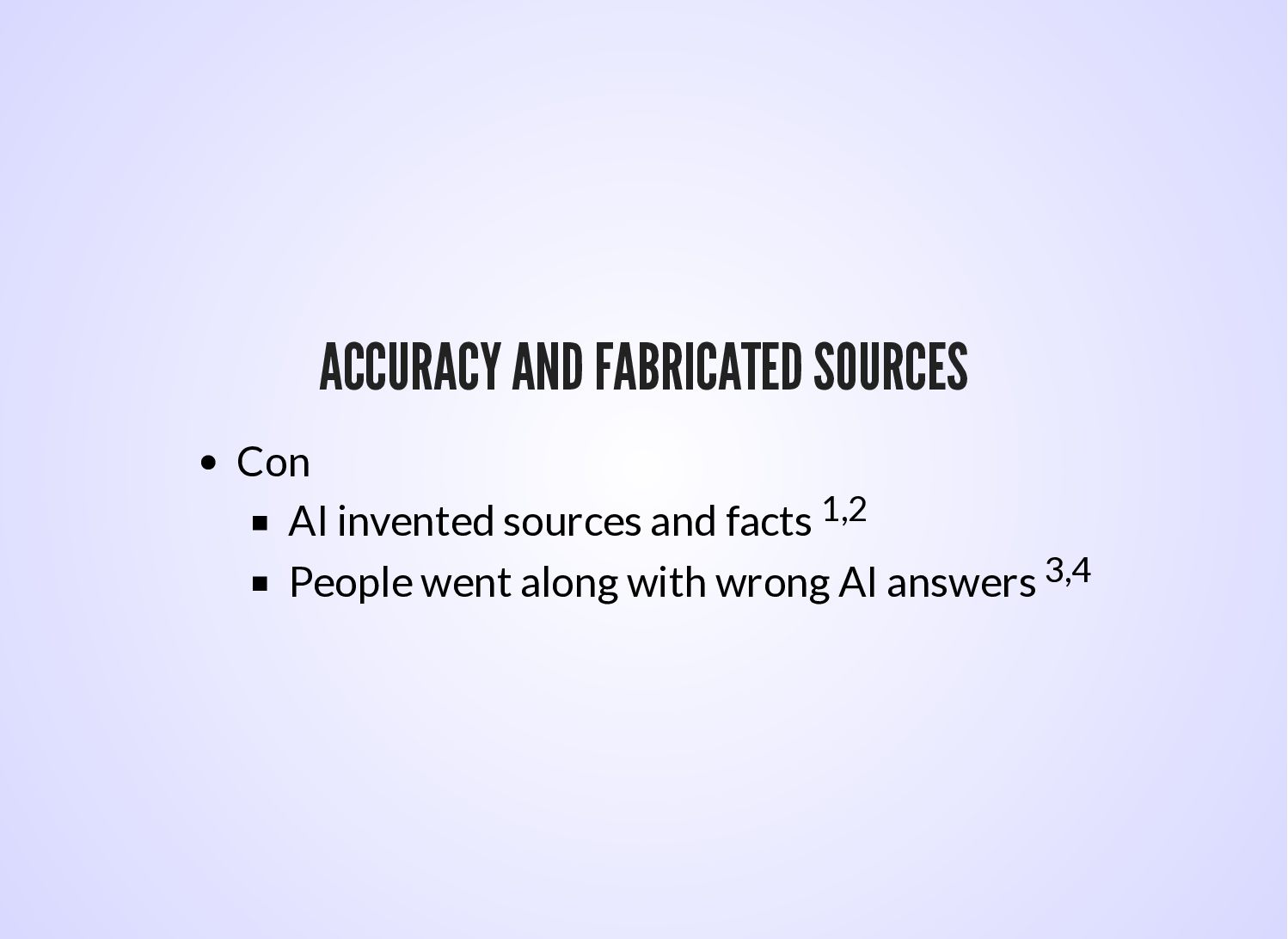
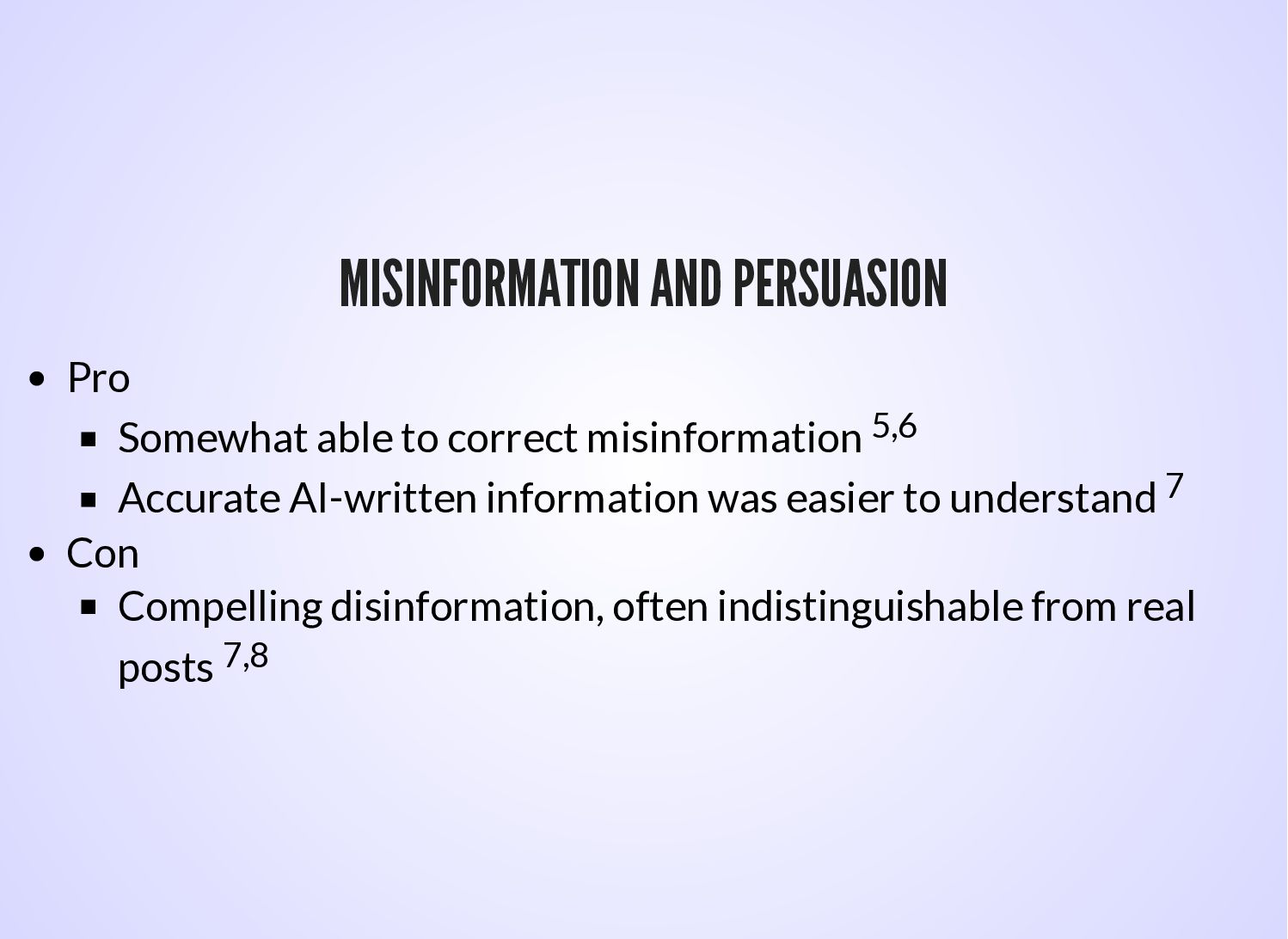
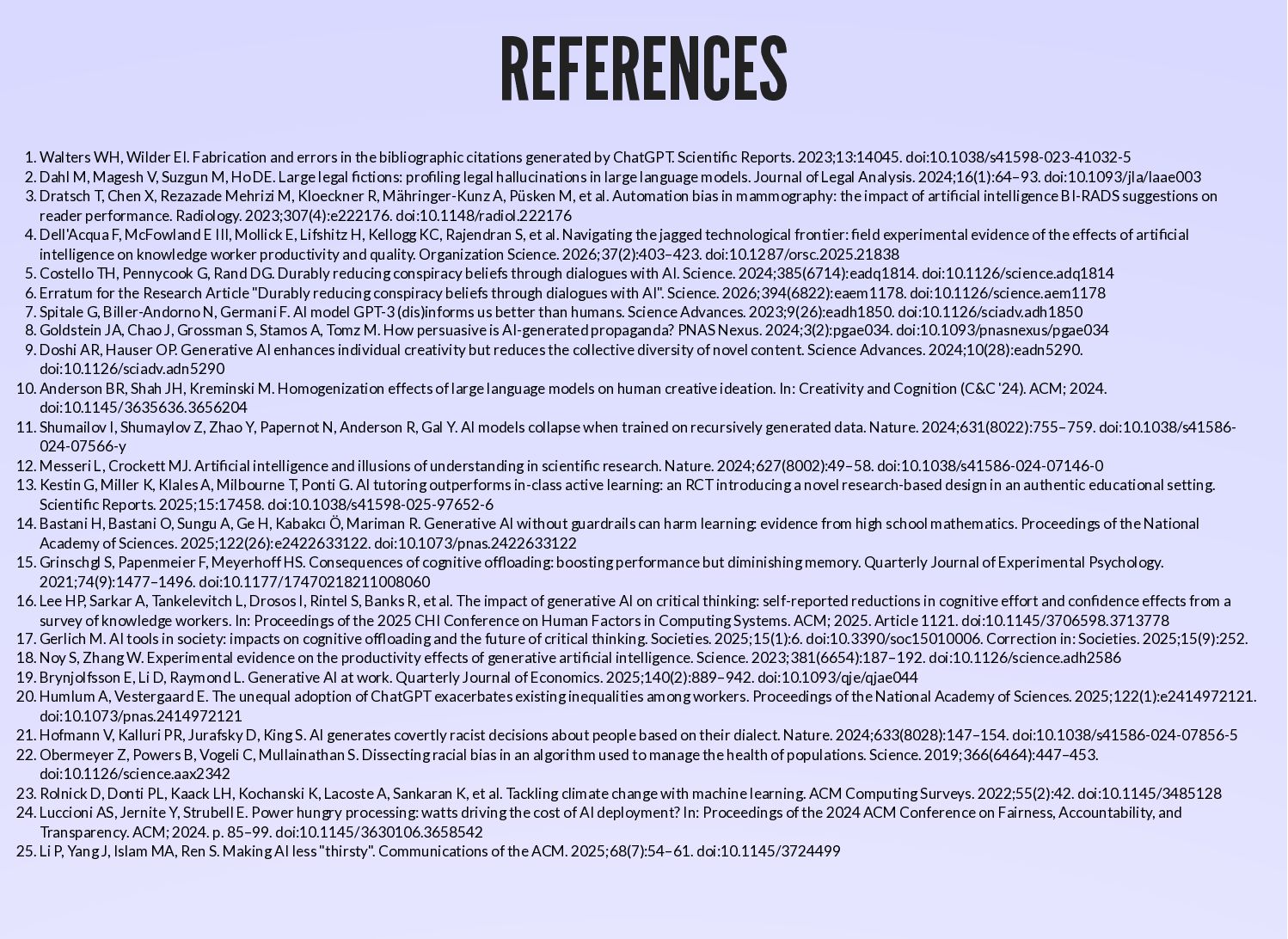
the bibliographic citations generated by ChatGPT. Scientific Reports. 2023;13:14045. doi:10.1038/s41598-023-41032-5 2. Dahl M, Magesh V, Suzgun M, Ho DE. Large legal fictions: profiling legal hallucinations in large language models. Journal of Legal Analysis. 2024;16(1):64–93. doi:10.1093/jla/laae003 3. Dratsch T, Chen X, Rezazade Mehrizi M, Kloeckner R, Mähringer-Kunz A, Püsken M, et al. Automation bias in mammography: the impact of artificial intelligence BI-RADS suggestions on reader performance. Radiology. 2023;307(4):e222176. doi:10.1148/radiol.222176 4. Dell'Acqua F, McFowland E III, Mollick E, Lifshitz H, Kellogg KC, Rajendran S, et al. Navigating the jagged technological frontier: field experimental evidence of the effects of artificial intelligence on knowledge worker productivity and quality. Organization Science. 2026;37(2):403–423. doi:10.1287/orsc.2025.21838 5. Costello TH, Pennycook G, Rand DG. Durably reducing conspiracy beliefs through dialogues with AI. Science. 2024;385(6714):eadq1814. doi:10.1126/science.adq1814 6. Erratum for the Research Article "Durably reducing conspiracy beliefs through dialogues with AI". Science. 2026;394(6822):eaem1178. doi:10.1126/science.aem1178 7. Spitale G, Biller-Andorno N, Germani F. AI model GPT-3 (dis)informs us better than humans. Science Advances. 2023;9(26):eadh1850. doi:10.1126/sciadv.adh1850 8. Goldstein JA, Chao J, Grossman S, Stamos A, Tomz M. How persuasive is AI-generated propaganda? PNAS Nexus. 2024;3(2):pgae034. doi:10.1093/pnasnexus/pgae034 9. Doshi AR, Hauser OP. Generative AI enhances individual creativity but reduces the collective diversity of novel content. Science Advances. 2024;10(28):eadn5290. doi:10.1126/sciadv.adn5290 10. Anderson BR, Shah JH, Kreminski M. Homogenization effects of large language models on human creative ideation. In: Creativity and Cognition (C&C '24). ACM; 2024. doi:10.1145/3635636.3656204 11. Shumailov I, Shumaylov Z, Zhao Y, Papernot N, Anderson R, Gal Y. AI models collapse when trained on recursively generated data. Nature. 2024;631(8022):755–759. doi:10.1038/s41586024-07566-y 12. Messeri L, Crockett MJ. Artificial intelligence and illusions of understanding in scientific research. Nature. 2024;627(8002):49–58. doi:10.1038/s41586-024-07146-0 13. Kestin G, Miller K, Klales A, Milbourne T, Ponti G. AI tutoring outperforms in-class active learning: an RCT introducing a novel research-based design in an authentic educational setting. Scientific Reports. 2025;15:17458. doi:10.1038/s41598-025-97652-6 14. Bastani H, Bastani O, Sungu A, Ge H, Kabakcı Ö, Mariman R. Generative AI without guardrails can harm learning: evidence from high school mathematics. Proceedings of the National Academy of Sciences. 2025;122(26):e2422633122. doi:10.1073/pnas.2422633122 15. Grinschgl S, Papenmeier F, Meyerhoff HS. Consequences of cognitive offloading: boosting performance but diminishing memory. Quarterly Journal of Experimental Psychology. 2021;74(9):1477–1496. doi:10.1177/17470218211008060 16. Lee HP, Sarkar A, Tankelevitch L, Drosos I, Rintel S, Banks R, et al. The impact of generative AI on critical thinking: self-reported reductions in cognitive effort and confidence effects from a survey of knowledge workers. In: Proceedings of the 2025 CHI Conference on Human Factors in Computing Systems. ACM; 2025. Article 1121. doi:10.1145/3706598.3713778 17. Gerlich M. AI tools in society: impacts on cognitive offloading and the future of critical thinking. Societies. 2025;15(1):6. doi:10.3390/soc15010006. Correction in: Societies. 2025;15(9):252. 18. Noy S, Zhang W. Experimental evidence on the productivity effects of generative artificial intelligence. Science. 2023;381(6654):187–192. doi:10.1126/science.adh2586 19. Brynjolfsson E, Li D, Raymond L. Generative AI at work. Quarterly Journal of Economics. 2025;140(2):889–942. doi:10.1093/qje/qjae044 20. Humlum A, Vestergaard E. The unequal adoption of ChatGPT exacerbates existing inequalities among workers. Proceedings of the National Academy of Sciences. 2025;122(1):e2414972121. doi:10.1073/pnas.2414972121 21. Hofmann V, Kalluri PR, Jurafsky D, King S. AI generates covertly racist decisions about people based on their dialect. Nature. 2024;633(8028):147–154. doi:10.1038/s41586-024-07856-5 22. Obermeyer Z, Powers B, Vogeli C, Mullainathan S. Dissecting racial bias in an algorithm used to manage the health of populations. Science. 2019;366(6464):447–453. doi:10.1126/science.aax2342 23. Rolnick D, Donti PL, Kaack LH, Kochanski K, Lacoste A, Sankaran K, et al. Tackling climate change with machine learning. ACM Computing Surveys. 2022;55(2):42. doi:10.1145/3485128 24. Luccioni AS, Jernite Y, Strubell E. Power hungry processing: watts driving the cost of AI deployment? In: Proceedings of the 2024 ACM Conference on Fairness, Accountability, and Transparency. ACM; 2024. p. 85–99. doi:10.1145/3630106.3658542 25. Li P, Yang J, Islam MA, Ren S. Making AI less "thirsty". Communications of the ACM. 2025;68(7):54–61. doi:10.1145/3724499


 cynthiang
 tkyowa
 littlehands
 skrb
 yoshimura_datam
 oracle4engineer
 ivry_presentationmaterials
 mikemcquaid
 ren8k
 raybugg
 arawn
 tarappo
 tomoyanonymous
 reverentgeek
 lynnandtonic
 chriscoyier
 thoeni
 marcelosomers
 aleyda
 watany
 jnunemaker
 inesmontani
 cassininazir
 mfonobong