Share
[Q1 2024] The Busy Platform Engineers Guide to API Gateways
API Gateways are certainly not a new technology, but the way in which they are being deployed, configured, and operated within modern platforms is forcing many of us to rethink our approach. Can we simply lift and shift our existing gateway into the cloud? Is our API gateway GitOps friendly (and does it need to be)? And what about service meshes, CNI, eBPF, and so on? Join this talk for a whistle-stop tour of modern API gateways, with a focus on deploying and managing this technology in Kubernetes (on which modern platforms are built). Understand why platform engineers should care about API Gateways today. Learn about API gateways, options, and requirements for modern platforms. Identify key considerations for migrating to the cloud or building a new platform on Kubernetes. Understand how cloud native workflows impact the user/developer experience (UX/DX) of an API gateway. Explore the components of a complete "edge stack" that supports end-to-end development flows.
danielbryantuk
Transcript
38 slides
-
@danielbryantuk | @ambassadorlabs The Busy Platform Engineers Guide to API
Gateways Daniel Bryant | Independent Technical Consultant @danielbryantuk -
@danielbryantuk | @ambassadorlabs tl;dr • Choosing (or migrating) an API
gateway is a complicated decision • Traffic management is a core component (hot path) of any platform • Treat an API Gateway as a product • Think about developer/operator experience • Focus on workflows and tooling interoperability -
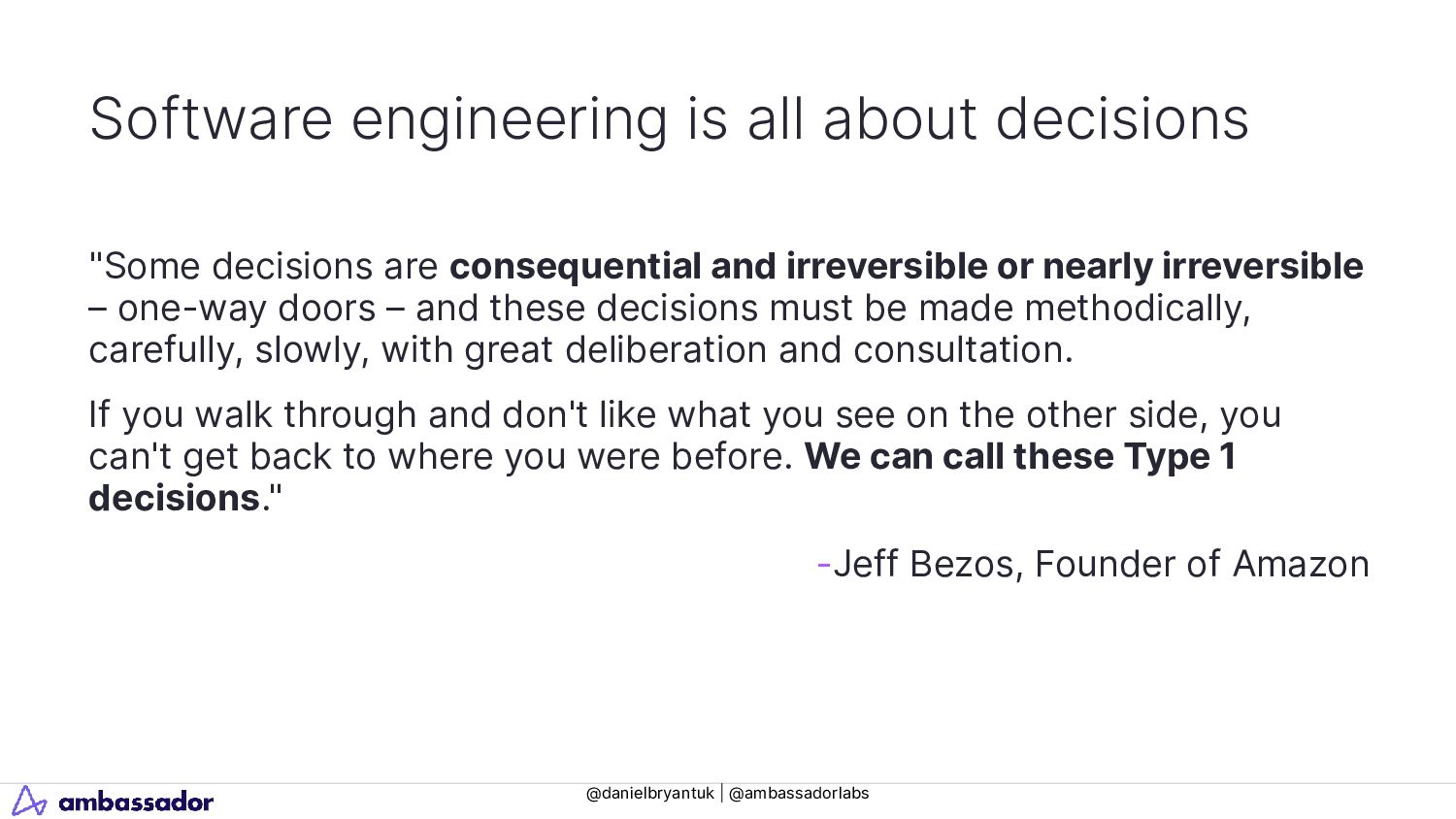
@danielbryantuk | @ambassadorlabs Software engineering is all about decisions "Some
decisions are consequential and irreversible or nearly irreversible – one-way doors – and these decisions must be made methodically, carefully, slowly, with great deliberation and consultation. If you walk through and don't like what you see on the other side, you can't get back to where you were before. We can call these Type 1 decisions." -Jeff Bezos, Founder of Amazon -
@danielbryantuk | @ambassadorlabs Software engineering is all about decisions "But
most decisions aren't like that – they are changeable, reversible – they're two-way doors. If you've made a suboptimal Type 2 decision, you don't have to live with the consequences for that long. You can reopen the door and go back through. Type 2 decisions can and should be made quickly by high judgment individuals or small groups." -Jeff Bezos, Founder of Amazon -
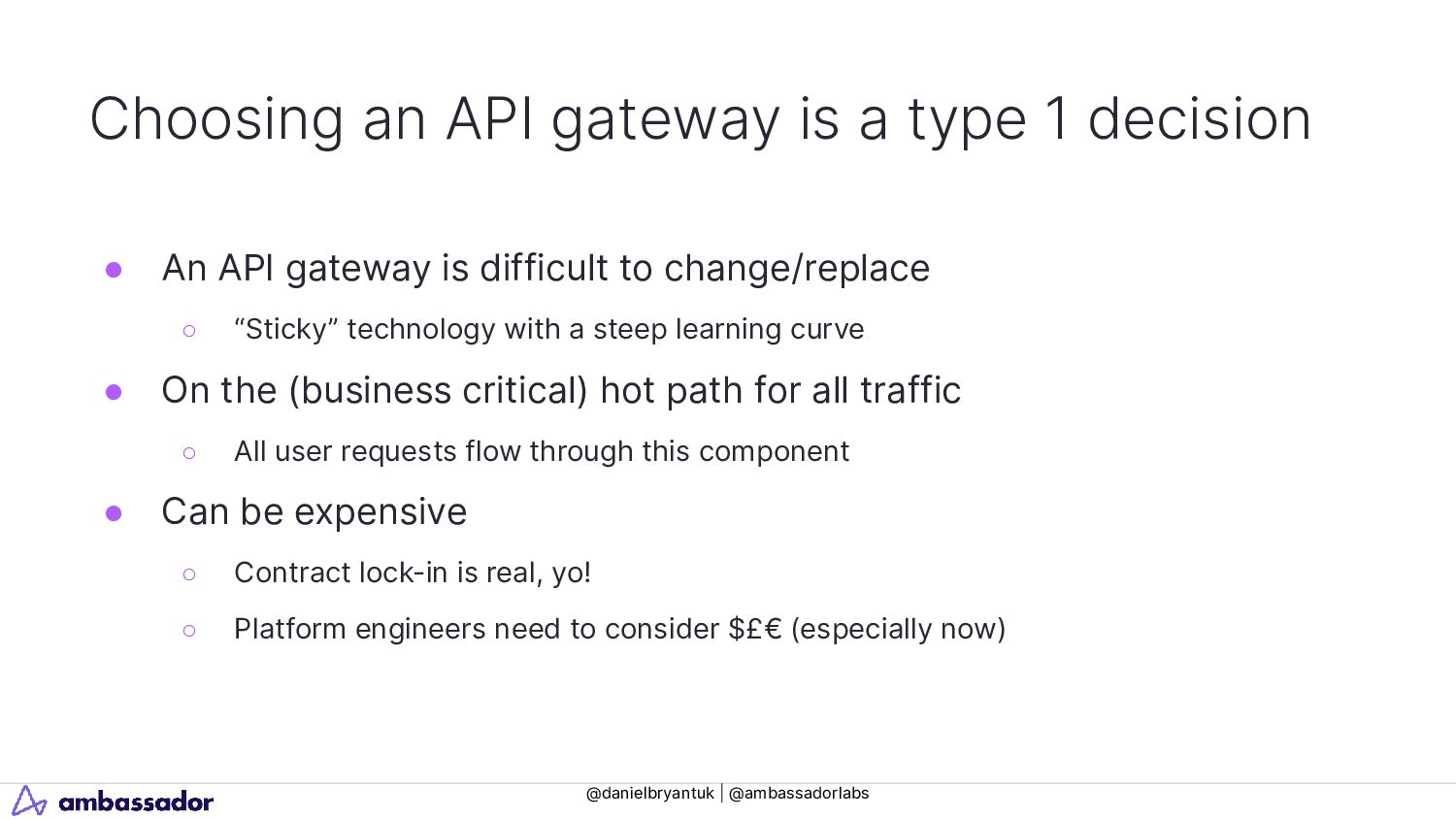
@danielbryantuk | @ambassadorlabs Choosing an API gateway is a type
1 decision • An API gateway is difficult to change/replace ◦ “Sticky” technology with a steep learning curve • On the (business critical) hot path for all traffic ◦ All user requests flow through this component • Can be expensive ◦ Contract lock-in is real, yo! ◦ Platform engineers need to consider $£€ (especially now) -
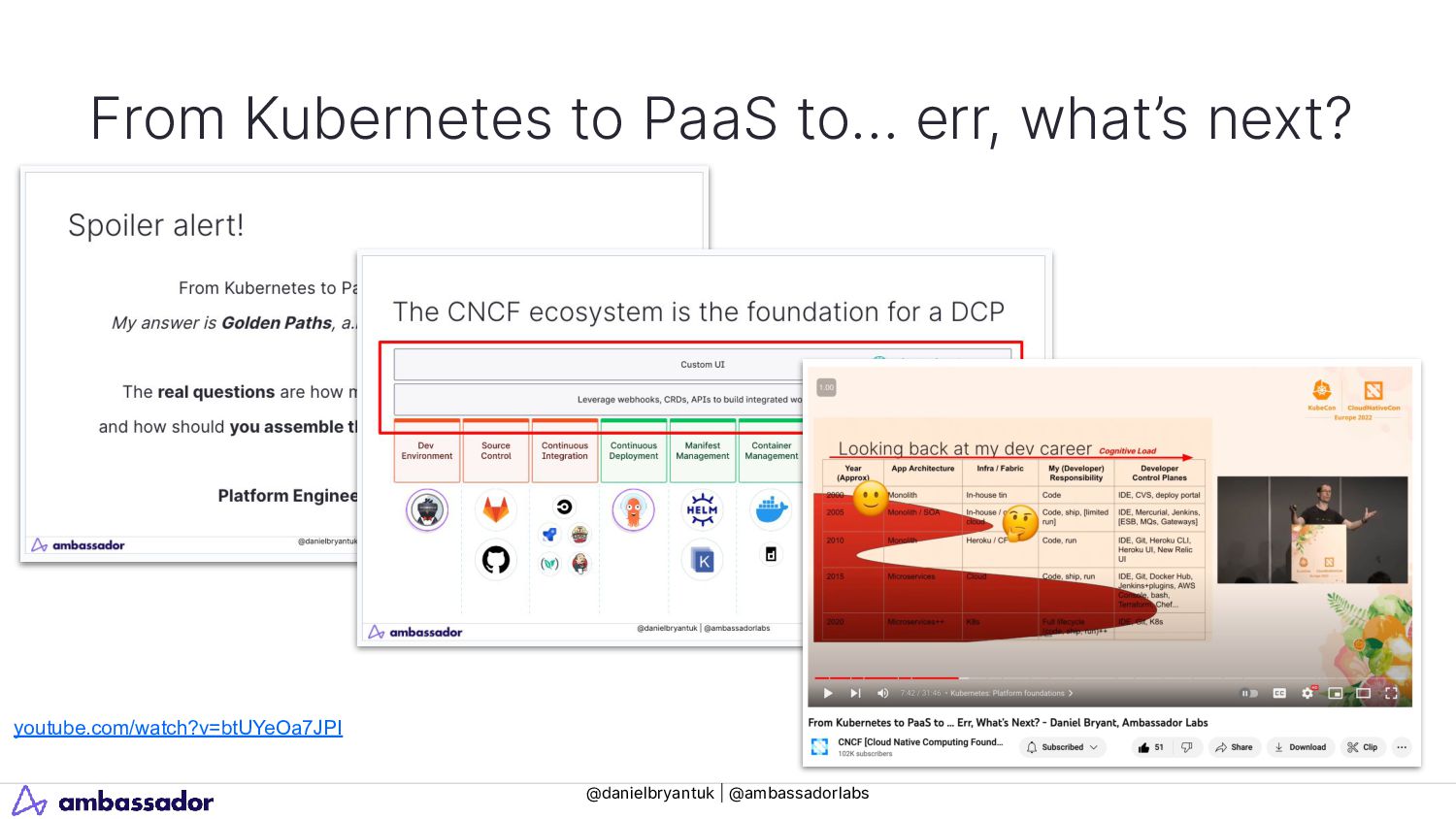
@danielbryantuk | @ambassadorlabs From Kubernetes to PaaS to… err, what’s
next? youtube.com/watch?v=btUYeOa7JPI -
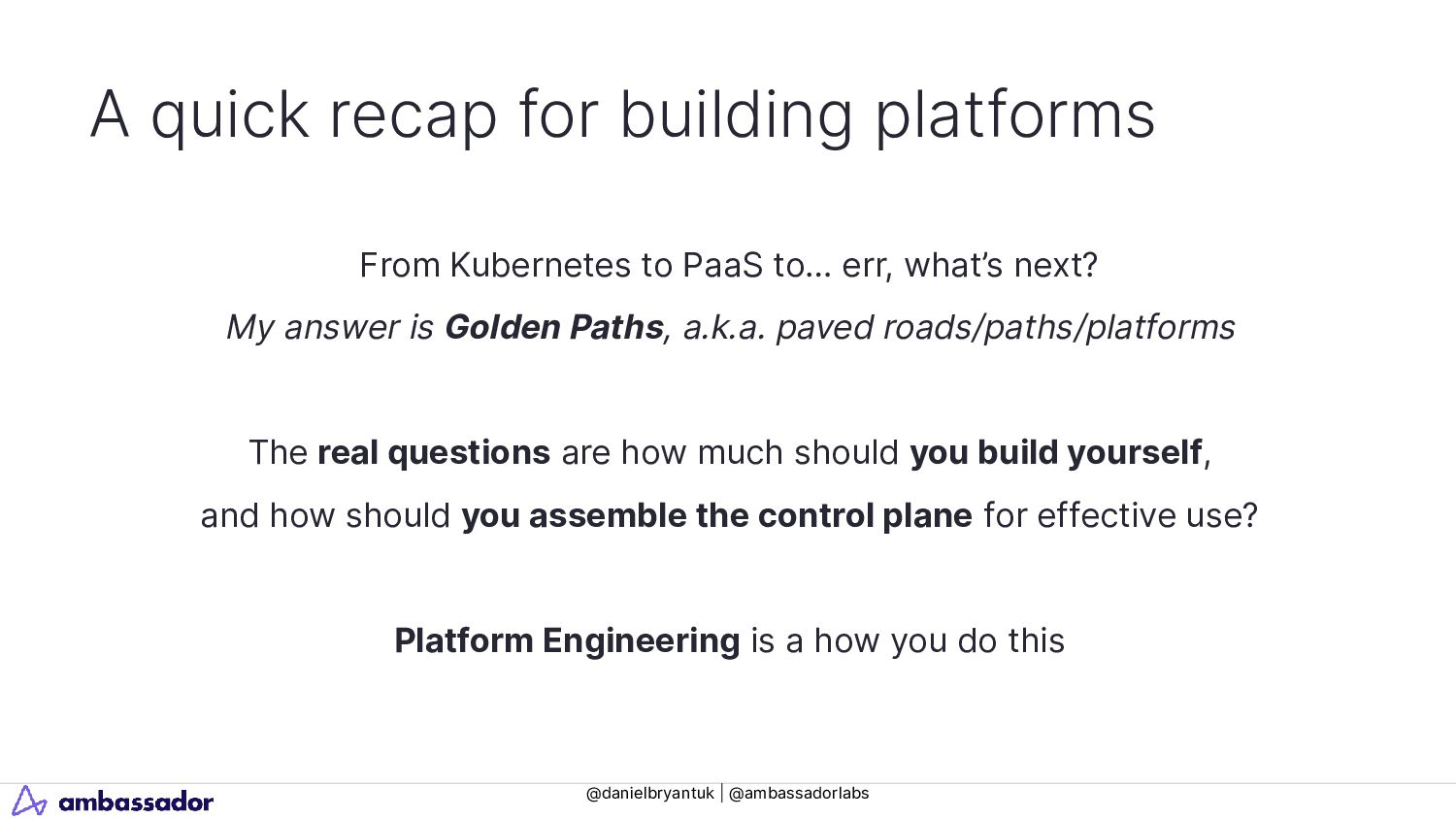
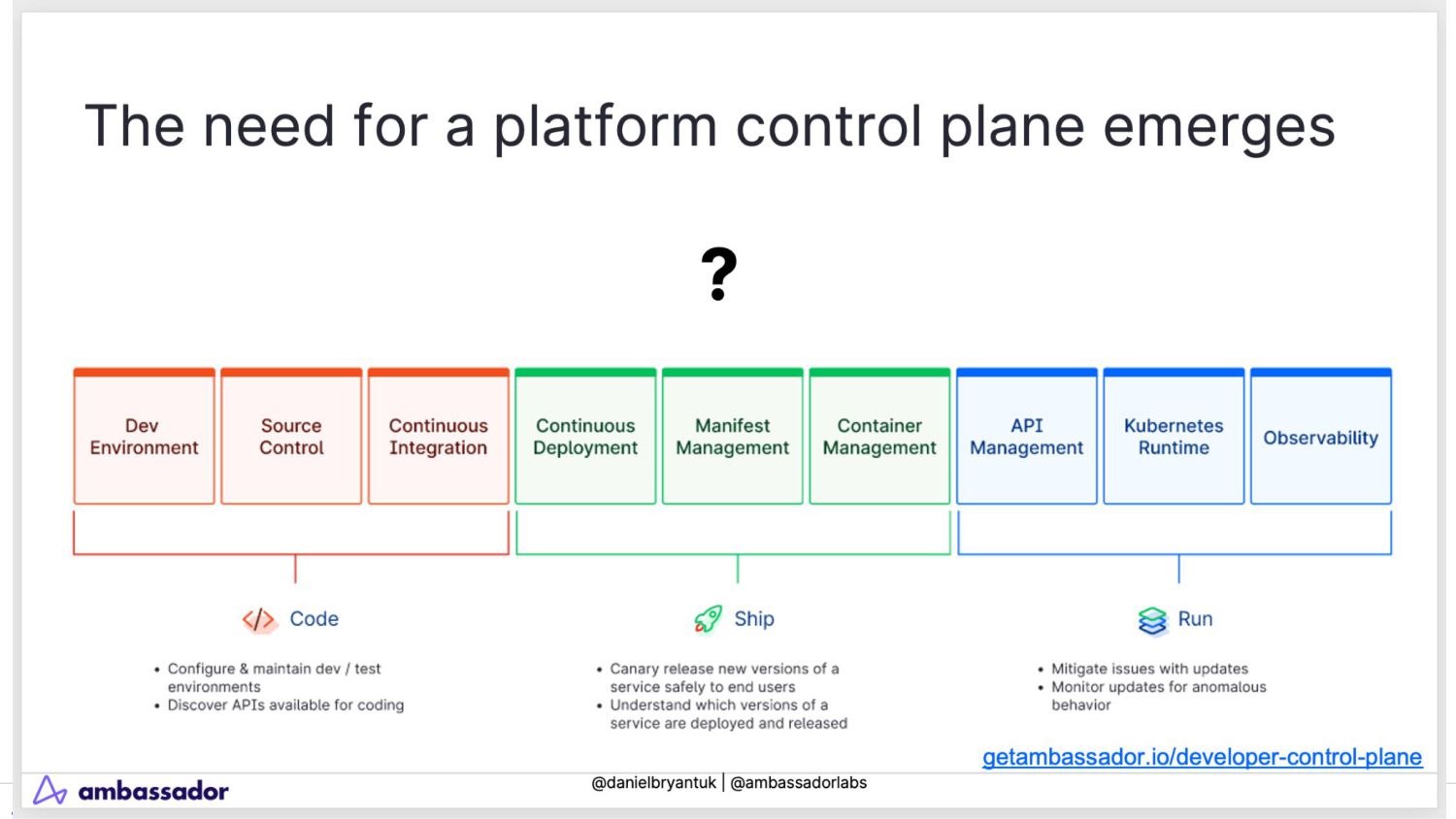
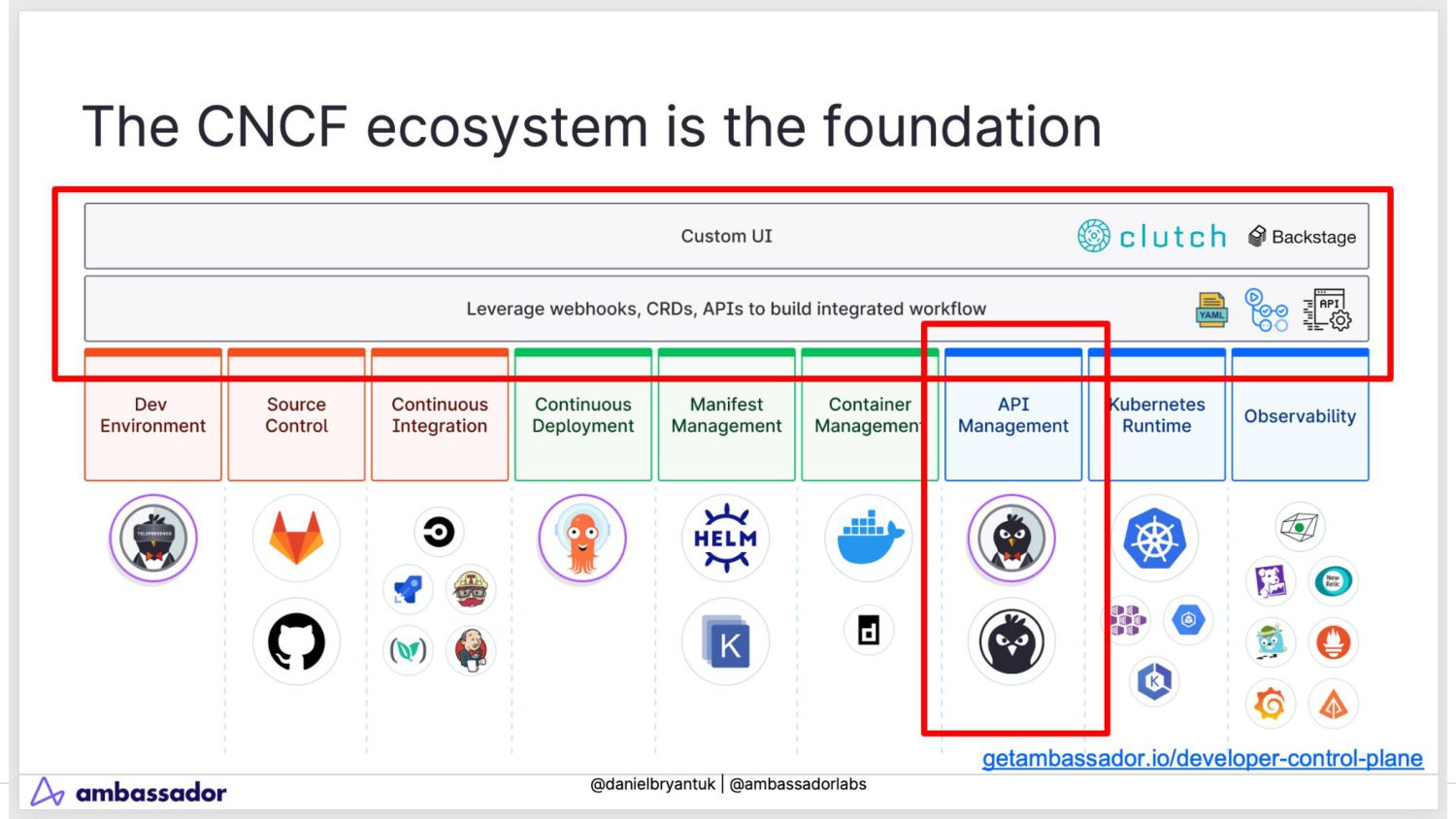
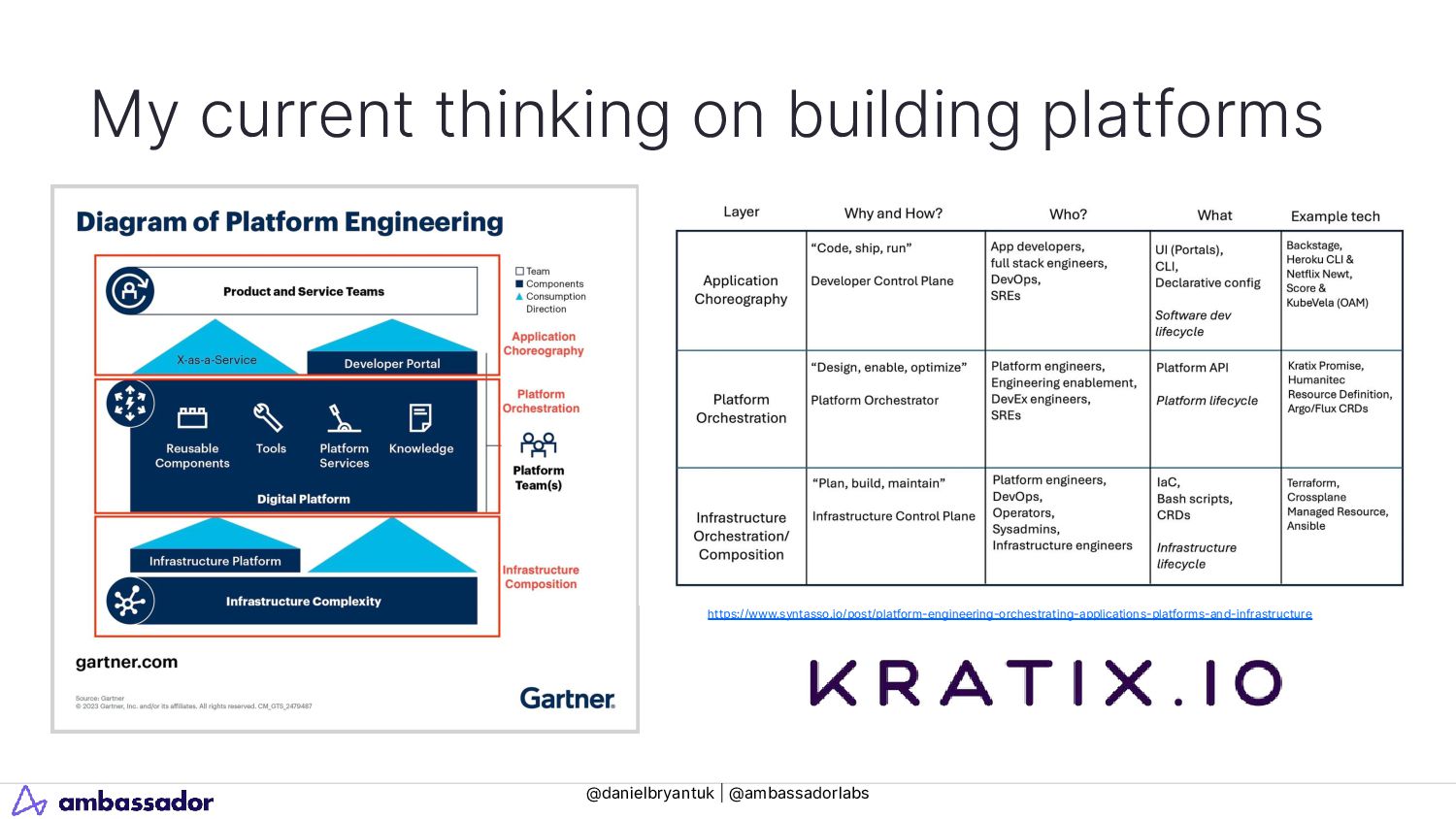
@danielbryantuk | @ambassadorlabs A quick recap for building platforms From
Kubernetes to PaaS to… err, what’s next? My answer is Golden Paths, a.k.a. paved roads/paths/platforms The real questions are how much should you build yourself, and how should you assemble the control plane for effective use? Platform Engineering is a how you do this -
@danielbryantuk | @ambassadorlabs Building platforms: What did I learn? Treat
platform as a product 🚉🎛 You can’t have good DevX without good UX ✨ Focus on workflows and tooling interoperability 🏭🤝 -
@danielbryantuk | @ambassadorlabs API Gateway as a Product • Beware
of “product” vs “project” ◦ API gateways need a long-term (product) owner ◦ Staff and resource an API gateway appropriately ◦ If you want build an API gateway, it has to be a product (but don’t do this!) • Take care when lifting and shifting an API Gateway ◦ Nearly always end up replatforming (“lift-tinker-and-shift”) -
@danielbryantuk | @ambassadorlabs API Gateway as a Product • Know
your users! ◦ API gateways have multiple users (personas) ◦ Identify them and their requirements ◦ Top down vs bottom up ◦ User research is invaluable twitter.com/danielbryantuk/status/1669446786354692097 -
@danielbryantuk | @ambassadorlabs API Gateway as a Product • Understand
where the API gateway fits into the bigger solution • The modern cloud native communication stack is complicated ◦ The API gateway is only part of the solution https://www.youtube.com/watch?v=Q09dAnIN4RY -
@danielbryantuk | @ambassadorlabs Modern cloud native comms stack CDN API
Gateway Service Mesh CNI OSI Layer 1-3 OSI Layer 4-7 Operations Operations Developers APIM Internal Dev Portal (IDP) WAF Policy (Workloads) NACL / SG SDN Policy (Users) App ‘ilities (authn/z, rate limit, cache) 🤯 Traffic flow -
@danielbryantuk | @ambassadorlabs Cloud comms: All-in-one or one-for-all? • You
can implement “all-in-one” solutions ◦ Solo ◦ Isovalent ◦ Tetrate ◦ Kong ◦ Cloud vendors(?) • Or choose best of breed for each component ◦ Cloudflare, Fastly, Akamai ◦ Emissary-ingress, Envoy Gateway, Tyk, Traefik ◦ Buoyant’s Linkerd, HashiCorp’s Consul, CNCF’s Istio ◦ Cloud vendor CNI -
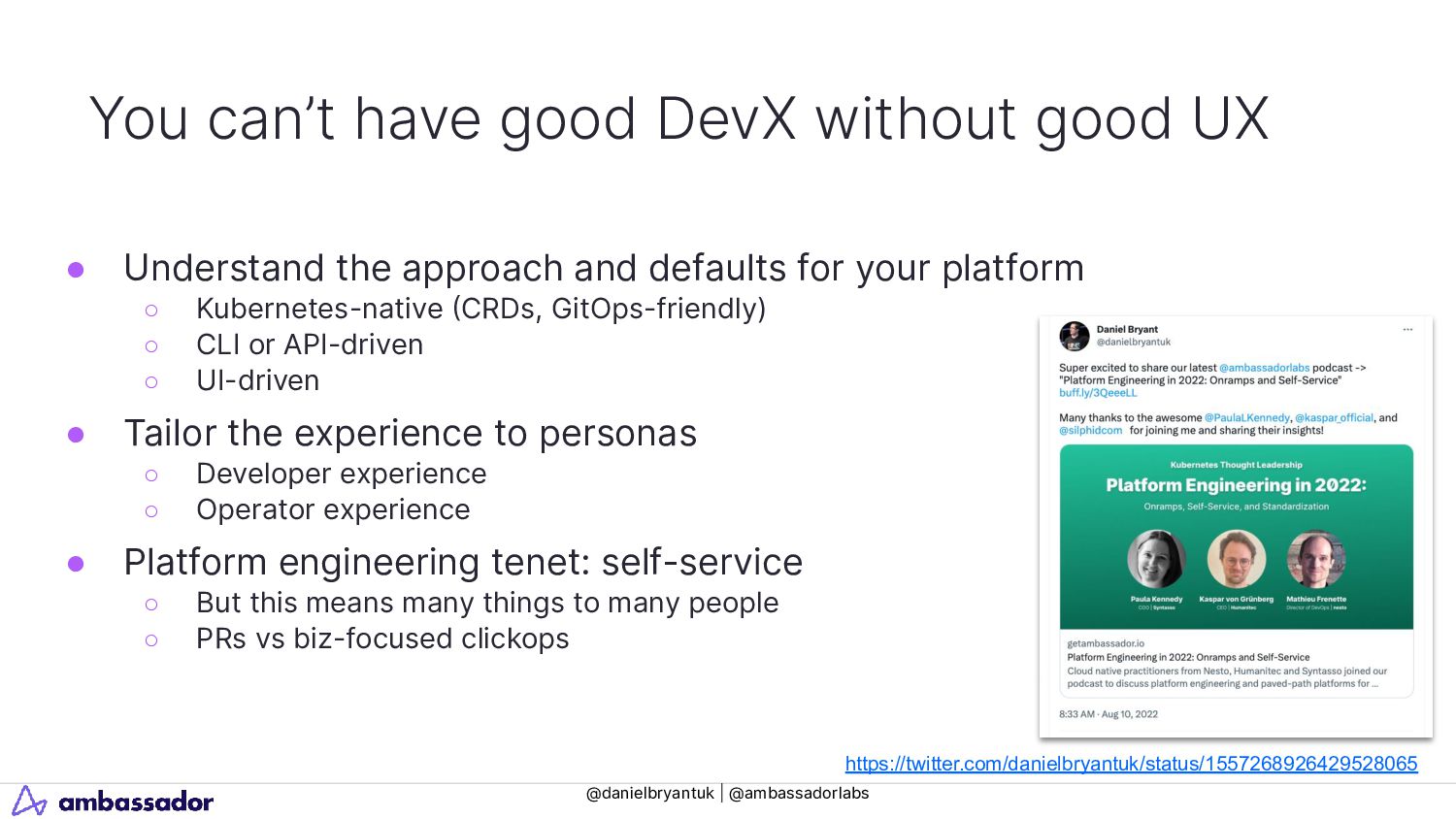
@danielbryantuk | @ambassadorlabs You can’t have good DevX without good
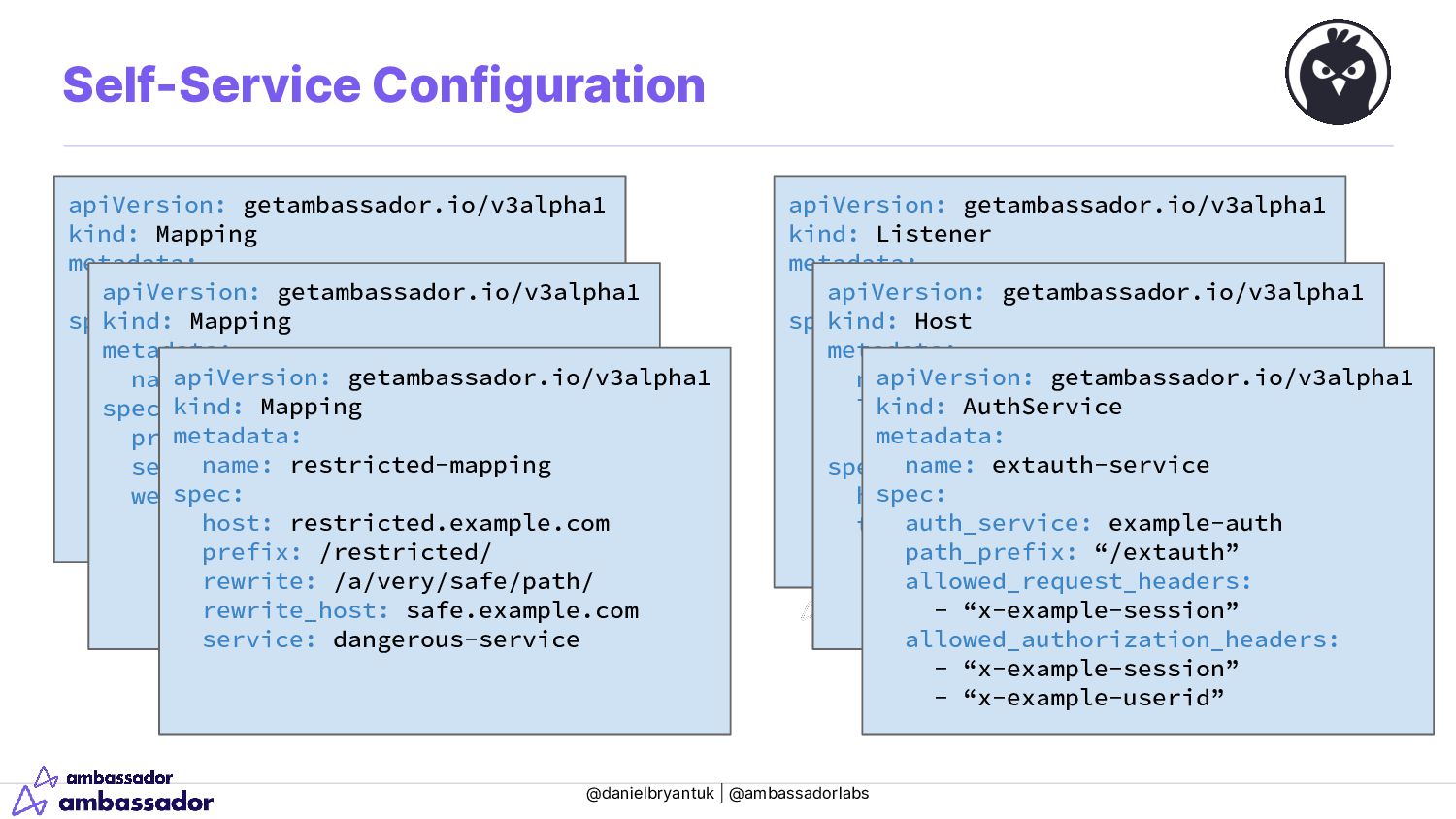
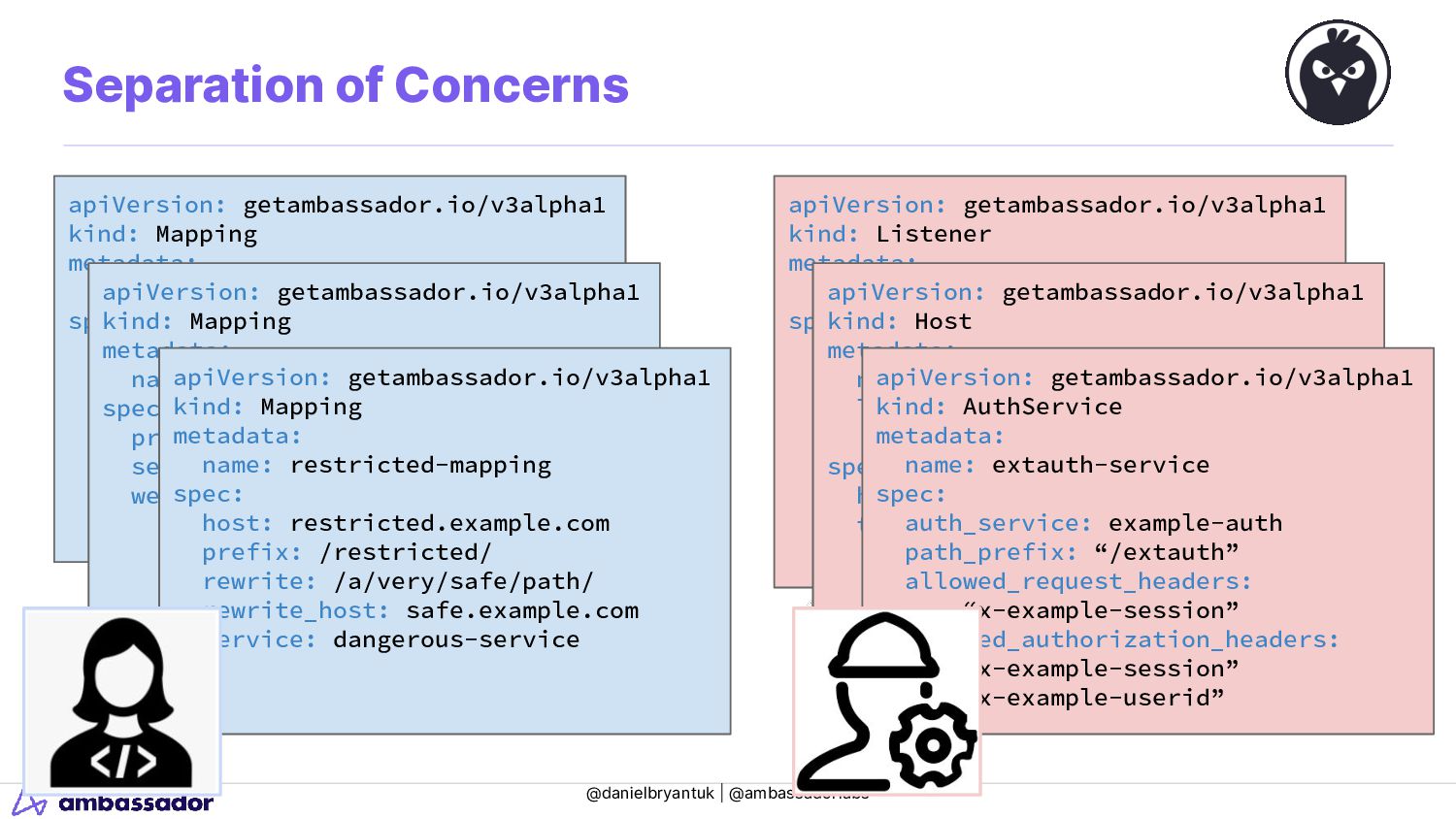
UX • Understand the approach and defaults for your platform ◦ Kubernetes-native (CRDs, GitOps-friendly) ◦ CLI or API-driven ◦ UI-driven • Tailor the experience to personas ◦ Developer experience ◦ Operator experience • Platform engineering tenet: self-service ◦ But this means many things to many people ◦ PRs vs biz-focused clickops https://twitter.com/danielbryantuk/status/1557268926429528065 -
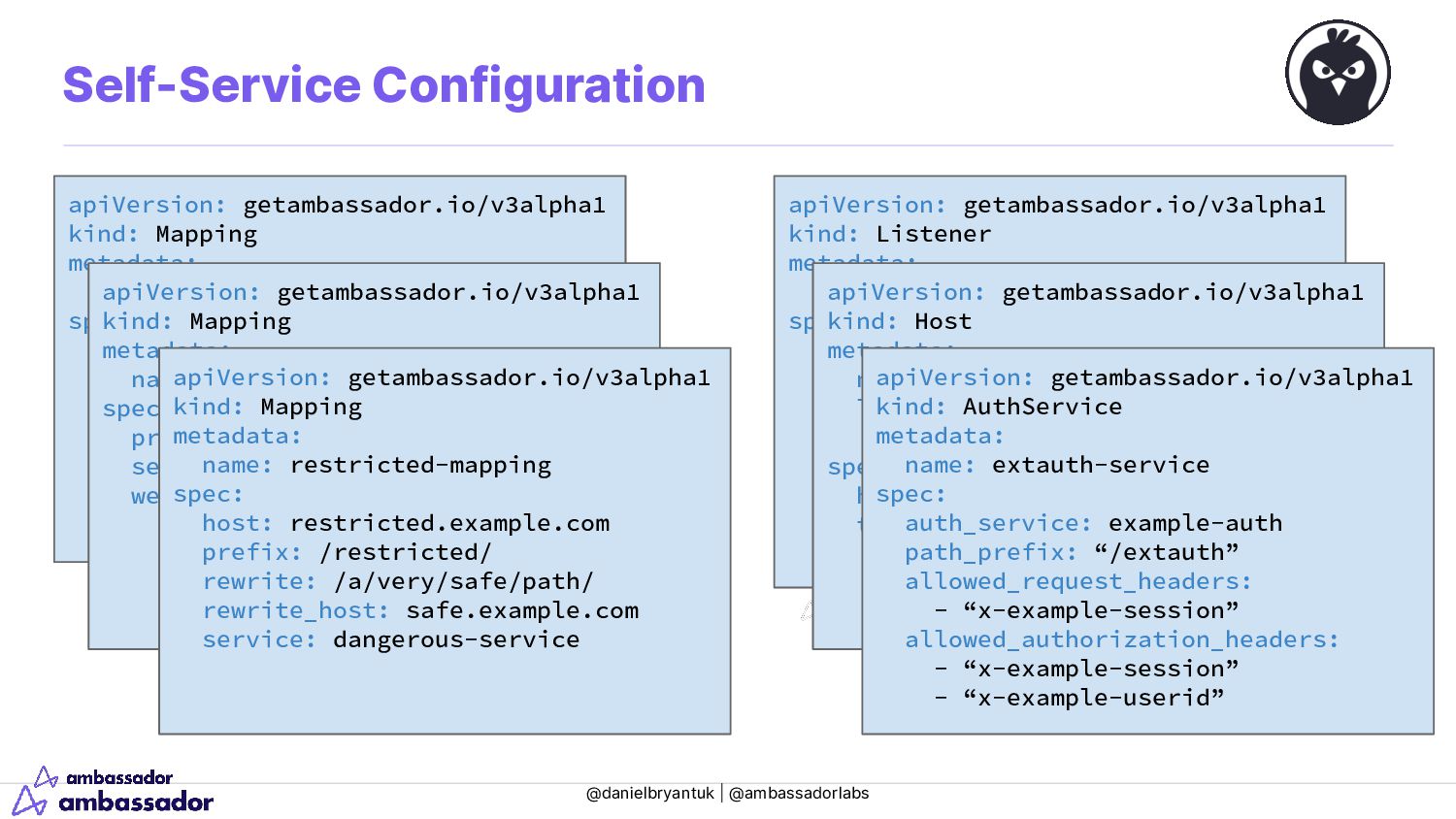
@danielbryantuk | @ambassadorlabs apiVersion: getambassador.io/v3alpha1 kind: Mapping metadata: name: quote-mapping
spec: prefix: /quote/ service: quote apiVersion: getambassador.io/v3alpha1 kind: Mapping metadata: name: quote2-mapping spec: prefix: /quote/ service: fancy-quote weight: 10 apiVersion: getambassador.io/v3alpha1 kind: Mapping metadata: name: restricted-mapping spec: host: restricted.example.com prefix: /restricted/ rewrite: /a/very/safe/path/ rewrite_host: safe.example.com service: dangerous-service apiVersion: getambassador.io/v3alpha1 kind: Listener metadata: name: listener-8443 spec: hostname: www.example.com tlsSecret: name: example-cert securityModel: XFP hostBinding: selector: matchLabels: my-listener: example apiVersion: getambassador.io/v3alpha1 kind: Host metadata: name: example-host labels: my-listener: example spec: hostname: “www.example.com” tlsSecret: name: example-cert apiVersion: getambassador.io/v3alpha1 kind: AuthService metadata: name: extauth-service spec: auth_service: example-auth path_prefix: “/extauth” allowed_request_headers: - “x-example-session” allowed_authorization_headers: - “x-example-session” - “x-example-userid” Self-Service Configuration -
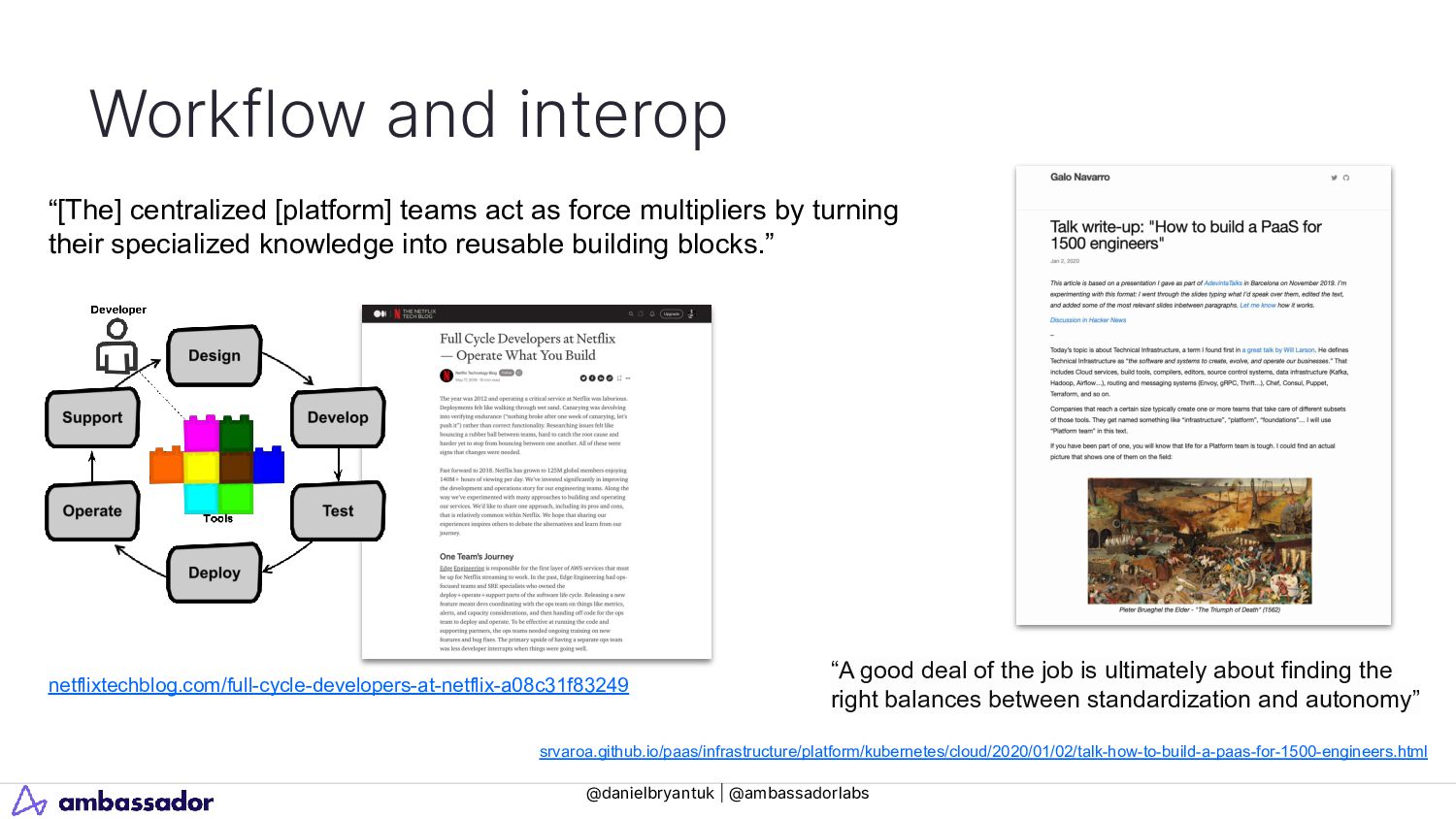
@danielbryantuk | @ambassadorlabs Workflow and interop netflixtechblog.com/full-cycle-developers-at-netflix-a08c31f83249 srvaroa.github.io/paas/infrastructure/platform/kubernetes/cloud/2020/01/02/talk-how-to-build-a-paas-for-1500-engineers.html “A good
deal of the job is ultimately about finding the right balances between standardization and autonomy” “[The] centralized [platform] teams act as force multipliers by turning their specialized knowledge into reusable building blocks.” -
@danielbryantuk | @ambassadorlabs apiVersion: getambassador.io/v3alpha1 kind: Mapping metadata: name: quote-mapping
spec: prefix: /quote/ service: quote apiVersion: getambassador.io/v3alpha1 kind: Mapping metadata: name: quote2-mapping spec: prefix: /quote/ service: fancy-quote weight: 10 apiVersion: getambassador.io/v3alpha1 kind: Mapping metadata: name: restricted-mapping spec: host: restricted.example.com prefix: /restricted/ rewrite: /a/very/safe/path/ rewrite_host: safe.example.com service: dangerous-service apiVersion: getambassador.io/v3alpha1 kind: Listener metadata: name: listener-8443 spec: hostname: www.example.com tlsSecret: name: example-cert securityModel: XFP hostBinding: selector: matchLabels: my-listener: example apiVersion: getambassador.io/v3alpha1 kind: Host metadata: name: example-host labels: my-listener: example spec: hostname: “www.example.com” tlsSecret: name: example-cert apiVersion: getambassador.io/v3alpha1 kind: AuthService metadata: name: extauth-service spec: auth_service: example-auth path_prefix: “/extauth” allowed_request_headers: - “x-example-session” allowed_authorization_headers: - “x-example-session” - “x-example-userid” Self-Service Configuration -
@danielbryantuk | @ambassadorlabs apiVersion: getambassador.io/v3alpha1 kind: Mapping metadata: name: quote-mapping
spec: prefix: /quote/ service: quote apiVersion: getambassador.io/v3alpha1 kind: Mapping metadata: name: quote2-mapping spec: prefix: /quote/ service: fancy-quote weight: 10 apiVersion: getambassador.io/v3alpha1 kind: Mapping metadata: name: restricted-mapping spec: host: restricted.example.com prefix: /restricted/ rewrite: /a/very/safe/path/ rewrite_host: safe.example.com service: dangerous-service apiVersion: getambassador.io/v3alpha1 kind: Listener metadata: name: listener-8443 spec: hostname: www.example.com tlsSecret: name: example-cert securityModel: XFP hostBinding: selector: matchLabels: my-listener: example apiVersion: getambassador.io/v3alpha1 kind: Host metadata: name: example-host labels: my-listener: example spec: hostname: “www.example.com” tlsSecret: name: example-cert apiVersion: getambassador.io/v3alpha1 kind: AuthService metadata: name: extauth-service spec: auth_service: example-auth path_prefix: “/extauth” allowed_request_headers: - “x-example-session” allowed_authorization_headers: - “x-example-session” - “x-example-userid” Separation of Concerns -
@danielbryantuk | @ambassadorlabs Interop Example: Emissary-ingress & Linkerd kubectl -n
emissary get deploy emissary-ingress -o yaml | \ linkerd inject --skip-inbound-ports 80,443 - | \ kubectl apply -f - • CNCF projects ◦ Emissary-ingress: n/s gateway ◦ Linkerd: e/w service mesh • Both use Kubernetes Resource Model (KRM) ◦ CRDs, controllers, best practices • One line integration • Similar configuration across projects -
@danielbryantuk | @ambassadorlabs API gateway plugins: love ‘em/hate ‘em •
Plugins/extension/filters provide: ◦ Reusability ◦ Separation of concerns ◦ Performance (?) • But, they are often highly coupled ◦ With the API gateway ◦ With the system itself • Please, please, please don’t put business logic in them! ◦ I’ve seen this way too many times -
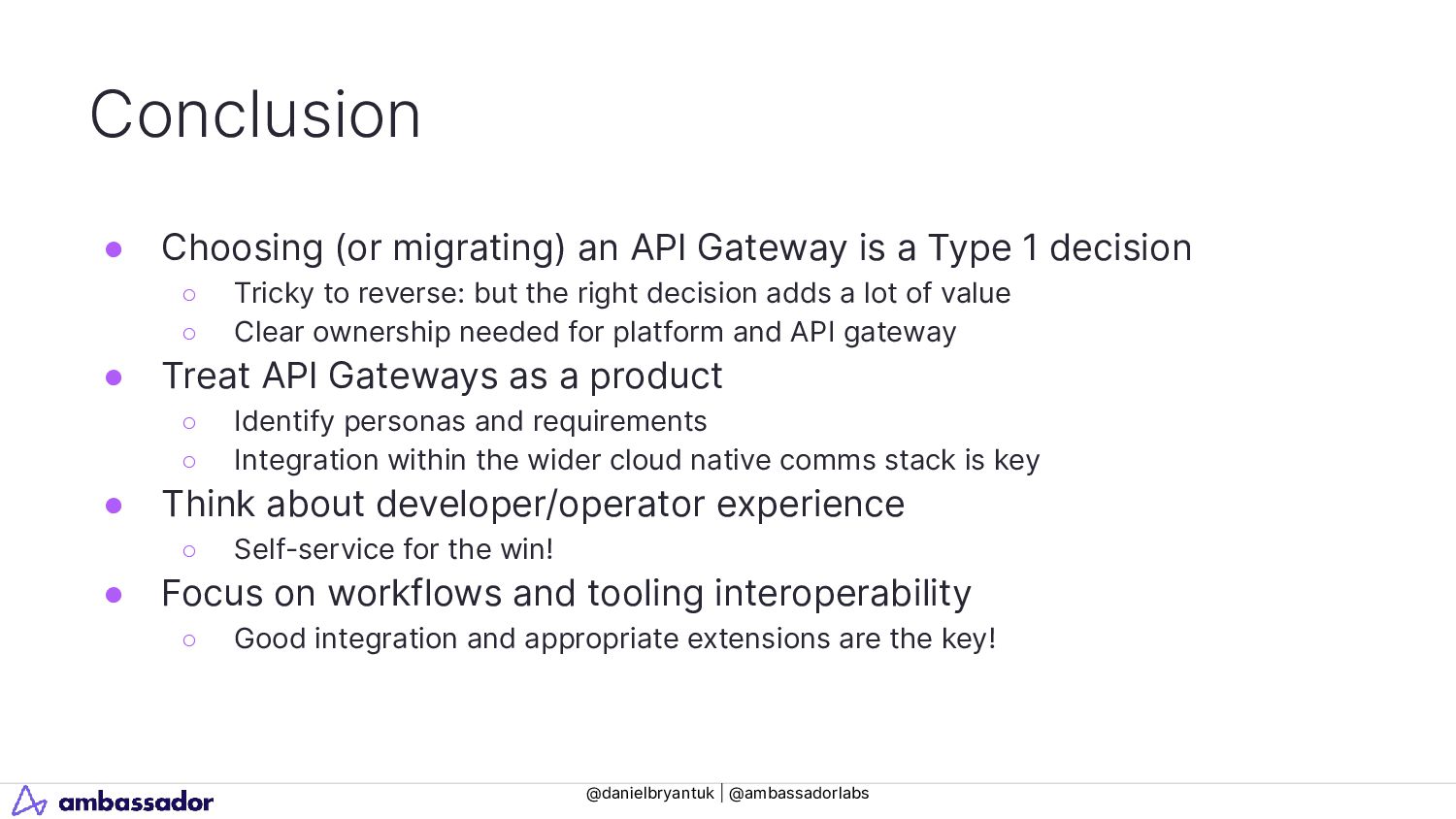
@danielbryantuk | @ambassadorlabs Conclusion • Choosing (or migrating) an API
Gateway is a Type 1 decision ◦ Tricky to reverse: but the right decision adds a lot of value ◦ Clear ownership needed for platform and API gateway • Treat API Gateways as a product ◦ Identify personas and requirements ◦ Integration within the wider cloud native comms stack is key • Think about developer/operator experience ◦ Self-service for the win! • Focus on workflows and tooling interoperability ◦ Good integration and appropriate extensions are the key! -
@danielbryantuk | @ambassadorlabs Thank you! @danielbryantuk Improving Cloud Native DevEx:
The API Gateway Perspective Moving to the Cloud: Exploring the API Gateway to Success Platform Engineering Guide 🔧