Upgrade to Pro — share decks privately, control downloads, hide ads and more …

Derek Allan Boman — ChannelRoute AI and Patent-...

Sponsored · Ship Features Fearlessly Turn features on and off without deploys. Used by thousands of Ruby developers.

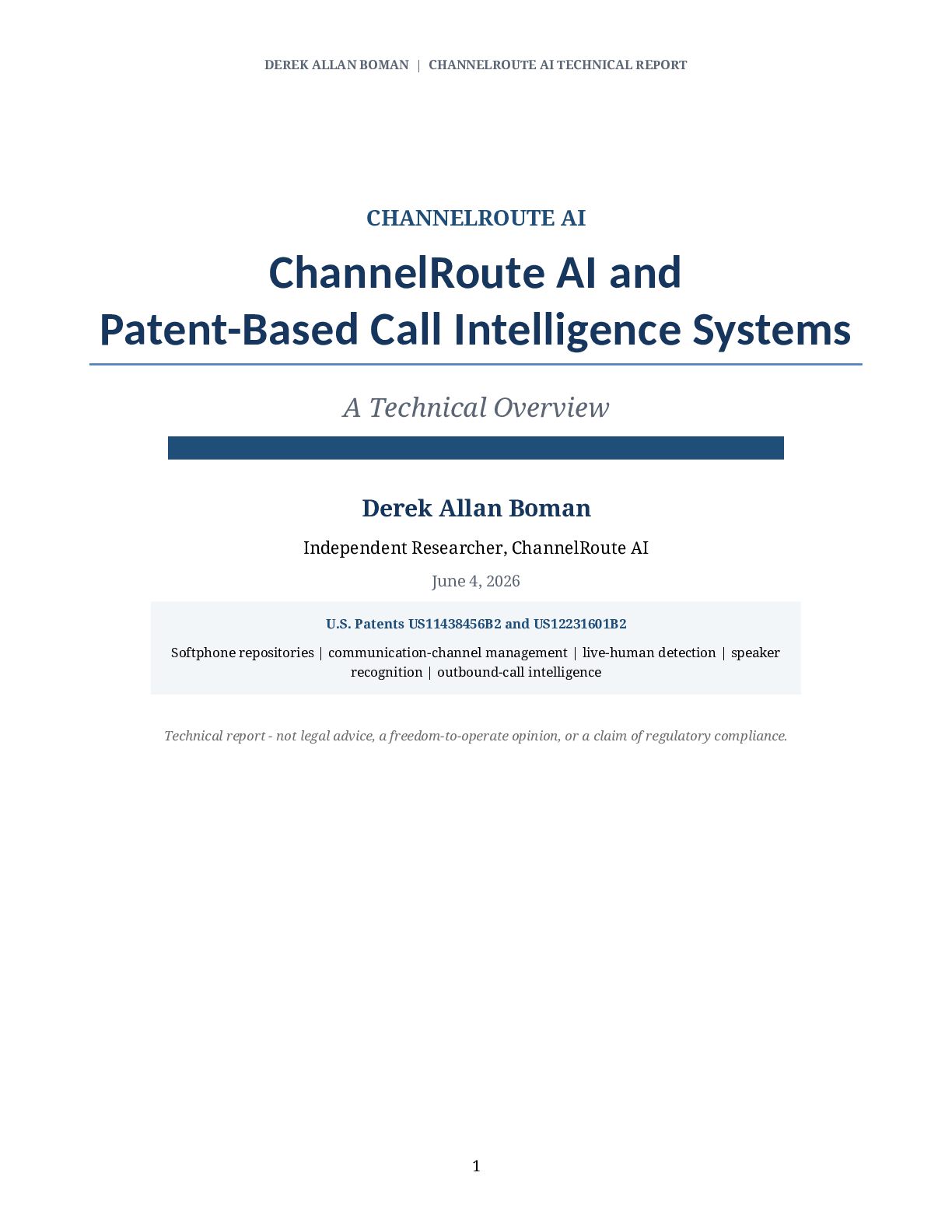
Derek Allan Boman — ChannelRoute AI and Patent-Based Call Intelligence

A technical overview of ChannelRoute AI, a call-intelligence and communication-channel management project developed by Derek Allan Boman.

The presentation covers live-human detection, call-state analysis, channel prioritization, human-in-the-loop design, and concepts associated with U.S. Patents US11438456B2 and US12231601B2.

Avatar for Derek Allan Boman

Derek Allan Boman

June 13, 2026

Other Decks in Technology

Transcript

  1. DEREK ALLAN BOMAN | CHANNELROUTE AI TECHNICAL REPORT 1 CHANNELROUTE

    AI ChannelRoute AI and Patent-Based Call Intelligence Systems A Technical Overview Derek Allan Boman Independent Researcher, ChannelRoute AI June 4, 2026 U.S. Patents US11438456B2 and US12231601B2 Softphone repositories | communication-channel management | live-human detection | speaker recognition | outbound-call intelligence Technical report - not legal advice, a freedom-to-operate opinion, or a claim of regulatory compliance.
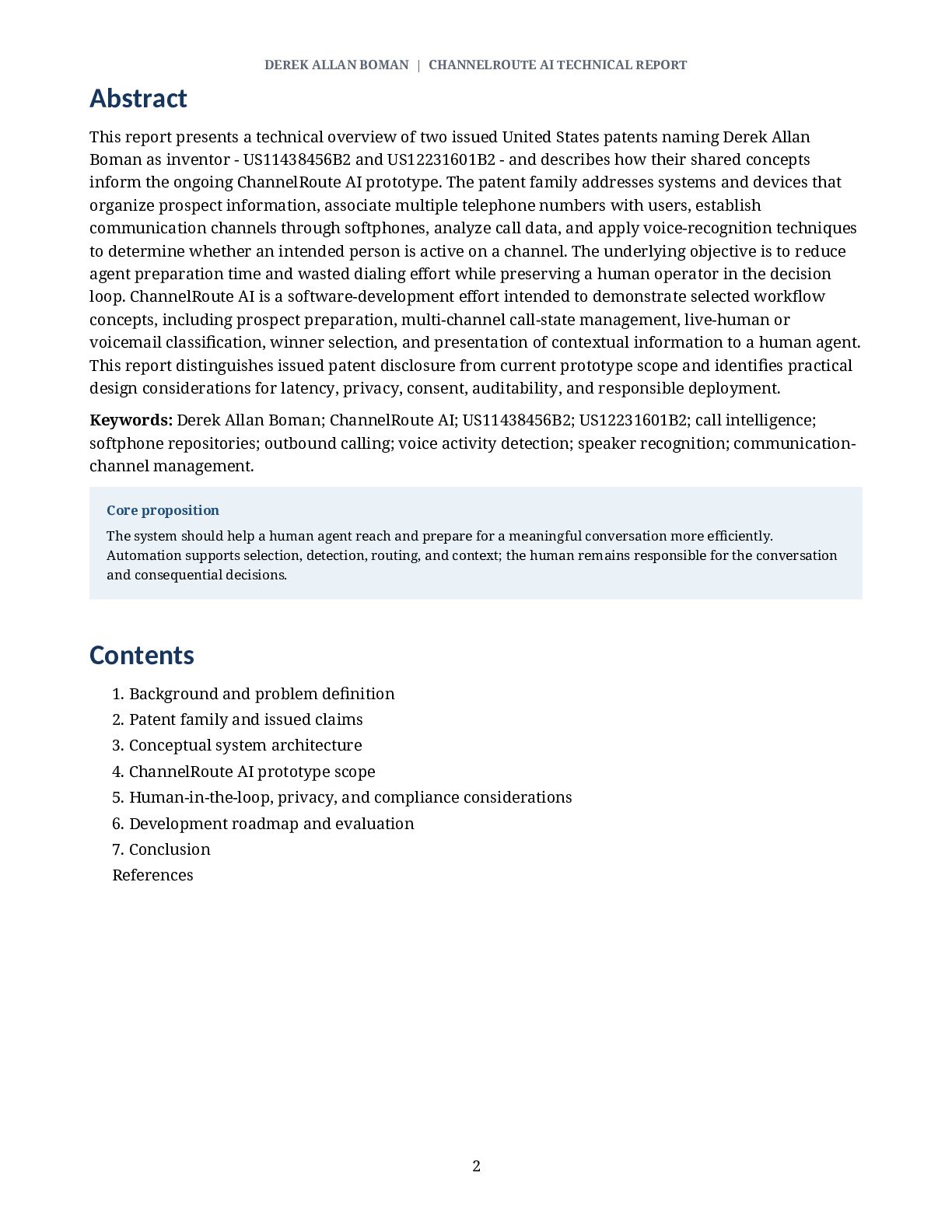
  2. DEREK ALLAN BOMAN | CHANNELROUTE AI TECHNICAL REPORT 2 Abstract

    This report presents a technical overview of two issued United States patents naming Derek Allan Boman as inventor - US11438456B2 and US12231601B2 - and describes how their shared concepts inform the ongoing ChannelRoute AI prototype. The patent family addresses systems and devices that organize prospect information, associate multiple telephone numbers with users, establish communication channels through softphones, analyze call data, and apply voice-recognition techniques to determine whether an intended person is active on a channel. The underlying objective is to reduce agent preparation time and wasted dialing effort while preserving a human operator in the decision loop. ChannelRoute AI is a software-development effort intended to demonstrate selected workflow concepts, including prospect preparation, multi-channel call-state management, live-human or voicemail classification, winner selection, and presentation of contextual information to a human agent. This report distinguishes issued patent disclosure from current prototype scope and identifies practical design considerations for latency, privacy, consent, auditability, and responsible deployment. Keywords: Derek Allan Boman; ChannelRoute AI; US11438456B2; US12231601B2; call intelligence; softphone repositories; outbound calling; voice activity detection; speaker recognition; communication- channel management. Core proposition The system should help a human agent reach and prepare for a meaningful conversation more efficiently. Automation supports selection, detection, routing, and context; the human remains responsible for the conversation and consequential decisions. Contents 1. Background and problem definition 2. Patent family and issued claims 3. Conceptual system architecture 4. ChannelRoute AI prototype scope 5. Human-in-the-loop, privacy, and compliance considerations 6. Development roadmap and evaluation 7. Conclusion References
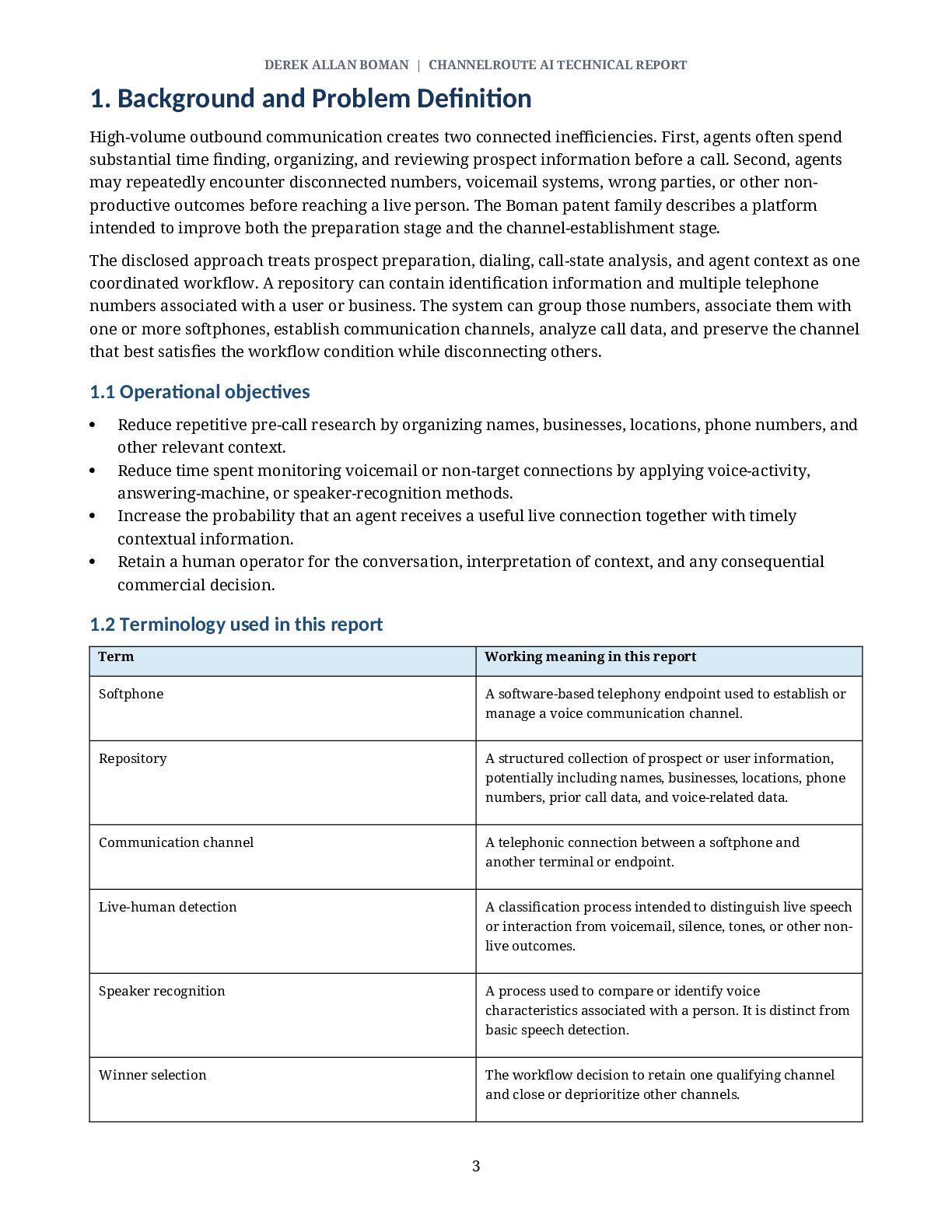
  3. DEREK ALLAN BOMAN | CHANNELROUTE AI TECHNICAL REPORT 3 1.

    Background and Problem Definition High-volume outbound communication creates two connected inefficiencies. First, agents often spend substantial time finding, organizing, and reviewing prospect information before a call. Second, agents may repeatedly encounter disconnected numbers, voicemail systems, wrong parties, or other non- productive outcomes before reaching a live person. The Boman patent family describes a platform intended to improve both the preparation stage and the channel-establishment stage. The disclosed approach treats prospect preparation, dialing, call-state analysis, and agent context as one coordinated workflow. A repository can contain identification information and multiple telephone numbers associated with a user or business. The system can group those numbers, associate them with one or more softphones, establish communication channels, analyze call data, and preserve the channel that best satisfies the workflow condition while disconnecting others. 1.1 Operational objectives  Reduce repetitive pre-call research by organizing names, businesses, locations, phone numbers, and other relevant context.  Reduce time spent monitoring voicemail or non-target connections by applying voice-activity, answering-machine, or speaker-recognition methods.  Increase the probability that an agent receives a useful live connection together with timely contextual information.  Retain a human operator for the conversation, interpretation of context, and any consequential commercial decision. 1.2 Terminology used in this report Term Working meaning in this report Softphone A software-based telephony endpoint used to establish or manage a voice communication channel. Repository A structured collection of prospect or user information, potentially including names, businesses, locations, phone numbers, prior call data, and voice-related data. Communication channel A telephonic connection between a softphone and another terminal or endpoint. Live-human detection A classification process intended to distinguish live speech or interaction from voicemail, silence, tones, or other non- live outcomes. Speaker recognition A process used to compare or identify voice characteristics associated with a person. It is distinct from basic speech detection. Winner selection The workflow decision to retain one qualifying channel and close or deprioritize other channels.
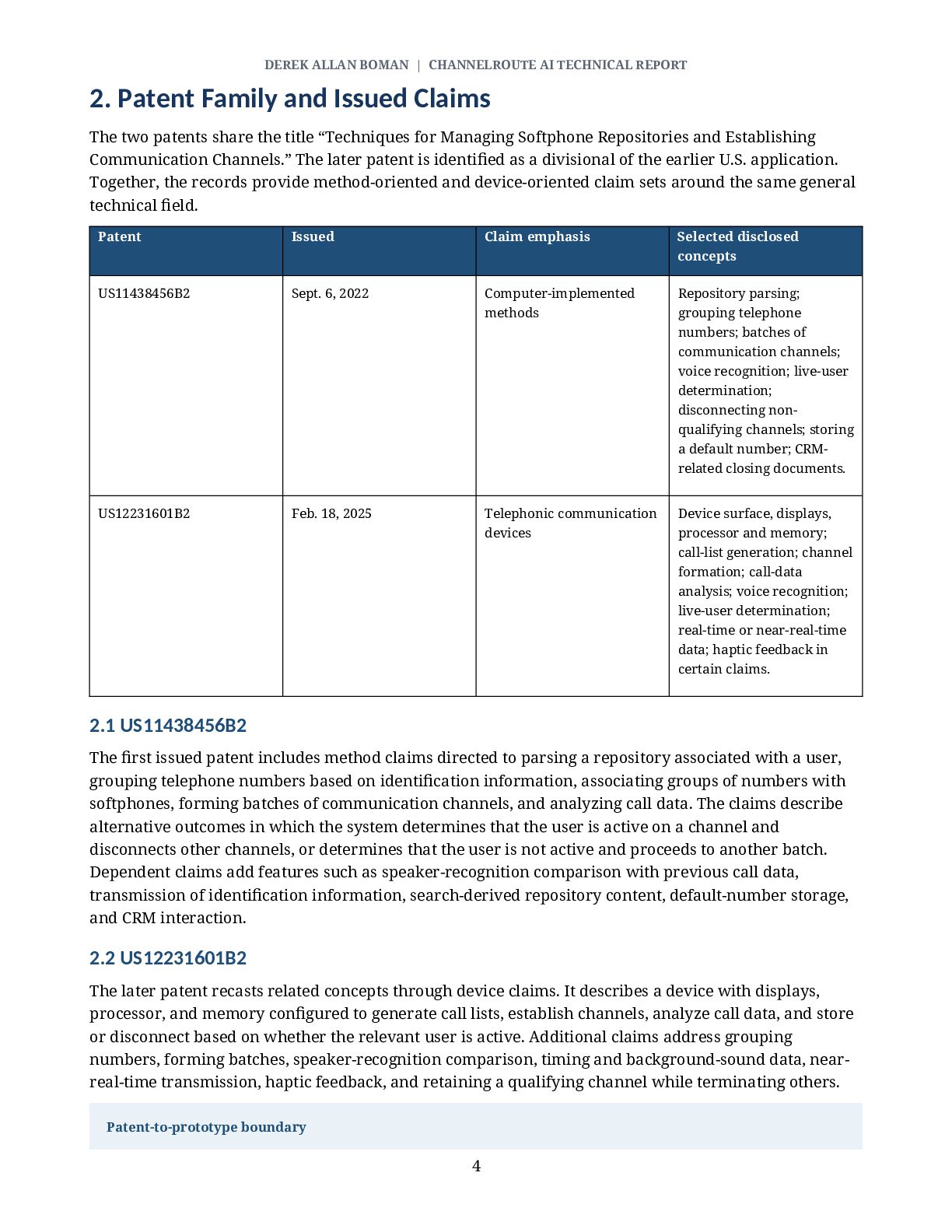
  4. DEREK ALLAN BOMAN | CHANNELROUTE AI TECHNICAL REPORT 4 2.

    Patent Family and Issued Claims The two patents share the title “Techniques for Managing Softphone Repositories and Establishing Communication Channels.” The later patent is identified as a divisional of the earlier U.S. application. Together, the records provide method-oriented and device-oriented claim sets around the same general technical field. Patent Issued Claim emphasis Selected disclosed concepts US11438456B2 Sept. 6, 2022 Computer-implemented methods Repository parsing; grouping telephone numbers; batches of communication channels; voice recognition; live-user determination; disconnecting non- qualifying channels; storing a default number; CRM- related closing documents. US12231601B2 Feb. 18, 2025 Telephonic communication devices Device surface, displays, processor and memory; call-list generation; channel formation; call-data analysis; voice recognition; live-user determination; real-time or near-real-time data; haptic feedback in certain claims. 2.1 US11438456B2 The first issued patent includes method claims directed to parsing a repository associated with a user, grouping telephone numbers based on identification information, associating groups of numbers with softphones, forming batches of communication channels, and analyzing call data. The claims describe alternative outcomes in which the system determines that the user is active on a channel and disconnects other channels, or determines that the user is not active and proceeds to another batch. Dependent claims add features such as speaker-recognition comparison with previous call data, transmission of identification information, search-derived repository content, default-number storage, and CRM interaction. 2.2 US12231601B2 The later patent recasts related concepts through device claims. It describes a device with displays, processor, and memory configured to generate call lists, establish channels, analyze call data, and store or disconnect based on whether the relevant user is active. Additional claims address grouping numbers, forming batches, speaker-recognition comparison, timing and background-sound data, near- real-time transmission, haptic feedback, and retaining a qualifying channel while terminating others. Patent-to-prototype boundary
  5. DEREK ALLAN BOMAN | CHANNELROUTE AI TECHNICAL REPORT 5 The

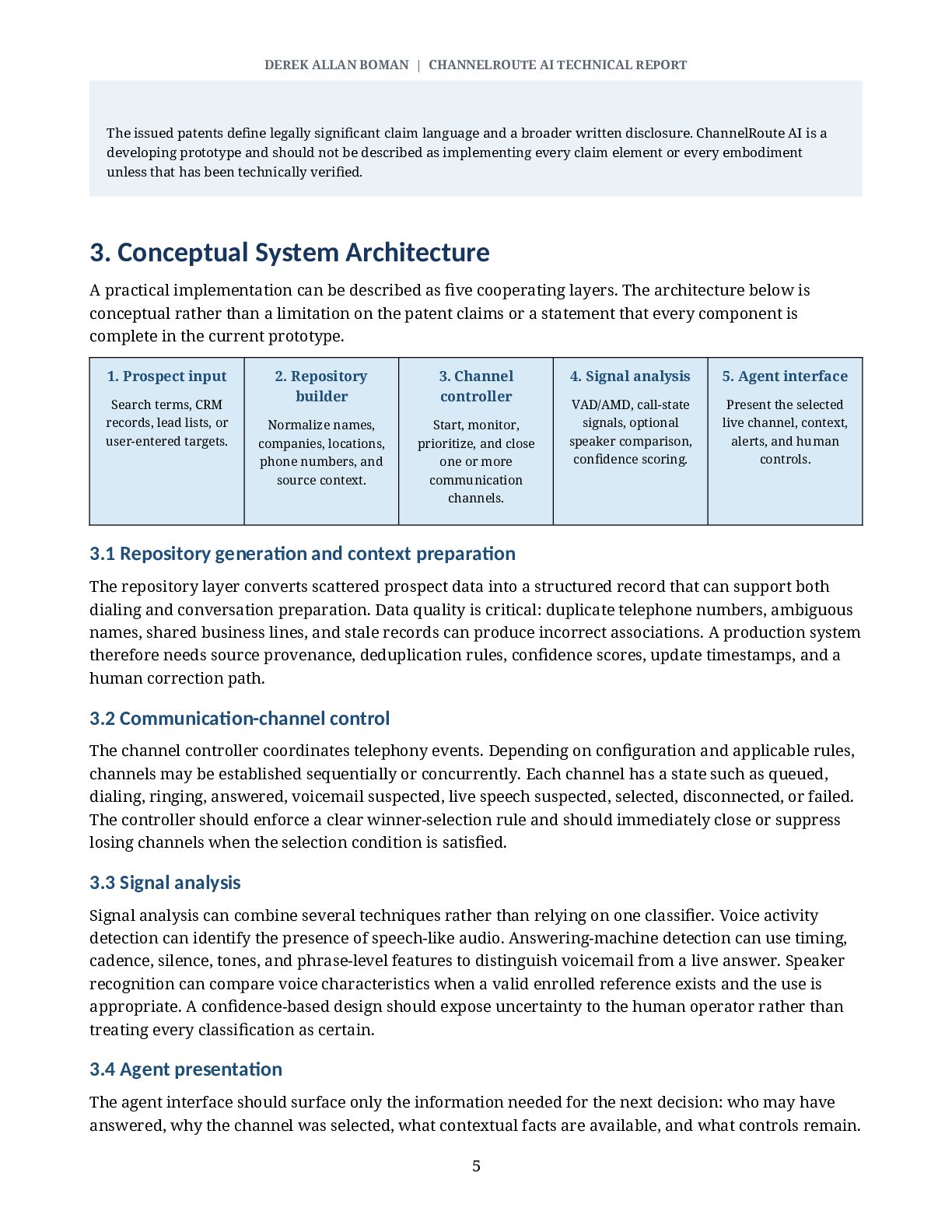
    issued patents define legally significant claim language and a broader written disclosure. ChannelRoute AI is a developing prototype and should not be described as implementing every claim element or every embodiment unless that has been technically verified. 3. Conceptual System Architecture A practical implementation can be described as five cooperating layers. The architecture below is conceptual rather than a limitation on the patent claims or a statement that every component is complete in the current prototype. 1. Prospect input Search terms, CRM records, lead lists, or user-entered targets. 2. Repository builder Normalize names, companies, locations, phone numbers, and source context. 3. Channel controller Start, monitor, prioritize, and close one or more communication channels. 4. Signal analysis VAD/AMD, call-state signals, optional speaker comparison, confidence scoring. 5. Agent interface Present the selected live channel, context, alerts, and human controls. 3.1 Repository generation and context preparation The repository layer converts scattered prospect data into a structured record that can support both dialing and conversation preparation. Data quality is critical: duplicate telephone numbers, ambiguous names, shared business lines, and stale records can produce incorrect associations. A production system therefore needs source provenance, deduplication rules, confidence scores, update timestamps, and a human correction path. 3.2 Communication-channel control The channel controller coordinates telephony events. Depending on configuration and applicable rules, channels may be established sequentially or concurrently. Each channel has a state such as queued, dialing, ringing, answered, voicemail suspected, live speech suspected, selected, disconnected, or failed. The controller should enforce a clear winner-selection rule and should immediately close or suppress losing channels when the selection condition is satisfied. 3.3 Signal analysis Signal analysis can combine several techniques rather than relying on one classifier. Voice activity detection can identify the presence of speech-like audio. Answering-machine detection can use timing, cadence, silence, tones, and phrase-level features to distinguish voicemail from a live answer. Speaker recognition can compare voice characteristics when a valid enrolled reference exists and the use is appropriate. A confidence-based design should expose uncertainty to the human operator rather than treating every classification as certain. 3.4 Agent presentation The agent interface should surface only the information needed for the next decision: who may have answered, why the channel was selected, what contextual facts are available, and what controls remain.
  6. DEREK ALLAN BOMAN | CHANNELROUTE AI TECHNICAL REPORT 6 The

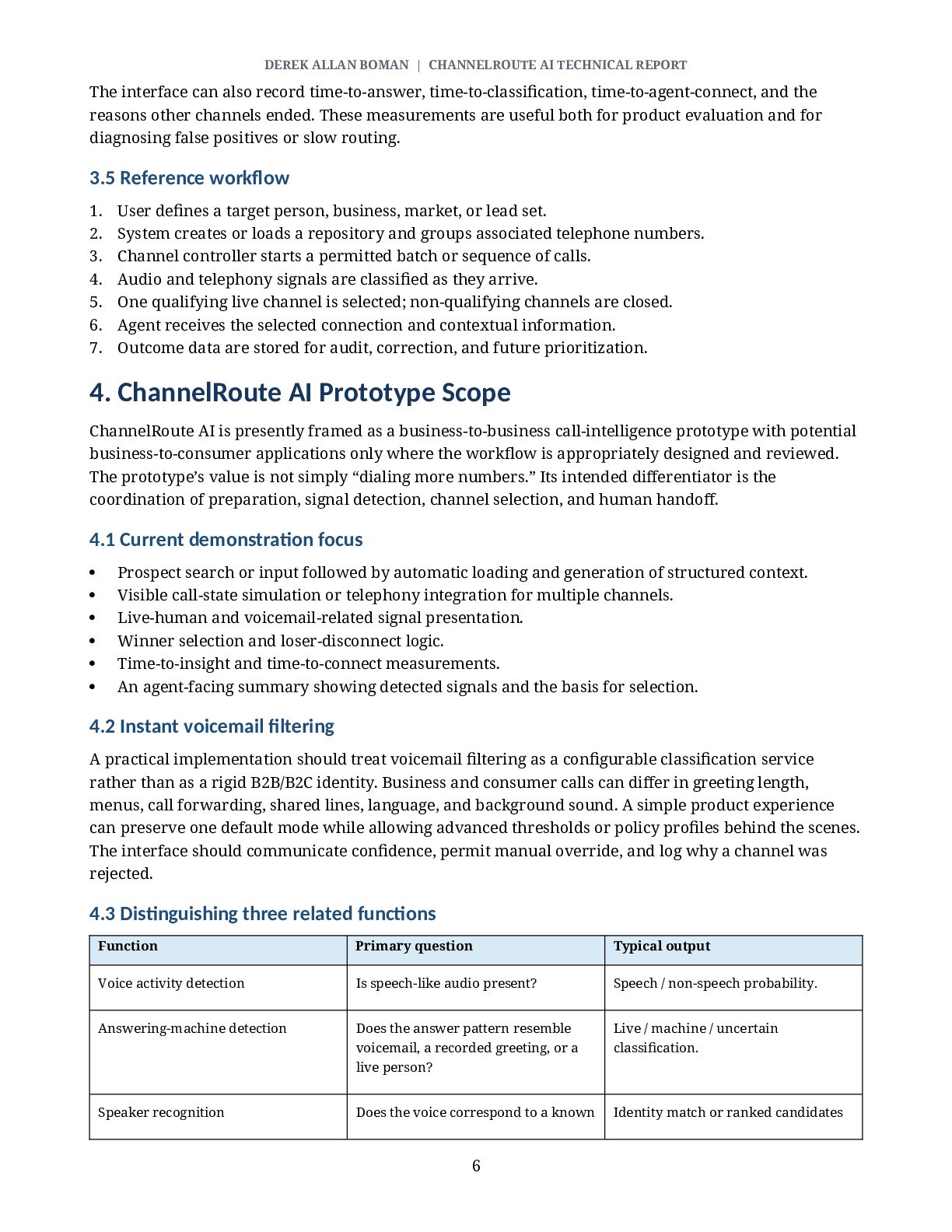
    interface can also record time-to-answer, time-to-classification, time-to-agent-connect, and the reasons other channels ended. These measurements are useful both for product evaluation and for diagnosing false positives or slow routing. 3.5 Reference workflow 1. User defines a target person, business, market, or lead set. 2. System creates or loads a repository and groups associated telephone numbers. 3. Channel controller starts a permitted batch or sequence of calls. 4. Audio and telephony signals are classified as they arrive. 5. One qualifying live channel is selected; non-qualifying channels are closed. 6. Agent receives the selected connection and contextual information. 7. Outcome data are stored for audit, correction, and future prioritization. 4. ChannelRoute AI Prototype Scope ChannelRoute AI is presently framed as a business-to-business call-intelligence prototype with potential business-to-consumer applications only where the workflow is appropriately designed and reviewed. The prototype’s value is not simply “dialing more numbers.” Its intended differentiator is the coordination of preparation, signal detection, channel selection, and human handoff. 4.1 Current demonstration focus  Prospect search or input followed by automatic loading and generation of structured context.  Visible call-state simulation or telephony integration for multiple channels.  Live-human and voicemail-related signal presentation.  Winner selection and loser-disconnect logic.  Time-to-insight and time-to-connect measurements.  An agent-facing summary showing detected signals and the basis for selection. 4.2 Instant voicemail filtering A practical implementation should treat voicemail filtering as a configurable classification service rather than as a rigid B2B/B2C identity. Business and consumer calls can differ in greeting length, menus, call forwarding, shared lines, language, and background sound. A simple product experience can preserve one default mode while allowing advanced thresholds or policy profiles behind the scenes. The interface should communicate confidence, permit manual override, and log why a channel was rejected. 4.3 Distinguishing three related functions Function Primary question Typical output Voice activity detection Is speech-like audio present? Speech / non-speech probability. Answering-machine detection Does the answer pattern resemble voicemail, a recorded greeting, or a live person? Live / machine / uncertain classification. Speaker recognition Does the voice correspond to a known Identity match or ranked candidates
  7. DEREK ALLAN BOMAN | CHANNELROUTE AI TECHNICAL REPORT 7 or

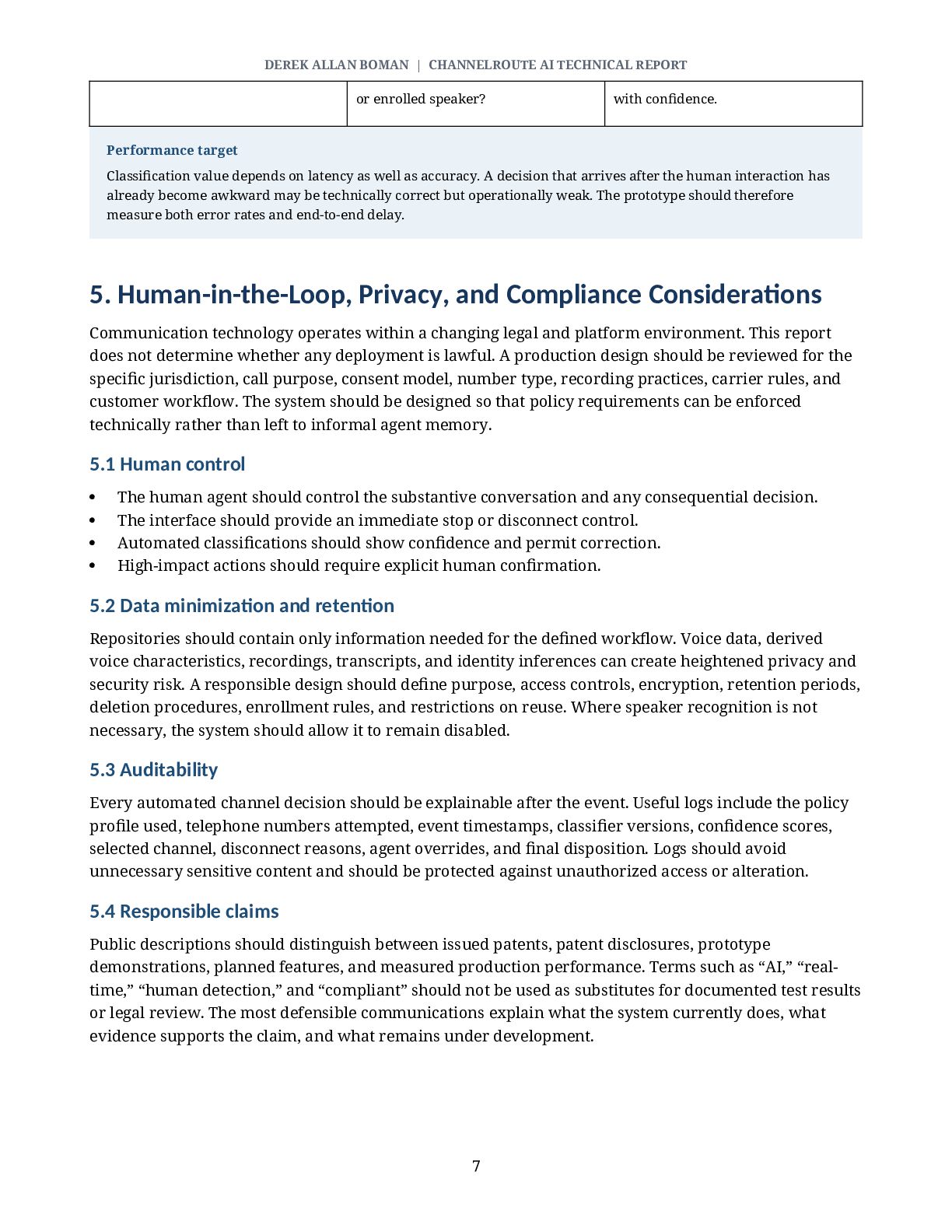
    enrolled speaker? with confidence. Performance target Classification value depends on latency as well as accuracy. A decision that arrives after the human interaction has already become awkward may be technically correct but operationally weak. The prototype should therefore measure both error rates and end-to-end delay. 5. Human-in-the-Loop, Privacy, and Compliance Considerations Communication technology operates within a changing legal and platform environment. This report does not determine whether any deployment is lawful. A production design should be reviewed for the specific jurisdiction, call purpose, consent model, number type, recording practices, carrier rules, and customer workflow. The system should be designed so that policy requirements can be enforced technically rather than left to informal agent memory. 5.1 Human control  The human agent should control the substantive conversation and any consequential decision.  The interface should provide an immediate stop or disconnect control.  Automated classifications should show confidence and permit correction.  High-impact actions should require explicit human confirmation. 5.2 Data minimization and retention Repositories should contain only information needed for the defined workflow. Voice data, derived voice characteristics, recordings, transcripts, and identity inferences can create heightened privacy and security risk. A responsible design should define purpose, access controls, encryption, retention periods, deletion procedures, enrollment rules, and restrictions on reuse. Where speaker recognition is not necessary, the system should allow it to remain disabled. 5.3 Auditability Every automated channel decision should be explainable after the event. Useful logs include the policy profile used, telephone numbers attempted, event timestamps, classifier versions, confidence scores, selected channel, disconnect reasons, agent overrides, and final disposition. Logs should avoid unnecessary sensitive content and should be protected against unauthorized access or alteration. 5.4 Responsible claims Public descriptions should distinguish between issued patents, patent disclosures, prototype demonstrations, planned features, and measured production performance. Terms such as “AI,” “real- time,” “human detection,” and “compliant” should not be used as substitutes for documented test results or legal review. The most defensible communications explain what the system currently does, what evidence supports the claim, and what remains under development.
  8. DEREK ALLAN BOMAN | CHANNELROUTE AI TECHNICAL REPORT 8 6.

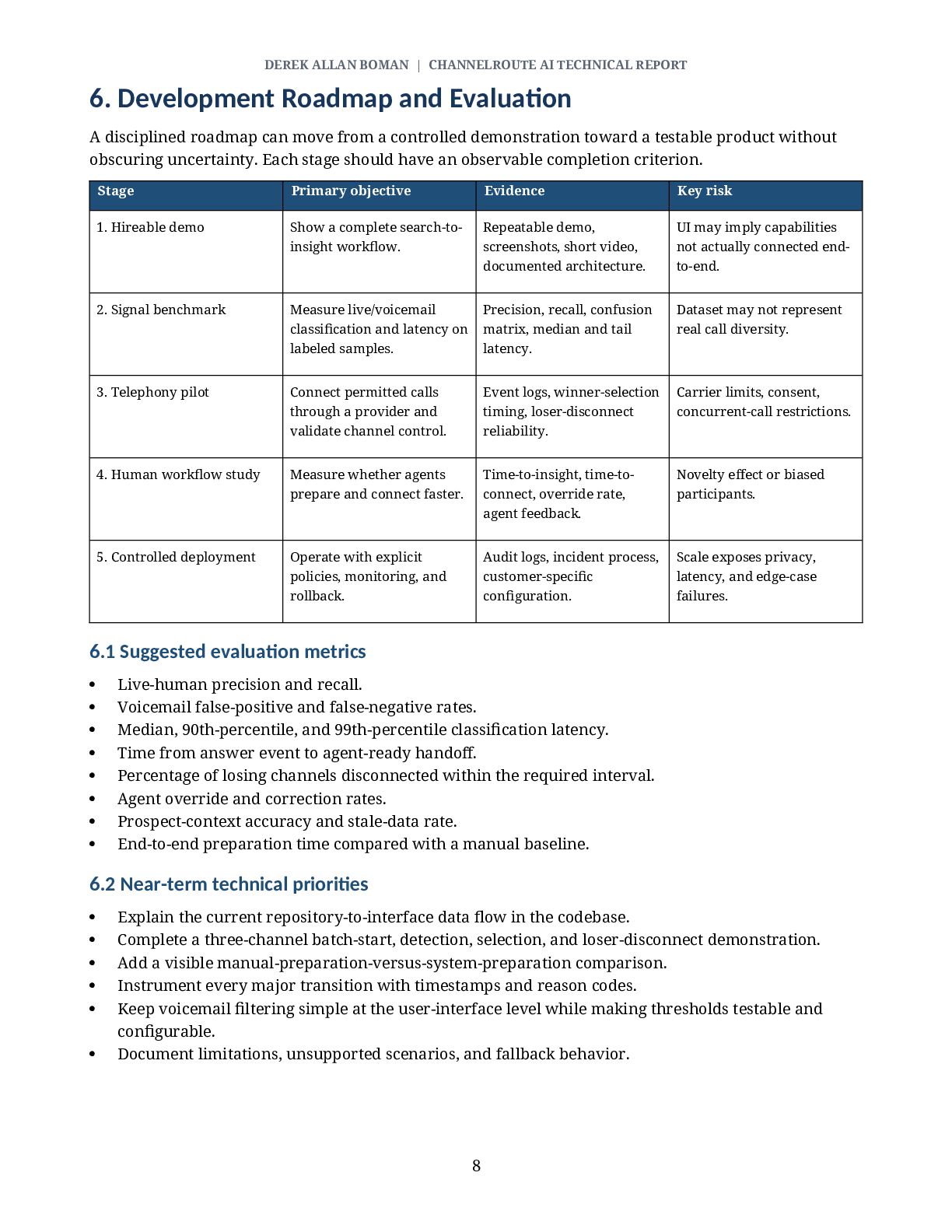
    Development Roadmap and Evaluation A disciplined roadmap can move from a controlled demonstration toward a testable product without obscuring uncertainty. Each stage should have an observable completion criterion. Stage Primary objective Evidence Key risk 1. Hireable demo Show a complete search-to- insight workflow. Repeatable demo, screenshots, short video, documented architecture. UI may imply capabilities not actually connected end- to-end. 2. Signal benchmark Measure live/voicemail classification and latency on labeled samples. Precision, recall, confusion matrix, median and tail latency. Dataset may not represent real call diversity. 3. Telephony pilot Connect permitted calls through a provider and validate channel control. Event logs, winner-selection timing, loser-disconnect reliability. Carrier limits, consent, concurrent-call restrictions. 4. Human workflow study Measure whether agents prepare and connect faster. Time-to-insight, time-to- connect, override rate, agent feedback. Novelty effect or biased participants. 5. Controlled deployment Operate with explicit policies, monitoring, and rollback. Audit logs, incident process, customer-specific configuration. Scale exposes privacy, latency, and edge-case failures. 6.1 Suggested evaluation metrics  Live-human precision and recall.  Voicemail false-positive and false-negative rates.  Median, 90th-percentile, and 99th-percentile classification latency.  Time from answer event to agent-ready handoff.  Percentage of losing channels disconnected within the required interval.  Agent override and correction rates.  Prospect-context accuracy and stale-data rate.  End-to-end preparation time compared with a manual baseline. 6.2 Near-term technical priorities  Explain the current repository-to-interface data flow in the codebase.  Complete a three-channel batch-start, detection, selection, and loser-disconnect demonstration.  Add a visible manual-preparation-versus-system-preparation comparison.  Instrument every major transition with timestamps and reason codes.  Keep voicemail filtering simple at the user-interface level while making thresholds testable and configurable.  Document limitations, unsupported scenarios, and fallback behavior.
  9. DEREK ALLAN BOMAN | CHANNELROUTE AI TECHNICAL REPORT 9 7.

    Conclusion The Boman patent family provides a coherent technical foundation for systems that combine prospect repositories, multiple softphones or channels, call-data analysis, voice-related classification, and human-agent presentation. US11438456B2 emphasizes computer-implemented methods, while US12231601B2 adds device-oriented claims. ChannelRoute AI is an effort to translate selected concepts into a demonstrable and measurable workflow. The most important next step is evidence. A credible prototype should show not only that a channel can be classified, but that the classification arrives quickly, the correct channel is preserved, the other channels are closed reliably, the agent receives useful context, and the system remains understandable and controllable. Those measurements will determine whether the technology improves real outbound work and will provide a stronger basis for product, licensing, and research discussions. References 1. Derek Allan Boman, “Techniques for Managing Softphone Repositories and Establishing Communication Channels,” U.S. Patent US11438456B2, issued Sept. 6, 2022. https://patents.google.com/patent/US11438456B2/en 2. Derek Allan Boman, “Techniques for Managing Softphone Repositories and Establishing Communication Channels,” U.S. Patent US12231601B2, issued Feb. 18, 2025. https://patents.google.com/patent/US12231601B2/en 3. ChannelRoute AI / CallSignal prototype repository. https://github.com/derekallanboman/callsignal-ai- call-intelligence 4. Derek Allan Boman - inventor and software-development portfolio. https://www.derekallanboman.com/ Author Note Derek Allan Boman is the named inventor of U.S. Patents US11438456B2 and US12231601B2 and is developing ChannelRoute AI, a prototype focused on call intelligence, communication-channel management, live-human detection, and agent preparation. This report is intended for technical communication and public archival use.