Upgrade to Pro — share decks privately, control downloads, hide ads and more …

Progress of Merchant Banking in India

Progress of Merchant Banking in India

This presentation provides a detailed overview of the evolution and progress of merchant banking in India. It traces the development of merchant banking from its early stages to the modern capital-market environment and explains the changing role of merchant bankers in corporate finance.

The presentation highlights the historical development of merchant banking, major milestones, regulatory framework, issue management, underwriting, project advisory, corporate advisory, mergers and acquisitions, private placement, technology and emerging trends.

Avatar for Dr D Divya

Dr D Divya

October 04, 2026

Other Decks in Education

Transcript

  1. PROGRESS OF MERCHANT BANKING IN INDIA Dr D Divya Assistant

    Professor Department of MBA Sri Ramakrishna College of Arts & Science Coimbatore
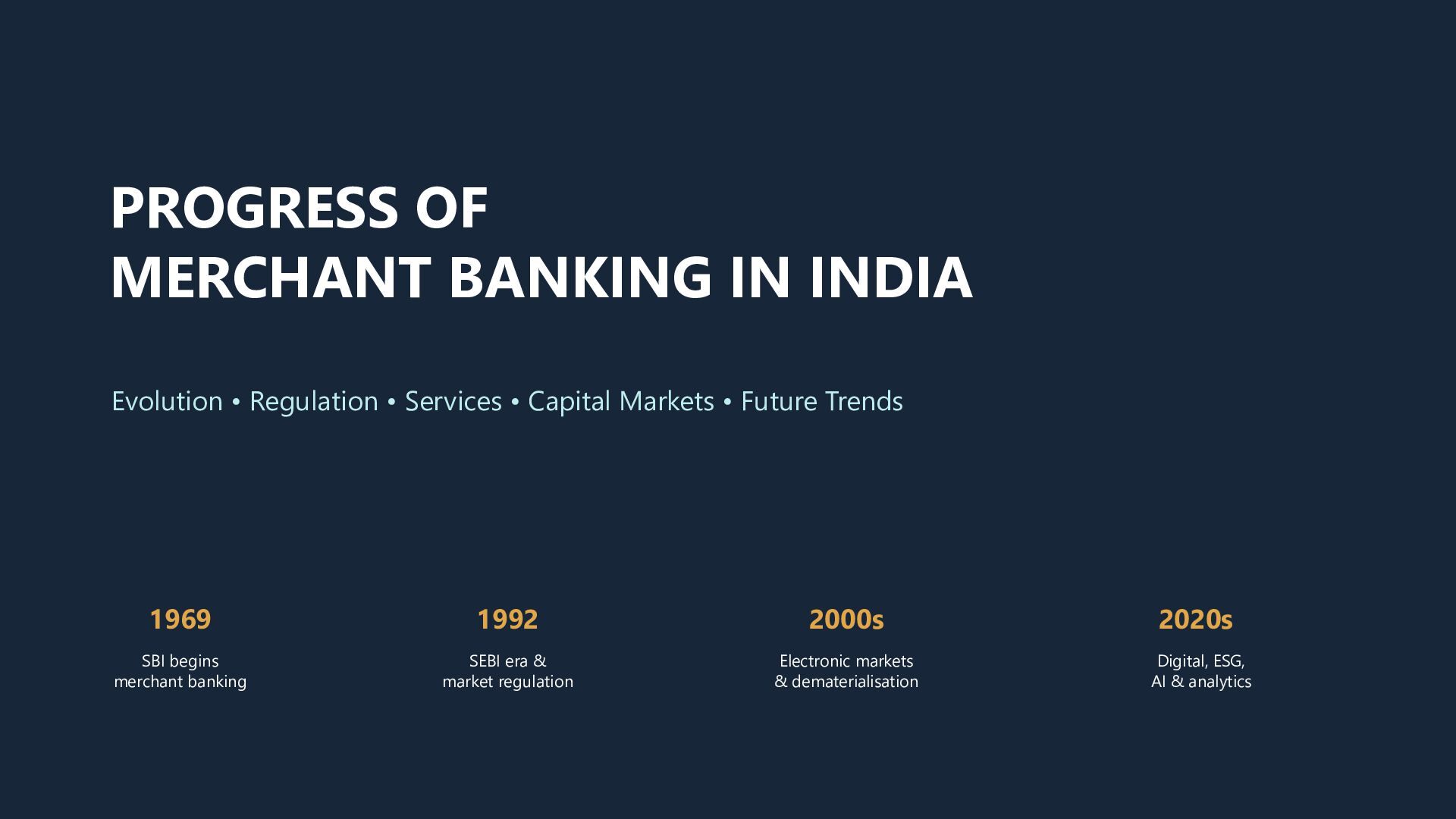
  2. PROGRESS OF MERCHANT BANKING IN INDIA Evolution • Regulation •

    Services • Capital Markets • Future Trends 1969 1992 2000s 2020s SBI begins merchant banking SEBI era & market regulation Electronic markets & dematerialisation Digital, ESG, AI & analytics
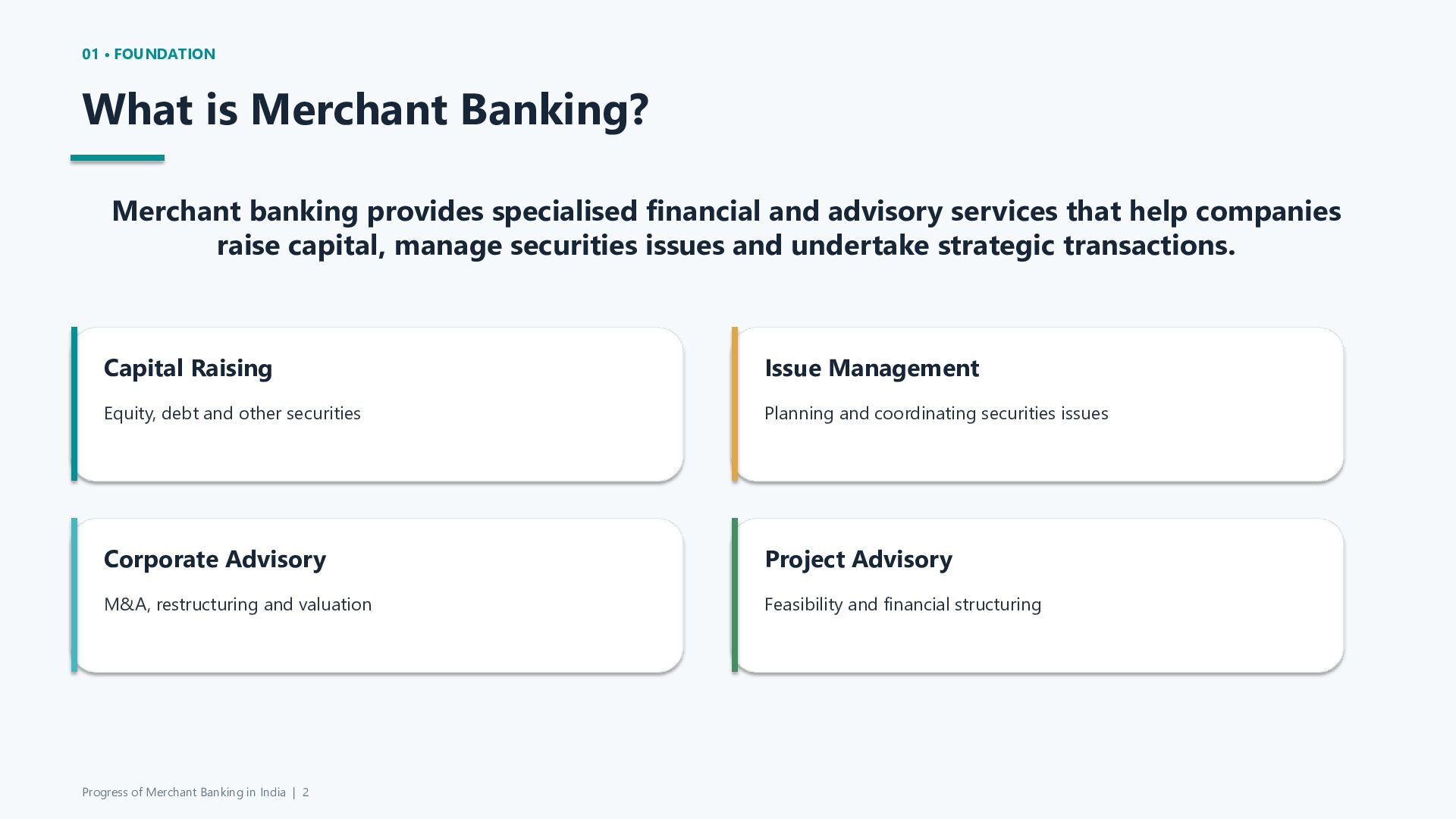
  3. 01 • FOUNDATION What is Merchant Banking? Merchant banking provides

    specialised financial and advisory services that help companies raise capital, manage securities issues and undertake strategic transactions. Capital Raising Issue Management Equity, debt and other securities Planning and coordinating securities issues Corporate Advisory Project Advisory M&A, restructuring and valuation Feasibility and financial structuring Progress of Merchant Banking in India | 2
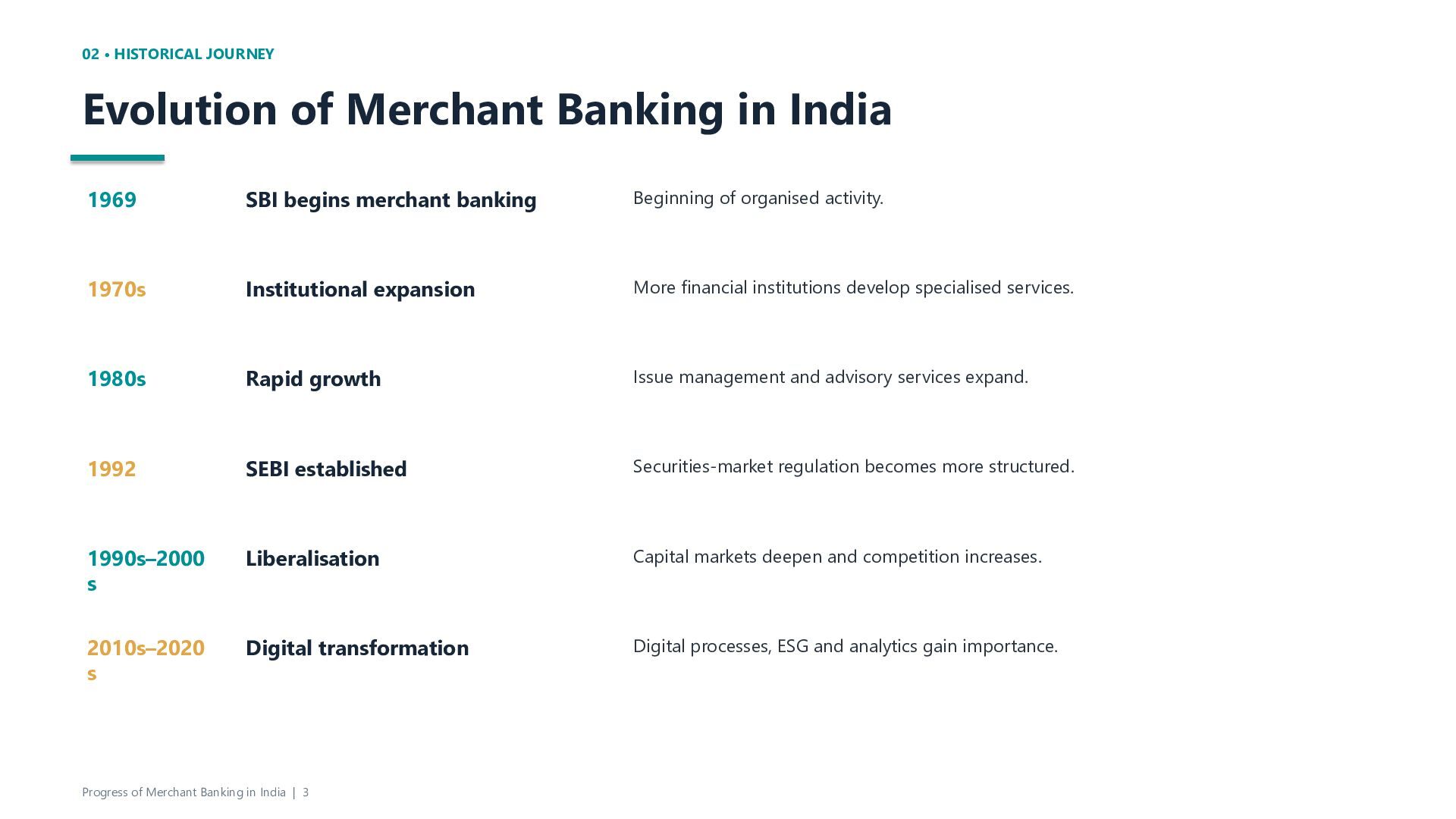
  4. 02 • HISTORICAL JOURNEY Evolution of Merchant Banking in India

    1969 SBI begins merchant banking Beginning of organised activity. 1970s Institutional expansion More financial institutions develop specialised services. 1980s Rapid growth Issue management and advisory services expand. 1992 SEBI established Securities-market regulation becomes more structured. 1990s–2000 s Liberalisation Capital markets deepen and competition increases. 2010s–2020 s Digital transformation Digital processes, ESG and analytics gain importance. Progress of Merchant Banking in India | 3
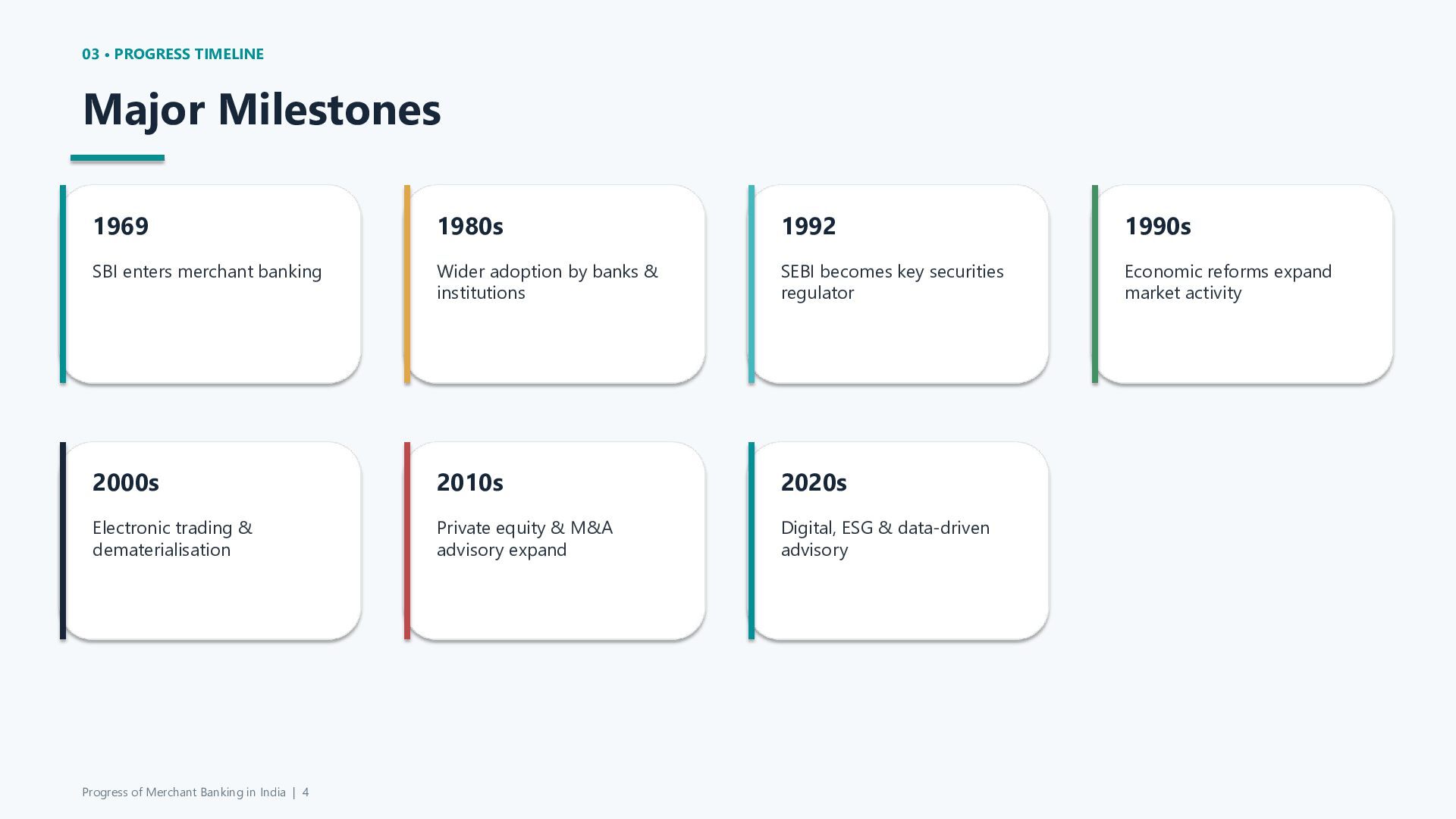
  5. 03 • PROGRESS TIMELINE Major Milestones 1969 1980s 1992 1990s

    SBI enters merchant banking Wider adoption by banks & institutions SEBI becomes key securities regulator Economic reforms expand market activity 2000s 2010s 2020s Electronic trading & dematerialisation Private equity & M&A advisory expand Digital, ESG & data-driven advisory Progress of Merchant Banking in India | 4
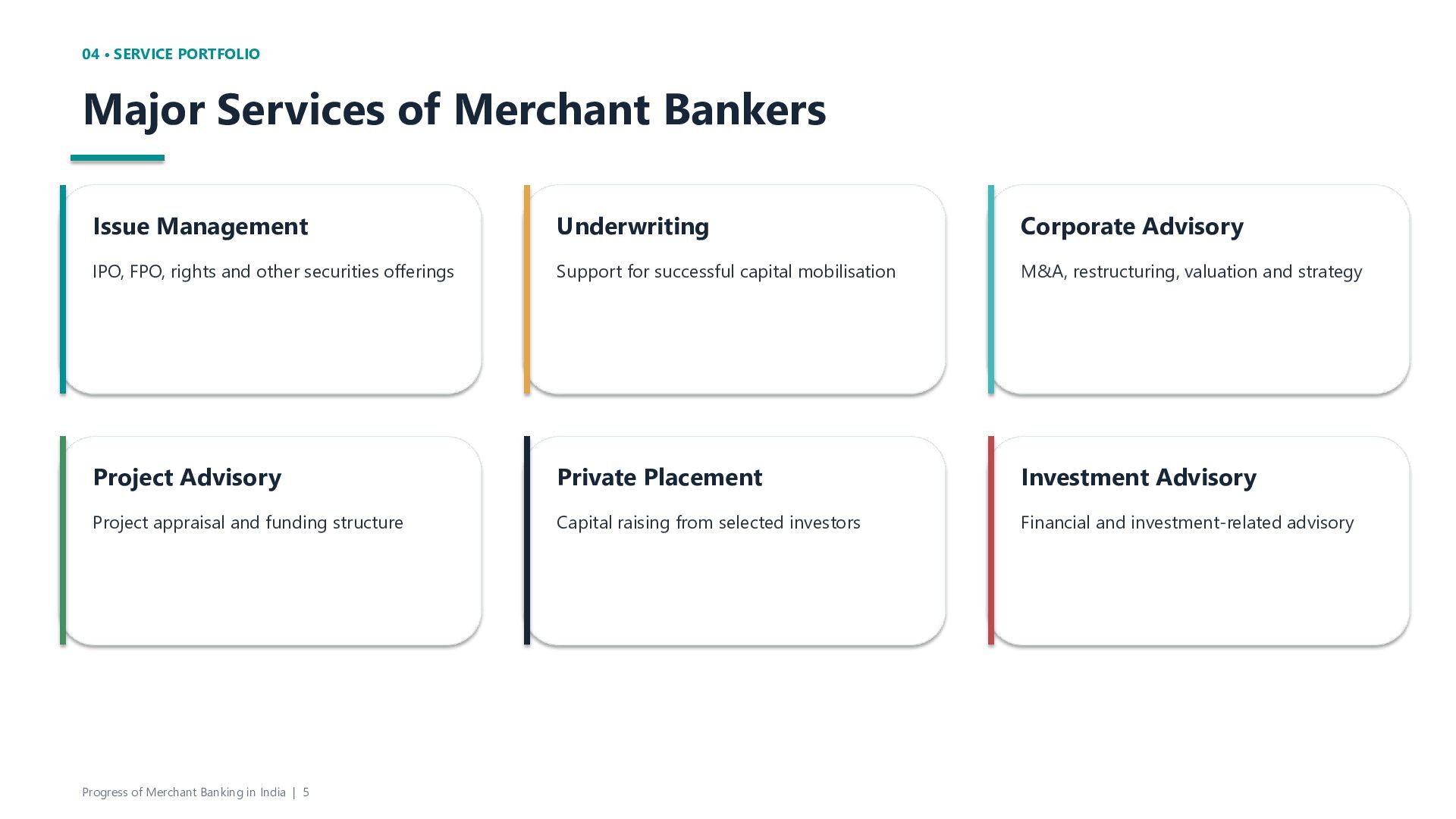
  6. 04 • SERVICE PORTFOLIO Major Services of Merchant Bankers Issue

    Management Underwriting Corporate Advisory IPO, FPO, rights and other securities offerings Support for successful capital mobilisation M&A, restructuring, valuation and strategy Project Advisory Private Placement Investment Advisory Project appraisal and funding structure Capital raising from selected investors Financial and investment-related advisory Progress of Merchant Banking in India | 5
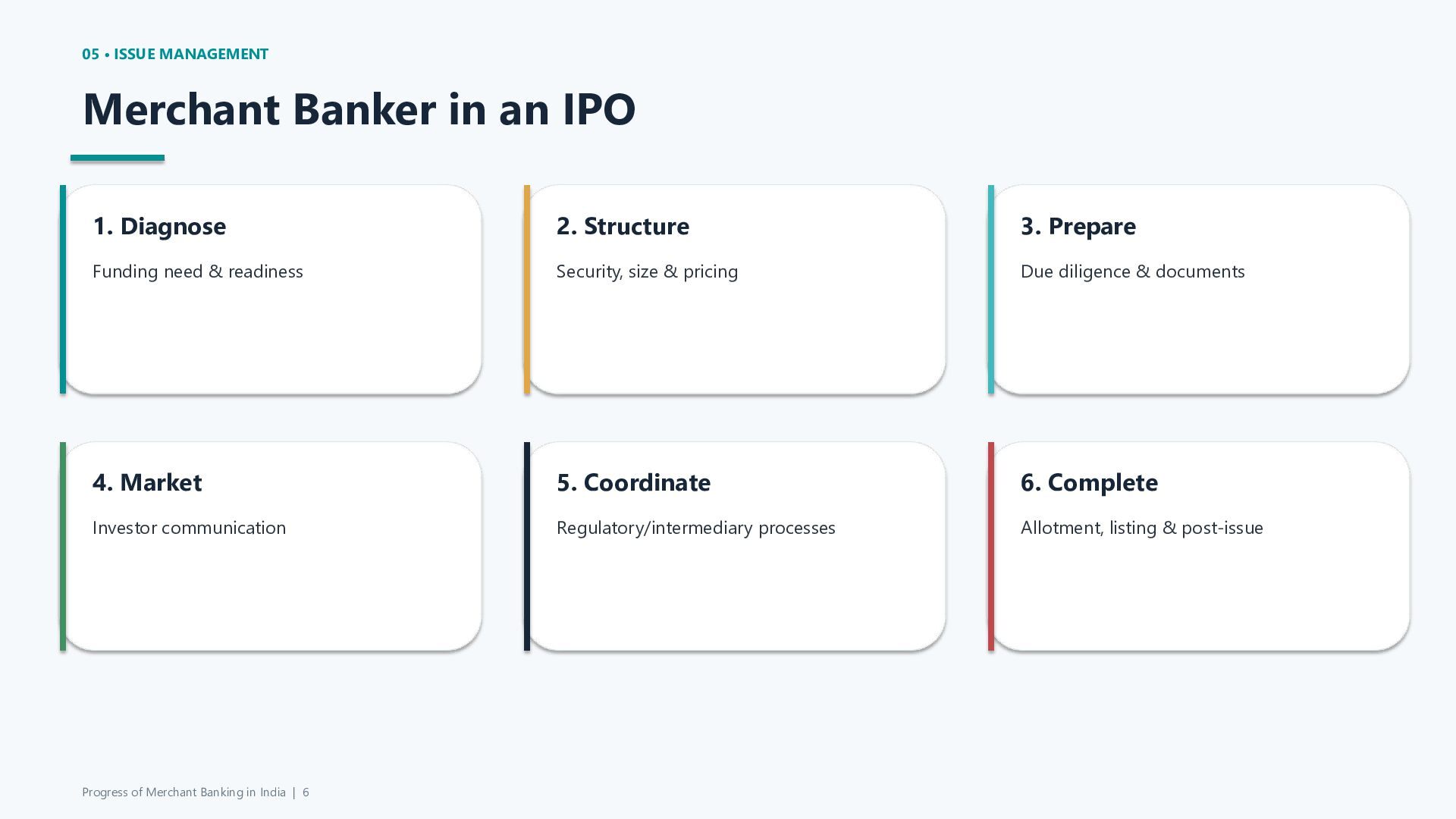
  7. 05 • ISSUE MANAGEMENT Merchant Banker in an IPO 1.

    Diagnose 2. Structure 3. Prepare Funding need & readiness Security, size & pricing Due diligence & documents 4. Market 5. Coordinate 6. Complete Investor communication Regulatory/intermediary processes Allotment, listing & post-issue Progress of Merchant Banking in India | 6
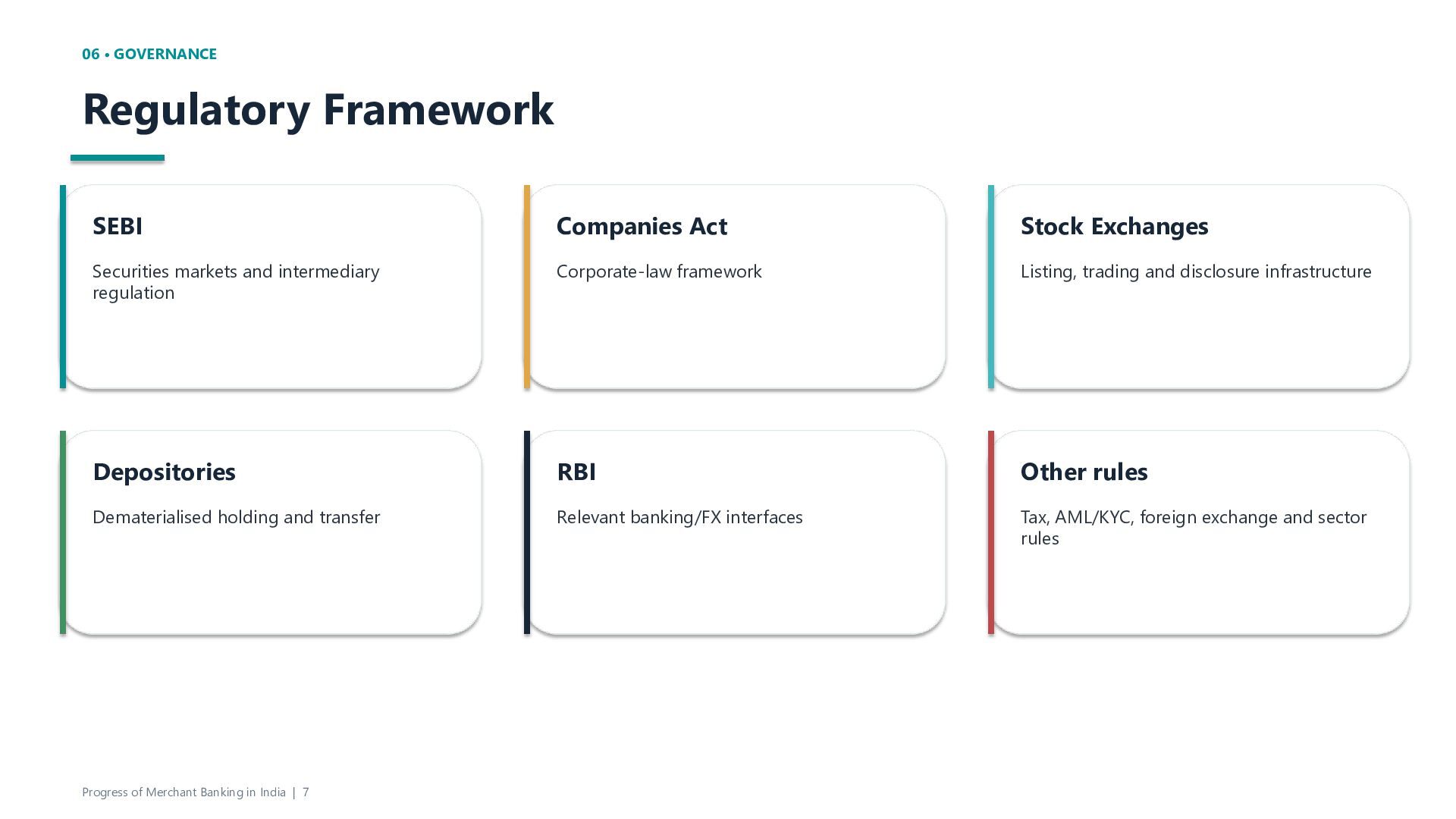
  8. 06 • GOVERNANCE Regulatory Framework SEBI Companies Act Stock Exchanges

    Securities markets and intermediary regulation Corporate-law framework Listing, trading and disclosure infrastructure Depositories RBI Other rules Dematerialised holding and transfer Relevant banking/FX interfaces Tax, AML/KYC, foreign exchange and sector rules Progress of Merchant Banking in India | 7
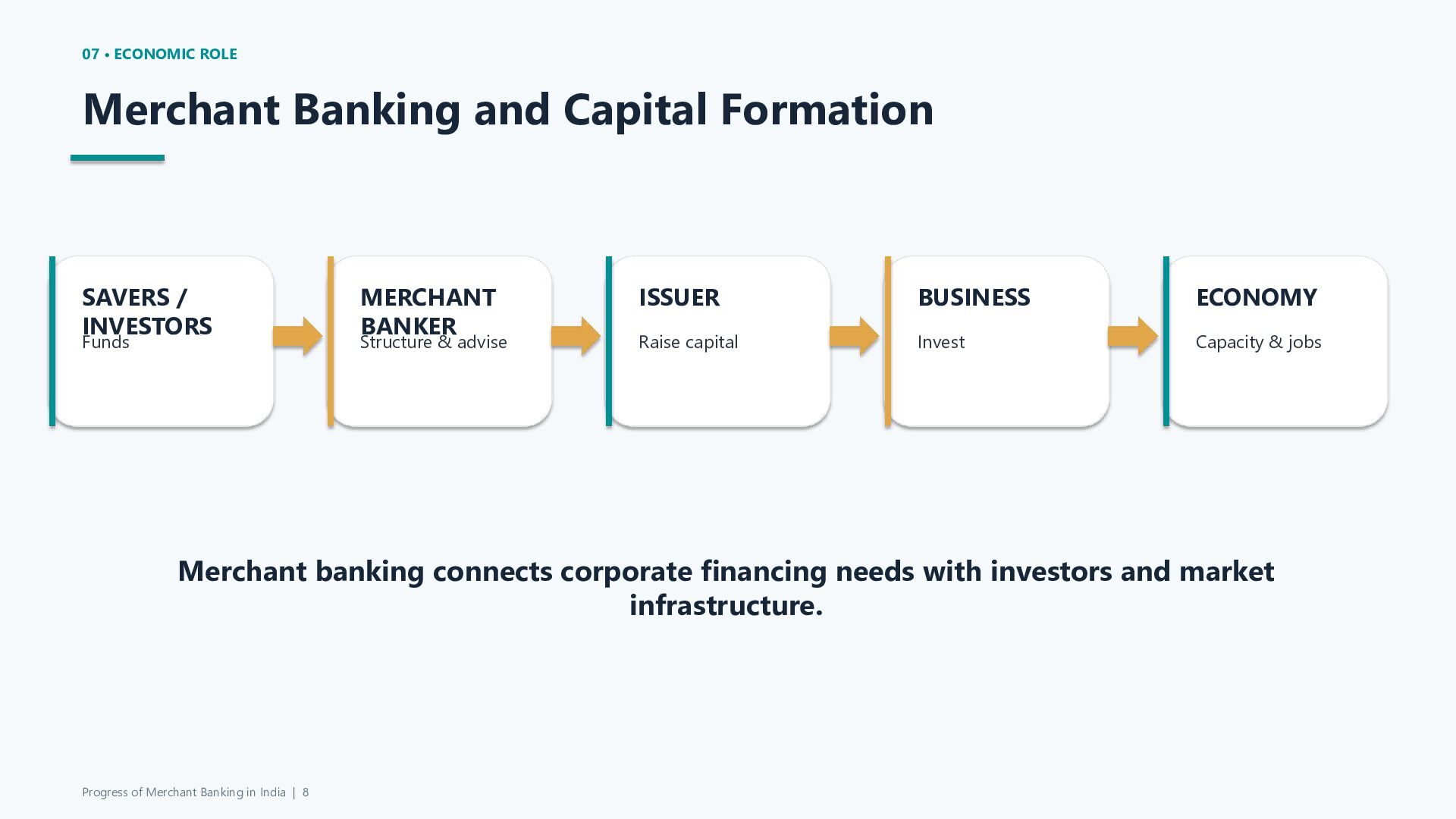
  9. 07 • ECONOMIC ROLE Merchant Banking and Capital Formation SAVERS

    / INVESTORS Funds MERCHANT BANKER Structure & advise ISSUER BUSINESS ECONOMY Raise capital Invest Capacity & jobs Merchant banking connects corporate financing needs with investors and market infrastructure. Progress of Merchant Banking in India | 8
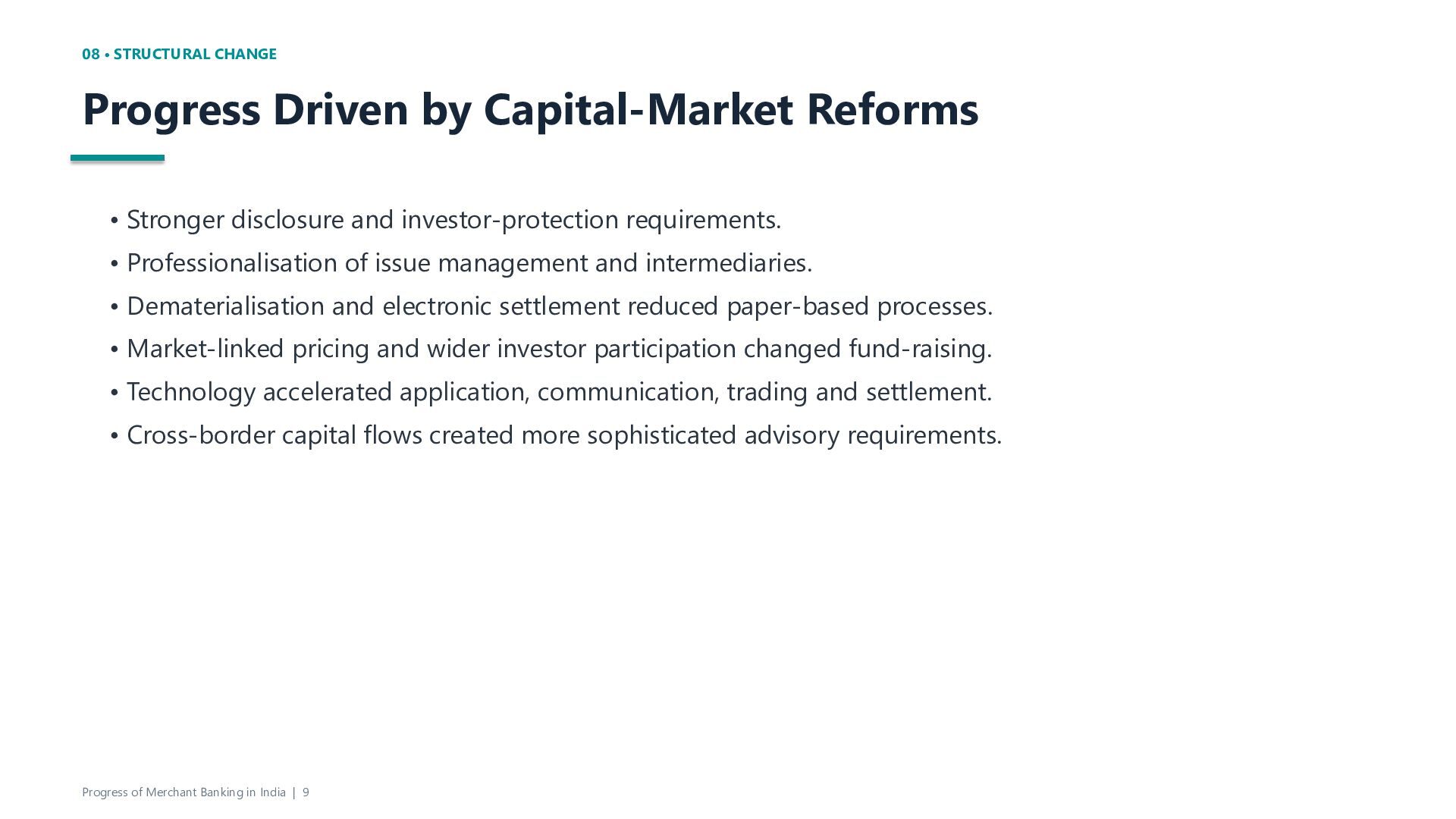
  10. 08 • STRUCTURAL CHANGE Progress Driven by Capital-Market Reforms •

    Stronger disclosure and investor-protection requirements. • Professionalisation of issue management and intermediaries. • Dematerialisation and electronic settlement reduced paper-based processes. • Market-linked pricing and wider investor participation changed fund-raising. • Technology accelerated application, communication, trading and settlement. • Cross-border capital flows created more sophisticated advisory requirements. Progress of Merchant Banking in India | 9
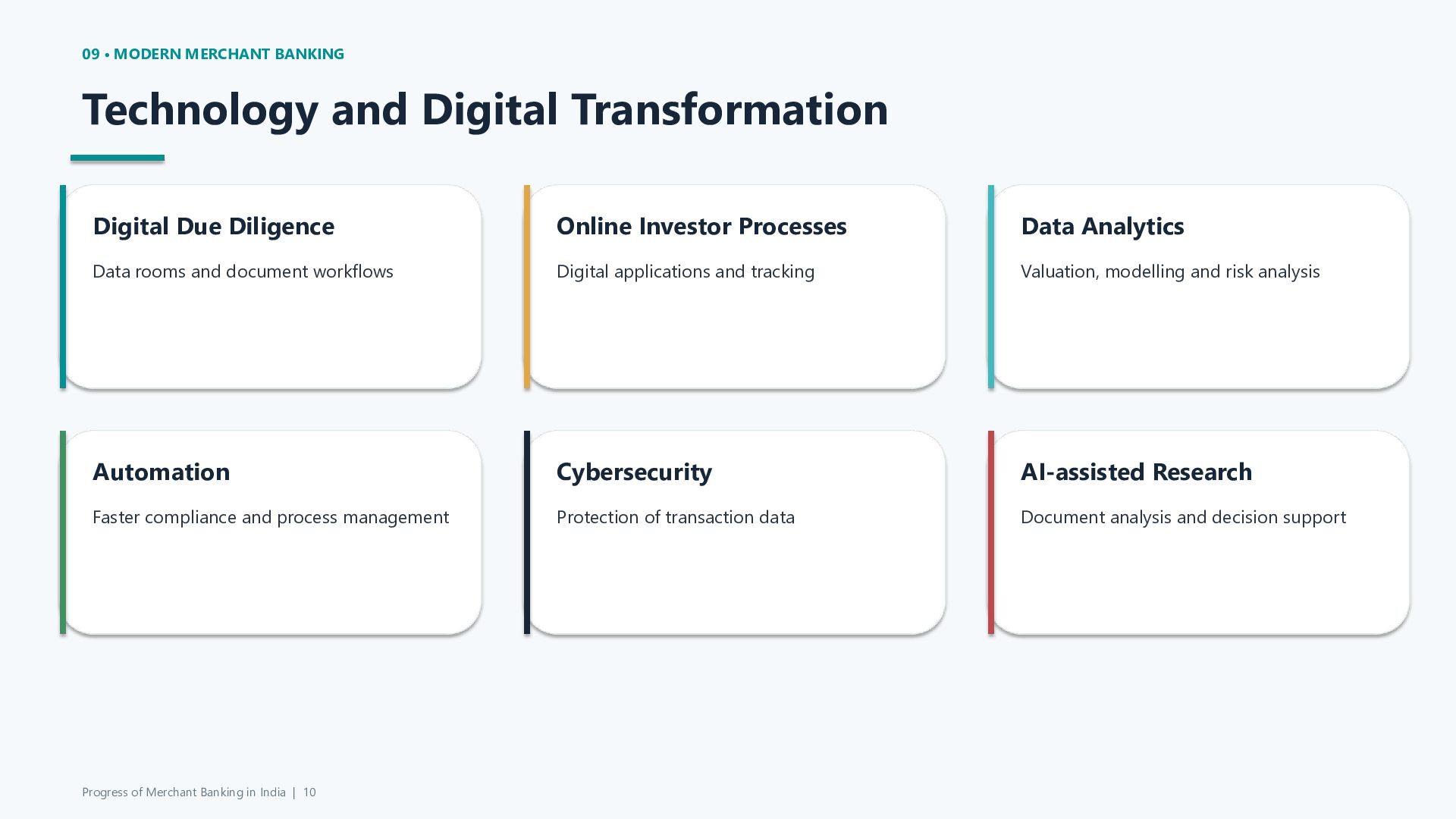
  11. 09 • MODERN MERCHANT BANKING Technology and Digital Transformation Digital

    Due Diligence Online Investor Processes Data Analytics Data rooms and document workflows Digital applications and tracking Valuation, modelling and risk analysis Automation Cybersecurity AI-assisted Research Faster compliance and process management Protection of transaction data Document analysis and decision support Progress of Merchant Banking in India | 10
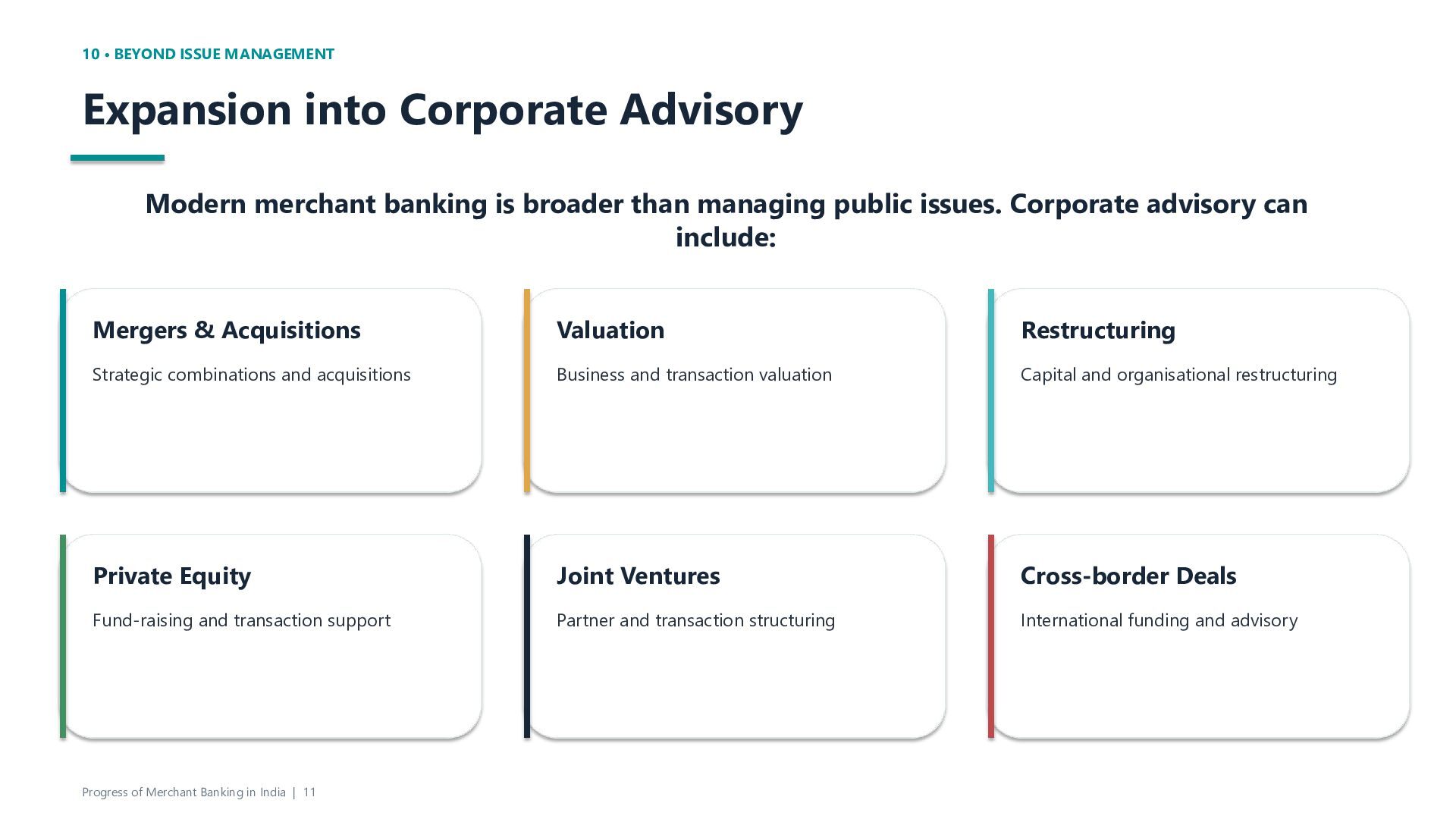
  12. 10 • BEYOND ISSUE MANAGEMENT Expansion into Corporate Advisory Modern

    merchant banking is broader than managing public issues. Corporate advisory can include: Mergers & Acquisitions Valuation Restructuring Strategic combinations and acquisitions Business and transaction valuation Capital and organisational restructuring Private Equity Joint Ventures Cross-border Deals Fund-raising and transaction support Partner and transaction structuring International funding and advisory Progress of Merchant Banking in India | 11
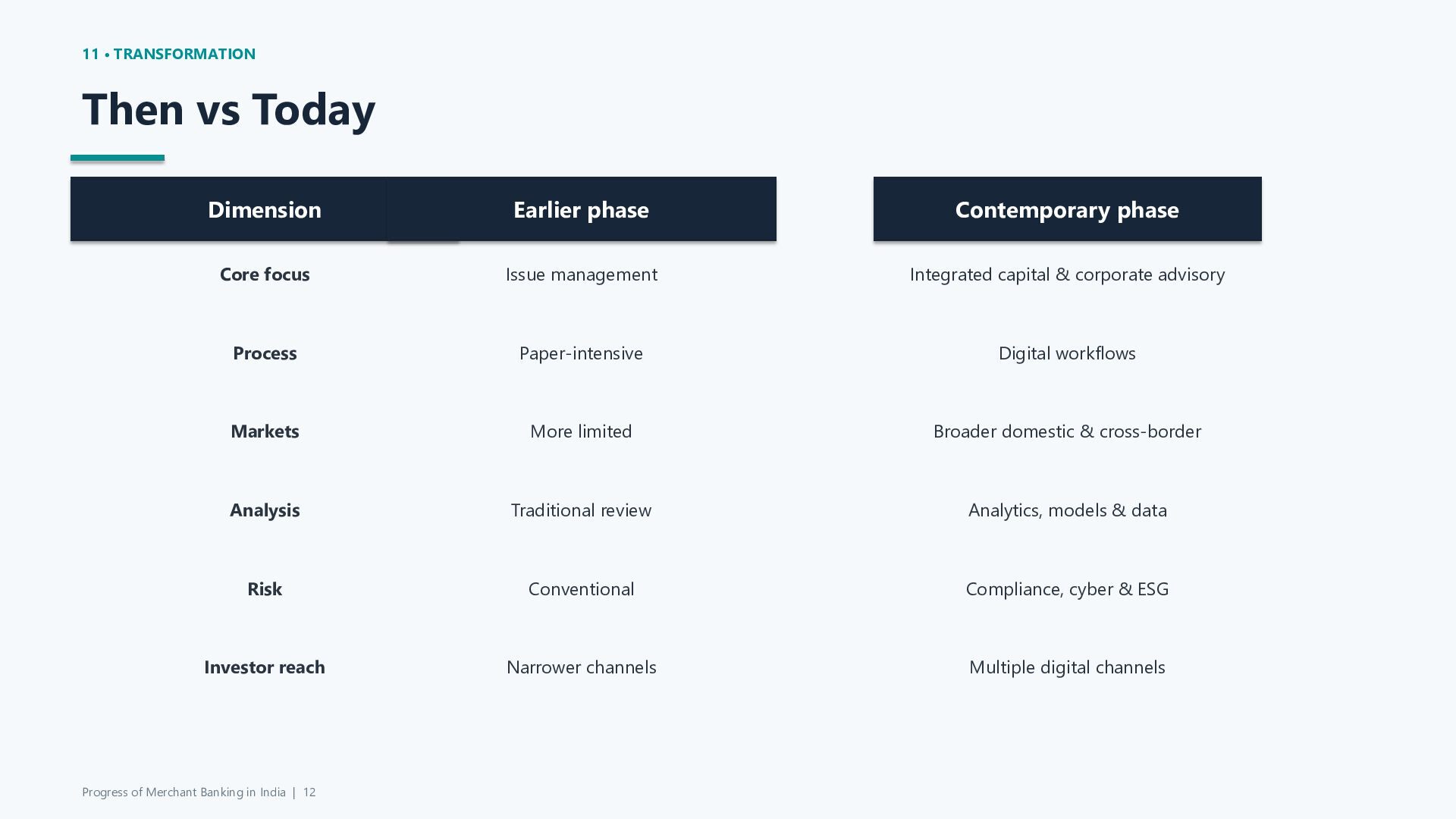
  13. 11 • TRANSFORMATION Then vs Today Dimension Earlier phase Contemporary

    phase Core focus Issue management Integrated capital & corporate advisory Process Paper-intensive Digital workflows Markets More limited Broader domestic & cross-border Analysis Traditional review Analytics, models & data Risk Conventional Compliance, cyber & ESG Investor reach Narrower channels Multiple digital channels Progress of Merchant Banking in India | 12
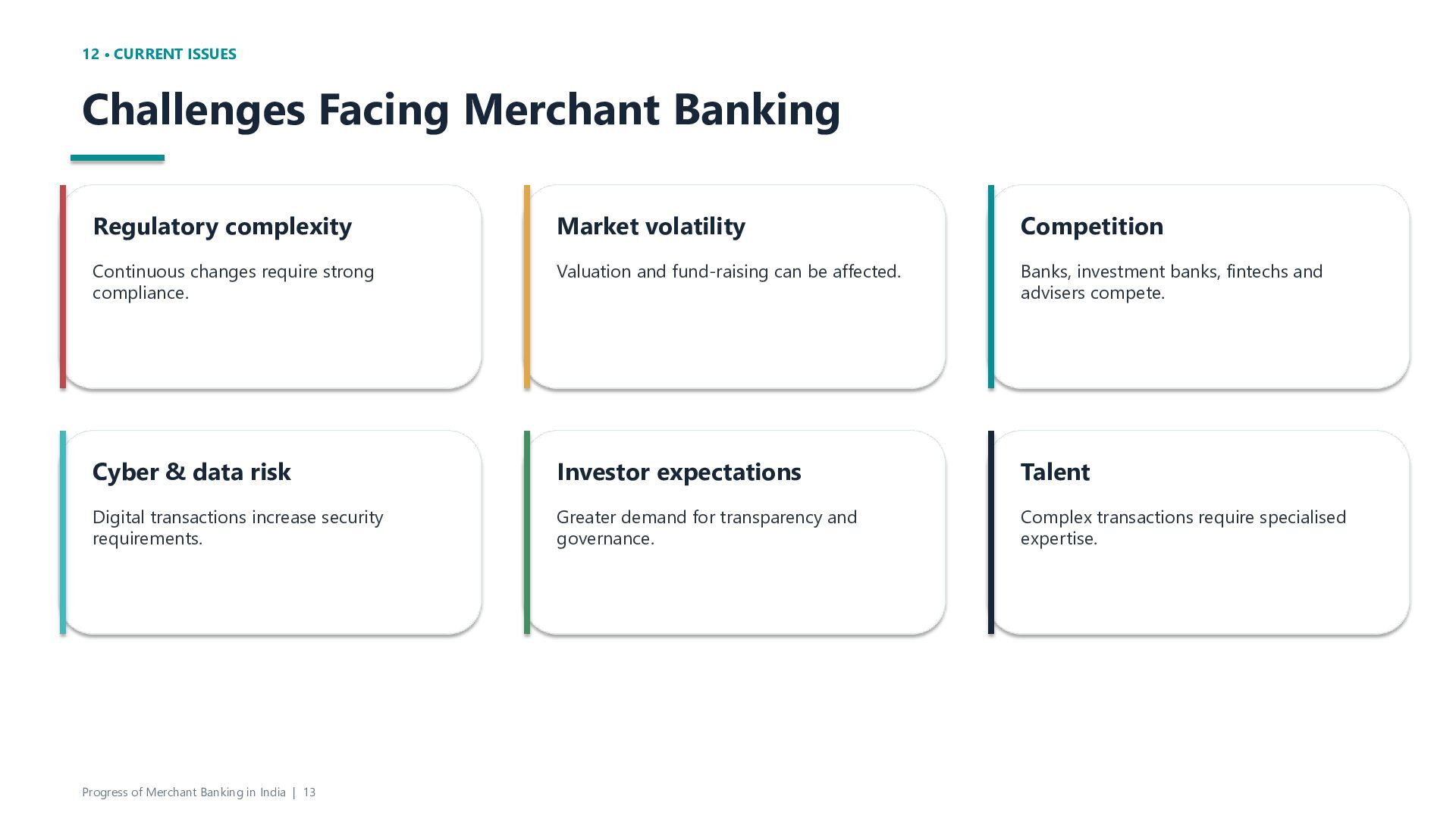
  14. 12 • CURRENT ISSUES Challenges Facing Merchant Banking Regulatory complexity

    Market volatility Competition Continuous changes require strong compliance. Valuation and fund-raising can be affected. Banks, investment banks, fintechs and advisers compete. Cyber & data risk Investor expectations Talent Digital transactions increase security requirements. Greater demand for transparency and governance. Complex transactions require specialised expertise. Progress of Merchant Banking in India | 13
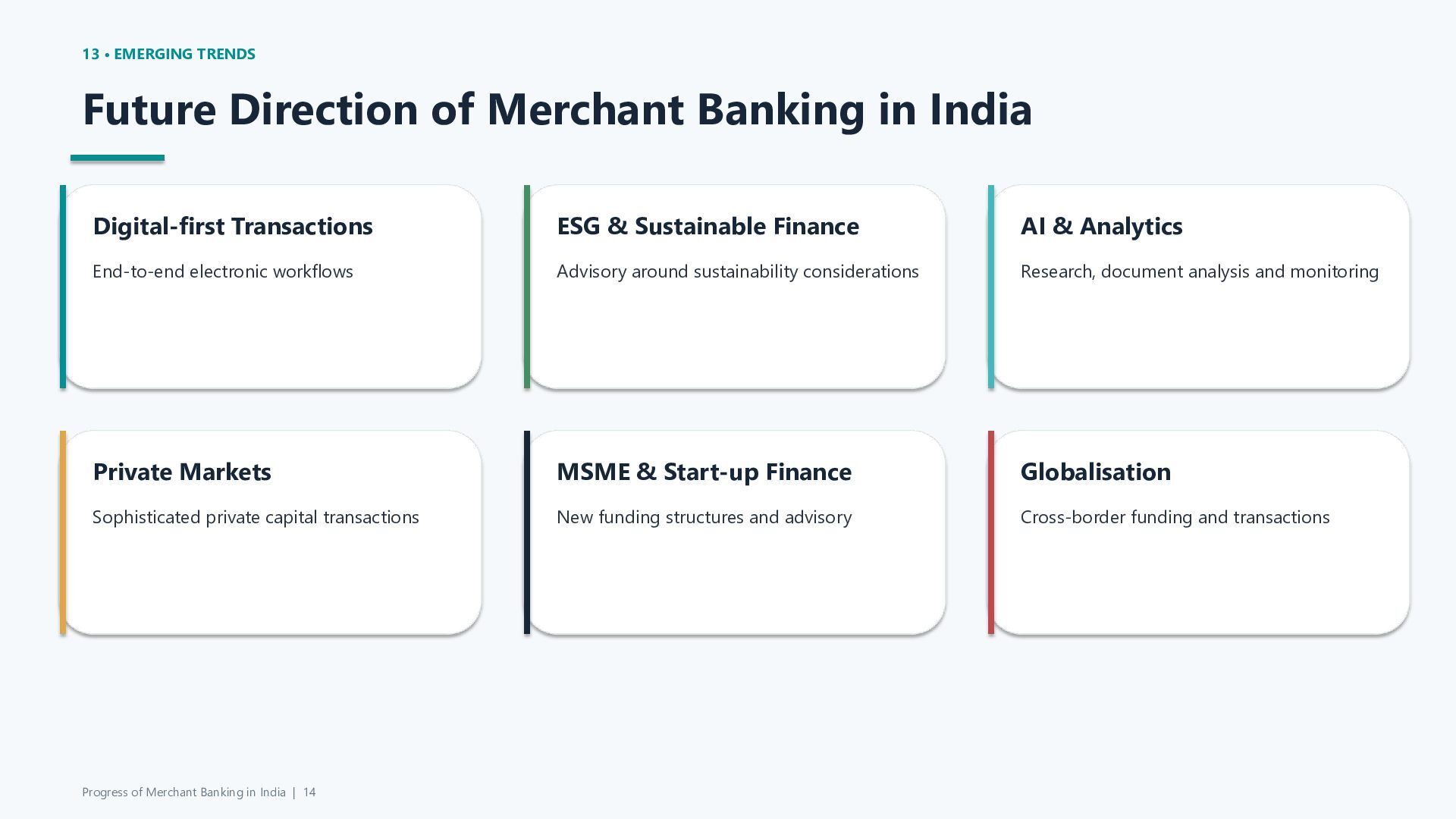
  15. 13 • EMERGING TRENDS Future Direction of Merchant Banking in

    India Digital-first Transactions ESG & Sustainable Finance AI & Analytics End-to-end electronic workflows Advisory around sustainability considerations Research, document analysis and monitoring Private Markets MSME & Start-up Finance Globalisation Sophisticated private capital transactions New funding structures and advisory Cross-border funding and transactions Progress of Merchant Banking in India | 14
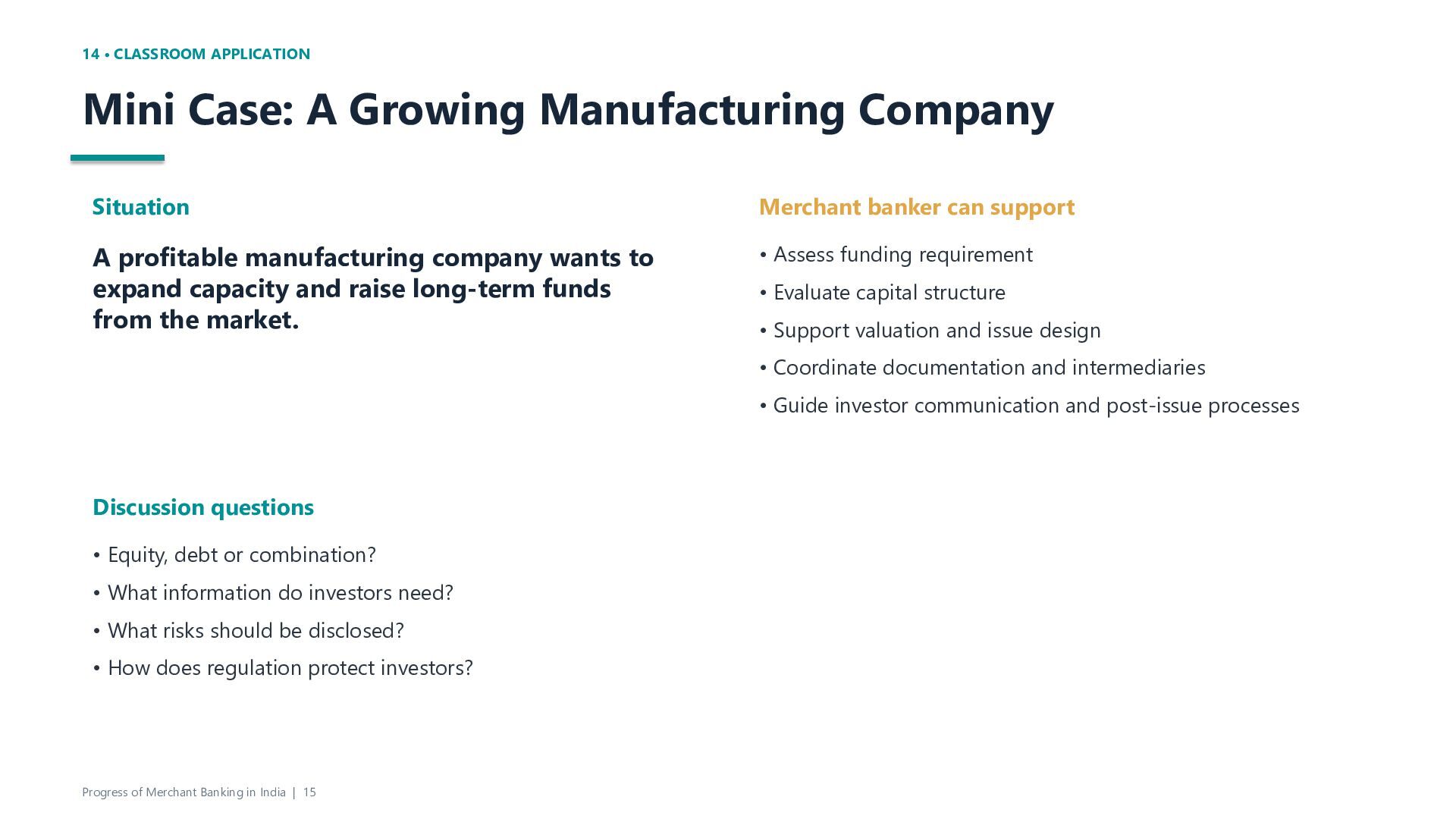
  16. 14 • CLASSROOM APPLICATION Mini Case: A Growing Manufacturing Company

    Situation Merchant banker can support A profitable manufacturing company wants to expand capacity and raise long-term funds from the market. • Assess funding requirement • Evaluate capital structure • Support valuation and issue design • Coordinate documentation and intermediaries • Guide investor communication and post-issue processes Discussion questions • Equity, debt or combination? • What information do investors need? • What risks should be disclosed? • How does regulation protect investors? Progress of Merchant Banking in India | 15
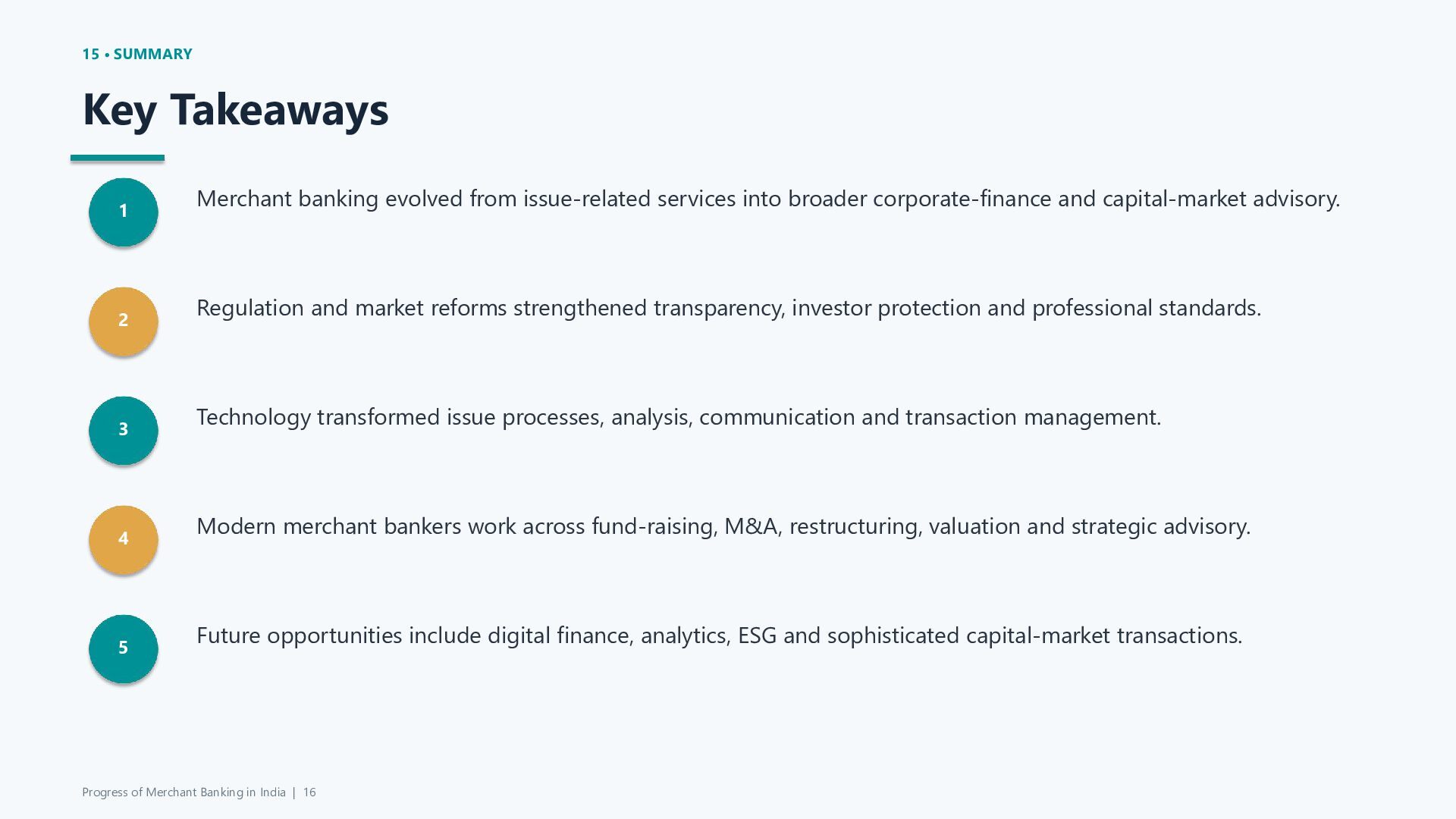
  17. 15 • SUMMARY Key Takeaways 1 2 3 4 5

    Merchant banking evolved from issue-related services into broader corporate-finance and capital-market advisory. Regulation and market reforms strengthened transparency, investor protection and professional standards. Technology transformed issue processes, analysis, communication and transaction management. Modern merchant bankers work across fund-raising, M&A, restructuring, valuation and strategic advisory. Future opportunities include digital finance, analytics, ESG and sophisticated capital-market transactions. Progress of Merchant Banking in India | 16
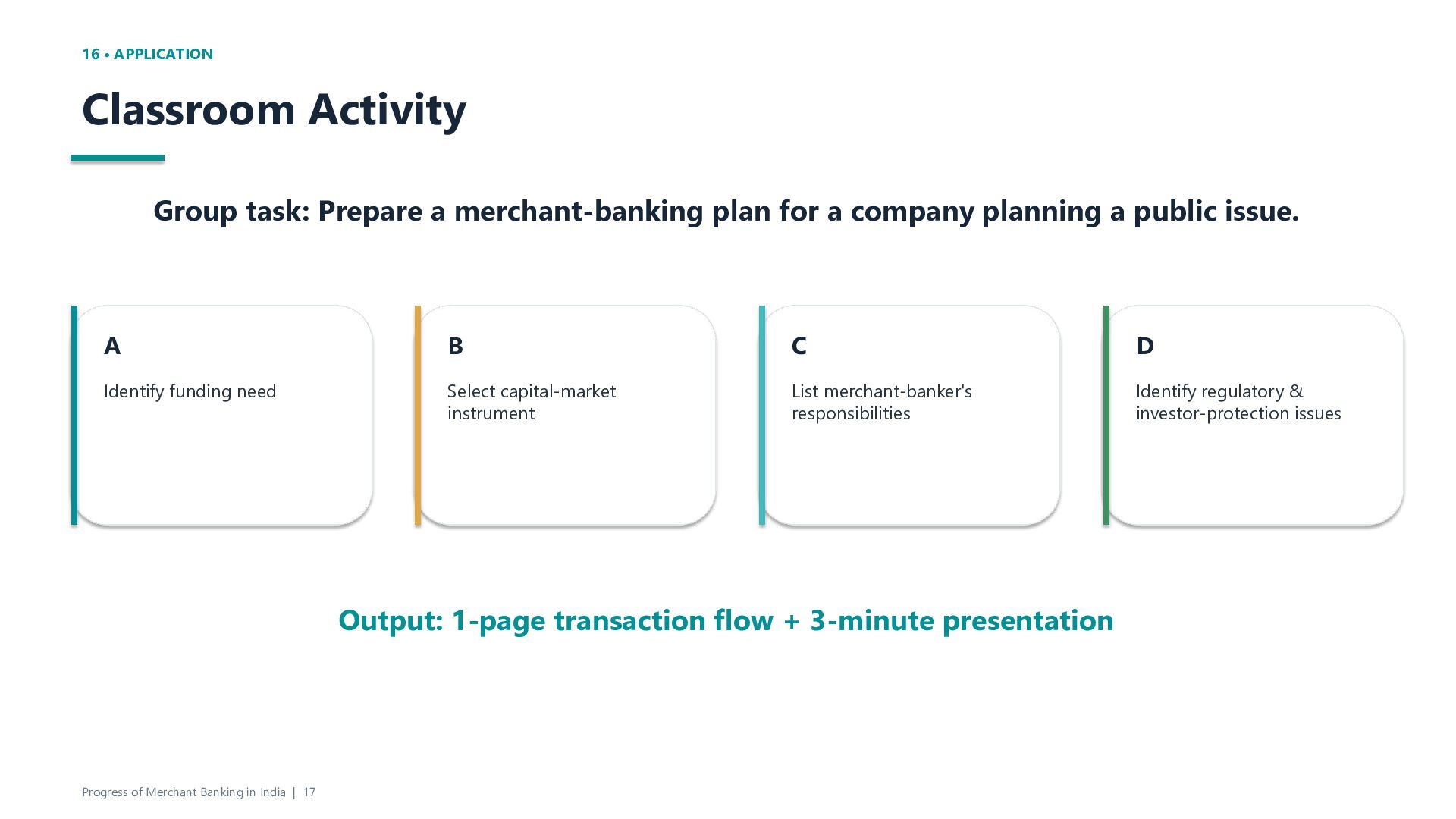
  18. 16 • APPLICATION Classroom Activity Group task: Prepare a merchant-banking

    plan for a company planning a public issue. A B C D Identify funding need Select capital-market instrument List merchant-banker's responsibilities Identify regulatory & investor-protection issues Output: 1-page transaction flow + 3-minute presentation Progress of Merchant Banking in India | 17
  19. 17 • FURTHER READING Suggested References • SEBI – official

    resources on merchant bankers, issue management and securities markets. • Reserve Bank of India – banking, financial-market and regulatory resources. • Ministry of Corporate Affairs – Companies Act and corporate regulatory framework. • Stock exchanges and depositories – listing, disclosure and securities-market infrastructure. • Standard texts on Financial Services, Merchant Banking and Investment Banking. • Use current SEBI regulations and official circulars when teaching regulatory provisions. Teaching note: regulatory provisions and market practices change over time; verify current official requirements before use. Progress of Merchant Banking in India | 18