Upgrade to Pro — share decks privately, control downloads, hide ads and more …

Liburd and Stoll Farrell "Copyright Essentials ...

Liburd and Stoll Farrell "Copyright Essentials From A to AI: A 2026 NISO Training Series, Session One: Foundations & Frameworks of Copyright"

This presentation was given by Willa Liburd, Legal Knowledge Management Consultant and Scholarly Communication Professional, and Karen Stoll Farrell, Director, Scholarly Communication and Open Publishing Associate, both of Indiana University Bloomington for the initial session of the NISO training series "Copyright Essentials From A to AI." Session One, "Foundations & Frameworks of Copyright," was held October 1, 2026.

More Decks by National Information Standards Organization

Other Decks in Education

Transcript

  1. Course overview October 1: Foundations & Frameworks of Copyright October

    8: Fair Use and the Public Domain October 15: Exceptions for Libraries October 22: Copyright in Pop Culture and Digital Media October 29: Licensing & Market Power November 5: Open Movements & Author Rights November 12: Copyright & AI: Guest Speakers November 19: Practices and programs in your Organization
  2. Critical lens on Copyright What is being protected? Who benefits?

    Who is excluded? What assumptions does this system make?
  3. Today US Copyright Limitations Foundations: International copyright • Originality •

    Creativity • Idea/Expression Theories of copyright ACTIVITIES
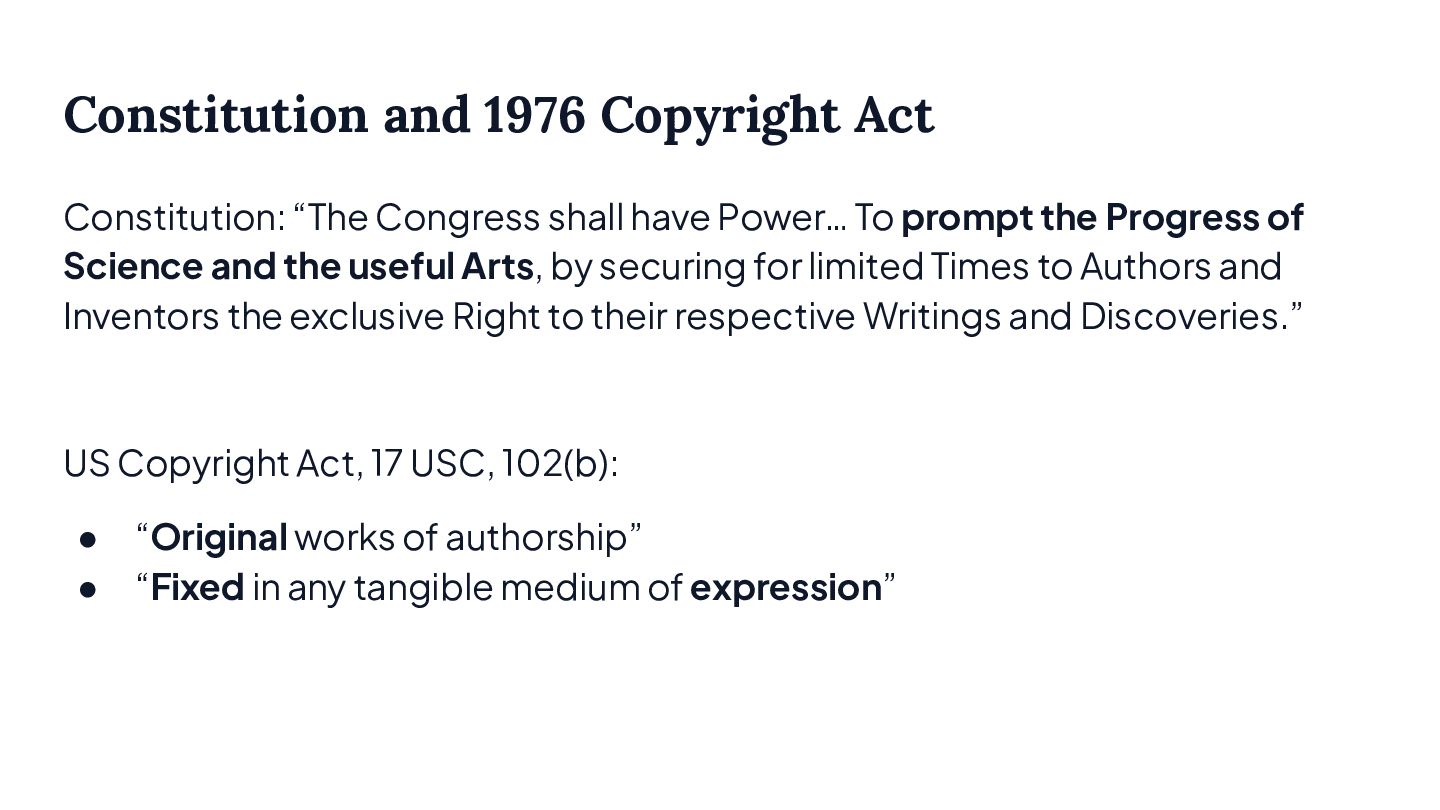
  4. Constitution and 1976 Copyright Act Constitution: “The Congress shall have

    Power… To prompt the Progress of Science and the useful Arts, by securing for limited Times to Authors and Inventors the exclusive Right to their respective Writings and Discoveries.” US Copyright Act, 17 USC, 102(b): • • “Original works of authorship” “Fixed in any tangible medium of expression”
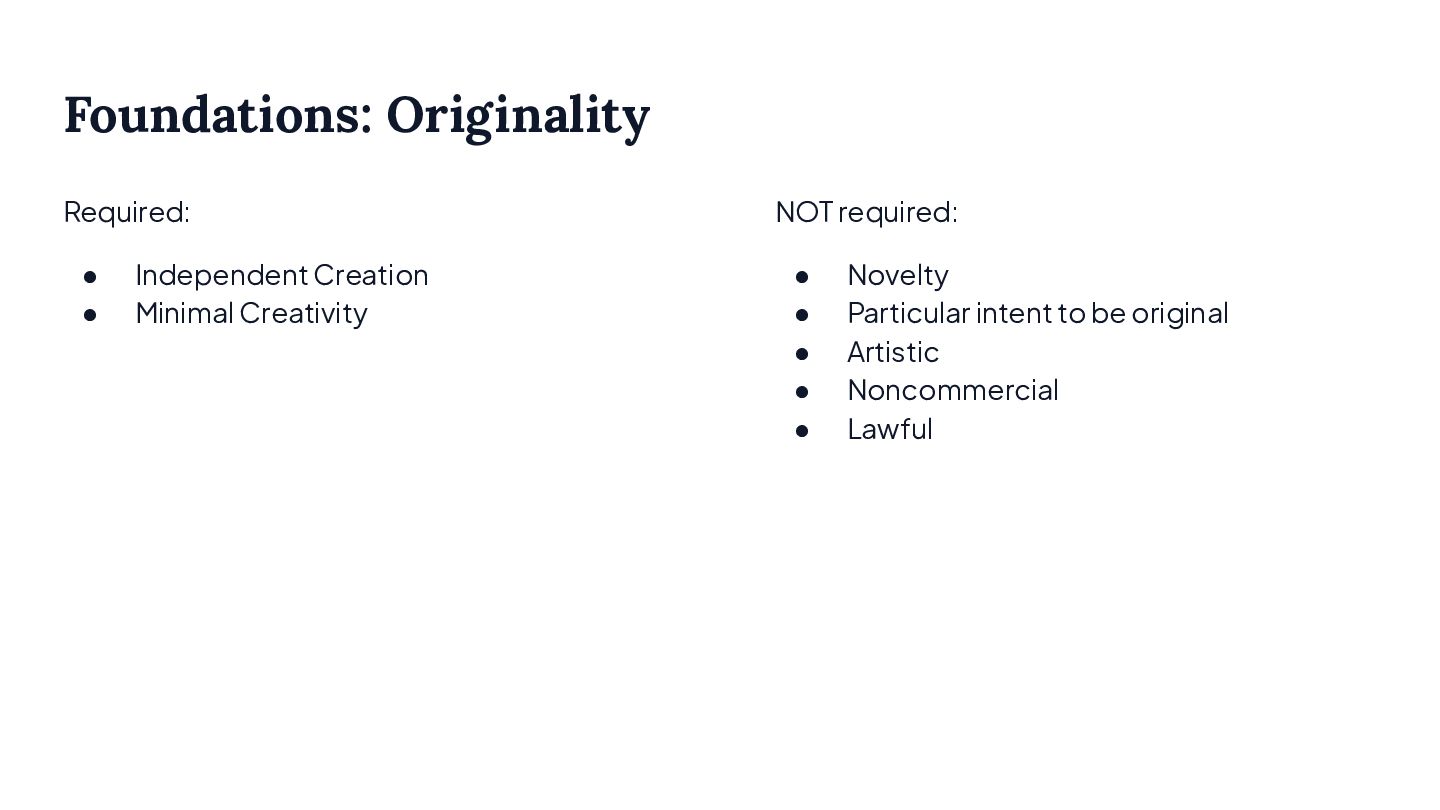
  5. Foundations: Originality Required: • • Independent Creation Minimal Creativity NOT

    required: • • • • • Novelty Particular intent to be original Artistic Noncommercial Lawful
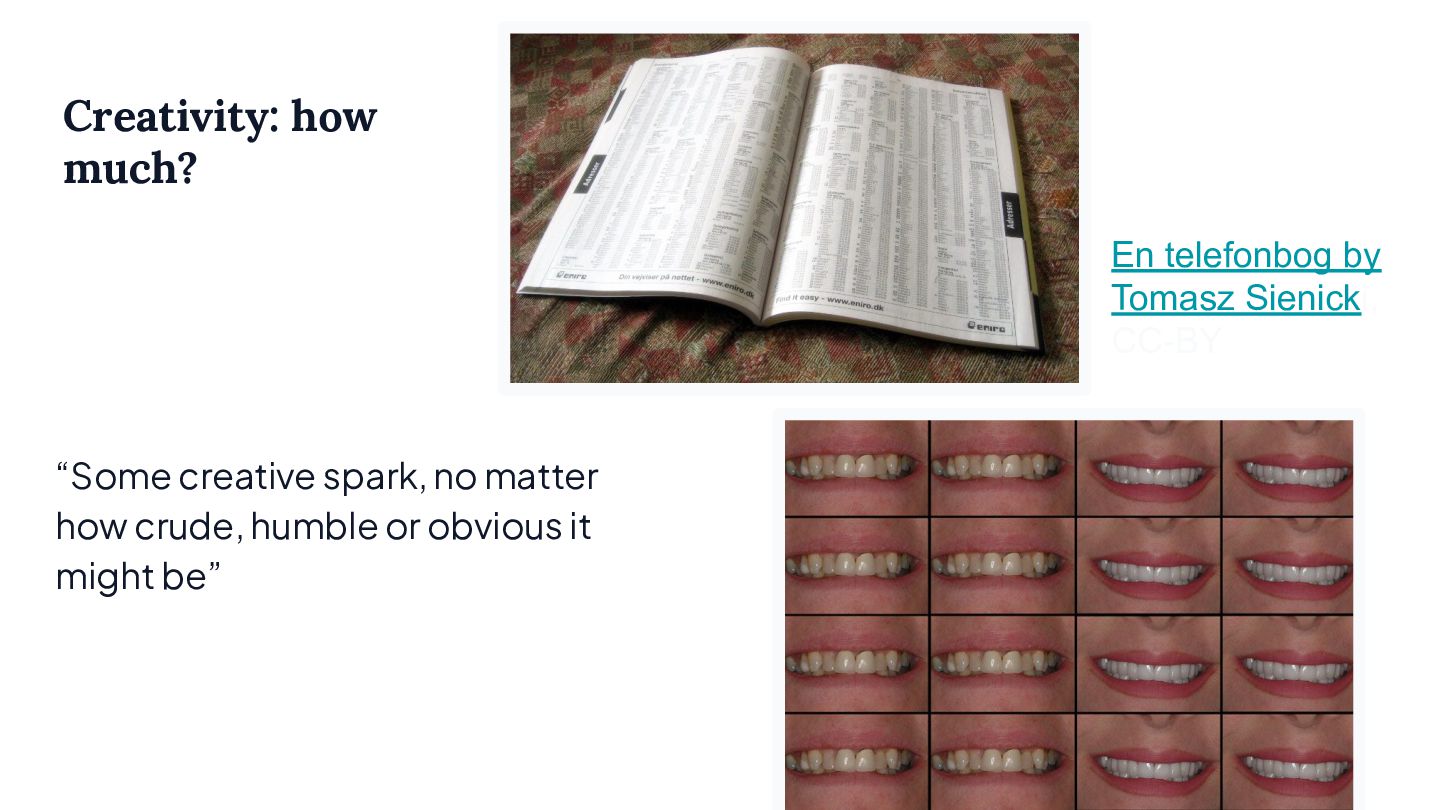
  6. Creativity: how much? En telefonbog by Tomasz Sienicki, CC-BY “Some

    creative spark, no matter how crude, humble or obvious it might be”
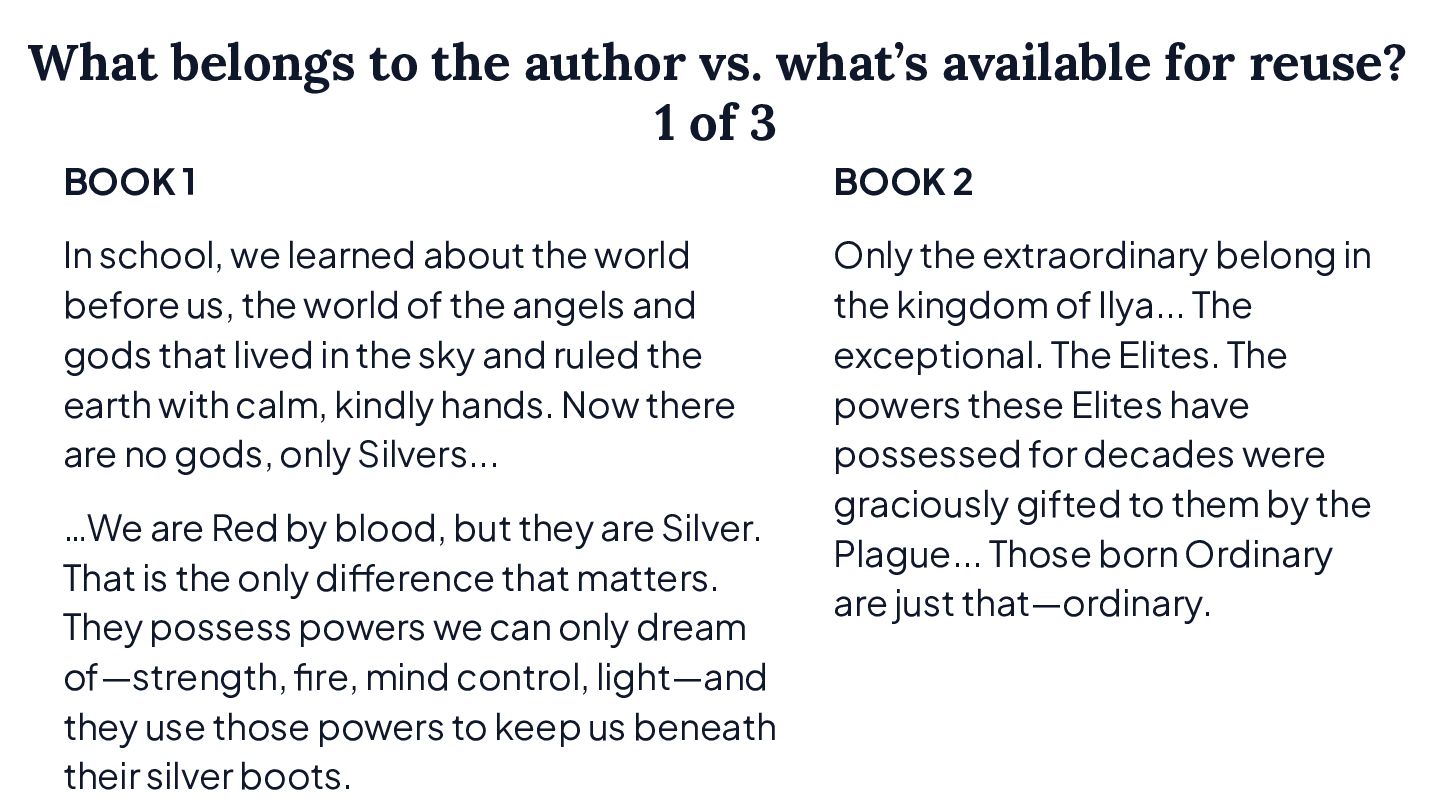
  7. What belongs to the author vs. what’s available for reuse?

    1 of 3 BOOK 1 BOOK 2 In school, we learned about the world before us, the world of the angels and gods that lived in the sky and ruled the earth with calm, kindly hands. Now there are no gods, only Silvers... Only the extraordinary belong in the kingdom of Ilya... The exceptional. The Elites. The powers these Elites have possessed for decades were graciously gifted to them by the Plague... Those born Ordinary are just that—ordinary. …We are Red by blood, but they are Silver. That is the only difference that matters. They possess powers we can only dream of—strength, fire, mind control, light—and they use those powers to keep us beneath their silver boots.
  8. What belongs to the author vs. what’s available for reuse?

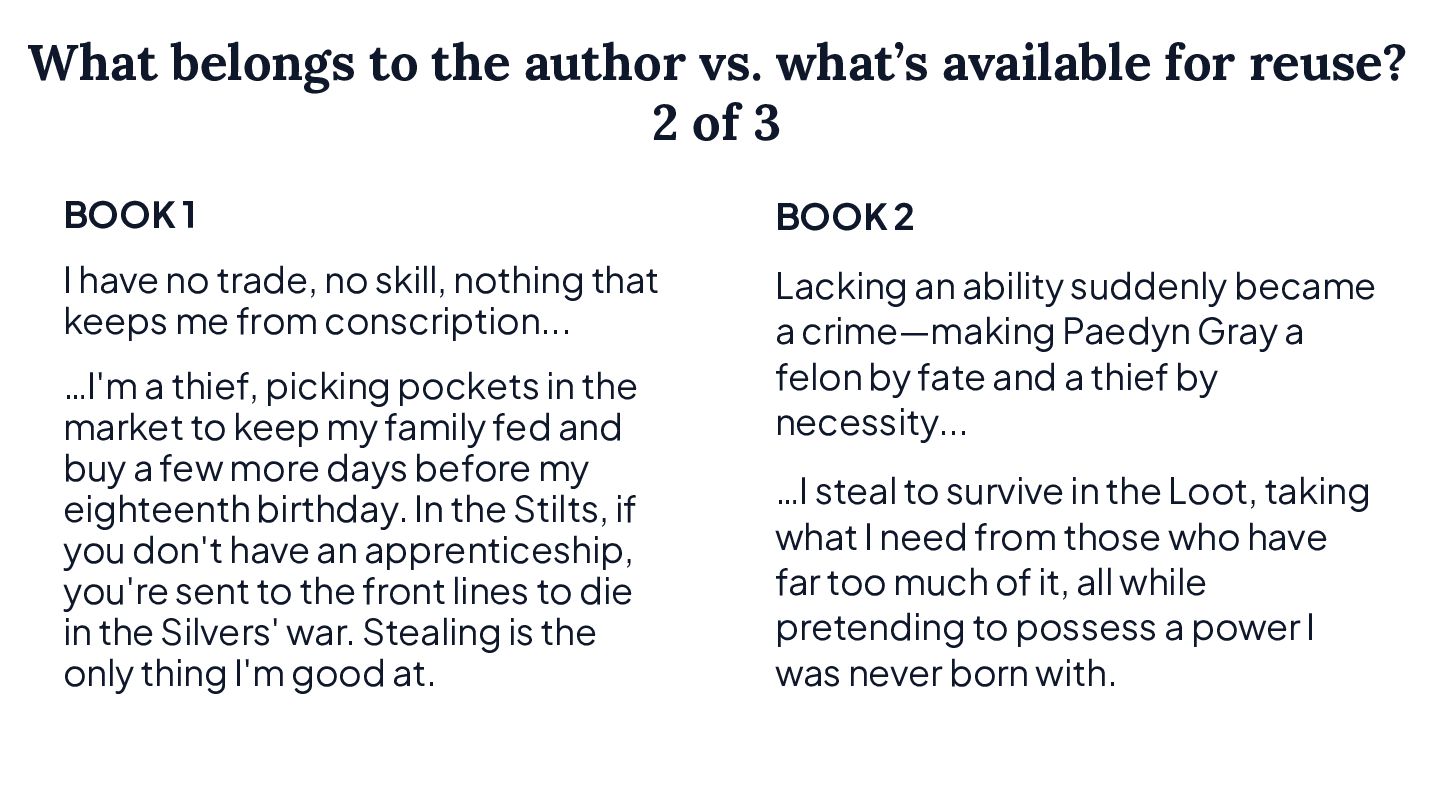
    2 of 3 BOOK 1 BOOK 2 I have no trade, no skill, nothing that keeps me from conscription... Lacking an ability suddenly became a crime—making Paedyn Gray a felon by fate and a thief by necessity... …I'm a thief, picking pockets in the market to keep my family fed and buy a few more days before my eighteenth birthday. In the Stilts, if you don't have an apprenticeship, you're sent to the front lines to die in the Silvers' war. Stealing is the only thing I'm good at. …I steal to survive in the Loot, taking what I need from those who have far too much of it, all while pretending to possess a power I was never born with.
  9. What belongs to the author vs. what’s available for reuse?

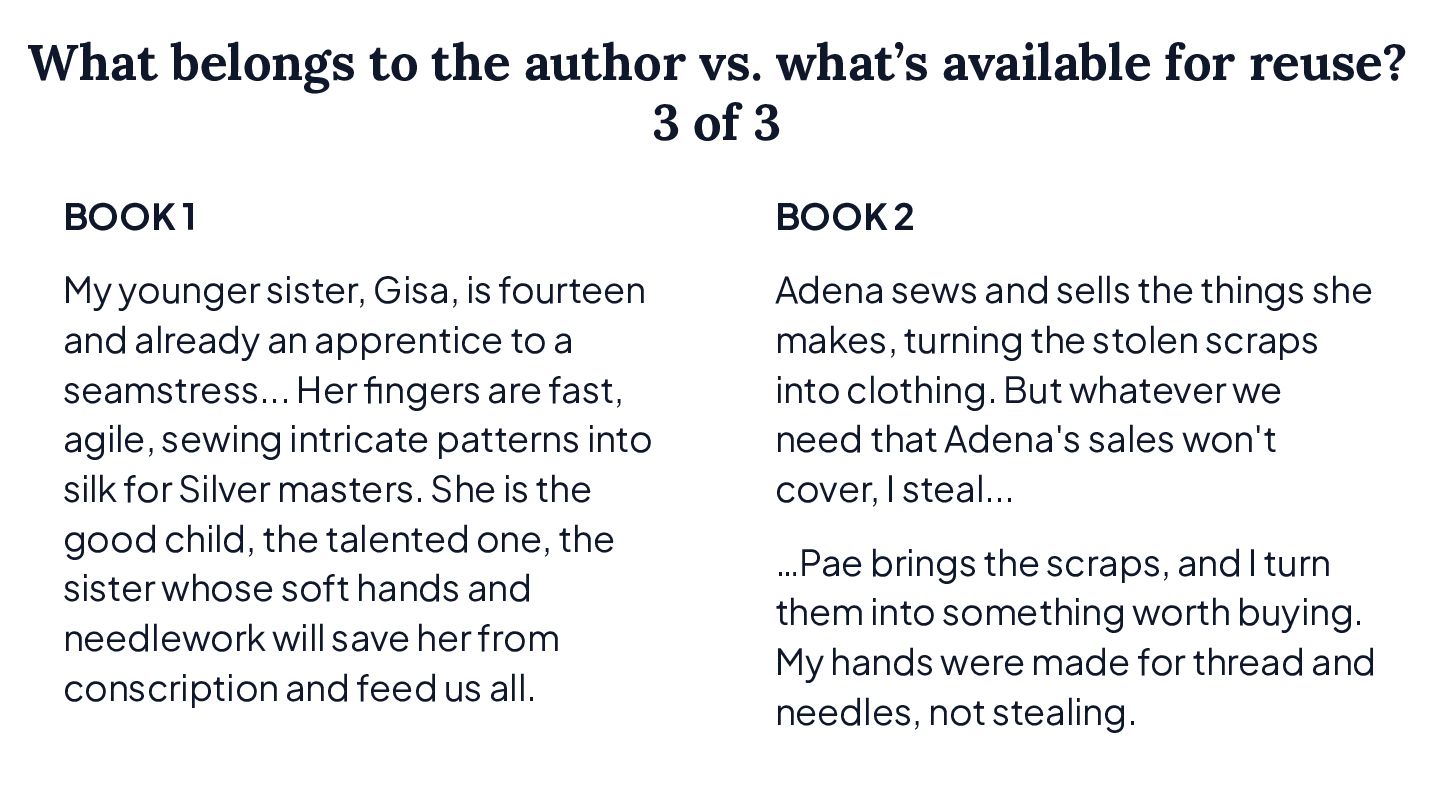
    3 of 3 BOOK 1 BOOK 2 My younger sister, Gisa, is fourteen and already an apprentice to a seamstress... Her fingers are fast, agile, sewing intricate patterns into silk for Silver masters. She is the good child, the talented one, the sister whose soft hands and needlework will save her from conscription and feed us all. Adena sews and sells the things she makes, turning the stolen scraps into clothing. But whatever we need that Adena's sales won't cover, I steal... …Pae brings the scraps, and I turn them into something worth buying. My hands were made for thread and needles, not stealing.
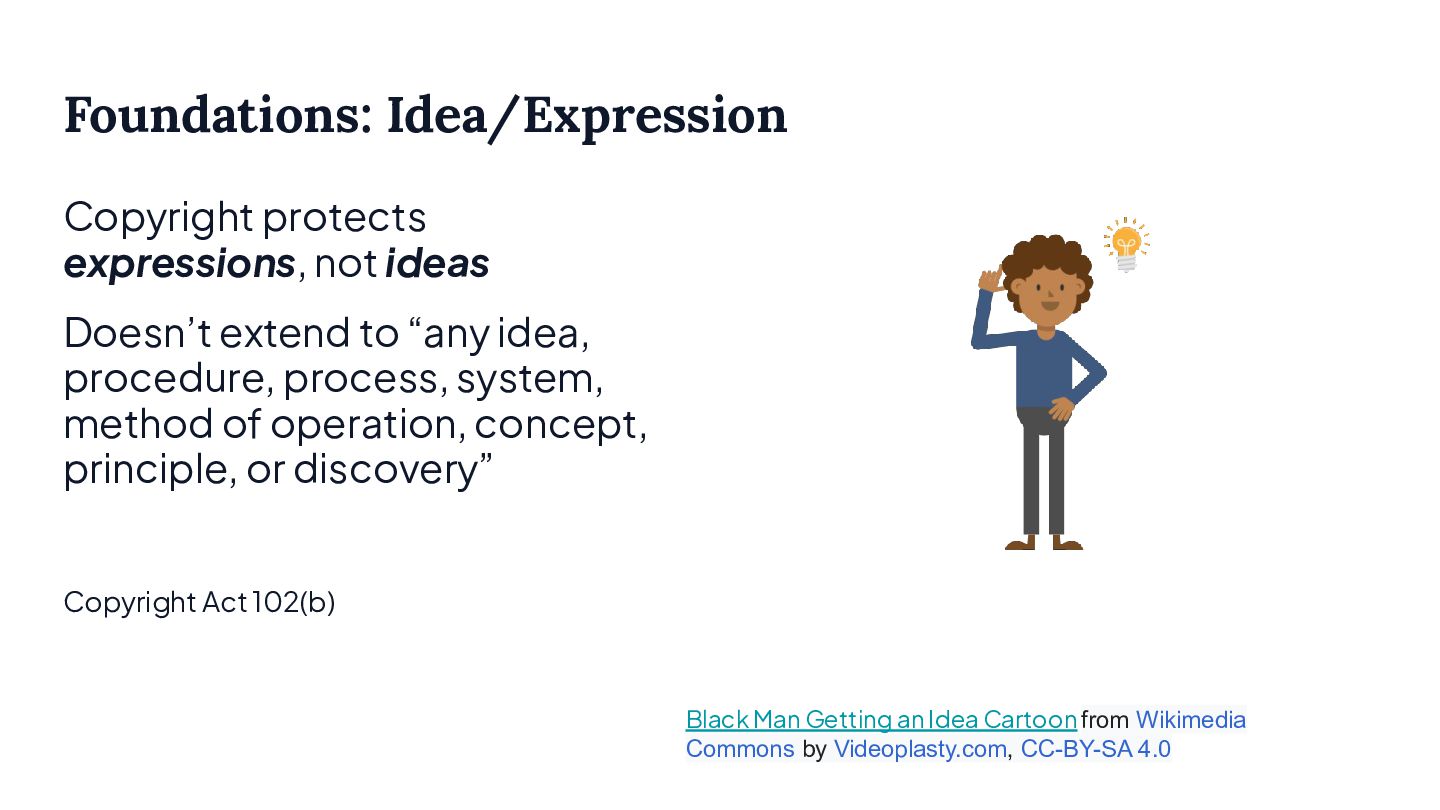
  10. Foundations: Idea/Expression Copyright protects expressions, not ideas Doesn’t extend to

    “any idea, procedure, process, system, method of operation, concept, principle, or discovery” Copyright Act 102(b) Black Man Getting an Idea Cartoon from Wikimedia Commons by Videoplasty.com, CC-BY-SA 4.0
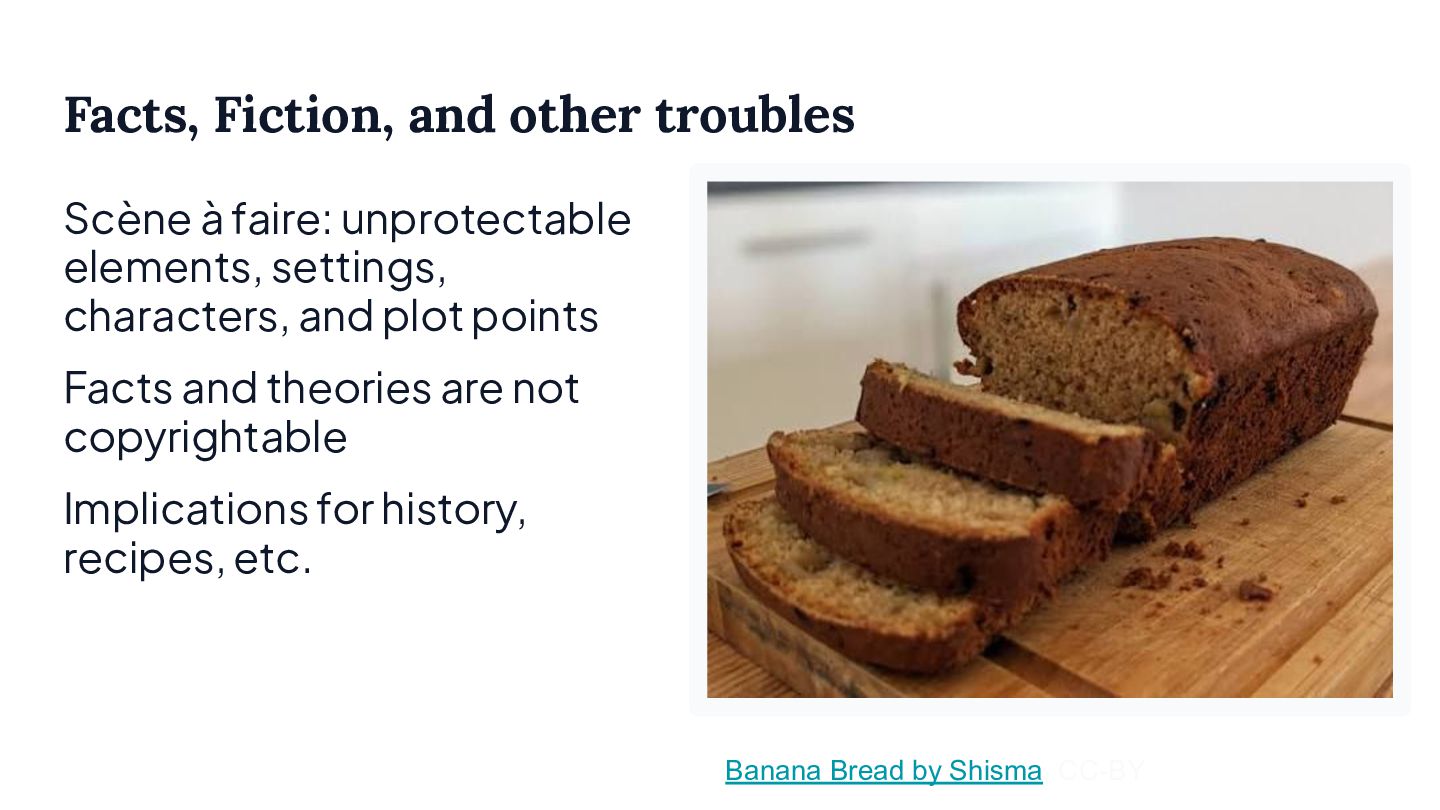
  11. Facts, Fiction, and other troubles Scène à faire: unprotectable elements,

    settings, characters, and plot points Facts and theories are not copyrightable Implications for history, recipes, etc. Banana Bread by Shisma, CC-BY
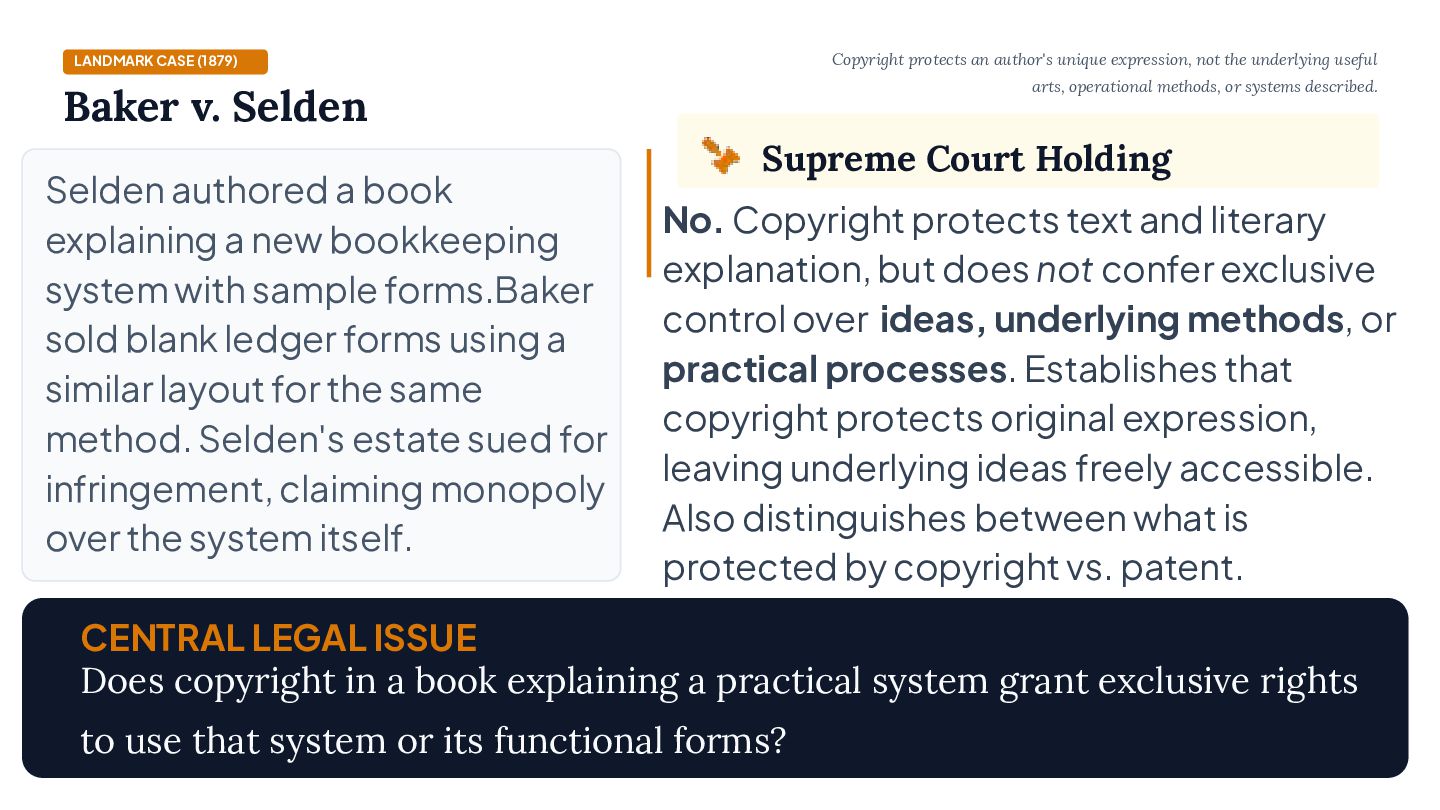
  12. Copyright protects an author's unique expression, not the underlying useful

    LANDMARK CASE (1879) arts, operational methods, or systems described. Baker v. Selden Selden authored a book explaining a new bookkeeping system with sample forms.Baker sold blank ledger forms using a similar layout for the same method. Selden's estate sued for infringement, claiming monopoly over the system itself. Supreme Court Holding No. Copyright protects text and literary explanation, but does not confer exclusive control over ideas, underlying methods, or practical processes. Establishes that copyright protects original expression, leaving underlying ideas freely accessible. Also distinguishes between what is protected by copyright vs. patent. CENTRAL LEGAL ISSUE Does copyright in a book explaining a practical system grant exclusive rights to use that system or its functional forms?
  13. Review Why does copyright not protect ideas? In Baker v

    Selden what formed an idea rather than an expression? Could you give an example of something relating to a bookkeeping system, which could, however, be protected by copyright?
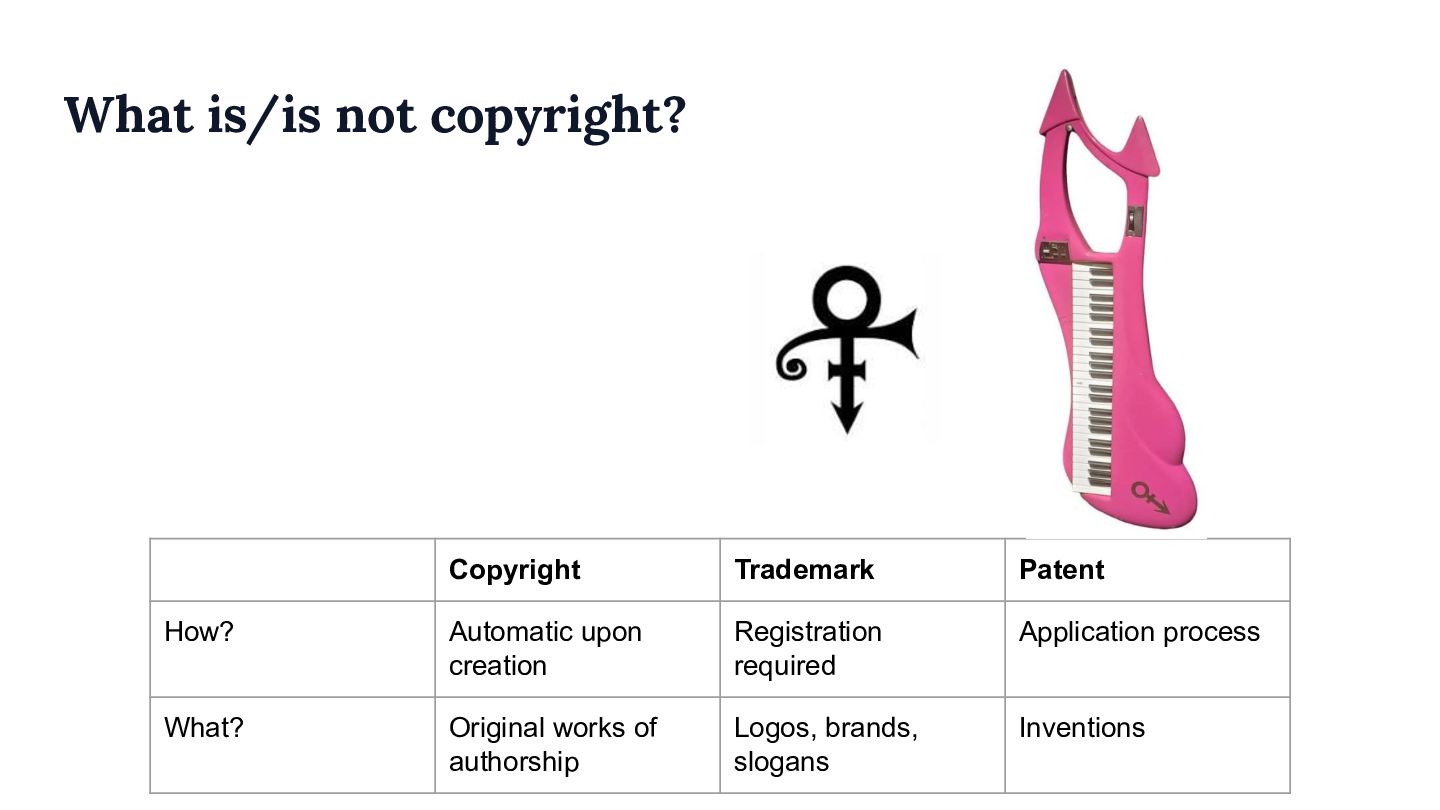
  14. What is/is not copyright? Copyright Trademark Patent How? Automatic upon

    creation Registration required Application process What? Original works of authorship Logos, brands, slogans Inventions
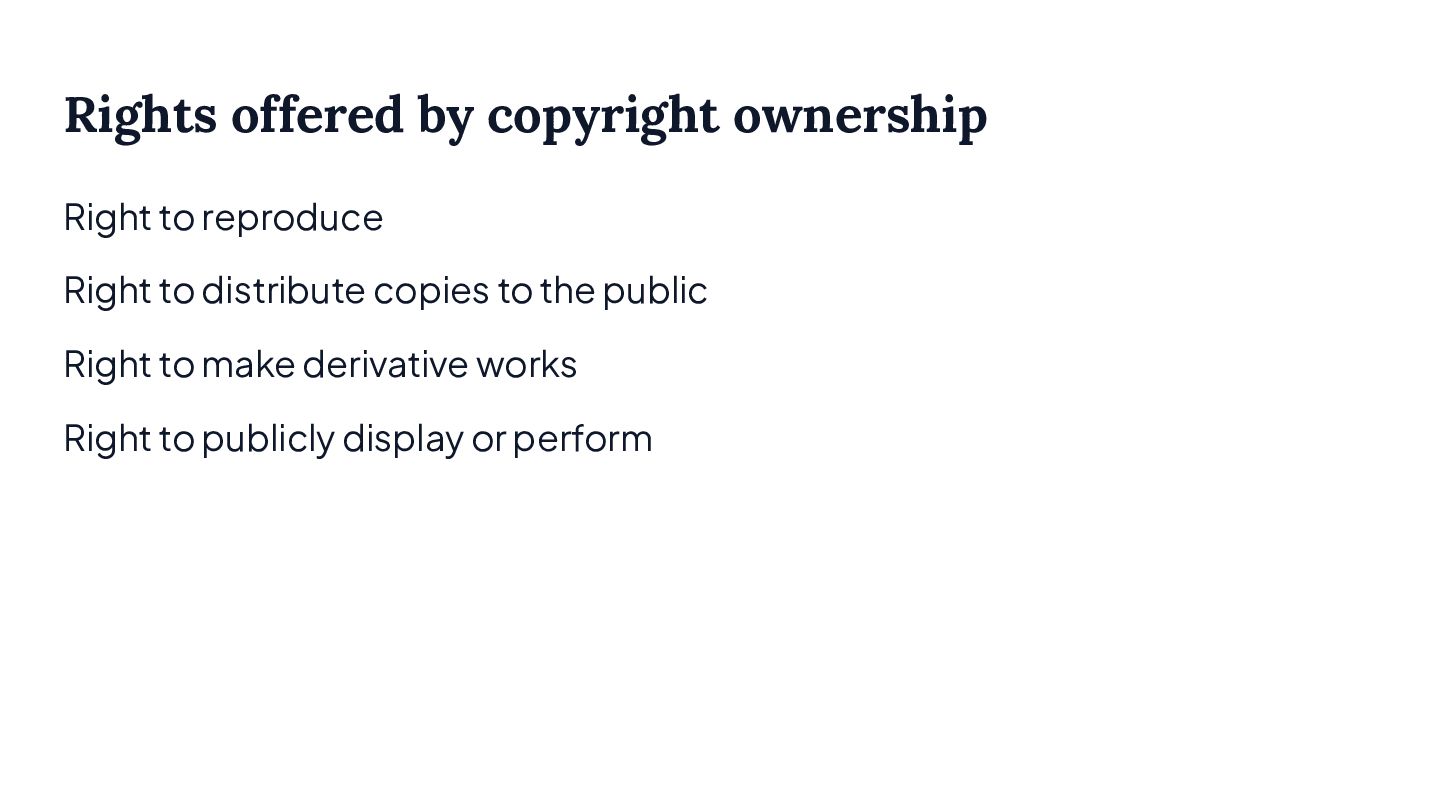
  15. Rights offered by copyright ownership Right to reproduce Right to

    distribute copies to the public Right to make derivative works Right to publicly display or perform
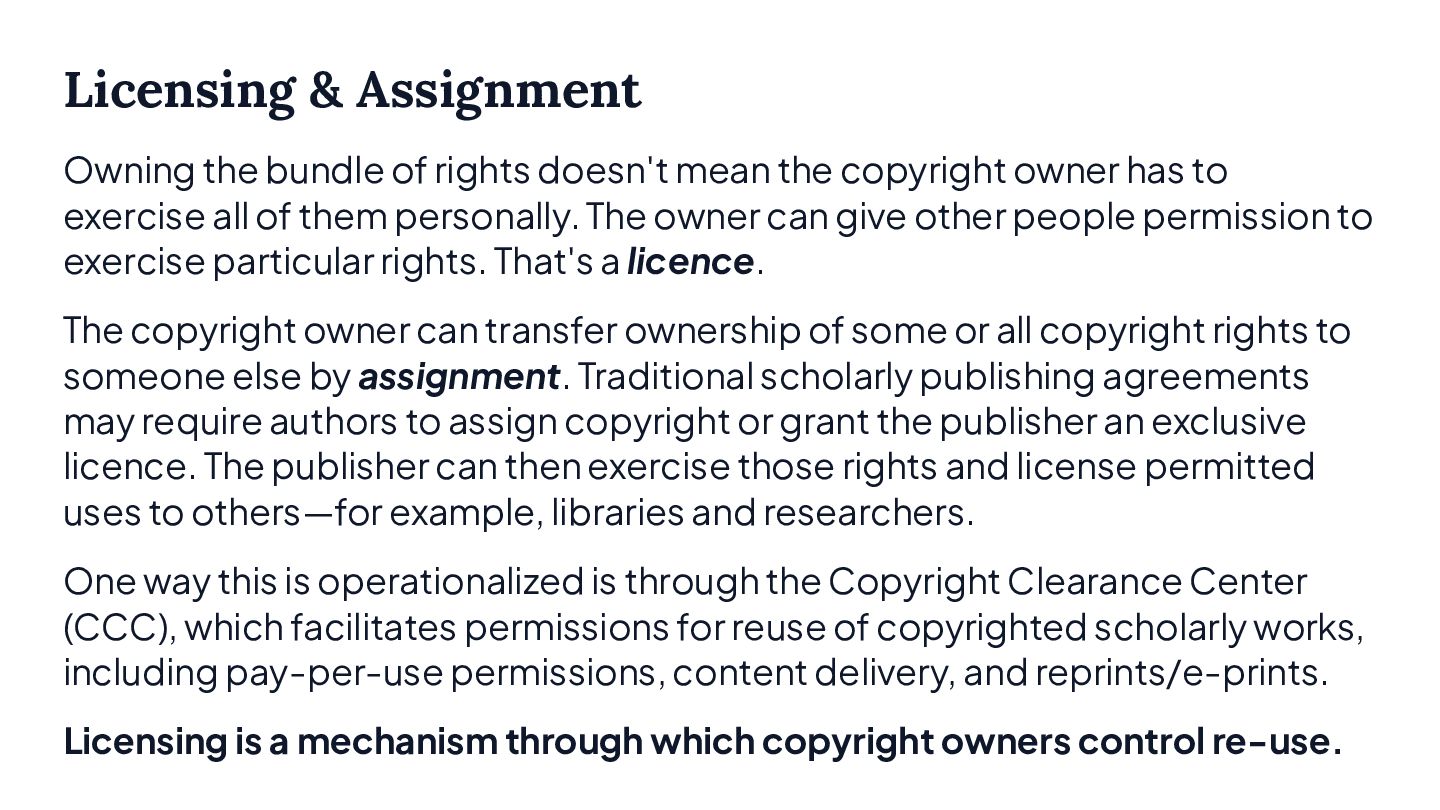
  16. Licensing & Assignment Owning the bundle of rights doesn't mean

    the copyright owner has to exercise all of them personally. The owner can give other people permission to exercise particular rights. That's a licence. The copyright owner can transfer ownership of some or all copyright rights to someone else by assignment. Traditional scholarly publishing agreements may require authors to assign copyright or grant the publisher an exclusive licence. The publisher can then exercise those rights and license permitted uses to others—for example, libraries and researchers. One way this is operationalized is through the Copyright Clearance Center (CCC), which facilitates permissions for reuse of copyrighted scholarly works, including pay-per-use permissions, content delivery, and reprints/e-prints. Licensing is a mechanism through which copyright owners control re-use.
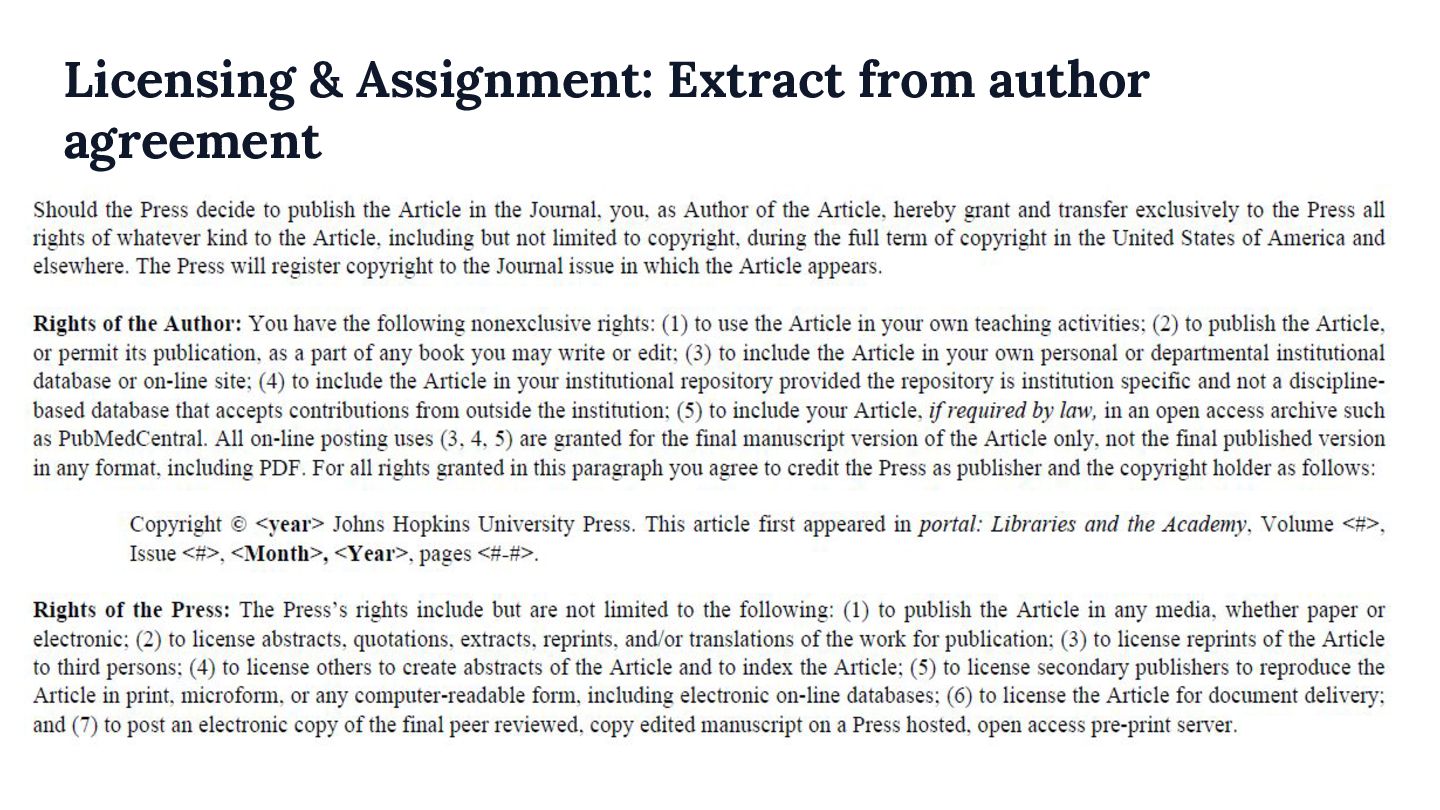
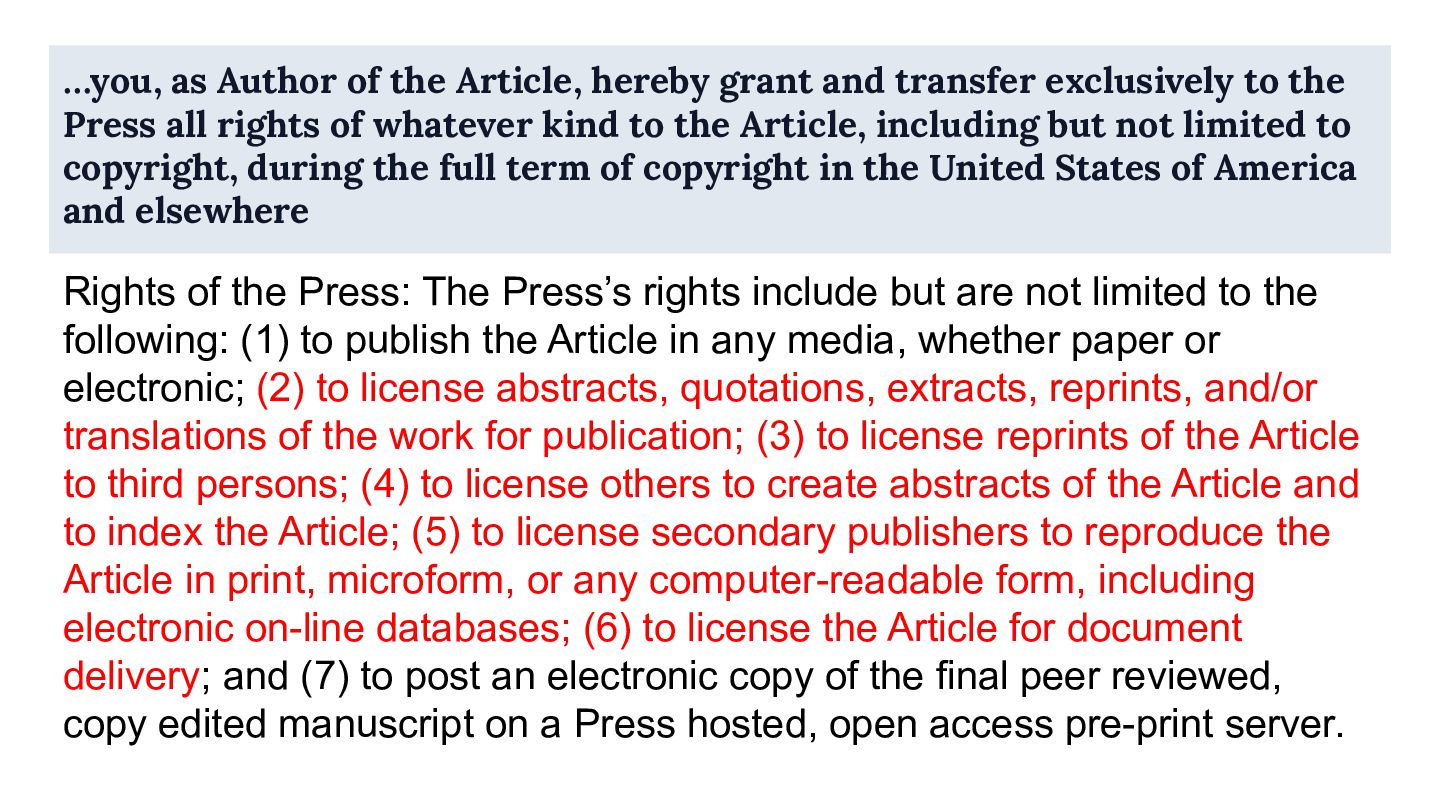
  17. …you, as Author of the Article, hereby grant and transfer

    exclusively to the Press all rights of whatever kind to the Article, including but not limited to copyright, during the full term of copyright in the United States of America and elsewhere Rights of the Press: The Press’s rights include but are not limited to the following: (1) to publish the Article in any media, whether paper or electronic; (2) to license abstracts, quotations, extracts, reprints, and/or translations of the work for publication; (3) to license reprints of the Article to third persons; (4) to license others to create abstracts of the Article and to index the Article; (5) to license secondary publishers to reproduce the Article in print, microform, or any computer-readable form, including electronic on-line databases; (6) to license the Article for document delivery; and (7) to post an electronic copy of the final peer reviewed, copy edited manuscript on a Press hosted, open access pre-print server.
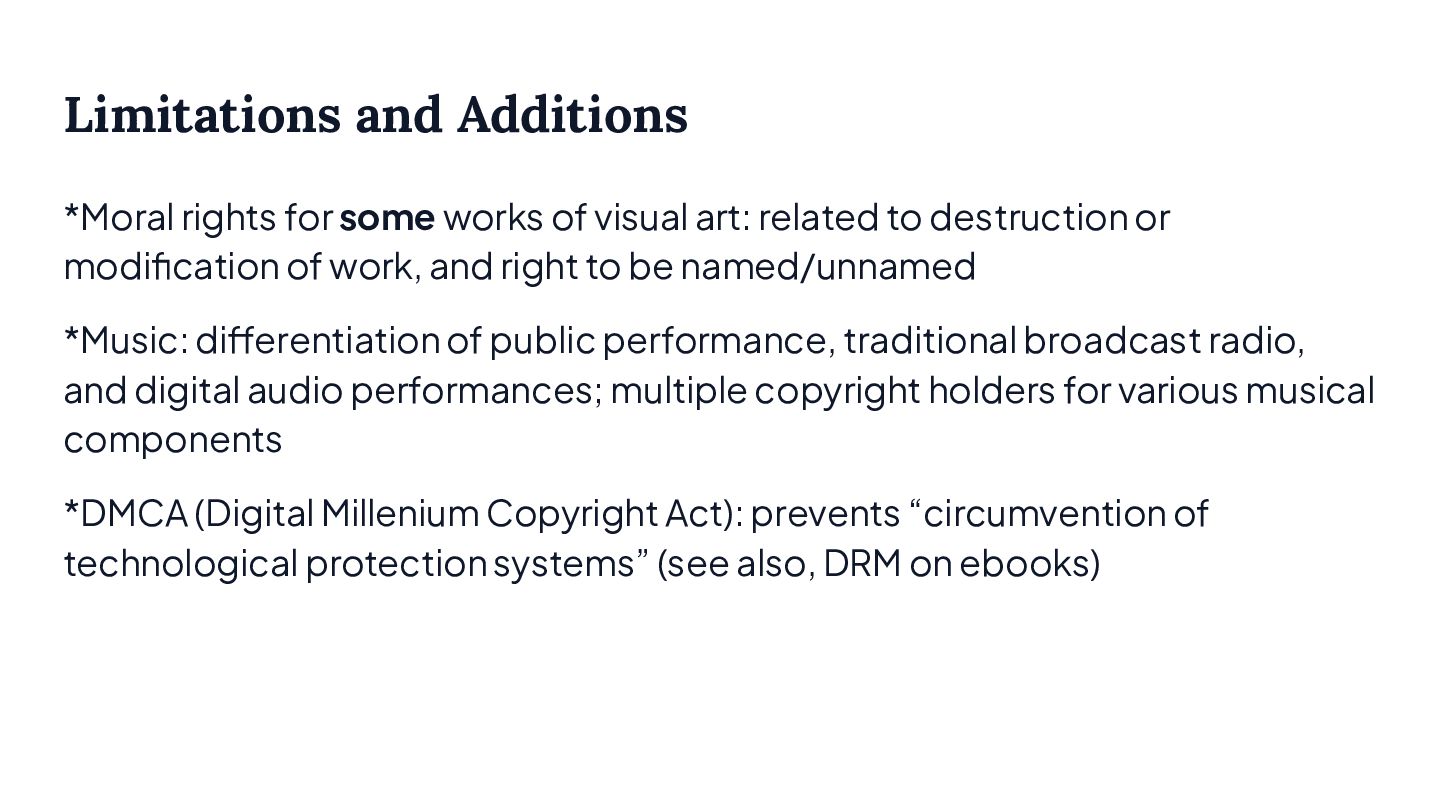
  18. Limitations and Additions *Moral rights for some works of visual

    art: related to destruction or modification of work, and right to be named/unnamed *Music: differentiation of public performance, traditional broadcast radio, and digital audio performances; multiple copyright holders for various musical components *DMCA (Digital Millenium Copyright Act): prevents “circumvention of technological protection systems” (see also, DRM on ebooks)
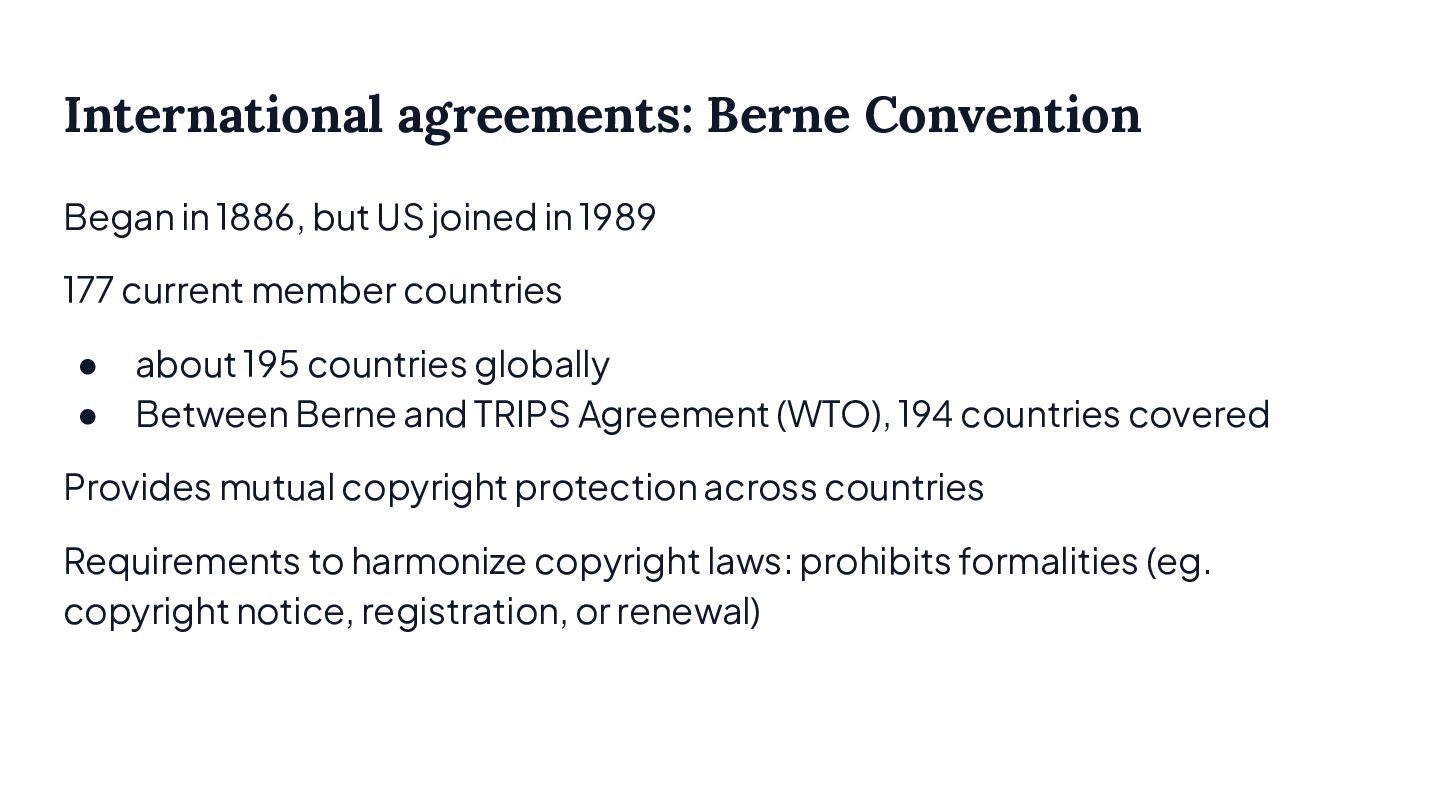
  19. International agreements: Berne Convention Began in 1886, but US joined

    in 1989 177 current member countries • • about 195 countries globally Between Berne and TRIPS Agreement (WTO), 194 countries covered Provides mutual copyright protection across countries Requirements to harmonize copyright laws: prohibits formalities (eg. copyright notice, registration, or renewal)
  20. International agreements: Marrakesh Treaty Developed by WIPO (World Intellectual Property

    Organization) in 2013 Facilitates copyright exceptions for accessible versions
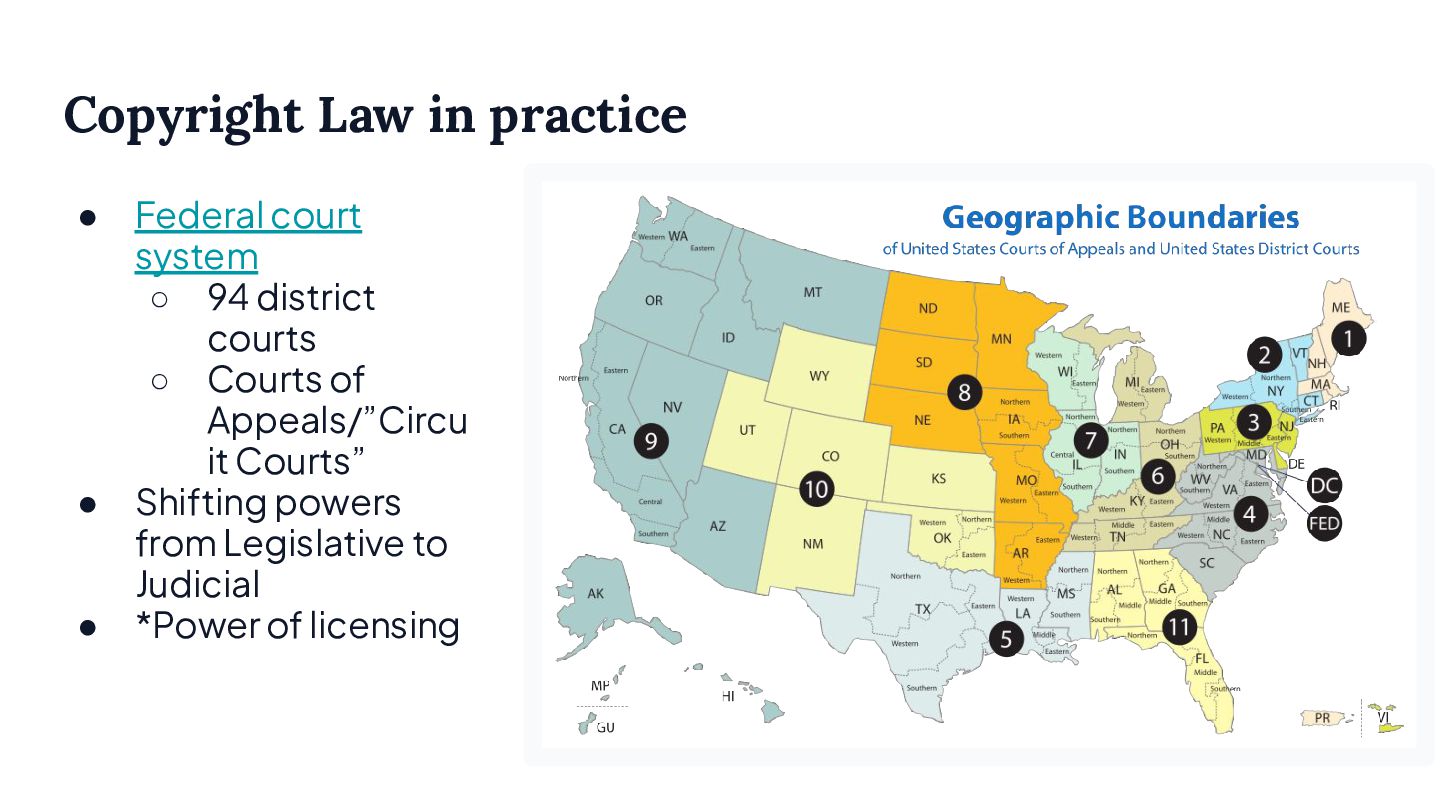
  21. Copyright Law in practice • • • Federal court system

    ◦ 94 district courts ◦ Courts of Appeals/”Circu it Courts” Shifting powers from Legislative to Judicial *Power of licensing