Share
Embed
Protecting your privacy when the Fourth Amendment doesn't protect you
Given for Highland Community College's Constitution Day celebration, 2026

Dorothea Salo
October 16, 2026
Transcript
45 slides
-
Protecting your privacy when the Fourth Amendment doesn’t protect you
Dorothea Salo Information School University of Wisconsin-Madison -
Hi! I’m Dorothea Salo. I am a librarian and educator.
I am not a lawyer! Much less a constitutional lawyer or historian! I am trying to educate y’all today. I am not trying to give y’all legal advice. -
Despite the talk title, I don’t want to talk about
privacy. Instead, I’m going to talk about surveillance. So, in spite of my talk title today, I don’t really want to talk about privacy with you. And that’s not because I don’t think it’s important — I do, it’s central to my work as a librarian and educator! It’s because I don’t have a lot of time and privacy is a really complicated, contested, and difficult idea. If I asked any two of you here in this room today what privacy means to you and how you expect to have your privacy respected, I don’t think any pair of you would completely agree, and that’s a rough place to start a talk from. So what I’m actually going to do today is talk about surveillance, which is a lot easier to define, and the relationship of the Fourth Amendment to that. -
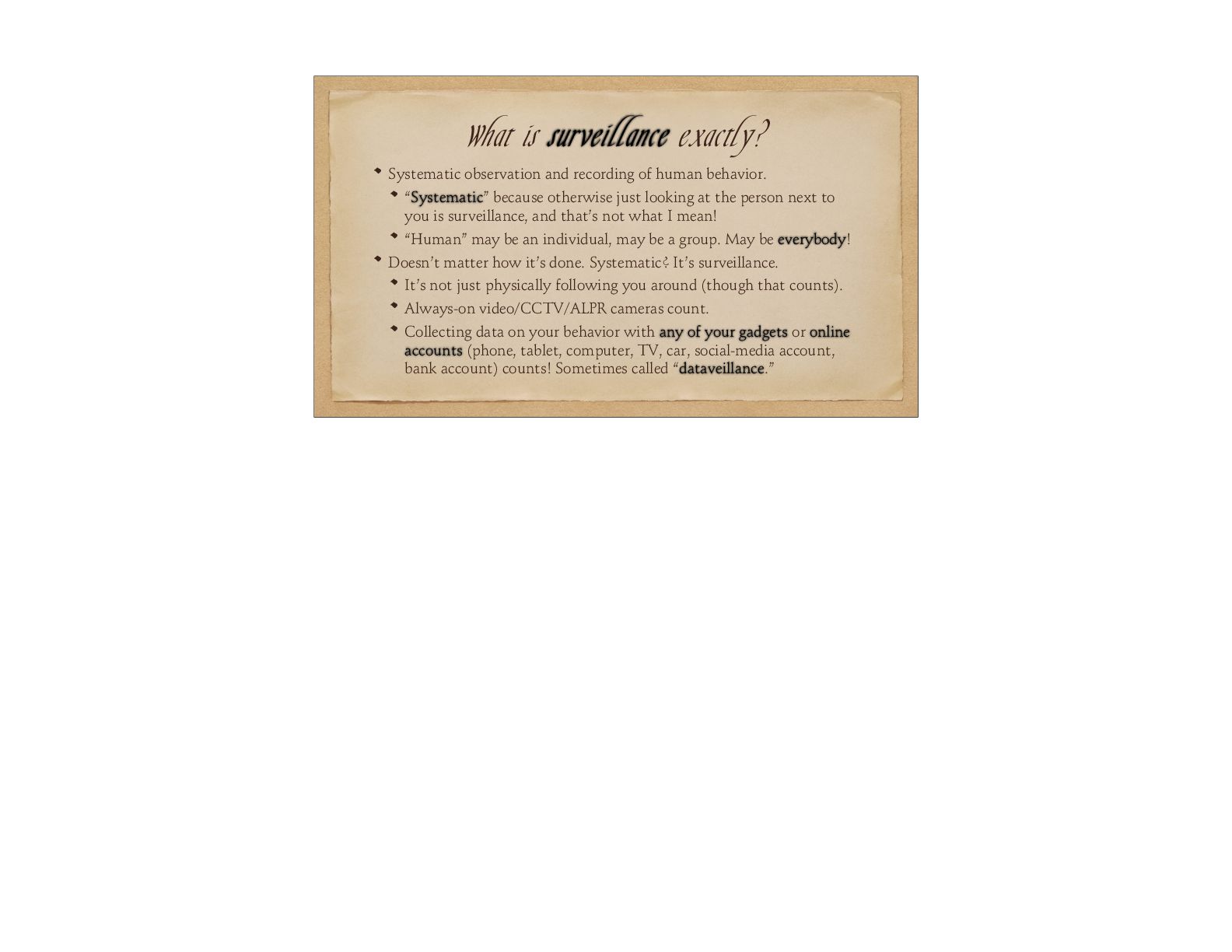
What is surveillance exactly? Systematic observation and recording of human
behavior. “Systematic” because otherwise just looking at the person next to you is surveillance, and that’s not what I mean! “Human” may be an individual, may be a group. May be everybody! Doesn’t matter how it’s done. Systematic? It’s surveillance. It’s not just physically following you around (though that counts). Always-on video/CCTV/ALPR cameras count. Collecting data on your behavior with any of your gadgets or online accounts (phone, tablet, computer, TV, car, social-media account, bank account) counts! Sometimes called “dataveillance.” -
And now… the Fourth Amendment to the Constitution of the
United States of America! Drumroll please! -
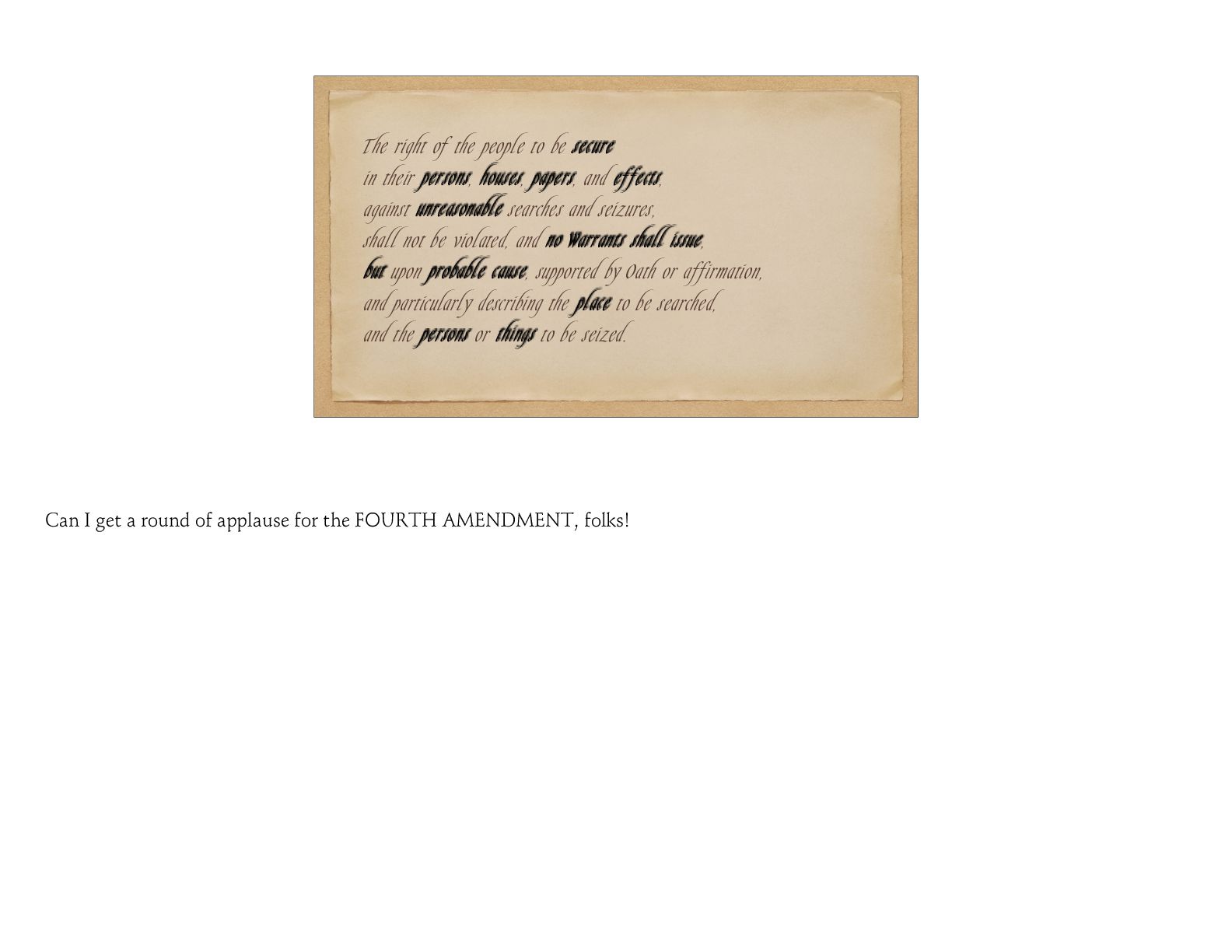
The right of the people to be secure in their
persons, houses, papers, and effects, against unreasonable searches and seizures, shall not be violated, and no Warrants shall issue, but upon probable cause, supported by Oath or affirmation, and particularly describing the place to be searched, and the persons or things to be seized. Can I get a round of applause for the FOURTH AMENDMENT, folks! -
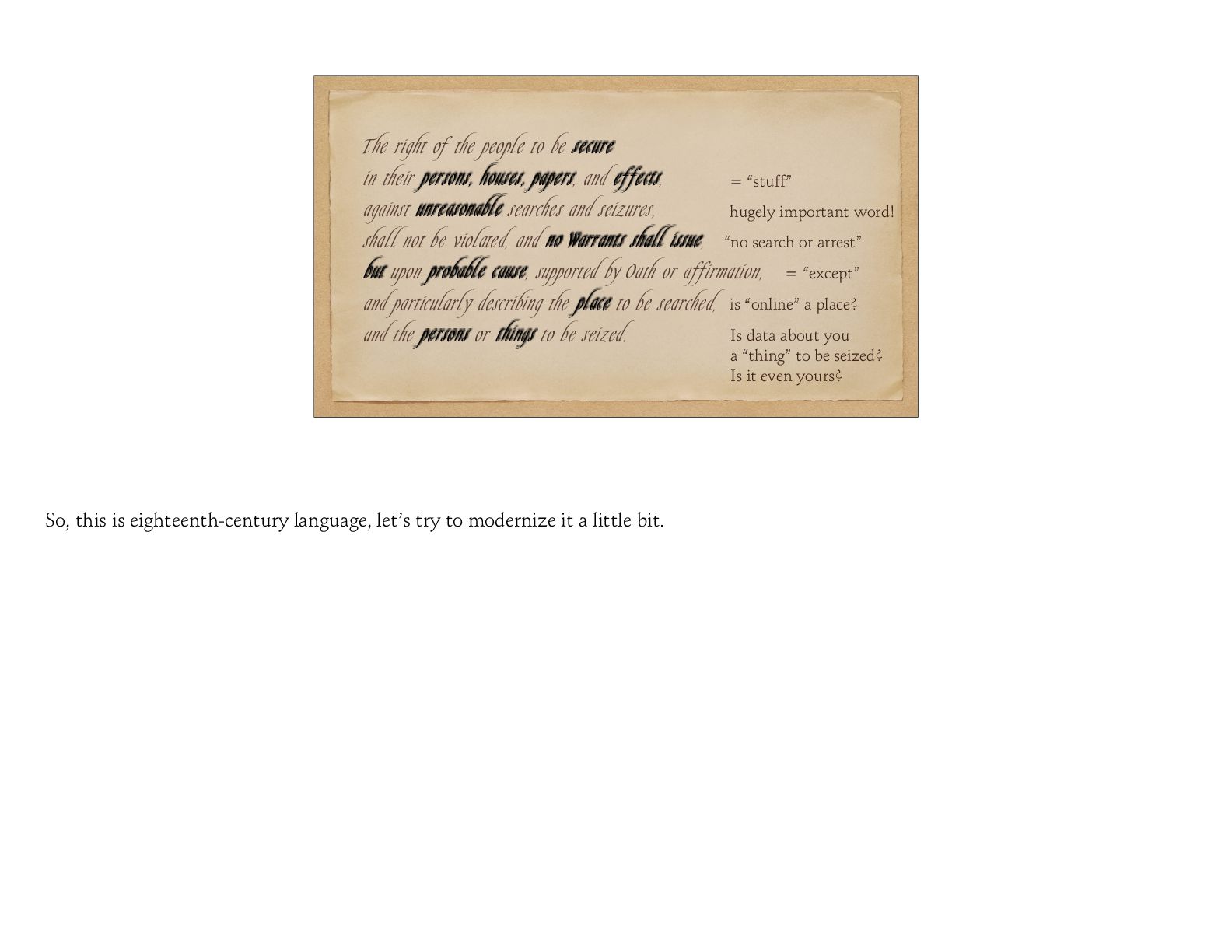
The right of the people to be secure in their
persons, houses, papers, and effects, = “stuff” against unreasonable searches and seizures, hugely important word! shall not be violated, and no Warrants shall issue, “no search or arrest” but upon probable cause, supported by Oath or affirmation, = “except” and particularly describing the place to be searched, is “online” a place? Is data about you and the persons or things to be seized. a “thing” to be seized? Is it even yours? So, this is eighteenth-century language, let’s try to modernize it a little bit. -
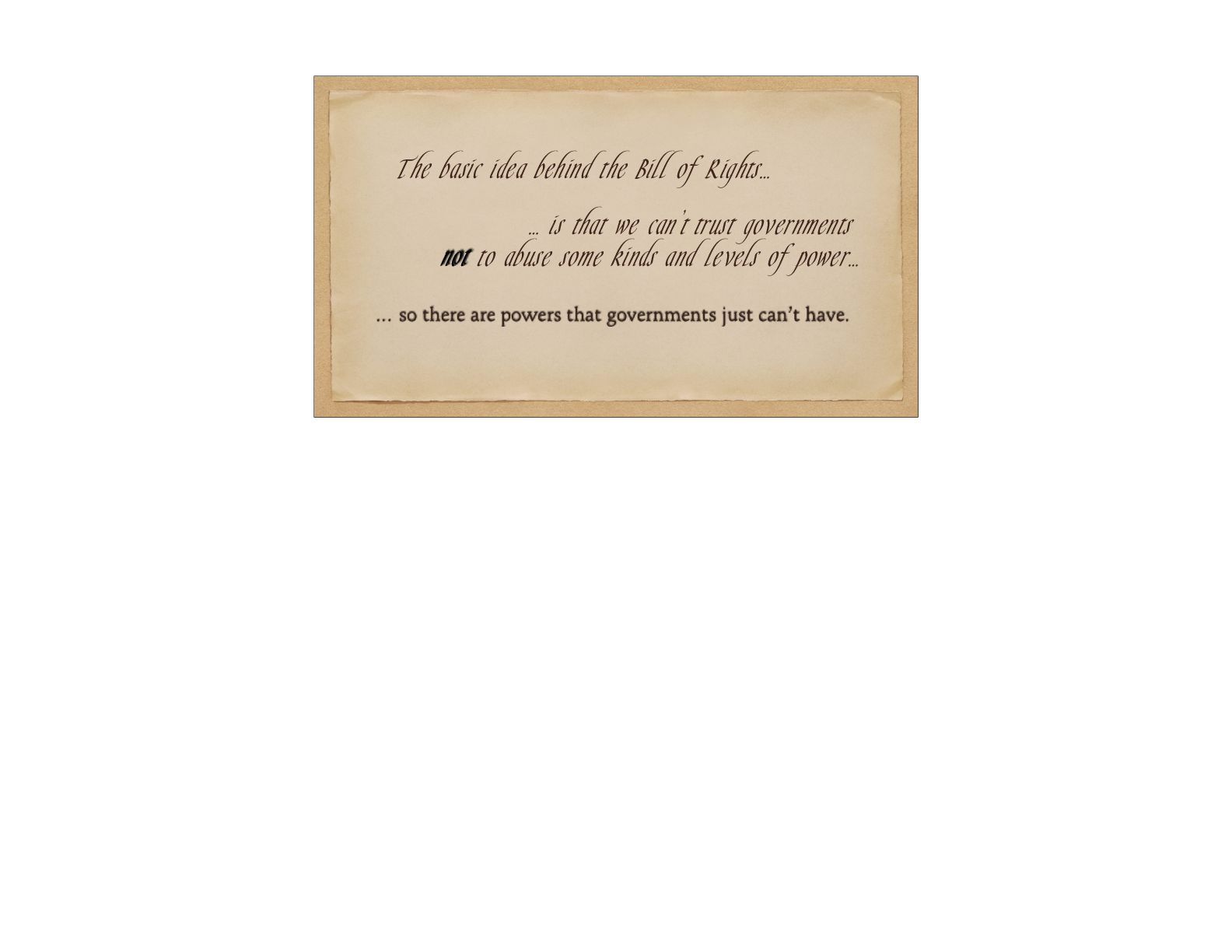
The basic idea behind the Bill of Rights… … is
that we can’t trust governments not to abuse some kinds and levels of power… … so there are powers that governments just can’t have. -
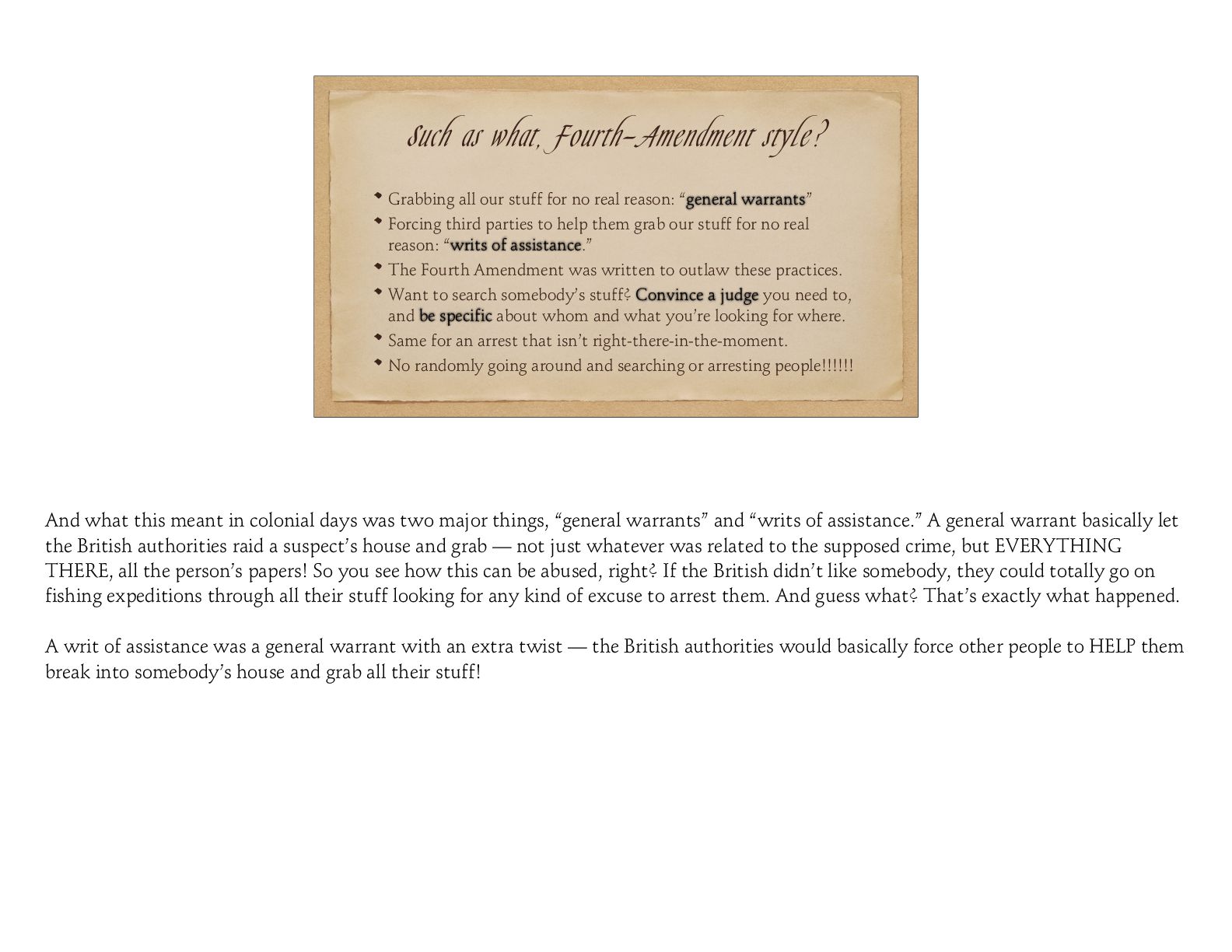
Such as what, Fourth-Amendment style? Grabbing all our stuff for
no real reason: “general warrants” Forcing third parties to help them grab our stuff for no real reason: “writs of assistance.” The Fourth Amendment was written to outlaw these practices. Want to search somebody’s stuff? Convince a judge you need to, and be specific about whom and what you’re looking for where. Same for an arrest that isn’t right-there-in-the-moment. No randomly going around and searching or arresting people!!!!!! And what this meant in colonial days was two major things, “general warrants” and “writs of assistance.” A general warrant basically let the British authorities raid a suspect’s house and grab — not just whatever was related to the supposed crime, but EVERYTHING THERE, all the person’s papers! So you see how this can be abused, right? If the British didn’t like somebody, they could totally go on fishing expeditions through all their stuff looking for any kind of excuse to arrest them. And guess what? That’s exactly what happened. A writ of assistance was a general warrant with an extra twist — the British authorities would basically force other people to HELP them break into somebody’s house and grab all their stuff! -
Saying it louder… The Fourth Amendment says that the government
needs a REASON before they can watch or search us. No fishing expeditions for any old thing that could give them an excuse! And no making others help watch or search us. -
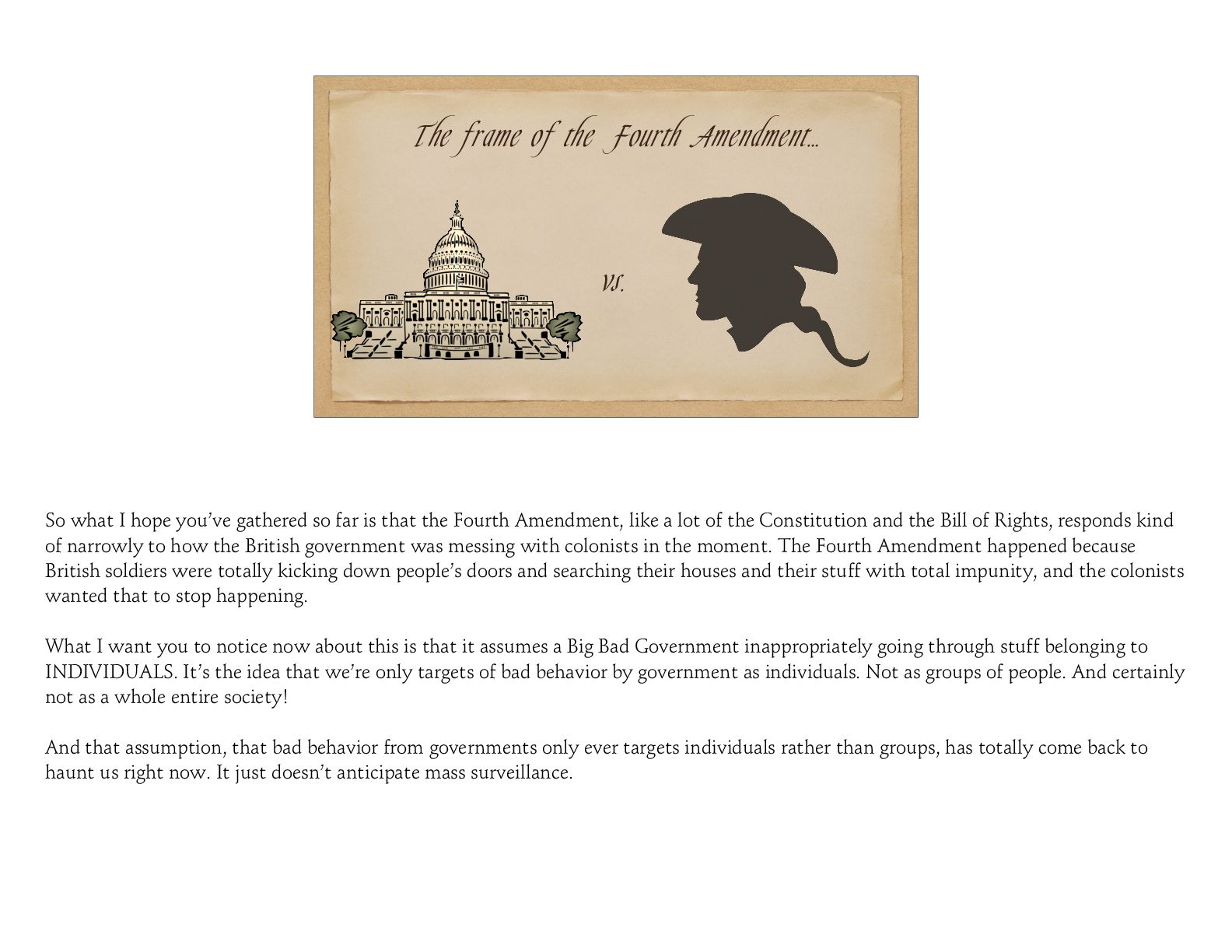
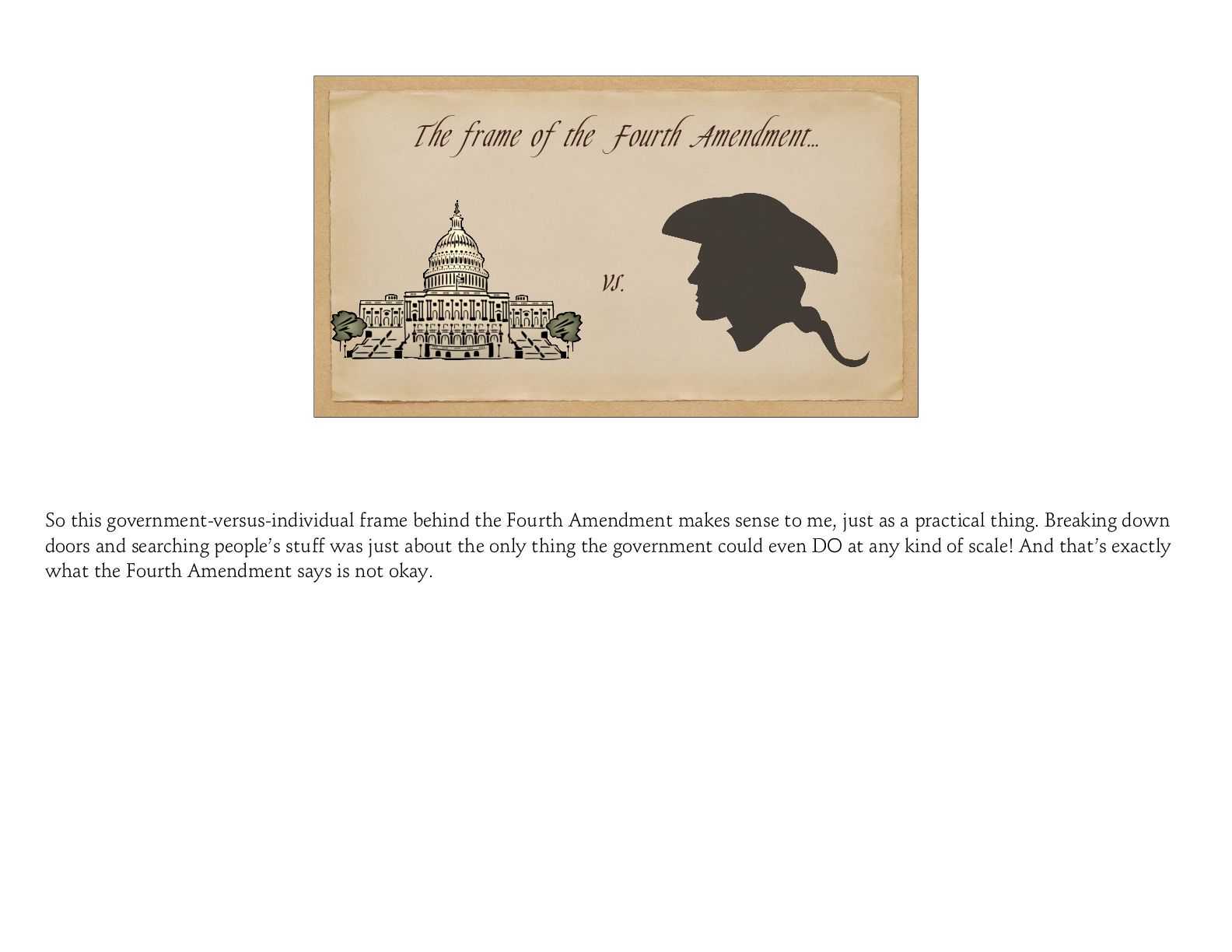
The frame of the Fourth Amendment… vs. So what I
hope you’ve gathered so far is that the Fourth Amendment, like a lot of the Constitution and the Bill of Rights, responds kind of narrowly to how the British government was messing with colonists in the moment. The Fourth Amendment happened because British soldiers were totally kicking down people’s doors and searching their houses and their stuff with total impunity, and the colonists wanted that to stop happening. What I want you to notice now about this is that it assumes a Big Bad Government inappropriately going through stuff belonging to INDIVIDUALS. It’s the idea that we’re only targets of bad behavior by government as individuals. Not as groups of people. And certainly not as a whole entire society! And that assumption, that bad behavior from governments only ever targets individuals rather than groups, has totally come back to haunt us right now. It just doesn’t anticipate mass surveillance. -
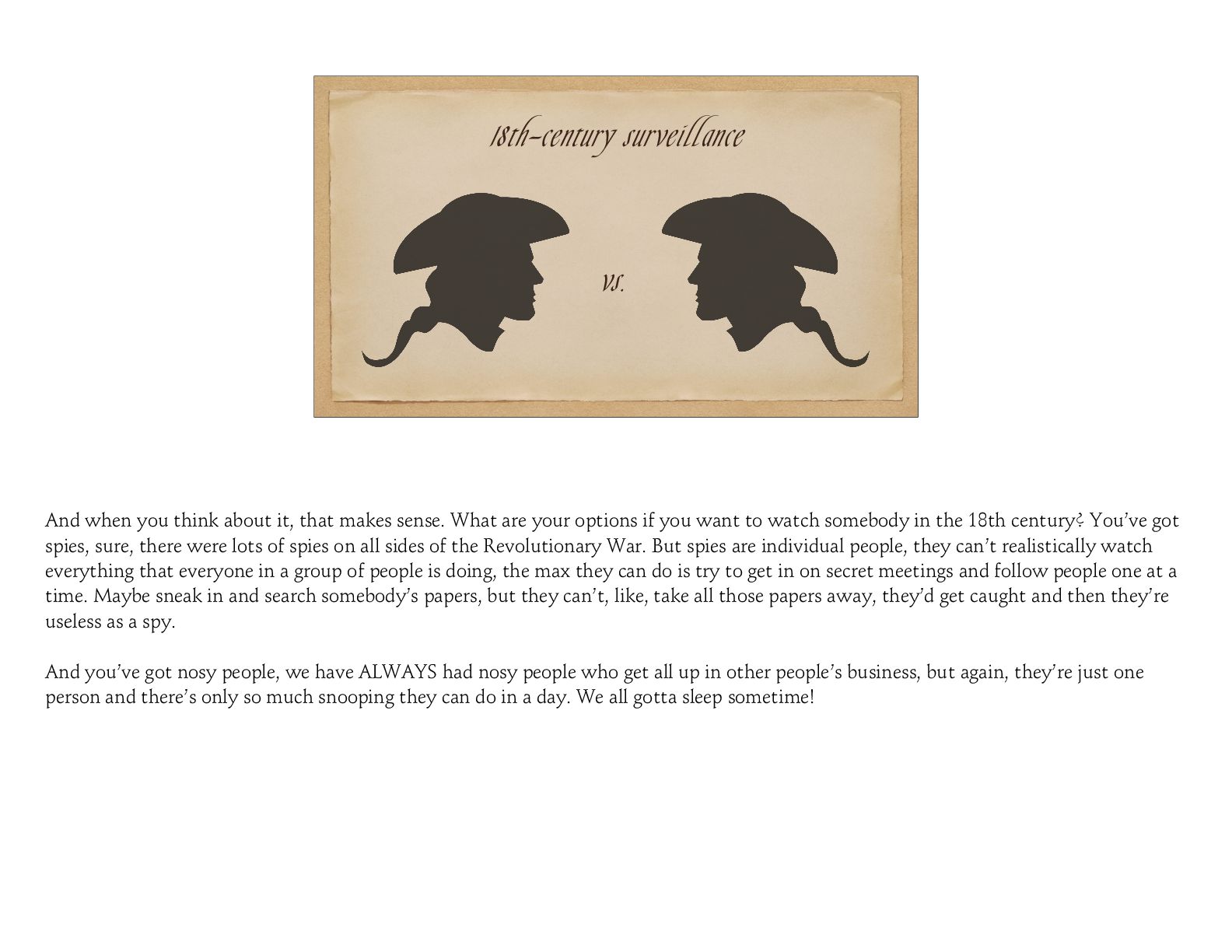
18th-century surveillance vs. And when you think about it, that
makes sense. What are your options if you want to watch somebody in the 18th century? You’ve got spies, sure, there were lots of spies on all sides of the Revolutionary War. But spies are individual people, they can’t realistically watch everything that everyone in a group of people is doing, the max they can do is try to get in on secret meetings and follow people one at a time. Maybe sneak in and search somebody’s papers, but they can’t, like, take all those papers away, they’d get caught and then they’re useless as a spy. And you’ve got nosy people, we have ALWAYS had nosy people who get all up in other people’s business, but again, they’re just one person and there’s only so much snooping they can do in a day. We all gotta sleep sometime! -
The frame of the Fourth Amendment… vs. So this government-versus-individual
frame behind the Fourth Amendment makes sense to me, just as a practical thing. Breaking down doors and searching people’s stuff was just about the only thing the government could even DO at any kind of scale! And that’s exactly what the Fourth Amendment says is not okay. -
Lots of things, actually, more than I have time to
discuss today… Actually a lot of things happened, way more than I have time to talk about today, and a lot of things that are firmly in the realm of Supreme Court decisionmaking, which is very much not my world — seriously, go talk to a law scholar, not me. But very long story short, in the last twenty-five or thirty years, law enforcement agencies have been pushing real hard toward narrower and narrower interpretations of the Fourth Amendment, and US courts, including the Supreme Court, have been letting them get away with that. -
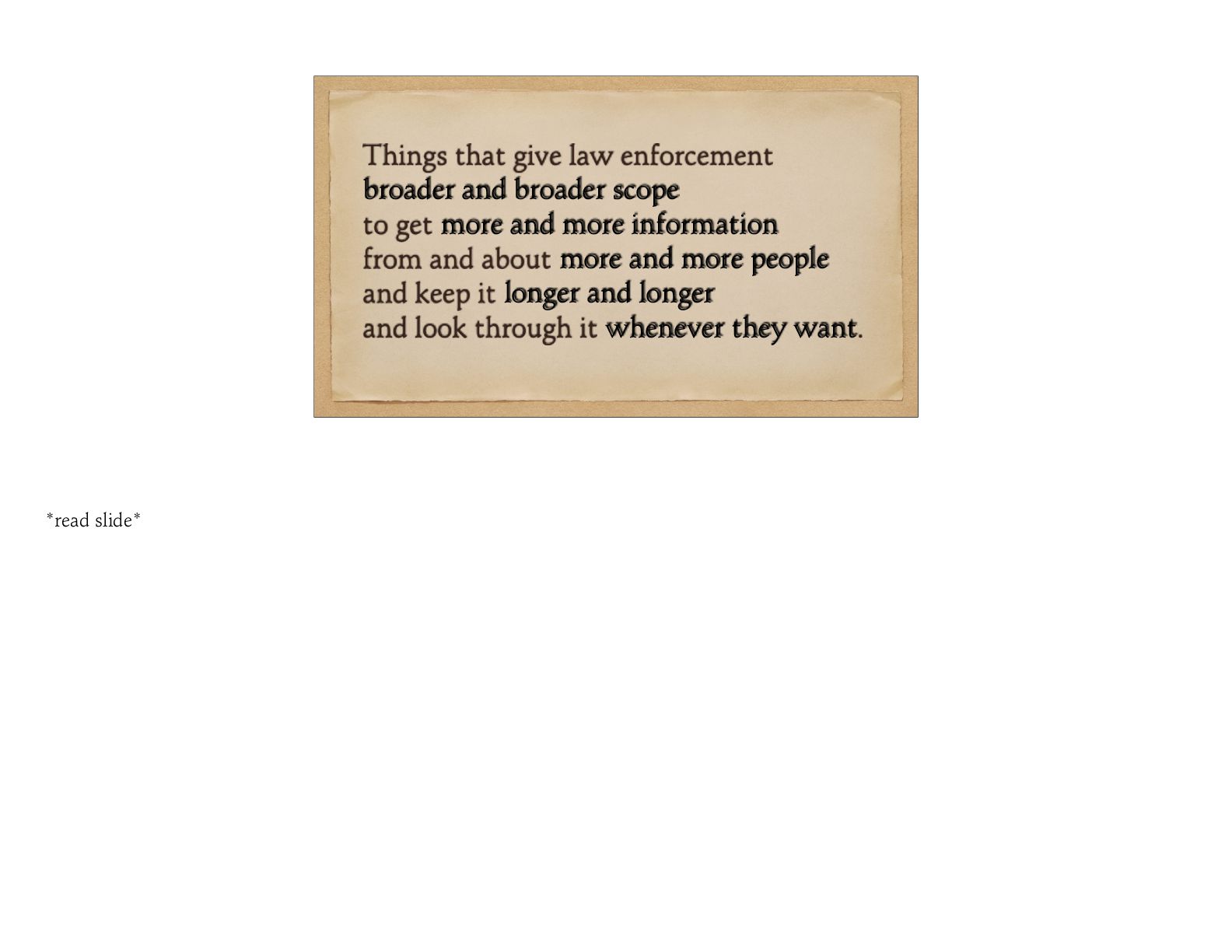
Things that give law enforcement broader and broader scope to
get more and more information from and about more and more people and keep it longer and longer and look through it whenever they want. *read slide* -
But wait! What about the practical limitations of surveillance? But
look, none of this really matters if we’re still in a Spy versus Spy world. There are still hard practical limits to how much surveillance a human being can do by themself! Yeah, well, those limitations are a thing of the past. What destroyed them, you ask? -
Mass surveillance through Big Data. That’s what happened. Mass surveillance
got easy, cheap… invisible, and broadly accepted. -
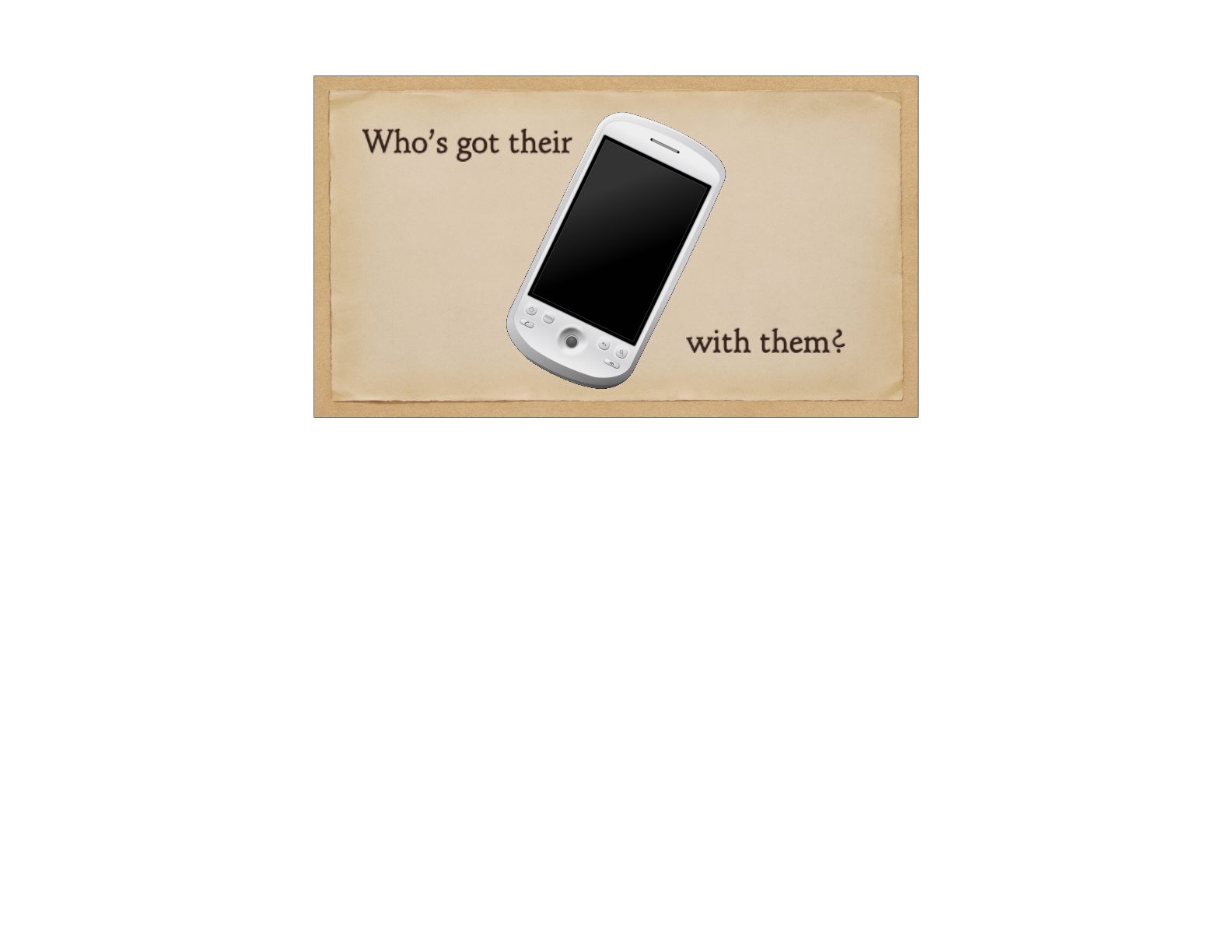
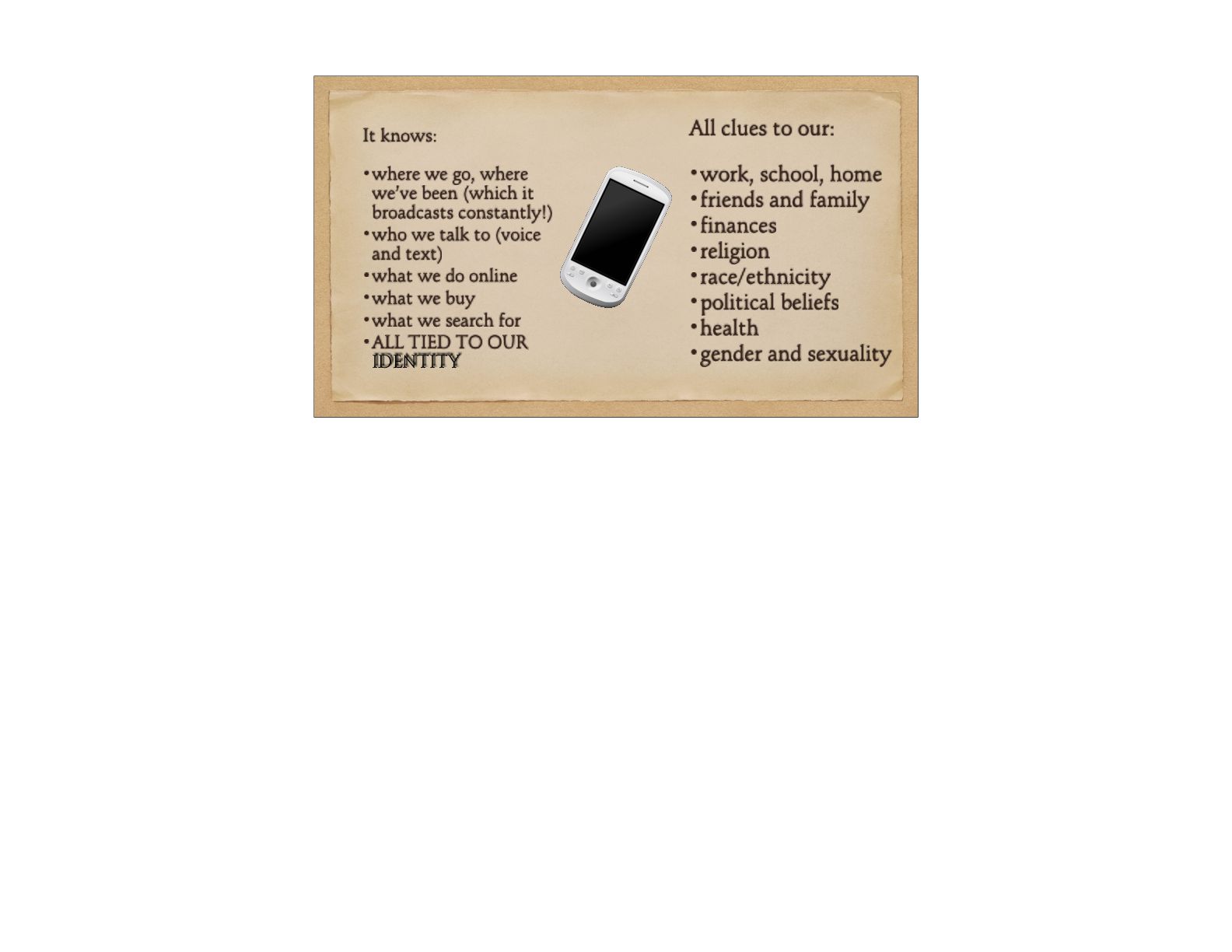
It knows: All clues to our: • where we go,
where • work, school, home we’ve been (which it broadcasts constantly!) • who we talk to (voice and text) • what we do online • what we buy • what we search for • ALL TIED TO OUR IDENTITY • friends and family • finances • religion • race/ethnicity • political beliefs • health • gender and sexuality -
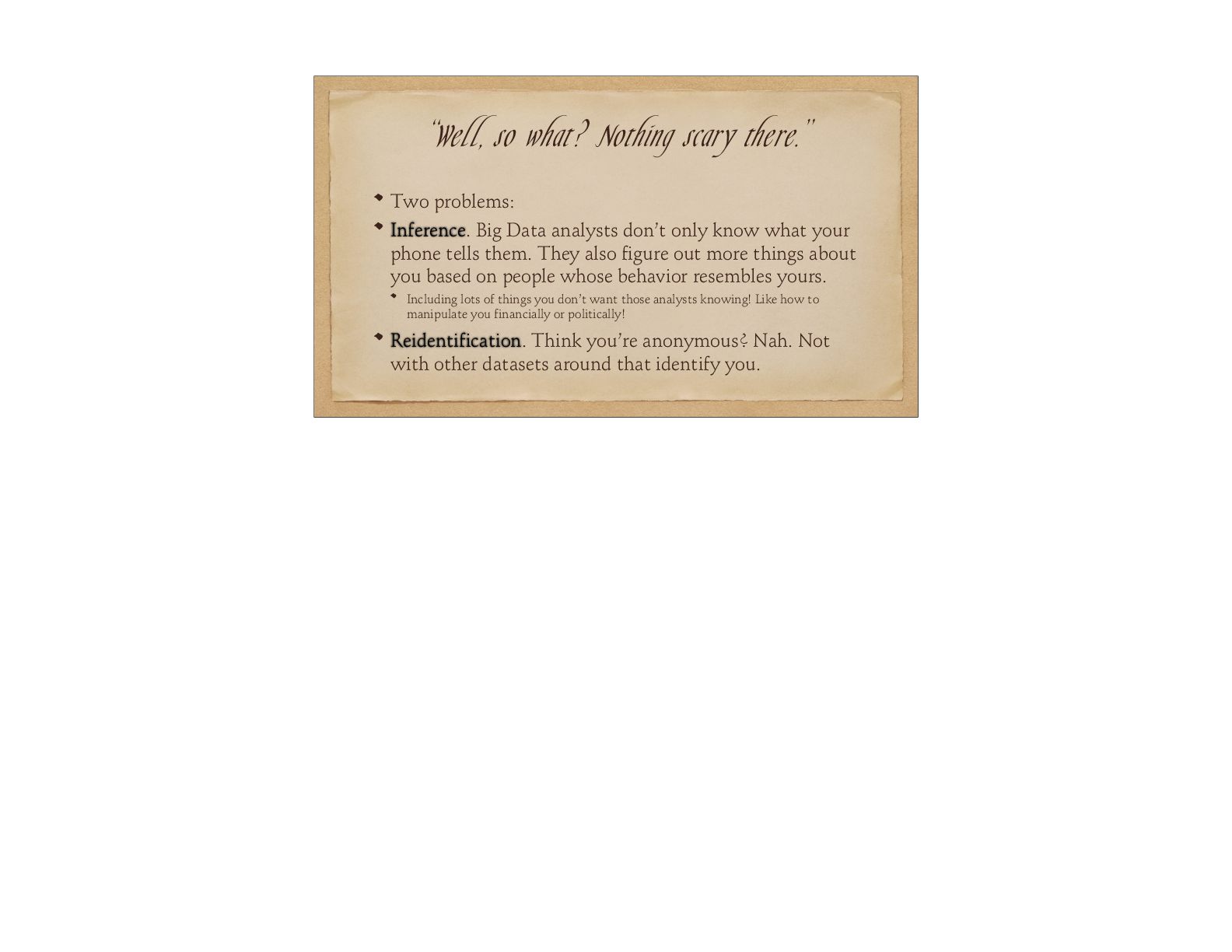
“Well, so what? Nothing scary there.” Two problems: Inference. Big
Data analysts don’t only know what your phone tells them. They also figure out more things about you based on people whose behavior resembles yours. Including lots of things you don’t want those analysts knowing! Like how to manipulate you financially or politically! Reidentification. Think you’re anonymous? Nah. Not with other datasets around that identify you. -
And that’s not all! Websites, and the ad networks they
work with, also know these things (often because they also get data from your phone). Your car, if it’s new enough, feeds data into this system. So does a new enough television or streaming gadget (Roku, Fire, whatever). So do video surveillance networks such as store surveillance video, home surveillance video (Ring), and Automated Licence Plate Readers (Flock, Axon). Oh, and police drones. -
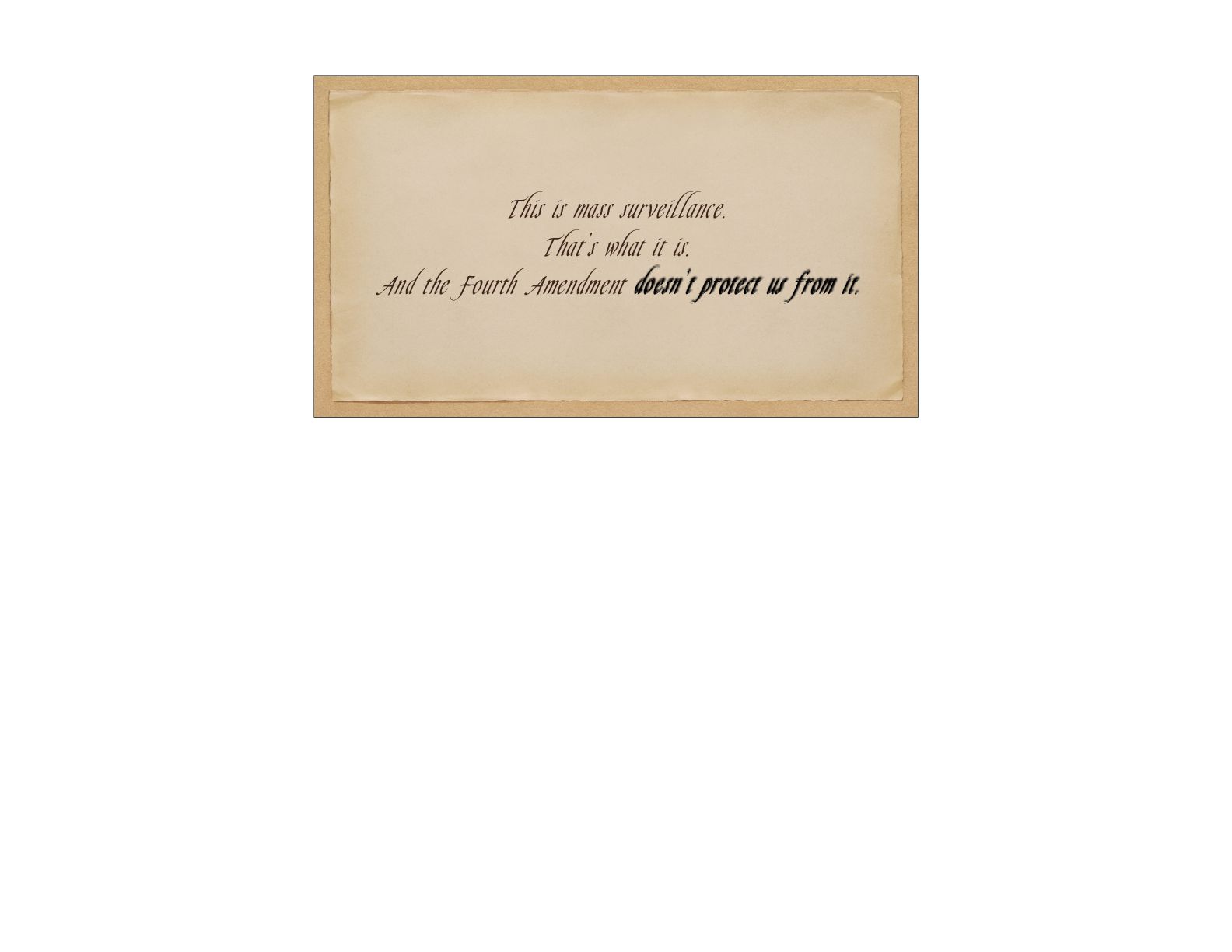
This is mass surveillance. That’s what it is. And the
Fourth Amendment doesn’t protect us from it. -
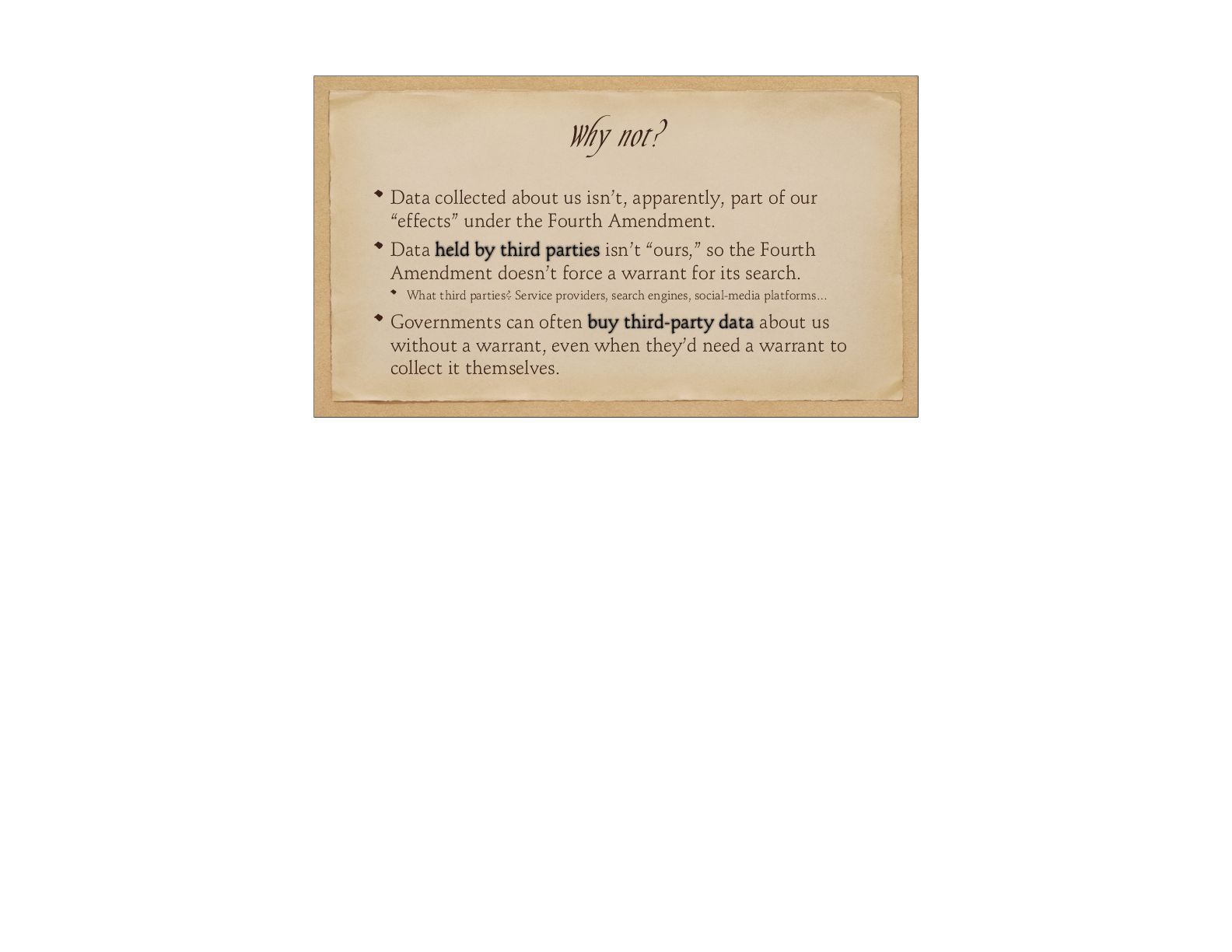
Why not? Data collected about us isn’t, apparently, part of
our “effects” under the Fourth Amendment. Data held by third parties isn’t “ours,” so the Fourth Amendment doesn’t force a warrant for its search. What third parties? Service providers, search engines, social-media platforms… Governments can often buy third-party data about us without a warrant, even when they’d need a warrant to collect it themselves. -
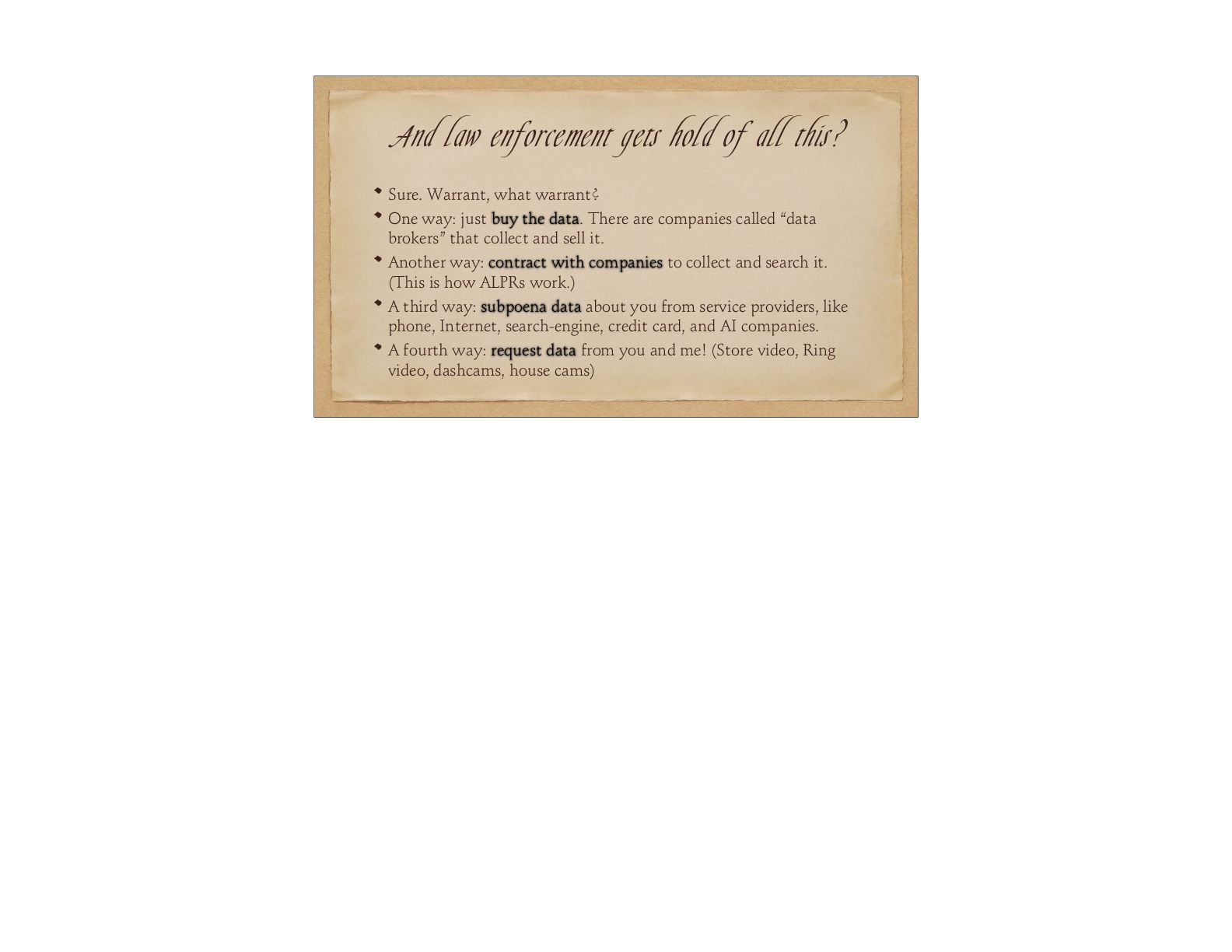
And law enforcement gets hold of all this? Sure. Warrant,
what warrant? One way: just buy the data. There are companies called “data brokers” that collect and sell it. Another way: contract with companies to collect and search it. (This is how ALPRs work.) A third way: subpoena data about you from service providers, like phone, Internet, search-engine, credit card, and AI companies. A fourth way: request data from you and me! (Store video, Ring video, dashcams, house cams) -
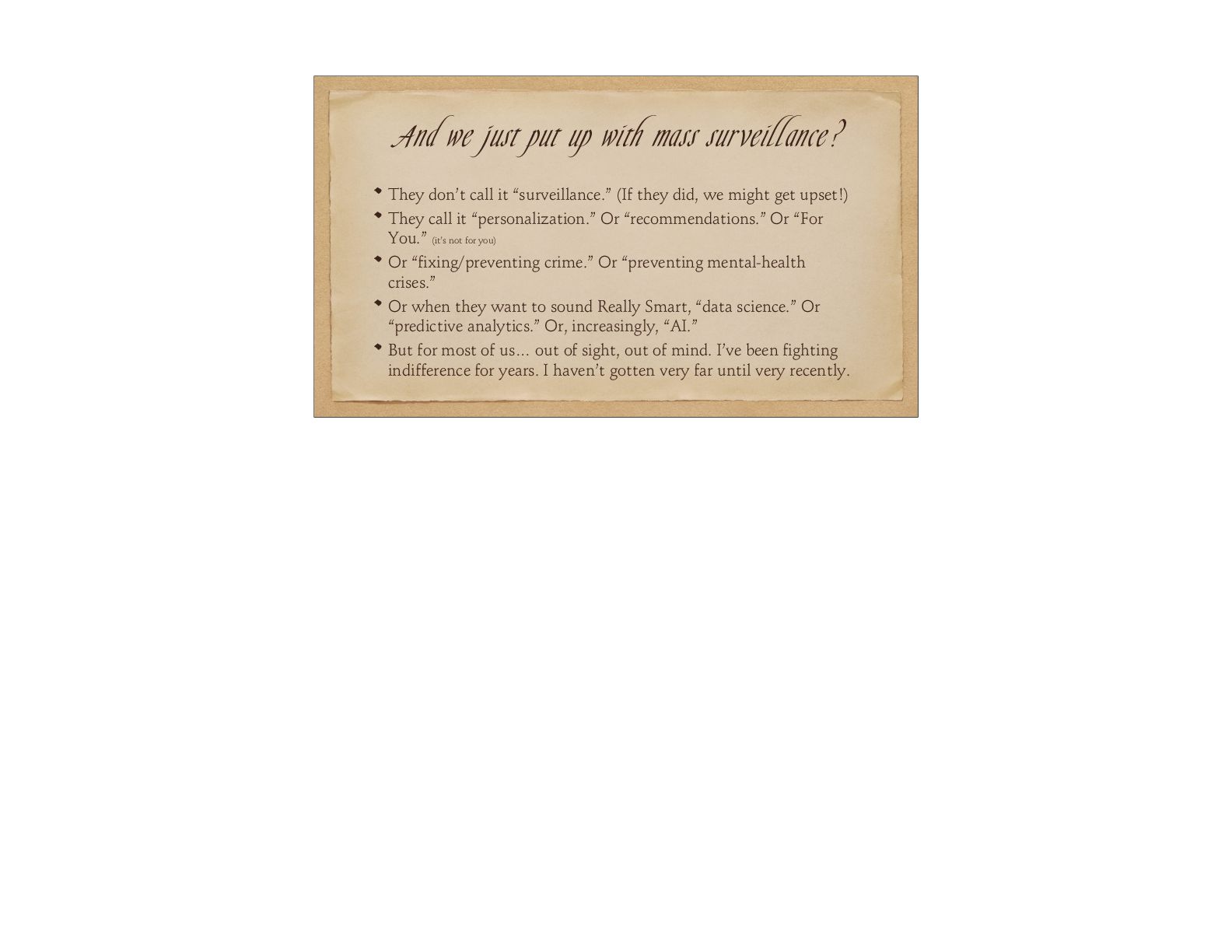
And we just put up with mass surveillance? They don’t
call it “surveillance.” (If they did, we might get upset!) They call it “personalization.” Or “recommendations.” Or “For You.” (it’s not for you) Or “fixing/preventing crime.” Or “preventing mental-health crises.” Or when they want to sound Really Smart, “data science.” Or “predictive analytics.” Or, increasingly, “AI.” But for most of us… out of sight, out of mind. I’ve been fighting indifference for years. I haven’t gotten very far until very recently. -
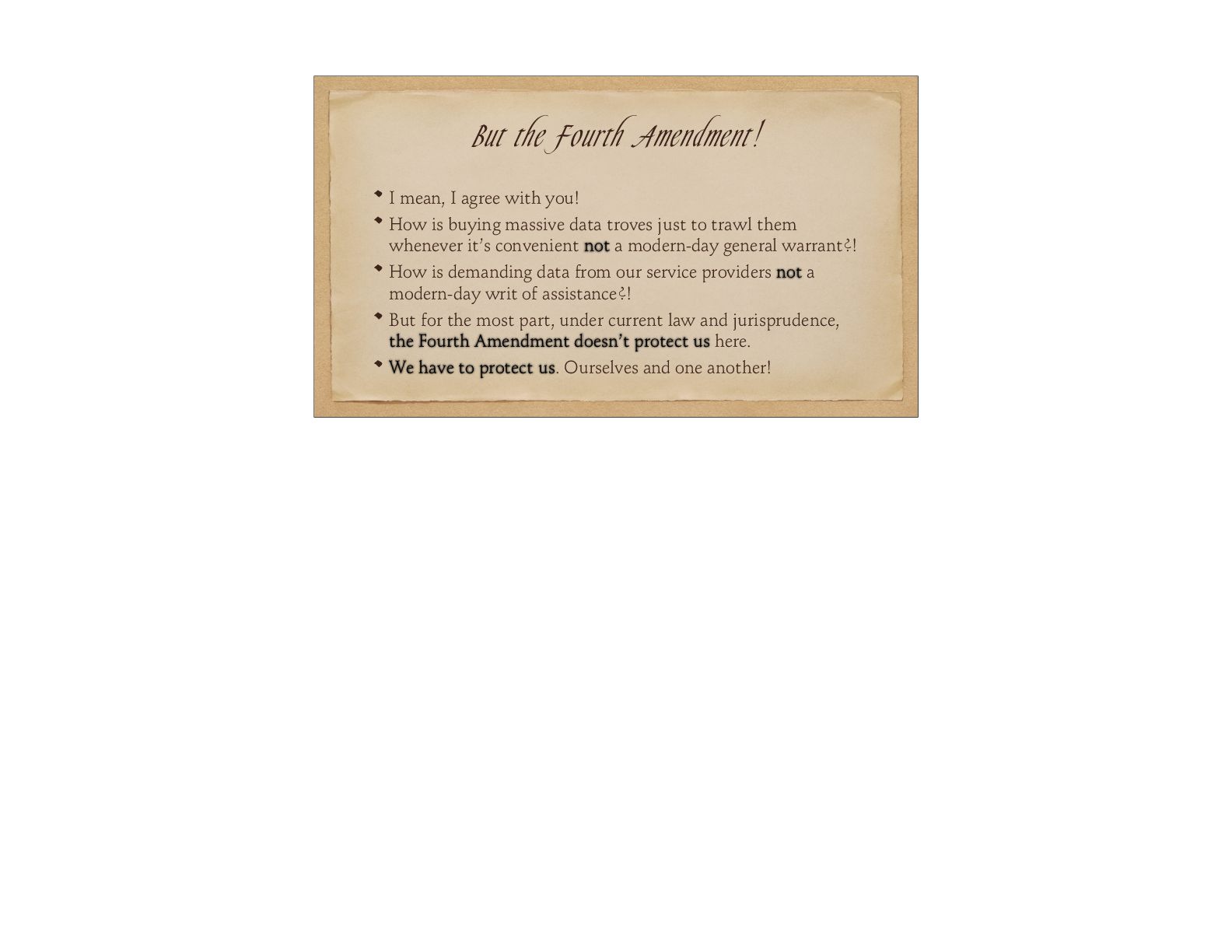
But the Fourth Amendment! I mean, I agree with you!
How is buying massive data troves just to trawl them whenever it’s convenient not a modern-day general warrant?! How is demanding data from our service providers not a modern-day writ of assistance?! But for the most part, under current law and jurisprudence, the Fourth Amendment doesn’t protect us here. We have to protect us. Ourselves and one another! -
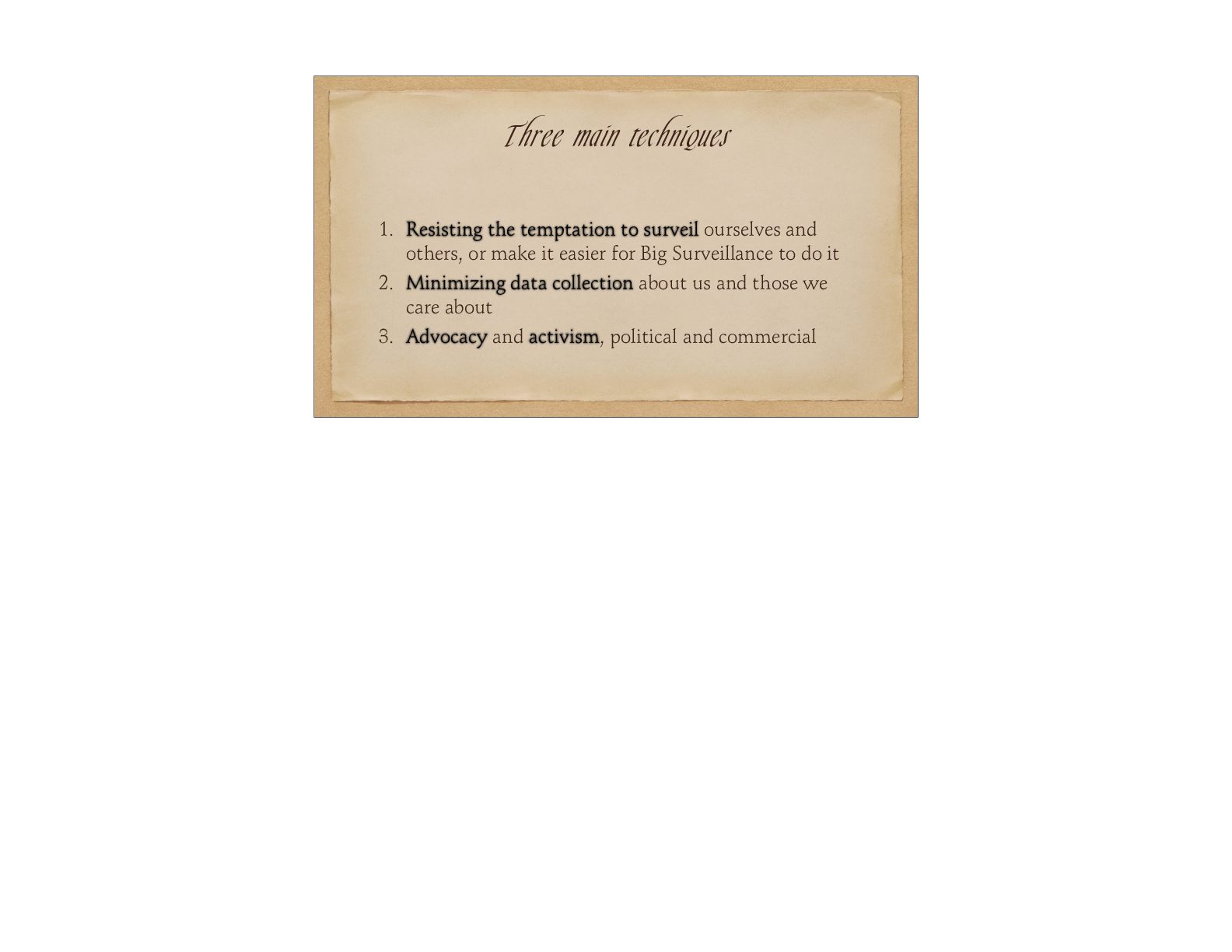
Three main techniques 1. Resisting the temptation to surveil ourselves
and others, or make it easier for Big Surveillance to do it 2. Minimizing data collection about us and those we care about 3. Advocacy and activism, political and commercial -
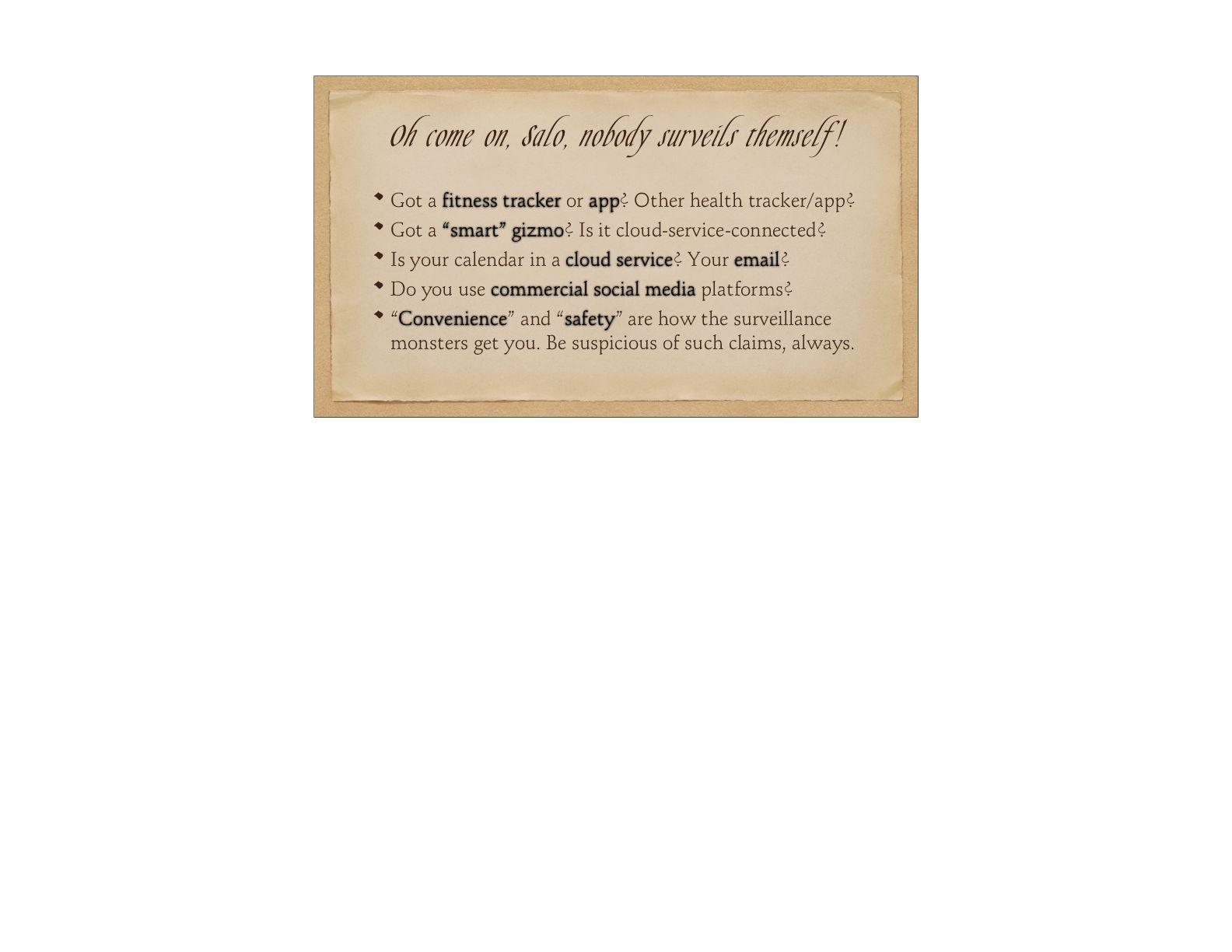
Oh come on, Salo, nobody surveils themself! Got a fitness
tracker or app? Other health tracker/app? Got a “smart” gizmo? Is it cloud-service-connected? Is your calendar in a cloud service? Your email? Do you use commercial social media platforms? “Convenience” and “safety” are how the surveillance monsters get you. Be suspicious of such claims, always. -
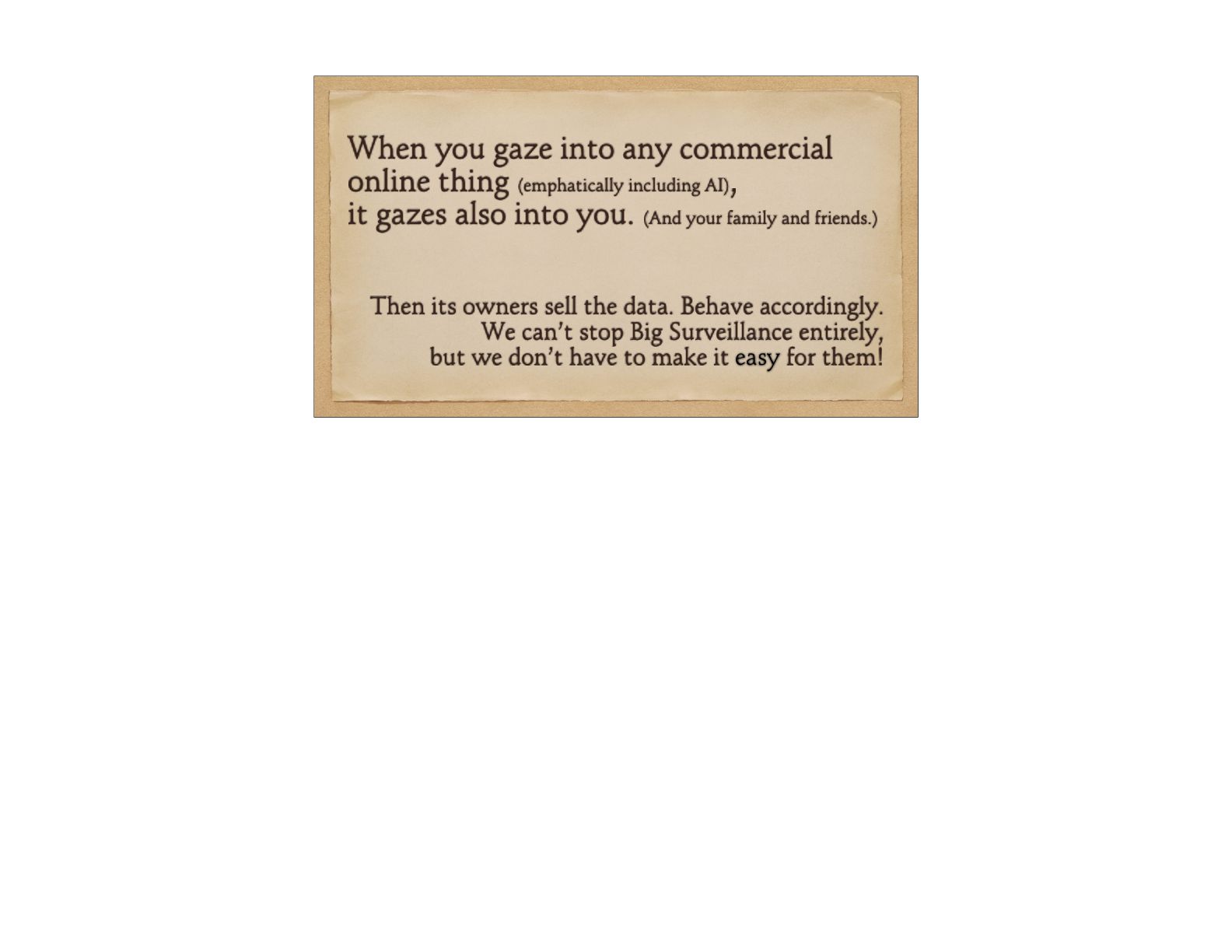
When you gaze into any commercial online thing (emphatically including
AI), it gazes also into you. (And your family and friends.) Then its owners sell the data. Behave accordingly. We can’t stop Big Surveillance entirely, but we don’t have to make it easy for them! -
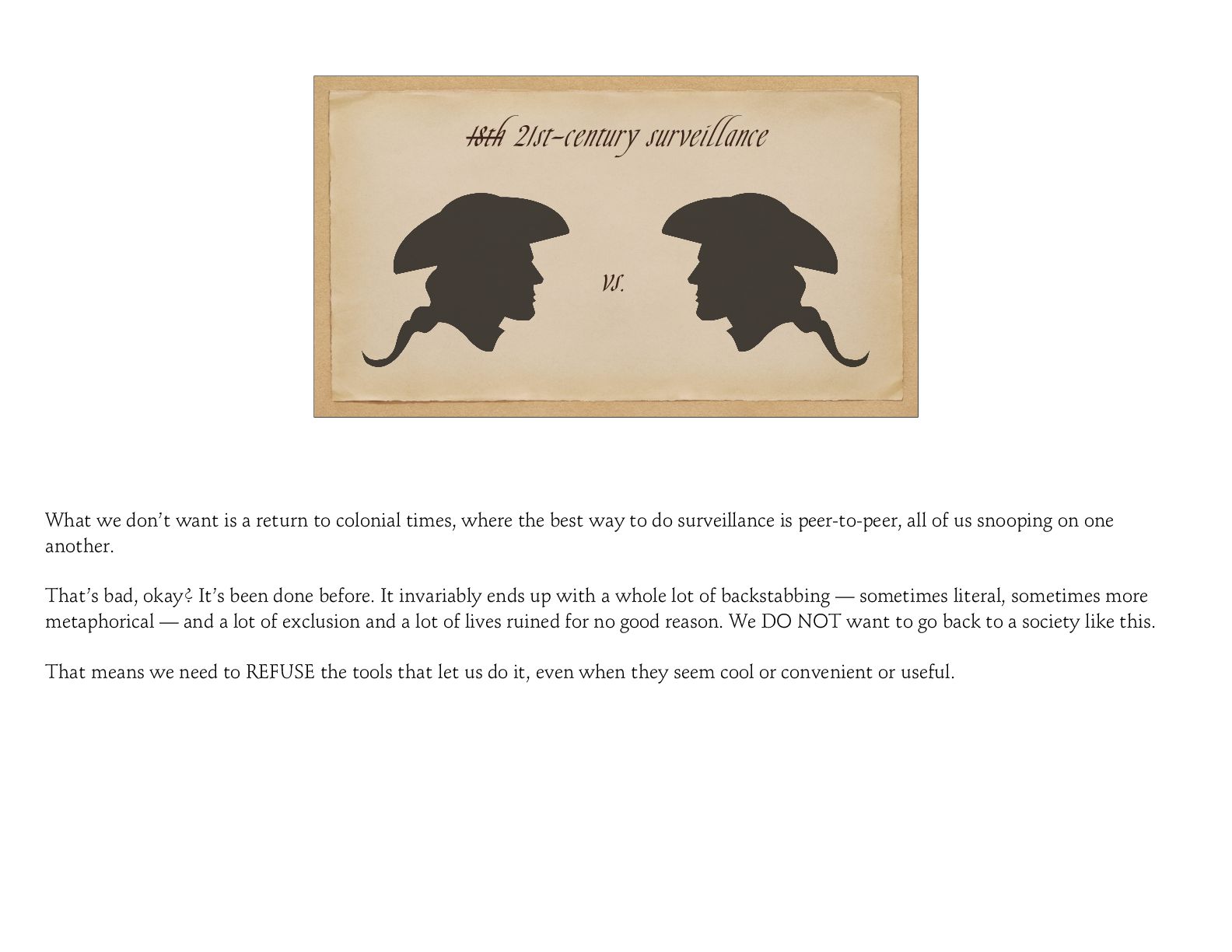
18th 21st-century surveillance vs. What we don’t want is a
return to colonial times, where the best way to do surveillance is peer-to-peer, all of us snooping on one another. That’s bad, okay? It’s been done before. It invariably ends up with a whole lot of backstabbing — sometimes literal, sometimes more metaphorical — and a lot of exclusion and a lot of lives ruined for no good reason. We DO NOT want to go back to a society like this. That means we need to REFUSE the tools that let us do it, even when they seem cool or convenient or useful. -
Refusing to surveil others Don’t automatically give cops data. Matter
of principle. If you walked into this room with pervert glasses or always-on audio/ transcription, who do you think you are?! Stop that! Don’t 24/7-track people in your life, either. (That’s stalking!) No, not even your children. Do them the respectful courtesy of negotiating check-ins. Use cameras and video, if you must, only when there’s a clear need, not just-in-case. And don’t use readymade cloud-service ones! Don’t pull in AI unless/until everybody agrees to it. Don’t do it just ’cuz. Another reason not to do these things: they let Big Surveillance say “everybody surveils, so surveillance must be okay!” That endangers us all. -
But I don’t know how! That’s okay. Nobody’s born knowing
how! (And Big Surveillance sure doesn’t want you to know there are ways to escape or at least cut down on it…) Great resource: Consumer Reports Security Planner Also good, if a bit overwhelming: EFF’s Security SelfDefense website Show what you learn to others. Each one teach one! -
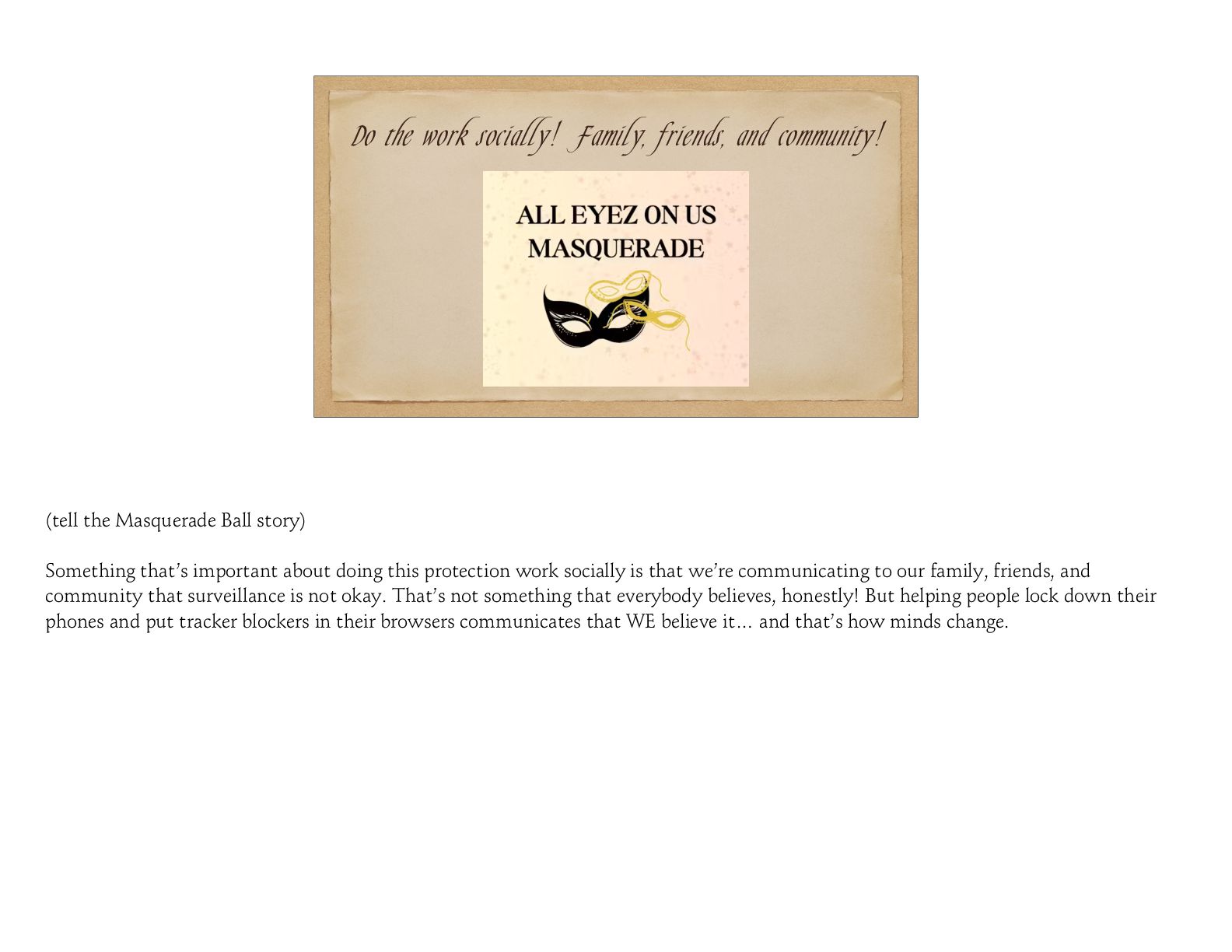
Do the work socially! Family, friends, and community! (tell the
Masquerade Ball story) Something that’s important about doing this protection work socially is that we’re communicating to our family, friends, and community that surveillance is not okay. That’s not something that everybody believes, honestly! But helping people lock down their phones and put tracker blockers in their browsers communicates that WE believe it… and that’s how minds change. -
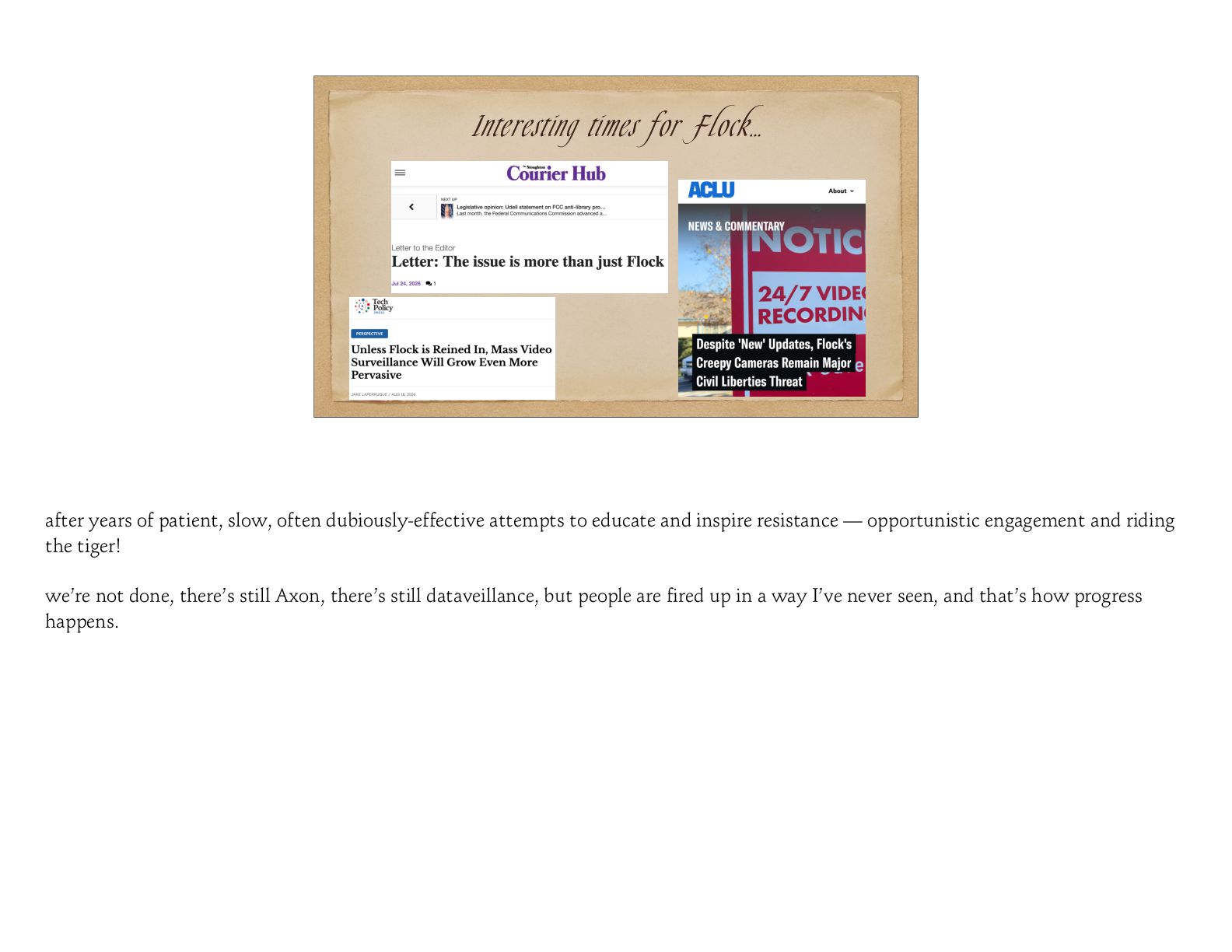
Interesting times for Flock… after years of patient, slow, often
dubiously-effective attempts to educate and inspire resistance — opportunistic engagement and riding the tiger! we’re not done, there’s still Axon, there’s still dataveillance, but people are fired up in a way I’ve never seen, and that’s how progress happens. -
Watch your school too! (I say this as someone who’s
had to fight the school I work in!) Schools, colleges, and universities are not immune to the temptations of surveillance and dataveillance. Watch them! Don’t let them get away with it! Watch out for: Surveillance for “safety” “Learning analytics” and “student success based on data.” Ask how much. Ask how long. Ask who has access. -
Tactics I suggest Don’t talk about privacy. Talk about surveillance
instead. I can’t expect privacy in a public place — look at you all looking at me! — but does that mean I’m supposed to expect surveillance?! I think very much not! Use this reframing. Build analogies on physical reality. Would we be okay with a cop on street corners recording IDs from everyone who passes by? Isn’t that exactly what an ALPR does? (Credit: Center for Democracy and Technology) Connect individual flashpoints to the bigger picture. Is Flock the sole problem with ALPRs? Of course not! But Flock has name recognition, so exploit that for all it’s worth, then expand the conversation. Educate. Educate. Educate. And celebrate every win. coming from someone who’s done this work for a very long time… -
Thank you! And be (as) safe (as you can) out
there. Dorothea Salo Information School University of Wisconsin-Madison
 dsalo
 signer
 ainischool
 pawan_pharm
 yatabe
 baltimoreniso
 hiola
 rashwhitman
 adeputra13
 jct
 tapps
 coloredviolet
 bermonpainter
 lara
 honnibal
 skipperchong
 baasie
 davetheseo
 tmiket
 katarinadahlin
 techseoconnect