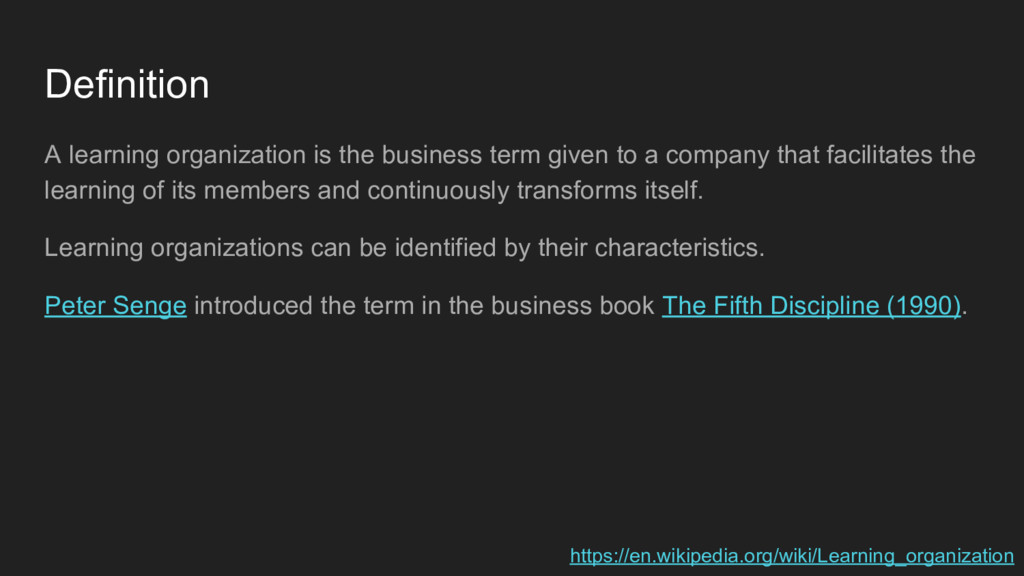
a company that facilitates the learning of its members and continuously transforms itself. Learning organizations can be identified by their characteristics. Peter Senge introduced the term in the business book The Fifth Discipline (1990). https://en.wikipedia.org/wiki/Learning_organization
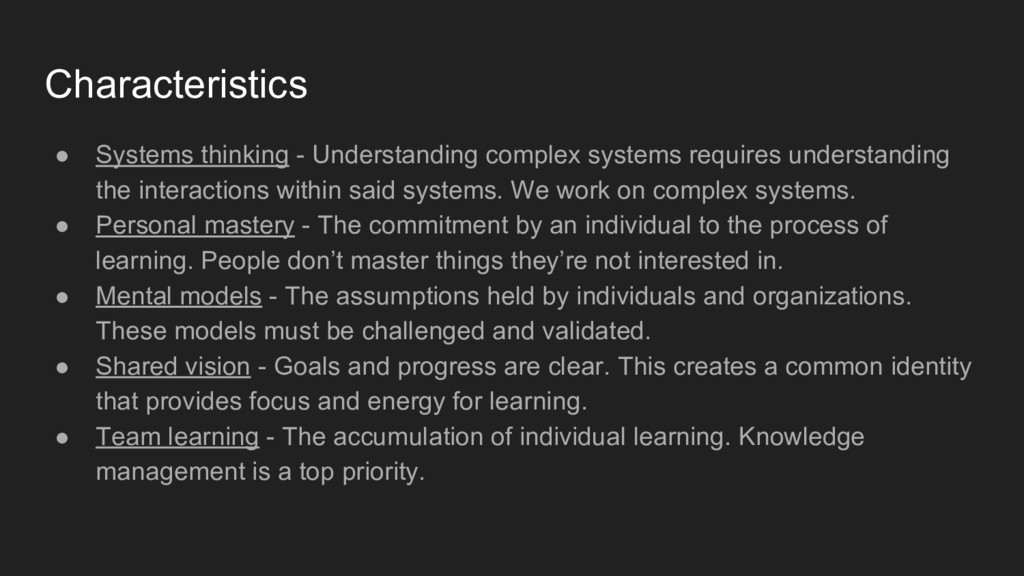
the interactions within said systems. We work on complex systems. • Personal mastery - The commitment by an individual to the process of learning. People don’t master things they’re not interested in. • Mental models - The assumptions held by individuals and organizations. These models must be challenged and validated. • Shared vision - Goals and progress are clear. This creates a common identity that provides focus and energy for learning. • Team learning - The accumulation of individual learning. Knowledge management is a top priority.
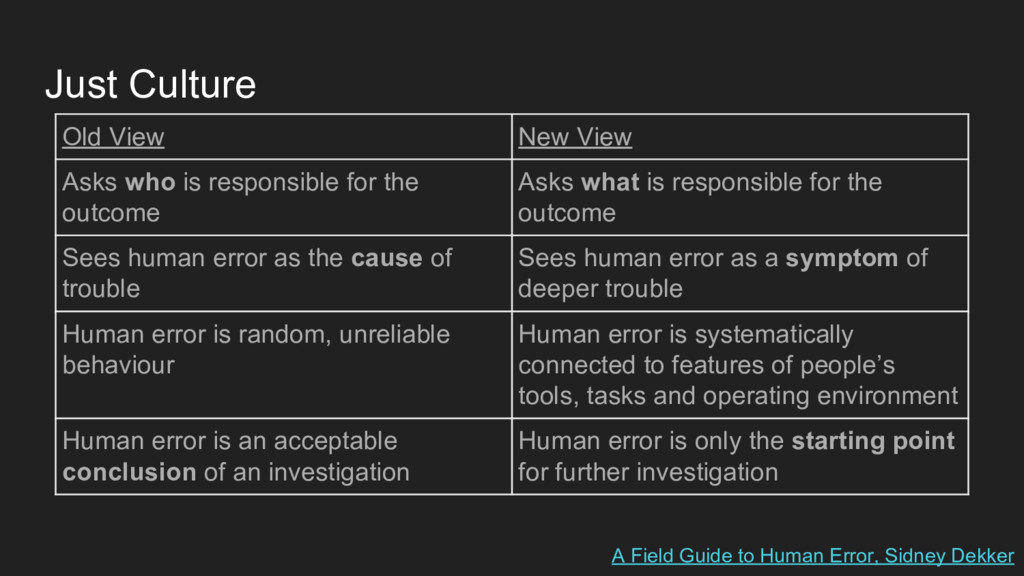
for the outcome Asks what is responsible for the outcome Sees human error as the cause of trouble Sees human error as a symptom of deeper trouble Human error is random, unreliable behaviour Human error is systematically connected to features of people’s tools, tasks and operating environment Human error is an acceptable conclusion of an investigation Human error is only the starting point for further investigation A Field Guide to Human Error, Sidney Dekker
implement learning organizations. Organizations that prioritize learning are better places to work and outperform those who do not. The annual Puppet Labs State of DevOps Report (2016), along with many other sources, show this with lots and lots of data. Agile, Cloud, DevOps. Just words. “You can't buy DevOps, but you may need to sell it” @kmugrage, presentation at DevOpsDays Denver 2017


 dustinmm80
 yamanoku
 iktakahiro
 takuroabe
 takanorip
 yazm
 nealle
 raspython3
 shogo4131
 sh_fk2
 yuuuuuuu168
 grimoh
 gogutan
 leimatthew05
 tammyeverts
 shpigford
 rakko
 seathinner
 apolaine
 jdejongh
 jonoalderson
 sugarenia
 katarinadahlin
 aleyda
 retrage