Upgrade to PRO for Only $50/Year—Limited-Time Offer! 🔥

FY 2024: MDC 20 - Alcohol-Drug use and Alcohol...

Avatar for e4health e4health PRO
April 04, 2024
150

FY 2024: MDC 20 - Alcohol-Drug use and Alcohol-Drug Induced Organic Mental Disorders

Avatar for e4health

e4health PRO

April 04, 2024
Tweet

Transcript

  1. H I M | C O D I N G

    & C D I | H E A LT H I T | R E V C Y C L E Empowering Better Health e4health tackles healthcare’s data, quality and revenue challenges empowering your providers to focus on better care.
  2. Objectives • Review MDC 20- Alcohol/Drug Use & Alcohol/Drug Induced

    Organic Mental Disorders with a focus on selected diagnoses and procedures • Learner will acquire a basic understanding of the diagnoses and procedures included in MDC-20 • Discuss Query opportunities in MDC-20 • Review coding clinics relevant to the chosen topics in each DRG
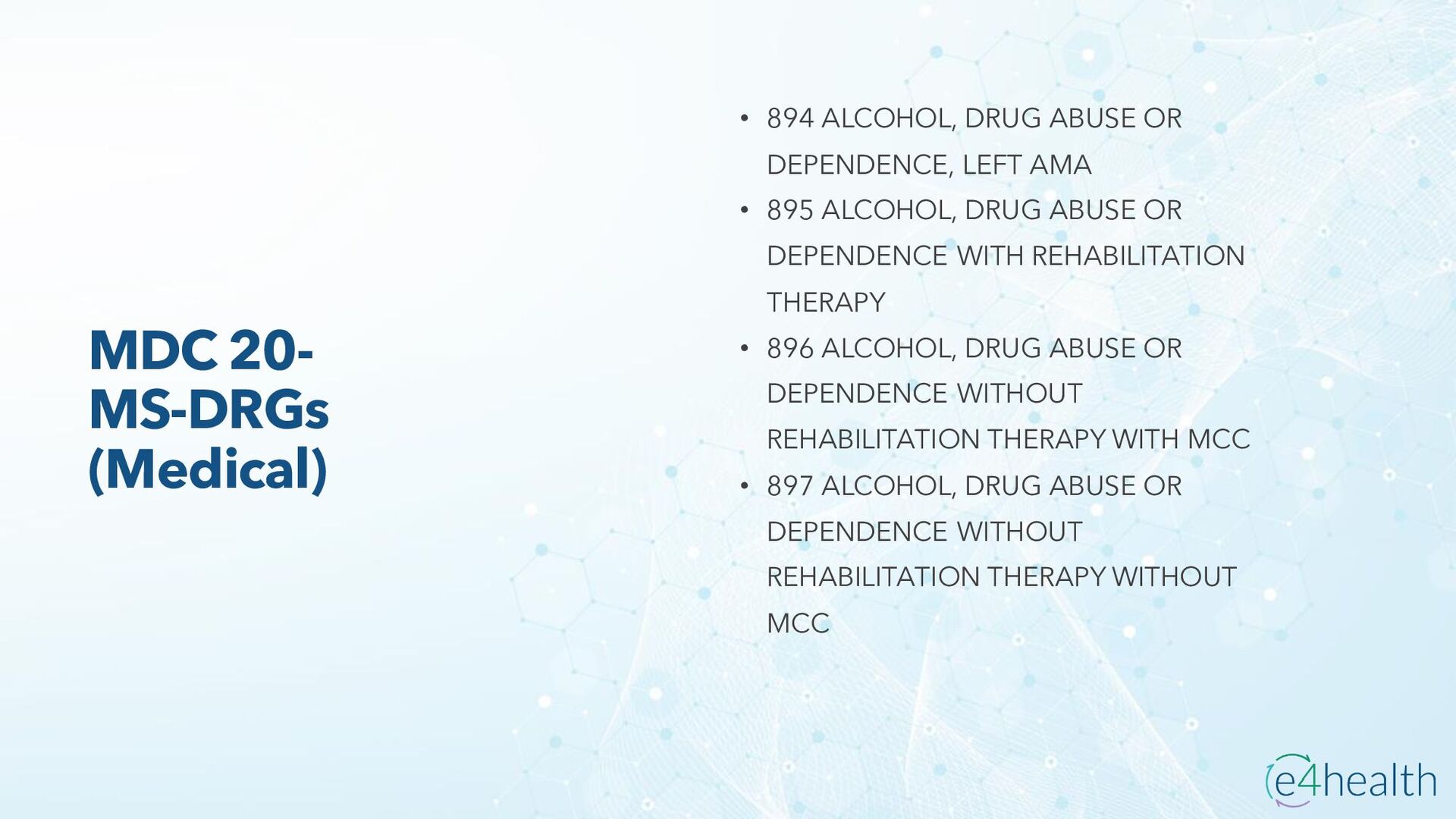
  3. MDC 20- MS-DRGs (Medical) • 894 ALCOHOL, DRUG ABUSE OR

    DEPENDENCE, LEFT AMA • 895 ALCOHOL, DRUG ABUSE OR DEPENDENCE WITH REHABILITATION THERAPY • 896 ALCOHOL, DRUG ABUSE OR DEPENDENCE WITHOUT REHABILITATION THERAPY WITH MCC • 897 ALCOHOL, DRUG ABUSE OR DEPENDENCE WITHOUT REHABILITATION THERAPY WITHOUT MCC
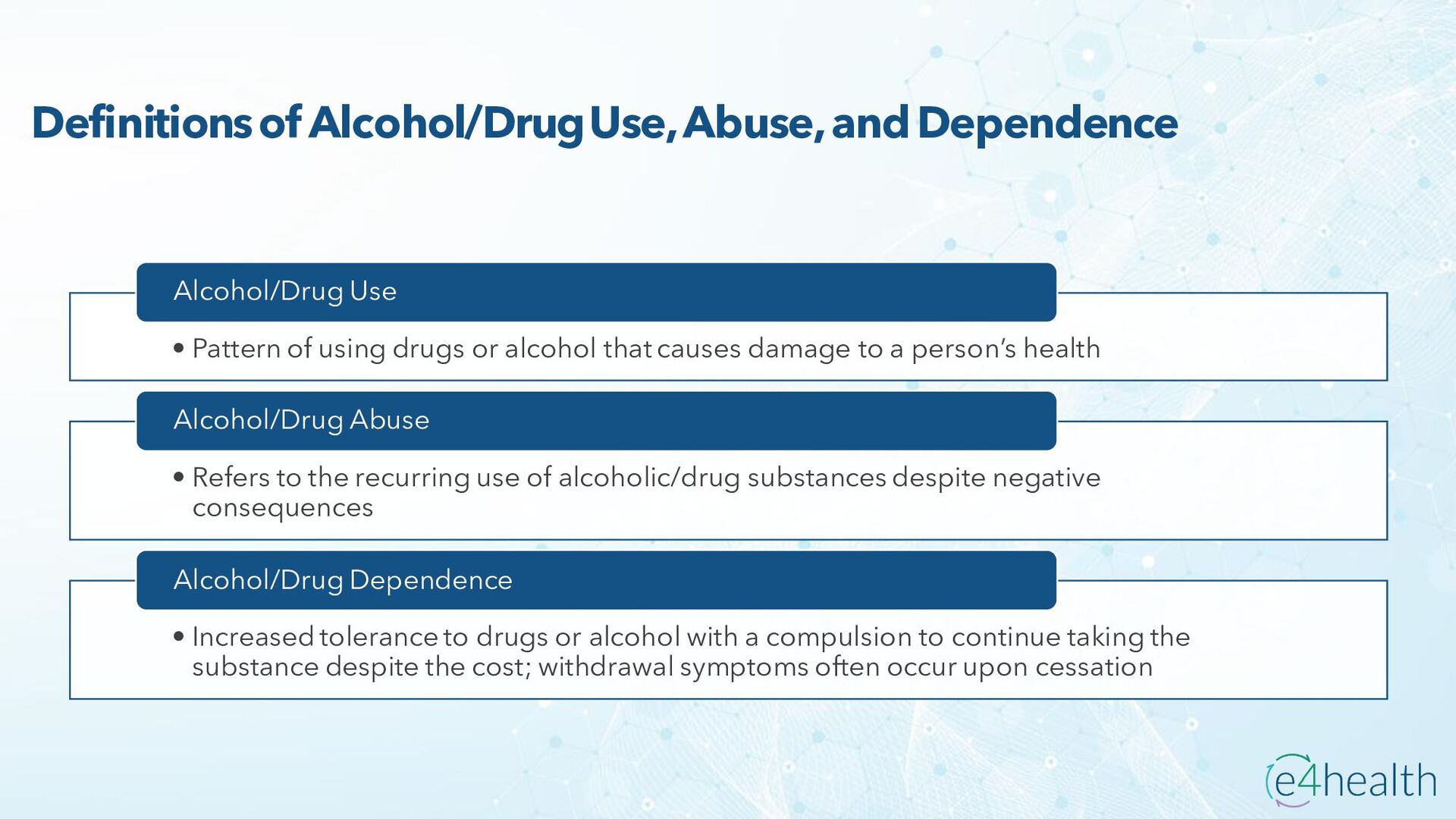
  4. Definitions of Alcohol/Drug Use, Abuse, and Dependence • Pattern of

    using drugs or alcohol that causes damage to a person’s health Alcohol/Drug Use • Refers to the recurring use of alcoholic/drug substances despite negative consequences Alcohol/Drug Abuse • Increased tolerance to drugs or alcohol with a compulsion to continue taking the substance despite the cost; withdrawal symptoms often occur upon cessation Alcohol/Drug Dependence
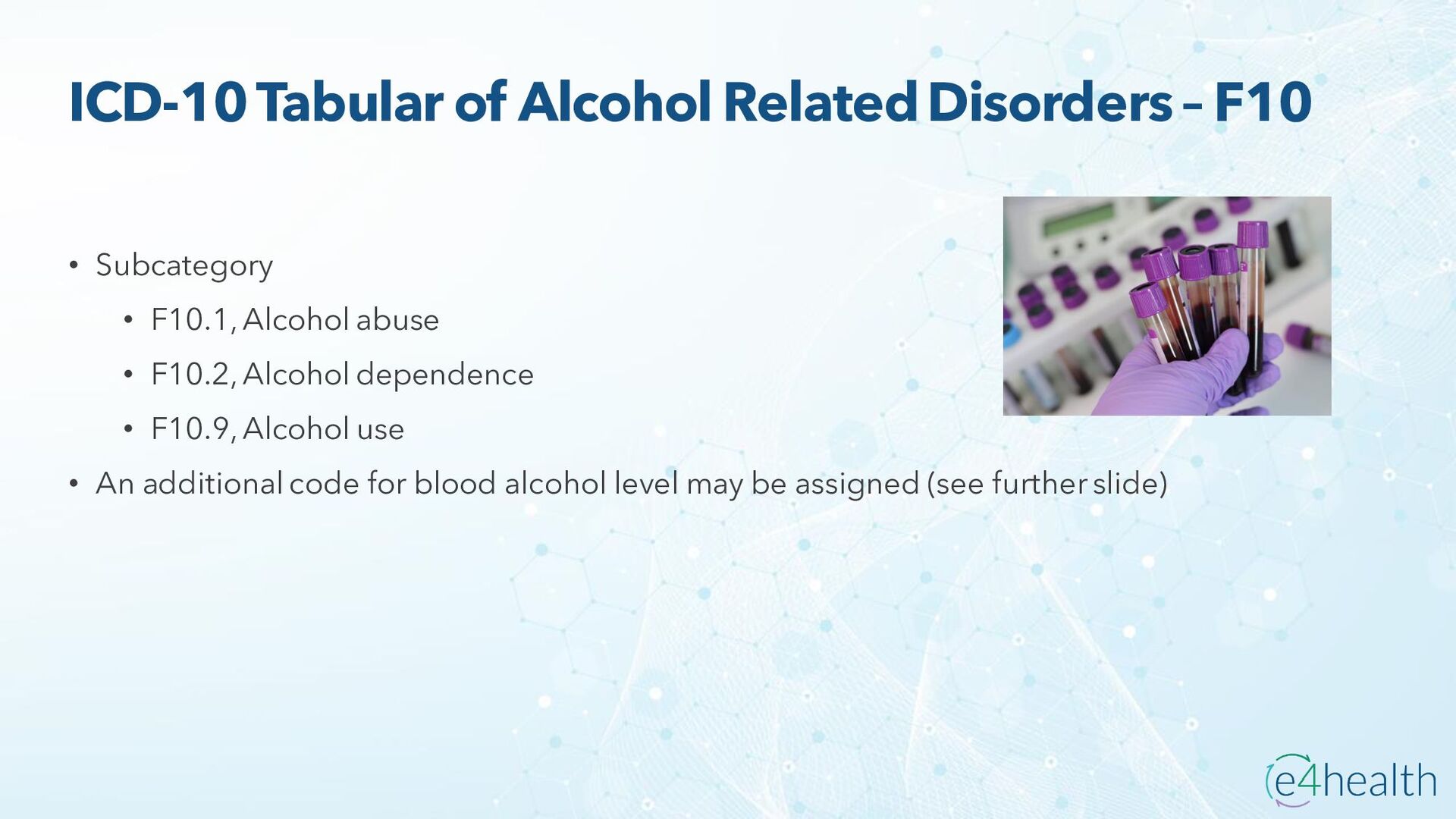
  5. ICD-10 Tabular of Alcohol Related Disorders – F10 • Subcategory

    • F10.1, Alcohol abuse • F10.2, Alcohol dependence • F10.9, Alcohol use • An additional code for blood alcohol level may be assigned (see further slide)
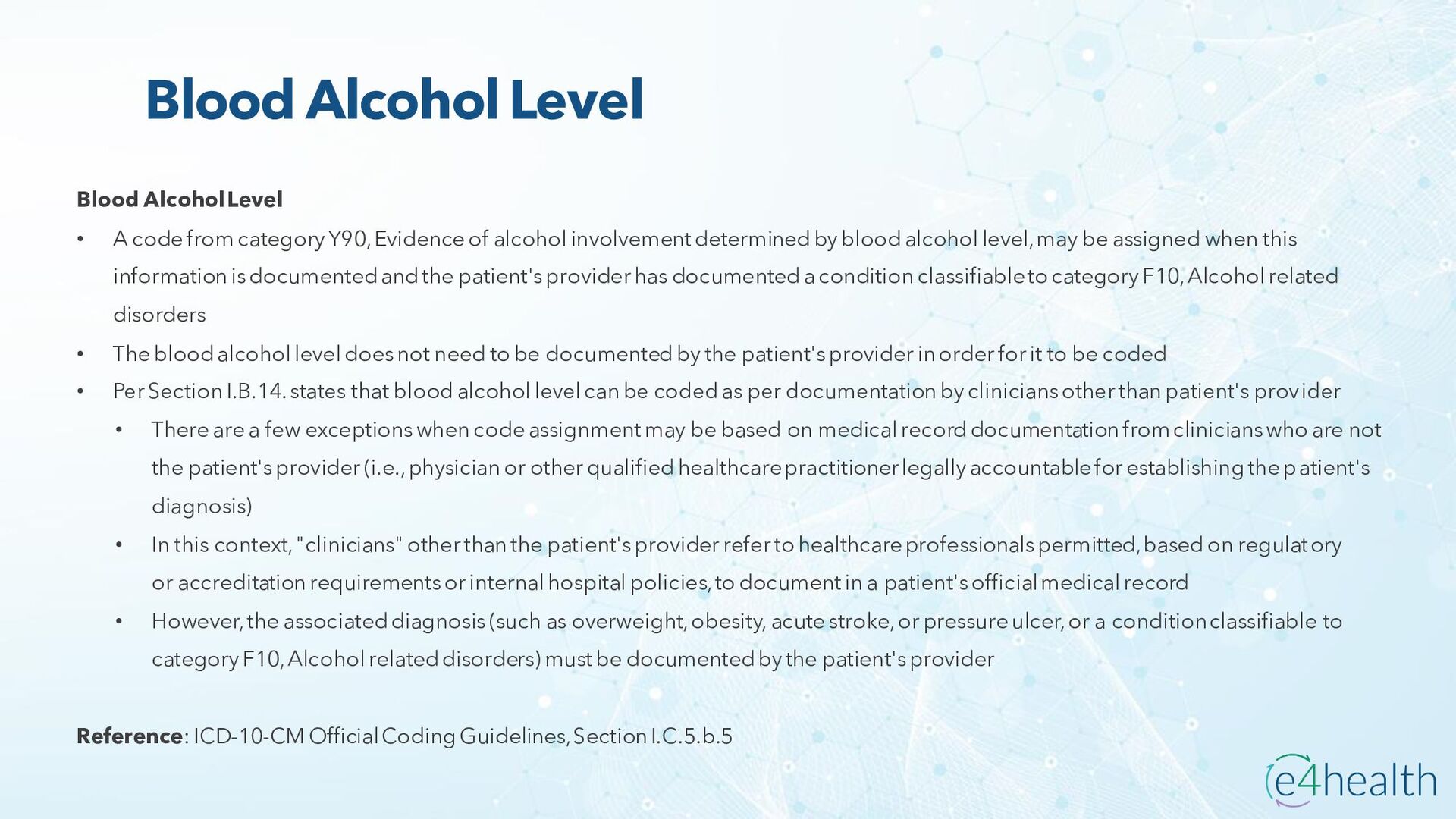
  6. Blood Alcohol Level Blood Alcohol Level • A code from

    category Y90, Evidence of alcohol involvement determined by blood alcohol level, may be assigned when this information is documented and the patient's provider has documented a condition classifiable to category F10, Alcohol related disorders • The blood alcohol level does not need to be documented by the patient's provider in order for it to be coded • Per Section I.B.14. states that blood alcohol level can be coded as per documentation by clinicians other than patient's provider • There are a few exceptions when code assignment may be based on medical record documentation from clinicians who are not the patient's provider (i.e., physician or other qualified healthcare practitioner legally accountable for establishing the patient's diagnosis) • In this context, "clinicians" other than the patient's provider refer to healthcare professionals permitted, based on regulatory or accreditation requirements or internal hospital policies, to document in a patient's official medical record • However, the associated diagnosis (such as overweight, obesity, acute stroke, or pressure ulcer, or a condition classifiable to category F10, Alcohol related disorders) must be documented by the patient's provider Reference: ICD-10-CM Official Coding Guidelines, Section I.C.5.b.5
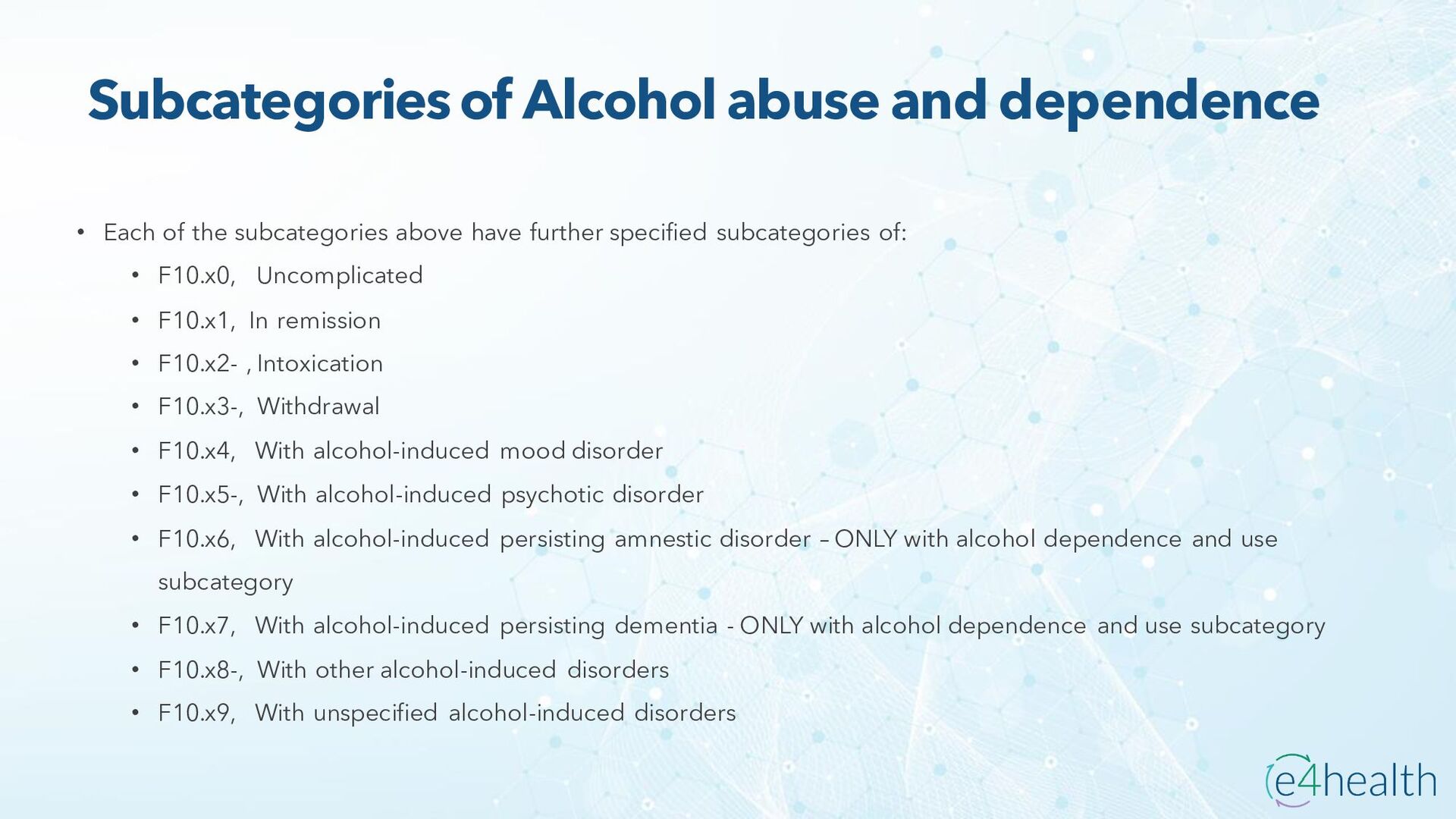
  7. Subcategories of Alcohol abuse and dependence • Each of the

    subcategories above have further specified subcategories of: • F10.x0, Uncomplicated • F10.x1, In remission • F10.x2- , Intoxication • F10.x3-, Withdrawal • F10.x4, With alcohol-induced mood disorder • F10.x5-, With alcohol-induced psychotic disorder • F10.x6, With alcohol-induced persisting amnestic disorder – ONLY with alcohol dependence and use subcategory • F10.x7, With alcohol-induced persisting dementia - ONLY with alcohol dependence and use subcategory • F10.x8-, With other alcohol-induced disorders • F10.x9, With unspecified alcohol-induced disorders
  8. Nuances of F10 subcategories The sixth character within subcategories of

    Abuse WITH Withdrawal as well as Dependence WITH Withdrawal provides additional detail regarding withdrawal symptoms, such as delirium or perceptual disturbances Assigning Withdrawal with alcohol Abuse, F10.1xx •F10.130, Alcohol abuse with withdrawal, uncomplicated •F10.131, Alcohol abuse with withdrawal delirium •F10.132, Alcohol abuse with withdrawal with perceptual disturbance •F10139, Alcohol abuse with withdrawal, unspecified Assigning Withdrawal with alcohol Dependence, F10.2xx •F10.230, Alcohol abuse with withdrawal, uncomplicated •F10.231, Alcohol abuse with withdrawal delirium •F10.232, Alcohol abuse with withdrawal with perceptual disturbance •F10.239, Alcohol abuse with withdrawal, unspecified
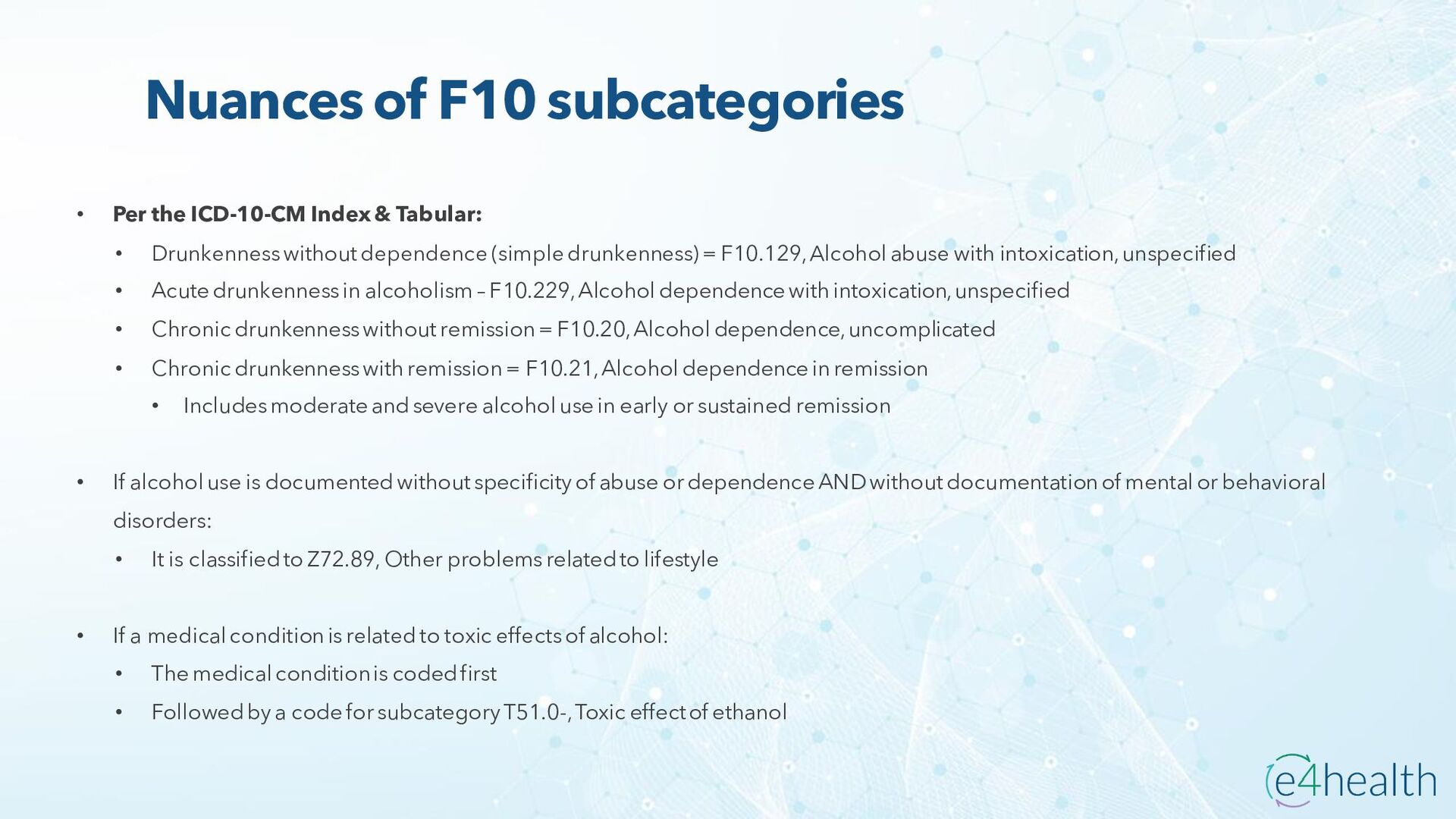
  9. Nuances of F10 subcategories • Per the ICD-10-CM Index &

    Tabular: • Drunkenness without dependence (simple drunkenness) = F10.129, Alcohol abuse with intoxication, unspecified • Acute drunkenness in alcoholism – F10.229, Alcohol dependence with intoxication, unspecified • Chronic drunkenness without remission = F10.20, Alcohol dependence, uncomplicated • Chronic drunkenness with remission = F10.21, Alcohol dependence in remission • Includes moderate and severe alcohol use in early or sustained remission • If alcohol use is documented without specificity of abuse or dependence AND without documentation of mental or behavioral disorders: • It is classified to Z72.89, Other problems related to lifestyle • If a medical condition is related to toxic effects of alcohol: • The medical condition is coded first • Followed by a code for subcategory T51.0-, Toxic effect of ethanol
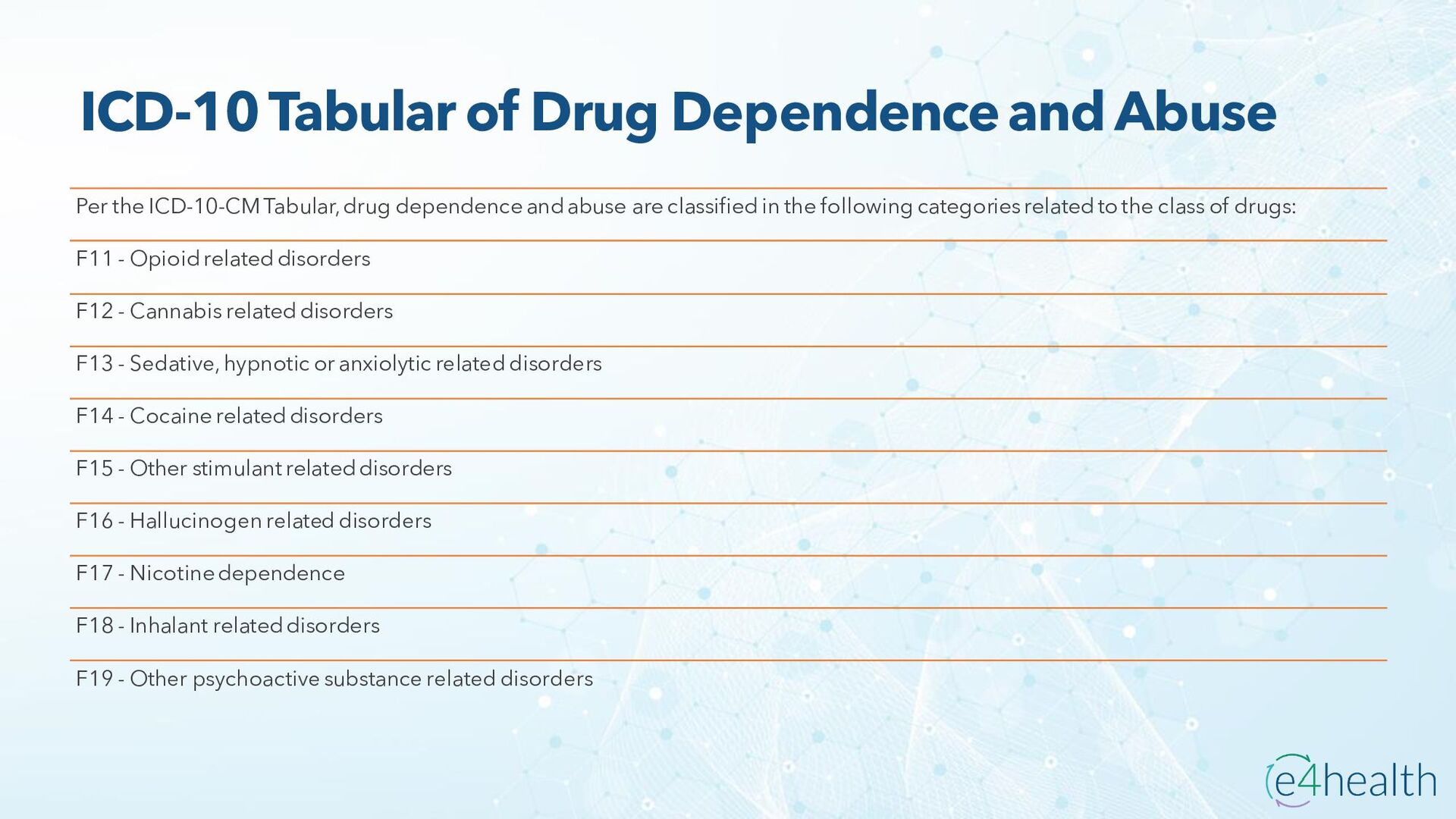
  10. ICD-10 Tabular of Drug Dependence and Abuse Per the ICD-10-CM

    Tabular, drug dependence and abuse are classified in the following categories related to the class of drugs: F11 - Opioid related disorders F12 - Cannabis related disorders F13 - Sedative, hypnotic or anxiolytic related disorders F14 - Cocaine related disorders F15 - Other stimulant related disorders F16 - Hallucinogen related disorders F17 - Nicotine dependence F18 - Inhalant related disorders F19 - Other psychoactive substance related disorders
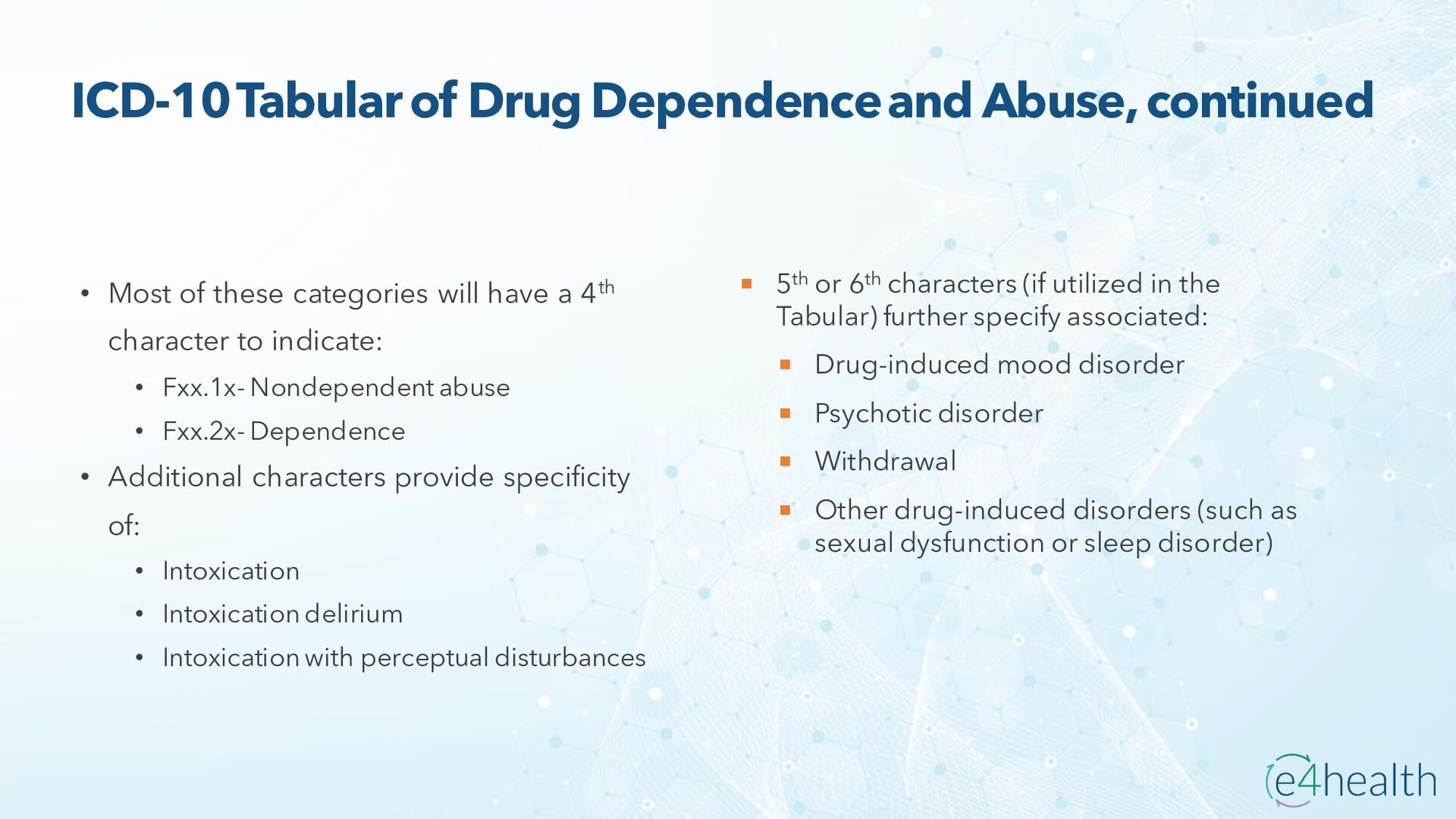
  11. ICD-10 Tabular of Drug Dependence and Abuse, continued • Most

    of these categories will have a 4th character to indicate: • Fxx.1x- Nondependent abuse • Fxx.2x- Dependence • Additional characters provide specificity of: • Intoxication • Intoxication delirium • Intoxication with perceptual disturbances  5th or 6th characters (if utilized in the Tabular) further specify associated:  Drug-induced mood disorder  Psychotic disorder  Withdrawal  Other drug-induced disorders (such as sexual dysfunction or sleep disorder)
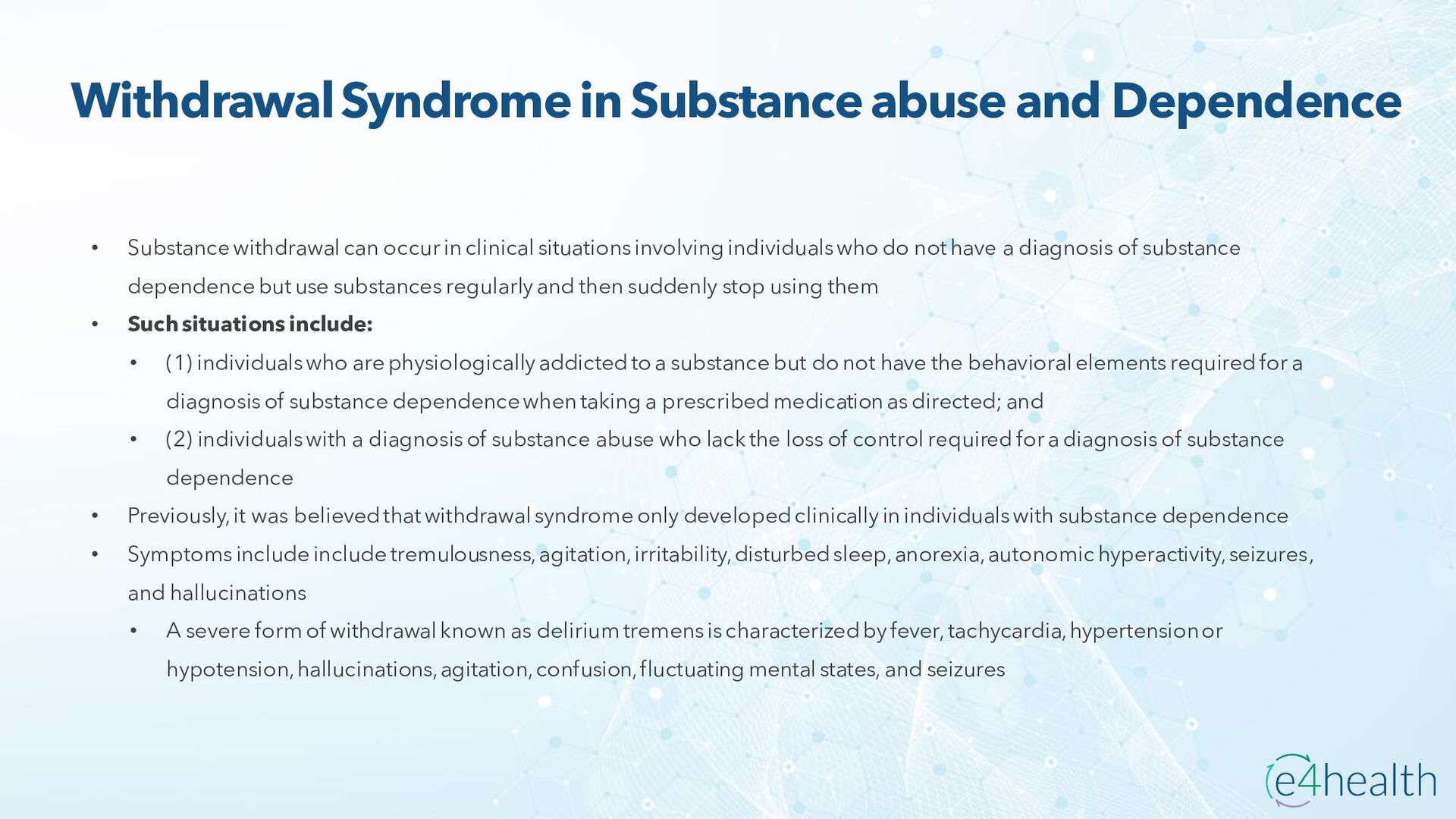
  12. Withdrawal Syndrome in Substance abuse and Dependence • Substance withdrawal

    can occur in clinical situations involving individuals who do not have a diagnosis of substance dependence but use substances regularly and then suddenly stop using them • Such situations include: • (1) individuals who are physiologically addicted to a substance but do not have the behavioral elements required for a diagnosis of substance dependence when taking a prescribed medication as directed; and • (2) individuals with a diagnosis of substance abuse who lack the loss of control required for a diagnosis of substance dependence • Previously, it was believed that withdrawal syndrome only developed clinically in individuals with substance dependence • Symptoms include include tremulousness, agitation, irritability, disturbed sleep, anorexia, autonomic hyperactivity, seizures, and hallucinations • A severe form of withdrawal known as delirium tremens is characterized by fever, tachycardia, hypertension or hypotension, hallucinations, agitation, confusion, fluctuating mental states, and seizures
  13. Withdrawal Syndrome in Substance abuse and Dependence, continued • Within

    the ICD-10-CM Tabular, Withdrawal is noted as the 5th character of “3” for every substance subcategory of abuse and dependence • Further specificity of a 6th character, if applicable, can specify further associated complications
  14. Combination codes with alcohol/substance abuse and Dependence with associated complications

    • ICD-10-CM provides combination codes that include both alcohol or substance abuse/dependence and any associated complications • Examples: • Dependence: • F10.280 Alcohol dependence with alcohol-induced anxiety disorder • F11.250 Opioid dependence with opioid-induced psychotic disorder with delusions • F12.288 Cannabis dependence with other cannabis-induced disorder (such as cannabis-sleep indued sleep disorder) • Abuse: • F14.150 Cocaine abuse with cocaine-induced psychotic disorder with delusions • F10.151 Alcohol abuse with alcohol-induced psychotic disorder with hallucinations • F13.182 Sedative, hypnotic or anxiolytic abuse with sedative, hypnotic or anxiolytic-induced sleep disorder
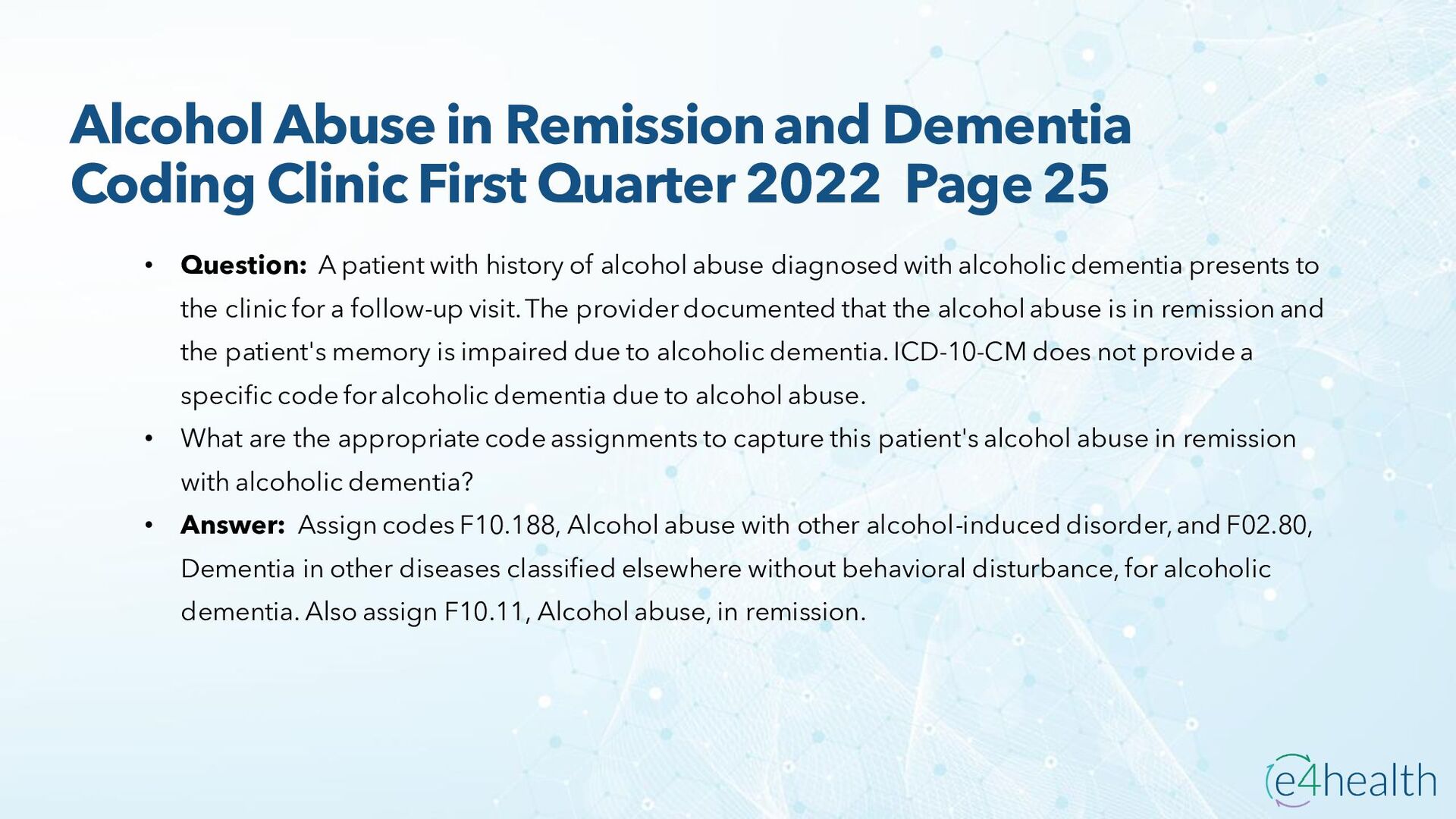
  15. Alcohol Abuse in Remission and Dementia Coding Clinic First Quarter

    2022 Page 25 • Question: A patient with history of alcohol abuse diagnosed with alcoholic dementia presents to the clinic for a follow-up visit. The provider documented that the alcohol abuse is in remission and the patient's memory is impaired due to alcoholic dementia. ICD-10-CM does not provide a specific code for alcoholic dementia due to alcohol abuse. • What are the appropriate code assignments to capture this patient's alcohol abuse in remission with alcoholic dementia? • Answer: Assign codes F10.188, Alcohol abuse with other alcohol-induced disorder, and F02.80, Dementia in other diseases classified elsewhere without behavioral disturbance, for alcoholic dementia. Also assign F10.11, Alcohol abuse, in remission.
  16. Anxiety with Alcohol Abuse Coding Clinic First Quarter 2022 Pages

    33-34 • Question: A patient was admitted for treatment of a malleolus fracture of the right ankle. The provider documented "Alcohol abuse - monitor for withdrawal symptoms." The patient also had a history of anxiety and was prescribed Cymbalta during hospitalization. • Based on the "with" convention, I.A.15, should we assume a link between anxiety and alcohol abuse and assign code F10.180, Alcohol abuse with alcohol-induced anxiety disorder? • Answer: Do not assume a relationship between alcohol abuse and/or dependence and anxiety. Although the Alphabetic Index links "alcohol with anxiety disorder" and "alcohol-induced anxiety disorder" is part of the code narrative, an alcohol- induced anxiety disorder is not the same as having anxiety and alcohol use/abuse/ dependence. • Further, the Tabular narrative for codes in subcategory F10.18-, Alcohol abuse with other alcohol-induced disorders, indicates these codes are assigned for "alcohol-induced disorders," and such a relationship must be documented by the provider. • While chronic alcohol dependence, abuse or use may lead to an alcohol induced anxiety disorder, there can be other underlying causes of anxiety. These conditions should not be linked, unless the provider clearly documents a relationship.
  17. Abuse/Dependence with Anxiety, Mood/Sleep Disorder or Sexual Dysfunction Coding Clinic

    First Quarter 2022 Page 34 • Question: Should combination codes be assigned from categories F10-F19, Mental and behavioral disorders due to psychoactive substance use, any time a patient with a substance abuse or dependence diagnosis also has documented anxiety, mood disorder, sleep disorder, or sexual dysfunction based on the "with" guideline? • Answer: Do not assume a relationship between substance abuse and/or dependence and anxiety, mood disorder, sleep disorder, or sexual dysfunction. • Although these conditions are terms that are located under "with" in the Index, the narrative in the Tabular indicates these codes are reported when the condition is documented as an "alcohol-induced" disorder and such a relationship is documented by the provider.
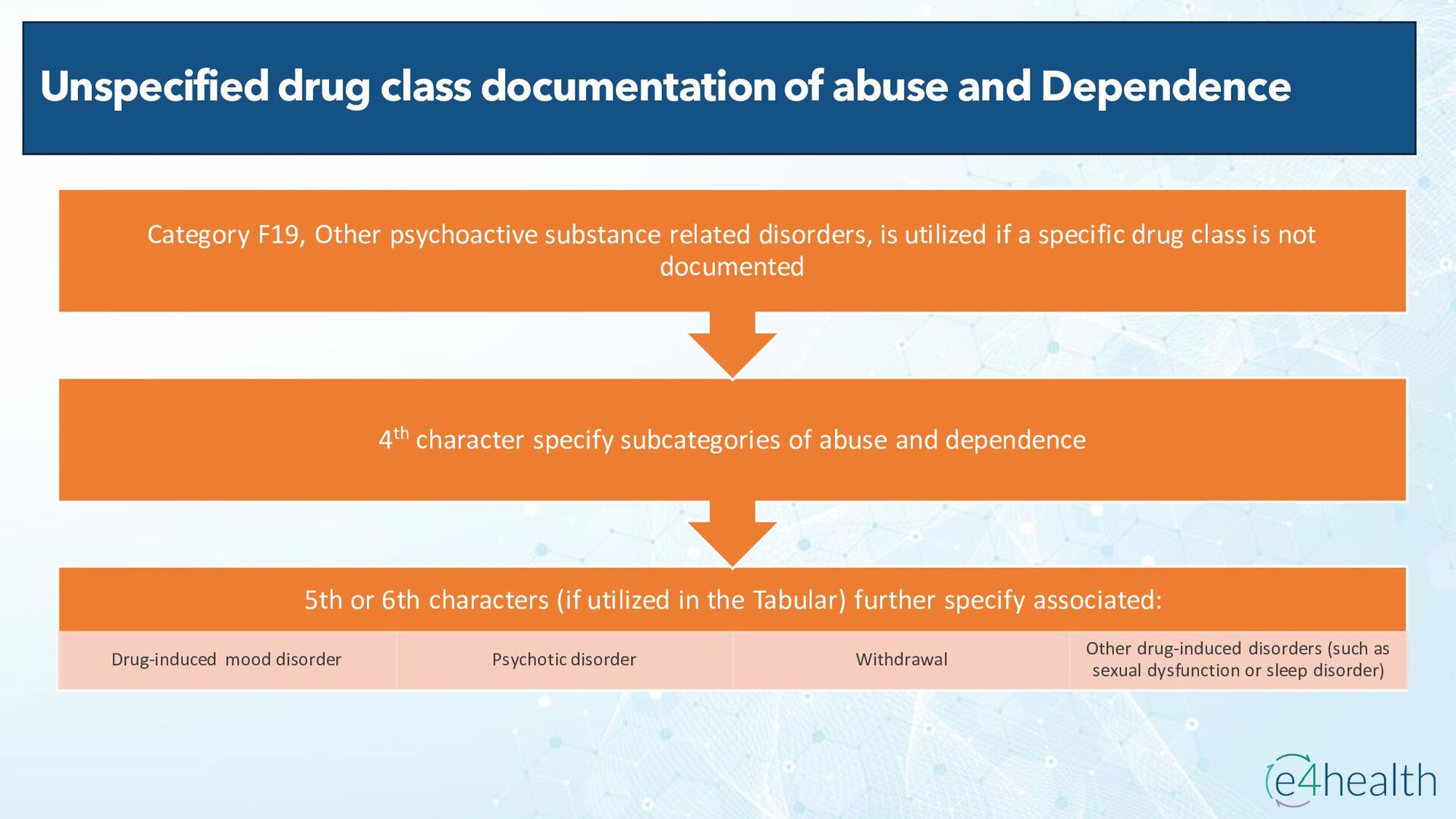
  18. Unspecified drug class documentation of abuse and Dependence 5th or

    6th characters (if utilized in the Tabular) further specify associated: Drug-induced mood disorder Psychotic disorder Withdrawal Other drug-induced disorders (such as sexual dysfunction or sleep disorder) 4th character specify subcategories of abuse and dependence Category F19, Other psychoactive substance related disorders, is utilized if a specific drug class is not documented
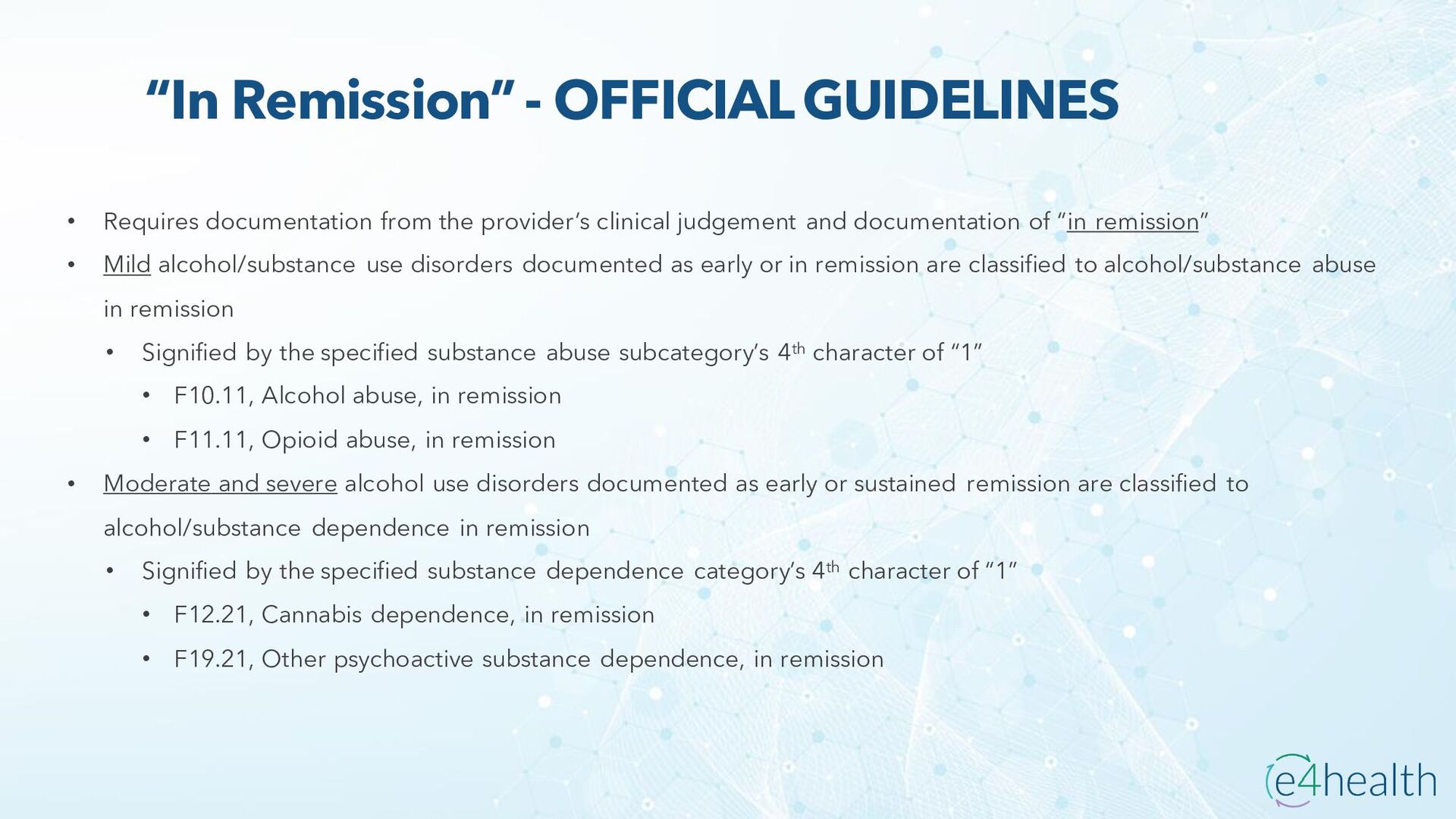
  19. “In Remission” - OFFICIAL GUIDELINES • Requires documentation from the

    provider’s clinical judgement and documentation of “in remission” • Mild alcohol/substance use disorders documented as early or in remission are classified to alcohol/substance abuse in remission • Signified by the specified substance abuse subcategory’s 4th character of “1” • F10.11, Alcohol abuse, in remission • F11.11, Opioid abuse, in remission • Moderate and severe alcohol use disorders documented as early or sustained remission are classified to alcohol/substance dependence in remission • Signified by the specified substance dependence category’s 4th character of “1” • F12.21, Cannabis dependence, in remission • F19.21, Other psychoactive substance dependence, in remission
  20. “In Remission” – Nicotine: Exception to the Rule • Question:

    In the ICD-10-CM Index to Diseases, history of drug dependence has a note to "see Dependence, drug, by type, in remission." However, history of tobacco/nicotine dependence is indexed to code Z87.891, Personal history of nicotine dependence. The instructions to code history of drug dependence as remission, and history of tobacco dependence as history, appear to be inconsistent and seem to conflict with the guideline to assign a code for remission when documented by the provider. When do you report drug remission versus drug history? • Answer: Codes for drug dependence with remission and history of nicotine dependence are assigned based on how the condition is indexed in the classification. • For example, if the provider documents history of cocaine dependence, assign code F14.21, Cocaine dependence, in remission. • Assign code Z87.891, Personal history of nicotine dependence, for history of tobacco dependence. • The ICD-10-CM classifies a history of nicotine dependence differently than other types of drug dependence, and there is a unique code for "history of nicotine dependence." • This is an exception, to drug dependence, as history of drug dependence is classified by "type of drug, in remission." Reference: History of Nicotine Dependence versus Drug Dependence in Remission - Coding Clinic, Second Quarter 2017: Page 27
  21. “In Remission” – Nicotine: Exception to the Rule • Question:

    The Index entries for history of drug and nicotine dependence appear to be inconsistent. Should history of nicotine dependence be coded as a personal history of nicotine dependence or as nicotine dependence in remission? What about history of dependence on other types of drugs, such as cocaine dependence? • Answer: As directed by the Index, history of nicotine dependence should be coded as a personal history (Z87.891), and history of dependence on other types of drugs, such as cocaine, should be coded as drug dependence in remission. • The codes for nicotine dependence in remission should only be assigned when "in remission" is specifically documented by the provider. • The Index entries are not inconsistent, but rather, they reflect clinical differences between dependence on nicotine versus other types of drugs. • The ICD-10-CM Official Guidelines for Coding and Reporting will be revised to state that codes for drug dependence "in remission" should be assigned when instructed by the classification (as well as when the provider specifically documents "in remission"). Reference: History of Nicotine Dependence versus Drug Dependence in Remission - Coding Clinic, Second Quarter 2017: Page 27
  22. Psychoactive Substance Use • ICD-10-CM provides codes for alcohol/substance use

    • Signified with the 4th character of “9” for each subcategory substance, such as: • F10.9-, Alcohol use, unspecified • F11.9, Opioid use, unspecified • F19.9, Other psychoactive substance use, unspecified • Codes are assigned as alcohol/substance use based on provider documentation and clinical judgment • These codes are utilized when psychoactive substance use is associated with substance-related Chapter 5 (Mental, Behavioral and Neurodevelopmental disorders, F01-F99) disorder, mental, behavioral, or medical condition, (such as sexual dysfunction, sleep disorder) where it is a documented relationship by the provider Reference: ICD-10-CM Official Coding Guidelines, Section I.C.5.b.3
  23. Cocaine Use and Pregnancy Coding Clinic Second Quarter 2018 Page

    10 • Question: Cocaine use during pregnancy is assigned a code from subcategory O99.32-, Drug use complicating pregnancy, childbirth, and the puerperium. • At subcategory O99.32-, there is a note instructing, "Use additional codes from F11-F16, and F18-F19 to identify manifestations of the drug use." • However, the Official Guidelines for Coding and Reporting, Section I.C.5.b.3., pertaining to psychoactive substance use, states that codes for psychoactive substance use are to be used only when the psychoactive substance use is associated with a physical, mental or behavioral disorder, and such a relationship is documented by the provider. • What is the correct code assignment for "cocaine use during pregnancy," when the provider has not documented a related physical, mental or behavioral disorder? • Answer: Assign the appropriate code from subcategory O99.32-, Drug use complicating pregnancy, childbirth, and the puerperium, followed by code F14.90, Cocaine use, unspecified, uncomplicated, for cocaine use during pregnancy. • The Official Guidelines for Coding and Reporting codes from Chapter 15 and sequencing priority (15.a.1.) state, "It is the provider's responsibility to state that the condition being treated is not affecting the pregnancy."
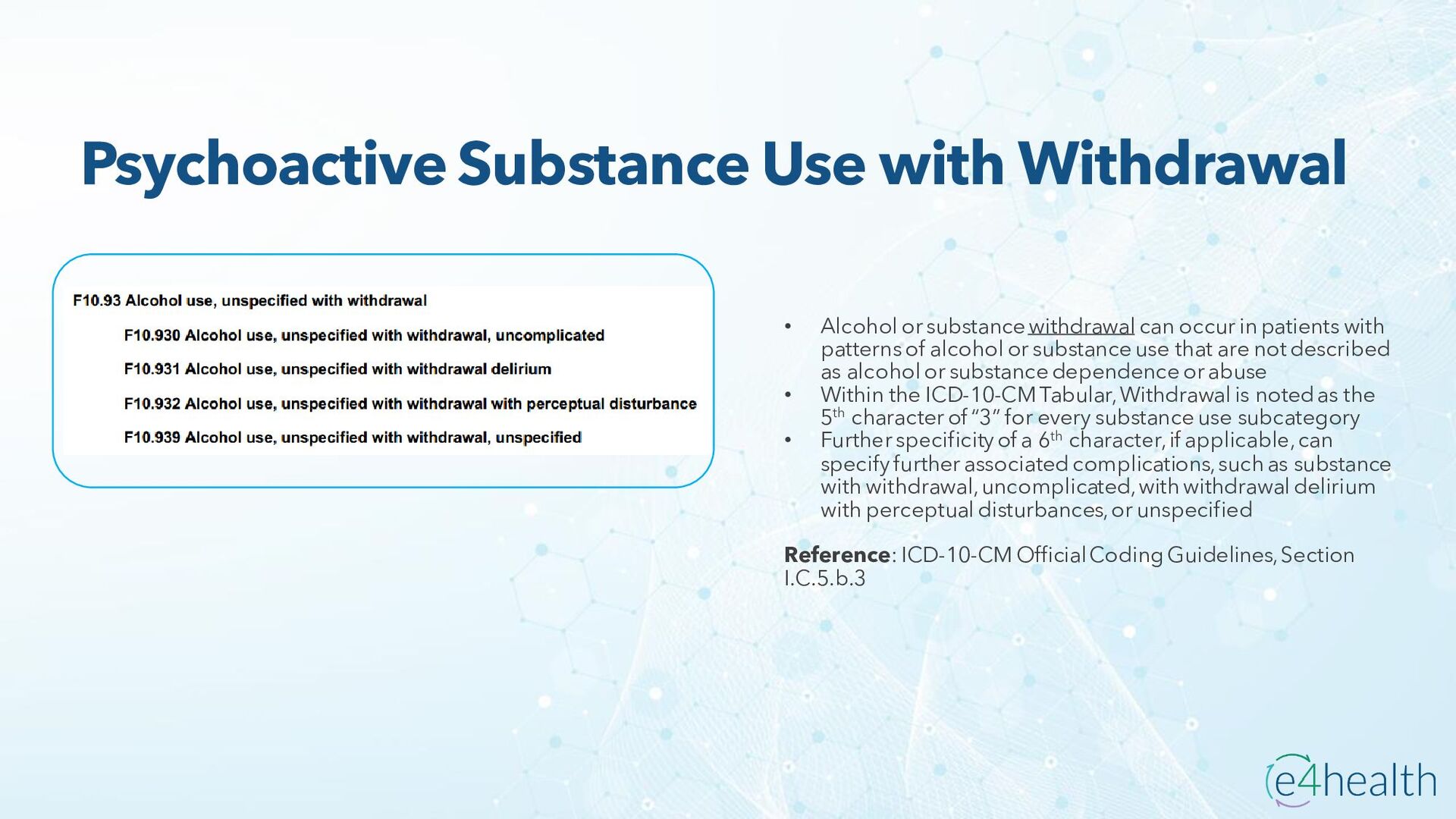
  24. Psychoactive Substance Use with Withdrawal • Alcohol or substance withdrawal

    can occur in patients with patterns of alcohol or substance use that are not described as alcohol or substance dependence or abuse • Within the ICD-10-CM Tabular, Withdrawal is noted as the 5th character of “3” for every substance use subcategory • Further specificity of a 6th character, if applicable, can specify further associated complications, such as substance with withdrawal, uncomplicated, with withdrawal delirium with perceptual disturbances, or unspecified Reference: ICD-10-CM Official Coding Guidelines, Section I.C.5.b.3
  25. Use, abuse, and dependence – Coding Hierarchy • If documentation

    refers to use, abuse, and dependence of the SAME substance, only ONE code should be assigned to identify the pattern of use: • If both use and abuse are documented, assign only the code for abuse • If both abuse and dependence are documented, assign only the code for dependence • If use, abuse and dependence are all documented, assign only the code for dependence • If both use and dependence are documented, assign only the code for dependence Reference: ICD-10-CM Official Coding Guidelines, Section I.C.5.b.2
  26. Medical Conditions Due to Psychoactive Substance Use, Abuse and Dependence

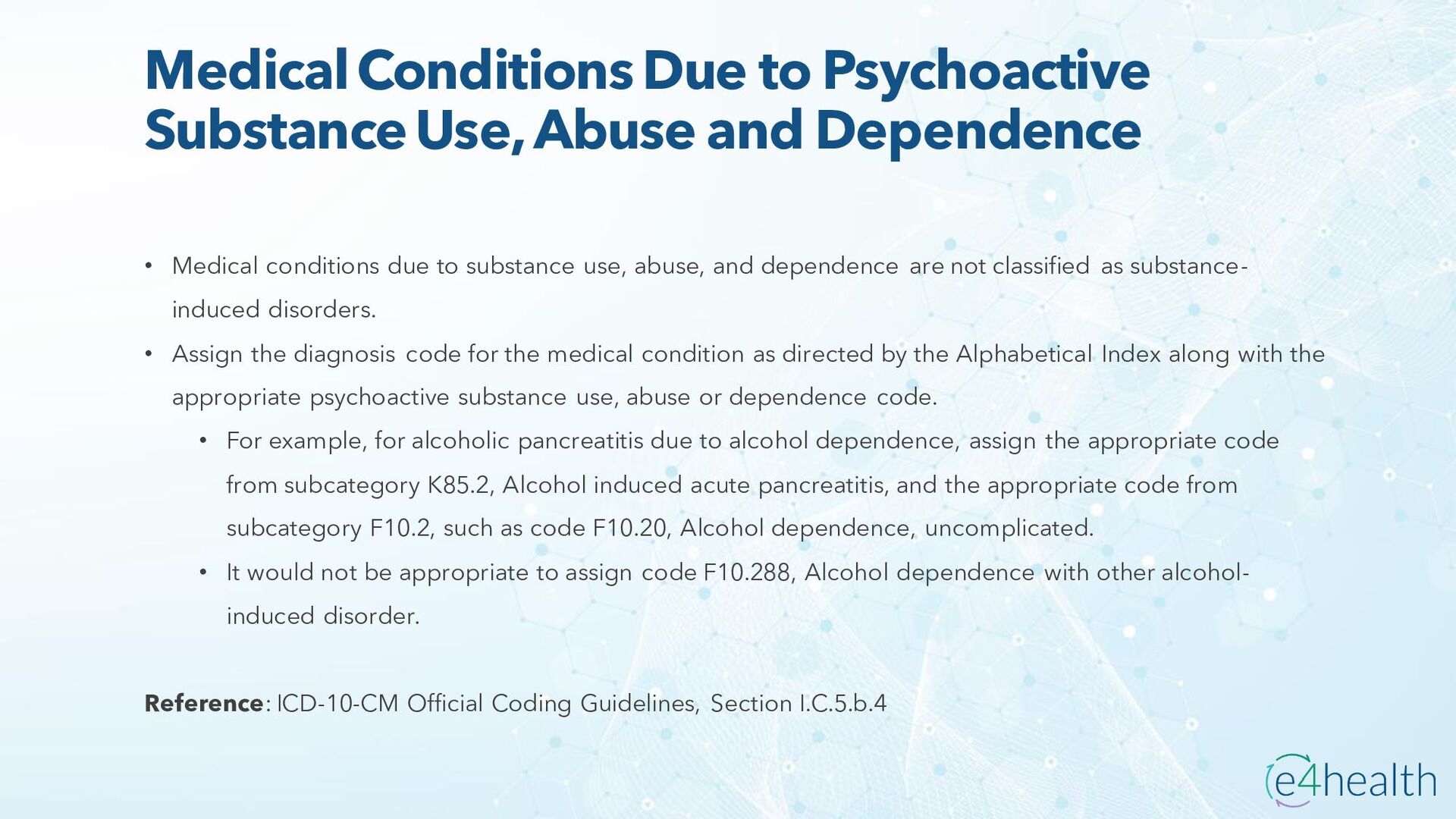
    • Medical conditions due to substance use, abuse, and dependence are not classified as substance- induced disorders. • Assign the diagnosis code for the medical condition as directed by the Alphabetical Index along with the appropriate psychoactive substance use, abuse or dependence code. • For example, for alcoholic pancreatitis due to alcohol dependence, assign the appropriate code from subcategory K85.2, Alcohol induced acute pancreatitis, and the appropriate code from subcategory F10.2, such as code F10.20, Alcohol dependence, uncomplicated. • It would not be appropriate to assign code F10.288, Alcohol dependence with other alcohol- induced disorder. Reference: ICD-10-CM Official Coding Guidelines, Section I.C.5.b.4
  27. Cardiomyopathy due to Methamphetamine Abuse Coding Clinic Third Quarter 2021

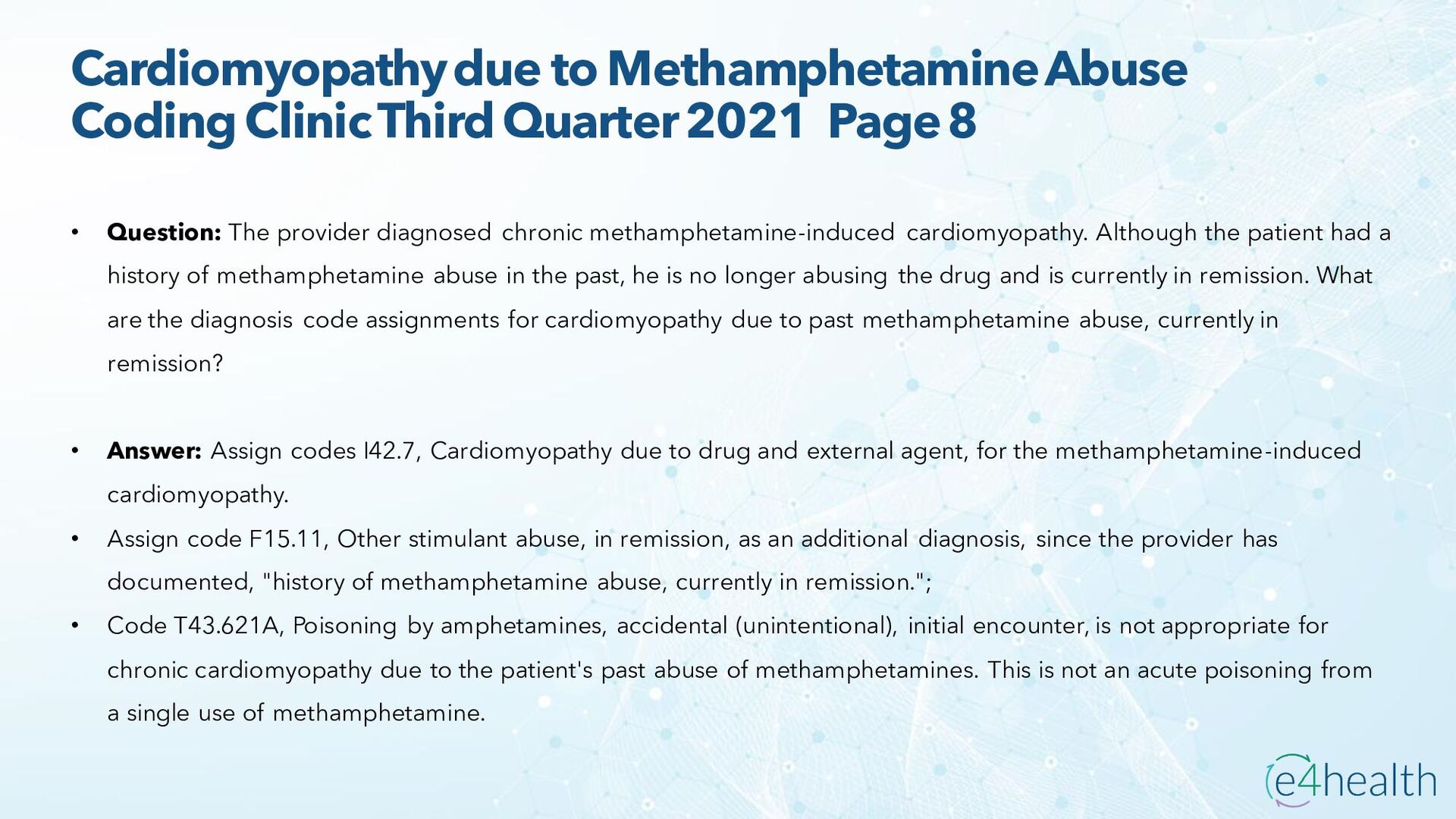
    Page 8 • Question: The provider diagnosed chronic methamphetamine-induced cardiomyopathy. Although the patient had a history of methamphetamine abuse in the past, he is no longer abusing the drug and is currently in remission. What are the diagnosis code assignments for cardiomyopathy due to past methamphetamine abuse, currently in remission? • Answer: Assign codes I42.7, Cardiomyopathy due to drug and external agent, for the methamphetamine-induced cardiomyopathy. • Assign code F15.11, Other stimulant abuse, in remission, as an additional diagnosis, since the provider has documented, "history of methamphetamine abuse, currently in remission."; • Code T43.621A, Poisoning by amphetamines, accidental (unintentional), initial encounter, is not appropriate for chronic cardiomyopathy due to the patient's past abuse of methamphetamines. This is not an acute poisoning from a single use of methamphetamine.
  28. Default Intent for Poisoning Coding Clinic Second Quarter 2016 Page

    8 • Question: A cocaine abuser is diagnosed as overdosing on crack cocaine and is admitted to the hospital. This is clearly a poisoning, but what is the appropriate "intent" for the poisoning code: accidental (unintentional) or undetermined? Is there a "default intent" for the poisoning codes? • Answer: In ICD-10-CM, the default for the intent for poisonings is accidental. Assign code T40.5X1A, Poisoning by cocaine, accidental (unintentional), initial encounter, for the crack cocaine overdose. • The Official Guidelines for Coding and Reporting (20, h.), regarding unknown or undetermined intent states, "If the intent (accident, self-harm, assault) of the cause of an injury or other condition is unknown or unspecified, code the intent as accidental intent." The Cooperating Parties for ICD-10-CM/PCS have agreed to create a corresponding guideline for Chapter 19 codes, so that the default intent for unknown poisonings is accidental.
  29. Selection of the Principal Diagnosis between Abuse and Dependence •

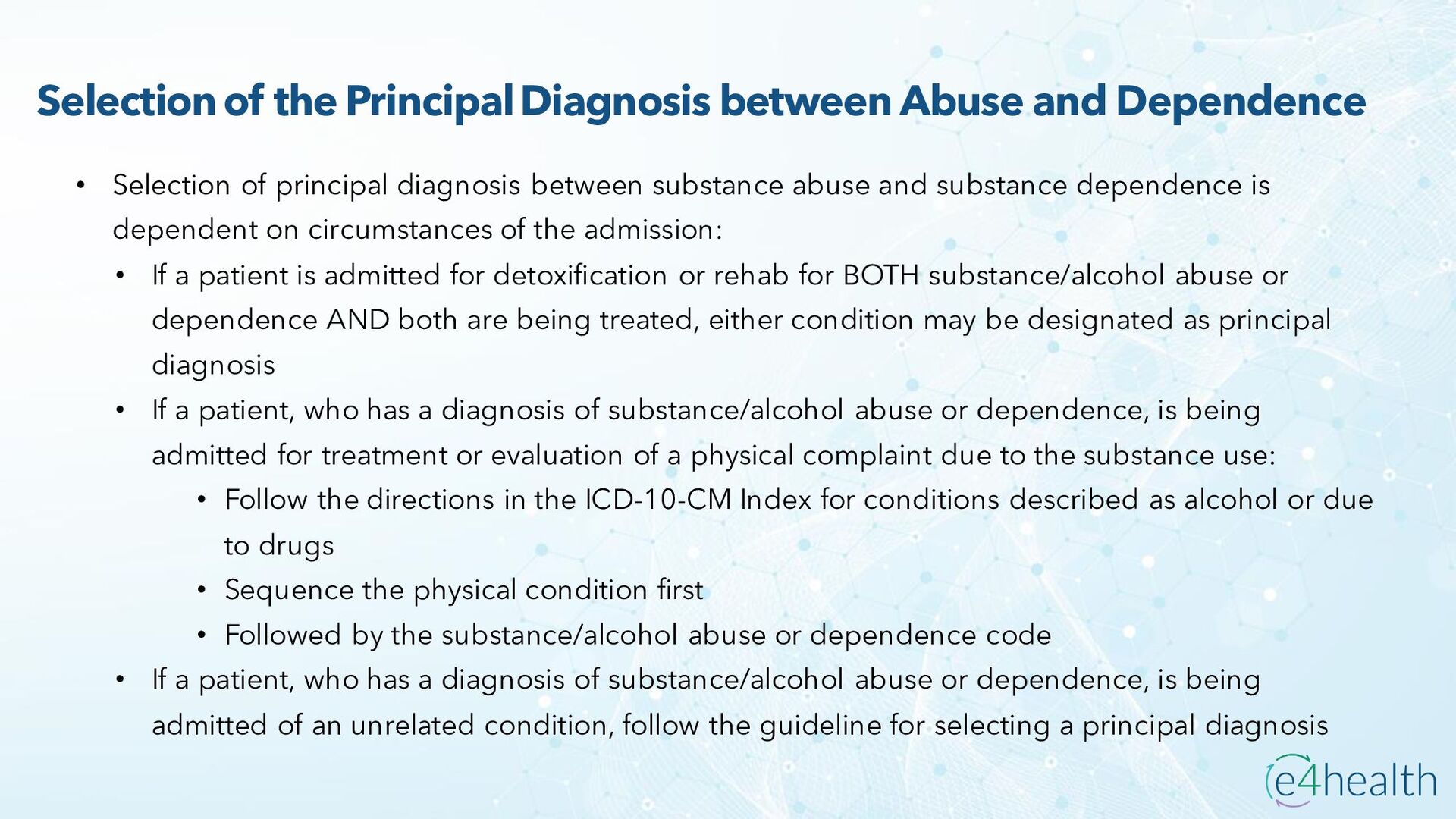
    Selection of principal diagnosis between substance abuse and substance dependence is dependent on circumstances of the admission: • If a patient is admitted for detoxification or rehab for BOTH substance/alcohol abuse or dependence AND both are being treated, either condition may be designated as principal diagnosis • If a patient, who has a diagnosis of substance/alcohol abuse or dependence, is being admitted for treatment or evaluation of a physical complaint due to the substance use: • Follow the directions in the ICD-10-CM Index for conditions described as alcohol or due to drugs • Sequence the physical condition first • Followed by the substance/alcohol abuse or dependence code • If a patient, who has a diagnosis of substance/alcohol abuse or dependence, is being admitted of an unrelated condition, follow the guideline for selecting a principal diagnosis
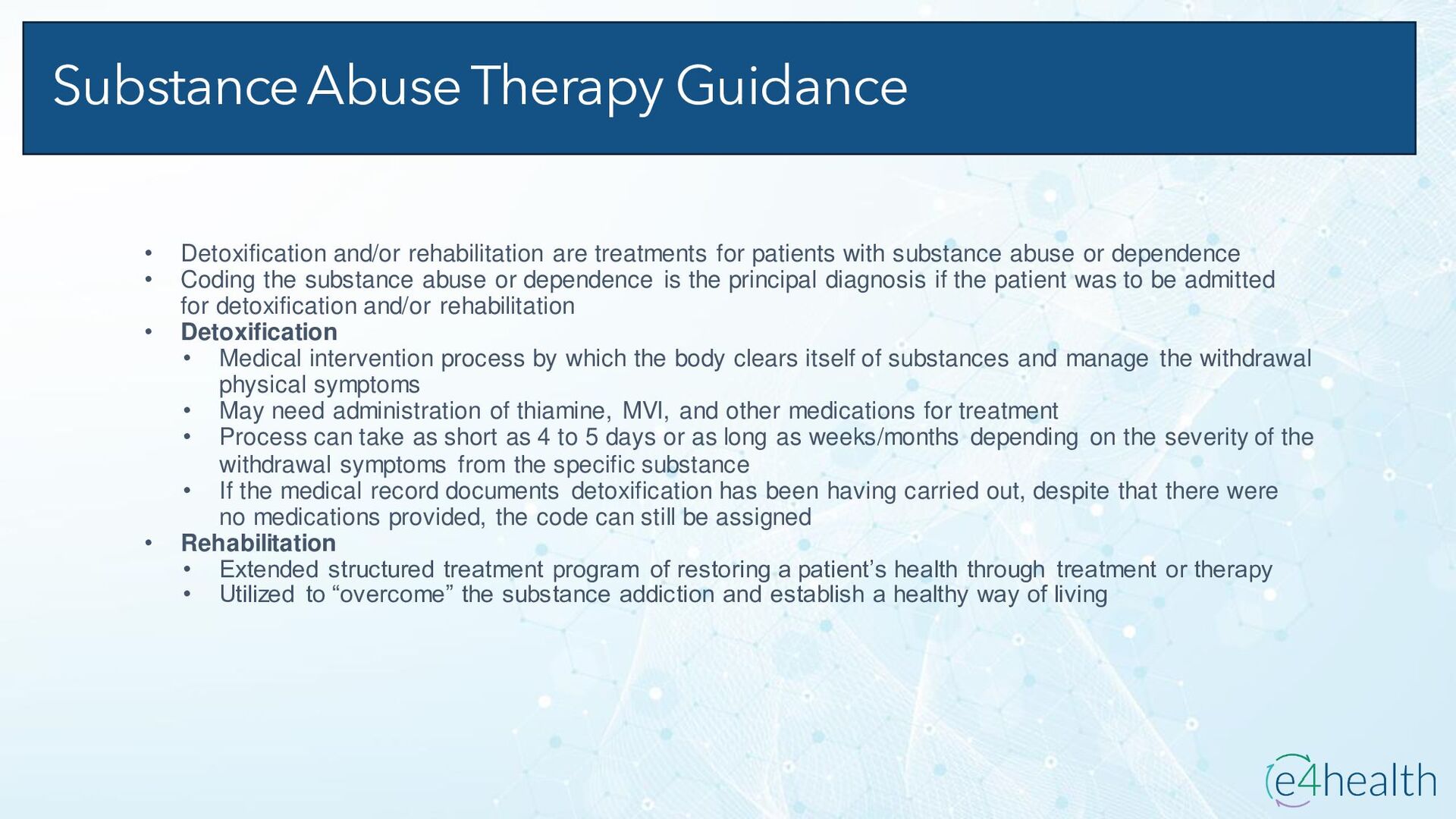
  30. Substance Abuse Therapy Guidance • Detoxification and/or rehabilitation are treatments

    for patients with substance abuse or dependence • Coding the substance abuse or dependence is the principal diagnosis if the patient was to be admitted for detoxification and/or rehabilitation • Detoxification • Medical intervention process by which the body clears itself of substances and manage the withdrawal physical symptoms • May need administration of thiamine, MVI, and other medications for treatment • Process can take as short as 4 to 5 days or as long as weeks/months depending on the severity of the withdrawal symptoms from the specific substance • If the medical record documents detoxification has been having carried out, despite that there were no medications provided, the code can still be assigned • Rehabilitation • Extended structured treatment program of restoring a patient’s health through treatment or therapy • Utilized to “overcome” the substance addiction and establish a healthy way of living
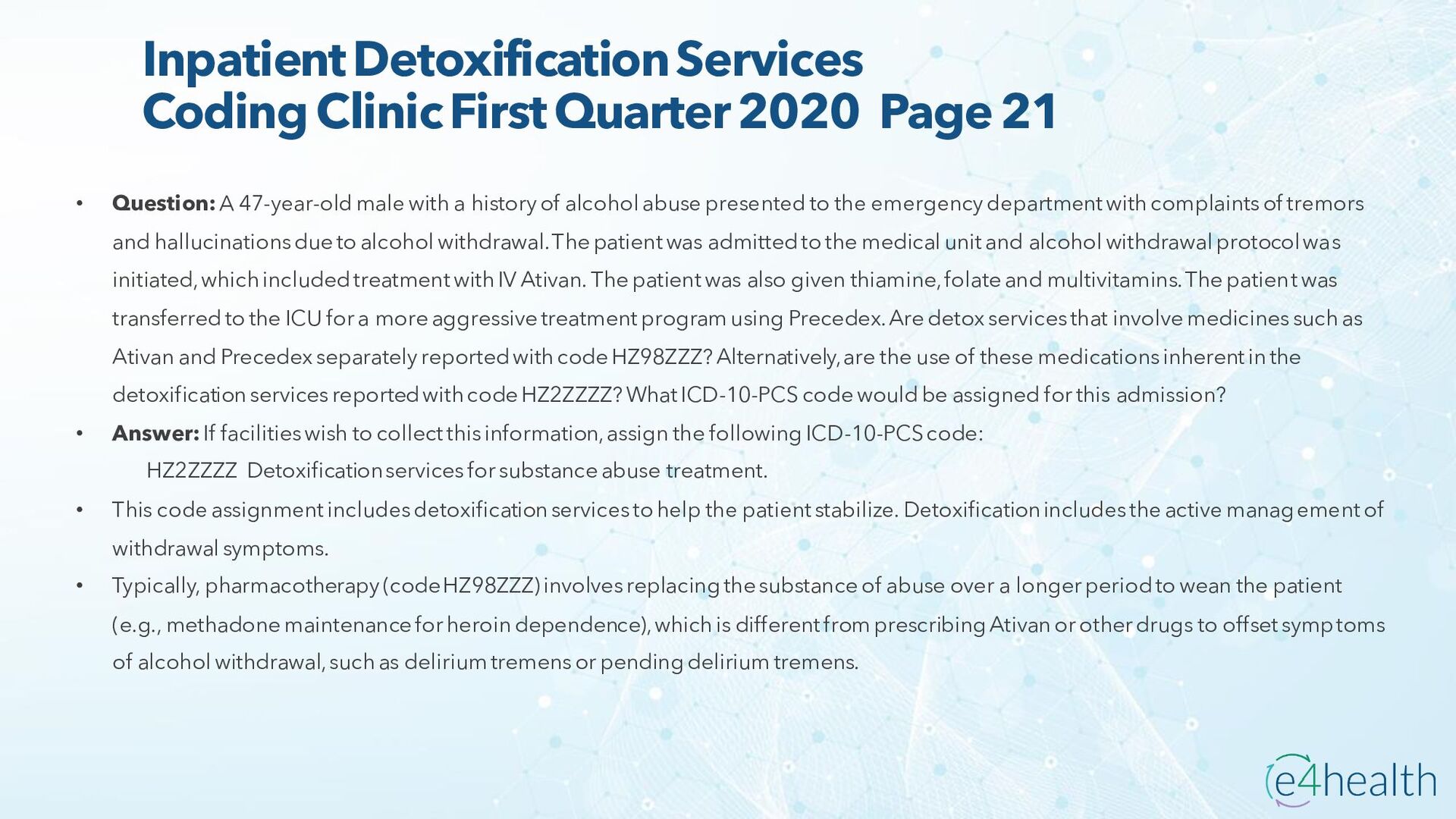
  31. Inpatient Detoxification Services Coding Clinic First Quarter 2020 Page 21

    • Question: A 47-year-old male with a history of alcohol abuse presented to the emergency department with complaints of tremors and hallucinations due to alcohol withdrawal. The patient was admitted to the medical unit and alcohol withdrawal protocol was initiated, which included treatment with IV Ativan. The patient was also given thiamine, folate and multivitamins. The patient was transferred to the ICU for a more aggressive treatment program using Precedex. Are detox services that involve medicines such as Ativan and Precedex separately reported with code HZ98ZZZ? Alternatively, are the use of these medications inherent in the detoxification services reported with code HZ2ZZZZ? What ICD-10-PCS code would be assigned for this admission? • Answer: If facilities wish to collect this information, assign the following ICD-10-PCS code: HZ2ZZZZ Detoxification services for substance abuse treatment. • This code assignment includes detoxification services to help the patient stabilize. Detoxification includes the active management of withdrawal symptoms. • Typically, pharmacotherapy (code HZ98ZZZ) involves replacing the substance of abuse over a longer period to wean the patient (e.g., methadone maintenance for heroin dependence), which is different from prescribing Ativan or other drugs to offset symptoms of alcohol withdrawal, such as delirium tremens or pending delirium tremens.
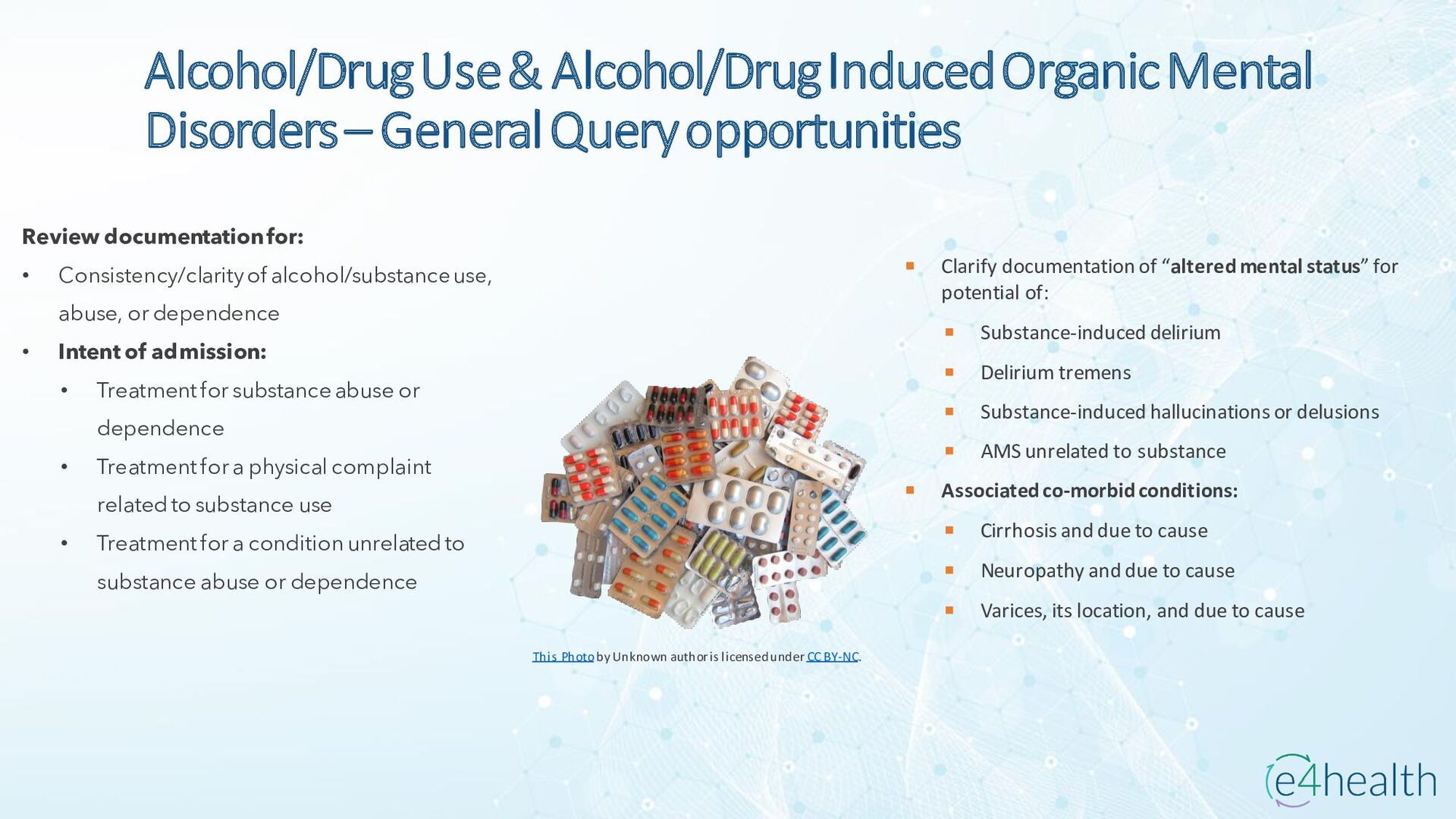
  32. Alcohol/Drug Use & Alcohol/Drug Induced Organic Mental Disorders – General

    Query opportunities Review documentation for: • Consistency/clarity of alcohol/substance use, abuse, or dependence • Intent of admission: • Treatment for substance abuse or dependence • Treatment for a physical complaint related to substance use • Treatment for a condition unrelated to substance abuse or dependence  Clarify documentation of “altered mental status” for potential of:  Substance-induced delirium  Delirium tremens  Substance-induced hallucinations or delusions  AMS unrelated to substance  Associated co-morbid conditions:  Cirrhosis and due to cause  Neuropathy and due to cause  Varices, its location, and due to cause This Photo by Unknown author is licensed under CC BY-NC.
  33. References • 3M Clinical Documentation Improvement System Reference • AHA

    Coding Handbook • Alcohol Use Disorder and Rehabilitation - Special Subjects - Merck Manuals Professional Edition • Substance-/Medication-Induced Psychotic Disorder - Psychiatric Disorders - Merck Manuals Professional Edition • Marijuana (Cannabis) - Special Subjects - Merck Manuals Professional Edition • Sedatives - Special Subjects - Merck Manuals Professional Edition • Cocaine - Special Subjects - Merck Manuals Professional Edition