Upgrade to PRO for Only $50/Year—Limited-Time Offer! 🔥

FY 2024: MDC 14 - Pregnancy, Childbirth, and t...

Avatar for e4health e4health PRO
April 04, 2024
190

FY 2024: MDC 14 - Pregnancy, Childbirth, and the Puerperium

Avatar for e4health

e4health PRO

April 04, 2024
Tweet

More Decks by e4health

Transcript

  1. H I M | C O D I N G

    & C D I | H E A LT H I T | R E V C Y C L E Empowering Better Health e4health tackles healthcare’s data, quality and revenue challenges empowering your providers to focus on better care.
  2. Objectives • Review MDC 14- Pregnancy, Childbirth & the Puerperium

    with a focus on selected diagnoses and procedures • Learner will acquire a basic understanding of the diagnoses and procedures included in MDC-14 • Discuss Query opportunities in MDC-14 • Review coding clinics relevant to the chosen topics in each DRG
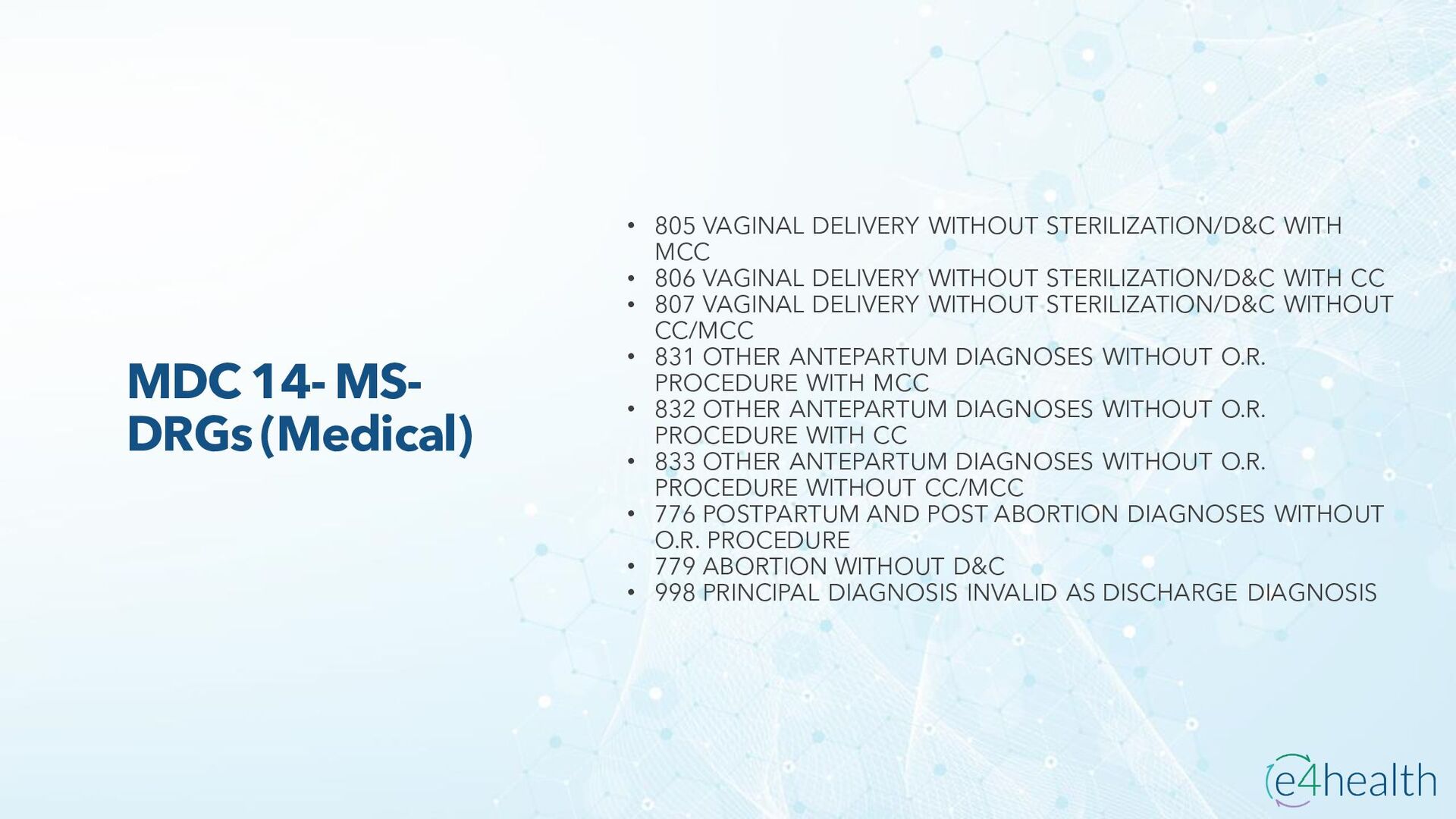
  3. MDC 14- MS- DRGs (Medical) • 805 VAGINAL DELIVERY WITHOUT

    STERILIZATION/D&C WITH MCC • 806 VAGINAL DELIVERY WITHOUT STERILIZATION/D&C WITH CC • 807 VAGINAL DELIVERY WITHOUT STERILIZATION/D&C WITHOUT CC/MCC • 831 OTHER ANTEPARTUM DIAGNOSES WITHOUT O.R. PROCEDURE WITH MCC • 832 OTHER ANTEPARTUM DIAGNOSES WITHOUT O.R. PROCEDURE WITH CC • 833 OTHER ANTEPARTUM DIAGNOSES WITHOUT O.R. PROCEDURE WITHOUT CC/MCC • 776 POSTPARTUM AND POST ABORTION DIAGNOSES WITHOUT O.R. PROCEDURE • 779 ABORTION WITHOUT D&C • 998 PRINCIPAL DIAGNOSIS INVALID AS DISCHARGE DIAGNOSIS
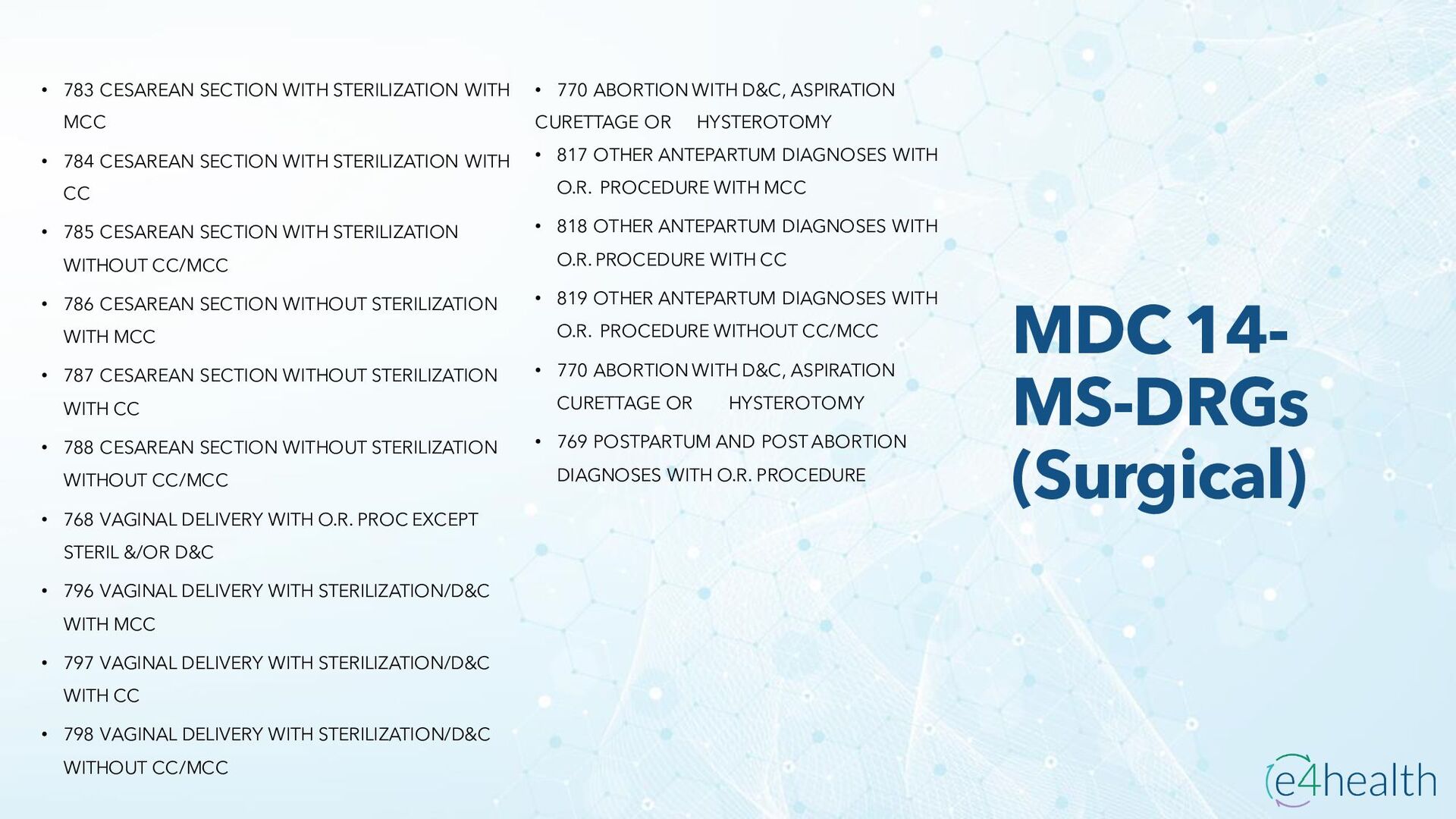
  4. MDC 14- MS-DRGs (Surgical) • 783 CESAREAN SECTION WITH STERILIZATION

    WITH MCC • 784 CESAREAN SECTION WITH STERILIZATION WITH CC • 785 CESAREAN SECTION WITH STERILIZATION WITHOUT CC/MCC • 786 CESAREAN SECTION WITHOUT STERILIZATION WITH MCC • 787 CESAREAN SECTION WITHOUT STERILIZATION WITH CC • 788 CESAREAN SECTION WITHOUT STERILIZATION WITHOUT CC/MCC • 768 VAGINAL DELIVERY WITH O.R. PROC EXCEPT STERIL &/OR D&C • 796 VAGINAL DELIVERY WITH STERILIZATION/D&C WITH MCC • 797 VAGINAL DELIVERY WITH STERILIZATION/D&C WITH CC • 798 VAGINAL DELIVERY WITH STERILIZATION/D&C WITHOUT CC/MCC • 770 ABORTION WITH D&C, ASPIRATION CURETTAGE OR HYSTEROTOMY • 817 OTHER ANTEPARTUM DIAGNOSES WITH O.R. PROCEDURE WITH MCC • 818 OTHER ANTEPARTUM DIAGNOSES WITH O.R. PROCEDURE WITH CC • 819 OTHER ANTEPARTUM DIAGNOSES WITH O.R. PROCEDURE WITHOUT CC/MCC • 770 ABORTION WITH D&C, ASPIRATION CURETTAGE OR HYSTEROTOMY • 769 POSTPARTUM AND POST ABORTION DIAGNOSES WITH O.R. PROCEDURE
  5. General Rules for Obstetric Cases • Codes from chapter 15

    and sequencing priority • Chapter 15 codes are only used on maternal record and not on the baby's record • Chapter 15 codes have sequencing priority over codes from other chapters • Additional codes from other chapters may be used in conjunction with chapter 15 codes to further specify conditions • Should the provider document that the pregnancy is incidental to the encounter, then code Z33.1, Pregnant state, incidental, should be used in place of any chapter 15 codes. It is the provider’s responsibility to state that the condition being treated is not affecting the pregnancy.
  6. Pregnancy Terms • Antepartum: The period of pregnancy from conception

    to childbirth • Peripartum: The period involving the last month of pregnancy to five (5) months postpartum • Postpartum: The period beginning right after delivery and including the next six (6) weeks • Puerperium: The clinical term for the postpartum period
  7. Trimester Specificity • First Trimester: Less than 14 weeks 0

    days • Second Trimester: 14 weeks 0 days to less than 28 weeks 0 days • Third Trimester: 28 weeks 0 days until delivery • ICD-10-CM initiated ‘trimester’ information within the Obstetrics chapter. Assignment of the final character for trimester should be based on the provider's documentation of the trimester (or number of weeks) for the current admission/encounter. Use the definitions above • Not every single code in the Obstetrics chapter has a trimester component. If trimester is not a component of a code, it is because the condition always occurs in a specific trimester or the concept of trimester of pregnancy is not applicable
  8. Trimester Specificity • Final character for trimester • If delivery

    occurs use the “in childbirth” option for obstetric complications if the options is available in the code set. • If a character is not available for “in childbirth” and delivery occurs during the admission, assign a code describing the current trimester for that code. • Final character when the admission spans more than one trimester • The trimester character is assigned to correspond with when the complication occurred, not the trimester of discharge. • If the condition was a complication present on admission, or is a pre-existing condition, the trimester at the time of admission is assigned.
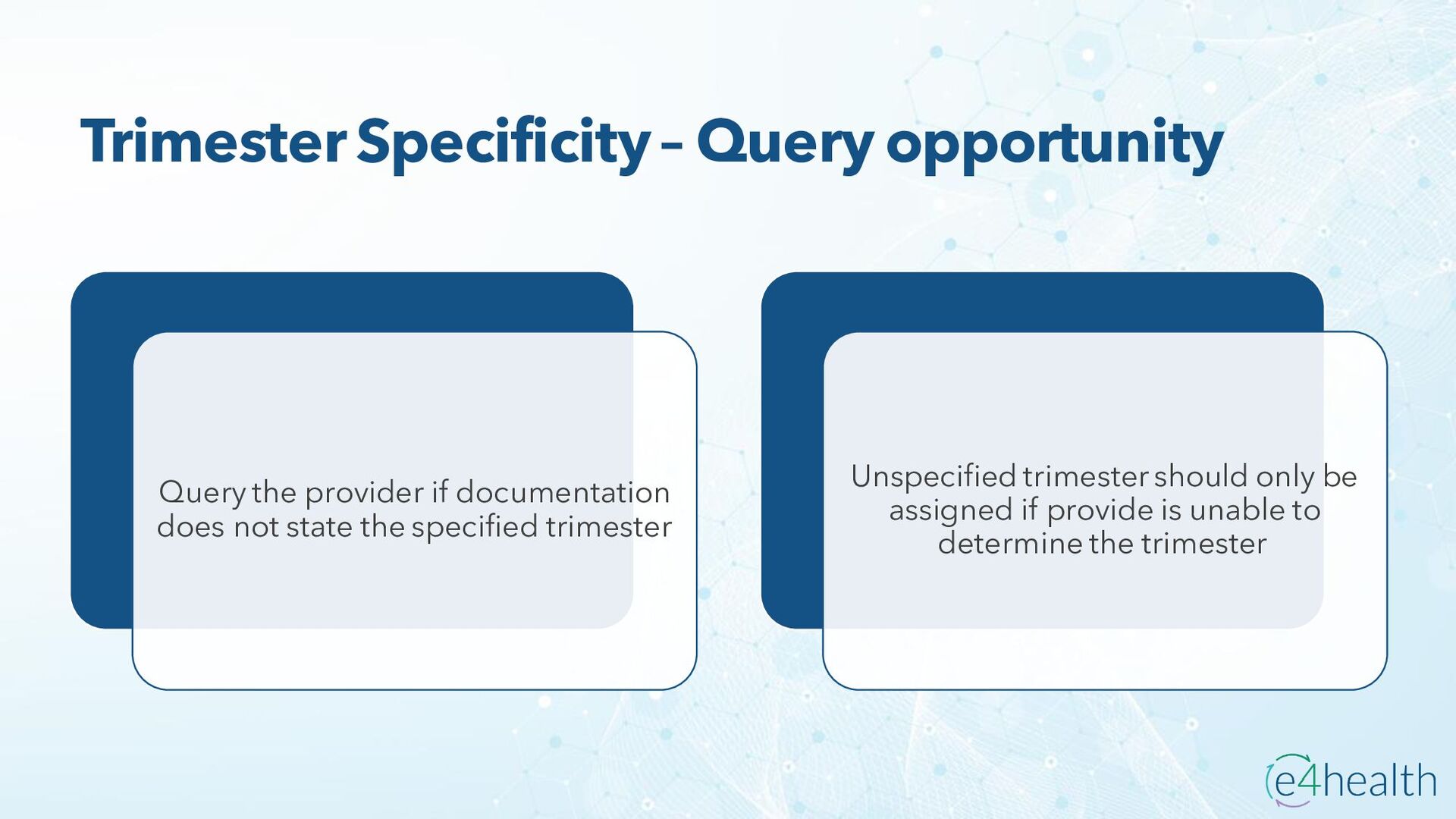
  9. Trimester Specificity – Query opportunity Query the provider if documentation

    does not state the specified trimester Unspecified trimester should only be assigned if provide is unable to determine the trimester
  10. Selection of Principal or First-Listed Diagnosis • Selection of Principal

    or First-Listed Diagnosis • Episodes when no delivery occurs • Select the principal complication of the pregnancy that was the reason for admission. If more than one exists, and all meet the definition of a principal diagnosis select the diagnosis that is highest weighted. • Episodes where a delivery occurs • The condition that prompted the admission is the principal diagnosis. • Codes for complications of the delivery are assigned as additional diagnoses. • If there is a cesarean delivery, the diagnosis that resulted in the cesarean delivery is assigned as the principal diagnosis. • If the diagnosis that occasioned the admission is not the reason for the cesarean delivery and this is documented, then that diagnosis is assigned as principal diagnosis
  11. Outcome of Delivery • Outcome of delivery • Code category

    Z37.0 through Z37.09 outcome of delivery should be included on every maternal record when a delivery has occurred. • The codes from category Z37 are not used on subsequent records • The codes are not used on the newborn record.
  12. General Rules for Obstetric Cases Pre-existing conditions vs. Conditions due

    to pregnancy: • Certain categories in Chapter 15 distinguish between conditions of the mother that existed prior to pregnancy (pre-existing) and those that are a direct result of pregnancy. For example: • Diagnosed Type 1 diabetic prior to pregnancy VS. • Diagnosed Gestational diabetes during trimester 2 • Unclear documentation should be clarified with the provider. • If the category does not distinguish between pre-existing or pregnancy-related, the codes can be used for either.
  13. Normal Delivery • Normal Delivery • Code O80 encounter for

    full term uncomplicated pregnancy. • Full-term, normal delivery of a single healthy infant without any complications. • Can not be used if any other code from chapter 15 is assigned. • Can be assigned if there was a complication during the pregnancy that is resolved and not impacting the patient at the time of delivery. • Z37.0 Single live birth is the only outcome of delivery code appropriate for use with O80. • Carefully review for any pre-existing or pregnancy related conditions.
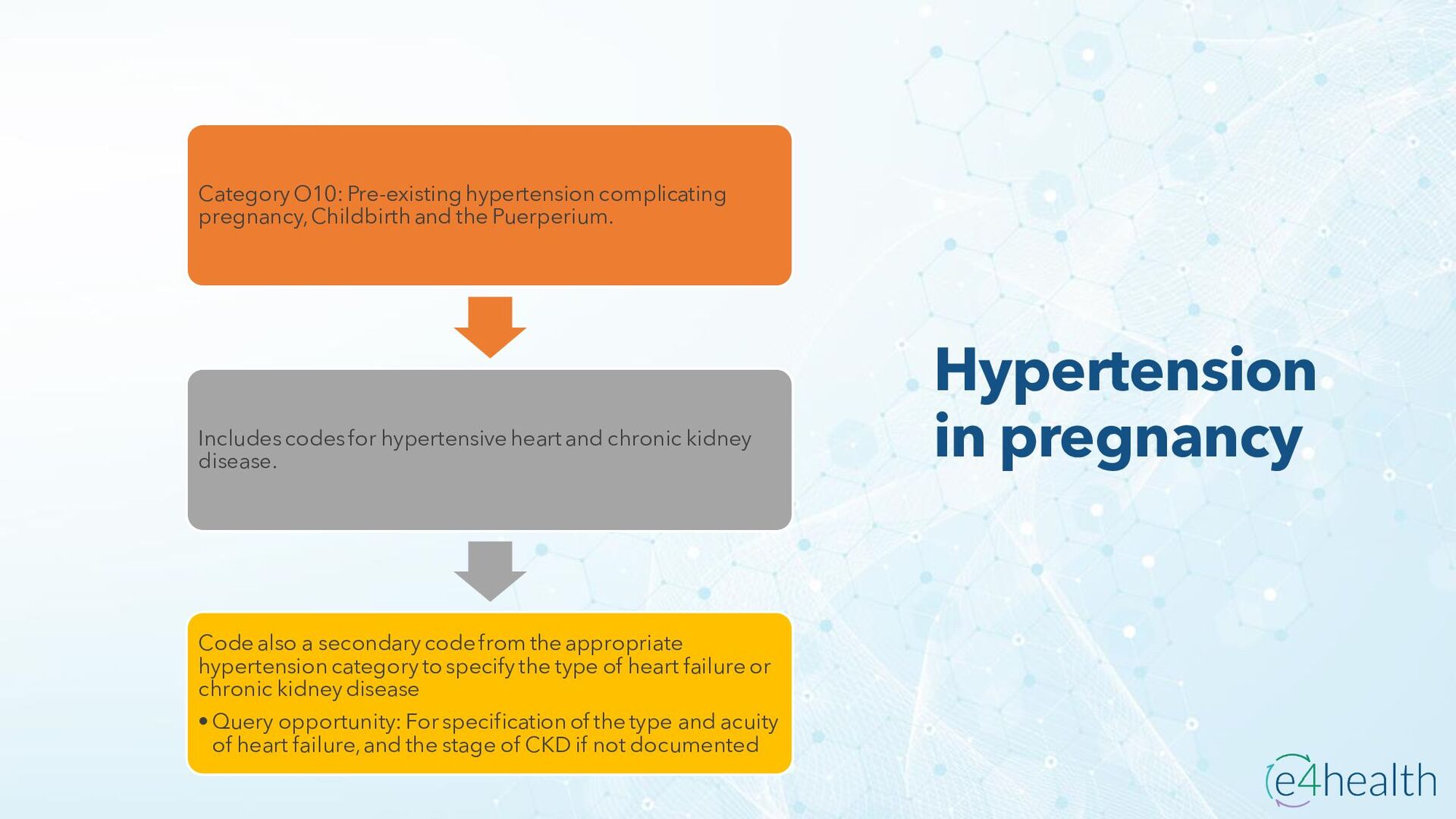
  14. Hypertension in pregnancy Category O10: Pre-existing hypertension complicating pregnancy, Childbirth

    and the Puerperium. Includes codes for hypertensive heart and chronic kidney disease. Code also a secondary code from the appropriate hypertension category to specify the type of heart failure or chronic kidney disease •Query opportunity: For specification of the type and acuity of heart failure, and the stage of CKD if not documented
  15. Fetal conditions affecting the management of mother • Codes from

    categories O35, Maternal care for known or suspected fetal abnormality and damage, and O36, Maternal care for other fetal problems: • Assigned only when the fetal condition is changing the management of the mother • Assigned only when it impacts the care of the mother by requiring diagnostic studies, additional observation, special care, or termination of pregnancy. • In utero surgery on a fetus is coded as an obstetric encounter. No code from Chapter 16, the perinatal codes, should be used on the mother's record to identify fetal conditions • Category 035 codes (maternal care for known or suspected fetal abnormality and damage) are used to identify the fetal condition plus an appropriate code for the procedure performed. Query opportunity: Review the record for complications of procedure, such as acute blood loss anemia, post-op infections, and loss of fetus due to procedure
  16. HIV infection in pregnancy Assigning codes from 098.7, HIV disease

    complicating pregnancy, childbirth, and puerperium, for patients who are admitted during pregnancy • Additional code to identify HIV related conditions is added if apply Asymptomatic HIV infection during pregnancy admission, codes from 098.7 along with Z21, asymptomatic HIV status, is added
  17. Diabetes in pregnancy • Codes from 024, Diabetes mellitus in

    pregnancy, childbirth and puerperium are assigned • Assign also pre-existing diabetes • Assign secondary codes from category E08-E13 to further specify the type of diabetes • Assign a code for long term use of insulin or oral hypoglycemics if apply Query opportunities: Review the record for clinical indicators and resource consumption for: • DKA • Pre-eclampsia • Renal insufficiency
  18. Diabetes in pregnancy • Diabetes in pregnancy • Complications in

    which pregnancy is contraindicated • Gastroparesis • May worsen during pregnancy. • May have difficulty with nutrition requiring parenteral nutrition during pregnancy. • High risk of morbidity and poor perinatal outcome • Ischemic heart disease • High risk pregnancy. • MI is treated the same as a non-pregnant patient. • Thrombolysis should not be withheld, and angioplasty/stenting in emergency situations should be performed
  19. Gestational Diabetes • Gestational Diabetes • Occurs in the second

    and third trimester in non-diabetic patients. • Increases risk for developing diabetes post-pregnancy. • Assign a code from subcategory O24.4 gestational diabetes mellitus. • Includes diet controlled, insulin controlled, controlled by oral hypoglycemic drugs. • Not necessary to assign codes Z79.4 long-term current use of insulin or Z79.84 Long-term current use of oral hypoglycemic drugs. • Do not assign any other codes from category O24.
  20. Sepsis and septic shock in pregnancy • Sepsis and septic

    shock complicating abortion, pregnancy, childbirth and the puerperium • O98.81- Other maternal infectious and parasitic diseases complicating pregnancy, childbirth and the puerperium, with further specificity for trimester. • Assign additional codes for the infection, severe sepsis or associated organ failures. • Carefully review an admitted pregnant patient with an infection for clinical indicators for sepsis POA and follow to be sure the Sepsis is carried through to the discharge summary.
  21. Sepsis and septic shock in pregnancy • Puerperal Sepsis •

    Code O85, Puerperal sepsis is assigned with an additional code to identify the causal organism. • Do not use codes from A40/A41 • Do assign additional codes for severe sepsis (R65.2-) and assign codes for any associated organ failure or dysfunction. • Query Opportunities • Sepsis ruled in, ruled out, or treated and resolved. • Links between organ failure/dysfunction and sepsis
  22. Alcohol, tobacco and drug use in pregnancy • Alcohol, tobacco

    and drug use during pregnancy, childbirth and the puerperium • Alcohol – Assign a code from subcategory O99.31 alcohol use complicating pregnancy, childbirth, and the puerperium along with an additional code from F10 alcohol related disorders. • Tobacco – Assign a code from subcategory O99.33 smoking complicating pregnancy, childbirth, and the puerperium along with an additional code from category F17 nicotine dependence. • Drug use - Assign a code from subcategory O99.32 drug use complicating pregnancy, childbirth, and the puerperium along with an additional code from category F11-F16 and F18-F19 to identify manifestations of the drug use.
  23. Poisoning, toxic effect, adverse effects and underdosing in pregnancy •

    Poisoning, toxic effect, adverse effects and underdosing in a pregnant patient • Assign a code from subcategory O9A.2 Injury, poisoning and certain other consequences of external causes complicating pregnancy, childbirth and the puerperium. • Assign an additional code for the correct injury, poisoning, toxic affect, adverse effect or underdosing code. • Assign another additional code for the condition caused by the poisoning, toxic effect, adverse effect or underdosing.
  24. Peripartum and Postpartum Period • Peripartum and Postpartum Period •

    Peripartum – One month before delivery to five months postpartum. • Postpartum – Immediately after delivery to six weeks after delivery. • Puerperium – six weeks post-delivery. • Postpartum complication – Any complication occurring within the postpartum period.
  25. Peripartum and Postpartum Period • Peripartum and Postpartum Period •

    Pregnancy-related complications after the 6-week postpartum period. • May use chapter 15 codes to describe conditions documented by the provider as related to pregnancy. Must be clearly documented by the provider. • Admission for routine postpartum care following delivery outside of the hospital. • Principal diagnosis Z39.0, Encounter for care and examination of mother immediately after delivery. • O90.3 Pregnancy associated cardiomyopathy • Diagnosed in the third trimester of pregnancy. • May continue for months post-delivery. • Used when the patient did not have pre-existing heart disease. • Treatment • ACE inhibitors, Beta blockers, Diuretics, Digitalis, Anticoagulants. • Treatment • Any indication of these medications in a pregnant patient without an associated diagnosis should prompt a query for a diagnosis associated with treatment. • Review for associated diagnoses such as hypertension, electrolyte abnormalities. If any indicators without a diagnosis, query for an associated diagnosis.
  26. Sequela of complication of pregnancy, childbirth and the puerperium •

    O94 – Sequela of complication of pregnancy, childbirth and the puerperium • Sequenced as a secondary diagnosis. The complication diagnosis is sequenced first. • Can be used any time after the postpartum period. • There is no time limit for the development of a sequela.
  27. Termination of pregnancy and spontaneous abortions • Termination of pregnancy

    and spontaneous abortions • Abortion with liveborn fetus • Assign Z33.2, encounter for elective termination of pregnancy. • Assign a code from category Z37, outcome of delivery. • Retained products of conception following an abortion • Subsequent encounter for retained products of conception following a spontaneous abortion or elective pregnancy termination without complications • O03.4 Incomplete spontaneous abortion without complication • O07.- failed attempted termination of pregnancy without complication.
  28. Abuse in pregnancy • Abuse in a pregnant patient •

    O9A.3 – Physical abuse complicating pregnancy, childbirth and puerperium • O9A.4 - Sexual abuse complicating pregnancy, childbirth and the puerperium • O9A.5 – Psychological abuse complicating pregnancy, childbirth and the puerperium
  29. COVID-19 in pregnancy • Covid-19 infection in pregnancy • O98.5-

    Other viral diseases complicating pregnancy, childbirth and the puerperium is the principal diagnosis • U07.1 COVID-19 and additional codes for any complications are assigned as well • Codes from chapter 15 take precedent. • COVID positive test when admission is related to another diagnosis: • Assign appropriate principal diagnosis as well as codes O98.5 and U07.1 and appropriate codes for any complications
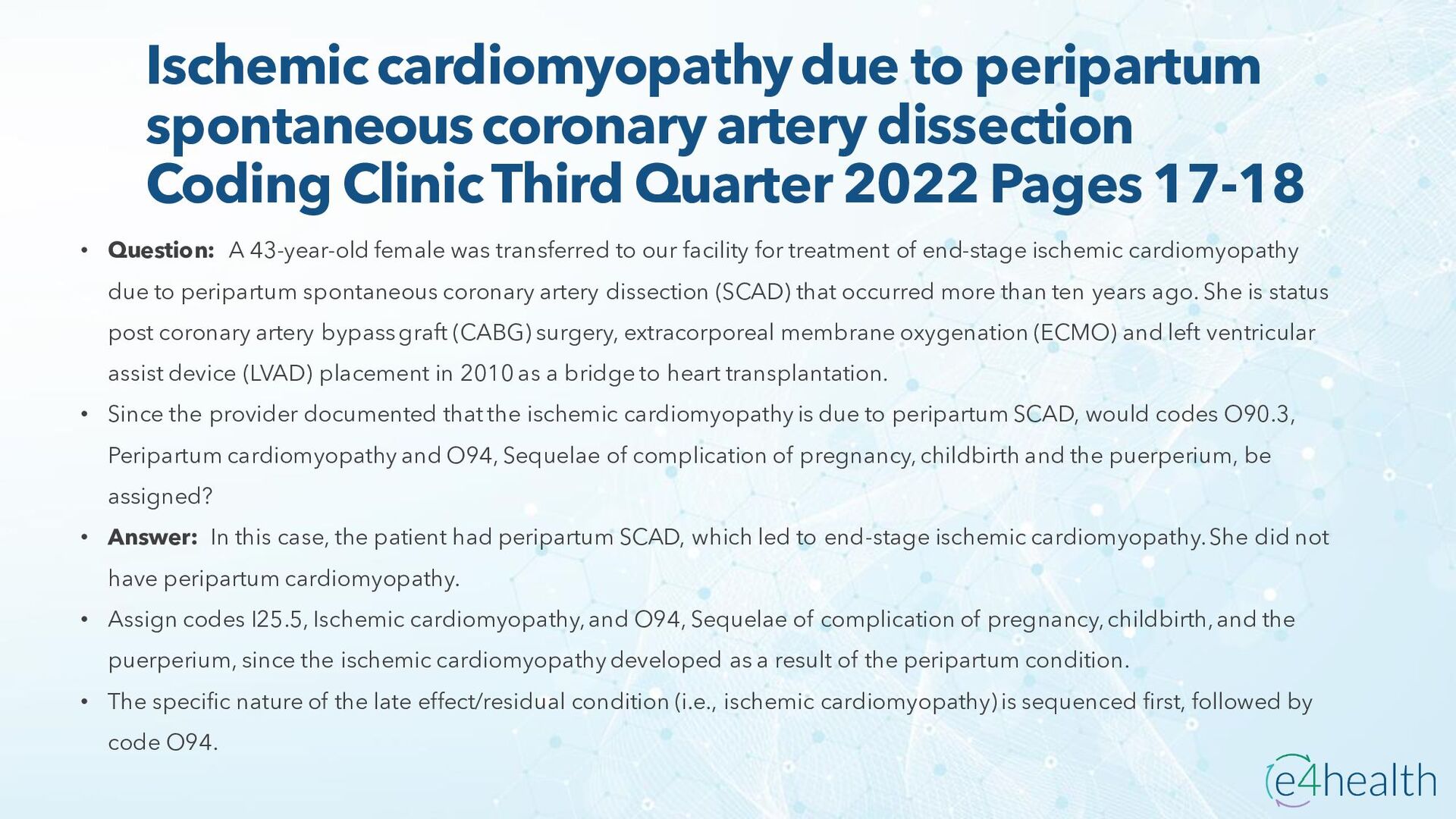
  30. Ischemic cardiomyopathy due to peripartum spontaneous coronary artery dissection Coding

    Clinic Third Quarter 2022 Pages 17-18 • Question: A 43-year-old female was transferred to our facility for treatment of end-stage ischemic cardiomyopathy due to peripartum spontaneous coronary artery dissection (SCAD) that occurred more than ten years ago. She is status post coronary artery bypass graft (CABG) surgery, extracorporeal membrane oxygenation (ECMO) and left ventricular assist device (LVAD) placement in 2010 as a bridge to heart transplantation. • Since the provider documented that the ischemic cardiomyopathy is due to peripartum SCAD, would codes O90.3, Peripartum cardiomyopathy and O94, Sequelae of complication of pregnancy, childbirth and the puerperium, be assigned? • Answer: In this case, the patient had peripartum SCAD, which led to end-stage ischemic cardiomyopathy. She did not have peripartum cardiomyopathy. • Assign codes I25.5, Ischemic cardiomyopathy, and O94, Sequelae of complication of pregnancy, childbirth, and the puerperium, since the ischemic cardiomyopathy developed as a result of the peripartum condition. • The specific nature of the late effect/residual condition (i.e., ischemic cardiomyopathy) is sequenced first, followed by code O94.
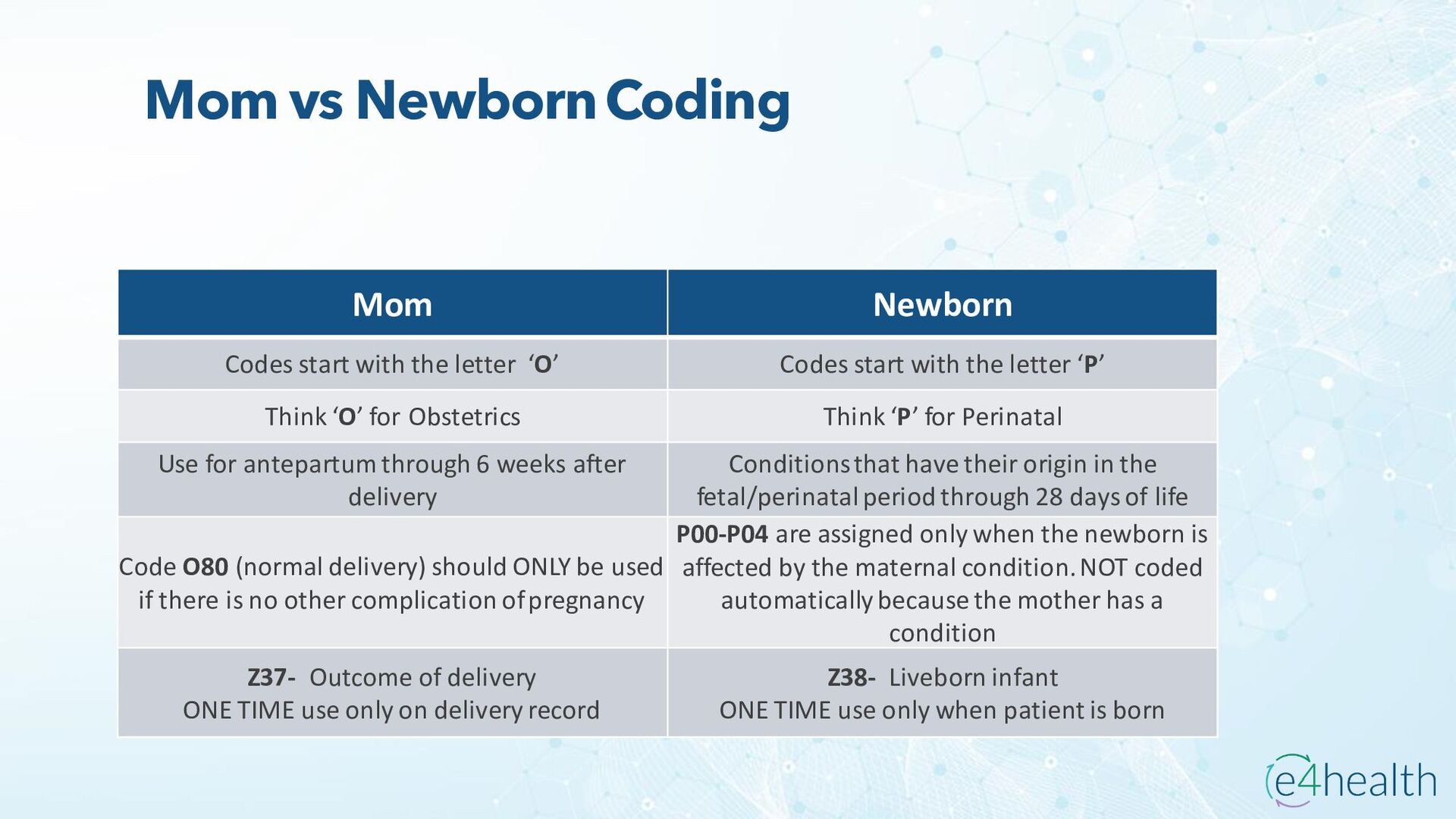
  31. Mom vs Newborn Coding Mom Newborn Codes start with the

    letter ‘O’ Codes start with the letter ‘P’ Think ‘O’ for Obstetrics Think ‘P’ for Perinatal Use for antepartum through 6 weeks after delivery Conditions that have their origin in the fetal/perinatal period through 28 days of life Code O80 (normal delivery) should ONLY be used if there is no other complication of pregnancy P00-P04 are assigned only when the newborn is affected by the maternal condition. NOT coded automatically because the mother has a condition Z37- Outcome of delivery ONE TIME use only on delivery record Z38- Liveborn infant ONE TIME use only when patient is born
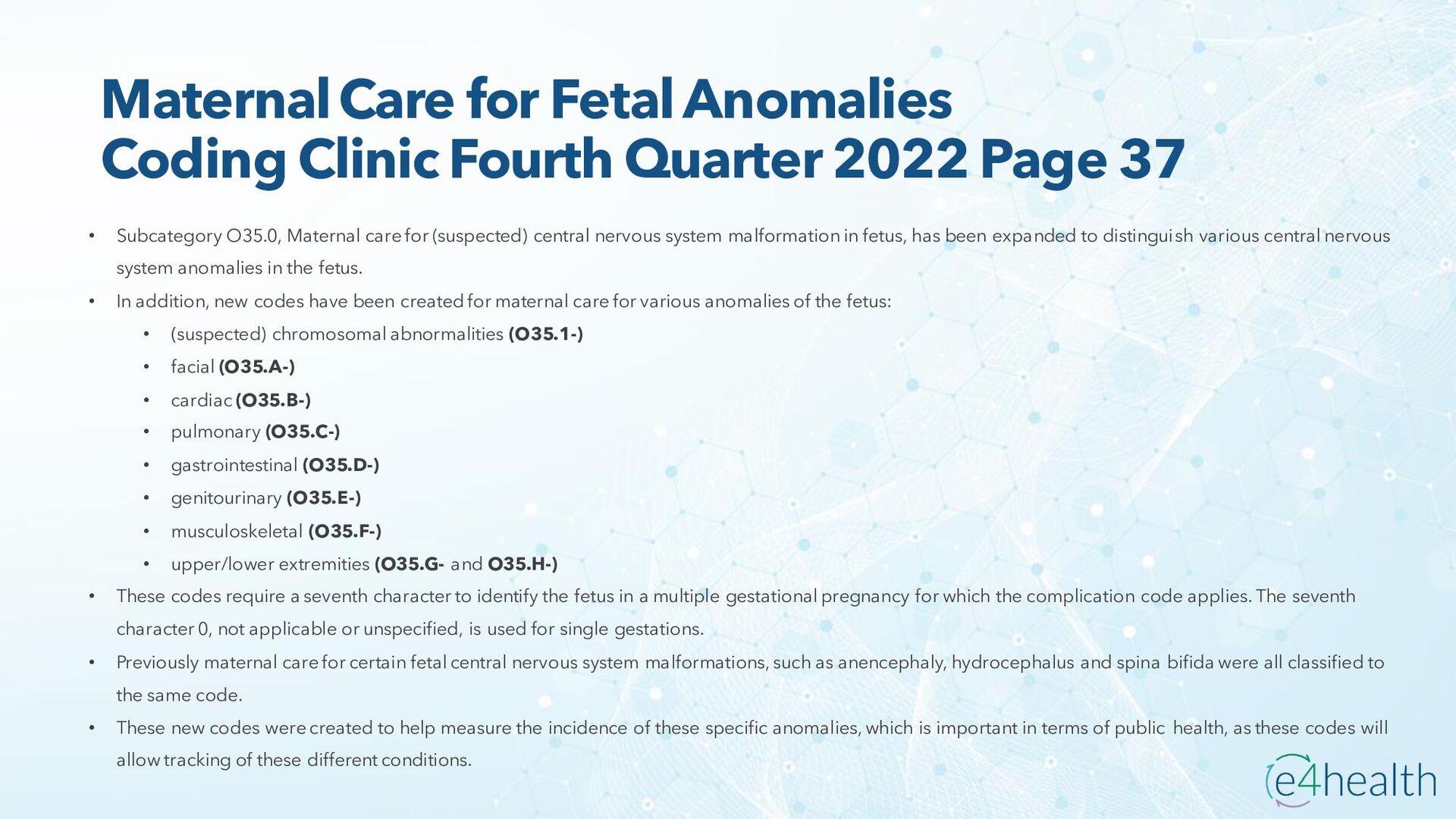
  32. Maternal Care for Fetal Anomalies Coding Clinic Fourth Quarter 2022

    Page 37 • Subcategory O35.0, Maternal care for (suspected) central nervous system malformation in fetus, has been expanded to distinguish various central nervous system anomalies in the fetus. • In addition, new codes have been created for maternal care for various anomalies of the fetus: • (suspected) chromosomal abnormalities (O35.1-) • facial (O35.A-) • cardiac (O35.B-) • pulmonary (O35.C-) • gastrointestinal (O35.D-) • genitourinary (O35.E-) • musculoskeletal (O35.F-) • upper/lower extremities (O35.G- and O35.H-) • These codes require a seventh character to identify the fetus in a multiple gestational pregnancy for which the complication code applies. The seventh character 0, not applicable or unspecified, is used for single gestations. • Previously maternal care for certain fetal central nervous system malformations, such as anencephaly, hydrocephalus and spina bifida were all classified to the same code. • These new codes were created to help measure the incidence of these specific anomalies, which is important in terms of public health, as these codes will allow tracking of these different conditions.
  33. Peripartum cardiomyopathy Coding Clinic Third Quarter 2022 Pages 16-17 •

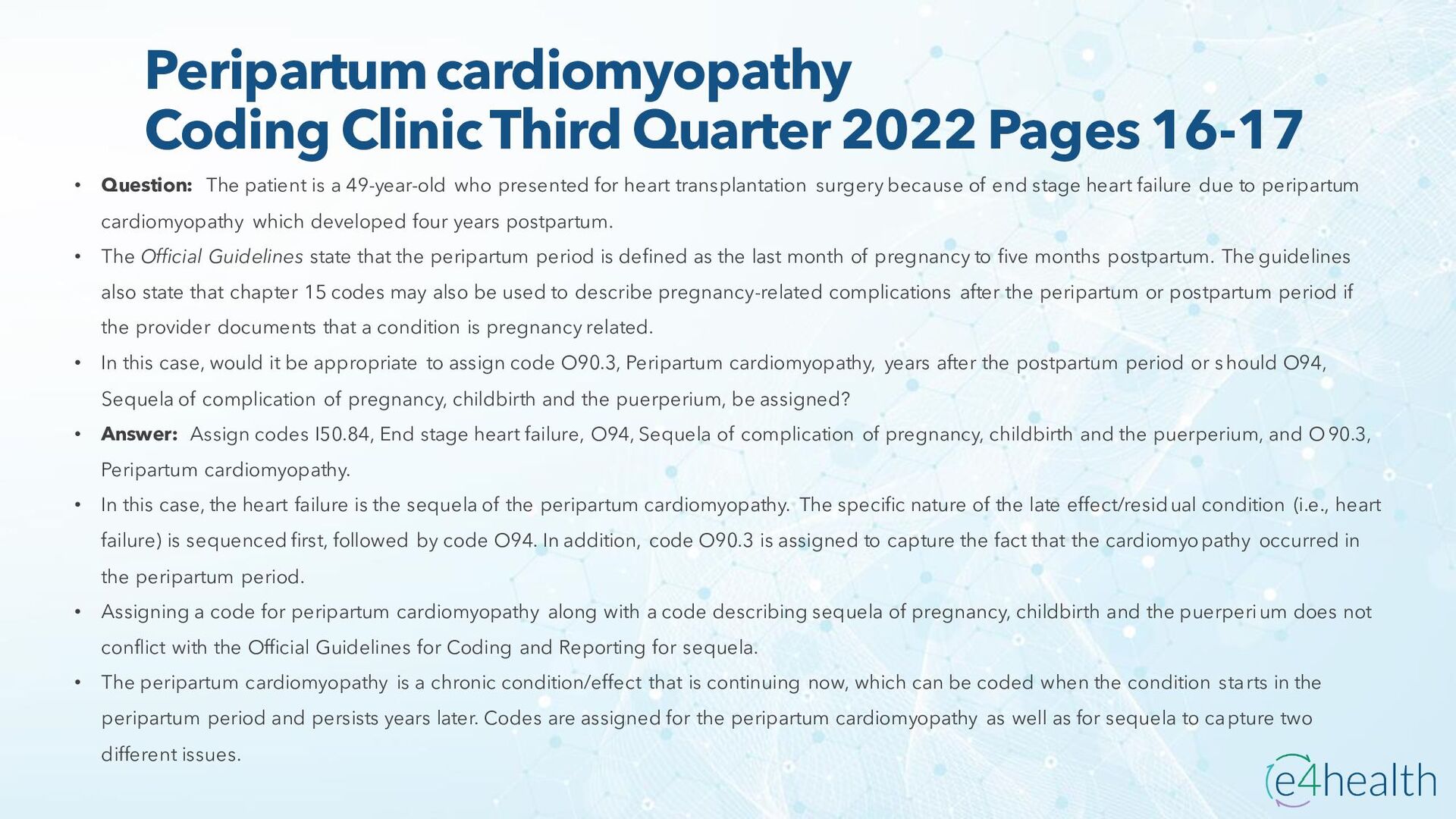
    Question: The patient is a 49-year-old who presented for heart transplantation surgery because of end stage heart failure due to peripartum cardiomyopathy which developed four years postpartum. • The Official Guidelines state that the peripartum period is defined as the last month of pregnancy to five months postpartum. The guidelines also state that chapter 15 codes may also be used to describe pregnancy-related complications after the peripartum or postpartum period if the provider documents that a condition is pregnancy related. • In this case, would it be appropriate to assign code O90.3, Peripartum cardiomyopathy, years after the postpartum period or should O94, Sequela of complication of pregnancy, childbirth and the puerperium, be assigned? • Answer: Assign codes I50.84, End stage heart failure, O94, Sequela of complication of pregnancy, childbirth and the puerperium, and O90.3, Peripartum cardiomyopathy. • In this case, the heart failure is the sequela of the peripartum cardiomyopathy. The specific nature of the late effect/residual condition (i.e., heart failure) is sequenced first, followed by code O94. In addition, code O90.3 is assigned to capture the fact that the cardiomyopathy occurred in the peripartum period. • Assigning a code for peripartum cardiomyopathy along with a code describing sequela of pregnancy, childbirth and the puerperium does not conflict with the Official Guidelines for Coding and Reporting for sequela. • The peripartum cardiomyopathy is a chronic condition/effect that is continuing now, which can be coded when the condition starts in the peripartum period and persists years later. Codes are assigned for the peripartum cardiomyopathy as well as for sequela to capture two different issues.
  34. Determining completed weeks of gestation Coding Clinic Second Quarter 2022

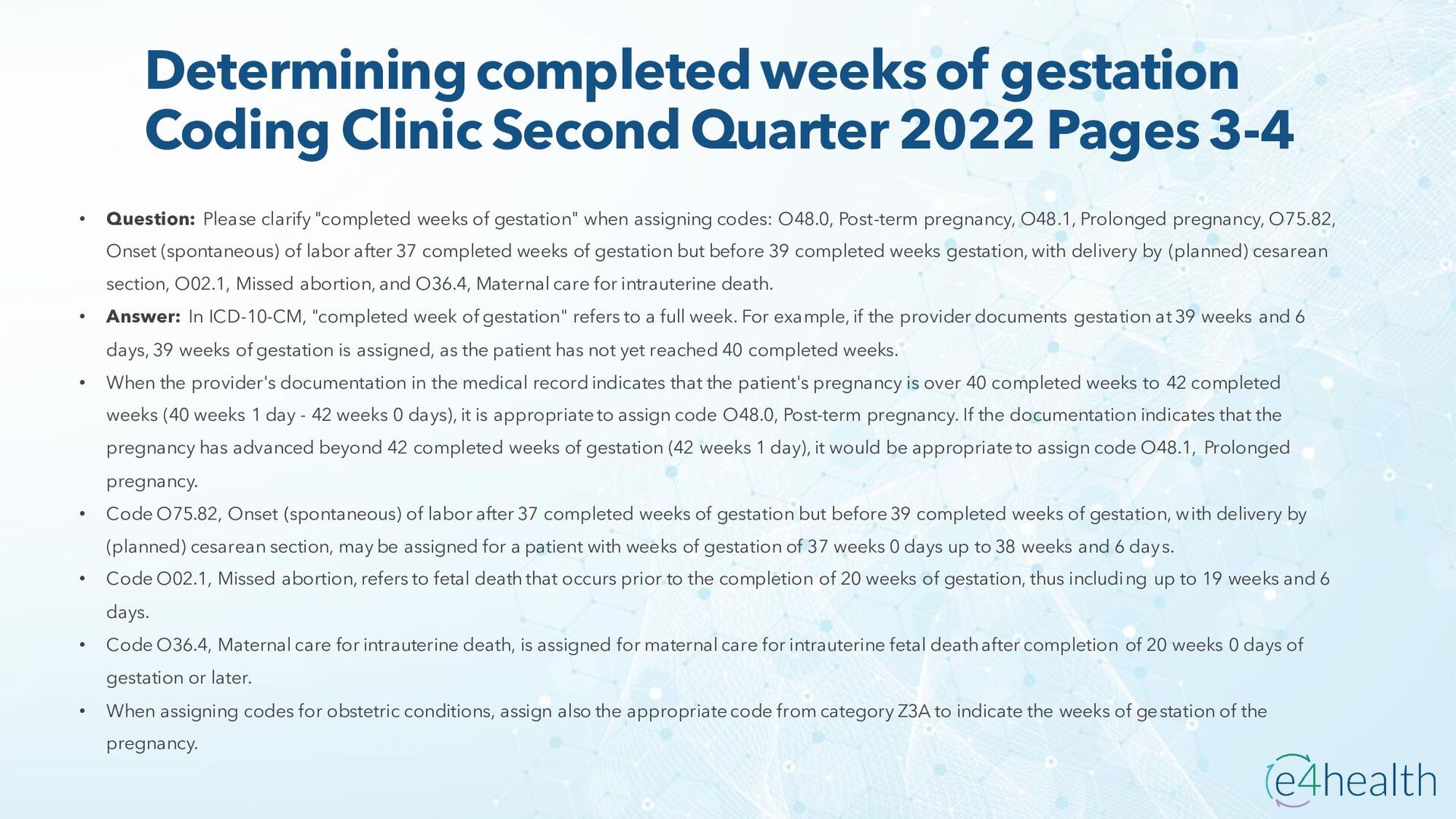
    Pages 3-4 • Question: Please clarify "completed weeks of gestation" when assigning codes: O48.0, Post-term pregnancy, O48.1, Prolonged pregnancy, O75.82, Onset (spontaneous) of labor after 37 completed weeks of gestation but before 39 completed weeks gestation, with delivery by (planned) cesarean section, O02.1, Missed abortion, and O36.4, Maternal care for intrauterine death. • Answer: In ICD-10-CM, "completed week of gestation" refers to a full week. For example, if the provider documents gestation at 39 weeks and 6 days, 39 weeks of gestation is assigned, as the patient has not yet reached 40 completed weeks. • When the provider's documentation in the medical record indicates that the patient's pregnancy is over 40 completed weeks to 42 completed weeks (40 weeks 1 day - 42 weeks 0 days), it is appropriate to assign code O48.0, Post-term pregnancy. If the documentation indicates that the pregnancy has advanced beyond 42 completed weeks of gestation (42 weeks 1 day), it would be appropriate to assign code O48.1, Prolonged pregnancy. • Code O75.82, Onset (spontaneous) of labor after 37 completed weeks of gestation but before 39 completed weeks of gestation, with delivery by (planned) cesarean section, may be assigned for a patient with weeks of gestation of 37 weeks 0 days up to 38 weeks and 6 days. • Code O02.1, Missed abortion, refers to fetal death that occurs prior to the completion of 20 weeks of gestation, thus including up to 19 weeks and 6 days. • Code O36.4, Maternal care for intrauterine death, is assigned for maternal care for intrauterine fetal death after completion of 20 weeks 0 days of gestation or later. • When assigning codes for obstetric conditions, assign also the appropriate code from category Z3A to indicate the weeks of gestation of the pregnancy.
  35. Newborn Exposure to COVID-19 Coding Clinic Second Quarter 2022 Page

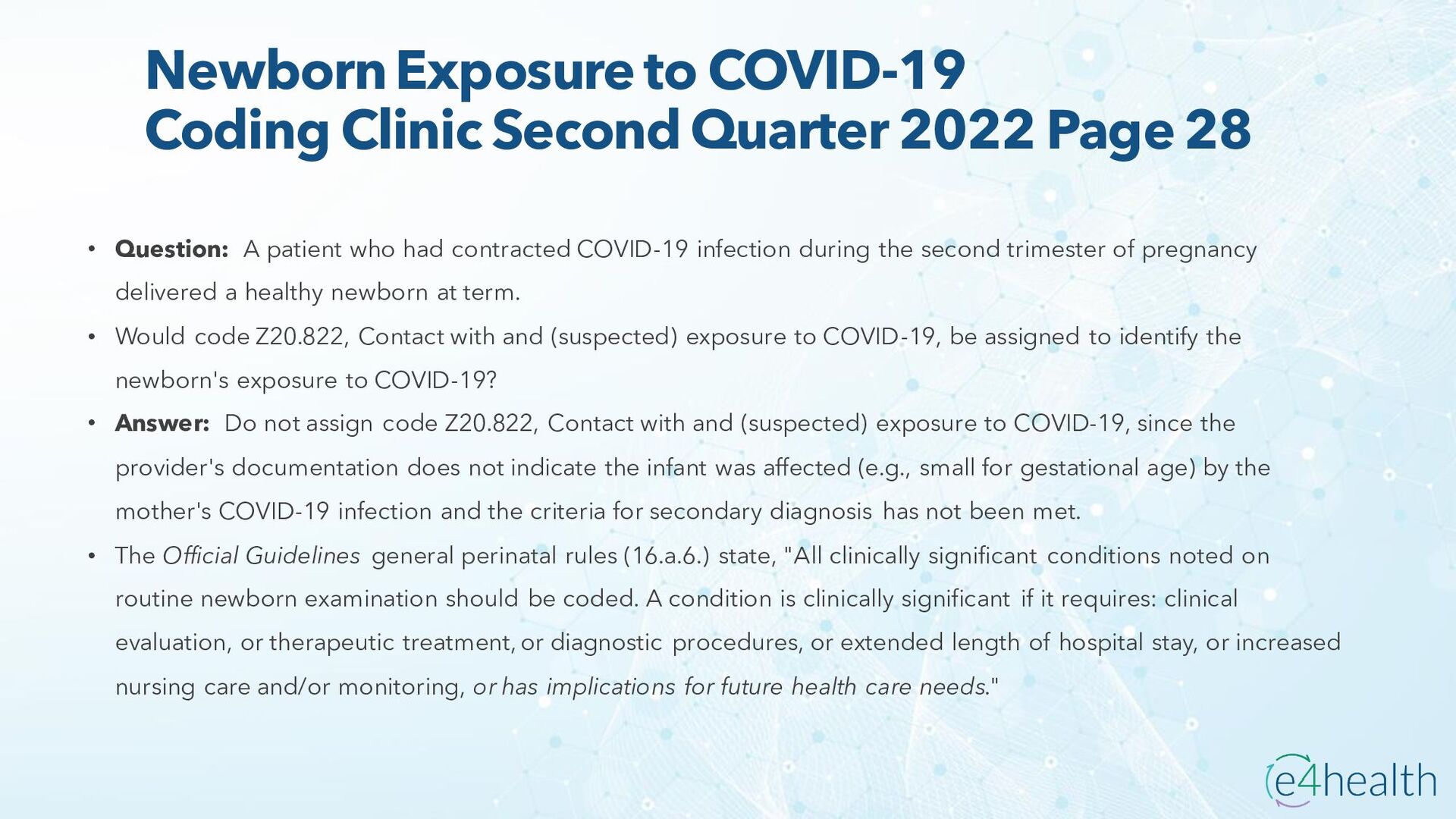
    28 • Question: A patient who had contracted COVID-19 infection during the second trimester of pregnancy delivered a healthy newborn at term. • Would code Z20.822, Contact with and (suspected) exposure to COVID-19, be assigned to identify the newborn's exposure to COVID-19? • Answer: Do not assign code Z20.822, Contact with and (suspected) exposure to COVID-19, since the provider's documentation does not indicate the infant was affected (e.g., small for gestational age) by the mother's COVID-19 infection and the criteria for secondary diagnosis has not been met. • The Official Guidelines general perinatal rules (16.a.6.) state, "All clinically significant conditions noted on routine newborn examination should be coded. A condition is clinically significant if it requires: clinical evaluation, or therapeutic treatment, or diagnostic procedures, or extended length of hospital stay, or increased nursing care and/or monitoring, or has implications for future health care needs."
  36. Post-term pregnancy Coding Clinic Second Quarter 2022 Page 3 •

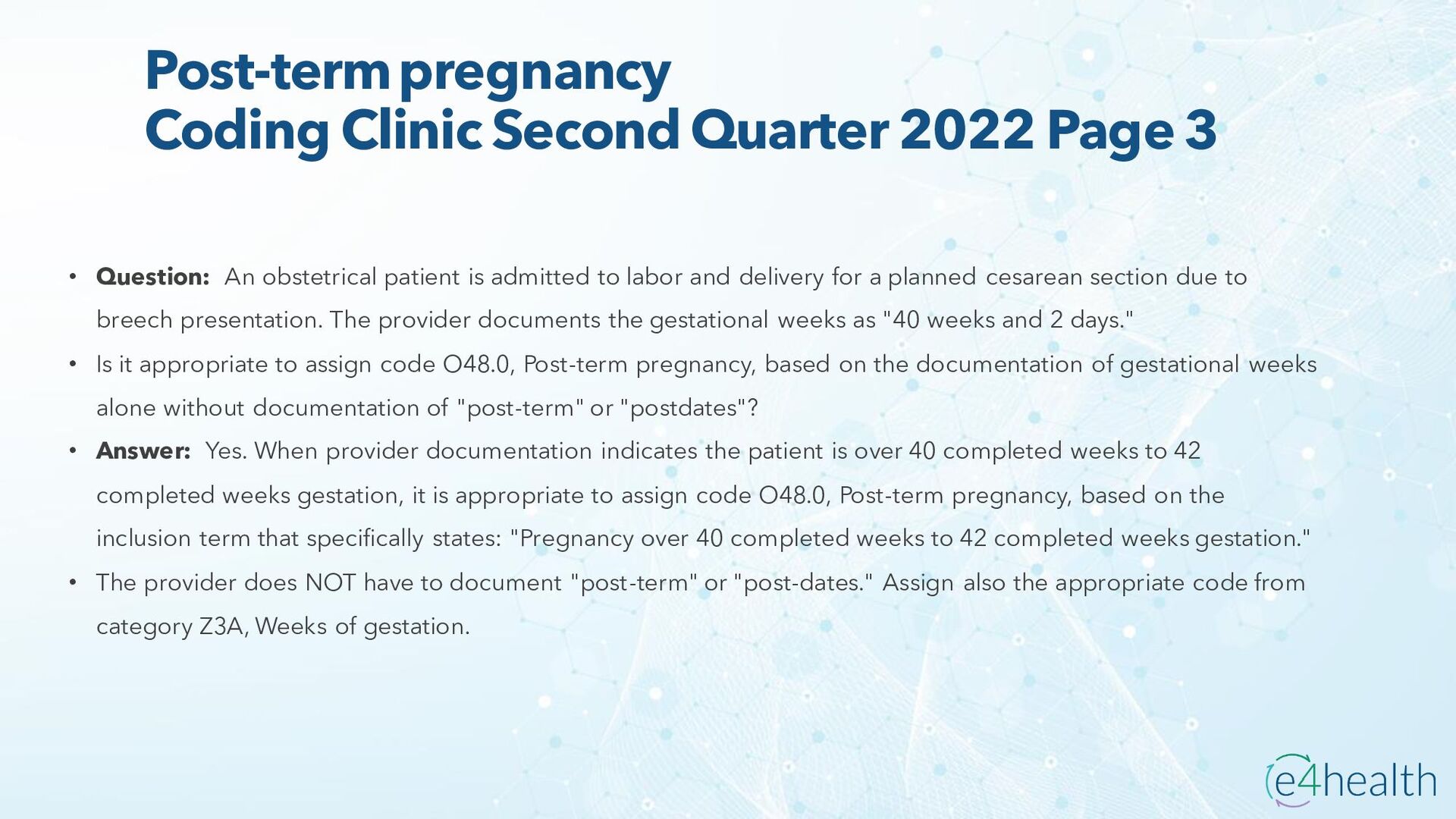
    Question: An obstetrical patient is admitted to labor and delivery for a planned cesarean section due to breech presentation. The provider documents the gestational weeks as "40 weeks and 2 days." • Is it appropriate to assign code O48.0, Post-term pregnancy, based on the documentation of gestational weeks alone without documentation of "post-term" or "postdates"? • Answer: Yes. When provider documentation indicates the patient is over 40 completed weeks to 42 completed weeks gestation, it is appropriate to assign code O48.0, Post-term pregnancy, based on the inclusion term that specifically states: "Pregnancy over 40 completed weeks to 42 completed weeks gestation." • The provider does NOT have to document "post-term" or "post-dates." Assign also the appropriate code from category Z3A, Weeks of gestation.
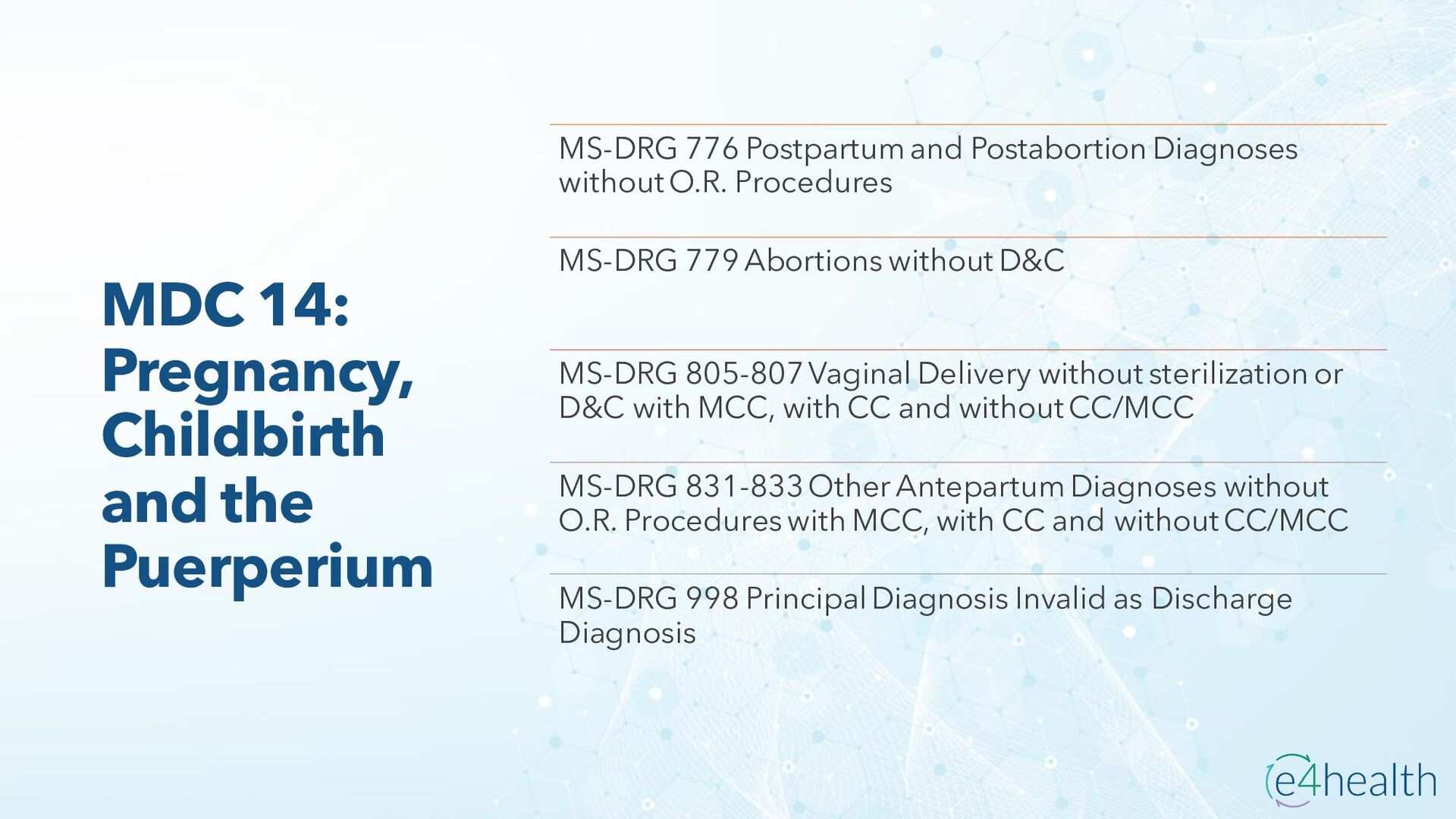
  37. MDC 14: Pregnancy, Childbirth and the Puerperium MS-DRG 776 Postpartum

    and Postabortion Diagnoses without O.R. Procedures MS-DRG 779 Abortions without D&C MS-DRG 805-807 Vaginal Delivery without sterilization or D&C with MCC, with CC and without CC/MCC MS-DRG 831-833 Other Antepartum Diagnoses without O.R. Procedures with MCC, with CC and without CC/MCC MS-DRG 998 Principal Diagnosis Invalid as Discharge Diagnosis
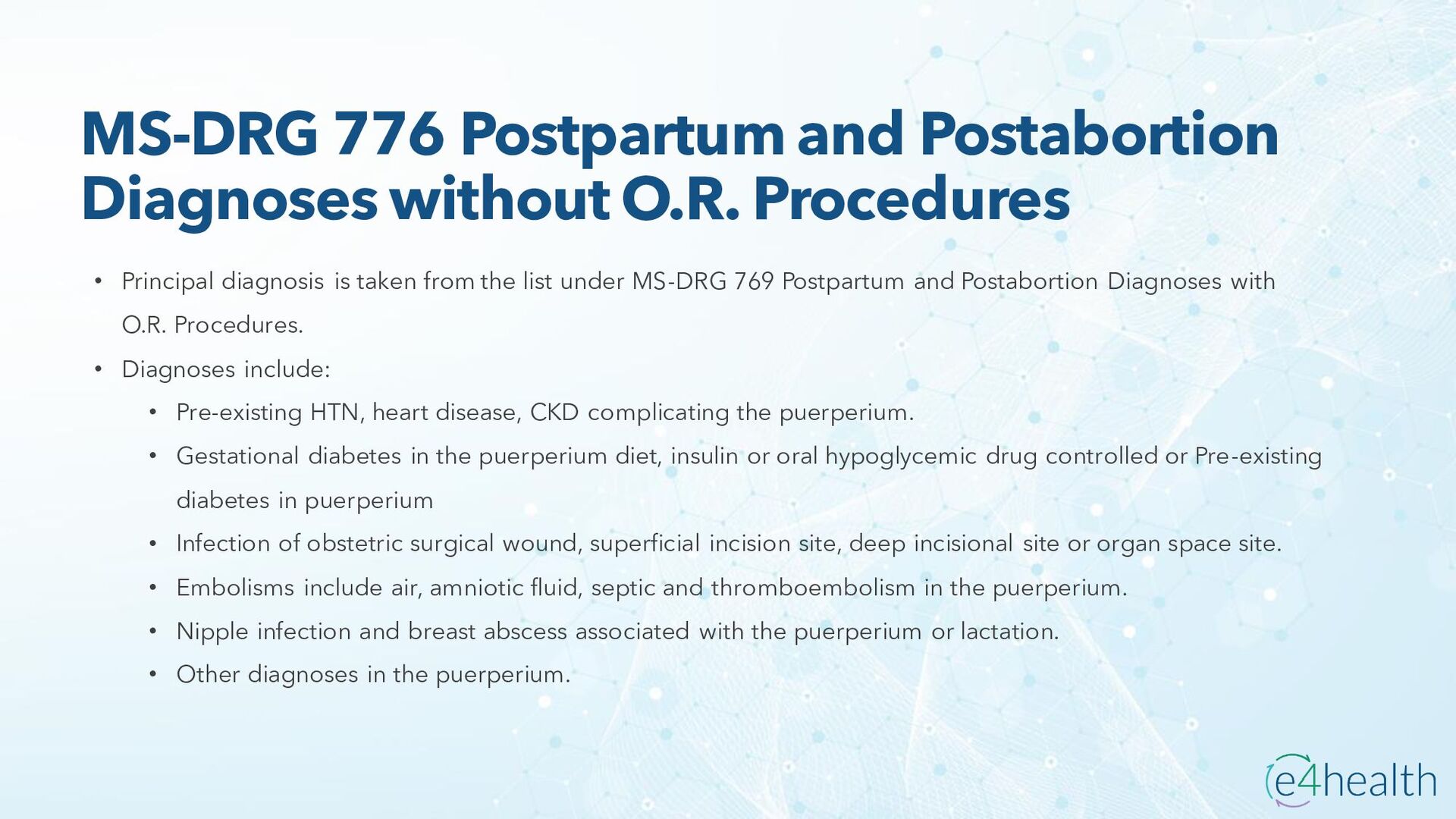
  38. MS-DRG 776 Postpartum and Postabortion Diagnoses without O.R. Procedures •

    Principal diagnosis is taken from the list under MS-DRG 769 Postpartum and Postabortion Diagnoses with O.R. Procedures. • Diagnoses include: • Pre-existing HTN, heart disease, CKD complicating the puerperium. • Gestational diabetes in the puerperium diet, insulin or oral hypoglycemic drug controlled or Pre-existing diabetes in puerperium • Infection of obstetric surgical wound, superficial incision site, deep incisional site or organ space site. • Embolisms include air, amniotic fluid, septic and thromboembolism in the puerperium. • Nipple infection and breast abscess associated with the puerperium or lactation. • Other diagnoses in the puerperium.
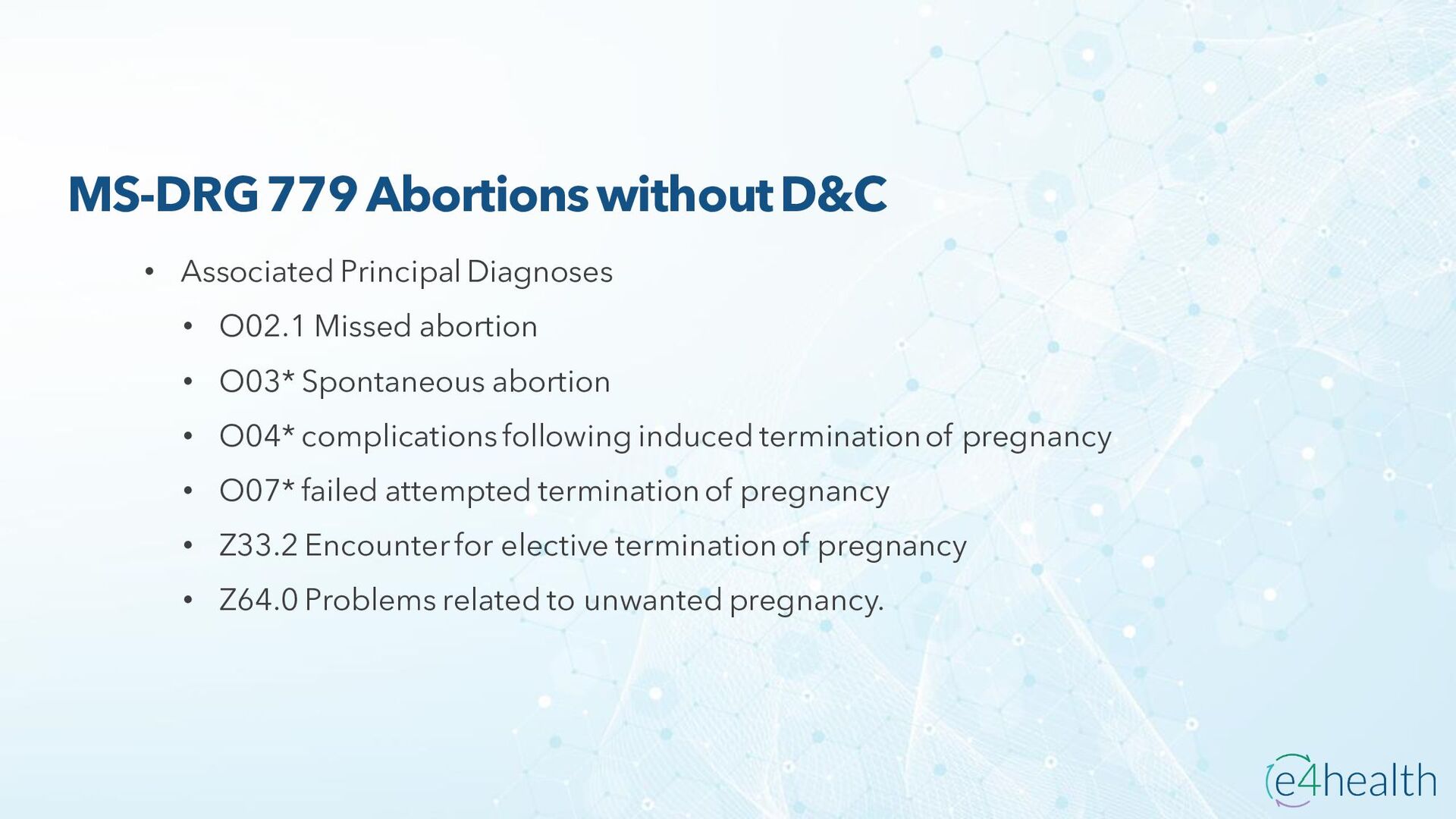
  39. MS-DRG 779 Abortions without D&C • Associated Principal Diagnoses •

    O02.1 Missed abortion • O03* Spontaneous abortion • O04* complications following induced termination of pregnancy • O07* failed attempted termination of pregnancy • Z33.2 Encounter for elective termination of pregnancy • Z64.0 Problems related to unwanted pregnancy.
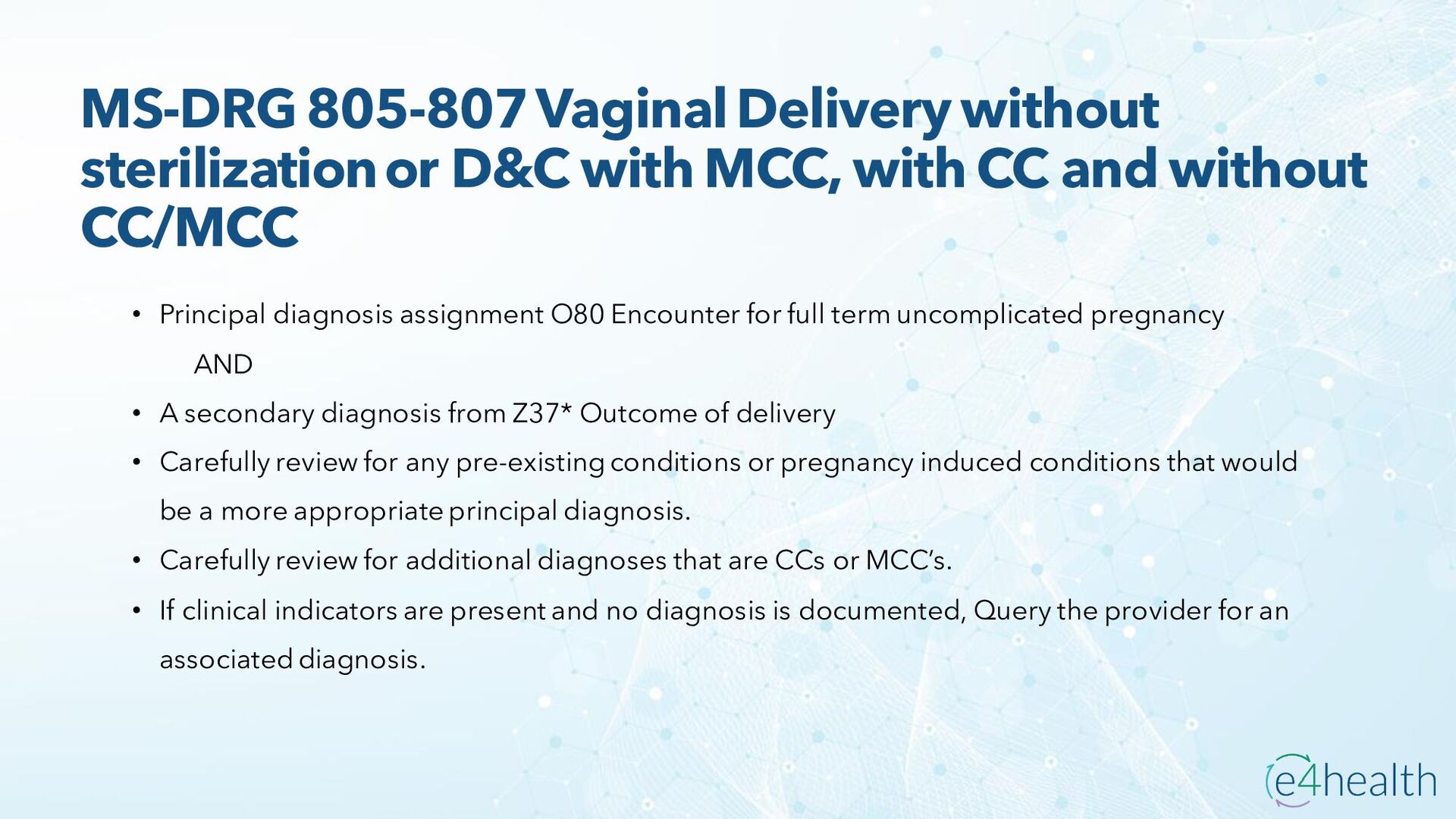
  40. MS-DRG 805-807 Vaginal Delivery without sterilization or D&C with MCC,

    with CC and without CC/MCC • Principal diagnosis assignment O80 Encounter for full term uncomplicated pregnancy AND • A secondary diagnosis from Z37* Outcome of delivery • Carefully review for any pre-existing conditions or pregnancy induced conditions that would be a more appropriate principal diagnosis. • Carefully review for additional diagnoses that are CCs or MCC’s. • If clinical indicators are present and no diagnosis is documented, Query the provider for an associated diagnosis.
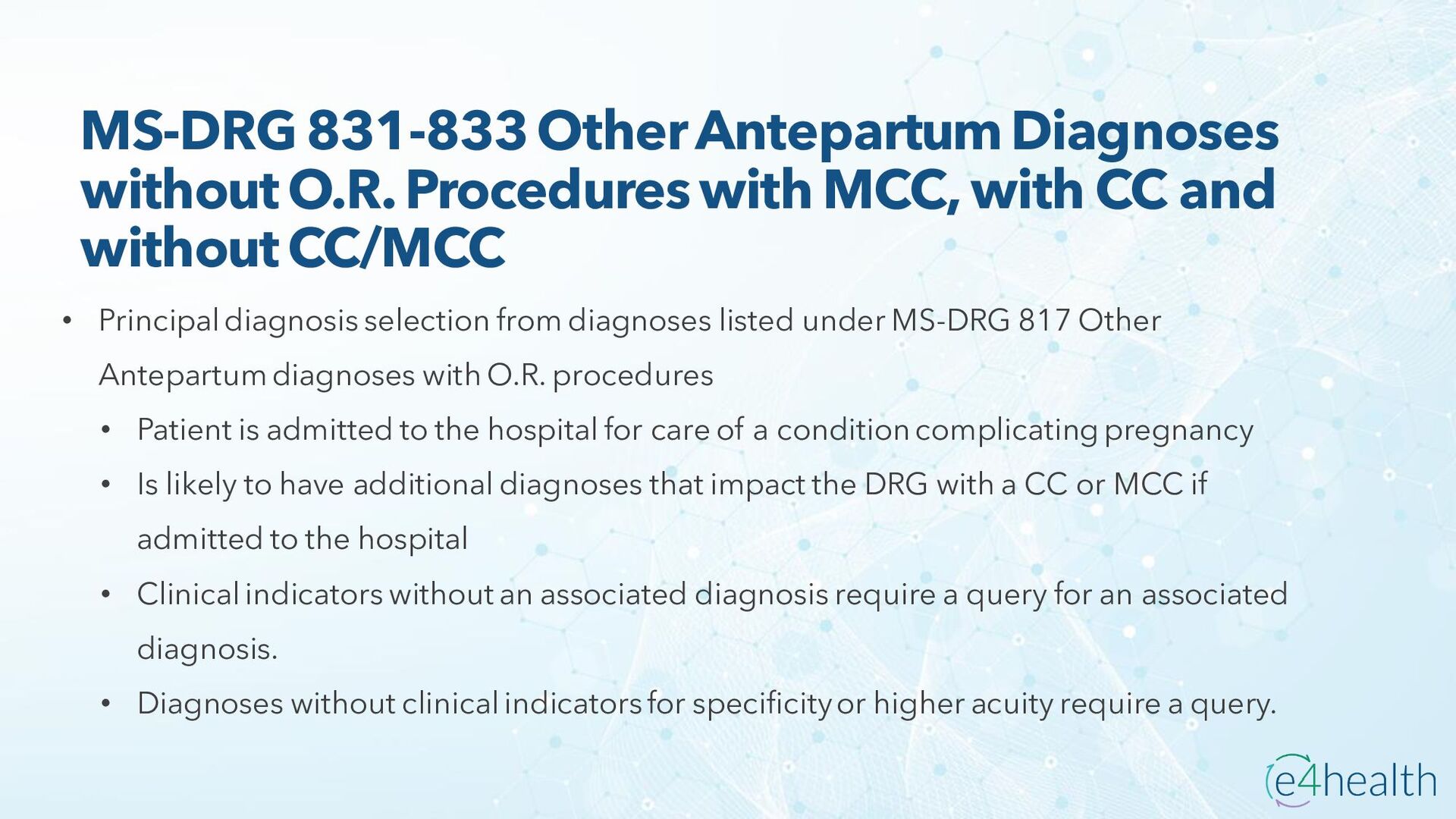
  41. MS-DRG 831-833 Other Antepartum Diagnoses without O.R. Procedures with MCC,

    with CC and without CC/MCC • Principal diagnosis selection from diagnoses listed under MS-DRG 817 Other Antepartum diagnoses with O.R. procedures • Patient is admitted to the hospital for care of a condition complicating pregnancy • Is likely to have additional diagnoses that impact the DRG with a CC or MCC if admitted to the hospital • Clinical indicators without an associated diagnosis require a query for an associated diagnosis. • Diagnoses without clinical indicators for specificity or higher acuity require a query.
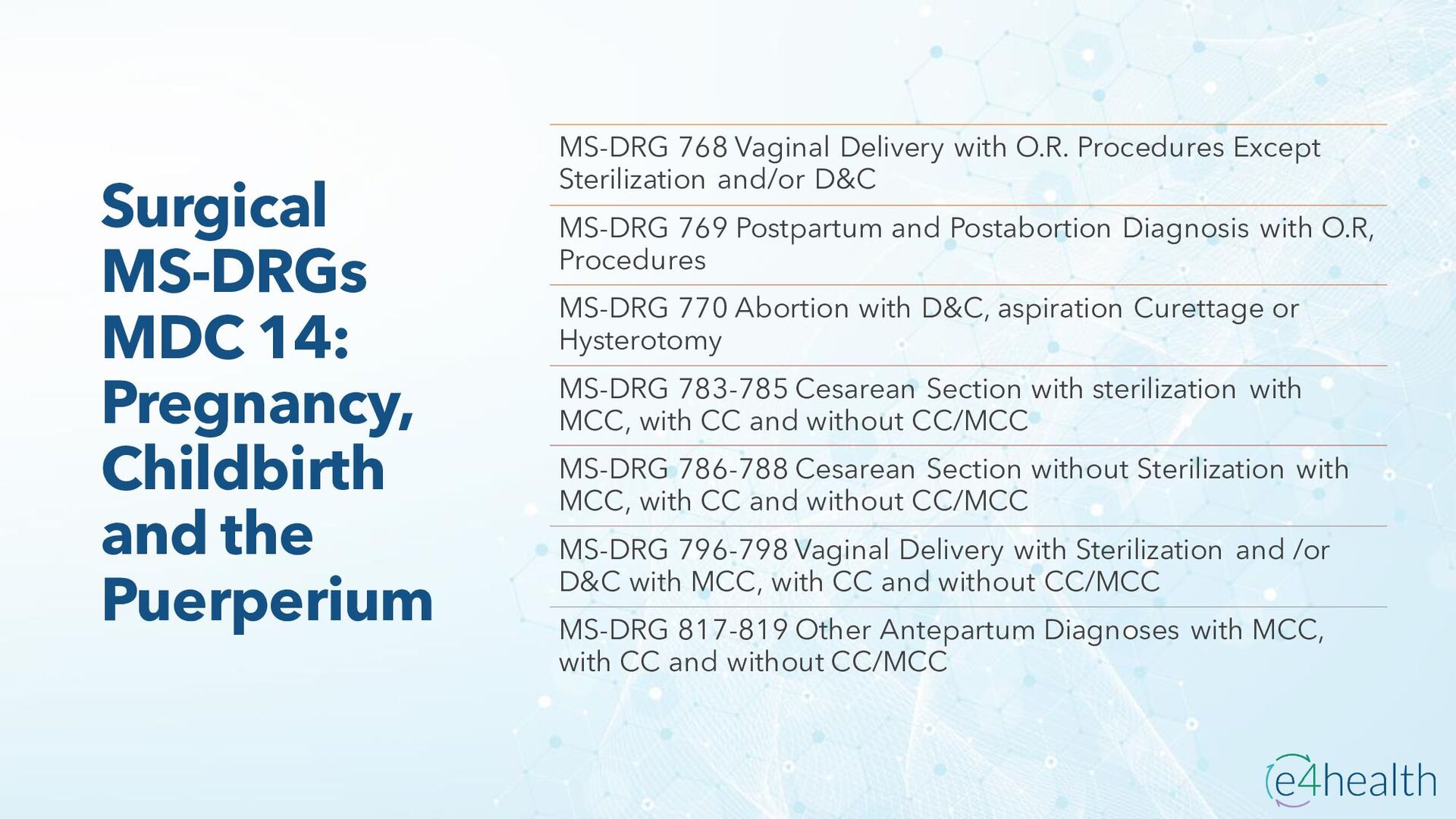
  42. Surgical MS-DRGs MDC 14: Pregnancy, Childbirth and the Puerperium MS-DRG

    768 Vaginal Delivery with O.R. Procedures Except Sterilization and/or D&C MS-DRG 769 Postpartum and Postabortion Diagnosis with O.R, Procedures MS-DRG 770 Abortion with D&C, aspiration Curettage or Hysterotomy MS-DRG 783-785 Cesarean Section with sterilization with MCC, with CC and without CC/MCC MS-DRG 786-788 Cesarean Section without Sterilization with MCC, with CC and without CC/MCC MS-DRG 796-798 Vaginal Delivery with Sterilization and /or D&C with MCC, with CC and without CC/MCC MS-DRG 817-819 Other Antepartum Diagnoses with MCC, with CC and without CC/MCC
  43. MS-DRG 768 Vaginal Delivery with O.R. Procedures Except Sterilization and/or

    D&C • Delivery operating room procedures OR • Delivery Nonoperating room procedures AND • Any operating room procedures except sterilization procedures OR • MDC 14 specific procedures • Found in Obstetrics PCS 102-10Y
  44. MS-DRG 769 Postpartum and Postabortion Diagnosis with O.R. Procedures These

    are the same PDX as found in DRG 776 with the addition of any operating room procedure including those found in MDC 14 specific procedures. Stand-alone DRG, not impacted by CC/MCC. Additional diagnoses may impact the APR/DRG.
  45. MS-DRG 770 Abortion with D&C, aspiration Curettage or Hysterotomy •

    Includes Operating room procedures • 10A00ZZ – Abortion Products of Conception, Open Approach • 10A03ZZ – Abortion Products of Conception, Percutaneous Approach • 10A04ZZ – Abortion Products of Conception, Percutaneous Endoscopic Approach • 10A07ZZ – Abortion Products of Conception, Via Natural or Artificial Opening • 10A08ZZ – Abortion Products of Conception, Via Natural or Artificial Opening Endoscopic • 10D17ZZ – Extraction Products of Conception, Retained Via Natural or Artificial Opening • 10D18ZZ – Extract Products of Conception, Retained Via Natural or Artificial Opening Endoscopic
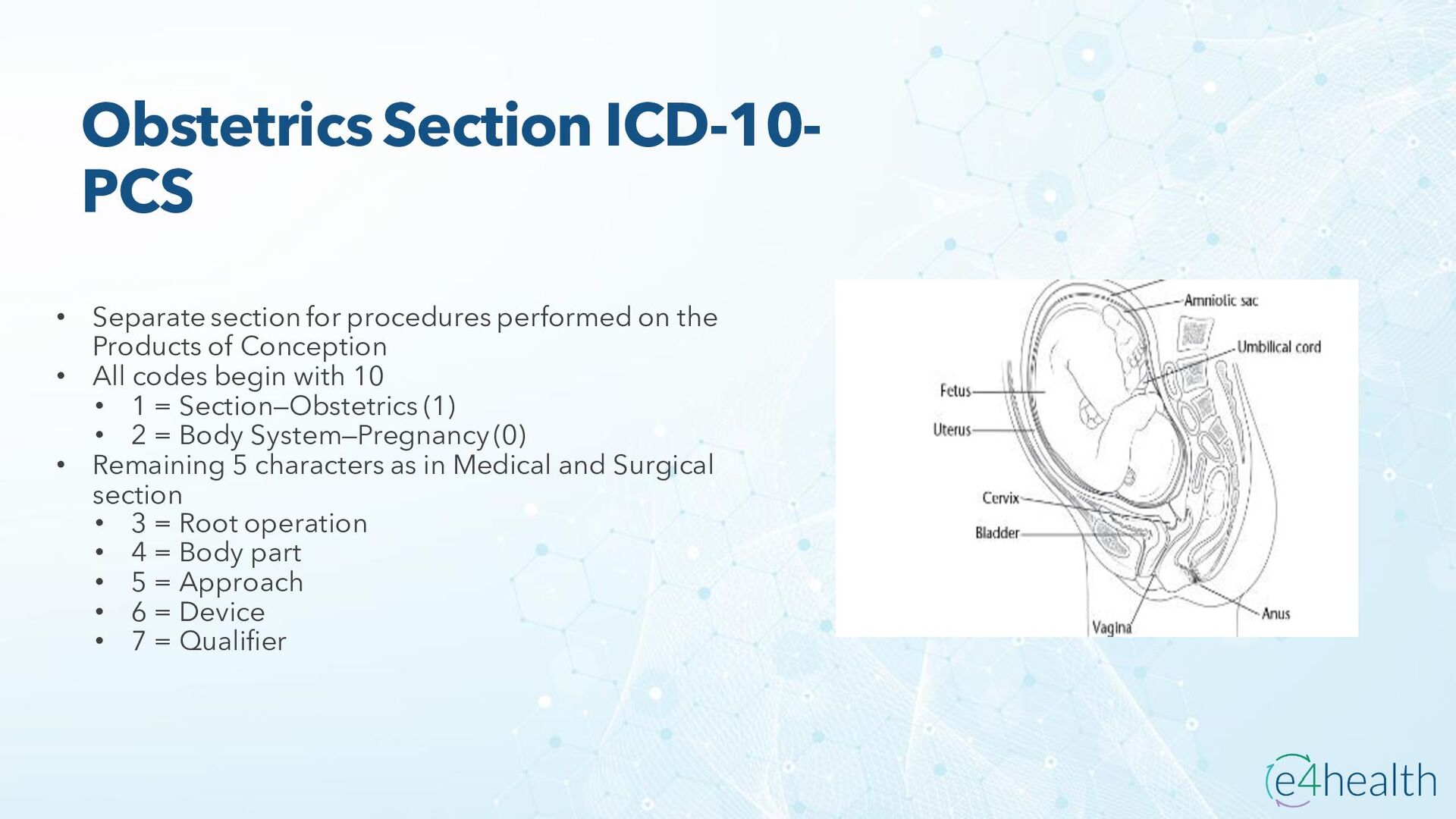
  46. Obstetrics Section ICD-10- PCS • Separate section for procedures performed

    on the Products of Conception • All codes begin with 10 • 1 = Section—Obstetrics (1) • 2 = Body System—Pregnancy (0) • Remaining 5 characters as in Medical and Surgical section • 3 = Root operation • 4 = Body part • 5 = Approach • 6 = Device • 7 = Qualifier
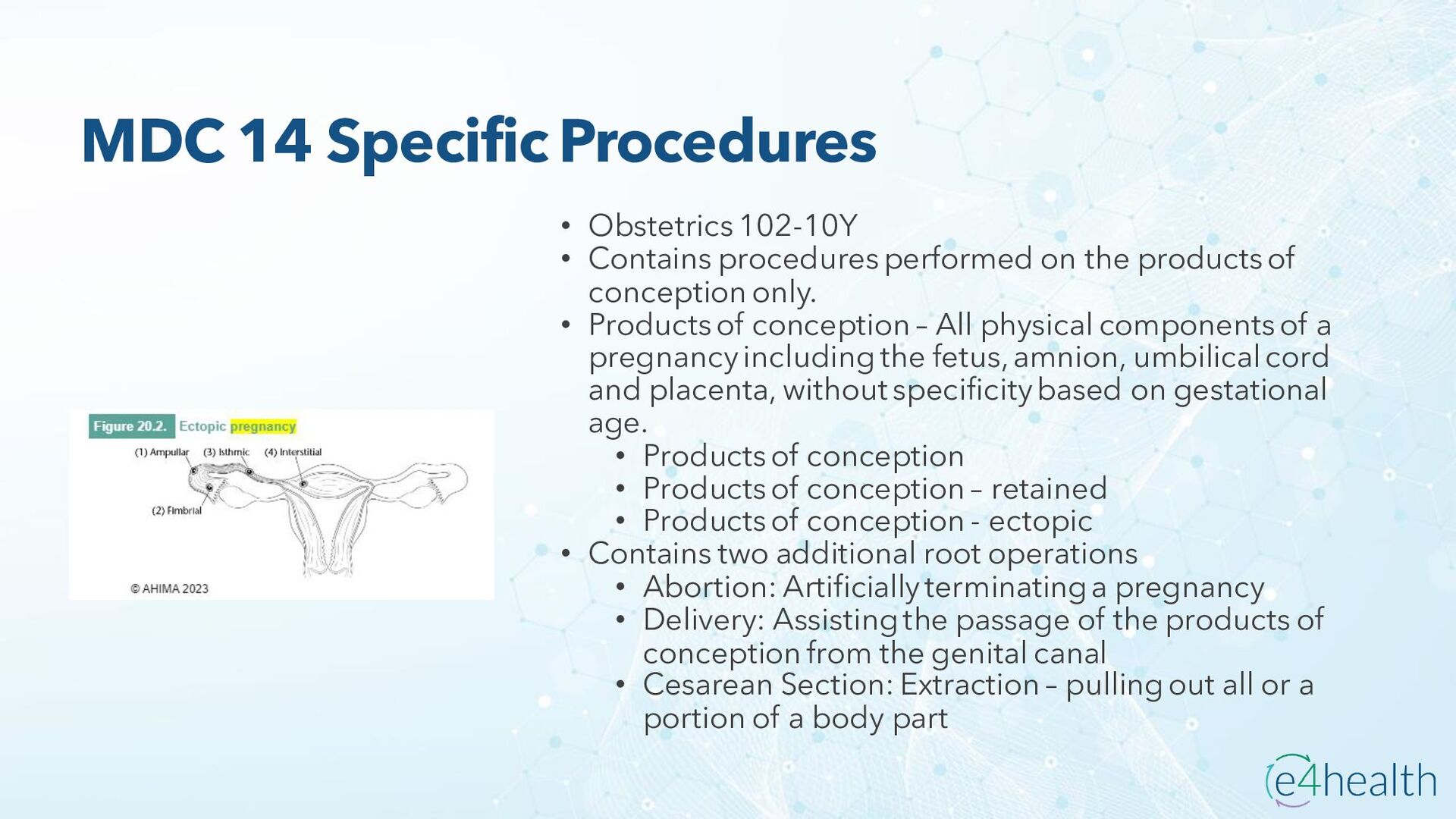
  47. MDC 14 Specific Procedures • Obstetrics 102-10Y • Contains procedures

    performed on the products of conception only. • Products of conception – All physical components of a pregnancy including the fetus, amnion, umbilical cord and placenta, without specificity based on gestational age. • Products of conception • Products of conception – retained • Products of conception - ectopic • Contains two additional root operations • Abortion: Artificially terminating a pregnancy • Delivery: Assisting the passage of the products of conception from the genital canal • Cesarean Section: Extraction – pulling out all or a portion of a body part
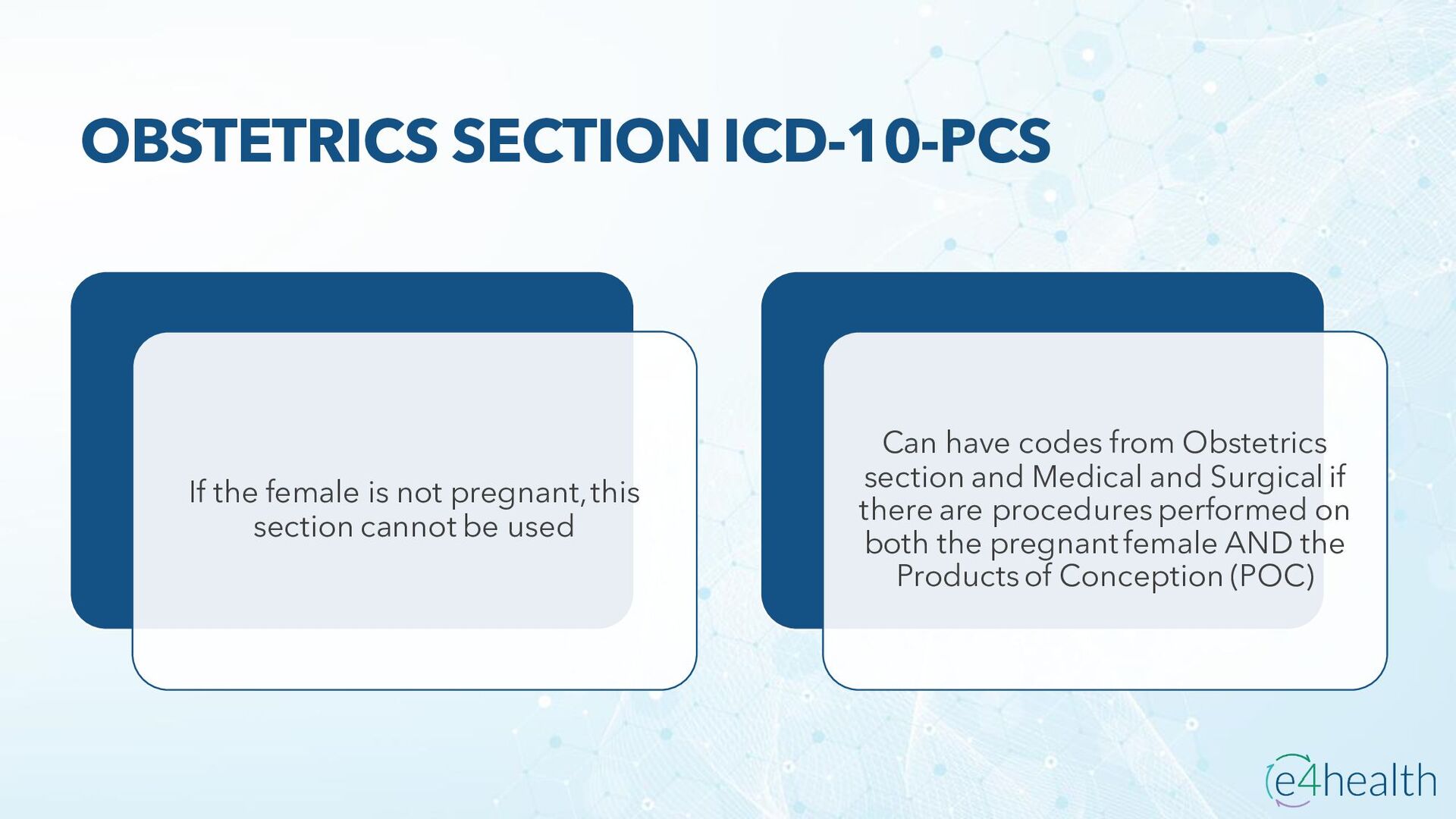
  48. OBSTETRICS SECTION ICD-10-PCS If the female is not pregnant, this

    section cannot be used Can have codes from Obstetrics section and Medical and Surgical if there are procedures performed on both the pregnant female AND the Products of Conception (POC)
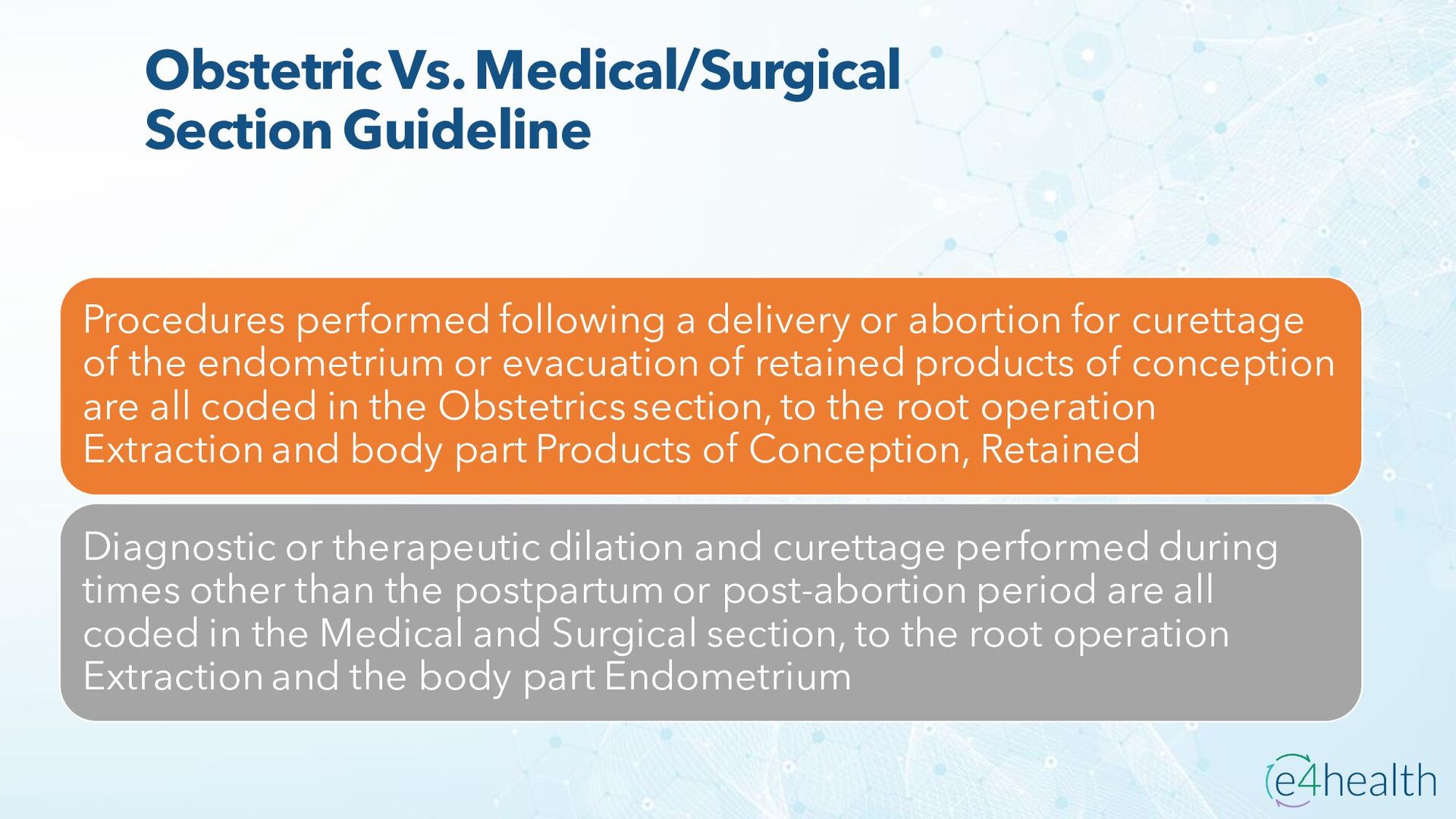
  49. Obstetric Vs. Medical/Surgical Section Guideline Procedures performed following a delivery

    or abortion for curettage of the endometrium or evacuation of retained products of conception are all coded in the Obstetrics section, to the root operation Extraction and body part Products of Conception, Retained Diagnostic or therapeutic dilation and curettage performed during times other than the postpartum or post-abortion period are all coded in the Medical and Surgical section, to the root operation Extraction and the body part Endometrium
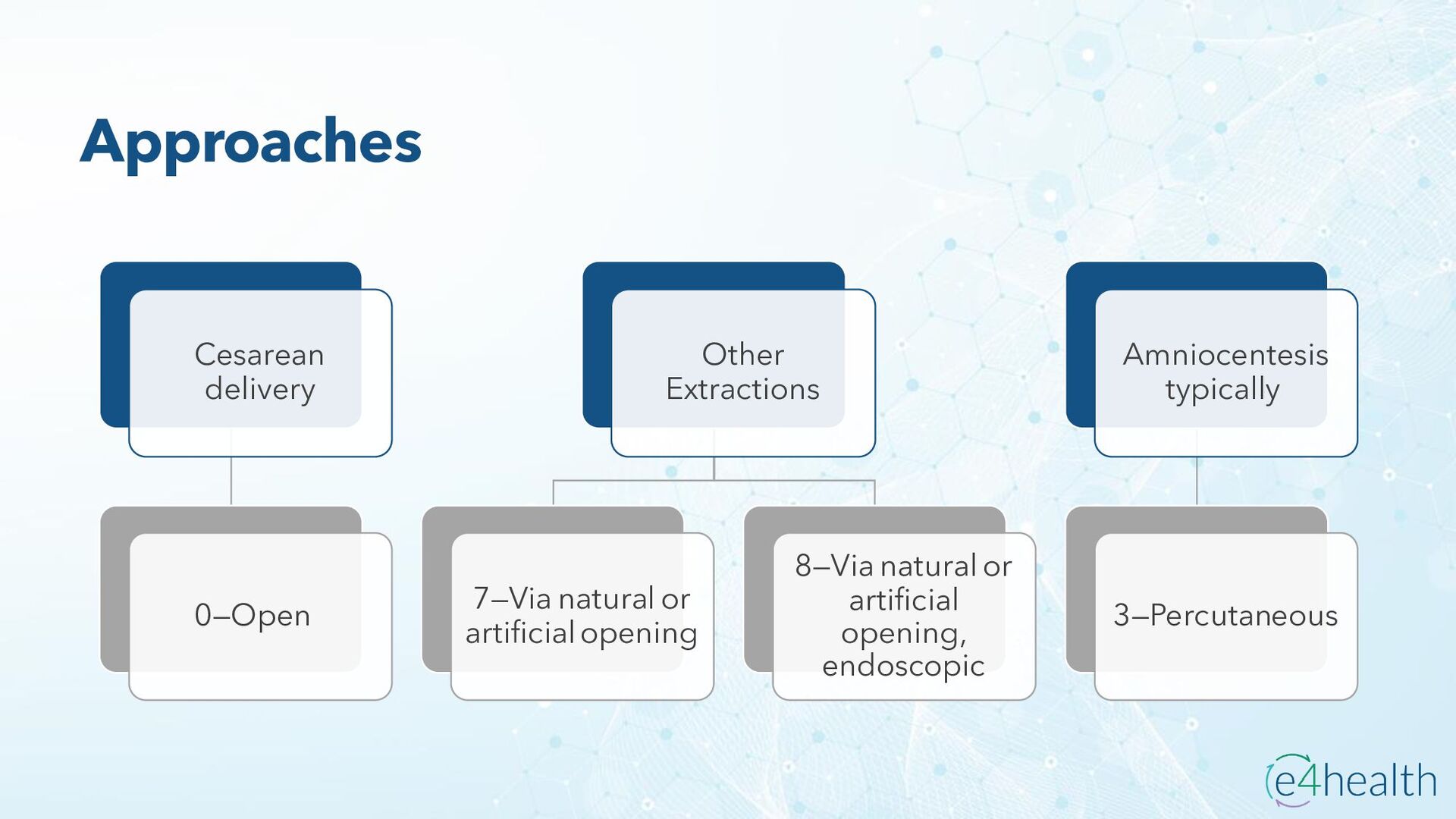
  50. Approaches Cesarean delivery 0—Open Other Extractions 7—Via natural or artificial

    opening 8—Via natural or artificial opening, endoscopic Amniocentesis typically 3—Percutaneous
  51. MS-DRG 783-785 Cesarean Section with sterilization with MCC, with CC

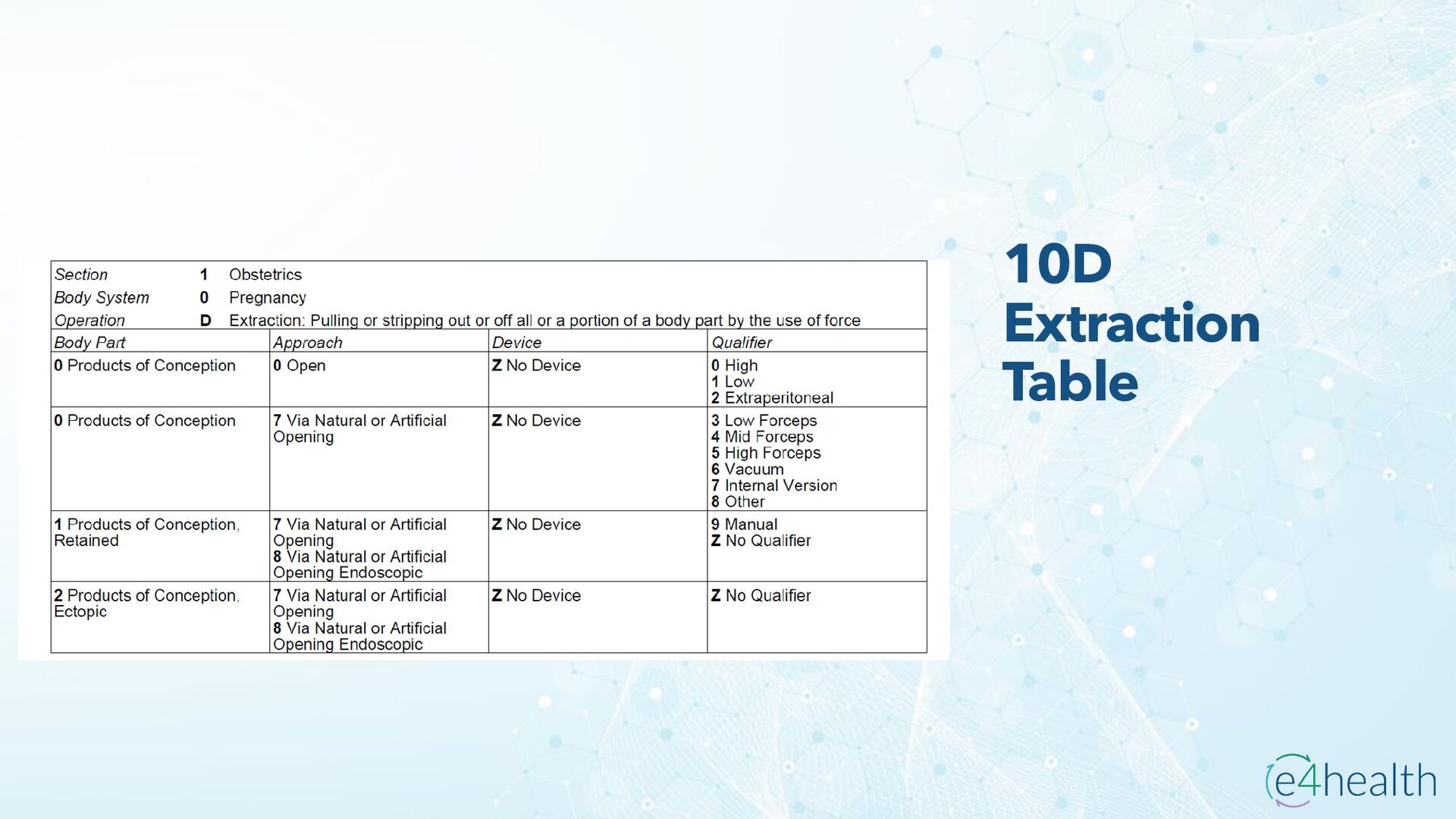
    and without CC/MCC • Includes cesarean section operating room Procedures • 10D00Z0 – Extraction of products of conception, High, Open Approach • 10D00Z1 – Extraction of products of conception, Low, Open Approach
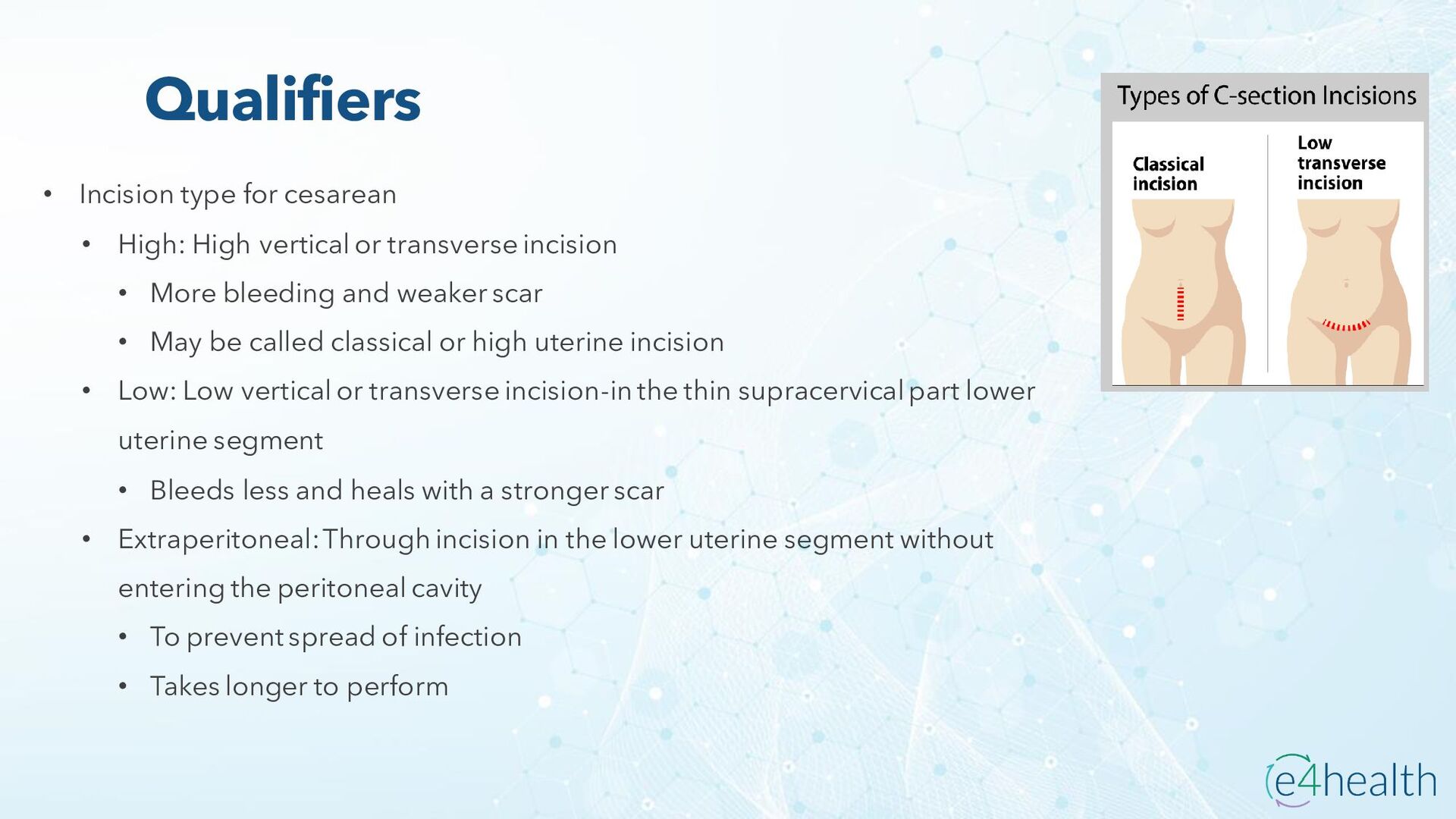
  52. Qualifiers • Incision type for cesarean • High: High vertical

    or transverse incision • More bleeding and weaker scar • May be called classical or high uterine incision • Low: Low vertical or transverse incision-in the thin supracervical part lower uterine segment • Bleeds less and heals with a stronger scar • Extraperitoneal: Through incision in the lower uterine segment without entering the peritoneal cavity • To prevent spread of infection • Takes longer to perform
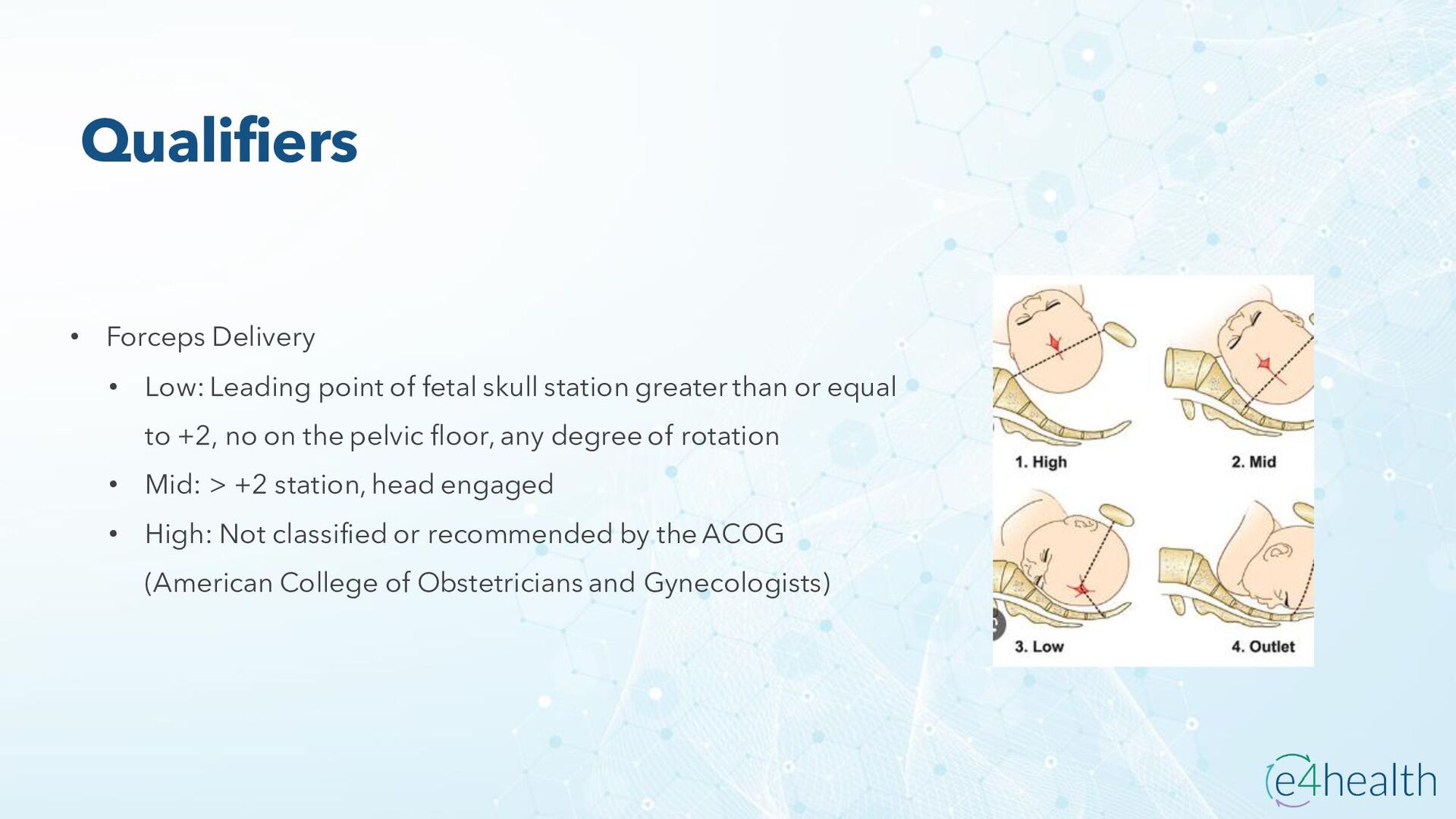
  53. Qualifiers • Forceps Delivery • Low: Leading point of fetal

    skull station greater than or equal to +2, no on the pelvic floor, any degree of rotation • Mid: > +2 station, head engaged • High: Not classified or recommended by the ACOG (American College of Obstetricians and Gynecologists)
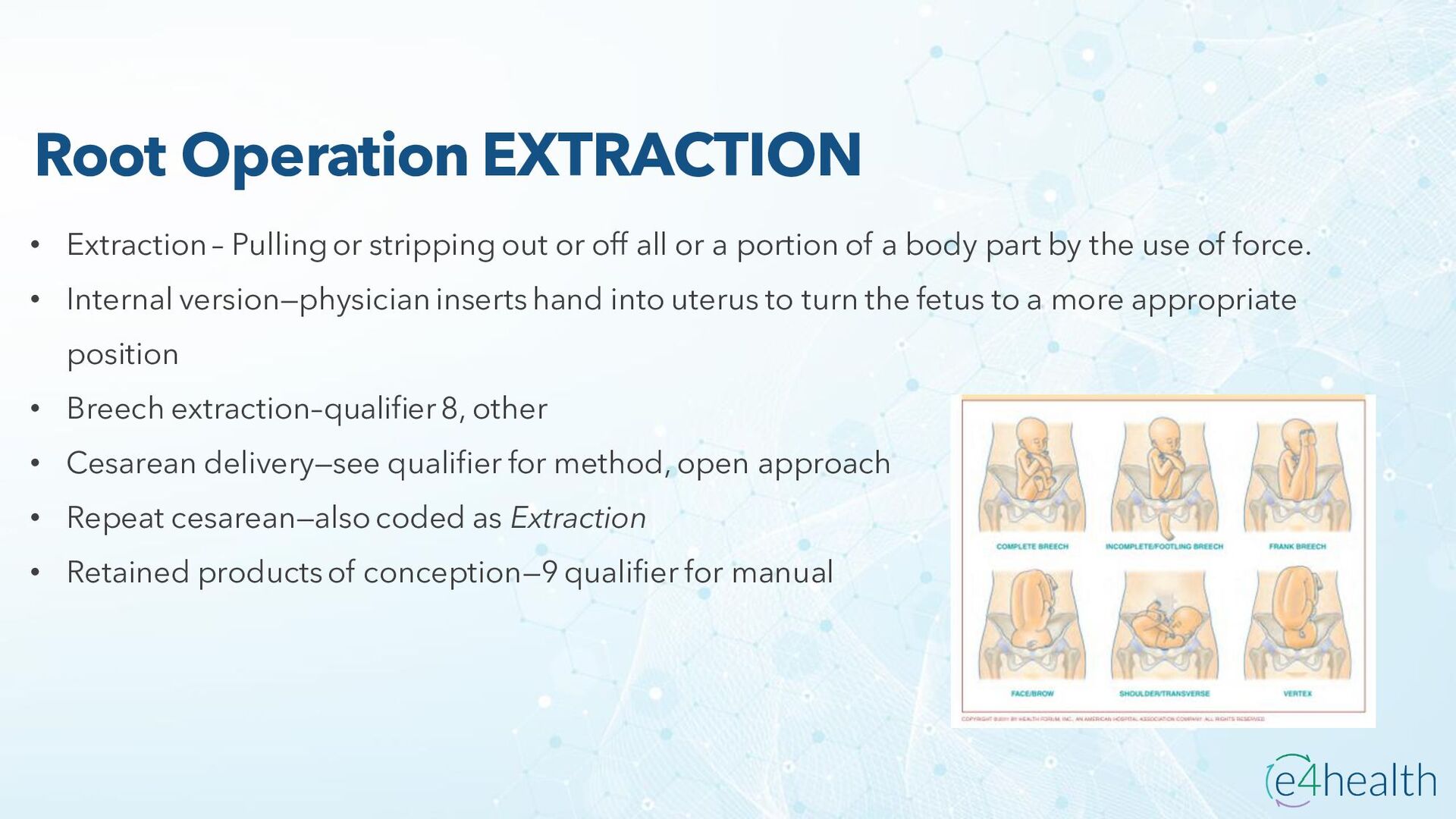
  54. Root Operation EXTRACTION • Extraction – Pulling or stripping out

    or off all or a portion of a body part by the use of force. • Internal version—physician inserts hand into uterus to turn the fetus to a more appropriate position • Breech extraction–qualifier 8, other • Cesarean delivery—see qualifier for method, open approach • Repeat cesarean—also coded as Extraction • Retained products of conception—9 qualifier for manual
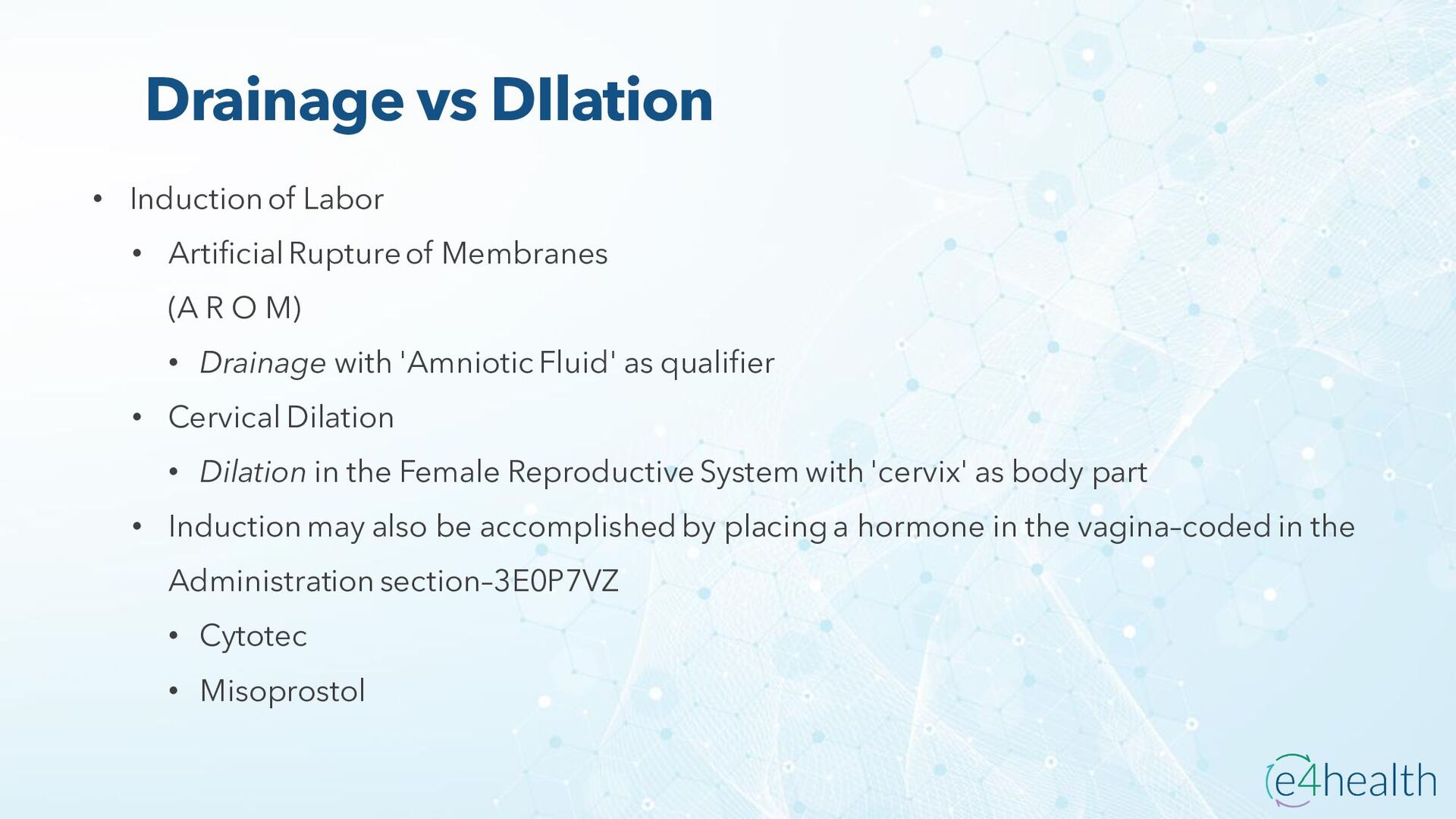
  55. Drainage vs DIlation • Induction of Labor • Artificial Rupture

    of Membranes (A R O M) • Drainage with 'Amniotic Fluid' as qualifier • Cervical Dilation • Dilation in the Female Reproductive System with 'cervix' as body part • Induction may also be accomplished by placing a hormone in the vagina–coded in the Administration section–3E0P7VZ • Cytotec • Misoprostol
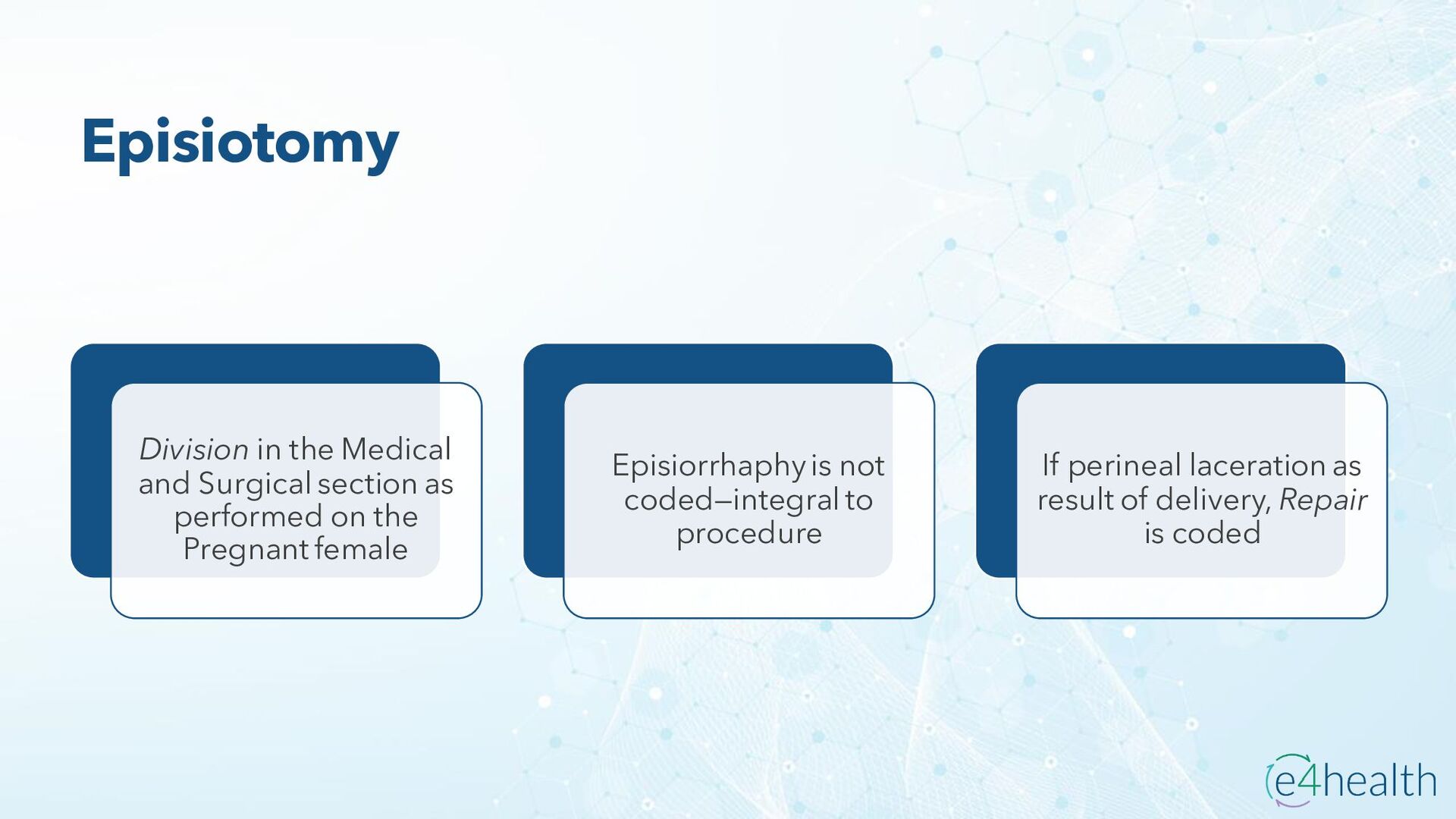
  56. Episiotomy Division in the Medical and Surgical section as performed

    on the Pregnant female Episiorrhaphy is not coded—integral to procedure If perineal laceration as result of delivery, Repair is coded
  57. References • American Diabetes Association; 14. Management of Diabetes in

    Pregnancy: Standards of Medical Care in Diabetes—2021. Diabetes Care 1 January 2021; 44 (Supplement_1): S200–S210. https://doi.org/10.2337/dc21- S014 • Hawthorne, G. (2011). Maternal complications in diabetic pregnancy. Best Practice & Research in Clinical Obstetrics & Gynaecology, 25(1), 77–90. https://doi.org/10.1016/j.bpobgyn.2010.10.015 • Peripartum Cardiomyopathy. (2023, April 25). www.heart.org. https://www.heart.org/en/health- topics/cardiomyopathy/what-is-cardiomyopathy-in-adults/peripartum-cardiomyopathy-ppcm/ • https://www.jaypeedigital.com/book/9788180619113/chapter/ch76 • https://www.uab.edu/news/research/item/7875-uab-investigators-find-repeat-cesarean-deliveries-less-cost- effective-in-low-risk-women • AHA ICD-10-CM and ICD-10-PCS Coding Handbook • ICD-10-PCS: An Applied Approach 2023 • Cengage: 3-2-1 CODE IT!