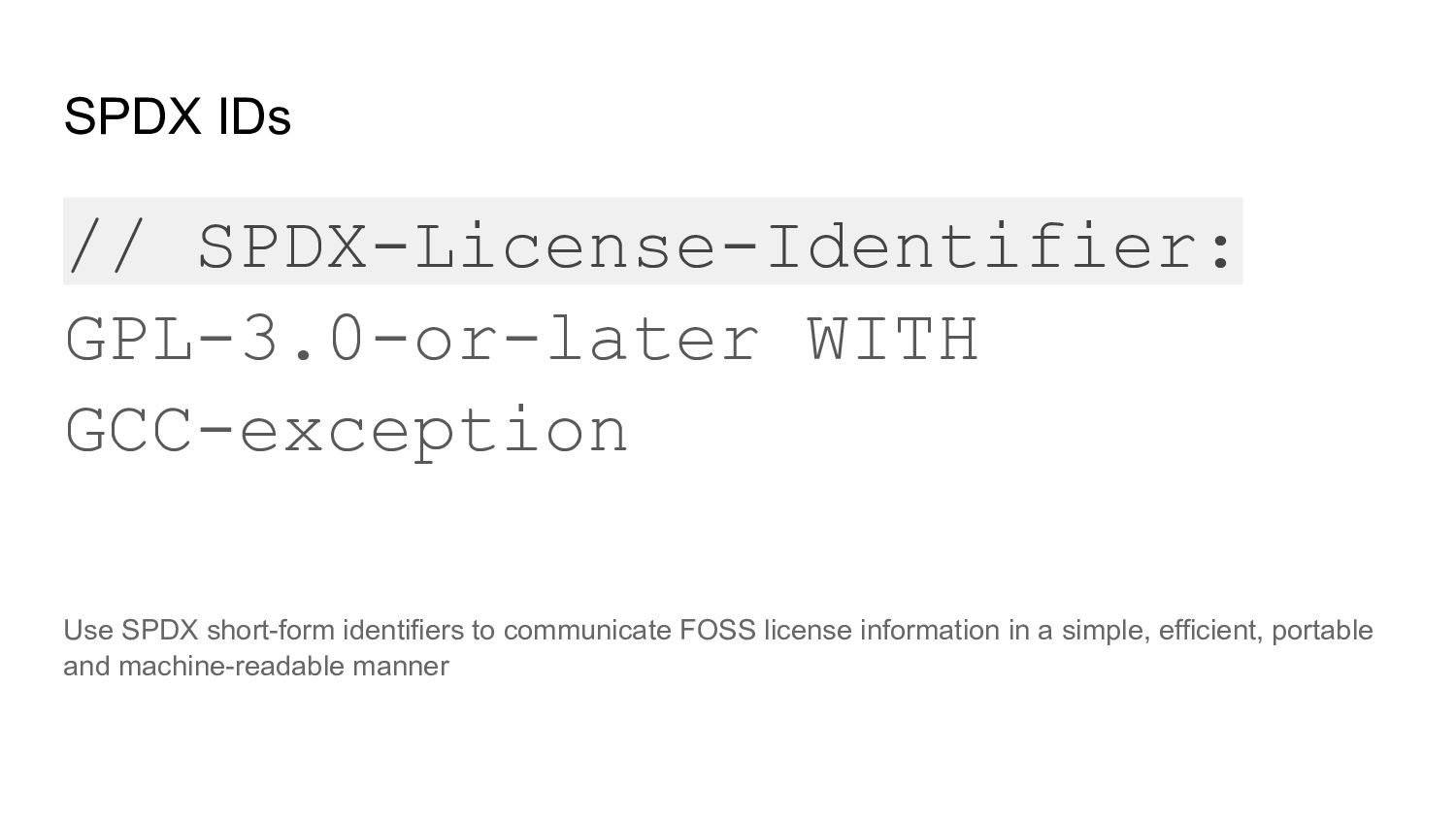
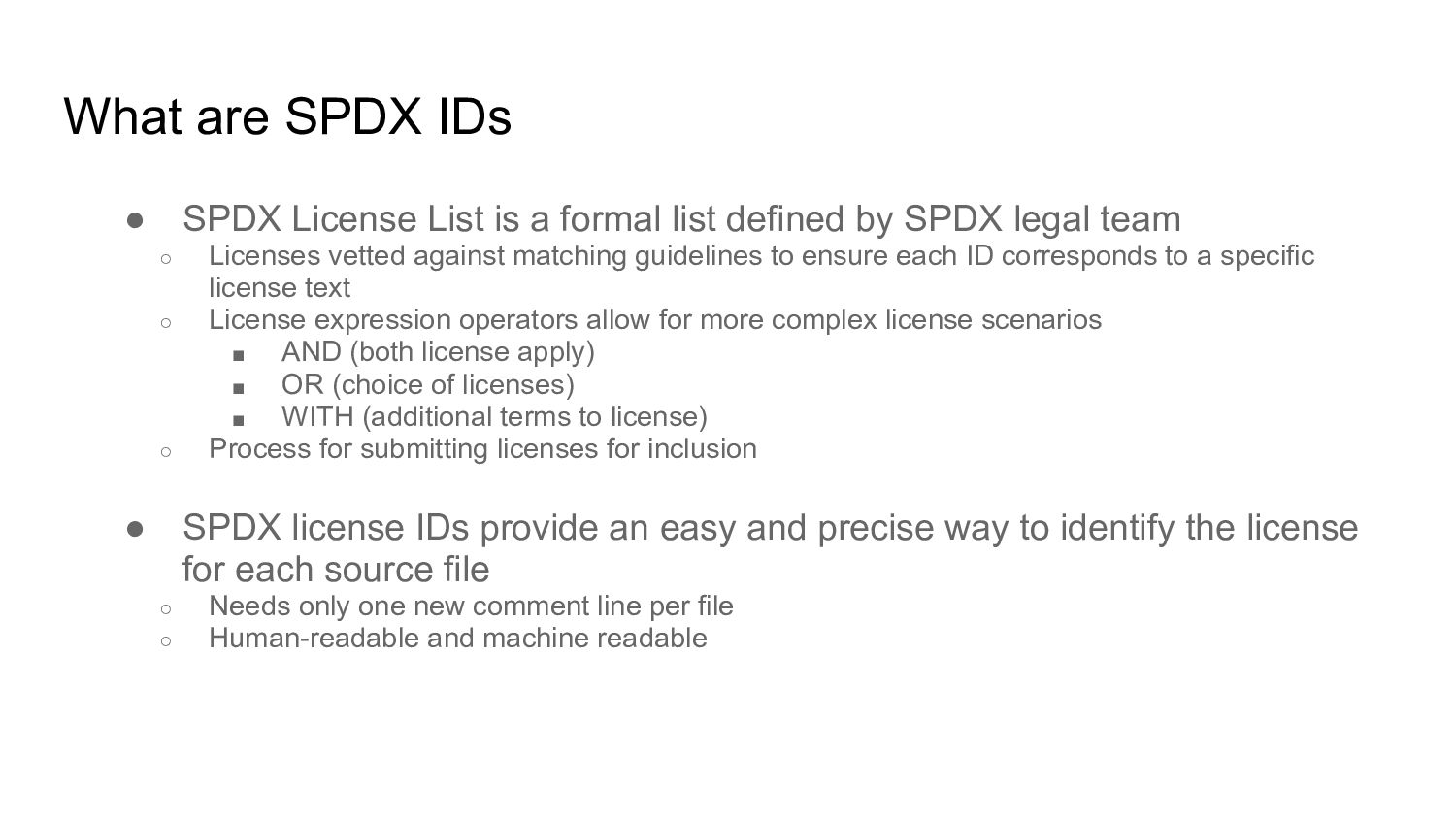
formal list defined by SPDX legal team ◦ Licenses vetted against matching guidelines to ensure each ID corresponds to a specific license text ◦ License expression operators allow for more complex license scenarios ▪ AND (both license apply) ▪ OR (choice of licenses) ▪ WITH (additional terms to license) ◦ Process for submitting licenses for inclusion • SPDX license IDs provide an easy and precise way to identify the license for each source file ◦ Needs only one new comment line per file ◦ Human-readable and machine readable
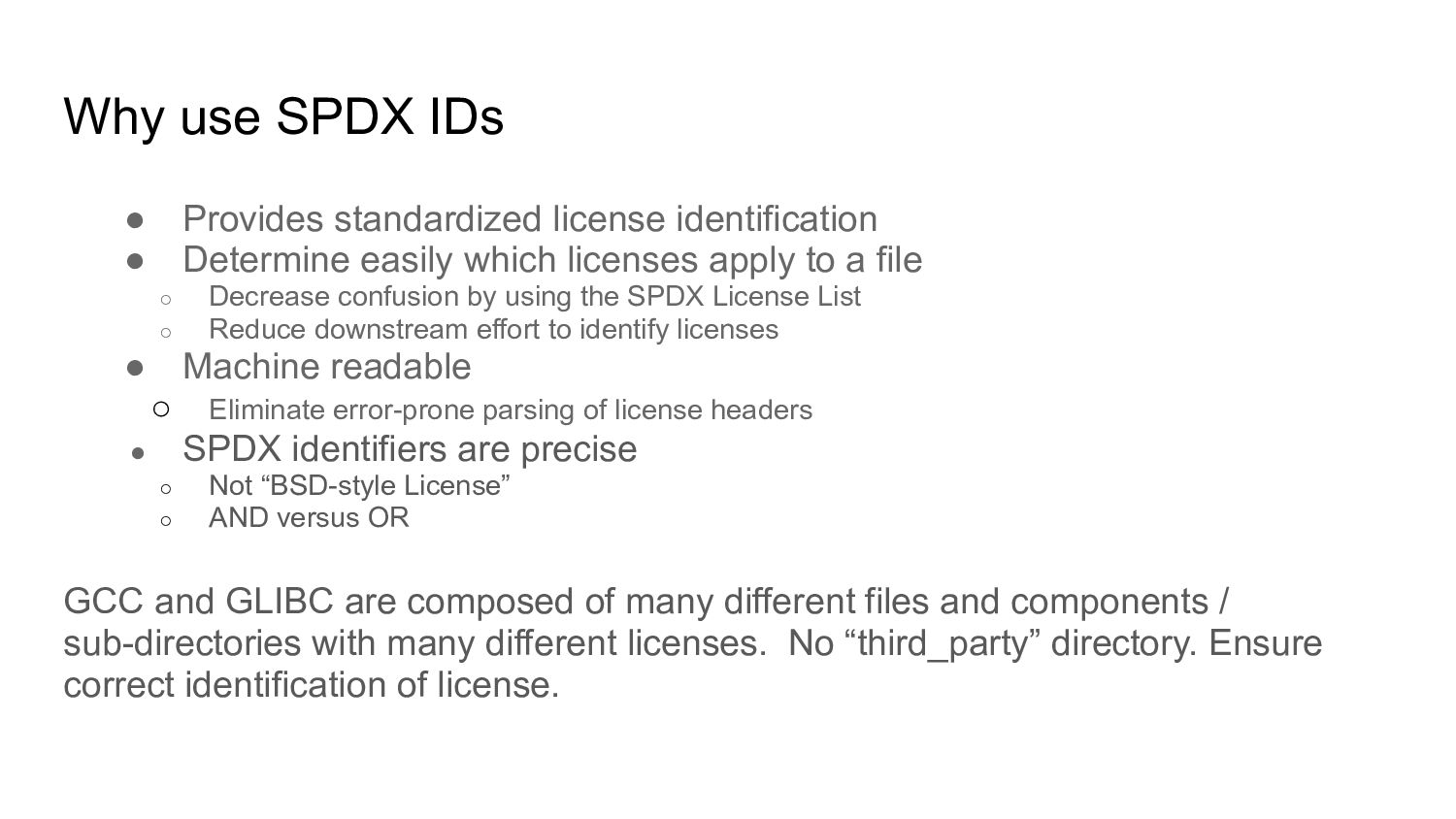
Determine easily which licenses apply to a file ◦ Decrease confusion by using the SPDX License List ◦ Reduce downstream effort to identify licenses • Machine readable ◦ Eliminate error-prone parsing of license headers • SPDX identifiers are precise ◦ Not “BSD-style License” ◦ AND versus OR GCC and GLIBC are composed of many different files and components / sub-directories with many different licenses. No “third_party” directory. Ensure correct identification of license.
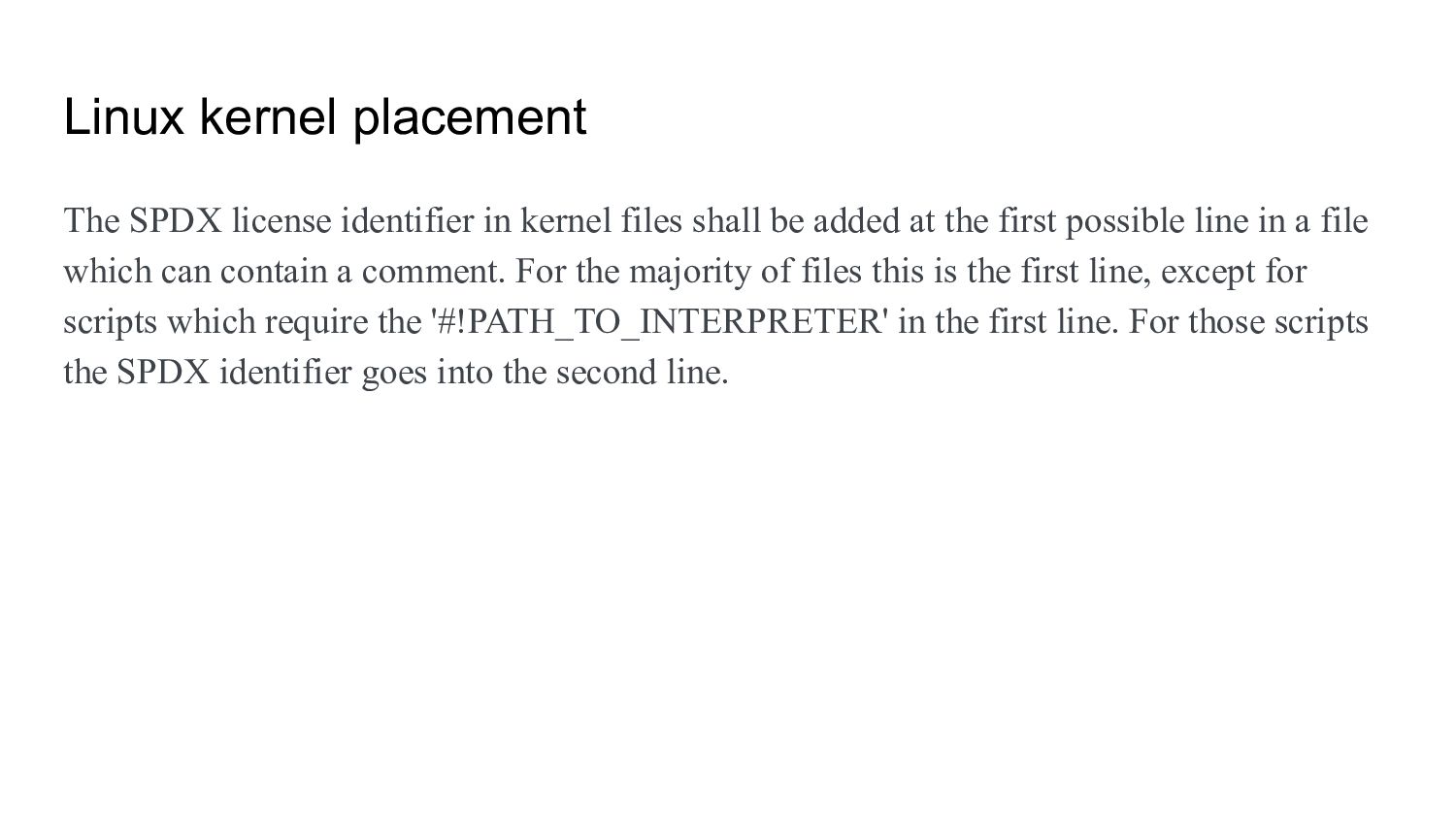
shall be added at the first possible line in a file which can contain a comment. For the majority of files this is the first line, except for scripts which require the '#!PATH_TO_INTERPRETER' in the first line. For those scripts the SPDX identifier goes into the second line.
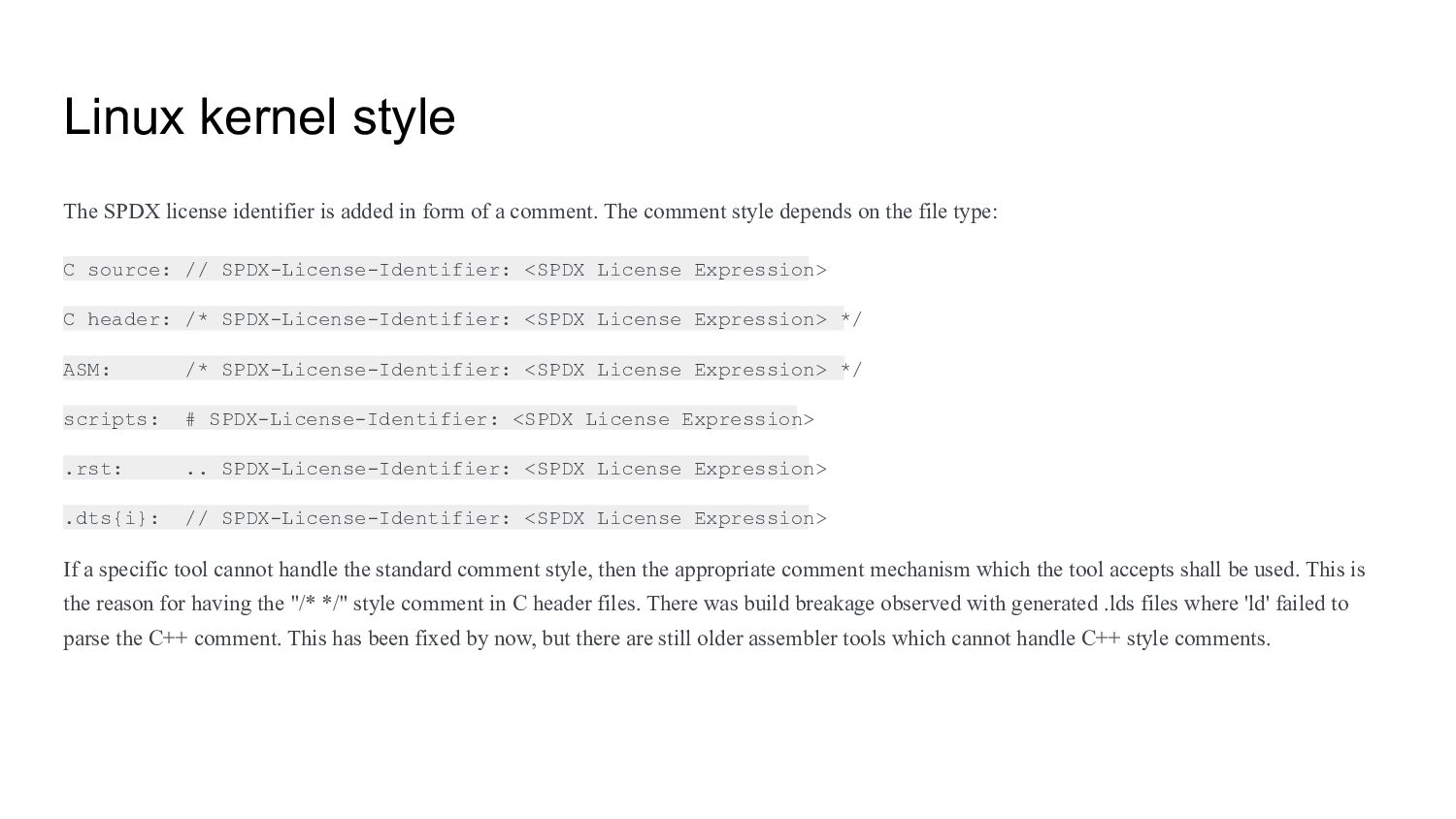
form of a comment. The comment style depends on the file type: C source: // SPDX-License-Identifier: <SPDX License Expression> C header: /* SPDX-License-Identifier: <SPDX License Expression> */ ASM: /* SPDX-License-Identifier: <SPDX License Expression> */ scripts: # SPDX-License-Identifier: <SPDX License Expression> .rst: .. SPDX-License-Identifier: <SPDX License Expression> .dts{i}: // SPDX-License-Identifier: <SPDX License Expression> If a specific tool cannot handle the standard comment style, then the appropriate comment mechanism which the tool accepts shall be used. This is the reason for having the "/* */" style comment in C header files. There was build breakage observed with generated .lds files where 'ld' failed to parse the C++ comment. This has been fixed by now, but there are still older assembler tools which cannot handle C++ style comments.
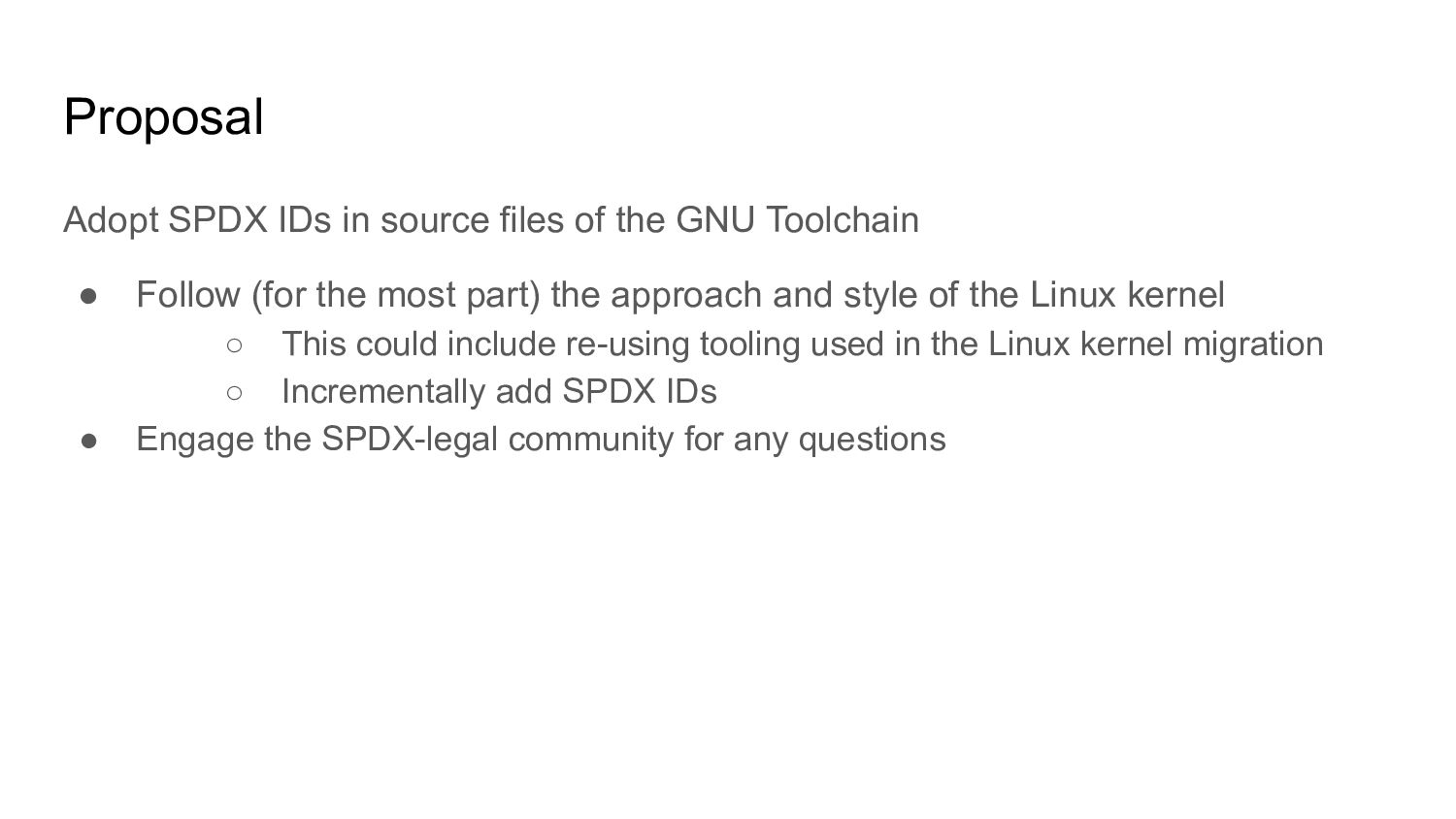
Toolchain • Follow (for the most part) the approach and style of the Linux kernel ◦ This could include re-using tooling used in the Linux kernel migration ◦ Incrementally add SPDX IDs • Engage the SPDX-legal community for any questions
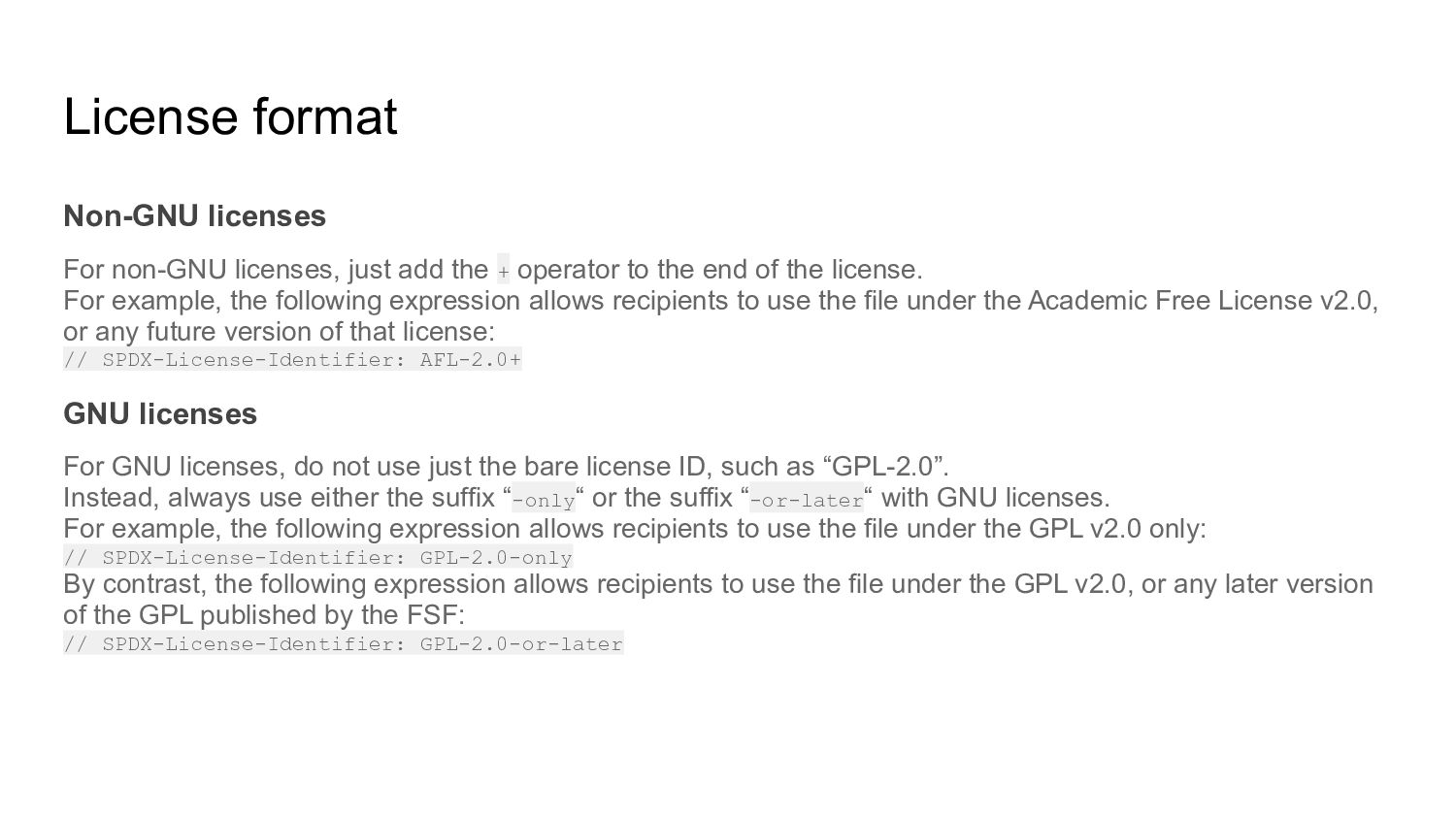
+ operator to the end of the license. For example, the following expression allows recipients to use the file under the Academic Free License v2.0, or any future version of that license: // SPDX-License-Identifier: AFL-2.0+ GNU licenses For GNU licenses, do not use just the bare license ID, such as “GPL-2.0”. Instead, always use either the suffix “-only“ or the suffix “-or-later“ with GNU licenses. For example, the following expression allows recipients to use the file under the GPL v2.0 only: // SPDX-License-Identifier: GPL-2.0-only By contrast, the following expression allows recipients to use the file under the GPL v2.0, or any later version of the GPL published by the FSF: // SPDX-License-Identifier: GPL-2.0-or-later


 edelsohn
 carta_engineering
 mohab1
 makocchi
 occhi
occhi
 gogutan
 glaforge
 y0hgi
y0hgi
 jyouryuusui
 shugo
shugo
 grimoh
 koukihosaka
 tokuty
 tamaranovitovic
 tenderlove
 techseoconnect
 inesmontani
 malarkey
 rocio
rocio
 palkan
 samlambert
 tmiket
 twada
twada
 orderedlist
 tapps
tapps