Upgrade to Pro — share decks privately, control downloads, hide ads and more …

Practical Tips for Reviewing Presentations of M...

Practical Tips for Reviewing Presentations of Machine Learning Healthcare Applications

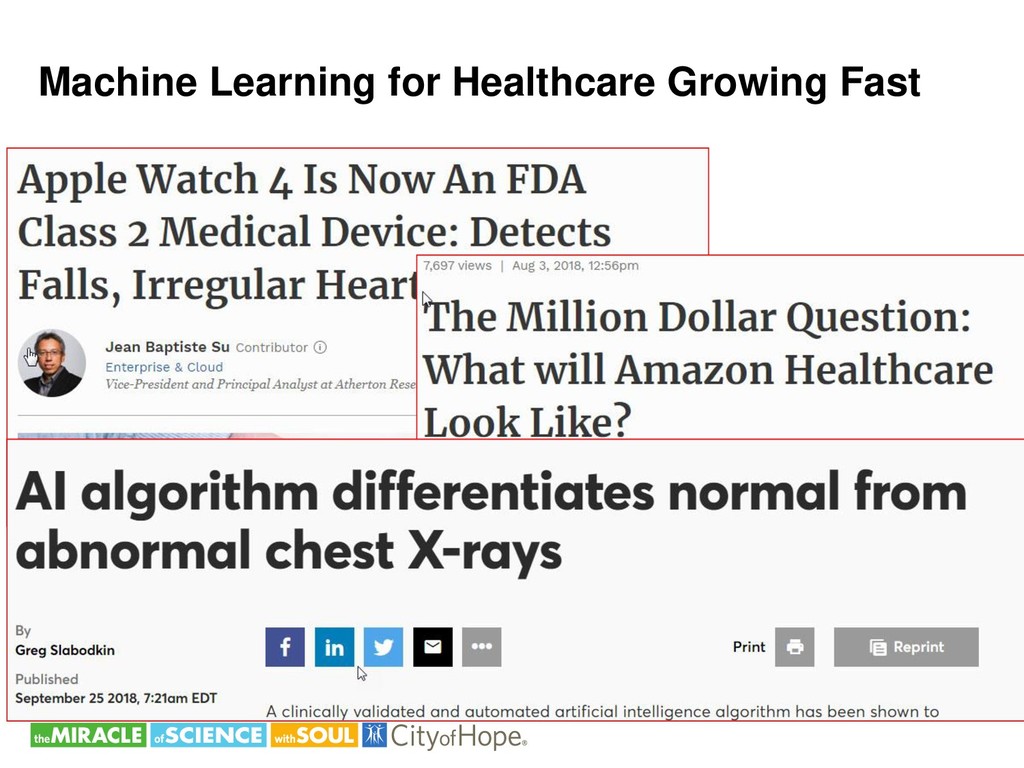
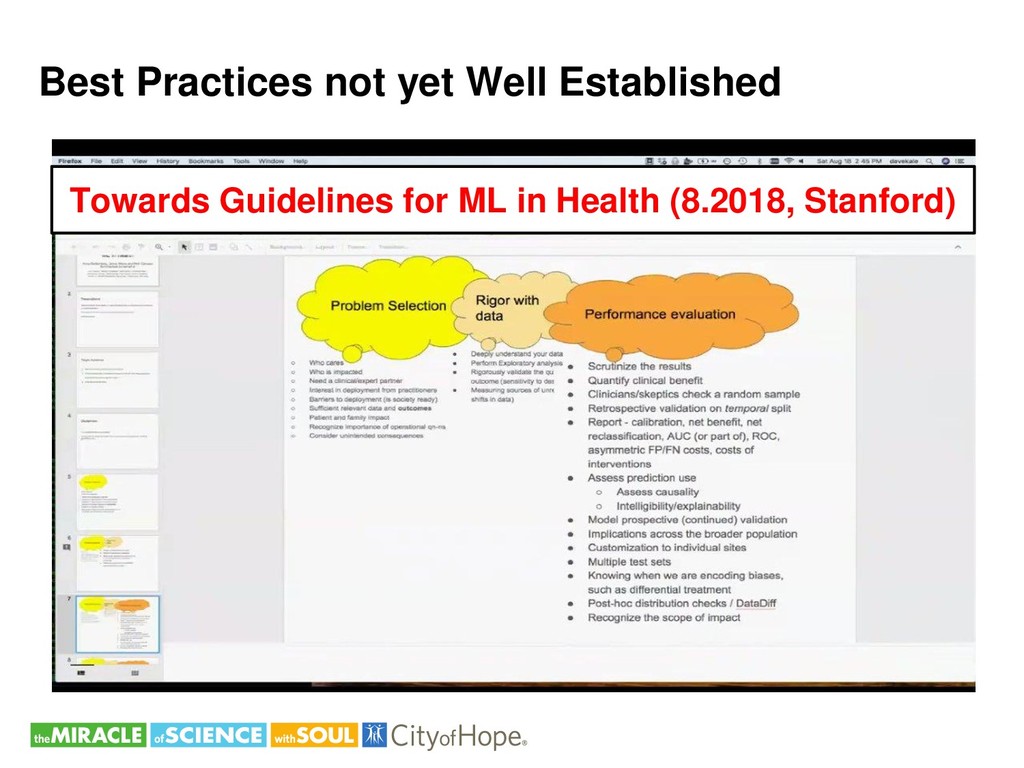
There is a fast growing interest in the application of machine learning to the field of healthcare. Medical institutions, universities and software giants like Google and Amazon are dedicating increasing resources to this field. Medical informaticians are likely to be exposed to presentations of machine learning applications by researchers, external vendors, or just by browsing the scientific literature. This is a very exciting but relatively young field. However, best practices for methods and reporting of results are not yet fully established.

This presentation gives an overview of keys aspects of machine learning methods, along with pros and cons of the most important error metrics. The goal is to provide simple guidelines on what to look for and which questions to ask to assess the validity of claims of oral presentations and papers.

Avatar for Lorenzo A. Rossi

Lorenzo A. Rossi

October 03, 2018

More Decks by Lorenzo A. Rossi

Other Decks in Technology

Transcript

  1. Lorenzo Rossi, PhD Data Scientist, City of Hope Center for

    Informatics CI4CC, October 2018, New Orleans, LA Practical Tips for Reviewing Presentations of Machine Learning Healthcare Applications
  2. Cancer informaticians will be exposed to increasing numbers of ML

    presentations Sources: – vendors – researchers – literature
  3. Cancer informaticians will be exposed to increasing numbers of ML

    presentations Sources: – vendors – researchers – literature Questions: How does it really perform? Would the application fit to my organization? Any red flags?
  4. Learning Objectives • Performance Metrics and Reporting • Methods •

    Cohort Definition Huge subject! This presentation covers only aspects of 1st topic
  5. Consider only binary prediction tasks for simplicity Actual answer only

    Yes (1) or No (0), e.g.: – 30 day readmission – 6 month mortality – sepsis detection Prediction algorithm gives score from 0 to 1 – E.g. close to 1 → high risk of readmission within 30 days
  6. Consider only binary prediction tasks for simplicity Actual answer only

    Yes (1) or No (0), e.g.: – 30 day readmission – 6 month mortality – sepsis detection Prediction algorithm gives score from 0 to 1 – E.g. close to 1 → high risk of readmission within 30 days Trade-off between false alarms and missed targets
  7. Types of Performance Metrics 1. Measure trade-offs – (ROC) AUC

    – average precision / PR AUC 2. Measure error rate at a specific decision point – false positives, false negatives, … – precision and recall – F1 – accuracy
  8. Types of Performance Metrics (II) 1. Measure trade-offs – AUC,

    average precision / PR AUC, – good for global performance characterization and (intra)- model comparisons 2. Measure error rate at a specific decision point – false positives, false negatives, …, precision, recall – possibly good for interpretation of specific clinical costs and benefits
  9. Performance should be reported with both types of metrics •

    1 or 2 metrics for trade-off evaluation – ROC AUC – average precision, log loss, • 1 metric for performance at clinically meaningful decision point – e.g. recall @ 90% precision
  10. Performance should be reported with both types of metrics •

    1 or 2 metrics for trade-off evaluation – ROC AUC – average precision, log loss, • 1 metric for performance at clinically meaningful decision point – e.g. recall @ 90% precision + Comparison with a known benchmark (baseline)
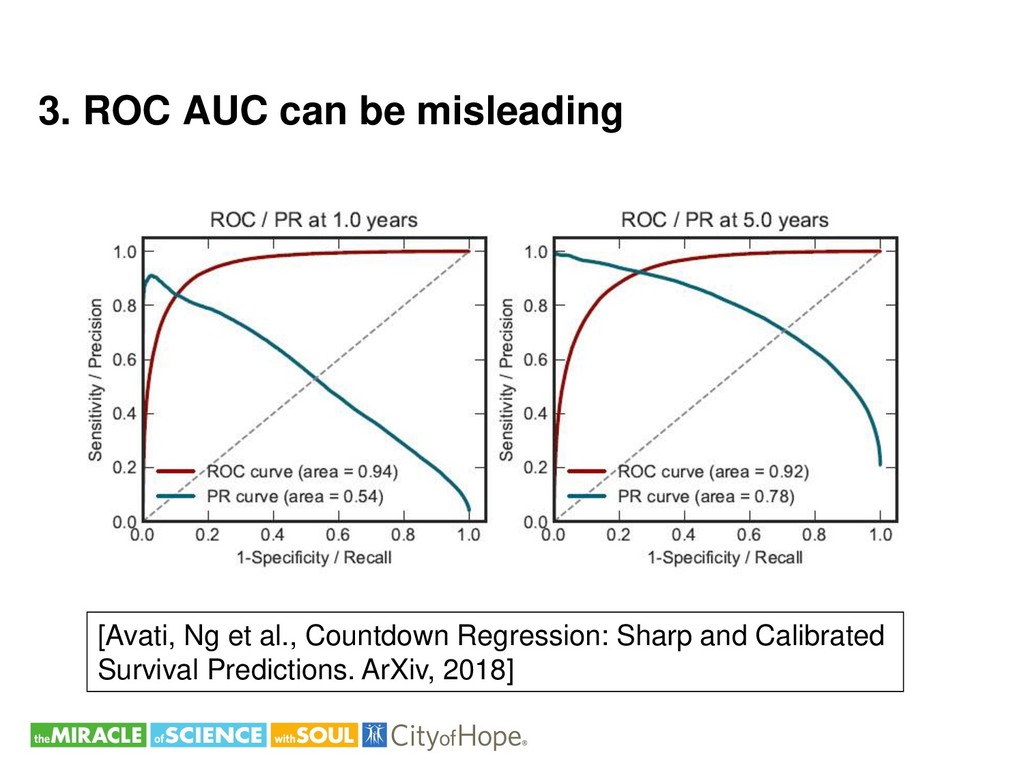
  11. [Avati, Ng et al., Countdown Regression: Sharp and Calibrated Survival

    Predictions. ArXiv, 2018] 3. ROC AUC can be misleading
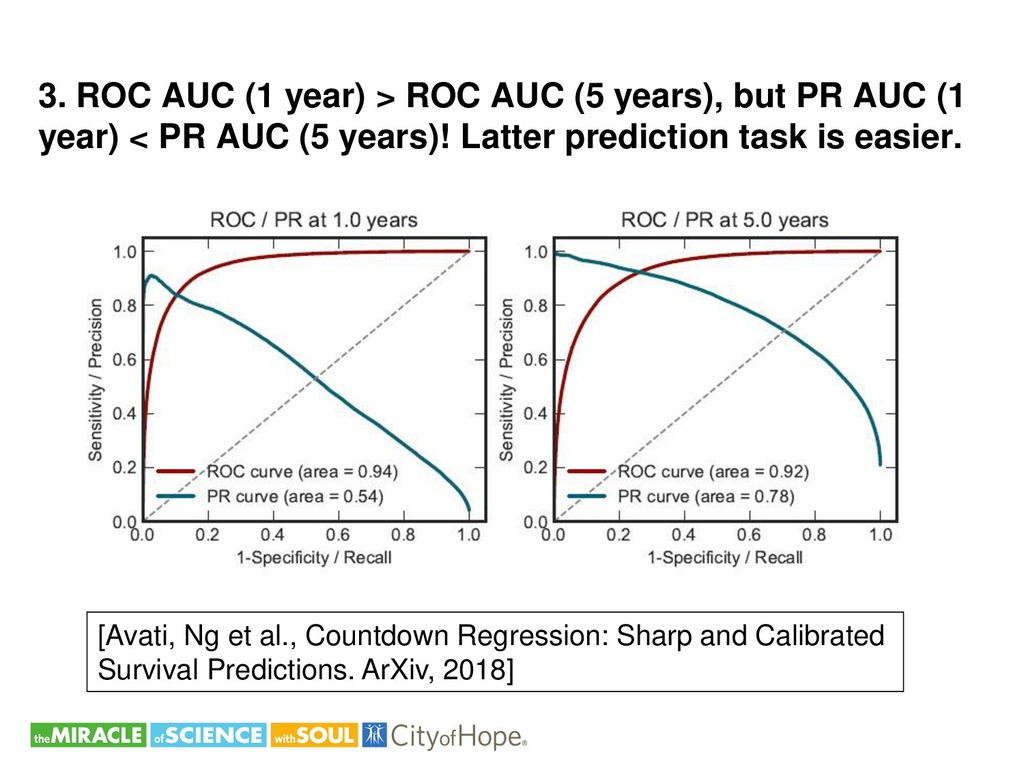
  12. 3. ROC AUC (1 year) > ROC AUC (5 years),

    but PR AUC (1 year) < PR AUC (5 years)! Latter prediction task is easier. [Avati, Ng et al., Countdown Regression: Sharp and Calibrated Survival Predictions. ArXiv, 2018]
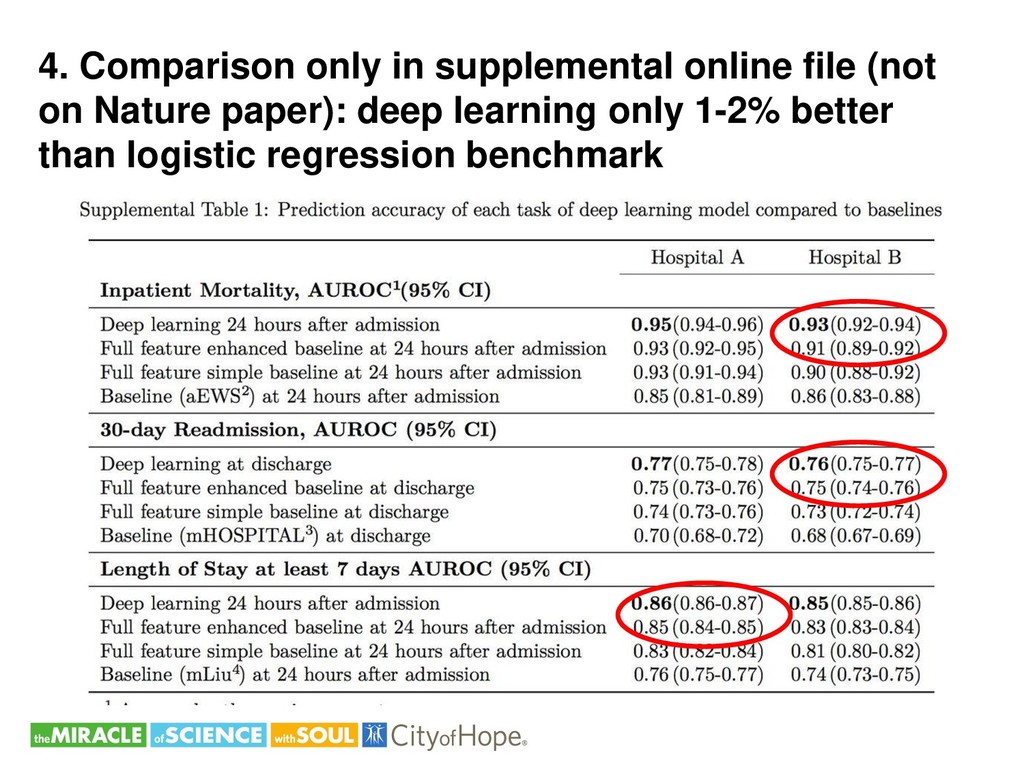
  13. 4. Comparison only in supplemental online file (not on Nature

    paper): deep learning only 1-2% better than logistic regression benchmark
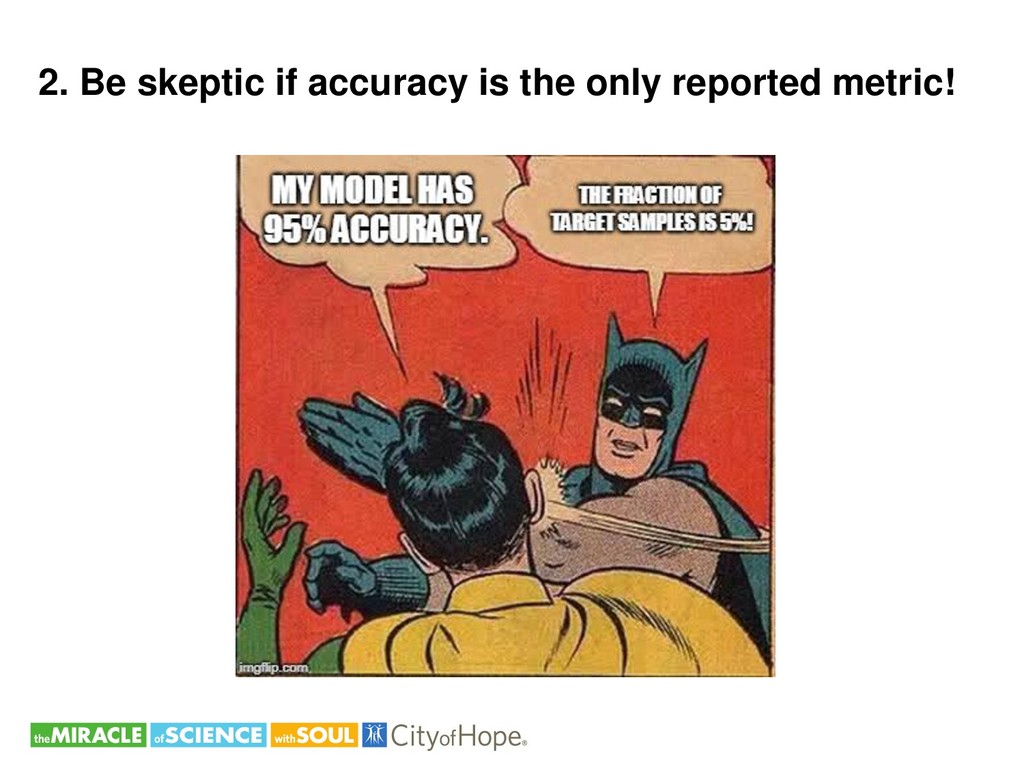
  14. Final Tips (Binary Predictions) • Look at types of metrics

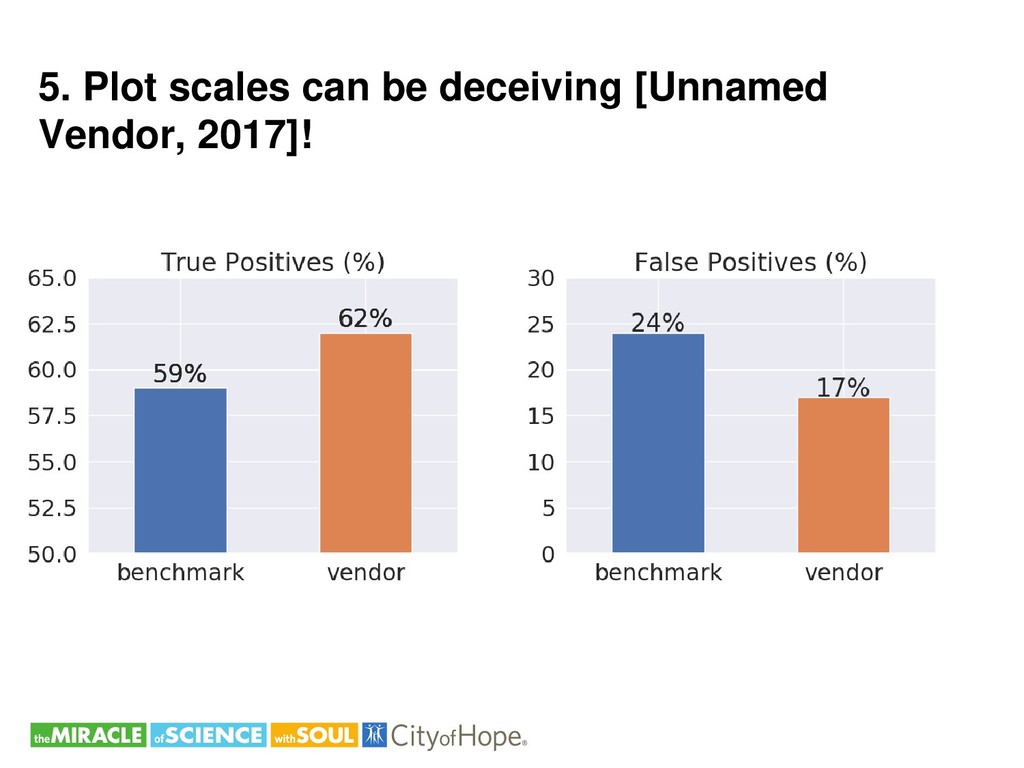
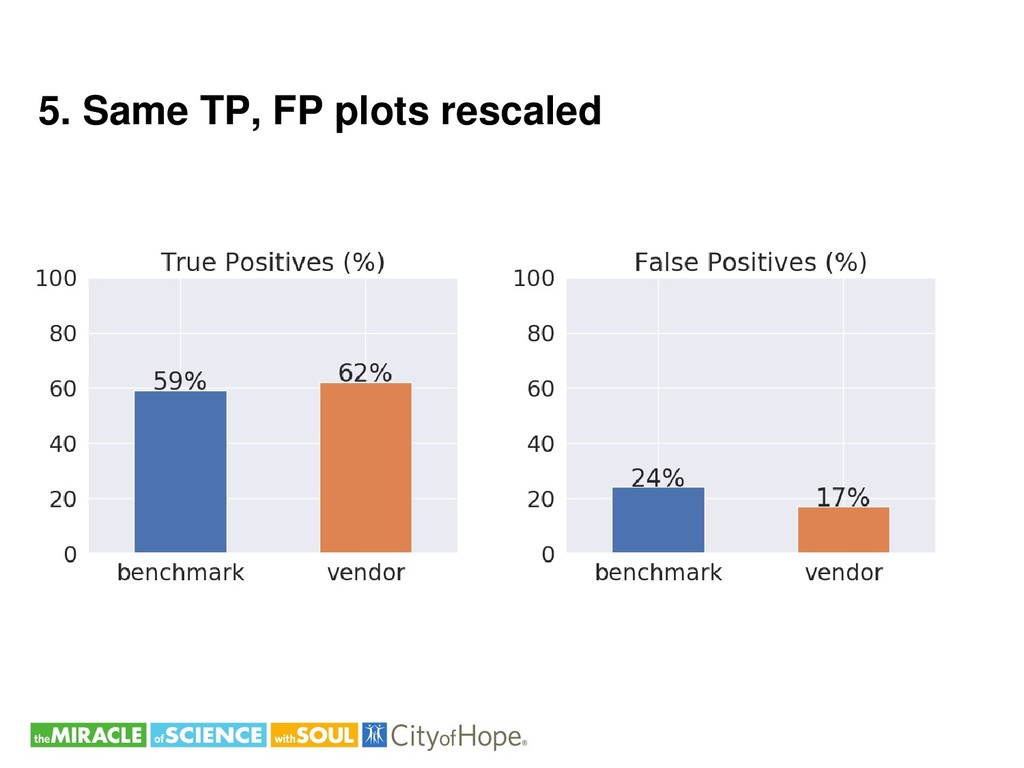
    being reported – ROC AUC alone could be misleading – Precision-Recall curve often more useful than ROC – Accuracy misleading unless target classes are balanced (e.g. ~50% of patient readmitted) • Look for comparison with known benchmark • Check scales of plots