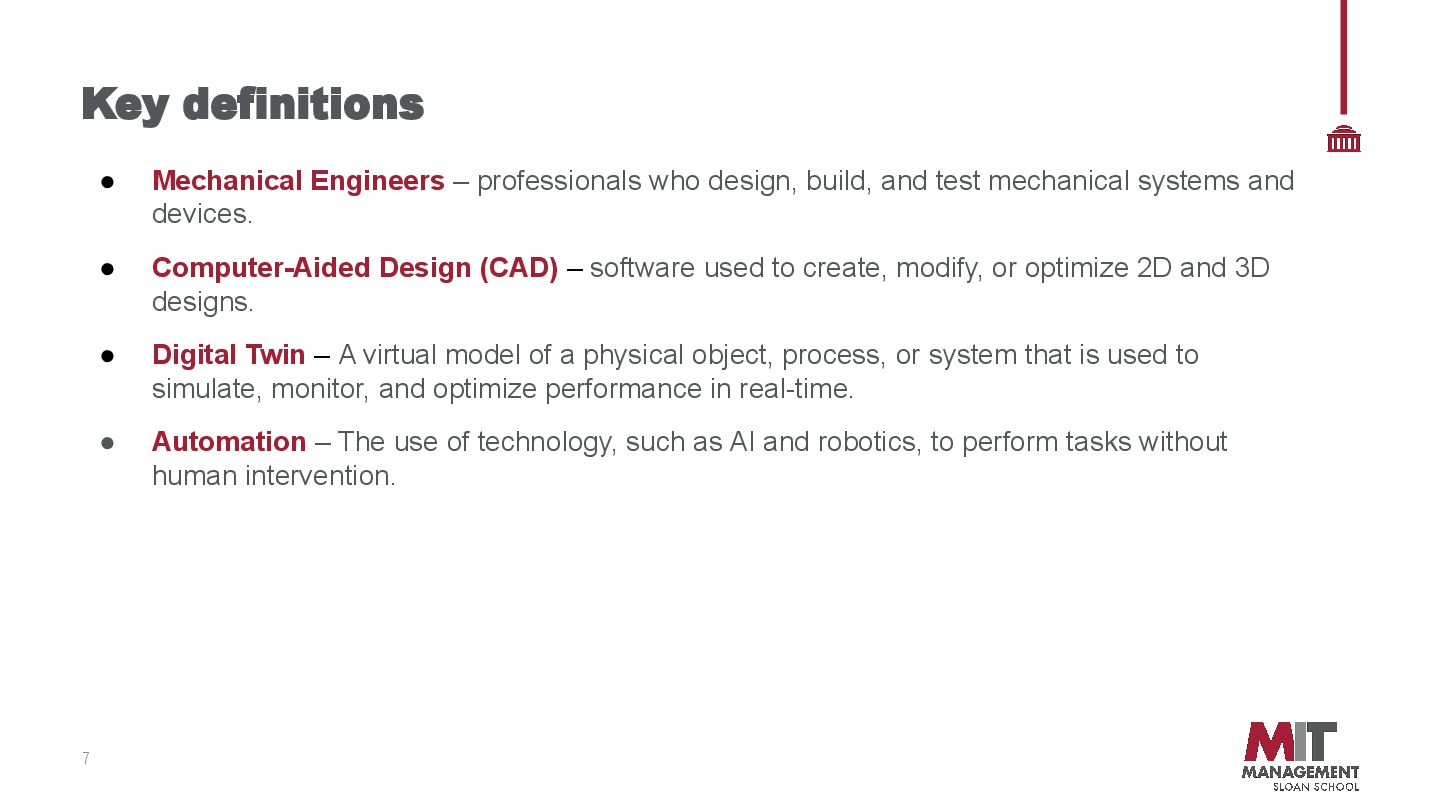
build, and test mechanical systems and devices. • Computer-Aided Design (CAD) – software used to create, modify, or optimize 2D and 3D designs. • Digital Twin – A virtual model of a physical object, process, or system that is used to simulate, monitor, and optimize performance in real-time. • Automation – The use of technology, such as AI and robotics, to perform tasks without human intervention.
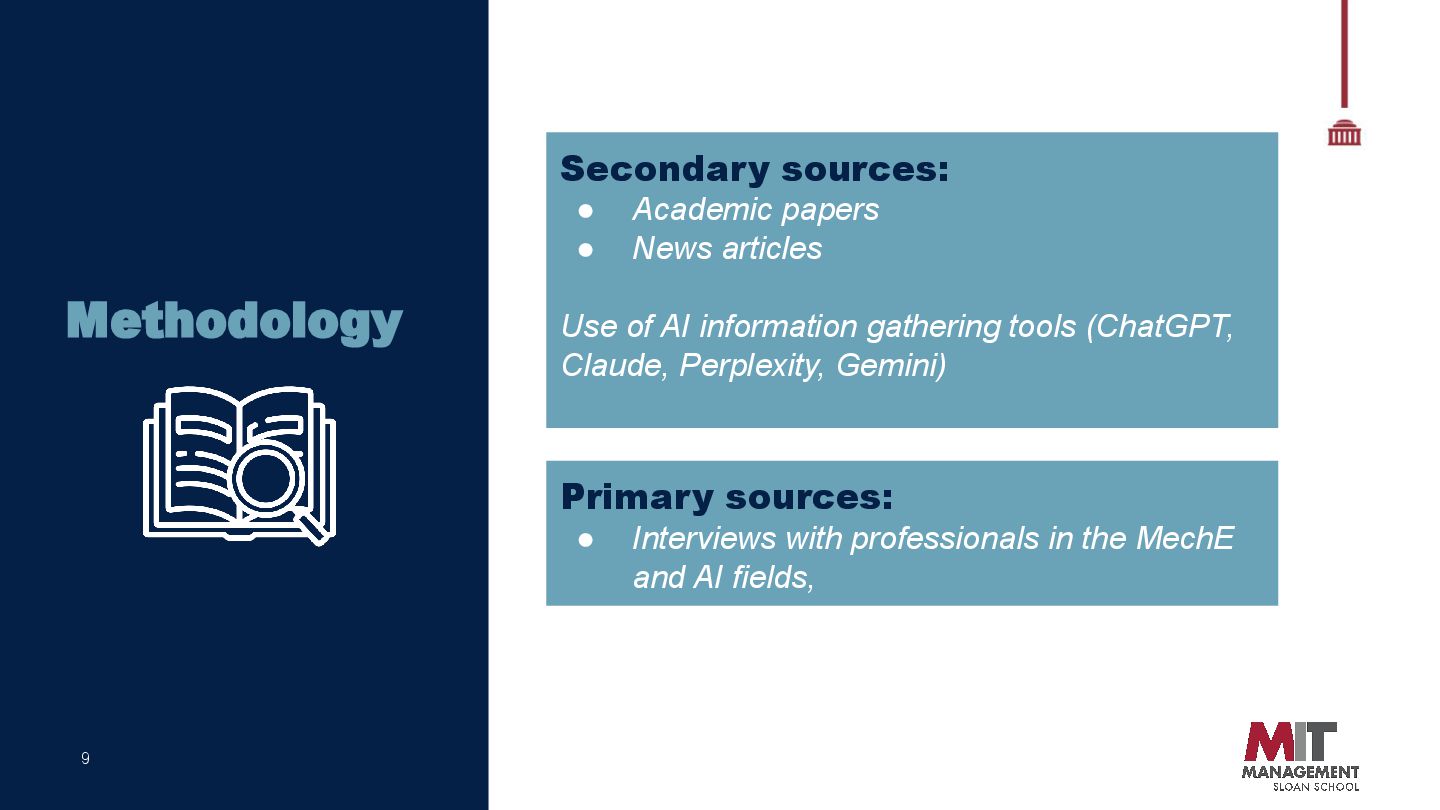
Use of AI information gathering tools (ChatGPT, Claude, Perplexity, Gemini) Primary sources: • Interviews with professionals in the MechE and AI fields,
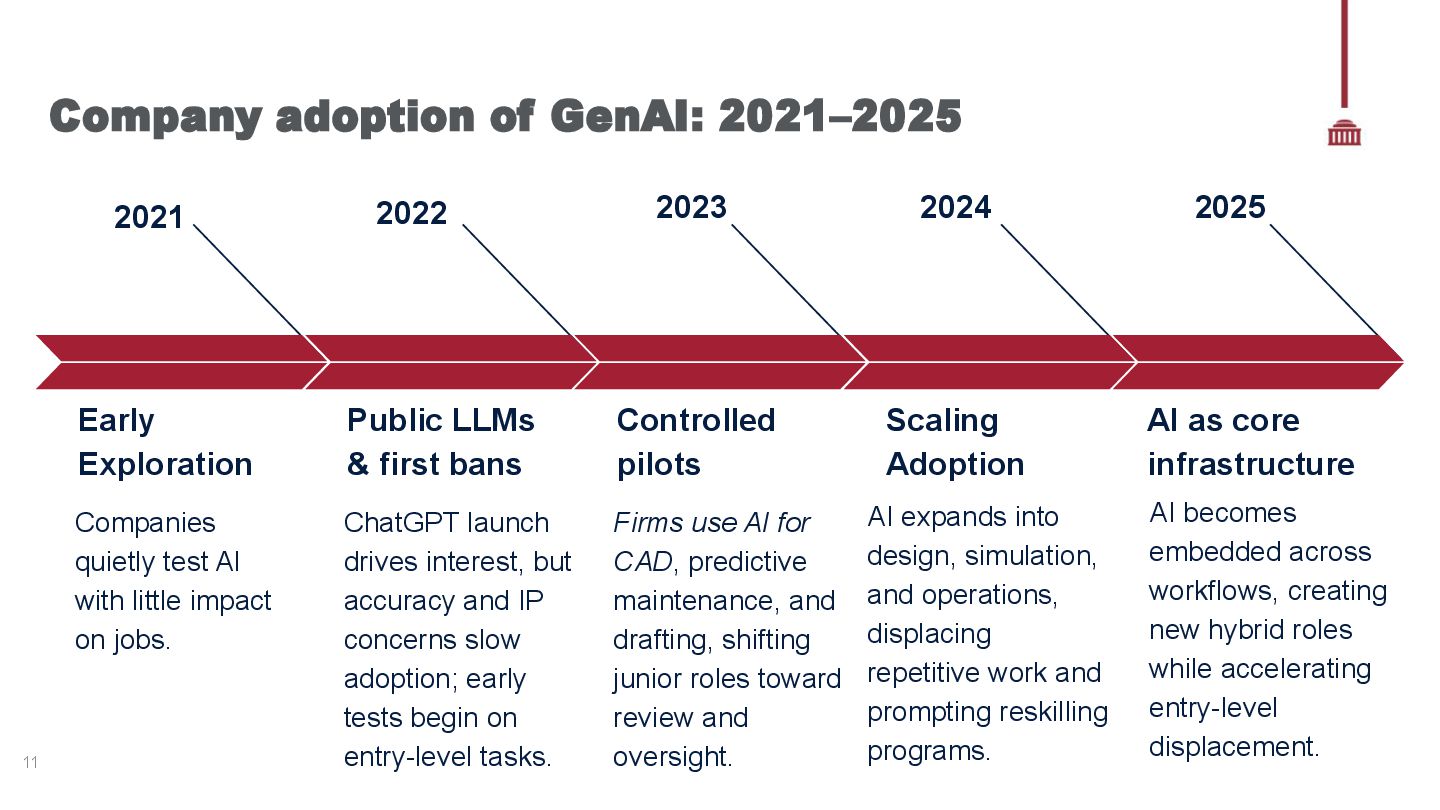
AI with little impact on jobs. 2021 Public LLMs & first bans ChatGPT launch drives interest, but accuracy and IP concerns slow adoption; early tests begin on entry-level tasks. 2022 Controlled pilots Firms use AI for CAD, predictive maintenance, and drafting, shifting junior roles toward review and oversight. 2023 Scaling Adoption AI expands into design, simulation, and operations, displacing repetitive work and prompting reskilling programs. 2024 AI as core infrastructure AI becomes embedded across workflows, creating new hybrid roles while accelerating entry-level displacement. 2025 11
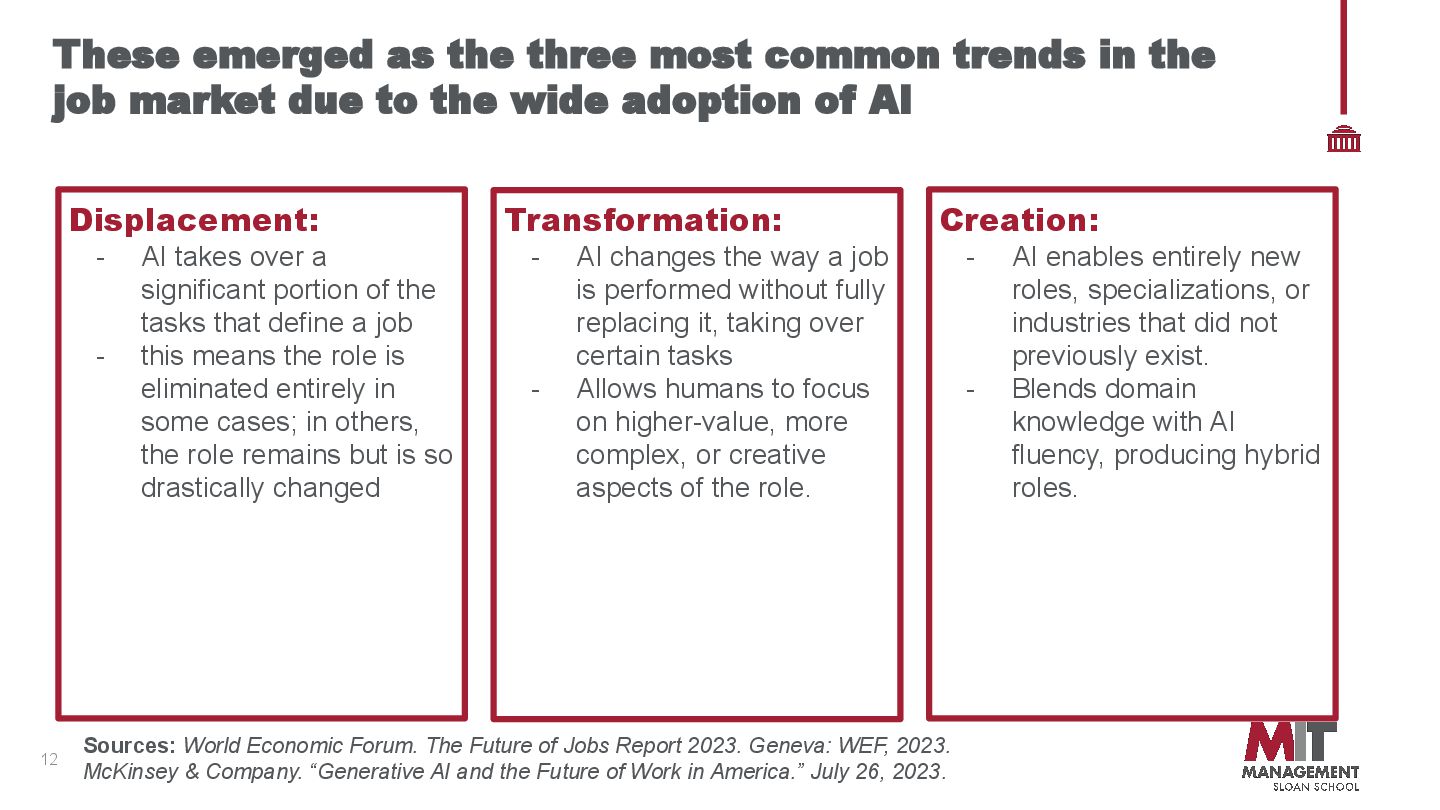
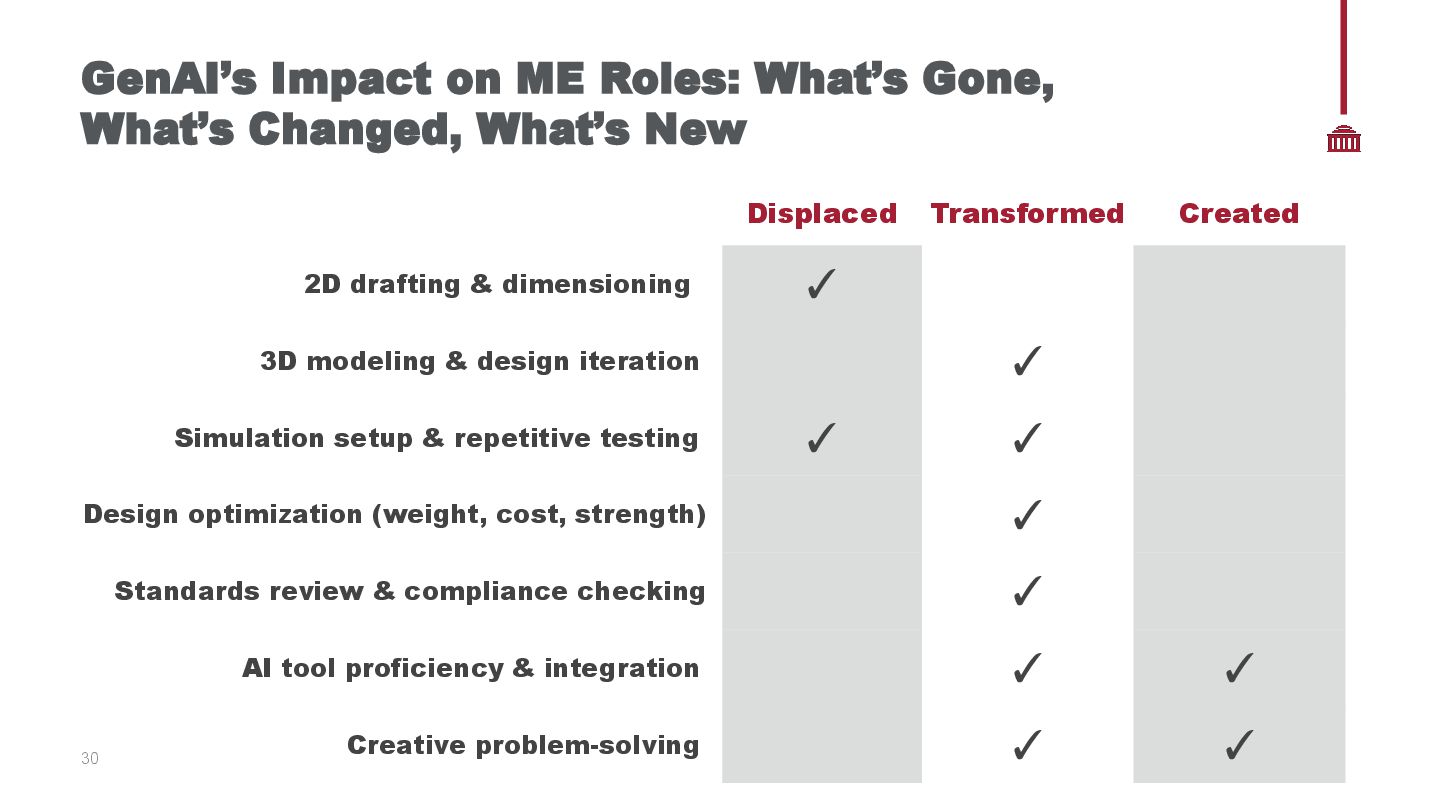
tasks that define a job - this means the role is eliminated entirely in some cases; in others, the role remains but is so drastically changed Transformation: - AI changes the way a job is performed without fully replacing it, taking over certain tasks - Allows humans to focus on higher-value, more complex, or creative aspects of the role. Creation: - AI enables entirely new roles, specializations, or industries that did not previously exist. - Blends domain knowledge with AI fluency, producing hybrid roles. These emerged as the three most common trends in the job market due to the wide adoption of AI 12 Sources: World Economic Forum. The Future of Jobs Report 2023. Geneva: WEF, 2023. McKinsey & Company. “Generative AI and the Future of Work in America.” July 26, 2023.
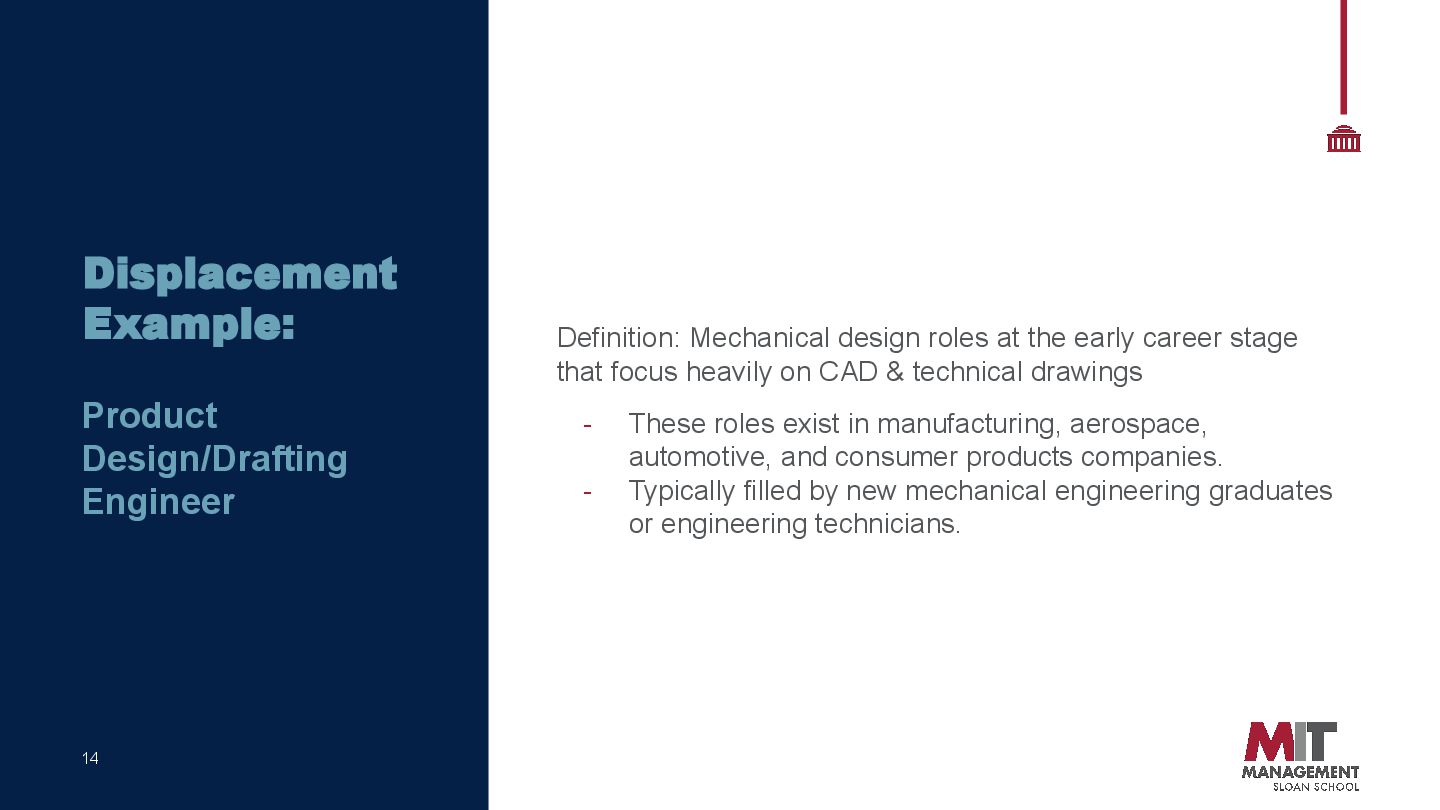
career stage that focus heavily on CAD & technical drawings - These roles exist in manufacturing, aerospace, automotive, and consumer products companies. - Typically filled by new mechanical engineering graduates or engineering technicians. Displacement Example: 14
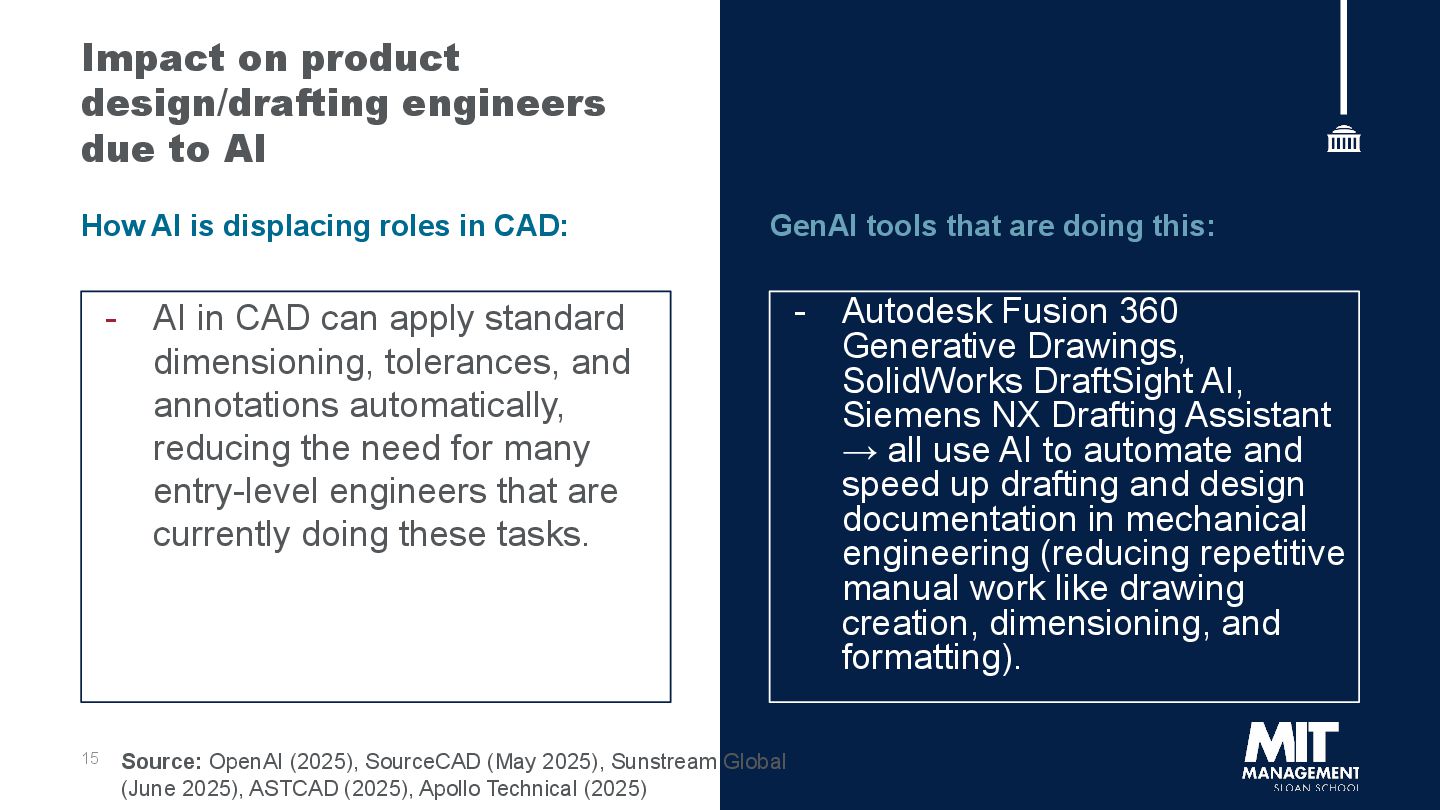
annotations automatically, reducing the need for many entry-level engineers that are currently doing these tasks. Impact on product design/drafting engineers due to AI 15 Source: OpenAI (2025), SourceCAD (May 2025), Sunstream Global (June 2025), ASTCAD (2025), Apollo Technical (2025) How AI is displacing roles in CAD: GenAI tools that are doing this: - Autodesk Fusion 360 Generative Drawings, SolidWorks DraftSight AI, Siemens NX Drafting Assistant → all use AI to automate and speed up drafting and design documentation in mechanical engineering (reducing repetitive manual work like drawing creation, dimensioning, and formatting).
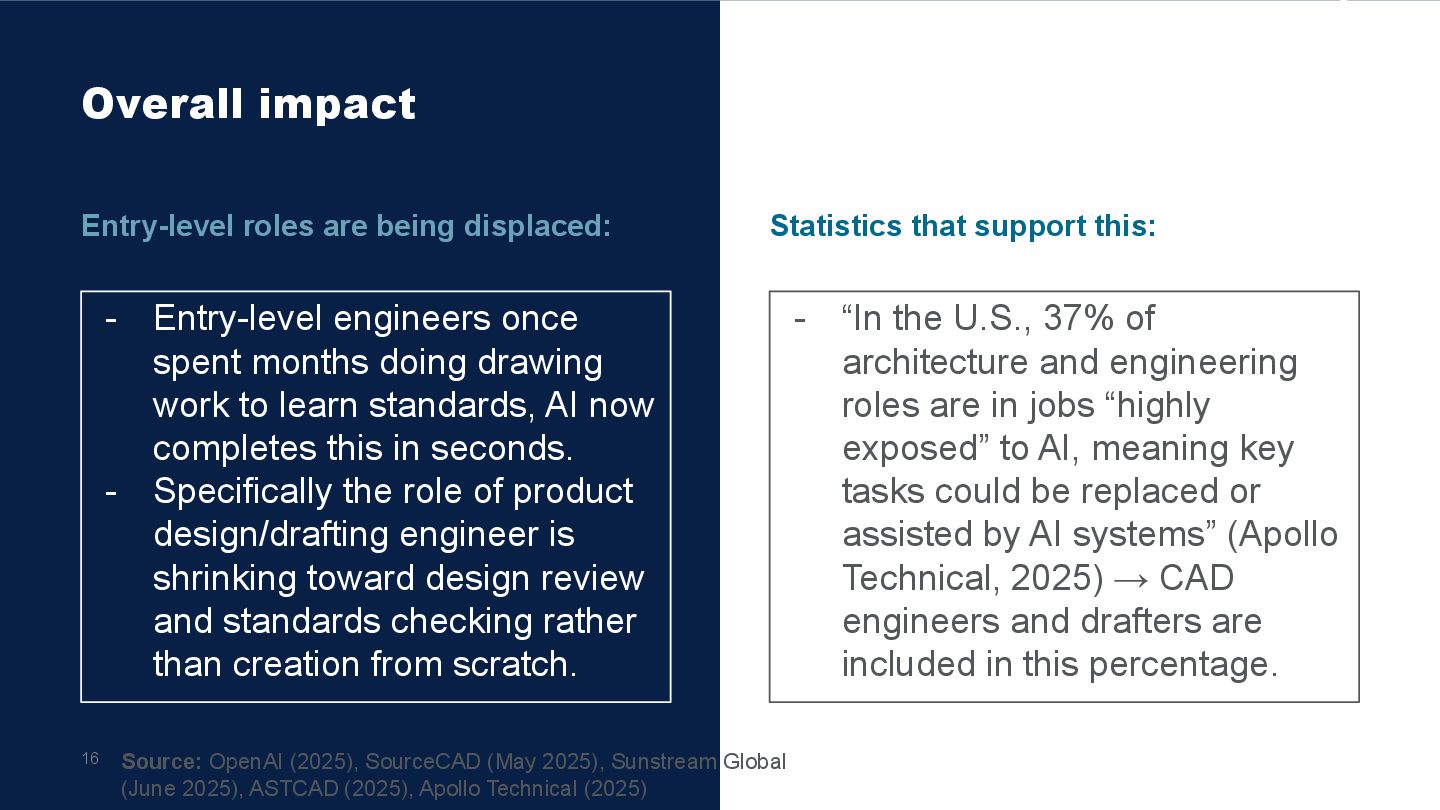
learn standards, AI now completes this in seconds. - Specifically the role of product design/drafting engineer is shrinking toward design review and standards checking rather than creation from scratch. Overall impact 16 Source: OpenAI (2025), SourceCAD (May 2025), Sunstream Global (June 2025), ASTCAD (2025), Apollo Technical (2025) Entry-level roles are being displaced: Statistics that support this: - “In the U.S., 37% of architecture and engineering roles are in jobs “highly exposed” to AI, meaning key tasks could be replaced or assisted by AI systems” (Apollo Technical, 2025) → CAD engineers and drafters are included in this percentage.
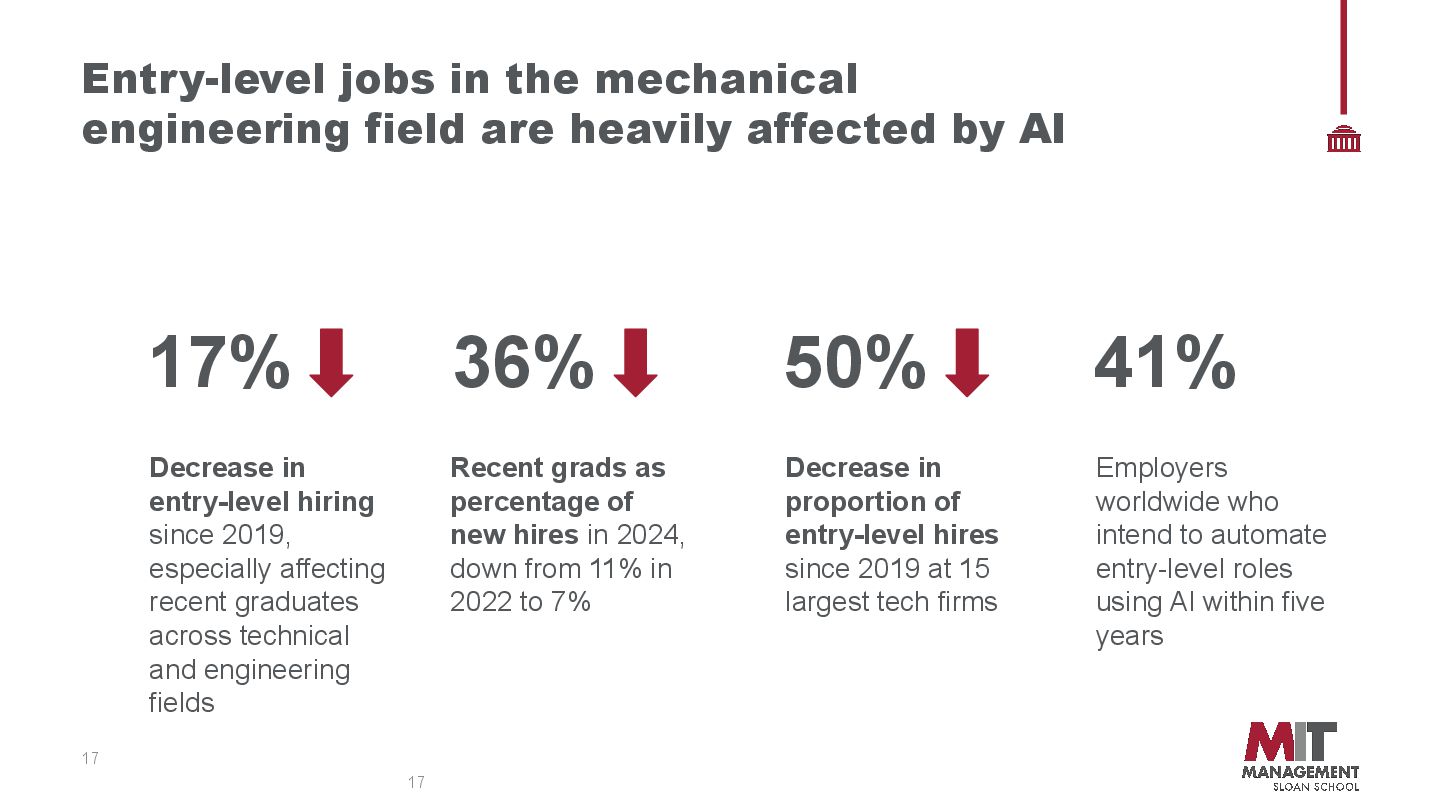
by AI 17 17% Decrease in entry-level hiring since 2019, especially affecting recent graduates across technical and engineering fields 17 36% Recent grads as percentage of new hires in 2024, down from 11% in 2022 to 7% 50% Decrease in proportion of entry-level hires since 2019 at 15 largest tech firms 41% Employers worldwide who intend to automate entry-level roles using AI within five years
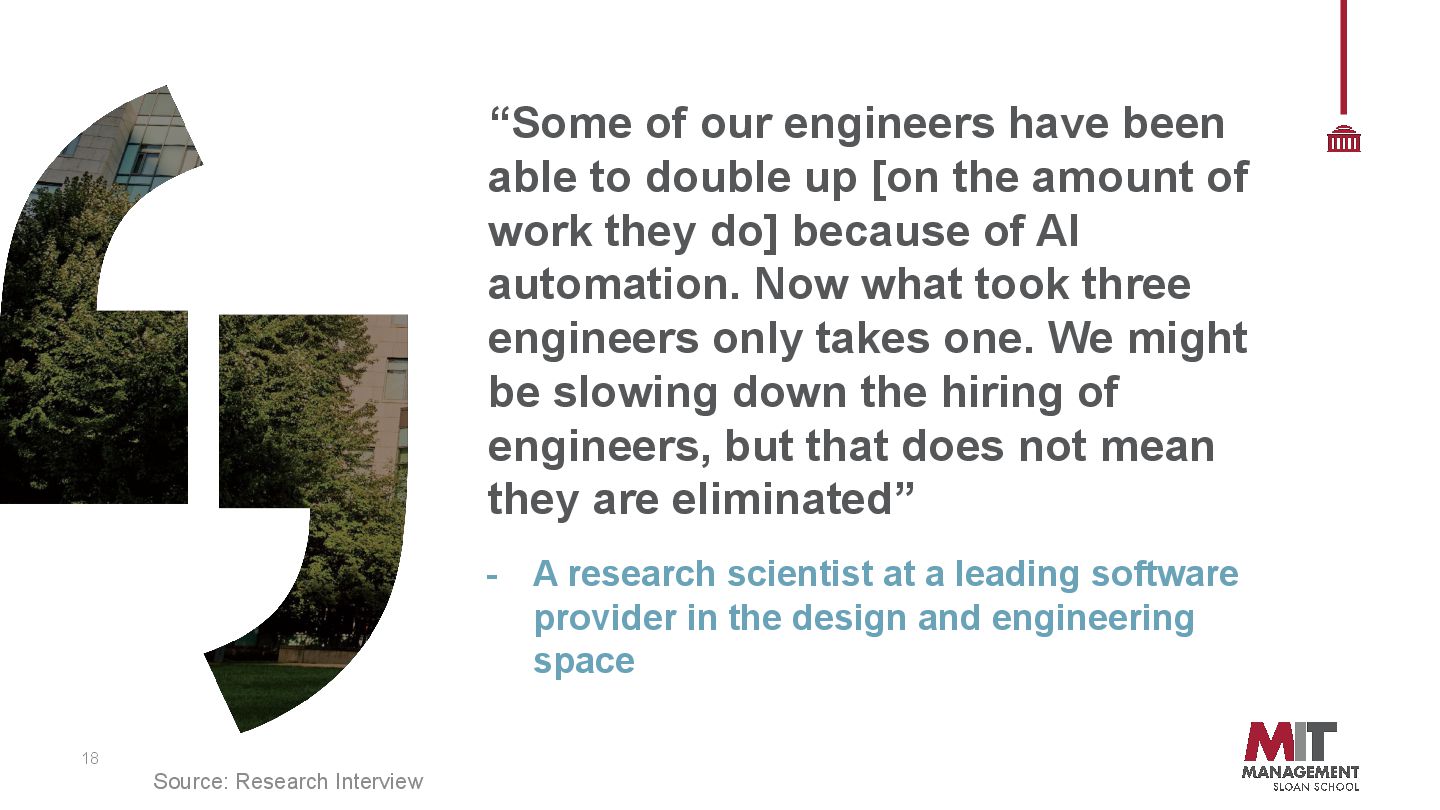
[on the amount of work they do] because of AI automation. Now what took three engineers only takes one. We might be slowing down the hiring of engineers, but that does not mean they are eliminated” - A research scientist at a leading software provider in the design and engineering space Source: Research Interview 18
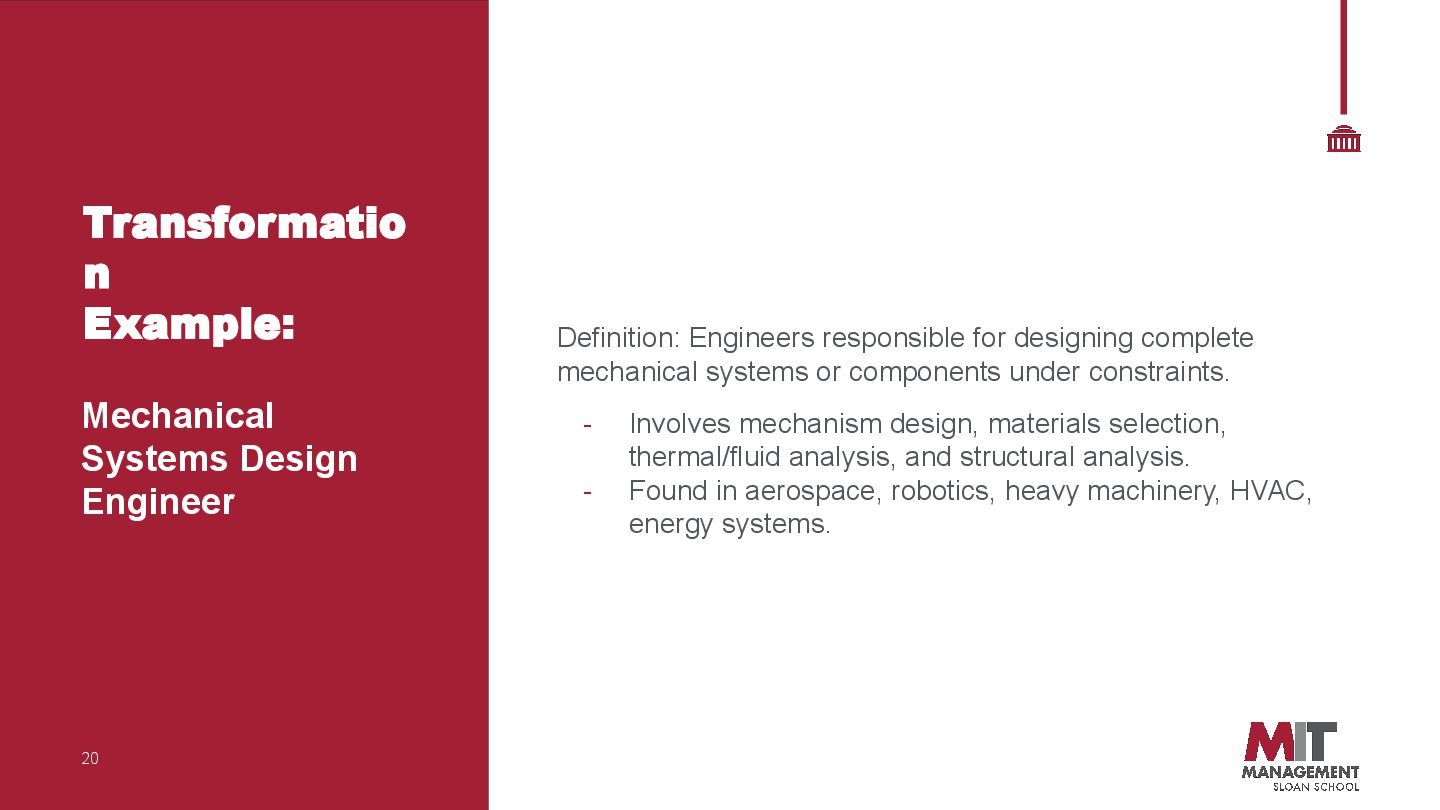
mechanical systems or components under constraints. - Involves mechanism design, materials selection, thermal/fluid analysis, and structural analysis. - Found in aerospace, robotics, heavy machinery, HVAC, energy systems. Transformatio n Example: 20
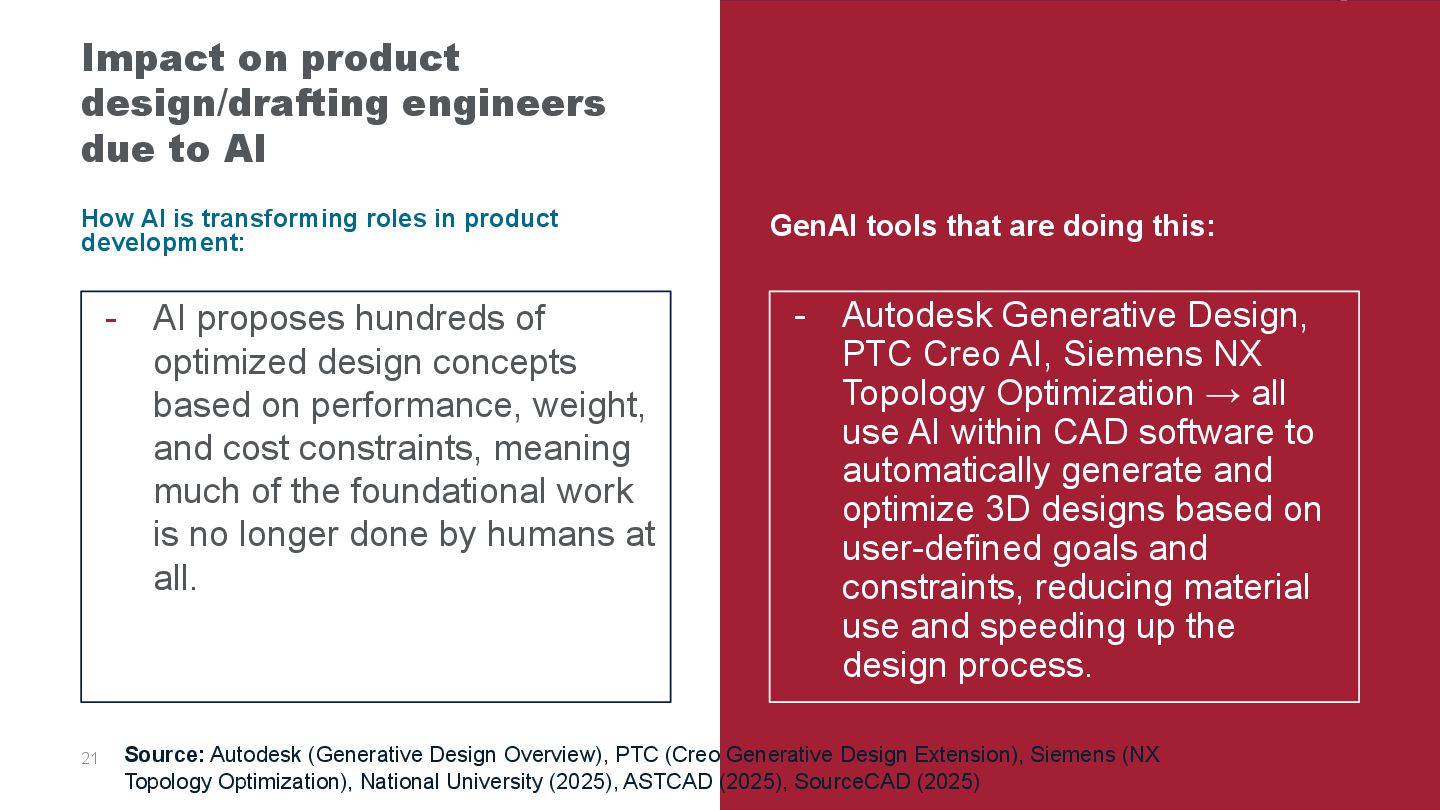
performance, weight, and cost constraints, meaning much of the foundational work is no longer done by humans at all. Impact on product design/drafting engineers due to AI 21 How AI is transforming roles in product development: GenAI tools that are doing this: - Autodesk Generative Design, PTC Creo AI, Siemens NX Topology Optimization → all use AI within CAD software to automatically generate and optimize 3D designs based on user-defined goals and constraints, reducing material use and speeding up the design process. Source: Autodesk (Generative Design Overview), PTC (Creo Generative Design Extension), Siemens (NX Topology Optimization), National University (2025), ASTCAD (2025), SourceCAD (2025)
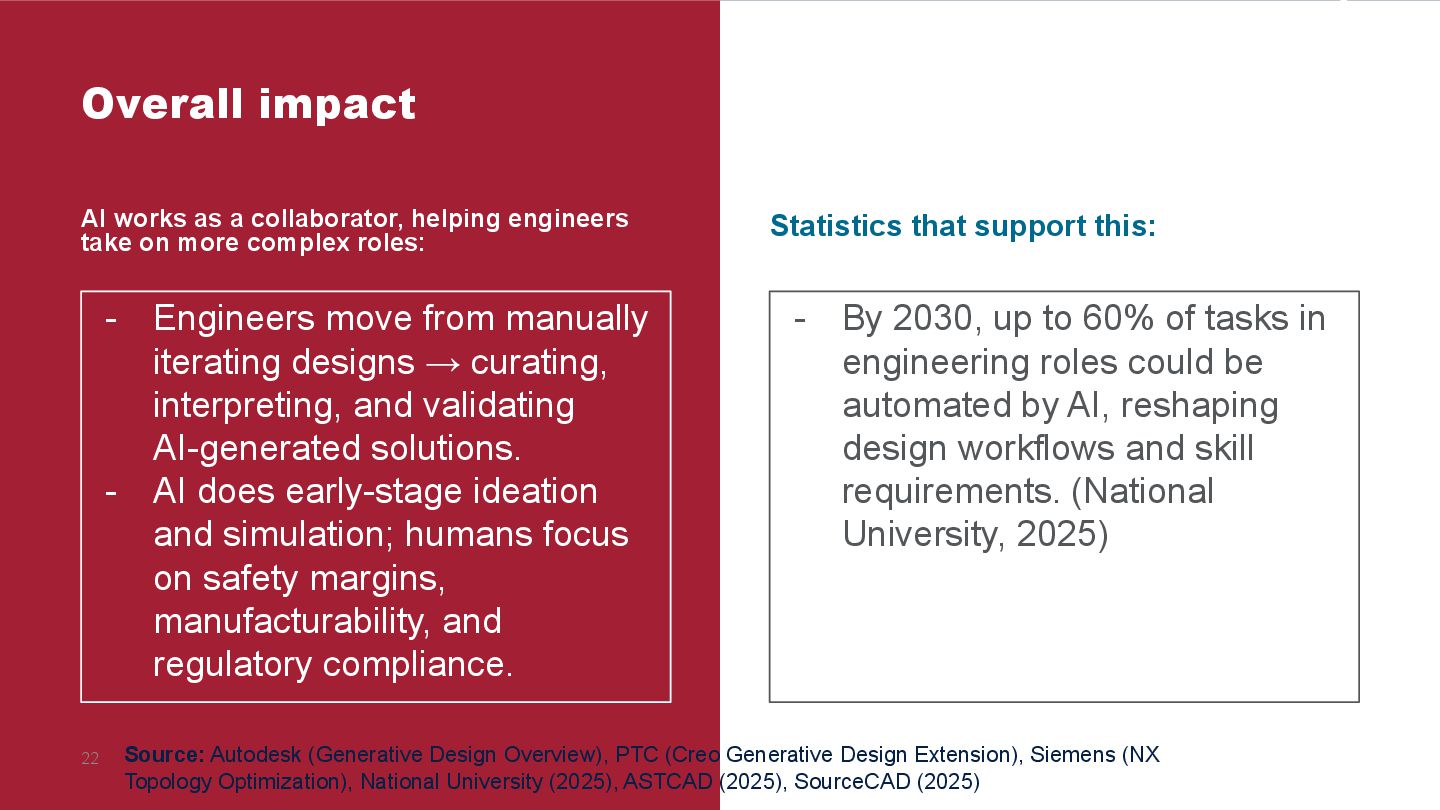
and validating AI-generated solutions. - AI does early-stage ideation and simulation; humans focus on safety margins, manufacturability, and regulatory compliance. Overall impact 22 AI works as a collaborator, helping engineers take on more complex roles: Statistics that support this: - By 2030, up to 60% of tasks in engineering roles could be automated by AI, reshaping design workflows and skill requirements. (National University, 2025) Source: Autodesk (Generative Design Overview), PTC (Creo Generative Design Extension), Siemens (NX Topology Optimization), National University (2025), ASTCAD (2025), SourceCAD (2025)
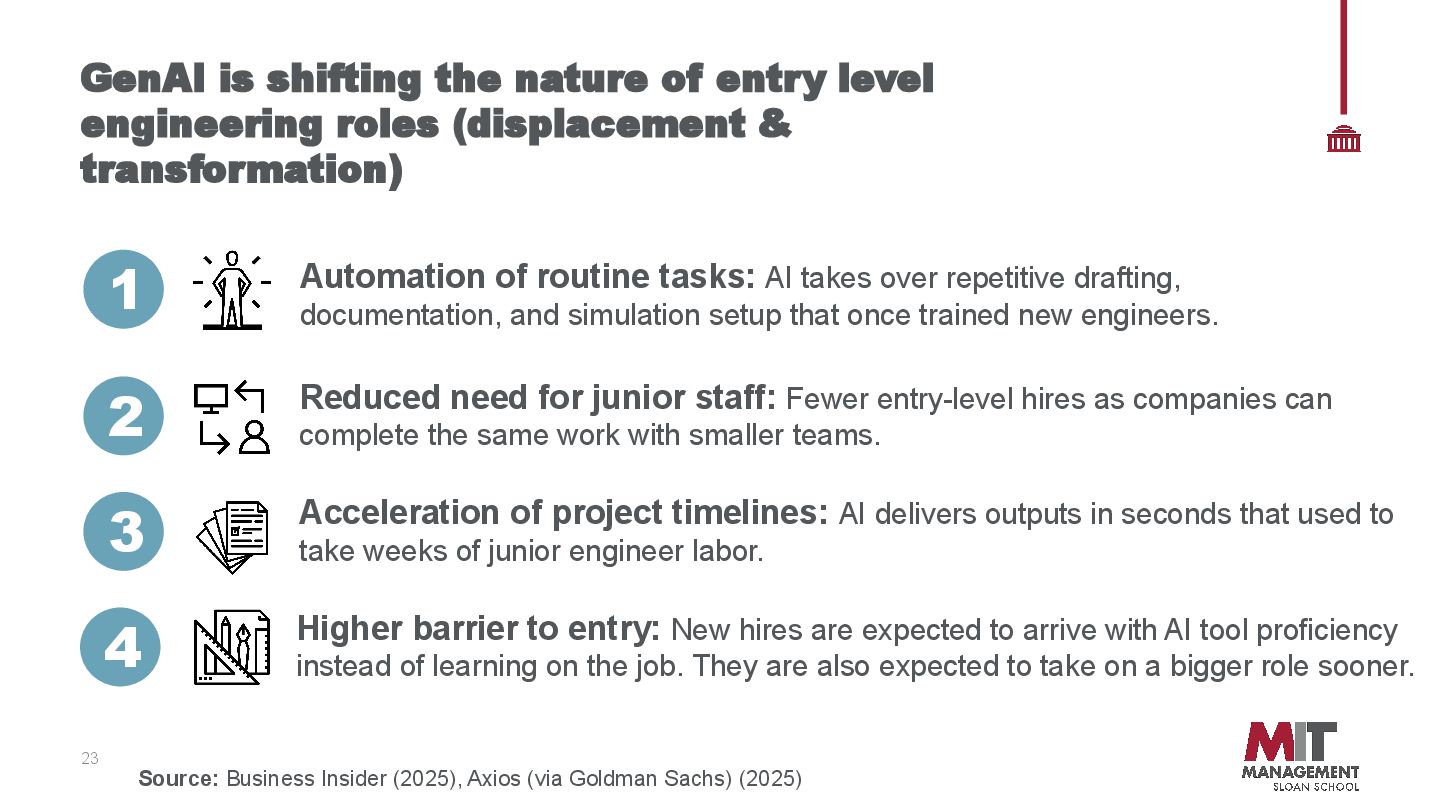
documentation, and simulation setup that once trained new engineers. 2 Reduced need for junior staff: Fewer entry-level hires as companies can complete the same work with smaller teams. 3 Acceleration of project timelines: AI delivers outputs in seconds that used to take weeks of junior engineer labor. 4 Higher barrier to entry: New hires are expected to arrive with AI tool proficiency instead of learning on the job. They are also expected to take on a bigger role sooner. 23 Source: Business Insider (2025), Axios (via Goldman Sachs) (2025) GenAI is shifting the nature of entry level engineering roles (displacement & transformation)
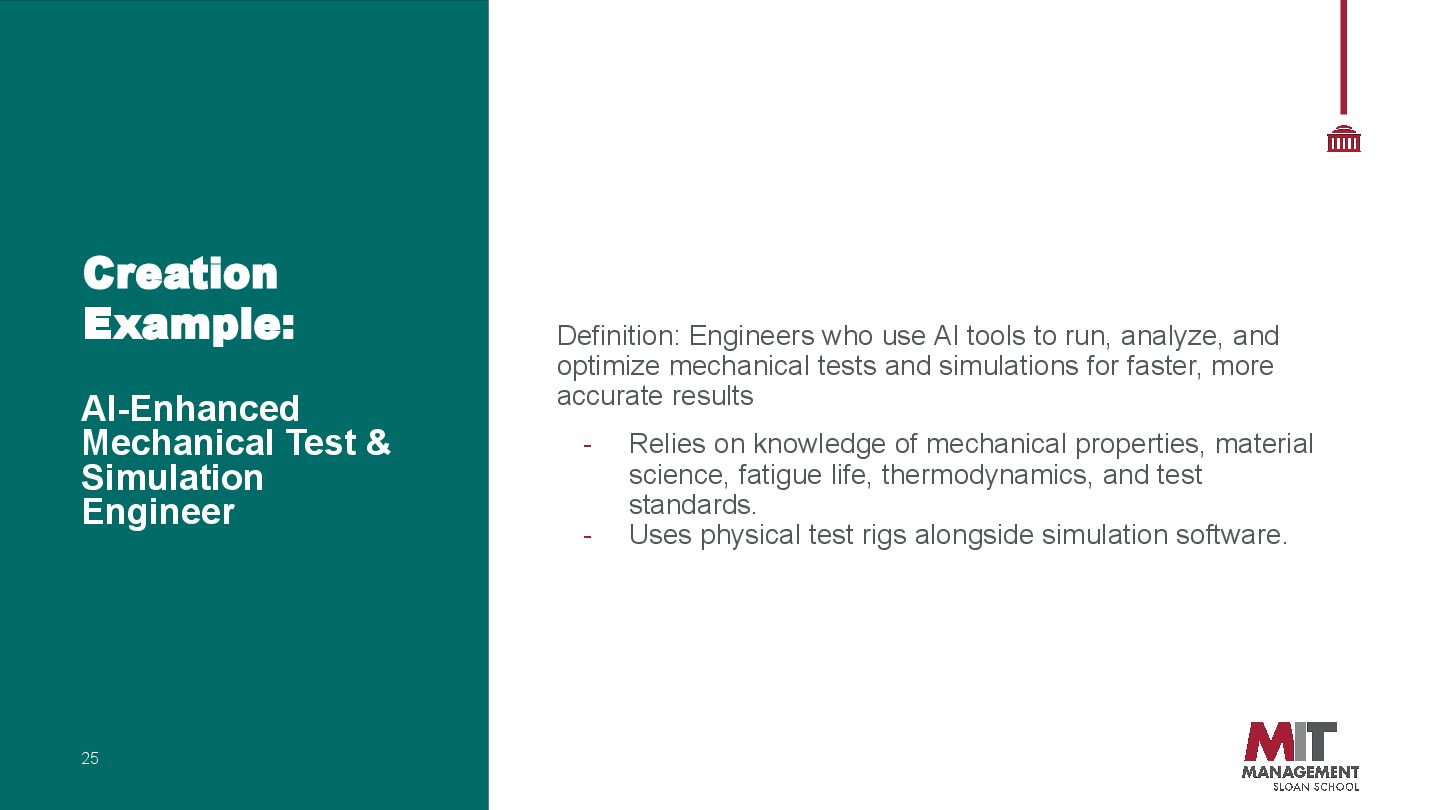
AI tools to run, analyze, and optimize mechanical tests and simulations for faster, more accurate results - Relies on knowledge of mechanical properties, material science, fatigue life, thermodynamics, and test standards. - Uses physical test rigs alongside simulation software. Creation Example: 25
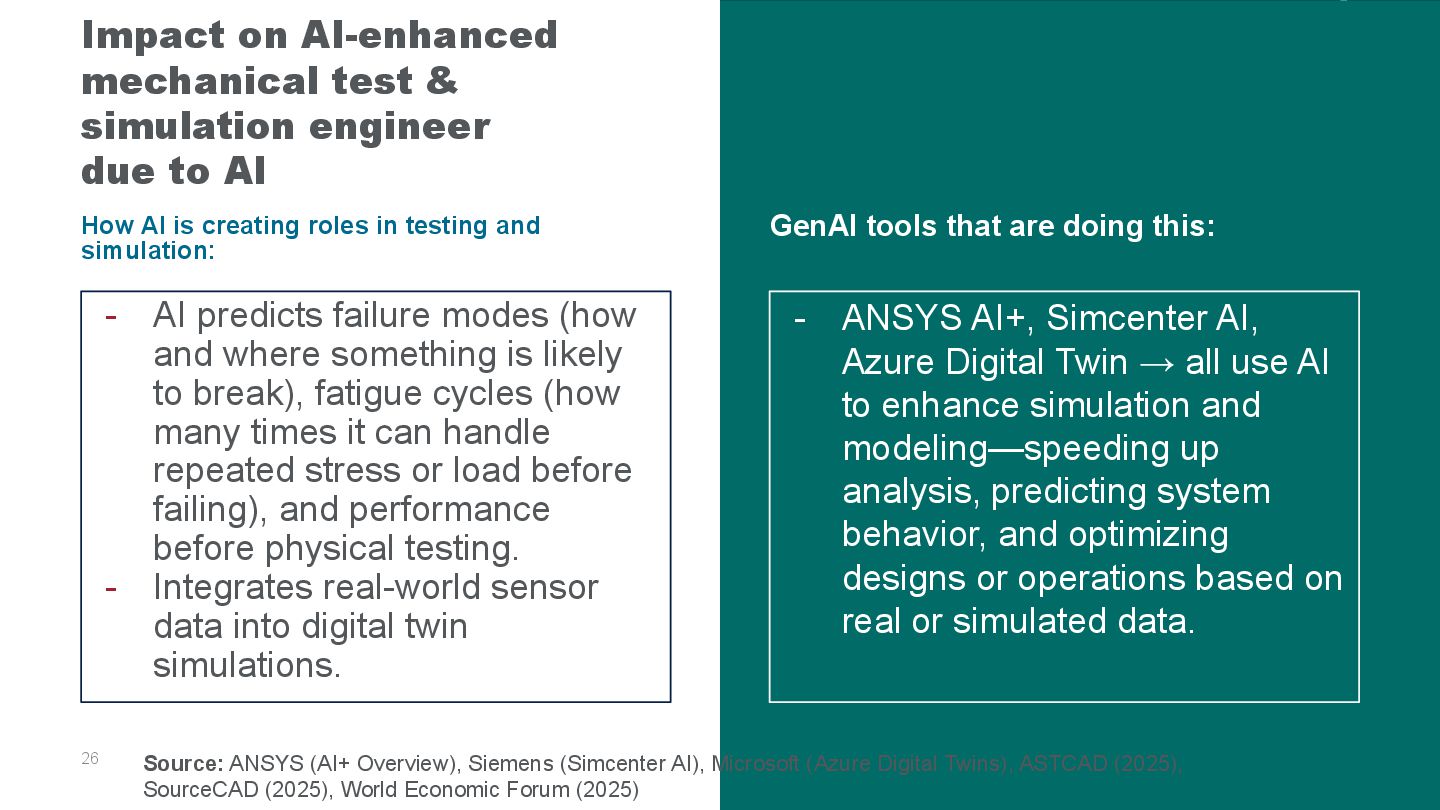
likely to break), fatigue cycles (how many times it can handle repeated stress or load before failing), and performance before physical testing. - Integrates real-world sensor data into digital twin simulations. Impact on AI-enhanced mechanical test & simulation engineer due to AI 26 How AI is creating roles in testing and simulation: GenAI tools that are doing this: - ANSYS AI+, Simcenter AI, Azure Digital Twin → all use AI to enhance simulation and modeling—speeding up analysis, predicting system behavior, and optimizing designs or operations based on real or simulated data. Source: ANSYS (AI+ Overview), Siemens (Simcenter AI), Microsoft (Azure Digital Twins), ASTCAD (2025), SourceCAD (2025), World Economic Forum (2025)
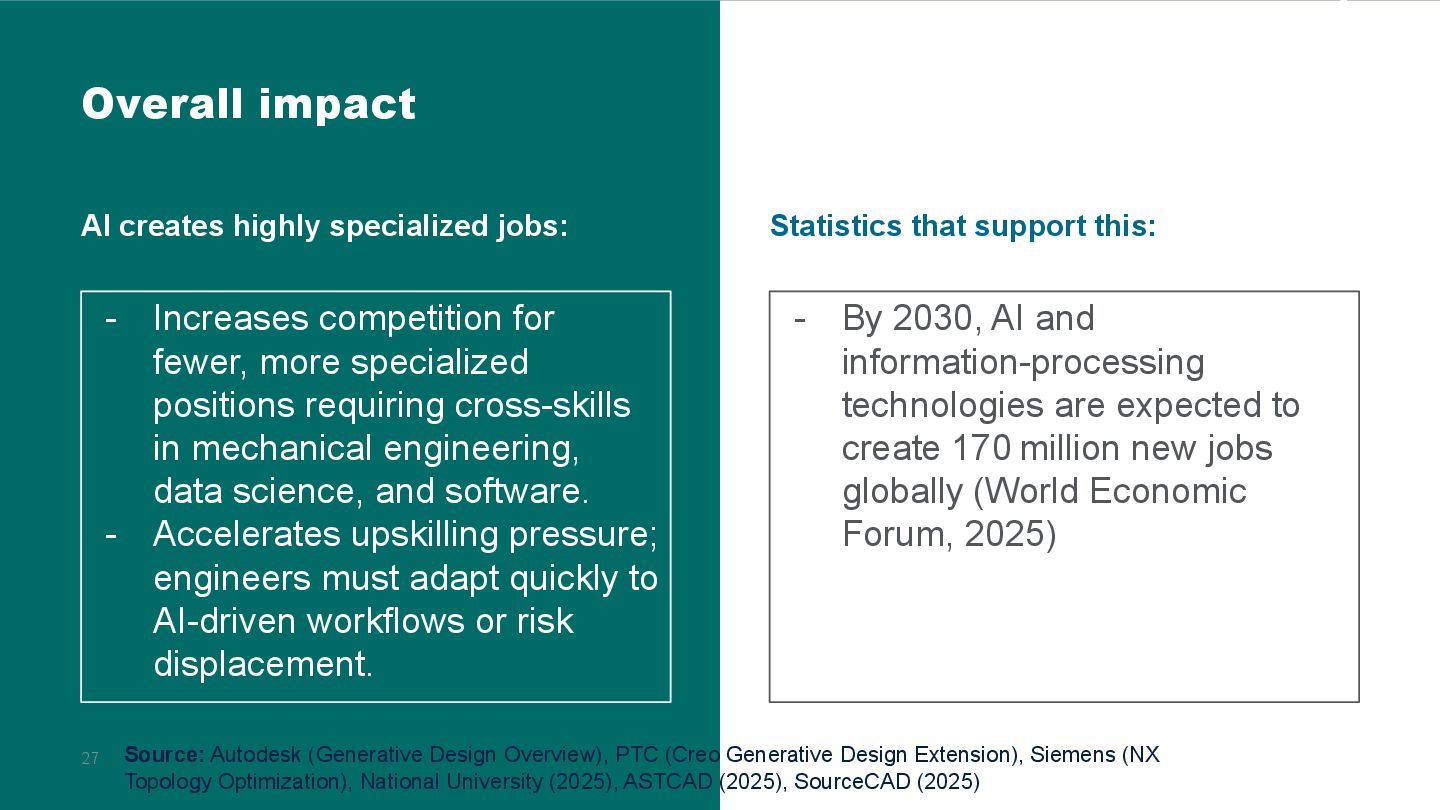
in mechanical engineering, data science, and software. - Accelerates upskilling pressure; engineers must adapt quickly to AI-driven workflows or risk displacement. Overall impact 27 AI creates highly specialized jobs: Statistics that support this: - By 2030, AI and information-processing technologies are expected to create 170 million new jobs globally (World Economic Forum, 2025) Source: Autodesk (Generative Design Overview), PTC (Creo Generative Design Extension), Siemens (NX Topology Optimization), National University (2025), ASTCAD (2025), SourceCAD (2025)
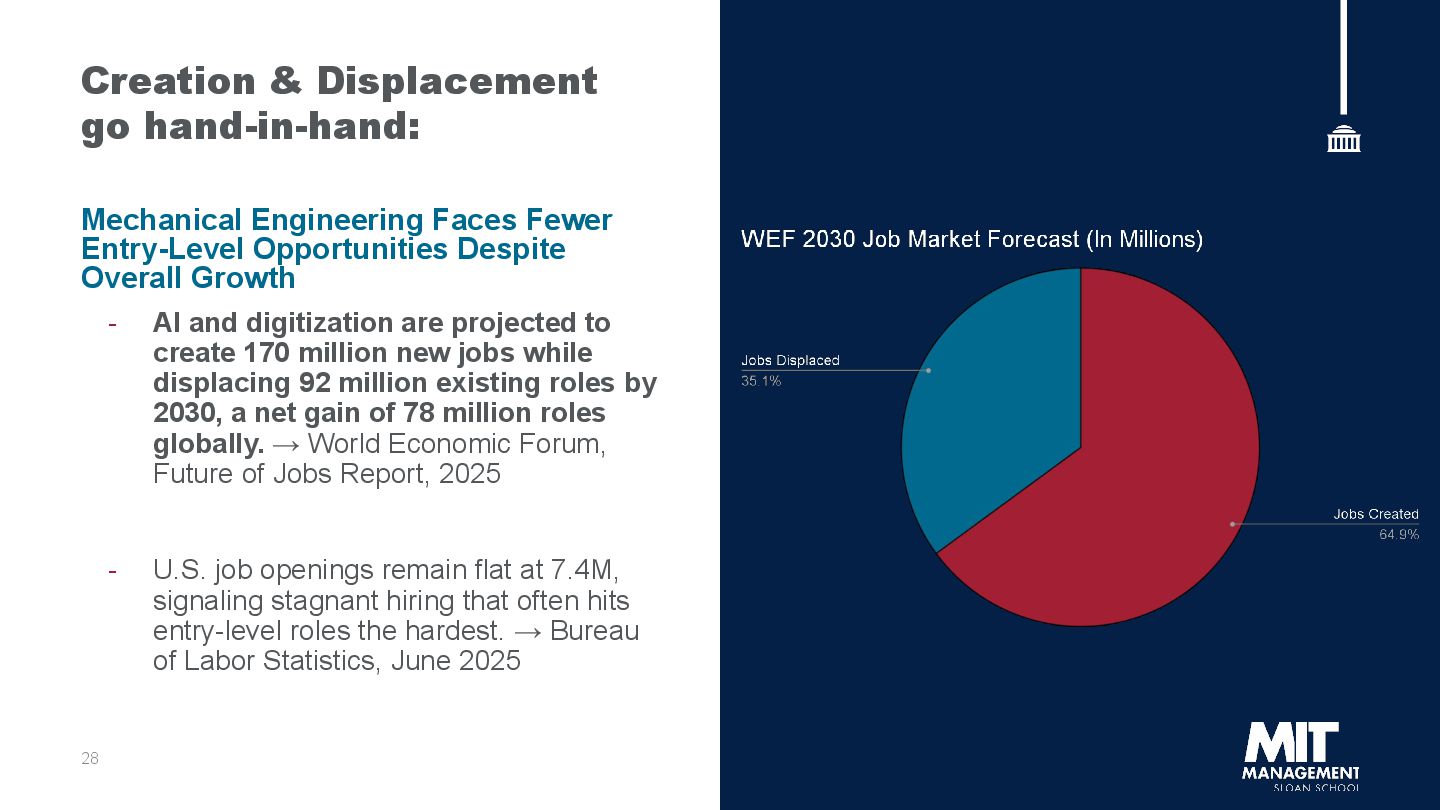
AI and digitization are projected to create 170 million new jobs while displacing 92 million existing roles by 2030, a net gain of 78 million roles globally. → World Economic Forum, Future of Jobs Report, 2025 - U.S. job openings remain flat at 7.4M, signaling stagnant hiring that often hits entry-level roles the hardest. → Bureau of Labor Statistics, June 2025 28 Creation & Displacement go hand-in-hand:
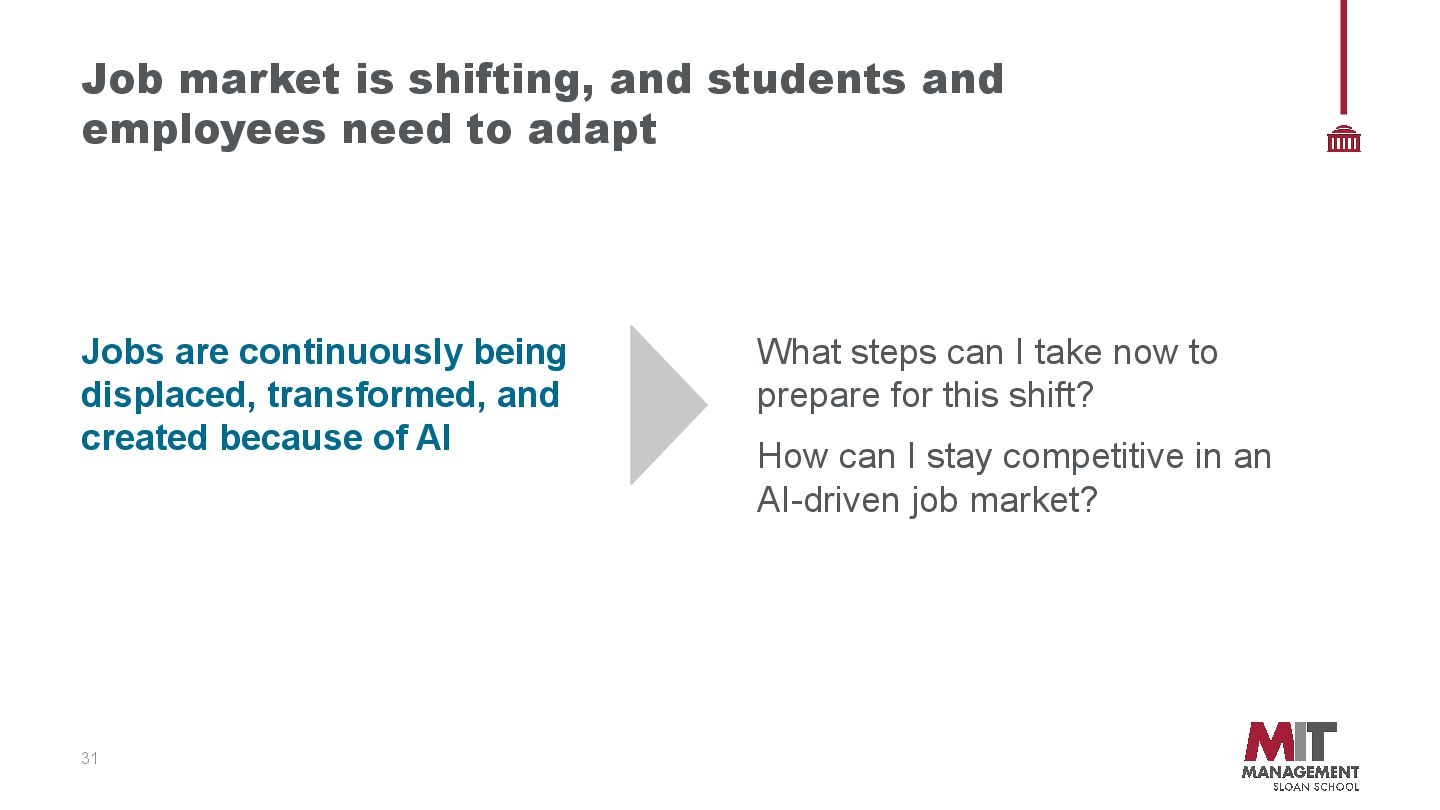
to adapt Jobs are continuously being displaced, transformed, and created because of AI What steps can I take now to prepare for this shift? How can I stay competitive in an AI-driven job market?
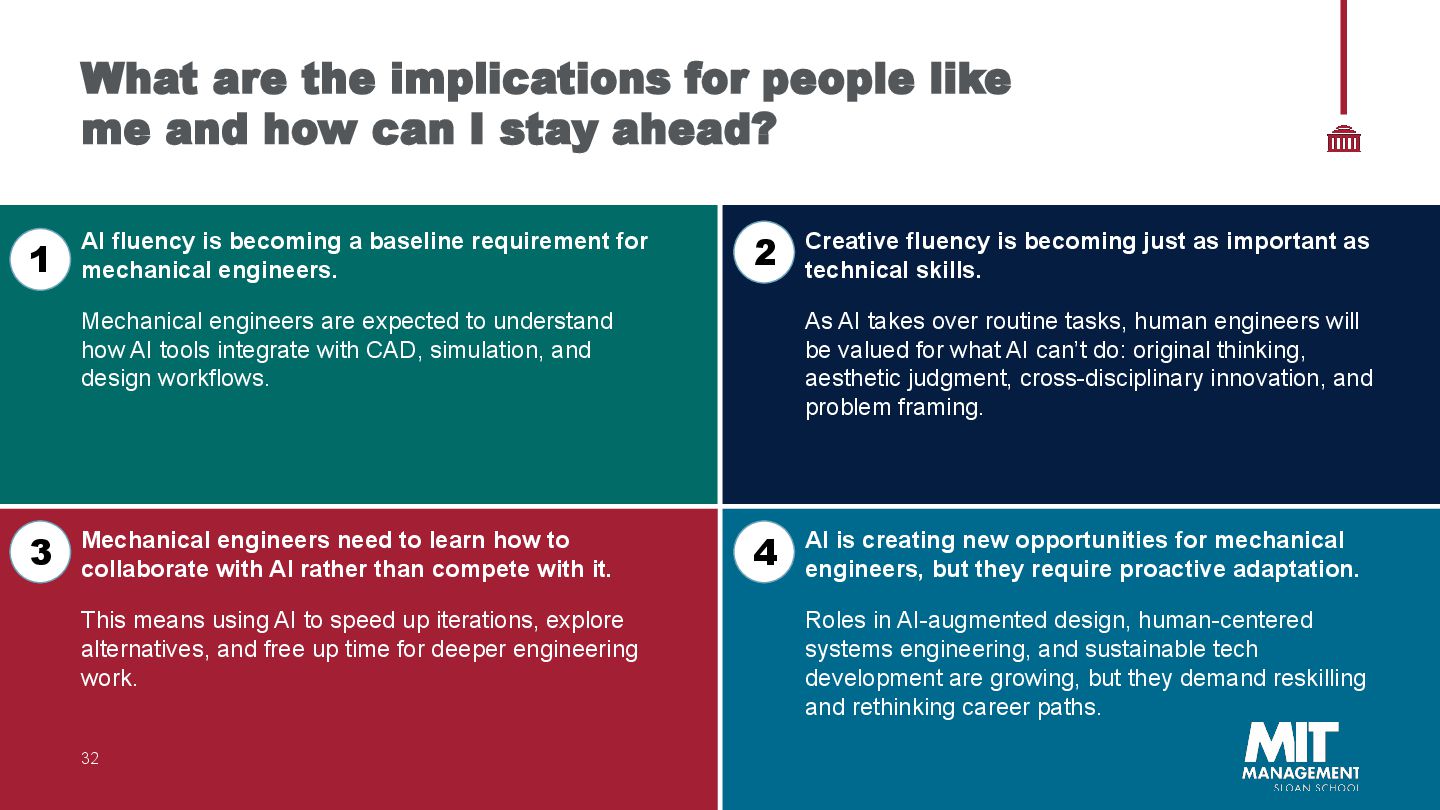
Creative fluency is becoming just as important as technical skills. Mechanical engineers need to learn how to collaborate with AI rather than compete with it. AI is creating new opportunities for mechanical engineers, but they require proactive adaptation. Mechanical engineers are expected to understand how AI tools integrate with CAD, simulation, and design workflows. As AI takes over routine tasks, human engineers will be valued for what AI can’t do: original thinking, aesthetic judgment, cross-disciplinary innovation, and problem framing. This means using AI to speed up iterations, explore alternatives, and free up time for deeper engineering work. Roles in AI-augmented design, human-centered systems engineering, and sustainable tech development are growing, but they demand reskilling and rethinking career paths. 32 1 2 3 4 What are the implications for people like me and how can I stay ahead?
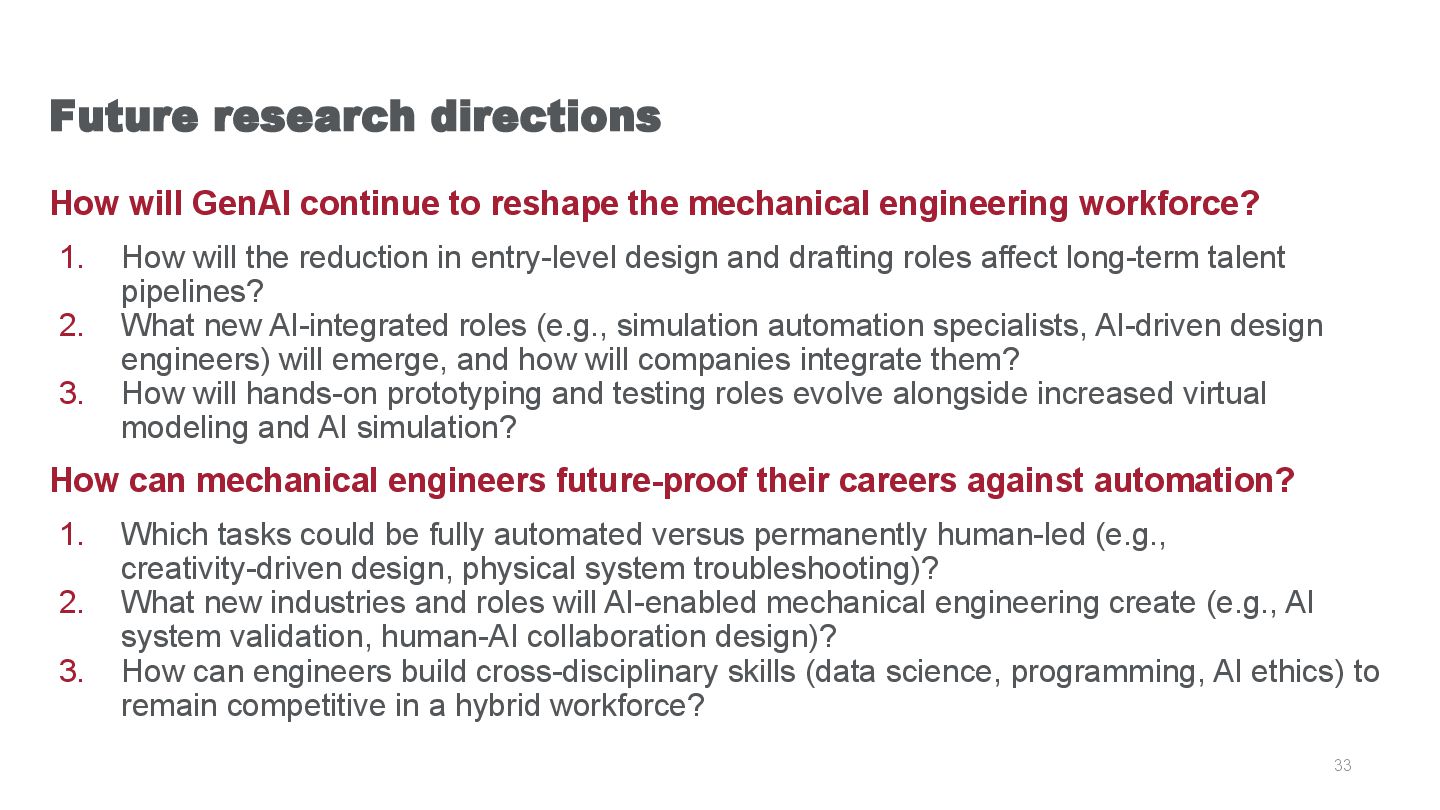
mechanical engineering workforce? 1. How will the reduction in entry-level design and drafting roles affect long-term talent pipelines? 2. What new AI-integrated roles (e.g., simulation automation specialists, AI-driven design engineers) will emerge, and how will companies integrate them? 3. How will hands-on prototyping and testing roles evolve alongside increased virtual modeling and AI simulation? How can mechanical engineers future-proof their careers against automation? 1. Which tasks could be fully automated versus permanently human-led (e.g., creativity-driven design, physical system troubleshooting)? 2. What new industries and roles will AI-enabled mechanical engineering create (e.g., AI system validation, human-AI collaboration design)? 3. How can engineers build cross-disciplinary skills (data science, programming, AI ethics) to remain competitive in a hybrid workforce? 33


 emiliedubiel
 morganepeng
 akademiya2063
 aleyda
 maltzj
 watany
 jdejongh
 marcduiker
 marktimemedia
 coloredviolet
 hannesfritz
 mkilby
 skipperchong