Upgrade to Pro — share decks privately, control downloads, hide ads and more …

Impact of GenAI on Writing Skills Development: ...

Sponsored · Your Podcast. Everywhere. Effortlessly. Share. Educate. Inspire. Entertain. You do you. We'll handle the rest. →
Avatar for Emilie Dubiel Emilie Dubiel
August 07, 2025
28

Impact of GenAI on Writing Skills Development: Inside and Outside of the Classroom

Avatar for Emilie Dubiel

Emilie Dubiel

August 07, 2025

More Decks by Emilie Dubiel

Transcript

  1. Impact of GenAI on Writing Skills Development: Inside and Outside

    the Classroom Georgia Severson Summer 2024 UROP
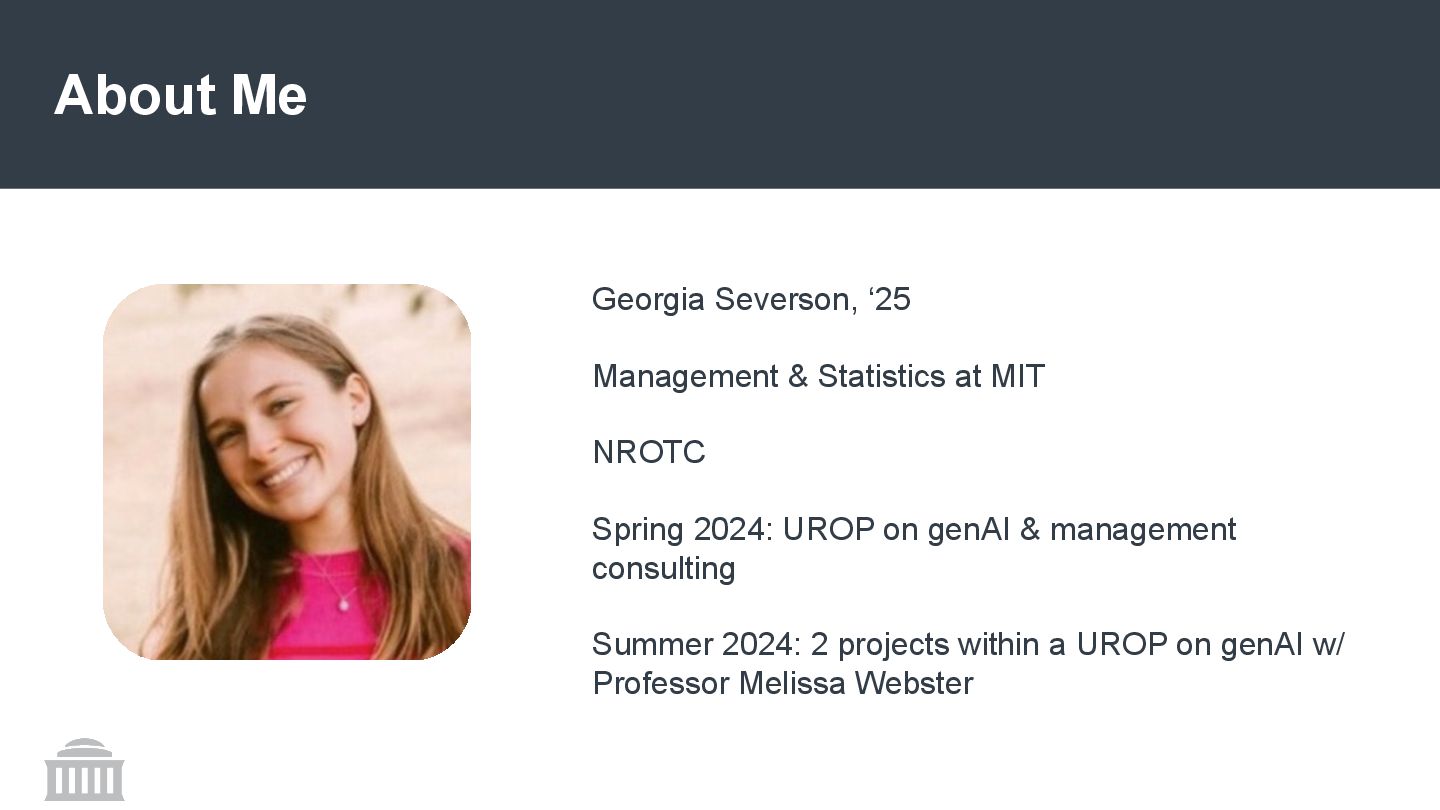
  2. About Me Georgia Severson, ‘25 Management & Statistics at MIT

    NROTC Spring 2024: UROP on genAI & management consulting Summer 2024: 2 projects within a UROP on genAI w/ Professor Melissa Webster
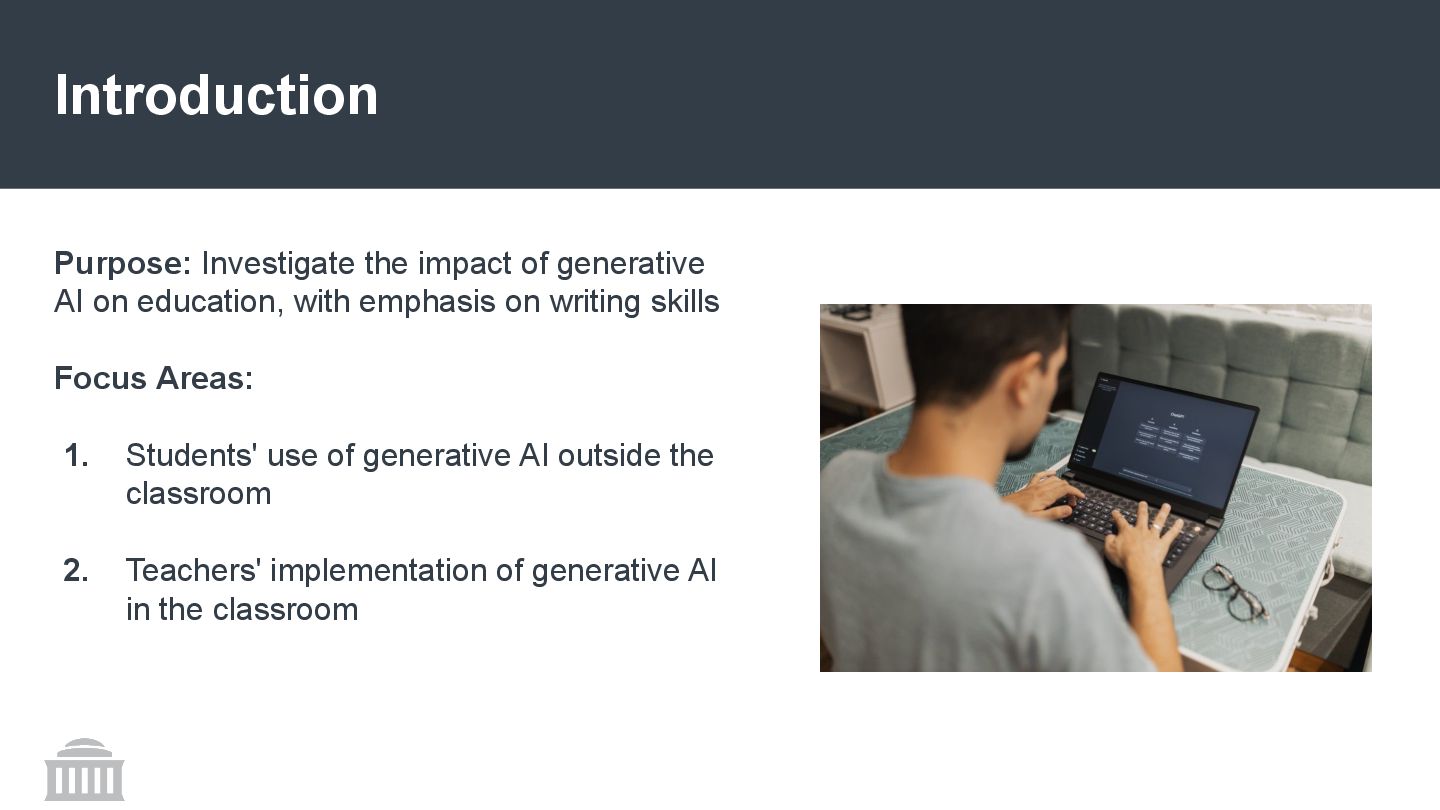
  3. Introduction Purpose: Investigate the impact of generative AI on education,

    with emphasis on writing skills Focus Areas: 1. Students' use of generative AI outside the classroom 2. Teachers' implementation of generative AI in the classroom
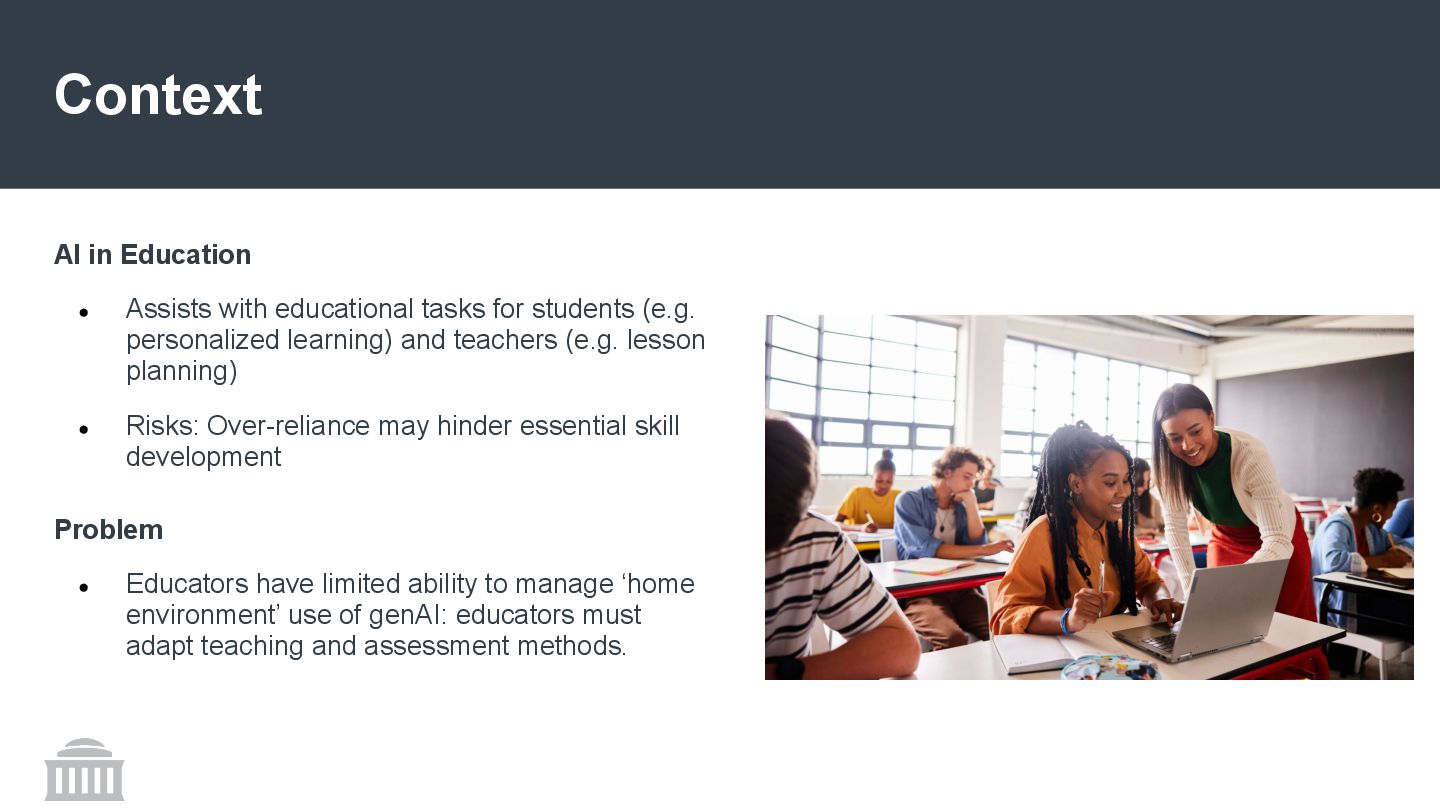
  4. Context AI in Education • Assists with educational tasks for

    students (e.g. personalized learning) and teachers (e.g. lesson planning) • Risks: Over-reliance may hinder essential skill development Problem • Educators have limited ability to manage ‘home environment’ use of genAI: educators must adapt teaching and assessment methods.
  5. Research Question What strategies can educators use to balance the

    benefits of AI assistance with the need for students to develop critical thinking and fundamental writing skills?
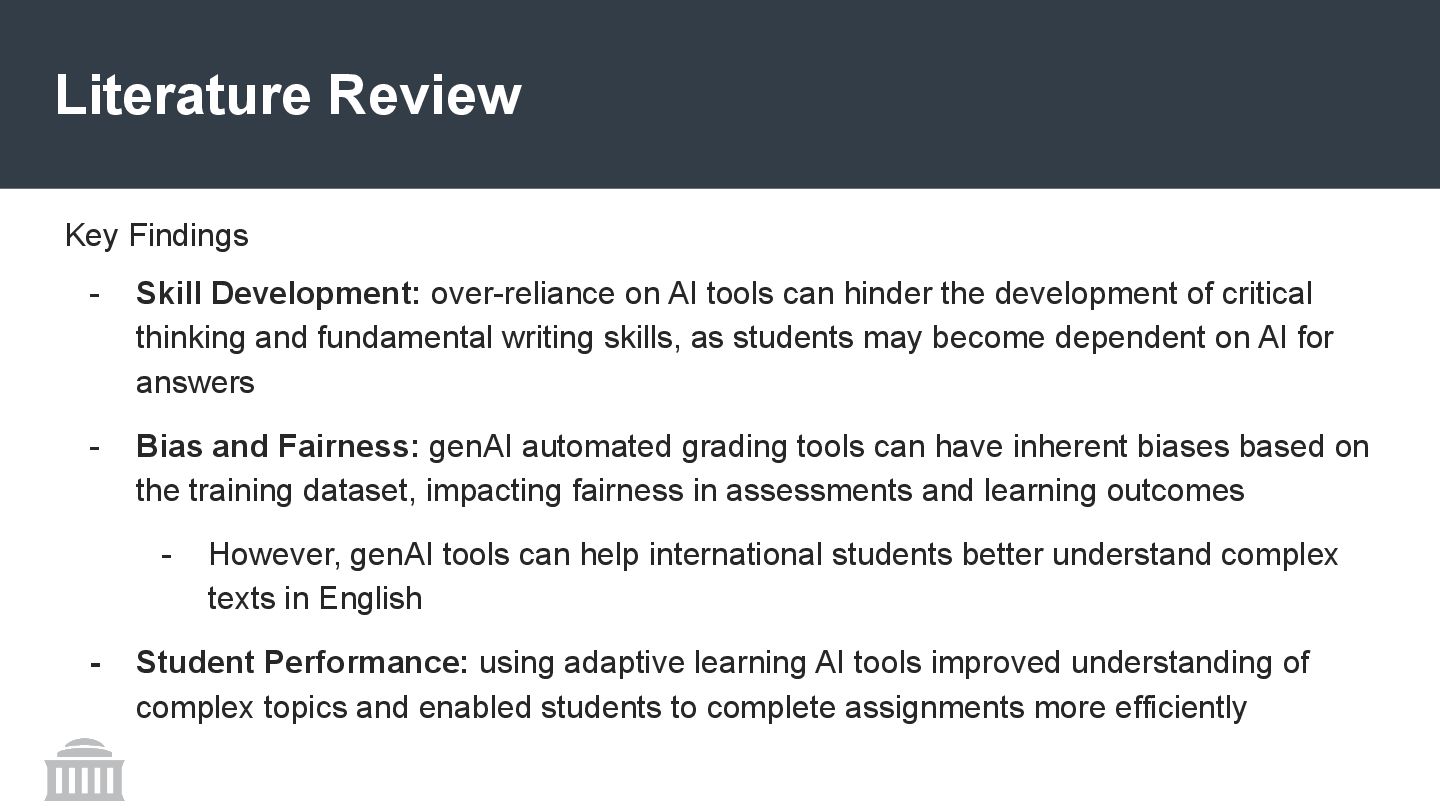
  6. Literature Review Key Findings - Skill Development: over-reliance on AI

    tools can hinder the development of critical thinking and fundamental writing skills, as students may become dependent on AI for answers - Bias and Fairness: genAI automated grading tools can have inherent biases based on the training dataset, impacting fairness in assessments and learning outcomes - However, genAI tools can help international students better understand complex texts in English - Student Performance: using adaptive learning AI tools improved understanding of complex topics and enabled students to complete assignments more efficiently
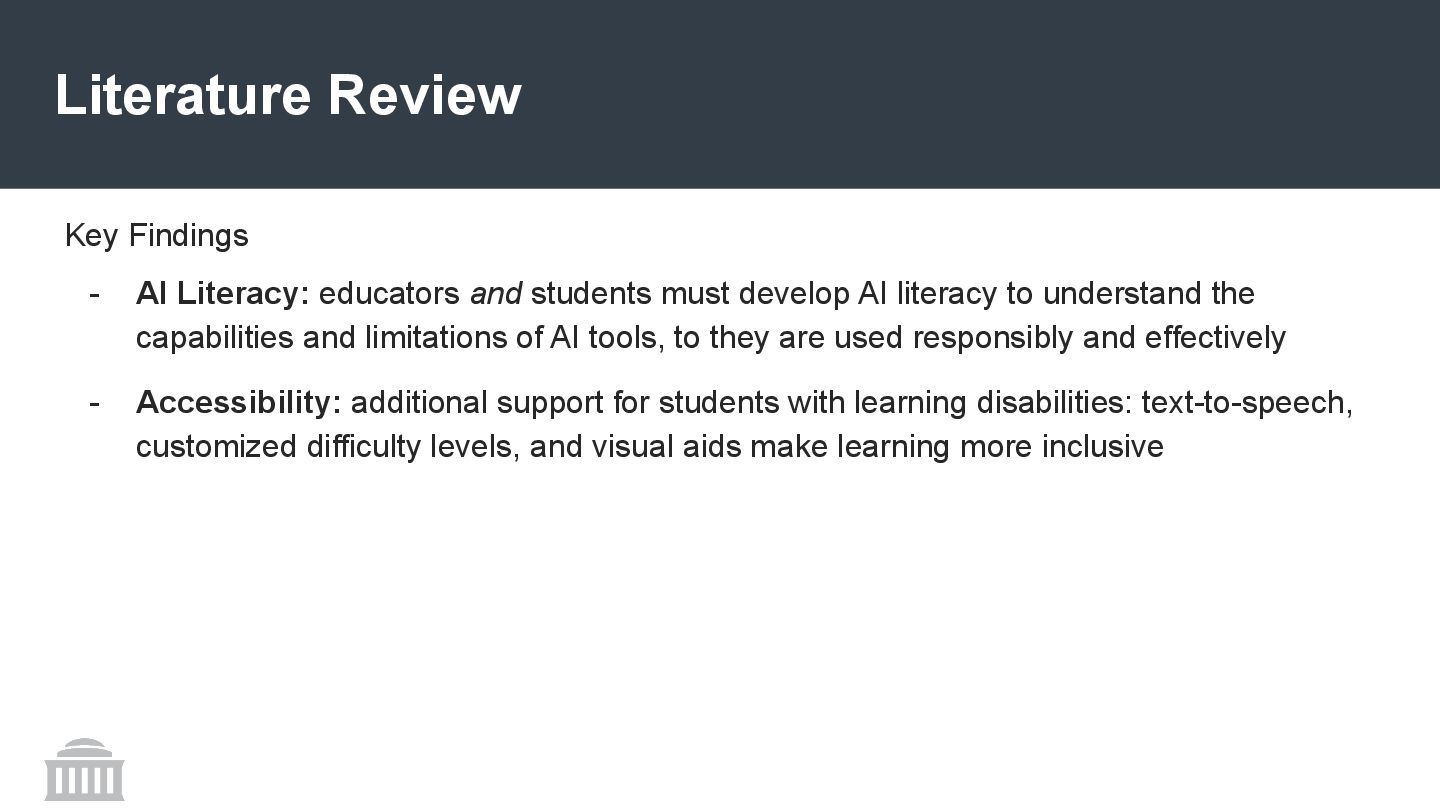
  7. Literature Review Key Findings - AI Literacy: educators and students

    must develop AI literacy to understand the capabilities and limitations of AI tools, to they are used responsibly and effectively - Accessibility: additional support for students with learning disabilities: text-to-speech, customized difficulty levels, and visual aids make learning more inclusive
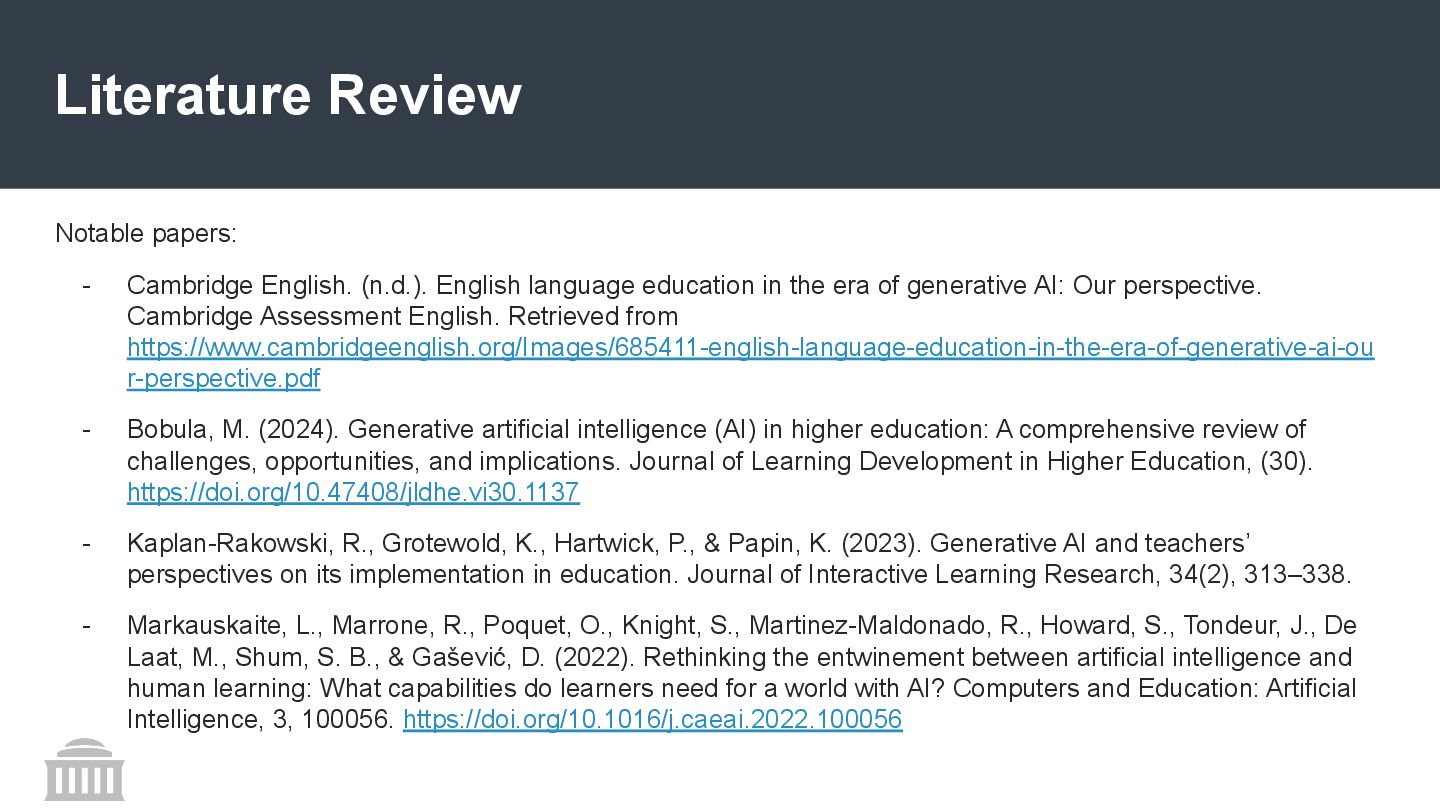
  8. Literature Review Notable papers: - Cambridge English. (n.d.). English language

    education in the era of generative AI: Our perspective. Cambridge Assessment English. Retrieved from https://www.cambridgeenglish.org/Images/685411-english-language-education-in-the-era-of-generative-ai-ou r-perspective.pdf - Bobula, M. (2024). Generative artificial intelligence (AI) in higher education: A comprehensive review of challenges, opportunities, and implications. Journal of Learning Development in Higher Education, (30). https://doi.org/10.47408/jldhe.vi30.1137 - Kaplan-Rakowski, R., Grotewold, K., Hartwick, P., & Papin, K. (2023). Generative AI and teachers’ perspectives on its implementation in education. Journal of Interactive Learning Research, 34(2), 313–338. - Markauskaite, L., Marrone, R., Poquet, O., Knight, S., Martinez-Maldonado, R., Howard, S., Tondeur, J., De Laat, M., Shum, S. B., & Gašević, D. (2022). Rethinking the entwinement between artificial intelligence and human learning: What capabilities do learners need for a world with AI? Computers and Education: Artificial Intelligence, 3, 100056. https://doi.org/10.1016/j.caeai.2022.100056
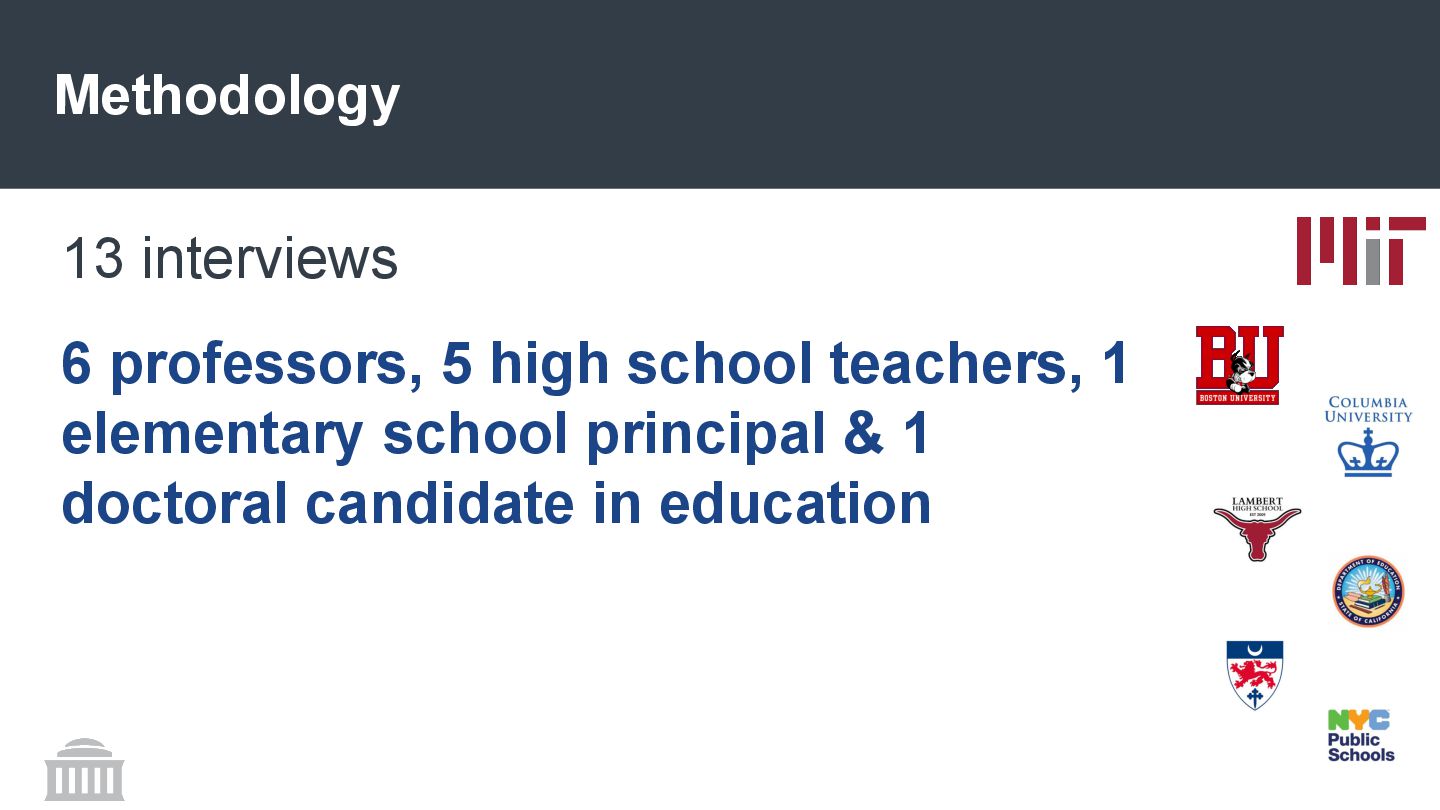
  9. Methodology 13 interviews 6 professors, 5 high school teachers, 1

    elementary school principal & 1 doctoral candidate in education
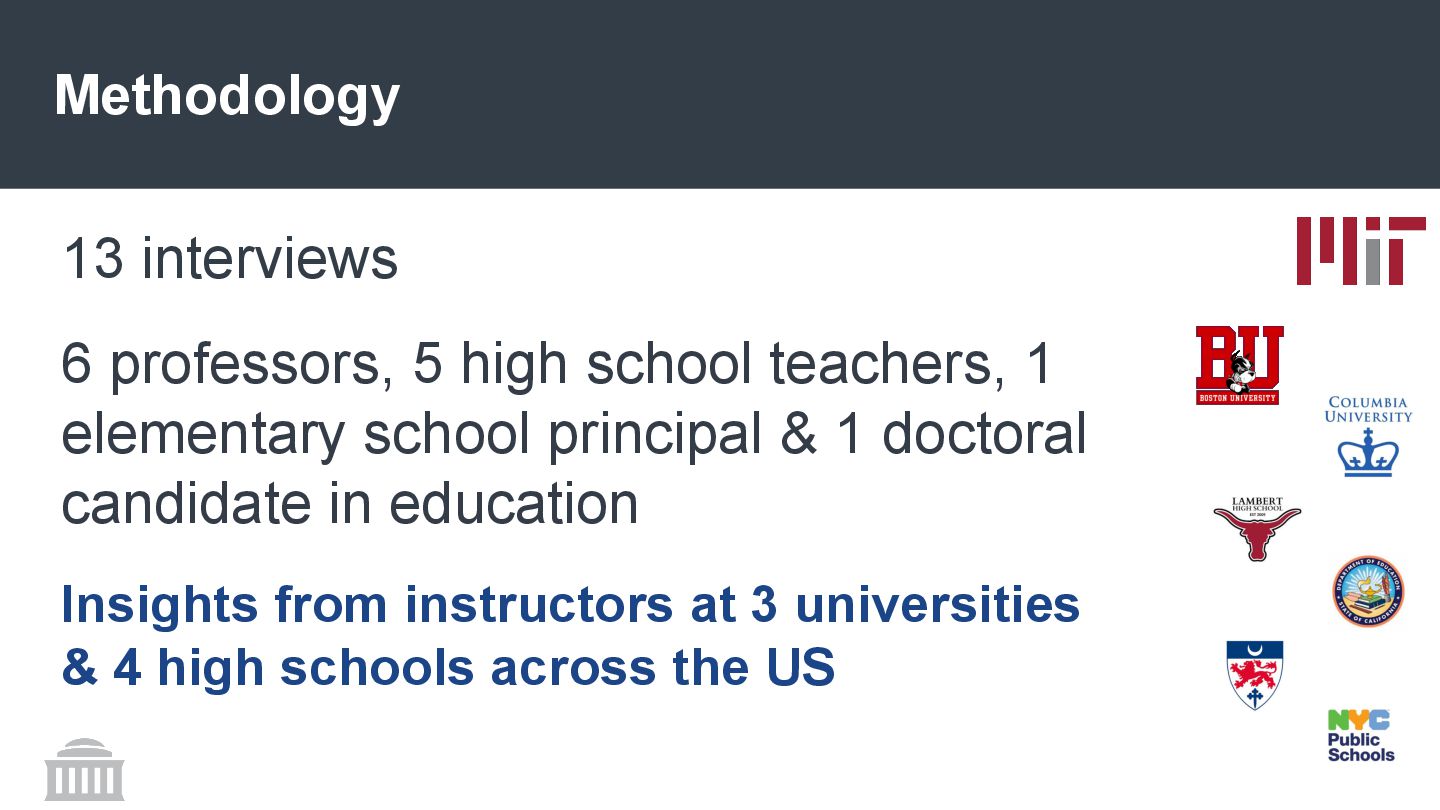
  10. Methodology 13 interviews 6 professors, 5 high school teachers, 1

    elementary school principal & 1 doctoral candidate in education Insights from instructors at 3 universities & 4 high schools across the US
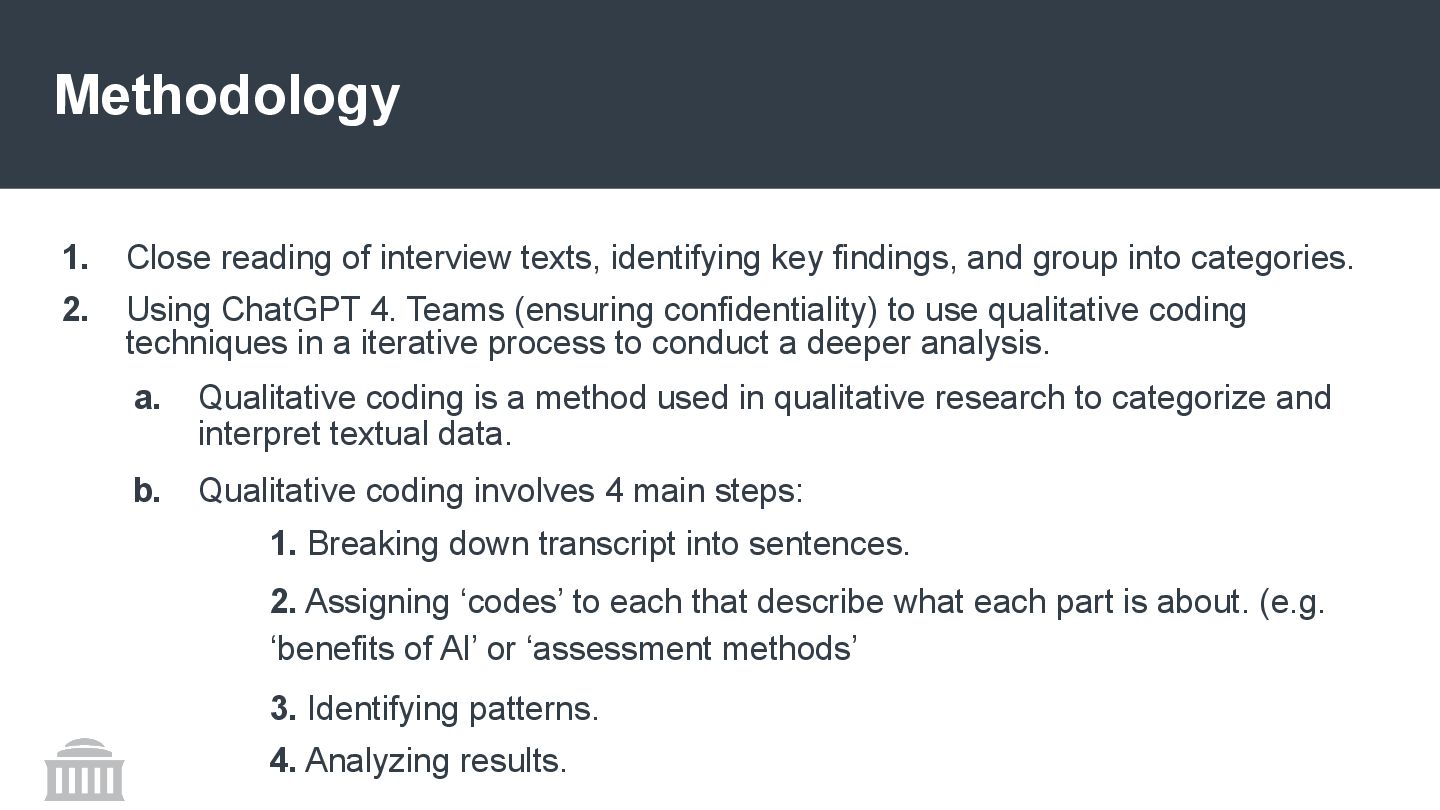
  11. Methodology 1. Close reading of interview texts, identifying key findings,

    and group into categories. 2. Using ChatGPT 4. Teams (ensuring confidentiality) to use qualitative coding techniques in a iterative process to conduct a deeper analysis. a. Qualitative coding is a method used in qualitative research to categorize and interpret textual data. b. Qualitative coding involves 4 main steps: 1. Breaking down transcript into sentences. 2. Assigning ‘codes’ to each that describe what each part is about. (e.g. ‘benefits of AI’ or ‘assessment methods’ 3. Identifying patterns. 4. Analyzing results.
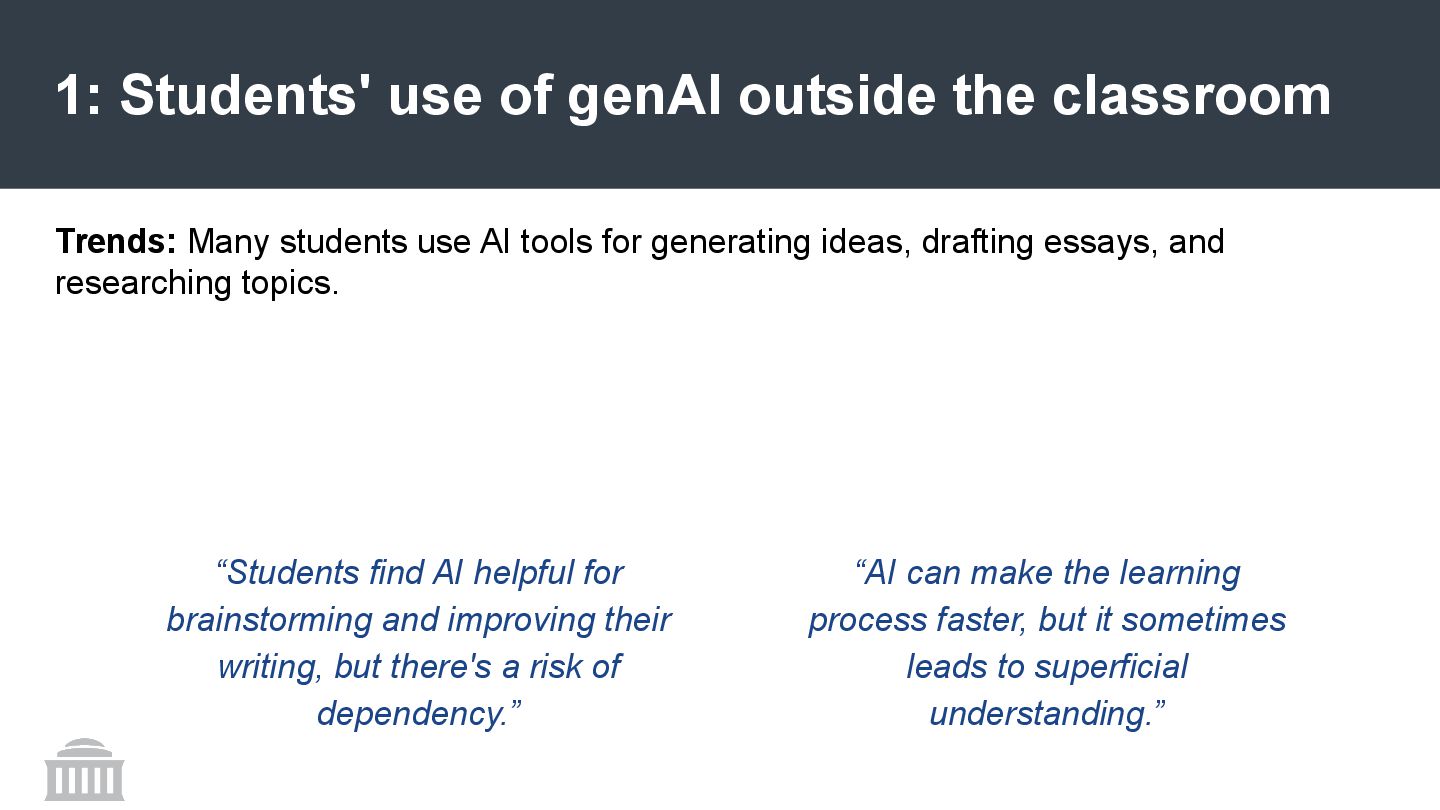
  12. 1: Students' use of genAI outside the classroom Trends: Many

    students use AI tools for generating ideas, drafting essays, and researching topics. Benefits: AI assists in brainstorming, enhancing writing quality, and providing quick answers to questions. Challenges: Over-reliance on AI can lead to a lack of independent critical thinking and problem-solving skills. “Students find AI helpful for brainstorming and improving their writing, but there's a risk of dependency.” “AI can make the learning process faster, but it sometimes leads to superficial understanding.”
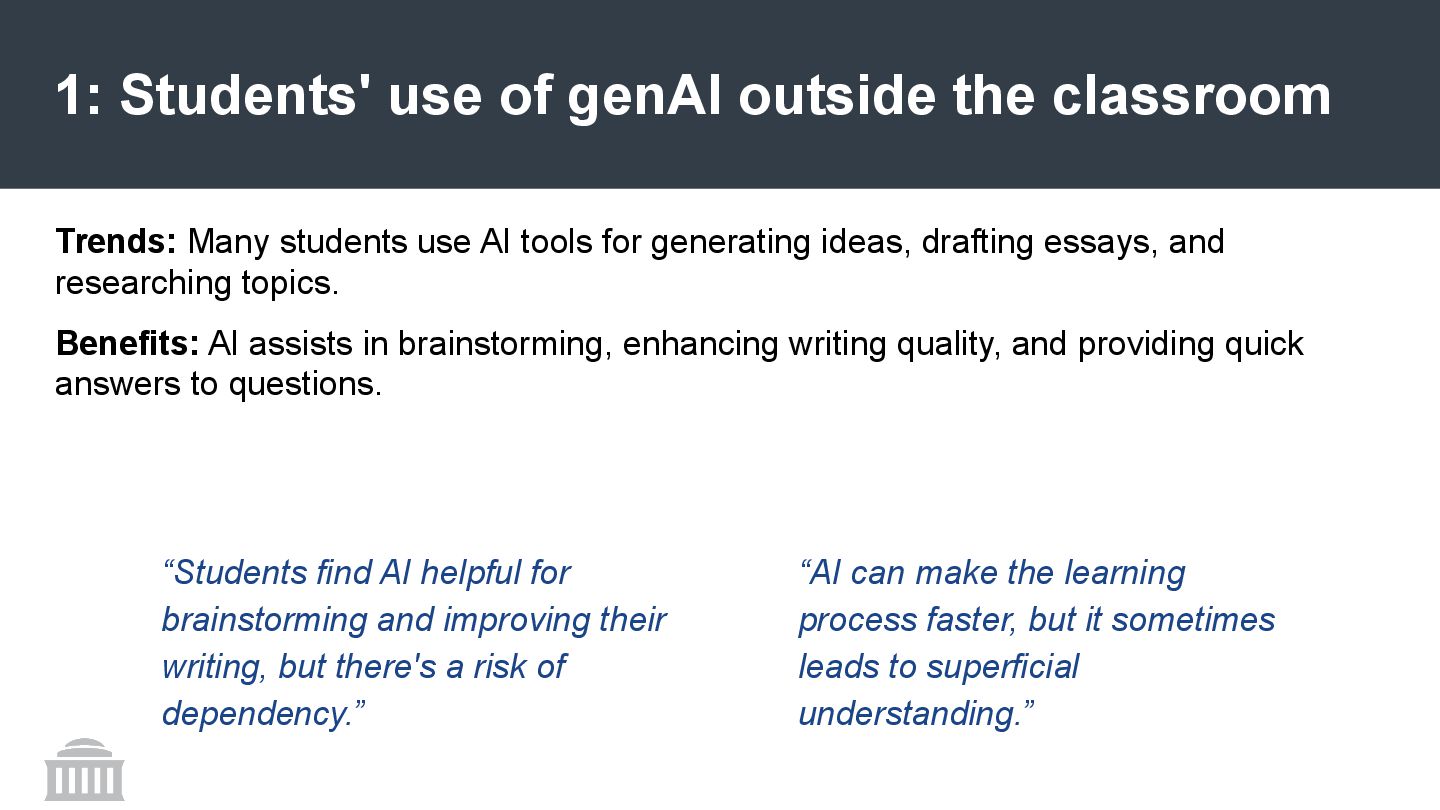
  13. 1: Students' use of genAI outside the classroom Trends: Many

    students use AI tools for generating ideas, drafting essays, and researching topics. Benefits: AI assists in brainstorming, enhancing writing quality, and providing quick answers to questions. Challenges: Over-reliance on AI can lead to a lack of independent critical thinking and problem-solving skills. “Students find AI helpful for brainstorming and improving their writing, but there's a risk of dependency.” “AI can make the learning process faster, but it sometimes leads to superficial understanding.”
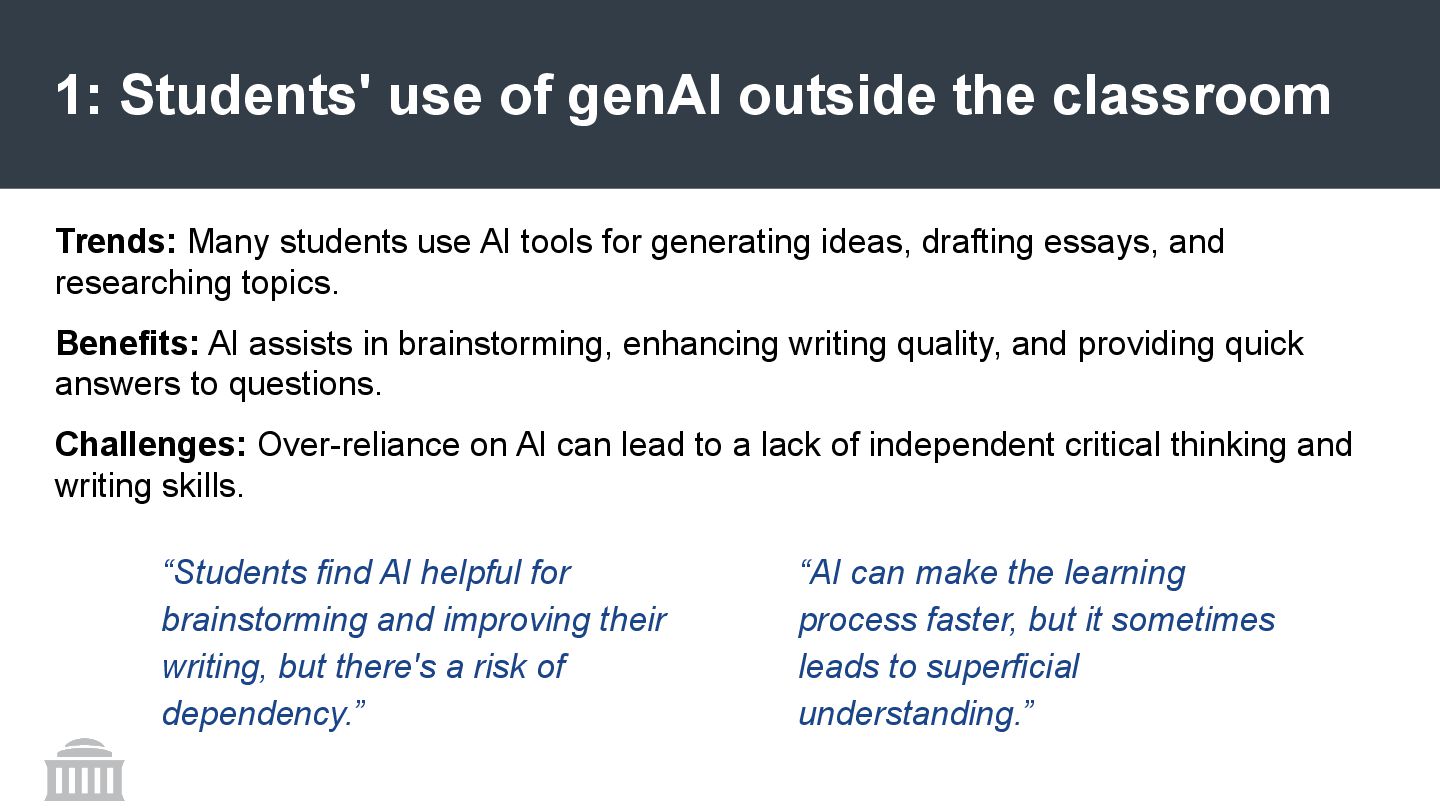
  14. 1: Students' use of genAI outside the classroom Trends: Many

    students use AI tools for generating ideas, drafting essays, and researching topics. Benefits: AI assists in brainstorming, enhancing writing quality, and providing quick answers to questions. Challenges: Over-reliance on AI can lead to a lack of independent critical thinking and writing skills. “Students find AI helpful for brainstorming and improving their writing, but there's a risk of dependency.” “AI can make the learning process faster, but it sometimes leads to superficial understanding.”
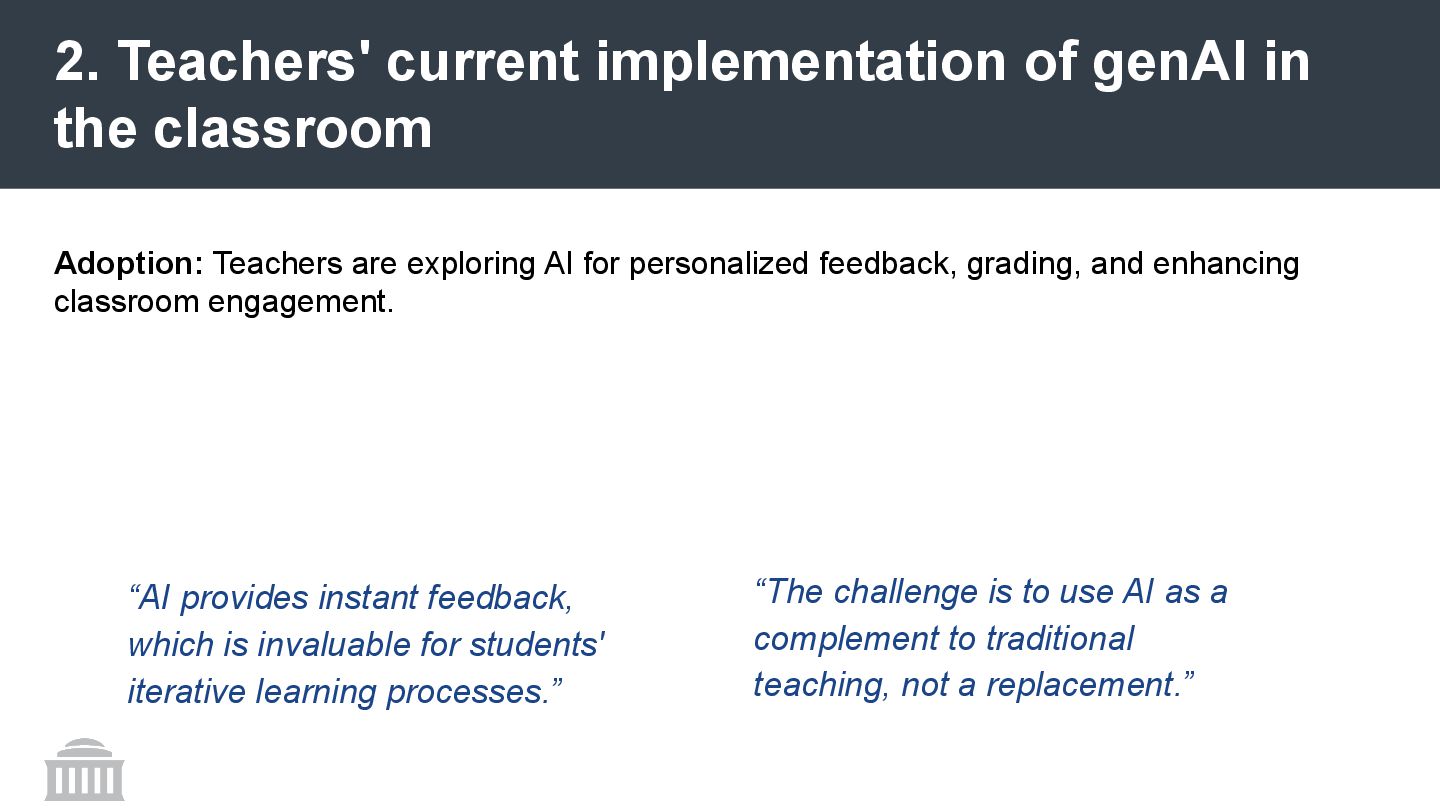
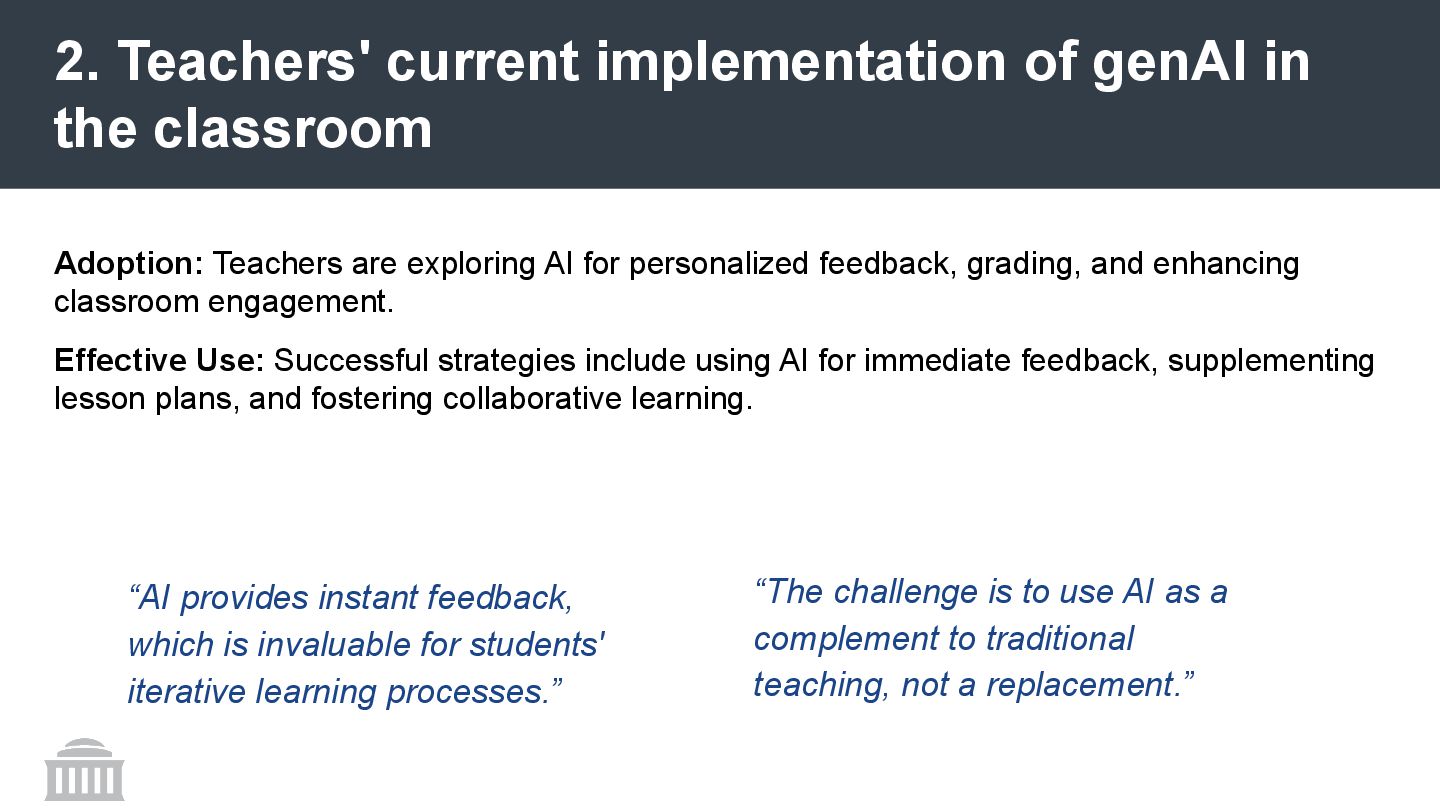
  15. 2. Teachers' current implementation of genAI in the classroom Adoption:

    Teachers are exploring AI for personalized feedback, grading, and enhancing classroom engagement. Effective Use: Successful strategies include using AI for immediate feedback, supplementing lesson plans, and fostering collaborative learning. Challenges: Ensuring AI integration does not compromise the development of students' core skills. “AI provides instant feedback, which is invaluable for students' iterative learning processes.” “The challenge is to use AI as a complement to traditional teaching, not a replacement.”
  16. 2. Teachers' current implementation of genAI in the classroom Adoption:

    Teachers are exploring AI for personalized feedback, grading, and enhancing classroom engagement. Effective Use: Successful strategies include using AI for immediate feedback, supplementing lesson plans, and fostering collaborative learning. Challenges: Ensuring AI integration does not compromise the development of students' core skills. “AI provides instant feedback, which is invaluable for students' iterative learning processes.” “The challenge is to use AI as a complement to traditional teaching, not a replacement.”
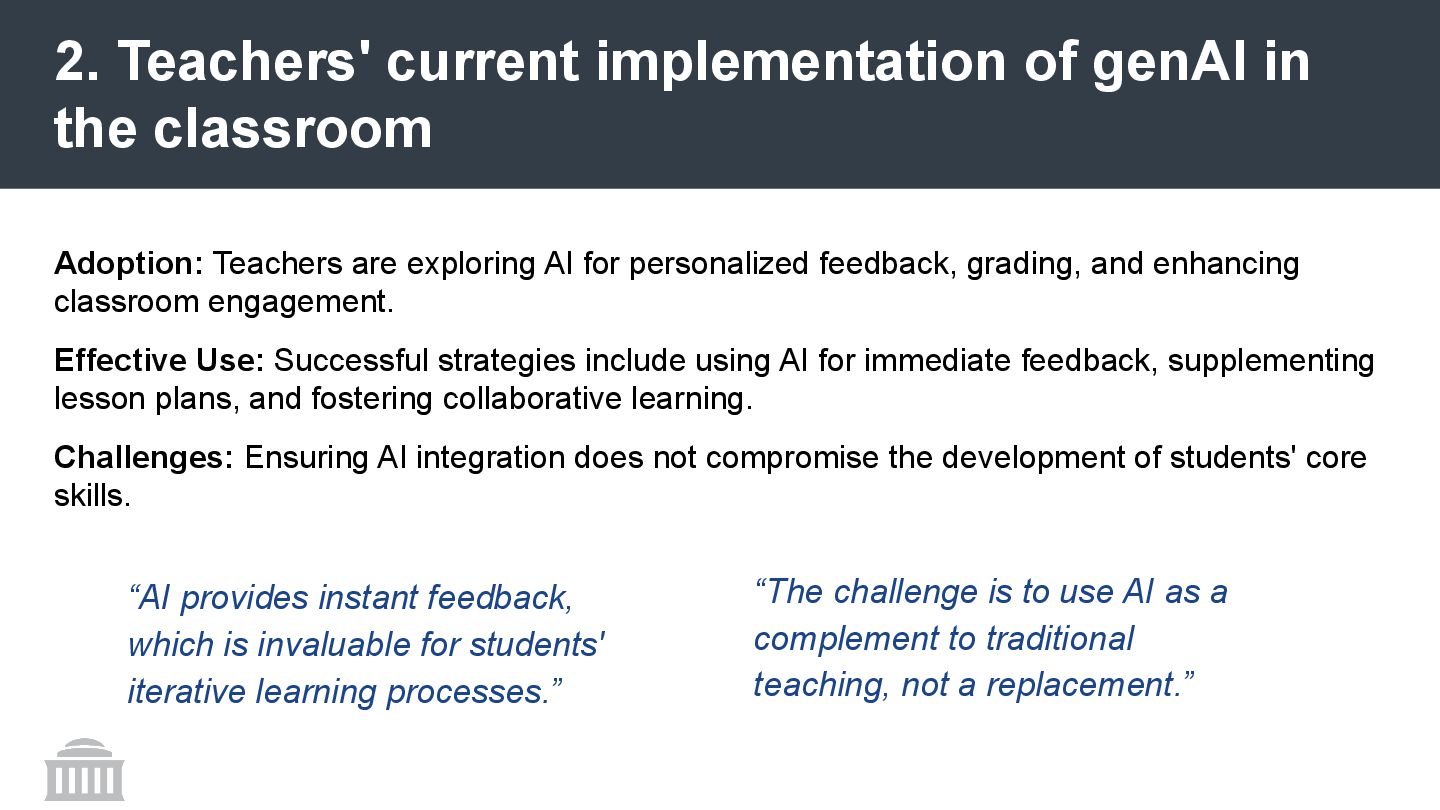
  17. 2. Teachers' current implementation of genAI in the classroom Adoption:

    Teachers are exploring AI for personalized feedback, grading, and enhancing classroom engagement. Effective Use: Successful strategies include using AI for immediate feedback, supplementing lesson plans, and fostering collaborative learning. Challenges: Ensuring AI integration does not compromise the development of students' core skills. “AI provides instant feedback, which is invaluable for students' iterative learning processes.” “The challenge is to use AI as a complement to traditional teaching, not a replacement.”
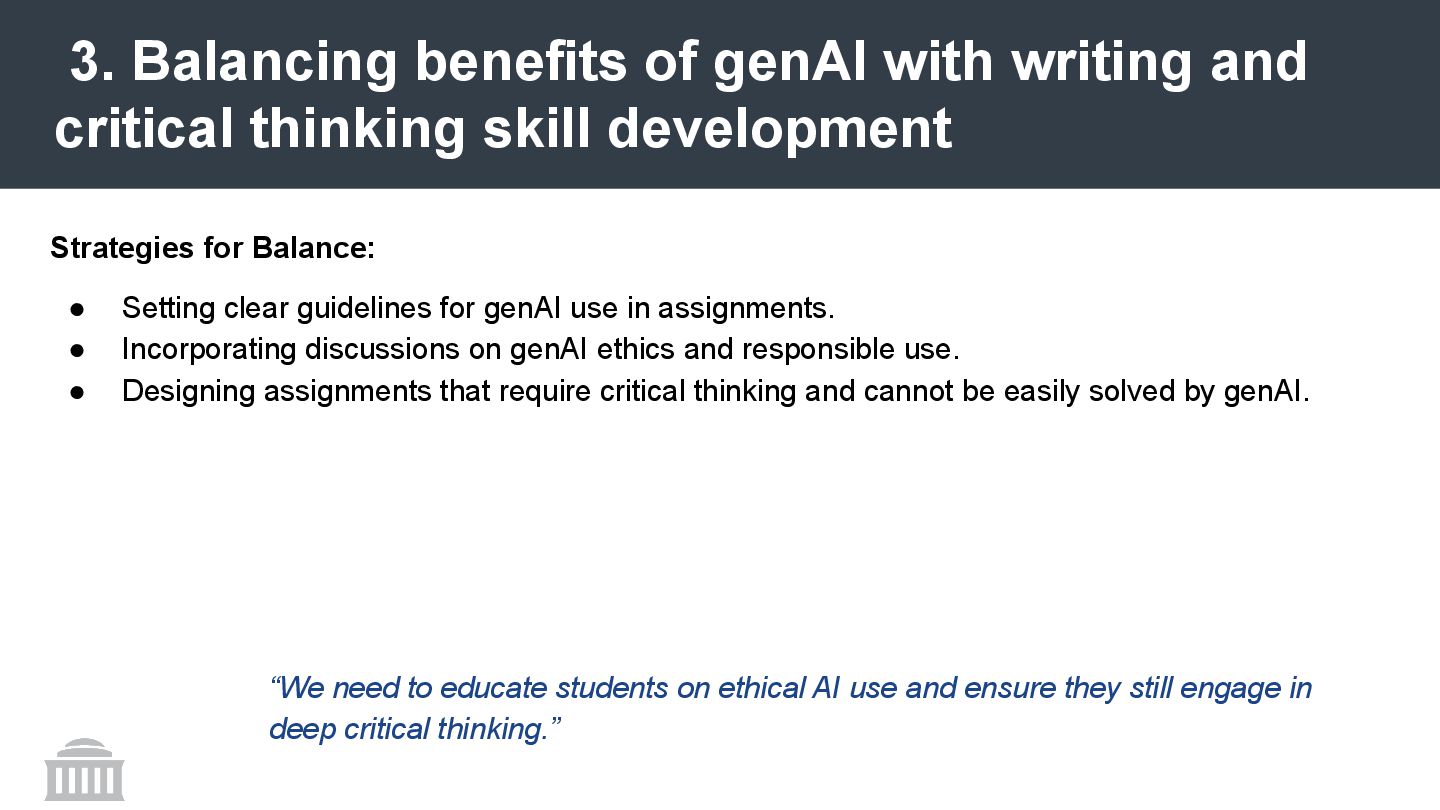
  18. 3. Balancing benefits of genAI with writing and critical thinking

    skill development Strategies for Balance: • Setting clear guidelines for genAI use in assignments. • Incorporating discussions on genAI ethics and responsible use. • Designing assignments that require critical thinking and cannot be easily solved by genAI. Examples: • Assignments that require personal reflection or unique problem-solving approaches. • Encouraging peer reviews and collaborative projects where AI can assist but not replace human input. “We need to educate students on ethical AI use and ensure they still engage in deep critical thinking.”
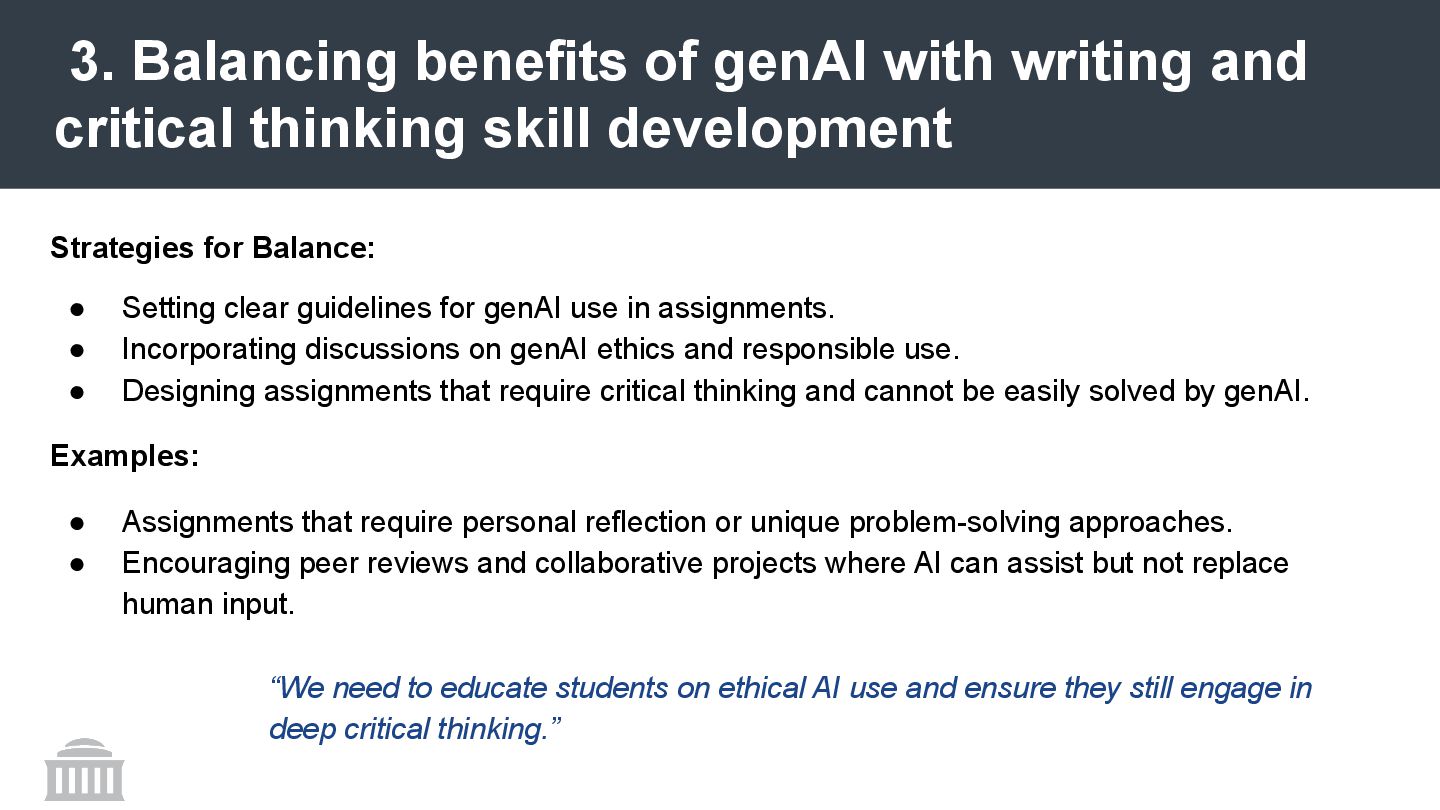
  19. 3. Balancing benefits of genAI with writing and critical thinking

    skill development Strategies for Balance: • Setting clear guidelines for genAI use in assignments. • Incorporating discussions on genAI ethics and responsible use. • Designing assignments that require critical thinking and cannot be easily solved by genAI. Examples: • Assignments that require personal reflection or unique problem-solving approaches. • Encouraging peer reviews and collaborative projects where AI can assist but not replace human input. “We need to educate students on ethical AI use and ensure they still engage in deep critical thinking.”
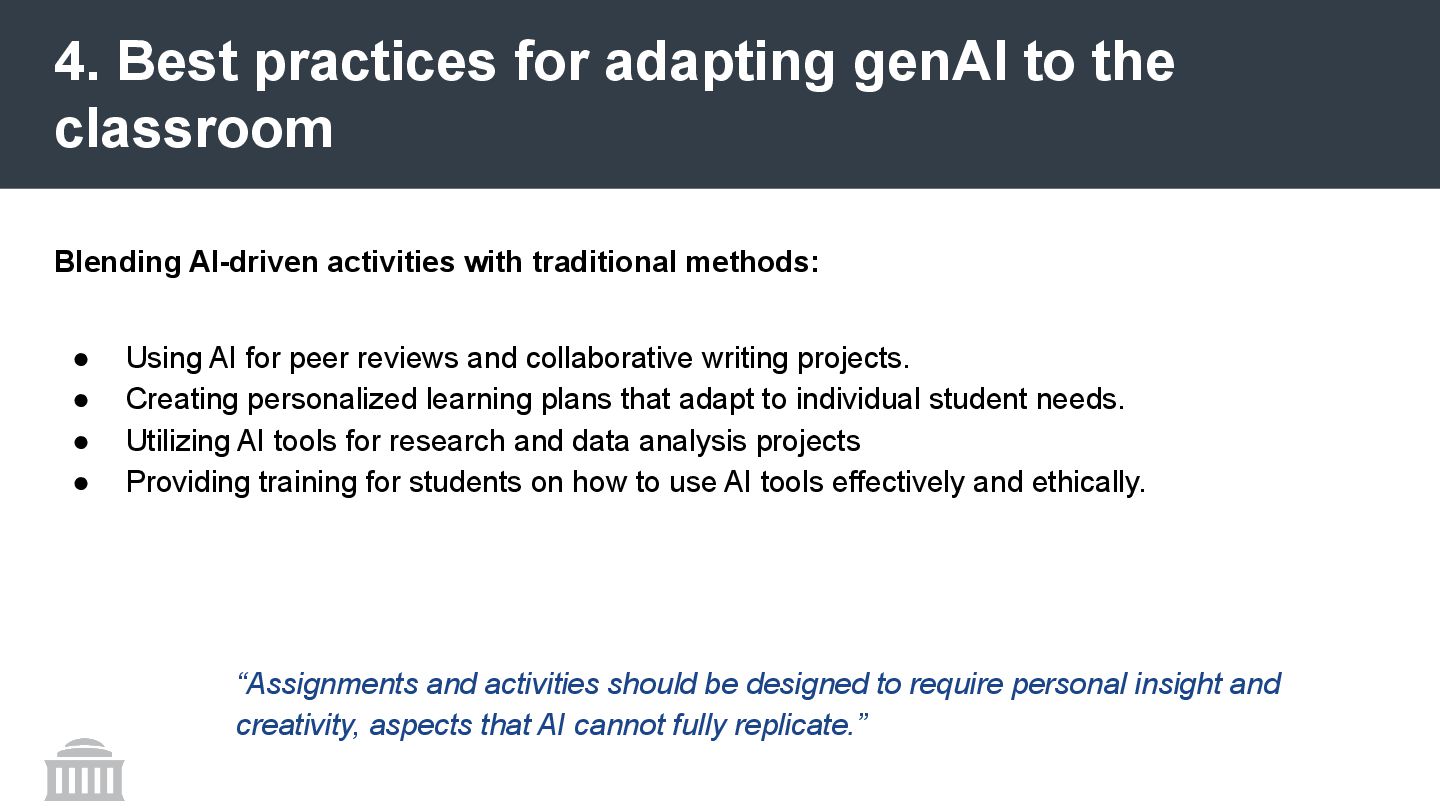
  20. 4. Best practices for adapting genAI to the classroom Blending

    AI-driven activities with traditional methods: • Using AI for peer reviews and collaborative writing projects. • Creating personalized learning plans that adapt to individual student needs. • Utilizing AI tools for research and data analysis projects • Providing training for students on how to use AI tools effectively and ethically. “Assignments and activities should be designed to require personal insight and creativity, aspects that AI cannot fully replicate.”
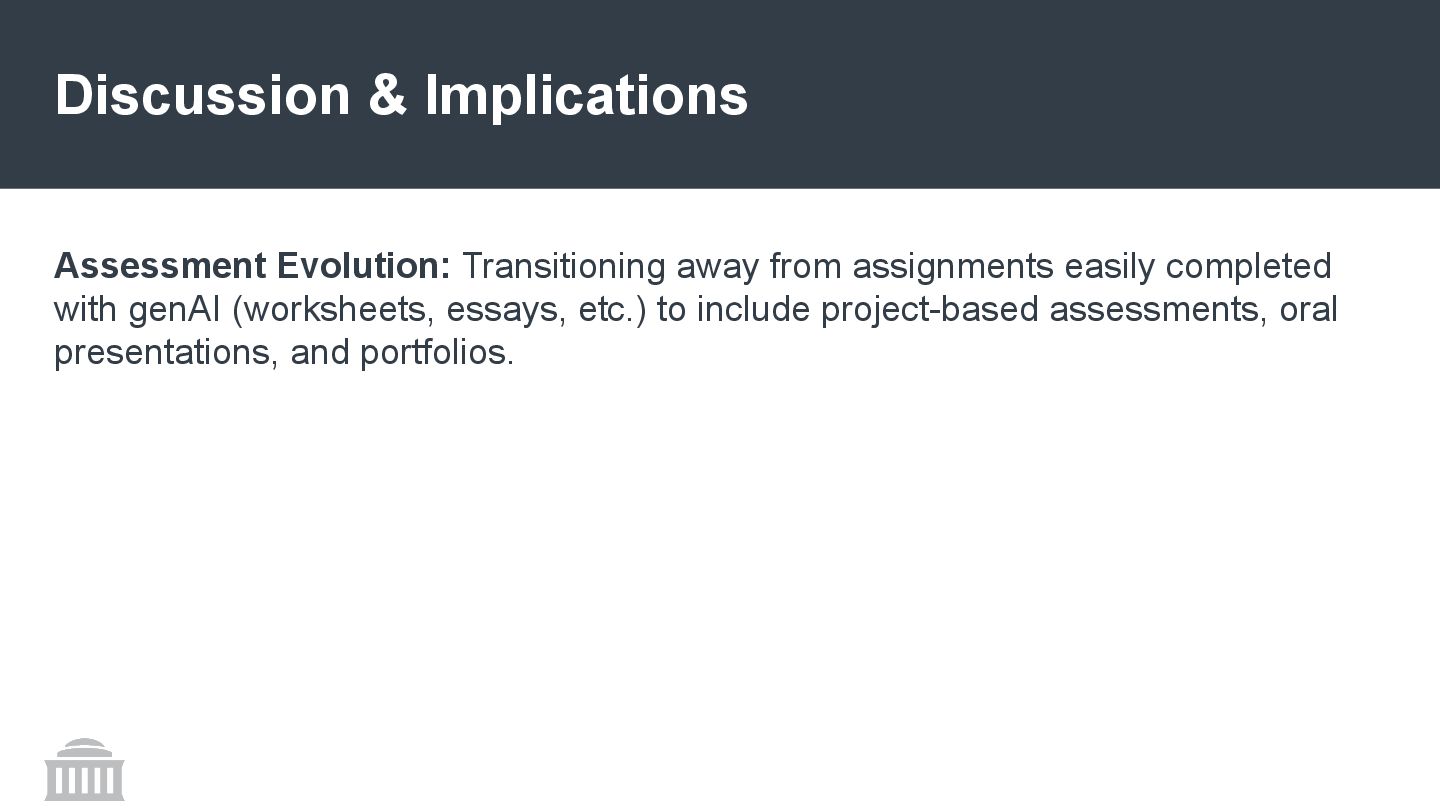
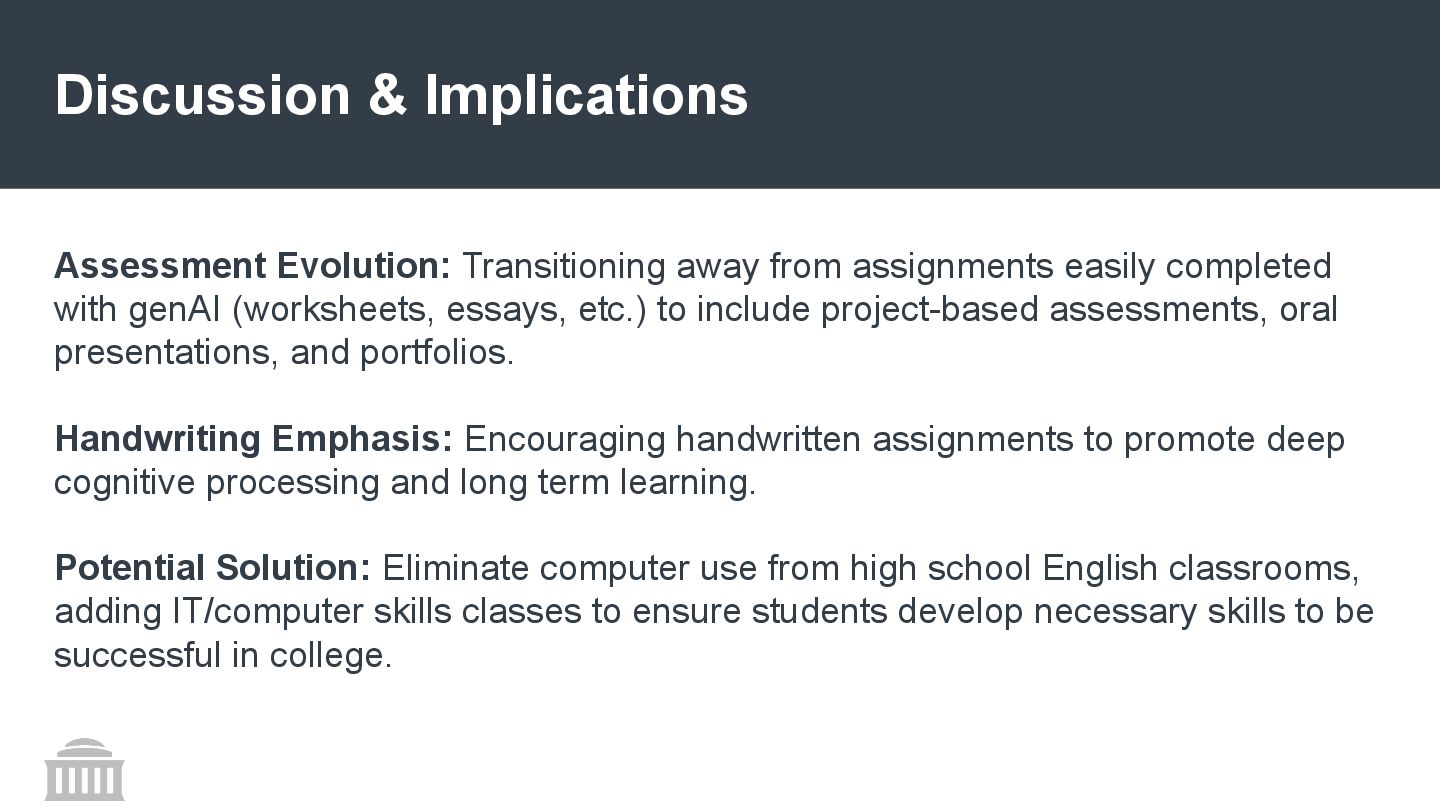
  21. Discussion & Implications Assessment Evolution: Transitioning away from assignments easily

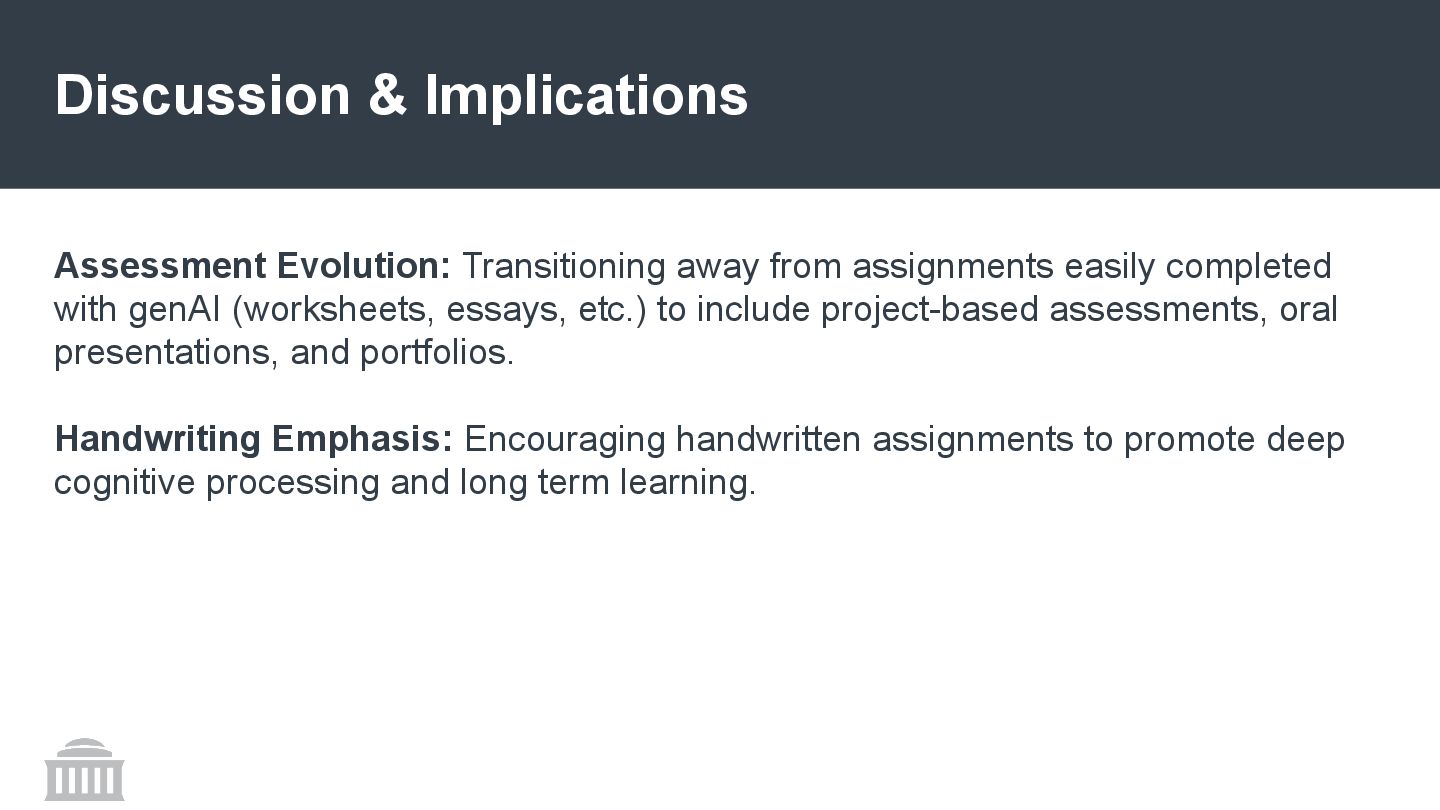
    completed with genAI (worksheets, essays, etc.) to include project-based assessments, oral presentations, and portfolios. Handwriting Emphasis: Encouraging handwritten assignments to promote deep cognitive processing and long term learning. Potential Solution: Eliminate computer use from high school English classrooms, adding IT/computer skills classes to ensure students develop necessary skills to be successful in college.
  22. Discussion & Implications Assessment Evolution: Transitioning away from assignments easily

    completed with genAI (worksheets, essays, etc.) to include project-based assessments, oral presentations, and portfolios. Handwriting Emphasis: Encouraging handwritten assignments to promote deep cognitive processing and long term learning. Potential Solution: Eliminate computer use from high school English classrooms, adding IT/computer skills classes to ensure students develop necessary skills to be successful in college.
  23. Discussion & Implications Assessment Evolution: Transitioning away from assignments easily

    completed with genAI (worksheets, essays, etc.) to include project-based assessments, oral presentations, and portfolios. Handwriting Emphasis: Encouraging handwritten assignments to promote deep cognitive processing and long term learning. Potential Solution: Eliminate computer use from high school English classrooms, adding IT/computer skills classes to ensure students develop necessary skills to be successful in college.
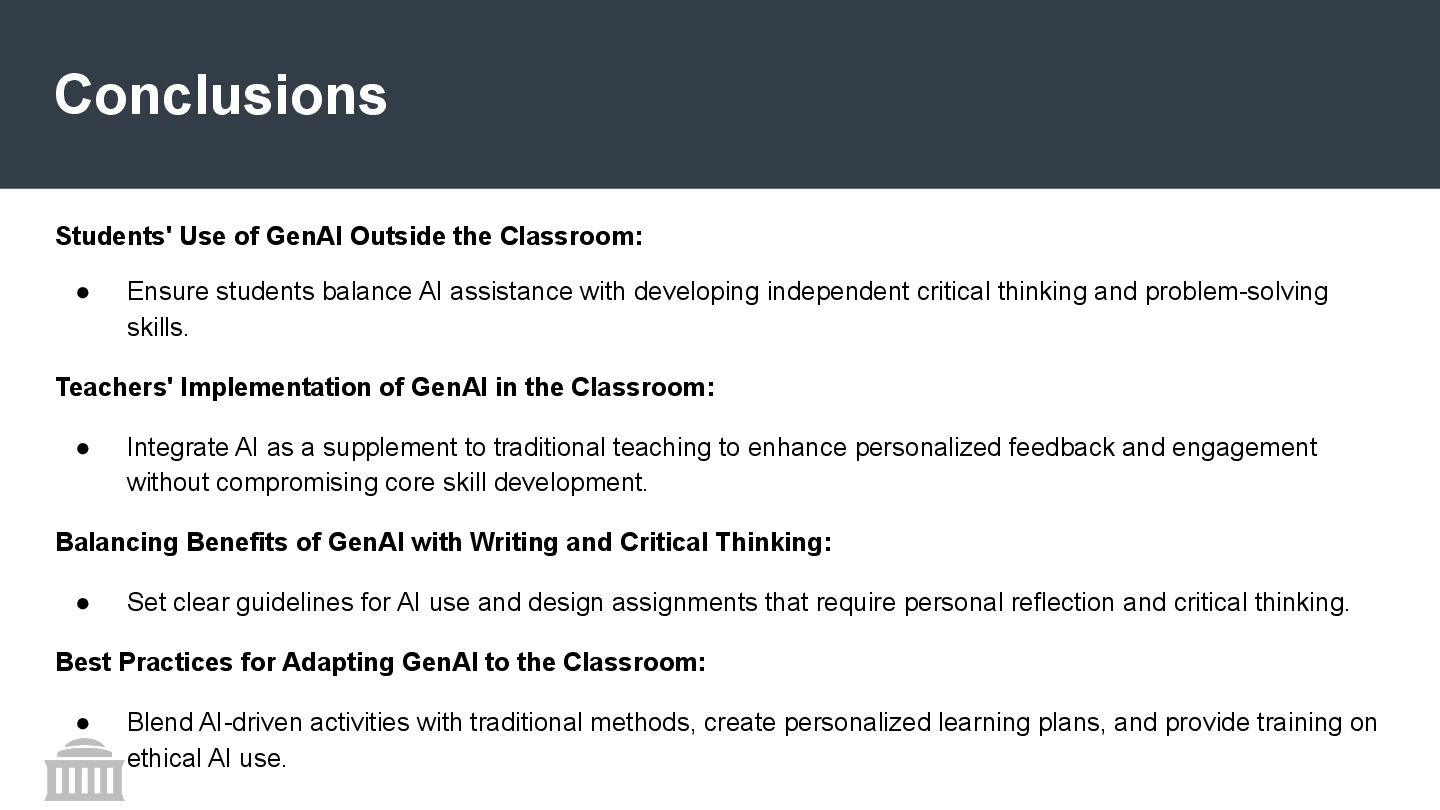
  24. Conclusions Students' Use of GenAI Outside the Classroom: • Ensure

    students balance AI assistance with developing independent critical thinking and problem-solving skills. Teachers' Implementation of GenAI in the Classroom: • Integrate AI as a supplement to traditional teaching to enhance personalized feedback and engagement without compromising core skill development. Balancing Benefits of GenAI with Writing and Critical Thinking: • Set clear guidelines for AI use and design assignments that require personal reflection and critical thinking. Best Practices for Adapting GenAI to the Classroom: • Blend AI-driven activities with traditional methods, create personalized learning plans, and provide training on ethical AI use.
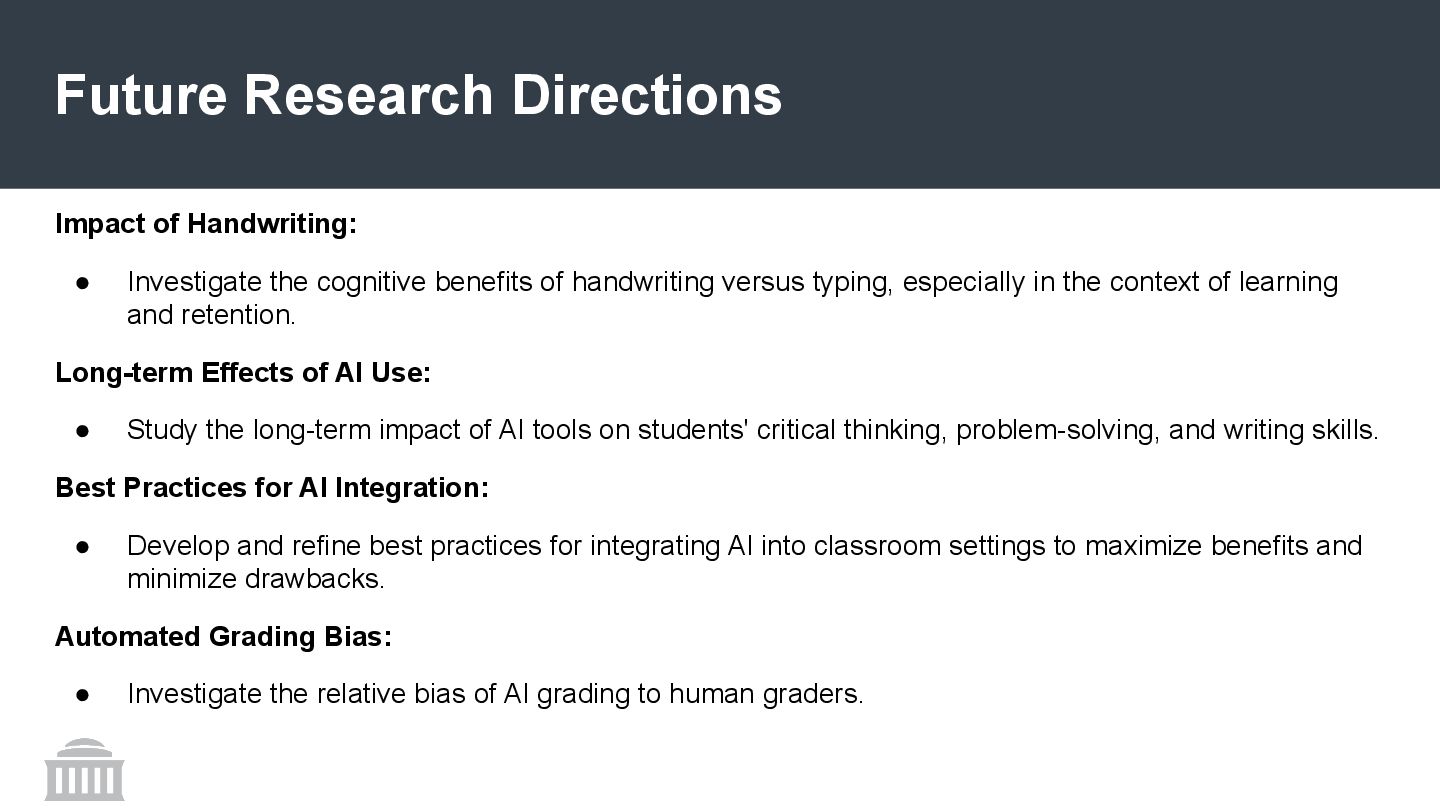
  25. Future Research Directions Impact of Handwriting: • Investigate the cognitive

    benefits of handwriting versus typing, especially in the context of learning and retention. Long-term Effects of AI Use: • Study the long-term impact of AI tools on students' critical thinking, problem-solving, and writing skills. Best Practices for AI Integration: • Develop and refine best practices for integrating AI into classroom settings to maximize benefits and minimize drawbacks. Automated Grading Bias: • Investigate the relative bias of AI grading to human graders.