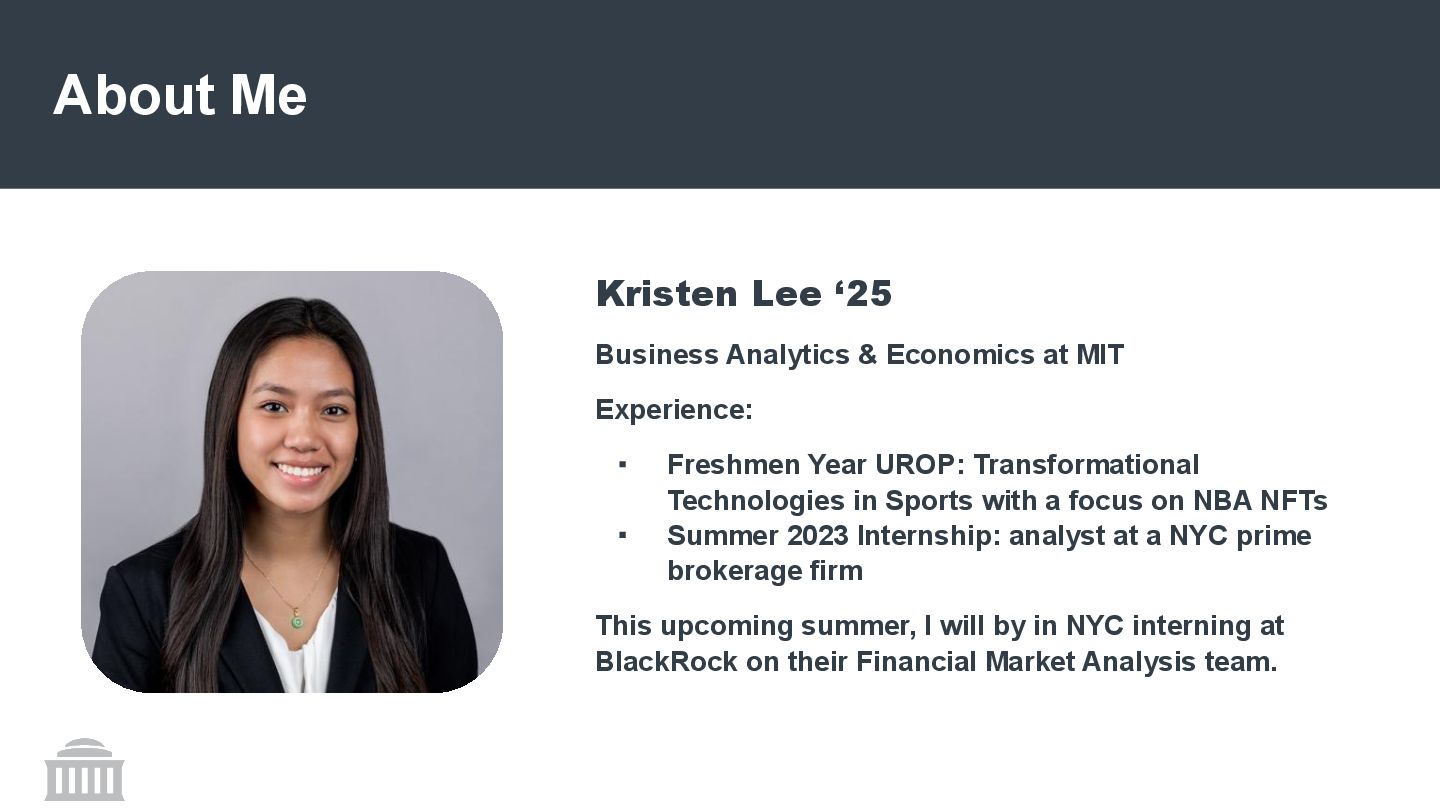
MIT Experience: ・ Freshmen Year UROP: Transformational Technologies in Sports with a focus on NBA NFTs ・ Summer 2023 Internship: analyst at a NYC prime brokerage firm This upcoming summer, I will by in NYC interning at BlackRock on their Financial Market Analysis team.
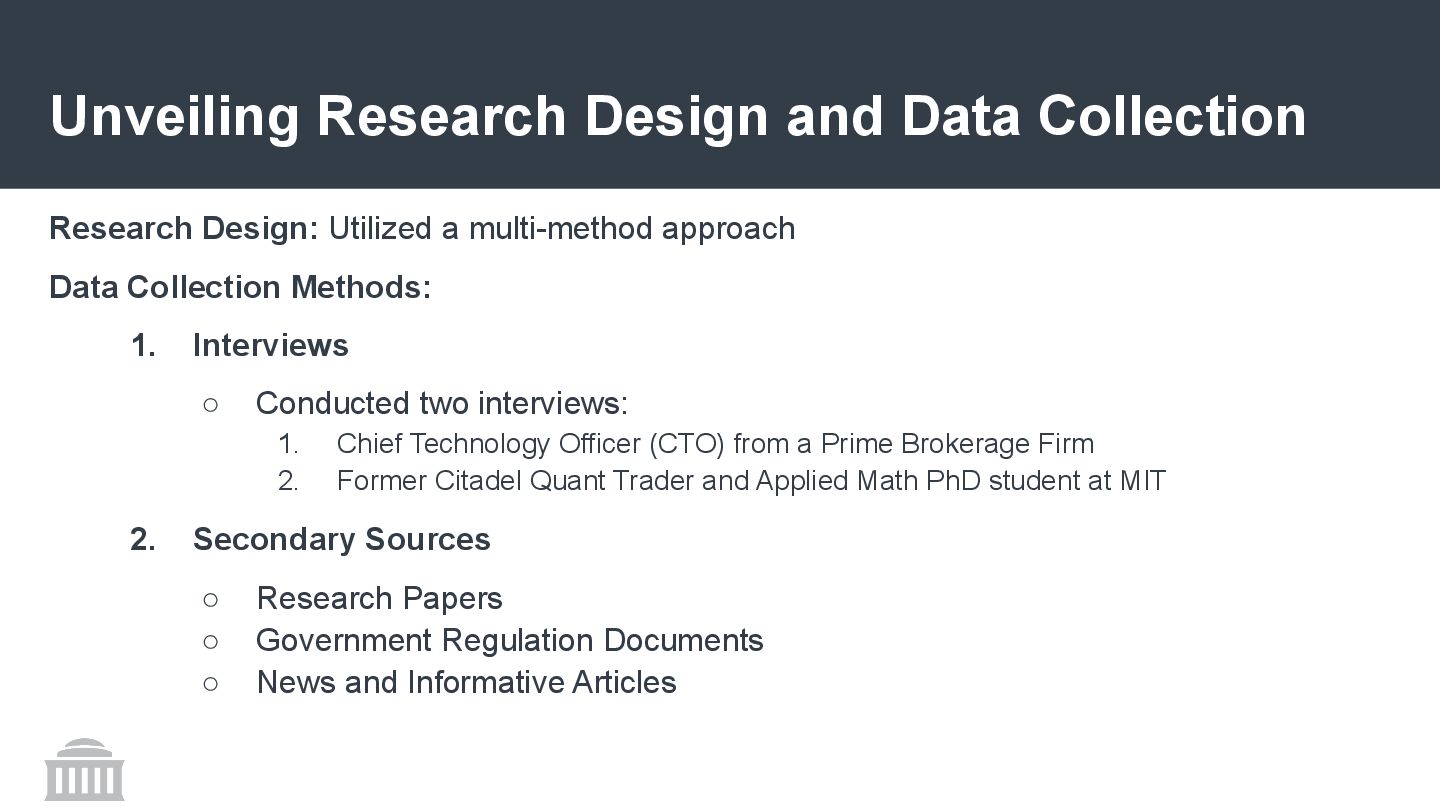
multi-method approach Data Collection Methods: 1. Interviews ◦ Conducted two interviews: 1. Chief Technology Officer (CTO) from a Prime Brokerage Firm 2. Former Citadel Quant Trader and Applied Math PhD student at MIT 2. Secondary Sources ◦ Research Papers ◦ Government Regulation Documents ◦ News and Informative Articles
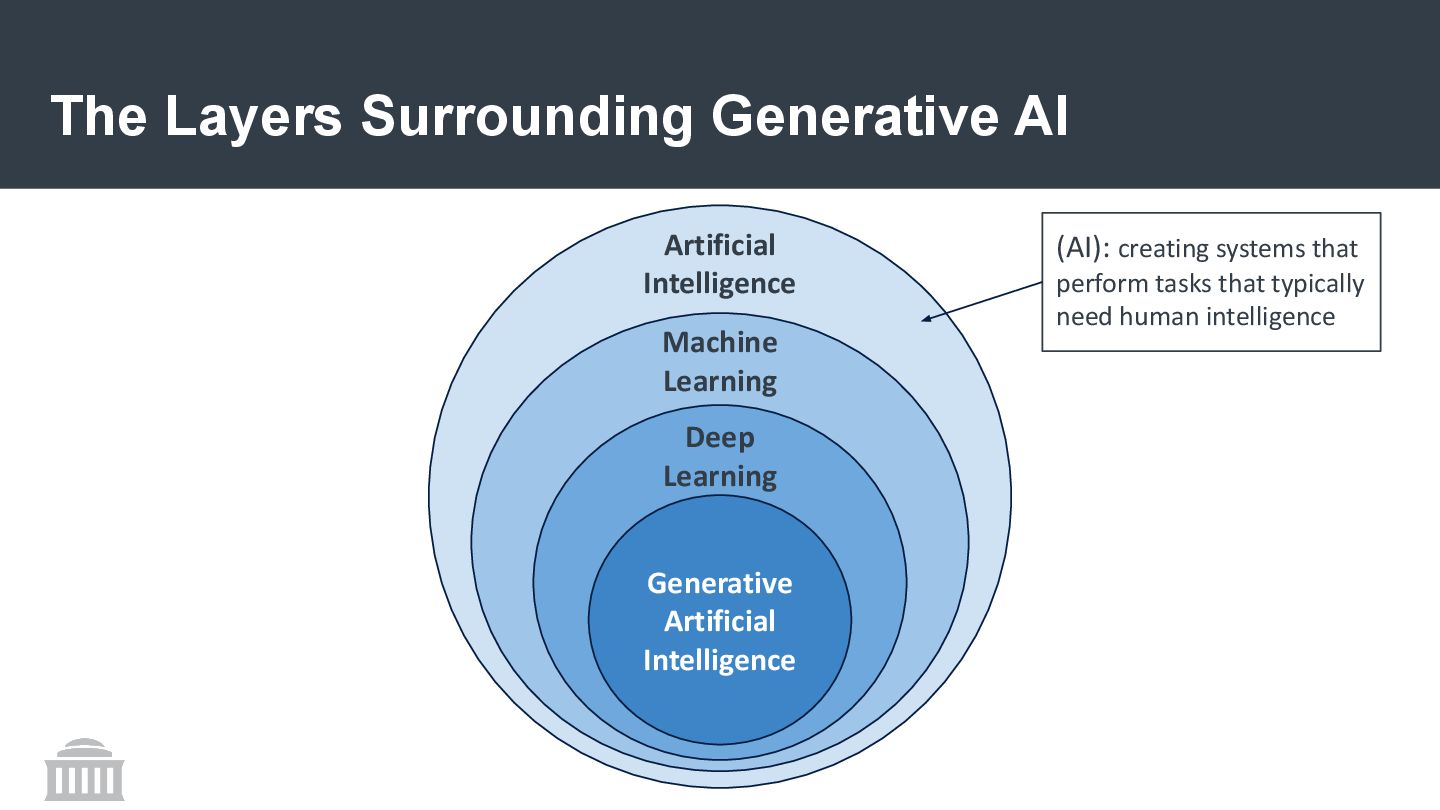
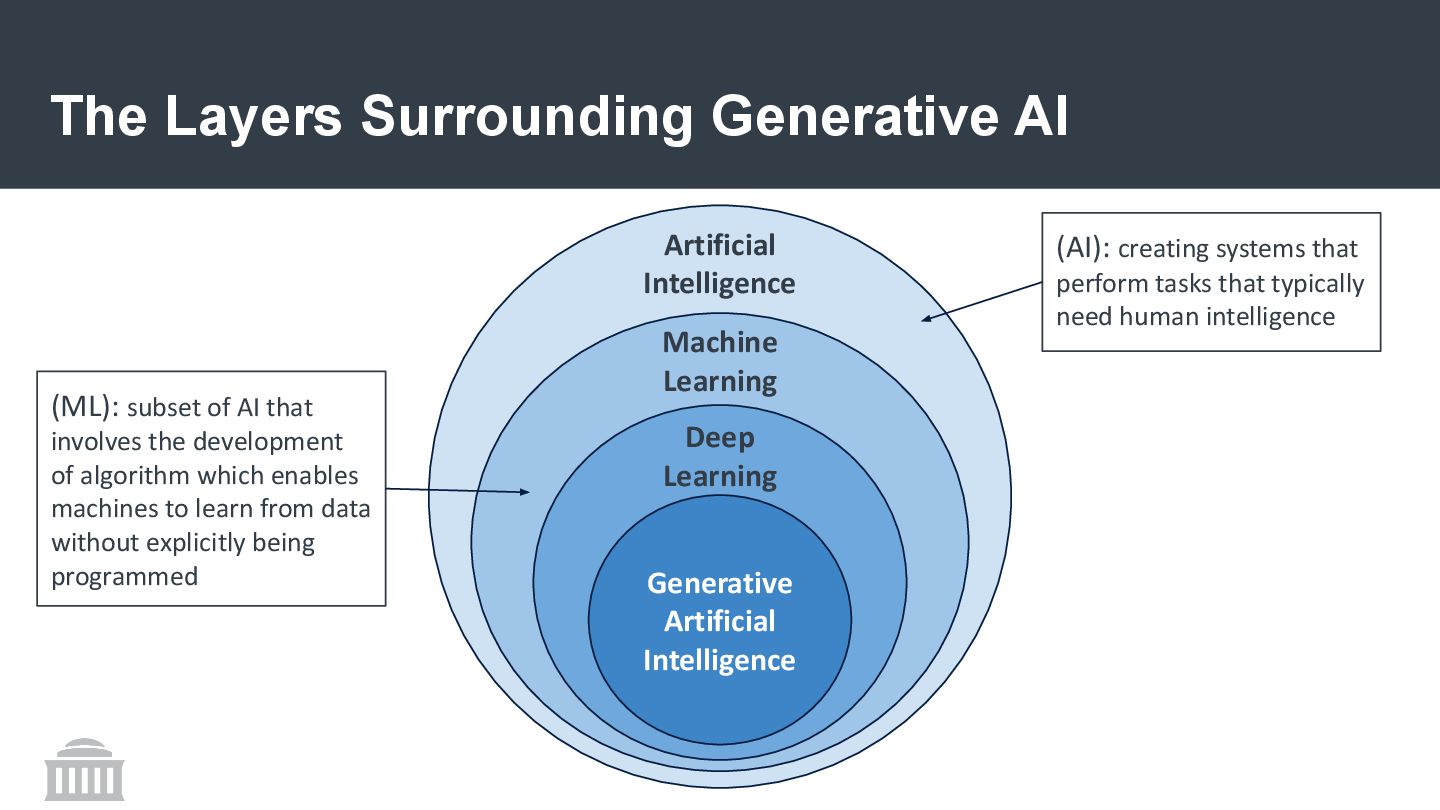
Artificial Intelligence Machine Learning (AI): creating systems that perform tasks that typically need human intelligence (ML): subset of AI that involves the development of algorithm which enables machines to learn from data without explicitly being programmed
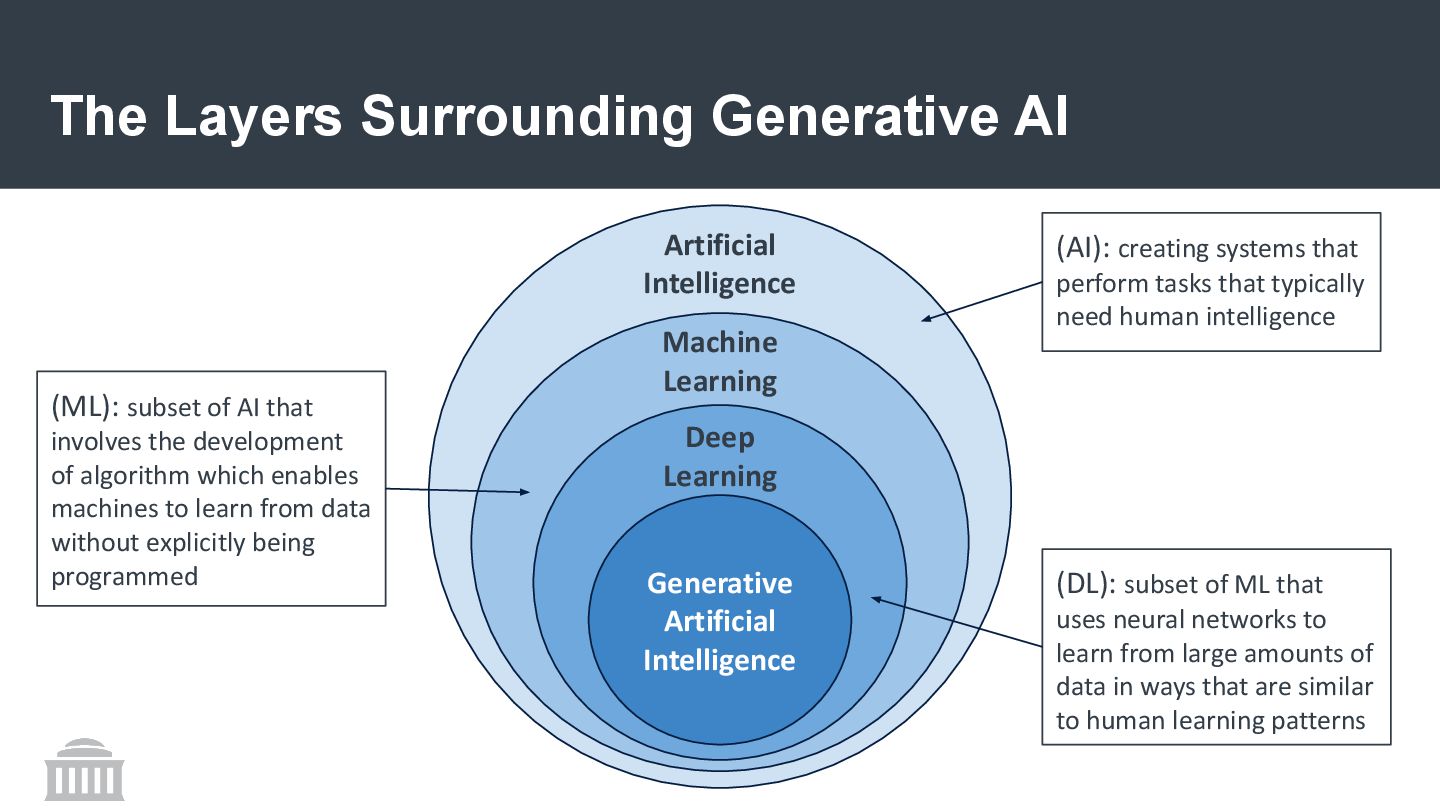
Artificial Intelligence Machine Learning (AI): creating systems that perform tasks that typically need human intelligence (ML): subset of AI that involves the development of algorithm which enables machines to learn from data without explicitly being programmed (DL): subset of ML that uses neural networks to learn from large amounts of data in ways that are similar to human learning patterns
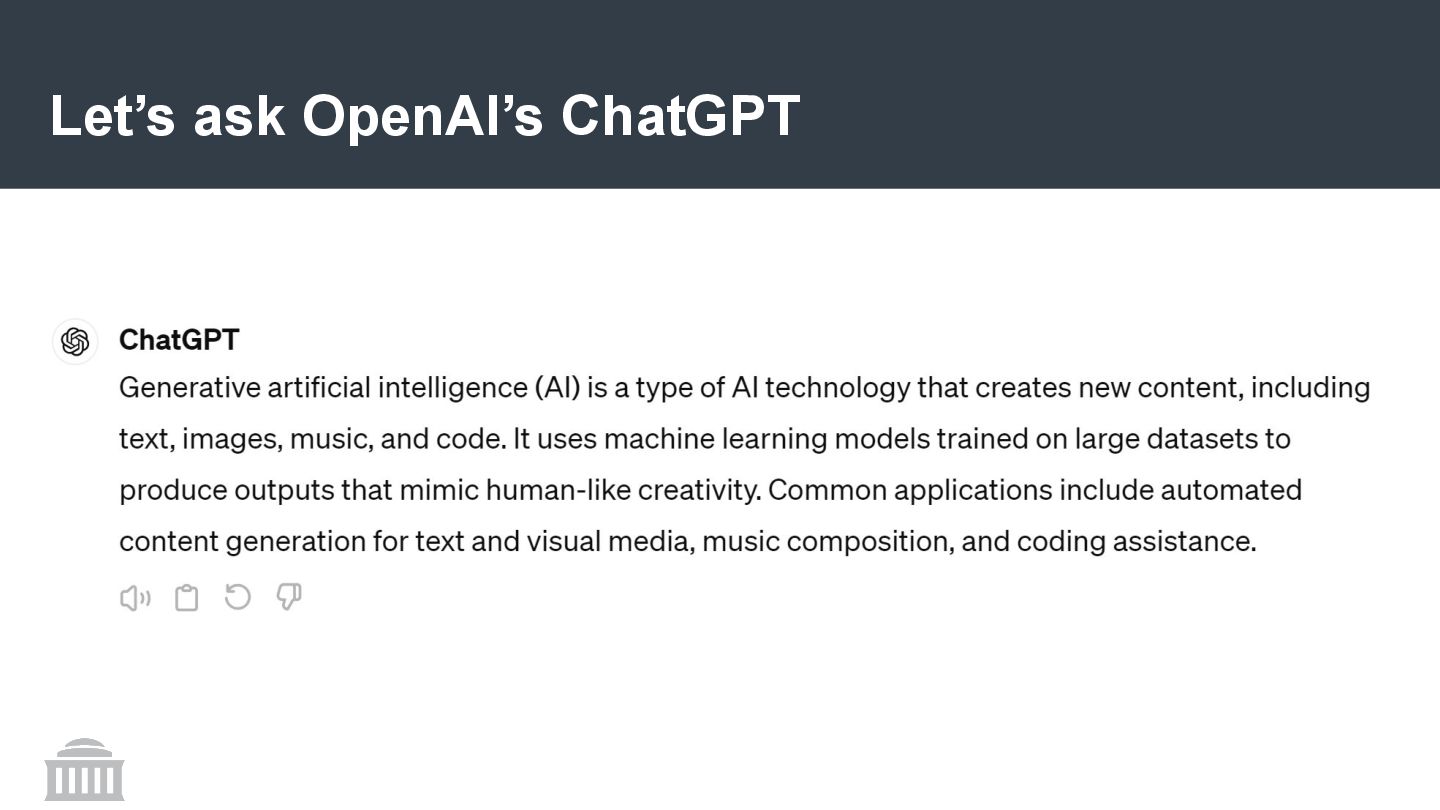
that can produce content that can synthesize realistic and complex outputs based on human learning patterns learned from a large dataset. Examples: ChatGPT Synthesia GitHub CoPilot Scribe
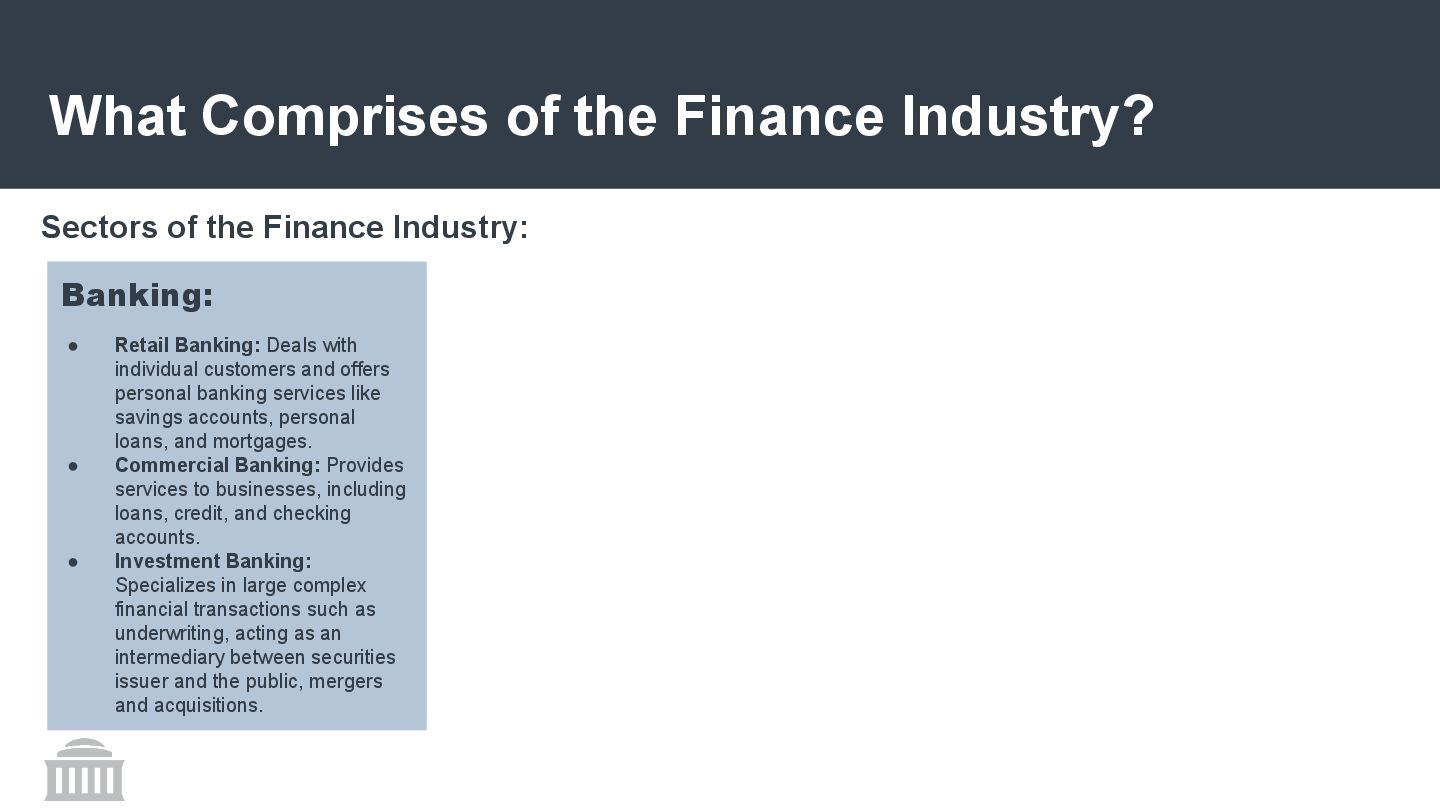
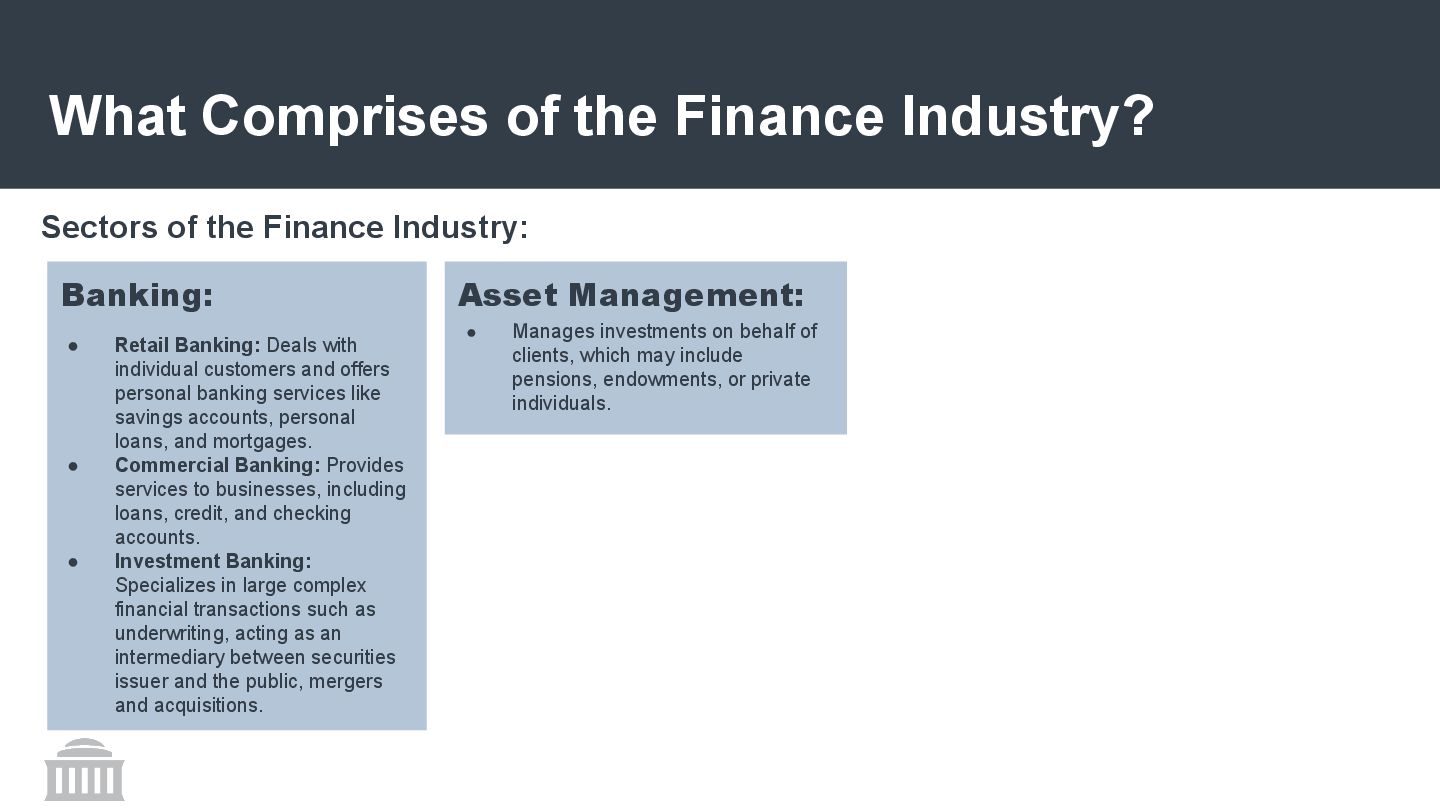
Industry: Banking: • Retail Banking: Deals with individual customers and offers personal banking services like savings accounts, personal loans, and mortgages. • Commercial Banking: Provides services to businesses, including loans, credit, and checking accounts. • Investment Banking: Specializes in large complex financial transactions such as underwriting, acting as an intermediary between securities issuer and the public, mergers and acquisitions.
may include pensions, endowments, or private individuals. What Comprises of the Finance Industry? Sectors of the Finance Industry: Banking: • Retail Banking: Deals with individual customers and offers personal banking services like savings accounts, personal loans, and mortgages. • Commercial Banking: Provides services to businesses, including loans, credit, and checking accounts. • Investment Banking: Specializes in large complex financial transactions such as underwriting, acting as an intermediary between securities issuer and the public, mergers and acquisitions.
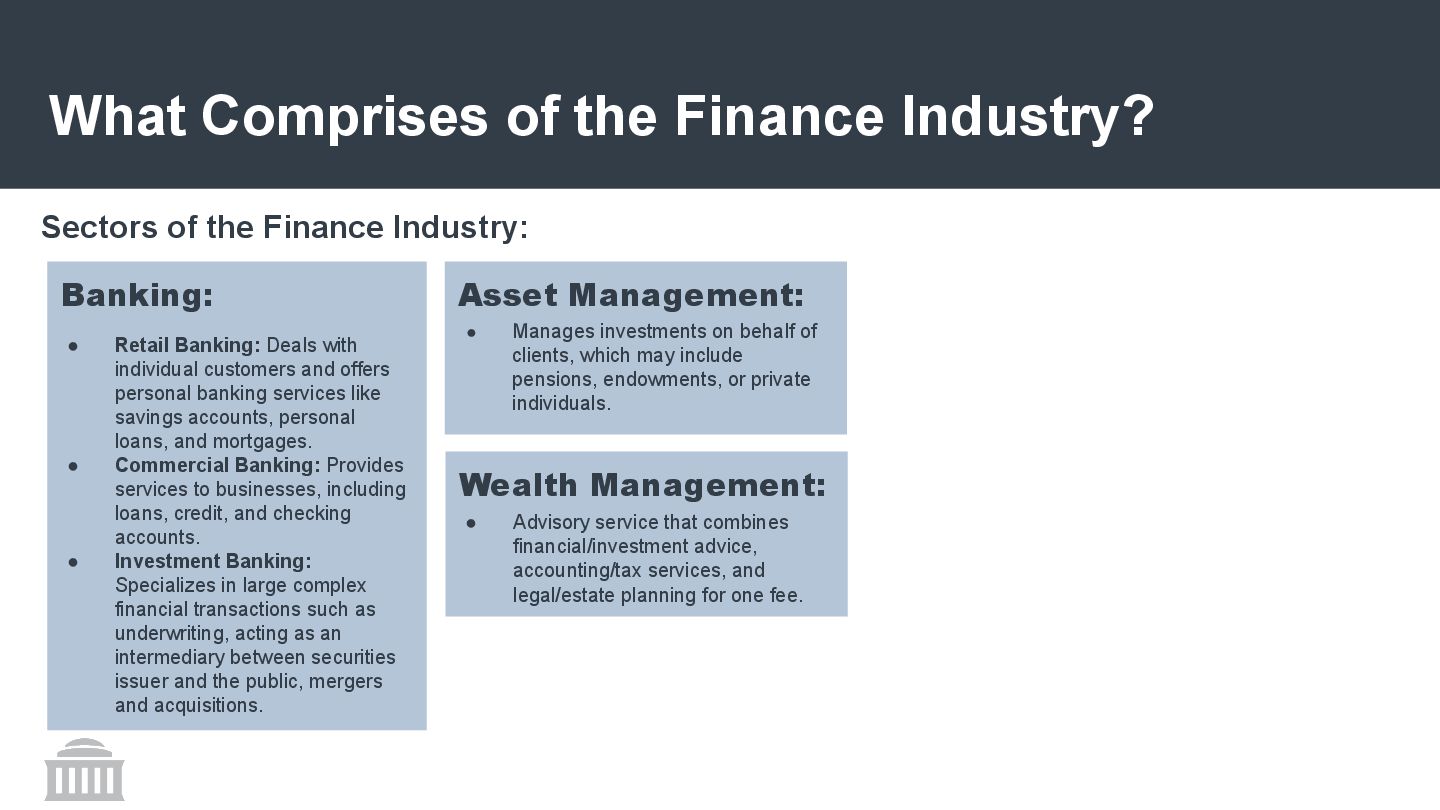
may include pensions, endowments, or private individuals. What Comprises of the Finance Industry? Sectors of the Finance Industry: Banking: • Retail Banking: Deals with individual customers and offers personal banking services like savings accounts, personal loans, and mortgages. • Commercial Banking: Provides services to businesses, including loans, credit, and checking accounts. • Investment Banking: Specializes in large complex financial transactions such as underwriting, acting as an intermediary between securities issuer and the public, mergers and acquisitions. Wealth Management: • Advisory service that combines financial/investment advice, accounting/tax services, and legal/estate planning for one fee.
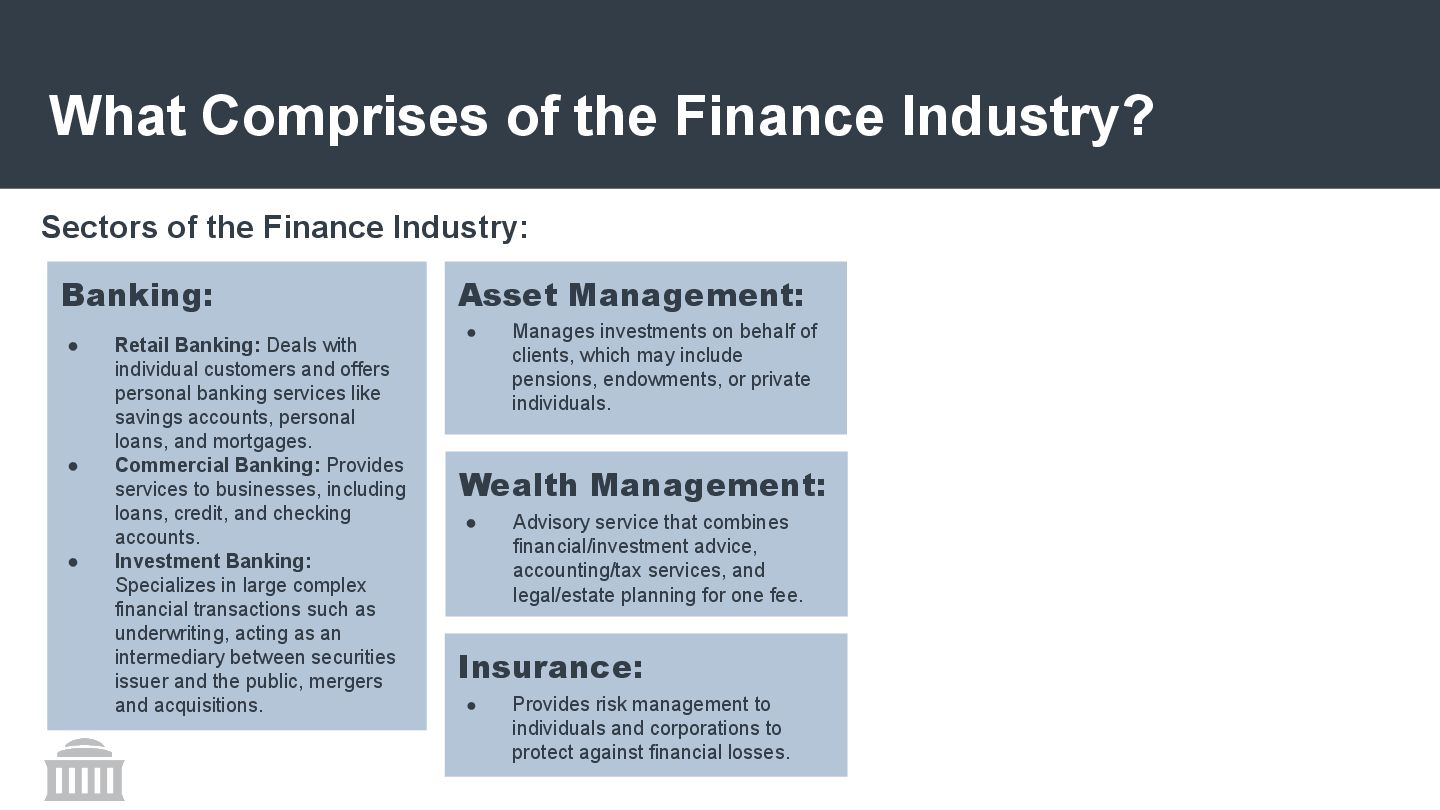
may include pensions, endowments, or private individuals. What Comprises of the Finance Industry? Sectors of the Finance Industry: Insurance: • Provides risk management to individuals and corporations to protect against financial losses. Banking: • Retail Banking: Deals with individual customers and offers personal banking services like savings accounts, personal loans, and mortgages. • Commercial Banking: Provides services to businesses, including loans, credit, and checking accounts. • Investment Banking: Specializes in large complex financial transactions such as underwriting, acting as an intermediary between securities issuer and the public, mergers and acquisitions. Wealth Management: • Advisory service that combines financial/investment advice, accounting/tax services, and legal/estate planning for one fee.
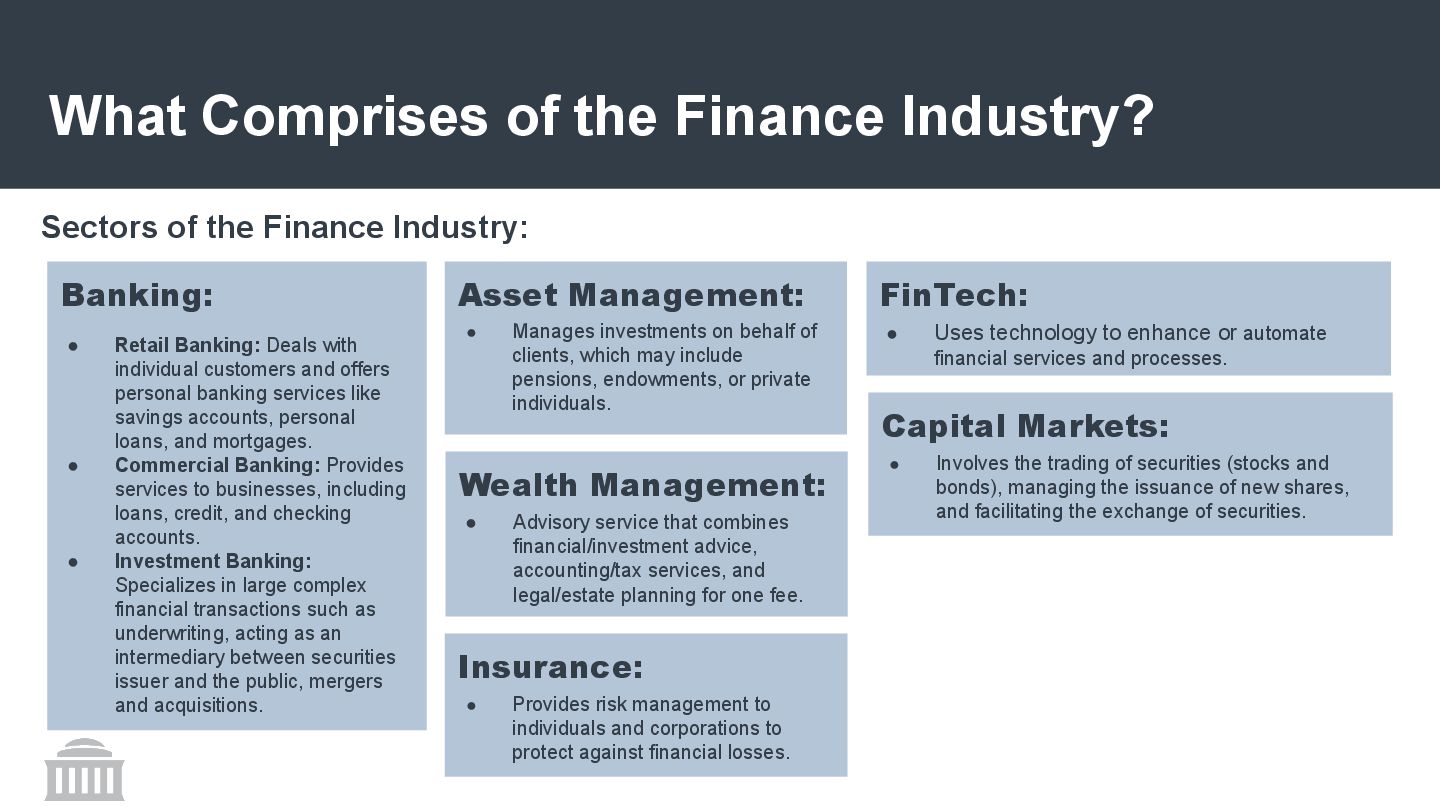
may include pensions, endowments, or private individuals. What Comprises of the Finance Industry? Sectors of the Finance Industry: Insurance: • Provides risk management to individuals and corporations to protect against financial losses. Banking: • Retail Banking: Deals with individual customers and offers personal banking services like savings accounts, personal loans, and mortgages. • Commercial Banking: Provides services to businesses, including loans, credit, and checking accounts. • Investment Banking: Specializes in large complex financial transactions such as underwriting, acting as an intermediary between securities issuer and the public, mergers and acquisitions. Wealth Management: • Advisory service that combines financial/investment advice, accounting/tax services, and legal/estate planning for one fee. FinTech: • Uses technology to enhance or automate financial services and processes.
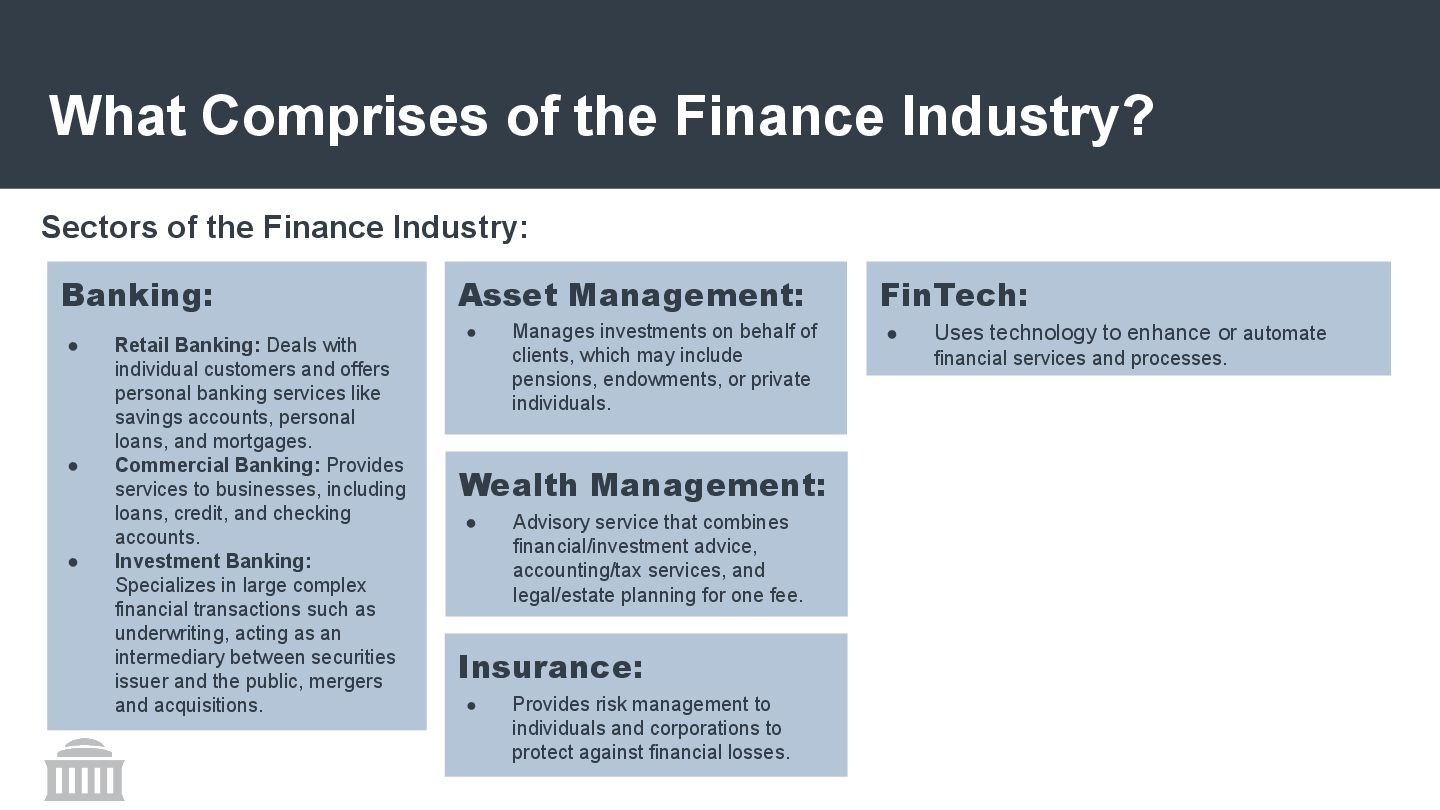
bonds), managing the issuance of new shares, and facilitating the exchange of securities. Asset Management: • Manages investments on behalf of clients, which may include pensions, endowments, or private individuals. What Comprises of the Finance Industry? Sectors of the Finance Industry: Insurance: • Provides risk management to individuals and corporations to protect against financial losses. Banking: • Retail Banking: Deals with individual customers and offers personal banking services like savings accounts, personal loans, and mortgages. • Commercial Banking: Provides services to businesses, including loans, credit, and checking accounts. • Investment Banking: Specializes in large complex financial transactions such as underwriting, acting as an intermediary between securities issuer and the public, mergers and acquisitions. Wealth Management: • Advisory service that combines financial/investment advice, accounting/tax services, and legal/estate planning for one fee. FinTech: • Uses technology to enhance or automate financial services and processes.
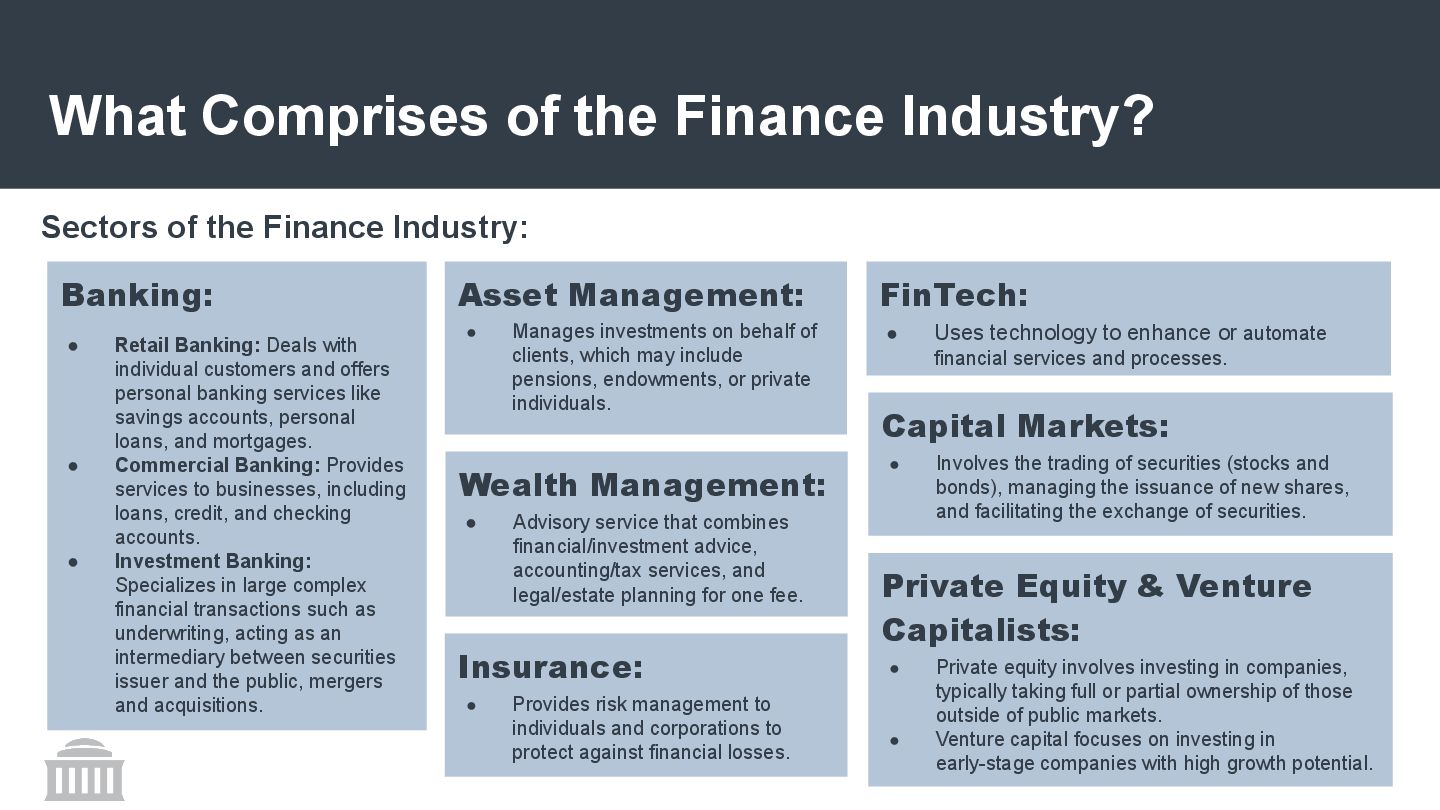
bonds), managing the issuance of new shares, and facilitating the exchange of securities. Asset Management: • Manages investments on behalf of clients, which may include pensions, endowments, or private individuals. What Comprises of the Finance Industry? Sectors of the Finance Industry: Insurance: • Provides risk management to individuals and corporations to protect against financial losses. Banking: • Retail Banking: Deals with individual customers and offers personal banking services like savings accounts, personal loans, and mortgages. • Commercial Banking: Provides services to businesses, including loans, credit, and checking accounts. • Investment Banking: Specializes in large complex financial transactions such as underwriting, acting as an intermediary between securities issuer and the public, mergers and acquisitions. Private Equity & Venture Capitalists: • Private equity involves investing in companies, typically taking full or partial ownership of those outside of public markets. • Venture capital focuses on investing in early-stage companies with high growth potential. Wealth Management: • Advisory service that combines financial/investment advice, accounting/tax services, and legal/estate planning for one fee. FinTech: • Uses technology to enhance or automate financial services and processes.
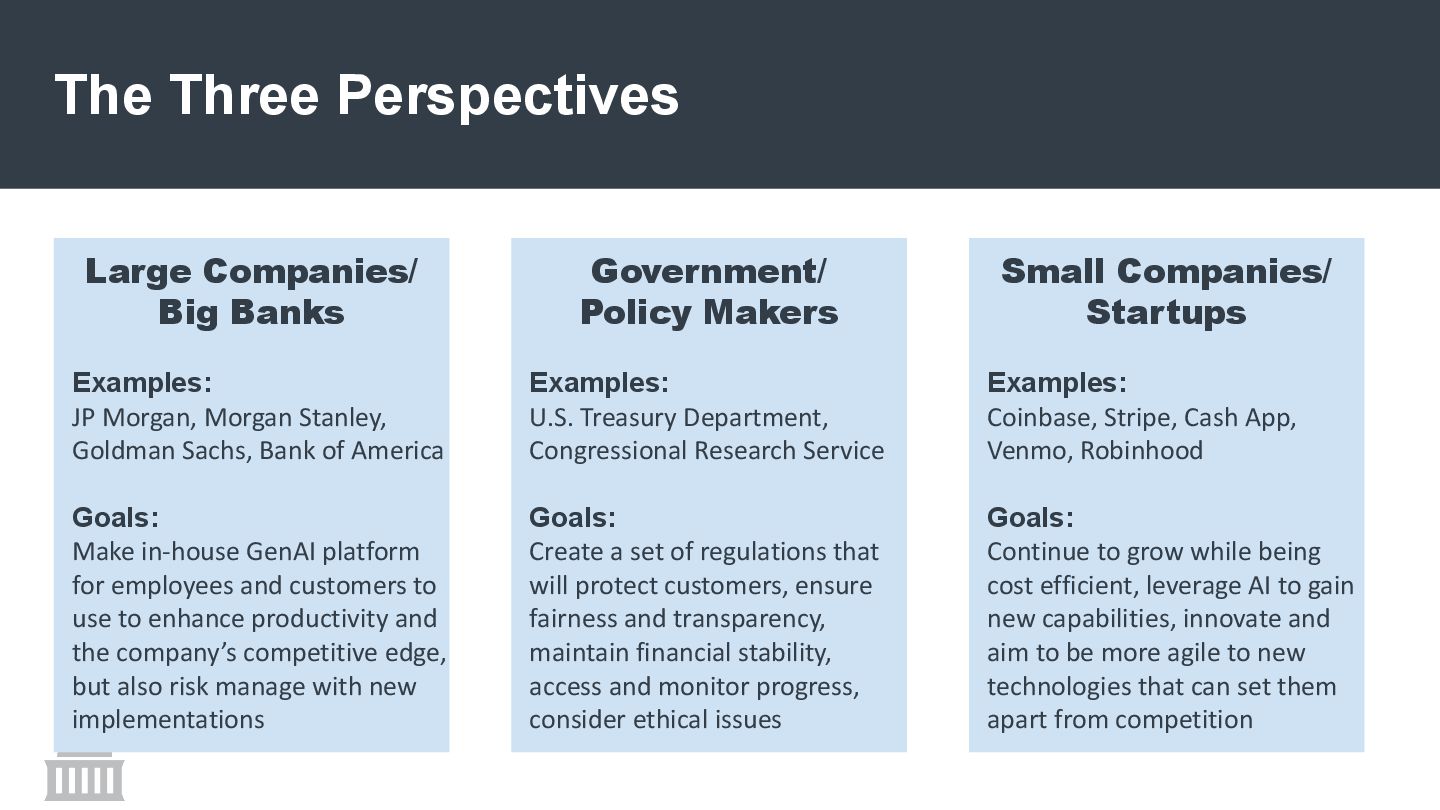
Morgan Stanley, Goldman Sachs, Bank of America Goals: Make in-house GenAI platform for employees and customers to use to enhance productivity and the company’s competitive edge, but also risk manage with new implementations Small Companies/ Startups Examples: Coinbase, Stripe, Cash App, Venmo, Robinhood Goals: Continue to grow while being cost efficient, leverage AI to gain new capabilities, innovate and aim to be more agile to new technologies that can set them apart from competition Government/ Policy Makers Examples: U.S. Treasury Department, Congressional Research Service Goals: Create a set of regulations that will protect customers, ensure fairness and transparency, maintain financial stability, access and monitor progress, consider ethical issues
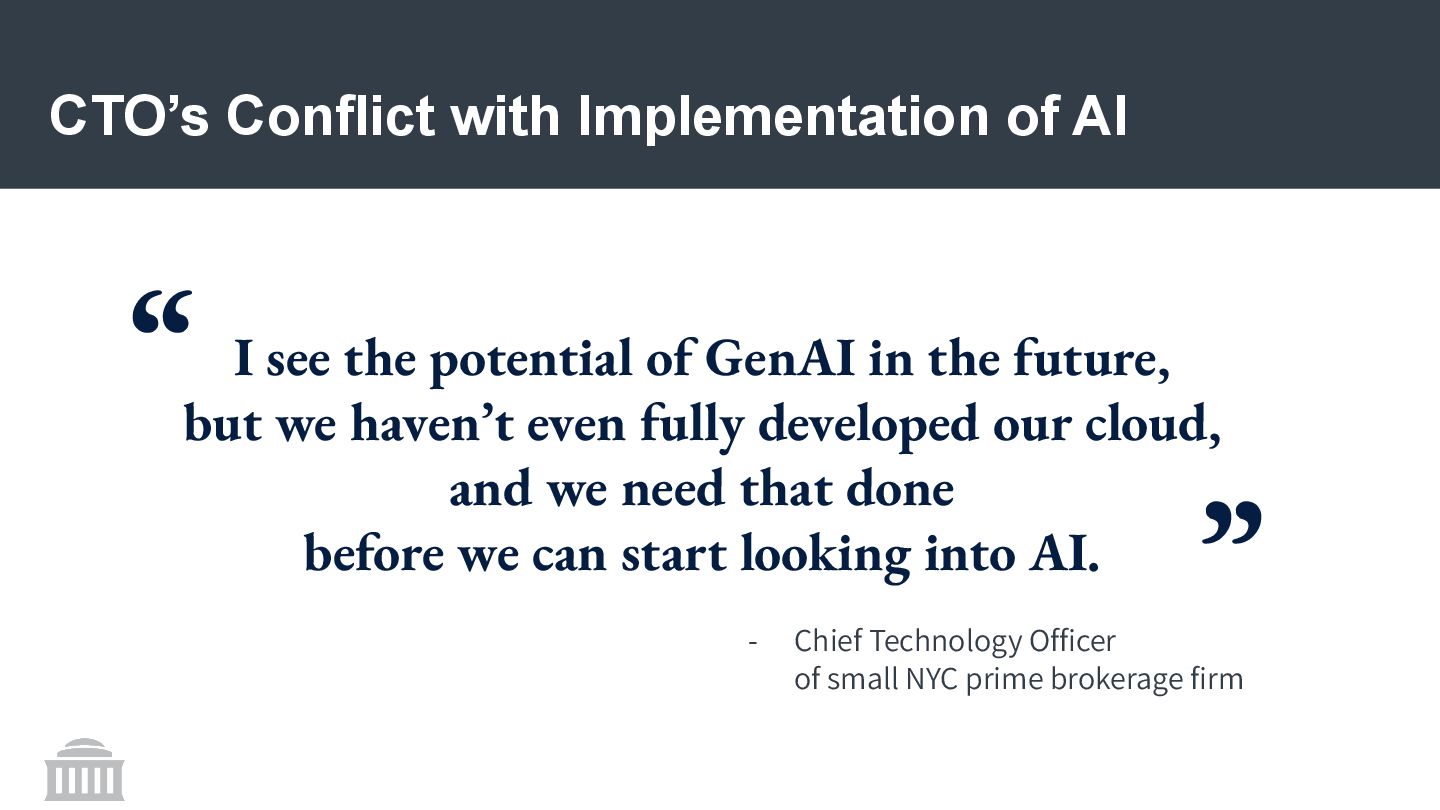
we haven’t even fully developed our cloud, and we need that done before we can start looking into AI. CTO’s Conflict with Implementation of AI “ ” - Chief Technology Officer of small NYC prime brokerage firm
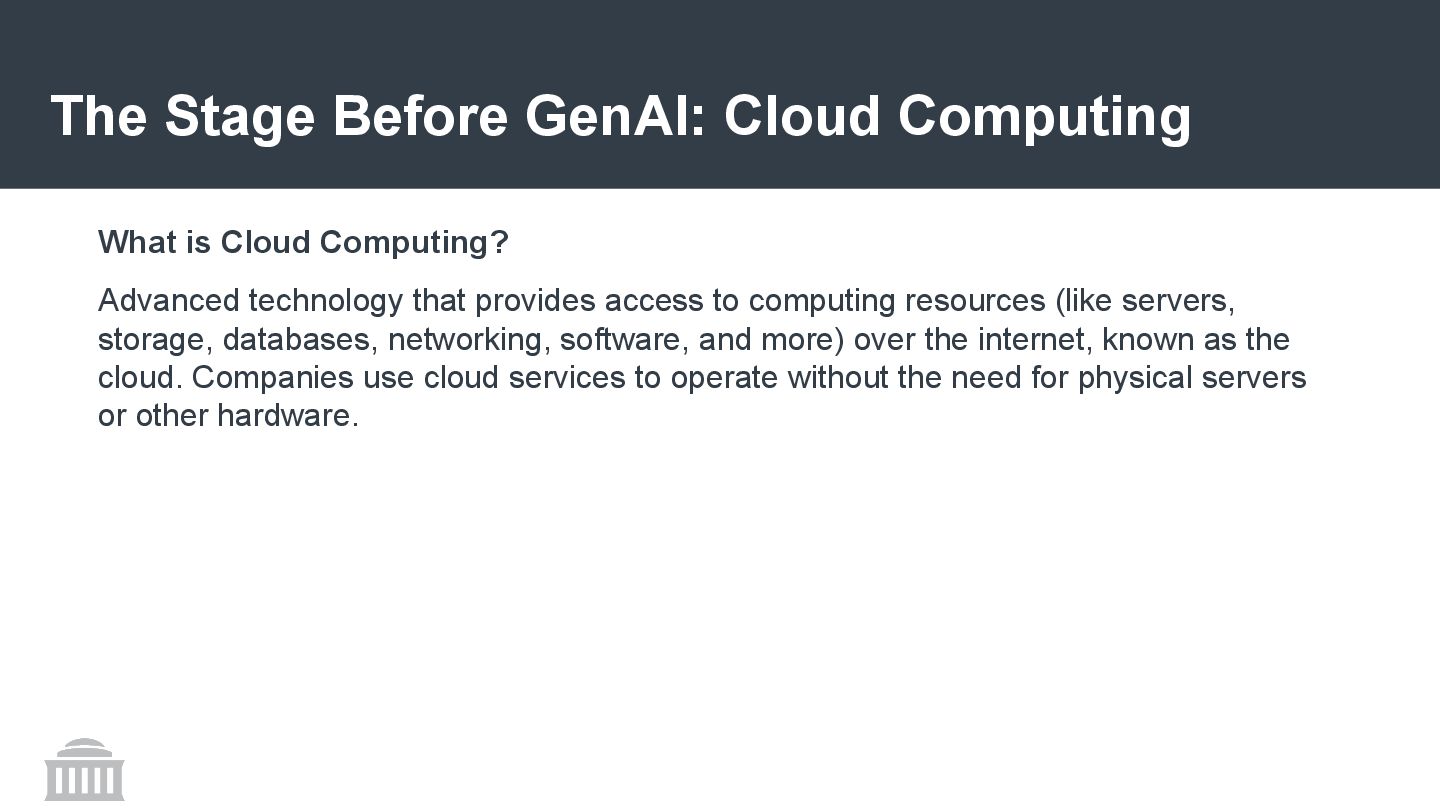
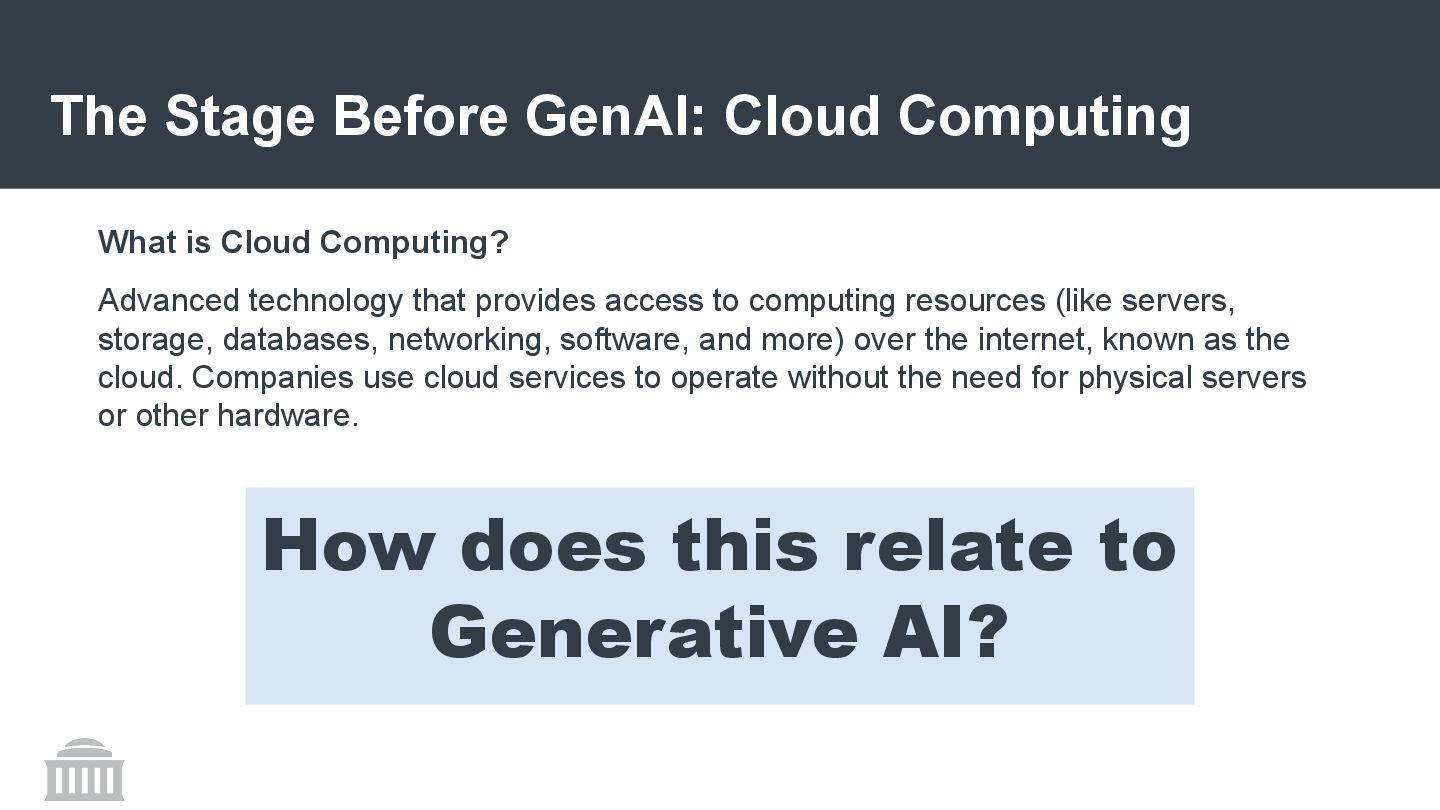
Advanced technology that provides access to computing resources (like servers, storage, databases, networking, software, and more) over the internet, known as the cloud. Companies use cloud services to operate without the need for physical servers or other hardware.
Advanced technology that provides access to computing resources (like servers, storage, databases, networking, software, and more) over the internet, known as the cloud. Companies use cloud services to operate without the need for physical servers or other hardware. How does this relate to Generative AI?
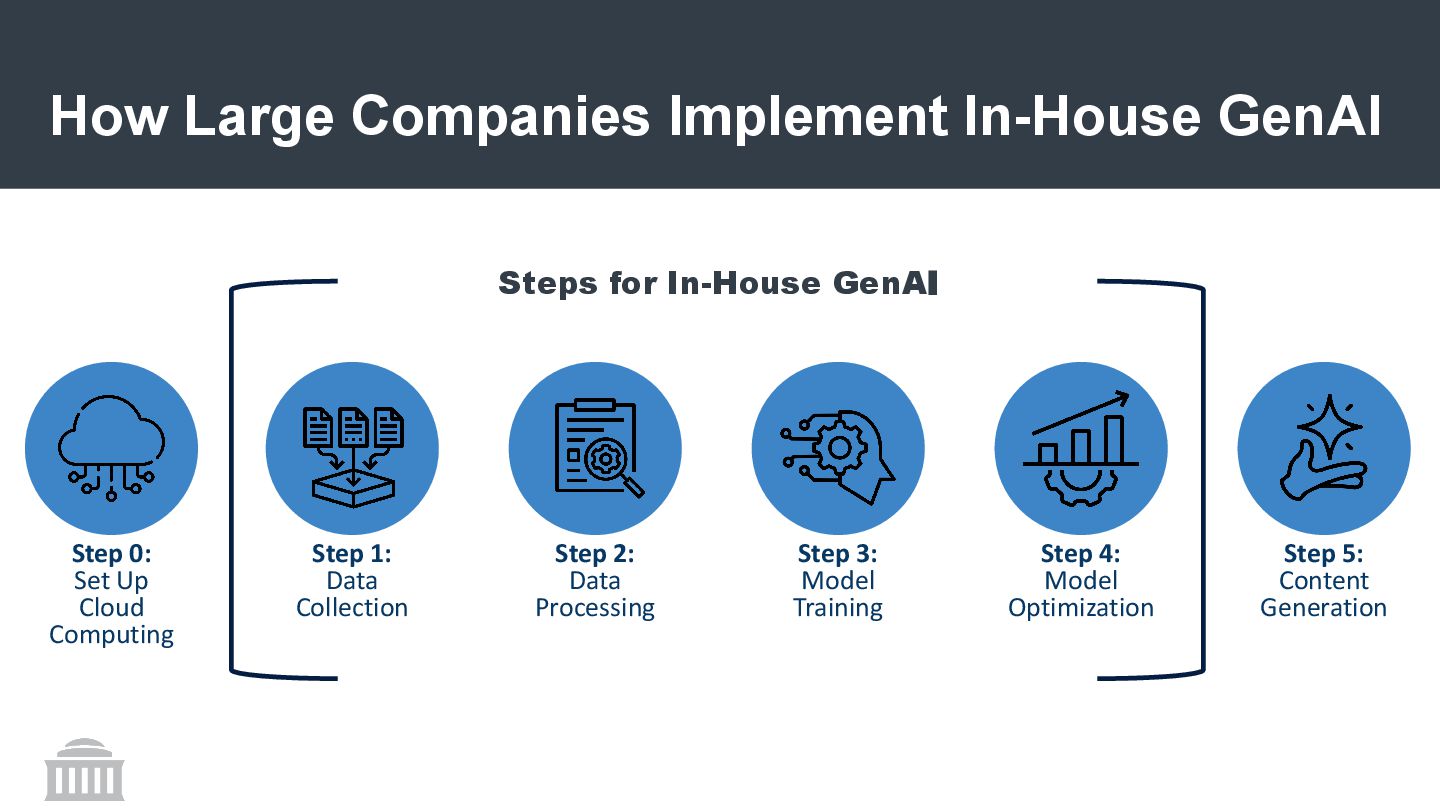
Step 1: Data Collection Step 2: Data Processing Step 3: Model Training Step 5: Content Generation Step 4: Model Optimization Step 0: Set Up Cloud Computing
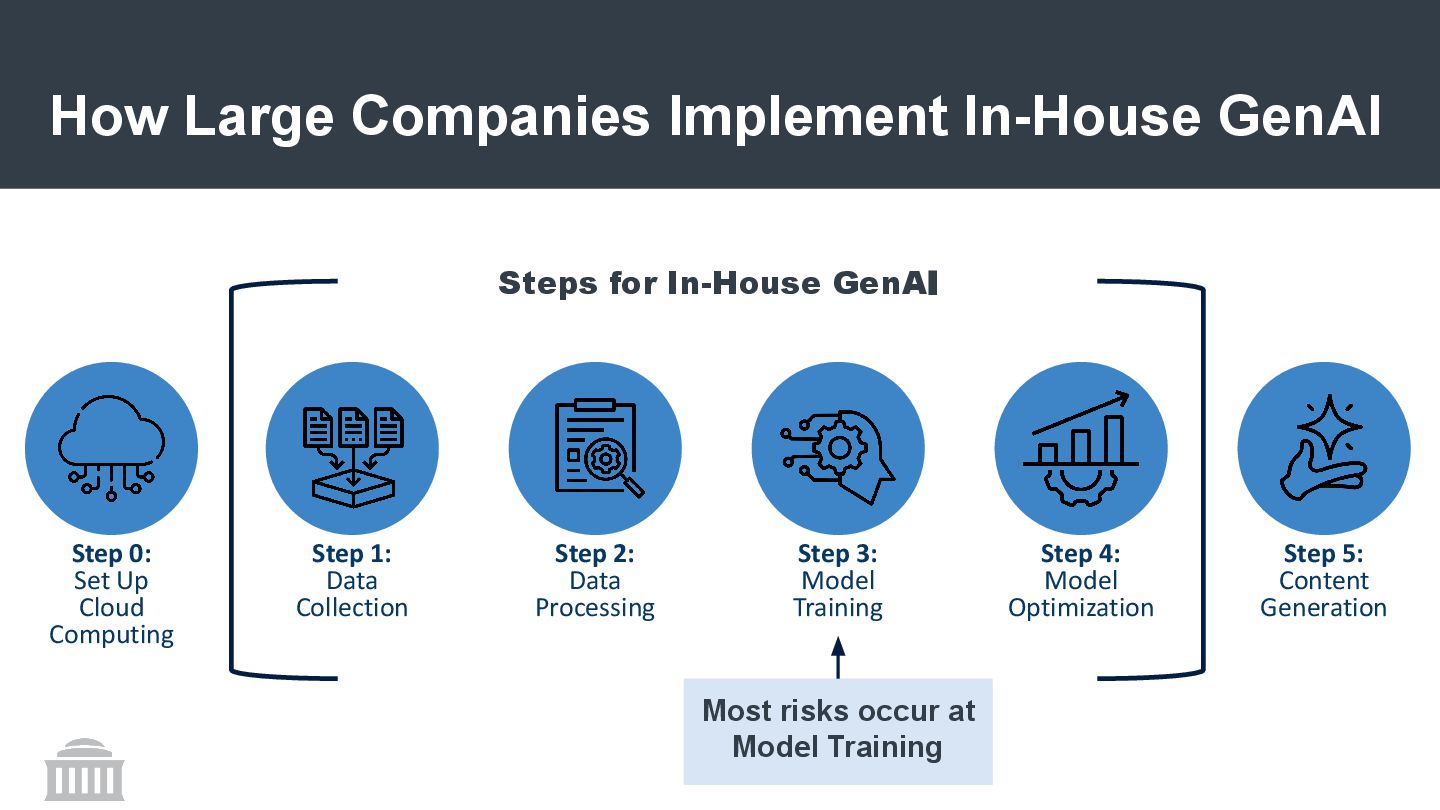
Step 1: Data Collection Step 2: Data Processing Step 3: Model Training Step 5: Content Generation Step 4: Model Optimization Step 0: Set Up Cloud Computing Most risks occur at Model Training
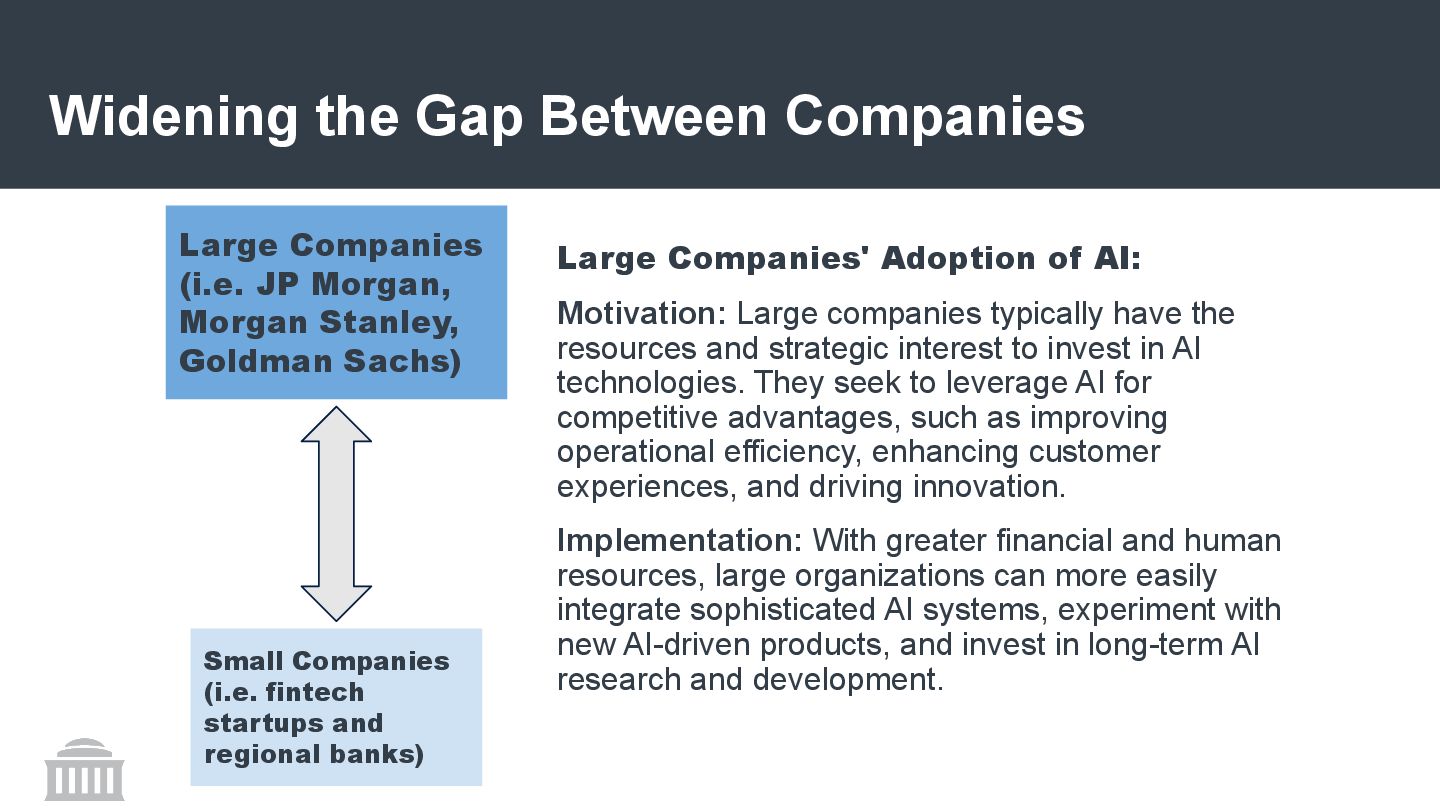
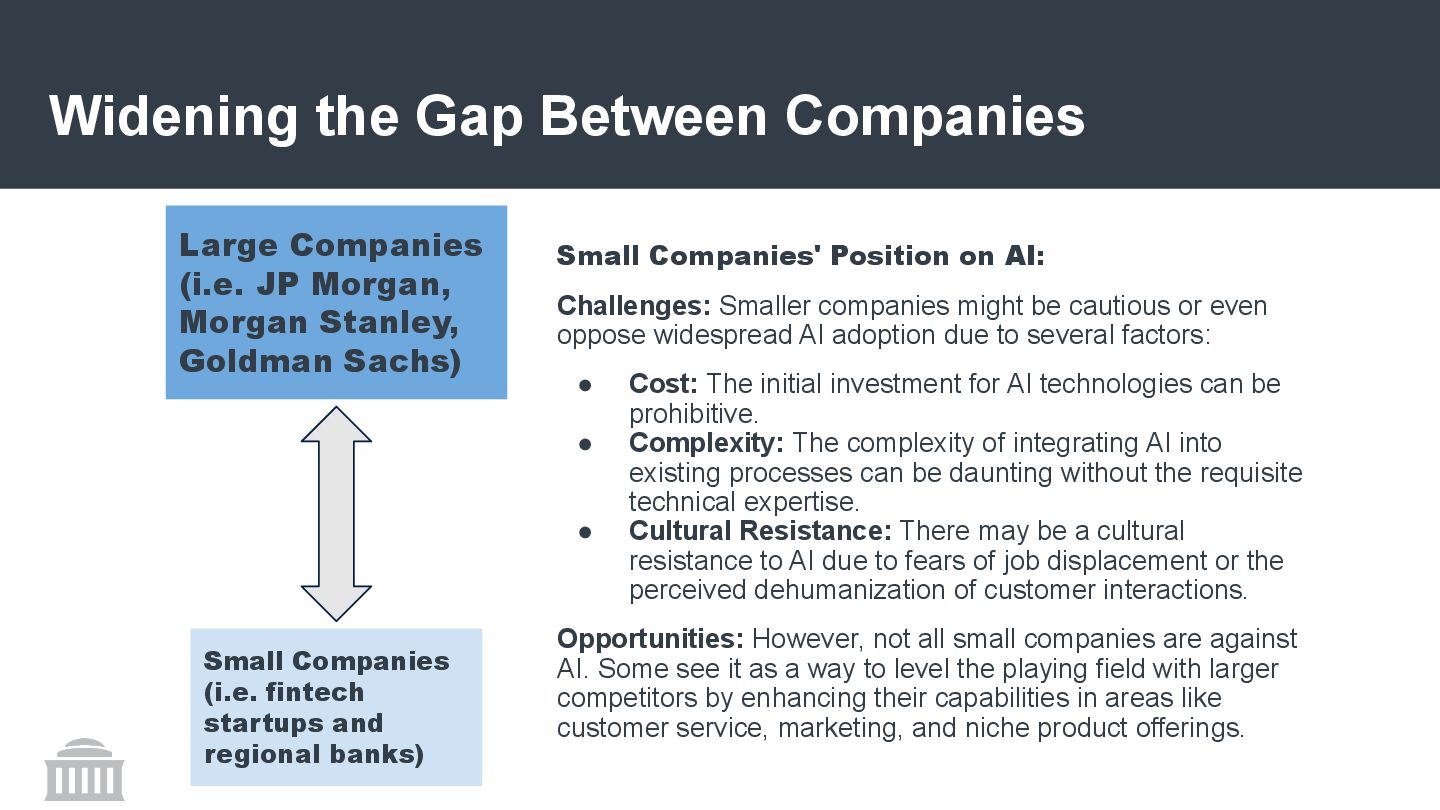
Motivation: Large companies typically have the resources and strategic interest to invest in AI technologies. They seek to leverage AI for competitive advantages, such as improving operational efficiency, enhancing customer experiences, and driving innovation. Implementation: With greater financial and human resources, large organizations can more easily integrate sophisticated AI systems, experiment with new AI-driven products, and invest in long-term AI research and development. Large Companies (i.e. JP Morgan, Morgan Stanley, Goldman Sachs) Small Companies (i.e. fintech startups and regional banks)
cautious or even oppose widespread AI adoption due to several factors: • Cost: The initial investment for AI technologies can be prohibitive. • Complexity: The complexity of integrating AI into existing processes can be daunting without the requisite technical expertise. • Cultural Resistance: There may be a cultural resistance to AI due to fears of job displacement or the perceived dehumanization of customer interactions. Opportunities: However, not all small companies are against AI. Some see it as a way to level the playing field with larger competitors by enhancing their capabilities in areas like customer service, marketing, and niche product offerings. Widening the Gap Between Companies Large Companies (i.e. JP Morgan, Morgan Stanley, Goldman Sachs) Small Companies (i.e. fintech startups and regional banks)
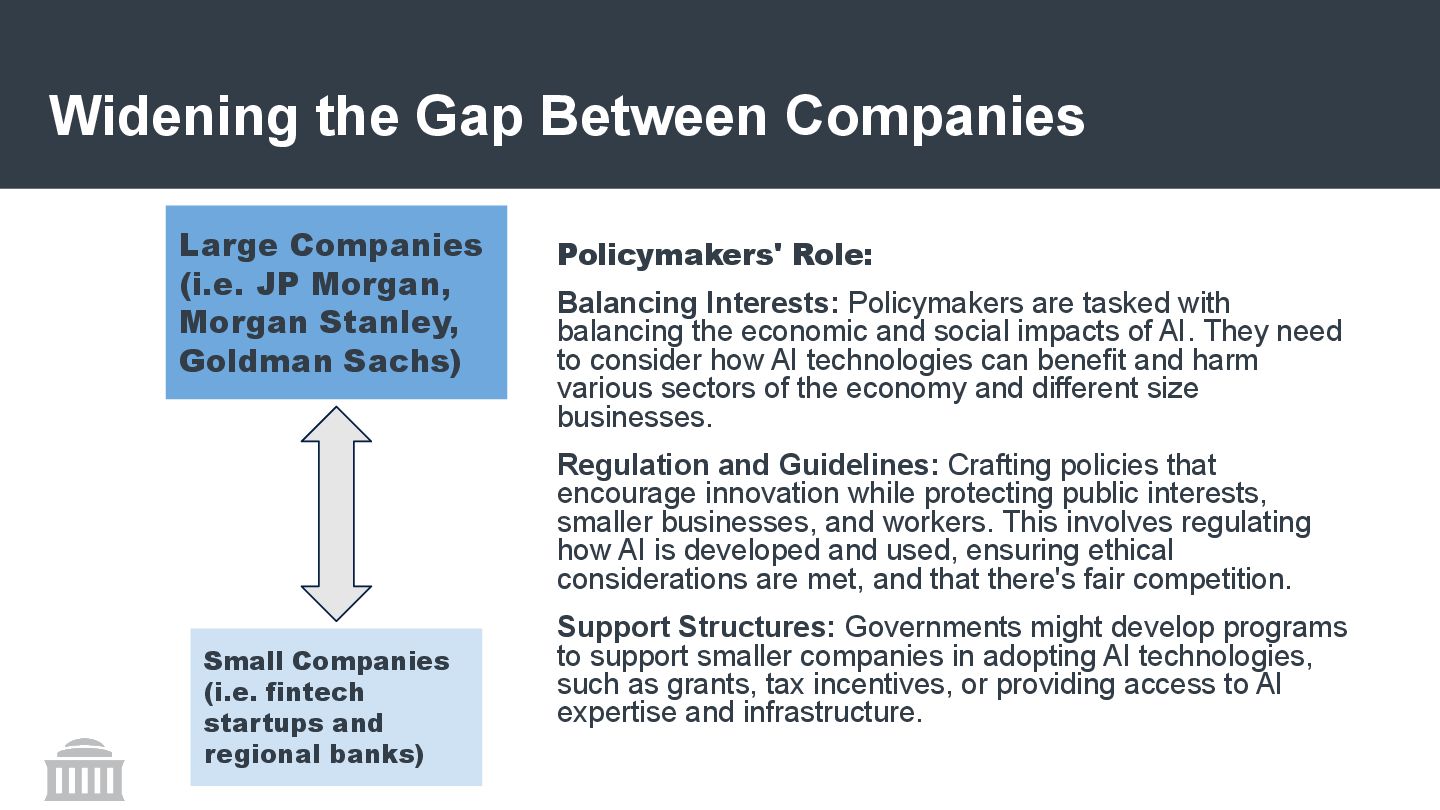
Morgan Stanley, Goldman Sachs) Small Companies (i.e. fintech startups and regional banks) Policymakers' Role: Balancing Interests: Policymakers are tasked with balancing the economic and social impacts of AI. They need to consider how AI technologies can benefit and harm various sectors of the economy and different size businesses. Regulation and Guidelines: Crafting policies that encourage innovation while protecting public interests, smaller businesses, and workers. This involves regulating how AI is developed and used, ensuring ethical considerations are met, and that there's fair competition. Support Structures: Governments might develop programs to support smaller companies in adopting AI technologies, such as grants, tax incentives, or providing access to AI expertise and infrastructure.
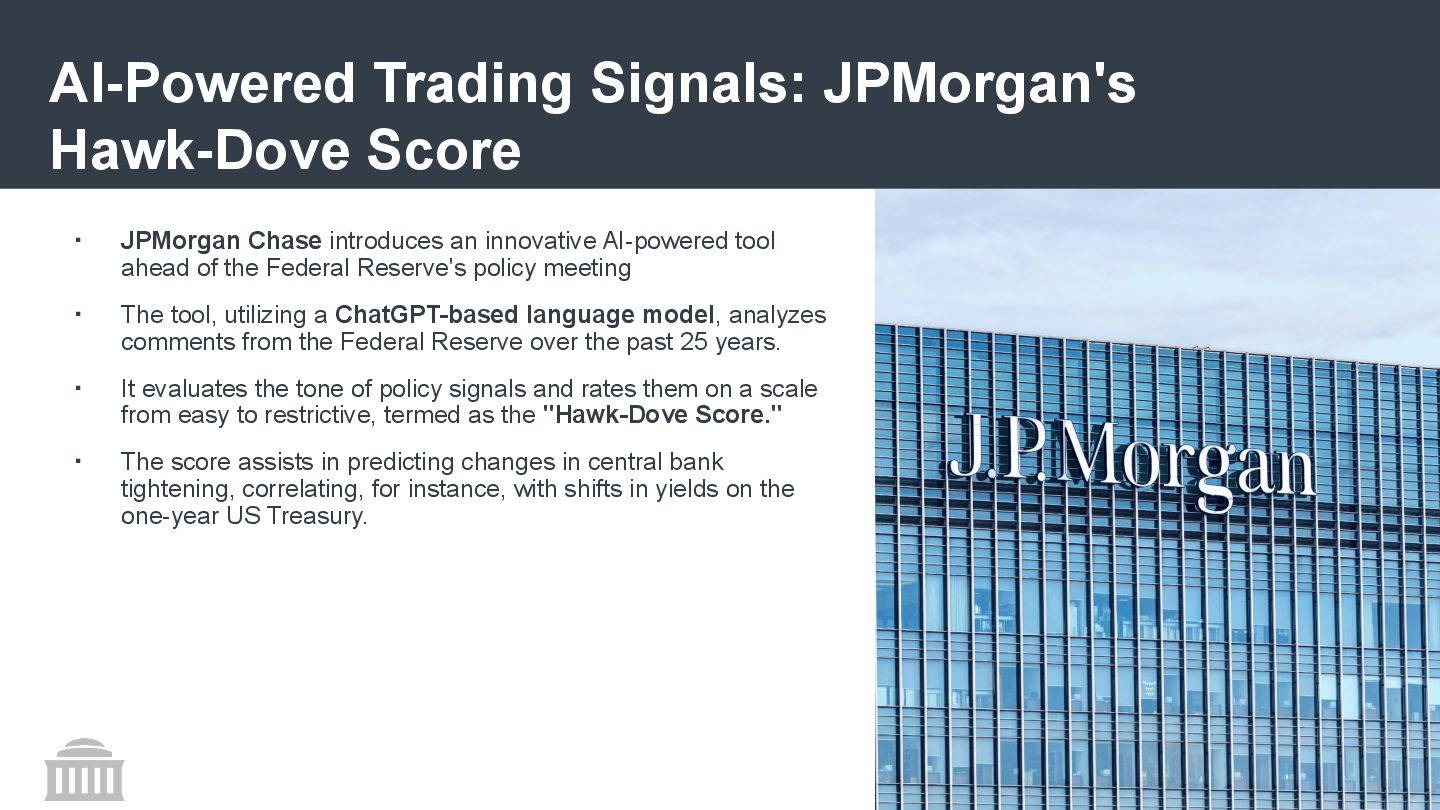
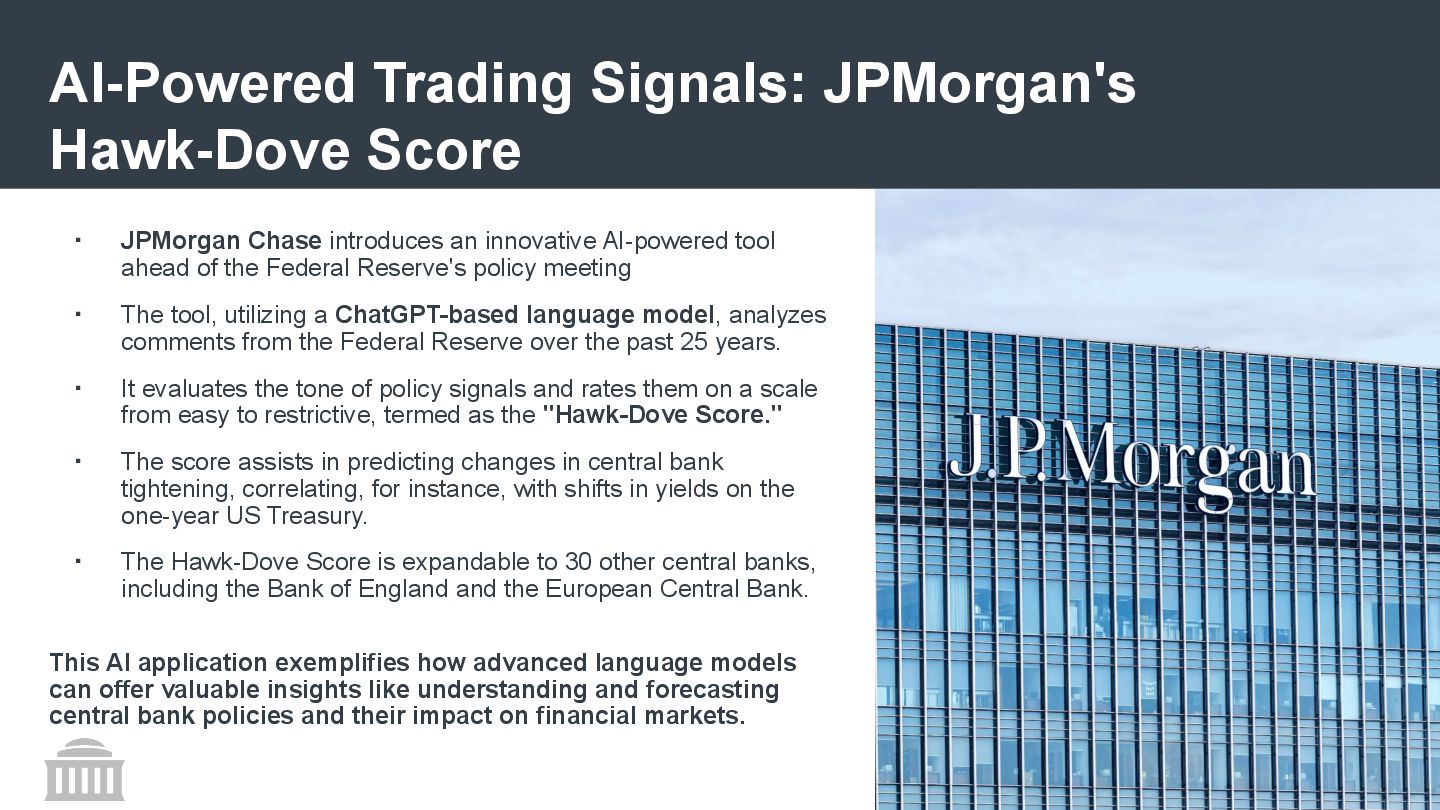
an innovative AI-powered tool ahead of the Federal Reserve's policy meeting ・ The tool, utilizing a ChatGPT-based language model, analyzes comments from the Federal Reserve over the past 25 years. ・ It evaluates the tone of policy signals and rates them on a scale from easy to restrictive, termed as the "Hawk-Dove Score." ・ The score assists in predicting changes in central bank tightening, correlating, for instance, with shifts in yields on the one-year US Treasury. ・ The Hawk-Dove Score is expandable to 30 other central banks, including the Bank of England and the European Central Bank. This AI application exemplifies how advanced language models can offer valuable insights like understanding and forecasting central bank policies and their impact on financial markets.
an innovative AI-powered tool ahead of the Federal Reserve's policy meeting ・ The tool, utilizing a ChatGPT-based language model, analyzes comments from the Federal Reserve over the past 25 years. ・ It evaluates the tone of policy signals and rates them on a scale from easy to restrictive, termed as the "Hawk-Dove Score." ・ The score assists in predicting changes in central bank tightening, correlating, for instance, with shifts in yields on the one-year US Treasury. ・ The Hawk-Dove Score is expandable to 30 other central banks, including the Bank of England and the European Central Bank. This AI application exemplifies how advanced language models can offer valuable insights like understanding and forecasting central bank policies and their impact on financial markets.
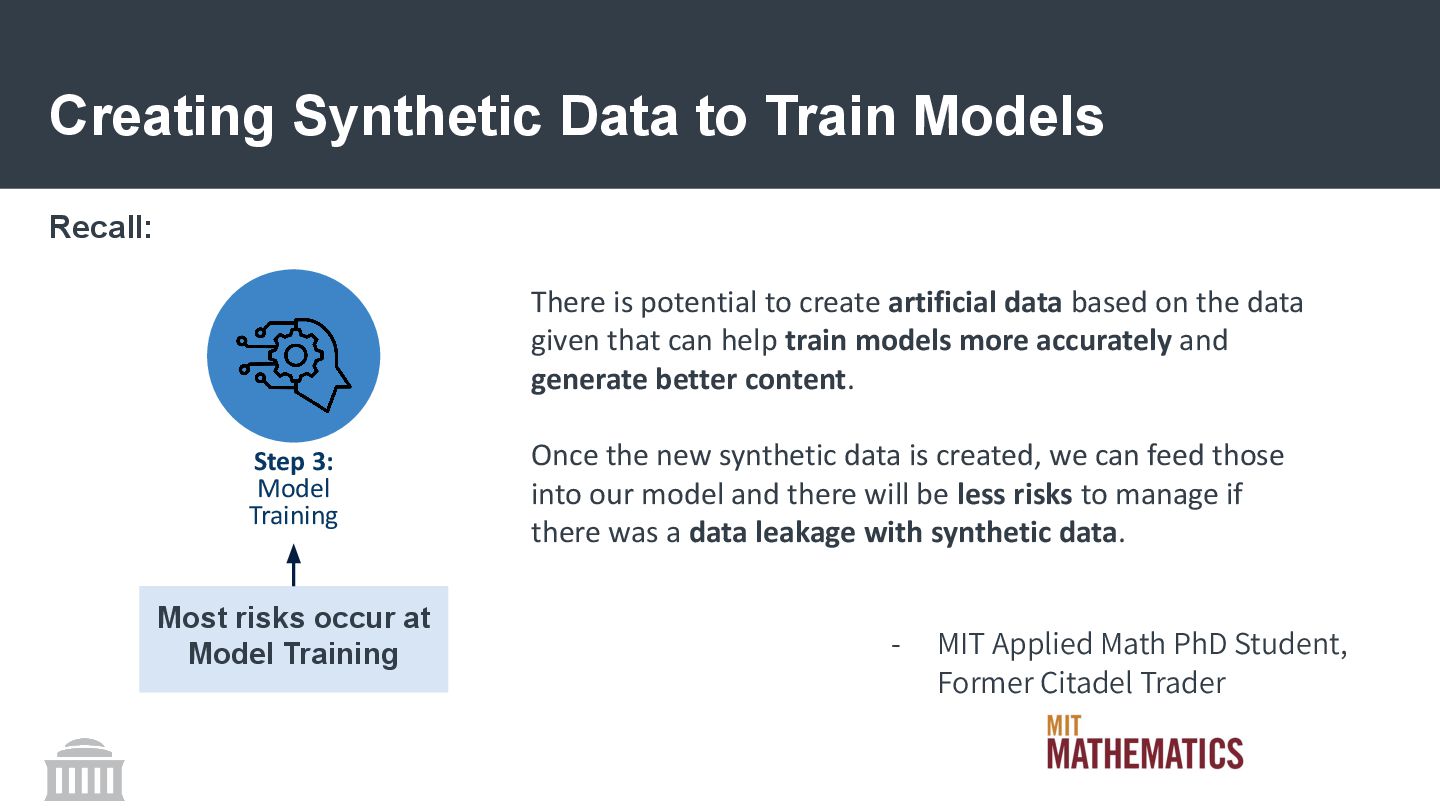
Training Most risks occur at Model Training There is potential to create artificial data based on the data given that can help train models more accurately and generate better content. Once the new synthetic data is created, we can feed those into our model and there will be less risks to manage if there was a data leakage with synthetic data. - MIT Applied Math PhD Student, Former Citadel Trader
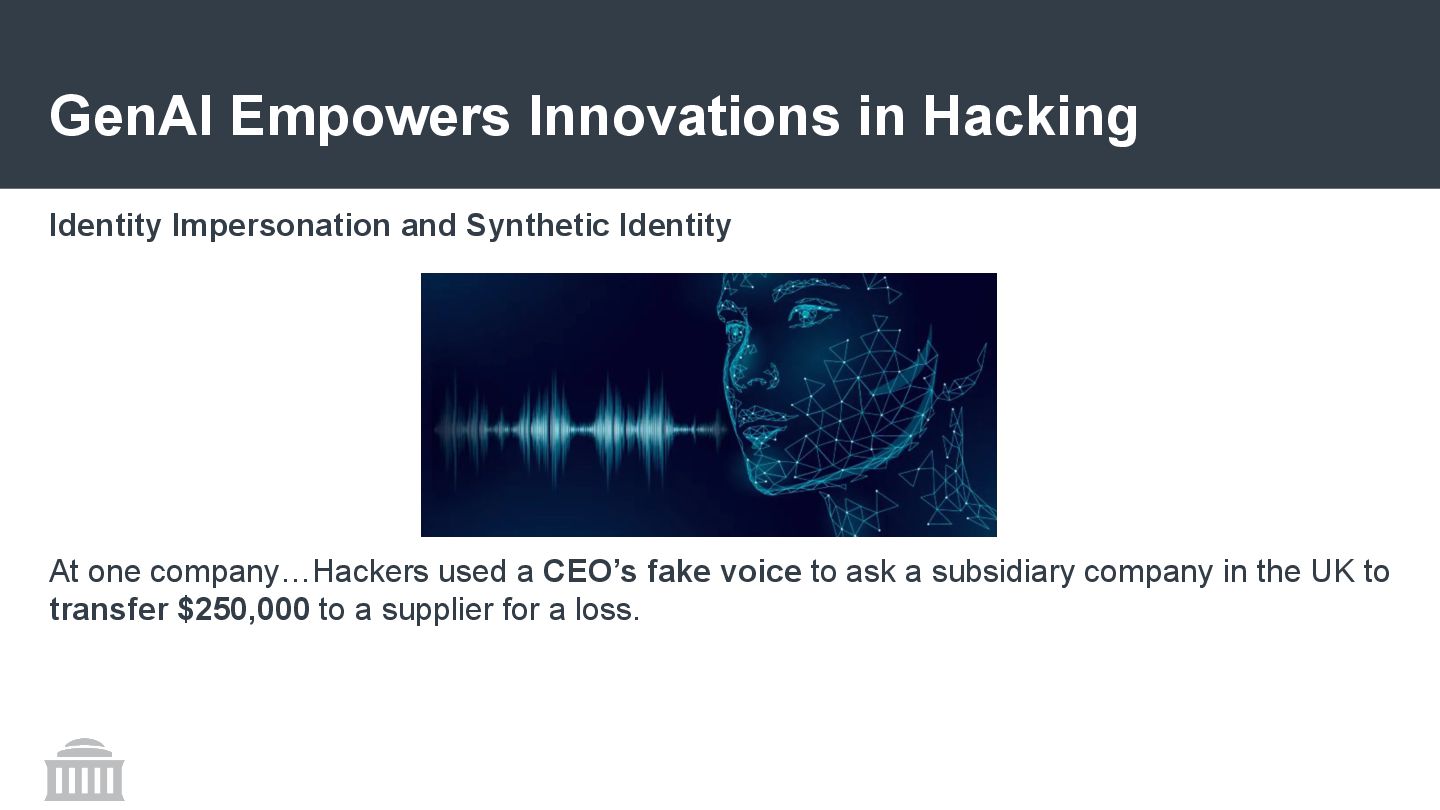
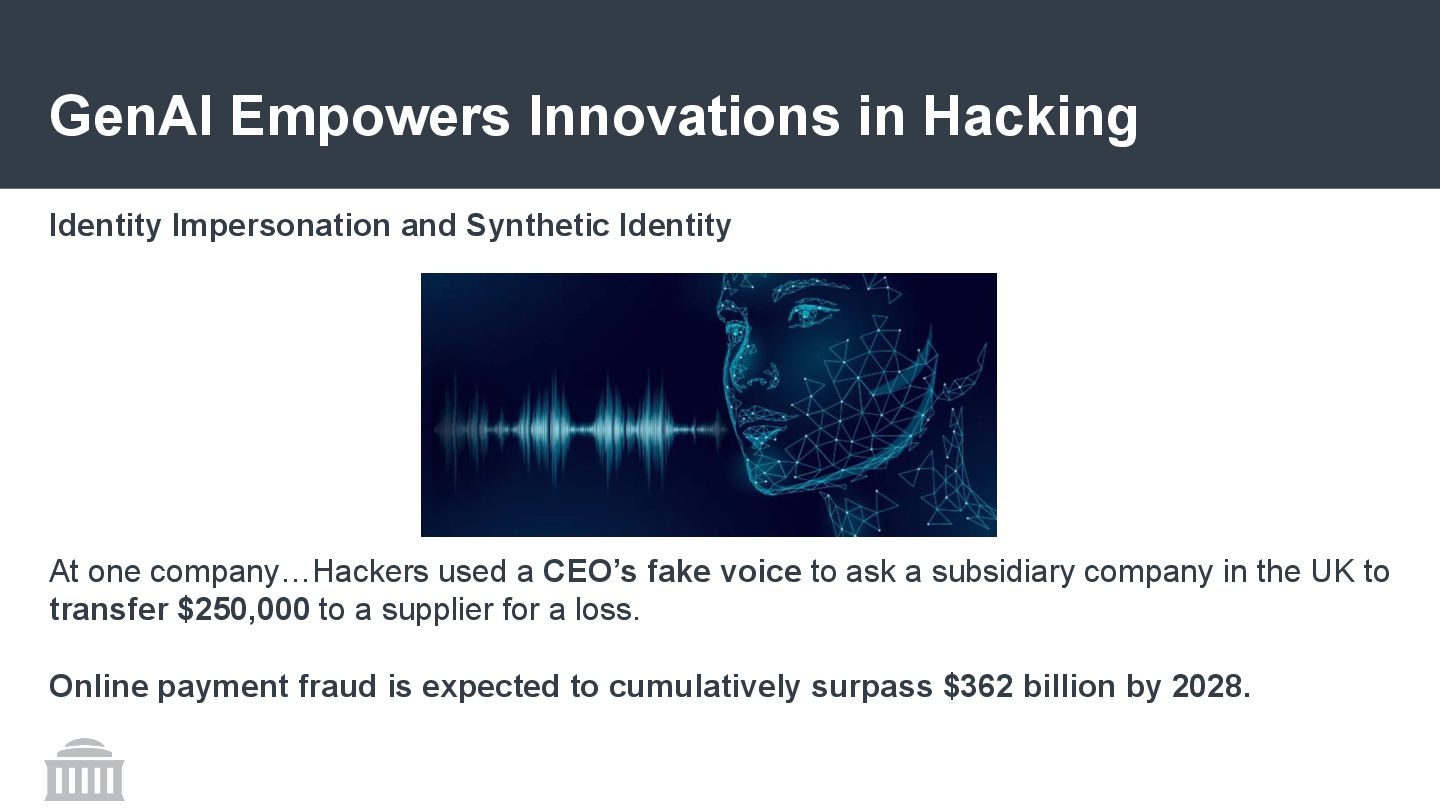
At one company…Hackers used a CEO’s fake voice to ask a subsidiary company in the UK to transfer $250,000 to a supplier for a loss. Online payment fraud is expected to cumulatively surpass $362 billion by 2028.
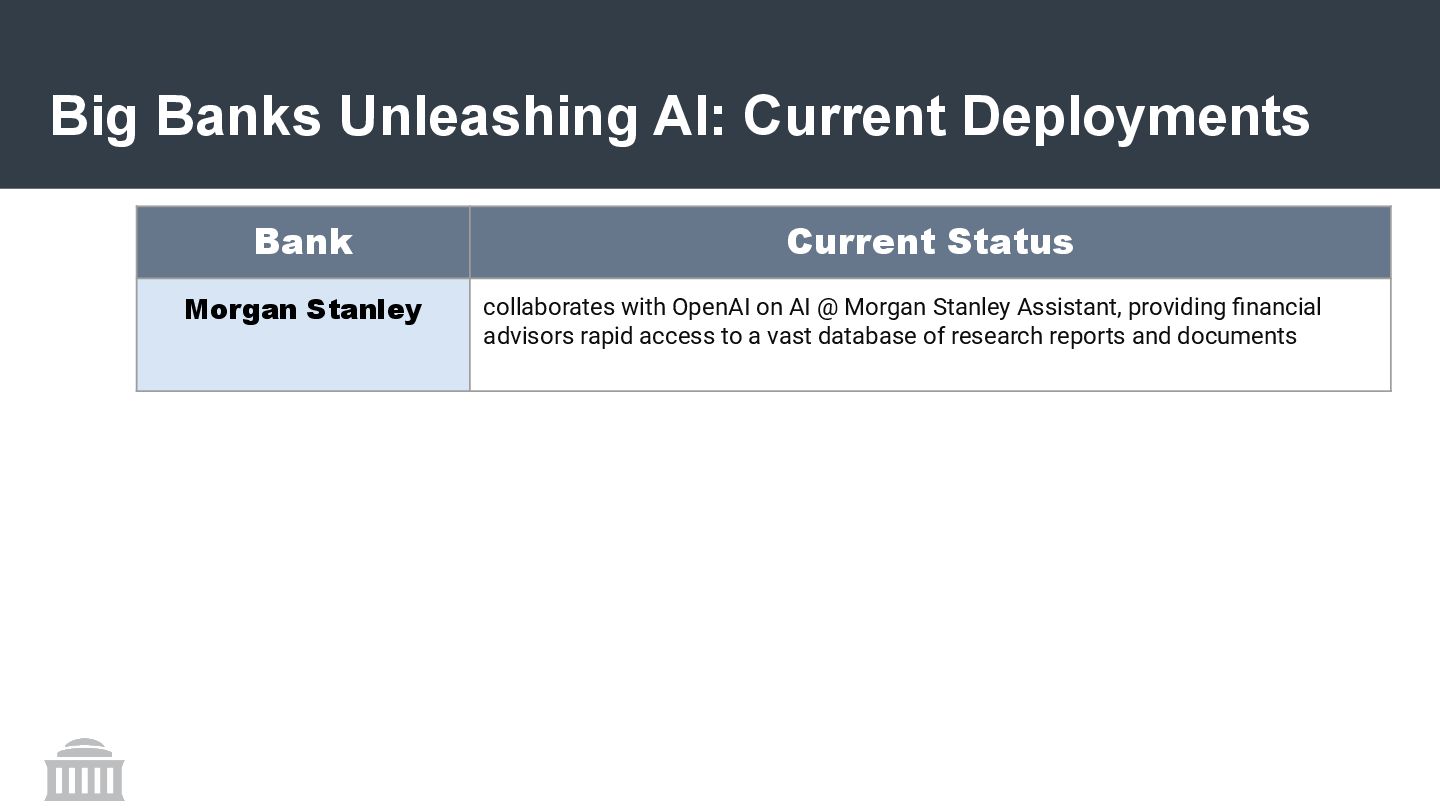
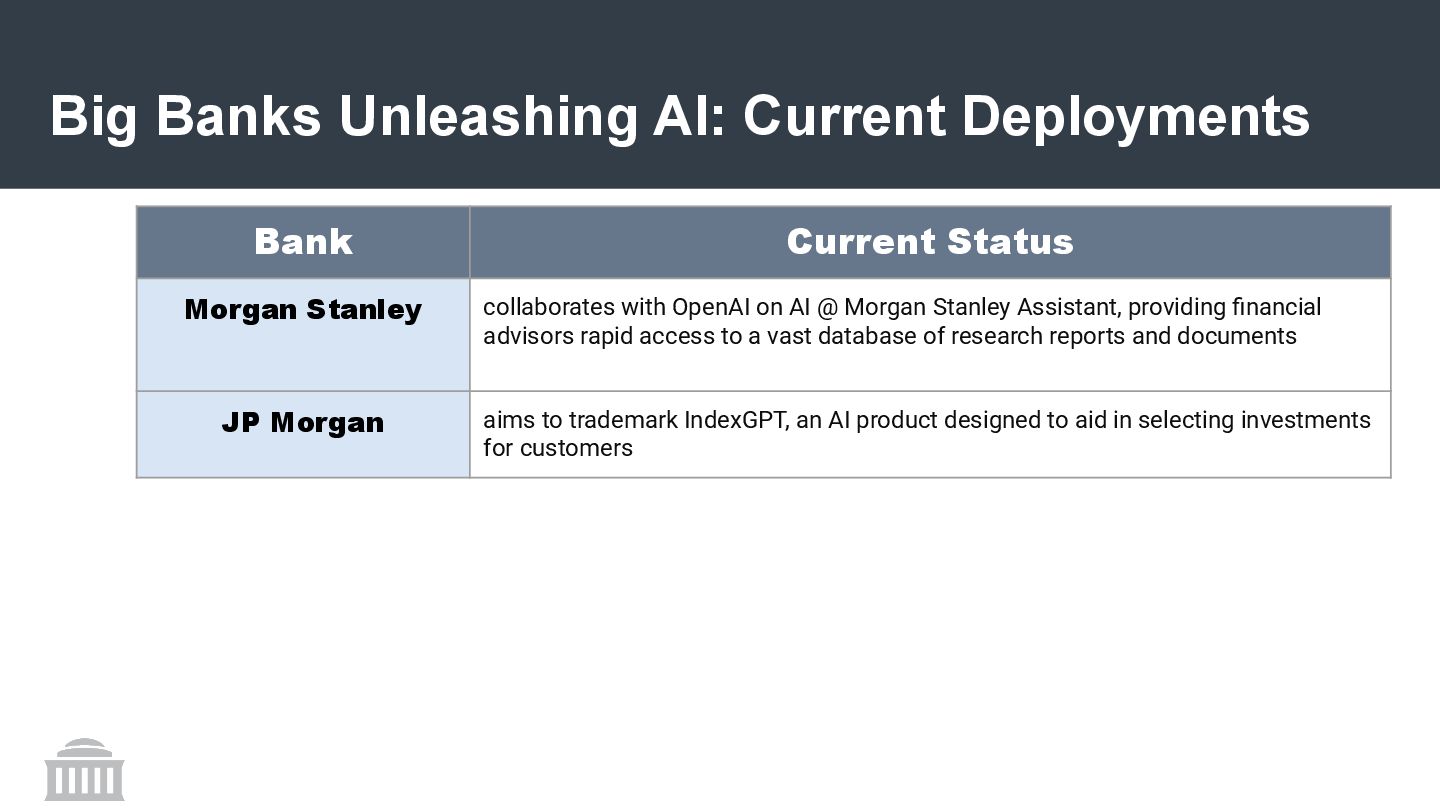
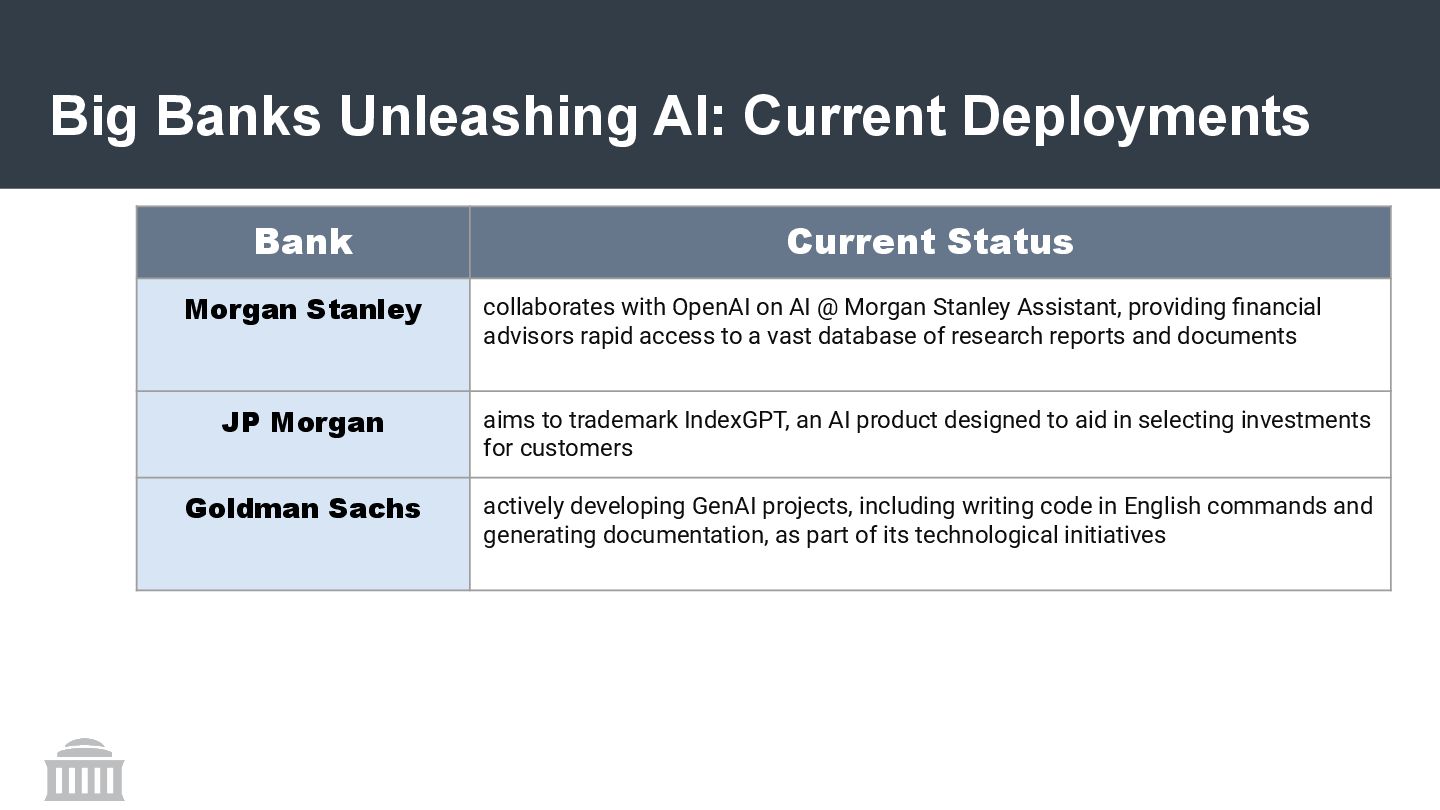
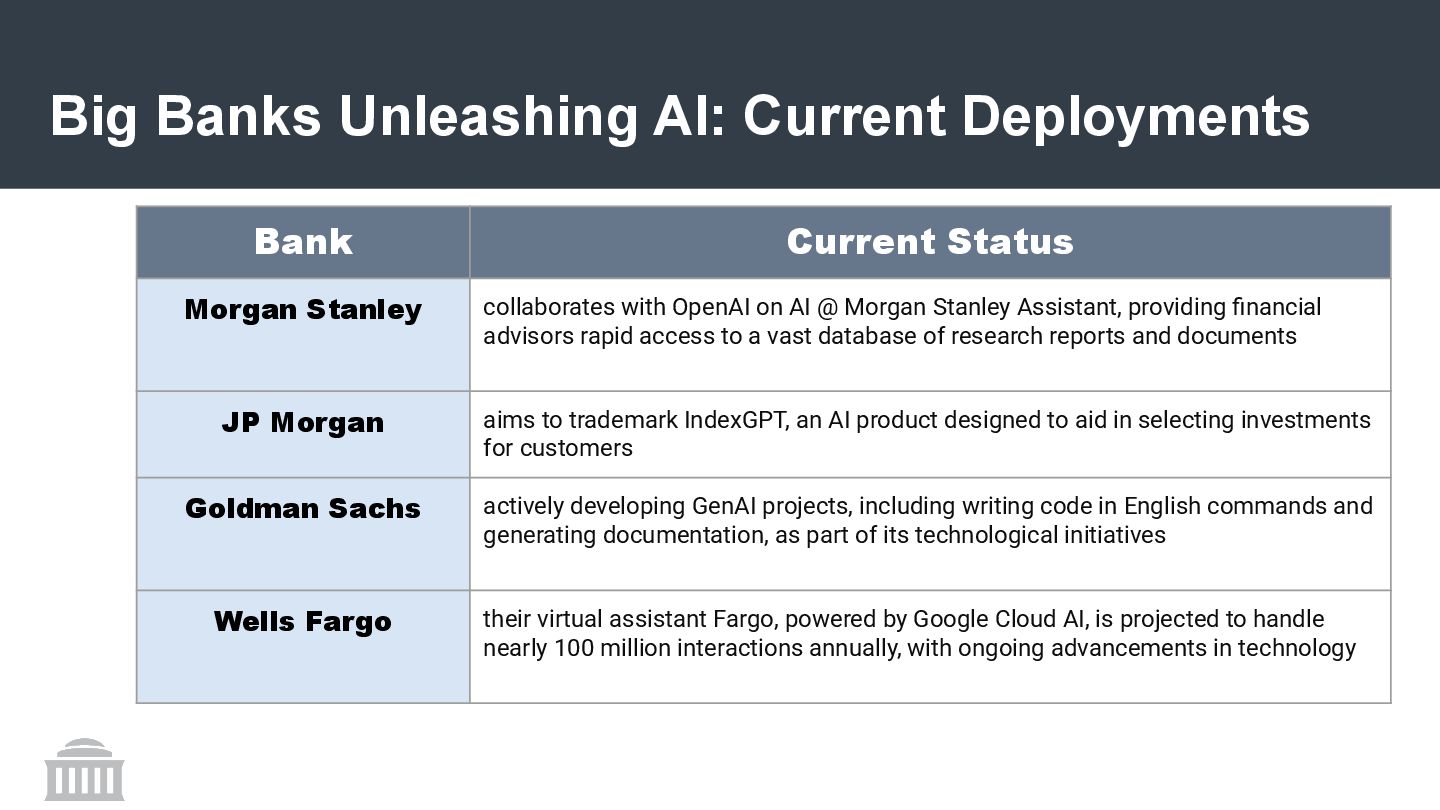
Stanley collaborates with OpenAI on AI @ Morgan Stanley Assistant, providing financial advisors rapid access to a vast database of research reports and documents
Stanley collaborates with OpenAI on AI @ Morgan Stanley Assistant, providing financial advisors rapid access to a vast database of research reports and documents JP Morgan aims to trademark IndexGPT, an AI product designed to aid in selecting investments for customers
Stanley collaborates with OpenAI on AI @ Morgan Stanley Assistant, providing financial advisors rapid access to a vast database of research reports and documents JP Morgan aims to trademark IndexGPT, an AI product designed to aid in selecting investments for customers Goldman Sachs actively developing GenAI projects, including writing code in English commands and generating documentation, as part of its technological initiatives
Stanley collaborates with OpenAI on AI @ Morgan Stanley Assistant, providing financial advisors rapid access to a vast database of research reports and documents JP Morgan aims to trademark IndexGPT, an AI product designed to aid in selecting investments for customers Goldman Sachs actively developing GenAI projects, including writing code in English commands and generating documentation, as part of its technological initiatives Wells Fargo their virtual assistant Fargo, powered by Google Cloud AI, is projected to handle nearly 100 million interactions annually, with ongoing advancements in technology
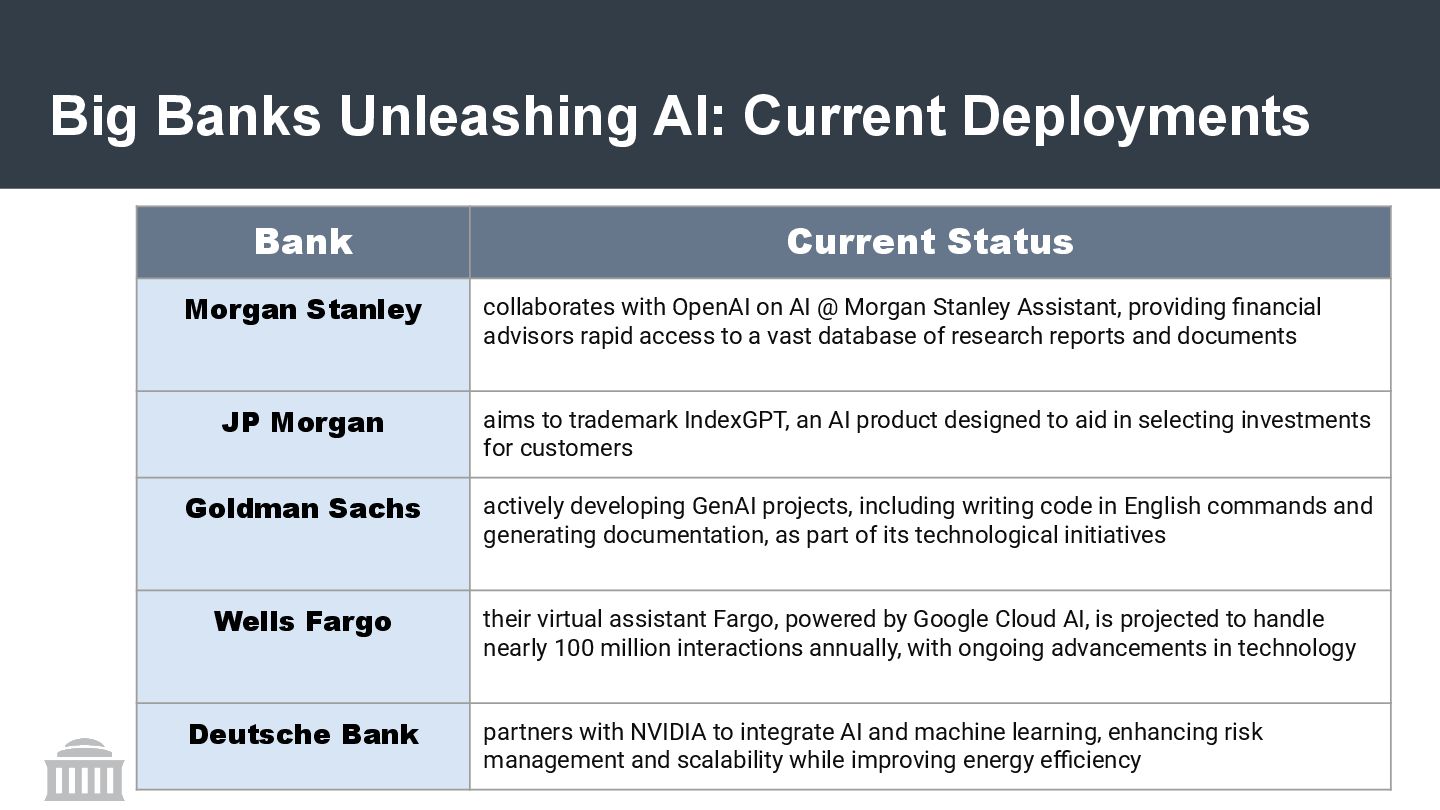
Stanley collaborates with OpenAI on AI @ Morgan Stanley Assistant, providing financial advisors rapid access to a vast database of research reports and documents JP Morgan aims to trademark IndexGPT, an AI product designed to aid in selecting investments for customers Goldman Sachs actively developing GenAI projects, including writing code in English commands and generating documentation, as part of its technological initiatives Wells Fargo their virtual assistant Fargo, powered by Google Cloud AI, is projected to handle nearly 100 million interactions annually, with ongoing advancements in technology Deutsche Bank partners with NVIDIA to integrate AI and machine learning, enhancing risk management and scalability while improving energy efficiency
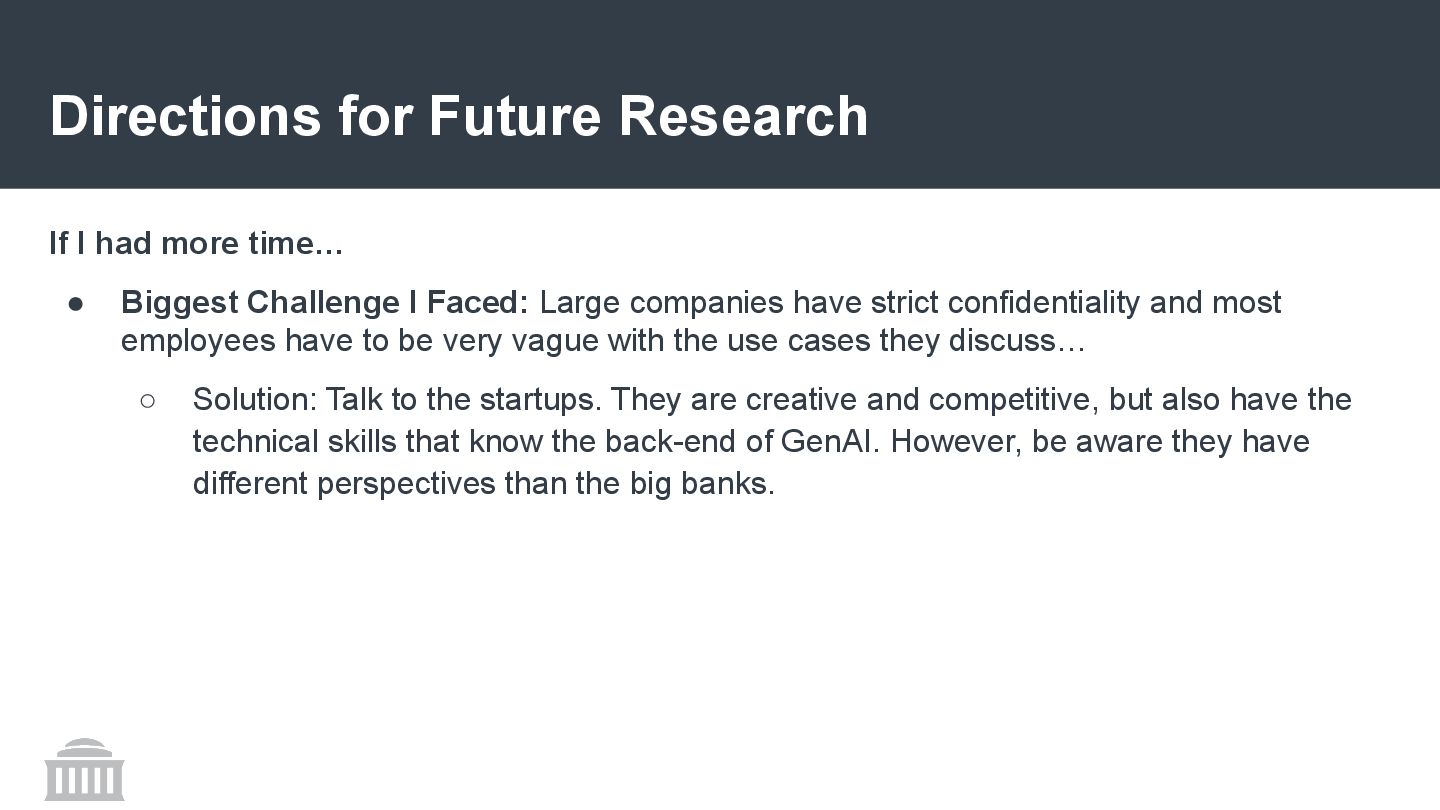
Large companies have strict confidentiality and most employees have to be very vague with the use cases they discuss… ◦ Solution: Talk to the startups. They are creative and competitive, but also have the technical skills that know the back-end of GenAI. However, be aware they have different perspectives than the big banks. Directions for Future Research
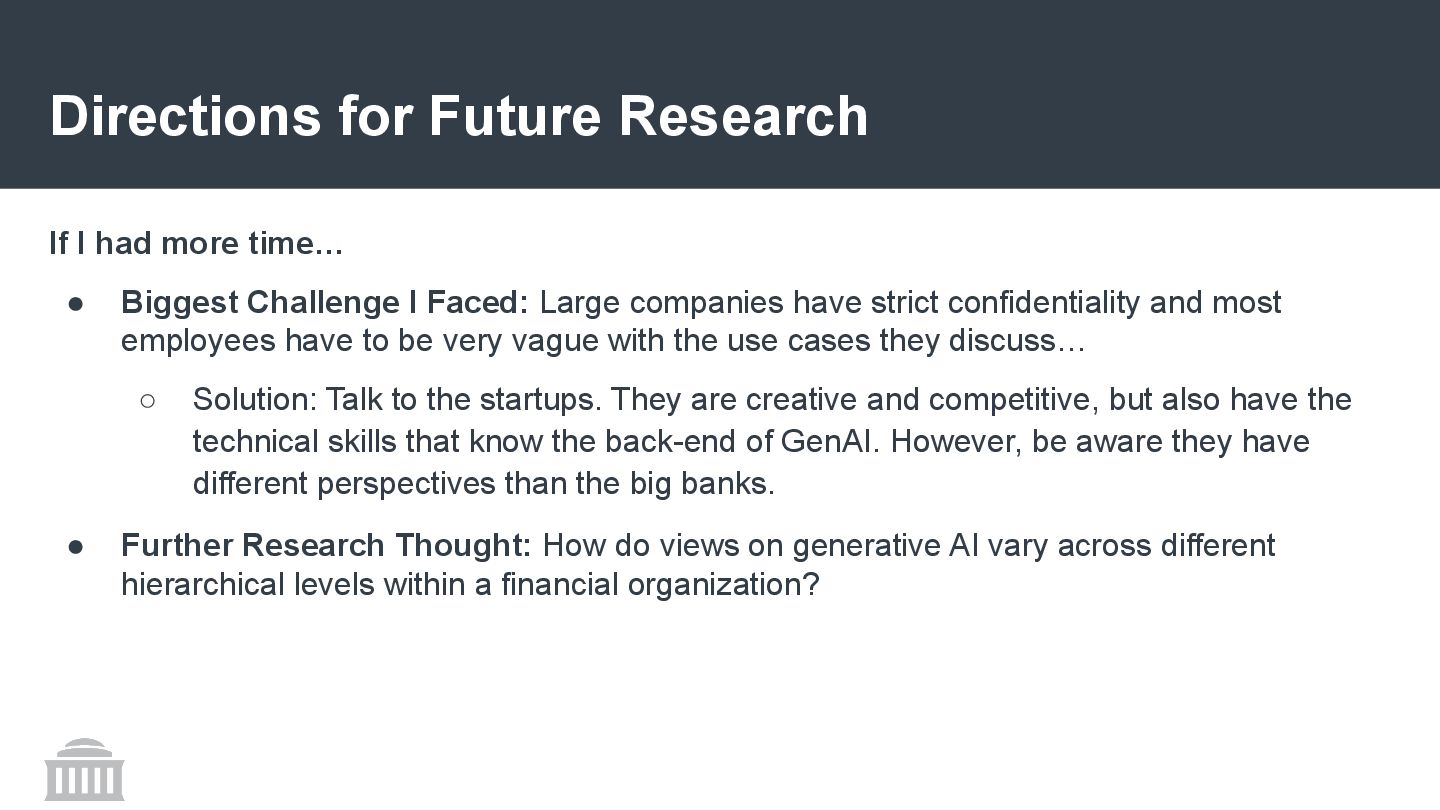
Large companies have strict confidentiality and most employees have to be very vague with the use cases they discuss… ◦ Solution: Talk to the startups. They are creative and competitive, but also have the technical skills that know the back-end of GenAI. However, be aware they have different perspectives than the big banks. • Further Research Thought: How do views on generative AI vary across different hierarchical levels within a financial organization? Directions for Future Research


 emiliedubiel
 helenjbeal
 samanthasiow
 marcelosomers
 eileencodes
 gr2m
 twada
 watany
 rkaga
 aleyda
 jeffersonlam
 livdayseo
 codingconduct