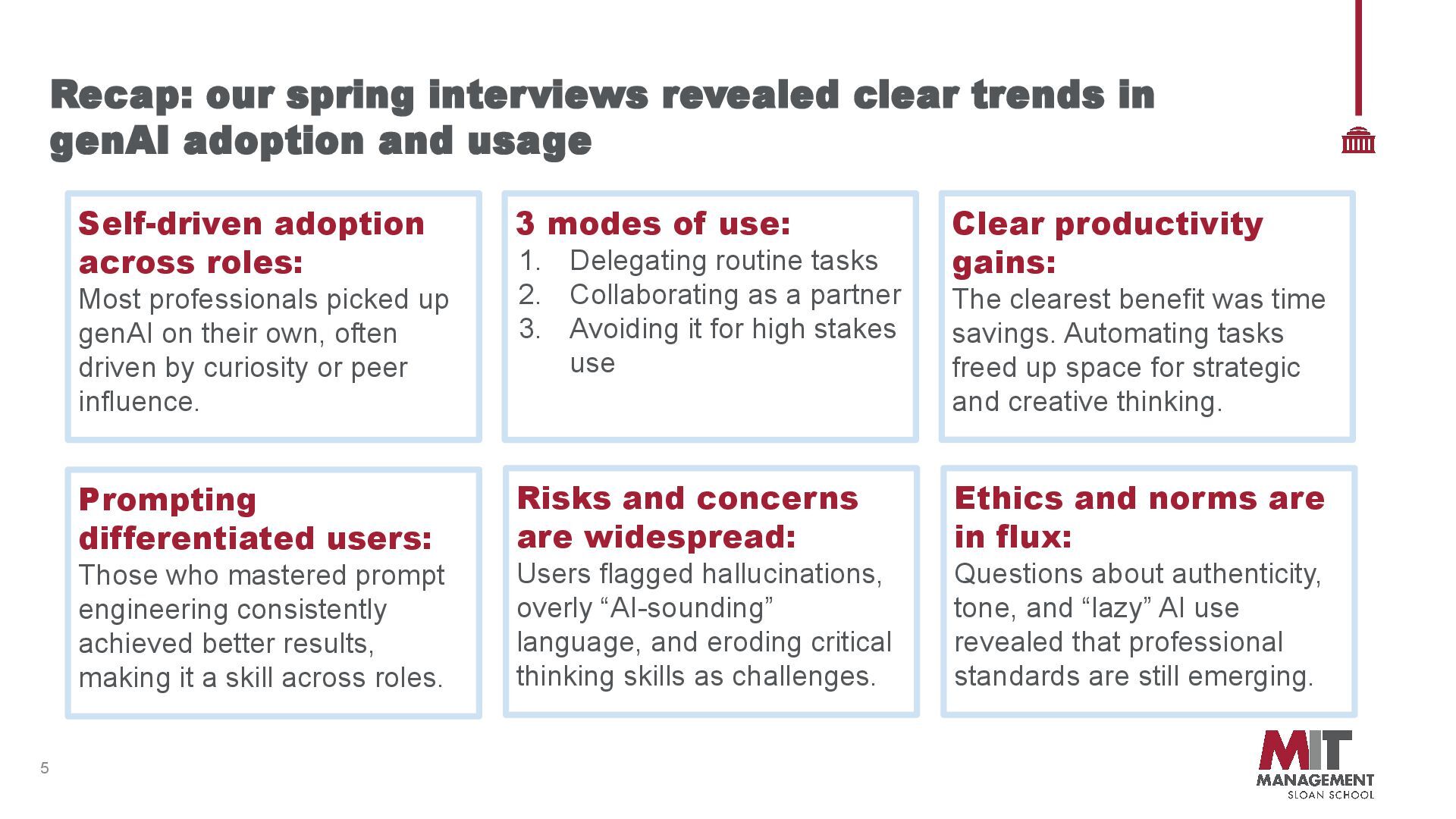
their own, often driven by curiosity or peer influence. 3 modes of use: 1. Delegating routine tasks 2. Collaborating as a partner 3. Avoiding it for high stakes use Risks and concerns are widespread: Users flagged hallucinations, overly “AI-sounding” language, and eroding critical thinking skills as challenges. Ethics and norms are in flux: Questions about authenticity, tone, and “lazy” AI use revealed that professional standards are still emerging. Clear productivity gains: The clearest benefit was time savings. Automating tasks freed up space for strategic and creative thinking. Recap: our spring interviews revealed clear trends in genAI adoption and usage 5 Prompting differentiated users: Those who mastered prompt engineering consistently achieved better results, making it a skill across roles.
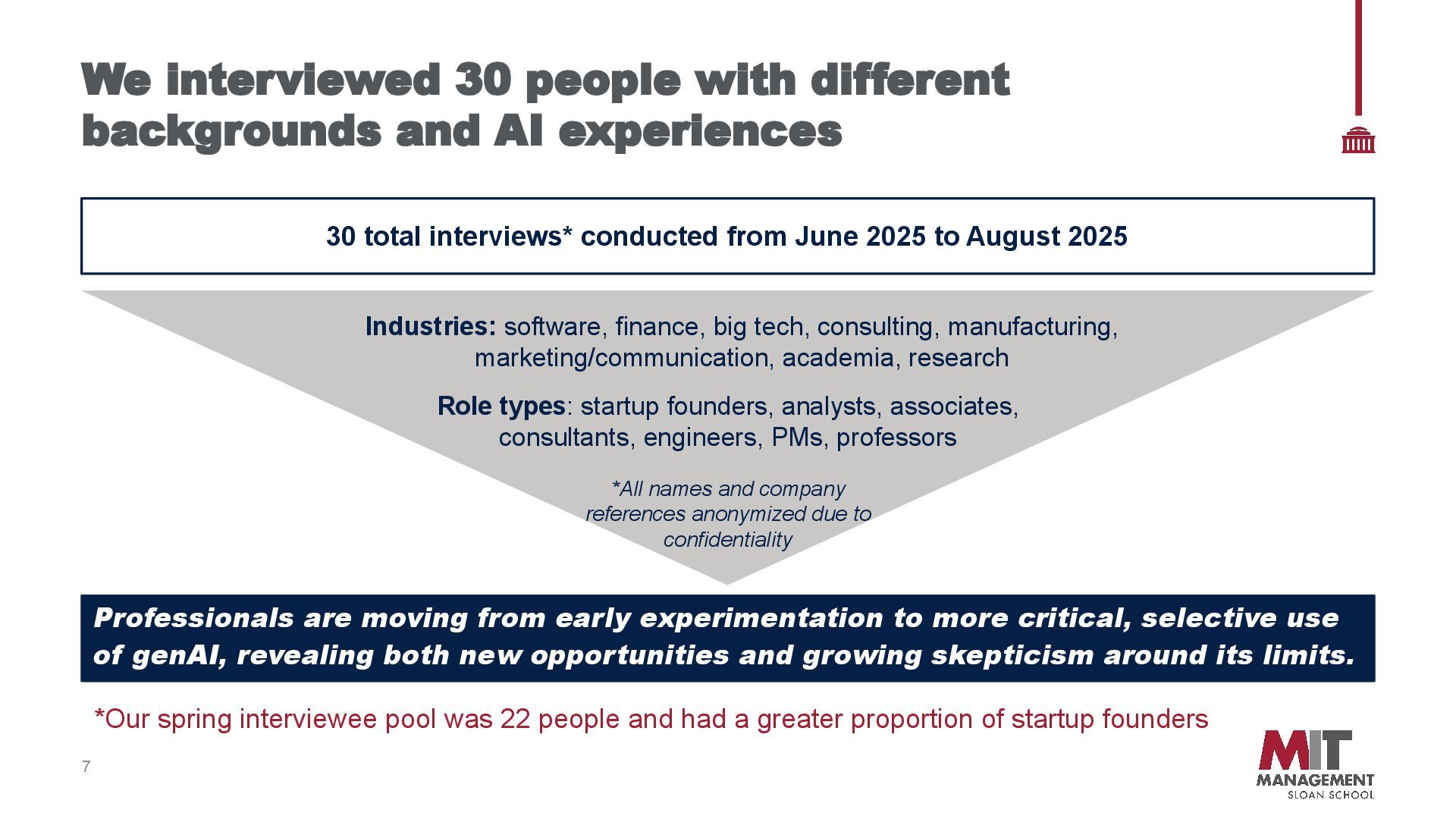
experiences 30 total interviews* conducted from June 2025 to August 2025 Professionals are moving from early experimentation to more critical, selective use of genAI, revealing both new opportunities and growing skepticism around its limits. Industries: software, finance, big tech, consulting, manufacturing, marketing/communication, academia, research Role types: startup founders, analysts, associates, consultants, engineers, PMs, professors *All names and company references anonymized due to confidentiality *Our spring interviewee pool was 22 people and had a greater proportion of startup founders
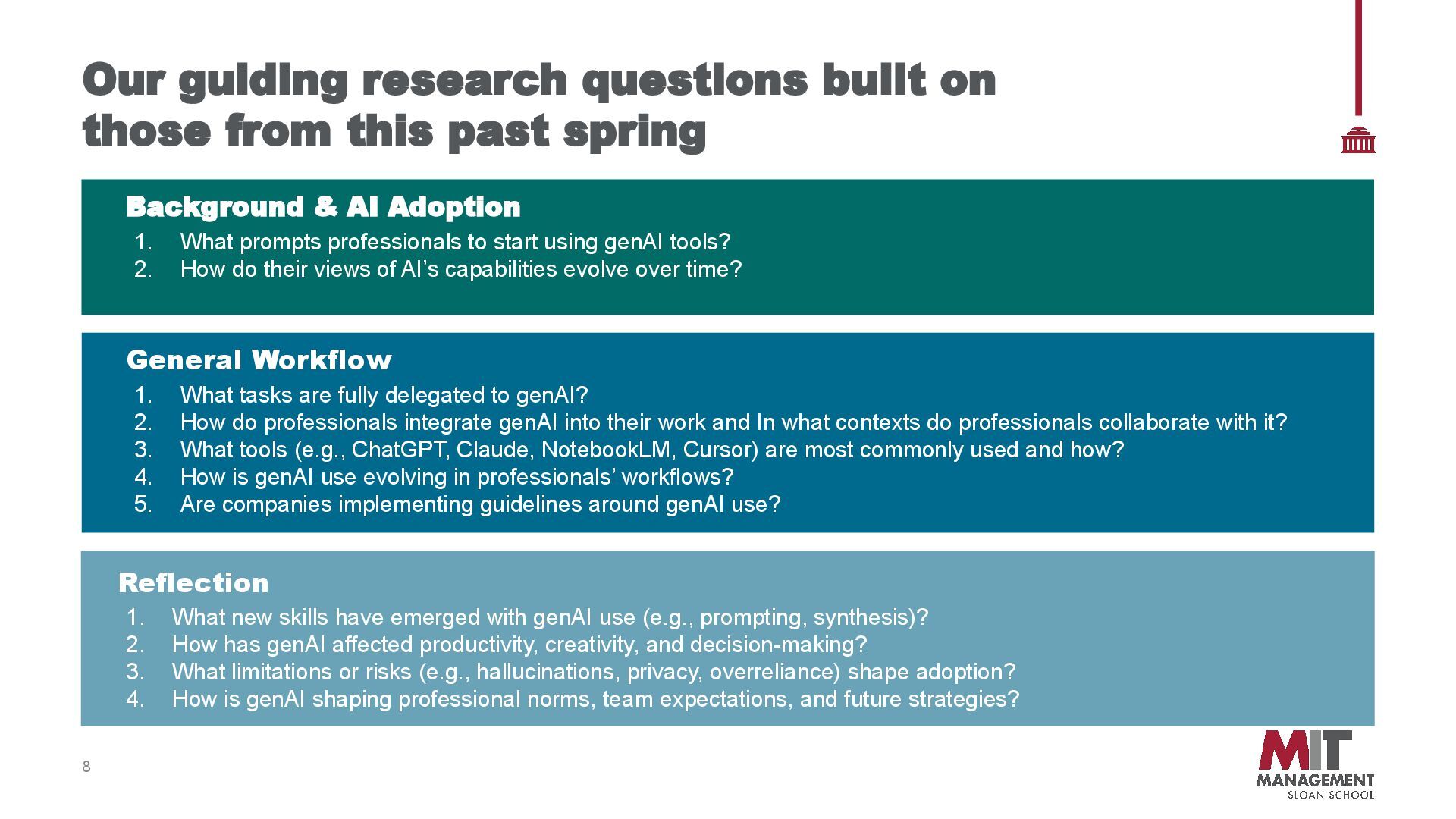
past spring General Workflow 1. What tasks are fully delegated to genAI? 2. How do professionals integrate genAI into their work and In what contexts do professionals collaborate with it? 3. What tools (e.g., ChatGPT, Claude, NotebookLM, Cursor) are most commonly used and how? 4. How is genAI use evolving in professionals’ workflows? 5. Are companies implementing guidelines around genAI use? Reflection 1. What new skills have emerged with genAI use (e.g., prompting, synthesis)? 2. How has genAI affected productivity, creativity, and decision-making? 3. What limitations or risks (e.g., hallucinations, privacy, overreliance) shape adoption? 4. How is genAI shaping professional norms, team expectations, and future strategies? Background & AI Adoption 1. What prompts professionals to start using genAI tools? 2. How do their views of AI’s capabilities evolve over time?
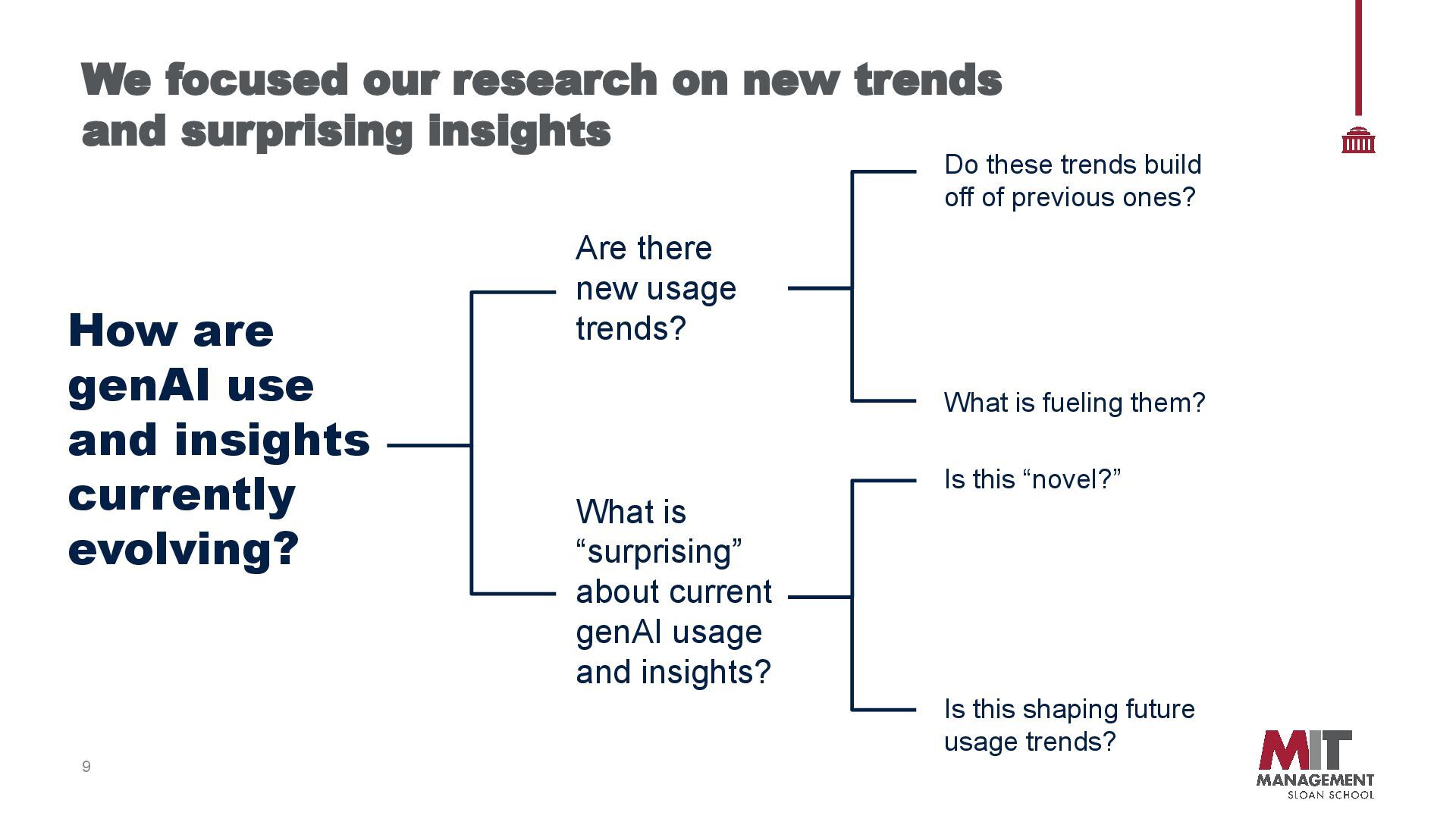
insights How are genAI use and insights currently evolving? Are there new usage trends? What is “surprising” about current genAI usage and insights? Do these trends build off of previous ones? What is fueling them? Is this “novel?” Is this shaping future usage trends?
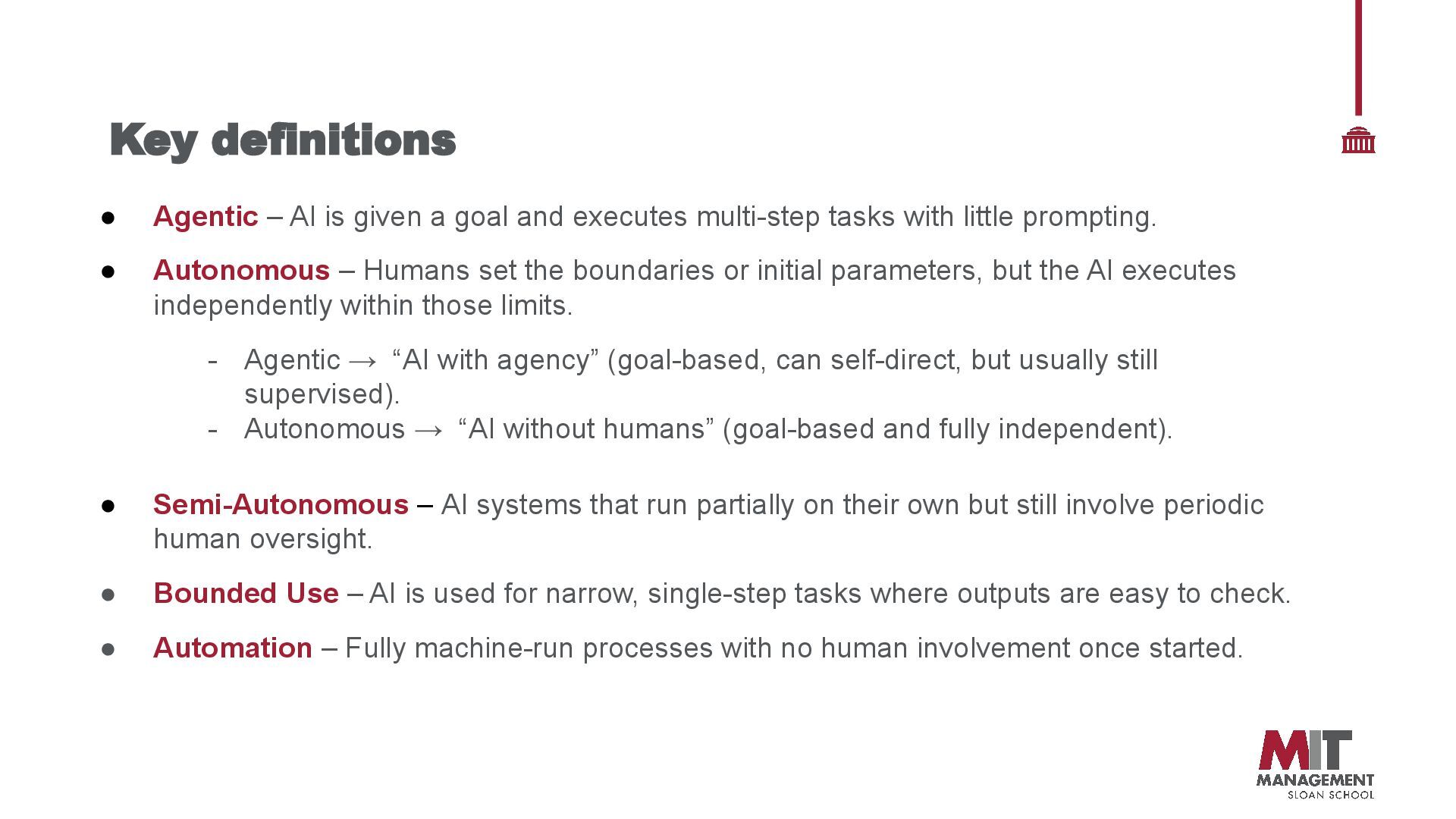
and executes multi-step tasks with little prompting. • Autonomous – Humans set the boundaries or initial parameters, but the AI executes independently within those limits. - Agentic → “AI with agency” (goal-based, can self-direct, but usually still supervised). - Autonomous → “AI without humans” (goal-based and fully independent). • Semi-Autonomous – AI systems that run partially on their own but still involve periodic human oversight. • Bounded Use – AI is used for narrow, single-step tasks where outputs are easy to check. • Automation – Fully machine-run processes with no human involvement once started.
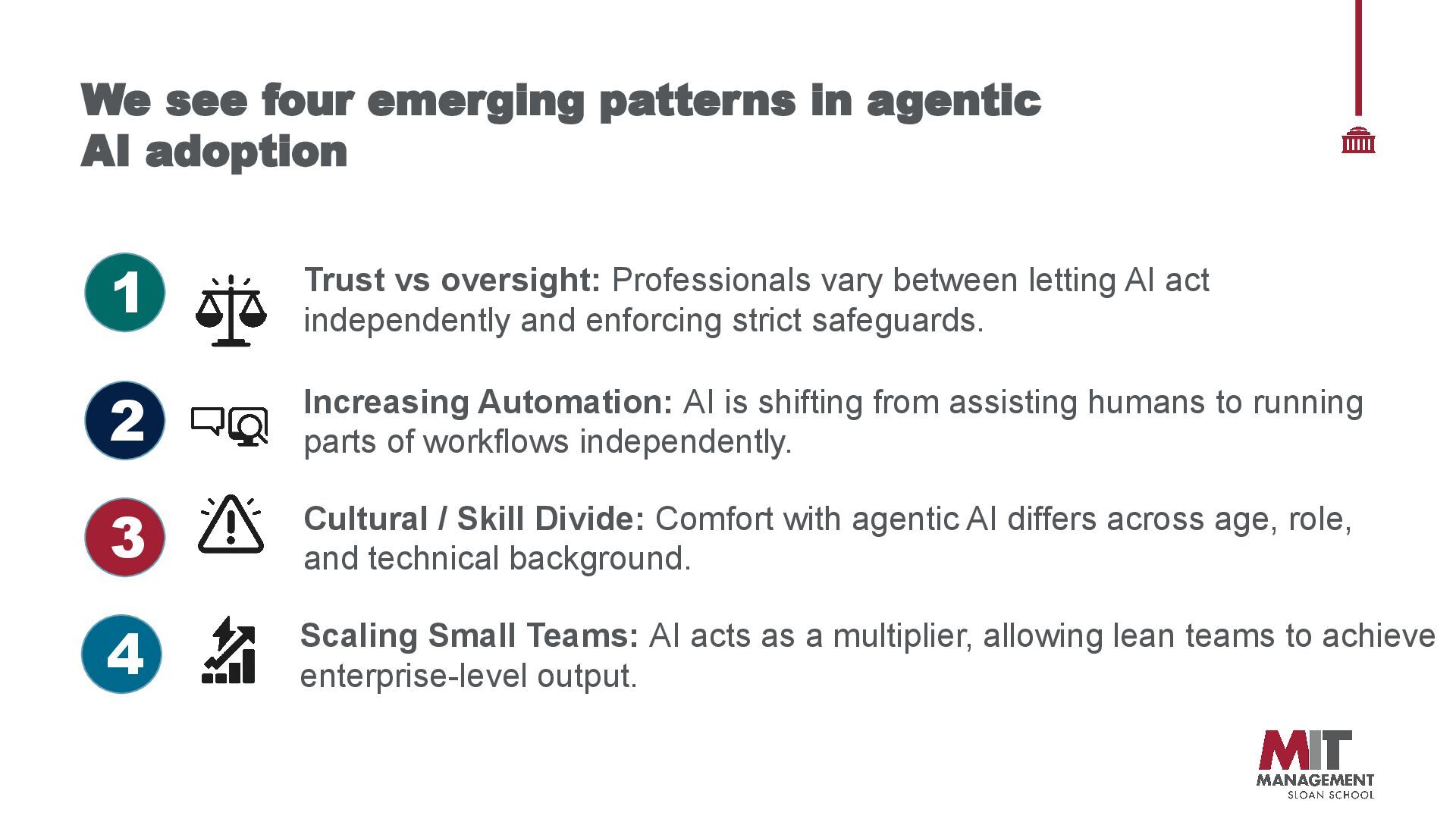
Trust vs oversight: Professionals vary between letting AI act independently and enforcing strict safeguards. 2 Increasing Automation: AI is shifting from assisting humans to running parts of workflows independently. 3 Cultural / Skill Divide: Comfort with agentic AI differs across age, role, and technical background. 4 Scaling Small Teams: AI acts as a multiplier, allowing lean teams to achieve enterprise-level output.
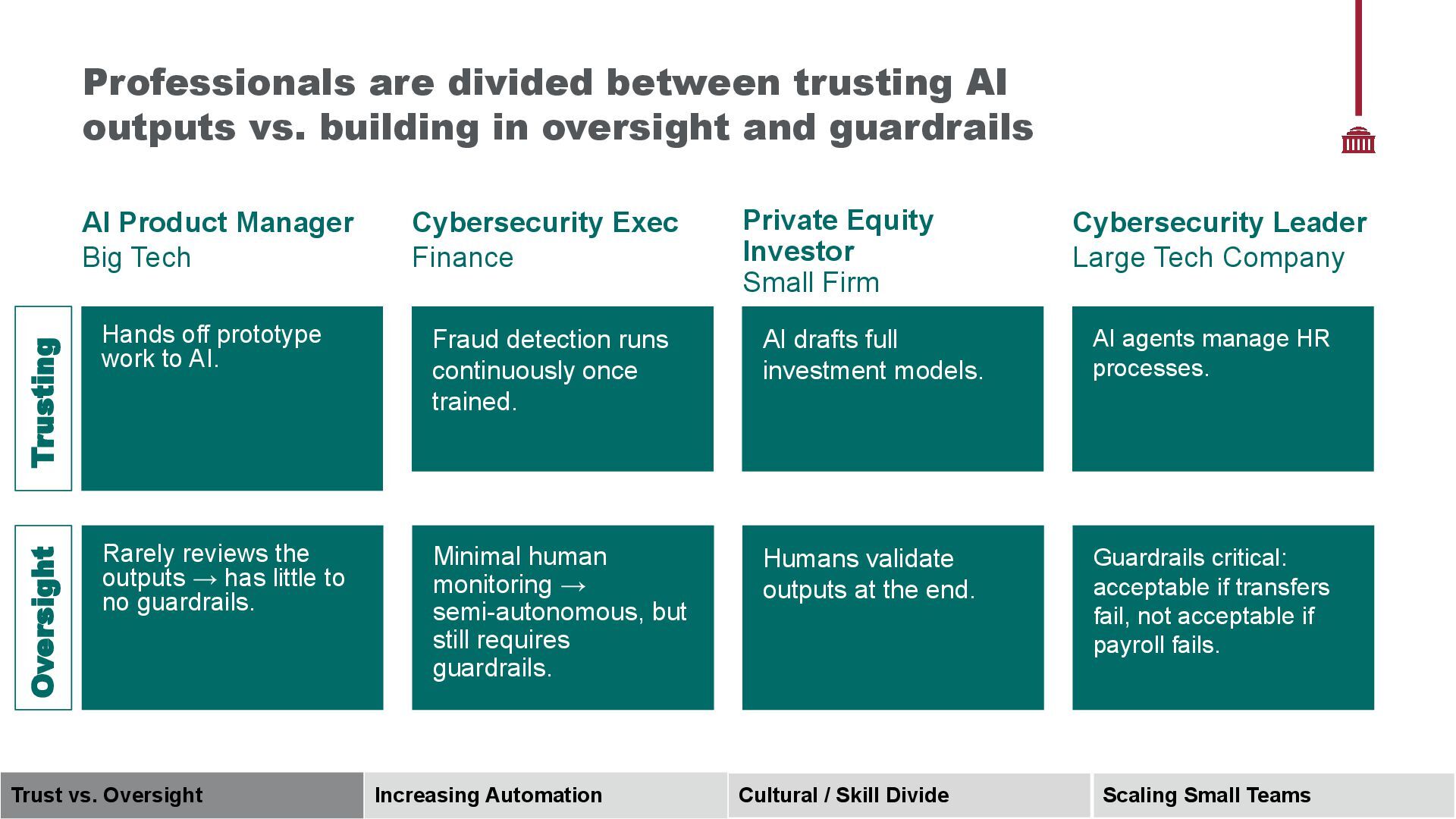
Cybersecurity Exec Finance Cybersecurity Leader Large Tech Company Professionals are divided between trusting AI outputs vs. building in oversight and guardrails AI agents manage HR processes. AI drafts full investment models. Hands off prototype work to AI. Fraud detection runs continuously once trained. Guardrails critical: acceptable if transfers fail, not acceptable if payroll fails. Humans validate outputs at the end. Rarely reviews the outputs → has little to no guardrails. Minimal human monitoring → semi-autonomous, but still requires guardrails. Trust vs. Oversight Increasing Automation Cultural / Skill Divide Scaling Small Teams Trusting Oversight
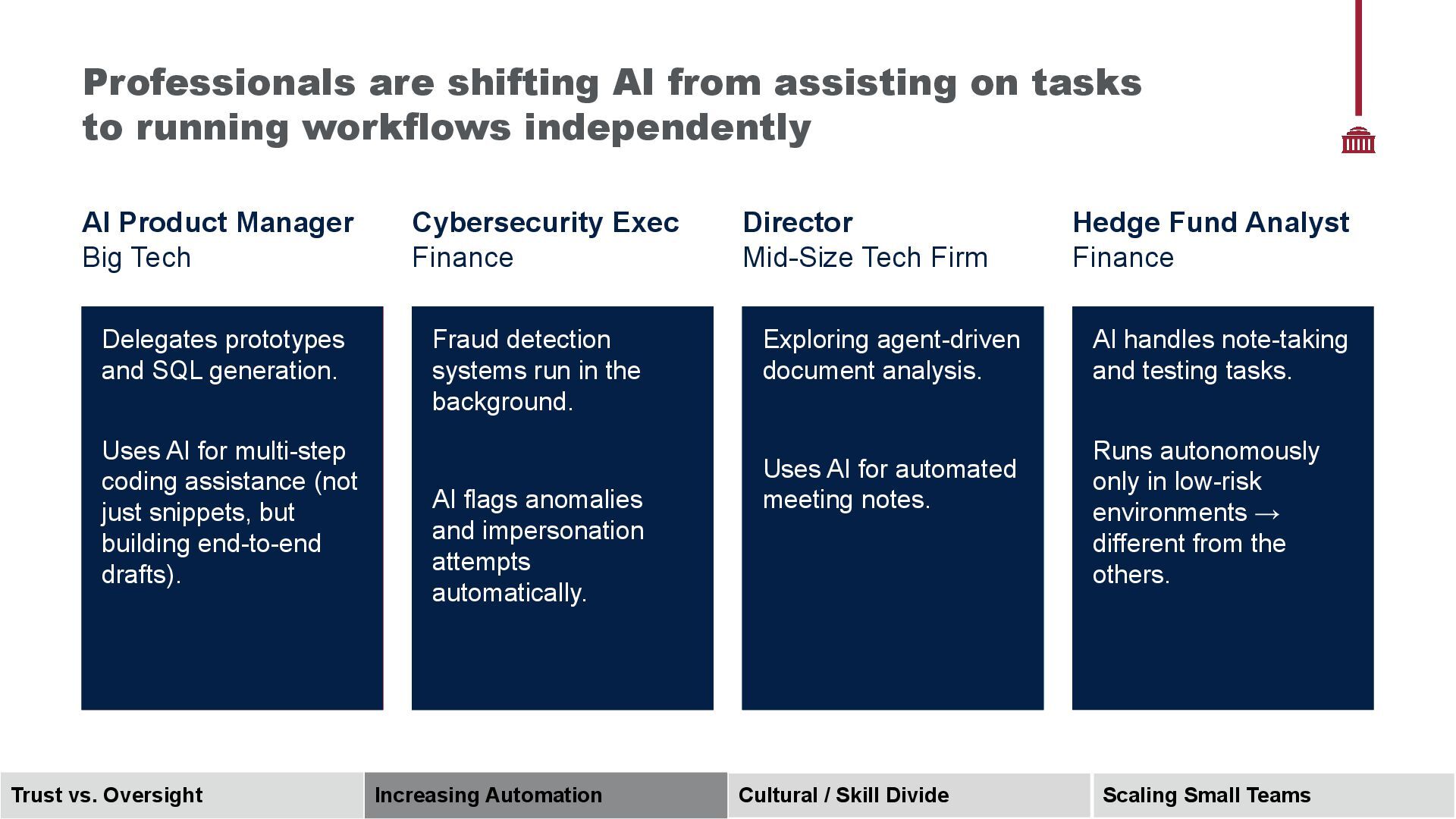
Fund Analyst Finance Professionals are shifting AI from assisting on tasks to running workflows independently AI handles note-taking and testing tasks. Runs autonomously only in low-risk environments → different from the others. Exploring agent-driven document analysis. Uses AI for automated meeting notes. Fraud detection systems run in the background. AI flags anomalies and impersonation attempts automatically. Delegates prototypes and SQL generation. Uses AI for multi-step coding assistance (not just snippets, but building end-to-end drafts). Trust vs. Oversight Increasing Automation Cultural / Skill Divide Scaling Small Teams Cybersecurity Exec Finance
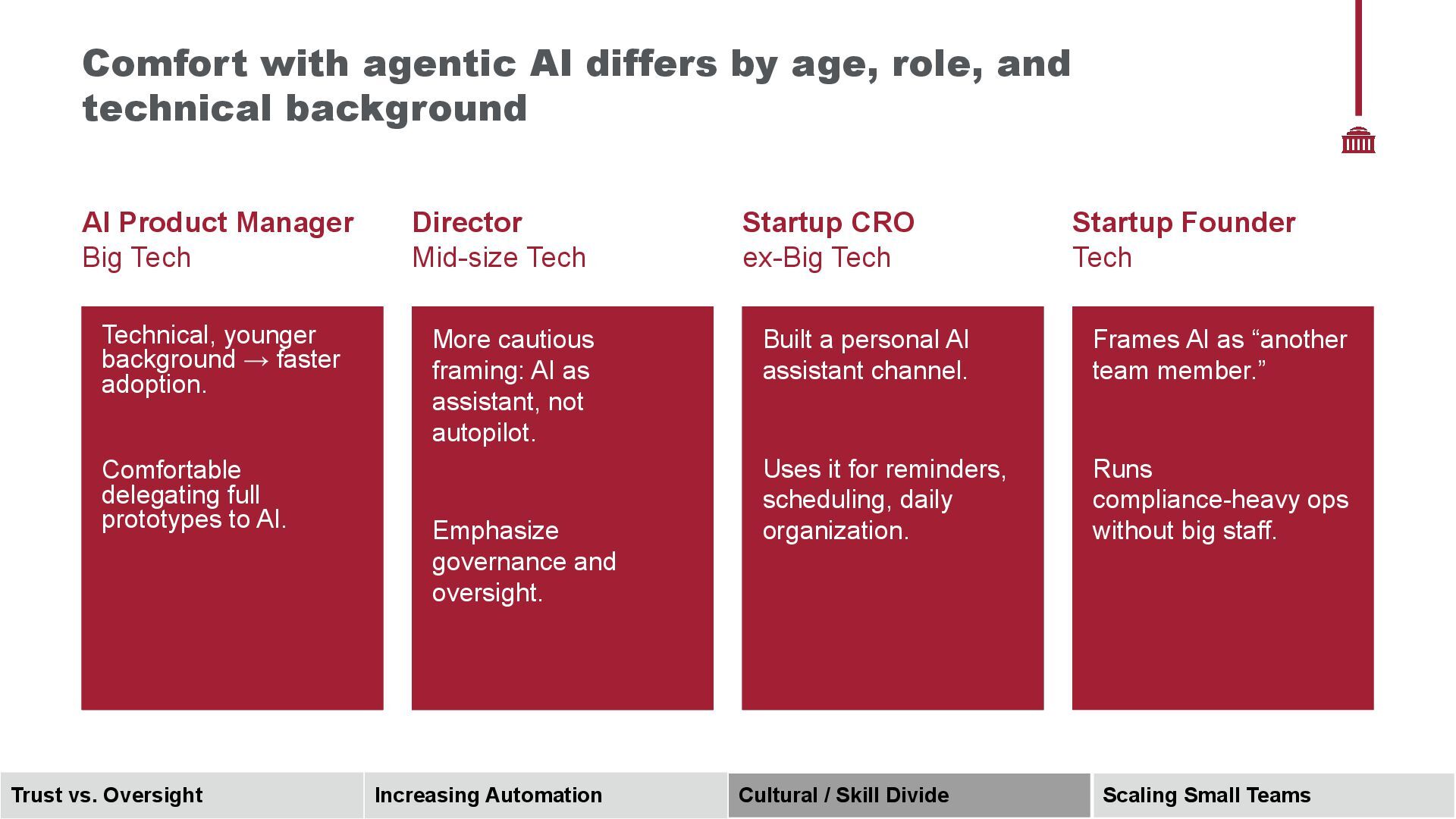
ex-Big Tech Startup Founder Tech Comfort with agentic AI differs by age, role, and technical background Frames AI as “another team member.” Runs compliance-heavy ops without big staff. Built a personal AI assistant channel. Uses it for reminders, scheduling, daily organization. More cautious framing: AI as assistant, not autopilot. Emphasize governance and oversight. Technical, younger background → faster adoption. Comfortable delegating full prototypes to AI. Trust vs. Oversight Increasing Automation Cultural / Skill Divide Scaling Small Teams
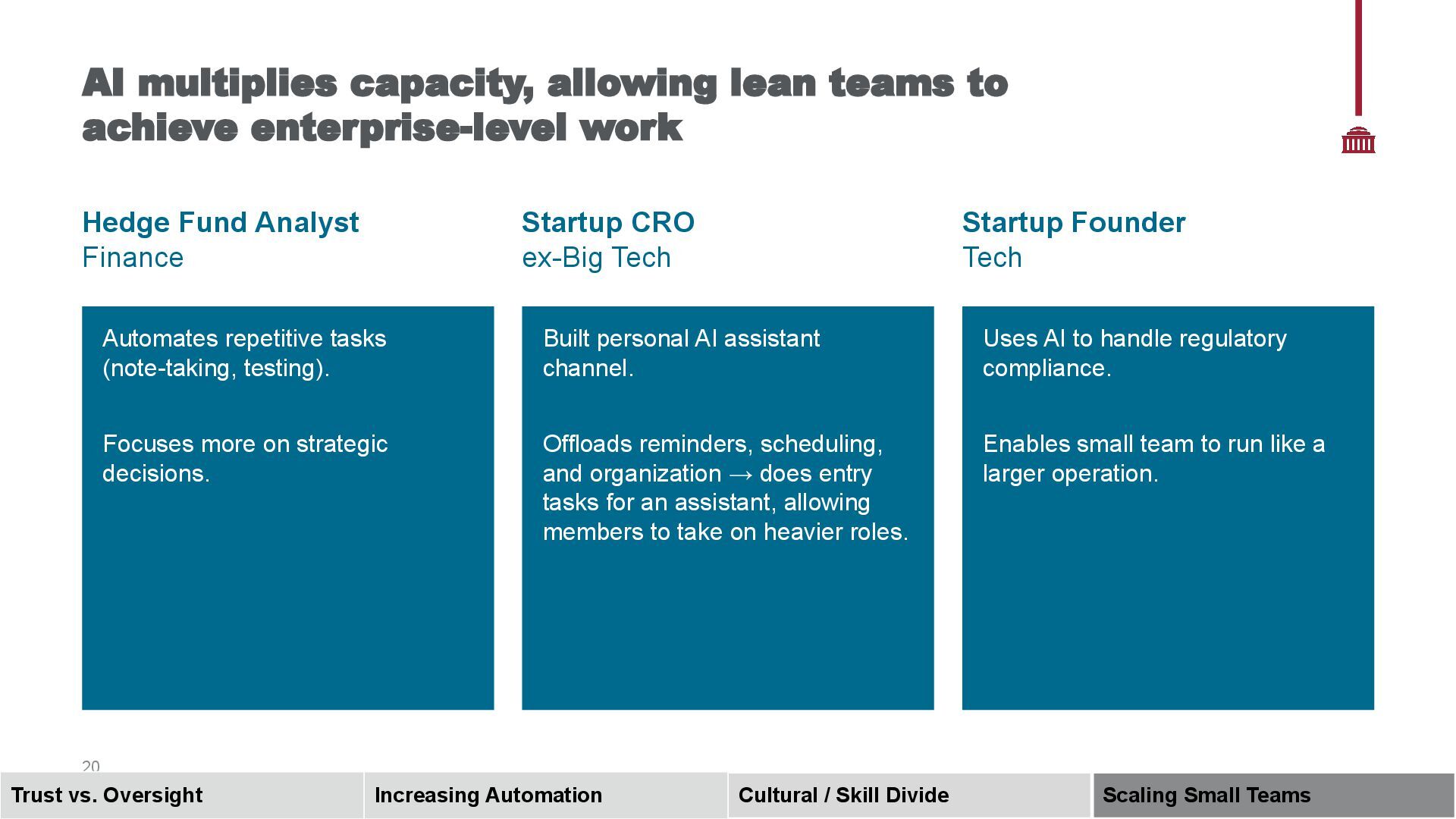
Focuses more on strategic decisions. Startup CRO ex-Big Tech Built personal AI assistant channel. Offloads reminders, scheduling, and organization → does entry tasks for an assistant, allowing members to take on heavier roles. Startup Founder Tech Uses AI to handle regulatory compliance. Enables small team to run like a larger operation. AI multiplies capacity, allowing lean teams to achieve enterprise-level work Trust vs. Oversight Increasing Automation Cultural / Skill Divide Scaling Small Teams
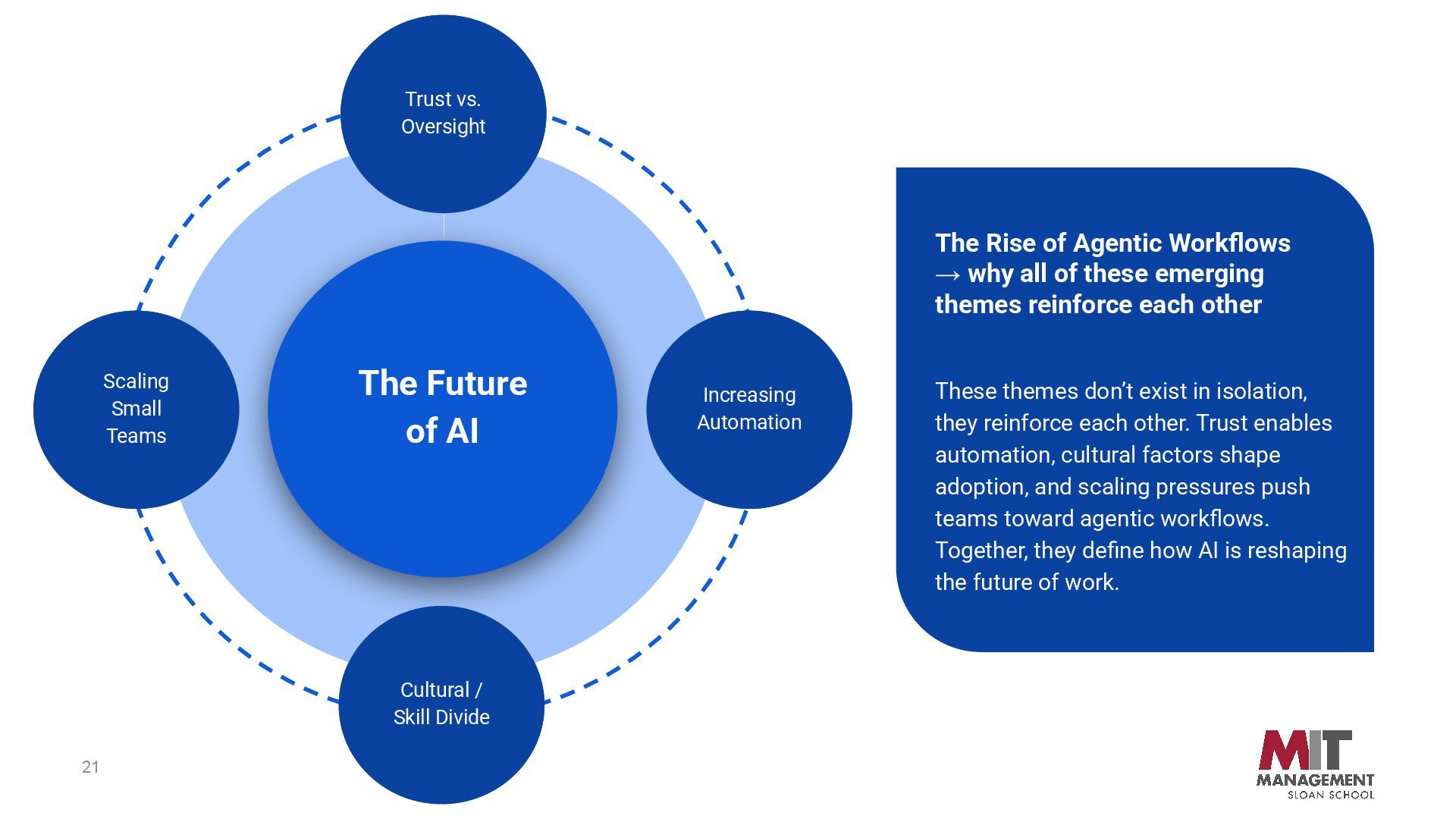
Lorem ipsum The Future of AI Trust vs. Oversight Cultural / Skill Divide Scaling Small Teams Increasing Automation The Rise of Agentic Workflows → why all of these emerging themes reinforce each other These themes don’t exist in isolation, they reinforce each other. Trust enables automation, cultural factors shape adoption, and scaling pressures push teams toward agentic workflows. Together, they define how AI is reshaping the future of work.
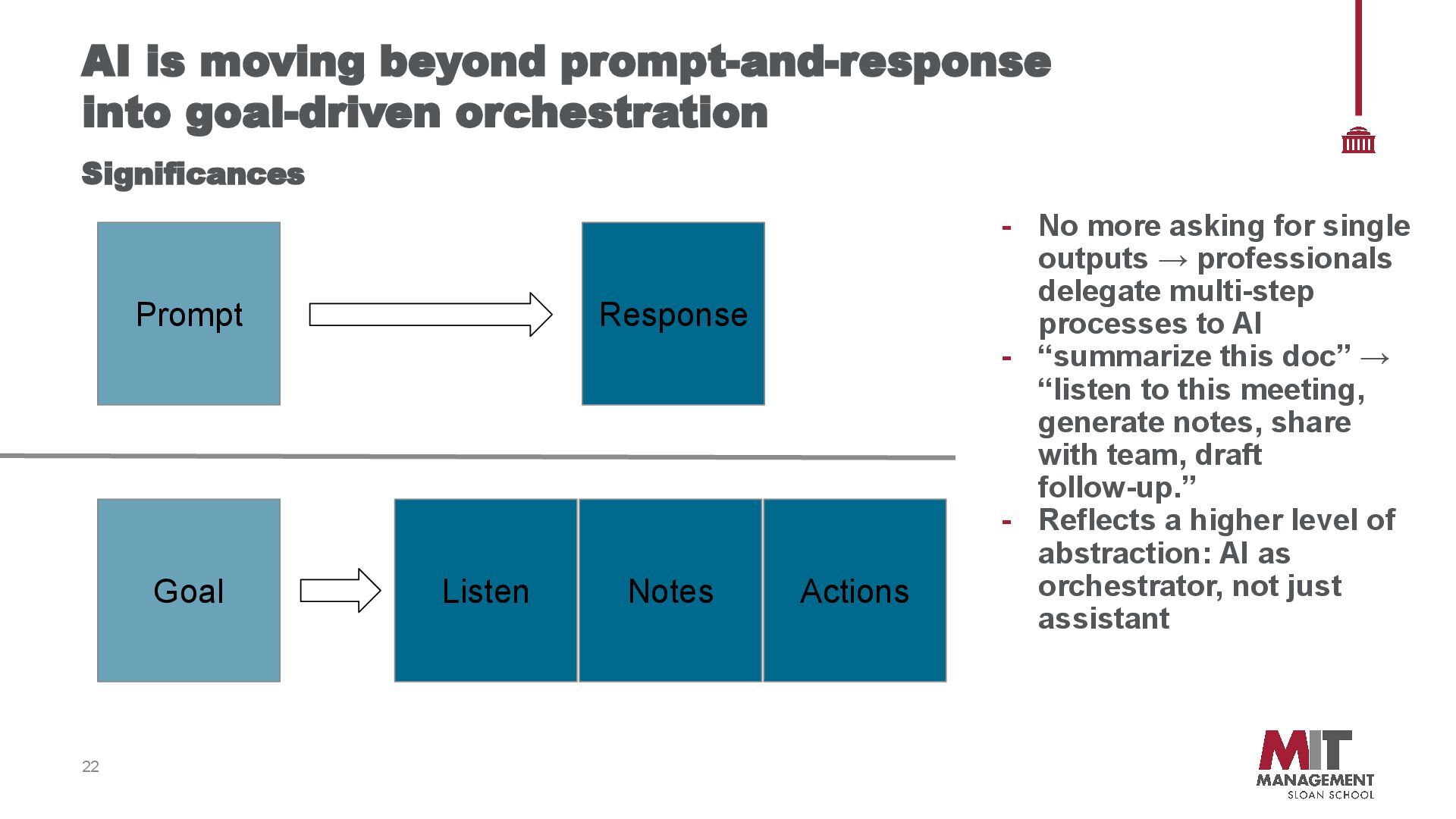
multi-step processes to AI - “summarize this doc” → “listen to this meeting, generate notes, share with team, draft follow-up.” - Reflects a higher level of abstraction: AI as orchestrator, not just assistant 22 AI is moving beyond prompt-and-response into goal-driven orchestration Prompt Response Goal Actions Notes Listen Significances
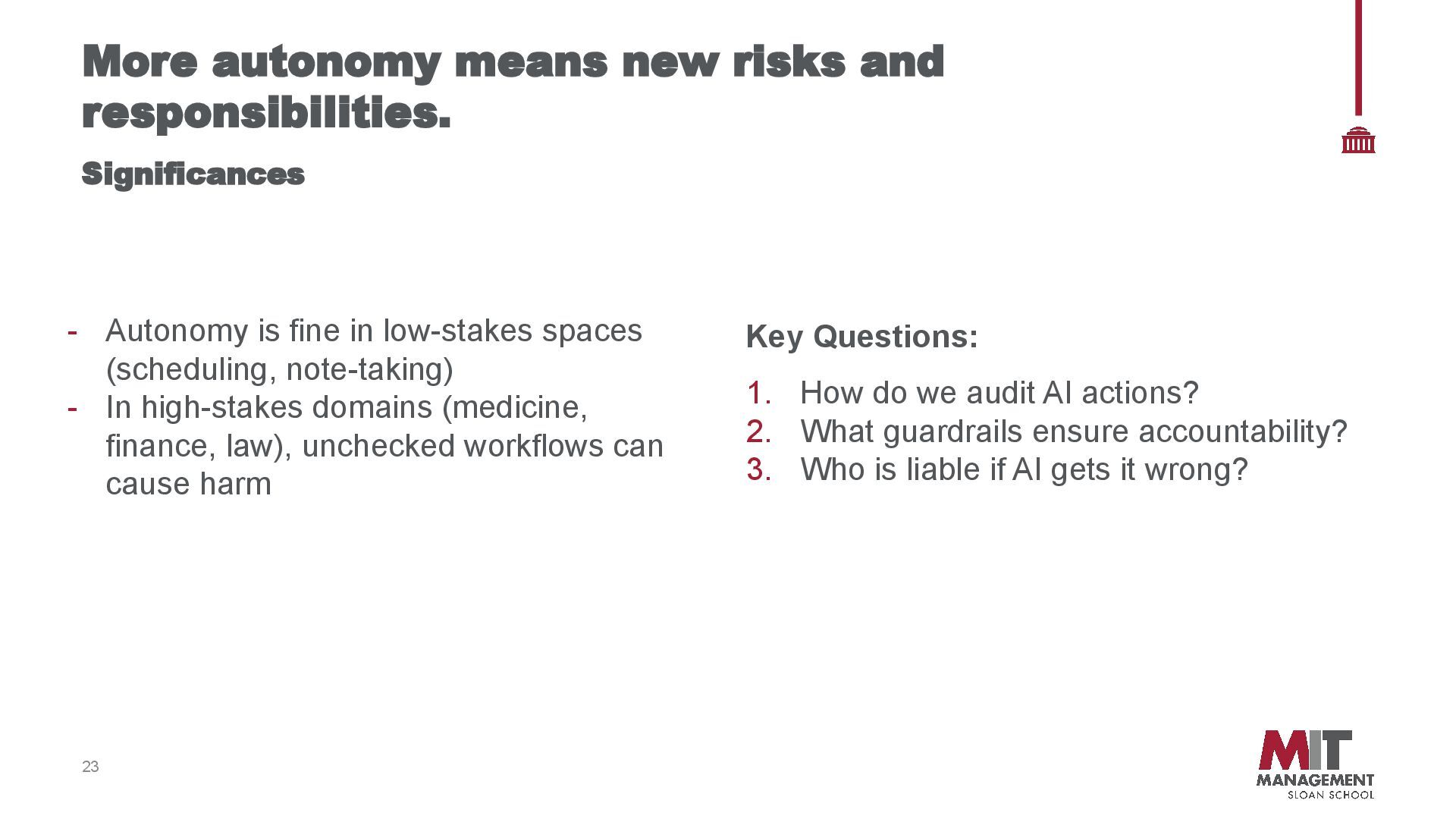
In high-stakes domains (medicine, finance, law), unchecked workflows can cause harm 23 More autonomy means new risks and responsibilities. Significances Key Questions: 1. How do we audit AI actions? 2. What guardrails ensure accountability? 3. Who is liable if AI gets it wrong?
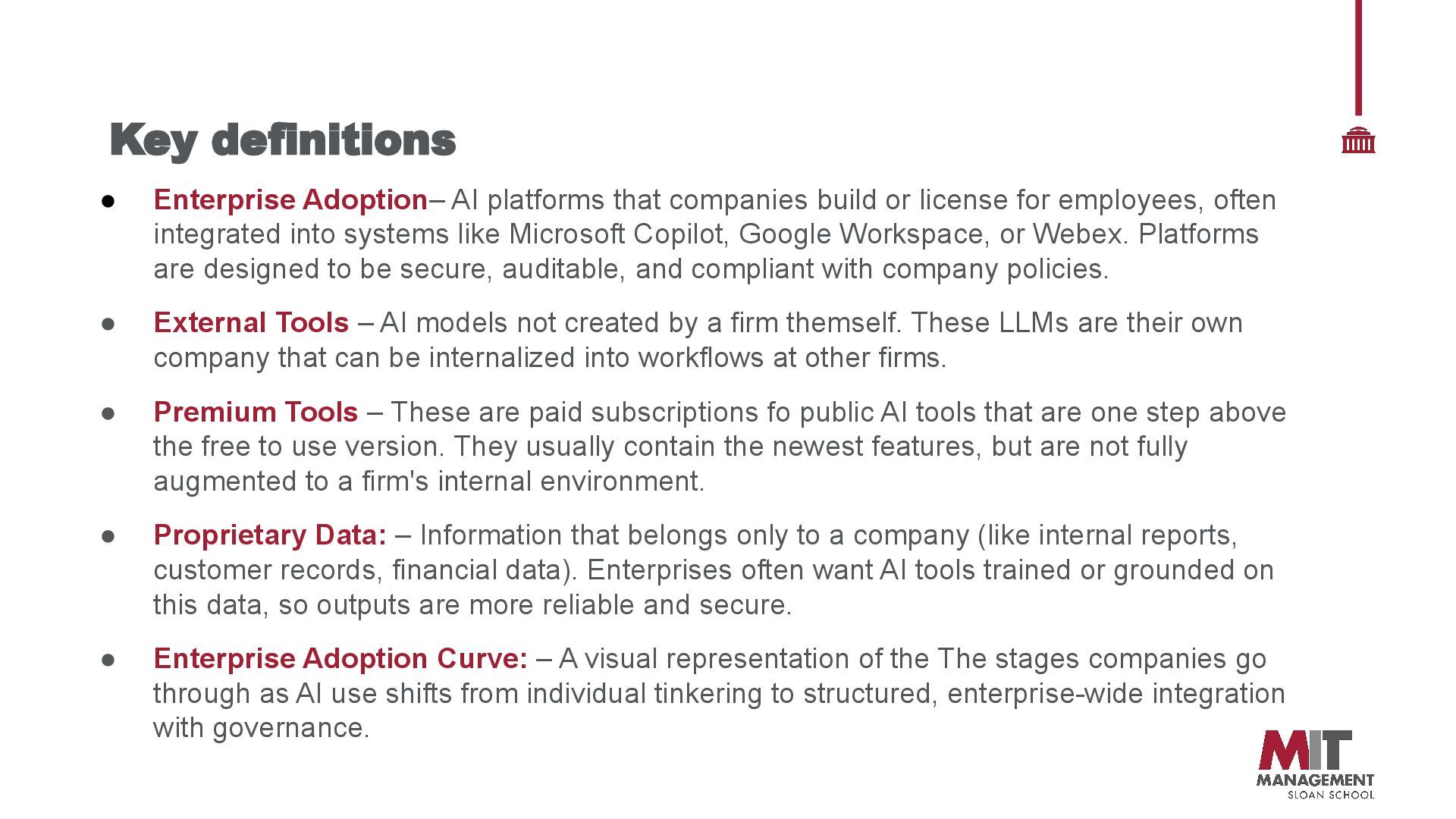
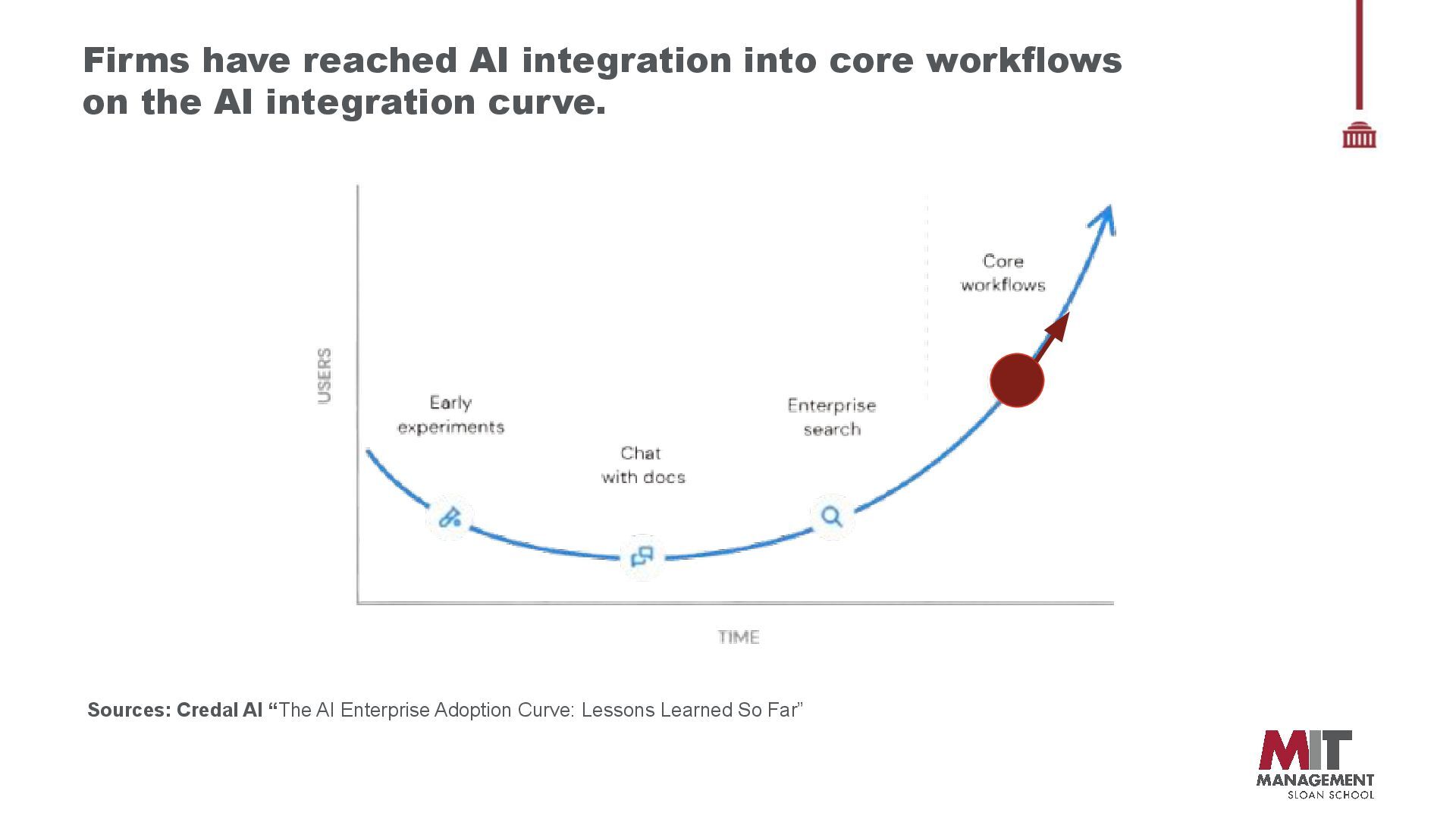
or license for employees, often integrated into systems like Microsoft Copilot, Google Workspace, or Webex. Platforms are designed to be secure, auditable, and compliant with company policies. • External Tools – AI models not created by a firm themself. These LLMs are their own company that can be internalized into workflows at other firms. • Premium Tools – These are paid subscriptions fo public AI tools that are one step above the free to use version. They usually contain the newest features, but are not fully augmented to a firm's internal environment. • Proprietary Data: – Information that belongs only to a company (like internal reports, customer records, financial data). Enterprises often want AI tools trained or grounded on this data, so outputs are more reliable and secure. • Enterprise Adoption Curve: – A visual representation of the The stages companies go through as AI use shifts from individual tinkering to structured, enterprise-wide integration with governance.
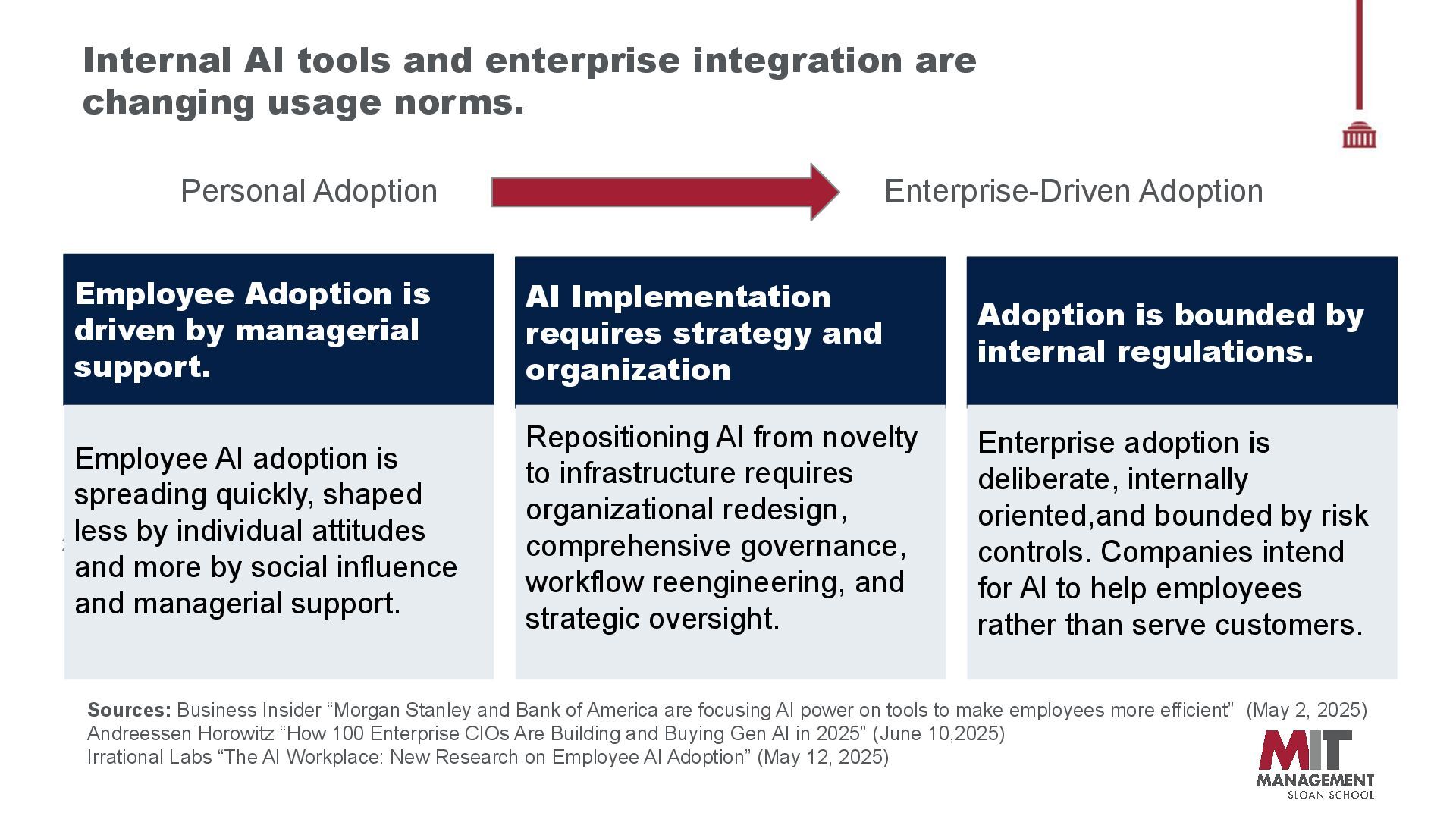
bounded by internal regulations. AI Implementation requires strategy and organization Employee AI adoption is spreading quickly, shaped less by individual attitudes and more by social influence and managerial support. Enterprise adoption is deliberate, internally oriented,and bounded by risk controls. Companies intend for AI to help employees rather than serve customers. Repositioning AI from novelty to infrastructure requires organizational redesign, comprehensive governance, workflow reengineering, and strategic oversight. Personal Adoption Enterprise-Driven Adoption Sources: Business Insider “Morgan Stanley and Bank of America are focusing AI power on tools to make employees more efficient” (May 2, 2025) Andreessen Horowitz “How 100 Enterprise CIOs Are Building and Buying Gen AI in 2025” (June 10,2025) Irrational Labs “The AI Workplace: New Research on Employee AI Adoption” (May 12, 2025) Internal AI tools and enterprise integration are changing usage norms.
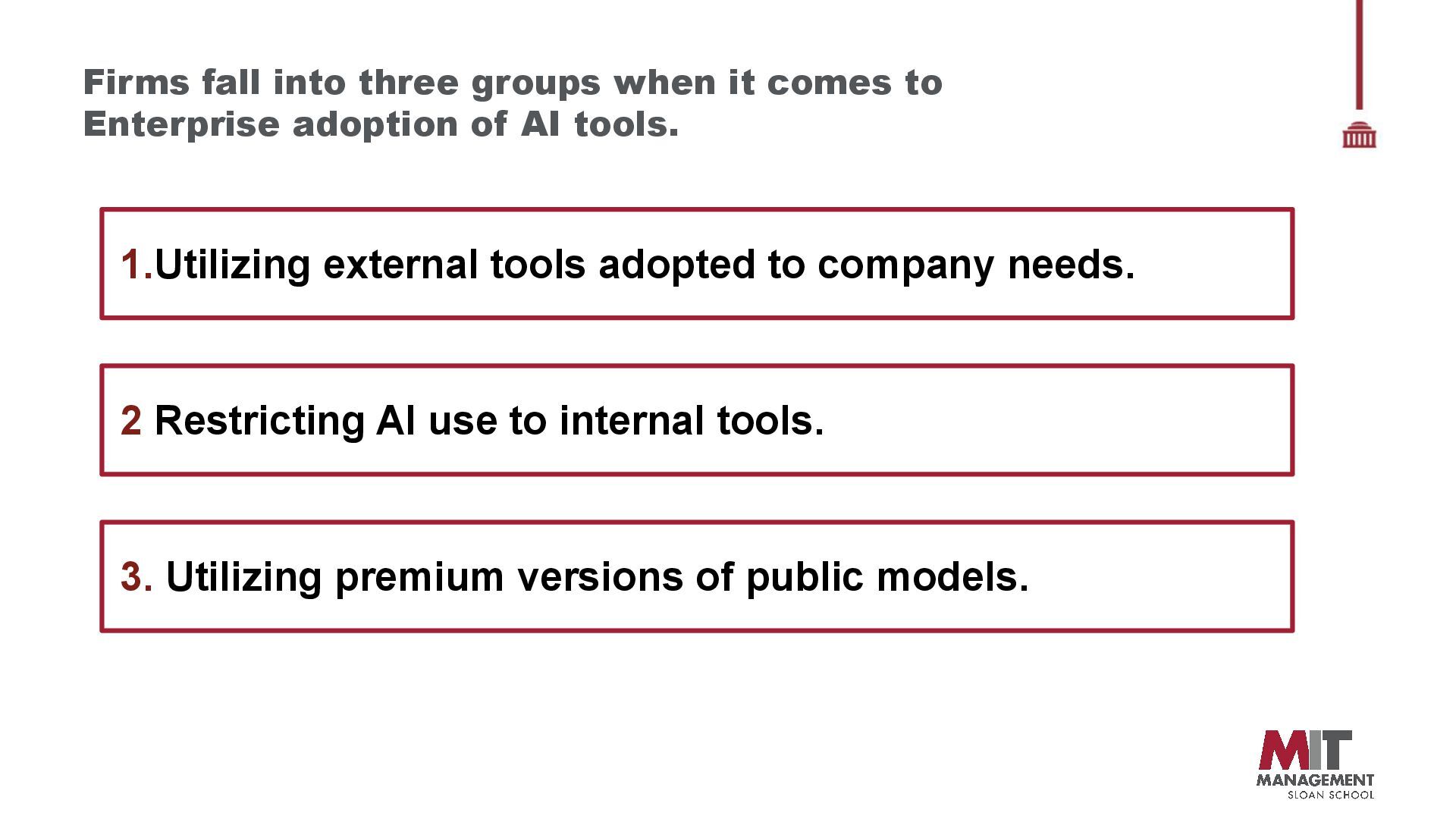
adoption of AI tools. 1.Utilizing external tools adopted to company needs. 2 Restricting AI use to internal tools. 3. Utilizing premium versions of public models.
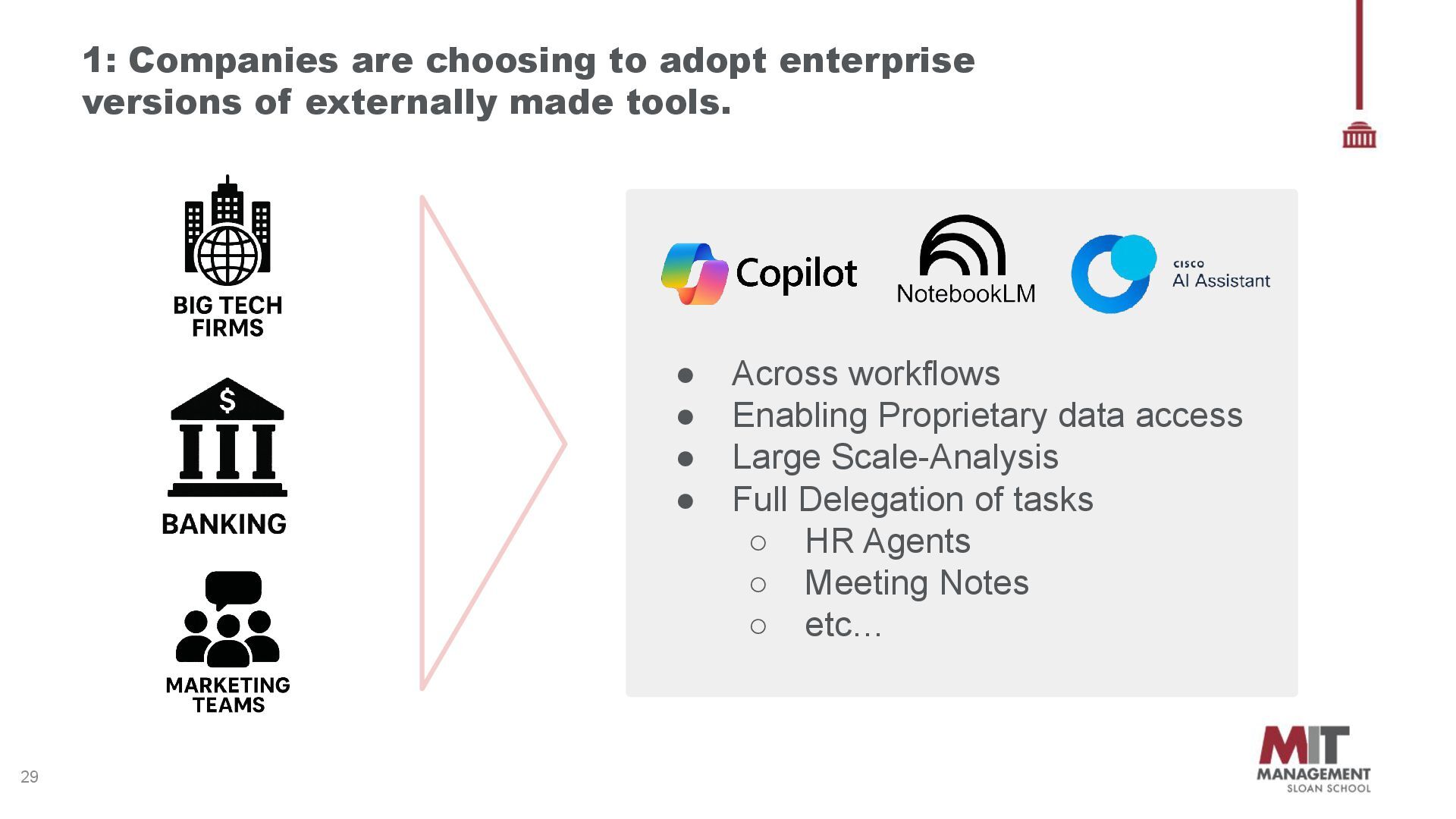
externally made tools. • Across workflows • Enabling Proprietary data access • Large Scale-Analysis • Full Delegation of tasks ◦ HR Agents ◦ Meeting Notes ◦ etc…
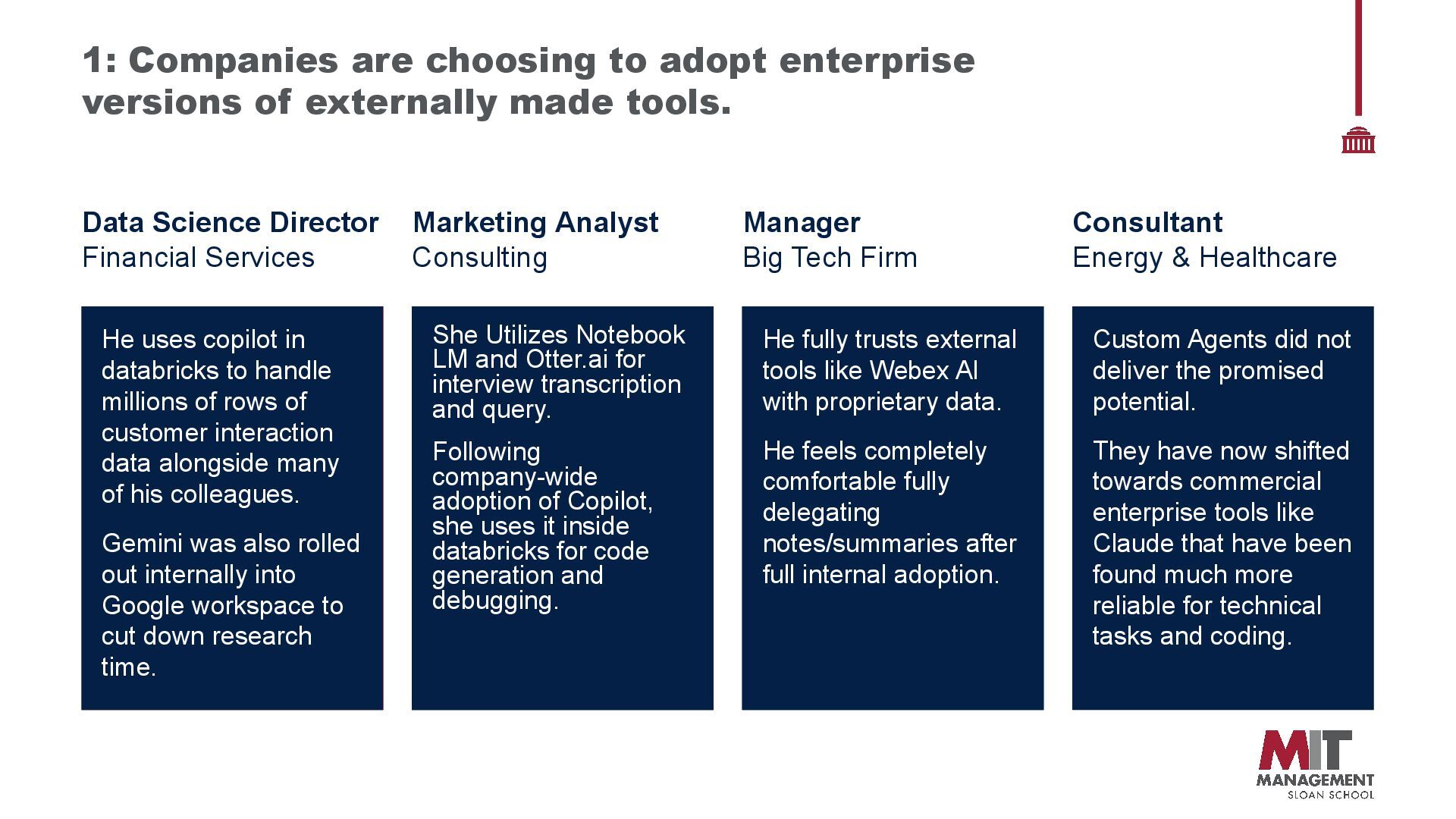
Energy & Healthcare Custom Agents did not deliver the promised potential. They have now shifted towards commercial enterprise tools like Claude that have been found much more reliable for technical tasks and coding. He fully trusts external tools like Webex AI with proprietary data. He feels completely comfortable fully delegating notes/summaries after full internal adoption. She Utilizes Notebook LM and Otter.ai for interview transcription and query. Following company-wide adoption of Copilot, she uses it inside databricks for code generation and debugging. He uses copilot in databricks to handle millions of rows of customer interaction data alongside many of his colleagues. Gemini was also rolled out internally into Google workspace to cut down research time. Marketing Analyst Consulting 1: Companies are choosing to adopt enterprise versions of externally made tools.
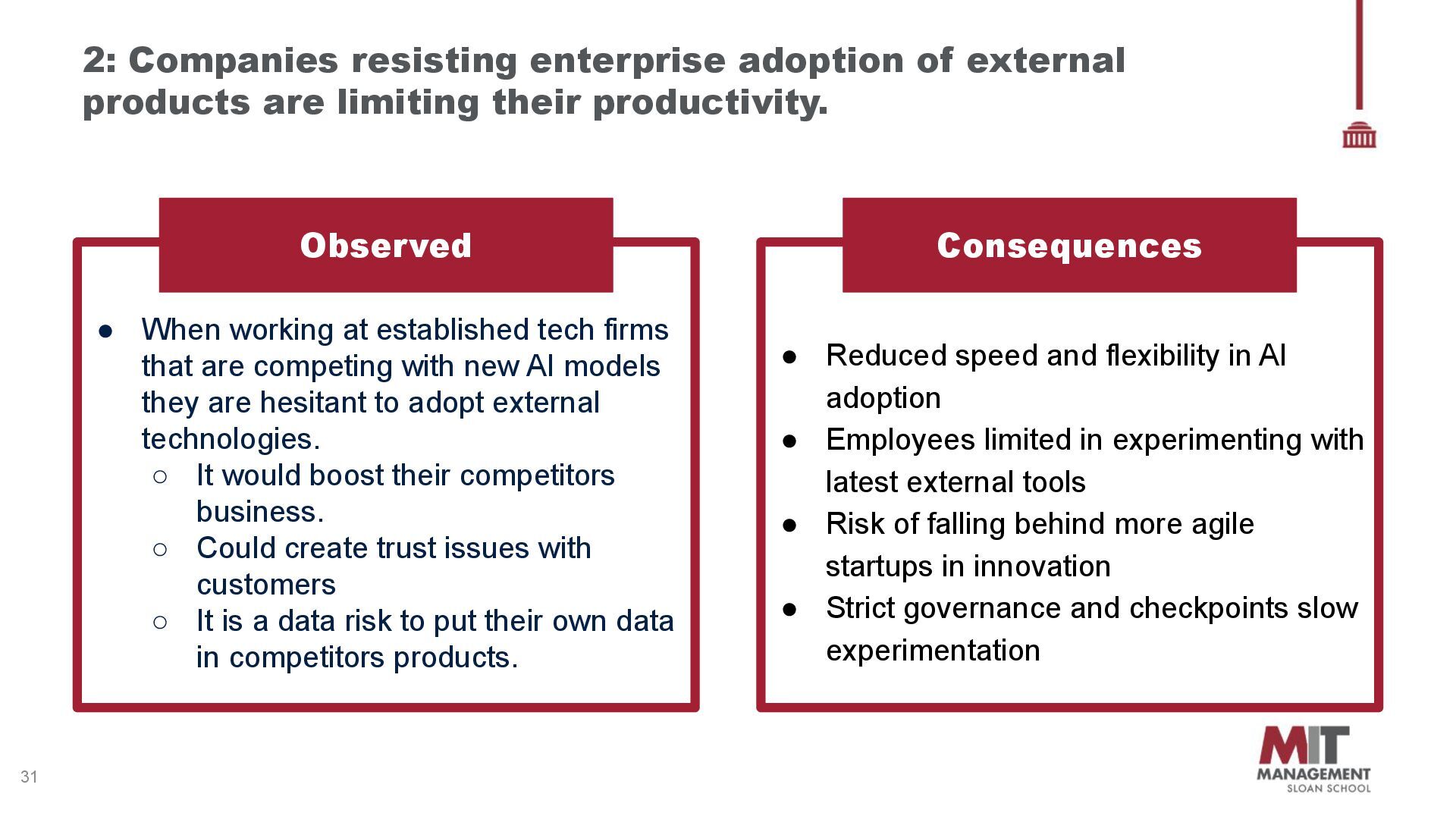
competing with new AI models they are hesitant to adopt external technologies. ◦ It would boost their competitors business. ◦ Could create trust issues with customers ◦ It is a data risk to put their own data in competitors products. Observed • Reduced speed and flexibility in AI adoption • Employees limited in experimenting with latest external tools • Risk of falling behind more agile startups in innovation • Strict governance and checkpoints slow experimentation Consequences 2: Companies resisting enterprise adoption of external products are limiting their productivity.
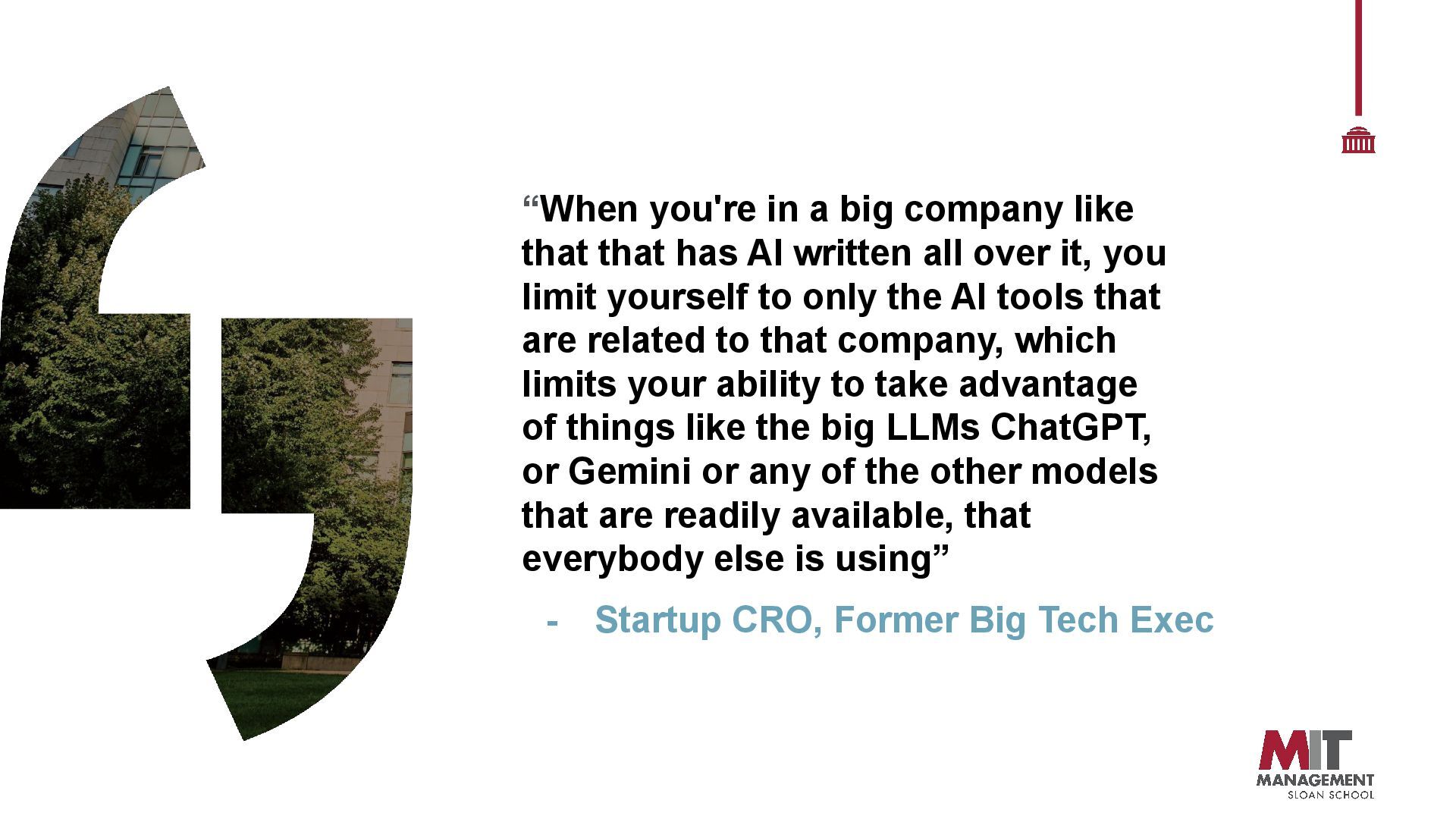
AI written all over it, you limit yourself to only the AI tools that are related to that company, which limits your ability to take advantage of things like the big LLMs ChatGPT, or Gemini or any of the other models that are readily available, that everybody else is using” - Startup CRO, Former Big Tech Exec
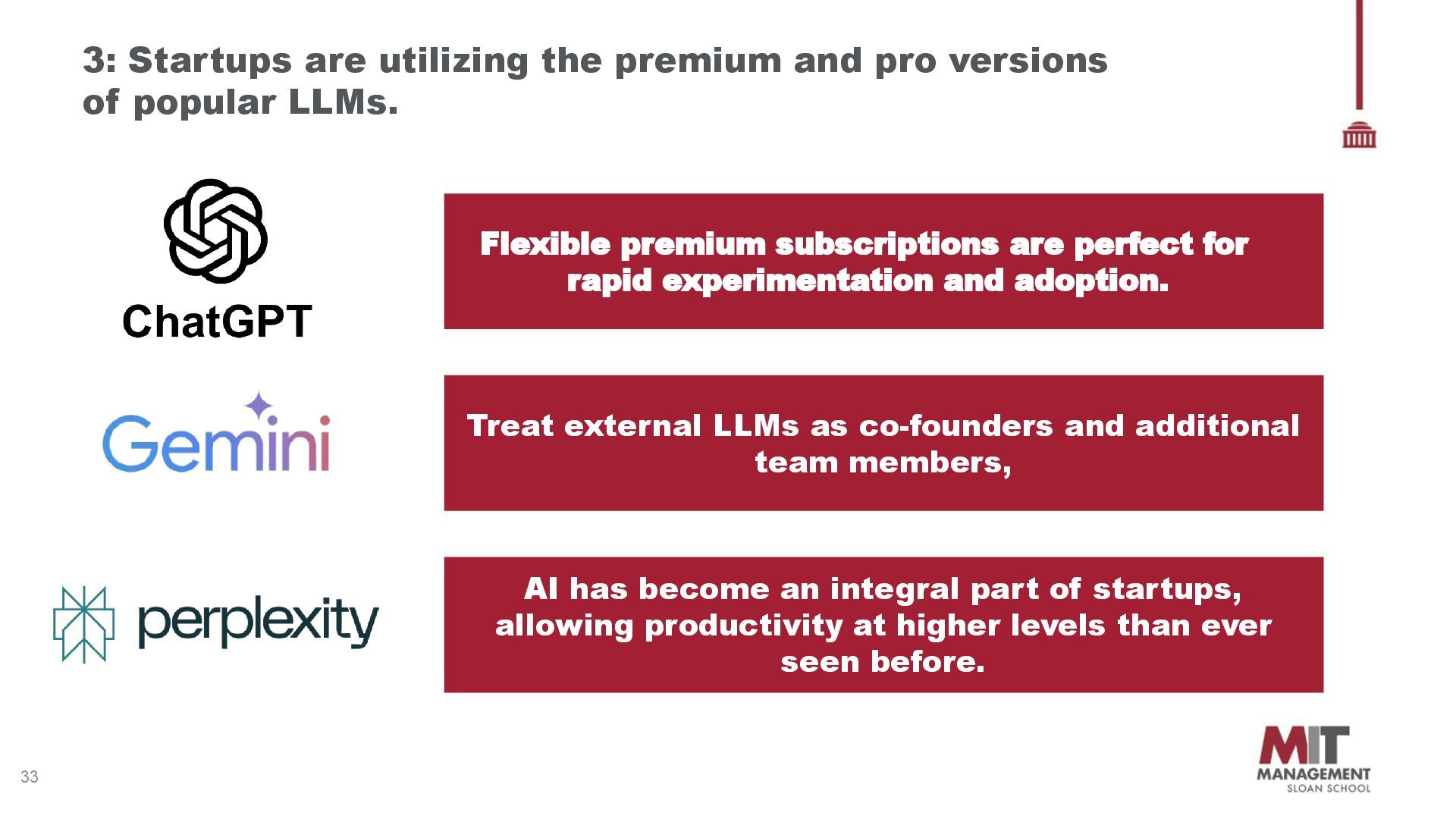
of popular LLMs. Flexible premium subscriptions are perfect for rapid experimentation and adoption. Treat external LLMs as co-founders and additional team members, AI has become an integral part of startups, allowing productivity at higher levels than ever seen before.
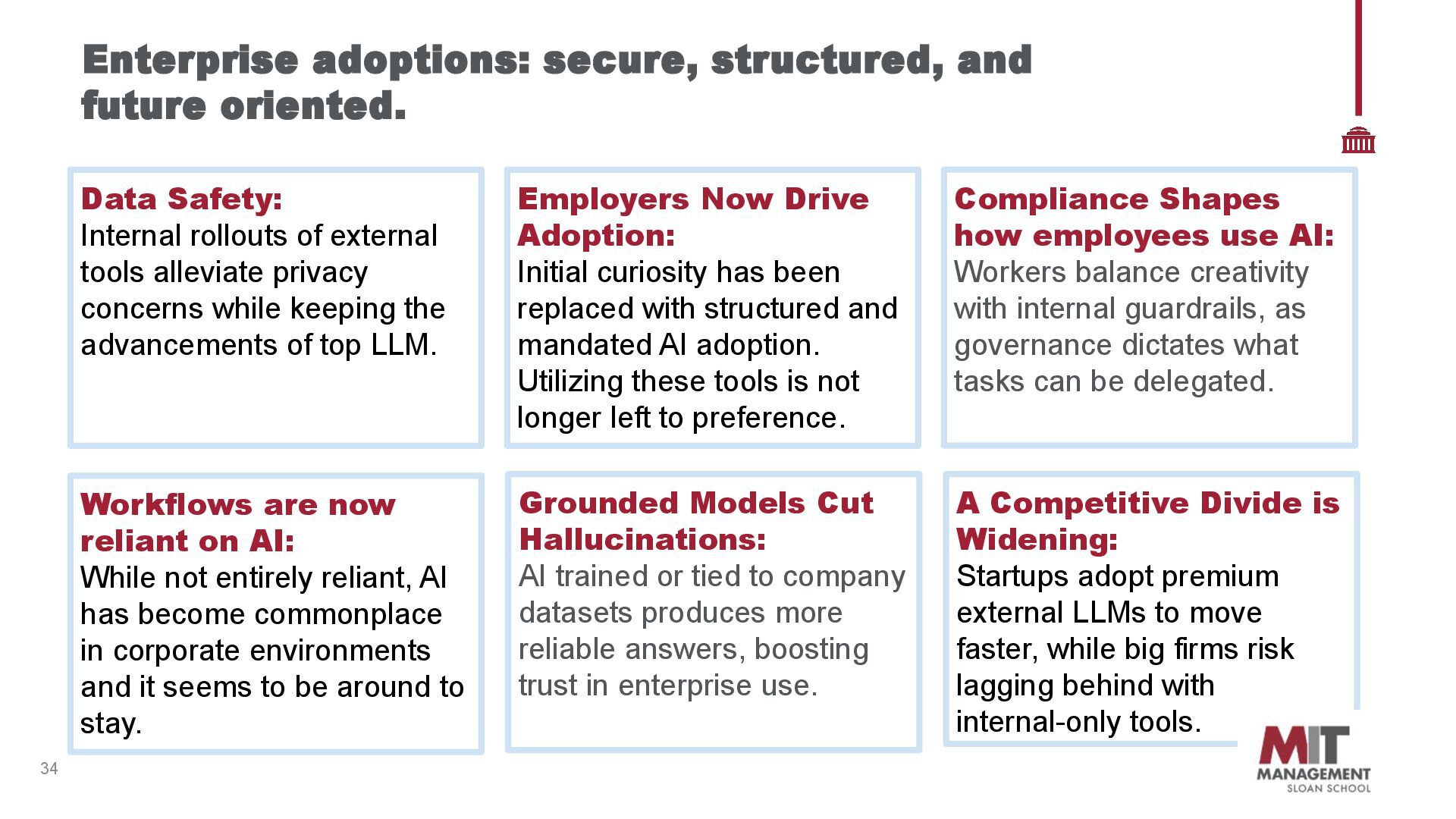
while keeping the advancements of top LLM. Employers Now Drive Adoption: Initial curiosity has been replaced with structured and mandated AI adoption. Utilizing these tools is not longer left to preference. Grounded Models Cut Hallucinations: AI trained or tied to company datasets produces more reliable answers, boosting trust in enterprise use. A Competitive Divide is Widening: Startups adopt premium external LLMs to move faster, while big firms risk lagging behind with internal-only tools. Compliance Shapes how employees use AI: Workers balance creativity with internal guardrails, as governance dictates what tasks can be delegated. Enterprise adoptions: secure, structured, and future oriented. 34 Workflows are now reliant on AI: While not entirely reliant, AI has become commonplace in corporate environments and it seems to be around to stay.
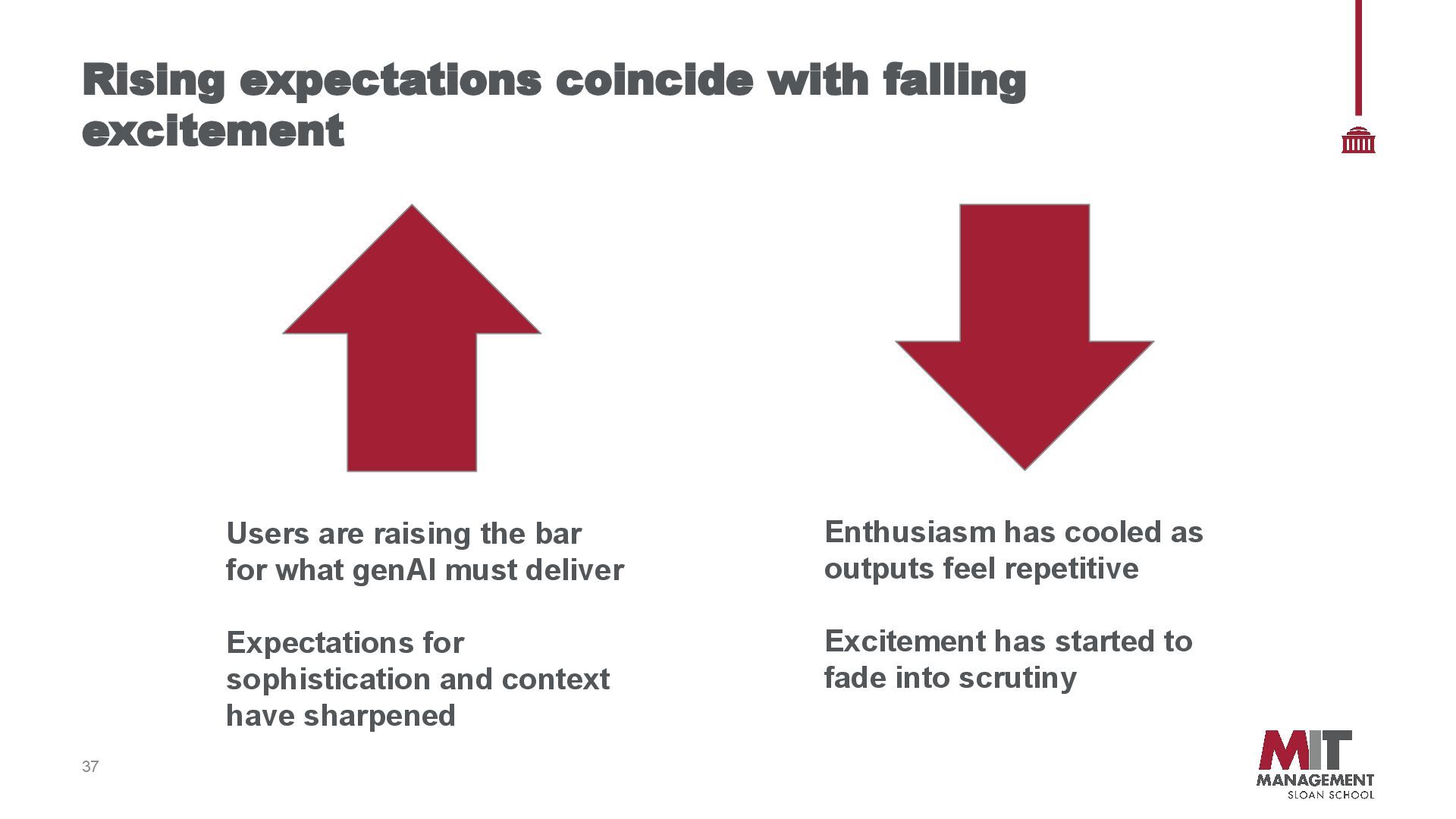
the bar for what genAI must deliver Expectations for sophistication and context have sharpened Enthusiasm has cooled as outputs feel repetitive Excitement has started to fade into scrutiny
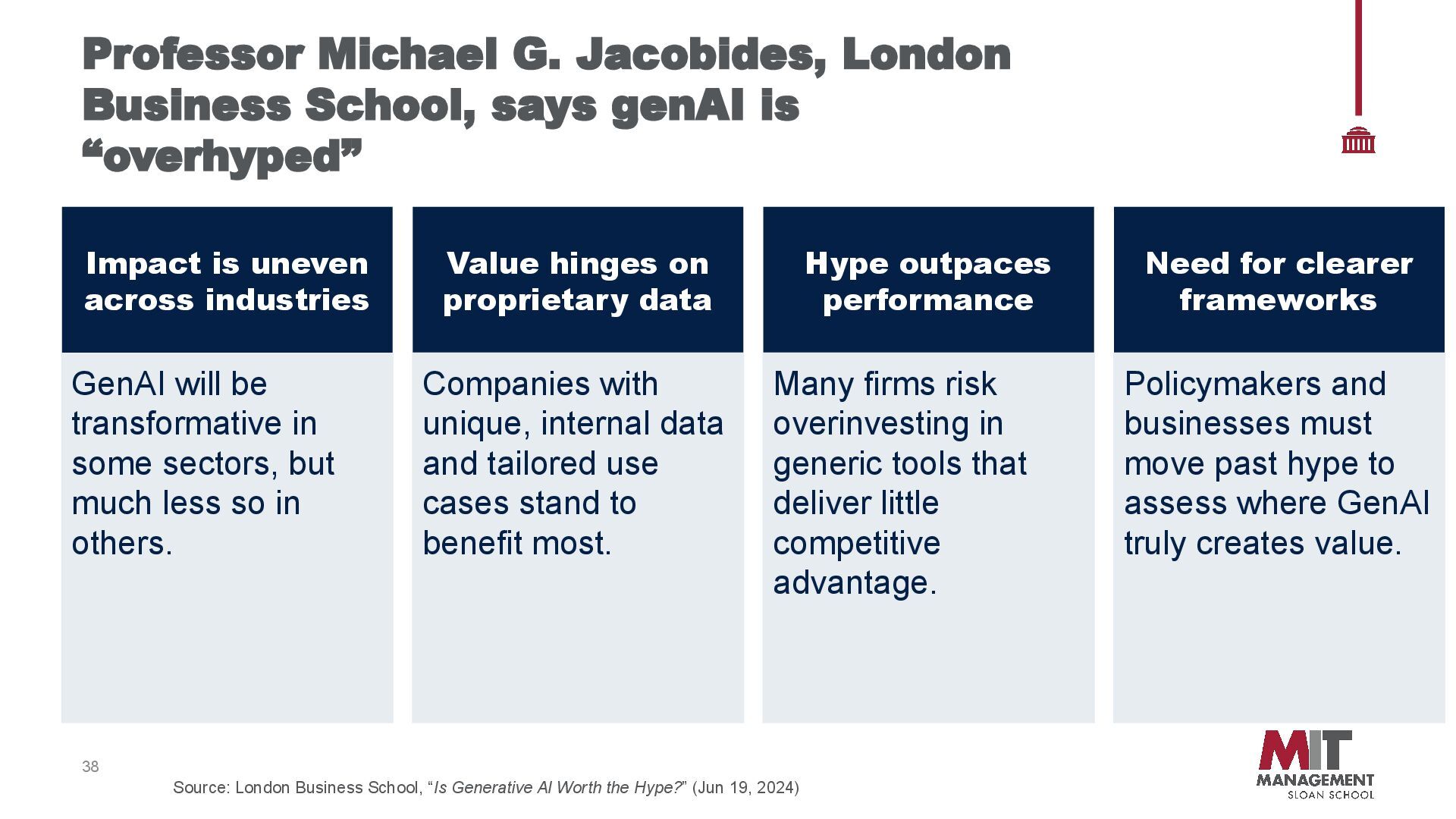
is “overhyped” 24% Impact is uneven across industries GenAI will be transformative in some sectors, but much less so in others. Value hinges on proprietary data Companies with unique, internal data and tailored use cases stand to benefit most. Hype outpaces performance Many firms risk overinvesting in generic tools that deliver little competitive advantage. Need for clearer frameworks Policymakers and businesses must move past hype to assess where GenAI truly creates value. Source: London Business School, “Is Generative AI Worth the Hype?” (Jun 19, 2024)
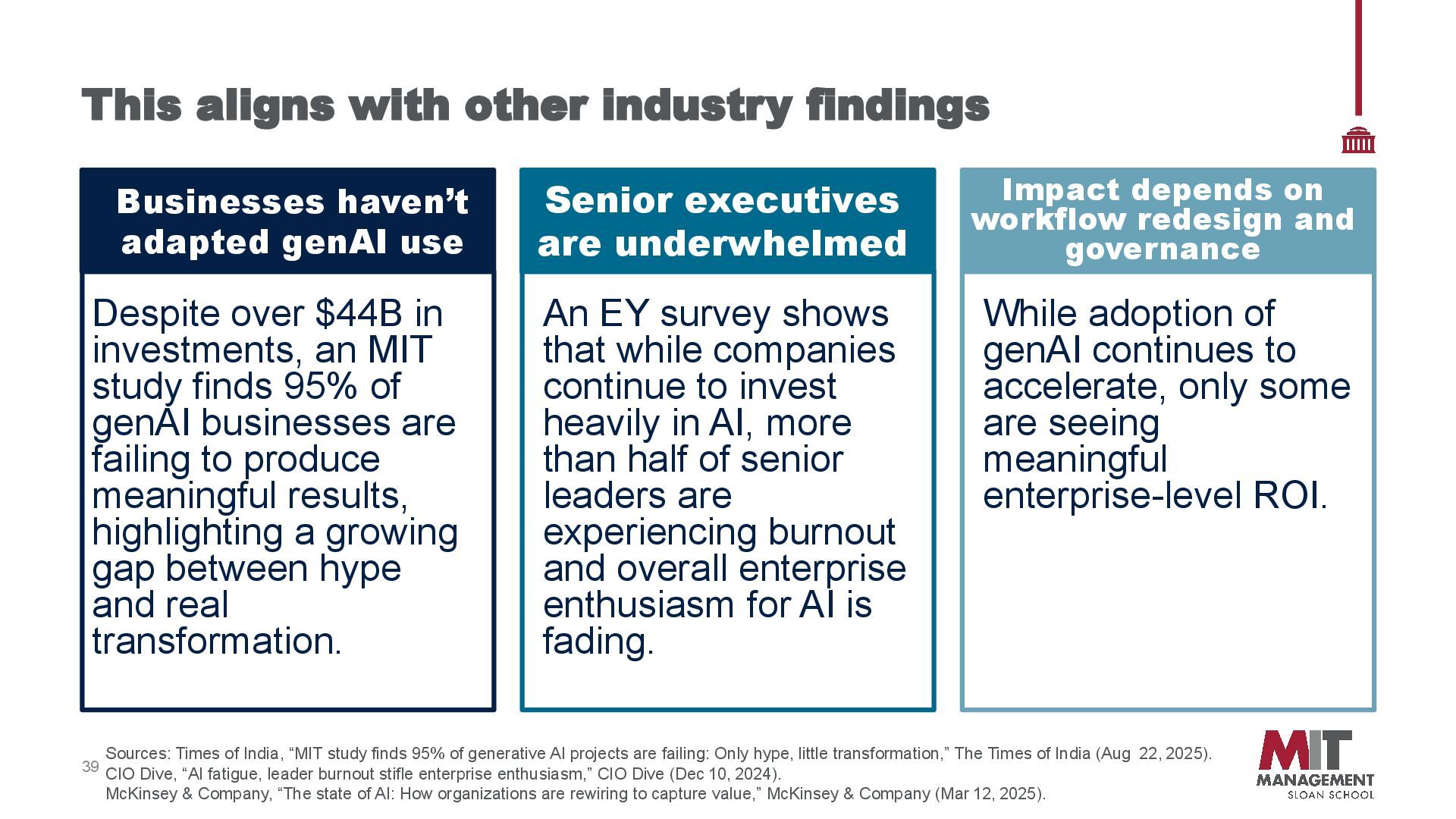
investments, an MIT study finds 95% of genAI businesses are failing to produce meaningful results, highlighting a growing gap between hype and real transformation. Senior executives are underwhelmed An EY survey shows that while companies continue to invest heavily in AI, more than half of senior leaders are experiencing burnout and overall enterprise enthusiasm for AI is fading. Impact depends on workflow redesign and governance While adoption of genAI continues to accelerate, only some are seeing meaningful enterprise-level ROI. This aligns with other industry findings Sources: Times of India, “MIT study finds 95% of generative AI projects are failing: Only hype, little transformation,” The Times of India (Aug 22, 2025). CIO Dive, “AI fatigue, leader burnout stifle enterprise enthusiasm,” CIO Dive (Dec 10, 2024). McKinsey & Company, “The state of AI: How organizations are rewiring to capture value,” McKinsey & Company (Mar 12, 2025).
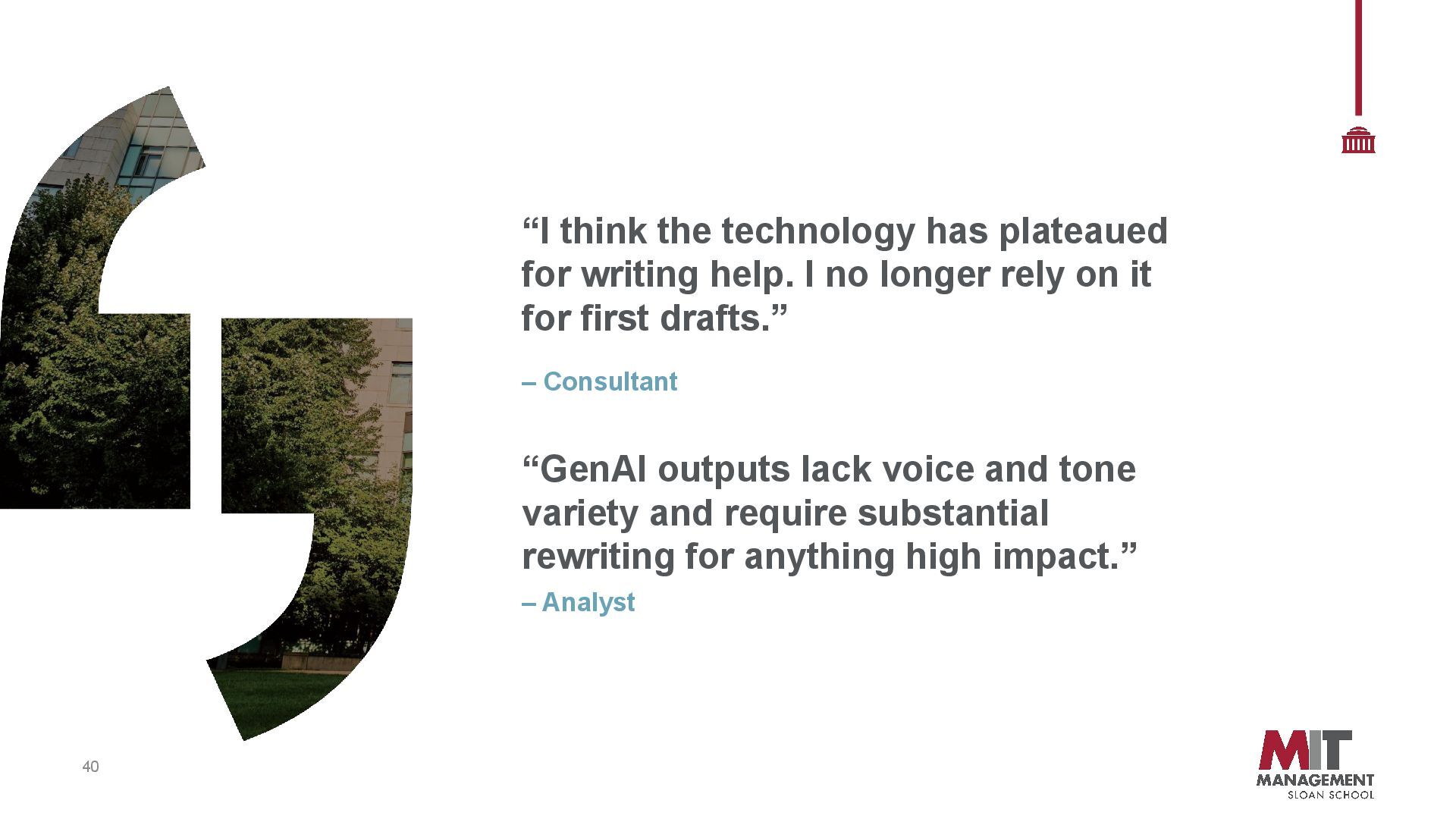
rewriting for anything high impact.” – Analyst 40 “I think the technology has plateaued for writing help. I no longer rely on it for first drafts.” – Consultant
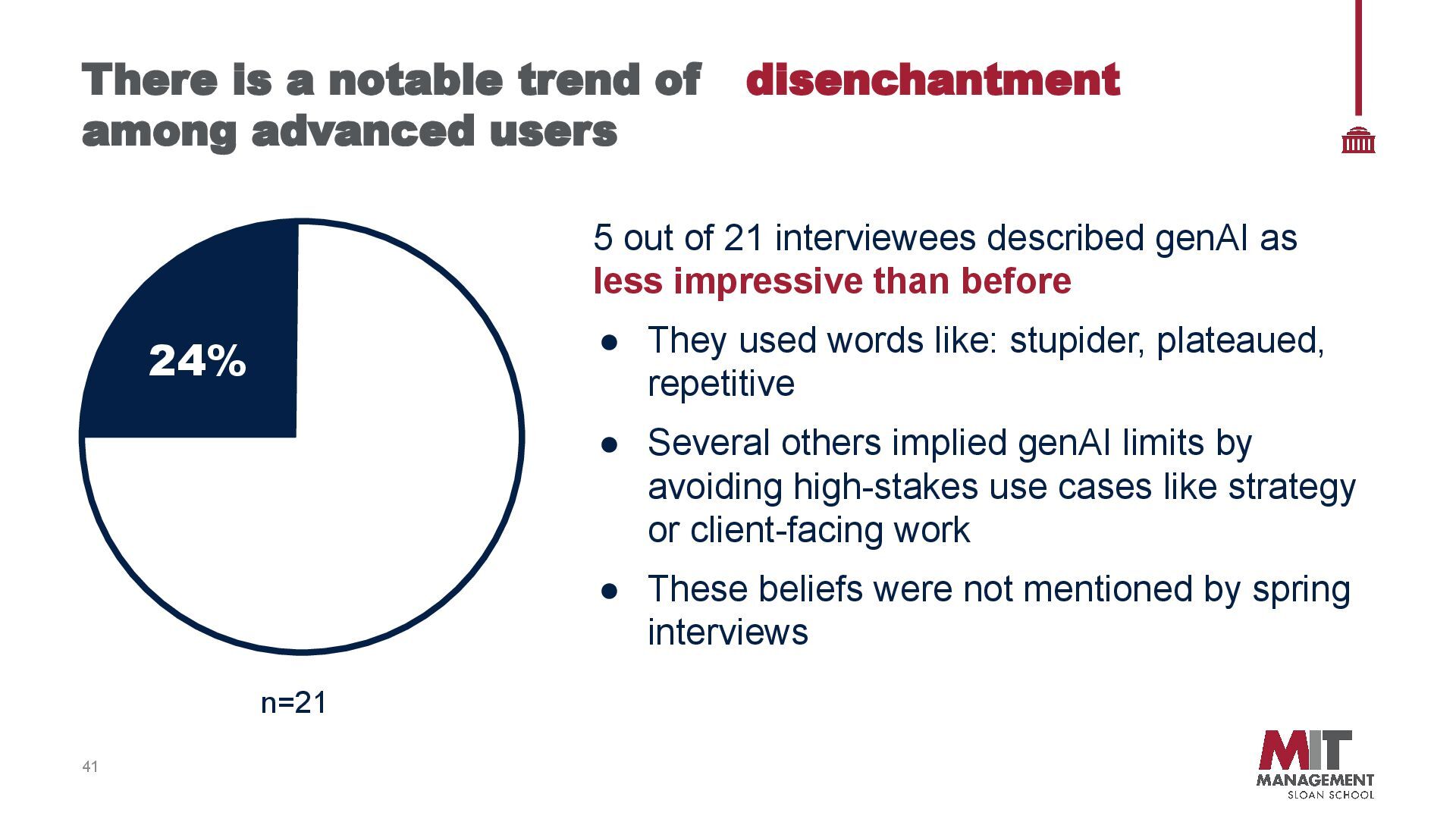
users n=21 24% 5 out of 21 interviewees described genAI as less impressive than before • They used words like: stupider, plateaued, repetitive • Several others implied genAI limits by avoiding high-stakes use cases like strategy or client-facing work • These beliefs were not mentioned by spring interviews
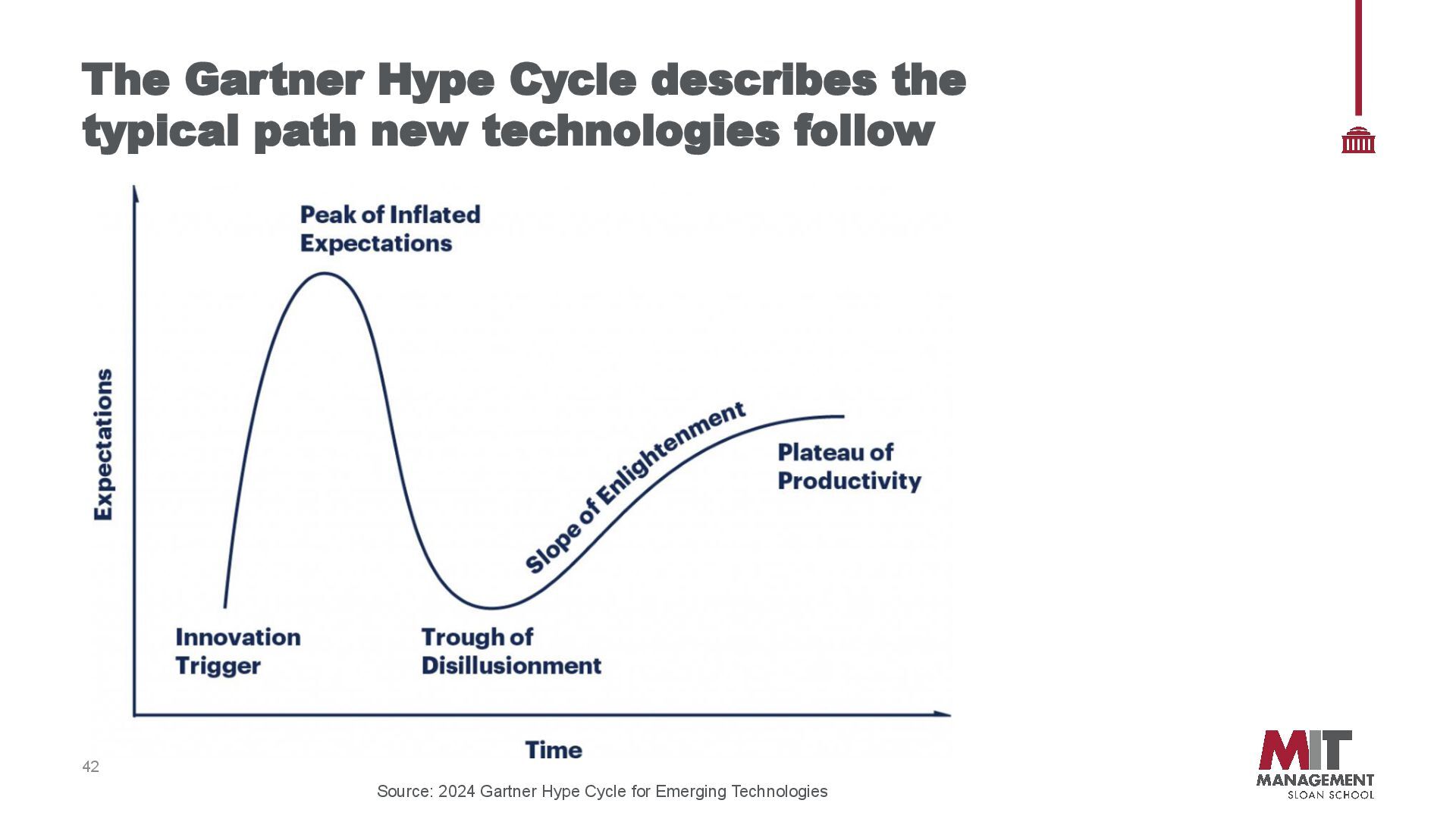
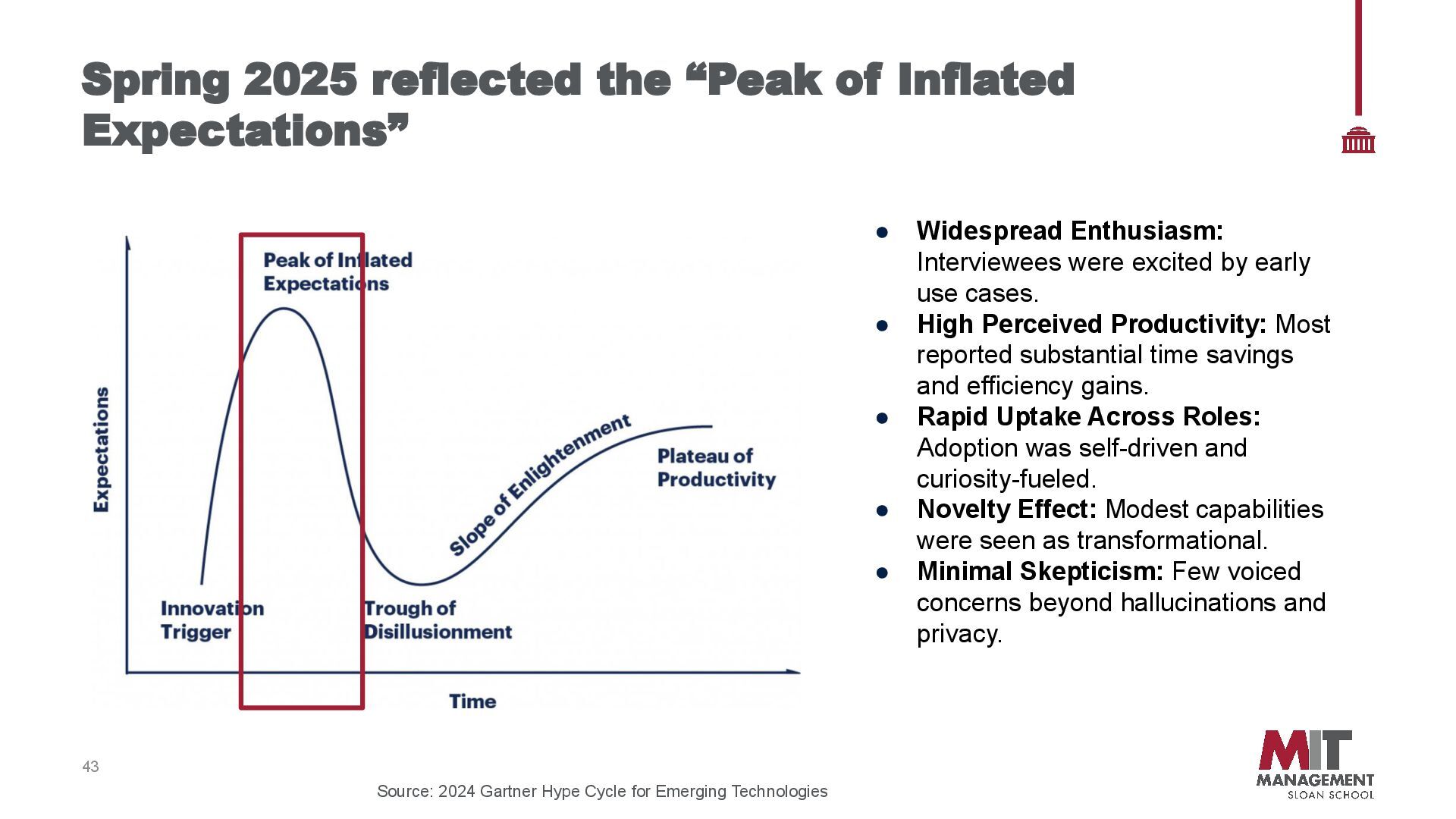
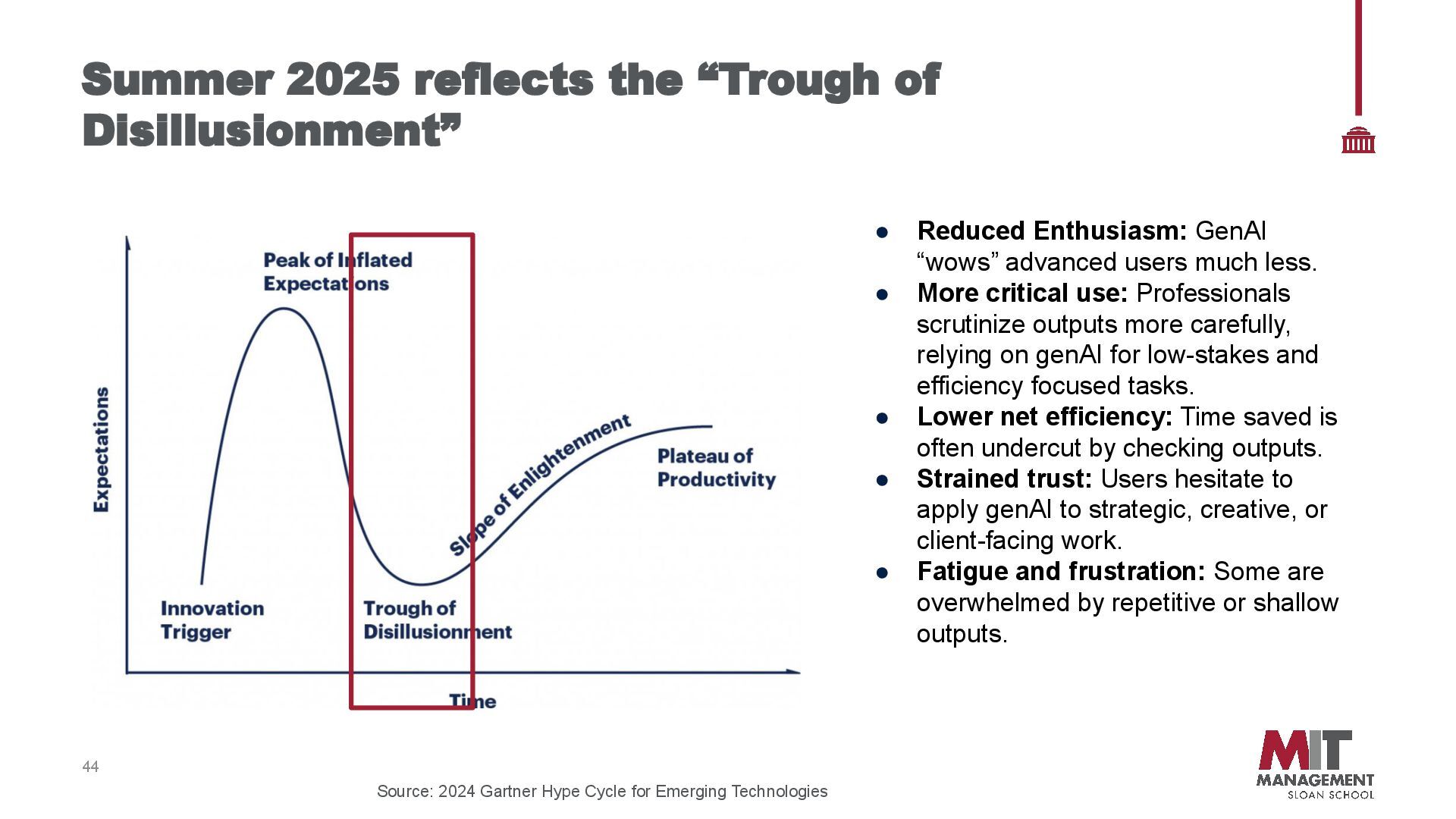
Widespread Enthusiasm: Interviewees were excited by early use cases. • High Perceived Productivity: Most reported substantial time savings and efficiency gains. • Rapid Uptake Across Roles: Adoption was self-driven and curiosity-fueled. • Novelty Effect: Modest capabilities were seen as transformational. • Minimal Skepticism: Few voiced concerns beyond hallucinations and privacy. Source: 2024 Gartner Hype Cycle for Emerging Technologies
Enthusiasm: GenAI “wows” advanced users much less. • More critical use: Professionals scrutinize outputs more carefully, relying on genAI for low-stakes and efficiency focused tasks. • Lower net efficiency: Time saved is often undercut by checking outputs. • Strained trust: Users hesitate to apply genAI to strategic, creative, or client-facing work. • Fatigue and frustration: Some are overwhelmed by repetitive or shallow outputs. Source: 2024 Gartner Hype Cycle for Emerging Technologies
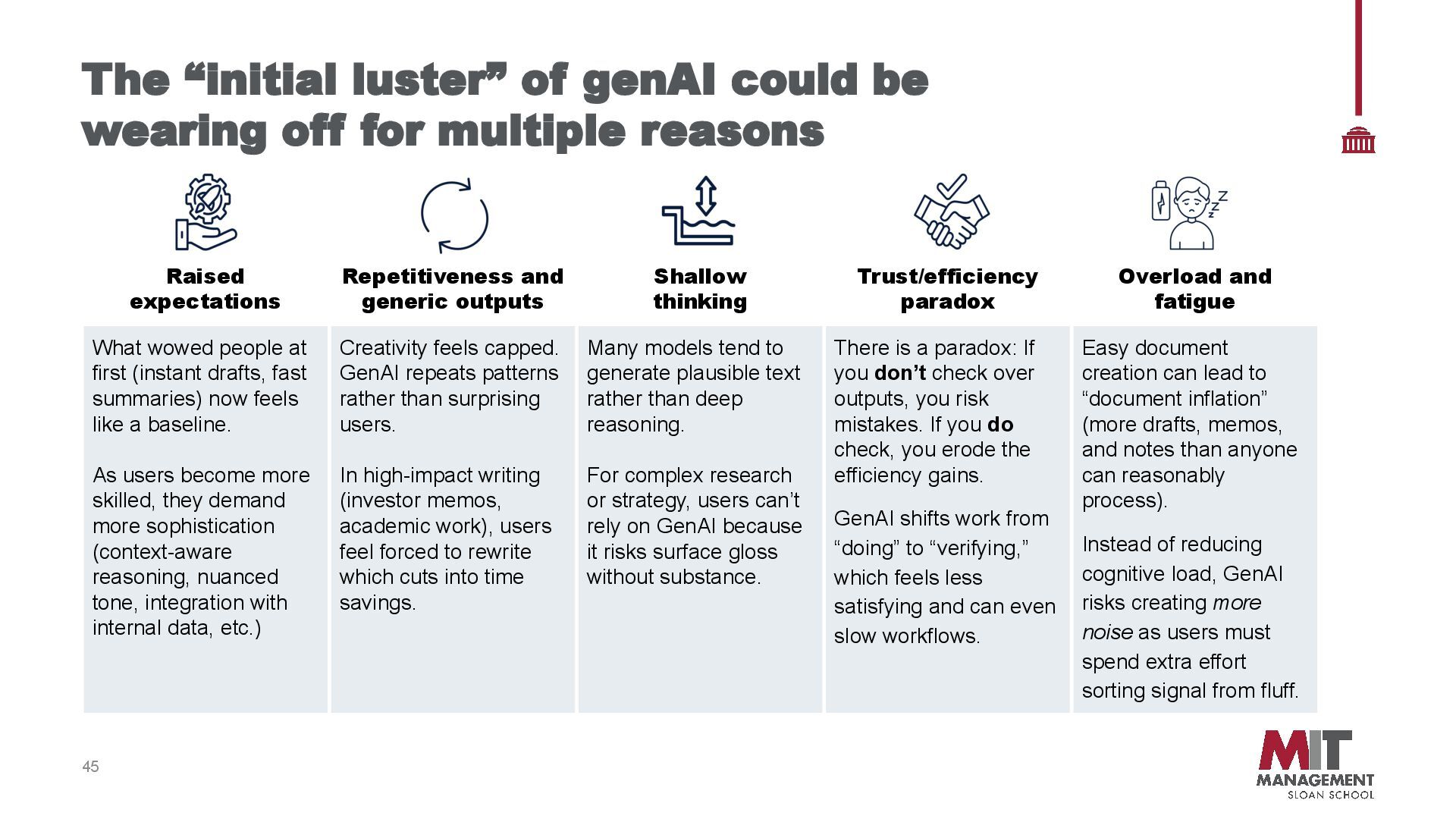
paradox Overload and fatigue What wowed people at first (instant drafts, fast summaries) now feels like a baseline. As users become more skilled, they demand more sophistication (context-aware reasoning, nuanced tone, integration with internal data, etc.) Creativity feels capped. GenAI repeats patterns rather than surprising users. In high-impact writing (investor memos, academic work), users feel forced to rewrite which cuts into time savings. Many models tend to generate plausible text rather than deep reasoning. For complex research or strategy, users can’t rely on GenAI because it risks surface gloss without substance. There is a paradox: If you don’t check over outputs, you risk mistakes. If you do check, you erode the efficiency gains. GenAI shifts work from “doing” to “verifying,” which feels less satisfying and can even slow workflows. Easy document creation can lead to “document inflation” (more drafts, memos, and notes than anyone can reasonably process). Instead of reducing cognitive load, GenAI risks creating more noise as users must spend extra effort sorting signal from fluff. The “initial luster” of genAI could be wearing off for multiple reasons
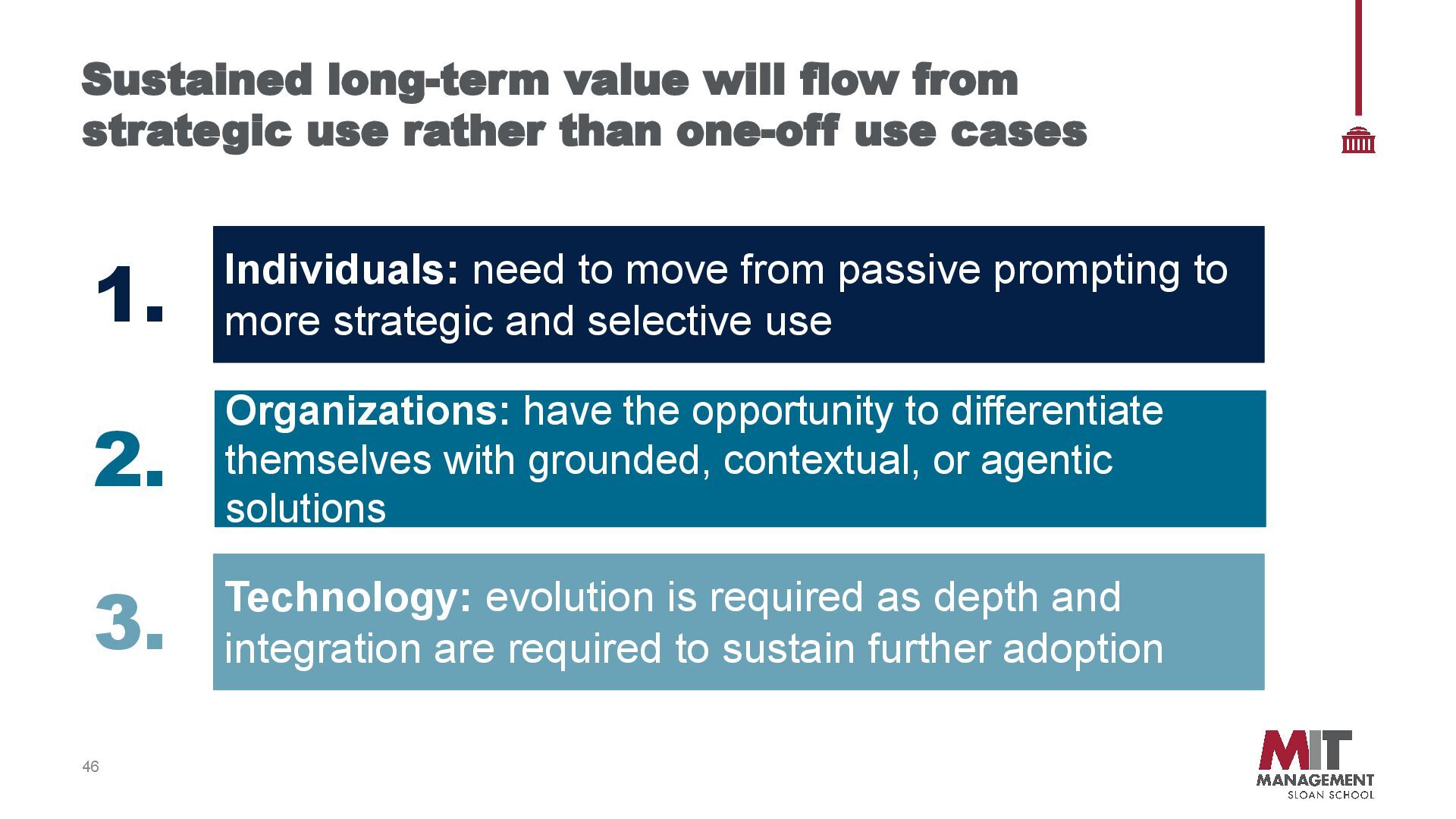
more strategic and selective use 2. 3. Organizations: have the opportunity to differentiate themselves with grounded, contextual, or agentic solutions Technology: evolution is required as depth and integration are required to sustain further adoption Sustained long-term value will flow from strategic use rather than one-off use cases
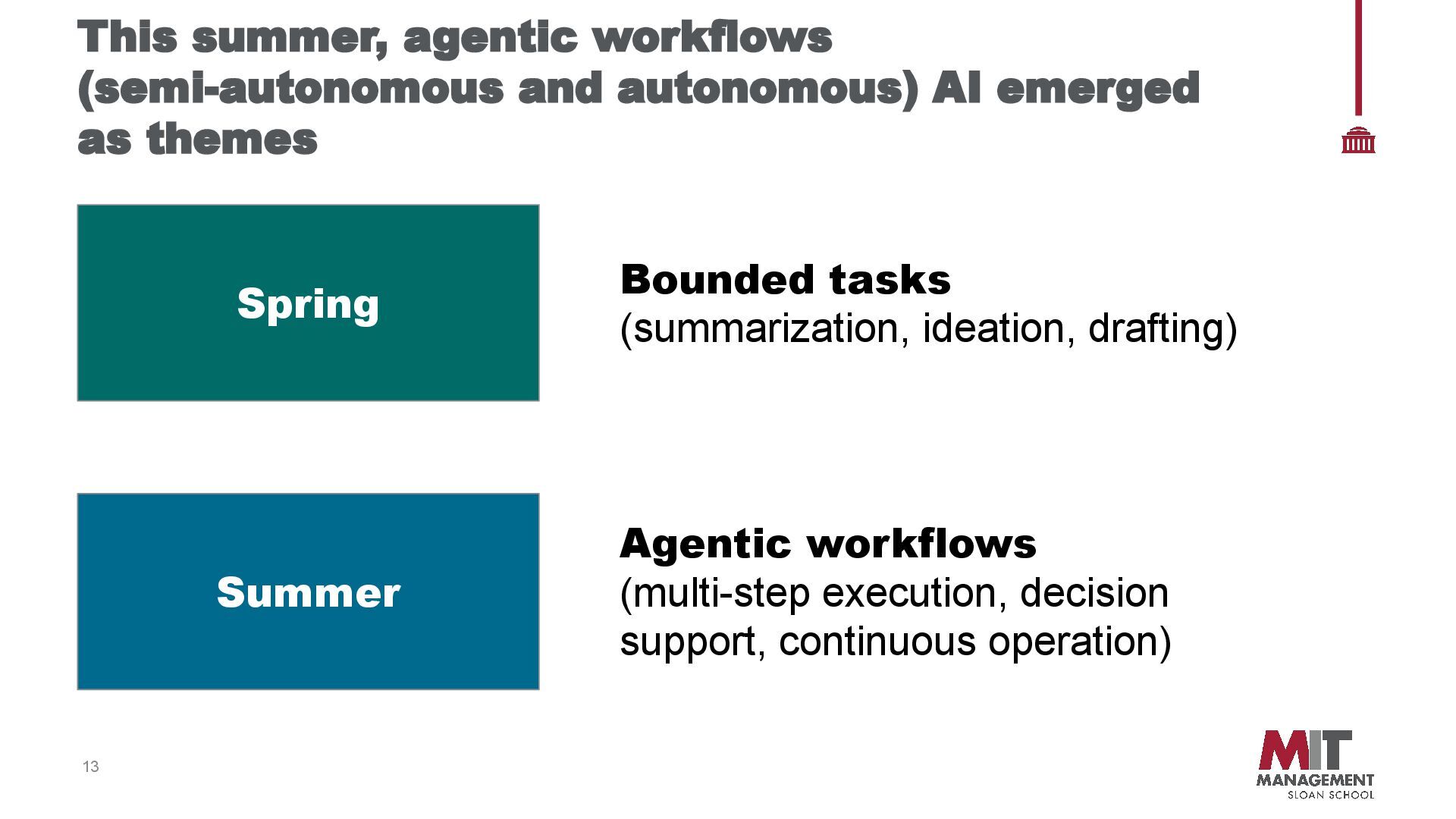
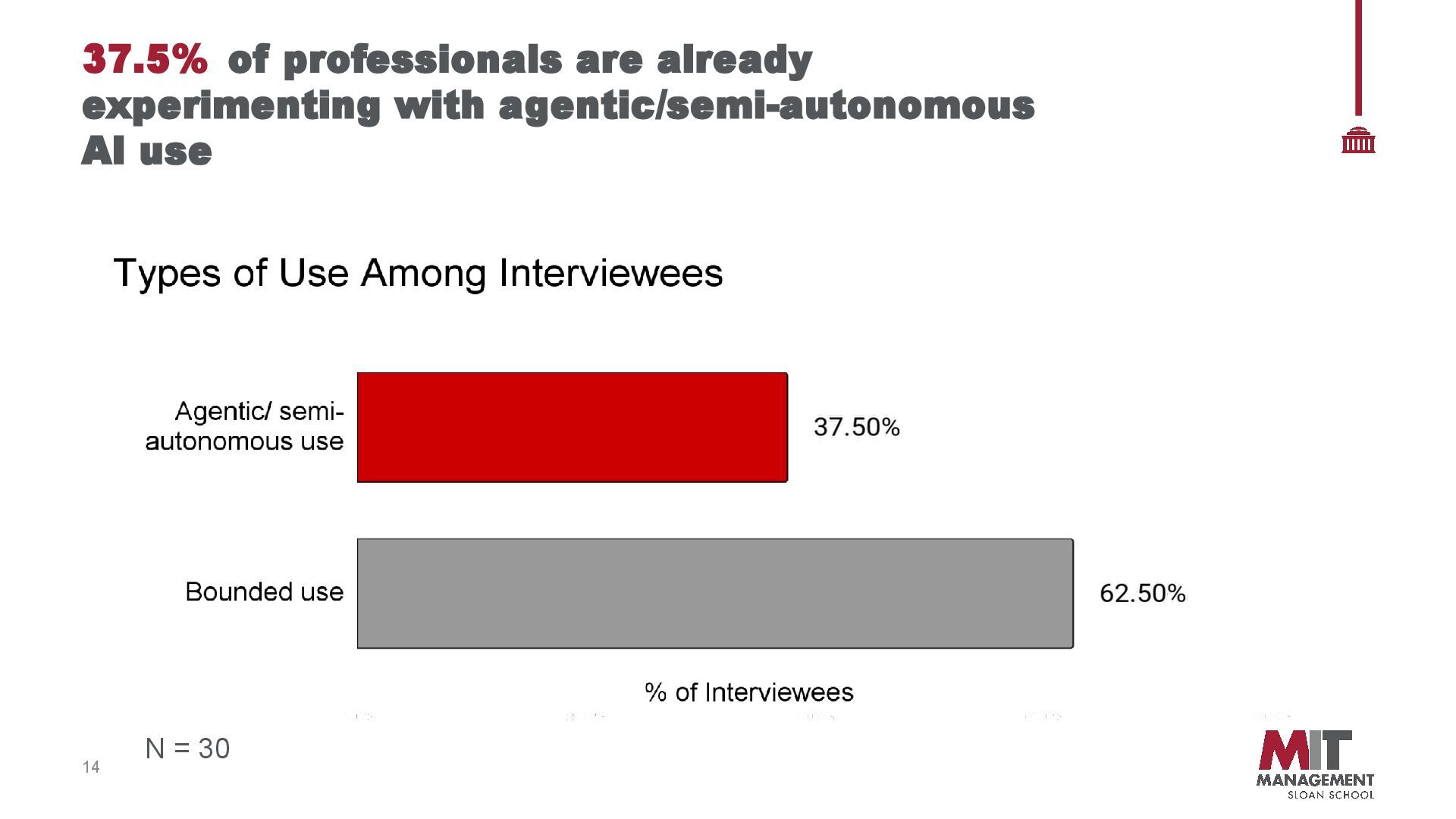
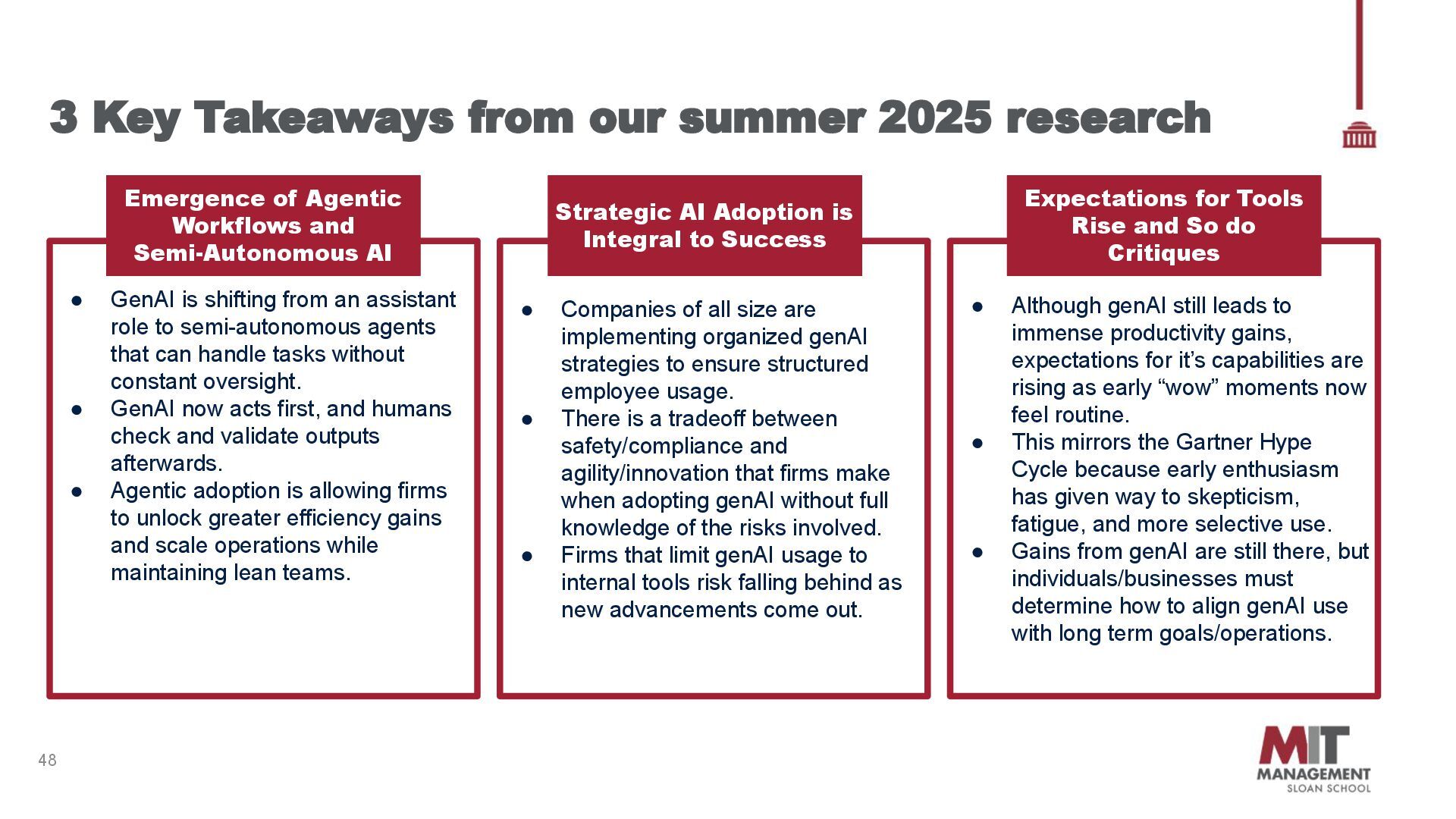
Companies of all size are implementing organized genAI strategies to ensure structured employee usage. • There is a tradeoff between safety/compliance and agility/innovation that firms make when adopting genAI without full knowledge of the risks involved. • Firms that limit genAI usage to internal tools risk falling behind as new advancements come out. Strategic AI Adoption is Integral to Success • Although genAI still leads to immense productivity gains, expectations for it’s capabilities are rising as early “wow” moments now feel routine. • This mirrors the Gartner Hype Cycle because early enthusiasm has given way to skepticism, fatigue, and more selective use. • Gains from genAI are still there, but individuals/businesses must determine how to align genAI use with long term goals/operations. Expectations for Tools Rise and So do Critiques • GenAI is shifting from an assistant role to semi-autonomous agents that can handle tasks without constant oversight. • GenAI now acts first, and humans check and validate outputs afterwards. • Agentic adoption is allowing firms to unlock greater efficiency gains and scale operations while maintaining lean teams. Emergence of Agentic Workflows and Semi-Autonomous AI
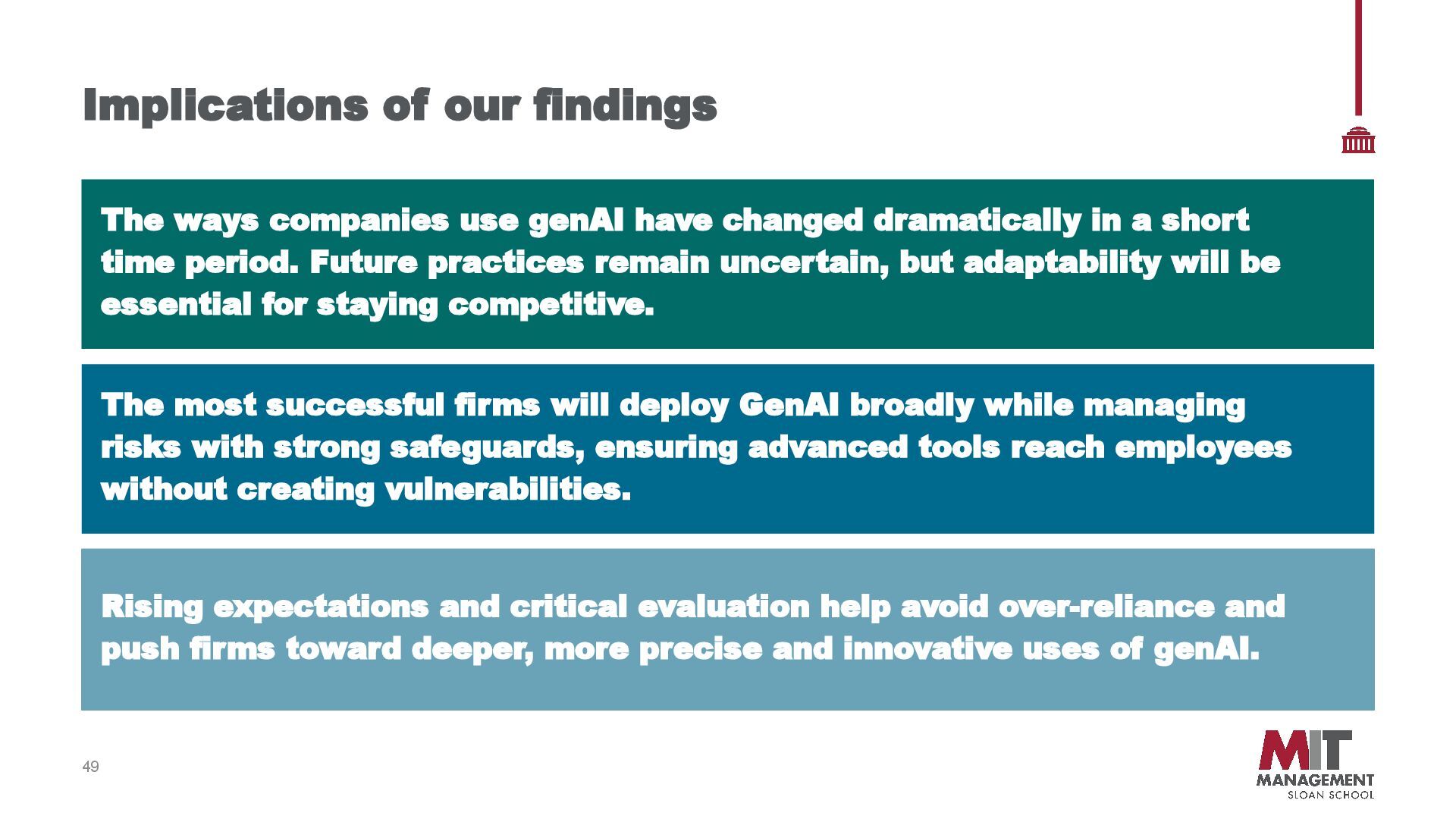
before 3 slides The ways companies use genAI have changed dramatically in a short time period. Future practices remain uncertain, but adaptability will be essential for staying competitive. The most successful firms will deploy GenAI broadly while managing risks with strong safeguards, ensuring advanced tools reach employees without creating vulnerabilities. Rising expectations and critical evaluation help avoid over-reliance and push firms toward deeper, more precise and innovative uses of genAI.
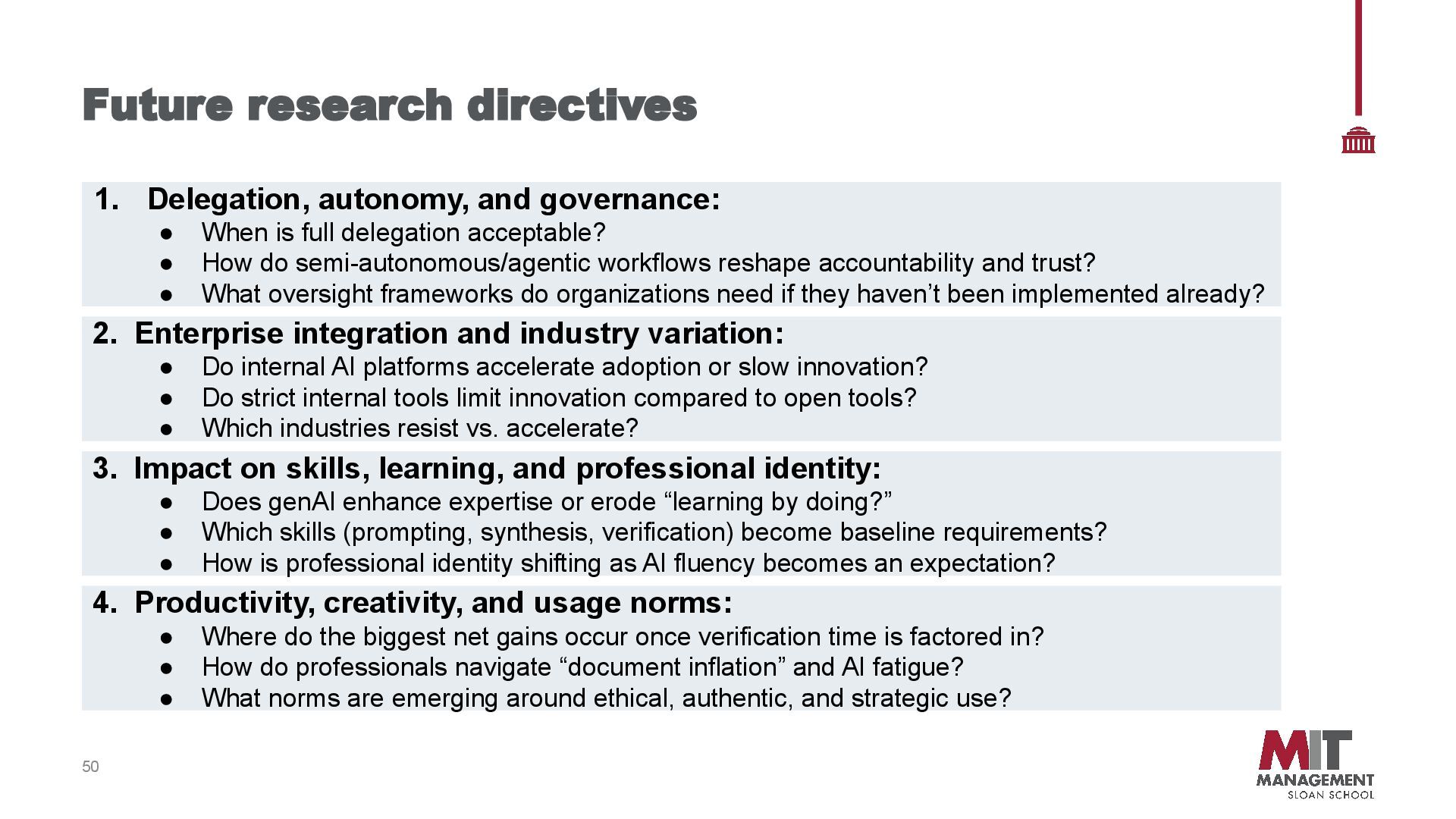
When is full delegation acceptable? • How do semi-autonomous/agentic workflows reshape accountability and trust? • What oversight frameworks do organizations need if they haven’t been implemented already? 2. Enterprise integration and industry variation: • Do internal AI platforms accelerate adoption or slow innovation? • Do strict internal tools limit innovation compared to open tools? • Which industries resist vs. accelerate? 3. Impact on skills, learning, and professional identity: • Does genAI enhance expertise or erode “learning by doing?” • Which skills (prompting, synthesis, verification) become baseline requirements? • How is professional identity shifting as AI fluency becomes an expectation? 4. Productivity, creativity, and usage norms: • Where do the biggest net gains occur once verification time is factored in? • How do professionals navigate “document inflation” and AI fatigue? • What norms are emerging around ethical, authentic, and strategic use?
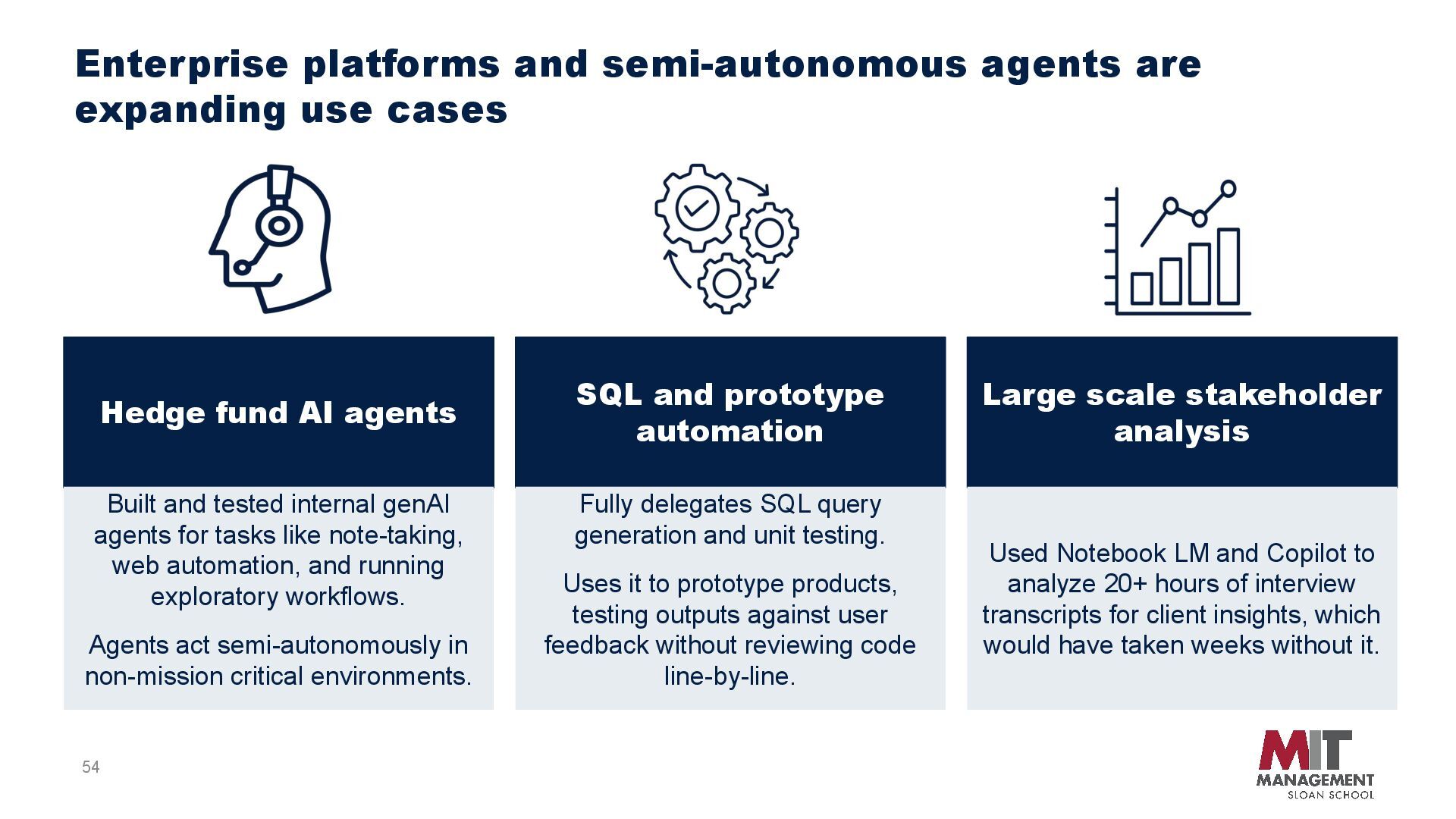
and prototype automation Built and tested internal genAI agents for tasks like note-taking, web automation, and running exploratory workflows. Agents act semi-autonomously in non-mission critical environments. Used Notebook LM and Copilot to analyze 20+ hours of interview transcripts for client insights, which would have taken weeks without it. Fully delegates SQL query generation and unit testing. Uses it to prototype products, testing outputs against user feedback without reviewing code line-by-line. Enterprise platforms and semi-autonomous agents are expanding use cases
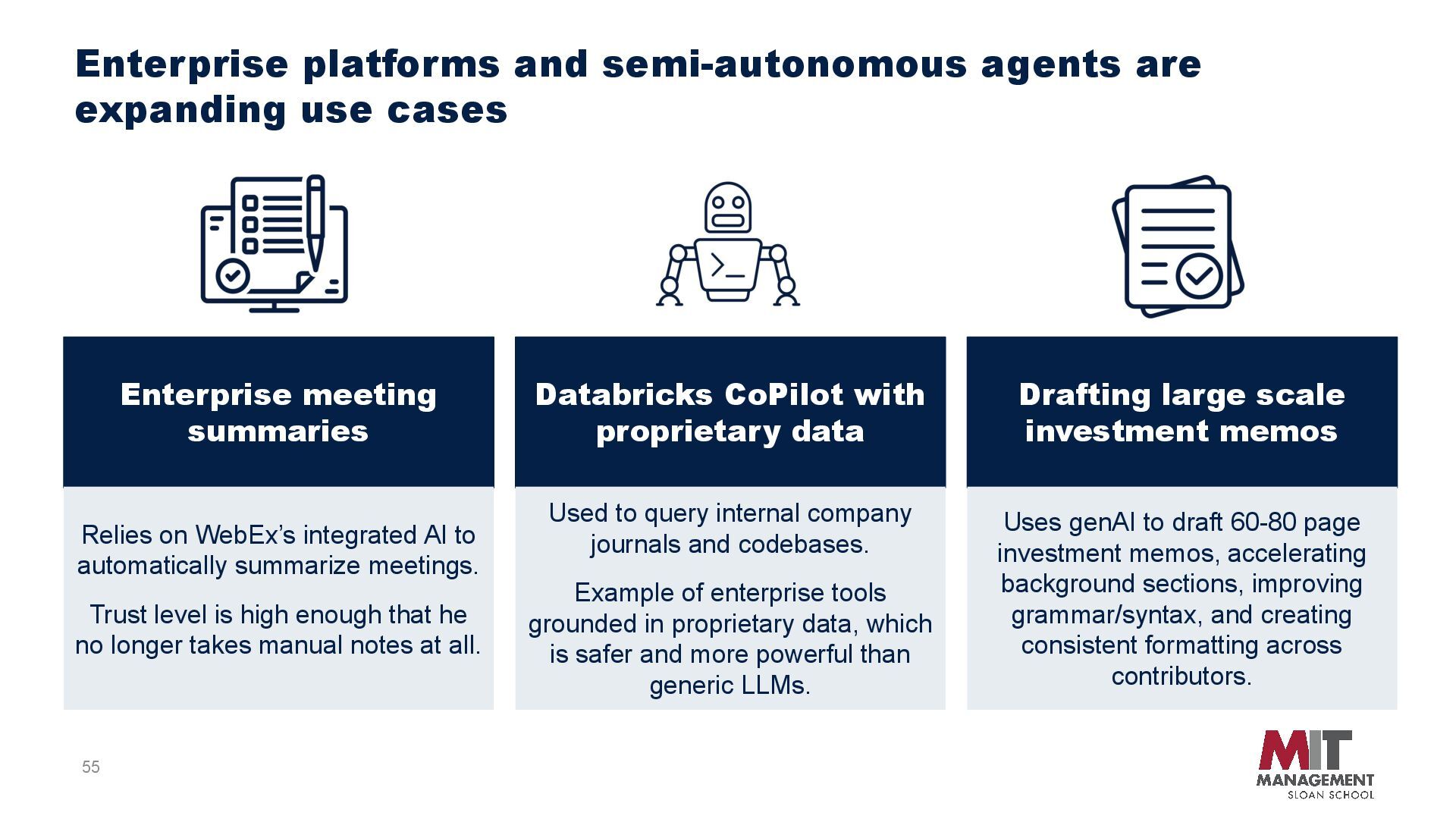
CoPilot with proprietary data Relies on WebEx’s integrated AI to automatically summarize meetings. Trust level is high enough that he no longer takes manual notes at all. Uses genAI to draft 60-80 page investment memos, accelerating background sections, improving grammar/syntax, and creating consistent formatting across contributors. Enterprise platforms and semi-autonomous agents are expanding use cases Used to query internal company journals and codebases. Example of enterprise tools grounded in proprietary data, which is safer and more powerful than generic LLMs.


 emiliedubiel
 techseoconnect
 honnibal
 marcduiker
 rkendrick25
 wjessup
 hannesfritz
 inesmontani
 sarafernandez
 sonatard
 elsirapls
 emna__ayadi
 csswizardry