The industry is moving faster than ever; some practices are evolving, others remain timeless, but remember:
"Software engineering was never just about writing code faster; it's about solving real-world problems"
leading teams that build products for real estate agents and professionals. I’m passionate about building high-quality software and solving real-world problems that streamline workflows and deliver tangible value
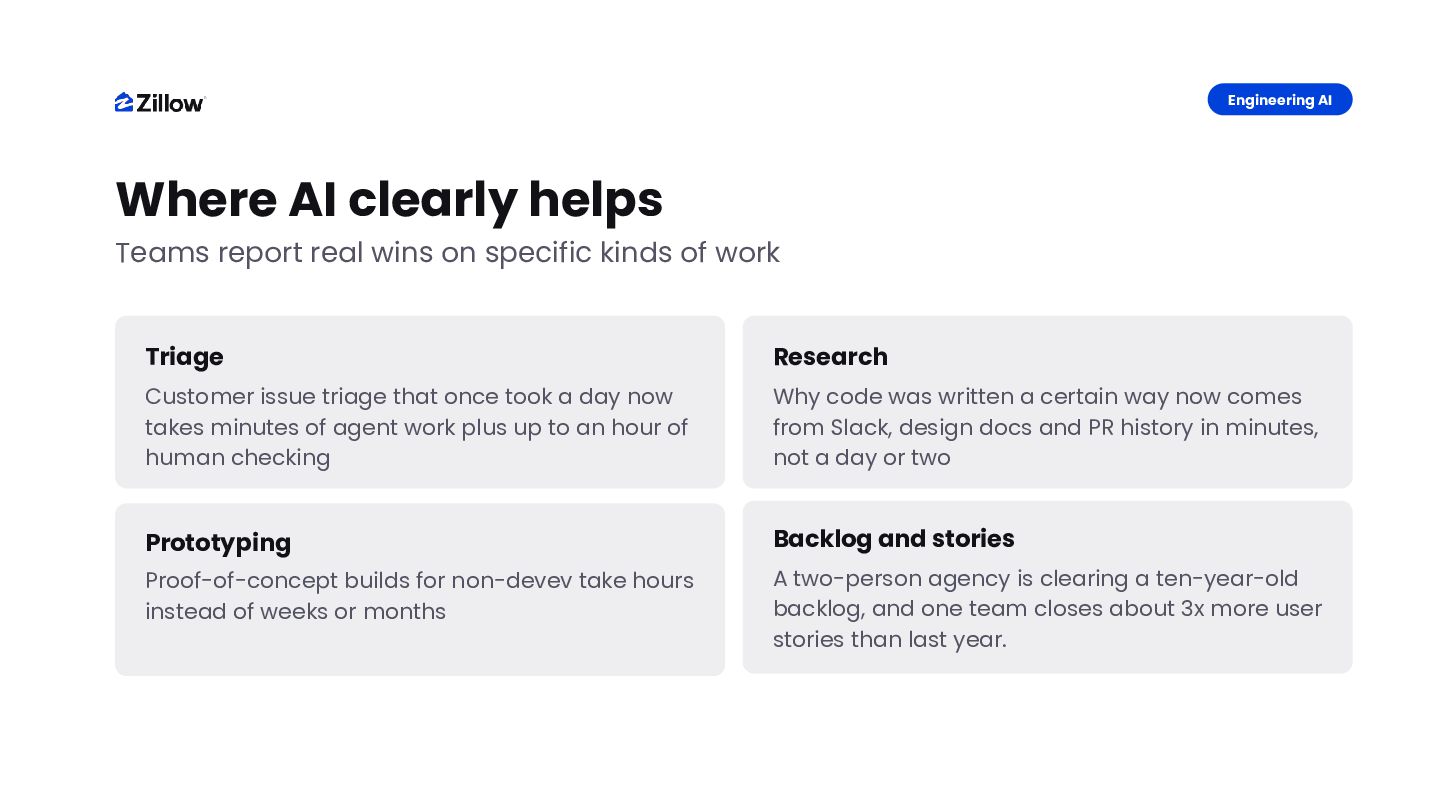
on specific kinds of work Triage Research Customer issue triage that once took a day now takes minutes of agent work plus up to an hour of human checking Why code was written a certain way now comes from Slack, design docs and PR history in minutes, not a day or two Prototyping Backlog and stories Proof-of-concept builds for non-devev take hours instead of weeks or months A two-person agency is clearing a ten-year-old backlog, and one team closes about 3x more user stories than last year.
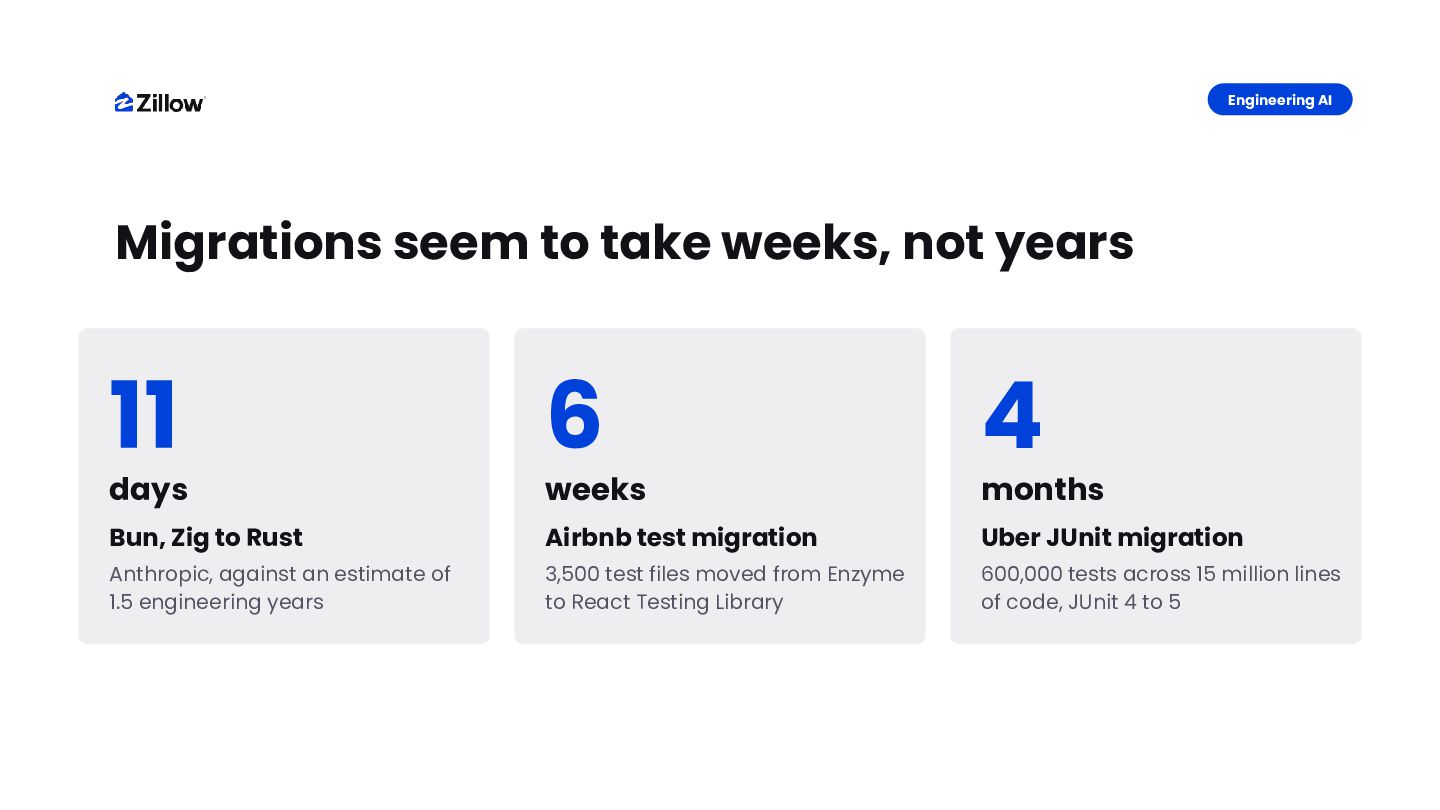
6 4 Bun, Zig to Rust Airbnb test migration Uber JUnit migration Anthropic, against an estimate of 1.5 engineering years 3,500 test files moved from Enzyme to React Testing Library 600,000 tests across 15 million lines of code, JUnit 4 to 5 days weeks months
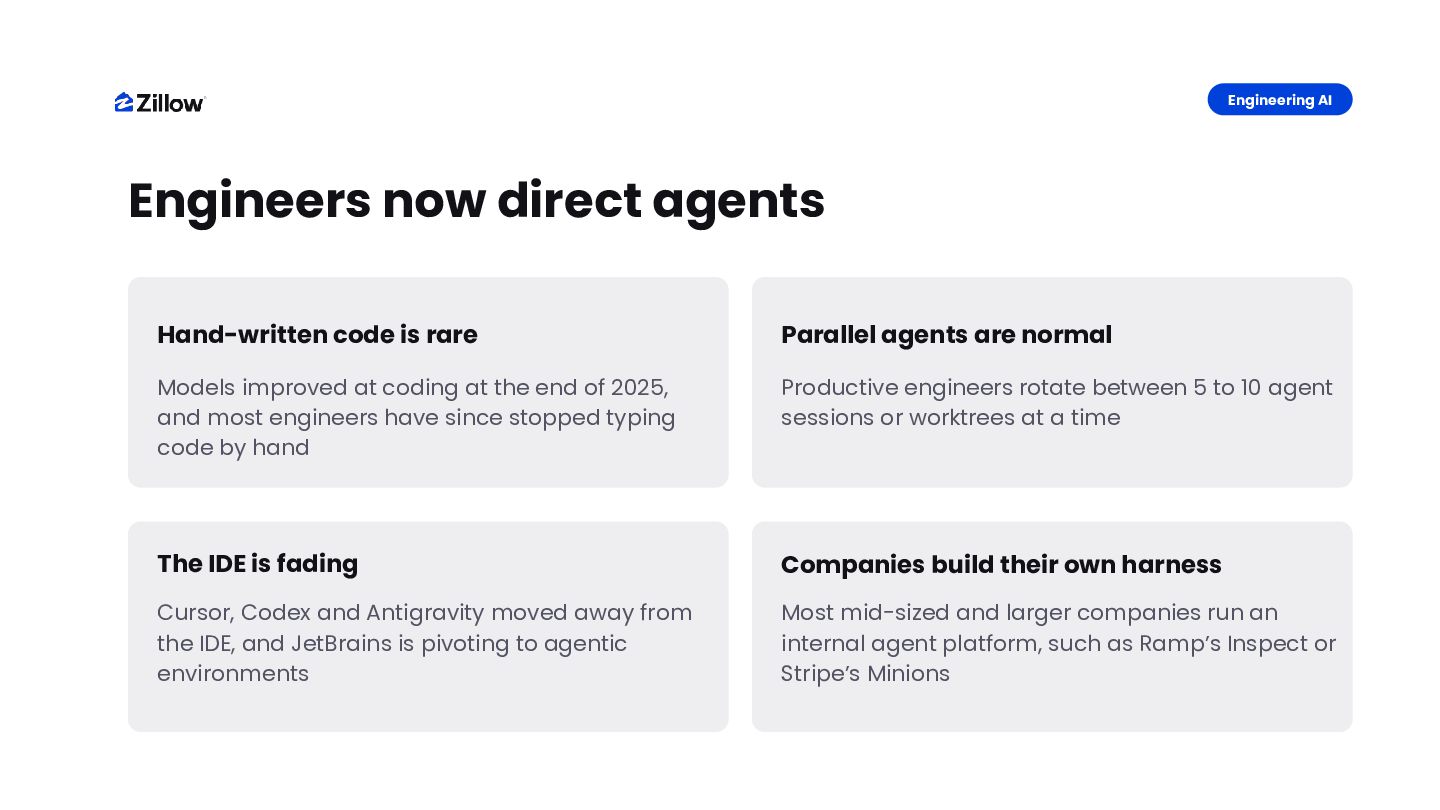
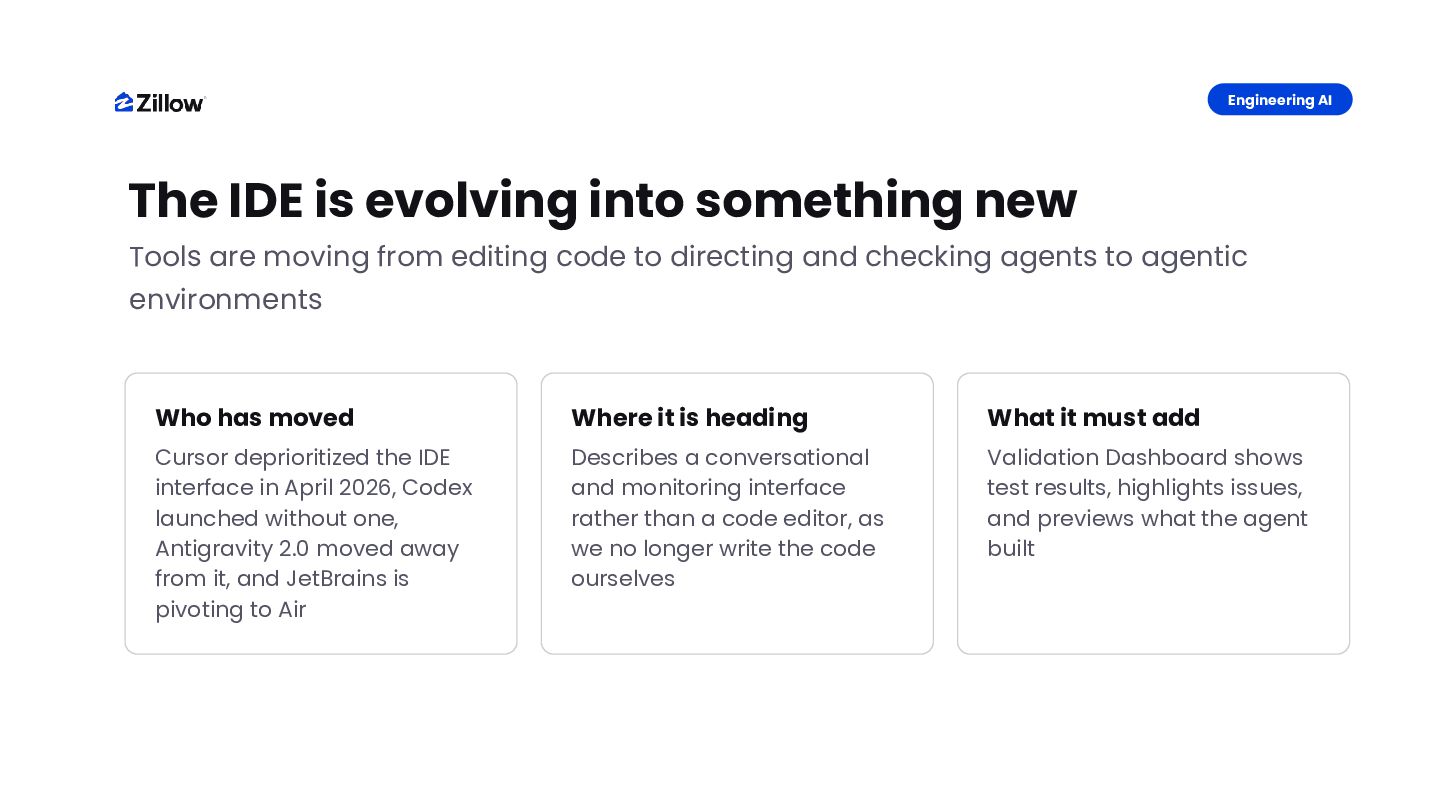
Parallel agents are normal Models improved at coding at the end of 2025, and most engineers have since stopped typing code by hand Productive engineers rotate between 5 to 10 agent sessions or worktrees at a time The IDE is fading Companies build their own harness Cursor, Codex and Antigravity moved away from the IDE, and JetBrains is pivoting to agentic environments Most mid-sized and larger companies run an internal agent platform, such as Ramp’s Inspect or Stripe’s Minions
are moving from editing code to directing and checking agents to agentic environments Who has moved Where it is heading What it must add Cursor deprioritized the IDE interface in April 2026, Codex launched without one, Antigravity 2.0 moved away from it, and JetBrains is pivoting to Air Describes a conversational and monitoring interface rather than a code editor, as we no longer write the code ourselves Validation Dashboard shows test results, highlights issues, and previews what the agent built
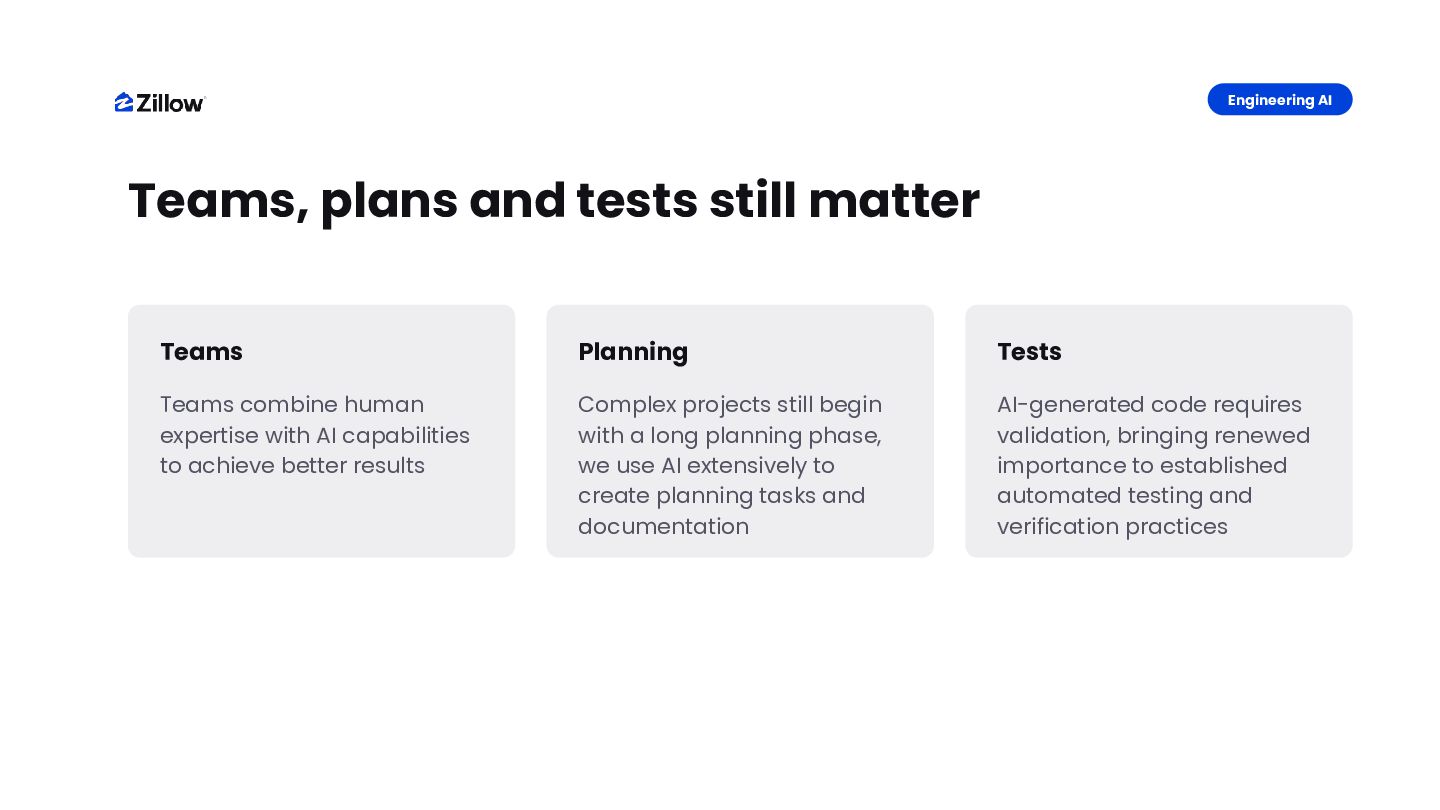
Tests Teams combine human expertise with AI capabilities to achieve better results Complex projects still begin with a long planning phase, we use AI extensively to create planning tasks and documentation AI-generated code requires validation, bringing renewed importance to established automated testing and verification practices
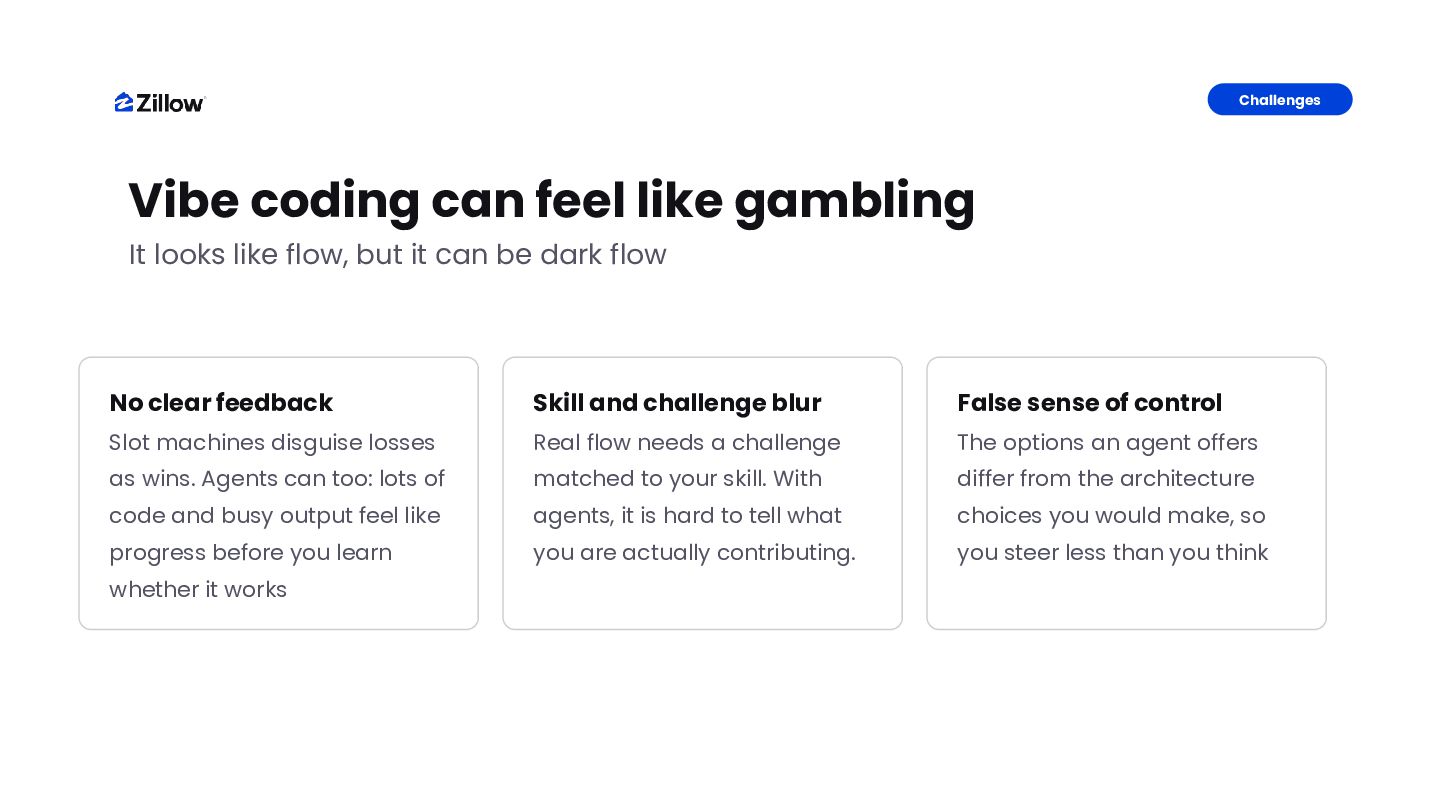
flow, but it can be dark flow No clear feedback Skill and challenge blur False sense of control Slot machines disguise losses Real flow needs a challenge The options an agent offers as wins. Agents can too: lots of matched to your skill. With differ from the architecture code and busy output feel like agents, it is hard to tell what choices you would make, so progress before you learn you are actually contributing. you steer less than you think whether it works
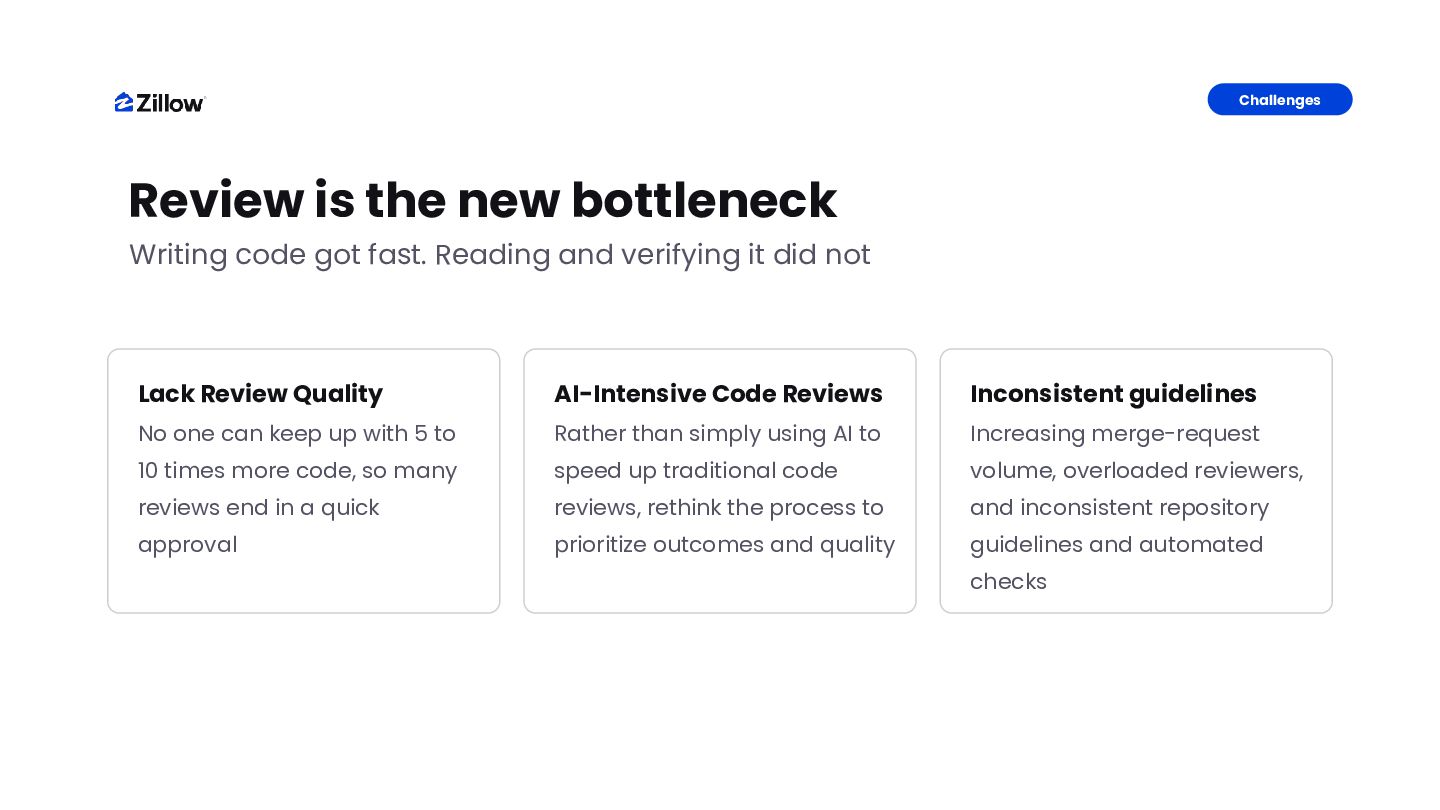
Reading and verifying it did not Lack Review Quality AI-Intensive Code Reviews Inconsistent guidelines No one can keep up with 5 to Rather than simply using AI to Increasing merge-request 10 times more code, so many speed up traditional code volume, overloaded reviewers, reviews end in a quick reviews, rethink the process to and inconsistent repository approval prioritize outcomes and quality guidelines and automated checks
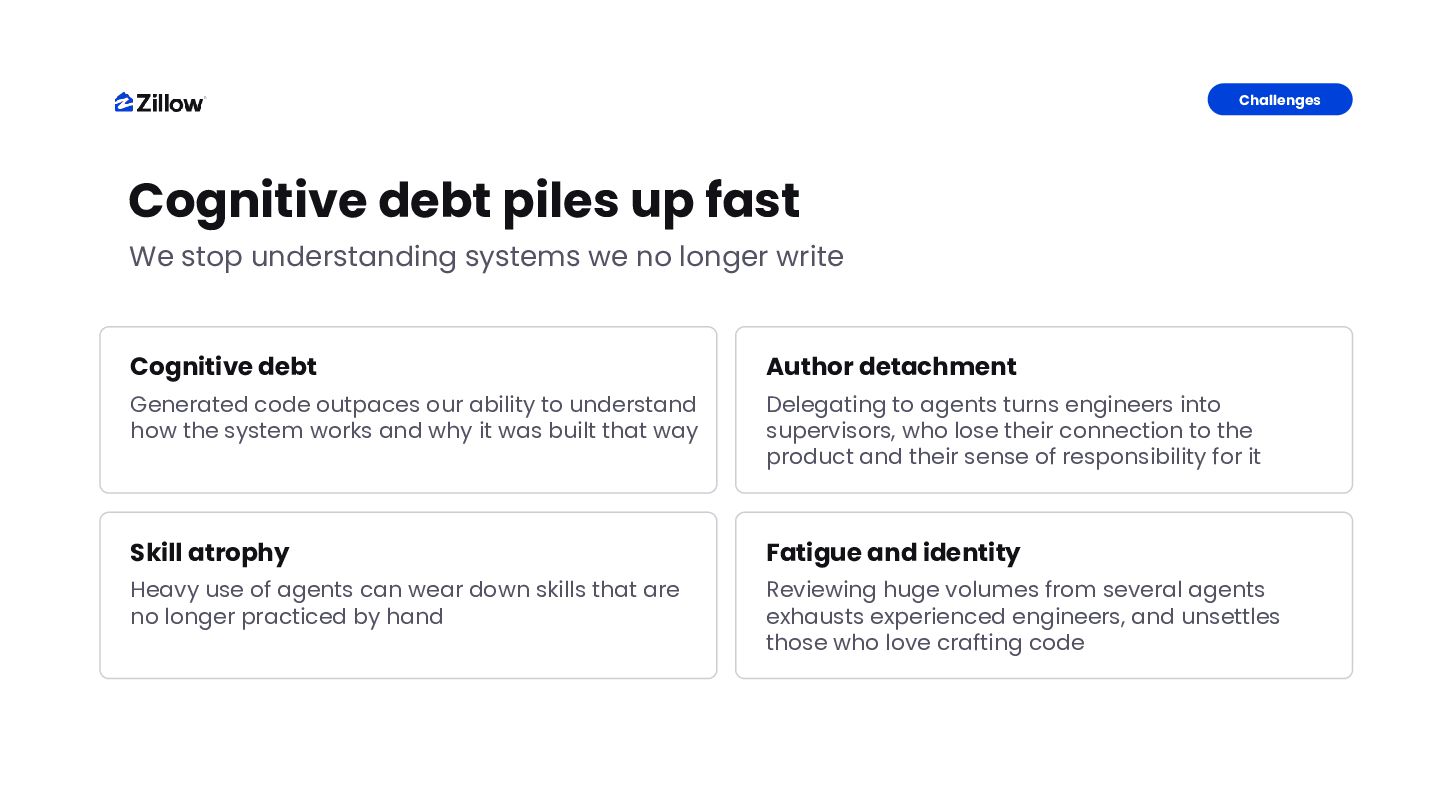
we no longer write Cognitive debt Author detachment Generated code outpaces our ability to understand how the system works and why it was built that way Delegating to agents turns engineers into supervisors, who lose their connection to the product and their sense of responsibility for it Skill atrophy Fatigue and identity Heavy use of agents can wear down skills that are no longer practiced by hand Reviewing huge volumes from several agents exhausts experienced engineers, and unsettles those who love crafting code
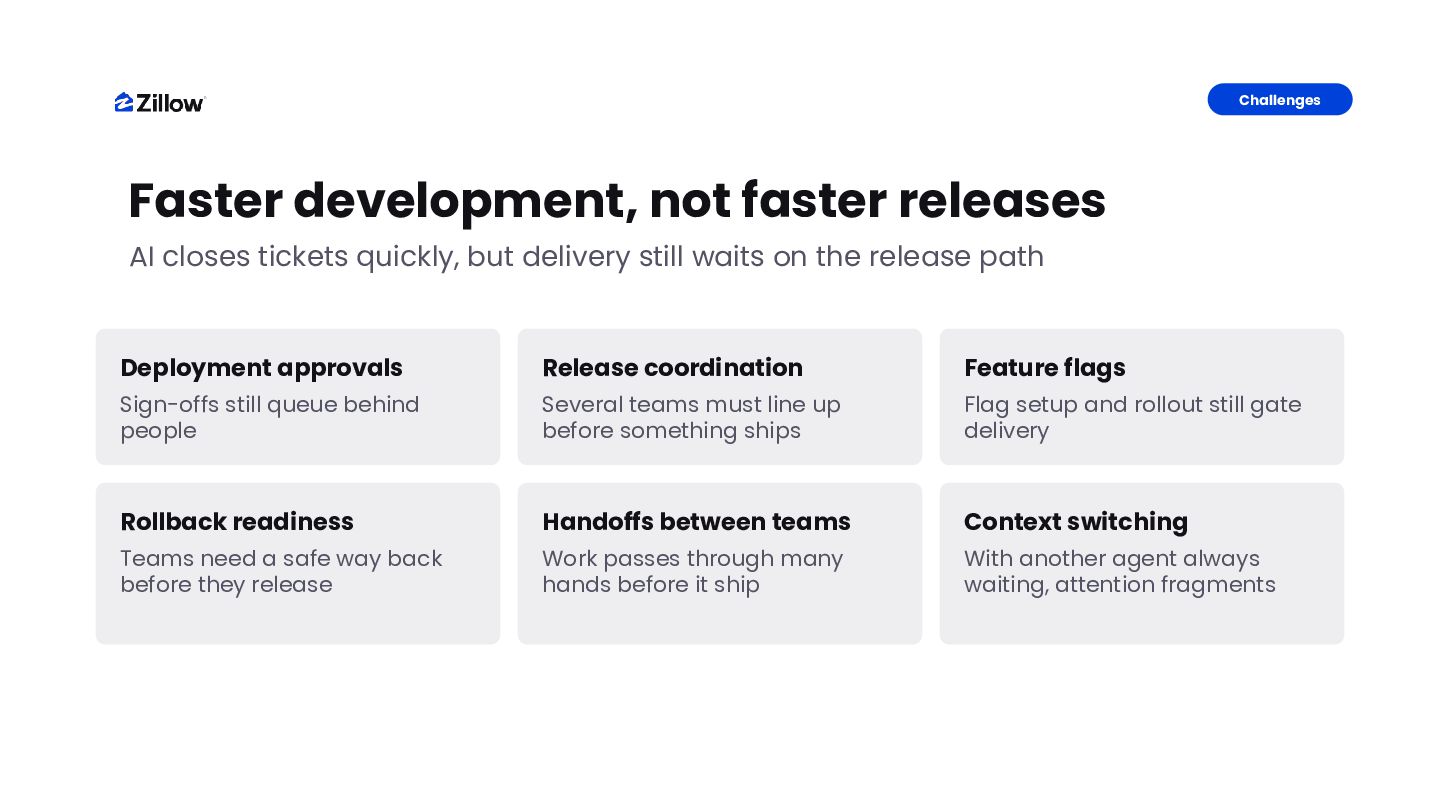
but delivery still waits on the release path Deployment approvals Release coordination Feature flags Sign-offs still queue behind people Several teams must line up before something ships Flag setup and rollout still gate delivery Rollback readiness Handoffs between teams Context switching Teams need a safe way back before they release Work passes through many hands before it ship With another agent always waiting, attention fragments
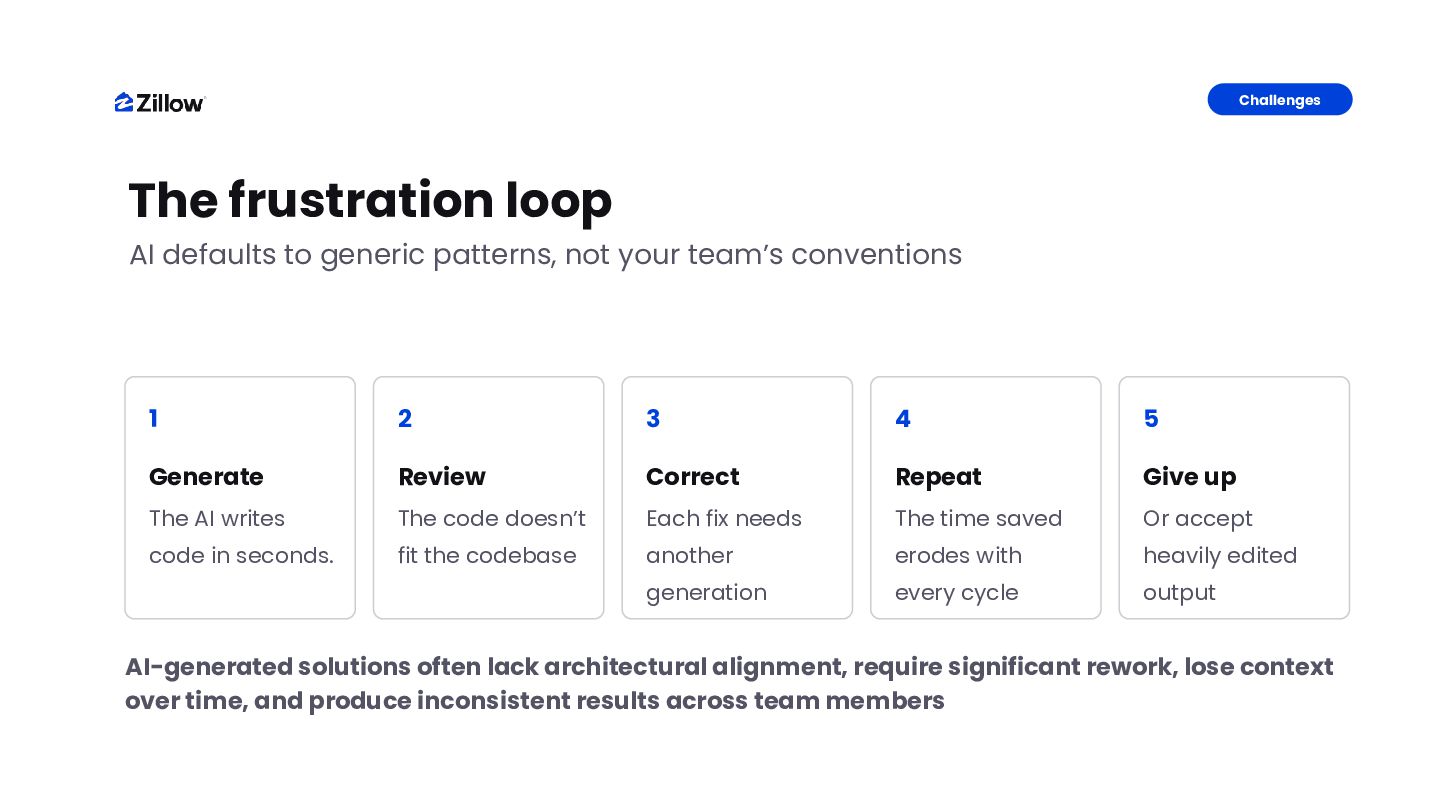
your team’s conventions 1 2 3 4 5 Generate Review Correct Repeat Give up The AI writes The code doesn’t Each fix needs The time saved Or accept code in seconds. fit the codebase another erodes with heavily edited generation every cycle output AI-generated solutions often lack architectural alignment, require significant rework, lose context over time, and produce inconsistent results across team members
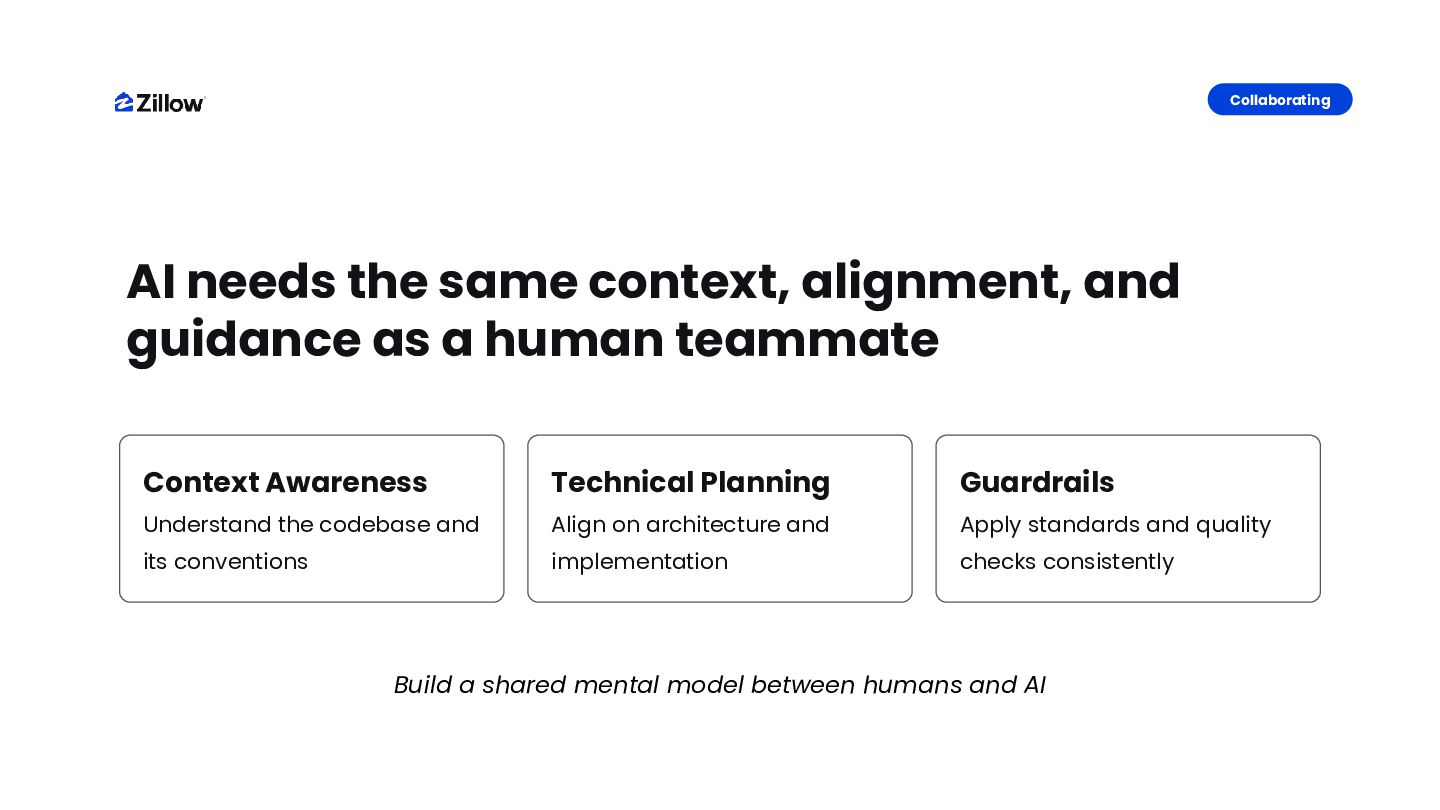
a human teammate Context Awareness Technical Planning Guardrails Understand the codebase and Align on architecture and Apply standards and quality its conventions implementation checks consistently Build a shared mental model between humans and AI
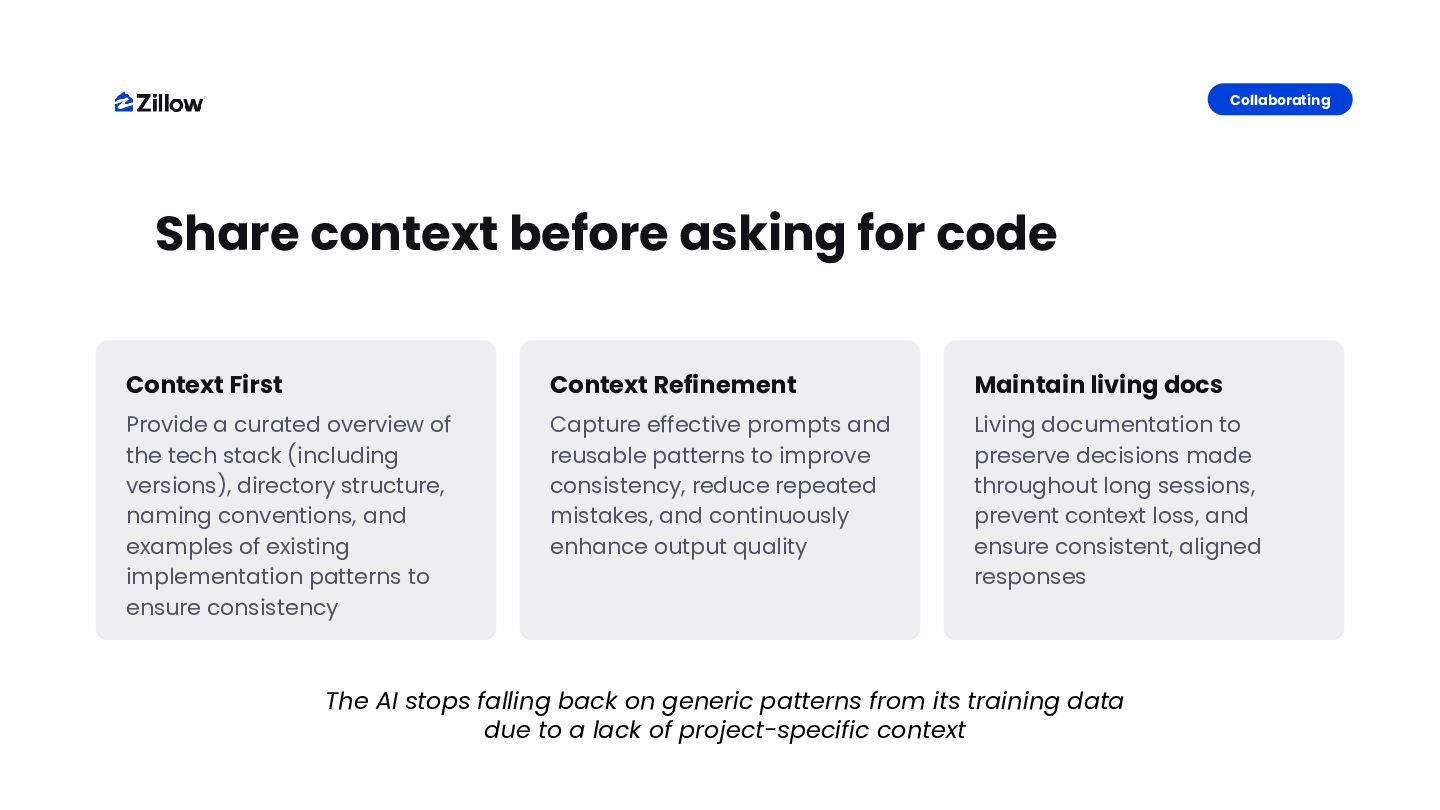
Refinement Maintain living docs Provide a curated overview of the tech stack (including versions), directory structure, naming conventions, and examples of existing implementation patterns to ensure consistency Capture effective prompts and reusable patterns to improve consistency, reduce repeated mistakes, and continuously enhance output quality Living documentation to preserve decisions made throughout long sessions, prevent context loss, and ensure consistent, aligned responses The AI stops falling back on generic patterns from its training data due to a lack of project-specific context
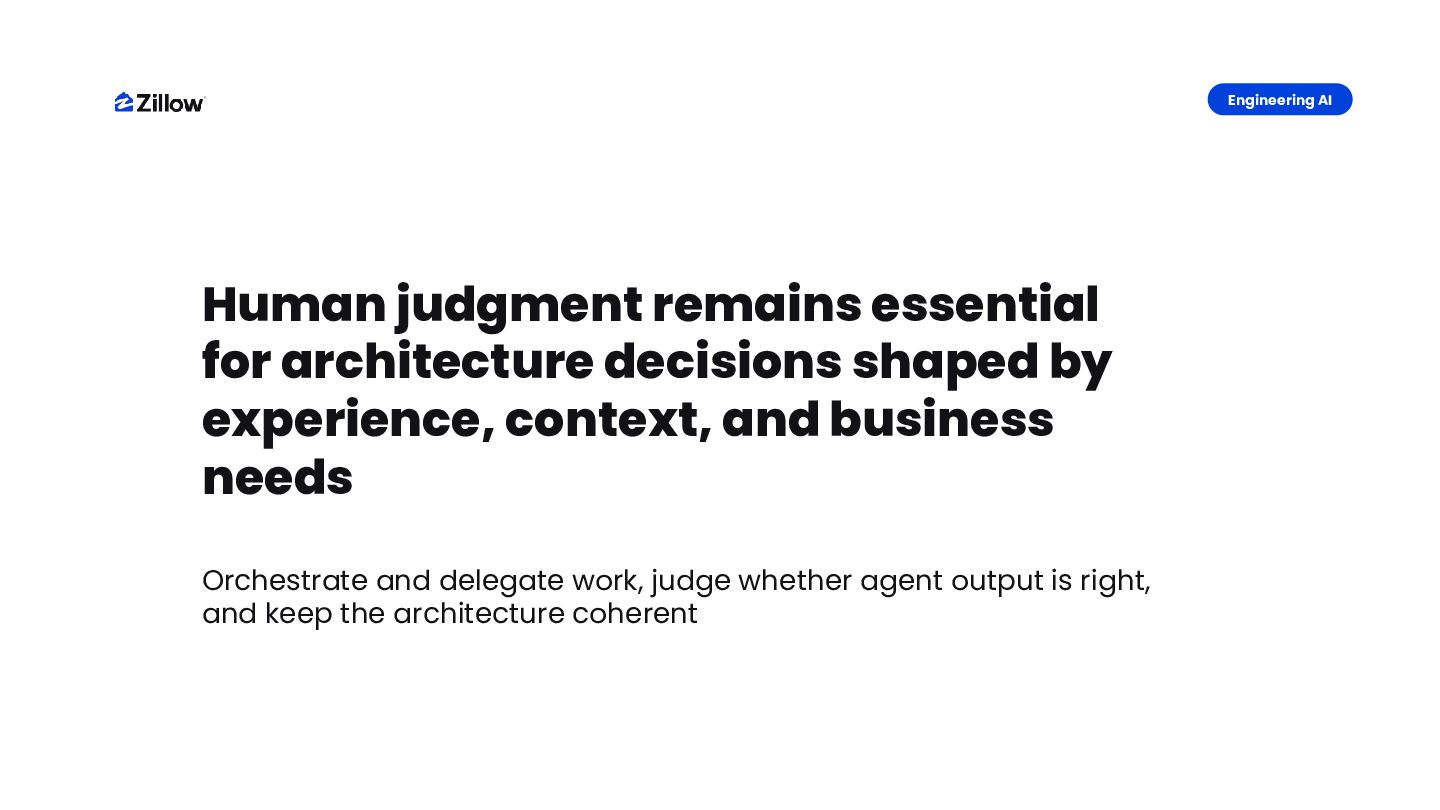
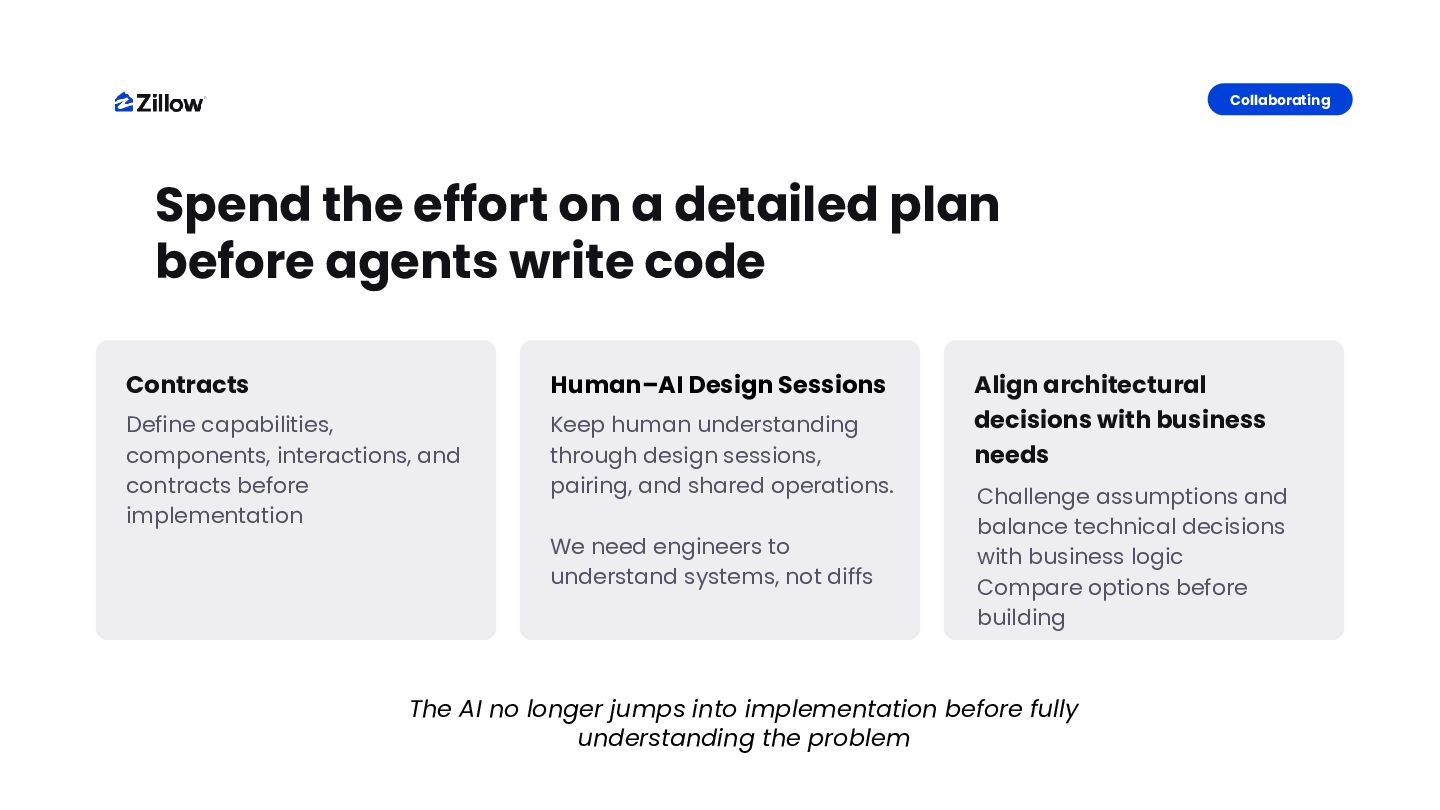
write code Contracts Human–AI Design Sessions Define capabilities, components, interactions, and contracts before implementation Keep human understanding through design sessions, pairing, and shared operations. We need engineers to understand systems, not diffs Align architectural decisions with business needs Challenge assumptions and balance technical decisions with business logic Compare options before building The AI no longer jumps into implementation before fully understanding the problem
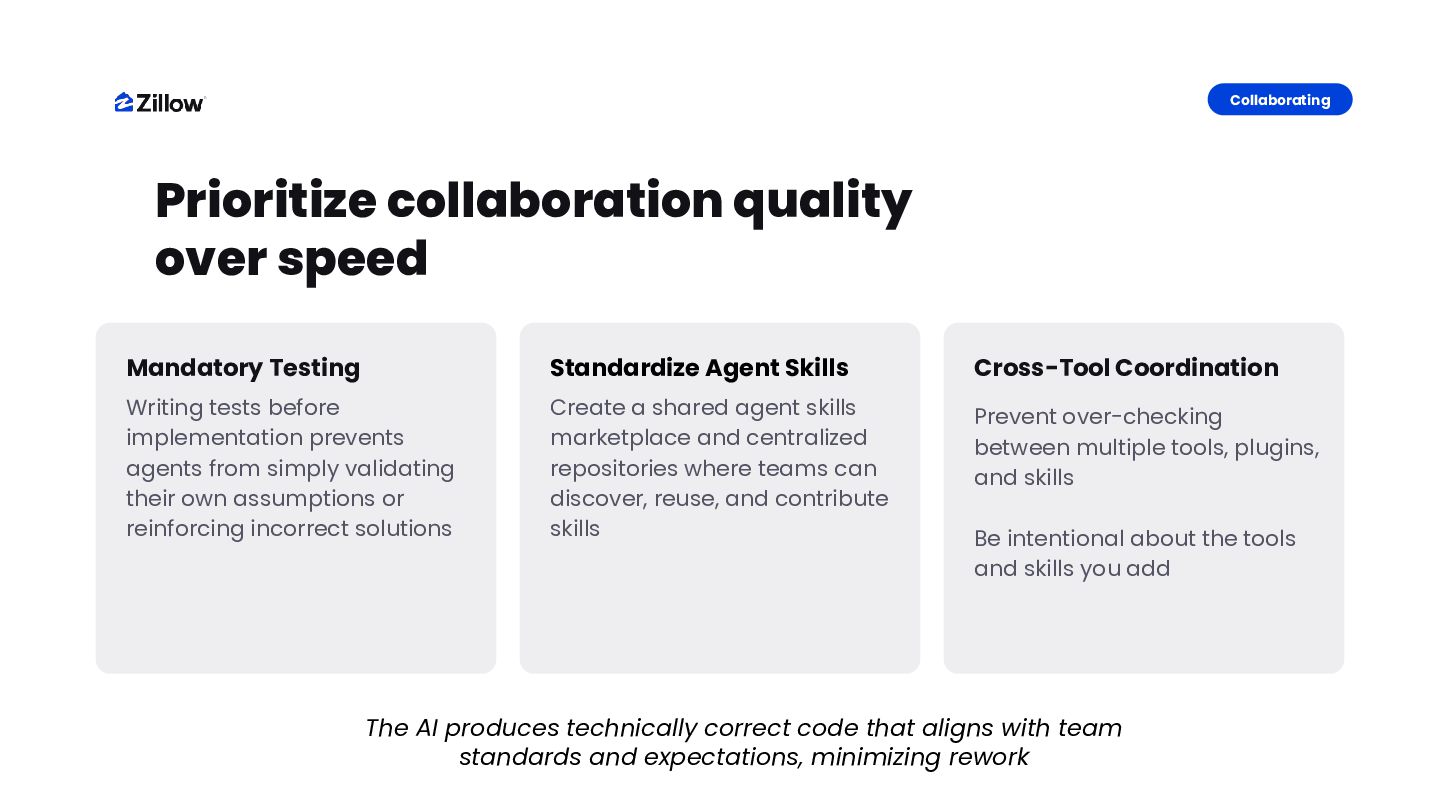
Skills Cross-Tool Coordination Writing tests before implementation prevents agents from simply validating their own assumptions or reinforcing incorrect solutions Create a shared agent skills marketplace and centralized repositories where teams can discover, reuse, and contribute skills Prevent over-checking between multiple tools, plugins, and skills Be intentional about the tools and skills you add The AI produces technically correct code that aligns with team standards and expectations, minimizing rework
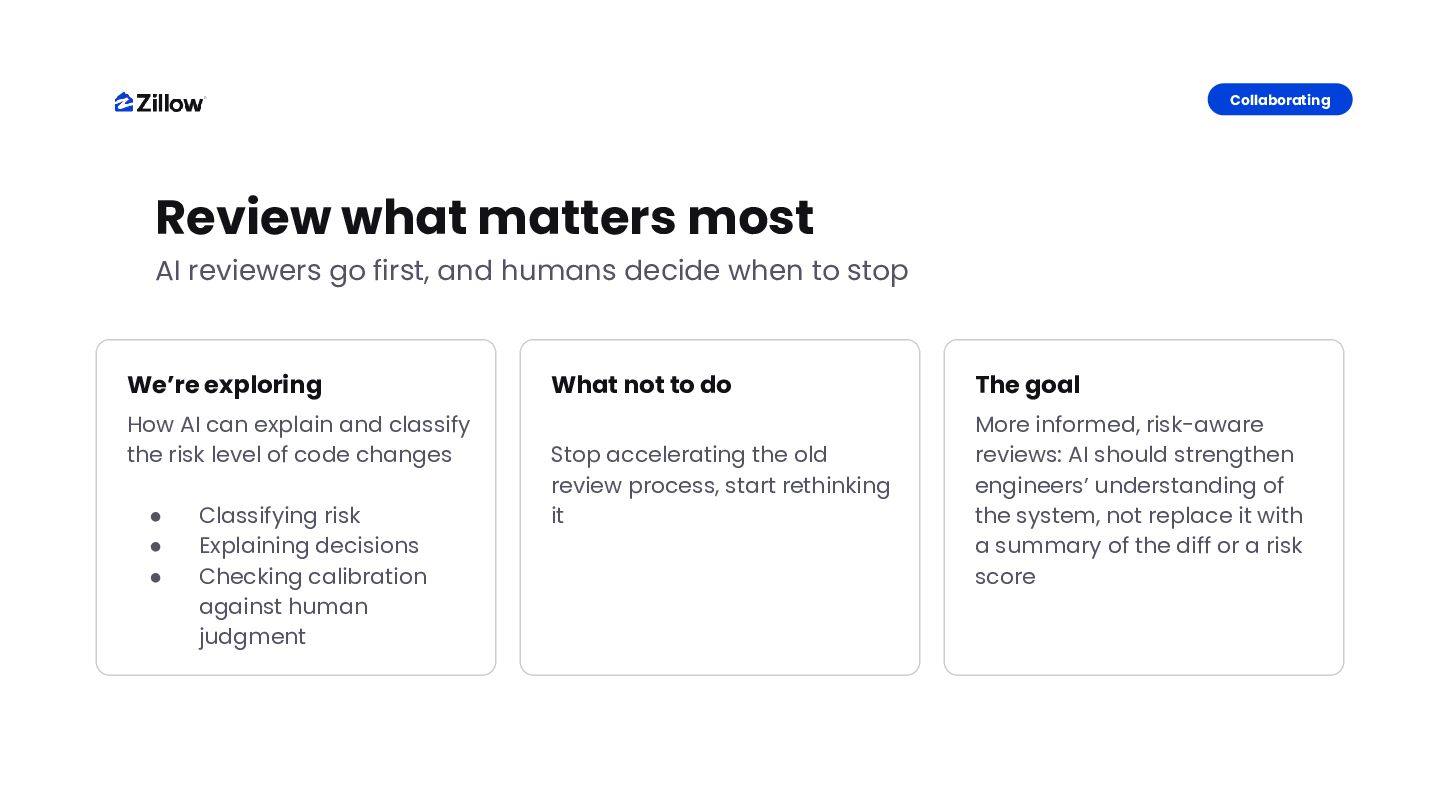
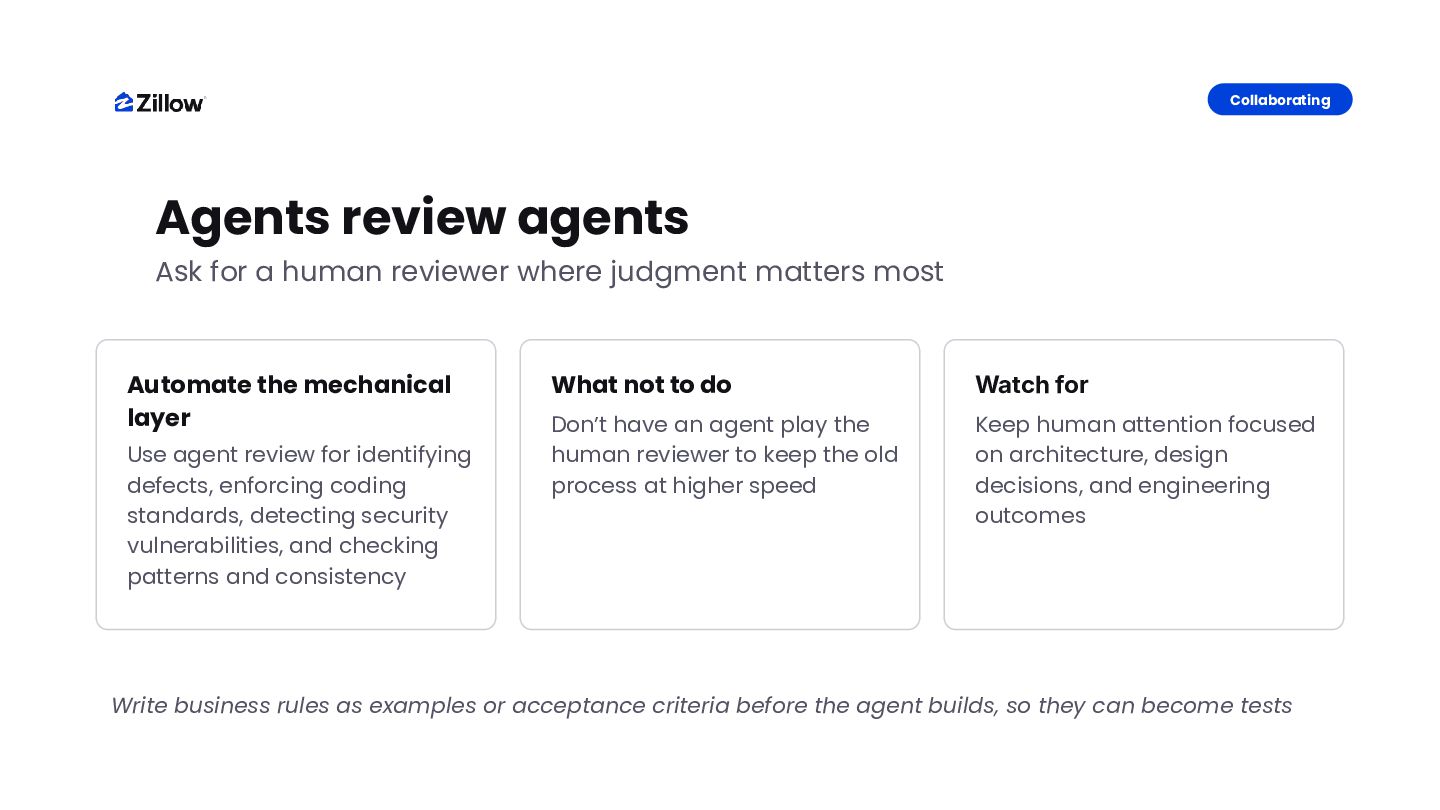
humans decide when to stop We’re exploring How AI can explain and classify the risk level of code changes • • • Classifying risk Explaining decisions Checking calibration against human judgment What not to do Stop accelerating the old review process, start rethinking it The goal More informed, risk-aware reviews: AI should strengthen engineers’ understanding of the system, not replace it with a summary of the diff or a risk score
judgment matters most Automate the mechanical layer Use agent review for identifying defects, enforcing coding standards, detecting security vulnerabilities, and checking patterns and consistency What not to do Watch for Don’t have an agent play the human reviewer to keep the old process at higher speed Keep human attention focused on architecture, design decisions, and engineering outcomes Write business rules as examples or acceptance criteria before the agent builds, so they can become tests
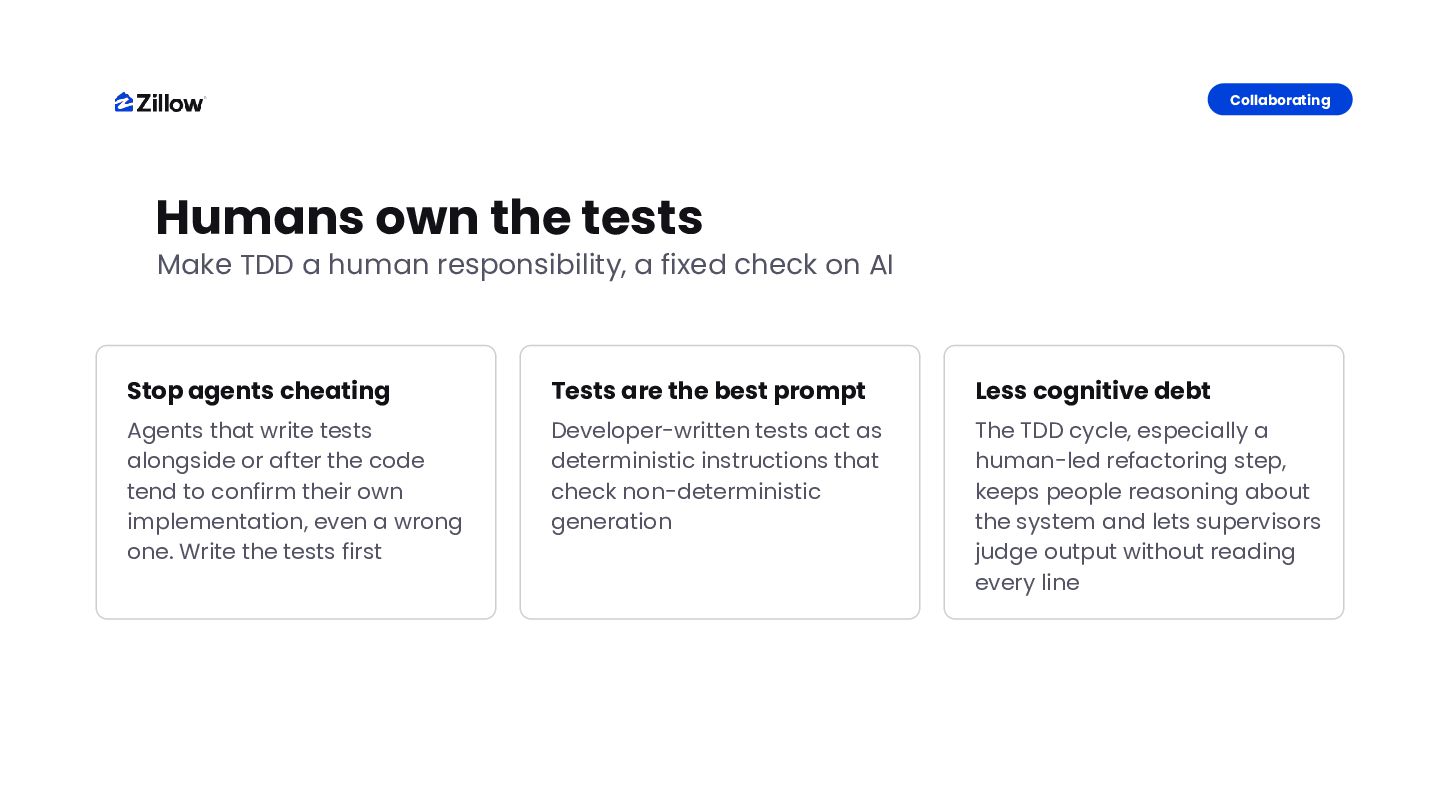
a fixed check on AI Stop agents cheating Tests are the best prompt Less cognitive debt Agents that write tests alongside or after the code tend to confirm their own implementation, even a wrong one. Write the tests first Developer-written tests act as deterministic instructions that check non-deterministic generation The TDD cycle, especially a human-led refactoring step, keeps people reasoning about the system and lets supervisors judge output without reading every line
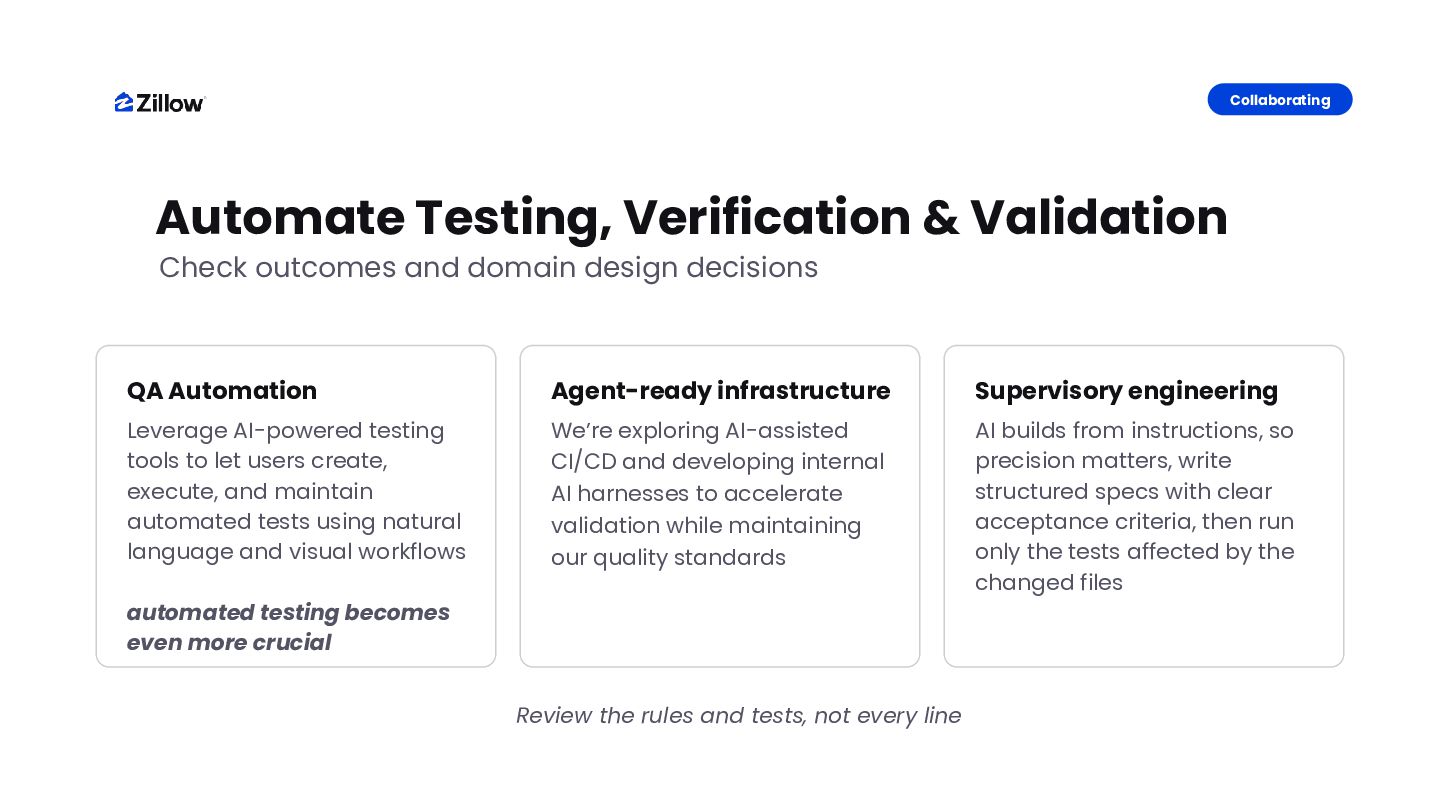
design decisions QA Automation Agent-ready infrastructure Supervisory engineering Leverage AI-powered testing tools to let users create, execute, and maintain automated tests using natural language and visual workflows We’re exploring AI-assisted CI/CD and developing internal AI harnesses to accelerate validation while maintaining our quality standards AI builds from instructions, so precision matters, write structured specs with clear acceptance criteria, then run only the tests affected by the changed files automated testing becomes even more crucial Review the rules and tests, not every line
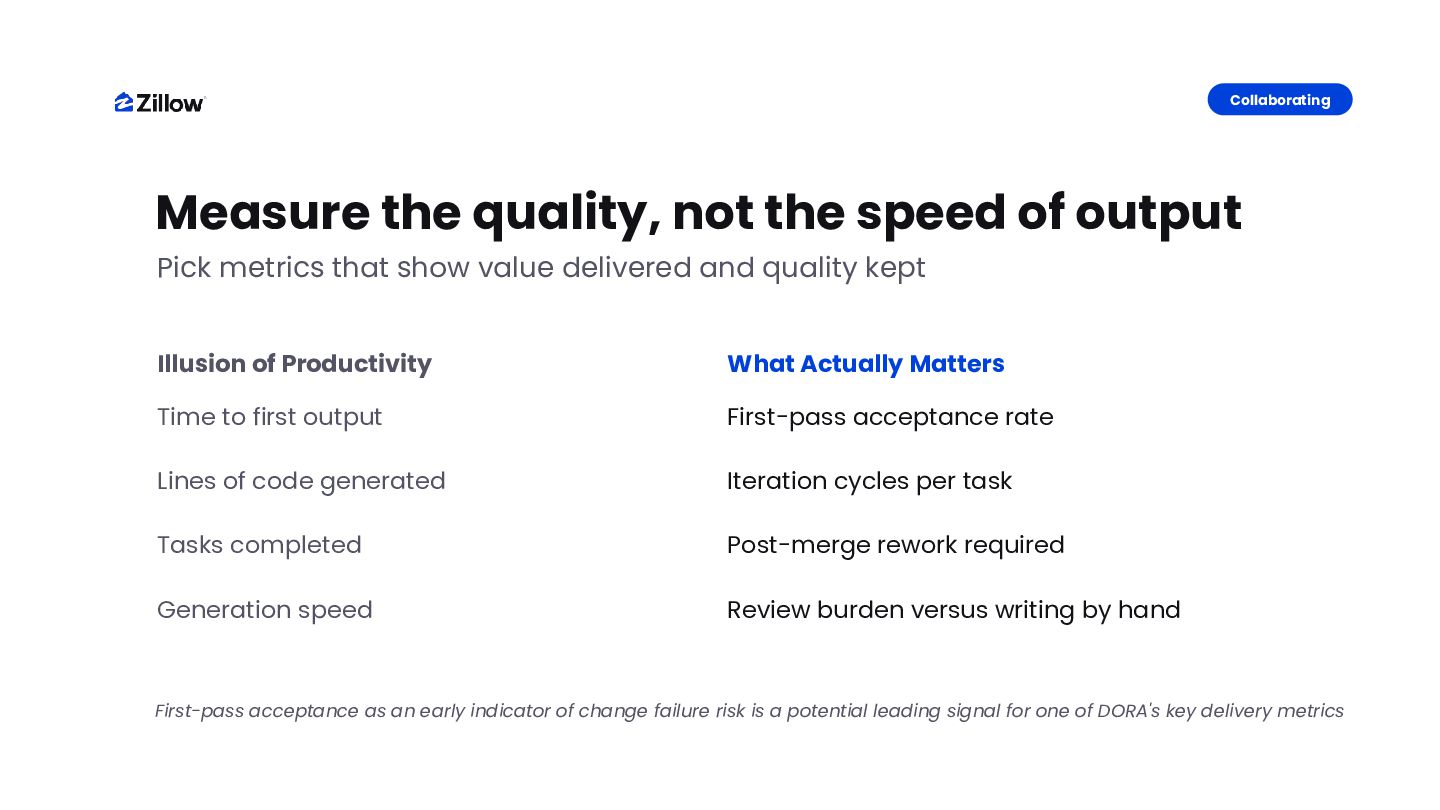
metrics that show value delivered and quality kept Illusion of Productivity What Actually Matters Time to first output First-pass acceptance rate Lines of code generated Iteration cycles per task Tasks completed Post-merge rework required Generation speed Review burden versus writing by hand First-pass acceptance as an early indicator of change failure risk is a potential leading signal for one of DORA's key delivery metrics
are evolving, others remain timeless, but remember: Software engineering was never just about writing code faster, It's about solving real-world problems
Era Of Mobile Engineering - Zillow Mobile • The next chapter of AI in real estate • How Zillow’s new AI mode works • Exploring Generative AI • To vibe or not to vibe • Agentic AI Foundation


 erikjhordan_rey
 techiro
 ryuseiiida
 snoozer05
 yoshiiryo1
 nkzn
 miu_crescent
 skydoves
 ryu1013
 myohei
 takanao
 konifar
 subroh0508
 eileencodes
 dougneiner
 colly
 codingconduct
 baasie
 rasagy
 cargoodrich
 konakalab
 hatefulcrawdad
 mfonobong
 tammyeverts
 philnash