Share
Embed
Transcript
20 slides
-
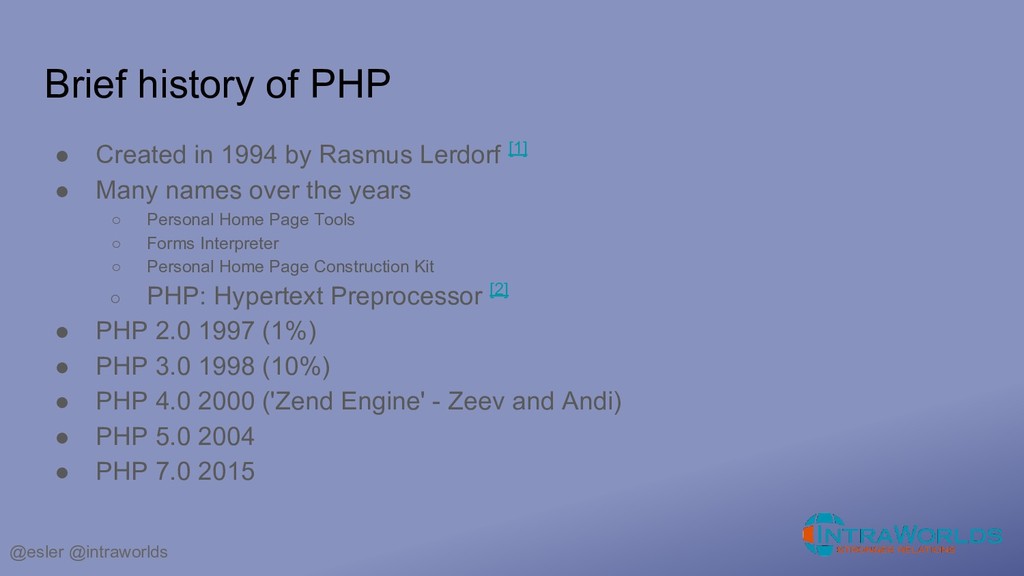
@esler @intraworlds Brief history of PHP • Created in 1994
by Rasmus Lerdorf [1] • Many names over the years ◦ Personal Home Page Tools ◦ Forms Interpreter ◦ Personal Home Page Construction Kit ◦ PHP: Hypertext Preprocessor [2] • PHP 2.0 1997 (1%) • PHP 3.0 1998 (10%) • PHP 4.0 2000 ('Zend Engine' - Zeev and Andi) • PHP 5.0 2004 • PHP 7.0 2015 -
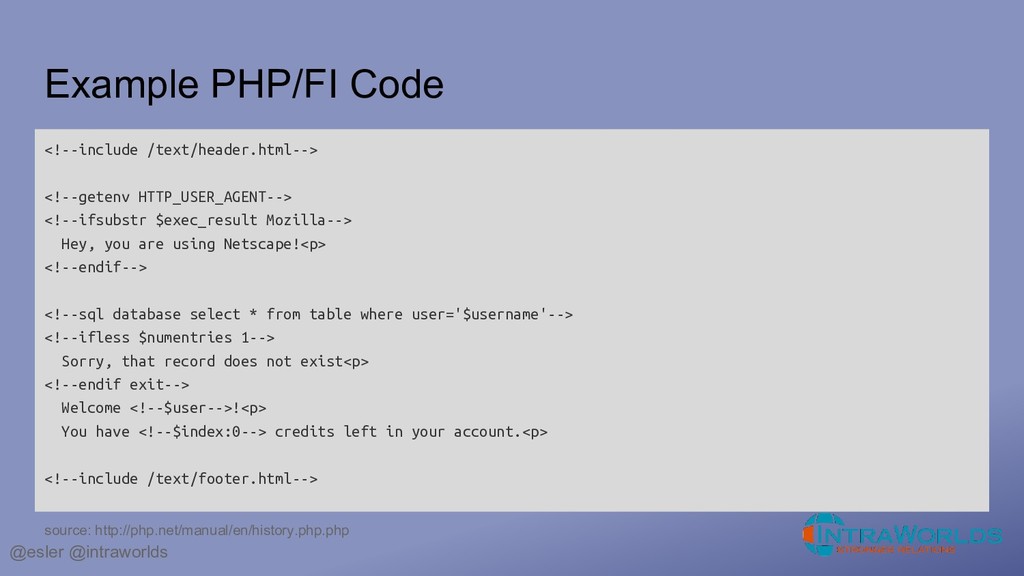
@esler @intraworlds Example PHP/FI Code <!--include /text/header.html--> <!--getenv HTTP_USER_AGENT--> <!--ifsubstr
$exec_result Mozilla--> Hey, you are using Netscape!<p> <!--endif--> <!--sql database select * from table where user='$username'--> <!--ifless $numentries 1--> Sorry, that record does not exist<p> <!--endif exit--> Welcome <!--$user-->!<p> You have <!--$index:0--> credits left in your account.<p> <!--include /text/footer.html--> source: http://php.net/manual/en/history.php.php -
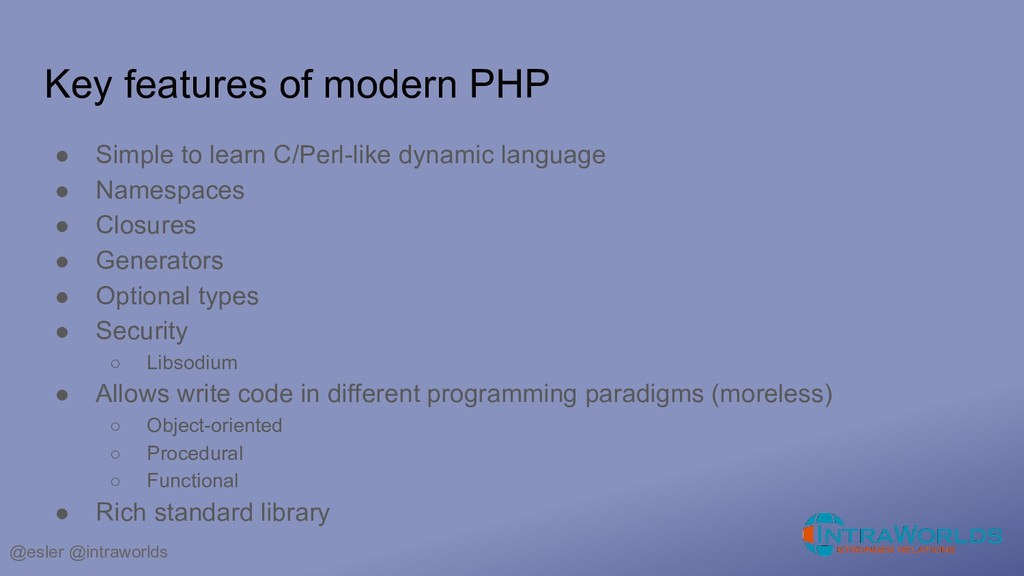
@esler @intraworlds Key features of modern PHP • Simple to
learn C/Perl-like dynamic language • Namespaces • Closures • Generators • Optional types • Security ◦ Libsodium • Allows write code in different programming paradigms (moreless) ◦ Object-oriented ◦ Procedural ◦ Functional • Rich standard library -
@esler @intraworlds And many more... • Basic syntax • Types
• Variables • Constants • Expressions • Operators • Control Structures • Functions • Classes and Objects • Namespaces • Errors • Exceptions • Generators • References Explained • Predefined Variables • Predefined Exceptions • Predefined Interfaces and Classes • Context options and parameters • Supported Protocols and Wrappers -
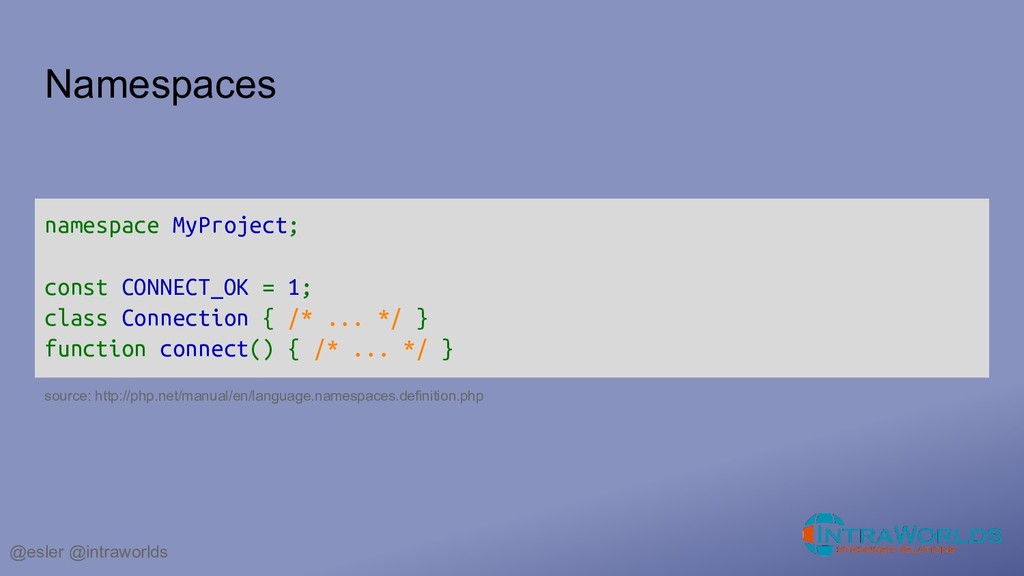
@esler @intraworlds Namespaces namespace MyProject; const CONNECT_OK = 1; class
Connection { /* ... */ } function connect() { /* ... */ } source: http://php.net/manual/en/language.namespaces.definition.php -
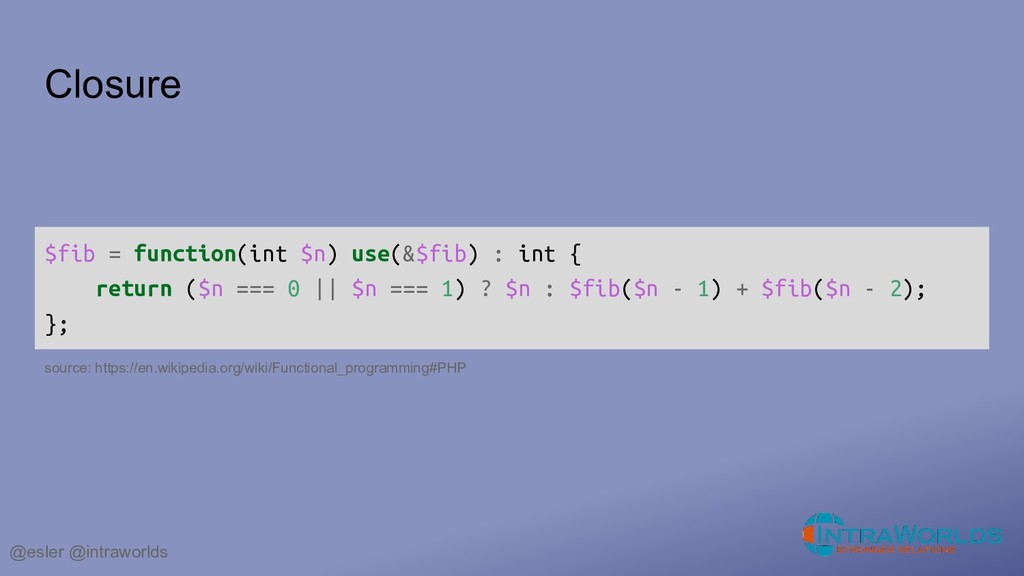
@esler @intraworlds Closure $fib = function(int $n) use(&$fib) : int
{ return ($n === 0 || $n === 1) ? $n : $fib($n - 1) + $fib($n - 2); }; source: https://en.wikipedia.org/wiki/Functional_programming#PHP -
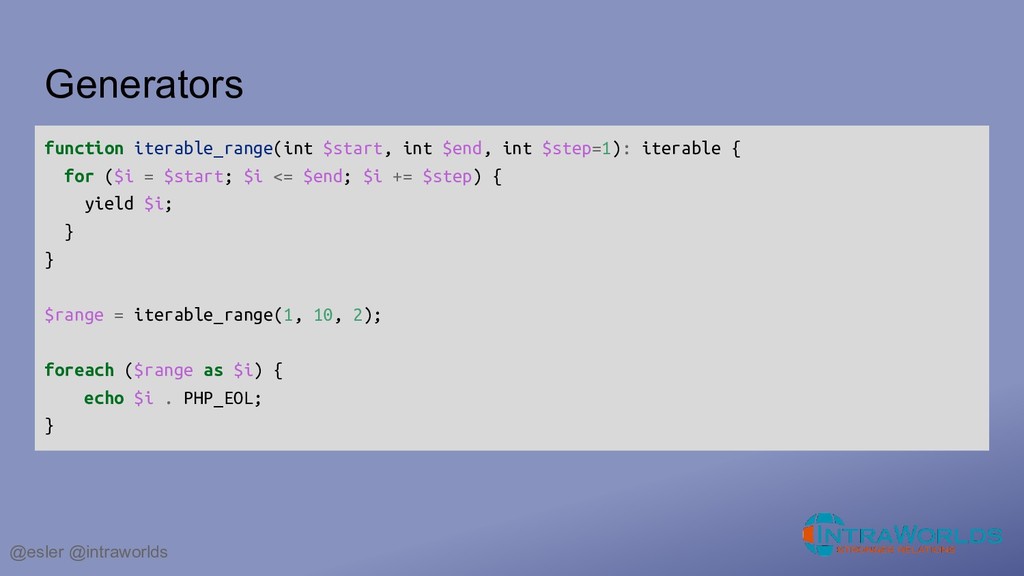
@esler @intraworlds Generators function iterable_range(int $start, int $end, int $step=1):
iterable { for ($i = $start; $i <= $end; $i += $step) { yield $i; } } $range = iterable_range(1, 10, 2); foreach ($range as $i) { echo $i . PHP_EOL; } -
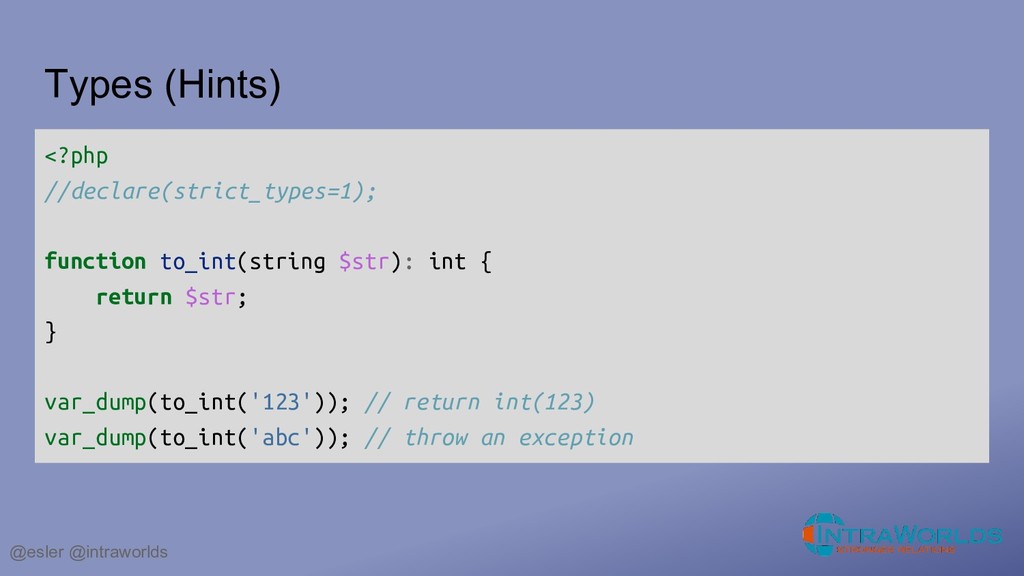
@esler @intraworlds Types (Hints) <?php //declare(strict_types=1); function to_int(string $str): int
{ return $str; } var_dump(to_int('123')); // return int(123) var_dump(to_int('abc')); // throw an exception -
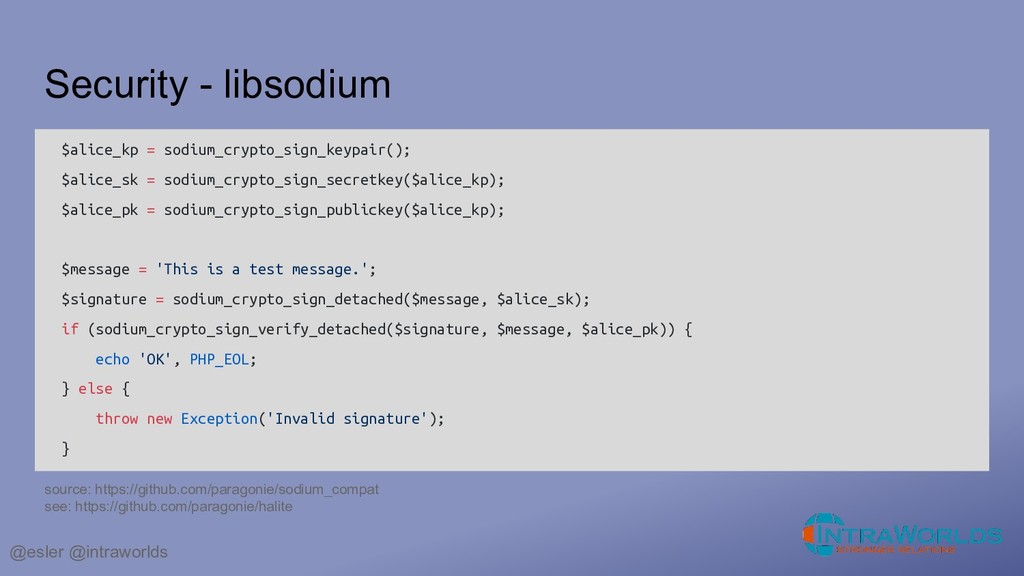
@esler @intraworlds Security - libsodium $alice_kp = sodium_crypto_sign_keypair(); $alice_sk =
sodium_crypto_sign_secretkey($alice_kp); $alice_pk = sodium_crypto_sign_publickey($alice_kp); $message = 'This is a test message.'; $signature = sodium_crypto_sign_detached($message, $alice_sk); if (sodium_crypto_sign_verify_detached($signature, $message, $alice_pk)) { echo 'OK', PHP_EOL; } else { throw new Exception('Invalid signature'); } source: https://github.com/paragonie/sodium_compat see: https://github.com/paragonie/halite -
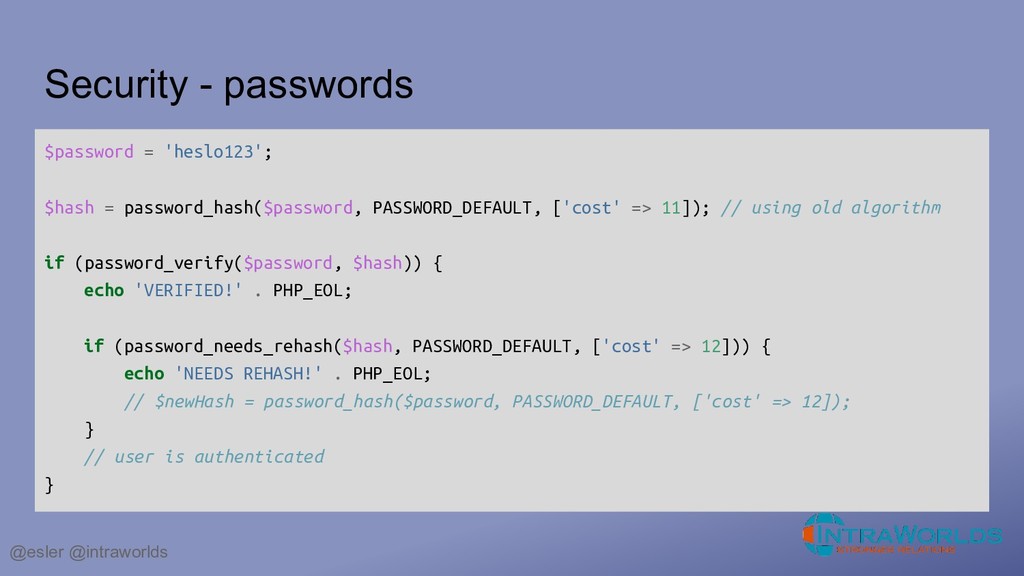
@esler @intraworlds Security - passwords $password = 'heslo123'; $hash =
password_hash($password, PASSWORD_DEFAULT, ['cost' => 11]); // using old algorithm if (password_verify($password, $hash)) { echo 'VERIFIED!' . PHP_EOL; if (password_needs_rehash($hash, PASSWORD_DEFAULT, ['cost' => 12])) { echo 'NEEDS REHASH!' . PHP_EOL; // $newHash = password_hash($password, PASSWORD_DEFAULT, ['cost' => 12]); } // user is authenticated } -
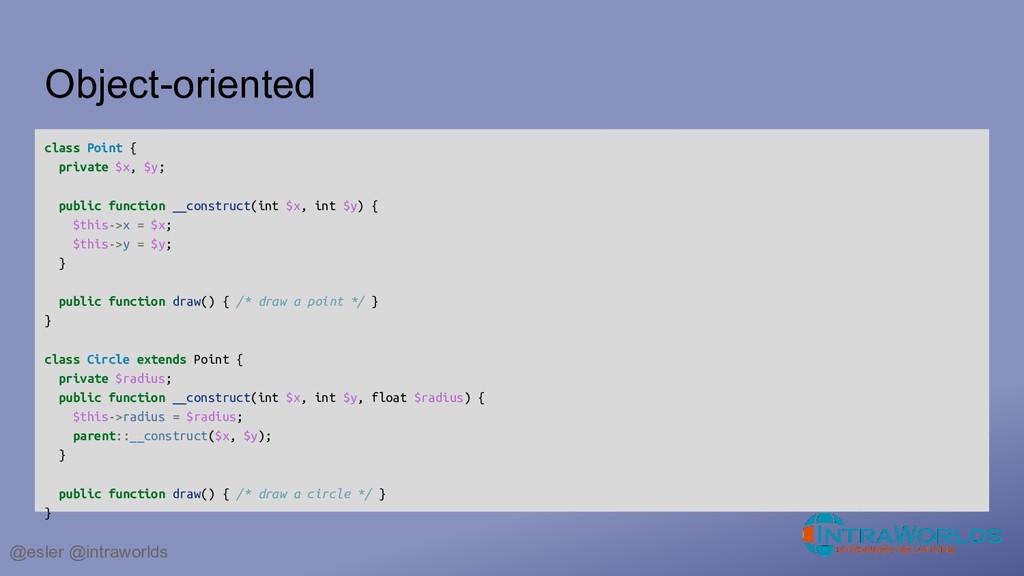
@esler @intraworlds Object-oriented class Point { private $x, $y; public
function __construct(int $x, int $y) { $this->x = $x; $this->y = $y; } public function draw() { /* draw a point */ } } class Circle extends Point { private $radius; public function __construct(int $x, int $y, float $radius) { $this->radius = $radius; parent::__construct($x, $y); } public function draw() { /* draw a circle */ } } -
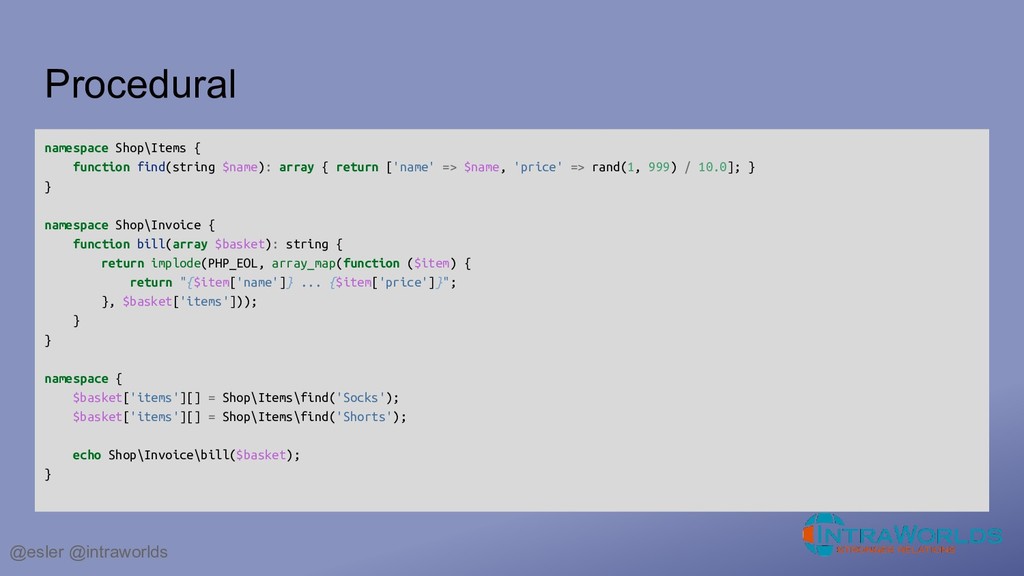
@esler @intraworlds Procedural namespace Shop\Items { function find(string $name): array
{ return ['name' => $name, 'price' => rand(1, 999) / 10.0]; } } namespace Shop\Invoice { function bill(array $basket): string { return implode(PHP_EOL, array_map(function ($item) { return "{$item['name']} ... {$item['price']}"; }, $basket['items'])); } } namespace { $basket['items'][] = Shop\Items\find('Socks'); $basket['items'][] = Shop\Items\find('Shorts'); echo Shop\Invoice\bill($basket); } -
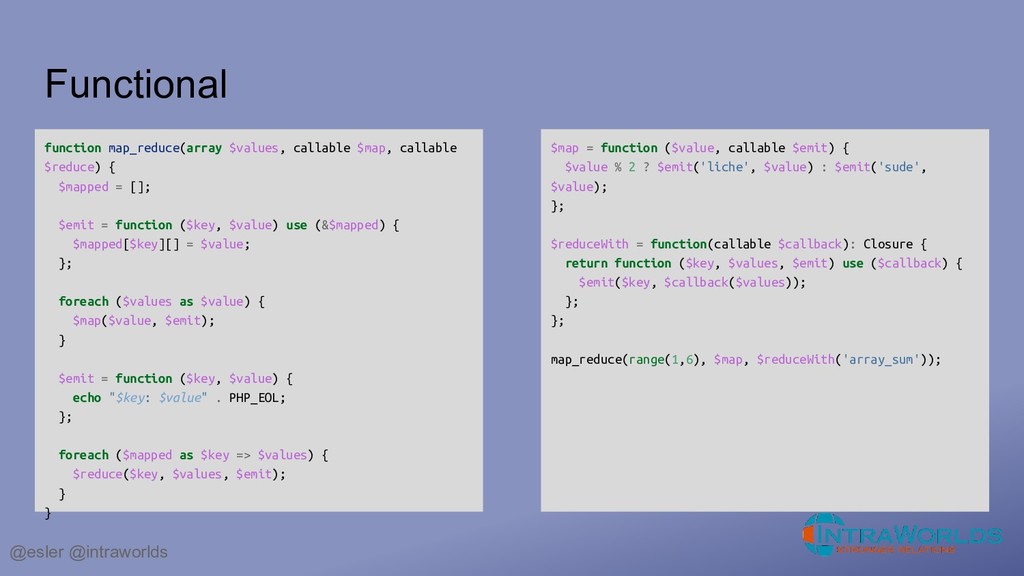
@esler @intraworlds Functional function map_reduce(array $values, callable $map, callable $reduce)
{ $mapped = []; $emit = function ($key, $value) use (&$mapped) { $mapped[$key][] = $value; }; foreach ($values as $value) { $map($value, $emit); } $emit = function ($key, $value) { echo "$key: $value" . PHP_EOL; }; foreach ($mapped as $key => $values) { $reduce($key, $values, $emit); } } $map = function ($value, callable $emit) { $value % 2 ? $emit('liche', $value) : $emit('sude', $value); }; $reduceWith = function(callable $callback): Closure { return function ($key, $values, $emit) use ($callback) { $emit($key, $callback($values)); }; }; map_reduce(range(1,6), $map, $reduceWith('array_sum')); -
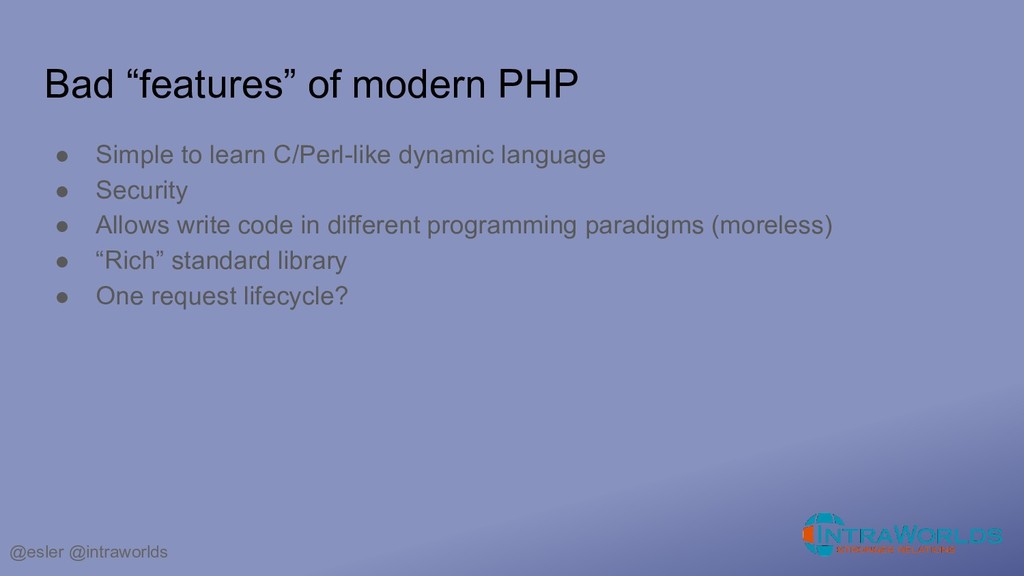
@esler @intraworlds Bad “features” of modern PHP • Simple to
learn C/Perl-like dynamic language • Security • Allows write code in different programming paradigms (moreless) • “Rich” standard library • One request lifecycle?