Upgrade to Pro — share decks privately, control downloads, hide ads and more …

How Global Enterprises Can Manage Multi-Entity ...

How Global Enterprises Can Manage Multi-Entity Operations in Dynamics 365 Business Central

Global enterprises can streamline multi-entity operations in Dynamics 365 Business Central by centralizing financials, standardizing processes, and automating intercompany transactions. Unified data, real-time reporting, and configurable governance frameworks enable consistent control, scalability, and efficient collaboration across subsidiaries, regions, and business units. For more details, visit us: https://evolvous.com

Avatar for Evolvous Limited

Evolvous Limited

December 10, 2025
Tweet

More Decks by Evolvous Limited

Other Decks in Business

Transcript

  1. HOW GLOBAL ENTERPRISES MANAGE MULTI-ENTITY OPERATIONS IN DYNAMICS 365 BUSINESS

    CENTRAL An overview of how Dynamics 365 Business Central modernizes multi-entity management for global enterprises through features such as company-level data isolation, automated dual-posting, multi-currency handling, localization packs, API-driven integrations, and a built-in consolidation engine—creating a scalable and compliant global ERP environment.
  2. 1. Follows its own financial rules 2. Uses different currencies

    3. Requires local tax compliance 4. Needs autonomy in operations GLOBAL COMPANIES OPERATE ACROSS MULTIPLE COUNTRIES, SUBSIDIARIES, AND BUSINESS UNITS. THE REALITY OF GLOBAL ENTERPRISES This creates operational complexity because each entity: Yet, corporate teams still require central oversight and consolidated reporting.
  3. KEY CHALLENGES IN MULTI- ENTITY MANAGEMENT MANAGING MULTIPLE COMPANIES WITHOUT

    AN INTEGRATED ERP LEADS TO: 1.Manual intercompany transactions 2.Slow month-end and year-end consolidation 3.Data duplication and inconsistencies 4.Lack of real-time visibility 5.Complicated approval workflows A unified system is essential for accuracy and speed.
  4. WHY BUSINESS CENTRAL FOR MULTI-ENTITY OPERATIONS DYNAMICS 365 BUSINESS CENTRAL

    IS DESIGNED TO SUPPORT UP TO 200 LEGAL ENTITIES WITHIN ONE ENVIRONMENT. 1. Unified financial and operational control 2. Seamless automation between companies 3. Independence + centralized governance 4. Scalable architecture for global growth IT OFFERS:
  5. ANALYSIS 2 ANALYSIS 1 CORE MULTI-ENTITY CAPABILITIES IN BUSINESS CENTRAL

    BC PROVIDES A STRONG FOUNDATION FOR GLOBAL OPERATIONS WITH: 1. Company-level segmentation 2. Automated intercompany posting 3. Multi-currency support 4. Built-in consolidation engine 5. Role-based security and compliance
  6. INDEPENDENT ENTITY SETUP EACH ENTITY IN BC OPERATES INDEPENDENTLY WITH

    ITS OWN: General ledger SHARED PROCESSES: Tax configuration Localization rules Audit trail Master data Inventory structures · Procurement
  7. AUTOMATED INTERCOMPANY TRANSACTIONS BC AUTOMATES INTERCOMPANY OPERATIONS SUCH AS: 1.

    Sales → Purchase document creation 2. Dual ledger postings 3. Cost allocations 4. Intercompany balancing With ISVs like Binary Stream, enterprises gain: 1.Advanced eliminations 2.Multi-entity posting 3.Reconciliation dashboards
  8. MULTI-CURRENCY & CONSOLIDATION BC SUPPORTS: THE CONSOLIDATION COMPANY ENABLES: 1.Local

    + reporting currency 2.Automatic revaluation 3.Exchange rate adjustments 1. COA mapping 2. Currency translation 3. Elimination entries 4. Power BI group-wide reporting
  9. MULTI-CURRENCY & CONSOLIDATION 1.Localization (GST, VAT, SAF-T, e‑invoicing) 2.Cross-entity supply

    chain 3.Centralized procurement 4.Master data governance 5.Role-based security (GDPR, SOC, SOX) BC DELIVERS ESSENTIAL CAPABILITIES:
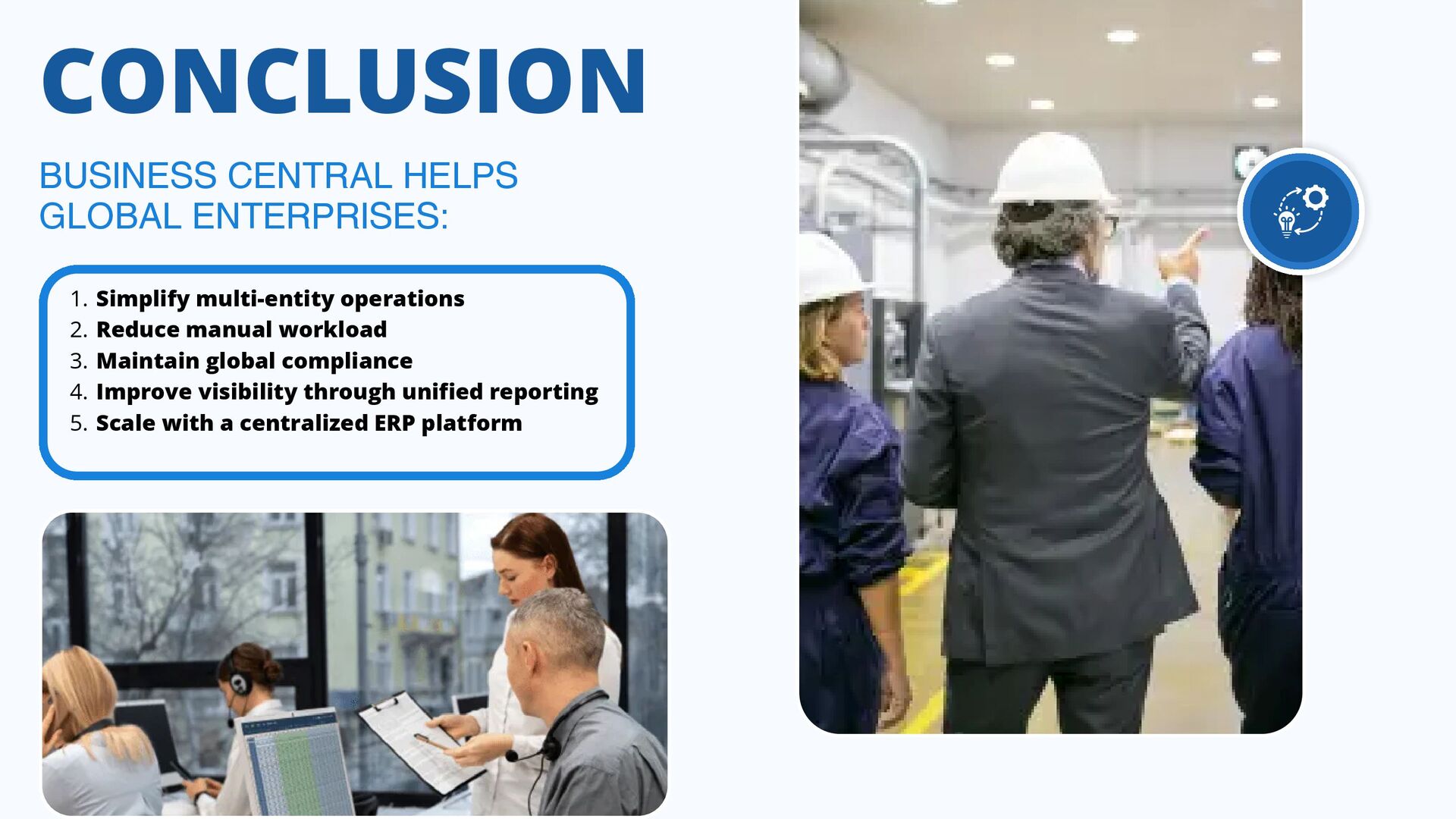
  10. CONCLUSION BUSINESS CENTRAL HELPS GLOBAL ENTERPRISES: 1. Simplify multi-entity operations

    2. Reduce manual workload 3. Maintain global compliance 4. Improve visibility through unified reporting 5. Scale with a centralized ERP platform