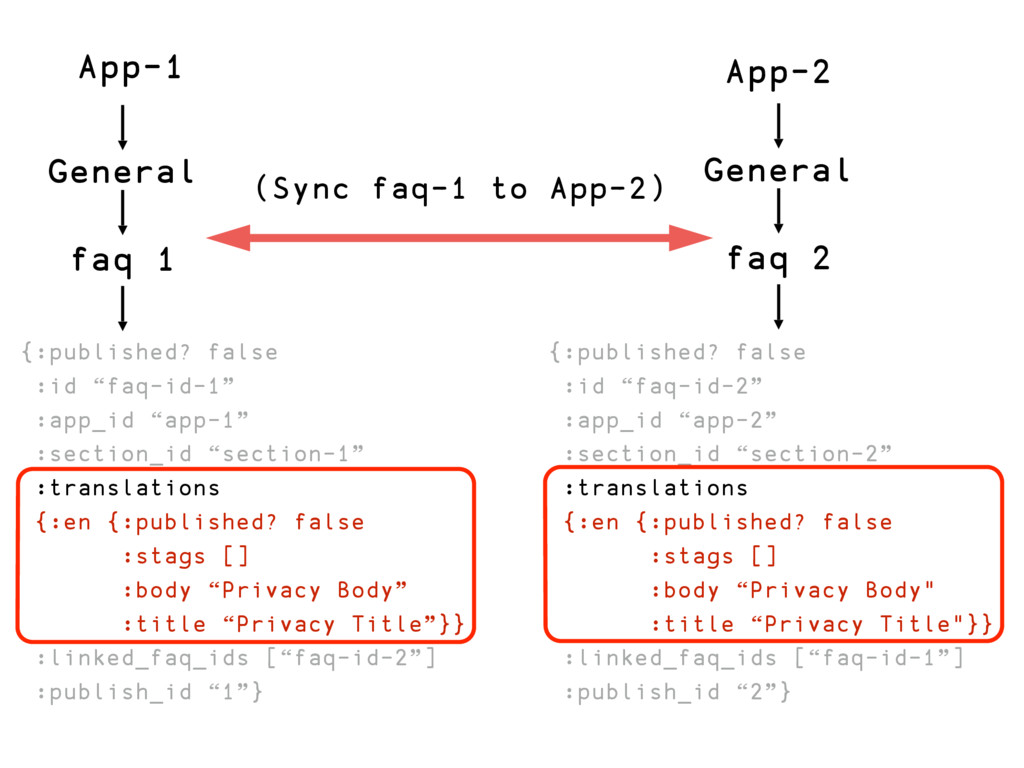
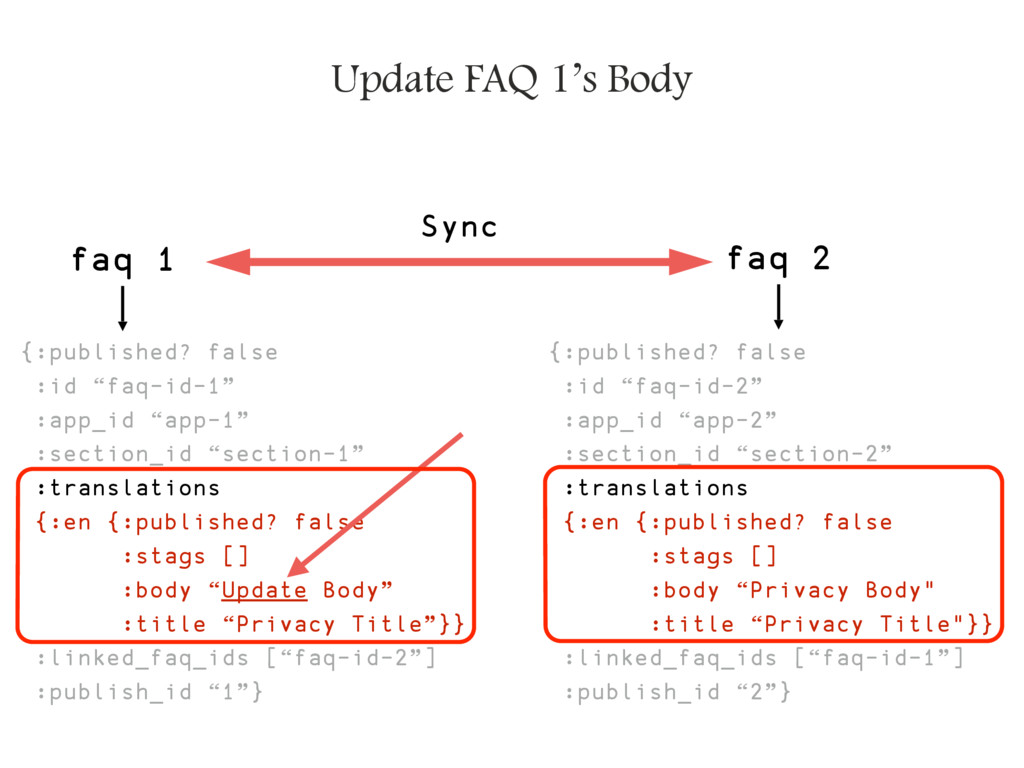
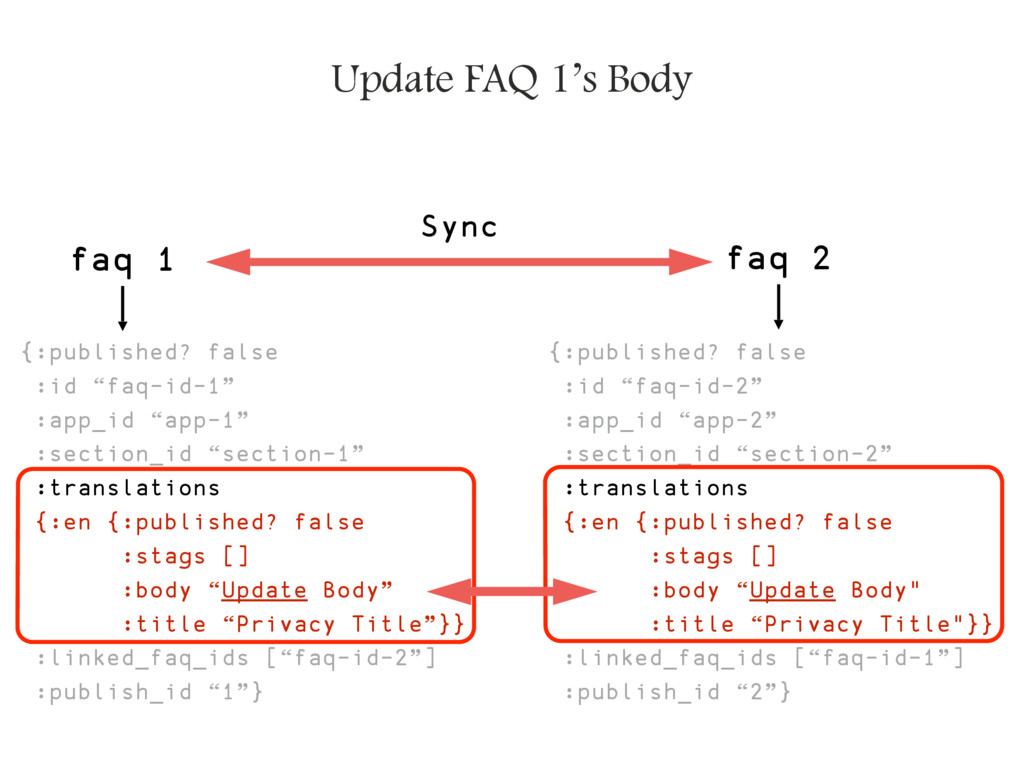
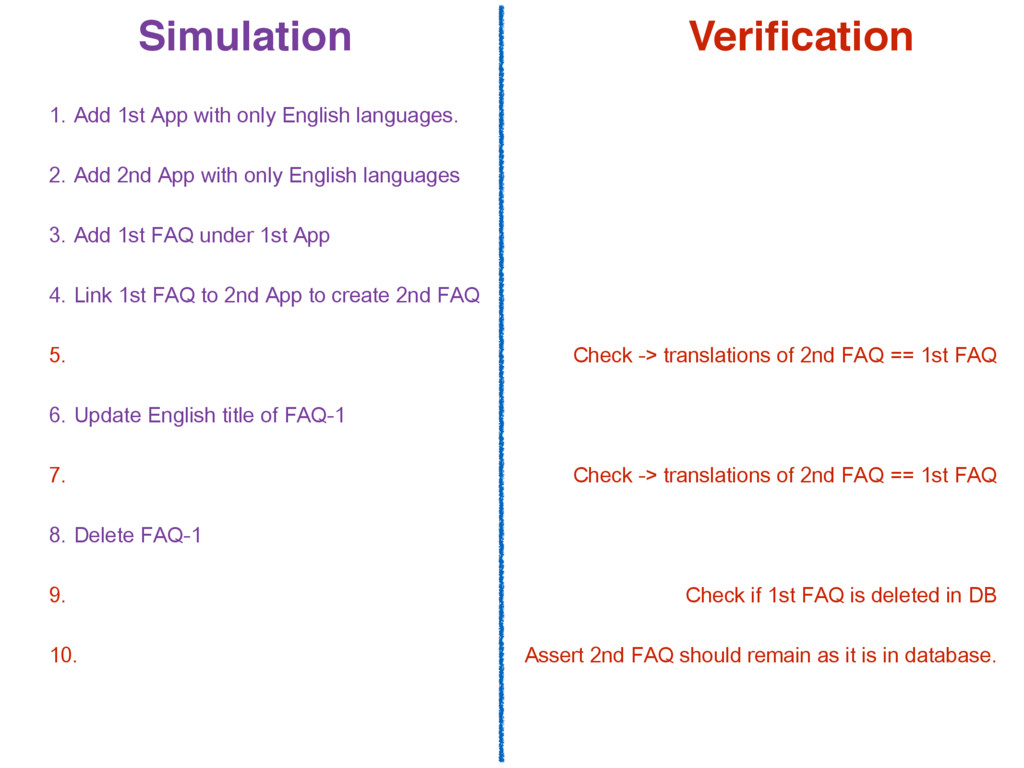
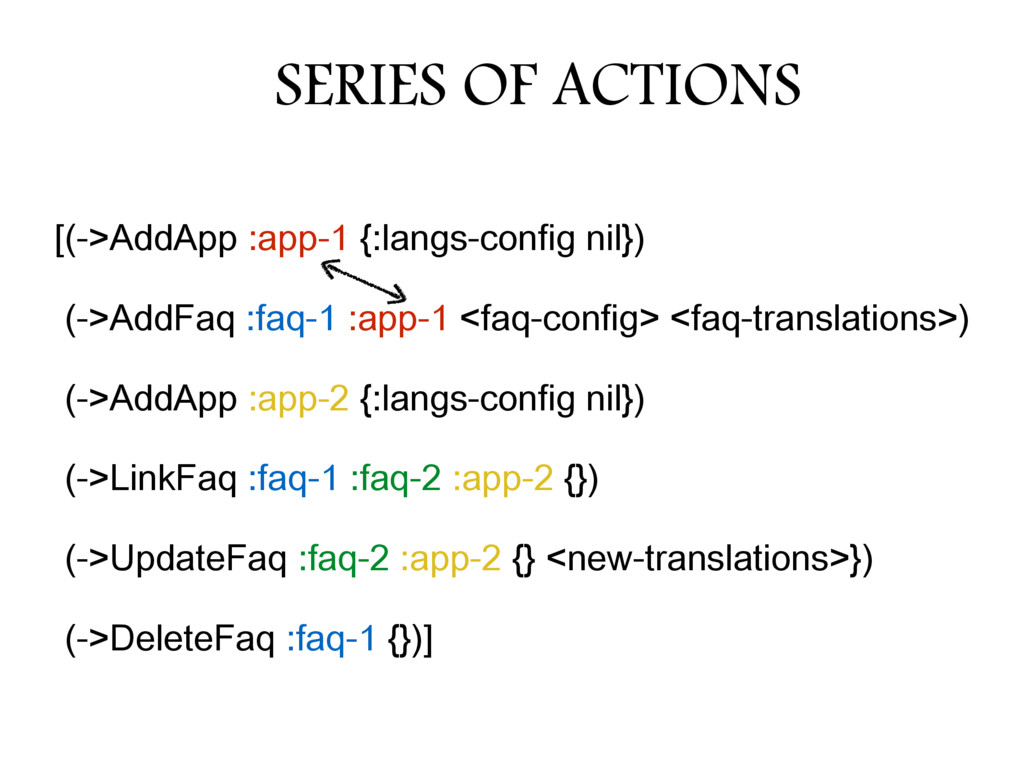
2nd App with only English languages 3. Add 1st FAQ under 1st App 4. Link 1st FAQ to 2nd App to create 2nd FAQ 5. Check -> translations of 2nd FAQ == 1st FAQ 6. Update English title of FAQ-1 7. Check -> translations of 2nd FAQ == 1st FAQ 8. Delete FAQ-1 9. Check if 1st FAQ is deleted in DB 10. Assert 2nd FAQ should remain as it is in database. Simulation Verification
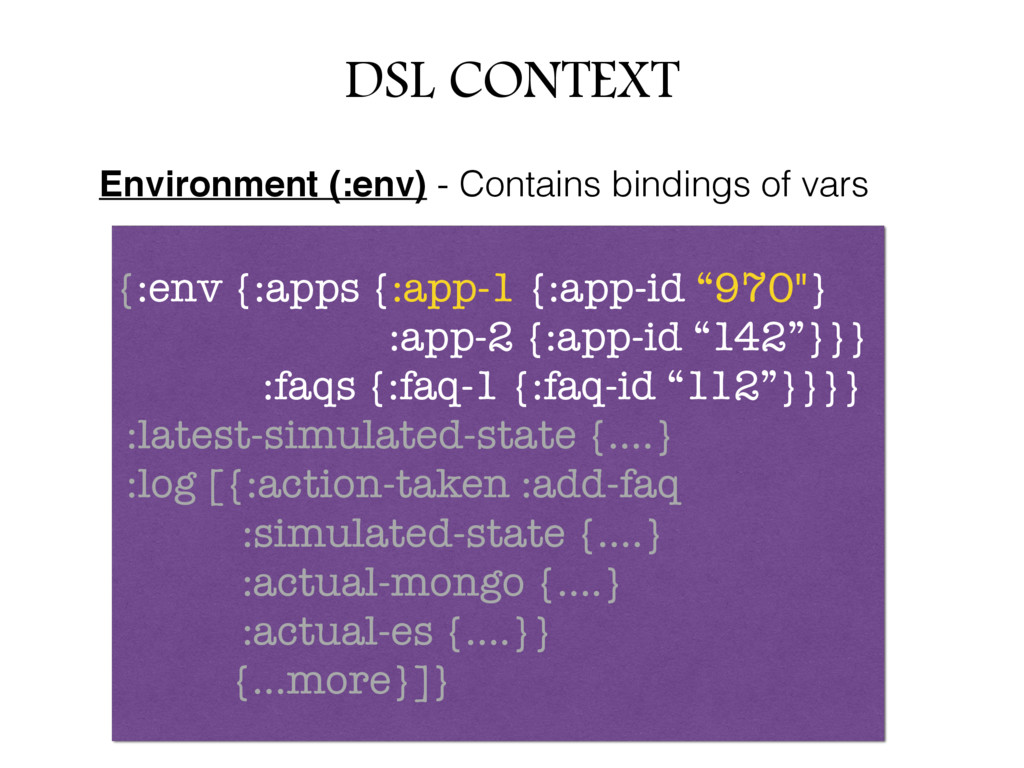
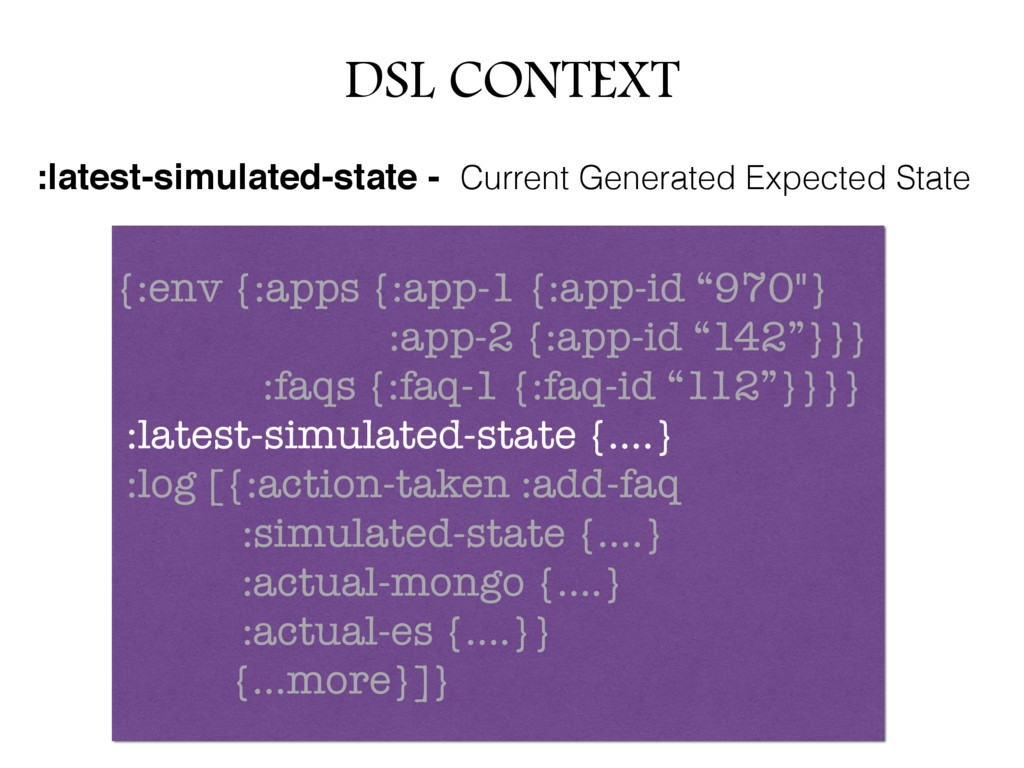
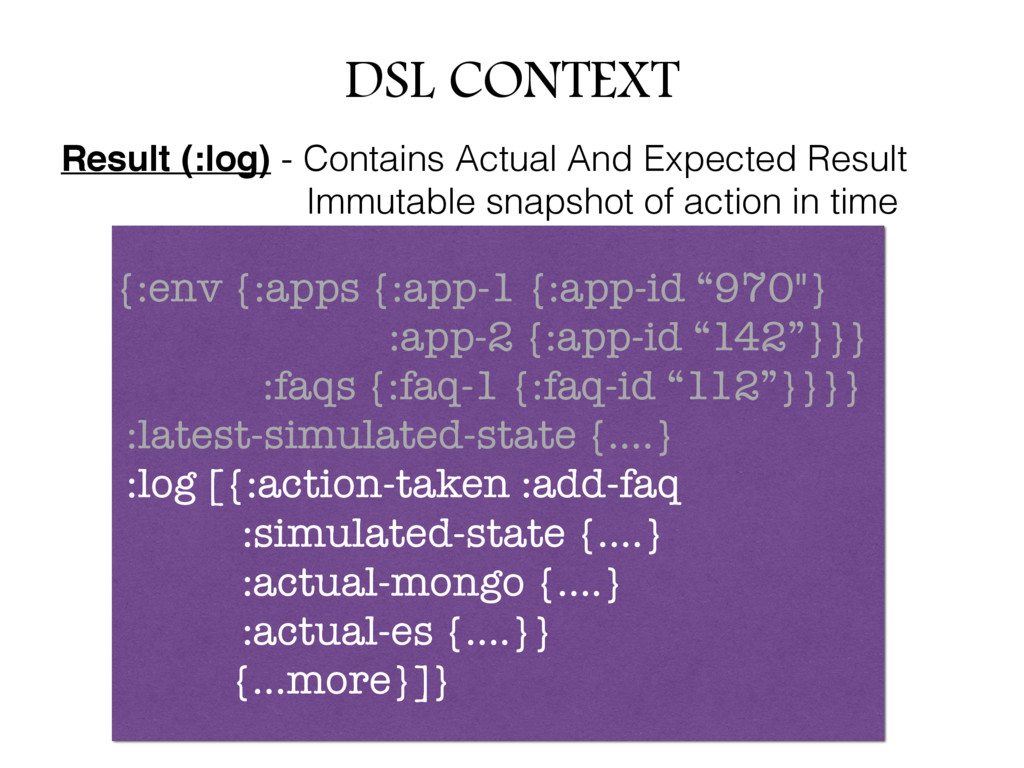
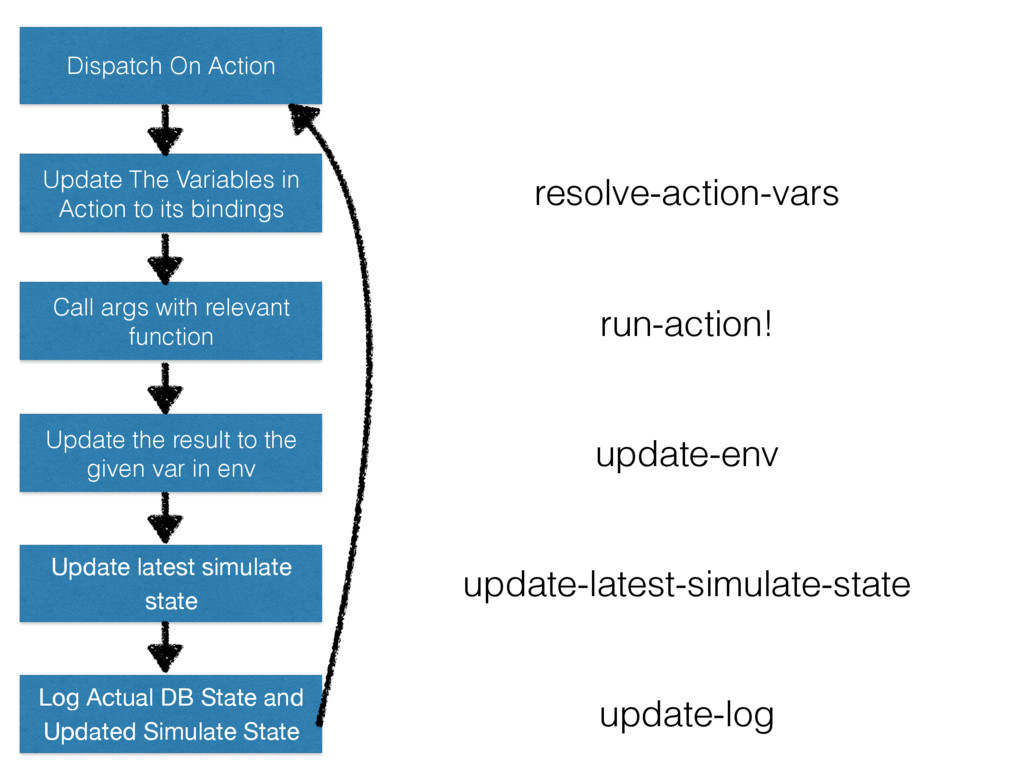
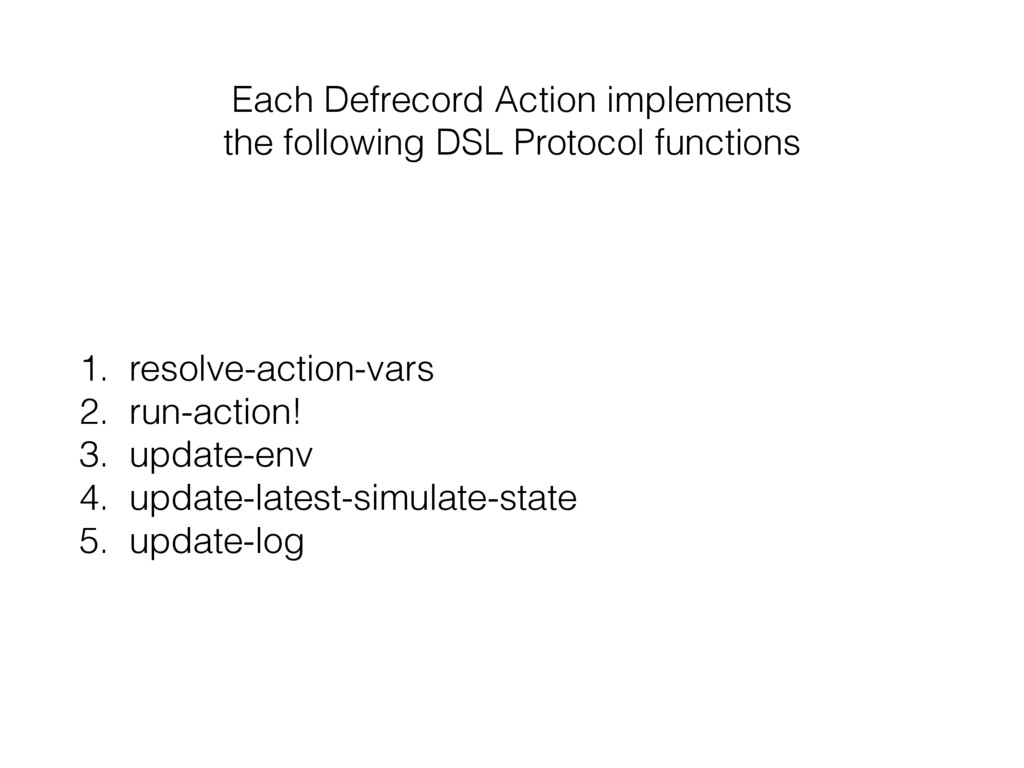
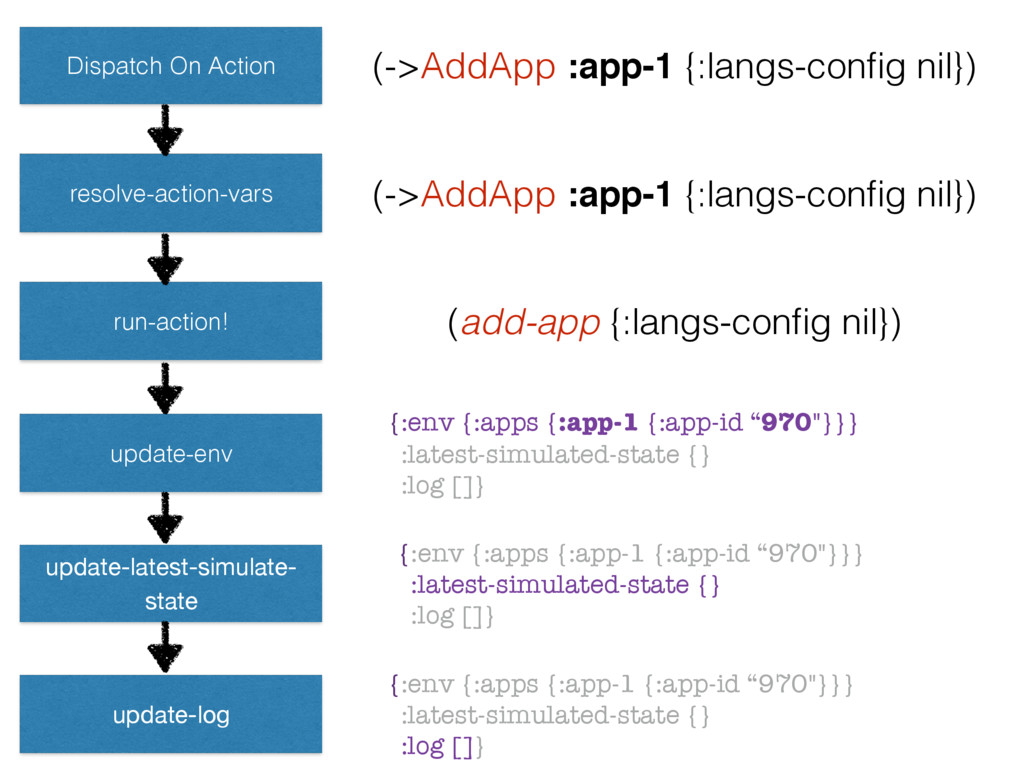
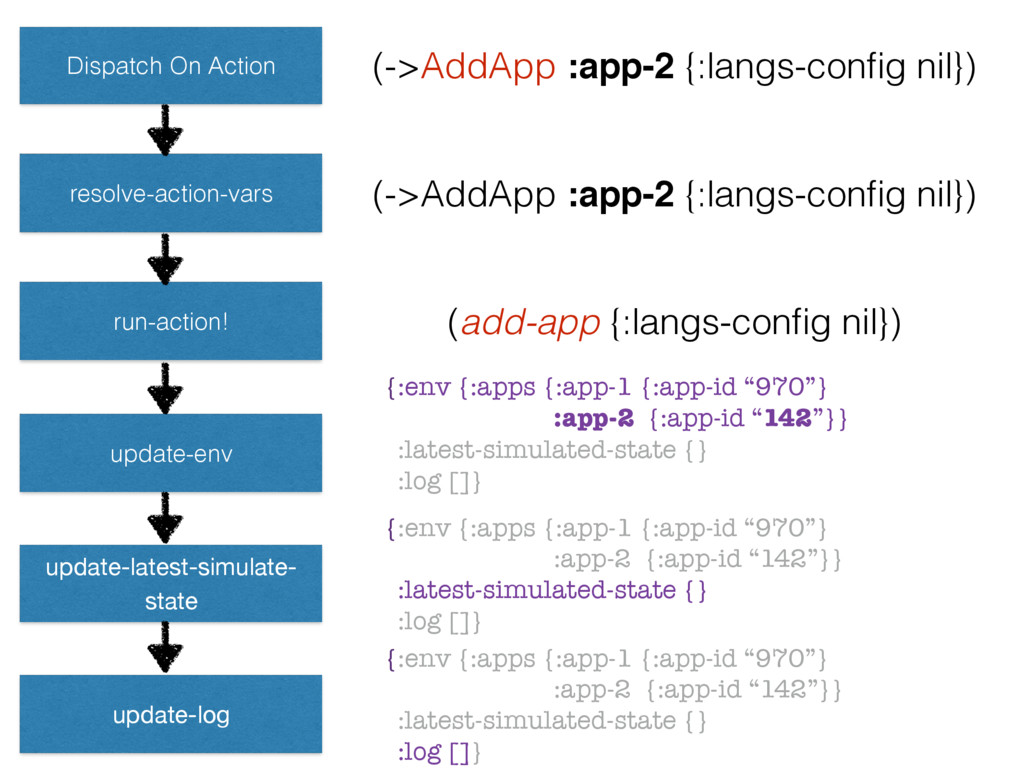
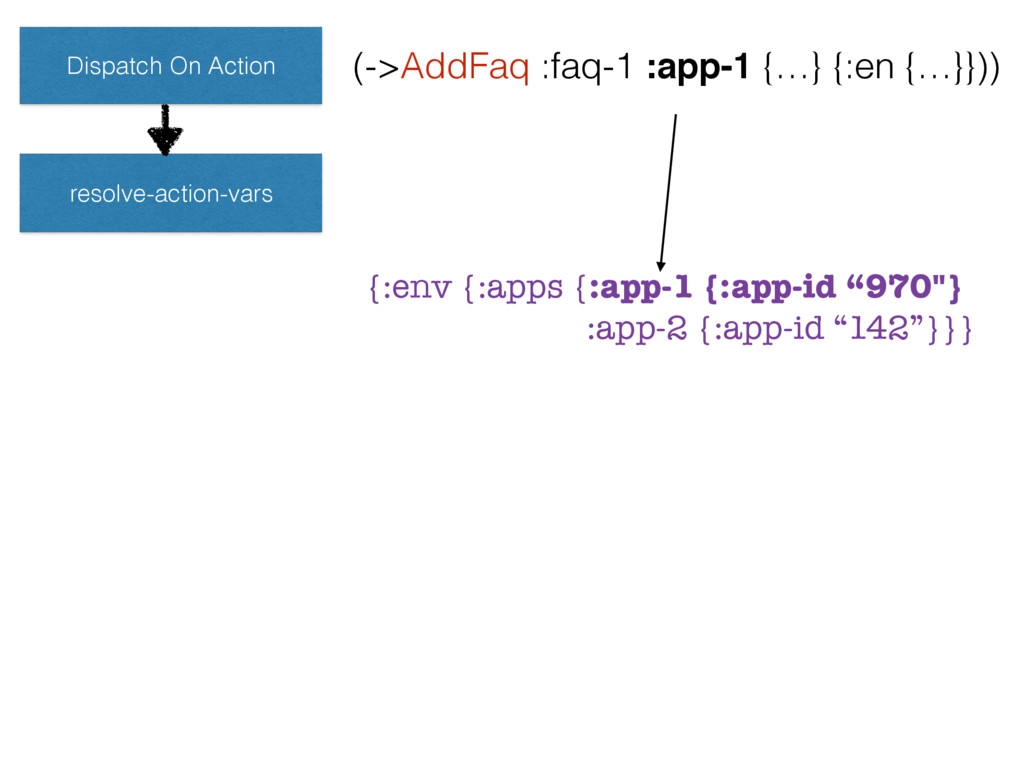
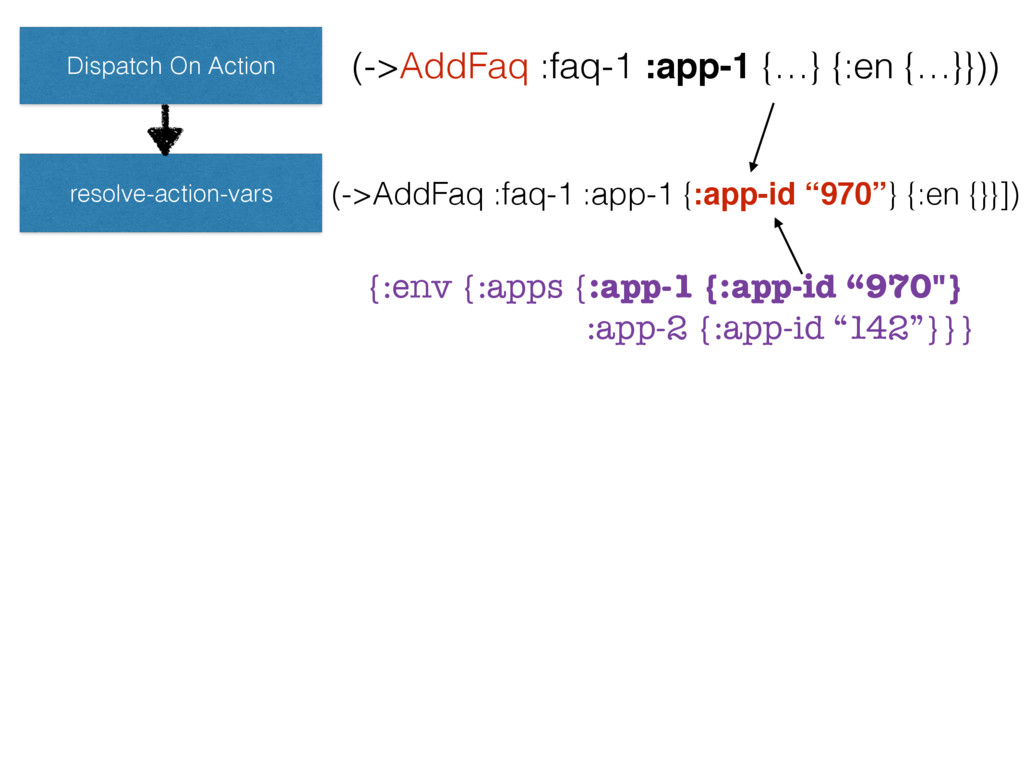
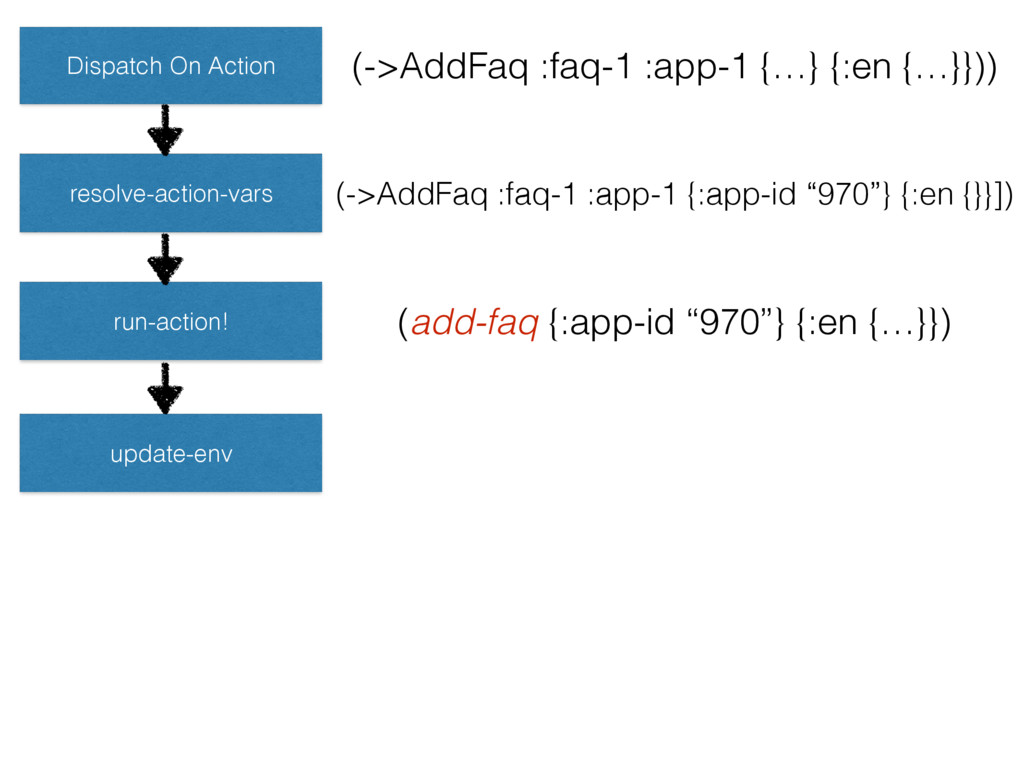
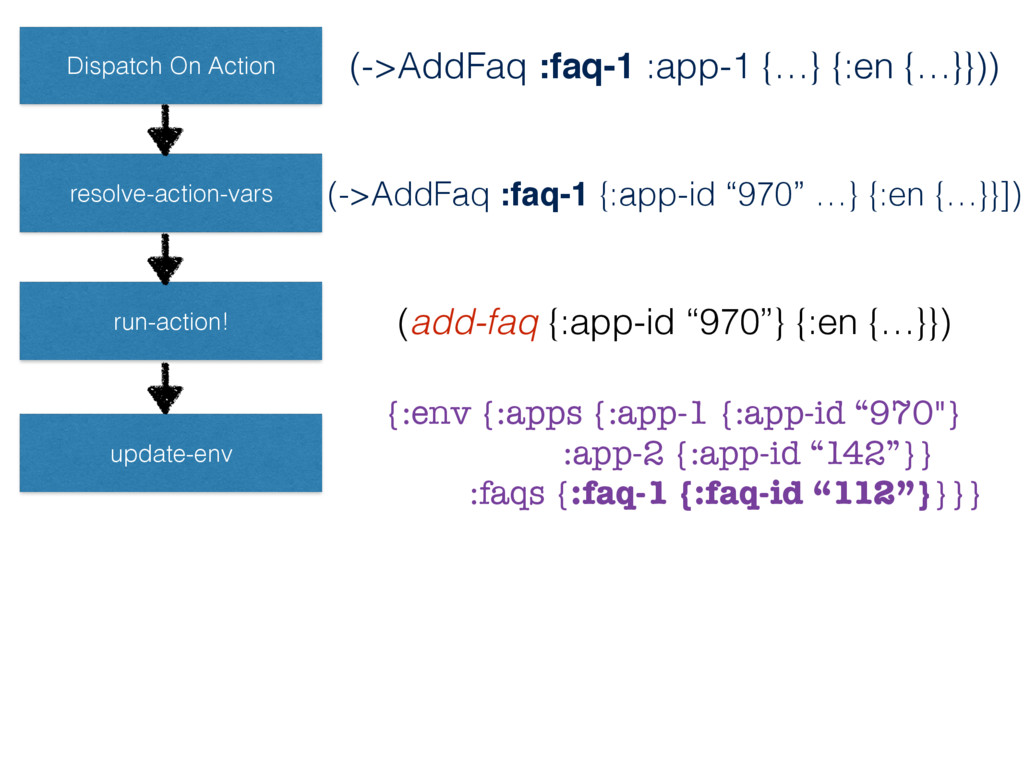
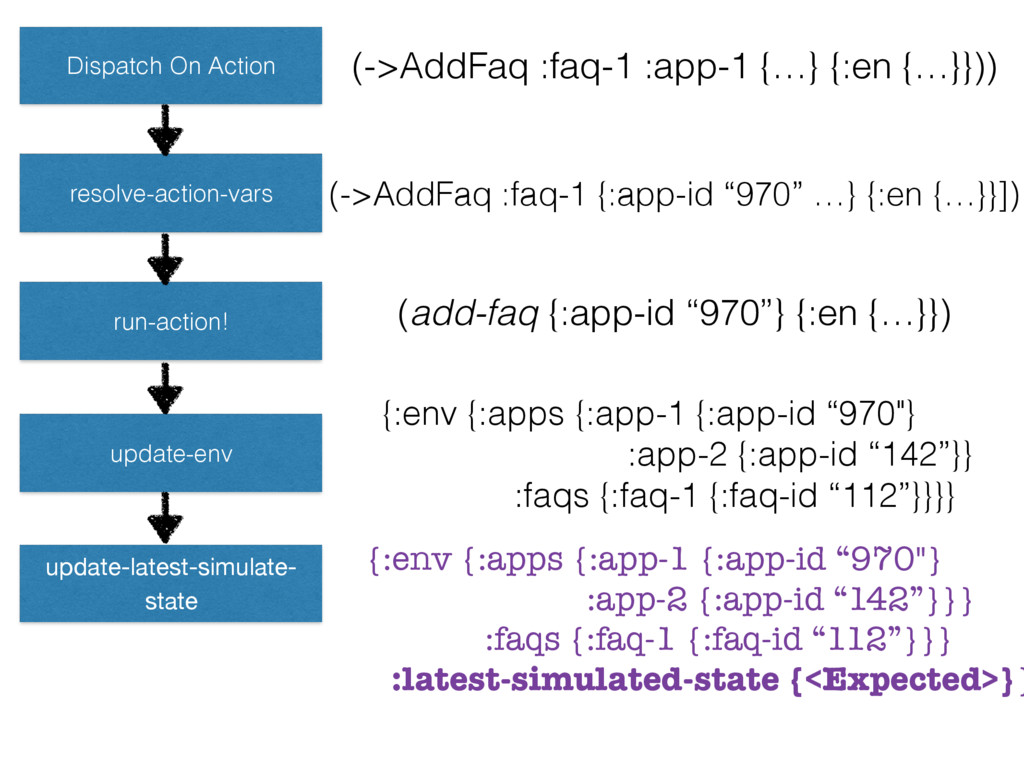
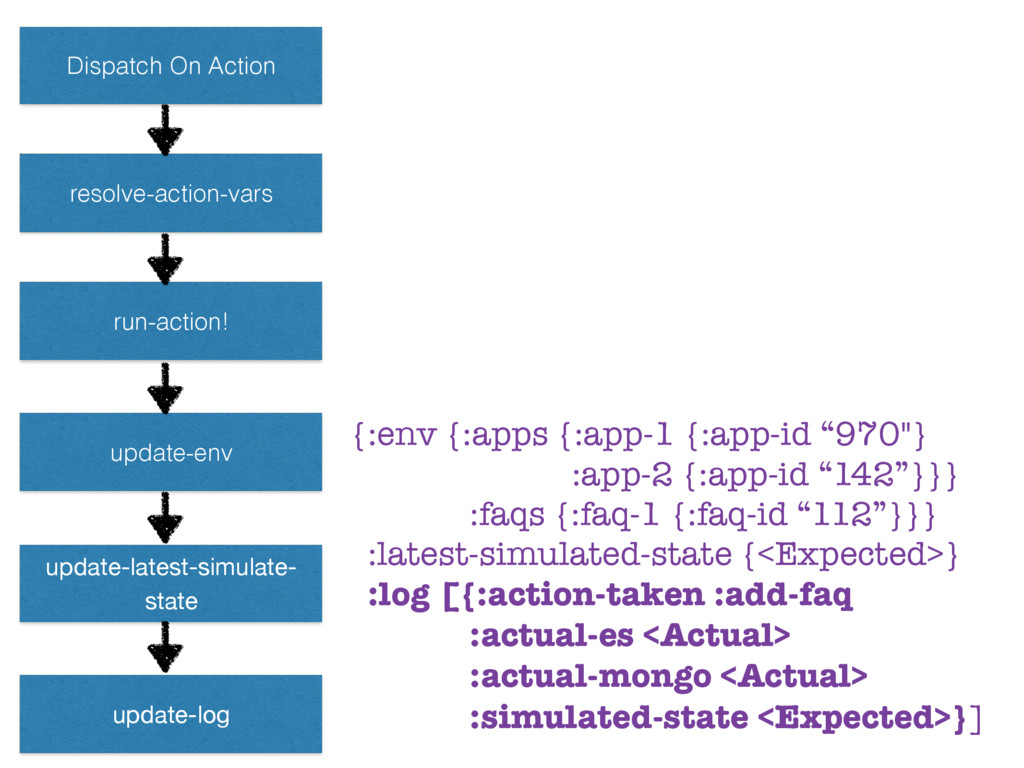
bindings Call args with relevant function Update the result to the given var in env Update latest simulate state Log Actual DB State and Updated Simulate State resolve-action-vars run-action! update-env update-latest-simulate-state update-log
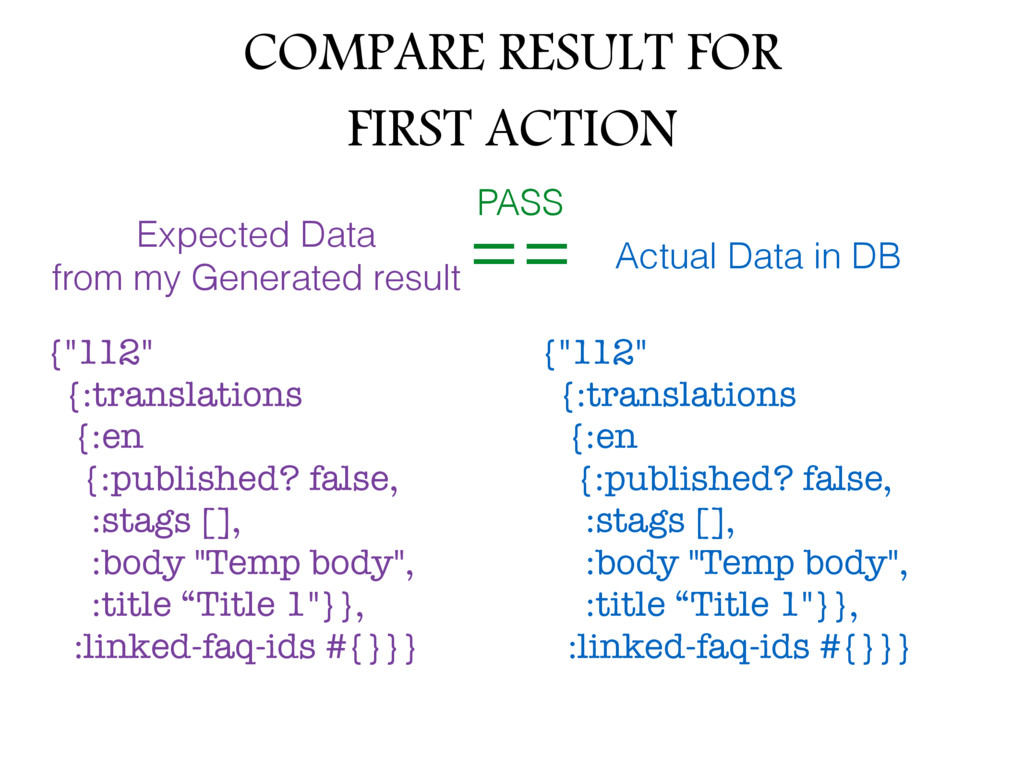
:stags [], :body "Temp body", :title “Title 1"}}, :linked-faq-ids #{}}} Actual Data in DB Expected Data from my Generated result {"112" {:translations {:en {:published? false, :stags [], :body "Temp body", :title “Title 1"}}, :linked-faq-ids #{}}} == PASS
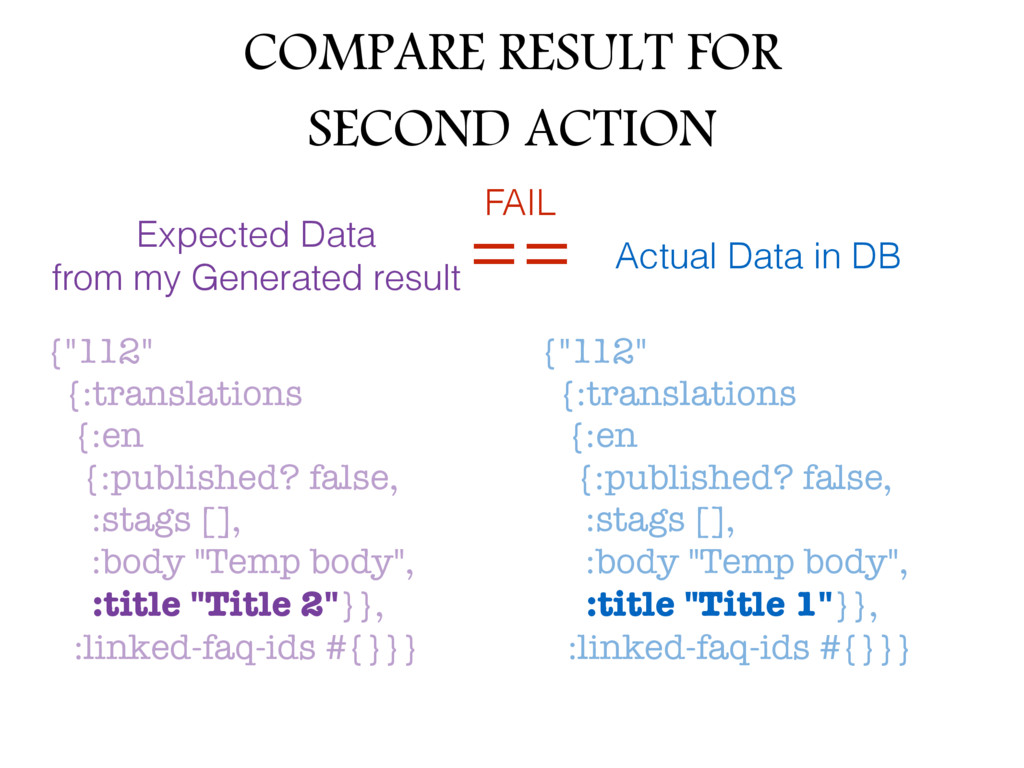
:title "Title 1"}}, :linked-faq-ids #{}}} Actual Data in DB Expected Data from my Generated result {"112" {:translations {:en {:published? false, :stags [], :body "Temp body", :title "Title 2"}}, :linked-faq-ids #{}}} == FAIL COMPARE RESULT FOR SECOND ACTION
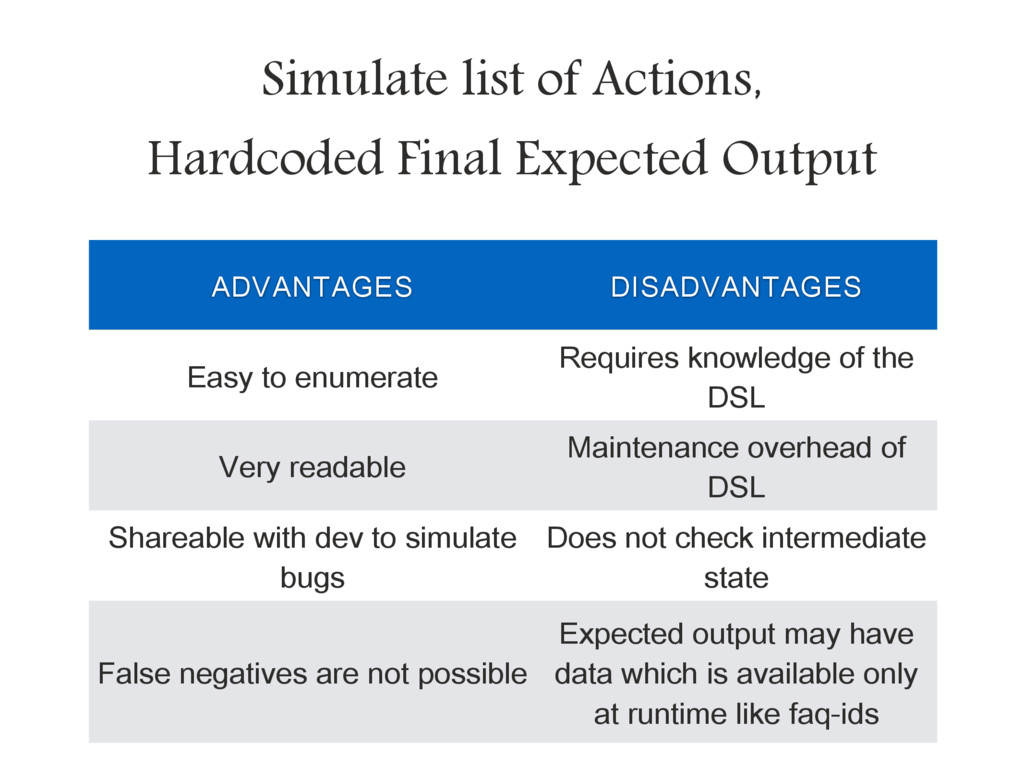
Easy to enumerate Requires knowledge of the DSL Very readable Maintenance overhead of DSL Shareable with dev to simulate bugs Does not check intermediate state False negatives are not possible Expected output may have data which is available only at runtime like faq-ids
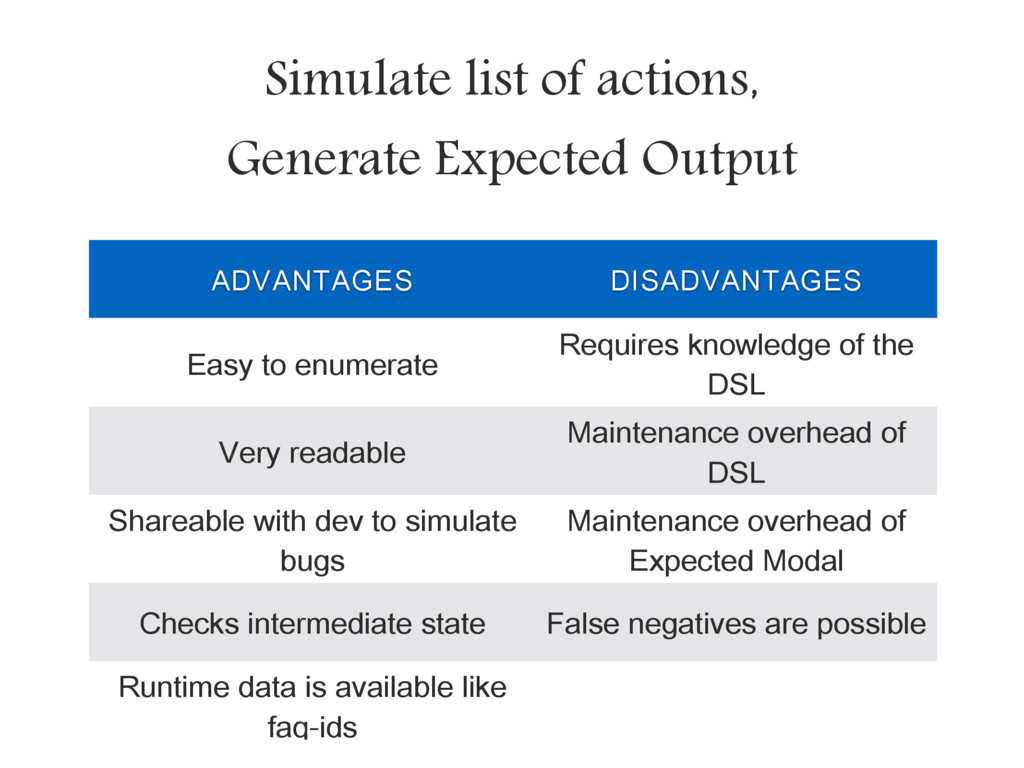
to enumerate Requires knowledge of the DSL Very readable Maintenance overhead of DSL Shareable with dev to simulate bugs Maintenance overhead of Expected Modal Checks intermediate state False negatives are possible Runtime data is available like faq-ids
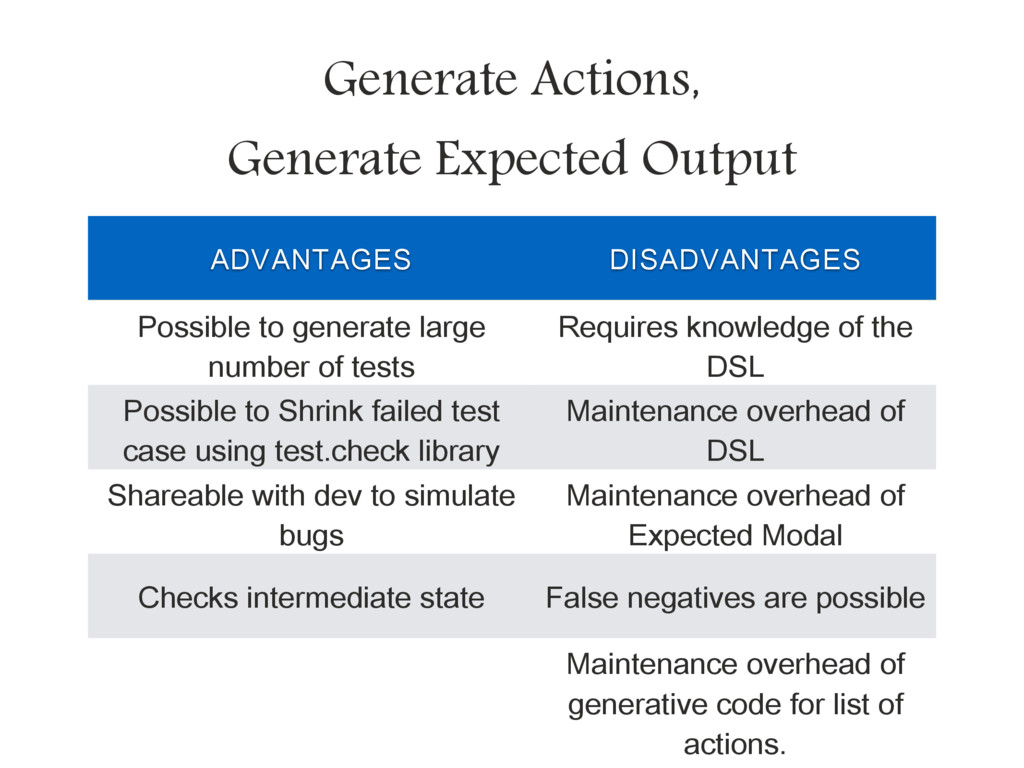
large number of tests Requires knowledge of the DSL Possible to Shrink failed test case using test.check library Maintenance overhead of DSL Shareable with dev to simulate bugs Maintenance overhead of Expected Modal Checks intermediate state False negatives are possible Maintenance overhead of generative code for list of actions.
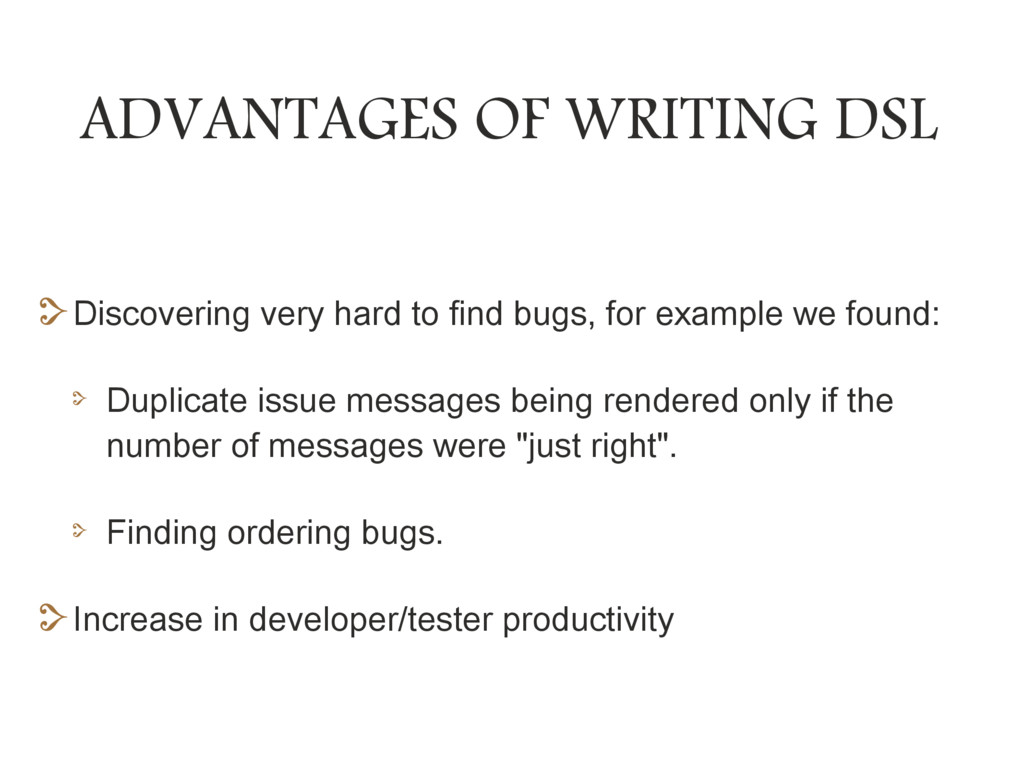
for example we found: Duplicate issue messages being rendered only if the number of messages were "just right". Finding ordering bugs. Increase in developer/tester productivity
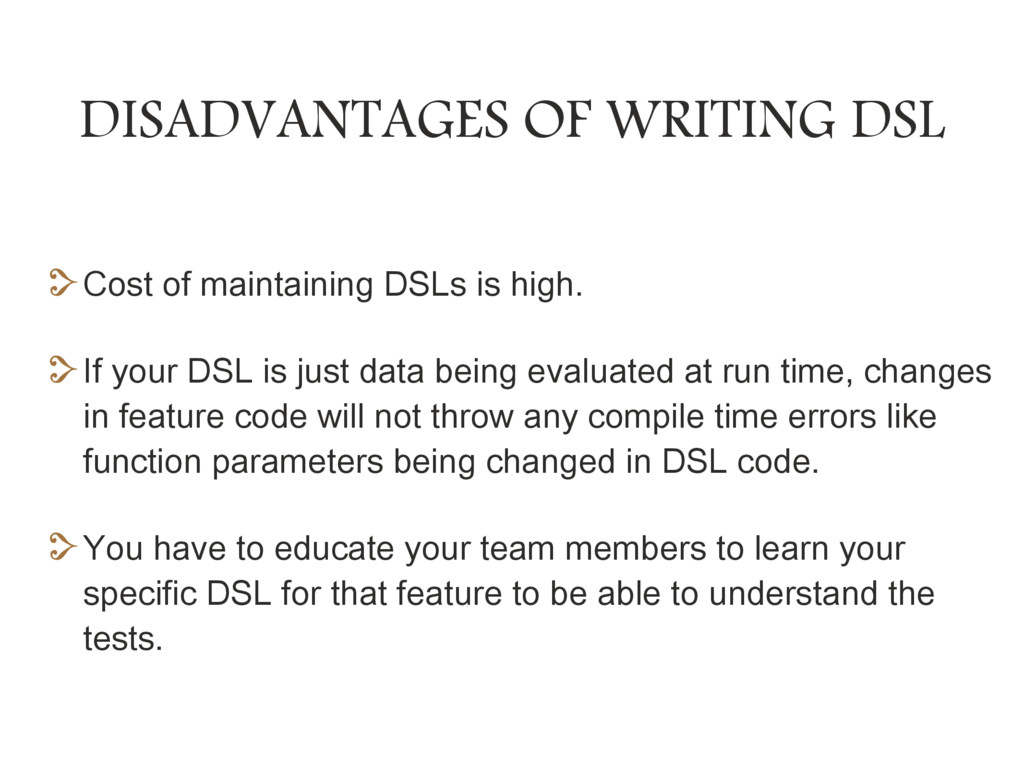
If your DSL is just data being evaluated at run time, changes in feature code will not throw any compile time errors like function parameters being changed in DSL code. You have to educate your team members to learn your specific DSL for that feature to be able to understand the tests.
Fowler • DSLs in Action by Debasish Ghosh • Growing a DSL with Clojure • Jeanine Adkisson - Design and Prototype a Language In Clojure • Clojure Tutorials on DSLs with Tim Baldridge (Paid) • John Hughes - Testing the Hard Stuff and Staying Sane • Reid Draper - Powerful Testing with test.check • Clojure Made Simple - Rich Hickey


 firesofmay
 falcon8823
 yub0n
 moro
 ___akari11
 kawashimo0
 rollbear
 kmars0605
 shihochan
 mixplace
 iwiwi
 tmikov2023
 ivargrimstad
 portentint
 bluesmoon
 lfama
 baasie
 skipperchong
 palkan
 takai
 inesmontani
 szymonslowik
 aki_iinuma
 denniskardys
![(let [r (simulate-actions [[:user :create-issue {:domain “mayanklocal", :message “0” :hs-tags](https://files.speakerdeck.com/presentations/8bea2a3d4e814f19afe0f2369df2d36b/slide_52.jpg)
![(fact "Simpler Edge case failure" (let [response (simulate-actions [[:user :create-issue](https://files.speakerdeck.com/presentations/8bea2a3d4e814f19afe0f2369df2d36b/slide_53.jpg)