Upgrade to Pro — share decks privately, control downloads, hide ads and more …

Paper Introduction

Avatar for Alhaji Alhaji
August 27, 2021

Paper Introduction

This is my Thesis Introduction.

Avatar for Alhaji

Alhaji

August 27, 2021

Other Decks in Technology

Transcript

  1. What is it about? / Main idea Is there any

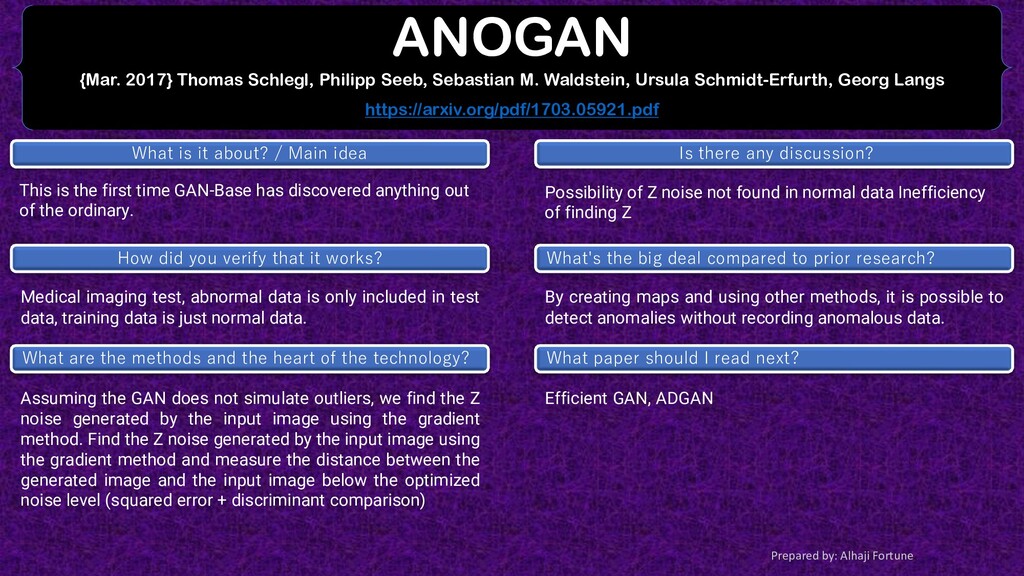
    discussion? How did you verify that it works? What's the big deal compared to prior research? What are the methods and the heart of the technology? What paper should I read next? ANOGAN {Mar. 2017} Thomas Schlegl, Philipp Seeb, Sebastian M. Waldstein, Ursula Schmidt-Erfurth, Georg Langs https://arxiv.org/pdf/1703.05921.pdf This is the first time GAN-Base has discovered anything out of the ordinary. Possibility of Z noise not found in normal data Inefficiency of finding Z Medical imaging test, abnormal data is only included in test data, training data is just normal data. By creating maps and using other methods, it is possible to detect anomalies without recording anomalous data. Assuming the GAN does not simulate outliers, we find the Z noise generated by the input image using the gradient method. Find the Z noise generated by the input image using the gradient method and measure the distance between the generated image and the input image below the optimized noise level (squared error + discriminant comparison) Efficient GAN, ADGAN Prepared by: Alhaji Fortune
  2. What is it about? / Main idea Is there any

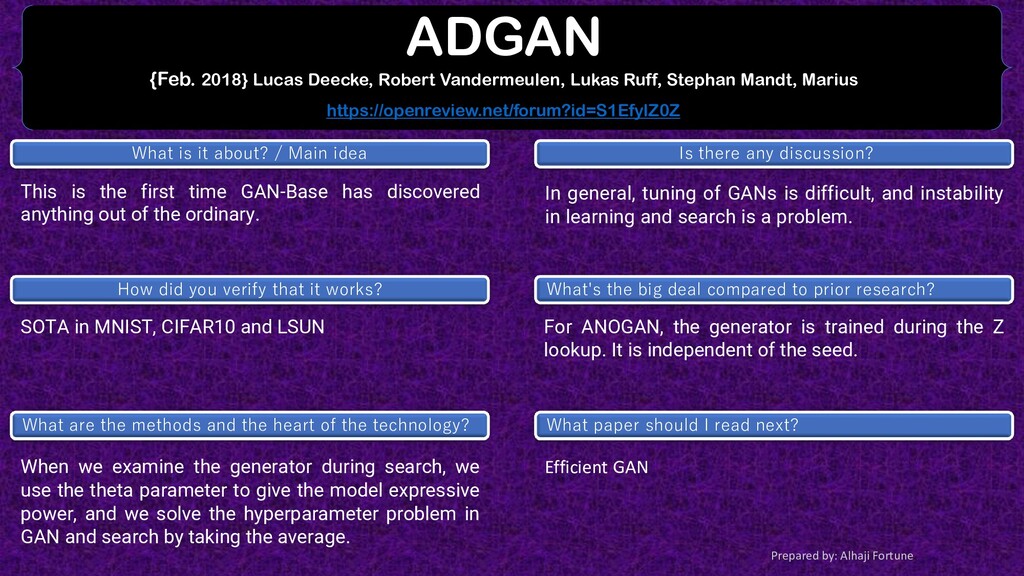
    discussion? How did you verify that it works? What's the big deal compared to prior research? What are the methods and the heart of the technology? What paper should I read next? ADGAN {Feb. 2018} Lucas Deecke, Robert Vandermeulen, Lukas Ruff, Stephan Mandt, Marius https://openreview.net/forum?id=S1EfylZ0Z This is the first time GAN-Base has discovered anything out of the ordinary. In general, tuning of GANs is difficult, and instability in learning and search is a problem. SOTA in MNIST, CIFAR10 and LSUN For ANOGAN, the generator is trained during the Z lookup. It is independent of the seed. When we examine the generator during search, we use the theta parameter to give the model expressive power, and we solve the hyperparameter problem in GAN and search by taking the average. Efficient GAN Prepared by: Alhaji Fortune
  3. What is it about? / Main idea Is there any

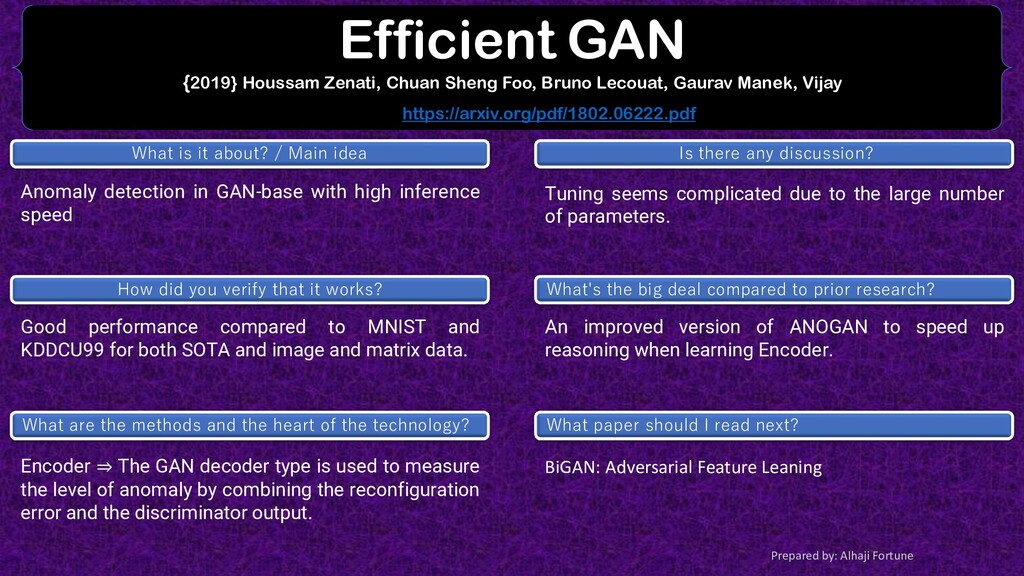
    discussion? How did you verify that it works? What's the big deal compared to prior research? What are the methods and the heart of the technology? What paper should I read next? Efficient GAN {2019} Houssam Zenati, Chuan Sheng Foo, Bruno Lecouat, Gaurav Manek, Vijay https://arxiv.org/pdf/1802.06222.pdf Anomaly detection in GAN-base with high inference speed Tuning seems complicated due to the large number of parameters. Good performance compared to MNIST and KDDCU99 for both SOTA and image and matrix data. An improved version of ANOGAN to speed up reasoning when learning Encoder. Encoder ⇒ The GAN decoder type is used to measure the level of anomaly by combining the reconfiguration error and the discriminator output. BiGAN: Adversarial Feature Leaning Prepared by: Alhaji Fortune
  4. What is it about? / Main idea Is there any

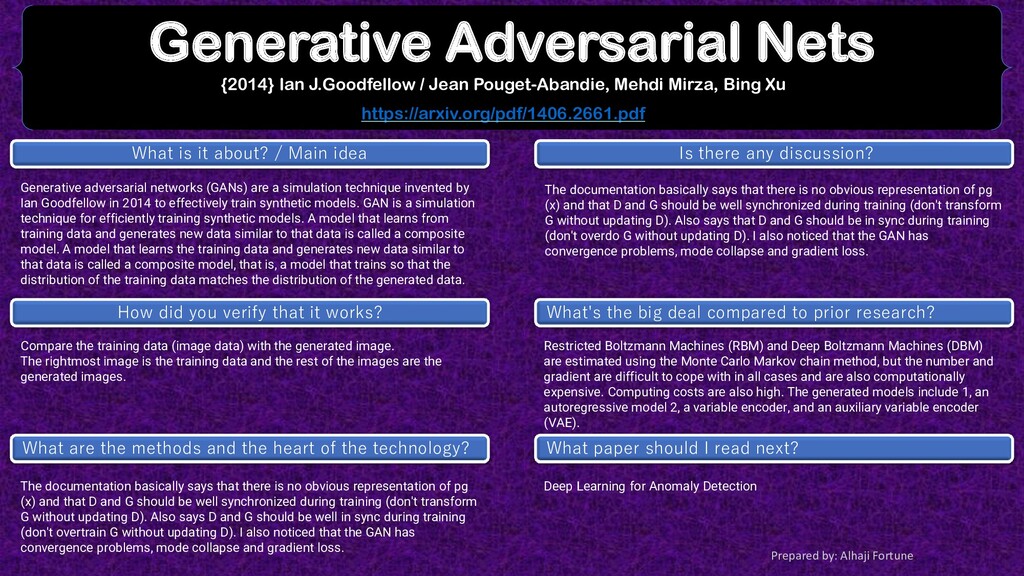
    discussion? How did you verify that it works? What's the big deal compared to prior research? What are the methods and the heart of the technology? What paper should I read next? Generative Adversarial Nets {2014} Ian J.Goodfellow / Jean Pouget-Abandie, Mehdi Mirza, Bing Xu https://arxiv.org/pdf/1406.2661.pdf Generative adversarial networks (GANs) are a simulation technique invented by Ian Goodfellow in 2014 to effectively train synthetic models. GAN is a simulation technique for efficiently training synthetic models. A model that learns from training data and generates new data similar to that data is called a composite model. A model that learns the training data and generates new data similar to that data is called a composite model, that is, a model that trains so that the distribution of the training data matches the distribution of the generated data. The documentation basically says that there is no obvious representation of pg (x) and that D and G should be well synchronized during training (don't transform G without updating D). Also says that D and G should be in sync during training (don't overdo G without updating D). I also noticed that the GAN has convergence problems, mode collapse and gradient loss. Compare the training data (image data) with the generated image. The rightmost image is the training data and the rest of the images are the generated images. Restricted Boltzmann Machines (RBM) and Deep Boltzmann Machines (DBM) are estimated using the Monte Carlo Markov chain method, but the number and gradient are difficult to cope with in all cases and are also computationally expensive. Computing costs are also high. The generated models include 1, an autoregressive model 2, a variable encoder, and an auxiliary variable encoder (VAE). The documentation basically says that there is no obvious representation of pg (x) and that D and G should be well synchronized during training (don't transform G without updating D). Also says D and G should be well in sync during training (don't overtrain G without updating D). I also noticed that the GAN has convergence problems, mode collapse and gradient loss. Deep Learning for Anomaly Detection Prepared by: Alhaji Fortune
  5. What is it about? / Main idea Is there any

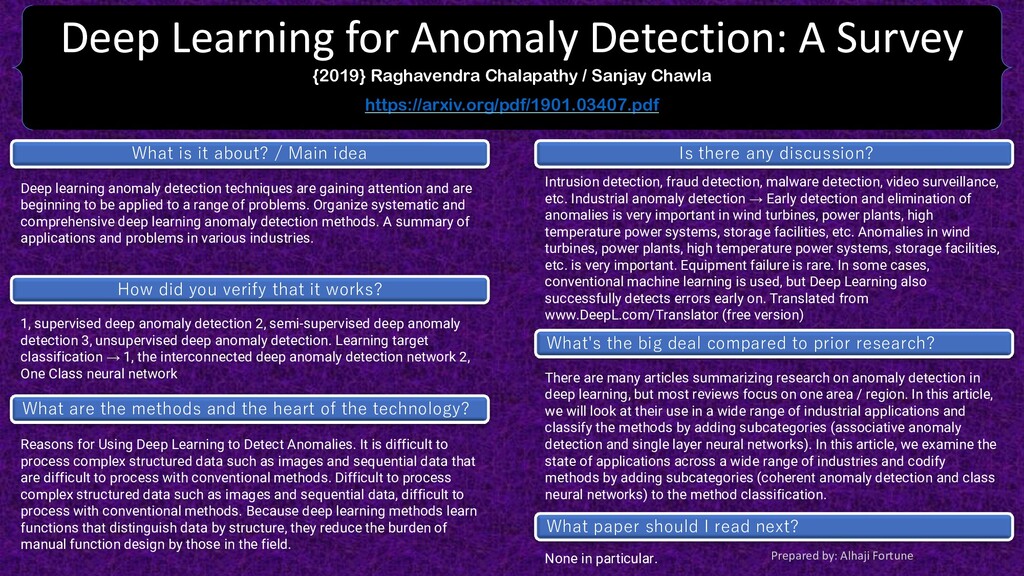
    discussion? How did you verify that it works? What's the big deal compared to prior research? What are the methods and the heart of the technology? What paper should I read next? Deep Learning for Anomaly Detection: A Survey {2019} Raghavendra Chalapathy / Sanjay Chawla https://arxiv.org/pdf/1901.03407.pdf Deep learning anomaly detection techniques are gaining attention and are beginning to be applied to a range of problems. Organize systematic and comprehensive deep learning anomaly detection methods. A summary of applications and problems in various industries. Intrusion detection, fraud detection, malware detection, video surveillance, etc. Industrial anomaly detection → Early detection and elimination of anomalies is very important in wind turbines, power plants, high temperature power systems, storage facilities, etc. Anomalies in wind turbines, power plants, high temperature power systems, storage facilities, etc. is very important. Equipment failure is rare. In some cases, conventional machine learning is used, but Deep Learning also successfully detects errors early on. Translated from www.DeepL.com/Translator (free version) 1, supervised deep anomaly detection 2, semi-supervised deep anomaly detection 3, unsupervised deep anomaly detection. Learning target classification → 1, the interconnected deep anomaly detection network 2, One Class neural network There are many articles summarizing research on anomaly detection in deep learning, but most reviews focus on one area / region. In this article, we will look at their use in a wide range of industrial applications and classify the methods by adding subcategories (associative anomaly detection and single layer neural networks). In this article, we examine the state of applications across a wide range of industries and codify methods by adding subcategories (coherent anomaly detection and class neural networks) to the method classification. Reasons for Using Deep Learning to Detect Anomalies. It is difficult to process complex structured data such as images and sequential data that are difficult to process with conventional methods. Difficult to process complex structured data such as images and sequential data, difficult to process with conventional methods. Because deep learning methods learn functions that distinguish data by structure, they reduce the burden of manual function design by those in the field. None in particular. Prepared by: Alhaji Fortune