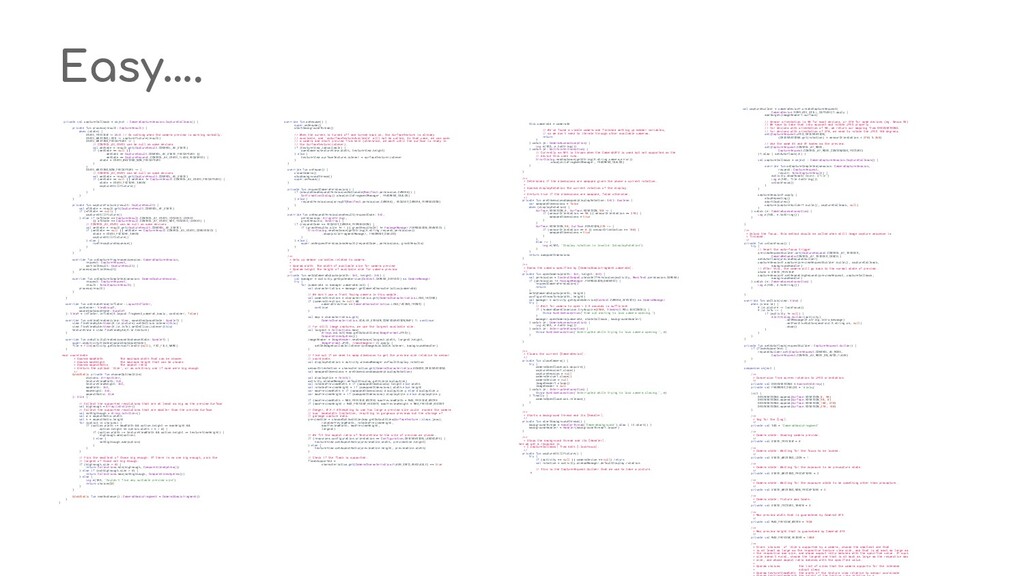
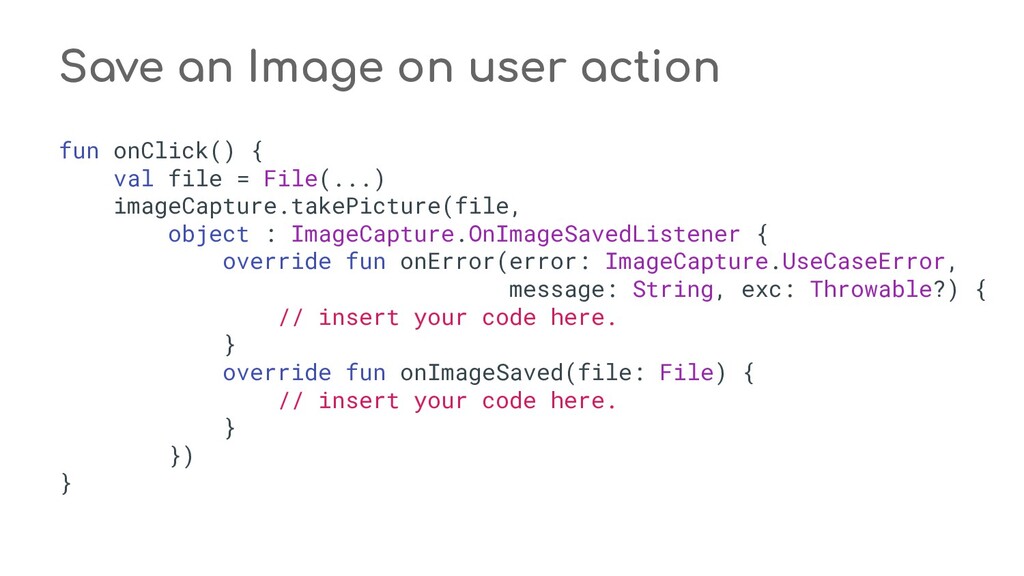
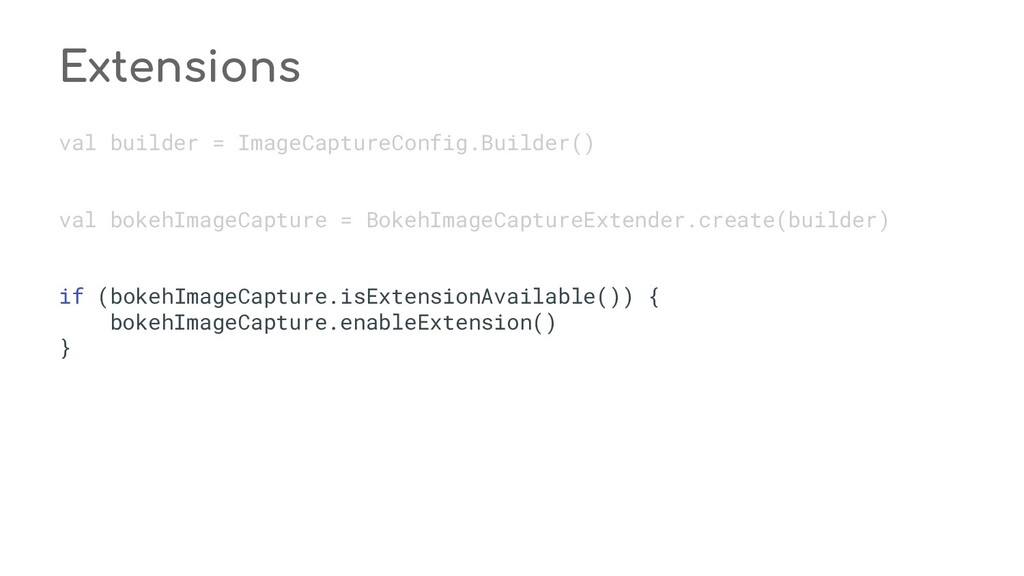
fun process(result: CaptureResult) { when (state) { STATE_PREVIEW -> Unit // Do nothing when the camera preview is working normally. STATE_WAITING_LOCK -> capturePicture(result) STATE_WAITING_PRECAPTURE -> { // CONTROL_AE_STATE can be null on some devices val aeState = result.get(CaptureResult.CONTROL_AE_STATE) if (aeState == null || aeState == CaptureResult.CONTROL_AE_STATE_PRECAPTURE || aeState == CaptureRequest.CONTROL_AE_STATE_FLASH_REQUIRED) { state = STATE_WAITING_NON_PRECAPTURE } } STATE_WAITING_NON_PRECAPTURE -> { // CONTROL_AE_STATE can be null on some devices val aeState = result.get(CaptureResult.CONTROL_AE_STATE) if (aeState == null || aeState != CaptureResult.CONTROL_AE_STATE_PRECAPTURE) { state = STATE_PICTURE_TAKEN captureStillPicture() } } } } private fun capturePicture(result: CaptureResult) { val afState = result.get(CaptureResult.CONTROL_AF_STATE) if (afState == null) { captureStillPicture() } else if (afState == CaptureResult.CONTROL_AF_STATE_FOCUSED_LOCKED || afState == CaptureResult.CONTROL_AF_STATE_NOT_FOCUSED_LOCKED) { // CONTROL_AE_STATE can be null on some devices val aeState = result.get(CaptureResult.CONTROL_AE_STATE) if (aeState == null || aeState == CaptureResult.CONTROL_AE_STATE_CONVERGED) { state = STATE_PICTURE_TAKEN captureStillPicture() } else { runPrecaptureSequence() } } } override fun onCaptureProgressed(session: CameraCaptureSession, request: CaptureRequest, partialResult: CaptureResult) { process(partialResult) } override fun onCaptureCompleted(session: CameraCaptureSession, request: CaptureRequest, result: TotalCaptureResult) { process(result) } } override fun onCreateView(inflater: LayoutInflater, container: ViewGroup?, savedInstanceState: Bundle? ): View? = inflater.inflate(R.layout.fragment_camera2_basic, container, false) override fun onViewCreated(view: View, savedInstanceState: Bundle?) { view.findViewById<View>(R.id.picture).setOnClickListener(this) view.findViewById<View>(R.id.info).setOnClickListener(this) textureView = view.findViewById(R.id.texture) } override fun onActivityCreated(savedInstanceState: Bundle?) { super.onActivityCreated(savedInstanceState) file = File(activity.getExternalFilesDir(null), PIC_FILE_NAME) } nsor coordinate * @param maxWidth The maximum width that can be chosen * @param maxHeight The maximum height that can be chosen * @param aspectRatio The aspect ratio * @return The optimal `Size`, or an arbitrary one if none were big enough */ @JvmStatic private fun chooseOptimalSize( choices: Array<Size>, textureViewWidth: Int, textureViewHeight: Int, maxWidth: Int, maxHeight: Int, aspectRatio: Size ): Size { // Collect the supported resolutions that are at least as big as the preview Surface val bigEnough = ArrayList<Size>() // Collect the supported resolutions that are smaller than the preview Surface val notBigEnough = ArrayList<Size>() val w = aspectRatio.width val h = aspectRatio.height for (option in choices) { if (option.width <= maxWidth && option.height <= maxHeight && option.height == option.width * h / w) { if (option.width >= textureViewWidth && option.height >= textureViewHeight) { bigEnough.add(option) } else { notBigEnough.add(option) } } } // Pick the smallest of those big enough. If there is no one big enough, pick the // largest of those not big enough. if (bigEnough.size > 0) { return Collections.min(bigEnough, CompareSizesByArea()) } else if (notBigEnough.size > 0) { return Collections.max(notBigEnough, CompareSizesByArea()) } else { Log.e(TAG, "Couldn't find any suitable preview size") return choices[0] } } @JvmStatic fun newInstance(): Camera2BasicFragment = Camera2BasicFragment() } } override fun onResume() { super.onResume() startBackgroundThread() // When the screen is turned off and turned back on, the SurfaceTexture is already // available, and "onSurfaceTextureAvailable" will not be called. In that case, we can open // a camera and start preview from here (otherwise, we wait until the surface is ready in // the SurfaceTextureListener). if (textureView.isAvailable) { openCamera(textureView.width, textureView.height) } else { textureView.surfaceTextureListener = surfaceTextureListener } } override fun onPause() { closeCamera() stopBackgroundThread() super.onPause() } private fun requestCameraPermission() { if (shouldShowRequestPermissionRationale(Manifest.permission.CAMERA)) { ConfirmationDialog().show(childFragmentManager, FRAGMENT_DIALOG) } else { requestPermissions(arrayOf(Manifest.permission.CAMERA), REQUEST_CAMERA_PERMISSION) } } override fun onRequestPermissionsResult(requestCode: Int, permissions: Array<String>, grantResults: IntArray) { if (requestCode == REQUEST_CAMERA_PERMISSION) { if (grantResults.size != 1 || grantResults[0] != PackageManager.PERMISSION_GRANTED) { ErrorDialog.newInstance(getString(R.string.request_permission)) .show(childFragmentManager, FRAGMENT_DIALOG) } } else { super.onRequestPermissionsResult(requestCode, permissions, grantResults) } } /** * Sets up member variables related to camera. * * @param width The width of available size for camera preview * @param height The height of available size for camera preview */ private fun setUpCameraOutputs(width: Int, height: Int) { val manager = activity.getSystemService(Context.CAMERA_SERVICE) as CameraManager try { for (cameraId in manager.cameraIdList) { val characteristics = manager.getCameraCharacteristics(cameraId) // We don't use a front facing camera in this sample. val cameraDirection = characteristics.get(CameraCharacteristics.LENS_FACING) if (cameraDirection != null && cameraDirection == CameraCharacteristics.LENS_FACING_FRONT) { continue } val map = characteristics.get( CameraCharacteristics.SCALER_STREAM_CONFIGURATION_MAP) ?: continue // For still image captures, we use the largest available size. val largest = Collections.max( Arrays.asList(*map.getOutputSizes(ImageFormat.JPEG)), CompareSizesByArea()) imageReader = ImageReader.newInstance(largest.width, largest.height, ImageFormat.JPEG, /*maxImages*/ 2).apply { setOnImageAvailableListener(onImageAvailableListener, backgroundHandler) } // Find out if we need to swap dimension to get the preview size relative to sensor // coordinate. val displayRotation = activity.windowManager.defaultDisplay.rotation sensorOrientation = characteristics.get(CameraCharacteristics.SENSOR_ORIENTATION) val swappedDimensions = areDimensionsSwapped(displayRotation) val displaySize = Point() activity.windowManager.defaultDisplay.getSize(displaySize) val rotatedPreviewWidth = if (swappedDimensions) height else width val rotatedPreviewHeight = if (swappedDimensions) width else height var maxPreviewWidth = if (swappedDimensions) displaySize.y else displaySize.x var maxPreviewHeight = if (swappedDimensions) displaySize.x else displaySize.y if (maxPreviewWidth > MAX_PREVIEW_WIDTH) maxPreviewWidth = MAX_PREVIEW_WIDTH if (maxPreviewHeight > MAX_PREVIEW_HEIGHT) maxPreviewHeight = MAX_PREVIEW_HEIGHT // Danger, W.R.! Attempting to use too large a preview size could exceed the camera // bus' bandwidth limitation, resulting in gorgeous previews but the storage of // garbage capture data. previewSize = chooseOptimalSize(map.getOutputSizes(SurfaceTexture::class.java), rotatedPreviewWidth, rotatedPreviewHeight, maxPreviewWidth, maxPreviewHeight, largest) // We fit the aspect ratio of TextureView to the size of preview we picked. if (resources.configuration.orientation == Configuration.ORIENTATION_LANDSCAPE) { textureView.setAspectRatio(previewSize.width, previewSize.height) } else { textureView.setAspectRatio(previewSize.height, previewSize.width) } // Check if the flash is supported. flashSupported = characteristics.get(CameraCharacteristics.FLASH_INFO_AVAILABLE) == true val captureBuilder = cameraDevice?.createCaptureRequest( CameraDevice.TEMPLATE_STILL_CAPTURE)?.apply { addTarget(imageReader?.surface) // Sensor orientation is 90 for most devices, or 270 for some devices (eg. Nexus 5X) // We have to take that into account and rotate JPEG properly. // For devices with orientation of 90, we return our mapping from ORIENTATIONS. // For devices with orientation of 270, we need to rotate the JPEG 180 degrees. set(CaptureRequest.JPEG_ORIENTATION, (ORIENTATIONS.get(rotation) + sensorOrientation + 270) % 360) // Use the same AE and AF modes as the preview. set(CaptureRequest.CONTROL_AF_MODE, CaptureRequest.CONTROL_AF_MODE_CONTINUOUS_PICTURE) }?.also { setAutoFlash(it) } val captureCallback = object : CameraCaptureSession.CaptureCallback() { override fun onCaptureCompleted(session: CameraCaptureSession, request: CaptureRequest, result: TotalCaptureResult) { activity.showToast("Saved: $file") Log.d(TAG, file.toString()) unlockFocus() } } captureSession?.apply { stopRepeating() abortCaptures() capture(captureBuilder?.build(), captureCallback, null) } } catch (e: CameraAccessException) { Log.e(TAG, e.toString()) } } /** * Unlock the focus. This method should be called when still image capture sequence is * finished. */ private fun unlockFocus() { try { // Reset the auto-focus trigger previewRequestBuilder.set(CaptureRequest.CONTROL_AF_TRIGGER, CameraMetadata.CONTROL_AF_TRIGGER_CANCEL) setAutoFlash(previewRequestBuilder) captureSession?.capture(previewRequestBuilder.build(), captureCallback, backgroundHandler) // After this, the camera will go back to the normal state of preview. state = STATE_PREVIEW captureSession?.setRepeatingRequest(previewRequest, captureCallback, backgroundHandler) } catch (e: CameraAccessException) { Log.e(TAG, e.toString()) } } override fun onClick(view: View) { when (view.id) { R.id.picture -> lockFocus() R.id.info -> { if (activity != null) { AlertDialog.Builder(activity) .setMessage(R.string.intro_message) .setPositiveButton(android.R.string.ok, null) .show() } } } } private fun setAutoFlash(requestBuilder: CaptureRequest.Builder) { if (flashSupported) { requestBuilder.set(CaptureRequest.CONTROL_AE_MODE, CaptureRequest.CONTROL_AE_MODE_ON_AUTO_FLASH) } } companion object { /** * Conversion from screen rotation to JPEG orientation. */ private val ORIENTATIONS = SparseIntArray() private val FRAGMENT_DIALOG = "dialog" init { ORIENTATIONS.append(Surface.ROTATION_0, 90) ORIENTATIONS.append(Surface.ROTATION_90, 0) ORIENTATIONS.append(Surface.ROTATION_180, 270) ORIENTATIONS.append(Surface.ROTATION_270, 180) } /** * Tag for the [Log]. */ private val TAG = "Camera2BasicFragment" /** * Camera state: Showing camera preview. */ private val STATE_PREVIEW = 0 /** * Camera state: Waiting for the focus to be locked. */ private val STATE_WAITING_LOCK = 1 /** * Camera state: Waiting for the exposure to be precapture state. */ private val STATE_WAITING_PRECAPTURE = 2 /** * Camera state: Waiting for the exposure state to be something other than precapture. */ private val STATE_WAITING_NON_PRECAPTURE = 3 /** * Camera state: Picture was taken. */ private val STATE_PICTURE_TAKEN = 4 /** * Max preview width that is guaranteed by Camera2 API */ private val MAX_PREVIEW_WIDTH = 1920 /** * Max preview height that is guaranteed by Camera2 API */ private val MAX_PREVIEW_HEIGHT = 1080 /** * Given `choices` of `Size`s supported by a camera, choose the smallest one that * is at least as large as the respective texture view size, and that is at most as large as * the respective max size, and whose aspect ratio matches with the specified value. If such * size doesn't exist, choose the largest one that is at most as large as the respective max * size, and whose aspect ratio matches with the specified value. * * @param choices The list of sizes that the camera supports for the intended * output class * @param textureViewWidth The width of the texture view relative to sensor coordinate this.cameraId = cameraId // We've found a viable camera and finished setting up member variables, // so we don't need to iterate through other available cameras. return } } catch (e: CameraAccessException) { Log.e(TAG, e.toString()) } catch (e: NullPointerException) { // Currently an NPE is thrown when the Camera2API is used but not supported on the // device this code runs. ErrorDialog.newInstance(getString(R.string.camera_error)) .show(childFragmentManager, FRAGMENT_DIALOG) } } /** * Determines if the dimensions are swapped given the phone's current rotation. * * @param displayRotation The current rotation of the display * * @return true if the dimensions are swapped, false otherwise. */ private fun areDimensionsSwapped(displayRotation: Int): Boolean { var swappedDimensions = false when (displayRotation) { Surface.ROTATION_0, Surface.ROTATION_180 -> { if (sensorOrientation == 90 || sensorOrientation == 270) { swappedDimensions = true } } Surface.ROTATION_90, Surface.ROTATION_270 -> { if (sensorOrientation == 0 || sensorOrientation == 180) { swappedDimensions = true } } else -> { Log.e(TAG, "Display rotation is invalid: $displayRotation") } } return swappedDimensions } /** * Opens the camera specified by [Camera2BasicFragment.cameraId]. */ private fun openCamera(width: Int, height: Int) { val permission = ContextCompat.checkSelfPermission(activity, Manifest.permission.CAMERA) if (permission != PackageManager.PERMISSION_GRANTED) { requestCameraPermission() return } setUpCameraOutputs(width, height) configureTransform(width, height) val manager = activity.getSystemService(Context.CAMERA_SERVICE) as CameraManager try { // Wait for camera to open - 2.5 seconds is sufficient if (!cameraOpenCloseLock.tryAcquire(2500, TimeUnit.MILLISECONDS)) { throw RuntimeException("Time out waiting to lock camera opening.") } manager.openCamera(cameraId, stateCallback, backgroundHandler) } catch (e: CameraAccessException) { Log.e(TAG, e.toString()) } catch (e: InterruptedException) { throw RuntimeException("Interrupted while trying to lock camera opening.", e) } } /** * Closes the current [CameraDevice]. */ private fun closeCamera() { try { cameraOpenCloseLock.acquire() captureSession?.close() captureSession = null cameraDevice?.close() cameraDevice = null imageReader?.close() imageReader = null } catch (e: InterruptedException) { throw RuntimeException("Interrupted while trying to lock camera closing.", e) } finally { cameraOpenCloseLock.release() } } /** * Starts a background thread and its [Handler]. */ private fun startBackgroundThread() { backgroundThread = HandlerThread("CameraBackground").also { it.start() } backgroundHandler = Handler(backgroundThread?.looper) } /** * Stops the background thread and its [Handler]. hen we get a response in * [.captureCallback] from both [.lockFocus]. */ private fun captureStillPicture() { try { if (activity == null || cameraDevice == null) return val rotation = activity.windowManager.defaultDisplay.rotation // This is the CaptureRequest.Builder that we use to take a picture. e


 gilgoldzweig
 takai
takai
 y0hgi
y0hgi
 hollycummins
 lynnswap
 iwatsukayura
 deka_morita
 palkan
 drumath2237
 satoshi256kbyte
 kishida
 yuta_onishi_97
 jame2408
 aleyda
 jlugia
 tmiket
 gr2m
gr2m
 nonsquared
 tammyeverts
 kimpetersen
 bethany
 reverentgeek
 tomoyanonymous
 thoeni
 iamctodd