Upgrade to Pro — share decks privately, control downloads, hide ads and more …

Why Humans Follow Fashion Trends

Why Humans Follow Fashion Trends

Ever wondered why you reach for a trending outfit even when you already have a wardrobe full of clothes? This presentation explores the fascinating psychology behind fashion conformity — from Solomon Asch's Social Conformity Theory to the role of peer pressure, celebrities, and social media in shaping what we wear.
Inside, you'll discover:
What Social Conformity Theory is and how it applies to fashion
The difference between normative and informational conformity
How self-esteem and enclothed cognition influence our style choices
Historical fashion trends and how they spread through society
Practical tips to balance trend awareness with personal authenticity
Whether you're a fashion enthusiast, psychology student, or content creator, this deck gives you a deeper understanding of why humans dress the way they do.

Avatar for Grace Banks

Grace Banks

June 12, 2026

Other Decks in Education

Transcript

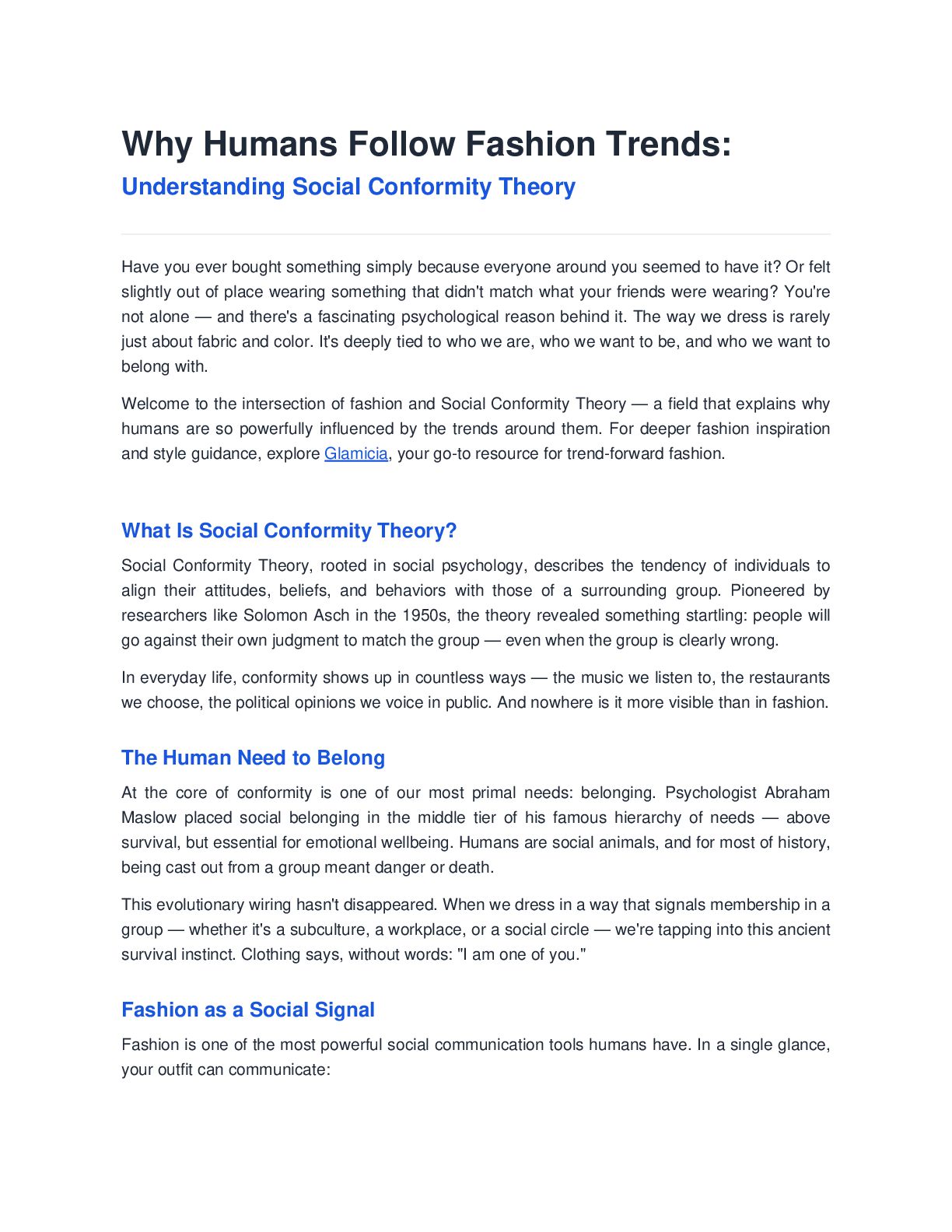
  1. Why Humans Follow Fashion Trends: Understanding Social Conformity Theory Have

    you ever bought something simply because everyone around you seemed to have it? Or felt slightly out of place wearing something that didn't match what your friends were wearing? You're not alone — and there's a fascinating psychological reason behind it. The way we dress is rarely just about fabric and color. It's deeply tied to who we are, who we want to be, and who we want to belong with. Welcome to the intersection of fashion and Social Conformity Theory — a field that explains why humans are so powerfully influenced by the trends around them. For deeper fashion inspiration and style guidance, explore Glamicia, your go-to resource for trend-forward fashion. What Is Social Conformity Theory? Social Conformity Theory, rooted in social psychology, describes the tendency of individuals to align their attitudes, beliefs, and behaviors with those of a surrounding group. Pioneered by researchers like Solomon Asch in the 1950s, the theory revealed something startling: people will go against their own judgment to match the group — even when the group is clearly wrong. In everyday life, conformity shows up in countless ways — the music we listen to, the restaurants we choose, the political opinions we voice in public. And nowhere is it more visible than in fashion. The Human Need to Belong At the core of conformity is one of our most primal needs: belonging. Psychologist Abraham Maslow placed social belonging in the middle tier of his famous hierarchy of needs — above survival, but essential for emotional wellbeing. Humans are social animals, and for most of history, being cast out from a group meant danger or death. This evolutionary wiring hasn't disappeared. When we dress in a way that signals membership in a group — whether it's a subculture, a workplace, or a social circle — we're tapping into this ancient survival instinct. Clothing says, without words: "I am one of you." Fashion as a Social Signal Fashion is one of the most powerful social communication tools humans have. In a single glance, your outfit can communicate:
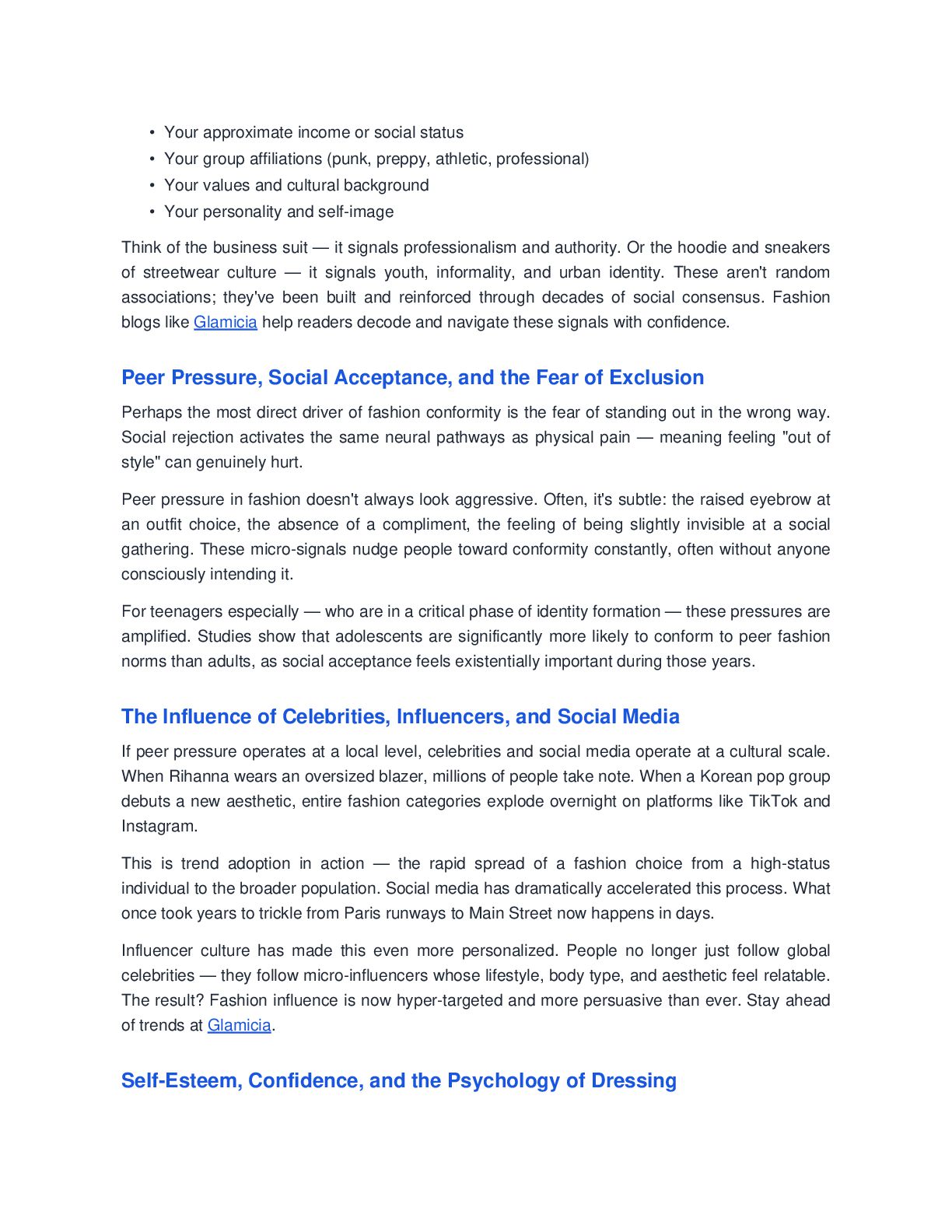
  2. • Your approximate income or social status • Your group

    affiliations (punk, preppy, athletic, professional) • Your values and cultural background • Your personality and self-image Think of the business suit — it signals professionalism and authority. Or the hoodie and sneakers of streetwear culture — it signals youth, informality, and urban identity. These aren't random associations; they've been built and reinforced through decades of social consensus. Fashion blogs like Glamicia help readers decode and navigate these signals with confidence. Peer Pressure, Social Acceptance, and the Fear of Exclusion Perhaps the most direct driver of fashion conformity is the fear of standing out in the wrong way. Social rejection activates the same neural pathways as physical pain — meaning feeling "out of style" can genuinely hurt. Peer pressure in fashion doesn't always look aggressive. Often, it's subtle: the raised eyebrow at an outfit choice, the absence of a compliment, the feeling of being slightly invisible at a social gathering. These micro-signals nudge people toward conformity constantly, often without anyone consciously intending it. For teenagers especially — who are in a critical phase of identity formation — these pressures are amplified. Studies show that adolescents are significantly more likely to conform to peer fashion norms than adults, as social acceptance feels existentially important during those years. The Influence of Celebrities, Influencers, and Social Media If peer pressure operates at a local level, celebrities and social media operate at a cultural scale. When Rihanna wears an oversized blazer, millions of people take note. When a Korean pop group debuts a new aesthetic, entire fashion categories explode overnight on platforms like TikTok and Instagram. This is trend adoption in action — the rapid spread of a fashion choice from a high-status individual to the broader population. Social media has dramatically accelerated this process. What once took years to trickle from Paris runways to Main Street now happens in days. Influencer culture has made this even more personalized. People no longer just follow global celebrities — they follow micro-influencers whose lifestyle, body type, and aesthetic feel relatable. The result? Fashion influence is now hyper-targeted and more persuasive than ever. Stay ahead of trends at Glamicia. Self-Esteem, Confidence, and the Psychology of Dressing
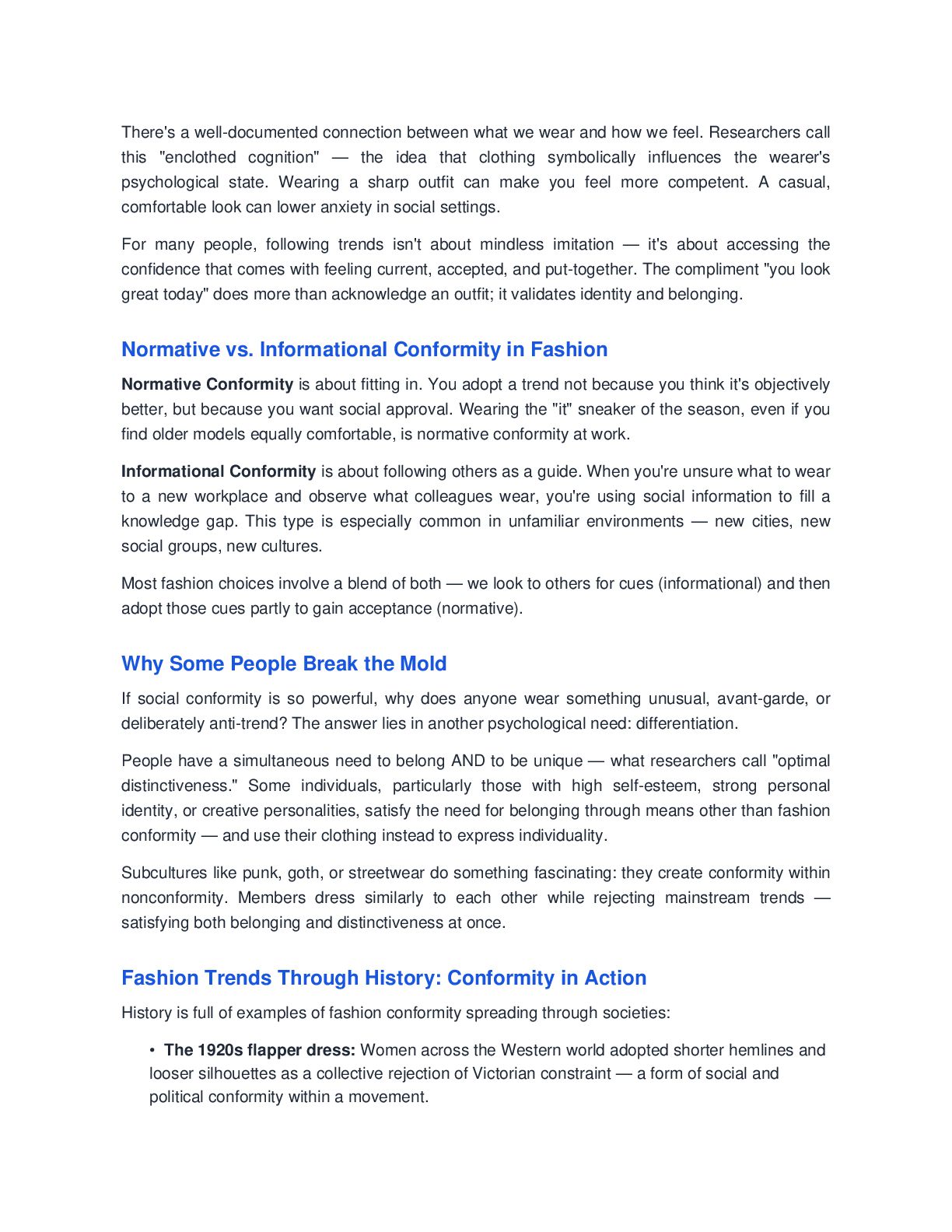
  3. There's a well-documented connection between what we wear and how

    we feel. Researchers call this "enclothed cognition" — the idea that clothing symbolically influences the wearer's psychological state. Wearing a sharp outfit can make you feel more competent. A casual, comfortable look can lower anxiety in social settings. For many people, following trends isn't about mindless imitation — it's about accessing the confidence that comes with feeling current, accepted, and put-together. The compliment "you look great today" does more than acknowledge an outfit; it validates identity and belonging. Normative vs. Informational Conformity in Fashion Normative Conformity is about fitting in. You adopt a trend not because you think it's objectively better, but because you want social approval. Wearing the "it" sneaker of the season, even if you find older models equally comfortable, is normative conformity at work. Informational Conformity is about following others as a guide. When you're unsure what to wear to a new workplace and observe what colleagues wear, you're using social information to fill a knowledge gap. This type is especially common in unfamiliar environments — new cities, new social groups, new cultures. Most fashion choices involve a blend of both — we look to others for cues (informational) and then adopt those cues partly to gain acceptance (normative). Why Some People Break the Mold If social conformity is so powerful, why does anyone wear something unusual, avant-garde, or deliberately anti-trend? The answer lies in another psychological need: differentiation. People have a simultaneous need to belong AND to be unique — what researchers call "optimal distinctiveness." Some individuals, particularly those with high self-esteem, strong personal identity, or creative personalities, satisfy the need for belonging through means other than fashion conformity — and use their clothing instead to express individuality. Subcultures like punk, goth, or streetwear do something fascinating: they create conformity within nonconformity. Members dress similarly to each other while rejecting mainstream trends — satisfying both belonging and distinctiveness at once. Fashion Trends Through History: Conformity in Action History is full of examples of fashion conformity spreading through societies: • The 1920s flapper dress: Women across the Western world adopted shorter hemlines and looser silhouettes as a collective rejection of Victorian constraint — a form of social and political conformity within a movement.
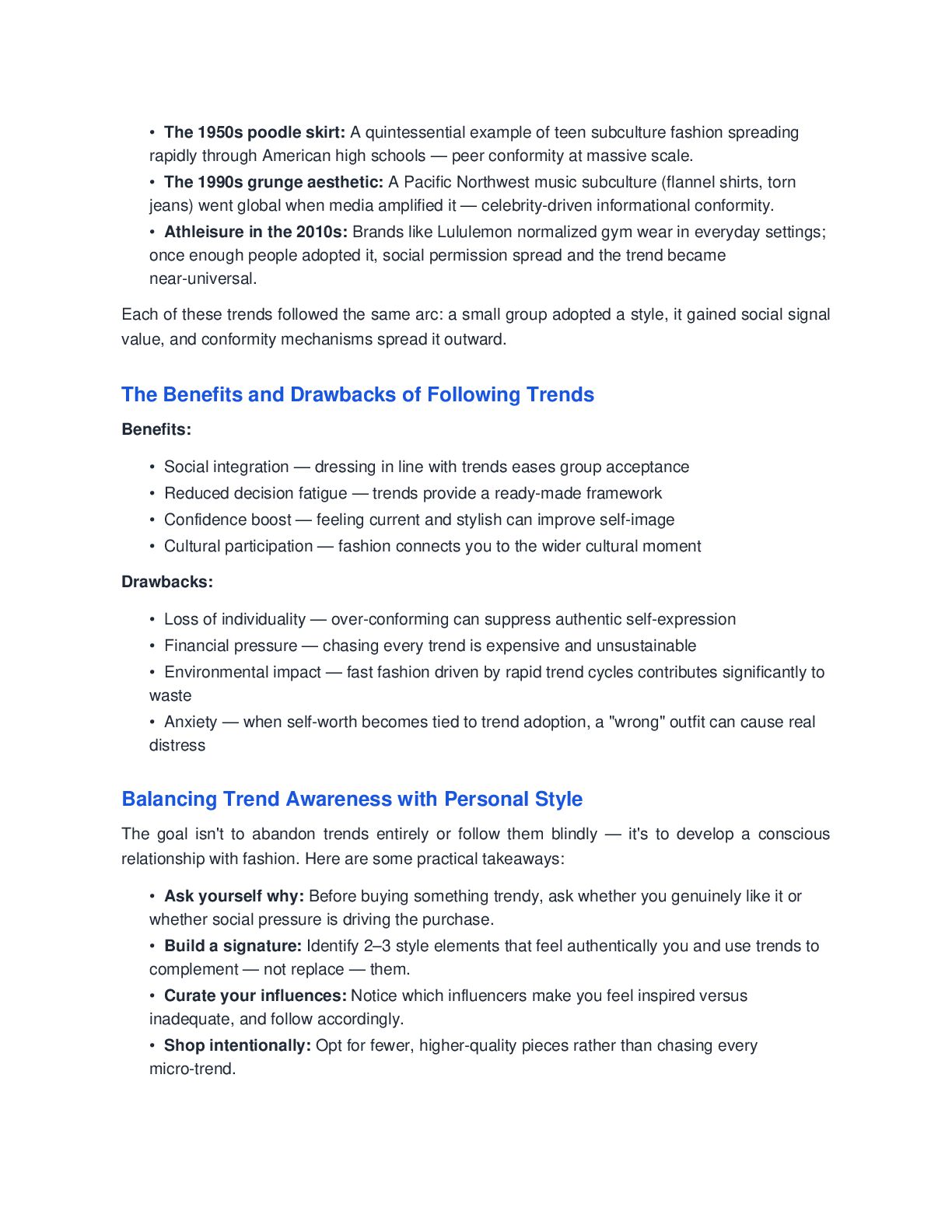
  4. • The 1950s poodle skirt: A quintessential example of teen

    subculture fashion spreading rapidly through American high schools — peer conformity at massive scale. • The 1990s grunge aesthetic: A Pacific Northwest music subculture (flannel shirts, torn jeans) went global when media amplified it — celebrity-driven informational conformity. • Athleisure in the 2010s: Brands like Lululemon normalized gym wear in everyday settings; once enough people adopted it, social permission spread and the trend became near-universal. Each of these trends followed the same arc: a small group adopted a style, it gained social signal value, and conformity mechanisms spread it outward. The Benefits and Drawbacks of Following Trends Benefits: • Social integration — dressing in line with trends eases group acceptance • Reduced decision fatigue — trends provide a ready-made framework • Confidence boost — feeling current and stylish can improve self-image • Cultural participation — fashion connects you to the wider cultural moment Drawbacks: • Loss of individuality — over-conforming can suppress authentic self-expression • Financial pressure — chasing every trend is expensive and unsustainable • Environmental impact — fast fashion driven by rapid trend cycles contributes significantly to waste • Anxiety — when self-worth becomes tied to trend adoption, a "wrong" outfit can cause real distress Balancing Trend Awareness with Personal Style The goal isn't to abandon trends entirely or follow them blindly — it's to develop a conscious relationship with fashion. Here are some practical takeaways: • Ask yourself why: Before buying something trendy, ask whether you genuinely like it or whether social pressure is driving the purchase. • Build a signature: Identify 2–3 style elements that feel authentically you and use trends to complement — not replace — them. • Curate your influences: Notice which influencers make you feel inspired versus inadequate, and follow accordingly. • Shop intentionally: Opt for fewer, higher-quality pieces rather than chasing every micro-trend.
  5. • Wear confidence: The most compelling fashion statement is wearing

    whatever you chose with conviction. For ongoing style inspiration that balances trends with authenticity, visit Glamicia — a fashion blog dedicated to helping you dress with intention and confidence. Final Thoughts Social conformity is not a flaw in human nature — it's a feature. It has helped humans build cultures, signal trust, and form communities for thousands of years. Fashion is simply one of the most visible stages on which this psychology plays out every single day. The next time you reach for a trending item, take a moment to reflect: Are you dressing for yourself, for others, or for some meaningful combination of both? There's no wrong answer — but the awareness itself is the beginning of a more intentional, authentic personal style. Because in the end, the most powerful trend you can follow is the one that makes you feel most like yourself. Keywords: Why Humans Follow Fashion Trends • Social Conformity Theory • Fashion Psychology • Social Influence • Consumer Behavior • Personal Style • Trend Adoption • Social Acceptance